
Grade 10 Worksheets
9,388 grade resources
Remote Sensing Worksheet | Science Standards Grade 10
JCreated byJ.S SheetsLearning Objectives
- Understand the types of sensors and spectral information used in satellite and aerial remote sensing.
- Identify common derived products such as snowpack mapping, oil-sands footprint assessment, and prairie wetland monitoring.
- Explain how temporal series and multi-spectral indices reveal environmental changes and support pattern detection.
Also included in: Grade 10 Earth Systems & Climate Science Lesson Bundle – Alberta Framework +1 more
Instant download

Multi Criteria Optimization Assessment for Grade 10 Science – Standards-Aligned
 Created byPrism Point Learning
Learning Objectives
- Understand the concept of multi-criteria optimization and its application in data-informed decision making.
- Identify how measurement trends influence design improvements under multiple goals and constraints.
- Explain the importance of prioritizing goals and analyzing trade-offs in optimization processes.
Instant download

Grade 10 Rhetorical Cause and Effect in Arguments Worksheet | TEKS ELA
 Created bySunny Desk Resources
Learning Objectives
- Explain how rhetorical choices change a reader’s interpretation of a claim.
- Analyze how framing, contrast, and wording create urgency or fairness in a text.
- Evaluate credibility strategies and their effect on persuasive strength.
Instant download

Grade 10 Science | Metabolic Regulation Worksheet (TEKS) PDF
 Created byEvergreen Desk Education
Learning Objectives
- Explain how allosteric regulation and feedback inhibition control metabolic pathway flux.
- Describe how covalent modification and cellular signaling can rapidly change enzyme activity.
- Compare hormonal regulation (insulin vs. glucagon) in regulating carbohydrate metabolism at the organism level.
Instant download

Computational Concepts Worksheet Grade 10 AP Science Data Skills
Created byPrism Point LearningLearning Objectives
- Explain how discrete time stepping and parameter sweeps are used to simulate dynamic systems.
- Describe how sensitivity analysis helps interpret how model outputs depend on uncertain parameters.
- Identify common assumptions and limitations in numerical simulations, including stability and approximation error.
Also included in: AP Science Inquiry Skills Lesson Bundle | Grade 10 | Modeling & CER
Instant download

Form Fit Evidence Use Worksheet for Grade 10 ELA | BC Standards Practice
JCreated byJ.S SheetsLearning Objectives
- Explain how evidence, style, and organization change to match informational, persuasive, and expressive forms.
- Select evidence that fits a form’s purpose by prioritizing relevance, definitions, data, or vivid moments as appropriate.
- Revise writing by checking that each piece of evidence supports the claim or theme and connects logically to surrounding sentences.
Instant download

Purposeful Presentations Worksheet for Grade 10 ELA | TEKS Speaking
 Created byGolden Apple Studio
Learning Objectives
- Identify how a speaker’s main idea and supporting points work together to achieve a clear purpose.
- Use transitions to guide an audience through a presentation’s structure and reasoning.
- Evaluate how delivery choices (tone, terminology, examples) strengthen clarity and intent.
Also included in: Grade 10 ELA Lesson Bundle | TEKS Rhetorical Analysis & Strategic Speaking +1 more
Instant download

Trophic Efficiency Worksheet | Standards-Aligned Grade 10 Science Practice
JCreated byJ.S SheetsLearning Objectives
- Define trophic efficiency and explain why energy transfer between trophic levels is usually low
- Analyze how trophic efficiency affects biomass pyramids and the number of trophic levels in an ecosystem
- Evaluate how differences in trophic efficiency can influence food-web structure and predator abundance
Instant download

Grade 10 Social Studies Worksheet | Industrial Revolution & Standards (PDF)
Created bySunny Desk ResourcesLearning Objectives
- Explain how the Industrial Revolution changed economies from agrarian work to industrial production
- Describe how new technologies in manufacturing and transportation altered daily life and work
- Analyze social impacts, including urbanization, labor systems, and debates about technological progress and equity
Also included in: Grade 10 World Wars to Cold War Social Studies Lesson Bundle: California +1 more
Instant download
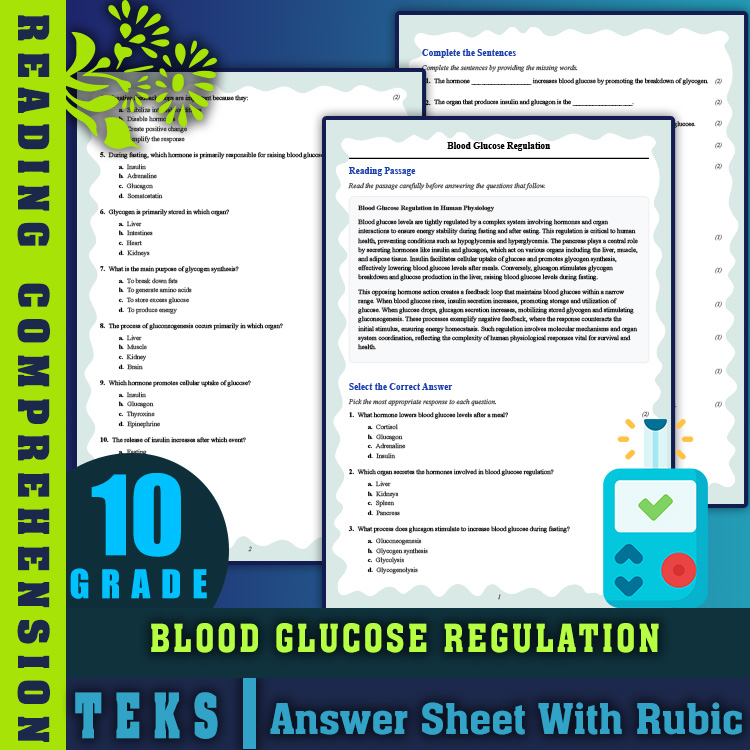
Grade 10 Science | Blood Glucose Regulation Reading Worksheet & Answer Key PDF
JCreated byJ.S SheetsLearning Objectives
- Understand the roles of insulin and glucagon in blood glucose regulation.
- Explain how endocrine signaling maintains energy homeostasis.
- Describe feedback mechanisms involved in blood glucose control.
Instant download

Climate Feedbacks Worksheet | Climate Change & Earth Systems Activities
Created byPrism Point LearningLearning Objectives
- Explain how greenhouse gases trigger climate warming and how that warming can lead to additional warming through feedbacks.
- Describe how surface properties (like ice/snow reflectivity) and clouds can either amplify or reduce climate change.
- Analyze how changes in aerosols can shift Earth’s radiation balance and influence temperature and precipitation.
Instant download
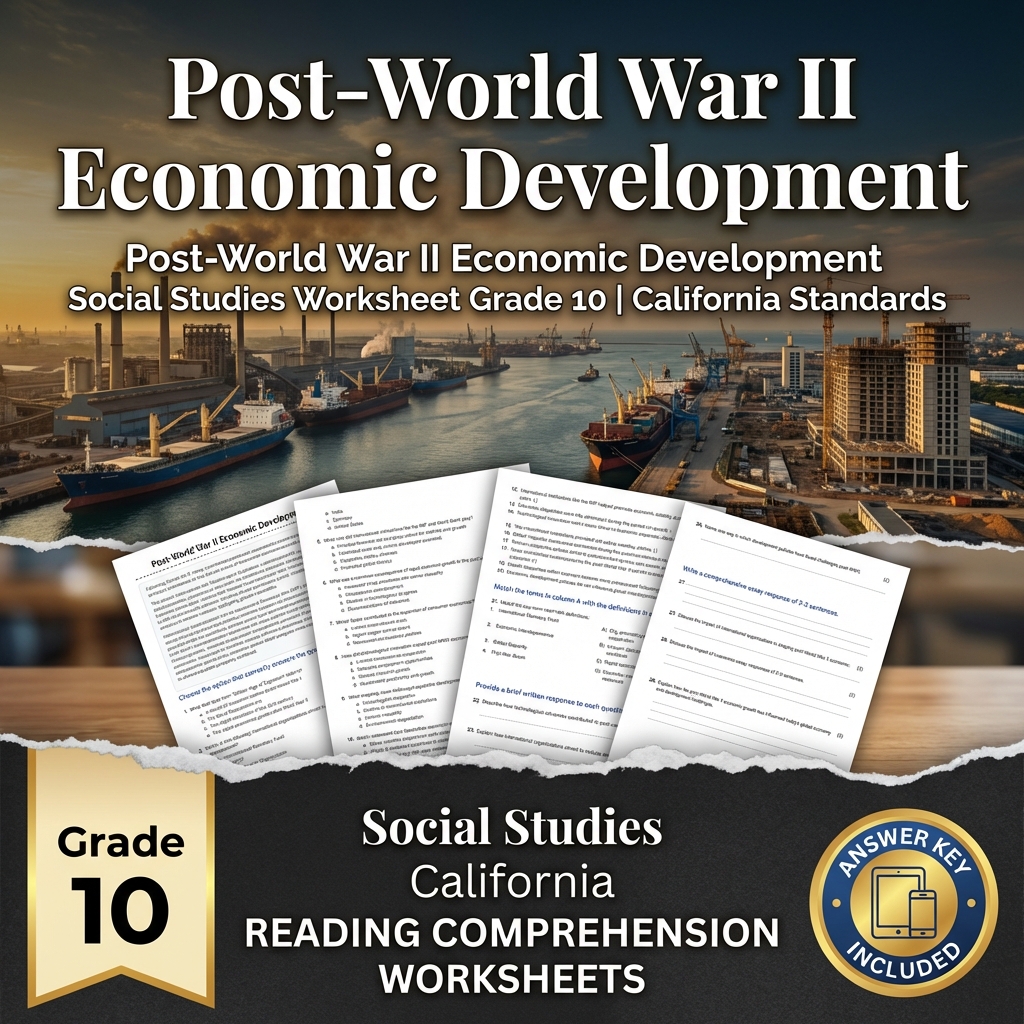
Post-World War II Economic Development Social Studies Grade 10
JCreated byJ.S SheetsLearning Objectives
- Understand the key factors that contributed to economic growth after World War II
- Analyze the role of international institutions in promoting economic stability
- Evaluate the impacts of economic development on global inequality and prosperity
Instant download
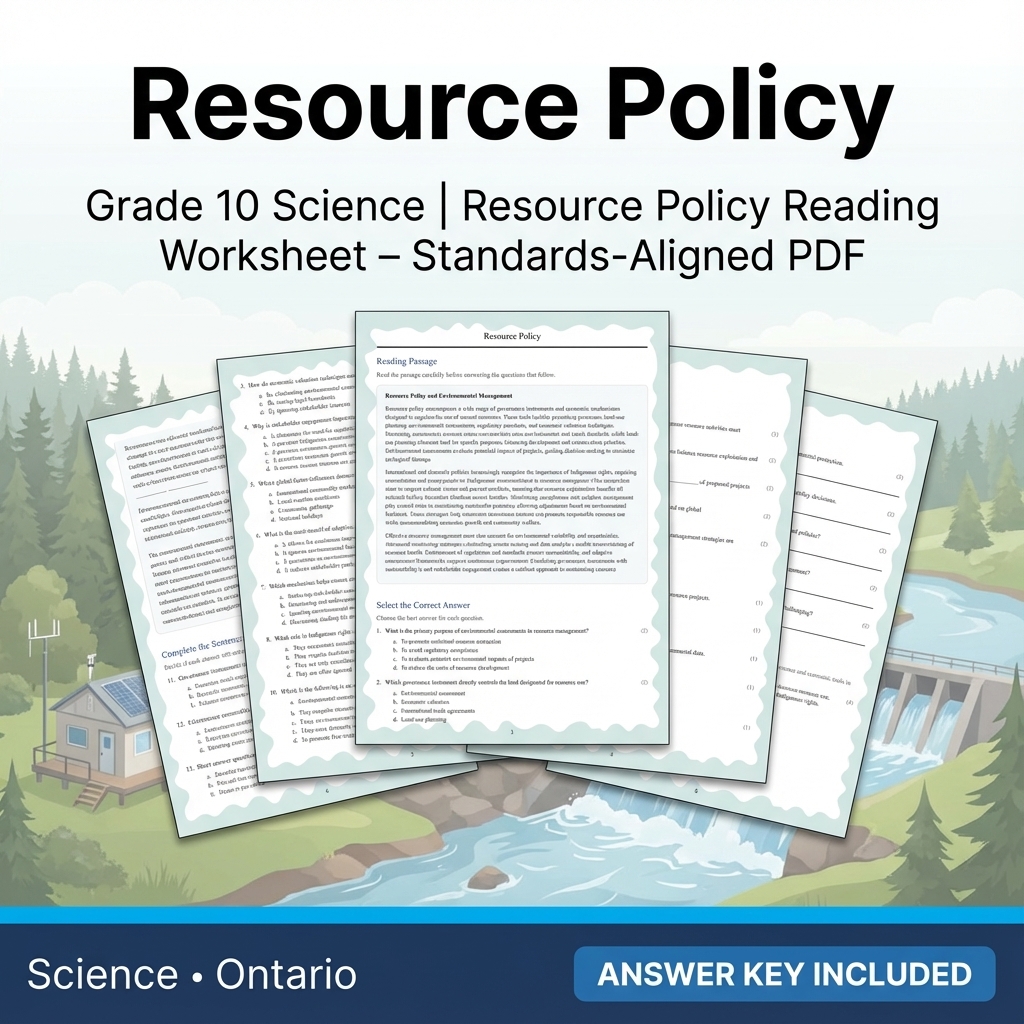
Grade 10 Science | Resource Policy Reading Worksheet – Standards-Aligned PDF
JCreated byJ.S SheetsLearning Objectives
- Understand governance instruments and economic mechanisms influencing resource use.
- Analyze the role of environmental assessment, permitting, and land‑use planning.
- Examine the importance of Indigenous rights, international markets, and monitoring in resource management.
Also included in: Grade 10 Science Unit Bundle – Earth Dynamics & Resources (PDF + Rubrics) +1 more
Instant download

Grade 10 Science | Mining Impacts Reading Worksheet (PDF + Answer Key)
JCreated byJ.S SheetsLearning Objectives
- Understand the environmental and social consequences of mineral extraction.
- Identify methods used to assess and manage mining impacts.
- Recognize the relationship between deposit types, extraction methods, and environmental outcomes.
Also included in: Grade 10 Science Unit Bundle – Earth Dynamics & Resources (PDF + Rubrics) +1 more
Instant download

Grade 10 Math Resource Allocation Worksheet – Ontario Standards (PDF)
 Created byClear Sky Classroom
Learning Objectives
- Apply the concepts of distance, midpoint, and line equations to model and solve resource distribution problems.
- Interpret graphical and numerical data to optimize resource allocation in real-world contexts.
- Develop mathematical reasoning and problem-solving skills related to applied resource management scenarios.
Also included in: Grade 10 Maths | Analytic Geometry Applied Lesson Bundle for Ontario +1 more
Instant download
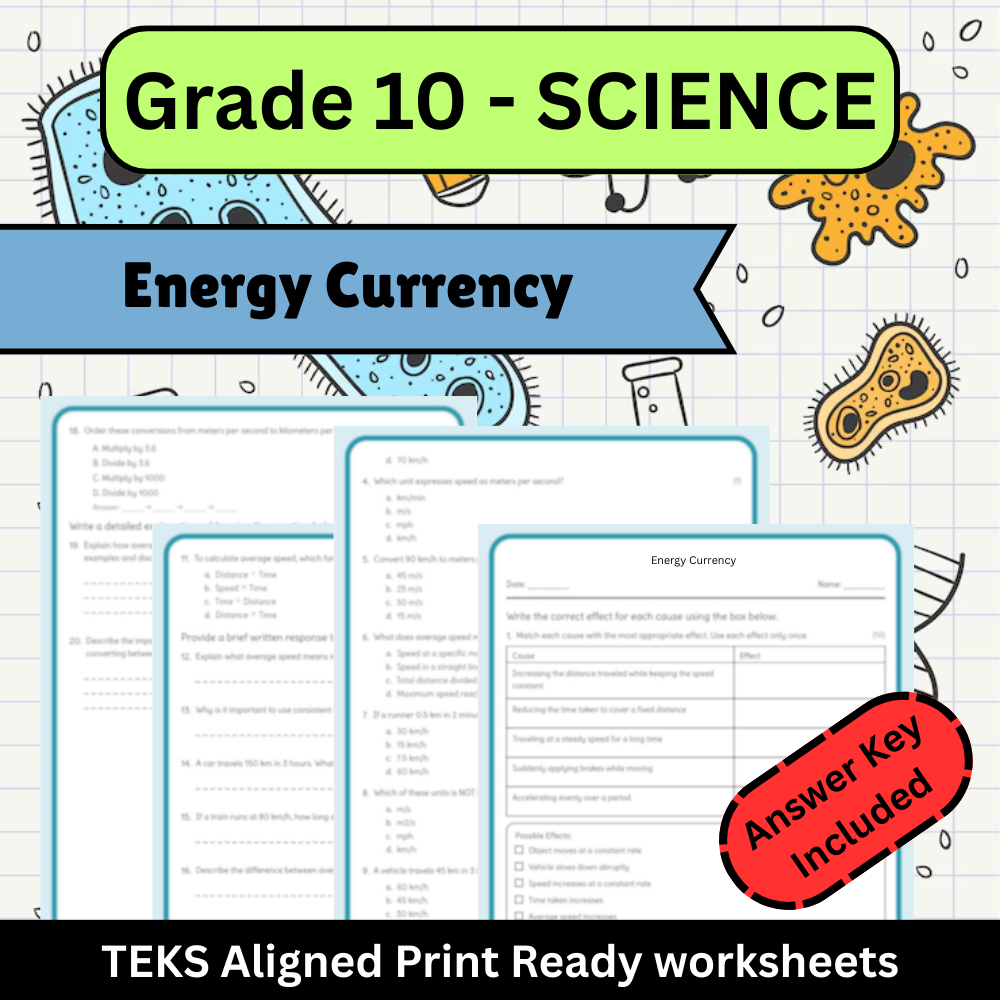
Grade 10 Science | Energy Currency Worksheet (Answer Key) – TEKS Aligned
 Created byBright Mind Resources
Learning Objectives
- Understand the role of ATP as the primary energy carrier in cells.
- Identify processes involved in ATP regeneration such as phosphorylation.
- Explain how ATP couples exergonic and endergonic reactions to support cellular functions.
Also included in: Grade 10 Science Unit Bundle – Photosynthesis, Respiration & Energy TEKS +5 more
Instant download

Bond Polarity Worksheet Grade 10 Science AP Chemistry Activities
Created byPrism Point LearningLearning Objectives
- Explain how electronegativity differences determine bond polarity and the direction of bond dipoles.
- Use dipole moment representations to describe electron distribution asymmetry in polar molecules.
- Relate bond polarity to intermolecular attraction and physical properties such as solubility.
Instant download

Human Impacts Worksheet | Grade 10 Science Activities
Created byPrism Point LearningLearning Objectives
- Explain how human activities can alter ecosystems through habitat alteration, pollution, species introductions, resource extraction, and climate change.
- Describe how nutrient cycles and energy flows can change as biodiversity and population dynamics shift.
- Apply scientific reasoning to predict ecosystem effects such as habitat fragmentation, invasive species disruption, and hypoxic zones.
Instant download

Grade 10 Plot and Structure Worksheet | Ontario ELA Literary Analysis
Created bySunny Desk ResourcesLearning Objectives
- Explain how exposition, rising action, turning points, and resolution shape a story’s plot.
- Analyze how sequencing and delayed revelation change a reader’s interpretation.
- Use transitions to identify causes and consequences that drive theme.
Instant download

Grade 10 Science | Photosynthesis Efficiency Worksheet (PDF) (BC Standard)
Created byEvergreen Desk EducationLearning Objectives
- Explain how absorption spectra, biochemical reactions, and respiration losses limit photosynthetic efficiency
- Interpret efficiency metrics such as quantum yield and net primary productivity in ecological contexts
- Compare bioenergy crop energy capture with engineered photovoltaics using system-level trade-offs
Instant download

Grade 10 Science | Photosynthesis Efficiency Worksheet | BC Standards
 Created byLumora Learning
Learning Objectives
- Understand the factors affecting the efficiency of photosynthesis in plants.
- Compare natural photosynthetic processes with engineered solar technologies.
- Evaluate ecological and technological trade-offs in energy capture and land use.
Instant download

Grade 10 Science | Mitigation Strategies Worksheet with Short Notes (PDF)
 Created byMeadowlark Worksheets
Learning Objectives
- Understand different mitigation strategies to reduce environmental impacts.
- Evaluate the effectiveness and trade-offs of mitigation options.
- Analyze technological, economic, and societal constraints in mitigation efforts.
Also included in: Grade 10 Science NGSS Earth & Human Activity Unit | Worksheet Pack +1 more
Instant download

Community Belonging & School-Year Growth Back to School Practice Grade 10
 Created byShaNova Worksheets
Learning Objectives
- Explain how community building supports learning at the start of a new school year
- Analyze how shared goals and traditions can strengthen social cohesion
- Use evidence from stories to connect empathy with collective success
Instant download
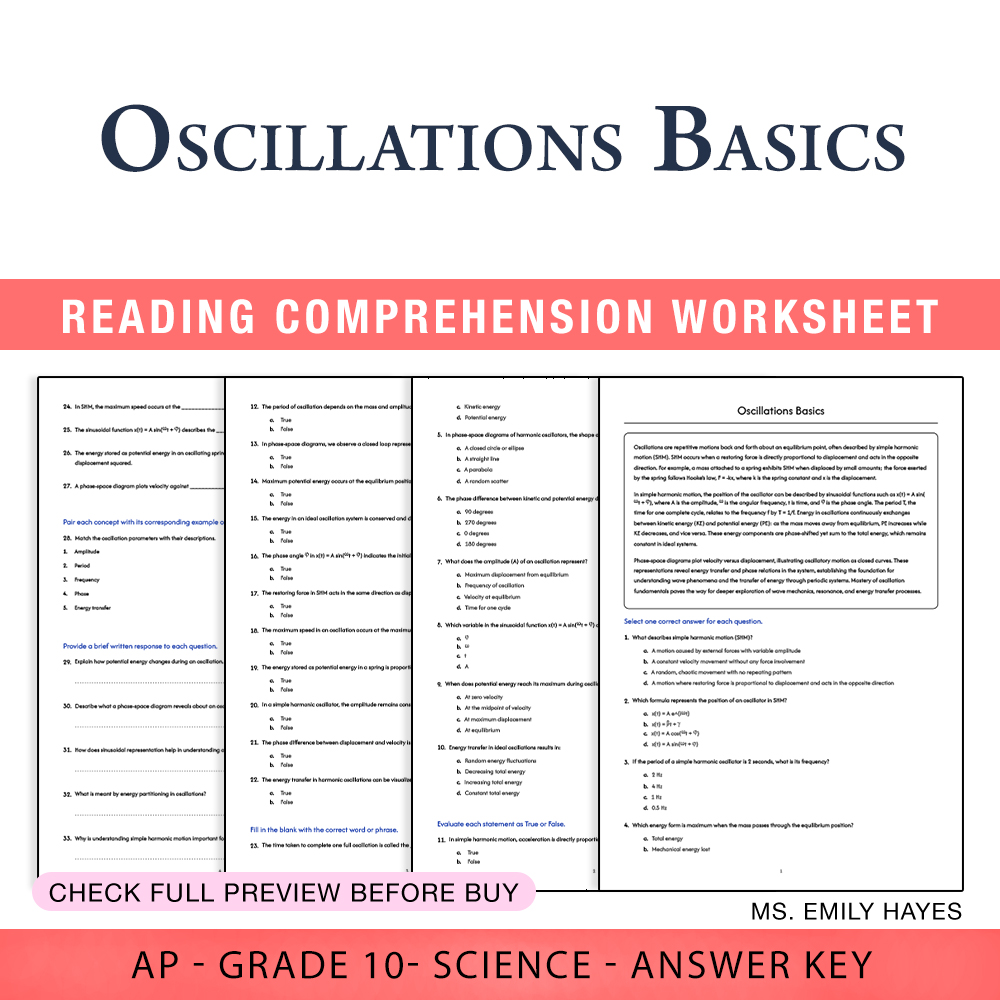
10th Grade Science | Oscillations Basics Worksheet (PDF+ Answer Key)
 Created byCopper Leaf Classroom
Learning Objectives
- Describe simple harmonic motion through restoring-force formulations and linear approximations for small displacements.
- Define period, frequency, amplitude, and phase, and relate energy partitioning between kinetic and potential forms over an oscillation.
- Use sinusoidal representations and phase-space sketches to connect time-domain and energy-domain perspectives.
Also included in: Grade 10 Science AP | Physics & Energy Concepts (PDF+ Answer Key) +1 more
Instant download
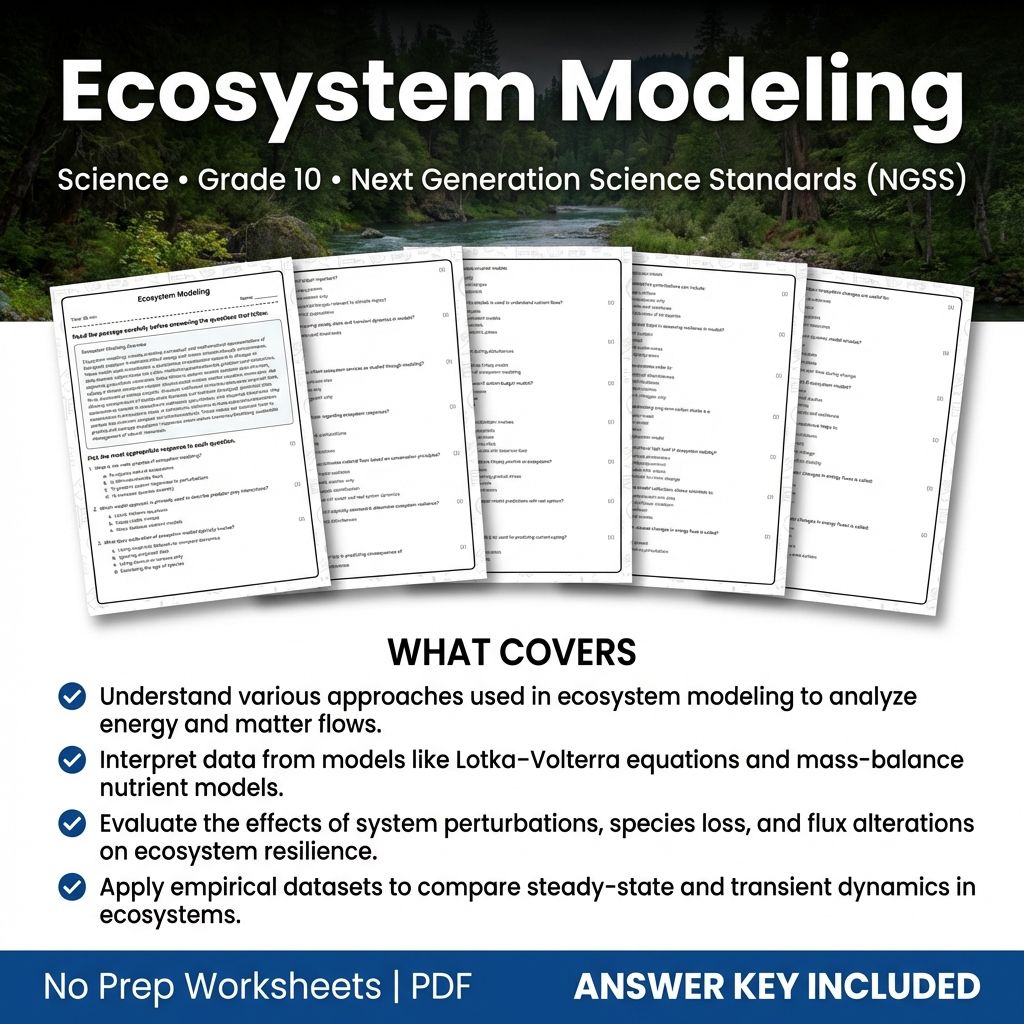
10th Grade Science | Ecosystem Modeling Worksheet & Answer Key (Printable PDF)
 Created byCoral Reef Learning
Learning Objectives
- Understand various approaches used in ecosystem modeling to analyze energy and matter flows.
- Interpret data from models like Lotka–Volterra equations and mass-balance nutrient models.
- Evaluate the effects of system perturbations, species loss, and flux alterations on ecosystem resilience.
Also included in: Grade 10 Science Worksheets Bundle| Ecosystems & Population Dynamics(Answer Key) +1 more
Instant download

Focused Paragraphs Worksheet for Grade 10 ELA | Standards-Aligned Practice
JCreated byJ.S SheetsLearning Objectives
- Identify how topic sentences and supporting details work together to maintain paragraph focus.
- Revise writing to remove unrelated ideas and prevent shifts in subject or claim.
- Evaluate whether evidence and explanation directly support a paragraph’s main point.
Instant download

Grade 10 Science – Mechanical Calculations & Energy Conservation | Worksheet
Created byBright Mind ResourcesLearning Objectives
- Understand the principles of energy conservation relating to potential and kinetic energy on hills
- Apply numerical methods to calculate energy transfer in systems with friction, springs, and gravity
- Analyze problems involving energy loss and conversion in practical scenarios
Also included in: Energy & Systems Interactions Grade 10 Science lesson bundle | Alberta +1 more
Instant download

Grade 10 | Back To School Worksheet for Overcoming Challenges | PDF + Answer Key
Created byShaNova WorksheetsLearning Objectives
- Identify key traits of resilience and perseverance in stories from different cultures
- Use evidence from reading to explain strategies for overcoming back-to-school challenges
- Apply challenge-management skills by planning small next steps for the school year
Instant download

Grade 10 Holiday Back To School Worksheet for Setting Goals | PDF + Answer Key
Created byShaNova WorksheetsLearning Objectives
- Identify characteristics of effective goals, such as clarity, measurability, realism, and relevance
- Distinguish academic, personal, and social goals and explain how each supports long-term success
- Use step-by-step planning to break goals into milestones and track progress
Instant download
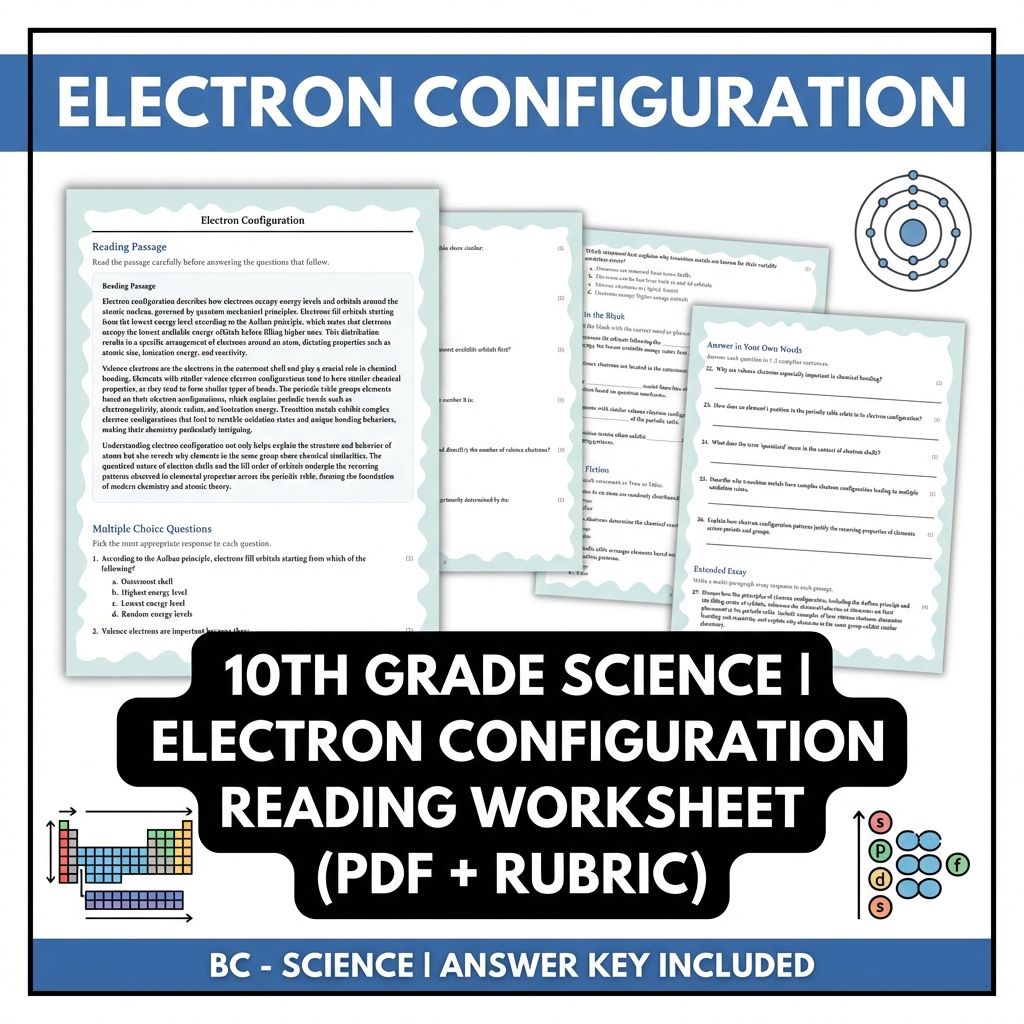
10th Grade Science | Electron Configuration Reading Worksheet (PDF + Rubric)
JCreated byJ.S SheetsLearning Objectives
- Understand how electrons occupy energy levels and orbitals around an atomic nucleus.
- Describe the significance of valence electrons in chemical bonding and reactivity.
- Explain the principles of electron distribution across shells following quantized rules.
Instant download

Collision Theory and Reaction Rates Worksheets | Grade 10 Science
Created bySunny Desk ResourcesLearning Objectives
- Explain how collision frequency affects reaction rate
- Describe the role of activation energy and effective collisions in collision theory
- Use particle-level ideas to predict how temperature and concentration change reaction rate
Also included in: Grade 10 Chemistry Lesson Bundle | Alberta Science Reaction & Analysis +1 more
Instant download

Grade 10 Math – Compound Interest Worksheet (Ontario) (PDF)
Created byClear Sky ClassroomLearning Objectives
- Understand the concept of compound interest and how it differs from simple interest.
- Calculate future value of investments using compound interest formulas.
- Analyze the effect of compounding frequency on investment growth.
Also included in: Grade 10 Math Lesson Bundle: Financial Literacy and Interest Skills +1 more
Instant download

Grade 10 Composed Function Models Worksheet | Function Composition CCSS
 Created byBRIGHT PATH RESOURCES
Learning Objectives
- Write composed functions using the correct order (f ∘ g)(x) = f(g(x)).
- Evaluate composed function models by substituting one function into another.
- Interpret composed models as multi-step processes where one output becomes the next input.
Also included in: Grade 10 Functions Lesson Bundle | Math | CCSS-Aligned +1 more
Instant download

Grade 10 Complementary Angle Cofunctions Worksheet | Trigonometry CCSS
Created byBRIGHT PATH RESOURCESLearning Objectives
- Use complementary angle relationships in a right triangle to convert between sine and cosine values.
- Use complementary angle cofunction relationships to convert between tangent and cotangent values.
- Apply cofunction identities to solve for missing trigonometric ratios of acute angles.
Also included in: Grade 10 Geometry Math Lesson Bundle: CCSS Trig & Similarity +1 more
Instant download

Organizational Structures Worksheet Pack | Grade 10 ELA Activities
Created bySunny Desk ResourcesLearning Objectives
- Identify common organizational structures (chronological order, problem-solution, compare-contrast, cause-effect) in informational and persuasive writing.
- Use structural markers such as headings, topic sentences, and summary statements to improve clarity and reader navigation.
- Explain how organizational structure supports the purpose of a text and helps readers follow the writer’s reasoning.
Also included in: Grade 10 Writing Lesson Bundle – Alberta ELA Framework Practice +1 more
Instant download

Plant Systems Worksheet for Grade 10 Science | Standards-Aligned Practice PDF
JCreated byJ.S SheetsLearning Objectives
- Describe the structure and function of plant organ systems in resource acquisition, transport, and reproduction.
- Explain how plant adaptations in Alberta's grasslands and foothill forests support survival and resource use.
- Connect the morphology of roots, xylem, phloem, and stomata to environmental responses and agricultural management.
Also included in: Grade 10 Cell Systems & Homeostasis Science Lesson Bundle | Alberta +1 more
Instant download

Grade 10 Complex Multiplication Worksheet | Complex Numbers CCSS
Created byBRIGHT PATH RESOURCESLearning Objectives
- Expand products of complex numbers of the form (a + bi)(c + di) using distributive multiplication.
- Simplify expressions using i^2 = −1 and collect like terms to write answers in the form x + yi.
- Identify real and imaginary parts after complex multiplication.
Also included in: Grade 10 Number System Lesson Bundle | Complex Numbers | CCSS Math +1 more
Instant download
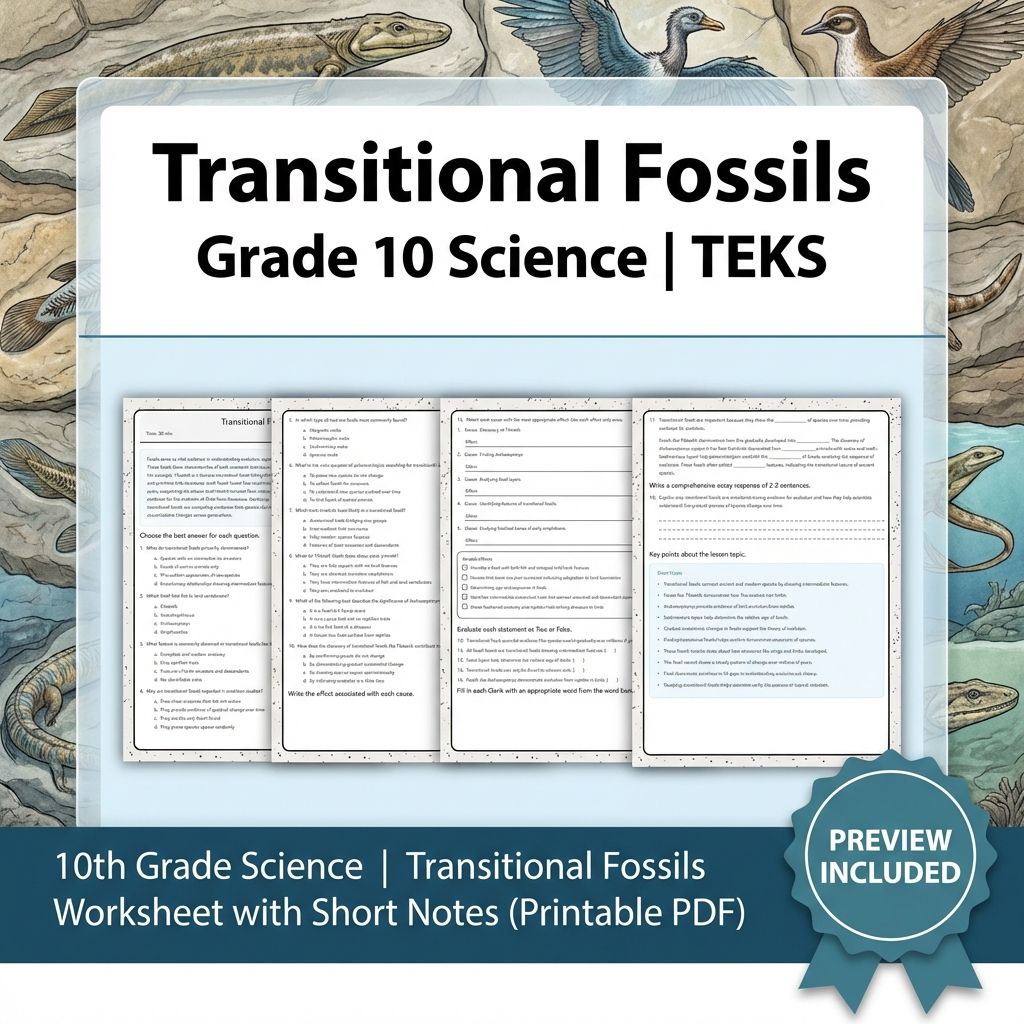
10th Grade Science | Transitional Fossils Worksheet with Short Notes (PDF)
Created byMeadowlark WorksheetsLearning Objectives
- Understand what transitional fossils are and their significance in evolution.
- Identify examples of transitional fossils and what they reveal about species evolution.
- Explain how transitional fossils provide evidence for common ancestors.
Instant download

Pattern Analysis Assessment | Alberta Standards Grade 10 Science
Created byPrism Point LearningLearning Objectives
- Understand methods for identifying temporal and spatial patterns in Earth and space phenomena.
- Analyze how data quality and sampling influence pattern detection and interpretation.
- Apply concepts of correlation, trend recognition, and cyclical behavior to real-world data.
Also included in: Grade 10 Earth and Space Systems Science Lesson Bundle for Alberta +1 more
Instant download

Grade 10 Maths – Parabolic Motion Worksheet (Ontario Standards) (PDF)
Created byClear Sky ClassroomLearning Objectives
- Understand the representation of projectile motion using quadratic functions.
- Calculate key features of parabolic trajectories such as maximum height and time of flight.
- Apply quadratic equations to real-world physical scenarios involving motion.
Also included in: Grade 10 Math Quadratic Relations Applied Lesson Bundle for Ontario +1 more
Instant download
Grade 10 Science | Inheritance Patterns Worksheet (Answer Key) for TEKS Standards
Created byBright Mind ResourcesLearning Objectives
- Explain how alleles segregate and assort during inheritance.
- Identify the relationship between dominant and recessive alleles in trait expression.
- Describe Mendelian principles such as segregation and independent assortment.
Also included in: Grade 10 Science | Genetics & DNA Unit Worksheet Pack (TEKS Aligned) +5 more
Instant download

Grade 10 Math | Line Equations and Slope Worksheet (PDF) Ontario Standards
Created byClear Sky ClassroomLearning Objectives
- Understand the interpretation of slope and y-intercept in linear equations within real-world contexts.
- Identify the rate of change and initial value from given line equations.
- Translate between algebraic, tabular, and graphical representations of lines.
Also included in: Grade 10 Maths | Analytic Geometry Applied Lesson Bundle for Ontario +1 more
Instant download

Measurement and Interpretation Worksheet | Grade 10 Science Data Analysis
Created byPrism Point LearningLearning Objectives
- Select appropriate units and interpret measurements using instruments and calibration.
- Use significant figures to report results accurately and support valid comparisons.
- Interpret graphs by identifying trends, considering outliers, and drawing conclusions from the overall data.
Instant download

Phylogenetic Trees and Shared Derived Traits Worksheet | Grade 10 TEKS
Created byBRIGHT PATH RESOURCESLearning Objectives
- Explain what a phylogenetic tree represents about evolutionary relationships.
- Interpret how branching patterns relate to common ancestry and divergence.
- Identify how shared derived traits and molecular data support a classification hypothesis.
Also included in: Grade 10 Evolution & Classification Science Worksheets Bundle | TEKS Biology +1 more
Instant download

Grade 10 Social Studies — Worksheet MCQ Paper for Origins of the Cold War
 Created byThe Resource Hub
Learning Objectives
- Analyze the political, ideological, and strategic factors that contributed to the Cold War's origins.
- Compare US and Soviet perspectives during the postwar settlements of Yalta and Potsdam.
- Evaluate the long-term consequences of early Cold War policies on global regions.
Instant download
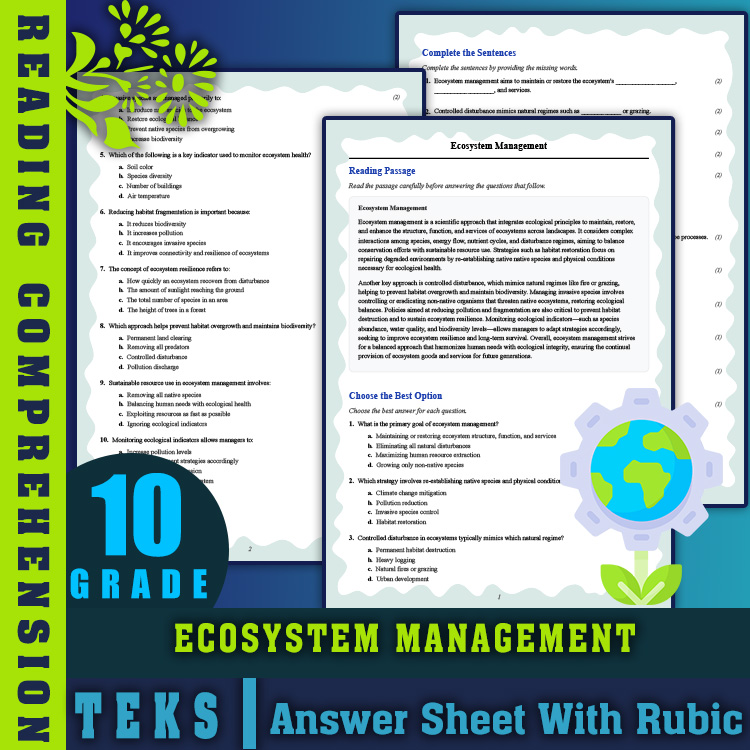
Grade 10 Science | Ecosystem Management Reading Worksheet & Answer Key (PDF)
JCreated byJ.S SheetsLearning Objectives
- Understand the principles of ecosystem management and its role in conservation.
- Identify different strategies used in managing ecosystems sustainably.
- Analyze ecological indicators and their importance in adaptive management.
Instant download
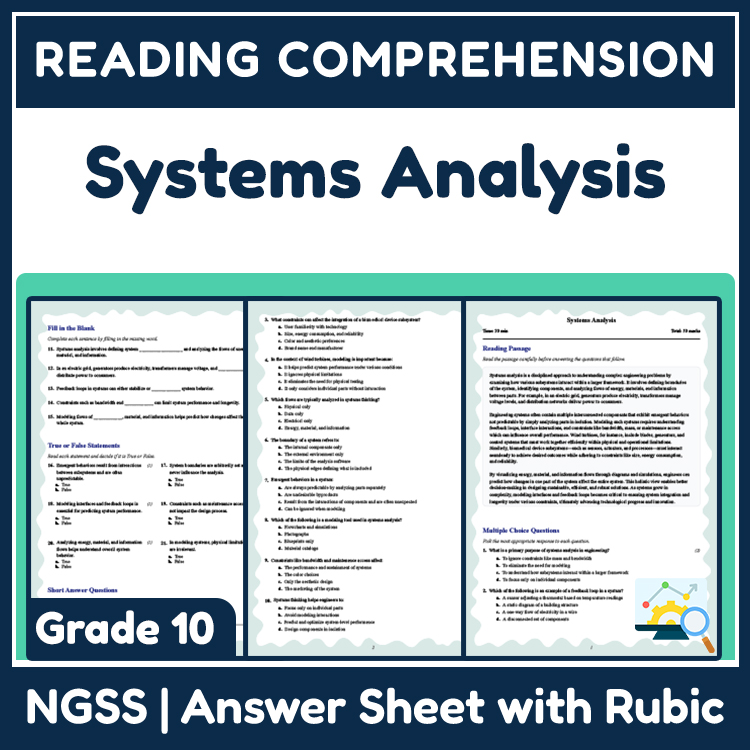
10th Grade Science | Systems Analysis Reading Worksheet with PDF Answer Key
JCreated byJ.S SheetsLearning Objectives
- Understand the fundamental concepts of systems thinking and how they apply to engineering design.
- Identify and analyze subsystem interactions, boundary definitions, and emergent behaviors in complex systems.
- Apply modeling techniques to predict system performance considering various constraints.
Also included in: Grade 10 Science Unit | Systems Analysis & Design Foundations Worksheets
Instant download
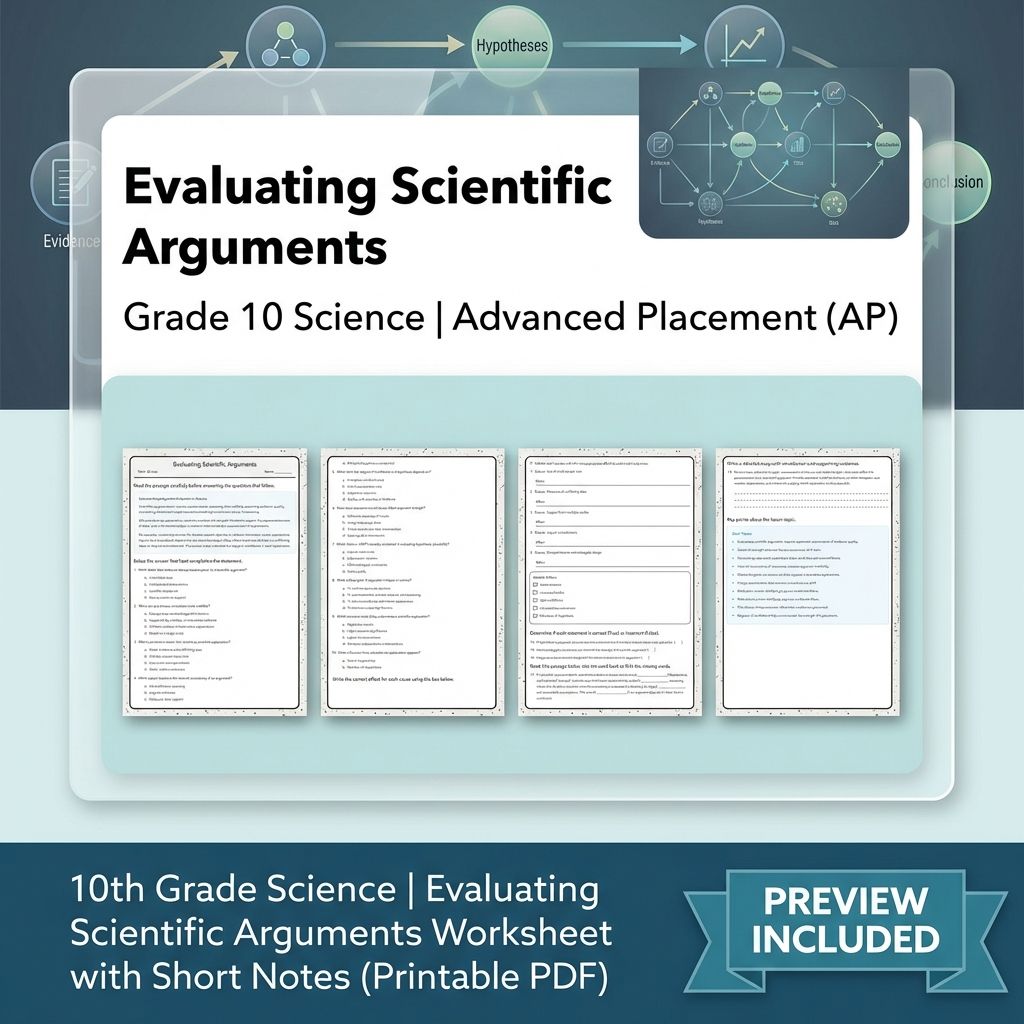
10th Grade Science | Evaluating Scientific Arguments Worksheet (PDF)
Created byMeadowlark WorksheetsLearning Objectives
- Understand the criteria for critically evaluating explanatory claims in science.
- Analyze evidence quality and consider alternative hypotheses to assess argument strength.
- Recognize the role of statistical and methodological factors in argument persuasiveness.
Also included in: Grade 10 Science Unit | Data Analysis, Modelling Worksheet Pack
Instant download
Browse more categories
About Grade 10 Worksheets
Find Grade 10 worksheets covering algebra, biology, literature, and history. All 9,388 resources download instantly as PDFs for classwork, homework, or review.
MyTeachingSheets worksheets are made by real teacher-authors and checked before they go live. Download any as a print-ready PDF for lessons, homework, or independent practice — most include answer keys, and previews are always free.