
Grade 10 Science Worksheets
7,038 worksheets
Weather Climate Links Assessment | General Standards-Assessment Grade 10 Science
 Created byPrism Point Learning
Learning Objectives
- Understand how atmospheric processes influence weather patterns.
- Explain the relationship between pressure differences and wind formation.
- Describe how fronts, convection, and jet streams organize storms.
Also included in: Grade 10 Climate Systems Science Lesson Bundle Assessments – General
Instant download

Trade Off Optimization Worksheet | NGSS-Aligned Science Practice Grade 10
JCreated byJ.S SheetsLearning Objectives
- Understand how to analyze trade-offs in engineering design choices.
- Apply cost-benefit matrices and Pareto fronts to evaluate competing objectives.
- Interpret sensitivity analysis results to identify optimal solutions under constraints.
Also included in: Grade 10 Engineering Design Science Lesson Bundle worksheets – NGSS
Instant download

Grade 10 Plate Tectonics Worksheet | Practice & Review PDF
 Created byClear Sky Classroom
Learning Objectives
- Explain how tectonic plates move and how those movements reshape Earth’s surface
- Differentiate divergent, convergent, and transform plate boundaries and the geologic hazards associated with each
- Use evidence (magnetic patterns, rock matching, and earthquake distribution) to support the theory of plate tectonics
Instant download

Grade 10 Science | Battery Storage in Science - Daily Reading Comprehension
 Created byCoral Reef Learning
Learning Objectives
- Understand how chemical energy is stored and converted in batteries
- Learn about the processes of charging and discharging in batteries
- Explore factors affecting battery efficiency and longevity
Instant download

Grade 10 Molecules And Lattices Worksheet | BC Use Practice PDF
Created byClear Sky ClassroomLearning Objectives
- Explain how ionic, covalent molecular, and metallic substances form different structural arrangements
- Describe how lattice structures and intermolecular forces affect melting point and brittleness/ductility
- Connect periodic table trends to bonding strength, solubility, and conductivity
Instant download

Grade 10 Science | Blood Glucose Regulation - Daily Reading Comprehension
Created byCoral Reef LearningLearning Objectives
- Identify the main organs involved in blood glucose regulation
- Understand the roles of insulin and glucagon
- Explain how negative feedback loops maintain blood glucose levels
Instant download

Grade 10 Science | Sphere Interactions Models - Daily Reading Comprehension
Created byCoral Reef LearningLearning Objectives
- Understand how Earth's water and air systems interact
- Identify key processes of the water cycle influenced by atmospheric conditions
- Analyze the impact of land cover changes on soil and water systems
Instant download

Friction and Resistance Worksheet | Grade 10 Science | Ontario Standards
JCreated byJ.S SheetsLearning Objectives
- Distinguish static friction from kinetic friction and explain why the friction force depends on the normal force and surface properties.
- Interpret the role of coefficients of friction as characteristic quantities for a pair of surfaces.
- Describe air resistance and viscous drag qualitatively, including how force direction relates to motion and how velocity affects resistance.
Instant download

Grade 10 Chromosomes and Inheritance Worksheet | Practice & PDF
Created byClear Sky ClassroomLearning Objectives
- Explain how chromosome transmission from parents to offspring supports patterns of inheritance
- Describe how allele locations on chromosomes influence trait outcomes
- Use dominance and genotype-phenotype relationships to predict inheritance results
Instant download

Grade 10 Science | Conservation In Reactions Worksheet | NGSSS Practice
 Created byLumora Learning
Learning Objectives
- Explain conservation of atoms by relating reactants and products in a balanced chemical equation
- Interpret balanced chemical equations as models that represent conservation of mass and atomic rearrangement
- Describe how mass changes in a system can be understood using the system boundary
Instant download

Grade 10 Science Atomic Structure Worksheet | Standards-Aligned Practice
JCreated byJ.S SheetsLearning Objectives
- Identify protons, neutrons, and electrons in atomic and nuclear notation using atomic number and mass number
- Explain isotopes and how different isotopes lead to an average atomic mass
- Describe basic electron configuration and valence electrons and connect them to chemical behavior
Instant download

Grade 10 Scientific Reasoning Worksheet | NGSS Practice PDF
Created byClear Sky ClassroomLearning Objectives
- Explain how scientific questions lead to testable hypotheses and evidence-based conclusions
- Distinguish correlation from causation using reasoning grounded in observations
- Evaluate alternative explanations and limitations of evidence when drawing scientific claims
Instant download

Grade 10 Science | Bond Energetics - Daily Reading Comprehension
Created byCoral Reef LearningLearning Objectives
- Understand the concept of chemical bonds and their energy characteristics
- Differentiate between types of chemical bonds (single, double, triple)
- Explain how bond formation and breaking involve energy changes
Instant download

Grade 10 Classification Basics Worksheet | Ontario Science | Answer Key
Created byClear Sky ClassroomLearning Objectives
- Distinguish between pure substances (elements and compounds) and mixtures using representative examples.
- Explain purity, homogeneity, and heterogeneity as classification criteria for matter.
- Connect macroscopic observations to microscopic identity using chemical formulas and simple particulate ideas.
Instant download

Ecosystem Modeling Energy & Matter Flows Worksheet | NGSS Grade 10
 Created byAmber Owl Education
Learning Objectives
- Explain how ecosystem models represent flows of energy and matter using qualitative and quantitative ideas.
- Interpret how model parameters affect predicted ecosystem responses to disturbance.
- Compare steady-state and transient dynamics when calibrating ecosystem models with data.
Instant download

Grade 10 Science | Evolutionary Predictions Worksheet | General Standard
Created byLumora LearningLearning Objectives
- Explain how selection can change allele frequencies and shift trait distributions over generations
- Use evidence from molecular similarity, fossils, and present-day variation to justify evolutionary predictions
- Describe how population-level outcomes depend on genetic mechanisms and constraints such as trade-offs and limited variation
Instant download

Grade 10 Science | Nutrient Cycles Worksheet | NGSSS Aligned
Created byLumora LearningLearning Objectives
- Explain how nutrients move through ecosystems in cycles involving producers, consumers, decomposers, soil, and water
- Compare the one-direction flow of energy with the cyclic movement of matter and nutrients
- Describe nitrogen and carbon pathways and how changes in nutrient availability affect ecosystem stability
Instant download

Grade 10 Science - Atomic Particles Worksheet (BC Standard) (PDF)
 Created byEvergreen Desk Education
Learning Objectives
- Explain how protons, neutrons, and electrons define atomic number and mass number
- Describe how electrons in shells relate to an element’s chemical behavior
- Interpret and apply atomic particle ideas to periodic table organization
Instant download

Grade 10 Science | Organelles - Daily Reading Comprehension
Created byCoral Reef LearningLearning Objectives
- Understand the structure and function of mitochondria
- Identify how mitochondria contribute to energy production
- Recognize the importance of compartmentalization within cells
Instant download

Grade 10 Science Worksheet | Magnetic Fields BC Standards (Printable PDF)
Created byEvergreen Desk EducationLearning Objectives
- Explain how moving charges and electric currents produce magnetic fields.
- Describe magnetic field lines as closed loops and identify their direction around currents and magnets.
- Predict how magnetic forces affect the motion of charged particles moving in a magnetic field.
Instant download

Field Superposition Worksheet for Grade 10 Science | Standards-Aligned Practice
JCreated byJ.S SheetsLearning Objectives
- Understand the principle of field superposition and how it applies to different interactions.
- Explain how the net field at a point is calculated by vector addition of sources.
- Identify regions of enhanced or canceled fields in various field configurations.
Instant download

Grade 10 Physics Circuit Power Worksheet | P=IV & Energy (Alberta)
Created byEvergreen Desk EducationLearning Objectives
- Explain electrical power in terms of voltage and current and use P = IV in circuit calculations
- Calculate electrical energy consumption over time using energy = power × time
- Compare practical energy use and efficiency across real applications (heating loads, EV charging, and power losses)
Instant download

Photosynthesis Basics Worksheet | Grade 10 Science | Ontario Standards
JCreated byJ.S SheetsLearning Objectives
- Explain how photosynthesis captures light energy and converts it into chemical energy using the light-dependent reactions and photophosphorylation.
- Describe carbon fixation in the Calvin cycle and how it produces a net increase in stored carbon compounds.
- Identify how light intensity, carbon dioxide availability, and temperature can limit net carbon fixation.
Instant download

Grade 10 Energy Flow Worksheet | NGSS Practice PDF
Created byClear Sky ClassroomLearning Objectives
- Explain how energy is transferred through trophic levels in ecosystems.
- Differentiate energy flow (directional) from matter cycling (recycled).
- Describe the role of producers, consumers, and decomposers in energy capture and nutrient return.
Instant download

Earth System Cycles Worksheet for Grade 10 Environmental Science
Created byPrism Point LearningLearning Objectives
- Explain how Earth’s major reservoirs (atmosphere, hydrosphere, geosphere, biosphere) interact through matter cycles and energy flow.
- Describe key processes that move matter, including evaporation/precipitation, surface runoff/groundwater, and chemical exchange.
- Evaluate how biological and geologic processes redistribute carbon and nutrients across Earth systems.
Instant download

Orbital Gravity Models Worksheet | Grade 10 Science | CA Standards
Created byEvergreen Desk EducationLearning Objectives
- Explain how gravity-based orbital models link centripetal acceleration to orbital motion.
- Use evidence from periodic motion to justify why one fundamental force can describe long-term trajectories.
- Compare how changes in mass and orbital shape affect the timing and geometry of orbits.
Instant download

Grade 10 Science | Gravity & Orbits - Daily Reading Comprehension
Created byCoral Reef LearningLearning Objectives
- Understand the concept of gravity and its influence on celestial bodies.
- Describe how gravity governs the motion of planets, moons, and other space objects.
- Explain the relationship between gravity, orbital paths, and elliptical orbits.
Instant download

Grade 10 Science | Understanding Volcanism & Orogeny - Reading Comprehension
Created byCoral Reef LearningLearning Objectives
- Explain the process of magma generation and ascent.
- Differentiate between effusive and explosive volcanism.
- Identify volcanic landforms produced by different eruptions.
Instant download

Evolutionary Evidence From Fossils to Molecules Worksheet | NGSS Grade 10
Created byAmber Owl EducationLearning Objectives
- Explain how multiple lines of evidence support common ancestry and descent with modification
- Use key terms (fossil record, transitional forms, homologous sequences, biogeography) to interpret evolutionary claims
- Connect radiometric dating and phylogenetic patterns to the timing and branching of evolution
Instant download

Orbital Geometry Worksheet Grade 10 Science Chemistry Activities
Created byPrism Point LearningLearning Objectives
- Explain how Earth’s axial tilt and yearly revolution affect seasons and day length at different latitudes.
- Describe how the Moon’s orbit produces phases and how its position changes relative to the Sun.
- Connect Earth’s rotation to the apparent daily motion of stars and relate planetary apparent motion to relative orbits.
Instant download

Grade 10 Science - Food Web Energy Worksheet (PDF) | BC Standards
Created byEvergreen Desk EducationLearning Objectives
- Explain how energy moves through a food web from producers to consumers and decomposers
- Describe how respiration and heat loss reduce energy available at each trophic transfer
- Use efficiency ideas and energy budgets to predict why ecosystems have limited food-chain lengths
Instant download

Energy Flow Worksheet for Grade 10 Science TEKS Standards | Practice
Created byCoral Reef LearningLearning Objectives
- Understand how energy flows through ecosystems from sunlight to various organisms.
- Identify the roles of producers, consumers, and decomposers in energy transfer.
- Explain the concept of energy loss at each trophic level and its impact on ecosystems.
Instant download

Grade 10 Genetic Code Meaning Worksheet | California Science Standards
Created byEvergreen Desk EducationLearning Objectives
- Explain how nucleotide codons in mRNA determine the order of amino acids during translation
- Interpret how changes in a DNA/mRNA sequence can change protein primary structure
- Connect protein sequence differences to differences in folding, function, and traits
Instant download

Atomic Particles Worksheet | Standard-Aligned Science Practice for Grade 10
JCreated byJ.S SheetsLearning Objectives
- Identify the basic subatomic particles that make up atoms.
- Explain how the number of protons determines an element.
- Describe the structure of an atom, including nucleus and electron shells.
Instant download

Grade 10 Science | Momentum and Collisions Worksheet (Answer Key) – BC Standards
 Created byBright Mind Resources
Learning Objectives
- Explain the concept of linear momentum and its conservation in isolated systems.
- Differentiate between elastic and inelastic collisions and their energy implications.
- Describe how impulse relates force, time, and changes in momentum.
Instant download

Grade 10 Science | Genomic Technologies Worksheet (TEKS) (PDF)
Created byEvergreen Desk EducationLearning Objectives
- Explain how genomic technologies such as PCR, DNA sequencing, CRISPR, and recombinant DNA are used to study and modify genetic material.
- Interpret how genomic data can support genetic diagnosis and comparative genomics.
- Evaluate ethical and ecological considerations involved in using genomic technologies.
Instant download

10th Grade Science | Cellular Specialization Reading Worksheet & Answer Key
JCreated byJ.S SheetsLearning Objectives
- Explain how organelle abundance relates to cell function in different cell types.
- Describe the process of cellular specialization forming tissues and organ systems.
- Analyze examples of specialized cells and their roles in the body.
Instant download

Ethics and Safety in Science Worksheet for Grade 10 | Ontario Standards
Created byCoral Reef LearningLearning Objectives
- Understand the importance of ethical responsibilities in scientific research.
- Identify safety practices and reporting obligations to maintain a safe laboratory environment.
- Recognize the role of oversight and professional norms in ensuring safety and integrity.
Instant download

Grade 10 Science – Plate Dynamics Worksheet (PDF) - Alberta Standards
Created byBright Mind ResourcesLearning Objectives
- Explain how tectonic plate movements influence surface landforms and geological processes.
- Identify key features resulting from plate interactions, such as mountain ranges and sedimentary basins.
- Describe the link between deep Earth processes and surface environmental changes.
Instant download

Grade 10 Science | Ecosystem Networks AP Worksheet + Answer Key (PDF)
Created byBright Mind ResourcesLearning Objectives
- Describe energy flow and matter cycling within ecosystems, including trophic structures and food-web topology.
- Quantify energy transfer efficiency, biomass distribution, and nutrient reservoirs in ecosystems.
- Explain how species interactions, disturbances, and abiotic factors influence ecosystem stability and properties.
Instant download

Grade 10 Astronomical Scale Worksheet | NGSS Practice PDF
Created byClear Sky ClassroomLearning Objectives
- Explain why astronomers use different distance units inside and outside the solar system (AU vs. light-years).
- Use the ideas of angular size and brightness to reason about apparent size and distance.
- Describe the scale hierarchy from planets to galaxies in the Milky Way.
Instant download
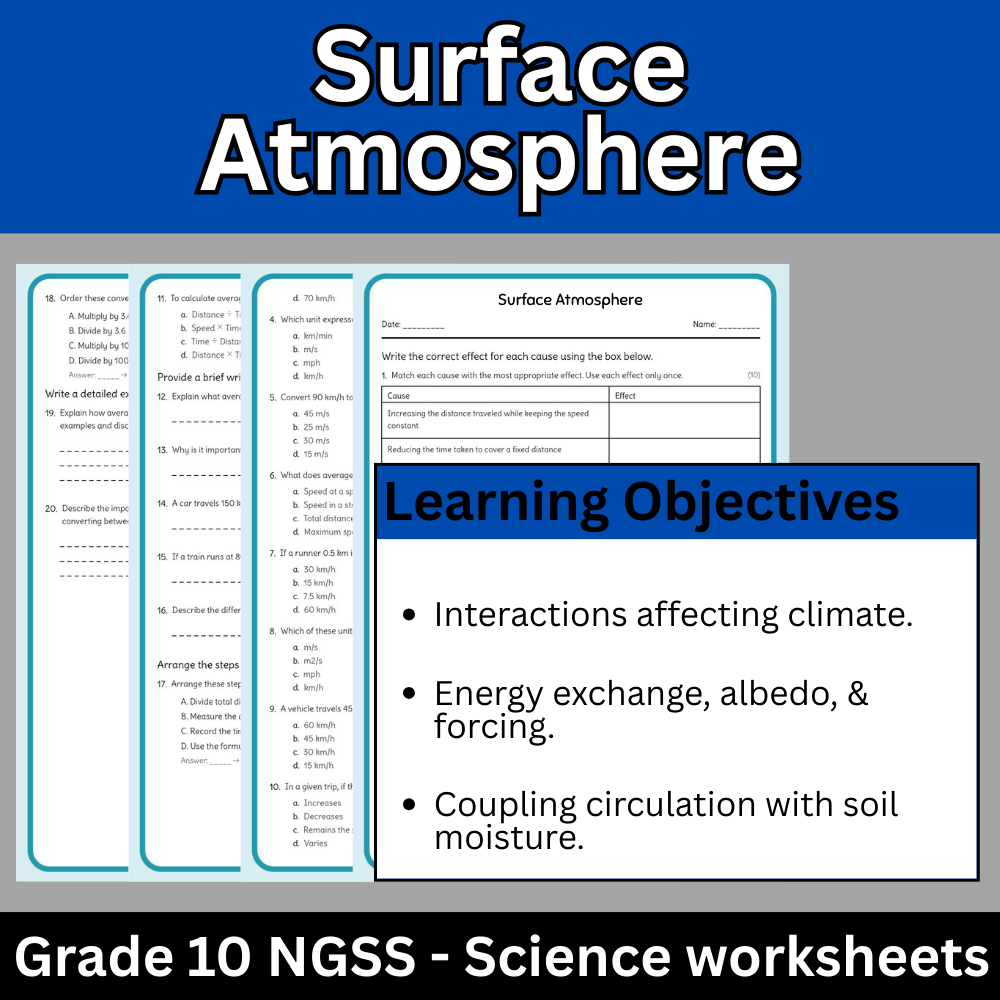
Grade 10 Science | Surface Atmosphere Concept Worksheet (NGSS & PDF)
Created byBright Mind ResourcesLearning Objectives
- Understand the interactions between surface and atmospheric processes affecting climate.
- Describe how energy exchange, albedo effects, and radiative forcing influence regional climate variability.
- Explain the coupling of atmospheric circulation with surface processes such as evapotranspiration and soil moisture dynamics.
Instant download

Grade 10 Rock Cycle & Rock Transformations Worksheet | NGSS Earth Science
 Created byBRIGHT PATH RESOURCES
Learning Objectives
- Understand the basic types of rocks: igneous, sedimentary, and metamorphic.
- Explain the processes involved in the rock cycle: crystallization, lithification, metamorphism, and weathering.
- Identify petrologic indicators such as mineral assemblages, textures, and geochemical signatures.
Also included in: Earth Systems Grade 10 Science Daily Reading Worksheets Lesson Bundle | NGSS +1 more
Instant download

Grade 10 Biodiversity Drivers Worksheet | NGSS Science Ecology Activity
Created byBRIGHT PATH RESOURCESLearning Objectives
- Identify different habitats and understand their role in supporting biodiversity
- Evaluate factors that influence species richness and composition
- Understand the impact of habitat fragmentation, invasive species, land-use change, and climate-driven range shifts
Also included in: Grade 10 Ecology Lesson Bundle | Daily Reading | ngss Science +1 more
Instant download

Grade 10 Science Net Force Motion Worksheet | NGSS Forces and Motion Activity
Created byBRIGHT PATH RESOURCESLearning Objectives
- Understand the concept of net force and how it affects an object's motion.
- Identify net force in simple situations involving different forces.
- Analyze the relationship between net force, mass, and acceleration using Newton's second law.
Also included in: Forces & Motion Grade 10 Science Daily Reading Worksheets Lesson Bundle | NGSS +1 more
Instant download

Grade 10 Understanding Nutrient Cycling Worksheet | NGSS Ecology Science
Created byBRIGHT PATH RESOURCESLearning Objectives
- Explain the major biogeochemical cycles, including the carbon and nitrogen cycles.
- Identify the roles of processes such as photosynthesis, respiration, nitrification, denitrification, and decomposition.
- Understand how human activities like fossil fuel combustion and agriculture affect nutrient reservoirs and fluxes.
Also included in: Grade 10 Ecology Lesson Bundle | Daily Reading | ngss Science +1 more
Instant download

Grade 10 Mendelian Patterns Worksheet | NGSS Genetics Biology Activity
Created byBRIGHT PATH RESOURCESLearning Objectives
- Understand the basics of Mendelian genetics and inheritance patterns.
- Identify dominant and recessive traits using Punnett squares.
- Analyze inheritance through pedigree charts.
Also included in: Genetics Grade 10 Science Daily Reading Worksheets Lesson Bundle | NGSS +1 more
Instant download

Grade 10 Energy Pathways in Biology Worksheet | Cellular Respiration NGSS
Created byBRIGHT PATH RESOURCESLearning Objectives
- Understand the process of photosynthesis and its key steps.
- Identify the components involved in energy transfer within plant cells.
- Explain how light energy is converted into chemical energy during photosynthesis.
Also included in: Human Physiology Grade 10 Science Daily Reading Worksheets Lesson Bundle | Ngss +1 more
Instant download
About Grade 10 Science Worksheets
Find Science worksheets built for Grade 10. All 7,038 cover core skills, practice, and review, each an instant PDF download.
Every worksheet on MyTeachingSheets is created by independent teacher-authors and reviewed before publication. All resources download as printable PDFs for classroom, homework, or at-home practice, and many include answer keys. Preview any worksheet free before buying.