
Grade 11 Science Worksheets
6,616 worksheets
London Dispersion Forces Learning Stations | Grade 11 Chemistry Activity
 Created byMTS Academic Studio
Learning Objectives
- Explain how temporary electron fluctuations produce London dispersion attractions
- Compare dispersion strength using molecular size and shape
- Relate surface contact to London dispersion force strength
Also included in: Grade 11 Science Chemical Bonding & Molecular Geometry Stations Bundle
Instant download

Dipole Interactions Learning Stations Activity | Grade 11 Chemistry
Created byMTS Academic StudioLearning Objectives
- Explain orientation-dependent attractions between permanent molecular dipoles
- Relate molecular structure to dipole interaction strength
- Explain temperature effects on boiling and condensation behaviour
Also included in: Grade 11 Science Chemical Bonding & Molecular Geometry Stations Bundle
Instant download

Saturation States Learning Stations | Grade 11 Chemistry Solubility Activity
Created byMTS Academic StudioLearning Objectives
- Identify unsaturated, saturated, and supersaturated conditions using case evidence.
- Explain dynamic equilibrium between dissolved substances and solid phases.
- Analyze how evaporation and cooling affect saturation conditions.
Also included in: Grade 11 Alberta Chemistry Solutions & Solubility Stations Bundle
Instant download

Limiting Reagents Learning Stations | Grade 11 Chemistry Activity
Created byMTS Academic StudioLearning Objectives
- Identify limiting reactants using balanced chemical equations and mole ratios.
- Distinguish excess reactants from limiting reactants in chemical processes.
- Explain how limiting reagents determine maximum theoretical product yield.
Also included in: Grade 11 Chemistry Titration & Stoichiometry Lesson Bundle Alberta
Instant download

Electronegativity Learning Stations Activity | Grade 11 Chemistry
Created byMTS Academic StudioLearning Objectives
- Explain electron sharing using electronegativity differences
- Compare unequal and nearly equal sharing of bonding electrons
- Connect bond polarity and partial charges to chemical behavior
Also included in: Grade 11 Science Chemical Bonding & Molecular Geometry Stations Bundle
Instant download

Titration Curves Learning Stations Activity | Grade 11 Chemistry
Created byMTS Academic StudioLearning Objectives
- Interpret initial pH on titration curves
- Identify buffer regions and equivalence points on titration profiles
- Compare curves produced by different acid-base systems
Instant download

Solubility Curves Learning Stations Activity | Grade 11 Chemistry
Created byMTS Academic StudioLearning Objectives
- Interpret solubility curves to explain temperature-dependent solubility.
- Predict saturation conditions using evidence from chemical cases.
- Explain crystallization and precipitation under changing solution conditions.
Also included in: Grade 11 Alberta Chemistry Solutions & Solubility Stations Bundle
Instant download

Solution Stoichiometry Learning Stations Activity | Grade 11 Chemistry
Created byMTS Academic StudioLearning Objectives
- Calculate moles of solute using molarity and solution volume.
- Determine solution concentrations from chemical quantities and volumes.
- Apply balanced equations to aqueous reaction stoichiometry calculations.
Also included in: Grade 11 Chemistry Titration & Stoichiometry Lesson Bundle Alberta
Instant download

Acid-Base Buffers Learning Stations | Grade 11 Chemistry Activity
Created byMTS Academic StudioLearning Objectives
- Explain how conjugate acid-base systems resist sudden pH changes
- Compare how buffer composition influences chemical pH stability
- Explain how equilibrium contributes to buffer behaviour
Instant download

Acid-Base Equilibrium Learning Stations | Grade 11 Chemistry Activity
Created byMTS Academic StudioLearning Objectives
- Interpret Ka and Kb as measures of acid-base equilibrium position
- Compare acid-base strength using pKa and pKb values
- Calculate conjugate equilibrium constants using Kw = Ka × Kb
Instant download

Lewis Structures Learning Stations Activity | Grade 11 Chemistry
Created byMTS Academic StudioLearning Objectives
- Construct Lewis structures from molecular formulas and valence-electron counts
- Apply formal charge to evaluate possible Lewis structures
- Interpret resonance representations for chemical substances
Also included in: Grade 11 Science Chemical Bonding & Molecular Geometry Stations Bundle
Instant download

pH and Ion Concentration Learning Stations | Grade 11 Chemistry Activity
Created byMTS Academic StudioLearning Objectives
- Calculate hydrogen ion concentration from measured pH values
- Calculate hydroxide ion concentration from measured pOH values
- Apply Kw to relate hydrogen and hydroxide ion concentrations
Instant download

Gas Stoichiometry Learning Stations Activity | Grade 11 Chemistry
Created byMTS Academic StudioLearning Objectives
- Apply balanced chemical equations to gaseous reaction relationships.
- Calculate gaseous quantities using mole ratios and gas laws.
- Compare gas volumes under different temperature and pressure conditions.
Also included in: Grade 11 Chemistry Titration & Stoichiometry Lesson Bundle Alberta
Instant download

Atomic Structure Learning Stations Activity | Grade 11 Chemistry
Created byMTS Academic StudioLearning Objectives
- Explain how proton number determines an element's identity
- Interpret electron arrangements to predict chemical behaviour
- Use valence electrons to explain ion formation
Also included in: Grade 11 Science Chemical Bonding & Molecular Geometry Stations Bundle
Instant download

Titration Calculations Learning Stations | Grade 11 Chemistry Activity
Created byMTS Academic StudioLearning Objectives
- Explain how titration measurements determine unknown concentrations
- Interpret equivalence in quantitative acid-base analysis
- Connect stoichiometric ratios to titration measurements
Instant download

Industrial Water Chemistry Learning Stations | Grade 11 Science Activity
Created byMTS Academic StudioLearning Objectives
- Explain how dissolved ions influence solubility and precipitation.
- Describe how temperature changes affect industrial water chemistry.
- Identify chemical factors contributing to corrosion and scale formation.
Also included in: Grade 11 Alberta Chemistry Solutions & Solubility Stations Bundle
Instant download

Solubility Product (Ksp) Learning Stations Activity | Grade 11 Chemistry
Created byMTS Academic StudioLearning Objectives
- Explain Ksp equilibrium between slightly soluble solids and dissolved ions.
- Predict precipitation using changes in dissolved ion concentrations.
- Explain how common ions influence solubility equilibrium.
Also included in: Grade 11 Alberta Chemistry Solutions & Solubility Stations Bundle
Instant download

Solution Stoichiometry Learning Stations Activity | Grade 11 Chemistry
Created byMTS Academic StudioLearning Objectives
- Interpret mole ratios from balanced aqueous chemical equations.
- Calculate dissolved substance quantities using molar concentration and solution volume.
- Identify limiting reactants in solution-phase chemical reactions.
Also included in: Grade 11 Alberta Chemistry Solutions & Solubility Stations Bundle
Instant download

Titration Theory Learning Stations Activity | Grade 11 Chemistry
Created byMTS Academic StudioLearning Objectives
- Explain how titrant volumes determine unknown solution concentrations.
- Apply stoichiometric reaction ratios to quantitative titration analysis.
- Compare five analytical titration methods and their applications.
Also included in: Grade 11 Chemistry Titration & Stoichiometry Lesson Bundle Alberta
Instant download

VSEPR Molecular Geometry Learning Stations Activity | Grade 11 Chemistry
Created byMTS Academic StudioLearning Objectives
- Identify bonding regions and lone pairs around central atoms.
- Predict molecular geometry using VSEPR electron-domain principles.
- Compare five molecular arrangements using bond angles and symmetry.
Also included in: Grade 11 Science Chemical Bonding & Molecular Geometry Stations Bundle
Instant download

Phase Behaviour Learning Stations Activity | Grade 11 Chemistry
Created byMTS Academic StudioLearning Objectives
- Explain how intermolecular forces influence phase behaviour
- Compare volatility and vapor pressure across real substances
- Explain how temperature and pressure affect phase changes
Also included in: Grade 11 Science Chemical Bonding & Molecular Geometry Stations Bundle
Instant download

Redox Reactions Learning Stations Activity | Grade 11 Chemistry
Created byMTS Academic StudioLearning Objectives
- Identify oxidation and reduction using changes in oxidation numbers.
- Explain electron transfer in industrial and environmental redox processes.
- Interpret redox equations using oxidation and reduction half-reactions.
Also included in: Grade 11 Chemistry Titration & Stoichiometry Lesson Bundle Alberta
Instant download

Net Ionic Equations Learning Stations Activity | Grade 11 Chemistry
Created byMTS Academic StudioLearning Objectives
- Identify reacting ions and spectator ions in aqueous reactions.
- Construct balanced complete ionic equations for aqueous chemical processes.
- Write net ionic equations by eliminating spectator ions.
Also included in: Grade 11 Chemistry Titration & Stoichiometry Lesson Bundle Alberta
Instant download

Percent Yield Chemistry Learning Stations Activity | Grade 11 Stoichiometry
Created byMTS Academic StudioLearning Objectives
- Distinguish theoretical yield from actual yield in chemical reactions.
- Calculate percent yield using actual and theoretical product quantities.
- Apply balanced equations to determine theoretical product yield.
Also included in: Grade 11 Chemistry Titration & Stoichiometry Lesson Bundle Alberta
Instant download

Mole Calculations Learning Stations Activity | Grade 11 Chemistry
Created byMTS Academic StudioLearning Objectives
- Calculate moles from mass using the appropriate molar mass.
- Convert between moles and particles using Avogadro's constant.
- Apply mole conversions to documented real-world chemistry examples.
Also included in: Grade 11 Chemistry Titration & Stoichiometry Lesson Bundle Alberta
Instant download

Chemical Bonding Learning Stations | Grade 11 Science Canadian Materials
Created byMTS Academic StudioLearning Objectives
- Distinguish four bonding types using structural evidence
- Compare electron behaviour in ionic, covalent, and metallic bonding
- Relate particle arrangement to conductivity, hardness, and melting behaviour
Also included in: Grade 11 Science Chemical Bonding & Molecular Geometry Stations Bundle
Instant download

Balancing Chemical Equations Learning Stations | Grade 11 Chemistry
Created byMTS Academic StudioLearning Objectives
- Balance chemical equations using appropriate stoichiometric coefficients.
- Demonstrate conservation of atoms in balanced chemical reactions.
- Identify five common categories of chemical reactions.
Also included in: Grade 11 Chemistry Titration & Stoichiometry Lesson Bundle Alberta
Instant download

Acid Strength Learning Stations | Grade 11 Chemistry Structure Activity
Created byMTS Academic StudioLearning Objectives
- Explain how molecular structure influences acid strength
- Apply bond polarity and atom size to acidity trends
- Explain how electronegativity and resonance affect acid strength
Instant download

Electrolyte Properties Learning Stations | Grade 11 Chemistry Activity
Created byMTS Academic StudioLearning Objectives
- Explain how mobile dissolved ions enable electrical conductivity in water.
- Compare conductivity in freshwater, saline water, and treated water.
- Distinguish strong electrolytes, weak electrolytes, and nonelectrolytes.
Also included in: Grade 11 Alberta Chemistry Solutions & Solubility Stations Bundle
Instant download

Strong and Weak Acids and Bases Learning Stations Activity | Grade 11
Created byMTS Academic StudioLearning Objectives
- Compare strong and weak acids when dissolved in water
- Compare strong and weak bases in aqueous solutions
- Explain how ionization affects hydrogen-ion concentrations
Instant download

Combustion Reactions Learning Stations Activity | Grade 11 Chemistry
Created byMTS Academic StudioLearning Objectives
- Identify fuel sources and oxygen requirements in documented combustion cases.
- Explain complete and incomplete combustion using balanced chemical equations.
- Interpret stoichiometric ratios to determine relationships between reactants and products.
Also included in: Grade 11 Chemistry Titration & Stoichiometry Lesson Bundle Alberta
Instant download

Molar Concentration Learning Stations | Grade 11 Chemistry Case Studies
Created byMTS Academic StudioLearning Objectives
- Explain molar concentration in moles per litre of solution.
- Distinguish molar concentration from mass concentration.
- Apply molar mass relationships to interpret dissolved quantities.
Also included in: Grade 11 Alberta Chemistry Solutions & Solubility Stations Bundle
Instant download

VSEPR & Intermolecular Forces Learning Stations Activity | Grade 11
Created byMTS Academic StudioLearning Objectives
- Use VSEPR reasoning to interpret molecular geometry
- Connect molecular geometry with molecular polarity
- Explain intermolecular forces from molecular structure
Also included in: Grade 11 Science Chemical Bonding & Molecular Geometry Stations Bundle
Instant download

Buffer Capacity Learning Stations | Acids, Bases and pH Grade 11
Created byMTS Academic StudioLearning Objectives
- Explain how neutralizing substances influence buffer capacity
- Compare natural and added materials that resist pH change
- Evaluate why environmental systems respond differently to acid inputs
Instant download

Gas Solubility and Henry's Law Learning Stations Activity | Grade 11 Science
Created byMTS Academic StudioLearning Objectives
- Explain how partial pressure influences dissolved gas concentration.
- Apply Henry's law to real-world gas solubility examples.
- Distinguish equilibrium concentration changes from dissolved gas release.
Also included in: Grade 11 Alberta Chemistry Solutions & Solubility Stations Bundle
Instant download

Conservation of Mass and Chemical Reactions Learning Stations Grade 11
Created byMTS Academic StudioLearning Objectives
- Explain conservation of atoms during chemical reactions using documented evidence.
- Interpret balanced chemical equations as representations of atom conservation.
- Identify system boundaries in laboratory and industrial chemical processes.
Also included in: Grade 11 Chemistry Titration & Stoichiometry Lesson Bundle Alberta
Instant download

Hydrogen Bonding Learning Stations Activity | Grade 11 Chemistry
Created byMTS Academic StudioLearning Objectives
- Identify molecular features that allow hydrogen bonding to occur
- Explain how hydrogen bonding influences boiling and density
- Relate hydrogen bonding to molecular structure and material strength
Also included in: Grade 11 Science Chemical Bonding & Molecular Geometry Stations Bundle
Instant download

pH Learning Stations Activity | Water Chemistry Cases | Grade 11 Science
Created byMTS Academic StudioLearning Objectives
- Interpret pH as a logarithmic measure of hydrogen ion concentration
- Compare acidity across different real-world water systems
- Explain how natural processes can change water pH
Instant download

Reaction Energetics Learning Stations Activity | Grade 11 Chemistry
Created byMTS Academic StudioLearning Objectives
- Identify exothermic reactions using evidence of energy release.
- Explain energy absorption in endothermic chemical reactions.
- Calculate reaction enthalpy using standard enthalpies of formation.
Also included in: Grade 11 Chemistry Titration & Stoichiometry Lesson Bundle Alberta
Instant download

Common Ion Effect Learning Stations Activity | Grade 11 Chemistry
Created byMTS Academic StudioLearning Objectives
- Identify common ions in dissolution equilibrium systems.
- Explain equilibrium shifts caused by changes in ion concentration.
- Predict precipitation or dissolution of sparingly soluble salts.
Also included in: Grade 11 Alberta Chemistry Solutions & Solubility Stations Bundle
Instant download

Electron Arrangement Learning Stations | Grade 11 Chemistry Activity
Created byMTS Academic StudioLearning Objectives
- Explain molecular polarity using valence-electron arrangement and shape
- Compare polar and nonpolar molecules using structural evidence
- Relate molecular polarity to intermolecular attractions
Also included in: Grade 11 Science Chemical Bonding & Molecular Geometry Stations Bundle
Instant download

Solubility Factors Learning Stations Activity | Grade 11 Chemistry
Created byMTS Academic StudioLearning Objectives
- Identify factors influencing solubility in environmental and industrial systems.
- Explain how temperature changes affect dissolved substances.
- Describe the relationship between pressure and gas solubility.
Also included in: Grade 11 Alberta Chemistry Solutions & Solubility Stations Bundle
Instant download

Industrial Stoichiometry Learning Stations Activity | Grade 11 Chemistry
Created byMTS Academic StudioLearning Objectives
- Apply balanced chemical equations to analyze industrial material requirements.
- Calculate reactant-product relationships using stoichiometric mole ratios.
- Compare how feedstock composition influences industrial product formation.
Also included in: Grade 11 Chemistry Titration & Stoichiometry Lesson Bundle Alberta
Instant download

Empirical Formulas Learning Stations Activity | Grade 11 Chemistry
Created byMTS Academic StudioLearning Objectives
- Convert elemental masses into moles using molar mass.
- Calculate empirical formulas from elemental percentage composition.
- Simplify mole ratios into the smallest whole-number ratios.
Also included in: Grade 11 Chemistry Titration & Stoichiometry Lesson Bundle Alberta
Instant download

Chemical Reactions Evidence Learning Stations Activity | Grade 11 Science
Created byMTS Academic StudioLearning Objectives
- Identify observable evidence of chemical reactions in documented cases
- Interpret colour changes, gas formation, and solid formation
- Recognize energy exchange as evidence of chemical processes
Also included in: Grade 11 Chemistry Titration & Stoichiometry Lesson Bundle Alberta
Instant download

Acids, Bases and pH Learning Stations | Grade 11 Environmental Chemistry
Created byMTS Academic StudioLearning Objectives
- Explain environmental applications of acid-base chemistry
- Compare neutralization, buffering, monitoring, and treatment strategies
- Interpret evidence involving pH and chemical equilibria
Instant download

Ionic Strength Learning Stations Activity | Grade 11 Chemistry Water Cases
Created byMTS Academic StudioLearning Objectives
- Explain how dissolved ion concentration influences ionic strength.
- Compare the contributions of different ionic charges to ionic strength.
- Explain differences between ion concentration and effective ionic activity.
Also included in: Grade 11 Alberta Chemistry Solutions & Solubility Stations Bundle
Instant download
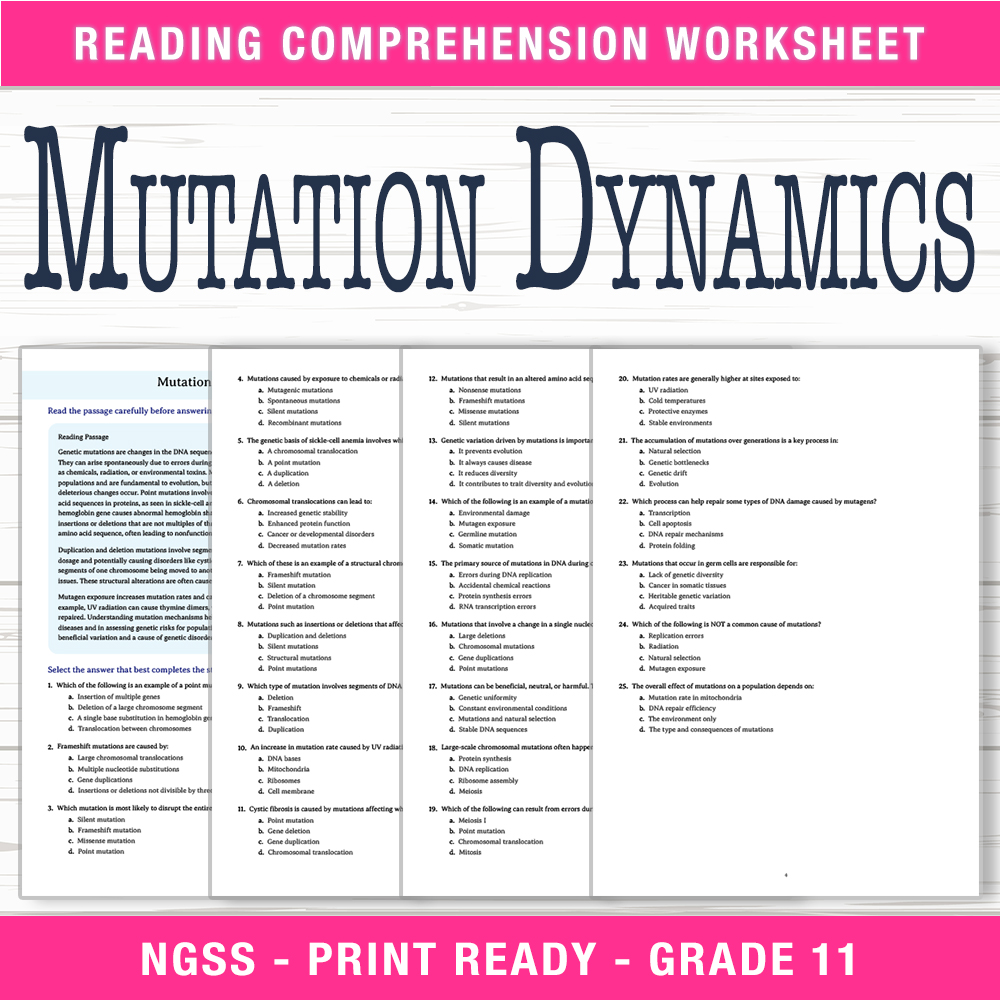
11th Grade Science | Mutation Dynamics Worksheet (PDF + Answer Key)
 Created byRiverstone Classroom
Learning Objectives
- Understand the sources and mechanisms of genetic mutations such as point mutations, frameshifts, duplications, deletions, and translocations.
- Describe the consequences of mutations on gene and protein function, including examples like sickle-cell hemoglobin and cystic fibrosis.
- Explain how mutation-driven genetic variation contributes to trait diversity and heritable diseases within populations.
Instant download
About Grade 11 Science Worksheets
Browse 6,616 printable Grade 11 Science worksheets — ready-to-print PDFs with answer keys where available.
Each resource here is built by an independent educator and reviewed for quality. Worksheets print straight from PDF and suit classroom use, homework, or extra practice; most come with answer keys, and you can preview before purchasing.