
Grade 11 Science Worksheets
6,616 worksheets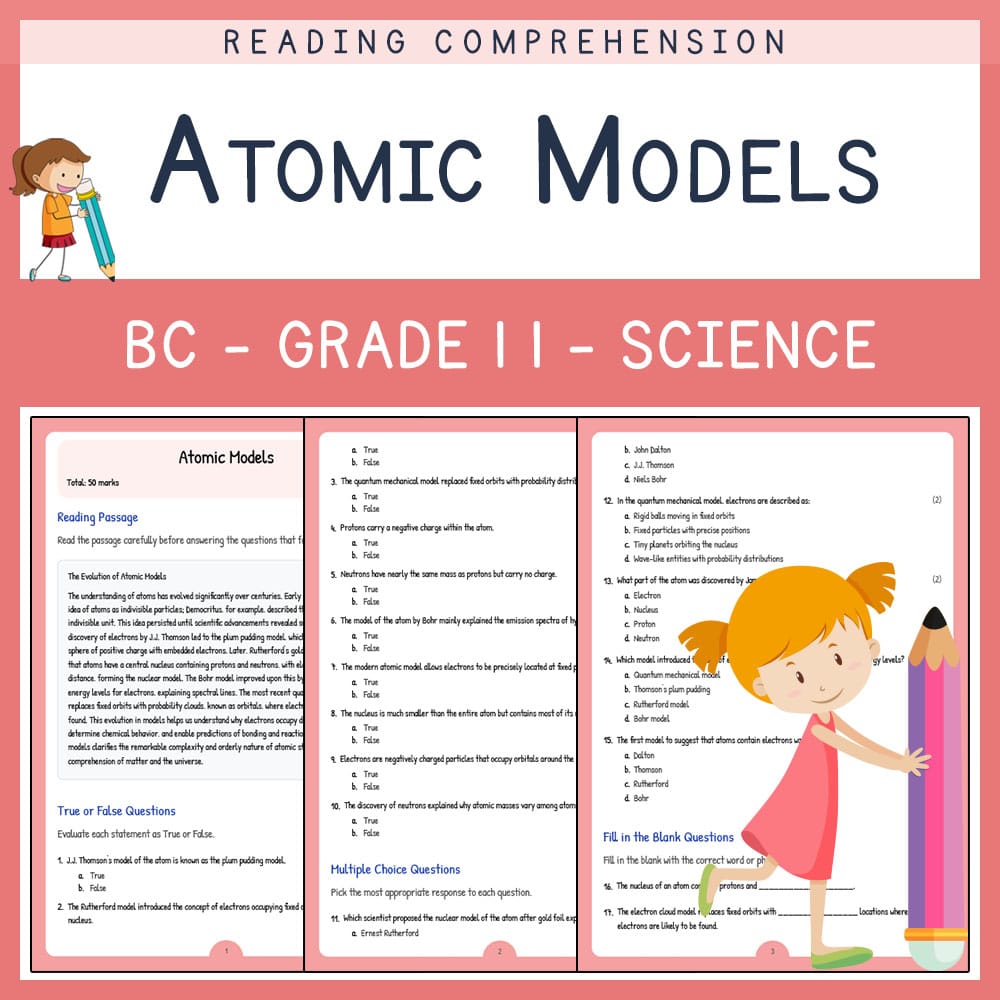
Grade 11 Science | Atomic Models Worksheet | BC Aligned
 Created byLumora Learning
Learning Objectives
- Understand the historical development of atomic models from early theories to quantum mechanics.
- Identify the key particles within atoms and their properties, including charge and mass.
- Explain how atomic models explain electron behavior, energy levels, and chemical properties.
Also included in: Grade 11 Science | Chemistry Lesson Bundle Worksheet | BC-Aligned
Instant download
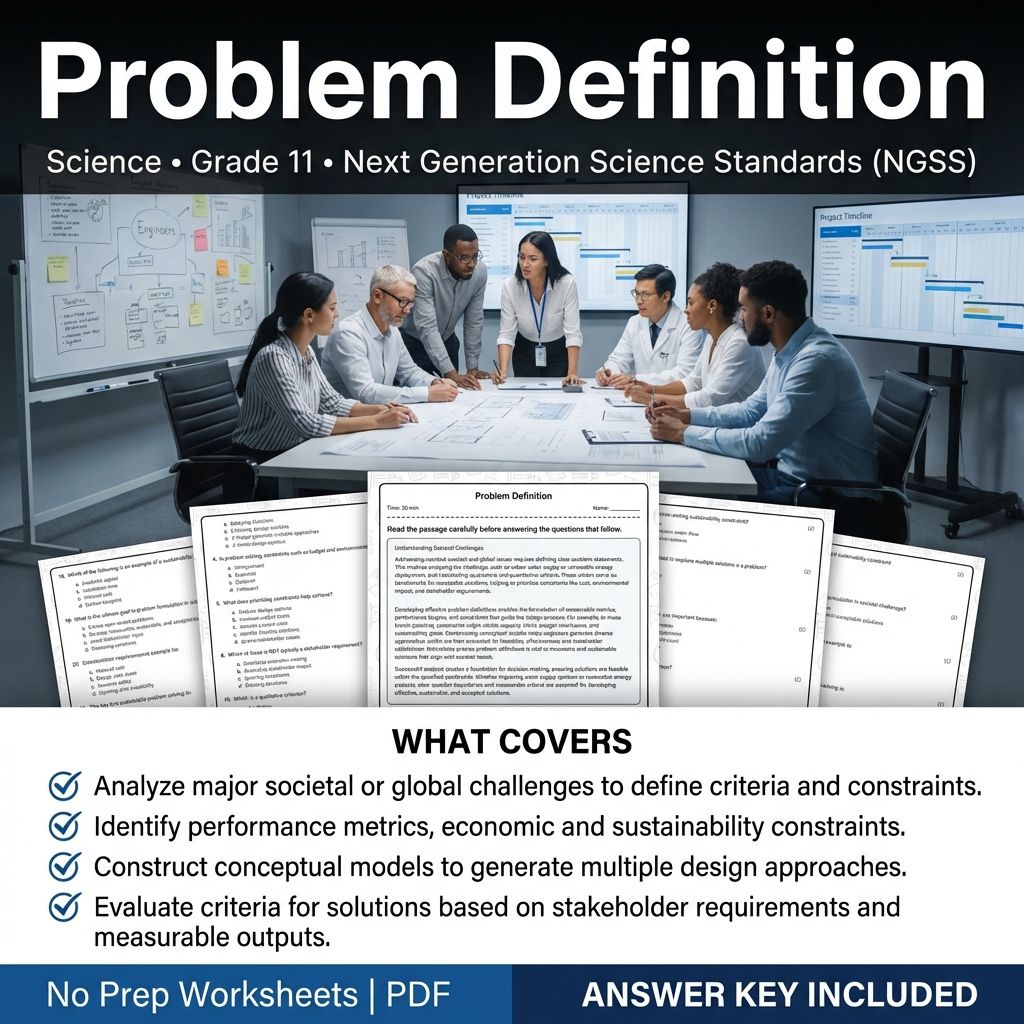
Grade 11 Science Worksheet | Problem Definition & Critical Thinking - Answer Key
 Created byCoral Reef Learning
Learning Objectives
- Analyze major societal or global challenges to define criteria and constraints.
- Identify performance metrics, economic and sustainability constraints.
- Construct conceptual models to generate multiple design approaches.
Also included in: Grade 11 Science | Engineering & Scientific Problem-Solving Worksheet Bundle +1 more
Instant download
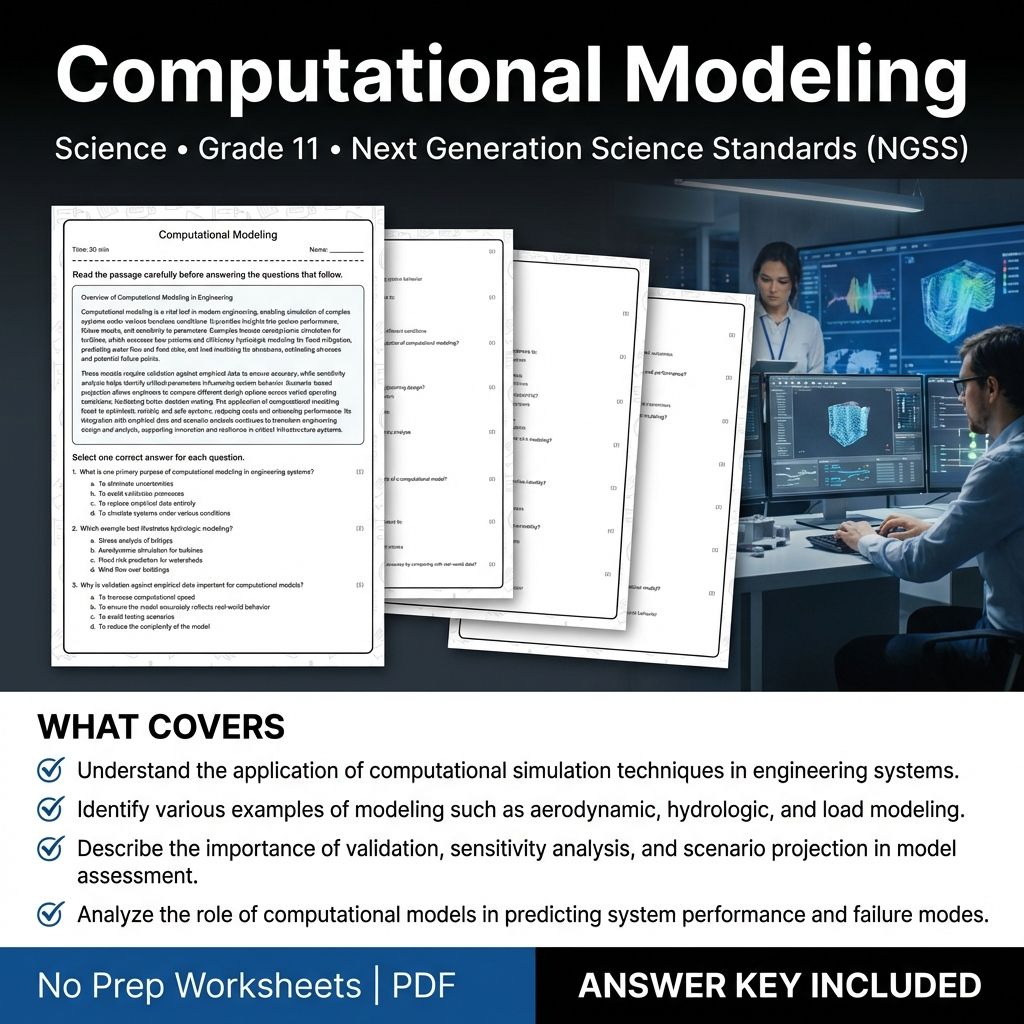
Grade 11 Science | Computational Modeling Worksheet & Answer Key PDF
Created byCoral Reef LearningLearning Objectives
- Understand the application of computational simulation techniques in engineering systems.
- Identify various examples of modeling such as aerodynamic, hydrologic, and load modeling.
- Describe the importance of validation, sensitivity analysis, and scenario projection in model assessment.
Also included in: Grade 11 Science | Engineering & Scientific Problem-Solving Worksheet Bundle +1 more
Instant download
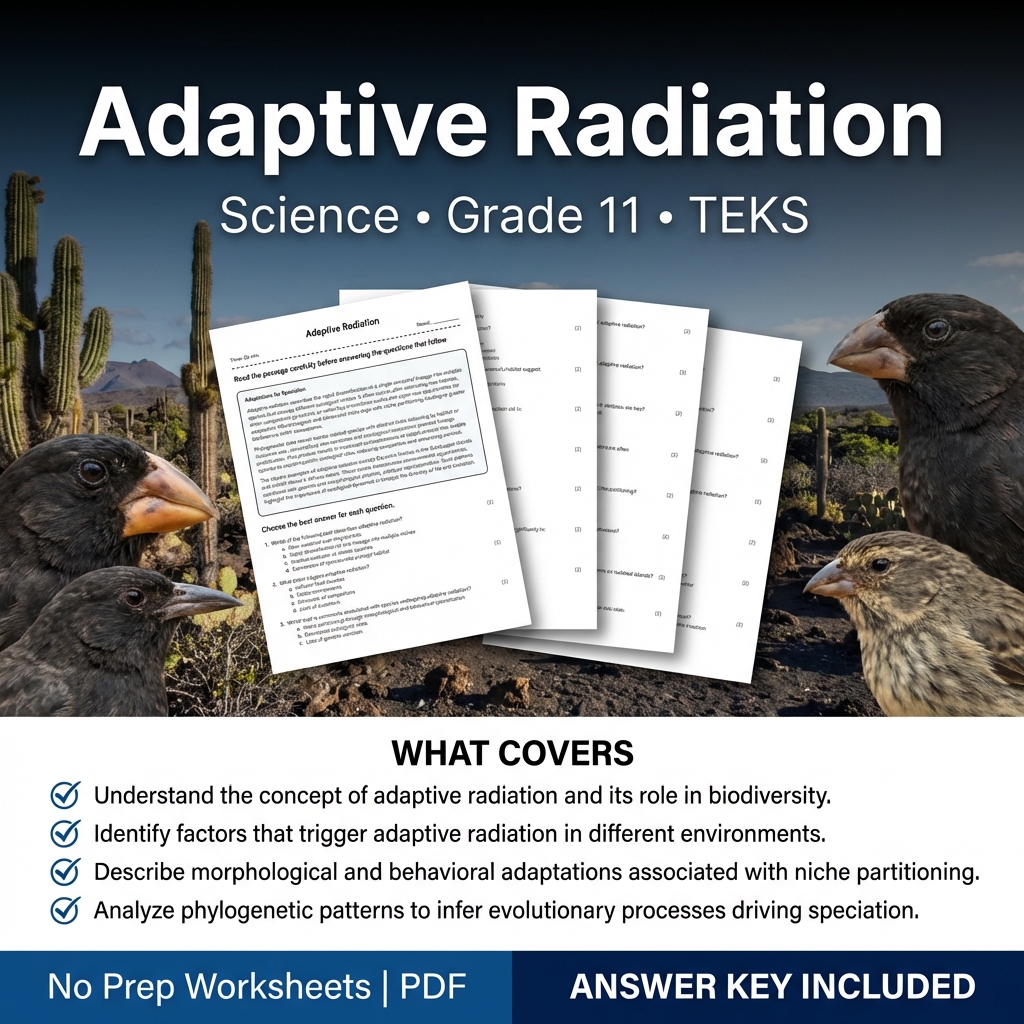
Adaptive Radiation Worksheet Grade 11 Science TEKS Practice PDF
Created byCoral Reef LearningLearning Objectives
- Understand the concept of adaptive radiation and its role in biodiversity.
- Identify factors that trigger adaptive radiation in different environments.
- Describe morphological and behavioral adaptations associated with niche partitioning.
Instant download

Grade 11 Science – Conservation of Mass Daily Reading Worksheet
 Created byBright Mind Resources
Learning Objectives
- Understand key concepts related to Science
- Apply knowledge through practice questions
- Demonstrate comprehension of the material
Also included in: Grade 11 Science Concept Daily Reading Worksheets Lesson Bundle | General +1 more
Instant download
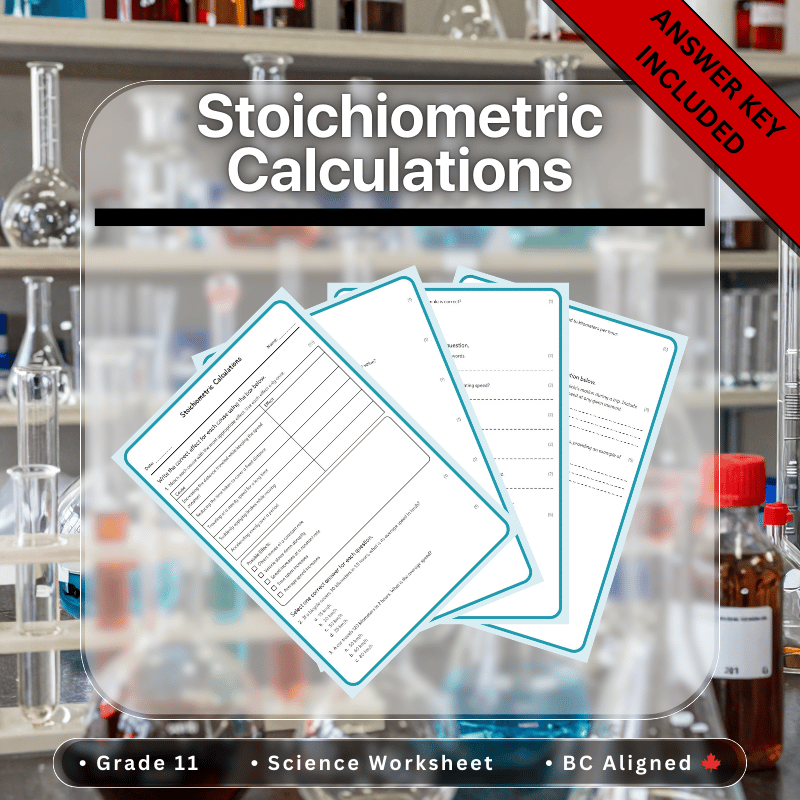
Grade 11 Science – Stoichiometric Calculations Worksheet(Answers) | BC Standards
Created byBright Mind ResourcesLearning Objectives
- Apply mole relationships and balanced chemical equations to quantify reactants and products.
- Identify limiting reagents and calculate percent yields in chemical reactions.
- Perform mass-to-mass, mass-to-mole, and mole-to-mole conversions using molar masses and coefficients.
Instant download

Grade 11 Stoichiometric Calculations Worksheet | Ontario Chemistry PDF
 Created byClear Sky Classroom
Learning Objectives
- Convert between mass, moles, and particle counts using molar mass and Avogadro’s number
- Use limiting reagent concepts to determine the maximum amount of product and theoretical yield
- Calculate percent yield and interpret the results in terms of reaction efficiency
Instant download

Grade 11 Science | Stoichiometric Calculations Worksheet | Ontario Standard
Created byLumora LearningLearning Objectives
- Understand the mole concept and convert between masses, moles, and particles.
- Apply Avogadro's number and molar mass in calculations.
- Perform limiting reagent analysis and compute theoretical yield and percent yield.
Also included in: Grade 11 Science | Chemistry Lesson Bundle | Ontario Framework
Instant download

Grade 11 Science – Stoichiometric Calculations Worksheet (BC Standards) (PDF)
 Created byEvergreen Desk Education
Learning Objectives
- Use balanced chemical equations and mole ratios to convert between masses, moles, and particle amounts in stoichiometric problems.
- Determine the limiting reactant and predict the amount of product formed from given reactant quantities.
- Calculate percent yield by comparing actual yield to theoretical yield and explain what lowers yield.
Instant download
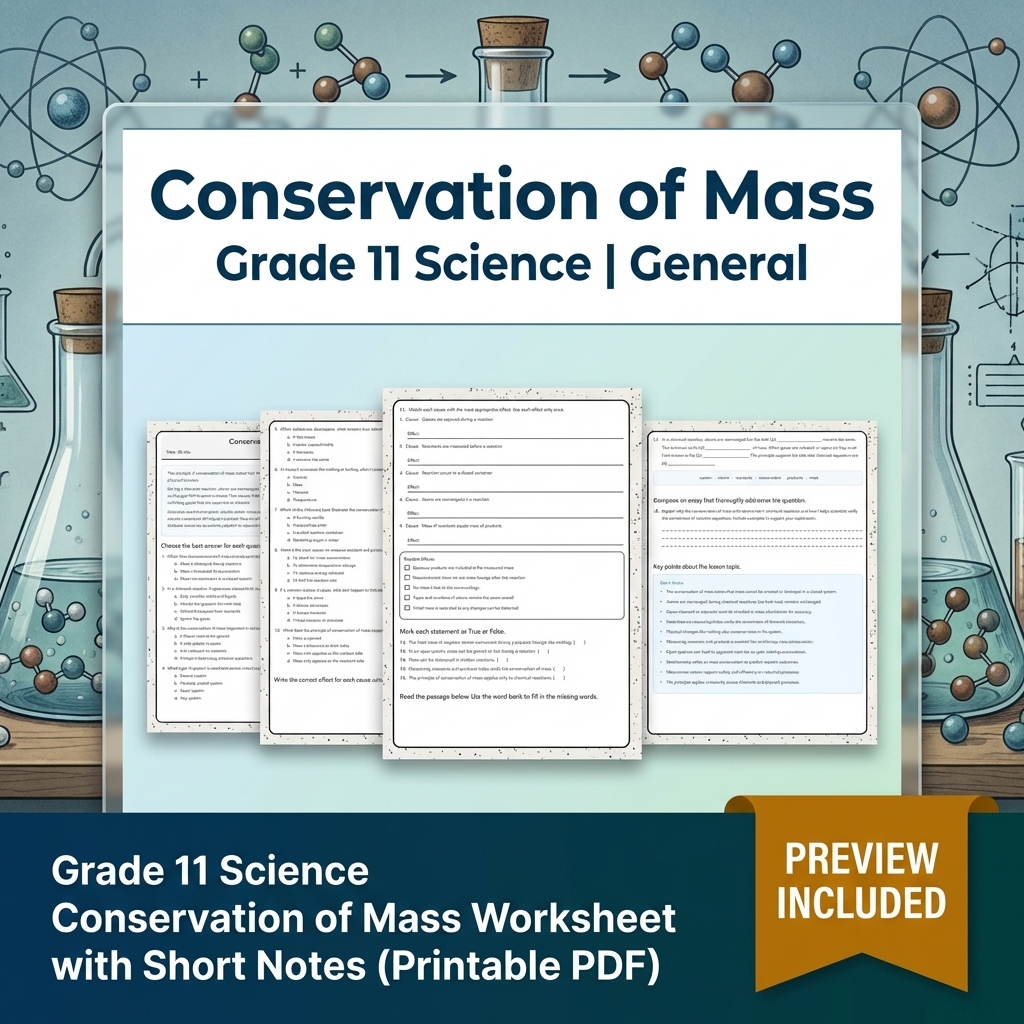
Grade 11 Science Conservation of Mass Worksheet with Short Notes (Printable PDF)
 Created byMeadowlark Worksheets
Learning Objectives
- Understand the principle of conservation of mass in chemical and physical processes.
- Identify how mass is balanced before and after reactions.
- Interpret reaction equations in terms of mass conservation.
Also included in: Grade 11 Science Concept Mastery Lesson Bundle (General Framework) +1 more
Instant download
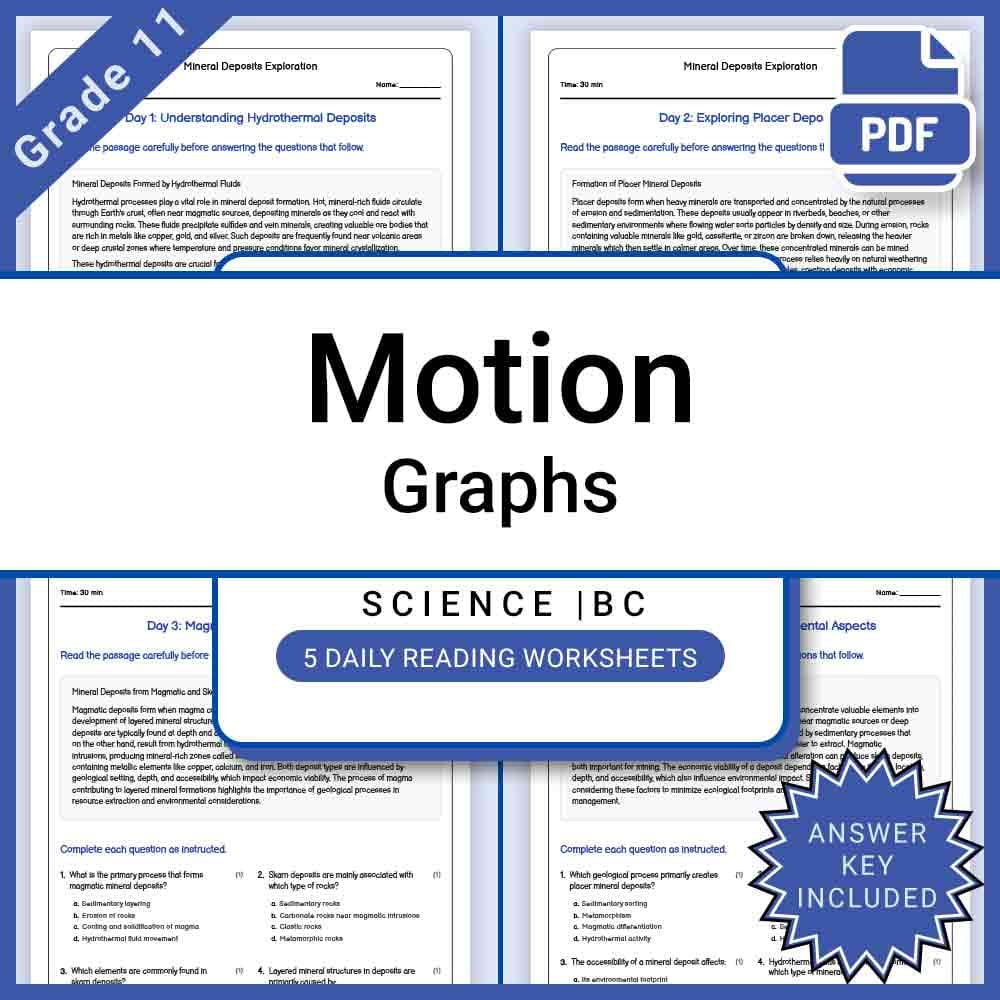
Grade 11 Science Motion Graphs Daily Reading Worksheet with Answer Key
JCreated byJ.S SheetsLearning Objectives
- Understand the types of motion graphs: position–time and velocity–time
- Interpret slope and area under the graph to determine velocity and displacement
- Identify different types of motion such as uniform velocity and constant acceleration
Also included in: Grade 11 Science Lesson Bundle BC Framework | Physics and Energy Concepts +1 more
Instant download
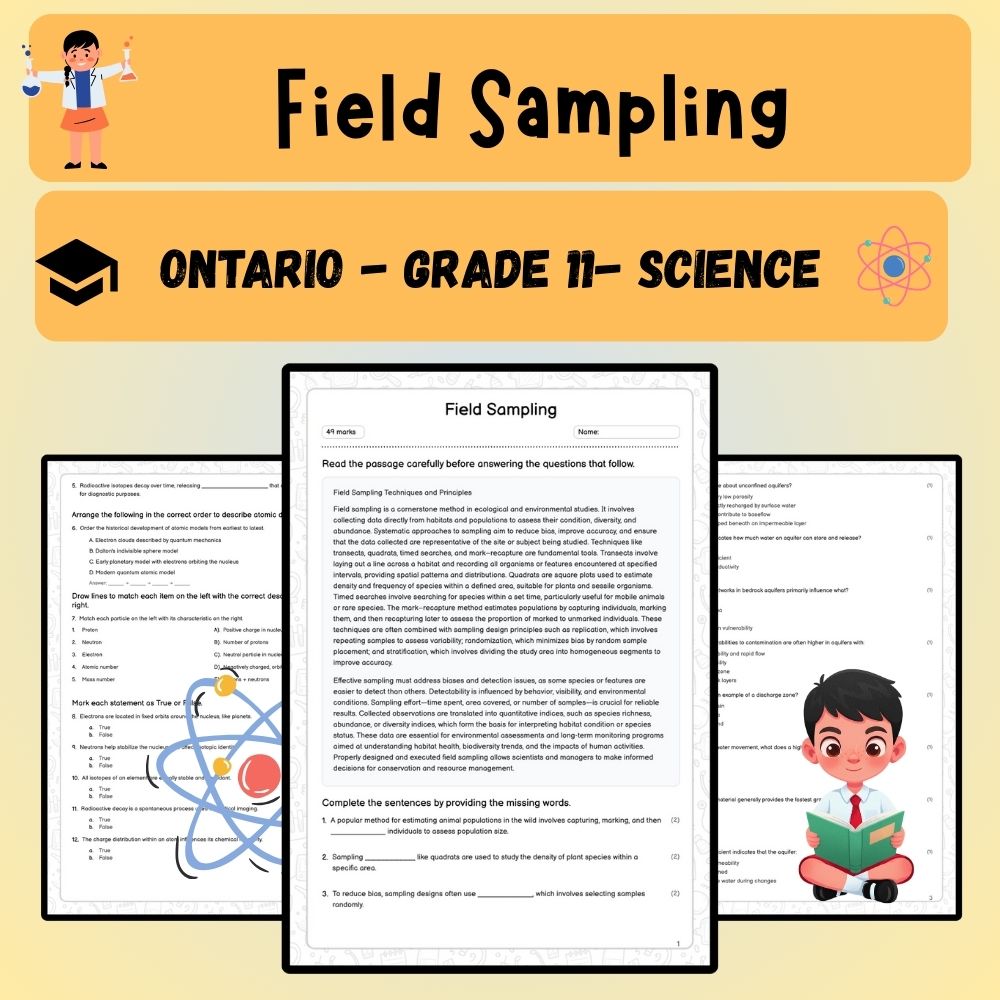
Grade 11 Science | Field Sampling Worksheet (Worksheet + Answer Key) – Ontario Standards
 Created byPrism Point Learning
Learning Objectives
- Understand systematic approaches to field sampling for ecological assessment.
- Identify different sampling techniques such as transects, quadrats, and mark–recapture.
- Explain sampling design principles including replication, randomization, and stratification.
Also included in: Grade 11 Science Ecosystems & Sustainability UNIT Worksheet Pack +1 more
Instant download
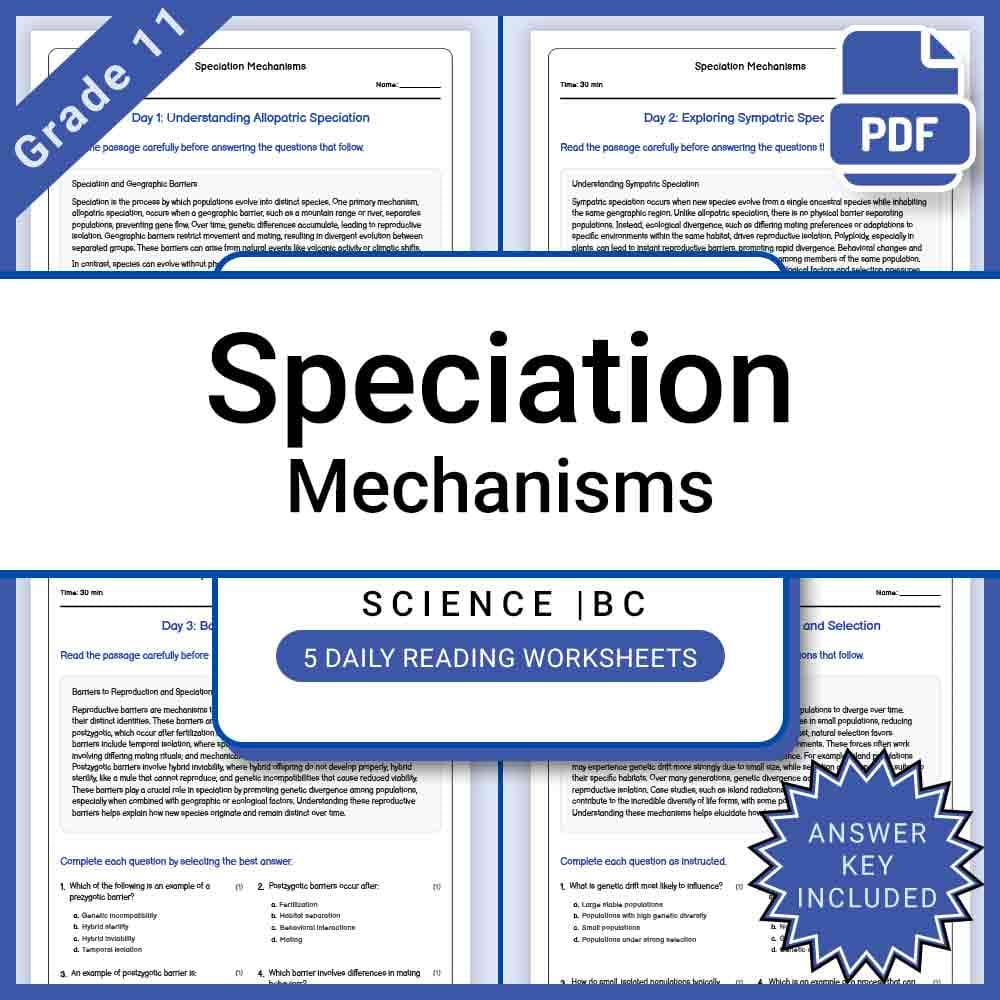
Grade 11 Science – Speciation Mechanisms Daily Reading Worksheet + Answer Key
JCreated byJ.S SheetsLearning Objectives
- Understand the concept of reproductive isolation in speciation
- Identify different types of geographic and reproductive barriers
- Explain processes like genetic drift, selection, and hybridization in divergence
Also included in: Grade 11 Science Lesson Bundle BC Framework | STEM & Core Concepts +1 more
Instant download
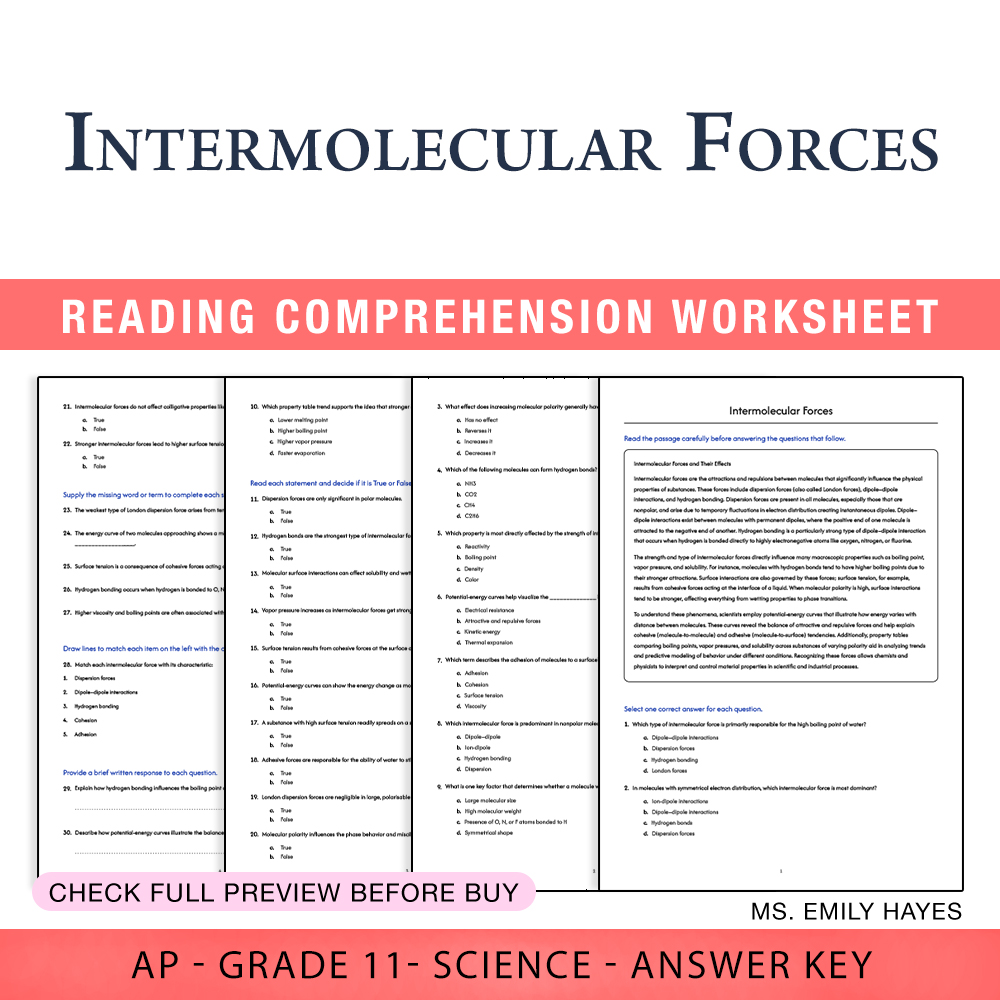
Grade 11 Science | Intermolecular Forces Worksheet (PDF+ Answer Key)
 Created byCopper Leaf Classroom
Learning Objectives
- Describe the types of intermolecular forces and their effects on physical properties of substances.
- Explain how molecular polarity influences surface interactions and phase behavior.
- Interpret potential-energy curves and property tables to understand cohesion and adhesion.
Also included in: Grade 11 Science | Chemistry Foundations AP Worksheet Bundle (PDF+ Answer Keys) +1 more
Instant download
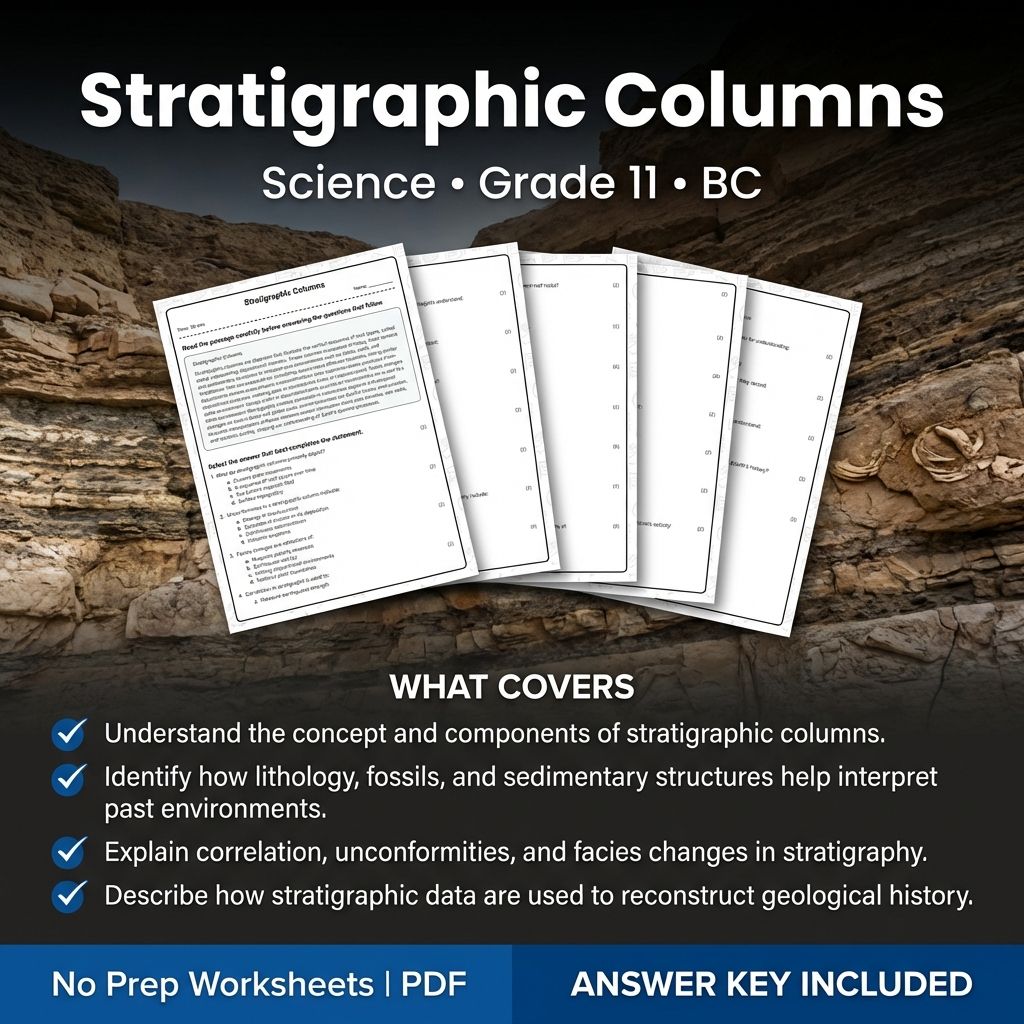
11th Grade Science | Stratigraphic Columns Worksheet & Answer Key (PDF)
Created byCoral Reef LearningLearning Objectives
- Understand the concept and components of stratigraphic columns.
- Identify how lithology, fossils, and sedimentary structures help interpret past environments.
- Explain correlation, unconformities, and facies changes in stratigraphy.
Instant download
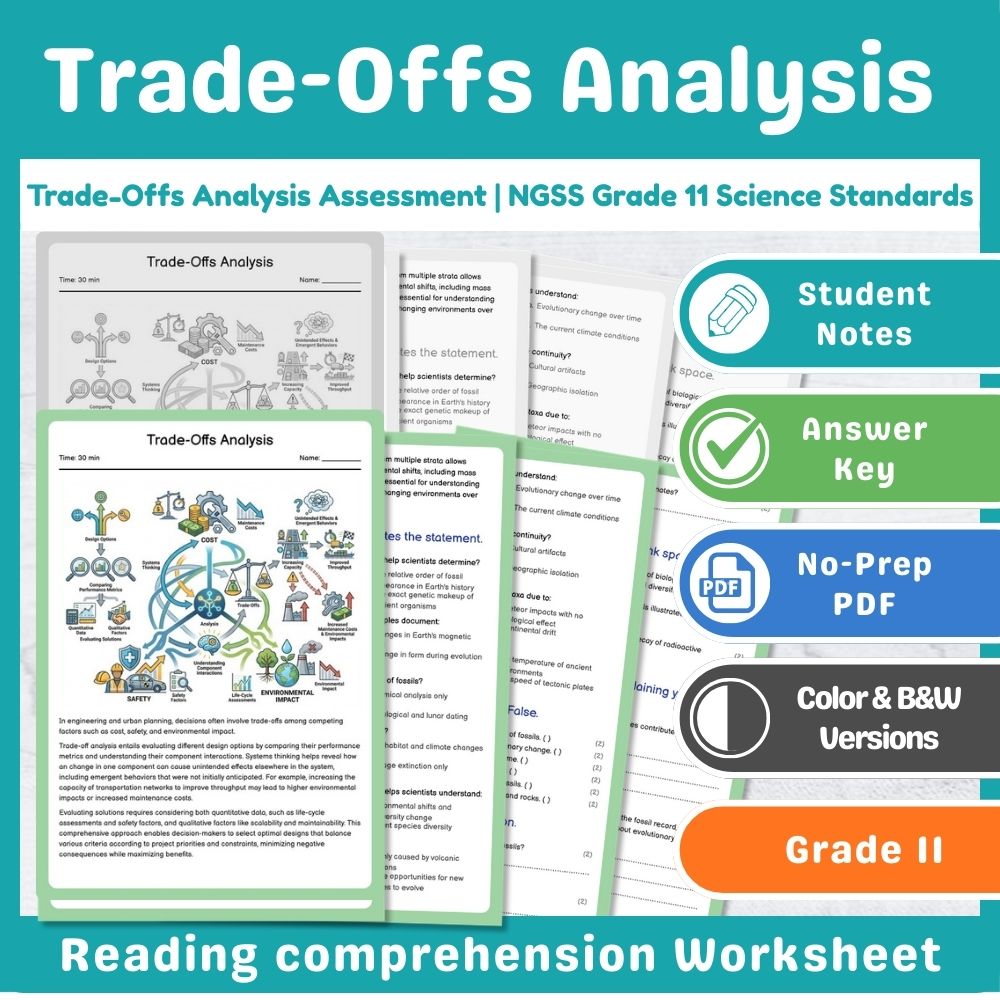
Trade-Offs Analysis Assessment | NGSS Grade 11 Science Standards
Created byPrism Point LearningLearning Objectives
- Evaluate proposed solutions against specified criteria and constraints using quantitative and qualitative methods.
- Apply systems thinking to analyze component interactions, emergent behavior, and unintended consequences in complex systems.
- Examine trade-offs among cost, safety, environmental impact, scalability, and maintainability in engineering and urban systems.
Instant download

Electron Arrangement and Polarity Assessment | Alberta Standard Grade 11 Science
Created byPrism Point LearningLearning Objectives
- Explain how valence electron distribution affects molecular polarity.
- Describe how electron density maps relate to observable polarity in molecules.
- Compare polar and nonpolar molecules using examples like water and carbon dioxide.
Also included in: Grade 11 Matter and Chemical Bonding Science Lesson Bundle for Alberta +1 more
Instant download
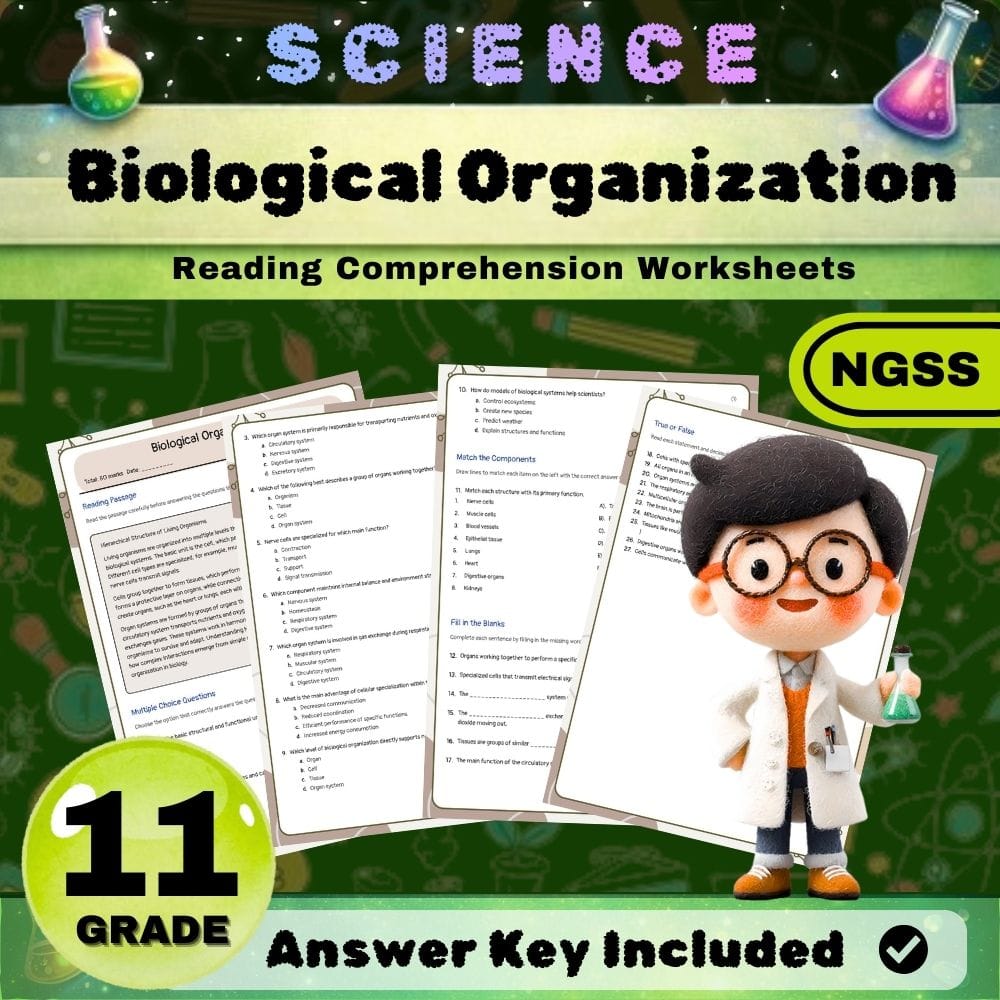
Grade 11 Science | Biological Organization Worksheet (NGSS) (PDF)
 Created byMaple Path Learning
Learning Objectives
- Understand the hierarchical levels of biological systems from cell to organism.
- Identify the functions of different cell types, tissues, and organ systems.
- Explain how structural organization supports nutrient distribution and signaling pathways.
Also included in: Grade 11 Life Science Biology Lesson Bundle (NGSS) | SCIENCE NGSS +1 more
Instant download
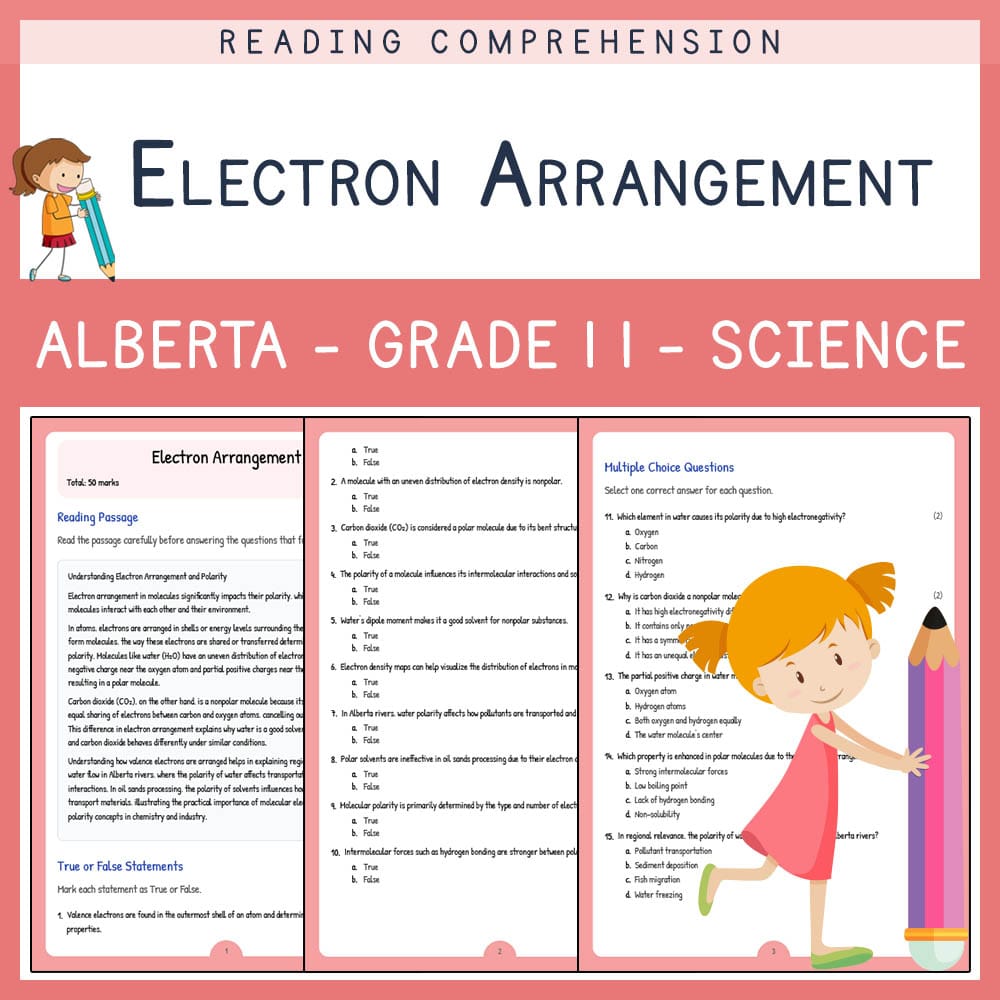
Grade 11 Science | Electron Arrangement Worksheet | Alberta Standards
Created byLumora LearningLearning Objectives
- Understand how valence electron distribution influences molecular polarity.
- Analyze how electron arrangement affects intermolecular interactions in molecules like water and carbon dioxide.
- Connect molecular electron density maps to observable polarity phenomena.
Also included in: Grade 11 Science | Matter and Chemical Bonding Custom Bundle | Alberta
Instant download

Grade 11 Science | Redox and Electrochemistry Worksheet (BC Standards)
Created byEvergreen Desk EducationLearning Objectives
- Determine oxidation numbers and identify oxidants and reductants in redox reactions.
- Balance redox equations using oxidation-number or half-reaction reasoning.
- Connect cell potential (E) to spontaneity and relate Gibbs free energy and equilibrium to measurable voltage.
Instant download
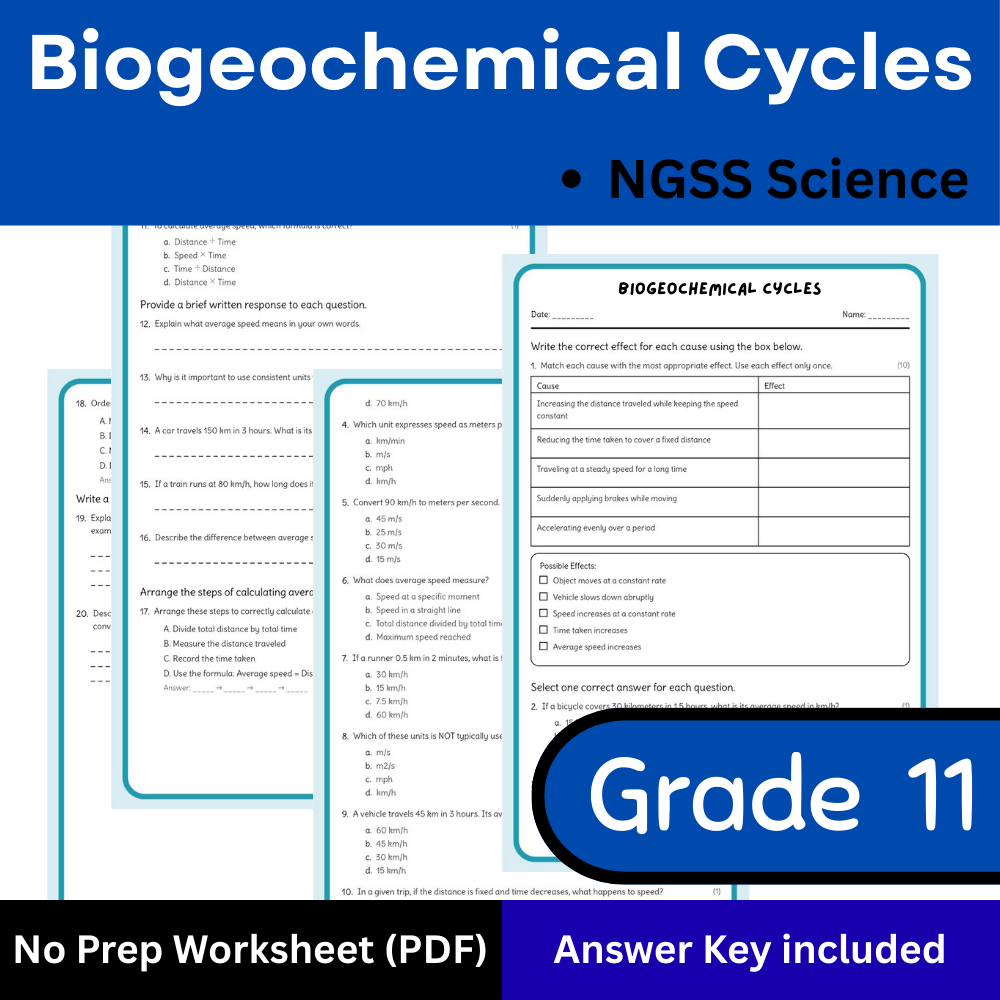
Grade 11 Science | Biogeochemical Cycles Worksheet (NGSS Aligned PDF)
Created byBright Mind ResourcesLearning Objectives
- Explain the main processes involved in the carbon, nitrogen, phosphorus, and water cycles.
- Describe how human activities alter biogeochemical pools and fluxes.
- Identify key processes like fixation, mineralization, nitrification, denitrification, sedimentation, and uptake.
Instant download

Titration Stoichiometry & Equivalence Point Calculations Worksheet Grade 11
 Created bySunny Desk Resources
Learning Objectives
- Explain how stoichiometry relates to titration at the equivalence point
- Calculate unknown concentration using titrant molarity and volume
- Apply balanced chemical equations to titration calculations
Also included in: Full Year Science • Grade 11 • Alberta
Instant download

Grade 11 Chemical Evidence Worksheet | Alberta Practice PDF
Created byClear Sky ClassroomLearning Objectives
- Identify chemical reactions using measurable macroscopic evidence such as color change, gas evolution, precipitate formation, and temperature/energy exchange.
- Connect observable particle changes to conservation principles in chemical reactions.
- Interpret statements and scenarios to determine whether chemical evidence supports that a reaction occurred.
Instant download
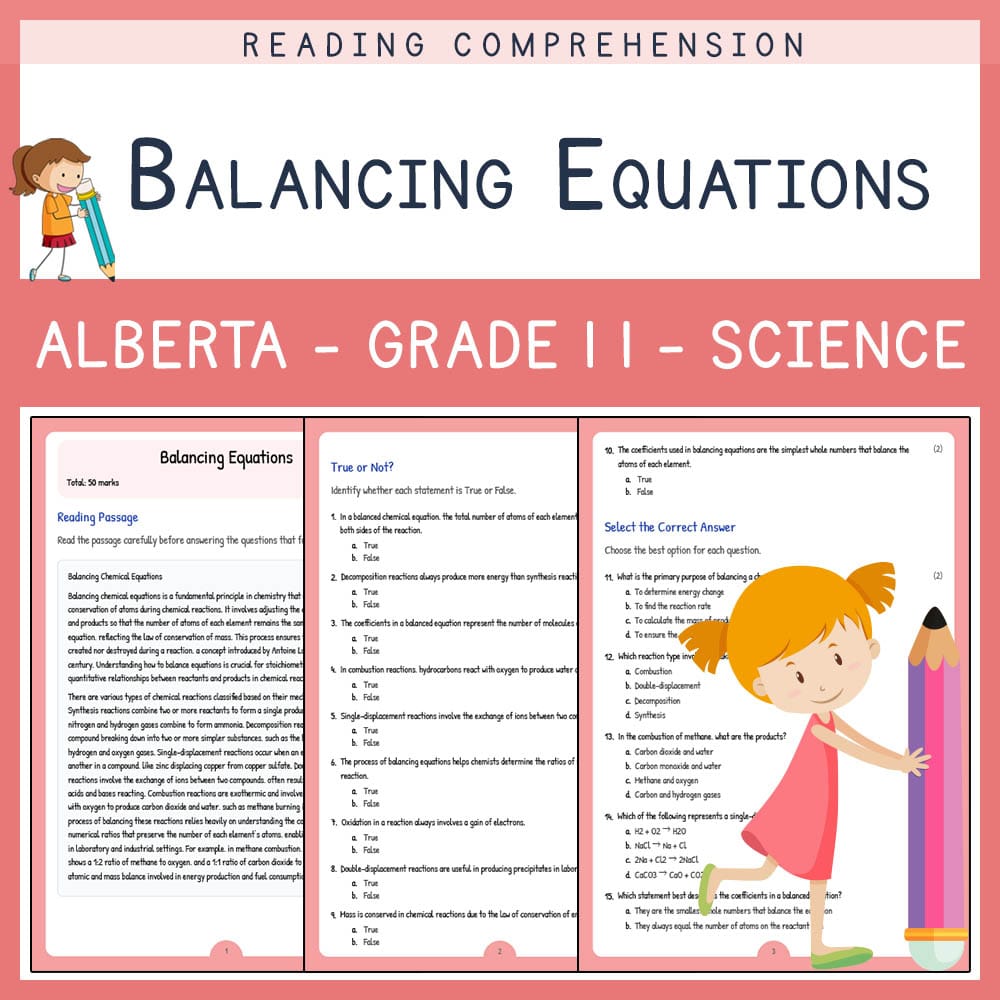
Grade 11 Science | Balancing Equations Worksheet | Alberta Standards
Created byLumora LearningLearning Objectives
- Explain the law of conservation of atoms in chemical reactions.
- Identify different types of chemical reactions such as synthesis, decomposition, single- and double-displacement, and combustion.
- Understand the role of stoichiometric coefficients in balancing chemical equations.
Instant download
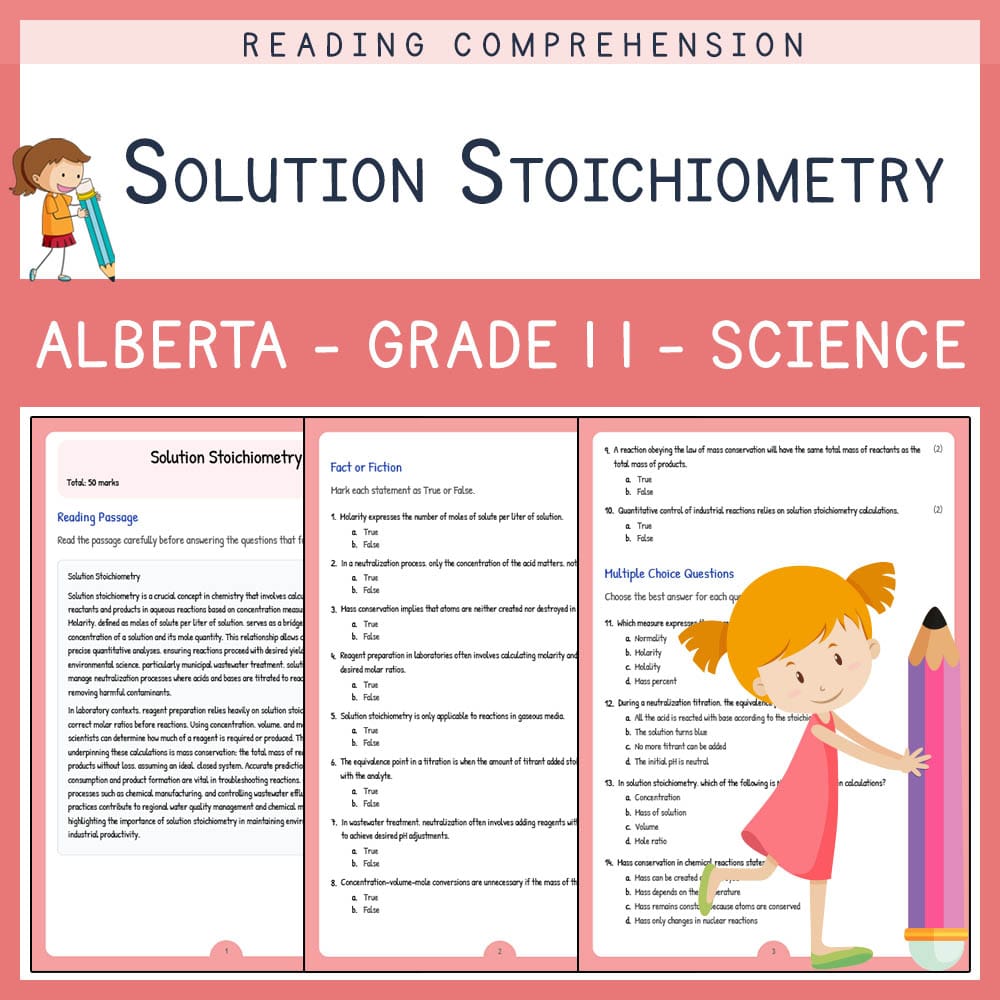
Grade 11 Science | Solution Stoichiometry Worksheet Elena | Alberta Standards
Created byLumora LearningLearning Objectives
- Understand the relationship between concentration, volume, and mole calculations in aqueous reactions.
- Apply mole relationships and equivalence concepts to predict reactant and product amounts.
- Utilize concentration-volume-mole conversions to support quantitative analysis in environmental and industrial contexts.
Instant download
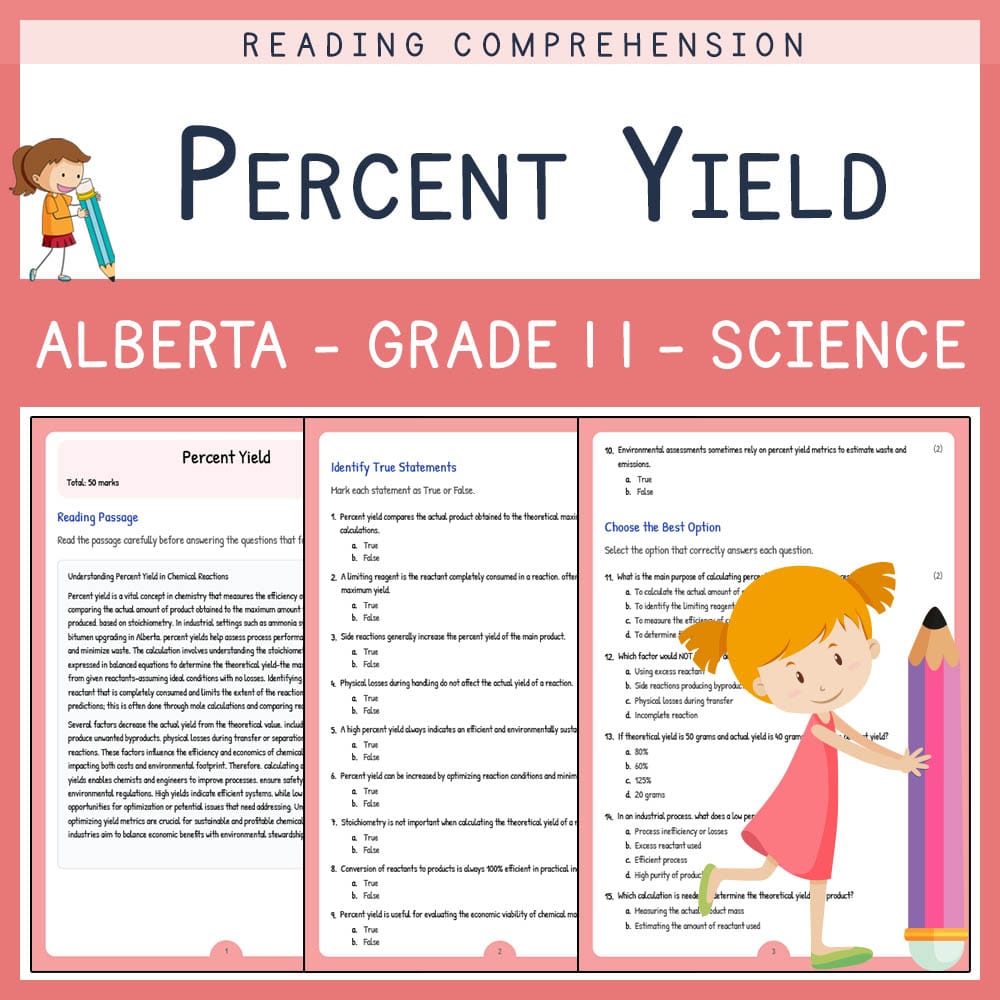
Grade 11 Science | Percent Yield Worksheet | Alberta Standards
Created byLumora LearningLearning Objectives
- Understand how to calculate theoretical and actual yield in chemical reactions.
- Identify factors that affect the efficiency of chemical processes and how to interpret yield metrics.
- Determine the limiting reagent in reactions to predict maximum product formation.
Instant download
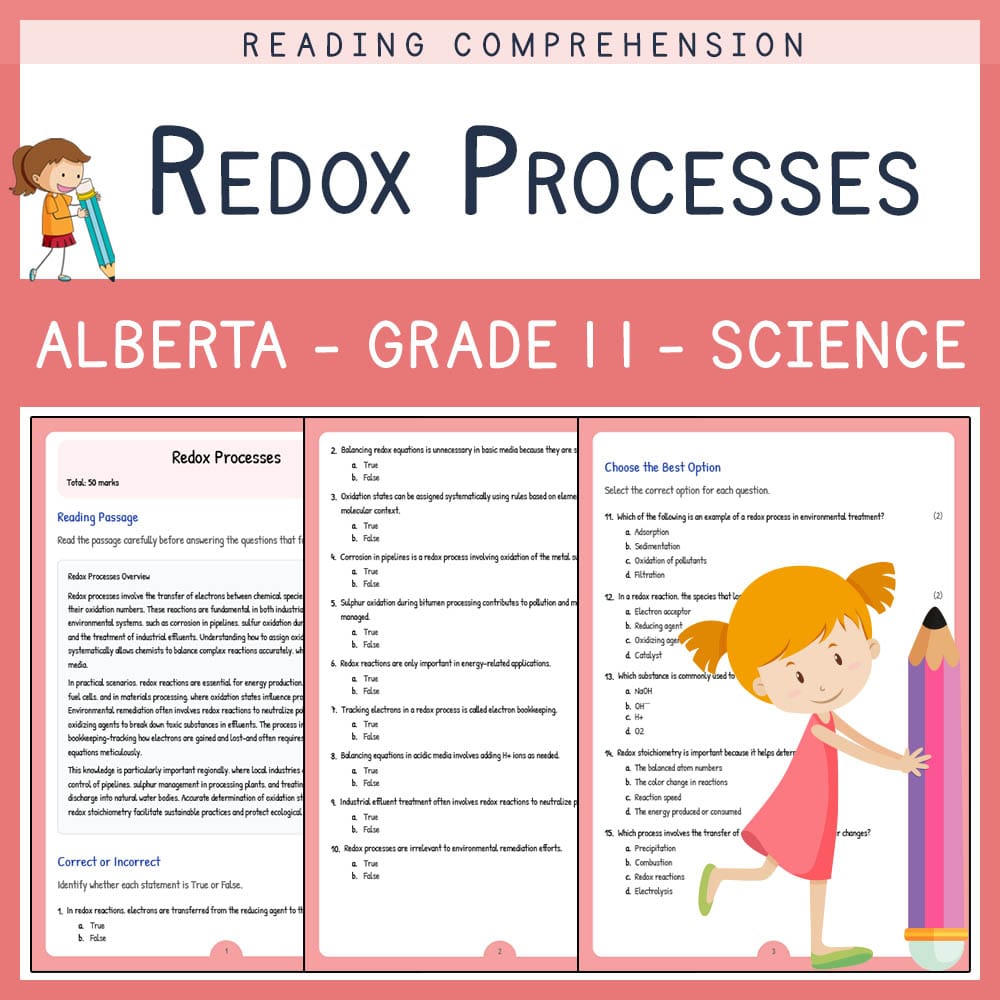
Grade 11 Science | Redox Processes Worksheet | Alberta Standards
Created byLumora LearningLearning Objectives
- Understand the systematic determination of oxidation states in redox reactions.
- Learn to balance redox equations in acidic and basic media.
- Explore the role of redox stoichiometry in energy production, materials processing, and environmental remediation.
Instant download
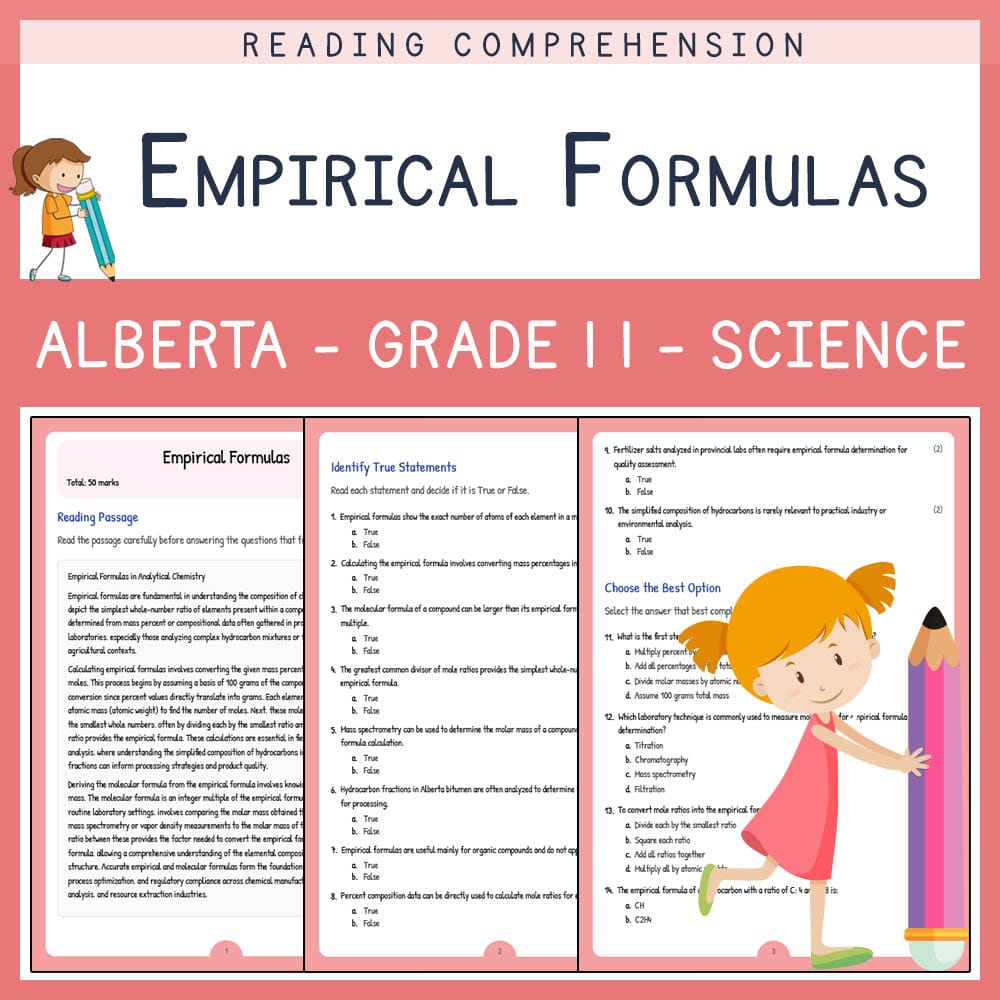
Grade 11 Science | Empirical Formulas Worksheet | Alberta Standards
Created byLumora LearningLearning Objectives
- Understand how empirical formulas are derived from mass percent and compositional data.
- Learn to convert percent composition to mole ratios for elements in a compound.
- Determine empirical and molecular formulas from analytical data.
Instant download
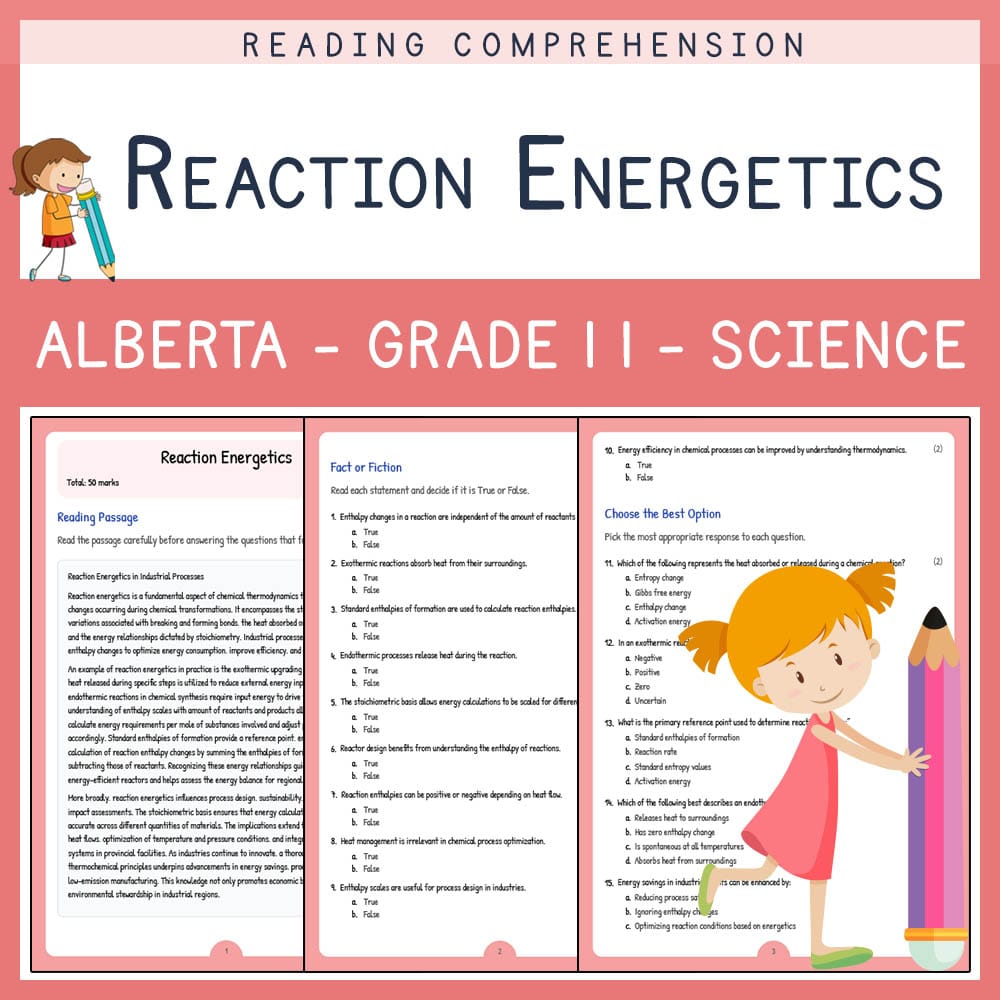
Grade 11 Science | Reaction Energetics Worksheet | Alberta Standards
Created byLumora LearningLearning Objectives
- Explain how enthalpy changes relate to chemical reactions and energy transfer.
- Calculate reaction enthalpies using standard enthalpies of formation.
- Understand the implications of reaction energetics on process efficiency and industrial applications.
Instant download
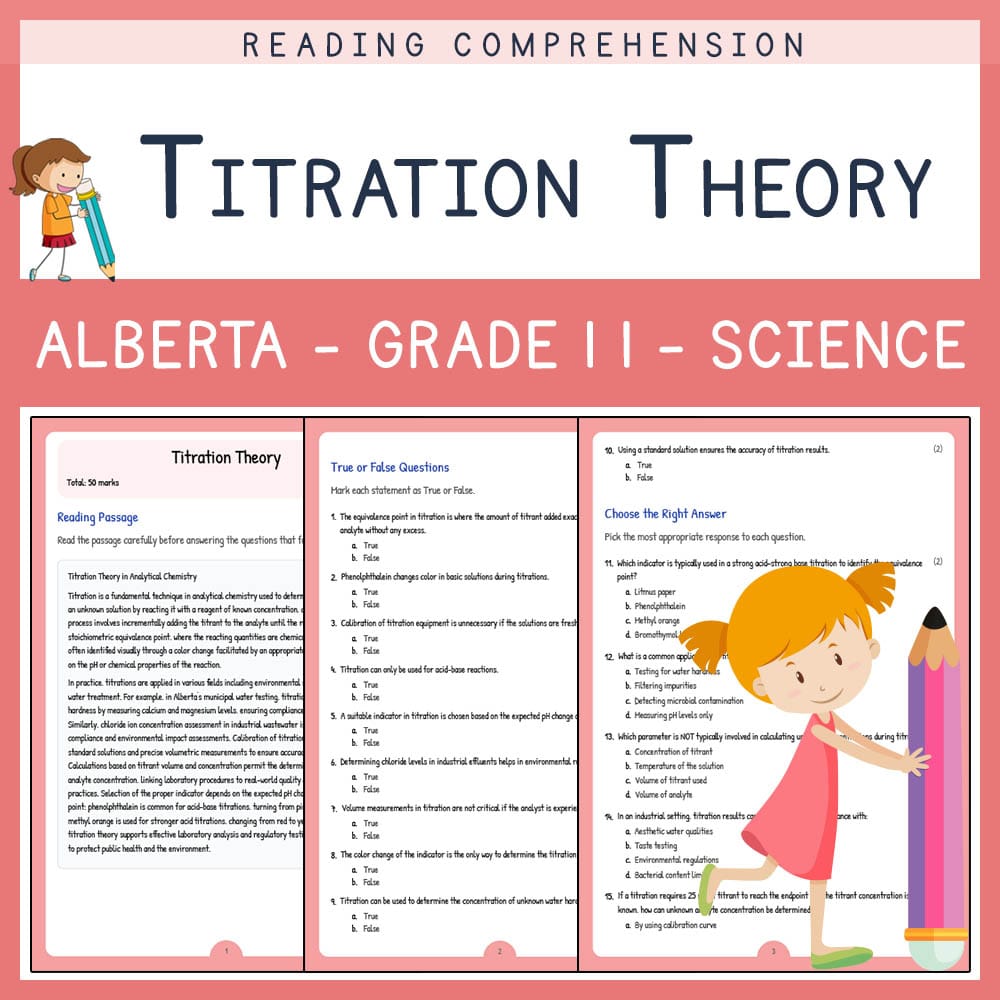
Grade 11 Science | Titration Theory Worksheet | Alberta Standard
Created byLumora LearningLearning Objectives
- Understand the principles and processes involved in titration analysis.
- Identify the components of a titration setup, including indicators and calibration.
- Calculate unknown concentrations based on titrant volumes and known parameters.
Instant download
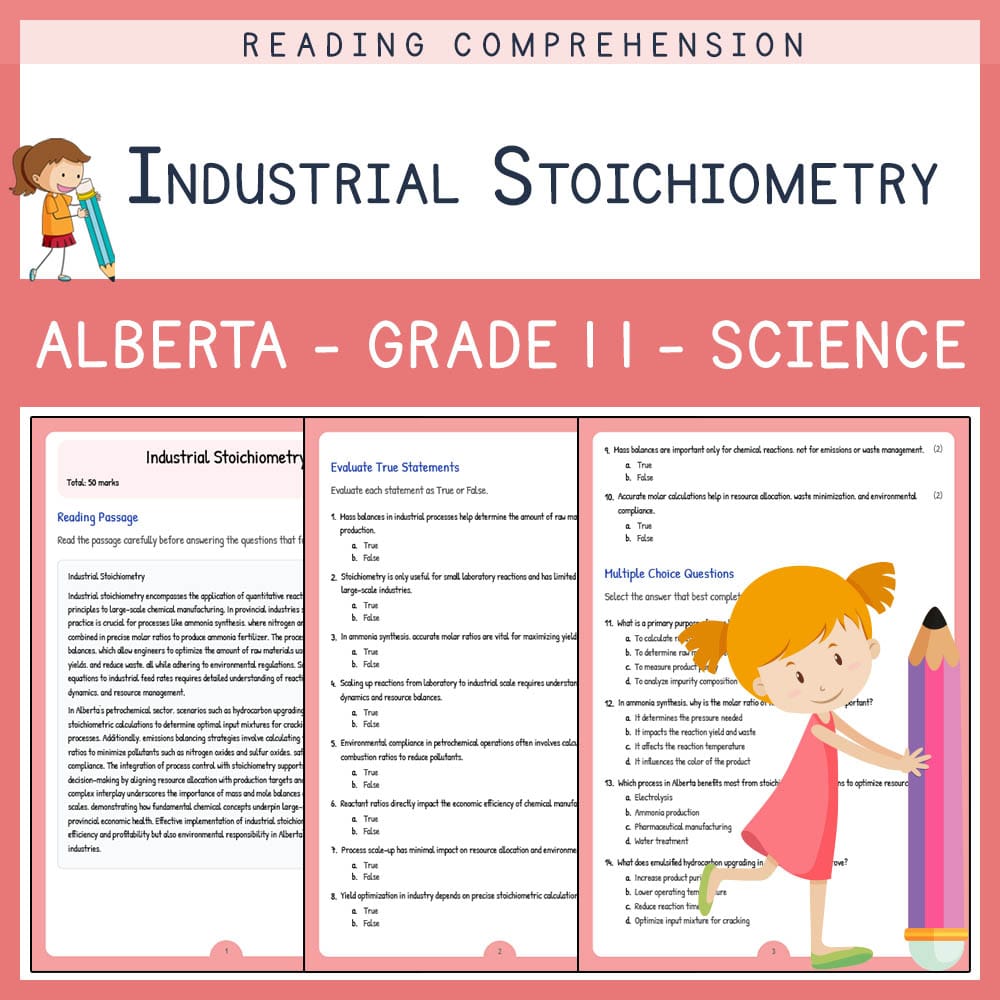
Grade 11 Science | Industrial Stoichiometry Worksheet | Alberta Standards
Created byLumora LearningLearning Objectives
- Understand the principles of stoichiometric calculations in large-scale industrial processes.
- Apply mass and mole balances to real-world chemical production scenarios.
- Interpret process data related to ammonia synthesis, hydrocarbon upgrading, and emissions management.
Instant download
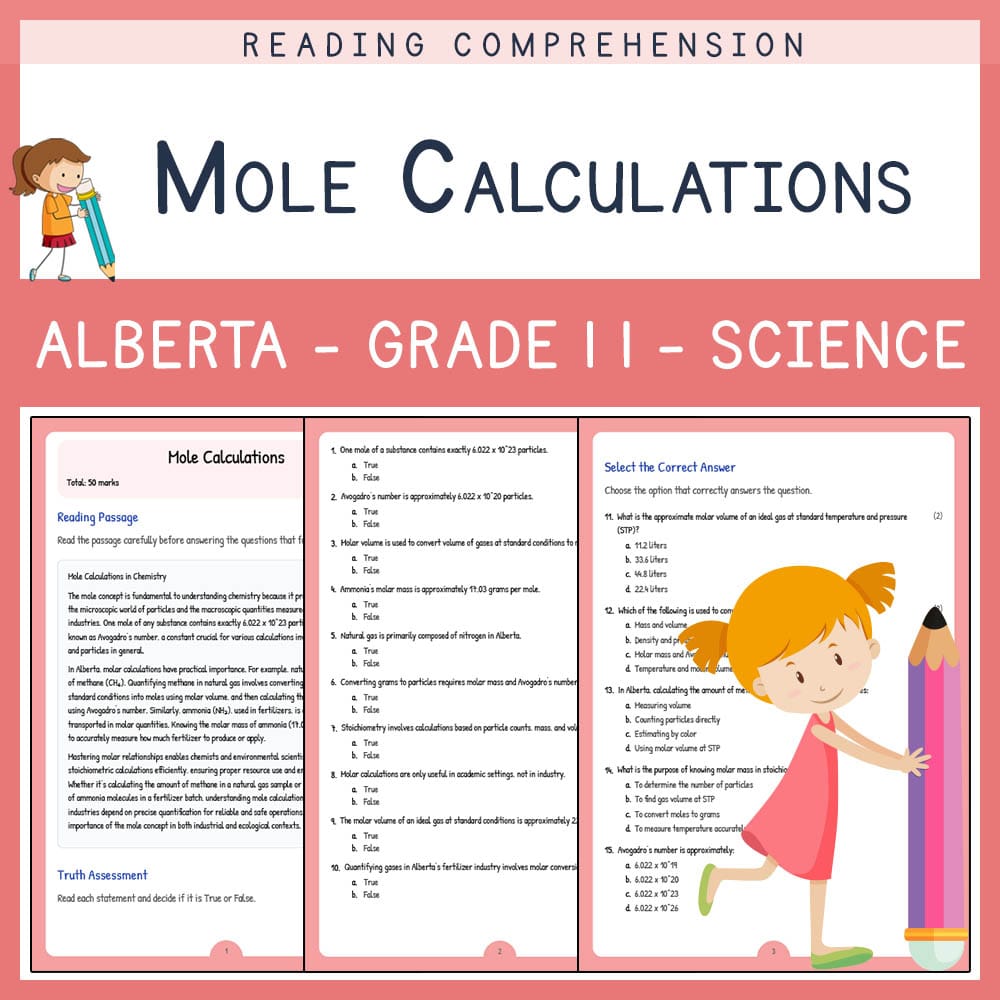
Grade 11 Science | Mole Calculations Worksheet | Alberta Standards
Created byLumora LearningLearning Objectives
- Understand the concept of the mole and its application in quantitative chemistry.
- Learn to convert between grams, moles, and particles using molar mass and Avogadro's number.
- Apply molar calculations to real-world Alberta contexts such as natural gas and fertilizer compounds.
Instant download
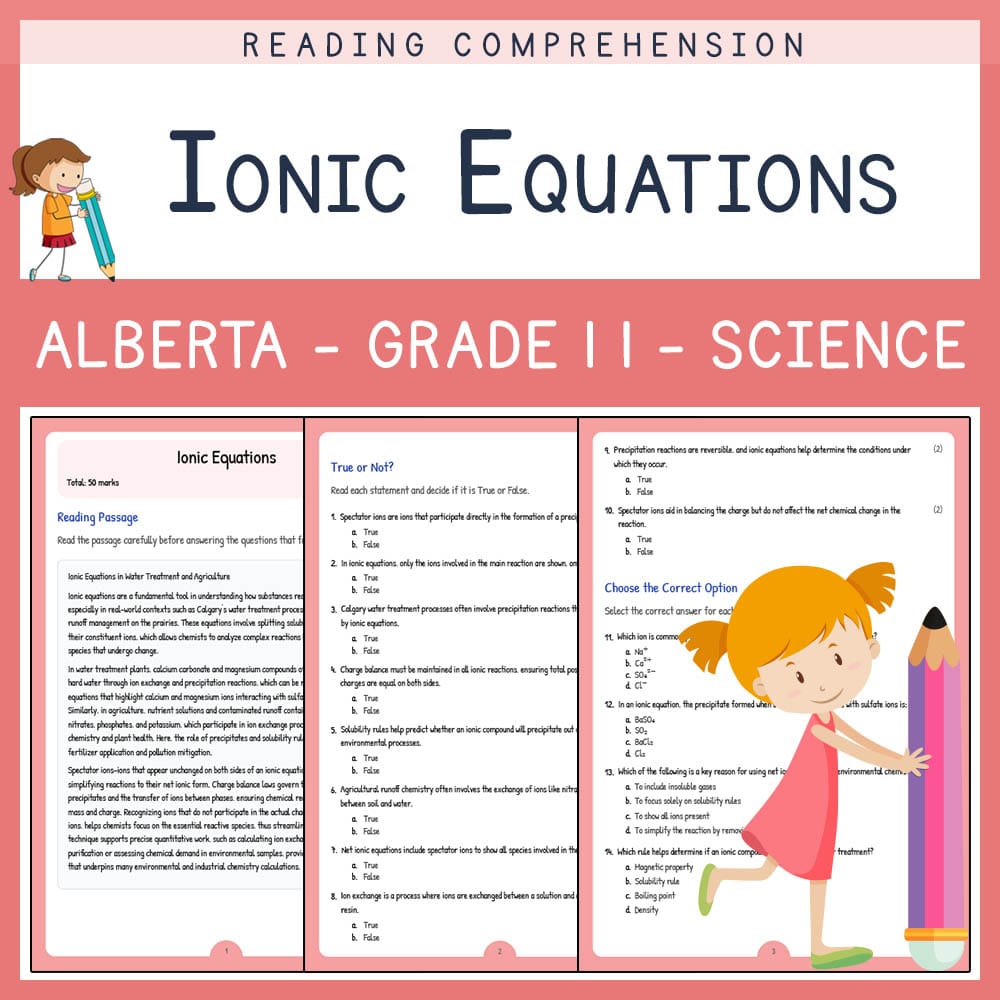
Grade 11 Science | Ionic Equations Worksheet | Alberta Standards
Created byLumora LearningLearning Objectives
- Understand how to convert chemical reactions into ionic equations, including complete and net forms.
- Identify spectator ions and distinguish them from reacting species in aqueous solutions.
- Apply charge balance and solubility rules to balance ionic equations accurately.
Instant download

Grade 11 Trophic Levels Worksheet | Florida NGSSS Ecology with Answer Key
Created byEvergreen Desk EducationLearning Objectives
- Explain how energy flows through trophic levels from producers to higher-level consumers
- Describe why biomass and population size generally decrease at higher trophic levels
- Interpret how energy loss (as heat) affects ecosystem productivity and the number of steps in food chains
Instant download

Grade 11 Science – Speciation & Phylogeny | Daily Reading Worksheet
Created byBright Mind ResourcesLearning Objectives
- Understand the mechanisms that lead to the formation of new species
- Identify different modes of speciation such as allopatric and sympatric
- Interpret phylogenetic trees and understand their significance in evolution
Also included in: Evolution Grade 11 Science Daily Reading Worksheets Lesson Bundle | NGSS +2 more
Instant download

Grade 11 Science -Mechanisms of Selection & Natural Selection |Reading Worksheet
Created byBright Mind ResourcesLearning Objectives
- Define natural selection and explain its role in evolution.
- Identify factors that influence natural selection, such as genetic variation and environmental pressures.
- Analyze examples of natural selection, including finch beak variation and industrial melanism.
Also included in: Evolution Grade 11 Science Daily Reading Worksheets Lesson Bundle | NGSS +2 more
Instant download

Grade 11 Science – Population Genetics & Statistics Daily Reading Worksheet
Created byBright Mind ResourcesLearning Objectives
- Understand the concept of allele frequencies in populations.
- Explain the Hardy–Weinberg equilibrium and its significance.
- Calculate expected genotype frequencies using allele frequencies.
Also included in: Evolution Grade 11 Science Daily Reading Worksheets Lesson Bundle | NGSS +2 more
Instant download

Mole Concept Worksheet Elena | BC Science Standards Grade 11
Created byLumora LearningLearning Objectives
- Understand the fundamental principles of the mole concept and its significance in chemistry.
- Apply molar mass and Avogadro's number to convert between mass, particles, and volume.
- Perform calculations involving moles, mass, and number of particles in chemical reactions.
Also included in: Grade 11 Science | Chemistry Lesson Bundle Worksheet | BC-Aligned
Instant download
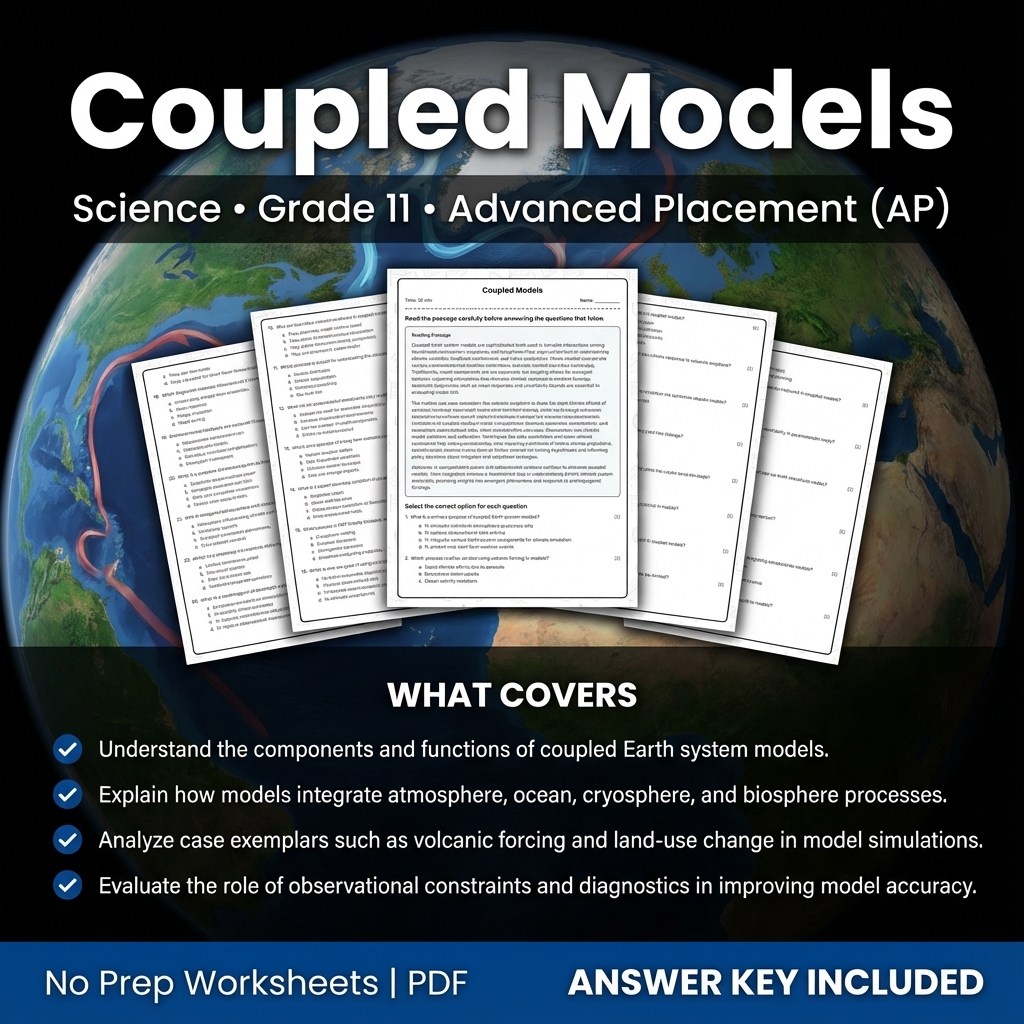
11th Grade Science | Coupled Models Worksheet (Printable PDF + Answer Key)
Created byCoral Reef LearningLearning Objectives
- Understand the components and functions of coupled Earth system models.
- Explain how models integrate atmosphere, ocean, cryosphere, and biosphere processes.
- Analyze case exemplars such as volcanic forcing and land-use change in model simulations.
Also included in: Grade 11 Science Unit Bundle – Earth Systems, Energy & Cycles Worksheets +1 more
Instant download
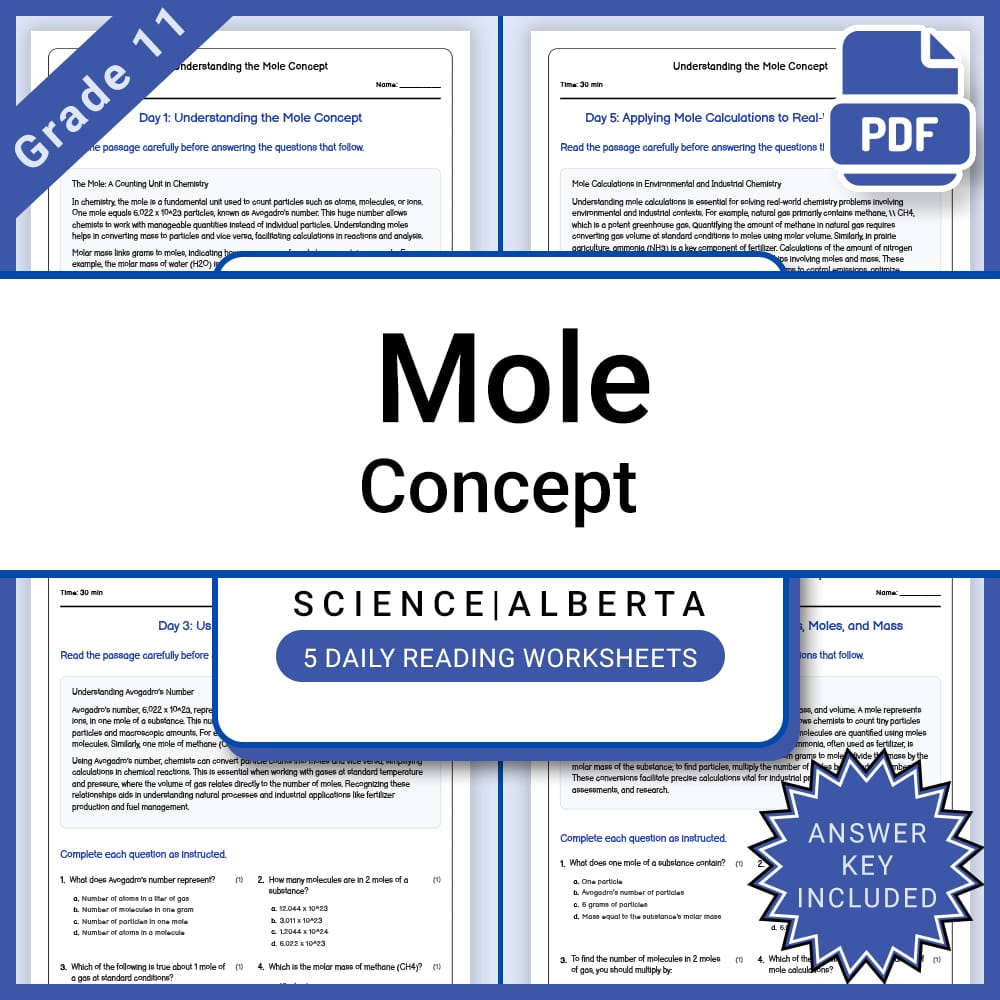
Grade 11 Science – Mole Concept Daily Reading Worksheet with Answer Key
JCreated byJ.S SheetsLearning Objectives
- Understand key concepts related to Science
- Apply knowledge through practice questions
- Demonstrate comprehension of the material
Also included in: Grade 11 Science Lesson Bundle | Core Concepts & Theories in Chemistry & Physics +1 more
Instant download
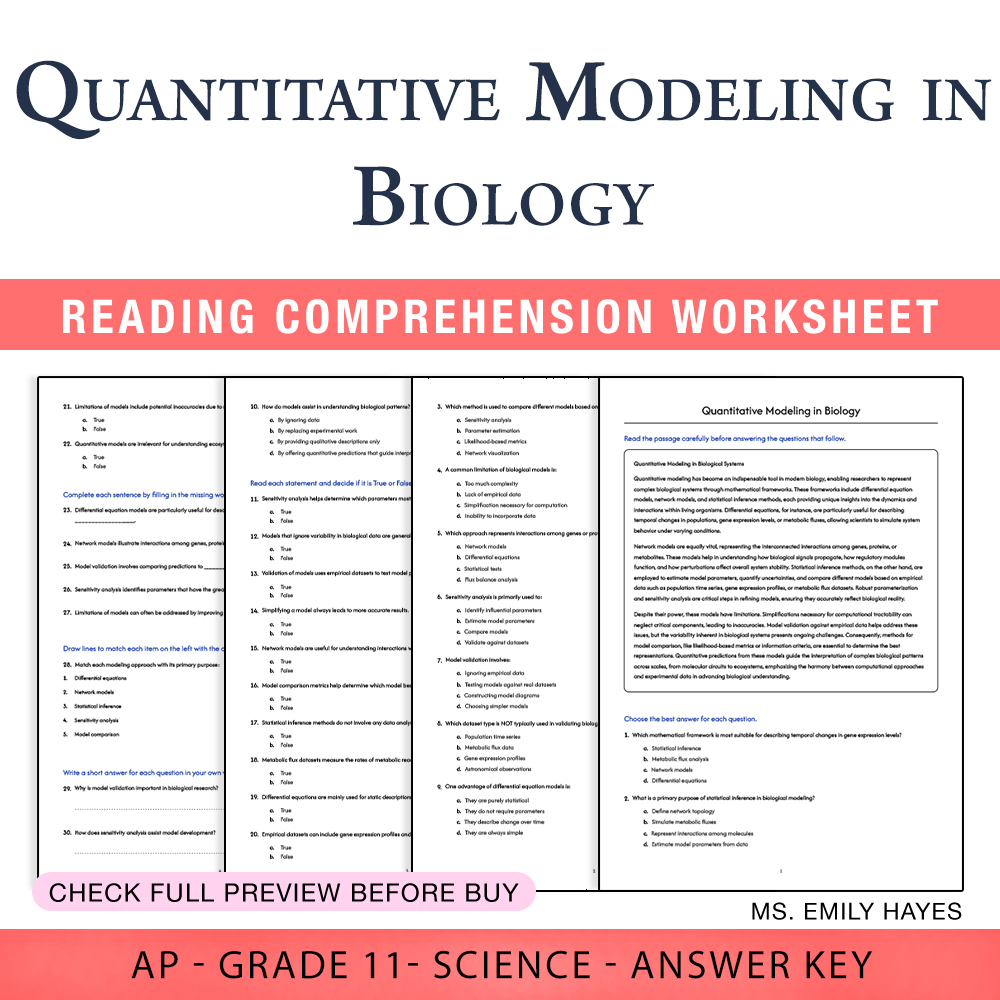
11th Grade Science |Quantitative Modeling in Biology Worksheet (PDF+ Answer Key)
Created byCopper Leaf ClassroomLearning Objectives
- Understand various quantitative approaches used to model biological systems.
- Analyze the role of parameterization, sensitivity analysis, and validation in model development.
- Interpret empirical datasets through the lens of mathematical and statistical models.
Also included in: Grade 11 Science | Biology & Ecosystems AP Worksheet Bundle (PDF+ Answer Keys) +1 more
Instant download

Grade 11 Worksheet B: Computational Modeling Worksheet | NGSS Practice PDF
Created byClear Sky ClassroomLearning Objectives
- Explain how computational simulations use equations, parameters, and boundary conditions to represent real systems.
- Use validation and parameter sensitivity analysis to judge how reliable a computational model is.
- Interpret scenario-based simulation results to compare engineering design options and possible failure modes.
Also included in: Grade 11 Engineering Design and Computational Modeling Science NGSS +1 more
Instant download

Grade 11 Science Worksheet B: Problem Definition Worksheet | NGSS Practice PDF
Created byClear Sky ClassroomLearning Objectives
- Formulate a clear engineering/scientific problem definition using measurable qualitative and quantitative criteria.
- Identify and prioritize constraints (economic, sustainability, regulatory, and technical) for acceptable solutions.
- Construct conceptual models that connect causes to effects and support generating multiple solution approaches.
Also included in: Grade 11 Engineering Design and Computational Modeling Science NGSS +1 more
Instant download

Grade 11 Science | Intermolecular Forces - Daily Reading Comprehension
Created byCoral Reef LearningLearning Objectives
- Understand the different types of intermolecular forces including dipole-dipole interactions, hydrogen bonding, and London dispersion forces.
- Explain how intermolecular forces influence physical properties such as boiling points and viscosity.
- Compare substances with similar molecular formulas but different intermolecular forces to understand their solubility and phase behavior.
Instant download

Grade 11 Science – Gene Expression & Regulation | Daily Reading Worksheet
Created byBright Mind ResourcesLearning Objectives
- Understand the basic concepts of gene regulation mechanisms
- Identify key elements involved in transcriptional initiation and post-transcriptional modification
- Recognize the role of promoter architecture, transcription factors, chromatin remodeling, and epigenetic marks
Also included in: Grade 11 Cell Organelle Science Daily Reading Worksheets Lesson Bundle | AP +2 more
Instant download
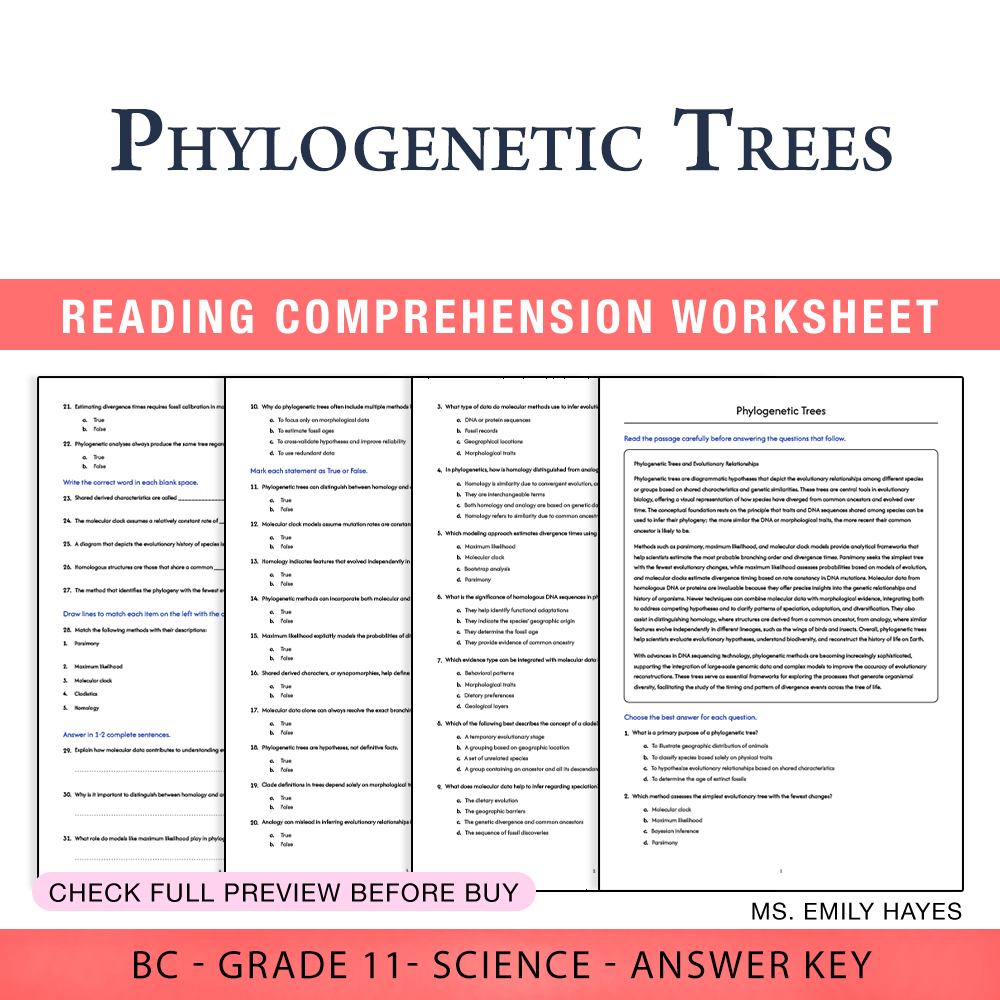
11th Grade Science | Phylogenetic Trees Worksheet (PDF + Answer Key)
Created byCopper Leaf ClassroomLearning Objectives
- Understand how phylogenetic trees illustrate hypotheses of evolutionary relationships.
- Interpret molecular and morphological data to infer common ancestry and divergence times.
- Differentiate between homology and analogy in the context of evolutionary biology.
Also included in: Grade 11 Science BC | Genetics, Evolution & Cell Biology (PDF + Answer Keys) +1 more
Instant download
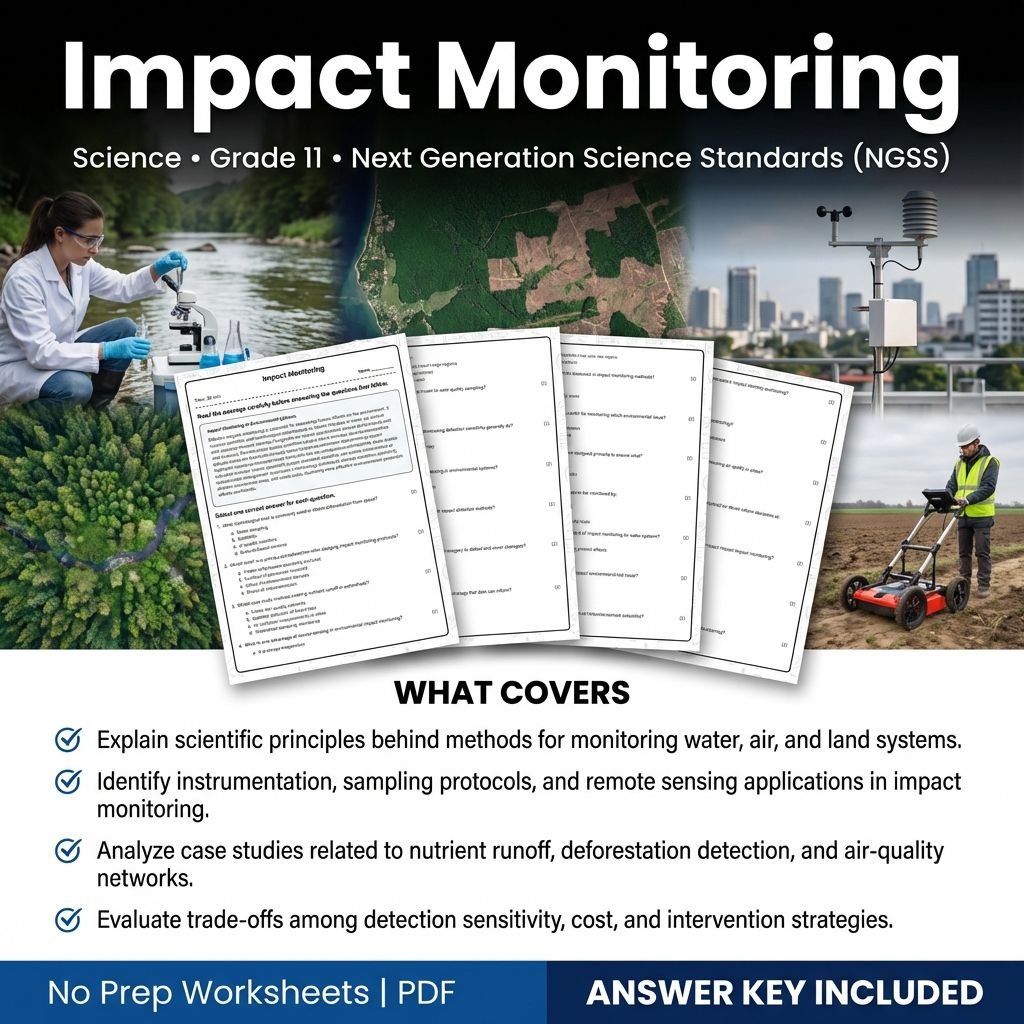
Grade 11 Science | Impact Monitoring Worksheet & Answer Key (Printable PDF)
Created byCoral Reef LearningLearning Objectives
- Explain scientific principles behind methods for monitoring water, air, and land systems.
- Identify instrumentation, sampling protocols, and remote sensing applications in impact monitoring.
- Analyze case studies related to nutrient runoff, deforestation detection, and air-quality networks.
Also included in: Grade 11 Science Unit Bundle – Sustainable Management & Environmental Models +1 more
Instant download

Grade 11 Science – Friction & Forces | Daily Reading Worksheet
Created byBright Mind ResourcesLearning Objectives
- Understand the difference between static and kinetic friction
- Describe how friction depends on surface properties and normal force
- Recognize real-world examples of static and kinetic friction
Also included in: Motion & Forces Grade 11 Science Daily Reading Worksheets Lesson Bundle | BC +1 more
Instant download
About Grade 11 Science Worksheets
Browse 6,616 printable Grade 11 Science worksheets — ready-to-print PDFs with answer keys where available.
Each resource here is built by an independent educator and reviewed for quality. Worksheets print straight from PDF and suit classroom use, homework, or extra practice; most come with answer keys, and you can preview before purchasing.