
Grade 6 ELA Worksheets
1,085 worksheets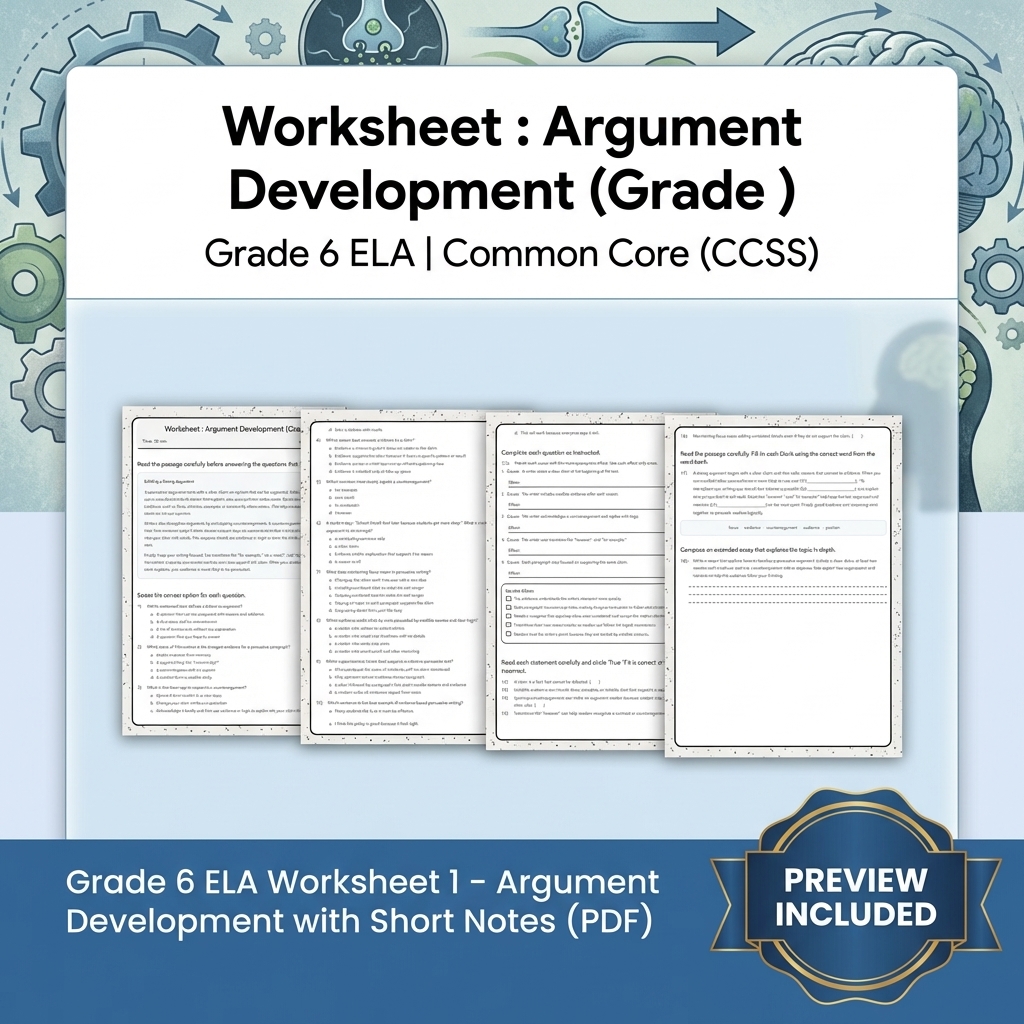
Grade 6 ELA Worksheet Argument Development with Short Notes (PDF)
 Created byMeadowlark Worksheets
Learning Objectives
- Write a clear claim and support it with relevant evidence in a persuasive argument.
- Explain how reasons and evidence help convince an audience logically.
- Address at least one counterargument and respond to it to strengthen an argument.
Also included in: Grade 6 Supporting Evidence ELA Lesson Bundle: Common Core CCSS Writing +1 more
Instant download

Grade 6 Comprehension Focus Worksheet | Ontario ELA Reading Skills Practice
 Created bySunny Desk Resources
Learning Objectives
- Identify main ideas and supporting details across sentences in a text
- Use context clues to determine the meaning of unfamiliar words
- Explain how background information helps the reader understand events and concepts
Instant download

Editing Skills Worksheet for Grade 6 ELA Practice and Review
Created bySunny Desk ResourcesLearning Objectives
- Identify and correct common grammar, punctuation, and usage errors while editing.
- Apply editing strategies to improve clarity and sentence structure.
- Use writing conventions appropriate to the intended genre and purpose.
Also included in: Grade 6 ELA Writing Lesson Bundle: Argument, Narrative & Informative CCSS +1 more
Instant download

Grade 6 ELA – Sentence Variety & Writing | Daily Reading Worksheet
 Created byQuiet Forest Education
Learning Objectives
- Identify simple sentences in reading passages and examples.
- Understand the structure of simple sentences.
- Construct correct and clear simple sentences.
Also included in: Language Grammar Grade 6 Daily Reading Worksheets Bundle | CCSS +1 more
Instant download

Author Purpose Worksheet for Grade 6 ELA | Standards-Aligned Practice
JCreated byJ.S SheetsLearning Objectives
- Identify an author’s purpose for writing (to inform, persuade, entertain, or explain).
- Analyze how purpose affects word choice, evidence, and the structure of a text.
- Distinguish main ideas from supporting details in passages with an identified purpose.
Instant download

Grade 6 ELA – Conventions of Standard English Daily Worksheet | CCSS Aligned
Created byQuiet Forest EducationLearning Objectives
- Understand the proper use of commas in compound sentences.
- Recognize correct punctuation in sentences.
- Apply capitalization rules for proper nouns.
Also included in: Language Grammar Grade 6 Daily Reading Worksheets Bundle | CCSS +1 more
Instant download

Evidence for Claims Worksheet | Grade 6 ELA Practice Aligned to Standards
JCreated byJ.S SheetsLearning Objectives
- Identify a central claim in informational writing about causes, processes, or interpretations.
- Support a claim by citing specific textual evidence (quoted or paraphrased) that matches the author’s meaning.
- Evaluate whether evidence is relevant and accurately represented, avoiding vague impressions.
Instant download

Point of View Worksheet Pack | Grade 6 ELA Practice
Created bySunny Desk ResourcesLearning Objectives
- Explain how an author’s point of view affects the way information is presented in a text.
- Identify bias or perspective by analyzing language choices, tone, and evidence.
- Compare statements to determine whether they reflect a neutral perspective or a specific viewpoint.
Also included in: Grade 6 Reading Comprehension Strategies Lesson Bundle | ELA | CCSS +1 more
Instant download

Author Purpose Worksheet | Grade 6 ELA Practice and Assessment
Created bySunny Desk ResourcesLearning Objectives
- Identify the author’s purpose (inform, persuade, entertain, or explain) in a text
- Use evidence from a passage (claims, examples, details, and word choice) to justify an author’s purpose
- Distinguish between main claims and supporting details in opinion-style writing
Also included in: Grade 6 Reading and Viewing Lesson Bundle | Alberta ELA Framework +1 more
Instant download

Purposeful Presenting Worksheet for Grade 6 ELA | Standards-Aligned Practice
JCreated byJ.S SheetsLearning Objectives
- Explain how a speaker’s purpose affects the selection of main ideas, supporting details, and evidence in an informational presentation.
- Identify main ideas and supporting details and use logical sequencing to understand presented information.
- Use signposting language and clear topic sentences to improve clarity and organization in a spoken or written presentation.
Instant download

Narrative Crafting Worksheet Pack | Grade 6 ELA Practice
Created bySunny Desk ResourcesLearning Objectives
- Identify the key parts of a narrative (character, setting, plot, and point of view)
- Use clear sequencing to make events in a story easy to follow
- Write with vivid details and craft choices that strengthen a personal or imagined narrative
Also included in: Grade 6 ELA Writing Lesson Bundle: Argument, Narrative & Informative CCSS +1 more
Instant download
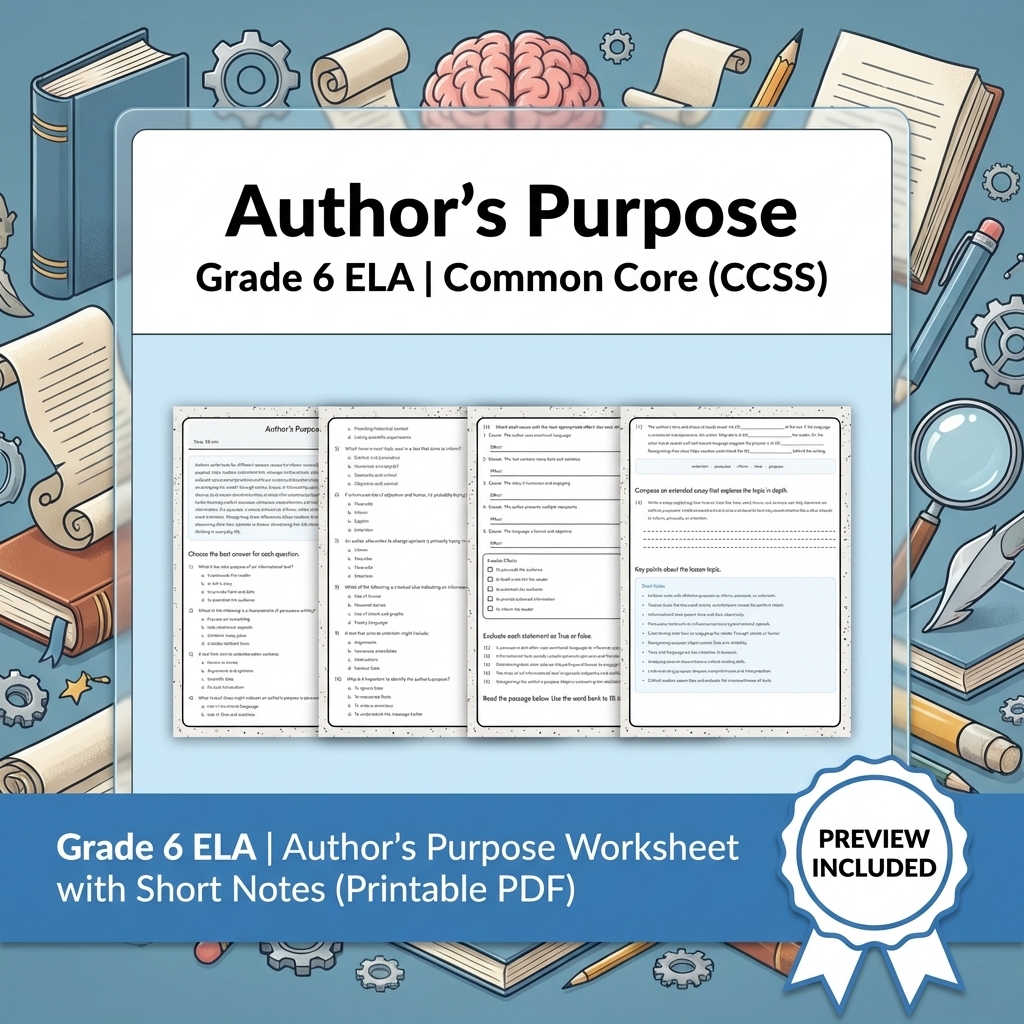
Grade 6 ELA | Author's Purpose Worksheet with Short Notes (Printable PDF)
Created byMeadowlark WorksheetsLearning Objectives
- Identify the different purposes an author might have when writing a text.
- Analyze textual clues and tone to determine whether the author aims to inform, persuade, or entertain.
- Distinguish between informational, persuasive, and entertainment texts through critical reading skills.
Also included in: Grade 6 ELA Text Evidence Comprehension Worksheets Lesson Bundle (CCSS) +1 more
Instant download

Grade 6 ELA | Infographic Details Worksheet | Alberta Standards
 Created byLumora Learning
Learning Objectives
- Interpret key infographic features such as titles, legends, axes, scales, labels, and icons to understand claims.
- Connect information from visuals to accompanying text to draw accurate conclusions.
- Evaluate how numbers and comparisons in infographics should be read using units and scale marks.
Instant download

Section Summaries Worksheet for Grade 6 ELA | Standards-Aligned Practice
JCreated byJ.S SheetsLearning Objectives
- Identify a section’s main idea and choose the most relevant supporting details for a summary.
- Write concise summaries that preserve the author’s purpose without repeating every sentence.
- Organize a summary in the same logical order as the text (claim first, then evidence).
Instant download

Clarifying Questions Worksheet Pack | Grade 6 ELA Practice
Created bySunny Desk ResourcesLearning Objectives
- I can ask clarifying questions that target specific details, definitions, or steps in reasoning.
- I can use question stems to request examples, evidence, or rewording when something is unclear.
- I can revise my questions to stay relevant to the topic being discussed.
Also included in: Speaking and Listening Lesson Bundle | Grade 6 ELA | BC +1 more
Instant download

Vocabulary Refinement Worksheet for Grade 6 | ELA Standard Practice
JCreated byJ.S SheetsLearning Objectives
- Refine word choice by selecting synonyms that match meaning and connotation in context
- Use surrounding context clues to determine the precise meaning of unfamiliar words
- Improve coherence by using thematic vocabulary consistently across related ideas
Instant download

Grade 6 ELA – Understanding Sentence Components | Daily Reading Worksheet
Created byQuiet Forest EducationLearning Objectives
- Identify subjects in simple sentences
- Recognize the role of subjects within sentence structure
- Differentiate between subjects and predicates
Also included in: Language Grammar Grade 6 Daily Reading Worksheets Bundle | CCSS +1 more
Instant download

6th Grade ELA Building on Peers Worksheet (Alberta Standards | PDF)
 Created byGolden Apple Studio
Learning Objectives
- Use discussion moves (paraphrasing, connecting, and asking follow-up questions) to refine ideas with classmates.
- Respond respectfully to disagreement by using reasoning or evidence instead of personal comments.
- Identify and practice claim-and-counterclaim moves to strengthen a collaborative discussion goal.
Also included in: Grade 6 ELA Discussion & Synthesis Lesson Bundle: Alberta Worksheet Set +1 more
Instant download

6th Grade ELA | Author Purpose Worksheet (Alberta) with Answer Key (PDF)
Created byGolden Apple StudioLearning Objectives
- Identify an author’s purpose (to inform, persuade, entertain, or explain) in different texts.
- Explain how purpose affects structure, evidence, and word choice.
- Distinguish main claims from supporting details and recognize bias or viewpoint signaled by language.
Also included in: Grade 6 Reading Comprehension Skills in ELA Lesson Bundle: Alberta Framework +1 more
Instant download

Conventions of Standard English Worksheet Pack | Grade 6 ELA Activities
Created bySunny Desk ResourcesLearning Objectives
- Use standard capitalization rules for proper nouns and titles
- Apply correct punctuation, including commas in compound sentences
- Use spelling conventions to produce clear, accurate writing
Also included in: Grade 6 ELA Word Choice, Grammar & Sentence Variety Lesson Bundle | Common Core +1 more
Instant download

Grade 6 ELA – Purpose Tailoring in Media Texts | Daily Reading Worksheet
Created byQuiet Forest EducationLearning Objectives
- Identify the purpose of persuasive advertisements.
- Understand how purpose influences structure and content of media texts.
- Differentiate between various media formats based on their purpose.
Also included in: Grade 6 Media Literacy ELA Daily Reading Worksheets Lesson Bundle | BC +1 more
Instant download

6th Grade ELA - Heading Structures Worksheet (PDF) | Alberta Standards
Created byGolden Apple StudioLearning Objectives
- Identify how titles, subheadings, and sectional labels organize information in a text.
- Use heading structure to predict content and confirm meaning while reading.
- Compare sections by noticing what headings suggest about main ideas, details, and sequence.
Also included in: Grade 6 Reading Comprehension Skills in ELA Lesson Bundle: Alberta Framework +1 more
Instant download

Parts of Speech Worksheet Grade 6 ELA Ontario Grammar Practice + Answer Key
Created byLumora LearningLearning Objectives
- Identify common parts of speech (nouns, verbs, adjectives, adverbs, pronouns, prepositions, conjunctions, interjections) in sentences.
- Determine how adverbs and adjectives change meaning and tone in descriptive writing.
- Use accurate parts of speech to improve clarity and precision in a short descriptive paragraph.
Instant download

6th Grade ELA | Sentence Variety Worksheet (PDF) Aligned to Alberta Standards
Created byGolden Apple StudioLearning Objectives
- Identify how simple, compound, and complex sentences affect meaning and readability in a draft.
- Revise run-on sentences and sentence fragments by changing punctuation and/or sentence boundaries.
- Combine or split sentences to improve flow, emphasis, and logical structure.
Also included in: Grade 6 ELA Sentence, Evidence & Revision Lesson Bundle – Alberta +1 more
Instant download

6th Grade ELA Worksheet | Evaluating Arguments (CCSS) Practice (PDF)
Created byGolden Apple StudioLearning Objectives
- Identify the claim, evidence, reasoning, and counterargument in an informational text.
- Evaluate whether evidence supports a claim and whether reasoning is logical and valid.
- Recognize common logical fallacies and explain why they weaken an argument.
Also included in: Grade 6 ELA Reading & Text Analysis Lesson Bundle | CCSS +1 more
Instant download

6th Grade ELA Worksheet | Context Clues Meaning (PDF) for Comprehension
Created byGolden Apple StudioLearning Objectives
- Use surrounding sentences to determine the meaning of unfamiliar words and phrases in a text.
- Identify how definitions, restatements, comparisons, and examples provide context clues.
- Use tone and the author’s perspective to decide whether a term is being limited or broadened.
Also included in: Grade 6 Evidence Based Reading & Writing English Language Lessons General ELA +1 more
Instant download

6th Grade ELA Cause and Effect Worksheet (Alberta) with Answer Key (PDF)
Created byGolden Apple StudioLearning Objectives
- Identify causes and effects in narrative and informational texts, including direct, indirect, and cumulative causes.
- Distinguish between stated reasons and implied effects using context clues.
- Use common transition words (because, therefore, as a result) to explain relationships between events.
Also included in: Grade 6 Reading Comprehension Skills in ELA Lesson Bundle: Alberta Framework +1 more
Instant download

6th Grade ELA Response Connections Worksheet (Alberta Standards) (PDF)
Created byGolden Apple StudioLearning Objectives
- Explain how a specific part of a text shapes a reader’s reaction.
- Connect ideas from a text to personal experiences, other texts, and real-world issues.
- Use evidence from a text to clarify why a chosen detail matters.
Also included in: Grade 6 Reading Comprehension Skills in ELA Lesson Bundle: Alberta Framework +1 more
Instant download

Main Ideas Worksheet Pack | Grade 6 ELA Practice and Assessment
Created bySunny Desk ResourcesLearning Objectives
- Identify the central idea of an informational text using key supporting details
- Distinguish between main ideas and less important details when reading closely
- Use evidence from the text to write a clear, accurate summary
Also included in: Grade 6 Reading Comprehension Strategies Lesson Bundle | ELA | CCSS +1 more
Instant download

6th Grade ELA – Media Product Worksheet (Alberta) (PDF)
Created byGolden Apple StudioLearning Objectives
- Explain how purpose, format, and audience content work together in a simple media product
- Use coherence techniques (consistent visuals/text/audio and supporting details) to strengthen a media message
- Apply ethical representation by ensuring information is accurate and not misleading
Also included in: Grade 6 Media Literacy ELA Lesson Bundle: Alberta Standards Worksheets +1 more
Instant download

Final Presentation Worksheet | Alberta Grade 6 ELA Assessment PDF
JCreated byJ.S SheetsLearning Objectives
- Review a draft to ensure spelling, punctuation, and paragraphing are accurate and consistent.
- Evaluate whether headings, titles, and text features support the purpose and audience.
- Revise for consistency in tense, voice, and style to create a polished final presentation.
Instant download

Grade 6 Purposeful Evidence Worksheet | Ontario ELA Writing Skills
Created byLumora LearningLearning Objectives
- Explain how purposeful evidence supports a writer’s central message
- Identify how ordering and transitions improve clarity and emphasis in writing
- Revise sentences to better connect evidence to claims through explanation
Instant download

Verb Agreement Worksheet for Grade 6 | ELA Standards Alignment & Practice
JCreated byJ.S SheetsLearning Objectives
- Identify correct subject–verb agreement in sentences with intervening phrases
- Choose the correct verb form for compound subjects (and/or/both...and)
- Maintain consistent tense and correct forms of verbs that show action or state of being
Instant download

6th Grade ELA | Event Development Worksheet (PDF) | General ELA Standards
Created byGolden Apple StudioLearning Objectives
- Write narrative events in purposeful sequence using clear transitions.
- Develop plot by explaining cause-and-effect relationships between choices and obstacles.
- Use relevant details, sensory information, and brief dialogue to advance a story.
Also included in: Grade 6 Explanatory Writing Skills ELA Lesson Bundle: General ELA +1 more
Instant download

6th Grade ELA Worksheet | Sentence Variety & Sentence Types (PDF)
Created byGolden Apple StudioLearning Objectives
- Identify and distinguish simple, compound, and complex sentences.
- Combine ideas using sentence variety to improve clarity and rhythm.
- Revise writing by changing sentence structure and length to make it more engaging.
Also included in: Grade 6 ELA Grammar, Vocabulary & Sentence Variety Lesson Bundle | CCSS +1 more
Instant download

6th Grade ELA | Claim and Reasons Worksheet (General ELA PDF)
Created byGolden Apple StudioLearning Objectives
- Identify a writer’s claim and distinguish it from reasons in an argumentative text.
- Explain how evidence (facts, examples, or data) supports each reason and connect it to the claim.
- Revise an argument so reasons and evidence clearly strengthen the writer’s overall position.
Also included in: Grade 6 Explanatory Writing Skills ELA Lesson Bundle: General ELA +1 more
Instant download

6th Grade ELA Worksheet | Motives and Choices (PDF) – General ELA
Created byGolden Apple StudioLearning Objectives
- Infer a character’s motive (goal, fear, loyalty, or misunderstanding) from what the character does and says
- Analyze how a choice leads to later consequences in a story
- Use evidence from key moments to support claims about character credibility and complexity
Also included in: 6th Grade ELA Theme, Point of View & Evidence Lesson Bundle - General ELA +1 more
Instant download

6th Grade ELA Worksheet | Multimedia Perspectives – Alberta Standards (PDF)
Created byGolden Apple StudioLearning Objectives
- Identify how narration, music, pacing, and camera angles influence meaning in multimedia texts
- Explain how visual choices can support or contradict spoken claims and affect credibility or emphasis
- Use evidence from both visuals and accompanying text to interpret a viewpoint accurately
Also included in: Grade 6 Reading Comprehension Skills in ELA Lesson Bundle: Alberta Framework +1 more
Instant download

Interactive Turn Taking Worksheet for Grade 6 ELA – Standards-Aligned Practice
JCreated byJ.S SheetsLearning Objectives
- Use respectful norms for entering a conversation, speaking, and pausing during group discussions.
- Demonstrate active listening by acknowledging ideas and building on the current topic without repeating or ignoring others.
- Respond to a classmate’s ideas with complete thoughts, brief follow-ups, and clear connections.
Instant download

6th Grade ELA Worksheet – Analyzing Text Structure (PDF)
Created byGolden Apple StudioLearning Objectives
- Identify common organizational structures in informational texts (cause and effect, compare and contrast, problem and solution).
- Use structural clues (signal words, headings, and patterns) to explain how information is organized.
- Infer the author’s purpose and improve comprehension by describing how parts of a text work together.
Also included in: Grade 6 ELA Reading & Text Analysis Lesson Bundle | CCSS +1 more
Instant download

Cause And Effect Worksheet for Grade 6 ELA | Standards-Aligned Practice
JCreated byJ.S SheetsLearning Objectives
- Identify cause-and-effect relationships (direct, indirect, and cumulative) in narrative and informational texts.
- Distinguish between stated reasons and implied effects by using context clues.
- Use transition words such as therefore, because, and as a result to clarify connections between events.
Instant download

Grade 6 Stylistic Text Features Worksheet | Ontario ELA Writing & Analysis
Created bySunny Desk ResourcesLearning Objectives
- Identify how text features (headings, captions, and bullet points) guide readers through information.
- Explain how punctuation and quotation marks support clarity in dialogue and narratives.
- Use stylistic choices such as precise verbs and sensory details to strengthen meaning and readability.
Instant download

6th Grade ELA – Inference Skills Worksheet (Common Core CCSS) (Practice Set)
Created byGolden Apple StudioLearning Objectives
- Use clues from a text to make logical inferences and draw conclusions.
- Determine character motives and likely feelings using dialogue and descriptive details.
- Identify themes or messages suggested by events, even when they are not explicitly stated.
Also included in: Theme, Evidence & Character Analysis Lesson Bundle | Grade 6 ELA | CCSS +1 more
Instant download

6th Grade ELA Worksheets | Clarifying Questions Practice (PDF)
Created byGolden Apple StudioLearning Objectives
- Explain how clarifying questions improve comprehension during discussion.
- Write clarifying questions that target confusion (definitions, examples, reasons, or missing details).
- Use active listening by restating an idea to confirm understanding.
Also included in: Grade 6 ELA Discussion & Synthesis Lesson Bundle: Alberta Worksheet Set +1 more
Instant download

6th Grade ELA – Figurative Language Meaning Worksheet (PDF)
Created byGolden Apple StudioLearning Objectives
- Interpret the meaning of similes, metaphors, and idioms by using context clues rather than only literal definitions.
- Explain how a speaker’s attitude and nearby events shape the figurative meaning of a phrase.
- Analyze how figurative language supports emotion, imagery, and conflict in a text.
Also included in: 6th Grade ELA Theme, Point of View & Evidence Lesson Bundle - General ELA +1 more
Instant download

Idea Organization Practice Worksheet | Grade 6 ELA Review & Assessment
Created byMeadowlark WorksheetsLearning Objectives
- Identify how main ideas and supporting details fit together to create clear paragraphs.
- Use organization strategies such as chronological order, cause and effect, and comparison to improve coherence.
- Explain how an introduction and conclusion help guide a reader through an explanatory text.
Also included in: Grade 6 Evidence-Based Writing Skills in ELA Lesson Bundle | Alberta +1 more
Instant download

Grade 6 ELA – Character Trait Tracking & Daily Reading Worksheet | BC Standards
Created byQuiet Forest EducationLearning Objectives
- Identify character traits through actions and dialogue
- Analyze how characters develop over time in a story
- Recognize changes in behavior, decisions, and relationships that reveal character traits
Also included in: Theme & Inferences Grade 6 ELA Daily Reading Worksheets Lesson Bundle | BC +1 more
Instant download

Grade 6 ELA | Active Listening Worksheet Elena | BC Assessments
Created byLumora LearningLearning Objectives
- Identify the main idea and key details in a speaker’s message during active listening
- Demonstrate engagement behaviors (eye contact, posture, and turn-taking) that support understanding
- Respond appropriately by confirming meaning and clarifying misunderstandings
Instant download
About Grade 6 ELA Worksheets
Browse 1,085 printable Grade 6 ELA worksheets — ready-to-print PDFs with answer keys where available.
Every worksheet on MyTeachingSheets is created by independent teacher-authors and reviewed before publication. All resources download as printable PDFs for classroom, homework, or at-home practice, and many include answer keys. Preview any worksheet free before buying.