
Grade 6 ELA Worksheets
1,085 worksheets
Purposeful Transitions Worksheet Grade 6 ELA TEKS Cause Contrast Support
 Created bySunny Desk Resources
Learning Objectives
- Analyze how transitions connect ideas and clarify relationships between sentences in informational text.
- Describe the specific relationship created by transitions such as therefore, however, for example, and in contrast.
- Use transitional words and phrases to strengthen coherence in a written response.
Instant download

Ethical Media Creation Test Prep Worksheet | Grade 6 ELA Alberta
 Created byMeadowlark Worksheets
Learning Objectives
- Explain how ethical media creation includes accurate, credible information and appropriate representation of perspectives.
- Identify common ethical responsibilities in media products, such as attribution and avoiding unauthorized copying.
- Evaluate whether a media message is misleading due to missing context or unbalanced supporting details.
Also included in: Grade 6 Media Literacy in ELA Lesson Bundle for Alberta Framework +1 more
Instant download

Theme Meaning Inferences Worksheet | BC Standards | Grade 6 ELA
JCreated byJ.S SheetsLearning Objectives
- Use inference to connect repeated ideas, events, and conflicts to a theme.
- Explain how character choices and patterns of events reveal an underlying message.
- Determine what a text implies by comparing explicit statements to broader meanings.
Instant download
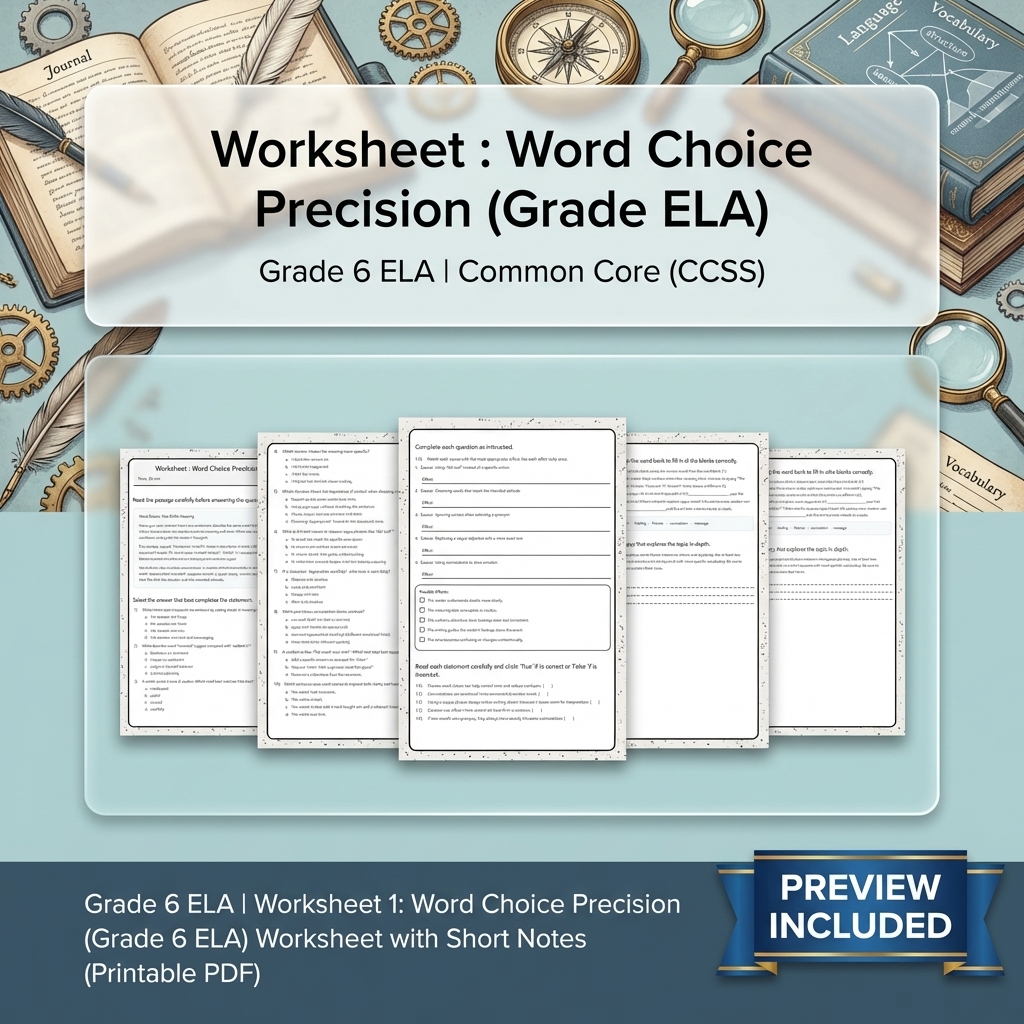
Grade 6 ELA | Worksheet Word Choice Precision Worksheet with Short Notes
Created byMeadowlark WorksheetsLearning Objectives
- Explain how precise word choice helps communicate meaning and tone.
- Identify how connotations change the impact of a sentence.
- Replace vague words with more specific vocabulary to improve writing and speaking.
Also included in: Grade 6 ELA Grammar, Vocabulary, and Sentence Variety Lesson Bundle: CCSS +1 more
Instant download

Evidence Based Answers Worksheet | General ELA | Grade 6 Practice
JCreated byJ.S SheetsLearning Objectives
- Use evidence from a text to support each part of a response to a prompt.
- Distinguish between what a text states directly and what can be inferred.
- Use structural cues (such as headings, topic sentences, and transitions) to synthesize information accurately.
Instant download

Clarifying Questions Worksheet for Grade 6 ELA | Standard BC Practice
JCreated byJ.S SheetsLearning Objectives
- Identify what makes a question clarifying rather than off-topic
- Use clarification strategies such as paraphrasing, defining terms, requesting evidence, and asking for steps in reasoning
- Answer follow-up questions that extend discussion by addressing missing logic or unclear details
Instant download

Sentence Variety Worksheet for Grade 6 ELA | Standards-Aligned Practice PDF
JCreated byJ.S SheetsLearning Objectives
- Identify and distinguish simple, compound, and complex sentences.
- Use subordinating elements (because, although, when, after, while) to show clear relationships in complex sentences.
- Revise writing to improve clarity by varying sentence structure and avoiding repetitive construction.
Instant download

Grade 6 ELA | Clarifying Questions Worksheet | BC Assessments
 Created byLumora Learning
Learning Objectives
- Ask clarification questions that target specific details, definitions, steps, or evidence that are unclear.
- Use paraphrasing to confirm understanding and maintain relevance during discussion.
- Explain how clarification questions can improve reasoning by identifying gaps and requesting concrete examples.
Instant download
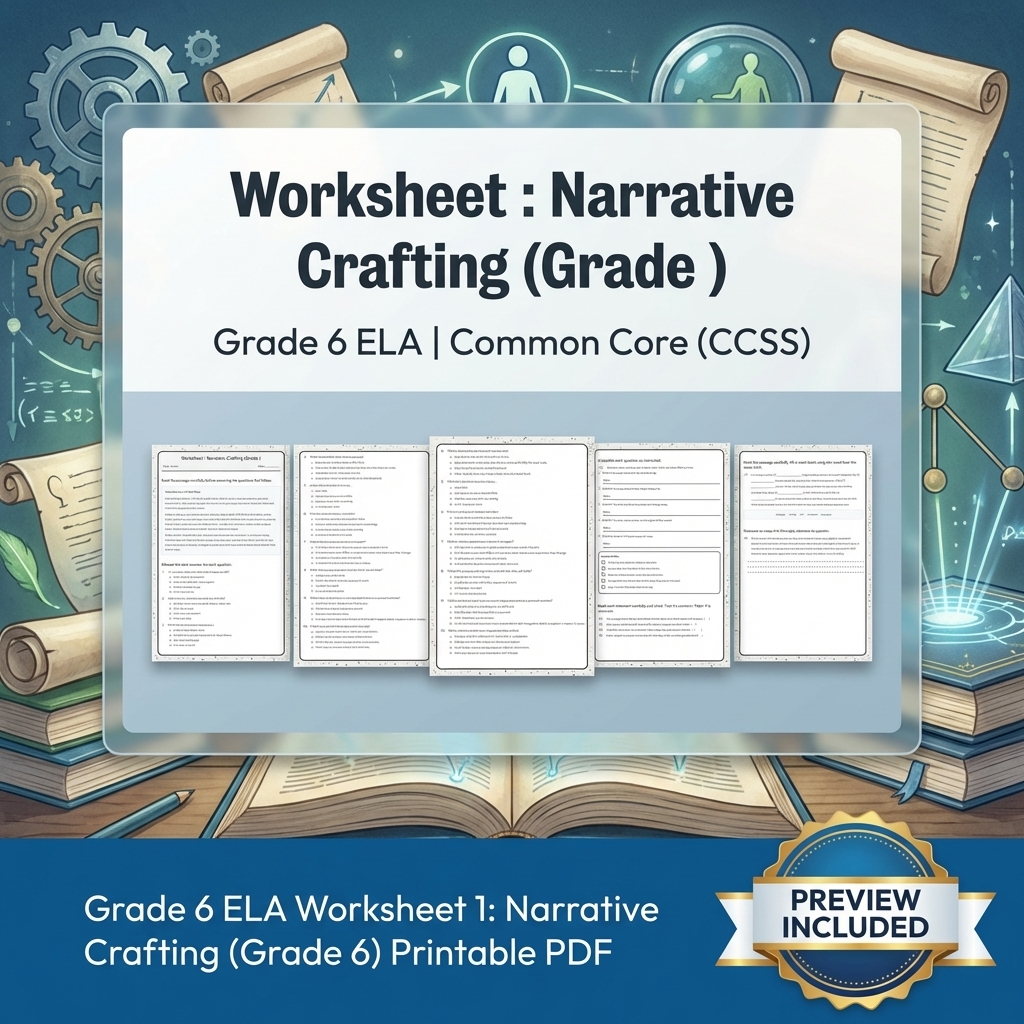
Grade 6 ELA Worksheet Narrative Crafting Printable PDF
Created byMeadowlark WorksheetsLearning Objectives
- Identify narrative elements such as character, setting, plot, and point of view in a story
- Use clear sequencing and vivid details to craft an engaging narrative
- Distinguish between correct and incorrect narrative writing choices
Also included in: Grade 6 Supporting Evidence ELA Lesson Bundle: Common Core CCSS Writing +1 more
Instant download

Grade 6 ELA | Clarifying Questions Worksheet Elena | Alberta Standard
Created byLumora LearningLearning Objectives
- Explain how clarifying questions strengthen comprehension during discussion
- Use active listening by restating claims to confirm accurate interpretation
- Identify whether a speaker’s meaning is evidence, an opinion, or a hypothesis
Also included in: Grade 6 ELA Discussion & Clear Explanations Lesson Bundle | Alberta
Instant download

Grade 6 ELA – Central Idea Support & Reading Comprehension | Daily Worksheet
 Created byQuiet Forest Education
Learning Objectives
- Identify the main idea or theme in a passage.
- Support the central idea with specific details from the text.
- Understand how details reinforce the message across paragraphs.
Also included in: Theme, Evidence & Author’s Purpose Daily Lesson Bundle | Grade 6 ELA | TEKS +1 more
Instant download

Building on Peers Practice Worksheet | Grade 6 ELA Assessment Alberta
Created byMeadowlark WorksheetsLearning Objectives
- Use discussion moves such as acknowledging others, connecting ideas, and paraphrasing to refine a shared understanding.
- Respond to disagreements with respectful reasoning and evidence rather than personal comments.
- Use short follow-up questions that clarify and extend ideas during collaborative conversation.
Also included in: Grade 6 Listening & Discussion Explanation ELA Lesson Bundle (Alberta) +1 more
Instant download

Revising for Clarity Worksheet | Grade 6 ELA Practice
Created bySunny Desk ResourcesLearning Objectives
- Revise writing to remove vague wording and replace it with precise terms.
- Improve clarity by making key points appear early and remain connected to the main idea.
- Use consistent references for people and topics so readers can easily follow meaning.
Also included in: Grade 6 Writing Lesson Bundle | ELA Writing Skills | BC +1 more
Instant download

Pronoun Reference Worksheet for Grade 6 ELA | Standards-Aligned Practice
JCreated byJ.S SheetsLearning Objectives
- Identify antecedents and explain how pronoun reference creates clarity
- Use correct pronoun case by recognizing common sentence patterns (after prepositions and linking verbs)
- Choose pronouns that match their antecedents in number and clarity to reduce ambiguity in informational writing
Instant download

Grade 6 ELA | Effective Intros Worksheet | Alberta Standards | PDF
Created byLumora LearningLearning Objectives
- Identify key features of strong introductions (hook, context, direction, narrowing focus).
- Determine how different intro strategies (scenario, fact, claim) match a purpose and audience.
- Use transitions to connect an introduction to the body in a clear, purposeful way.
Also included in: Writing with Evidence & Clarity Lesson Bundle | Grade 6 ELA | Alberta
Instant download

Response Connections Worksheet | Alberta Grade 6 ELA Practice and Assessment
JCreated byJ.S SheetsLearning Objectives
- Explain how a specific detail from a text shapes a reader’s reaction and interpretation.
- Connect ideas from a text to personal experiences, other texts, and real-world issues using evidence.
- Analyze how tone, word choice, and character decisions influence meaning and perspective.
Instant download

Purpose and Audience Worksheet Pack | Grade 6 ELA Activities
Created bySunny Desk ResourcesLearning Objectives
- Explain the difference between purpose and audience in writing
- Identify how purpose affects what details and language a writer includes
- Describe how audience affects tone, format, and the level of explanation
Also included in: Grade 6 Writing Lesson Bundle | ELA Writing Skills | BC +1 more
Instant download
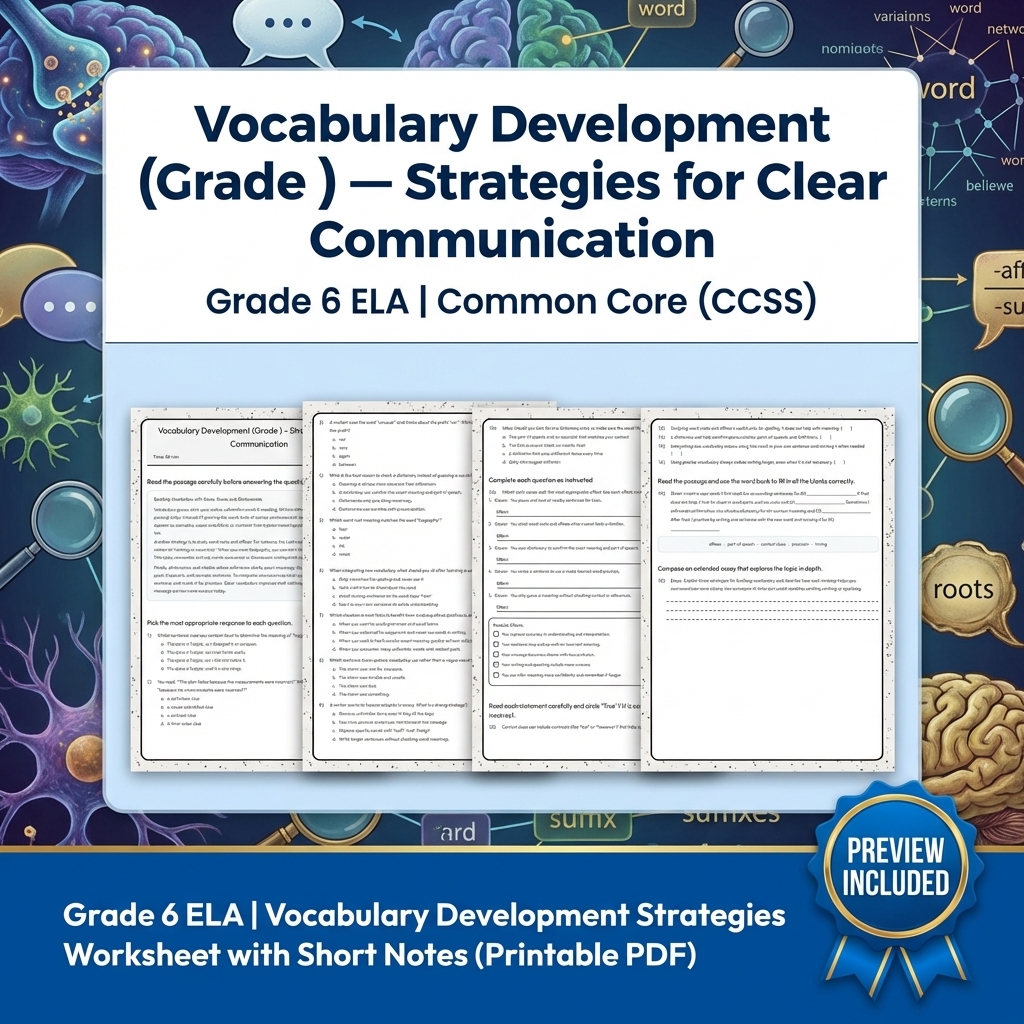
Grade 6 ELA | Vocabulary Development Strategies Worksheet with Short Notes
Created byMeadowlark WorksheetsLearning Objectives
- Use context clues to determine the meaning of unfamiliar words
- Apply knowledge of word roots and affixes to infer word meanings
- Use dictionaries and precise word choice to improve writing and speaking
Also included in: Grade 6 ELA Grammar, Vocabulary, and Sentence Variety Lesson Bundle: CCSS +1 more
Instant download

Grade 6 ELA | Persuasive Techniques Worksheet | Alberta Assessment PDF
Created byLumora LearningLearning Objectives
- Explain how specific persuasive techniques in media influence attention, emotion, and audience interpretation.
- Identify visual and audio features (camera angles, color, music, repetition, slogans, and testimonials) and describe how they can encourage agreement.
- Evaluate why a creator uses a technique and whether it matches the needs and beliefs of a target audience.
Also included in: Media Literacy Lesson Bundle | Grade 6 ELA | Alberta
Instant download

Comparing Claims Practice Worksheet | Grade 6 ELA Assessment Alberta
Created byMeadowlark WorksheetsLearning Objectives
- Compare multiple versions of a claim by evaluating evidence, context, and sourcing.
- Identify indicators of sponsorship and determine whether statistics are defined and sourced.
- Detect contradictions between accounts and explain which message is more trustworthy and why.
Also included in: Grade 6 Media Literacy in ELA Lesson Bundle for Alberta Framework +1 more
Instant download

Integrated Editing Worksheet Pack | Grade 6 ELA Practice
Created bySunny Desk ResourcesLearning Objectives
- Revise writing for clarity by checking sentence boundaries and fixing run-on sentences or fragments.
- Use punctuation (commas, periods, and other end punctuation) to guide meaning and interpretation.
- Proofread to confirm correct spelling of key terms and consistent mechanical details.
Also included in: Grade 6 Language Lesson Bundle – BC ELA Skills & Editing +1 more
Instant download

Main Idea Worksheet Pack | Grade 6 ELA Practice
Created bySunny Desk ResourcesLearning Objectives
- Identify the main idea of a paragraph by using topic sentences, repeated ideas, and connected details
- Distinguish the main idea from supporting details when wording changes across sentences
- Summarize a text accurately using the central point as a guide
Also included in: Grade 6 Reading and Viewing Lesson Bundle | Alberta ELA Framework +1 more
Instant download

Response Connections Worksheet Pack | Grade 6 ELA Practice
Created bySunny Desk ResourcesLearning Objectives
- Explain how a specific detail from a text shapes a reader’s reaction
- Connect ideas in a text to personal experiences, other texts, and real-world issues
- Analyze how tone and character choices affect interpretation and perspective
Also included in: Grade 6 Reading and Viewing Lesson Bundle | Alberta ELA Framework +1 more
Instant download

Heading Structures Worksheet Pack | Grade 6 ELA Practice
Created bySunny Desk ResourcesLearning Objectives
- Explain how headings, subheadings, and sectional labels organize information in a report or study guide.
- Use heading structure to predict what a section will discuss and to confirm meaning while reading.
- Compare sections by identifying the main idea signaled by each heading.
Also included in: Grade 6 Reading and Viewing Lesson Bundle | Alberta ELA Framework +1 more
Instant download
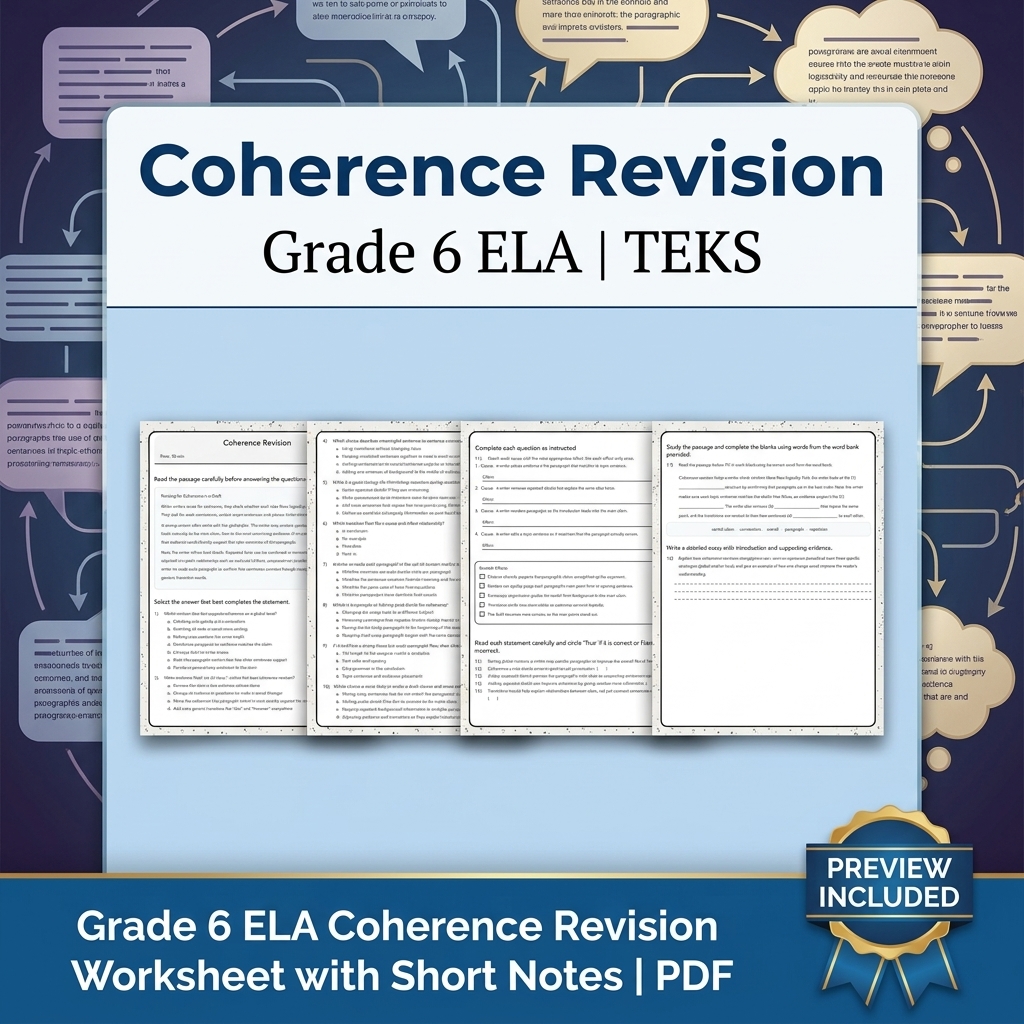
Grade 6 ELA Coherence Revision Worksheet with Short Notes | PDF
Created byMeadowlark WorksheetsLearning Objectives
- Revise an informational or argumentative draft by improving logical order and paragraph structure.
- Strengthen coherence by refining topic sentences and ensuring evidence is placed where it best supports the claim.
- Eliminate repetition by combining, deleting, or replacing redundant details without losing meaning.
Also included in: Grade 6 Evidence-Based Writing & Revision Skills ELA Lesson Bundle TEKS +1 more
Instant download

Point of View Grade 6 Worksheet | ELA Standard Practice PDF
JCreated byJ.S SheetsLearning Objectives
- Explain how an author’s point of view affects the presentation of information in a text.
- Identify clues of bias or perspective by analyzing tone, word choice, and supporting evidence.
- Evaluate how the author’s language choices influence a reader’s understanding of claims.
Instant download

Grade 6 ELA Interactive Turn-Taking Discussion Worksheet Ontario Speaking Skills
Created byLumora LearningLearning Objectives
- Demonstrate respectful oral communication by using appropriate turn-taking behaviors (entering, speaking, and pausing).
- Listen actively during discussions and respond by acknowledging and building on others’ ideas without repeating them.
- Use complete thoughts with clear connections to the topic and appropriate pacing during a conversation.
Instant download

Evidence From Character Actions Grade 6 ELA Worksheet Practice
Created bySunny Desk ResourcesLearning Objectives
- Connect character development to specific textual evidence such as dialogue, internal thoughts, and significant actions
- Explain cause-and-effect relationships in a story by showing how one event influences the next
- Distinguish between what a character says, what the narrator shows, and what the plot requires when making interpretations
Also included in: Reading and Viewing Lesson Bundle – Grade 6 ELA (BC Framework) +1 more
Instant download
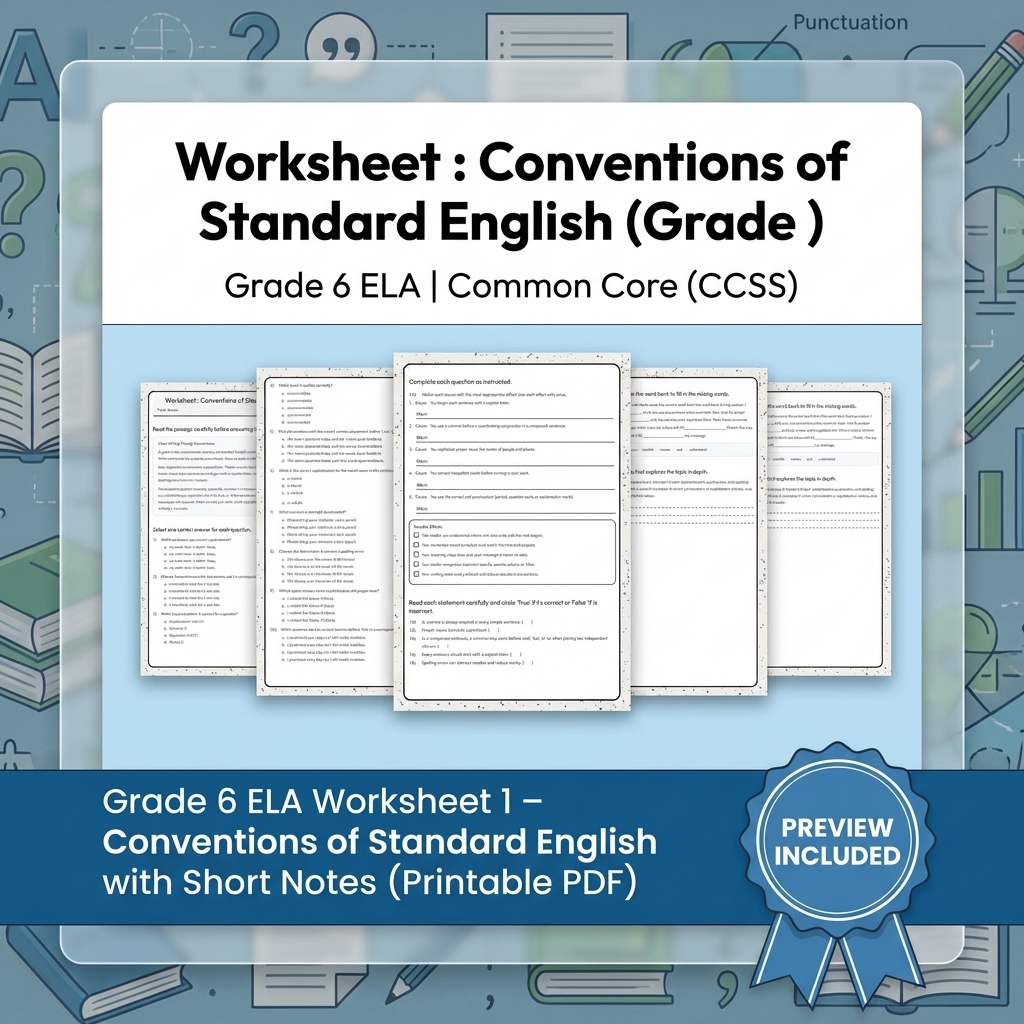
Grade 6 ELA Worksheet 1 – Conventions of Standard English with Short Notes
Created byMeadowlark WorksheetsLearning Objectives
- Use correct capitalization for proper nouns and the start of sentences.
- Apply standard punctuation, including commas in compound sentences and correct end punctuation.
- Choose correct spelling and edit writing for clarity using conventions.
Also included in: Grade 6 ELA Grammar, Vocabulary, and Sentence Variety Lesson Bundle: CCSS +1 more
Instant download

Proofreading Skills Worksheet Pack | Grade 6 ELA Practice
Created bySunny Desk ResourcesLearning Objectives
- Identify common spelling errors and apply proofreading strategies to correct them
- Check unfamiliar words using reliable strategies (context, word parts, and reference tools)
- Find repeated mistakes that reduce clarity and revise drafts to protect meaning
Also included in: Grade 6 Language Lesson Bundle – BC ELA Skills & Editing +1 more
Instant download

Heading Structures Worksheet | Grade 6 ELA | Standards-Aligned Practice
JCreated byJ.S SheetsLearning Objectives
- Identify how main headings, subheadings, and sectional labels organize information in an informational text.
- Use headings and their formatting to predict content and confirm meaning while reading.
- Explain how heading structures support comprehension by grouping related information and signaling relationships.
Instant download

Theme Development Worksheet Pack Grade 6 ELA Practice for Reading & Writing
Created bySunny Desk ResourcesLearning Objectives
- Explain what a theme is and how it differs from a topic or a plot summary
- Identify a text’s theme by connecting characters’ choices, conflicts, and recurring ideas
- Use evidence from multiple parts of a text to support a theme claim
Also included in: Grade 6 Reading and Viewing Lesson Bundle | Alberta ELA Framework +1 more
Instant download
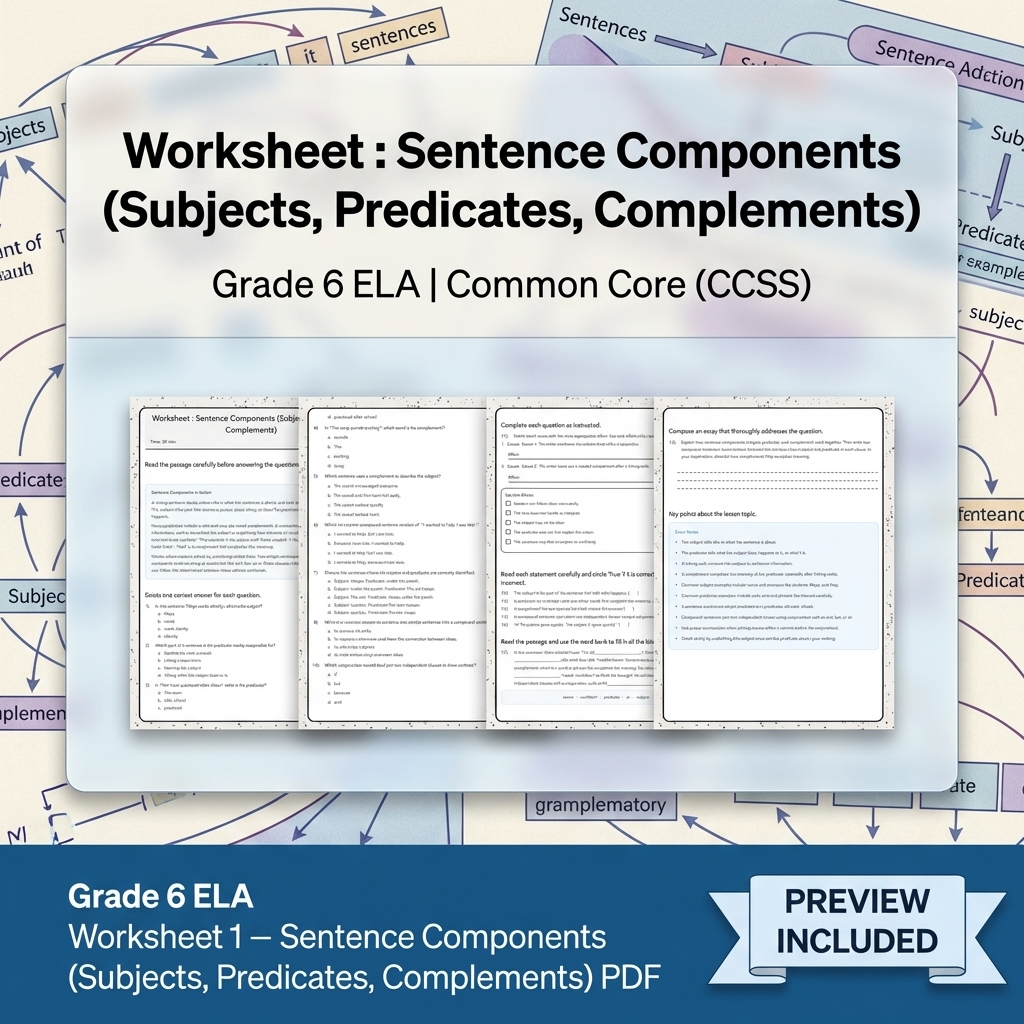
Grade 6 ELA Worksheet Sentence Components
Created byMeadowlark WorksheetsLearning Objectives
- Identify the subject and predicate in different sentence types.
- Recognize how complements complete the meaning of verbs.
- Combine simple clauses into compound sentences to improve coherence.
Also included in: Grade 6 ELA Grammar, Vocabulary, and Sentence Variety Lesson Bundle: CCSS +1 more
Instant download

Critical Listening Worksheet Grade 6 ELA Ontario Speaking & Listening
Created byLumora LearningLearning Objectives
- Track spoken information to identify main ideas and key details.
- Infer speaker intent by paying attention to phrasing, emphasis, and tone.
- Distinguish fact, opinion, and reasoning using careful listening.
Instant download

Spelling Strategies Worksheet Grade 6 ELA Word Study Practice + Answer Key
Created byLumora LearningLearning Objectives
- Apply spelling strategies for long and short vowels and consonant doubling when adding endings
- Use knowledge of word families and meaningful context to choose correct spelling for related words
- Identify and correct errors involving homophones and frequently confused words during proofreading
Instant download

Final Presentation Test Prep Printables | Grade 6 ELA
Created byMeadowlark WorksheetsLearning Objectives
- Review a published draft to confirm it matches its purpose and audience.
- Revise for correct spelling, punctuation, consistent formatting, and clear paragraphing.
- Check that headings/titles and text features support understanding and keep the draft polished and consistent.
Also included in: Grade 6 Evidence-Based Writing Skills in ELA Lesson Bundle | Alberta +1 more
Instant download

Persuasive Techniques Worksheet Pack | Grade 6 ELA Practice
Created bySunny Desk ResourcesLearning Objectives
- Identify common persuasive techniques used in media and explain how they influence an audience’s attention and emotions
- Analyze how design and delivery choices (such as visuals, music, repetition, and testimonials) support a persuasive message
- Evaluate whether persuasive techniques align with the needs and interests of a specific audience
Also included in: Grade 6 Media Literacy Lesson Bundle: ELA Alberta Framework +1 more
Instant download

Grade 6 Roots and Affixes Worksheet | Ontario ELA Vocabulary Building
Created bySunny Desk ResourcesLearning Objectives
- Explain how common prefixes, suffixes, and roots build meaning in academic words.
- Identify how affixes signal ideas such as negation, time, location, and profession.
- Use root and affix knowledge to support spelling and interpretation of complex words.
Instant download

Advanced Comprehension Worksheet | CCSS ELA Grade 6 Practice
JCreated byJ.S SheetsLearning Objectives
- Make inferences about an author’s purpose and meaning in complex informational texts
- Evaluate evidence by identifying which details support specific claims
- Interpret technical vocabulary and text signals that show relationships (cause, contrast, consequence)
Instant download

Summarizing Ideas Worksheet | Alberta Grade 6 ELA Practice PDF
JCreated byJ.S SheetsLearning Objectives
- Identify the most important ideas in a text and distinguish them from minor details.
- Write a summary that preserves the author’s overall meaning using logical transitions.
- Determine whether information is presented as a fact or an opinion and represent it accurately in a summary.
Instant download

Evidence From Character Actions Worksheet | BC Standards Grade 6 ELA
JCreated byJ.S SheetsLearning Objectives
- Connect a character’s development to specific evidence from the text, such as dialogue, internal thoughts, and significant actions.
- Use cause-and-effect reasoning to explain how one event influences the next in a story.
- Distinguish between what a character says, what the narrator shows, and what the plot requires to stay grounded in textual support.
Instant download

Figurative Meaning Worksheet for Grade 6 ELA | Standards-Aligned Practice
JCreated byJ.S SheetsLearning Objectives
- Identify and interpret metaphors, similes, and idioms by explaining how they create figurative meaning.
- Analyze how figurative language and word relationships (synonyms, antonyms, and categories) affect tone and mood.
- Use nuance between closely related words to explain differences in emphasis, intensity, or perspective within a sentence.
Instant download

Revision For Focus Worksheet Pack | Grade 6 ELA Practice
Created bySunny Desk ResourcesLearning Objectives
- Revise a draft so sentences clearly support a central message (main idea).
- Improve coherence by ordering ideas in the most effective sequence and adding missing explanations.
- Strengthen clarity by reducing unnecessary repetition and clarifying confusing sections.
Also included in: Grade 6 Writing Workshop Lesson Bundle | ELA Alberta Framework +1 more
Instant download

Point of View Worksheet for Grade 6 ELA | Standards-Aligned Practice PDF
JCreated byJ.S SheetsLearning Objectives
- Identify how first-person and third-person narration affect point of view and narrative distance.
- Analyze reliability by noting what a narrator includes, excludes, or emphasizes.
- Explain how an author’s word choice and structure reveal perspective in informational text.
Instant download

6th Grade ELA | Graphic Integration Worksheet – Standards Aligned (PDF)
 Created byGolden Apple Studio
Learning Objectives
- Integrate information from visuals (charts, diagrams, maps, timelines) with surrounding text to answer questions.
- Interpret labels, legends, and key data in a graphic and connect them to the author’s explanation.
- Explain how visuals and text work together when they support the same idea or provide different types of information.
Also included in: Grade 6 Evidence Based Reading & Writing English Language Lessons General ELA +1 more
Instant download

Roots and Affixes Worksheet Grade 6 ELA Vocabulary Word Study + Answer Key
Created byLumora LearningLearning Objectives
- Explain how roots and affixes contribute to word meaning patterns in Grade 6 vocabulary
- Identify common prefixes and suffixes and infer meaning from them
- Use knowledge of roots, prefixes, and suffixes to support accurate spelling and interpretation of complex words
Instant download
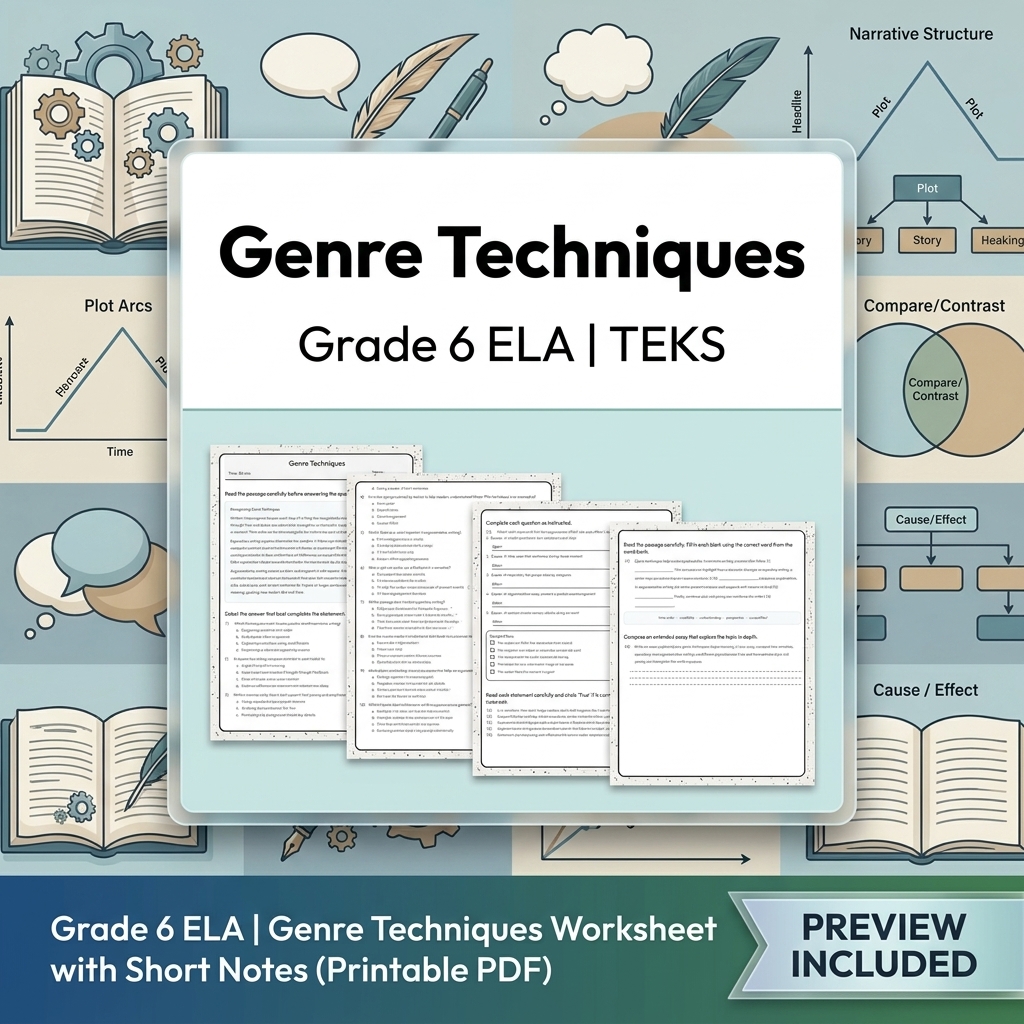
Grade 6 ELA | Genre Techniques Worksheet with Short Notes (Printable PDF)
Created byMeadowlark WorksheetsLearning Objectives
- Identify genre techniques that shape meaning in narrative, expository, and argumentative writing.
- Explain how sentence style and pacing can reinforce a writer’s purpose.
- Apply cause-and-effect and word-choice skills to determine how details impact an audience.
Also included in: Grade 6 Evidence-Based Writing & Revision Skills ELA Lesson Bundle TEKS +1 more
Instant download

Integrating Grammar and Usage Worksheet Pack | Grade 6 ELA Practice
Created bySunny Desk ResourcesLearning Objectives
- Apply correct modifier placement to improve clarity and meaning.
- Maintain consistent verb tense in paragraphs and revise for errors.
- Use correct subject-verb agreement in sentences, especially with tricky subjects.
Also included in: Grade 6 ELA Word Choice, Grammar & Sentence Variety Lesson Bundle | Common Core +1 more
Instant download
About Grade 6 ELA Worksheets
Browse 1,085 printable Grade 6 ELA worksheets — ready-to-print PDFs with answer keys where available.
Every worksheet on MyTeachingSheets is created by independent teacher-authors and reviewed before publication. All resources download as printable PDFs for classroom, homework, or at-home practice, and many include answer keys. Preview any worksheet free before buying.