
Grade 6 Worksheets
8,578 grade resources
6th Grade Science – Societal Impacts Worksheet (TEKS) PDF
 Created byEvergreen Desk Education
Learning Objectives
- Explain how scientific findings lead to societal changes through evidence-based public health, environmental, and resource decisions.
- Use data and indicators to evaluate whether interventions achieve intended short-term and long-term outcomes.
- Describe trade-offs between economic priorities and environmental or health goals using real examples.
Instant download
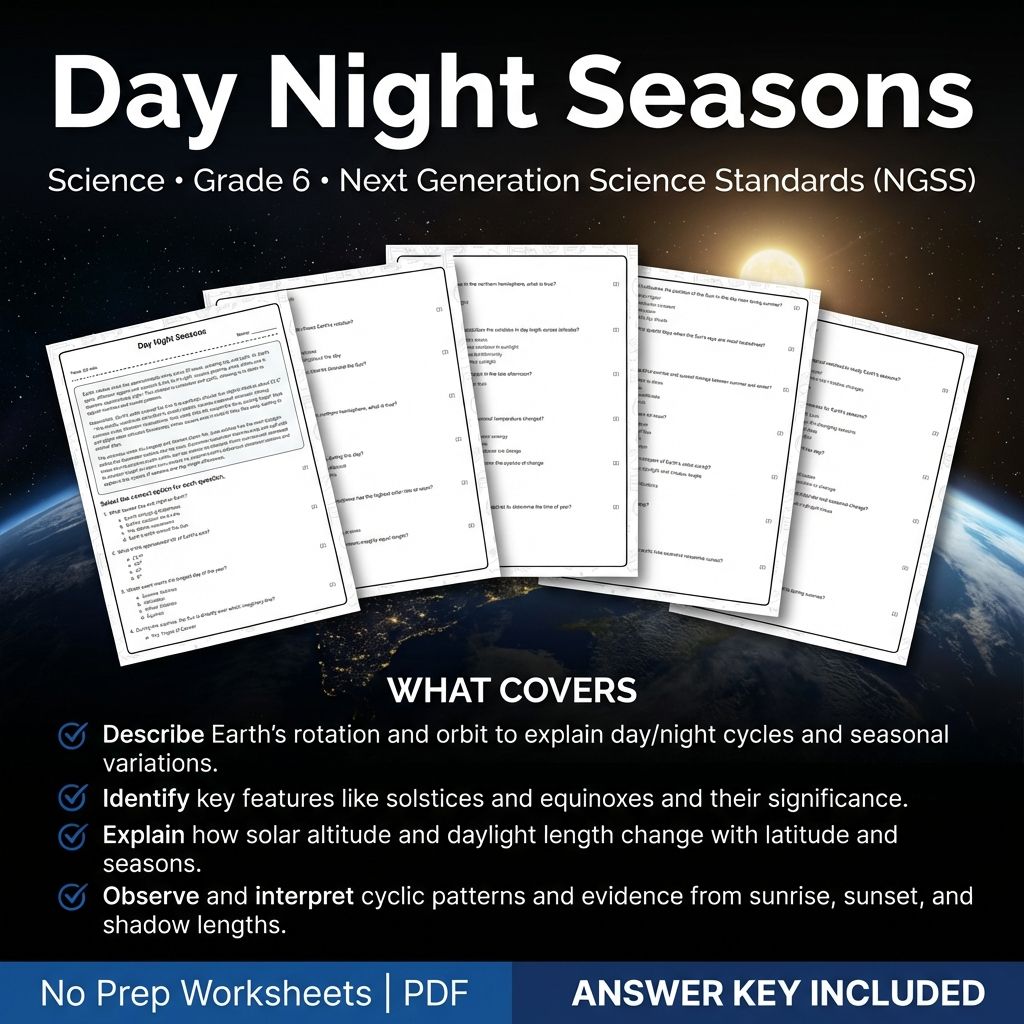
6th Grade Science Worksheet | Day, Night & Seasons NGSS Practice (Printable PDF)
 Created byCoral Reef Learning
Learning Objectives
- Describe Earth's rotation and orbit to explain day/night cycles and seasonal variations.
- Identify key features like solstices and equinoxes and their significance.
- Explain how solar altitude and daylight length change with latitude and seasons.
Instant download

6th Grade Rearrangement Explanation Worksheet | Chemical Reactions PDF
Created byEvergreen Desk EducationLearning Objectives
- Explain how atoms rearrange during a chemical reaction and how this leads to new substances
- Identify which parts of a reaction description indicate particle rearrangement (not just mixing)
- Use atomic-level reasoning to predict how product properties relate to new combinations
Instant download
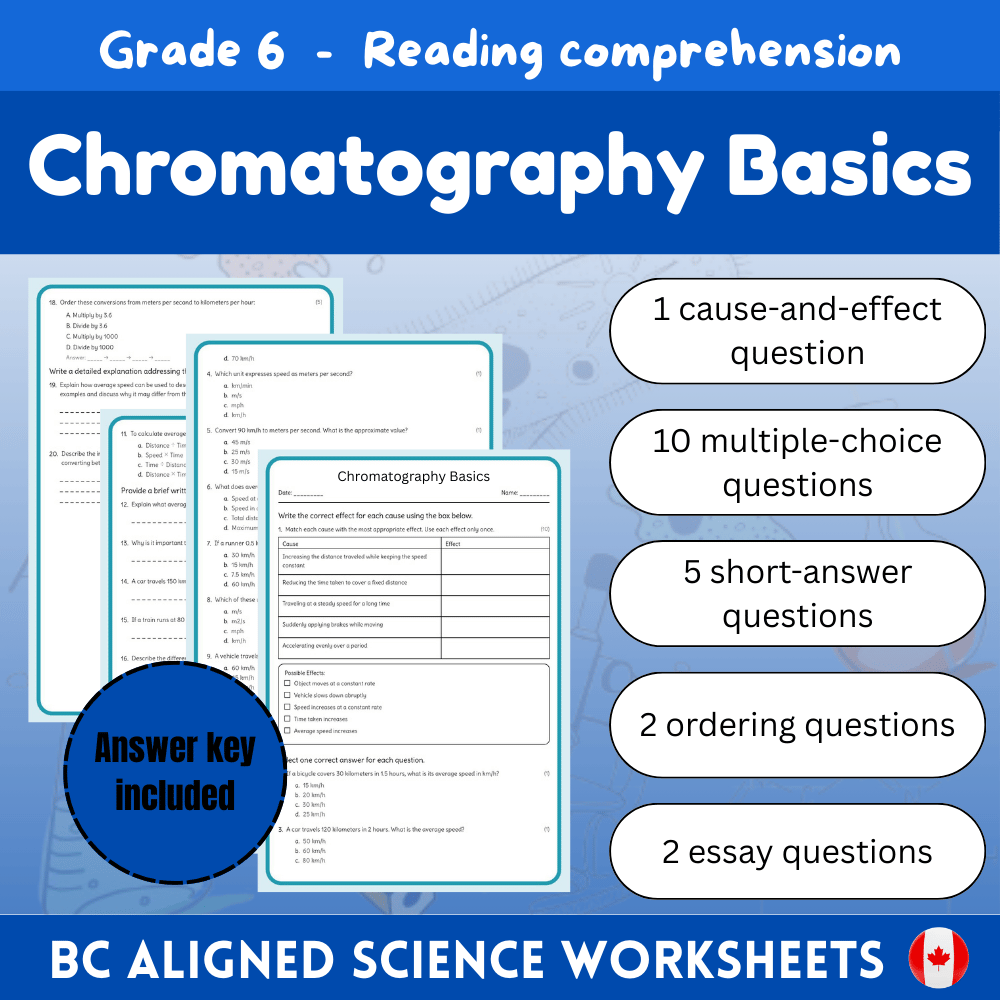
6th Grade Science | Chromatography Basics Worksheet (PDF) – BC Standards
 Created byBright Mind Resources
Learning Objectives
- Understand the fundamental principles of paper chromatography.
- Identify components that influence the movement of substances in chromatography.
- Describe how solubility and affinity affect separation outcomes.
Instant download

6th Grade Science | Adaptation Overview Worksheet (PDF) - BC Standards
Created byEvergreen Desk EducationLearning Objectives
- Explain the difference between structural and physiological adaptations.
- Describe how natural selection can favor traits that improve survival and reproduction.
- Connect specific organism features to the advantages they provide in a habitat.
Instant download
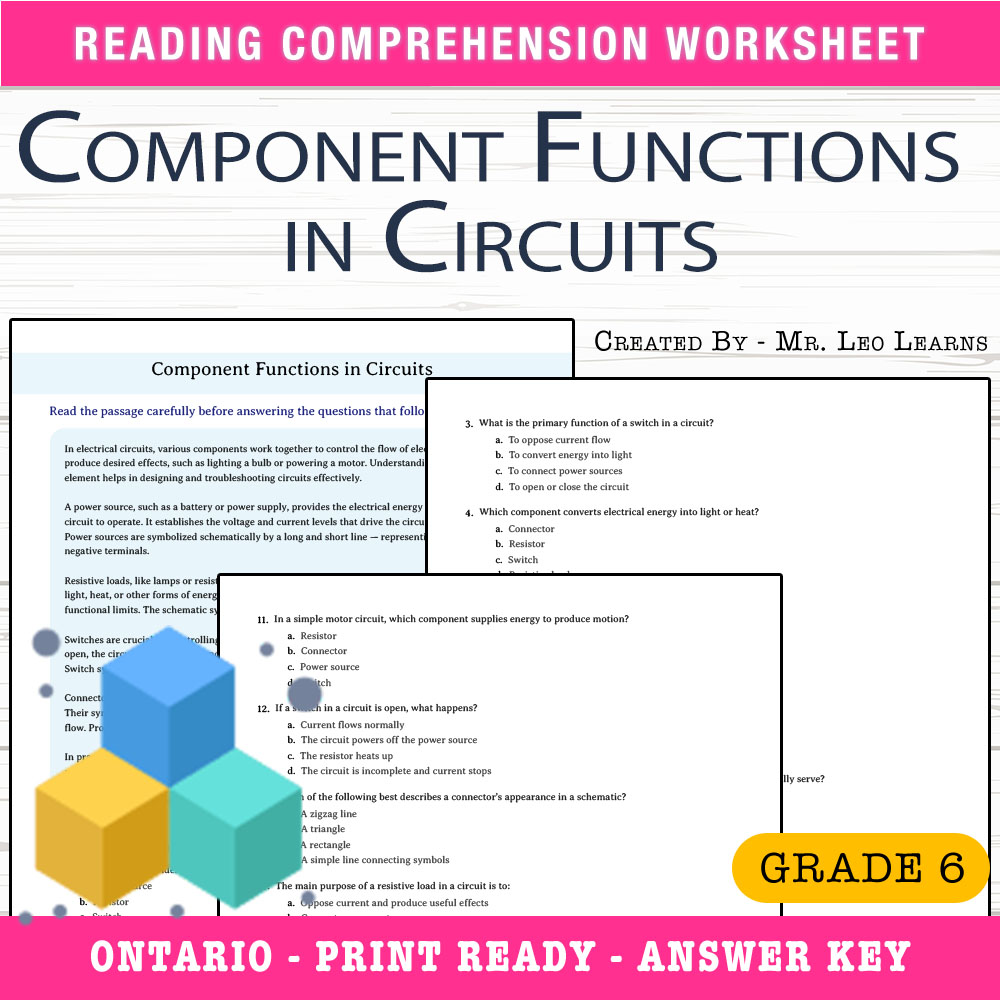
Grade 6 Science — Component Functions in Circuits Worksheet for Mastery
 Created byThe Resource Hub
Learning Objectives
- Identify common circuit components such as power sources, resistive loads, switches, and connectors.
- Describe how each component influences the behaviour of an electric circuit.
- Interpret schematic symbols and relate them to physical components.
Also included in: Grade 6 Science Unit Bundle – Circuits, Electricity & Energy Worksheets +1 more
Instant download
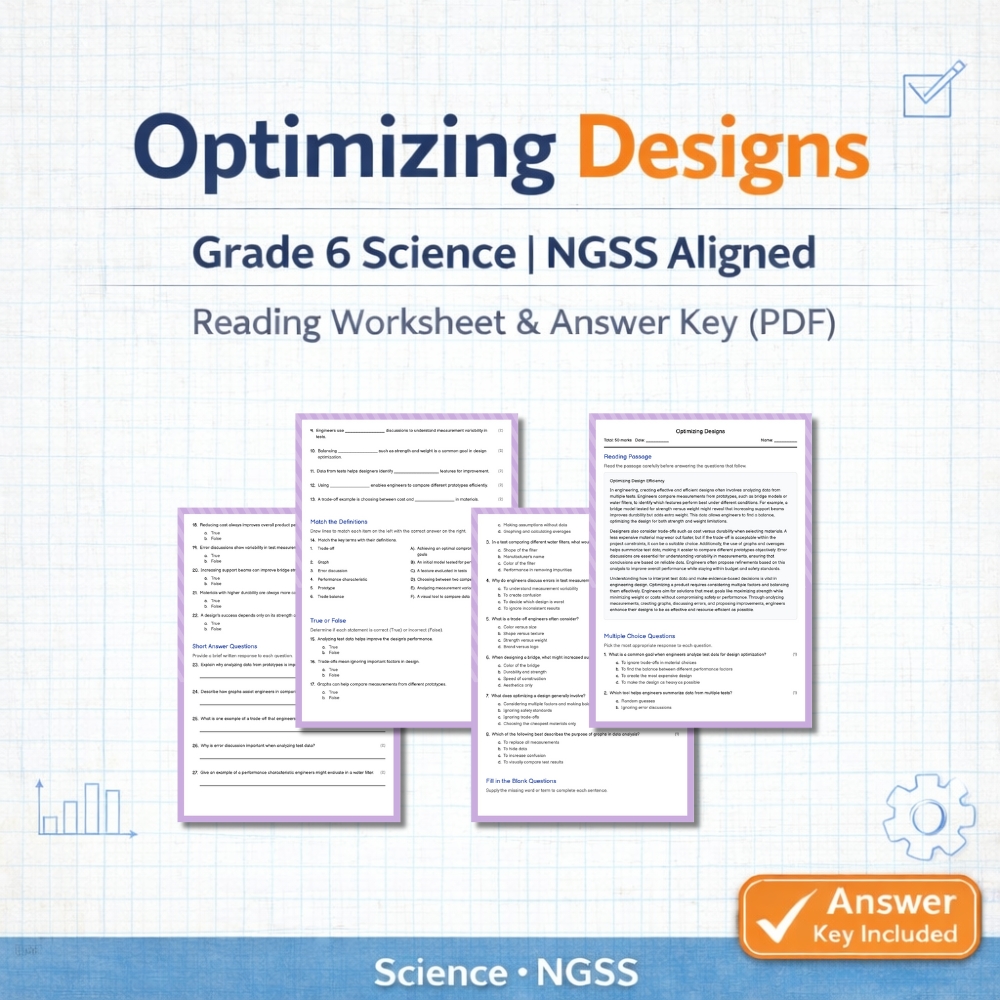
6th Grade Science | Optimizing Designs | Worksheet – NGSS Aligned
 Created byCedar Grove Learning
Learning Objectives
- Analyze data from tests to compare performance of different design options.
- Use graphs, averages, and error discussion to support decisions in design optimization.
- Evaluate trade-offs in design performance criteria such as strength versus weight, cost versus durability.
Also included in: Grade 6 Science Unit Bundle | Engineering Design & Problem Solving Worksheets +1 more
Instant download

Defining Problems Worksheet | NGSS-Aligned Grade 6 Science Practice
JCreated byJ.S SheetsLearning Objectives
- Understand how to define criteria and constraints for a design problem.
- Identify required functions, success measures, and limits such as materials, cost, and safety.
- Relate cause and effect using models and scientific principles.
Also included in: Grade 6 Engineering Design Science Lesson Bundle | NGSS Worksheets +1 more
Instant download
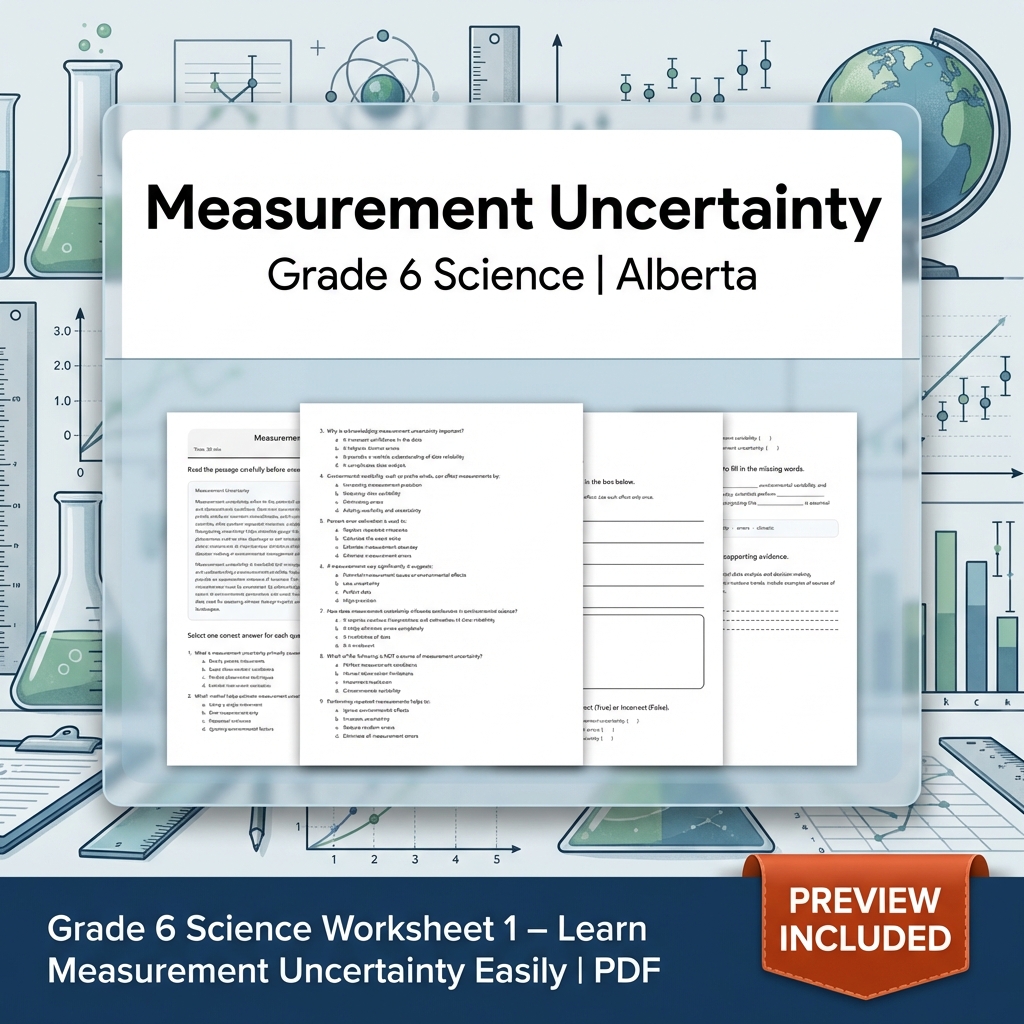
Grade 6 Science Worksheet 1 – Learn Measurement Uncertainty Easily | PDF
 Created byMeadowlark Worksheets
Learning Objectives
- Understand the concept of measurement uncertainty and its sources.
- Learn methods for estimating and discussing measurement uncertainty.
- Recognize how uncertainty affects confidence in scientific data and conclusions.
Also included in: Grade 6 Science | Evidence & Investigation Unit Worksheet Bundle +1 more
Instant download

Aerodynamic Design Learning Stations | Grade 6 Air and Aerodynamics
 Created byMTS Academic Studio
Learning Objectives
- Identify aircraft features that affect aerodynamic performance
- Explain how designers manage lift, drag, and stability
- Compare wing designs used for different flight goals
Also included in: Grade 6 Air and Aerodynamics Science Stations Bundle | Alberta
Instant download

Evidence and Investigation Learning Stations Activity | Grade 6 Science
Created byMTS Academic StudioLearning Objectives
- Identify how observations and measurements support evidence-based claims
- Choose useful displays for different kinds of scientific data
- Explain why units make scientific evidence easier to interpret
Also included in: Grade 6 Alberta Science Investigations Learning Stations Bundle
Instant download

Lunar Motion Learning Stations Activity | Grade 6 Moon Phases Science
Created byMTS Academic StudioLearning Objectives
- Describe how orbital position produces predictable Moon phases
- Compare observations of the Moon's position, phase, and motion
- Explain Sun-Earth-Moon relationships using lunar observations
Also included in: Grade 6 Sky Science Learning Stations Bundle | Alberta Science
Instant download

Tree Anatomy Learning Stations Activity | Grade 6 Alberta Science
Created byMTS Academic StudioLearning Objectives
- Identify major tree structures and describe their functions
- Explain how tree anatomy supports survival during environmental change
- Compare structural responses to fire, drought, insects, and flooding
Also included in: Grade 6 Alberta Science Trees and Forests Learning Stations Bundle
Instant download

Celestial Motion Learning Stations Activity | Grade 6 Sky Science
Created byMTS Academic StudioLearning Objectives
- Identify predictable celestial motion using real observations
- Explain how relative positions create repeating sky patterns
- Explain how orbits contribute to recurring celestial patterns
Also included in: Grade 6 Sky Science Learning Stations Bundle | Alberta Science
Instant download

Streamlining Science Learning Stations Activity | Grade 6 Aerodynamics
Created byMTS Academic StudioLearning Objectives
- Identify design features that promote smooth airflow around objects
- Explain how object shape can reduce aerodynamic drag
- Explain how surface features influence aerodynamic resistance
Also included in: Grade 6 Air and Aerodynamics Science Stations Bundle | Alberta
Instant download

Stem Transport Learning Stations Activity | Grade 6 Trees and Forests
Created byMTS Academic StudioLearning Objectives
- Explain how xylem transports water and minerals through stems
- Explain how phloem transports sugars through stems
- Compare how environmental stressors affect stem transport
Also included in: Grade 6 Alberta Science Trees and Forests Learning Stations Bundle
Instant download

Solar and Lunar Eclipses Learning Stations Activity | Grade 6 Science
Created byMTS Academic StudioLearning Objectives
- Describe Sun-Earth-Moon positions during solar and lunar eclipses
- Compare alignments producing total, partial, and annular eclipses
- Interpret real eclipse observations using celestial positions
Also included in: Grade 6 Sky Science Learning Stations Bundle | Alberta Science
Instant download

Graph Selection Learning Stations Activity | Grade 6 Science Data Skills
Created byMTS Academic StudioLearning Objectives
- Match graph types to appropriate kinds of scientific data
- Explain how data purpose influences graph selection
- Identify clear axis labels for scientific graphs
Also included in: Grade 6 Alberta Science Investigations Learning Stations Bundle
Instant download

Experimental Design Learning Stations Activity | Grade 6 Science
Created byMTS Academic StudioLearning Objectives
- Identify testable questions in experimental investigations
- Distinguish changed variables from measured outcomes
- Identify controls used to create fair comparisons
Also included in: Grade 6 Alberta Science Investigations Learning Stations Bundle
Instant download

Air Density Learning Stations Activity | Grade 6 Science Alberta
Created byMTS Academic StudioLearning Objectives
- Explain how temperature changes air density
- Explain how altitude affects air density
- Connect air density changes with buoyancy and lift
Also included in: Grade 6 Air and Aerodynamics Science Stations Bundle | Alberta
Instant download

Air Pressure & Weather Learning Stations Activity | Grade 6 Science
Created byMTS Academic StudioLearning Objectives
- Explain how differences in air pressure create wind
- Identify how air pressure contributes to changing weather
- Explain how mountains and plains affect pressure patterns
Also included in: Grade 6 Air and Aerodynamics Science Stations Bundle | Alberta
Instant download

Forest Disturbance Regimes Learning Stations Activity | Grade 6 Science
Created byMTS Academic StudioLearning Objectives
- Identify natural and human-caused disturbances in forest ecosystems
- Compare disturbances by size, intensity, and cause
- Explain how disturbances affect forest structure and regeneration
Also included in: Grade 6 Alberta Science Trees and Forests Learning Stations Bundle
Instant download

Aerodynamic Drag Learning Stations Activity | Grade 6 Science
Created byMTS Academic StudioLearning Objectives
- Identify major forms of aerodynamic drag from real-world evidence
- Explain how shape and surface airflow influence aerodynamic drag
- Explain how lift affects aerodynamic drag
Also included in: Grade 6 Air and Aerodynamics Science Stations Bundle | Alberta
Instant download

Scientific Investigation Learning Stations | Evidence & Conclusions Grade 6
Created byMTS Academic StudioLearning Objectives
- Explain connections among questions, measurements, analysis, and conclusions
- Compare evidence gathered from multiple sources or locations
- Evaluate how consistent methods affect scientific conclusions
Also included in: Grade 6 Alberta Science Investigations Learning Stations Bundle
Instant download

Alberta Forest Types Learning Stations Activity | Grade 6 Science
Created byMTS Academic StudioLearning Objectives
- Identify Alberta forest types using vegetation and environmental clues
- Explain how elevation influences forest distribution
- Explain how soil moisture and climate shape forest environments
Also included in: Grade 6 Alberta Science Trees and Forests Learning Stations Bundle
Instant download

Tree Roots and Water Learning Stations Activity | Grade 6 Science
Created byMTS Academic StudioLearning Objectives
- Explain how roots help trees obtain water
- Compare root systems during establishment and recovery
- Identify effects of changing soil moisture on trees
Also included in: Grade 6 Alberta Science Trees and Forests Learning Stations Bundle
Instant download

Day and Night Learning Stations | Earth’s Rotation Activity Grade 6
Created byMTS Academic StudioLearning Objectives
- Explain how Earth’s rotation produces day and night
- Describe how axial tilt affects seasonal daylight duration
- Connect Earth’s orbit to changing daylight patterns
Also included in: Grade 6 Sky Science Learning Stations Bundle | Alberta Science
Instant download

Sun Earth Moon Learning Stations Activity | Grade 6 Sky Science
Created byMTS Academic StudioLearning Objectives
- Explain changing Sun–Earth–Moon positions using real observations
- Connect celestial alignments to lunar phases and eclipses
- Explain how Sun–Earth–Moon relationships influence tides
Also included in: Grade 6 Sky Science Learning Stations Bundle | Alberta Science
Instant download

Integrated Forest Management Learning Stations Activity | Grade 6 Science
Created byMTS Academic StudioLearning Objectives
- Explain how forest managers balance multiple management objectives
- Compare tools used for landscape-scale forest management
- Identify how monitoring supports forest management decisions
Also included in: Grade 6 Alberta Science Trees and Forests Learning Stations Bundle
Instant download

Earth Rotation Learning Stations Activity | Grade 6 Sky Science
Created byMTS Academic StudioLearning Objectives
- Explain how Earth's rotation causes day and night
- Explain apparent daily motion in the sky
- Compare observations from different places
Also included in: Grade 6 Sky Science Learning Stations Bundle | Alberta Science
Instant download

Air Properties Learning Stations | Grade 6 Air and Aerodynamics Activity
Created byMTS Academic StudioLearning Objectives
- Explain how temperature changes the properties of air
- Explain how altitude affects air pressure and density
- Identify how gas composition can change air properties
Also included in: Grade 6 Air and Aerodynamics Science Stations Bundle | Alberta
Instant download

Bernoulli Principle Learning Stations | Grade 6 Air & Aerodynamics
Created byMTS Academic StudioLearning Objectives
- Explain how airflow speed relates to air pressure
- Use airfoil test evidence to identify pressure differences
- Explain how pressure differences can contribute to lift
Also included in: Grade 6 Air and Aerodynamics Science Stations Bundle | Alberta
Instant download

Leaf Functions Learning Stations Activity | Grade 6 Alberta Science
Created byMTS Academic StudioLearning Objectives
- Explain how leaves support photosynthesis, gas exchange, and transpiration
- Compare drought, insect, and wildfire effects on leaf function
- Relate leaf traits to tree growth and water use
Also included in: Grade 6 Alberta Science Trees and Forests Learning Stations Bundle
Instant download

Alberta Data Patterns Learning Stations Activity | Grade 6 Science
Created byMTS Academic StudioLearning Objectives
- Identify trends, cycles, spatial patterns, and unusual data values
- Connect observed patterns to plausible environmental drivers
- Consider alternative explanations for patterns in environmental data
Also included in: Grade 6 Alberta Science Investigations Learning Stations Bundle
Instant download

Parachute Physics Learning Stations | Air & Aerodynamics Grade 6
Created byMTS Academic StudioLearning Objectives
- Explain how drag affects parachute descent
- Explain how mass influences parachute descent
- Compare effects of canopy area on parachute performance
Also included in: Grade 6 Air and Aerodynamics Science Stations Bundle | Alberta
Instant download

Shadow Patterns Learning Stations Activity | Grade 6 Sky Science
Created byMTS Academic StudioLearning Objectives
- Describe changes in shadow length as the Sun appears to move
- Describe changes in shadow direction throughout the day
- Explain daily shadow patterns using Earth's rotation
Also included in: Grade 6 Sky Science Learning Stations Bundle | Alberta Science
Instant download

Stability in Flight Learning Stations Activity | Grade 6 Science
Created byMTS Academic StudioLearning Objectives
- Explain how mass placement affects aircraft stability
- Explain how aerodynamic forces influence stable flight
- Compare features that improve longitudinal and lateral stability
Also included in: Grade 6 Air and Aerodynamics Science Stations Bundle | Alberta
Instant download

Measurement Tools Learning Stations Activity | Grade 6 Science Alberta
Created byMTS Academic StudioLearning Objectives
- Identify measurement tools used to collect environmental evidence
- Match measurement tools to the quantities they measure
- Explain how correct units improve data quality
Also included in: Grade 6 Alberta Science Investigations Learning Stations Bundle
Instant download

Wing Shapes Learning Stations Activity | Grade 6 Air and Aerodynamics
Created byMTS Academic StudioLearning Objectives
- Compare wing shapes used for different aircraft missions
- Explain how aspect ratio affects flight performance
- Connect wing thickness and area to lift and drag
Also included in: Grade 6 Air and Aerodynamics Science Stations Bundle | Alberta
Instant download

Variables Learning Stations Activity | Grade 6 Science Investigations
Created byMTS Academic StudioLearning Objectives
- Identify independent variables in scientific investigations
- Identify dependent variables from measured or observed outcomes
- Determine controlled variables needed for fair comparisons
Also included in: Grade 6 Alberta Science Investigations Learning Stations Bundle
Instant download

Science Error Analysis Learning Stations Activity | Grade 6 Alberta
Created byMTS Academic StudioLearning Objectives
- Distinguish systematic errors from random errors in scientific examples
- Explain how calibration can reveal or reduce measurement error
- Explain why repeated measurements help identify random variation
Also included in: Grade 6 Alberta Science Investigations Learning Stations Bundle
Instant download

Sampling Methods Learning Stations Activity | Grade 6 Science Alberta
Created byMTS Academic StudioLearning Objectives
- Identify five sampling approaches used in environmental investigations
- Compare systematic, stratified, targeted, repeated, and broad-area sampling
- Explain how sample location and spacing affect representation
Also included in: Grade 6 Alberta Science Investigations Learning Stations Bundle
Instant download

Sky Science Learning Stations Activity | Historical Perspectives Grade 6
Created byMTS Academic StudioLearning Objectives
- Compare Indigenous and settler uses of repeated sky patterns
- Explain how sky observations supported navigation and seasonal planning
- Explain how celestial observations supported scientific measurement
Also included in: Grade 6 Sky Science Learning Stations Bundle | Alberta Science
Instant download

Solar Timekeeping Learning Stations | Grade 6 Sky Science Activity
Created byMTS Academic StudioLearning Objectives
- Explain how apparent Sun motion can measure local solar time
- Compare local solar time with standardized clock time
- Explain how longitude affects differences in local solar time
Also included in: Grade 6 Sky Science Learning Stations Bundle | Alberta Science
Instant download

Alberta Trees and Forests Stewardship Learning Stations Grade 6 Science
Created byMTS Academic StudioLearning Objectives
- Identify stewardship practices used to protect Alberta landscapes
- Explain how planting and restoration benefit ecosystems
- Describe how community involvement supports landscape stewardship
Also included in: Grade 6 Alberta Science Trees and Forests Learning Stations Bundle
Instant download

Air and Aerodynamics Learning Stations | Grade 6 Flight Control Activity
Created byMTS Academic StudioLearning Objectives
- Identify how control surfaces change an aircraft's motion
- Explain how pilots control roll, pitch, and yaw
- Compare flight controls used during takeoff and landing
Also included in: Grade 6 Air and Aerodynamics Science Stations Bundle | Alberta
Instant download

Apparent Sun Path Learning Stations | Alberta Grade 6 Sky Science
Created byMTS Academic StudioLearning Objectives
- Describe seasonal changes in the Sun's apparent path
- Compare Sun patterns at different Alberta latitudes
- Compare sunrise, sunset, noon Sun height, and day length
Also included in: Grade 6 Sky Science Learning Stations Bundle | Alberta Science
Instant download

Four Forces of Flight Learning Stations Activity | Grade 6 Science
Created byMTS Academic StudioLearning Objectives
- Identify lift, thrust, drag, and weight in flight situations
- Explain how force balance changes motion through air
- Compare forces acting during powered flight and gliding
Also included in: Grade 6 Air and Aerodynamics Science Stations Bundle | Alberta
Instant download
Browse more categories
About Grade 6 Worksheets
Browse 8,578 printable Grade 6 worksheets across math, ELA, science, and social studies — each a ready-to-print PDF with optional answer keys.
MyTeachingSheets worksheets are made by real teacher-authors and checked before they go live. Download any as a print-ready PDF for lessons, homework, or independent practice — most include answer keys, and previews are always free.