
Grade 7 Worksheets
8,498 grade resources
Grade 7 Social Studies — Worksheet MCQ Paper for Mastering Reform Movements
 Created byThe Resource Hub
Learning Objectives
- Explain how political reform movements in the 1830s challenged colonial governance in favor of responsible government and representation.
- Analyze the causes and consequences of reform agitation and the rebellions of 1837–38 on governance.
- Describe continuity and change in colonial administrative structures during constitutional evolution.
Also included in: Grade 7 Canadian History Social Studies Lesson Bundle: Ontario MCQ +1 more
Instant download

Grade 7 Science – Adaptation Functions Worksheet (PDF)
 Created byEvergreen Desk Education
Learning Objectives
- Explain how structural, behavioral, and functional adaptations support specific life processes in organisms.
- Describe trade-offs and how improving one function can reduce performance in another.
- Connect adaptations (form) to their roles in survival, feeding, protection, and reproduction.
Also included in: Grade 7 Ecosystem Energy Flows Science Lesson Bundle - General Framework +1 more
Instant download

Grade 7 — Worksheet MCQ Paper for Mastering Scientific Discoveries
Created byThe Resource HubLearning Objectives
- Explain how key scientific breakthroughs (such as electricity and vaccines) changed daily life and society
- Describe how technological innovations shift economic power and create new industries
- Analyze cause-and-effect relationships between scientific progress and social change
Also included in: Industrial Technologies & Transportation Lesson Bundle | Grade 7 Social Studies +1 more
Instant download

Grade 7 Science | Climate Drivers Over Time - Daily Reading Comprehension
 Created byCoral Reef Learning
Learning Objectives
- Understand how natural records like ice cores provide evidence of past climate conditions.
- Identify different natural indicators used to assess historical climate changes.
- Learn about the impact of long-term climate drivers on Earth's energy balance and circulation.
Instant download

Grade 7 Science: Chemical Properties Worksheet (Ontario Standards, PDF)
Created byEvergreen Desk EducationLearning Objectives
- Explain how chemical properties describe what happens to substances during chemical changes
- Identify chemical property evidence such as gas production, color change, and precipitate formation
- Relate reactivity with acids/bases, combustion/oxidation, corrosion tendencies, and pH changes to material suitability and separation choices
Also included in: Grade 7 Substances and Mixtures Science Lesson Bundle Worksheet (Ontario) +1 more
Instant download
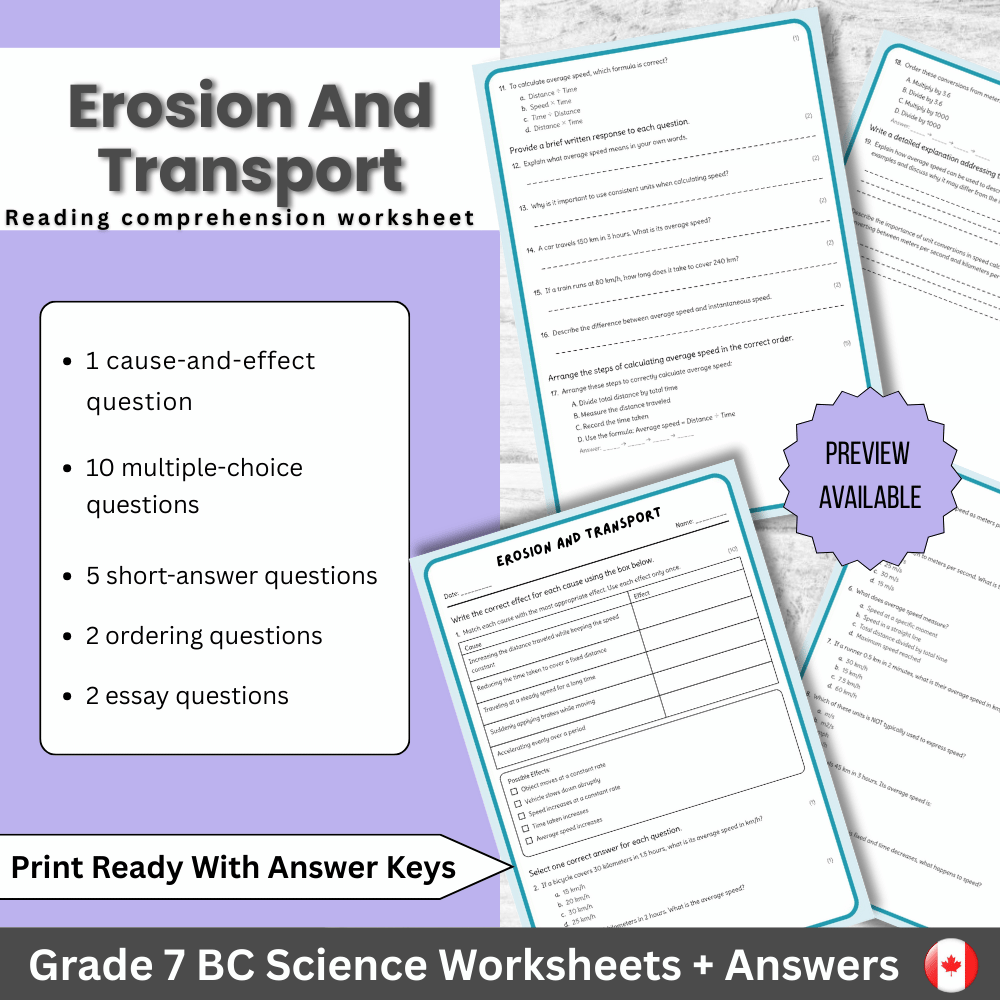
7th Grade Science | Erosion and Transport Worksheet (Answer Key) - BC Standards
 Created byBright Mind Resources
Learning Objectives
- Understand how agents like water, glaciers, wind, and gravity erode and transport sediment.
- Identify the distinctive signatures produced by different erosion and transport agents.
- Analyze landscape features formed by erosion and sediment transport processes.
Instant download

Pronoun References Worksheet | Grade 7 ELA Activities
 Created byMeadowlark Worksheets
Learning Objectives
- Match pronouns to their antecedents in person and number to prevent confusion.
- Use relative and demonstrative pronouns clearly so readers can identify what is being referenced.
- Revise sentences to eliminate vague or misleading pronoun references (especially it/they).
Also included in: Grade 7 Grammar, Punctuation & Sentence Skills ELA Lesson Bundle Alberta +1 more
Instant download

Freshwater Stratification Worksheets: Seasonal Turnover Grade 7 Science
 Created byPrism Point Learning
Learning Objectives
- Describe how light and dissolved oxygen change with freshwater depth
- Explain how seasonal thermal turnover affects nutrient mixing
- Predict vertical zonation from abiotic gradients in standing freshwater
Also included in: Interactions in the Environment Lesson Bundle | Grade 7 Science | Ontario +1 more
Instant download
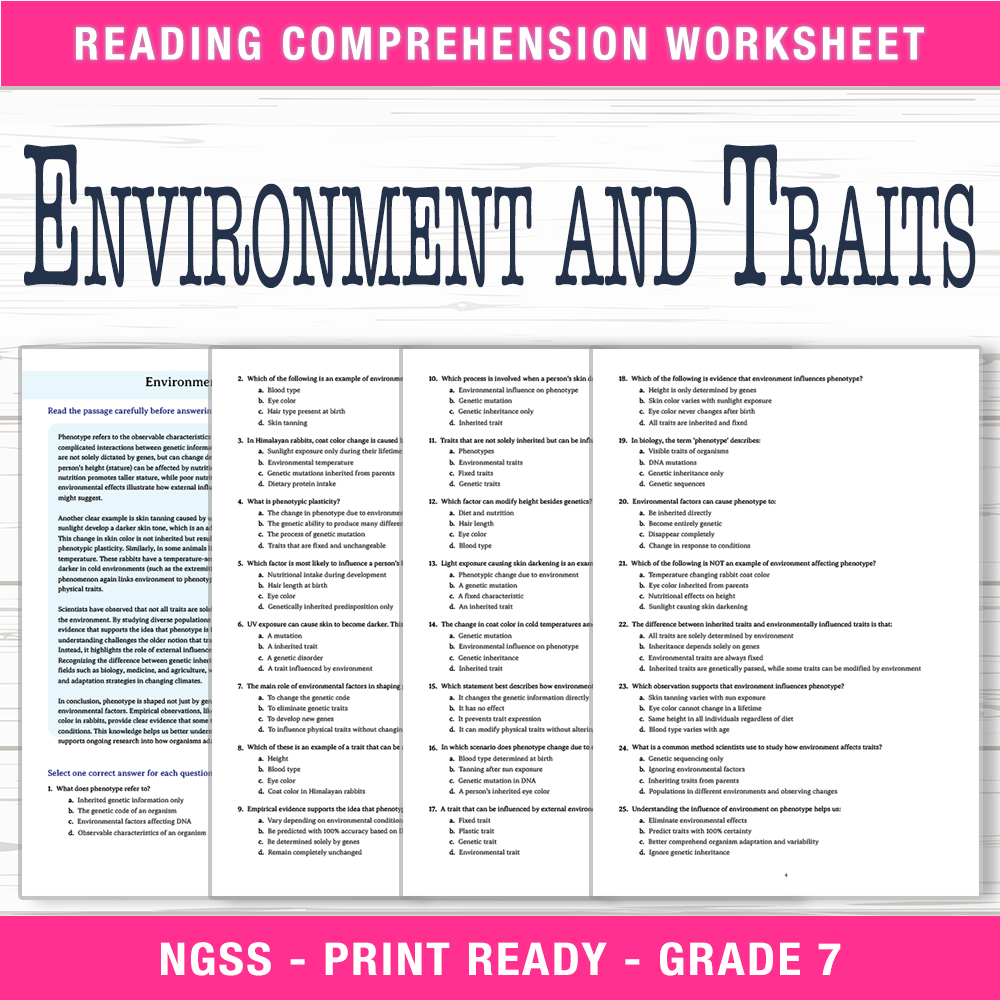
Grade 7 Science | Environment and Traits Worksheet (PDF + Answer Key)
 Created byRiverstone Classroom
Learning Objectives
- Explain how phenotype results from interactions between genetic makeup and environmental factors.
- Identify examples of traits influenced by external environmental conditions.
- Distinguish between inherited genetic traits and environmentally modulated traits.
Instant download
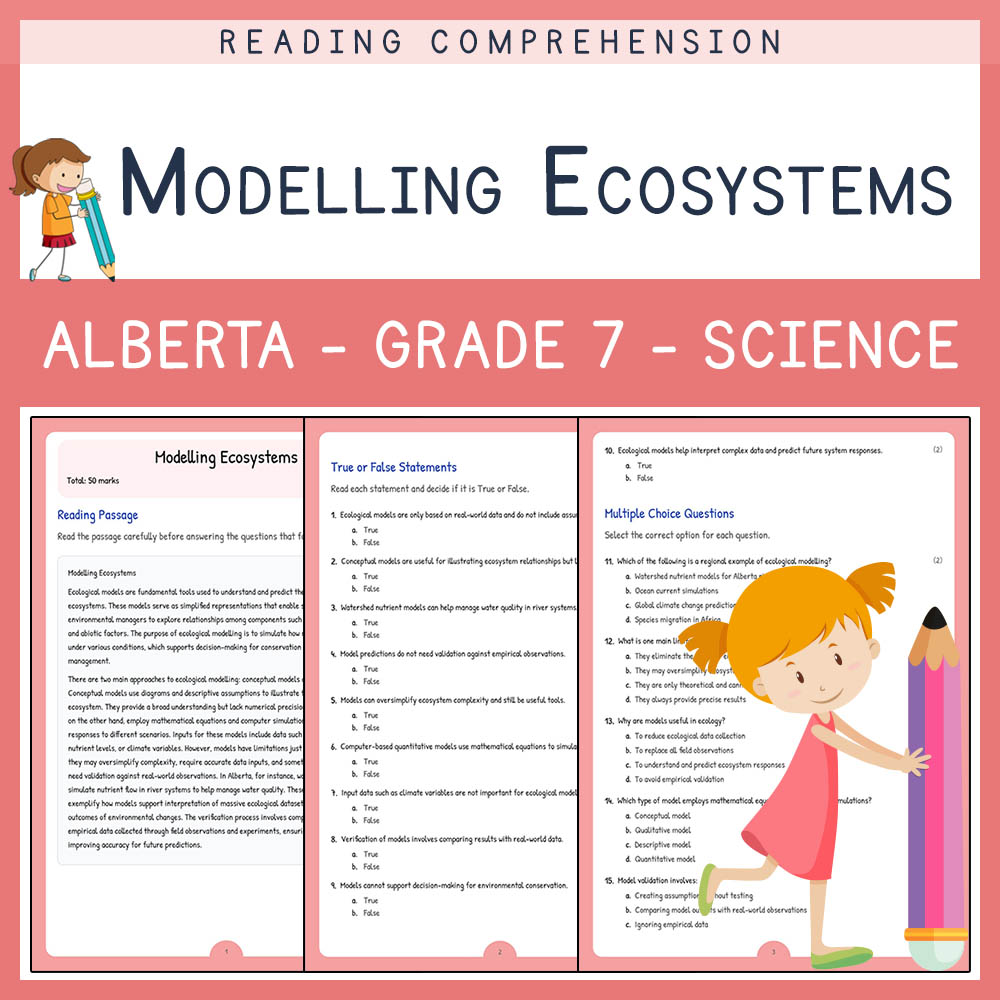
Grade 7 Science | Modelling Ecosystems Worksheet | Alberta Standards
 Created byLumora Learning
Learning Objectives
- Understand types of ecological models and their applications.
- Identify the inputs and limitations of ecological modelling.
- Explain regional examples such as watershed nutrient models.
Also included in: Grade 7 Science | Interactions & Ecosystems Custom Bundle | Alberta
Instant download
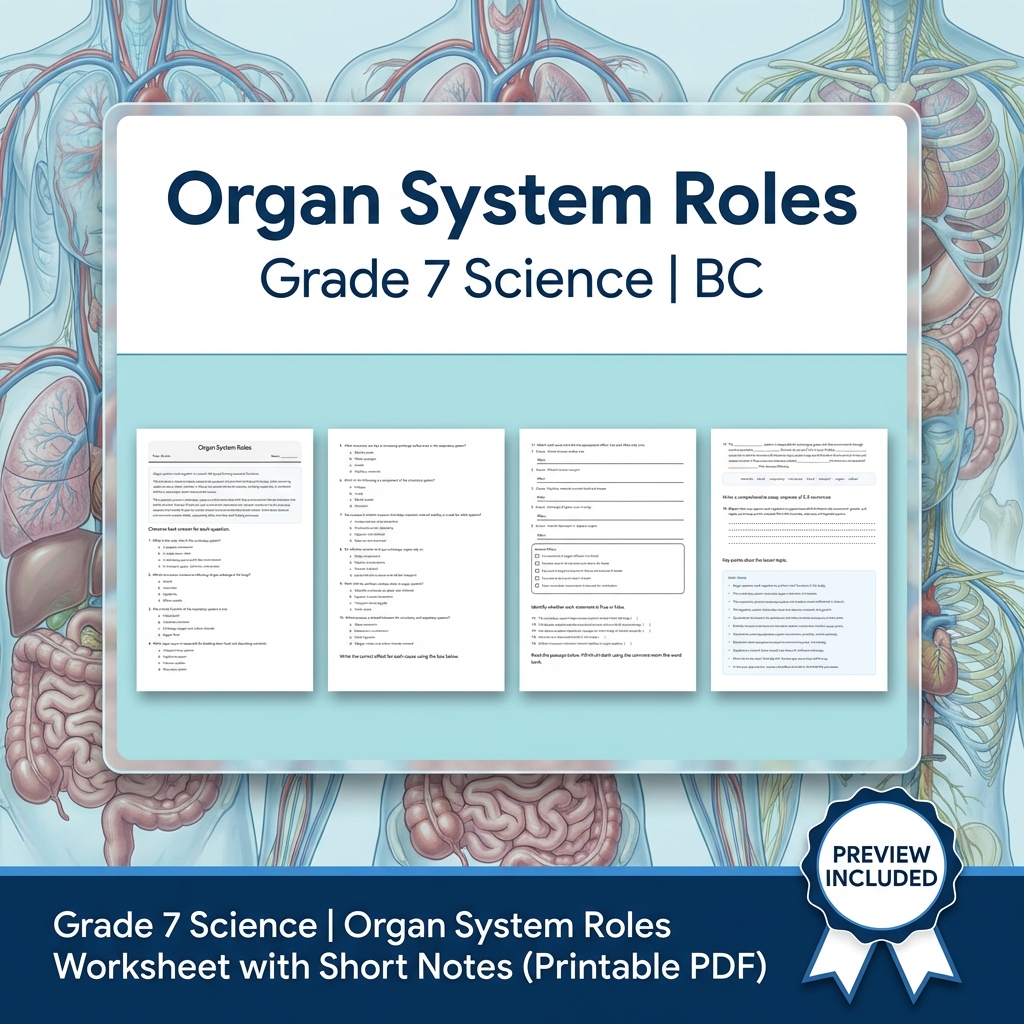
Grade 7 Science | Organ System Roles Worksheet with Short Notes (Printable PDF)
Created byMeadowlark WorksheetsLearning Objectives
- Describe the functions of major organ systems involved in circulation, respiration, and digestion.
- Explain how tissues and organs coordinate within organ systems to maintain life processes.
- Identify specialized structures like capillaries and alveoli that increase exchange efficiency.
Also included in: Grade 7 Science Lesson Bundle | Cell Structures & Functions Worksheets +1 more
Instant download
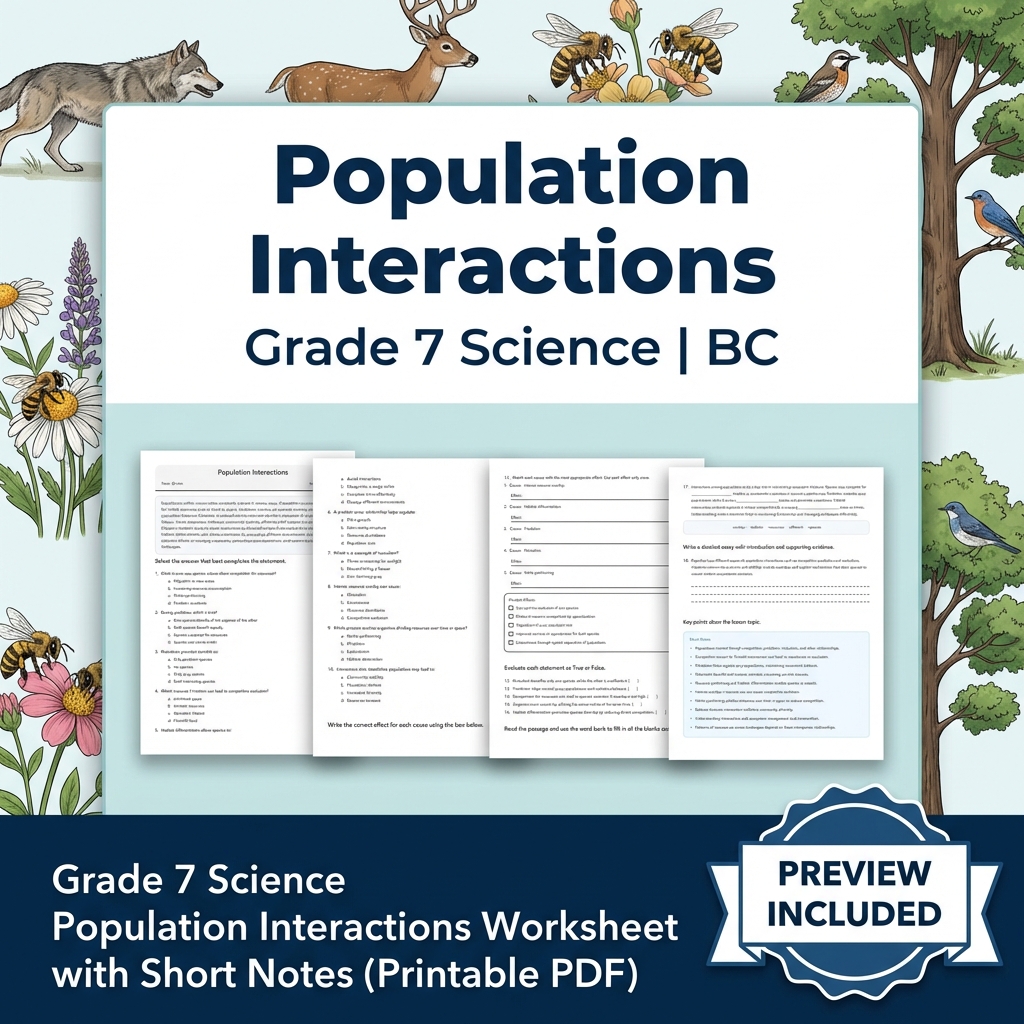
Grade 7 Science Population Interactions Worksheet with Short Notes (PDF)
Created byMeadowlark WorksheetsLearning Objectives
- Describe the different types of population interactions such as competition, predation, and mutualism.
- Explain how resource competition affects community composition and population dynamics.
- Identify mechanisms like niche partitioning and habitat differentiation that allow species to coexist.
Also included in: Grade 7 Science Lesson Bundle: Ecosystems and Population Dynamics Worksheets +1 more
Instant download

Grade 7 Science – Biodiversity Measures & Indices | Daily Reading Worksheet
Created byBright Mind ResourcesLearning Objectives
- Understand the concept of biodiversity and its different types
- Identify methods used to measure biodiversity such as richness, evenness, and habitat heterogeneity
- Explain the significance of biodiversity indices in assessing ecosystem health
Also included in: Grade 7 Ecosystems Science Lesson Bundle for Daily Reading Worksheets | Alberta +2 more
Instant download
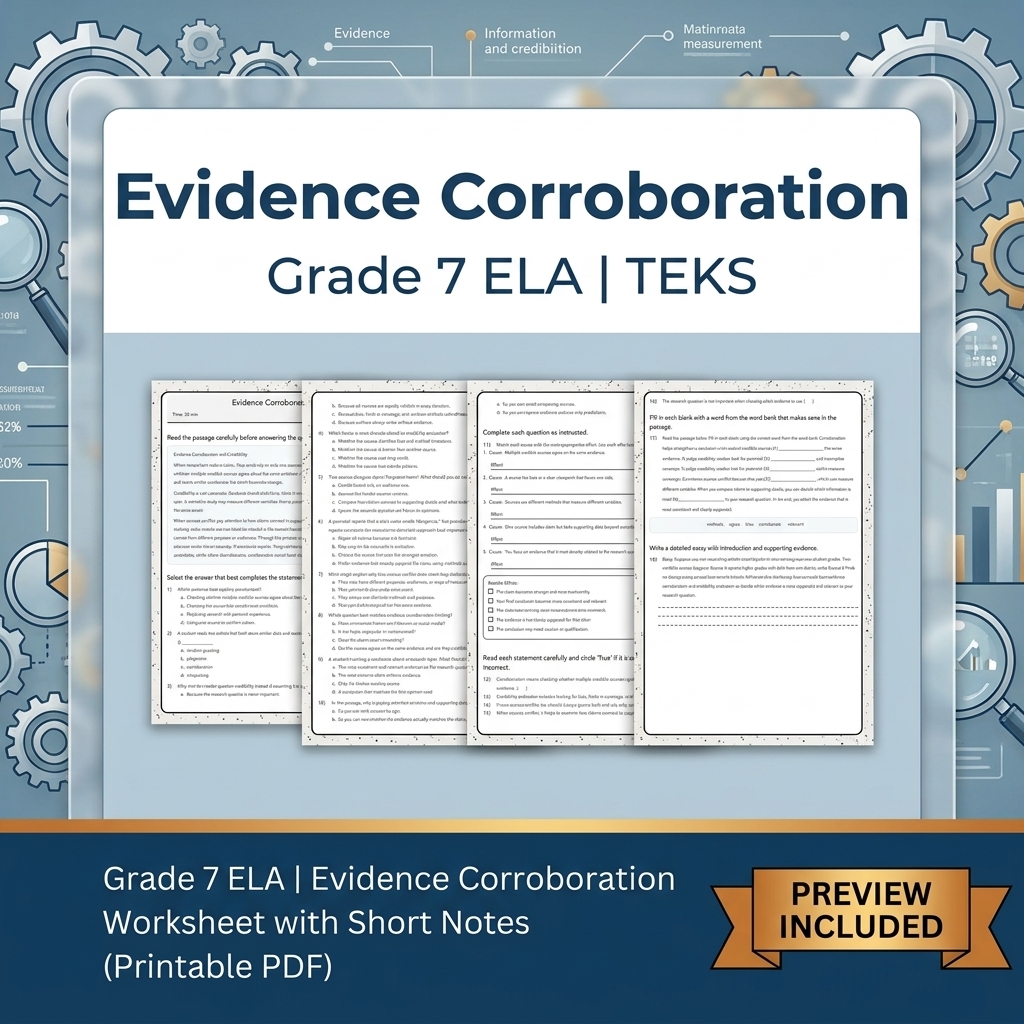
Grade 7 ELA | Evidence Corroboration Worksheet with Short Notes (Printable PDF)
Created byMeadowlark WorksheetsLearning Objectives
- Define corroboration and explain how it strengthens a conclusion.
- Evaluate source credibility by identifying bias, incomplete coverage, and differences in method, audience, or purpose.
- Analyze how claims relate to supporting evidence, especially when sources disagree.
Also included in: Grade 7 Evidence Synthesis, Source Credibility ELA Lesson Bundle: TEKS +1 more
Instant download

Landscape Evolution Practice Worksheet | Grade 7 Science Assessment
Created byPrism Point LearningLearning Objectives
- Explain how tectonic uplift and volcanic construction contribute to changes in Earth’s landscapes over time.
- Describe how surface processes such as weathering, erosion, and deposition redistribute materials.
- Compare how changes in uplift versus erosion affect whether topography increases or decreases.
Also included in: Earth's Systems & Processes Lesson Bundle | Grade 7 Science | BC +1 more
Instant download
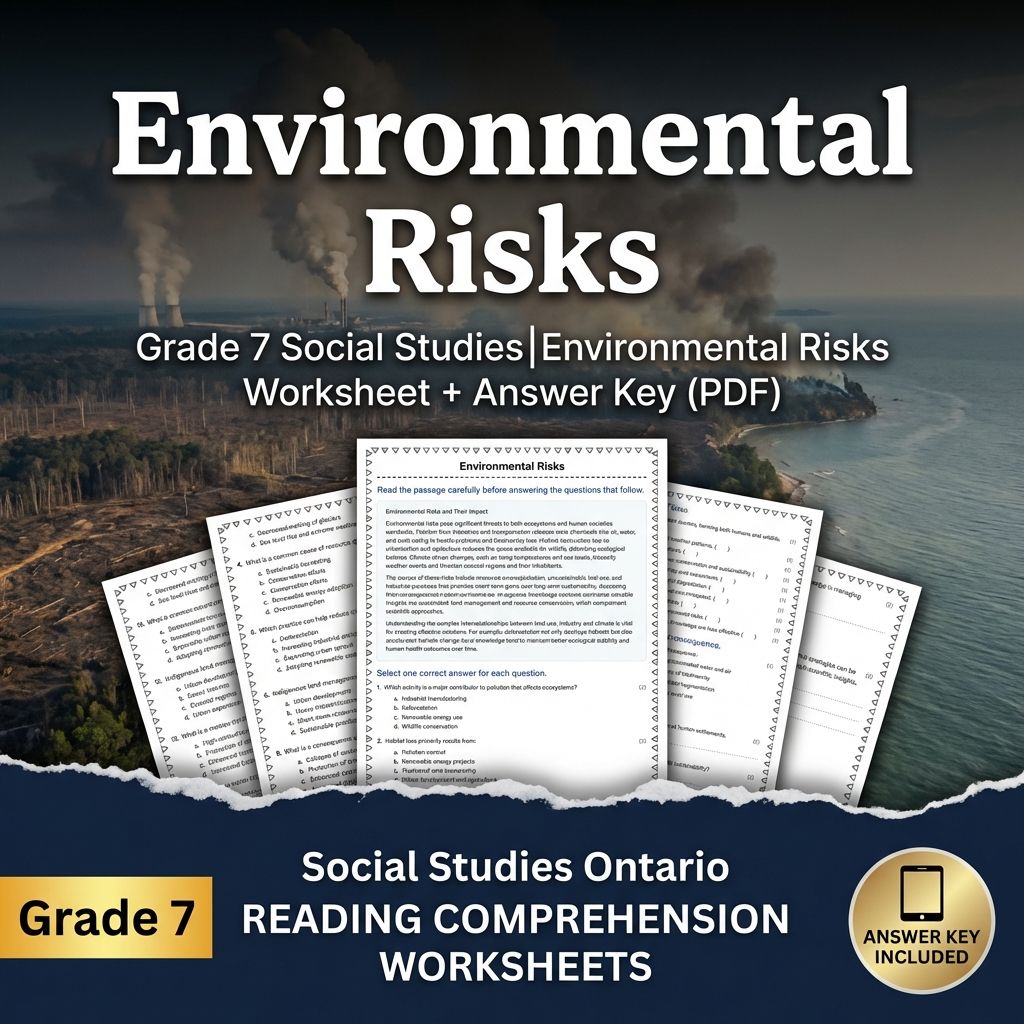
Grade 7 Social Studies | Environmental Risks Worksheet + Answer Key (PDF)
JCreated byJ.S SheetsLearning Objectives
- Identify key environmental risks such as pollution, habitat loss, and climate change.
- Analyze causes and consequences of resource use and settlement patterns.
- Evaluate interrelationships among land use, industry, and climate in affecting ecosystems and human health.
Also included in: Grade 7 Social Studies Bundle | Human-Environment Interactions & Global Networks +1 more
Instant download

Grade 7 Science | Invasive Species Worksheet | BC-Aligned
Created byLumora LearningLearning Objectives
- Understand the ecological mechanisms by which invasive species establish and spread.
- Identify the environmental and economic impacts of invasive species on native ecosystems.
- Analyze how invasive species alter food webs, nutrient cycles, and habitat structures.
Instant download

Grade 7 Science | Understanding Measurement Tools - Daily Reading Comprehension
Created byCoral Reef LearningLearning Objectives
- Identify how different measurement tools have varying levels of resolution.
- Understand how repeated measurements estimate uncertainty.
- Learn how graphs and tables can display measurement ranges and error margins.
Instant download

Science Worksheet Insulation Principles Grade 7 | Standards-Aligned Practice
JCreated byJ.S SheetsLearning Objectives
- Explain how insulation reduces heat transfer by limiting conduction, convection, and radiation
- Compare common insulating materials (fiberglass, foam, and reflective foils) using thermal resistance ideas and practical thickness
- Describe how thermal bridging and air leakage increase heat loss and why continuous insulation helps
Instant download

Social Media Day Reading Comprehension | Voicing Respect | Grades 6–8
Learning Objectives
- Explain how respectful digital citizenship and empathy influence online communication.
- Identify strategies for disagreeing politely and reducing conflict in social media conversations.
- Describe how online comments contribute to a digital footprint and can affect relationships.
Also included in: Social Media Day Mega Bundle | Grades 3–10 | Reading Comprehension
Instant download
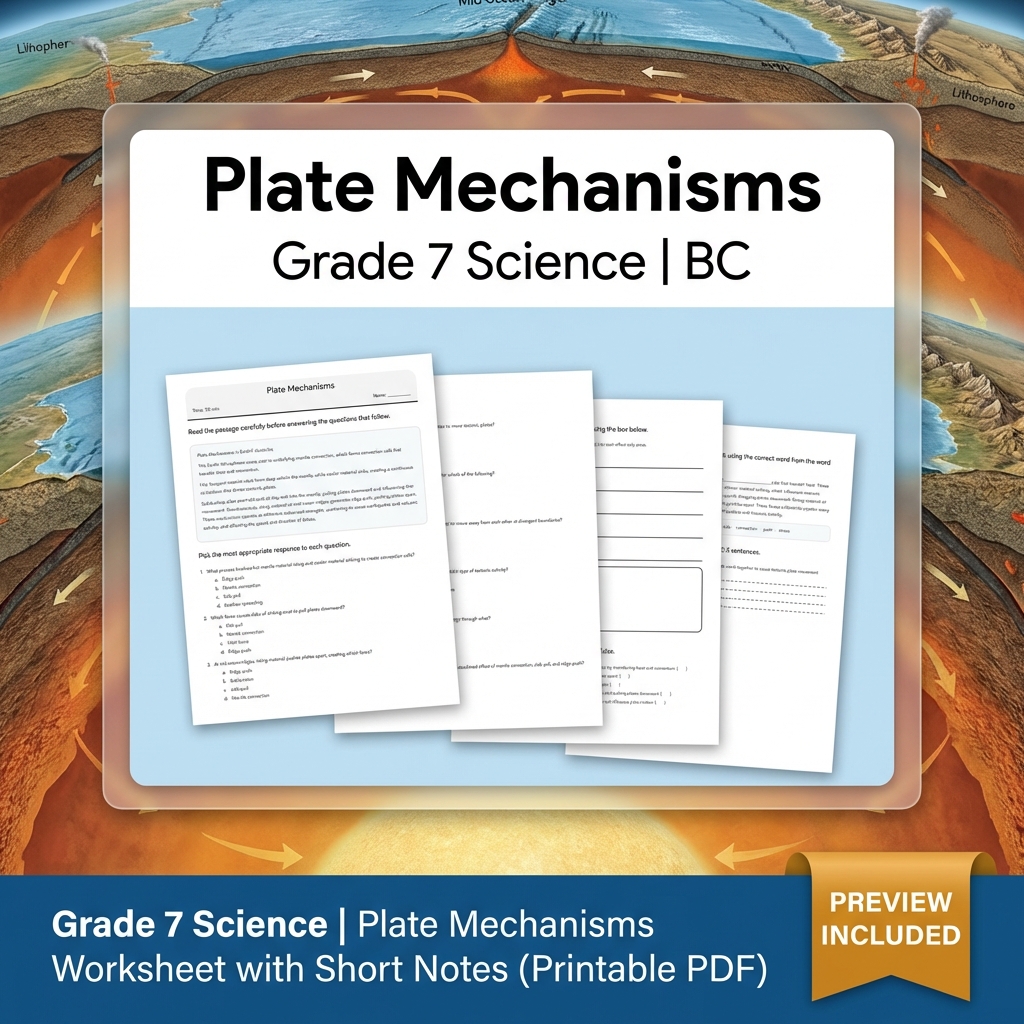
Grade 7 Science | Plate Mechanisms Worksheet with Short Notes (Printable PDF)
Created byMeadowlark WorksheetsLearning Objectives
- Understand how mantle convection, slab pull, and ridge push influence plate motion.
- Describe the processes of mantle convection and their role in tectonic activity.
- Explain how slab pull and ridge push contribute to plate movement.
Also included in: Grade 7 Science Lesson Bundle | Earth Processes Worksheets Group +1 more
Instant download

Loops and Iteration Coding Worksheet | Grade 7 Computer Science
Created byPrism Point LearningLearning Objectives
- Explain how loops use repetition to automate repeated steps in a program.
- Use loop ideas to predict what a program will do over multiple iterations.
- Compare efficiency and code clarity when using loops instead of duplicate instructions.
Instant download

Grade 7 Social Studies — Trade Foundations Worksheet MCQ Paper
Created byThe Resource HubLearning Objectives
- Understand the geographic factors that influenced the development of West African kingdoms.
- Analyze the significance of trade routes, especially the Trans-Saharan trade, in regional growth.
- Explain how the gold-salt exchange facilitated economic and political stability.
Also included in: Grade 7 Trade & Culture Social Studies Custom Bundle | California +1 more
Instant download

Bonding Patterns Worksheet | Grade 7 Science TEKS Practice
Created byPrism Point LearningLearning Objectives
- Differentiate ionic and covalent bonding using evidence from bonding structure and particle interactions.
- Relate bonding type to observable properties such as melting point, solubility, and electrical conductivity.
- Use empirical formulas to describe simple binary ionic salts and molecular compounds.
Also included in: Grade 7 Matter, States, and Reactions in Science Lesson Bundle TEKS
Instant download
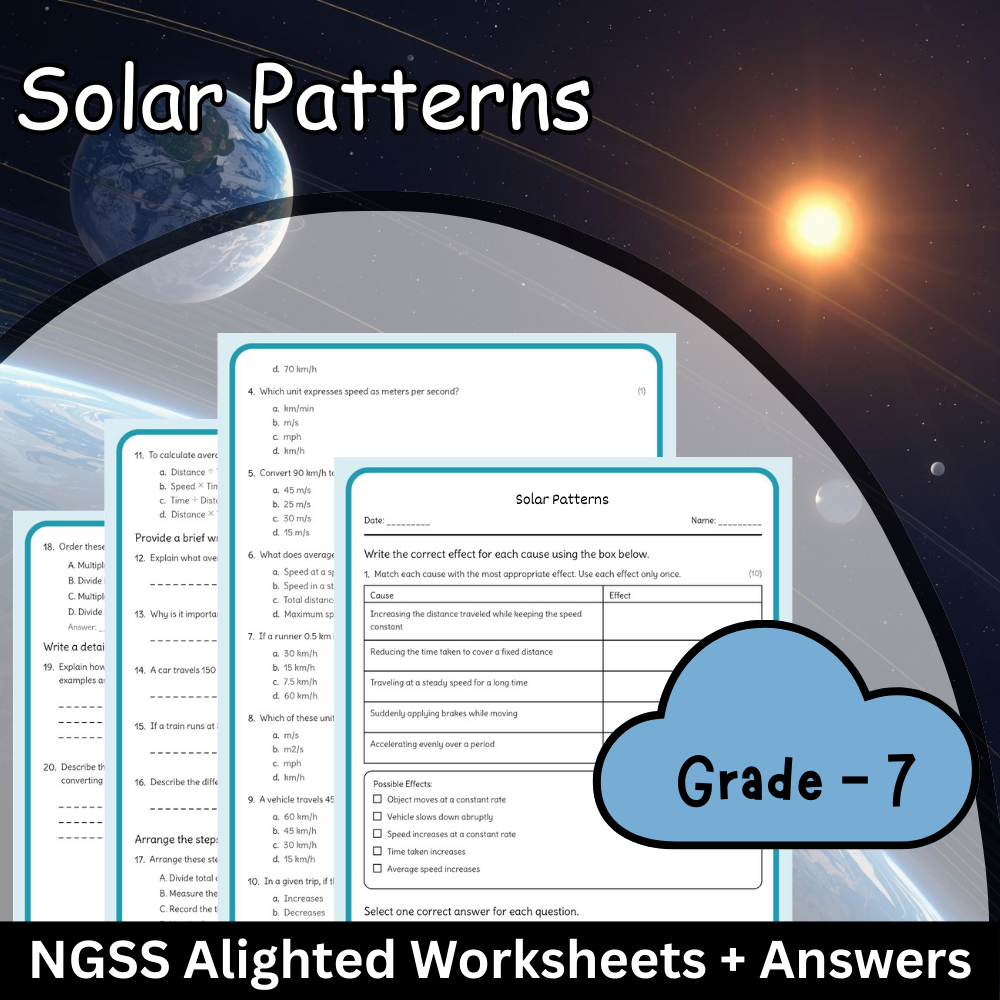
Grade 7 Science | Solar Patterns Worksheet + Answer Key (NGSS Standards)
Created byBright Mind ResourcesLearning Objectives
- Understand how relative motions of the Sun, Earth, and Moon produce observable cyclic patterns.
- Describe the causes of lunar phases, solar and lunar eclipses, and seasonal changes.
- Explain how diagrams of orbital geometry and axial tilt relate to day-night cycles and phases.
Instant download

Grade 7 Social Studies Worksheet | Settlement Patterns & Land Use (PDF)
 Created bySunny Desk Resources
Learning Objectives
- Explain how land grants and migration influenced settlement patterns from 1713 to 1850
- Describe how settlement affected Indigenous communities and agricultural development
- Compare continuity and change in community forms (rural and urban) over time
Also included in: Grade 7 War of 1812 to Atlantic Colonies Social Studies lesson bundle (Ontario) +1 more
Instant download

Audience Organization Worksheet for Grade 7 ELA | Standards-Aligned Practice
JCreated byJ.S SheetsLearning Objectives
- Explain how a text’s organization helps an audience follow a purpose (inform, persuade, or summarize).
- Identify how transitions and paragraph structure show relationships between ideas (sequence, cause/effect, and contrast).
- Use audience-aware strategies such as defining key terms and selecting examples that match listeners’ background knowledge.
Instant download
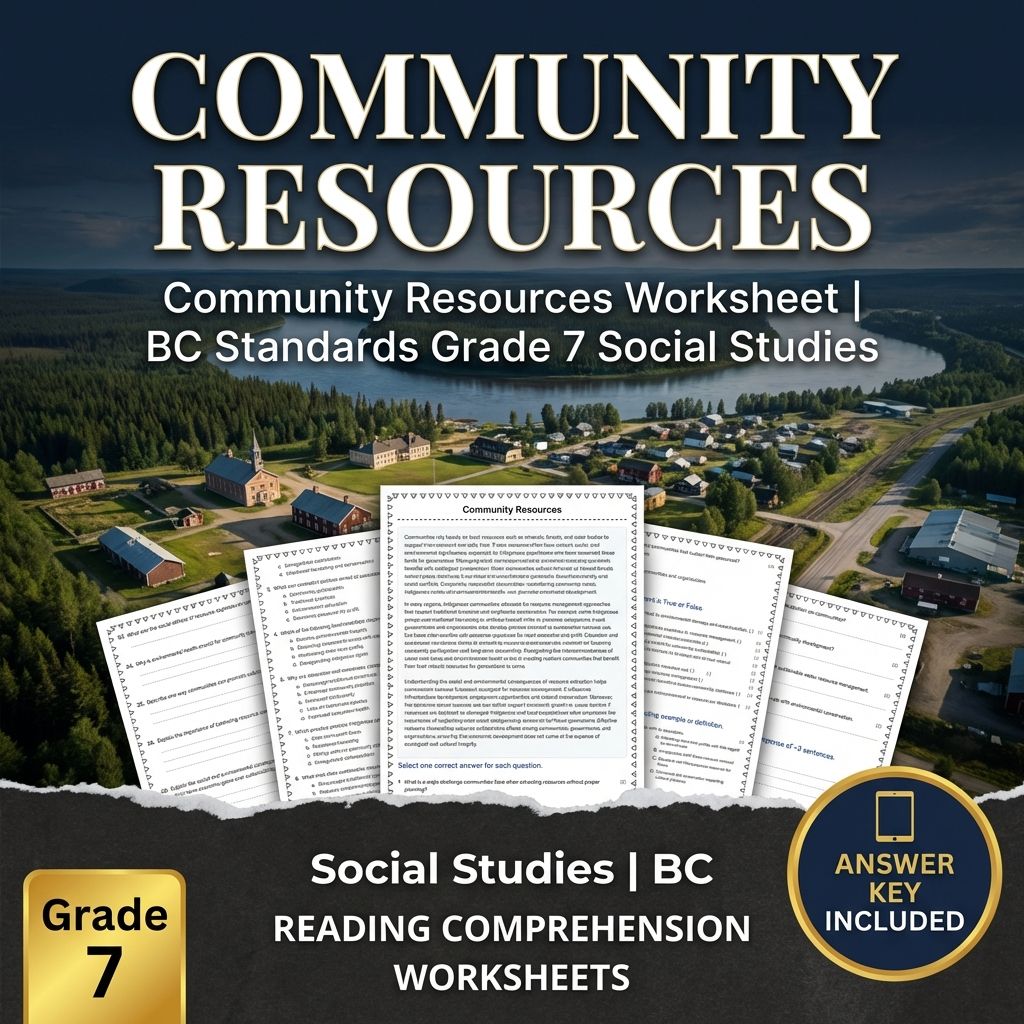
Community Resources Worksheet | BC Standards Grade 7 Social Studies
JCreated byJ.S SheetsLearning Objectives
- Understand how communities utilize local natural resources such as minerals, forests, and water.
- Analyze the social and environmental impacts of resource extraction and management.
- Explore Indigenous and local perspectives on resource stewardship.
Instant download
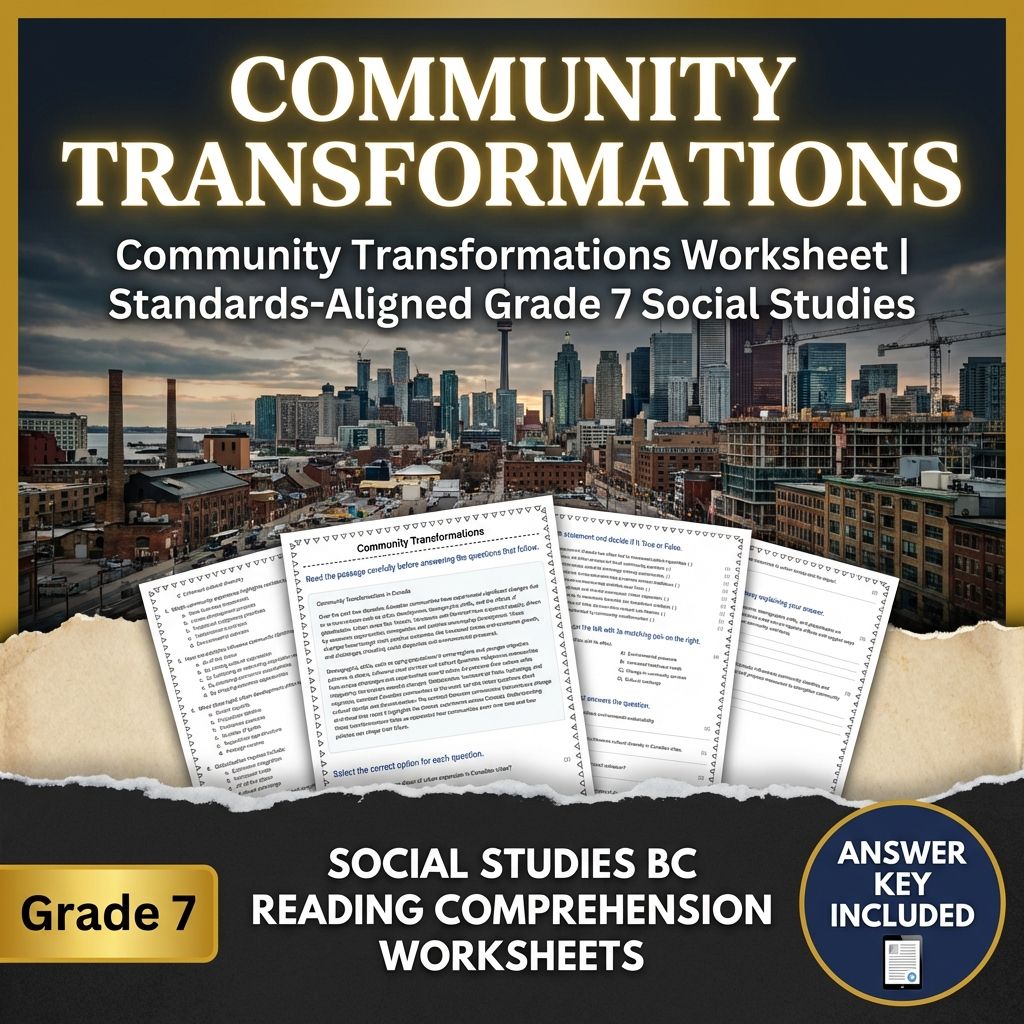
Community Transformations Worksheet | Standards-Aligned Grade 7 Social Studies
JCreated byJ.S SheetsLearning Objectives
- Understand the factors that influence urban development and demographic shifts.
- Analyze the causes and effects of globalization on Canadian communities.
- Compare different experiences of community change and their impact on cultural diversity and social cohesion.
Instant download

Fitness and Survival Worksheet | Grade 7 Evolution & Natural Selection
Created byPrism Point LearningLearning Objectives
- Explain how fitness relates to survival and reproduction in a particular environment
- Describe how environmental changes can change which heritable traits are favored by natural selection
- Connect fitness outcomes to variation within a population and changing selection pressures
Also included in: Grade 7 Evolution, Genetics & Ecosystems Lesson Bundle | Florida NGSSS
Instant download

Grade 7 Social Studies — Community Transformations Worksheet MCQ Paper
Created byThe Resource HubLearning Objectives
- Understand the causes of community changes such as urban development, demographic shifts, and globalization.
- Analyze the effects of these changes on cultural diversity and social cohesion.
- Compare different community experiences in Canada to see how change influences identity.
Also included in: Grade 7 Social Studies BC Bundle – Patterns of Continuity and Change Worksheets +1 more
Instant download

Grade 7 Social Studies — Art and Society Worksheet MCQ Paper for Mastery
Created byThe Resource HubLearning Objectives
- Explain how art and literature can reflect societal values and identity
- Describe ways creative expression can challenge norms and inspire reform
- Analyze examples of historical change connected to artistic and intellectual ideas
Instant download

Energy Flow in Ecosystems Worksheets for Grade 7 Science
 Created bythe curious pencil
Learning Objectives
- Identify producers, consumers, and decomposers in food webs
- Explain how photosynthesis captures energy in ecosystems
- Describe how cellular respiration contributes to energy flow
Also included in: Ecosystems Worksheets Grade 7 Science | NGSS Unit Bundle +2 more
Instant download

Natural Selection and Adaptation Worksheets | Grade 7 Science
Created bythe curious pencilLearning Objectives
- Explain how heritable variation affects populations over generations
- Describe how environmental pressures influence trait frequencies
- Identify how survival and reproduction contribute to natural selection
Also included in: Biological Evolution Worksheets Bundle | Grade 7 Science NGSS +2 more
Instant download

Anatomical Evidence for Evolution Worksheets Grade 7 Science
Created bythe curious pencilLearning Objectives
- Distinguish homologous, analogous, and vestigial structures
- Explain how anatomy provides evidence for evolutionary relationships
- Infer common ancestry from comparative anatomical patterns
Also included in: Biological Evolution Worksheets Bundle | Grade 7 Science NGSS +2 more
Instant download

Inheritance Probability and Genetic Variation Worksheets – Grade 7 Science
Created bythe curious pencilLearning Objectives
- Calculate genotype probabilities from simple monohybrid crosses.
- Calculate phenotype probabilities using dominant and recessive alleles.
- Use Punnett squares to connect allele combinations with probability.
Also included in: Heredity Inheritance and Variation of Traits NGSS Science Bundle +2 more
Instant download

Heat Transfer Worksheets: Thermal Energy Movement | Grade 7 Science
Created bythe curious pencilLearning Objectives
- Identify conduction, convection, and radiation as energy-transfer mechanisms
- Explain how thermal energy moves between warmer and cooler regions
- Use temperature changes as evidence of thermal energy transfer
Also included in: Energy Grade 7 Science Worksheets | NGSS Energy Unit Bundle +2 more
Instant download

Ecosystem Disturbances and Resilience Worksheets | Grade 7 Science
Created bythe curious pencilLearning Objectives
- Identify physical and biological disturbances in ecosystems
- Explain resistance, resilience, and succession after disturbances
- Interpret population changes caused by ecosystem disturbances
Also included in: Ecosystems Worksheets Grade 7 Science | NGSS Unit Bundle +2 more
Instant download

Material Properties Worksheets: Physical & Chemical Properties Grade 7
Created bythe curious pencilLearning Objectives
- Distinguish physical properties from chemical properties
- Describe how density and melting point identify materials
- Explain how solubility and conductivity characterize materials
Also included in: Matter and Its Interactions Worksheets | Grade 7 Science NGSS +2 more
Instant download

Global Atmospheric and Oceanic Circulation Worksheets Grade 7 Science
Created bythe curious pencilLearning Objectives
- Explain how unequal solar heating drives atmospheric circulation.
- Describe how Earth’s rotation affects prevailing winds.
- Identify Hadley, Ferrel, and polar circulation cells.
Also included in: Earth's Systems Worksheets Grade 7 Science | NGSS Unit Bundle +2 more
Instant download

Biodiversity and Ecosystem Services Worksheets | Grade 7 Science
Created bythe curious pencilLearning Objectives
- Compare strategies used to protect biodiversity and ecosystem services
- Identify benefits and trade-offs of habitat management strategies
- Evaluate ecological, economic, and social evidence
Also included in: Ecosystems Worksheets Grade 7 Science | NGSS Unit Bundle +2 more
Instant download

DNA and Chromosomes Worksheets: Grade 7 Heredity & Inheritance
Created bythe curious pencilLearning Objectives
- Explain how DNA is organized into chromosomes and contains genes.
- Describe how DNA sequence differences contribute to observable trait variation.
- Model chromosome separation during gamete formation.
Also included in: Heredity Inheritance and Variation of Traits NGSS Science Bundle +2 more
Instant download

Rock Cycle Worksheets for Grade 7 Earth Science | Earth's Systems
Created bythe curious pencilLearning Objectives
- Identify how igneous, sedimentary, and metamorphic rocks form
- Explain how weathering and erosion move rock materials
- Describe how heat and pressure cause metamorphism
Also included in: Earth's Systems Worksheets Grade 7 Science | NGSS Unit Bundle +2 more
Instant download

Species Interactions in Ecosystems Worksheets | Grade 7 Science
Created bythe curious pencilLearning Objectives
- Identify predation, competition, parasitism, mutualism, and commensalism
- Explain how species interactions affect populations and communities
- Trace direct and indirect effects through food webs
Also included in: Ecosystems Worksheets Grade 7 Science | NGSS Unit Bundle +2 more
Instant download

Momentum and Collisions Worksheets | Grade 7 Science
Created bythe curious pencilLearning Objectives
- Define momentum in terms of mass and velocity
- Calculate momentum using mass and velocity
- Explain conservation of momentum during simple collisions
Also included in: Motion and Stability Grade 7 Science Worksheets | NGSS Forces Bundle +2 more
Instant download

Embryonic Development and Evolution Worksheets | Grade 7 Science
Created bythe curious pencilLearning Objectives
- Describe how embryonic similarities provide evolutionary evidence
- Identify conserved developmental features in vertebrate embryos
- Explain the role of transient developmental structures
Also included in: Biological Evolution Worksheets Bundle | Grade 7 Science NGSS +2 more
Instant download

Plate Tectonics and Continental Movement Worksheets Grade 7
Created bythe curious pencilLearning Objectives
- Identify evidence supporting continental and tectonic plate movement
- Explain how fossils reveal past continental connections
- Interpret matching rock layers and continental margins as evidence
Also included in: Earth's Systems Worksheets Grade 7 Science | NGSS Unit Bundle +2 more
Instant download

Earth's Place in the Universe Worksheets | Grade 7 Science
Created bythe curious pencilLearning Objectives
- Explain how Earth's rotation produces the day-night cycle
- Describe how Earth's axial tilt and orbit produce seasons
- Explain how the Moon's orbit creates repeating lunar phases
Also included in: Earth's Place in the Universe Worksheets Grade 7 | NGSS Bundle +2 more
Instant download
Browse more categories
About Grade 7 Worksheets
Find Grade 7 worksheets covering math, ELA, science, and social studies. All 8,498 resources download instantly as PDFs for classwork, homework, or review.
MyTeachingSheets worksheets are made by real teacher-authors and checked before they go live. Download any as a print-ready PDF for lessons, homework, or independent practice — most include answer keys, and previews are always free.