
Grade 7 Worksheets
8,498 grade resources
Plate Tectonics and Continental Movement Worksheets Grade 7
 Created bythe curious pencil
Learning Objectives
- Identify evidence supporting continental and tectonic plate movement
- Explain how fossils reveal past continental connections
- Interpret matching rock layers and continental margins as evidence
Also included in: Earth's Systems Worksheets Grade 7 Science | NGSS Unit Bundle +2 more
Instant download

Species Interactions in Ecosystems Worksheets | Grade 7 Science
Created bythe curious pencilLearning Objectives
- Identify predation, competition, parasitism, mutualism, and commensalism
- Explain how species interactions affect populations and communities
- Trace direct and indirect effects through food webs
Also included in: Ecosystems Worksheets Grade 7 Science | NGSS Unit Bundle +2 more
Instant download

Cell Structures and Functions Worksheets Grade 7 Science
Created bythe curious pencilLearning Objectives
- Identify major organelles in eukaryotic cells
- Describe functions of major cellular structures
- Explain how cell structure supports specialized functions
Also included in: Grade 7 Science Cells & Organisms Worksheets Bundle | NGSS +2 more
Instant download

Relative Dating of Rock Strata Worksheets | Grade 7 Earth Science
Created bythe curious pencilLearning Objectives
- Apply superposition to determine relative ages of rock layers
- Explain original horizontality using changes to sedimentary layers
- Use cross-cutting relationships to sequence geologic events
Also included in: Earth's Place in the Universe Worksheets Grade 7 | NGSS Bundle +2 more
Instant download

Potential Energy in Systems Worksheets | Grade 7 Science Energy
Created bythe curious pencilLearning Objectives
- Identify gravitational, elastic, and magnetic potential energy
- Explain how object arrangement affects stored potential energy
- Compare potential energy in different system arrangements
Also included in: Energy Grade 7 Science Worksheets | NGSS Energy Unit Bundle +2 more
Instant download

Natural Hazards, Risk & Mitigation Worksheets | Grade 7 Science
Created bythe curious pencilLearning Objectives
- Identify patterns in the frequency and distribution of natural hazards
- Explain how recurrence intervals support natural hazard risk assessment
- Interpret how hazard maps and forecasts communicate potential risk
Also included in: Earth and Human Activity Worksheets Grade 7 Science | NGSS Bundle +2 more
Instant download

Cell Evidence and Cellular Organization Worksheets Grade 7 Science
Created bythe curious pencilLearning Objectives
- Identify evidence that organisms are composed of cells
- Distinguish unicellular from multicellular organization
- Compare cell boundaries in plant and animal cells
Also included in: Grade 7 Science Cells & Organisms Worksheets Bundle | NGSS +2 more
Instant download

Net Force, Mass, and Acceleration Worksheets for Grade 7 Science
Created bythe curious pencilLearning Objectives
- Calculate net force from forces acting in opposite directions.
- Explain how unbalanced forces change an object's motion.
- Relate net force and mass to acceleration.
Also included in: Motion and Stability Grade 7 Science Worksheets | NGSS Forces Bundle +2 more
Instant download

Surface Processes and Landscape Change Worksheets | Grade 7 Science
Created bythe curious pencilLearning Objectives
- Distinguish weathering, erosion, transport, and deposition
- Explain how water, ice, wind, waves, and gravity shape Earth
- Identify landforms produced by different surface processes
Also included in: Earth's Systems Worksheets Grade 7 Science | NGSS Unit Bundle +2 more
Instant download

Organ System Interactions and Homeostasis Worksheets | Grade 7 Science
Created bythe curious pencilLearning Objectives
- Explain how organ systems cooperate to support body functions
- Describe how oxygen and nutrients are transported to cells
- Identify how organ systems contribute to homeostasis
Also included in: Grade 7 Science Cells & Organisms Worksheets Bundle | NGSS +2 more
Instant download

Gravitational, Electric, and Magnetic Interactions Worksheets Grade 7
Created bythe curious pencilLearning Objectives
- Describe gravity as an attractive non-contact force between masses.
- Explain how mass and distance affect gravitational attraction.
- Identify attractive and repulsive electric interactions between charges.
Also included in: Motion and Stability Grade 7 Science Worksheets | NGSS Forces Bundle +2 more
Instant download

Climate Change Worksheets for Grade 7 Earth Science | NGSS Practice
Created bythe curious pencilLearning Objectives
- Identify evidence used to study long-term climate change patterns
- Explain how greenhouse gases influence Earth's climate
- Describe how carbon moves through the carbon cycle
Also included in: Earth and Human Activity Worksheets Grade 7 Science | NGSS Bundle +2 more
Instant download

Engineering Design Problem Definition Worksheets | Grade 7 Science
Created bythe curious pencilLearning Objectives
- Define criteria and constraints in an engineering design problem.
- Distinguish measurable performance criteria from design constraints.
- Translate real-world needs into measurable performance targets.
Also included in: Engineering Design Grade 7 Science Worksheets | NGSS Bundle +2 more
Instant download

Population Limits and Carrying Capacity Worksheets | Grade 7
Created bythe curious pencilLearning Objectives
- Explain how limited resources affect population growth rates
- Interpret logistic growth curves and identify carrying capacity
- Describe how births and deaths change population size
Also included in: Ecosystems Worksheets Grade 7 Science | NGSS Unit Bundle +2 more
Instant download

Fossil Patterns & Common Ancestry Worksheets | Grade 7 Science
Created bythe curious pencilLearning Objectives
- Identify patterns in fossil records and sedimentary rock layers
- Explain how index fossils help compare rock-layer ages
- Describe how fossil assemblages help correlate rock layers
Also included in: Biological Evolution Worksheets Bundle | Grade 7 Science NGSS +2 more
Instant download

Quantitative Models of Evolution Worksheets | Grade 7 Science Practice
Created bythe curious pencilLearning Objectives
- Explain how quantitative models describe population changes
- Calculate simple trait and allele frequencies
- Interpret graphs showing changes across generations
Also included in: Biological Evolution Worksheets Bundle | Grade 7 Science NGSS +2 more
Instant download

Balanced Forces & Equilibrium Worksheets | Grade 7 Science
Created bythe curious pencilLearning Objectives
- Explain equilibrium using the vector sum of forces.
- Distinguish static equilibrium from dynamic equilibrium.
- Identify balanced gravity, normal force, and tension.
Also included in: Motion and Stability Grade 7 Science Worksheets | NGSS Forces Bundle +2 more
Instant download

Environment and Phenotype Science Worksheets | Grade 7
Created bythe curious pencilLearning Objectives
- Explain how genes and environment interact to influence phenotype.
- Identify environmental factors that can influence observable traits.
- Distinguish inherited contributions from environmental influences on phenotype.
Also included in: Heredity Inheritance and Variation of Traits NGSS Science Bundle +2 more
Instant download

Water Cycle Worksheets: Pathways and Processes | Grade 7 Science
Created bythe curious pencilLearning Objectives
- Explain how solar energy drives evaporation in the water cycle
- Describe how gravity moves water through Earth's systems
- Identify processes that move water into and through groundwater
Also included in: Earth's Systems Worksheets Grade 7 Science | NGSS Unit Bundle +2 more
Instant download

Resource Distribution and Geologic Processes Worksheets Grade 7
Created bythe curious pencilLearning Objectives
- Explain how geologic processes create uneven resource distributions
- Connect plate tectonics and sedimentation to resource formation
- Describe how weathering affects minerals, soil, and groundwater
Also included in: Earth and Human Activity Worksheets Grade 7 Science | NGSS Bundle +2 more
Instant download

Cosmic Scale: Sizes and Distances in Space Worksheets Grade 7
Created bythe curious pencilLearning Objectives
- Compare relative sizes and distances within the solar system
- Use astronomical units to describe distances in the solar system
- Use light-years to describe distances beyond the solar system
Also included in: Earth's Place in the Universe Worksheets Grade 7 | NGSS Bundle +2 more
Instant download

Photosynthesis and Cellular Respiration Energy Transformations Worksheet Grade 7
Created bythe curious pencilLearning Objectives
- Explain how photosynthesis stores light energy in sugar bonds
- Describe how cellular respiration transfers energy into ATP
- Connect photosynthesis and respiration through matter and energy
Also included in: Grade 7 Science Cells & Organisms Worksheets Bundle | NGSS +2 more
Instant download

Engineering Design Trade-Offs Worksheets | Grade 7 Science
Created bythe curious pencilLearning Objectives
- Compare design solutions using consistent measurements.
- Identify trade-offs among competing design features.
- Distinguish predicted behavior from observed prototype behavior.
Also included in: Engineering Design Grade 7 Science Worksheets | NGSS Bundle +2 more
Instant download

Energy Accounting Worksheets: Motion & Energy Transfers Grade 7
Created bythe curious pencilLearning Objectives
- Explain how motion energy changes during energy transfers
- Identify transfers from motion energy to thermal energy and sound
- Calculate simple changes in motion energy using joule values
Also included in: Energy Grade 7 Science Worksheets | NGSS Energy Unit Bundle +2 more
Instant download

Energy Conversion and Efficiency Worksheets | Grade 7 Science Practice
Created bythe curious pencilLearning Objectives
- Identify energy transformations in common devices.
- Explain energy conservation during energy transformations.
- Describe thermal energy transfer to the surroundings.
Also included in: Energy Grade 7 Science Worksheets | NGSS Energy Unit Bundle +2 more
Instant download

Climate Patterns and Regional Climate Worksheets Grade 7 Science
Created bythe curious pencilLearning Objectives
- Explain how uneven solar heating creates temperature gradients.
- Interpret wind, temperature, precipitation, and sea-surface temperature patterns.
- Describe how El Niño influences climate patterns.
Also included in: Earth's Systems Worksheets Grade 7 Science | NGSS Unit Bundle +2 more
Instant download

Population Impacts on Natural Resources Worksheets Grade 7 Science
Created bythe curious pencilLearning Objectives
- Explain how population growth affects total resource demand
- Describe how per-capita consumption changes resource demand
- Identify ecosystem effects of urbanization and agriculture
Also included in: Earth and Human Activity Worksheets Grade 7 Science | NGSS Bundle +2 more
Instant download

Human Impacts on Land, Water, and Air Worksheets | Grade 7
Created bythe curious pencilLearning Objectives
- Identify human activities that change land, water, and air
- Explain how environmental indicators reveal human impacts
- Interpret monitoring data to identify environmental changes
Also included in: Earth and Human Activity Worksheets Grade 7 Science | NGSS Bundle +2 more
Instant download

Gravity Motion and Orbital Patterns Worksheets Grade 7 Science
Created bythe curious pencilLearning Objectives
- Explain how gravity governs orbital motion.
- Describe how mass and distance affect gravitational attraction.
- Interpret elliptical orbits and orbital periods.
Also included in: Earth's Place in the Universe Worksheets Grade 7 | NGSS Bundle +2 more
Instant download

Matter and Its Interactions Worksheets: Representations Grade 7
Created bythe curious pencilLearning Objectives
- Interpret chemical equations as quantitative representations
- Compare measurements shown in graphs and tables
- Identify patterns in changing experimental measurements
Also included in: Matter and Its Interactions Worksheets | Grade 7 Science NGSS +2 more
Instant download

Matter Cycling in Organisms Worksheets | Grade 7 Science
Created bythe curious pencilLearning Objectives
- Explain how digestion makes atoms available for cellular use
- Describe how biosynthesis rearranges atoms into cellular materials
- Trace carbon and nitrogen through organisms and wastes
Also included in: Grade 7 Science Cells & Organisms Worksheets Bundle | NGSS +2 more
Instant download

Engineering Design Optimization Worksheets | Grade 7 Science
Created bythe curious pencilLearning Objectives
- Analyze test data to identify measurable design improvements
- Compare design results with performance requirements and constraints
- Explain how parameter changes affect design performance
Also included in: Engineering Design Grade 7 Science Worksheets | NGSS Bundle +2 more
Instant download

Grade 7 Science – Net Force Diagrams & Force Vectors | Daily Reading Worksheet
 Created byBright Mind Resources
Learning Objectives
- Learn what free-body diagrams represent and how forces are shown.
- Identify different forces acting on objects in various situations.
- Understand how to draw simple net force diagrams for objects on inclined surfaces.
Also included in: Grade 7 Structures & Forces Science Lesson Bundle Daily Reading | Alberta +2 more
Instant download

Grade 7 Design Thinking Worksheet | Engineering Design Process Ontario
 Created byChalk and Compass
Learning Objectives
- Explain the steps of engineering design thinking from problem definition to solution iteration.
- Write clear problem specifications that include measurable criteria and realistic constraints.
- Use trade-off thinking to compare conceptual solutions using feasibility, cost, and environmental factors.
Also included in: Grade 7 Science Scientific Inquiry & Data Analysis Lesson Bundle | Ontario +1 more
Instant download
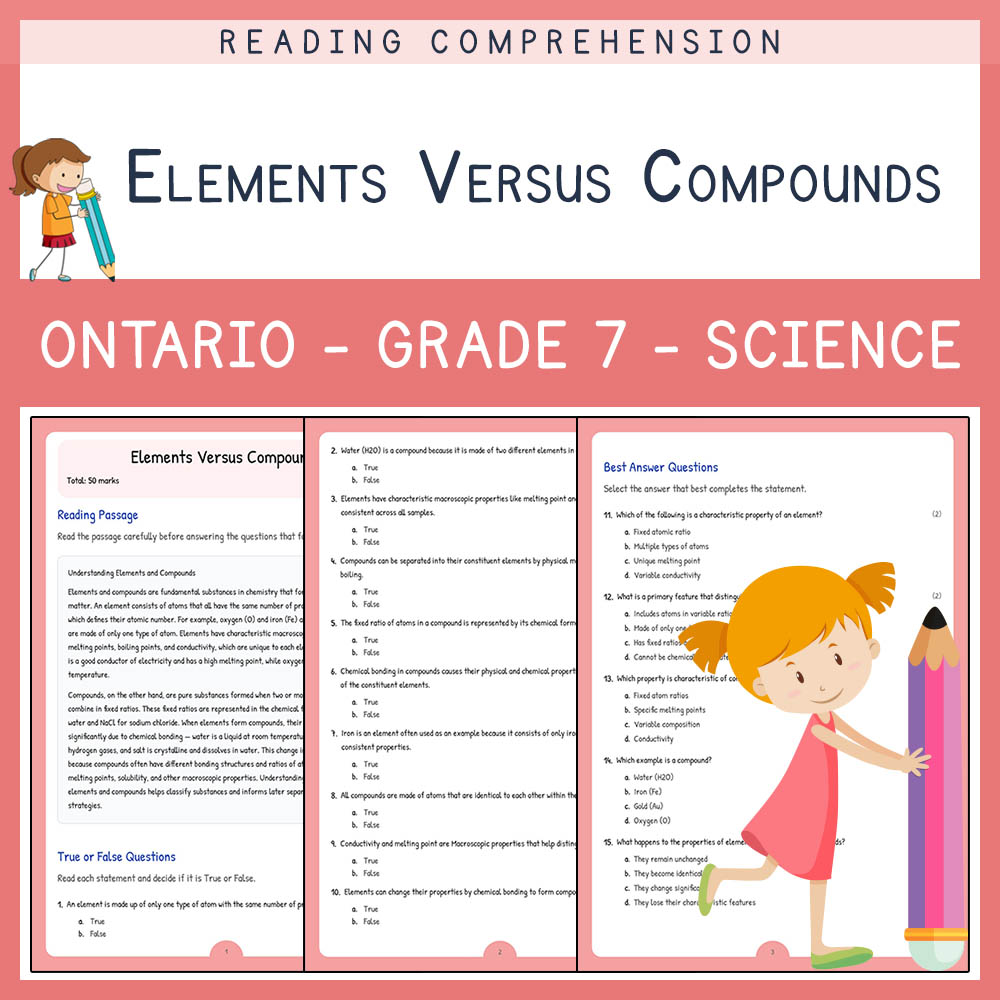
Grade 7 Science | Elements Versus Compounds Worksheet Elena | Ontario
 Created byLumora Learning
Learning Objectives
- Understand the differences in atomic composition between elements and compounds.
- Identify distinctive features of elements and compounds based on bonding and properties.
- Explain how chemical combinations alter properties compared to the constituent elements.
Also included in: Grade 7 Science | Pure Substances and Mixtures Unit Bundle | Ontario
Instant download

Grade 7 Science | Space Technology - Daily Reading Comprehension
 Created byCoral Reef Learning
Learning Objectives
- Understand how space telescopes are used to observe distant celestial objects
- Identify different types of space observation devices such as satellites and spacecraft
- Learn about the contributions of robotic missions and space stations to scientific data collection
Instant download

Scientific Data Recording & Provenance Worksheets Grade 7 Science
 Created byPrism Point Learning
Learning Objectives
- Organize categorical and numerical data in clear scientific tables
- Explain how metadata and logs support credible scientific records
- Apply consistent timestamps and units to time-series observations
Also included in: Scientific Inquiry & Data Practices Lesson Bundle | Grade 7 Science | Ontario +1 more
Instant download

Vocabulary Acquisition Worksheet | CCSS Grade 7 ELA Practice PDF
JCreated byJ.S SheetsLearning Objectives
- Use contextual clues to infer the meaning of unfamiliar words in grade-level texts.
- Analyze word parts (prefixes, suffixes, roots) to support vocabulary understanding.
- Choose precise word meanings by using a dictionary and considering context and tone.
Instant download
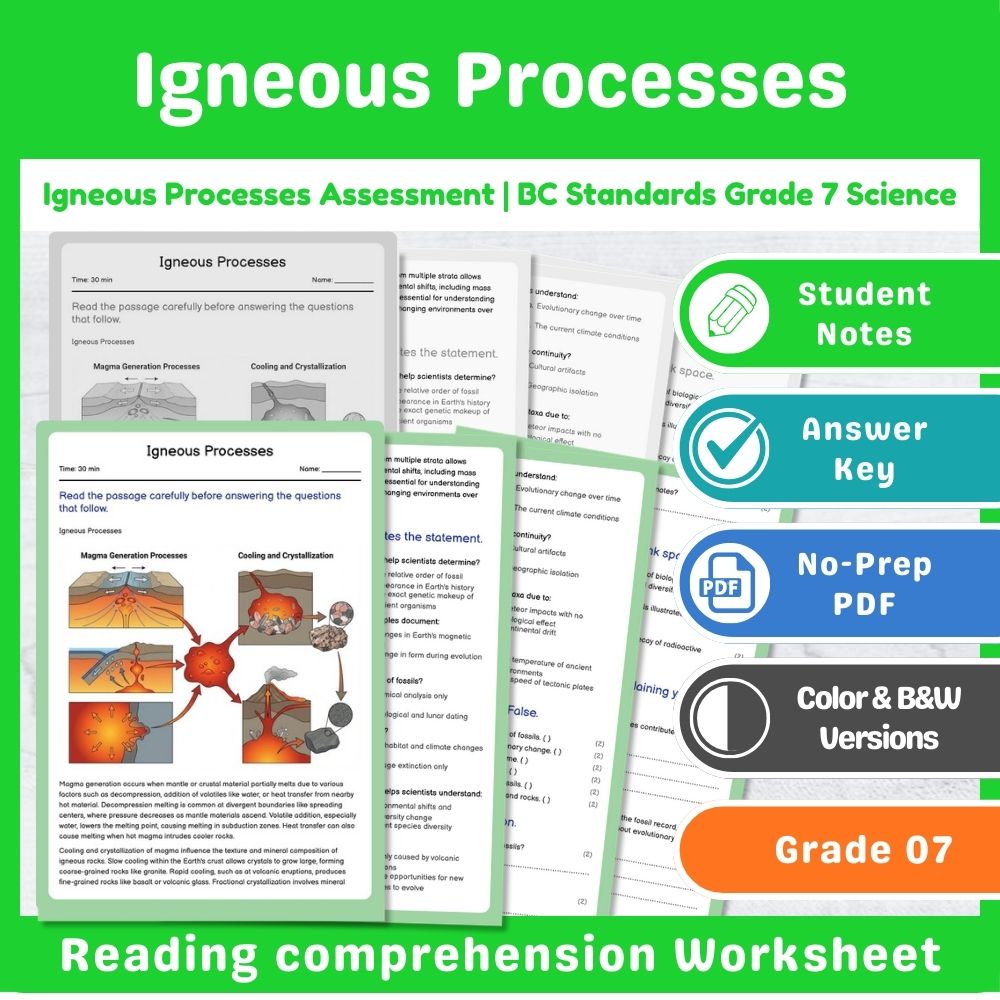
Igneous Processes Assessment | BC Standards Grade 7 Science
Created byPrism Point LearningLearning Objectives
- Describe how magma forms through partial melting due to decompression, volatiles, or heat transfer.
- Explain the processes of cooling and crystallization that determine rock textures and mineral assemblages.
- Identify the roles of fractional crystallization and magma mixing in producing diverse igneous rocks.
Also included in: Grade 7 Science Lesson – Earth Processes Assessment & Landforms Bundle
Instant download

Grade 7 Social Studies — Primary and Secondary Sources Worksheet MCQ Paper
 Created byThe Resource Hub
Learning Objectives
- Differentiate between primary and secondary sources in social studies
- Analyze the origin and purpose of sources to judge credibility and perspective
- Use multiple sources to strengthen historical interpretations
Also included in: Primary & Secondary Sources & Perspectives Lesson Bundle | Grade 7 +1 more
Instant download

Grade 7 Science | Evaluation Methods Worksheet (TEKS) PDF
 Created byEvergreen Desk Education
Learning Objectives
- Evaluate scientific explanations by checking assumptions, alternative hypotheses, and the logic of conclusions.
- Distinguish correlation from causation and explain why strong evidence is not the same as strong claims.
- Assess the reliability of data and models by identifying methodological limitations and potential sources of bias.
Instant download

Grade 7 Convection Heat Transfer Worksheet | Warm Air Rises Alberta Science
 Created byBRIGHT PATH RESOURCES
Learning Objectives
- Explain the cause-and-effect chain in convection using temperature, density, and fluid motion
- Identify natural convection patterns in air based on density differences
- Use convection vocabulary (buoyancy, boundary layer, density) to describe heat transfer
Also included in: Grade 7 Alberta Science Energy Heat and Thermal Processes Worksheet Bundle +1 more
Instant download

Grade 7 Social Studies – Regional Networks Worksheet (PDF) BC Standards
 Created bySunny Desk Resources
Learning Objectives
- Explain how trade routes, communication channels, and transportation systems connect communities within a region.
- Describe how regional networks support economic development and cultural exchange.
- Analyze how transportation and communication reduce barriers between places and strengthen social cohesion.
Also included in: Grade 7 Regional Networks Social Studies lesson bundle (BC Framework) +1 more
Instant download

Grade 7 Social Studies Worksheet | Historical Interdependence (PDF)
Created bySunny Desk ResourcesLearning Objectives
- Explain how geographic factors connect groups across regions through trade and resource exchange.
- Analyze historical examples of Indigenous trade and colonial resource exchanges to identify causes and consequences.
- Evaluate how interdependence shapes economic systems, regional identities, and community development over time.
Also included in: Grade 7 Regional Networks Social Studies lesson bundle (BC Framework) +1 more
Instant download

Plate Tectonics Worksheets | Grade 6 Earth Science Practice
LCreated byLearnora ResourcesLearning Objectives
- Define plate tectonics using accurate Earth science vocabulary.
- Identify tectonic plates as large, moving pieces of Earth’s lithosphere.
- Distinguish continental crust from oceanic crust.
Instant download
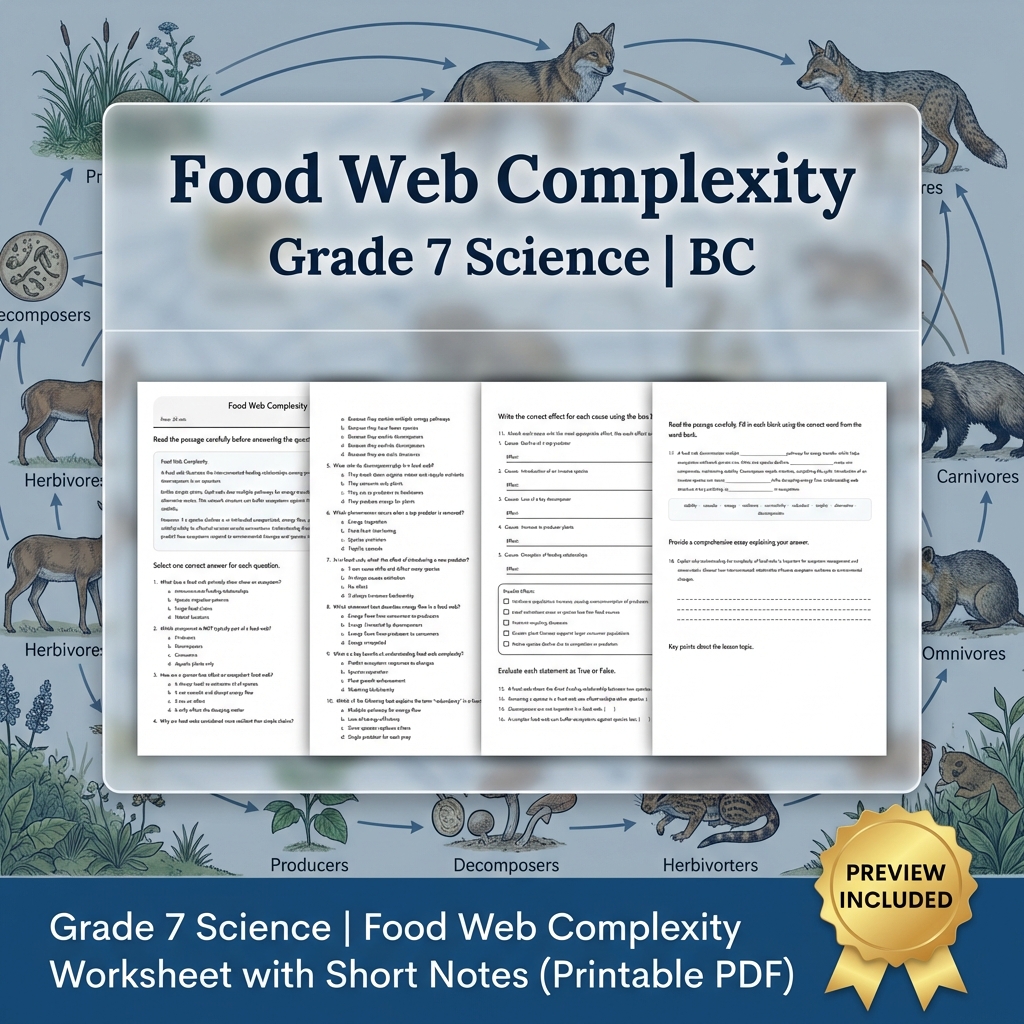
Grade 7 Science | Food Web Complexity Worksheet with Short Notes (Printable PDF)
 Created byMeadowlark Worksheets
Learning Objectives
- Understand the structure and components of food webs in ecosystems.
- Identify how energy flows through interconnected species in a food web.
- Describe how changes to one species can affect the entire ecosystem.
Also included in: Grade 7 Science Lesson Bundle: Ecosystems and Population Dynamics Worksheets +1 more
Instant download

Grade 7 Social Studies – Environmental Influences Worksheet (PDF)
Created bySunny Desk ResourcesLearning Objectives
- Explain how geographic features and environmental resources influence where communities settle and how they grow over time.
- Analyze how social relationships (culture, cooperation, and migration) interact with environmental conditions to support or challenge sustainability.
- Evaluate case examples to identify strategies communities use for long-term resource management and stability.
Also included in: Grade 7 Regional Networks Social Studies lesson bundle (BC Framework) +1 more
Instant download

Grade 7 Science | Earth Sun Cycles Worksheet | General Standard-Aligned
Created byLumora LearningLearning Objectives
- Explain how Earth’s rotation and axial tilt create daily and seasonal patterns.
- Describe how changes in daylight length are linked to the equinoxes and solstices.
- Use astronomical ideas to understand basic calendar and timekeeping conventions.
Instant download
Browse more categories
About Grade 7 Worksheets
Find Grade 7 worksheets covering math, ELA, science, and social studies. All 8,498 resources download instantly as PDFs for classwork, homework, or review.
MyTeachingSheets worksheets are made by real teacher-authors and checked before they go live. Download any as a print-ready PDF for lessons, homework, or independent practice — most include answer keys, and previews are always free.