
Grade 7 Worksheets
8,498 grade resources
Message Construction Worksheet | Grade 7 ELA Ontario Writing & Analysis
 Created bySunny Desk Resources
Learning Objectives
- Explain how persuasive message-construction techniques (contrast, repetition, statistics, imagery, and narrative sequencing) shape meaning beyond literal words.
- Identify how visual and sound design choices (framing, lighting, proximity, pacing) influence how an audience interprets a message.
- Use evidence from a text or prompt to justify claims about how construction techniques affect audience response.
Instant download

Grade 7 Prototyping Methods Worksheet | Ontario Science PDF & Key
 Created byClear Sky Classroom
Learning Objectives
- Compare scaled physical models, digital finite-element models, and laboratory load rigs for evaluating strength, stiffness, and failure modes.
- Explain how instrumentation such as strain gauges and displacement transducers measures structural response.
- Describe limitations of prototyping, especially scaling effects on joints and material heterogeneity.
Instant download

Grade 7 science | Control Methods Worksheet | General Standards
 Created byLumora Learning
Learning Objectives
- Define control conditions and comparison conditions in a scientific investigation.
- Explain how controlling variables increases the credibility of evidence.
- Describe why consistent timing, tool calibration, and standardized handling support fair tests.
Instant download

Evolutionary Change Assessment for Grade 7 Science | NGSSS Standards
 Created byPrism Point Learning
Learning Objectives
- Explain how evolutionary change occurs at the population level through changes in allele frequency over generations
- Connect inherited variation and differential survival/reproduction to long-term shifts in traits
- Differentiate evolution from individual organisms changing within their lifetimes
Instant download
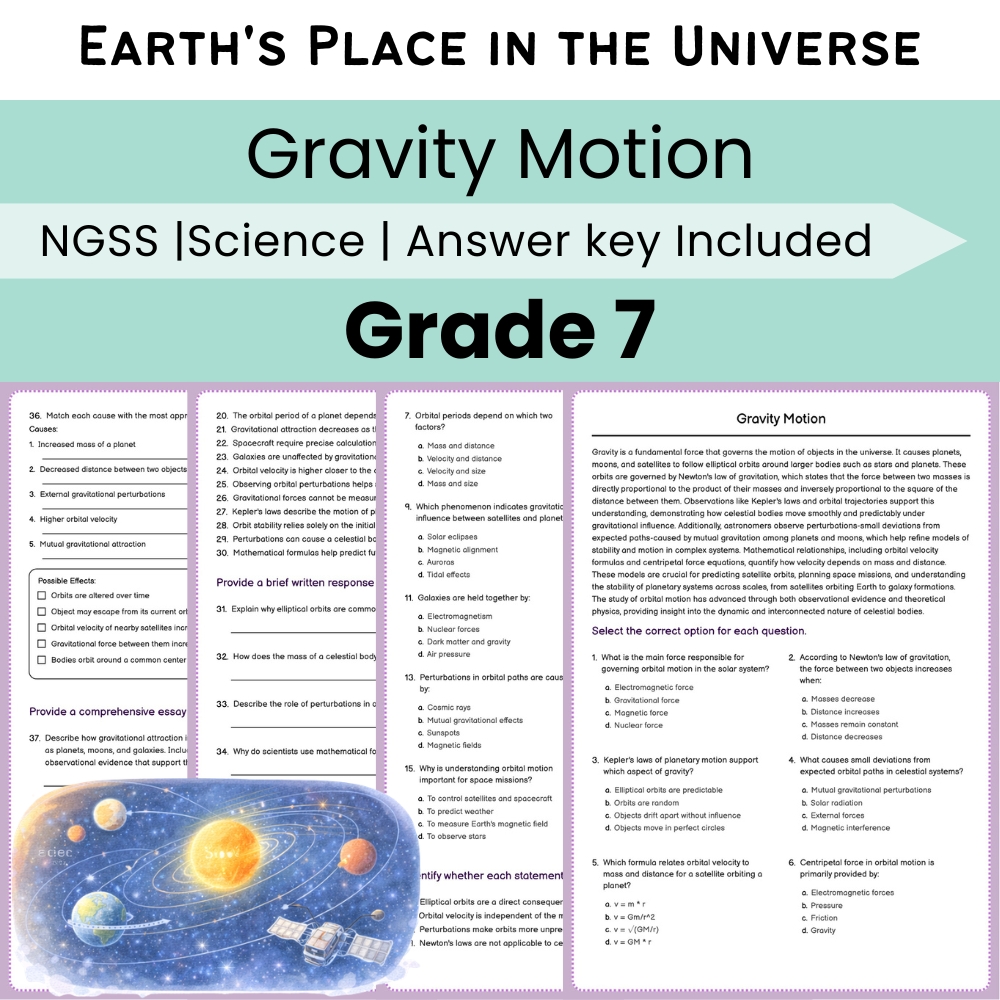
Gravity Motion Worksheet | Grade 7 Science Printable PDF Assessment
Learning Objectives
- Explain how gravitational attraction influences orbital motion within the solar system.
- Understand the mathematical relationships that describe orbital velocity and centripetal force.
- Identify observational evidence supporting theories of orbital motion, stability, and perturbations.
Also included in: Grade 7 Science NGSS Lesson Bundle – Earth's Place in the Universe Worksheets +1 more
Instant download
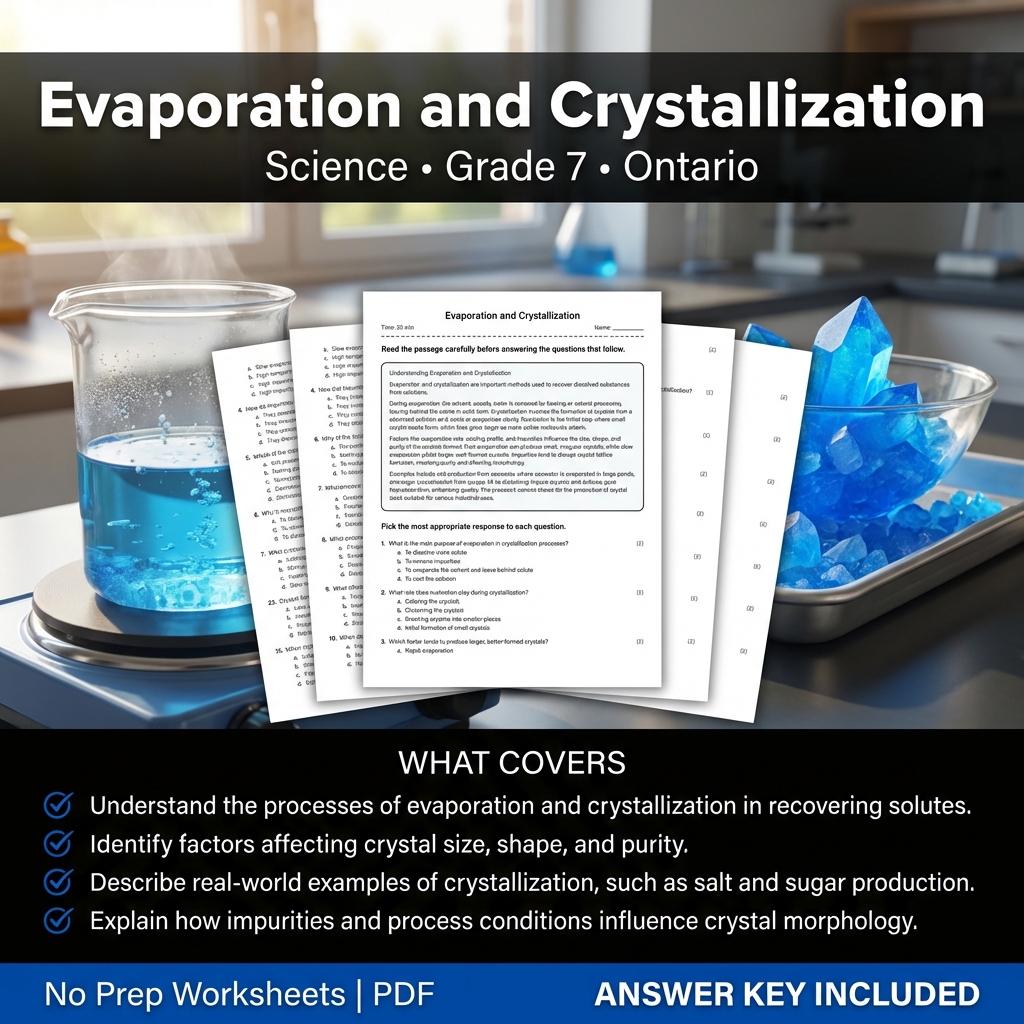
Grade 7 Science Worksheet on Evaporation and Crystallization | Ontario Standard
 Created byCoral Reef Learning
Learning Objectives
- Understand the processes of evaporation and crystallization in recovering solutes.
- Identify factors affecting crystal size, shape, and purity.
- Describe real-world examples of crystallization, such as salt and sugar production.
Instant download

Grade 7 Science Worksheet | Mechanical Energy & Conservation (PDF)
 Created byEvergreen Desk Education
Learning Objectives
- Explain how mechanical energy transfers between kinetic and potential energy in moving systems such as pendulums and springs.
- Use qualitative energy bookkeeping to describe conservation of mechanical energy in a closed system and energy loss to nonmechanical forms in an open system.
- Interpret motion outcomes (speed, height, and amplitude) as evidence of energy redistribution and inefficiencies.
Instant download

Biodiversity Measures Worksheet | Grade 7 Science Practice
Created byPrism Point LearningLearning Objectives
- Describe how biodiversity includes genetic, species, and ecosystem diversity.
- Explain how richness, evenness, and habitat heterogeneity are used to measure regional biodiversity.
- Interpret what biodiversity metrics can suggest about ecosystem resilience and function.
Also included in: Grade 7 Ecosystems & Biodiversity Science Lesson Bundle | Alberta
Instant download

Grade 7 ELA | Text Form Refinement Worksheet | Alberta Standards
Created byLumora LearningLearning Objectives
- Identify text-form features (narrative, informational, persuasive, explanatory) that shape structure and style
- Revise writing by strengthening introductions, supporting development, and conclusions that match the genre’s purpose
- Refine language choices and formatting conventions to make a draft read like a complete example of its intended text form
Also included in: Grade 7 ELA Clarity & Coherence Writing Lesson Bundle | Alberta
Instant download

Cyberbullying Prevention Worksheet | Grade 7 Digital Citizenship
Created byPrism Point LearningLearning Objectives
- Identify signs of cyberbullying and harassment in online communication
- Practice safe responses by reporting incidents and supporting affected people
- Explain how to preserve evidence and seek trusted help when needed
Also included in: Digital Citizenship & Cyber Safety Lesson Bundle | Grade 7 CS | General
Instant download

Reading Meaning Strategies Worksheets for Grade 7 ELA
 Created byGolden Apple Studio
Learning Objectives
- Set reading goals that guide attention before reading
- Make predictions that focus attention during reading
- Monitor comprehension by rereading nearby sentences
Also included in: Grade 7 ELA Reading Worksheets | Text Features, Theme & Author Craft +1 more
Instant download

Media and Mischief Worksheet | Grades 6, 7 & 8 Holiday printable PDF |Assessment
Learning Objectives
- Understand how digital media can spread both humor and misinformation.
- Learn to identify credible versus false online stories.
- Develop critical thinking skills to evaluate media content.
Instant download
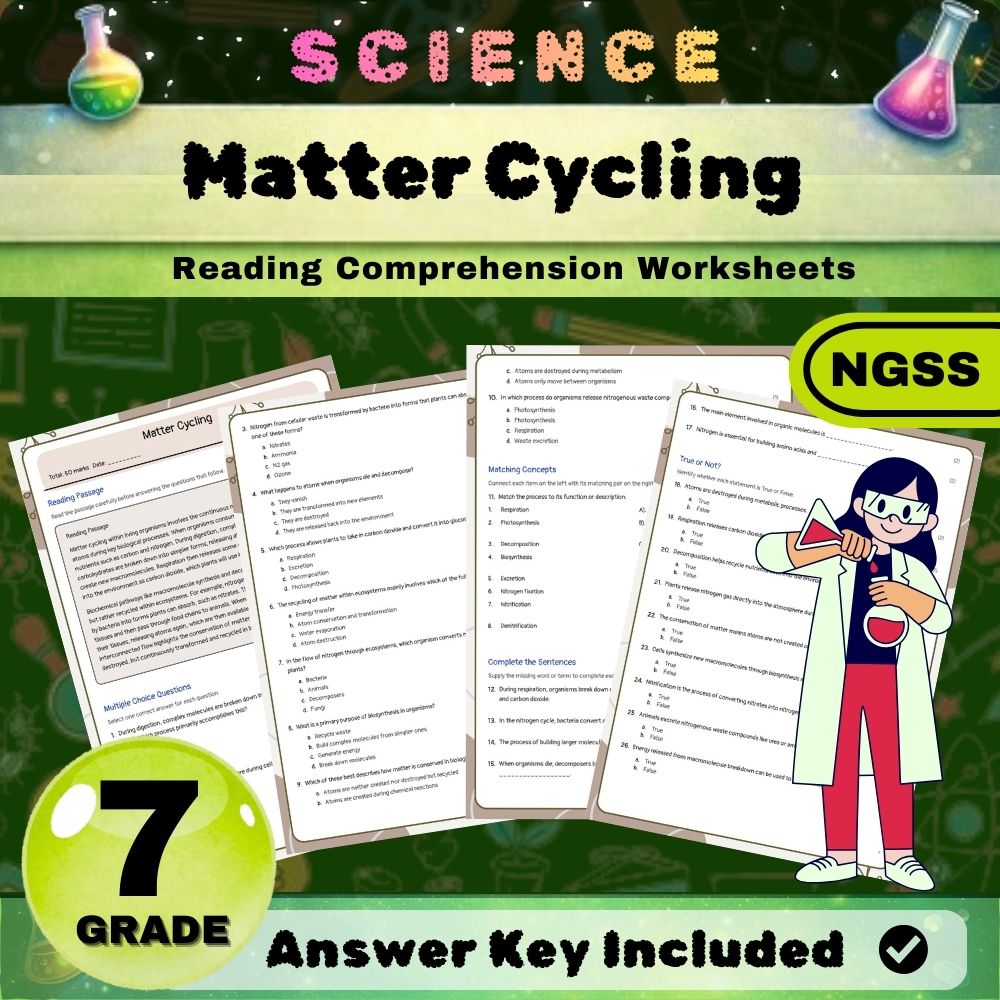
Grade 7 Science | Matter Cycling NGSS Worksheet (PDF)
 Created byMaple Path Learning
Learning Objectives
- Describe how matter is cycled within organisms through processes like digestion, biosynthesis, and respiration.
- Explain the conservation of matter during biochemical pathways such as macromolecule synthesis and decomposition.
- Identify how carbon and nitrogen flow through food chains and are released as gases or excreted compounds.
Instant download
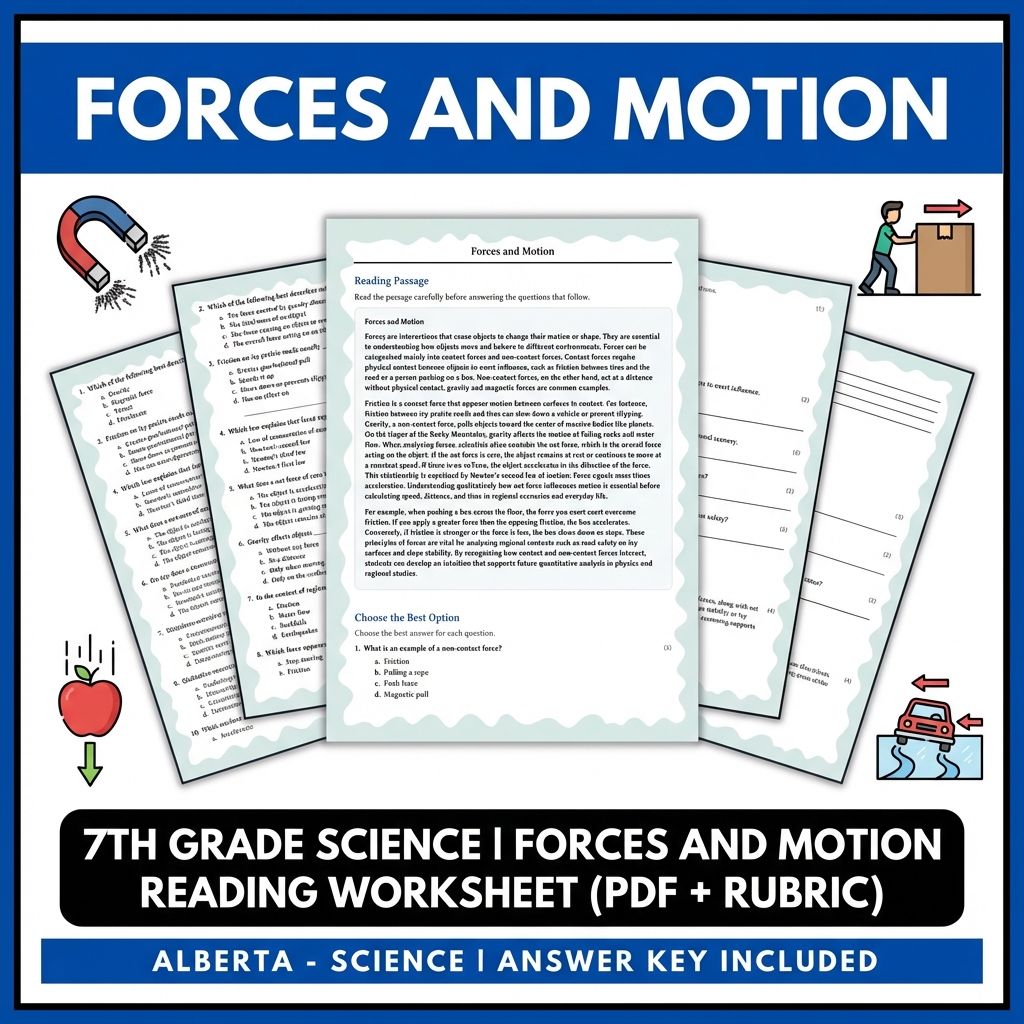
7th Grade Science | Forces and Motion Reading Worksheet (PDF + Rubric)
JCreated byJ.S SheetsLearning Objectives
- Explain the differences between contact and non-contact forces.
- Describe how net force affects the acceleration of an object.
- Identify examples of forces such as friction and gravity in regional contexts.
Also included in: Grade 7 Science | Forces, Motion & Structural Concepts (Answer Keys Included) +1 more
Instant download

States of Matter Worksheets | Properties, Particles & Changes Practice
LCreated byLearnora ResourcesLearning Objectives
- Identify solids, liquids, and gases from their observable properties
- Compare particle arrangement and movement in the three states
- Explain how shape and volume differ among states of matter
Instant download
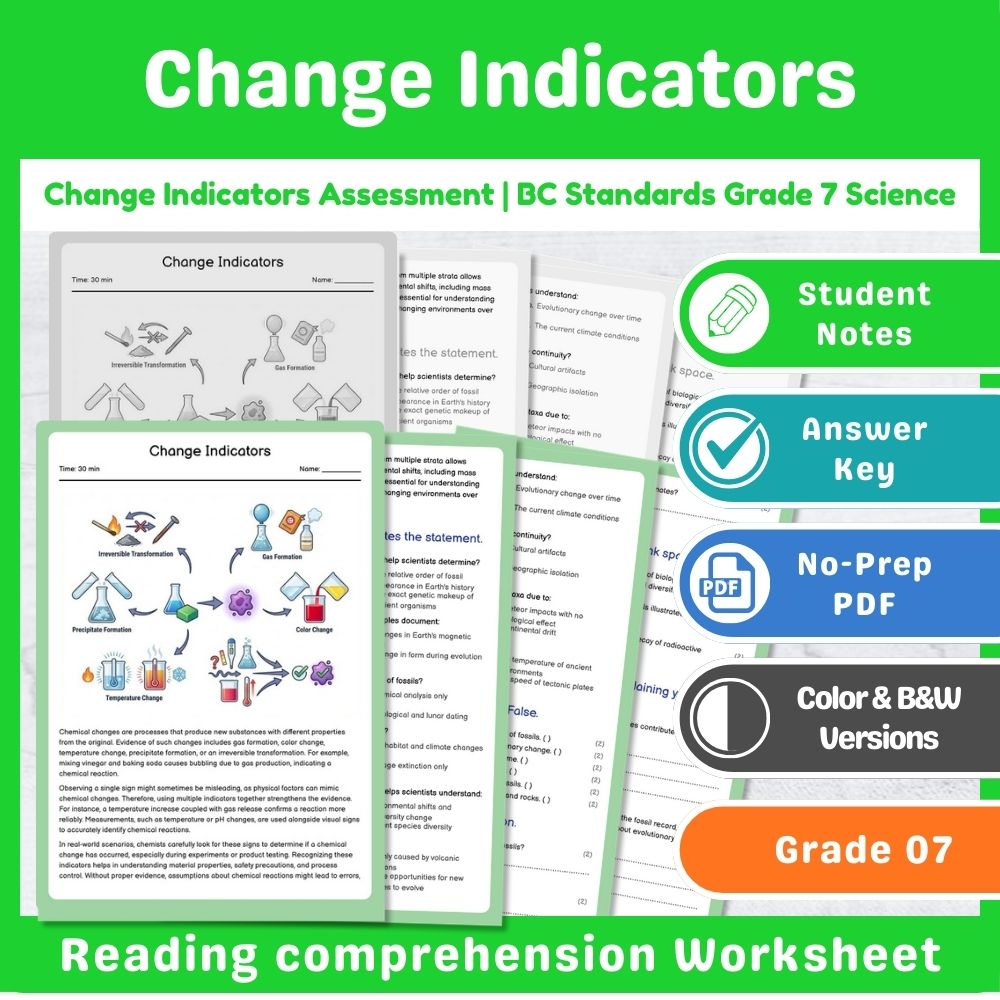
Change Indicators Assessment | BC Standards Grade 7 Science
Created byPrism Point LearningLearning Objectives
- Identify observable signs indicating chemical changes in substances.
- Differentiate between physical and chemical changes using evidence.
- Understand the importance of multiple indicators to confirm a chemical change.
Instant download

Grade 7 Holiday Worksheet | Honoring Moms with Reading & Comprehension (PDF)
 Created bySilver Birch Teaching
Learning Objectives
- Explain the origins and significance of Mother’s Day and how it developed over time.
- Compare how different cultures honor maternal figures and why these traditions matter to families.
- Use vocabulary related to family, emotions, and gratitude to describe meaningful actions.
Also included in: Grade 7 Community Helpers Holiday Lesson Bundle: May Reading & Care Worksheets +1 more
Instant download
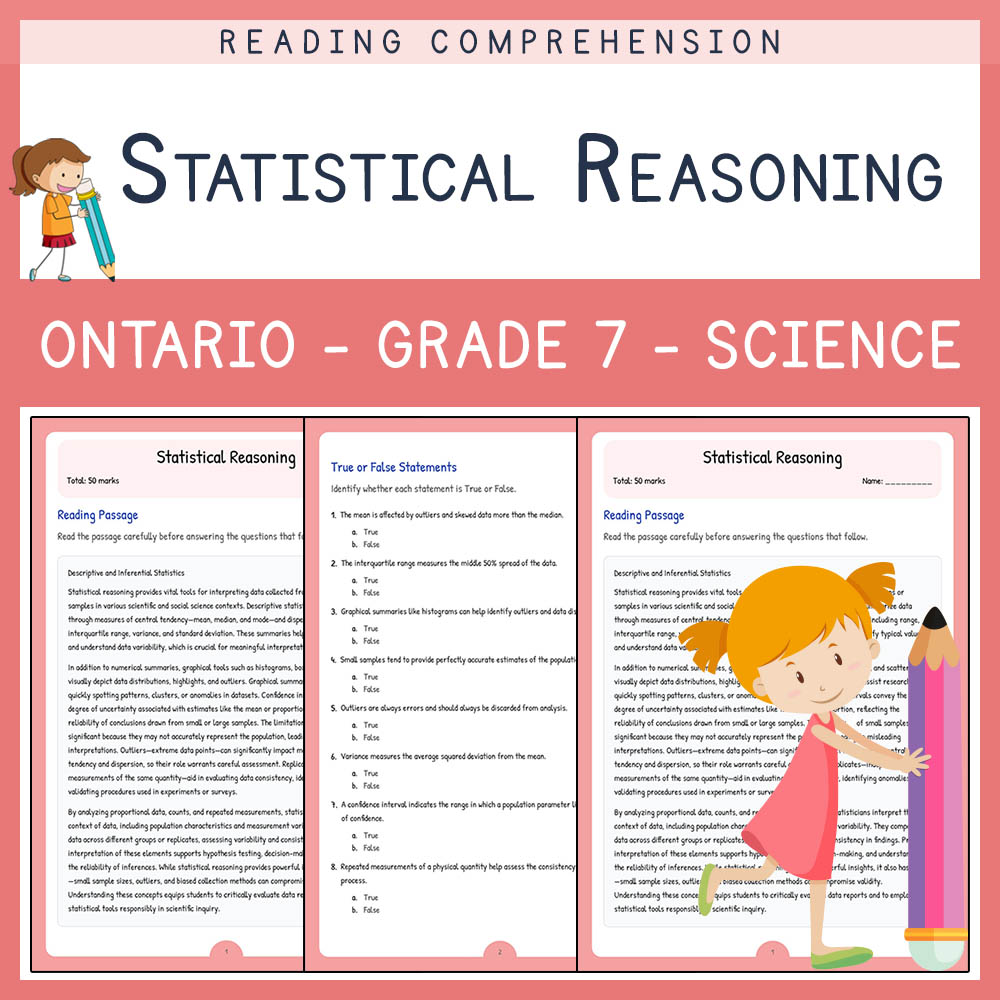
Grade 7 Science Assessment | Statistical Reasoning Worksheet | Ontario Standard
Created byLumora LearningLearning Objectives
- Understand key descriptive statistics such as mean, median, and mode.
- Explain concepts of dispersion including interquartile range and variance.
- Interpret graphical summaries and confidence intervals.
Also included in: Grade 7 Science | STEM Skills and Connections Custom Bundle | Ontario
Instant download
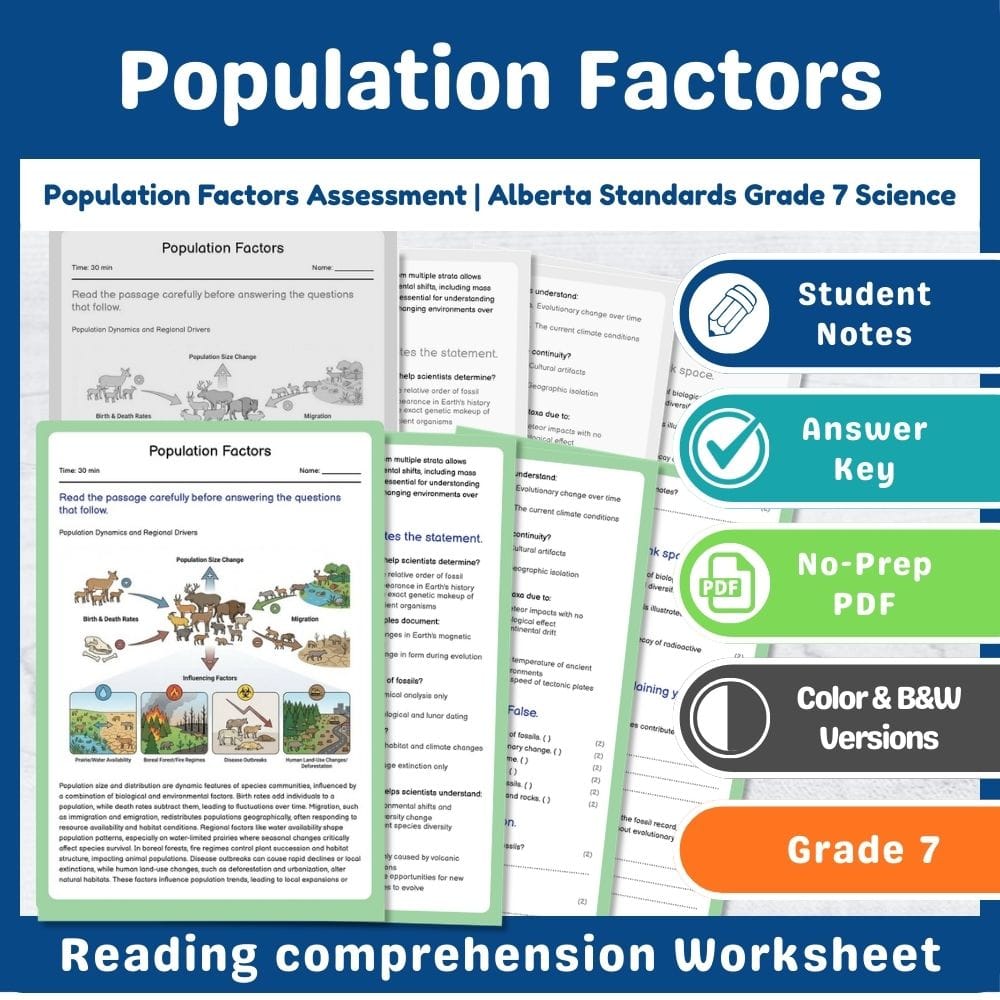
Population Factors Assessment | Alberta Standards Grade 7 Science
Created byPrism Point LearningLearning Objectives
- Understand how birth and death rates influence population size.
- Explore how immigration and emigration impact population distribution.
- Identify regional drivers affecting population fluctuations and biodiversity.
Also included in: Lesson Bundle Grade 7 Science - Interactions and Ecosystems +1 more
Instant download
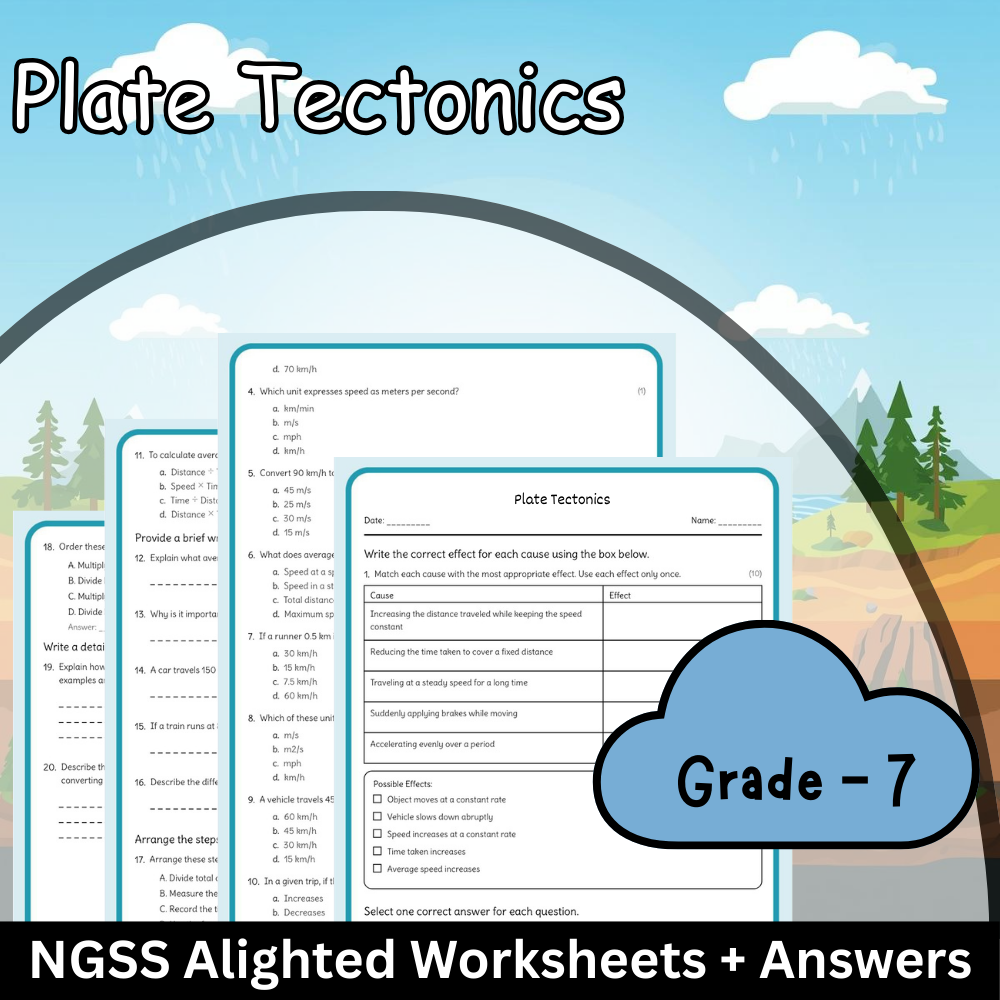
Grade 7 Science | Plate Tectonics Worksheet (Answer Key)– NGSS Standards Aligned
 Created byBright Mind Resources
Learning Objectives
- Describe the evidence supporting the theory of plate tectonics, including fossil distribution, seafloor structures, and matching continental edges.
- Explain how geologic features such as mid-ocean ridges, trenches, and mountain ranges record past and present tectonic activity.
- Understand the role of magnetic striping and seismic activity in revealing plate movements.
Instant download

Renaissance Innovation Worksheet | Standards-Aligned Grades 7 Social Studies
JCreated byJ.S SheetsLearning Objectives
- Explain how Renaissance artists used classical ideas to develop new techniques such as perspective and chiaroscuro.
- Describe how Renaissance thinkers expanded knowledge through observation and renewed study of classical texts.
- Analyze how the printing press helped spread ideas and increase literacy in Europe.
Instant download

Varying Structures ELA Worksheet for Grade 7 | Standards-Aligned Practice
JCreated byJ.S SheetsLearning Objectives
- Identify and distinguish simple, compound, and complex sentences in explanatory and persuasive writing.
- Use subordinate clauses to add time, reason, condition, and contrast to strengthen meaning.
- Improve sentence variety by rearranging clauses and phrases to control emphasis and pacing.
Instant download

Grade 7 Science Worksheet | Adaptation Traits Alberta Standards (PDF)
Created bySilver Birch TeachingLearning Objectives
- Explain how adaptation traits (structural, physiological, and behavioural) help organisms survive and reproduce in specific environments.
- Describe how selective pressures shape trait variation and how trade-offs can affect survival.
- Connect examples from Alberta habitats to niches and long-term persistence of species.
Also included in: Grade 7 Ecosystems & Biodiversity Science Lesson Bundle for Alberta Framework +1 more
Instant download

Semicolons and Colons Worksheet | General ELA Standard Grade 7
JCreated byJ.S SheetsLearning Objectives
- Explain the purpose of semicolons in connecting closely related independent clauses.
- Explain the purpose of colons in introducing lists, explanations, or evidence after a general statement.
- Revise sentences to fix comma splices and run-ons by choosing the correct punctuation mark.
Instant download

Grade 7 Science | Integrated Design - Daily Reading Comprehension
Created byCoral Reef LearningLearning Objectives
- Understand the principles of mechanical advantage in design
- Analyze how structural choices affect safety and efficiency
- Evaluate different design options based on quantitative data
Also included in: Forces, Structures and Motion Lesson Bundle | Grade 7 Science Alberta +1 more
Instant download
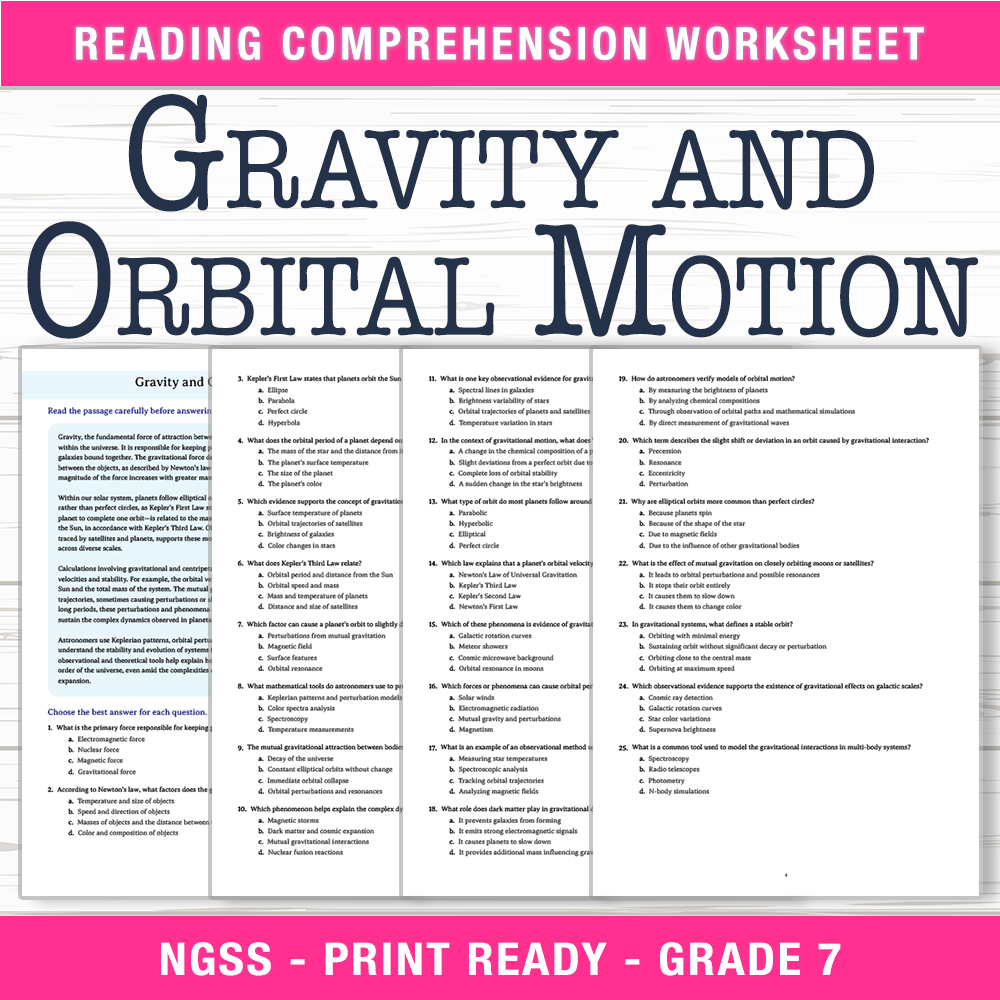
Grade 7 Science | Gravity & Orbital Motion Worksheet (PDF + Answer Key)
 Created byRiverstone Classroom
Learning Objectives
- Understand the role of gravity in governing orbital motion within the solar system and galaxies.
- Describe how elliptical orbits and orbital periods are influenced by mass and distance.
- Apply mathematical relationships to calculate orbital velocity and centripetal effects for planets and moons.
Instant download

Conservation Mass Worksheet | Grade 7 Science Activities
Created byPrism Point LearningLearning Objectives
- Explain conservation of mass in terms of atoms being conserved in a closed system.
- Predict whether total mass changes by comparing masses of reactants and products when nothing enters or leaves.
- Use sealed-container observations to support claims about conservation of mass during physical or chemical changes.
Instant download

Technology Ethics & Trade-Offs Worksheet | Engineering Grade 7
 Created byBRIGHT PATH RESOURCES
Learning Objectives
- Explain how technology trade-offs can affect both people and the environment
- Use ethical principles to evaluate impacts of technology across its life cycle
- Identify real-world engineering choices that can increase fairness, privacy, and safety
Also included in: Grade 7 Science Engineering Worksheets Bundle | Design & Data +2 more
Instant download

Punctuation For Clarity Worksheet | Grade 7 ELA Activities
 Created byMeadowlark Worksheets
Learning Objectives
- Use periods, question marks, and exclamation marks to match a sentence’s purpose and tone.
- Apply comma rules to separate ideas clearly in Grade 7 writing.
- Revise sentences so punctuation accurately supports meaning and reduces confusion.
Also included in: Grade 7 Grammar, Punctuation & Sentence Skills ELA Lesson Bundle Alberta +1 more
Instant download

Subject Verb Agreement Worksheet Pack | Grade 7 ELA Activities
Created byMeadowlark WorksheetsLearning Objectives
- Match singular and plural subjects with the correct verb forms in Grade 7 writing.
- Apply subject-verb agreement when phrases or clauses appear between the subject and the verb.
- Use correct verb forms with collective nouns and common grammar patterns.
Also included in: Grade 7 Grammar, Punctuation & Sentence Skills ELA Lesson Bundle Alberta +1 more
Instant download

Interpreting Charts Worksheet Pack | Grade 7 ELA Practice
Created bySunny Desk ResourcesLearning Objectives
- Identify how chart features (labels, legends, and scales) help readers understand data.
- Explain what a visual (chart, diagram, timeline, or map) suggests about relationships, comparisons, or change over time.
- Use evidence from both the chart and the surrounding text to make accurate interpretations.
Also included in: Reading and Viewing Lesson Bundle | Grade 7 ELA | Alberta Framework +1 more
Instant download

Misplaced And Dangling Modifiers Worksheet | Grade 7 ELA Activities
Created byMeadowlark WorksheetsLearning Objectives
- Identify misplaced modifiers and dangling modifiers and explain how they change sentence meaning.
- Revise sentences so modifiers clearly attach to the intended word or phrase.
- Use adverbial phrases and descriptive clauses accurately to strengthen logic and tone.
Also included in: Grade 7 Grammar, Punctuation & Sentence Skills ELA Lesson Bundle Alberta +1 more
Instant download
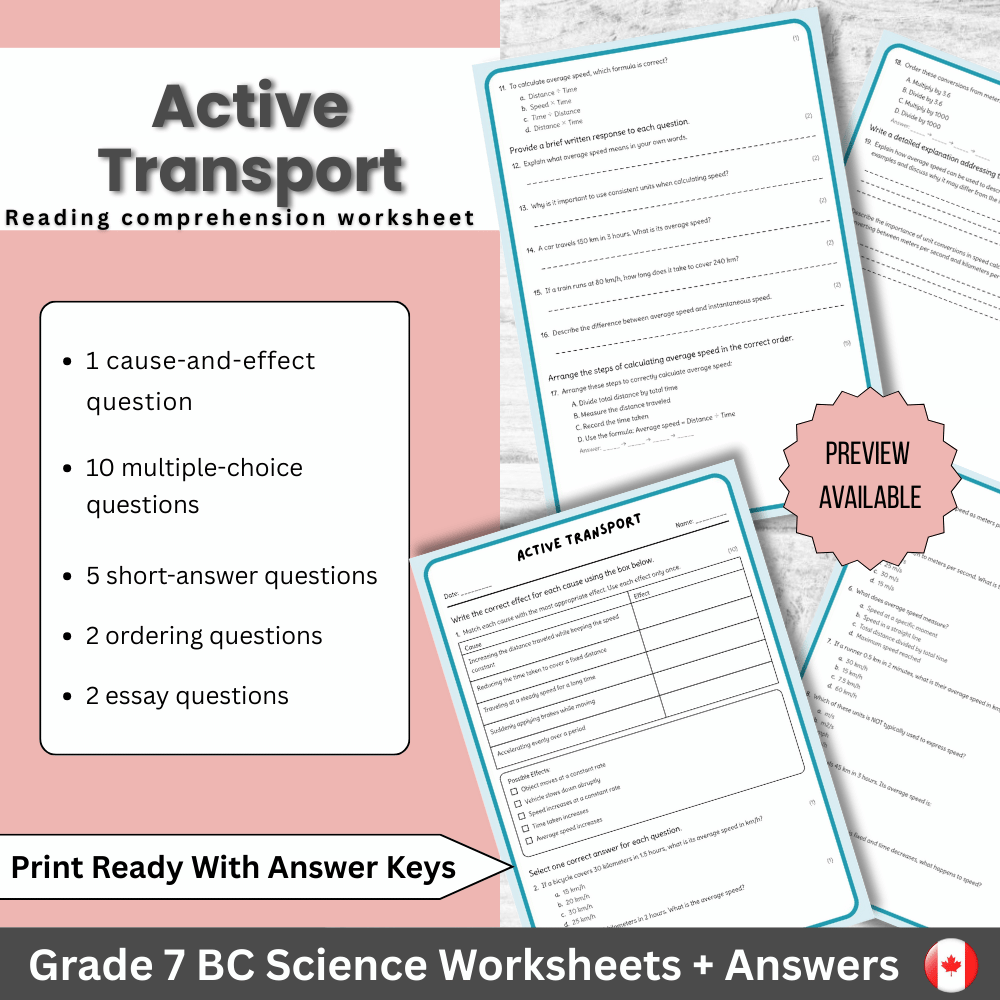
Grade 7 Science | Active Transport Worksheet + Answer Key (BC Standards)
Created byBright Mind ResourcesLearning Objectives
- Understand the concept of active transport and how it differs from passive diffusion.
- Identify the key types of active transport mechanisms in cells, including the sodium-potassium pump and vesicular transport.
- Explain how active transport contributes to cell functions like nutrient intake, waste removal, and maintaining electrochemical gradients.
Instant download

Transformative Grade 7 ELA Worksheet on Collaborative Tone | Standards Aligned
JCreated byJ.S SheetsLearning Objectives
- Identify language moves that support collaborative discussion, such as respectful disagreement and focused turn-taking.
- Use precise academic phrasing to reduce ambiguity and keep the conversation productive.
- Adjust wording to incorporate feedback, clarify misunderstandings, and build on others’ ideas.
Instant download

Theme Meaning Worksheet | Grade 7 ELA Activities
Created byMeadowlark WorksheetsLearning Objectives
- Explain what theme means and distinguish it from a topic or summary
- Use textual evidence (events, decisions, and recurring ideas) to support a theme claim
- Trace how a theme develops through conflicts and resolutions across a text
Also included in: Grade 7 Author Craft ELA Lesson Bundle: Tone, Theme, Evidence (Alberta) +1 more
Instant download

Grade 7 ELA | Theme Meaning Worksheet | Alberta Standard
Created byLumora LearningLearning Objectives
- Explain how a theme (central idea) develops across a text using evidence from events, character decisions, and details
- Distinguish theme from a plot summary by focusing on the lesson or message about life, society, or human behavior
- Support a theme with specific textual evidence and reasoning
Also included in: Grade 7 ELA Tone, Theme & Evidence Lesson Bundle | Alberta
Instant download

Nuanced Word Meaning Worksheet | Grade 7 ELA | Ontario Standards
JCreated byJ.S SheetsLearning Objectives
- Determine connotation by analyzing how word choice affects tone, mood, and the author’s stance.
- Explain how shifts in diction change meaning within a passage.
- Evaluate which interpretation best fits the author’s intent, theme, and overall argument when multiple context clues compete.
Instant download

Evidence and Reasoning Worksheet Grade 7 ELA Argument Writing Skills
Created bySunny Desk ResourcesLearning Objectives
- Evaluate a speaker’s claim by checking whether specific evidence actually supports it
- Judge whether reasoning is logically sound and recognize common fallacies
- Examine how a speaker qualifies statements and addresses counterpoints
Also included in: Speaking and Listening Lesson Bundle | Grade 7 ELA | General ELA +1 more
Instant download

Resource Distribution Worksheet | NGSS Grade 7 Science Practice & Assessment
JCreated byJ.S SheetsLearning Objectives
- Understand how geologic processes influence the distribution of mineral, energy, and groundwater resources.
- Connect plate tectonics, sedimentation, weathering, and biological activity to resource location.
- Analyze the impacts of resource extraction and consider renewable versus nonrenewable resources.
Also included in: Grade 7 Human Impacts on Earth Systems Science Lesson Bundle – NGSS +1 more
Instant download

Niche Interactions Worksheet Pack Grade 7 Science Activities
Created byPrism Point LearningLearning Objectives
- Describe how competition, predation, mutualism, and parasitism affect ecological niches
- Explain how niche partitioning reduces competition and supports species coexistence
- Evaluate how keystone species and altered interaction networks can change community stability
Also included in: Ecosystems & Adaptations Grade 7 Science Lesson Bundle TEKS Worksheets
Instant download

Water Cycle Pathways Assessment for Grade 7 Science | California Standards
Created byPrism Point LearningLearning Objectives
- Explain how water moves through the water cycle among the atmosphere, land, and oceans
- Describe energy and gravity roles in evaporation, condensation, and precipitation
- Differentiate runoff from infiltration and subsurface storage
Also included in: Grade 7 Earth Systems Science Lesson Bundle Assessments | California Standards +1 more
Instant download

Photosynthesis & Cellular Respiration Worksheets: Energy Transformations
 Created byTeachers Club
Learning Objectives
- Explain how light energy becomes chemical energy during photosynthesis
- Describe how cellular respiration produces ATP from chemical energy
- Connect chloroplast and mitochondria roles across different organisms
Also included in: From Molecules to Organisms Grade 7 Science NGSS Worksheets Bundle +2 more
Instant download

Grade 7 Holiday Storytelling Constructs Worksheet (May Standards) (PDF)
Created bySilver Birch TeachingLearning Objectives
- Use descriptive language to build a clear setting in a sci-fi adventure
- Identify narrative elements such as characters, plot events, and theme in a story
- Apply cause-and-effect reasoning to choices characters make during a mission
Also included in: Grade 7 Holiday Space STEM Lesson Bundle Worksheets: May Standards +1 more
Instant download
Grade 7 Science | Energy and Change Worksheet with Short Notes (PDF)
Created byMeadowlark WorksheetsLearning Objectives
- Understand how energy changes occur during chemical reactions, including exothermic and endothermic processes.
- Recognize signs of energy transfer in physical and chemical changes.
- Explain the relationship between energy exchange and bond breaking/formation.
Also included in: Grade 7 Science Lesson Bundle | BC Framework on Matter & Reactions Worksheets +1 more
Instant download
Grade 7 Science Forces and Change Worksheet with Short Notes (Printable PDF)
Created byMeadowlark WorksheetsLearning Objectives
- Understand how forces cause changes in motion.
- Differentiate between balanced and unbalanced forces.
- Explain how friction, air resistance, and gravity affect motion.
Also included in: Grade 7 Energy Transfer and Motion Science Lesson Bundle | General +1 more
Instant download
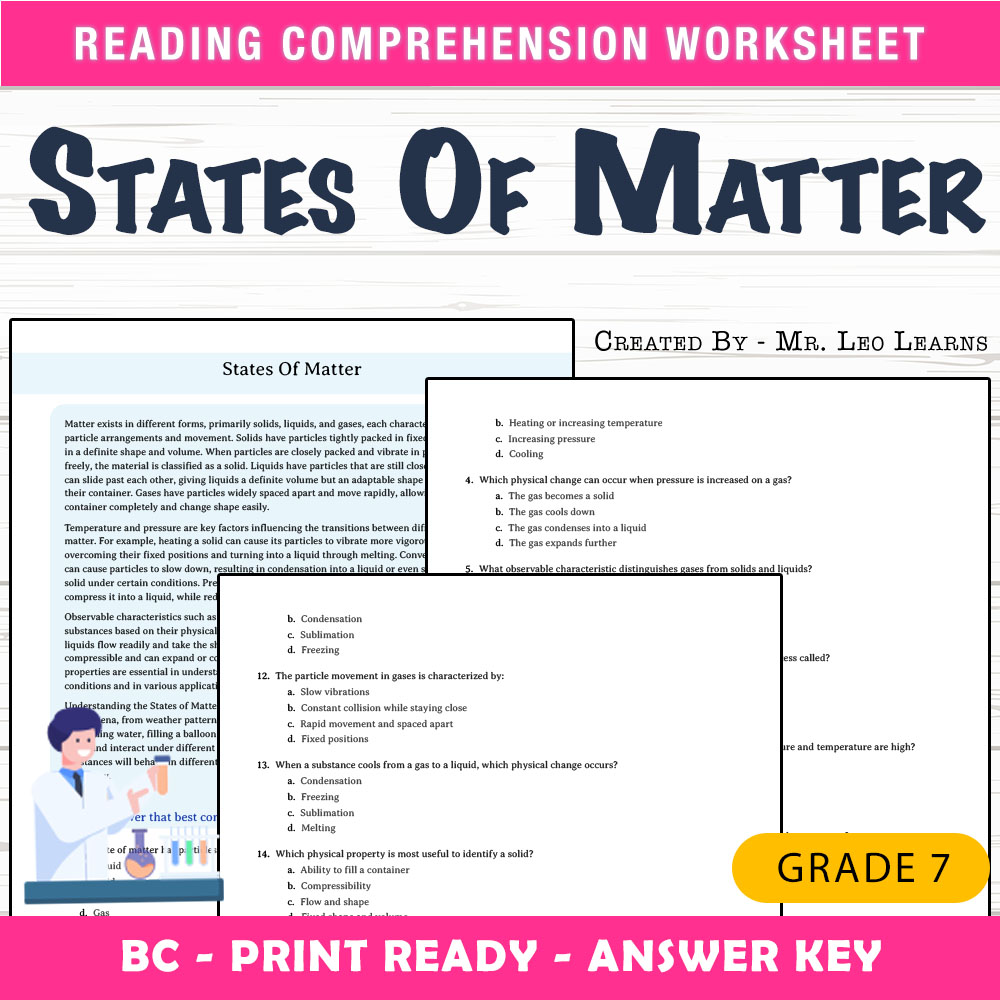
Grade 7 Science — States Of Matter Worksheet MCQ Paper for Mastery
 Created byThe Resource Hub
Learning Objectives
- Describe the different states of matter: solids, liquids, and gases.
- Understand how particle arrangement and movement define each state.
- Explain how temperature and pressure influence state transitions.
Also included in: Grade 7 Science | Matter & Chemical Change Worksheet Bundle – BC Framework +1 more
Instant download

Grade 7 ELA Counterclaim Response Worksheet (PDF) – General ELA Standards
Created byGolden Apple StudioLearning Objectives
- State a counterclaim fairly and accurately without misrepresenting the opposing viewpoint.
- Respond to counterclaims using evidence and reasoning that strengthens the original claim.
- Use language that signals balance (acknowledge, explain, support) while maintaining a clear main argument.
Also included in: Grade 7 ELA Writing, Research, & Revision Lesson Bundle | General ELA +1 more
Instant download
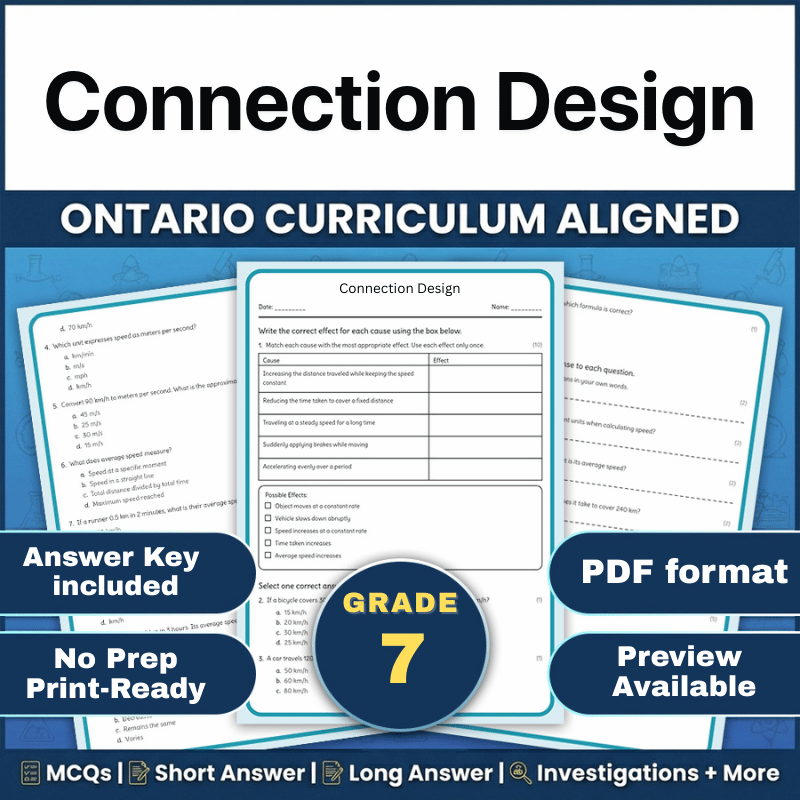
Grade 7 Science | Connection Design Worksheet (Ontario, PDF)
Created byBright Mind ResourcesLearning Objectives
- Understand the roles of different types of connections and joints in structural systems.
- Identify how bolted, welded, and bearing connections transfer load and maintain stability.
- Explain shear, bearing, and slip at connection points and their impact on structural performance.
Instant download
Browse more categories
About Grade 7 Worksheets
Find Grade 7 worksheets covering math, ELA, science, and social studies. All 8,498 resources download instantly as PDFs for classwork, homework, or review.
MyTeachingSheets worksheets are made by real teacher-authors and checked before they go live. Download any as a print-ready PDF for lessons, homework, or independent practice — most include answer keys, and previews are always free.