
Grade 7 Science Worksheets
6,039 worksheets
Grade 7 Science – Surface Changes & Landform Processes | Daily Reading Worksheet
 Created byBright Mind Resources
Learning Objectives
- Understand how rainfall and storms can alter Earth's surface temporarily and permanently.
- Identify natural processes that cause rapid and gradual landscape changes.
- Explain the effects of severe weather events like storms, earthquakes, and volcanic activity on landforms.
Also included in: Grade 7 Earth Science Daily Reading Worksheets Lesson Bundle | Florida NGSSS +1 more
Instant download

Grade 7 Science – Heating Curve Phases Reading Worksheet | California Standards
Created byBright Mind ResourcesLearning Objectives
- Understand the different stages of phase changes during heating.
- Interpret temperature-time graphs to identify solid, melting, and other phases.
- Explain the energy transfer during phase transitions in terms of particle behavior.
Also included in: Grade 7 Matter & Forces Science Reading Lesson Bundle | California Standards +1 more
Instant download
Grade 7 Science – Connection Design & Structural Engineering | Daily Worksheet
 Created byQuiet Forest Education
Learning Objectives
- Understand the role of different types of connections in maintaining load paths in structures.
- Identify how bolted, welded, and bearing connections transfer loads and their impact on structural redundancy.
- Describe the concepts of shear, bearing, and slip at structural connections.
Also included in: Structural Engineering Grade 7 Science Daily Reading Worksheets Bundle | Ontario +1 more
Instant download

Grade 7 Science – States of Matter Reading Worksheet | California Standards
Created byBright Mind ResourcesLearning Objectives
- Understand the properties of solids and liquids
- Describe changes between different states of matter
- Explain how energy transfer causes phase changes
Also included in: Grade 7 Matter & Forces Science Reading Lesson Bundle | California Standards +1 more
Instant download

Grade 7 Science – Thermal Expansion & Matter | Daily Reading Worksheet
Created byBright Mind ResourcesLearning Objectives
- Understand how heating causes particles to move apart in solids and liquids.
- Explain how particle motion affects thermal expansion and contraction.
- Describe how gases respond differently to temperature changes due to particle behavior.
Also included in: Grade 7 Matter & Forces Science Reading Lesson Bundle | California Standards +1 more
Instant download
Grade 7 Science – Daily Worksheet | Chemical Properties & Reactions
Created byQuiet Forest EducationLearning Objectives
- Define chemical properties and identify common indicators of chemical changes.
- Differentiate between reactive and stable substances based on their chemical properties.
- Recognize observable indicators such as gas evolution, color change, and precipitate formation.
Also included in: Elements & Compounds Grade 7 Science Daily Reading Worksheets Bundle | Ontario +1 more
Instant download
Grade 7 Science – Design Optimization & Structural Engineering | Worksheet
 Created byElena Brooks
Learning Objectives
- Understand how to analyze test data to improve structural designs
- Apply quantitative comparisons to optimize engineering solutions
- Recognize the iterative process in design refinement
Also included in: Structural Engineering Grade 7 Science Daily Reading Worksheets Bundle | NGSS +1 more
Instant download

Grade 7 Science – Geologic Processes & Earth’s Landforms | Reading Worksheet
Created byBright Mind ResourcesLearning Objectives
- Understand how tectonic plates move and create landforms.
- Identify different types of tectonic movements and their effects.
- Describe how Earth's surface is reshaped over time by geologic processes.
Also included in: Grade 7 Earth Science Daily Reading Worksheets Lesson Bundle | Florida NGSSS +1 more
Instant download
Grade 7 Science – Understanding Equilibrium Worksheet(PDF + Answer Key)
 Created byCopper Leaf Classroom
Learning Objectives
- Define equilibrium and identify its key characteristics.
- Differentiate between static and dynamic equilibrium.
- Recognize forces involved in equilibrium, such as gravity, normal force, and tension.
Instant download
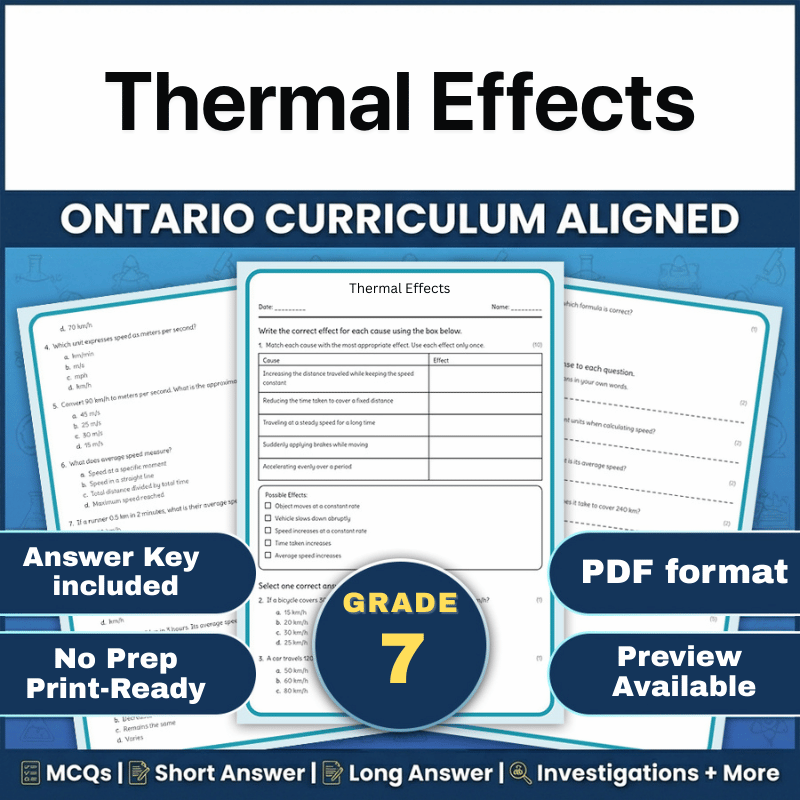
Grade 7 Science | Thermal Effects Worksheet (Ontario Standard) (PDF)
Created byBright Mind ResourcesLearning Objectives
- Understand how temperature changes affect material properties and systems.
- Explain concepts of thermal expansion, contraction, phase changes, and viscosity variations.
- Connect microscopic particle motion to macroscopic thermal effects such as volume and pressure changes.
Instant download
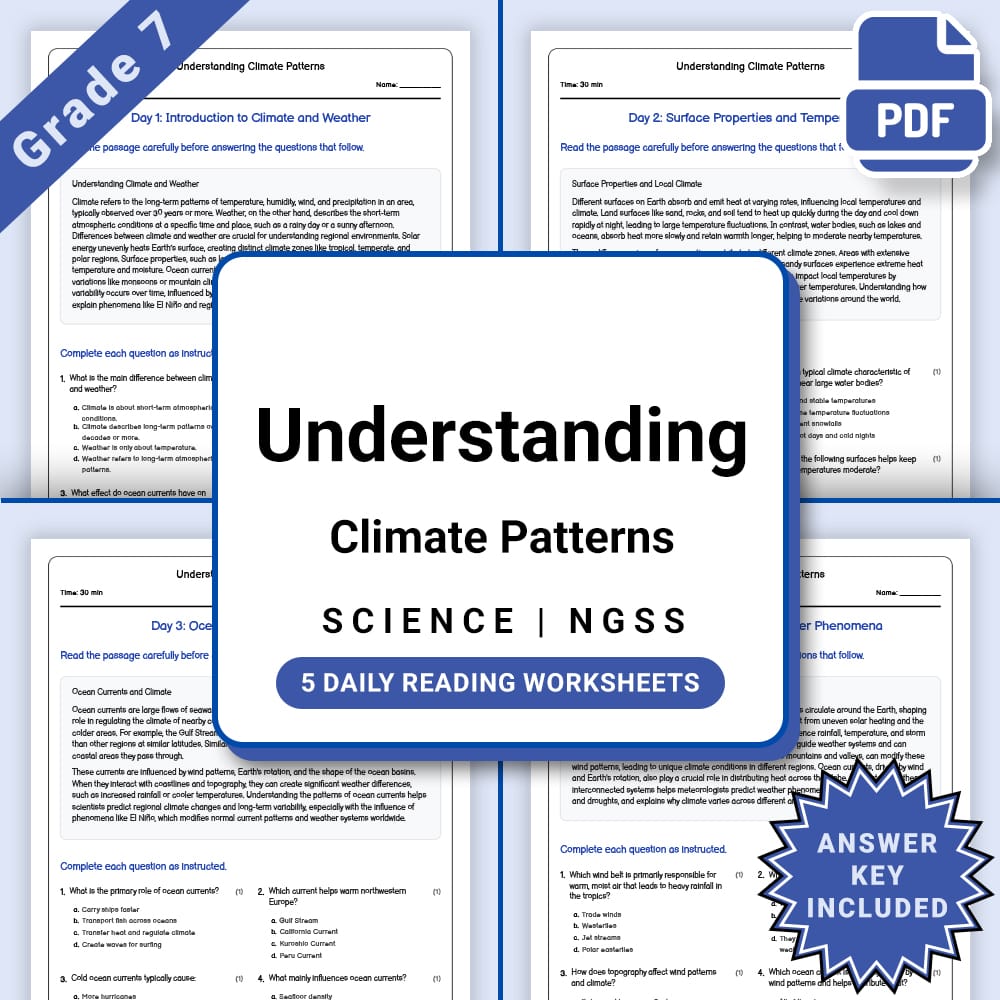
Grade 7 Science – Understanding Climate Patterns Worksheet(PDF + Answer Key)
Created byCopper Leaf ClassroomLearning Objectives
- Differentiate between weather and climate.
- Identify basic concepts related to climate patterns.
- Understand how solar heating influences climate zones.
Instant download
Grade 7 Science | Data Organization Worksheet (PDF) - Ontario Standards
Created byBright Mind ResourcesLearning Objectives
- Understand systematic data recording methods in scientific research.
- Identify types of data structures such as categorical and numerical data.
- Learn proper metadata standards and documentation practices for data provenance.
Instant download
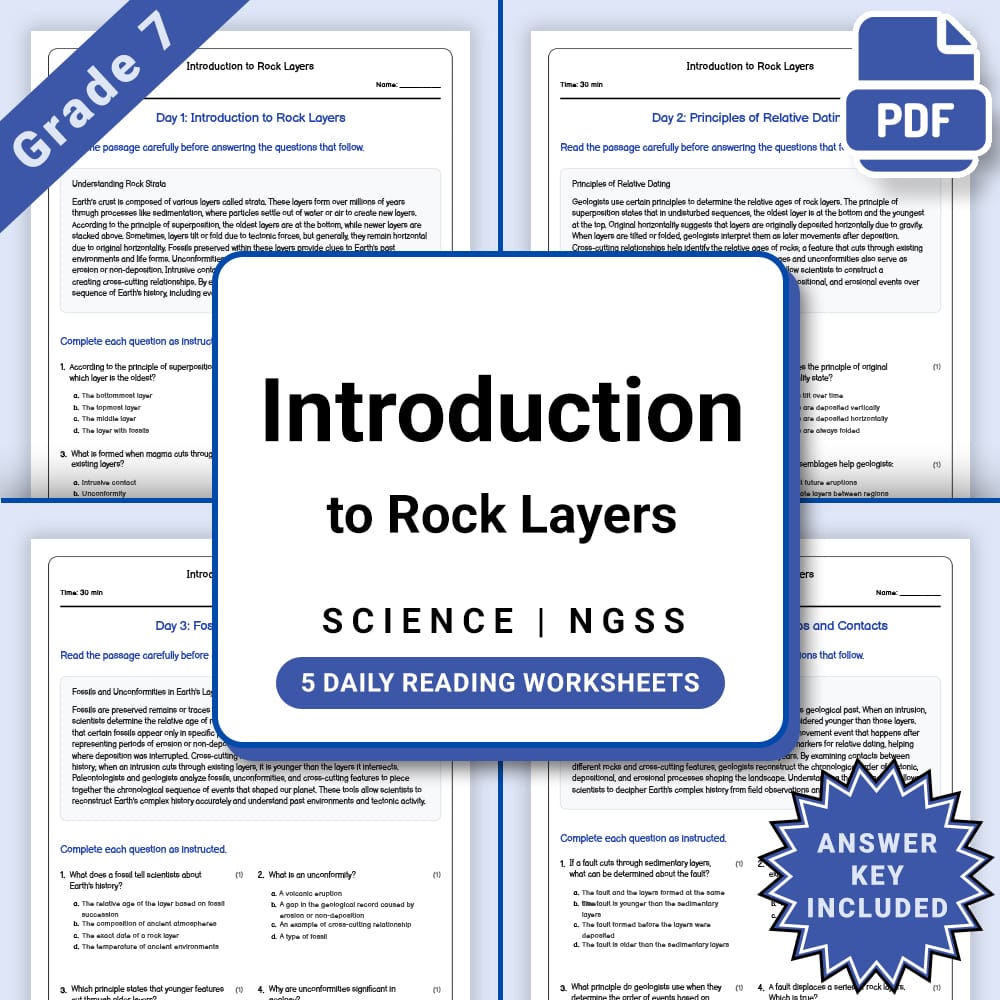
Grade 7 Science – Introduction to Rock Layers Worksheet(PDF + Answer Key)
Created byCopper Leaf ClassroomLearning Objectives
- Understand the principles of relative dating such as superposition, original horizontality, and cross-cutting relationships.
- Identify different types of rock layers and their formation processes.
- Learn to interpret fossils, unconformities, and intrusive contacts as markers for correlating layers.
Instant download
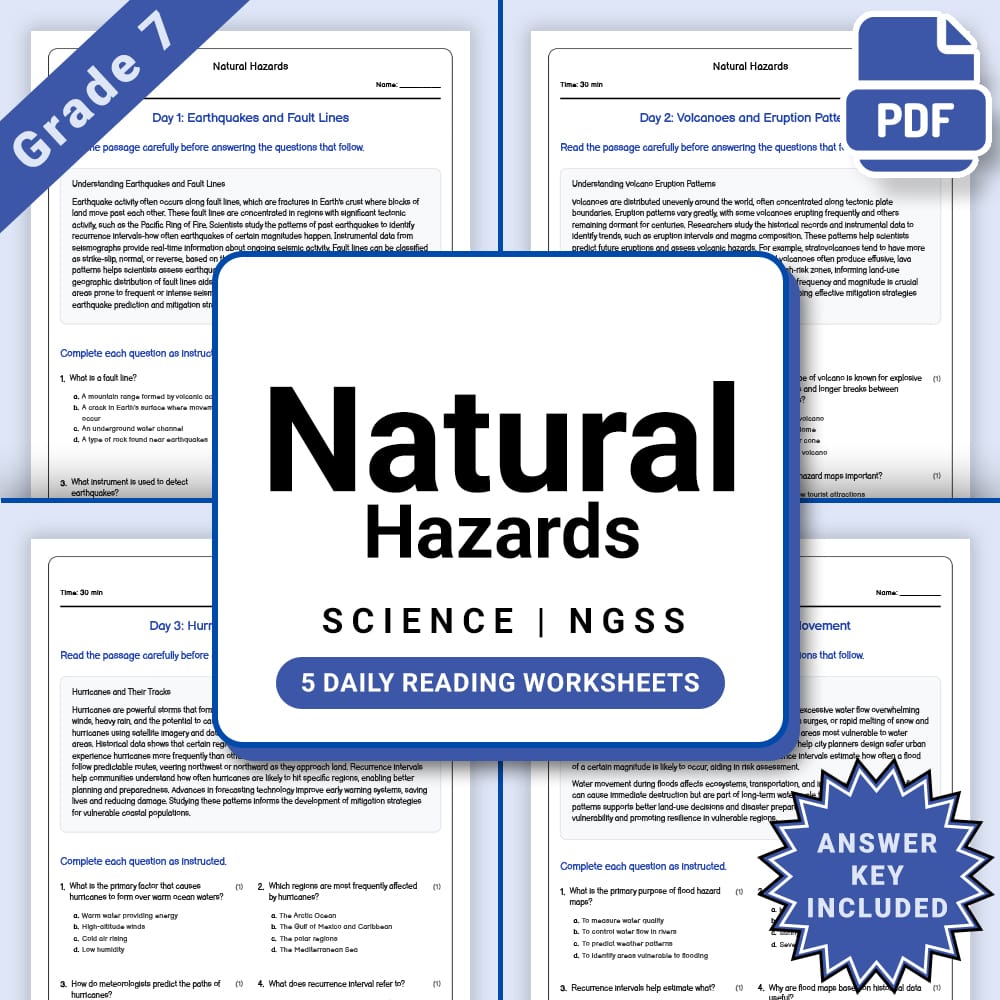
Grade 7 Science – Natural Hazards Daily Reading Worksheet(PDF + Answer Key)
Created byCopper Leaf ClassroomLearning Objectives
- Identify patterns of earthquakes and understand fault lines
- Interpret historical and instrumental data on seismic activity
- Analyze hazard maps and recurrence intervals
Instant download
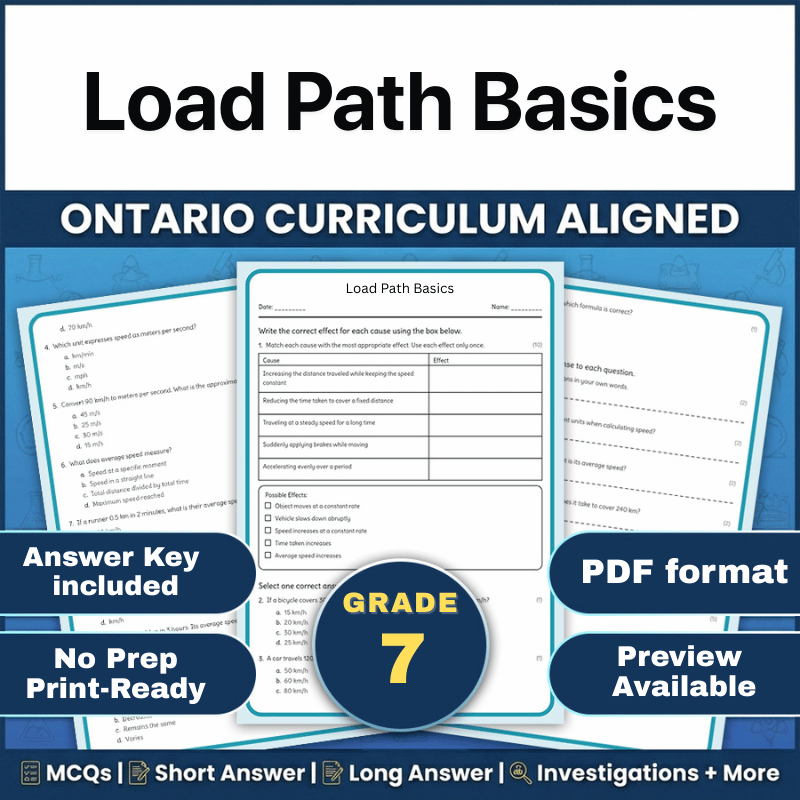
Grade 7 Science Worksheet – Load Path Basics (PDF) | Ontario Standards
Created byBright Mind ResourcesLearning Objectives
- Define primary structural elements and understand load transfer in structures.
- Distinguish between dead loads and live loads in structural systems.
- Identify tension, compression, and shear forces within members.
Instant download
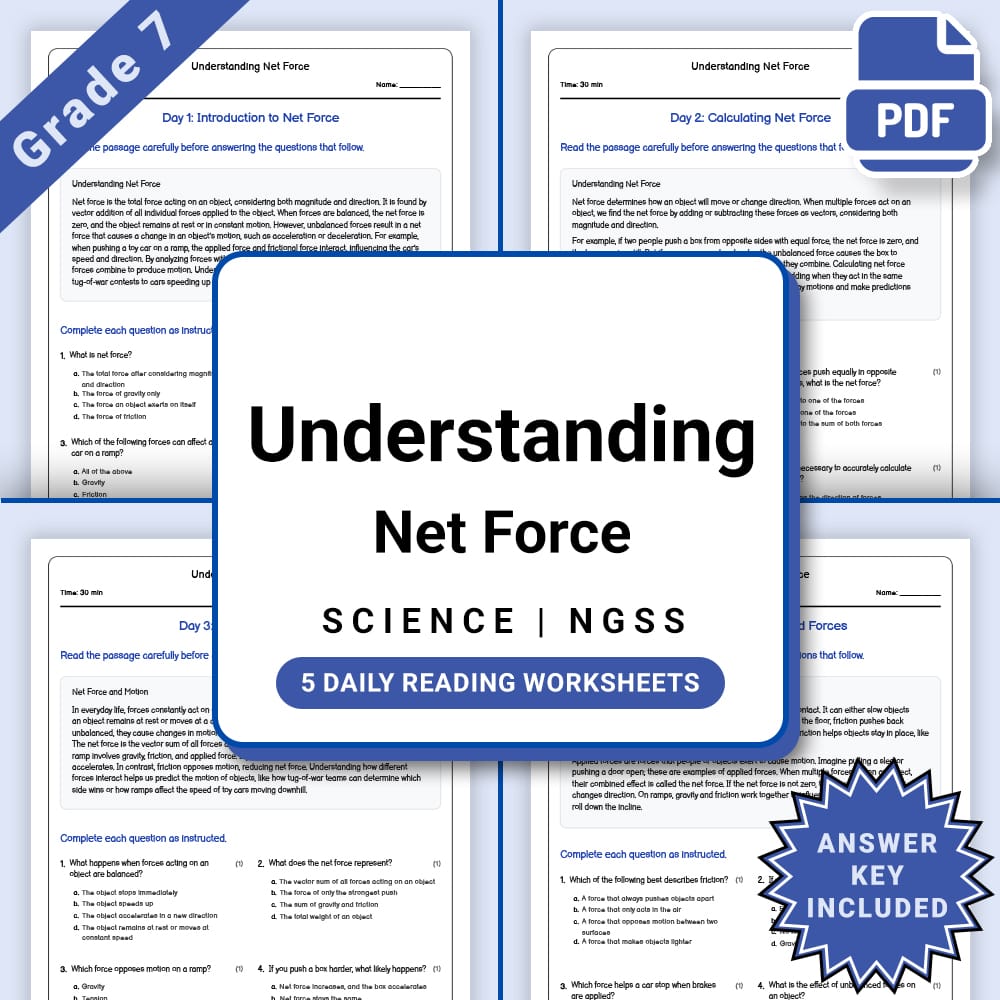
Grade 7 Science – Understanding Net Force Worksheet(PDF + Answer Key)
Created byCopper Leaf ClassroomLearning Objectives
- Define net force as the vector sum of all forces acting on an object.
- Explain how unbalanced forces cause changes in motion.
- Use free-body diagrams to visualize forces.
Instant download
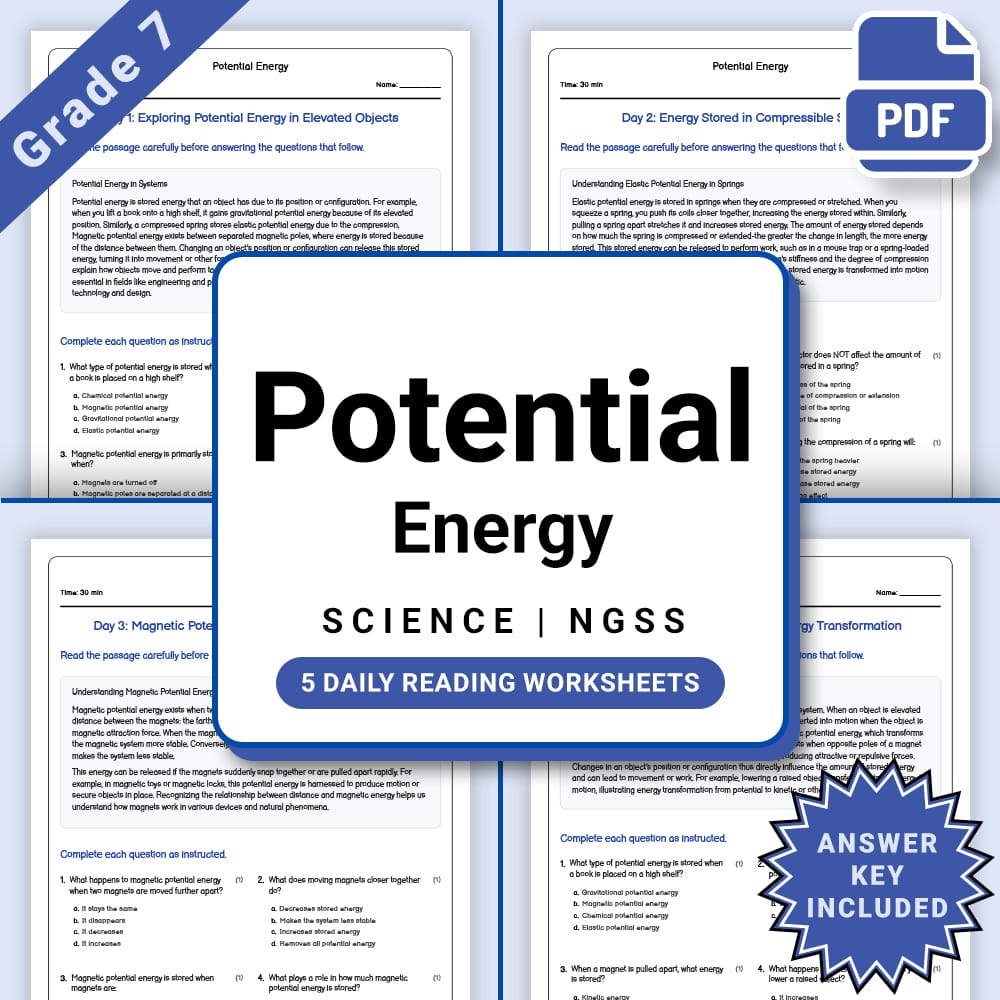
Grade 7 Science – Potential Energy Worksheet(PDF + Answer Key)
Created byCopper Leaf ClassroomLearning Objectives
- Understand key concepts related to Science
- Apply knowledge through practice questions
- Demonstrate comprehension of the material
Instant download
Grade 7 Science | Load Path Mapping Worksheet (PDF) – Ontario Standards
Created byBright Mind ResourcesLearning Objectives
- Understand the methods for mapping load paths in complex structures.
- Identify primary and secondary load transfer routes in buildings and bridges.
- Explain how openings, corners, and irregular shapes affect load redistribution.
Instant download
Grade 7 Science – Failure Modes in Structural Engineering Worksheet (PDF)
Created byBright Mind ResourcesLearning Objectives
- Identify common structural failure modes such as buckling, fatigue cracking, shear, and foundation failures.
- Describe the concepts of limit states design, safety factors, and redundancy in mitigating failure risk.
- Relate failure mechanisms to geometric, material, and loading characteristics using real-world examples.
Instant download
Grade 7 Science | Invasive Species Impacts Worksheet (Ontario Standard) (PDF)
Created byBright Mind ResourcesLearning Objectives
- Understand the ecological and economic consequences of invasive species.
- Identify pathways and factors facilitating the spread of invasive species.
- Analyze long-term effects of invasive species on native ecosystems.
Instant download
Grade 7 Science – Optimization Methods Worksheet (Ontario) (PDF)
Created byBright Mind ResourcesLearning Objectives
- Identify key performance metrics for design optimization.
- Understand how to manage constraints and evaluate trade-offs.
- Learn methods for parameter variation and sensitivity analysis.
Instant download
Grade 7 Science – Global Circulation Daily Reading Worksheet(PDF + Answer Key)
Created byCopper Leaf ClassroomLearning Objectives
- Understand key concepts related to Science
- Apply knowledge through practice questions
- Demonstrate comprehension of the material
Instant download
Grade 7 Science – Cosmic Scale Daily Reading Worksheet(PDF + Answer Key)
Created byCopper Leaf ClassroomLearning Objectives
- Understand the relative sizes of planets within the solar system
- Estimate distances between planets using astronomical units
- Recognize the concept of light-years and their significance in astronomy
Instant download
Grade 7 Science | Decomposition Cycles Worksheet (Ontario) (PDF)
Created byBright Mind ResourcesLearning Objectives
- Describe decomposition processes and nutrient cycling in ecosystems.
- Identify the roles of detritivores, fungi, bacteria, and abiotic factors in decomposition.
- Explain carbon and nitrogen transformations during decomposition.
Instant download
Grade 7 Science | Density Separation Worksheet (PDF) Ontario Standards
Created byBright Mind ResourcesLearning Objectives
- Explain how density differences are exploited in separation techniques such as decanting, floatation, and centrifugation.
- Describe the physical principles of buoyant force, sedimentation rate, and centrifugal acceleration as they relate to particle density and size.
- Identify suitable media and conditions for effective density-based separation.
Instant download
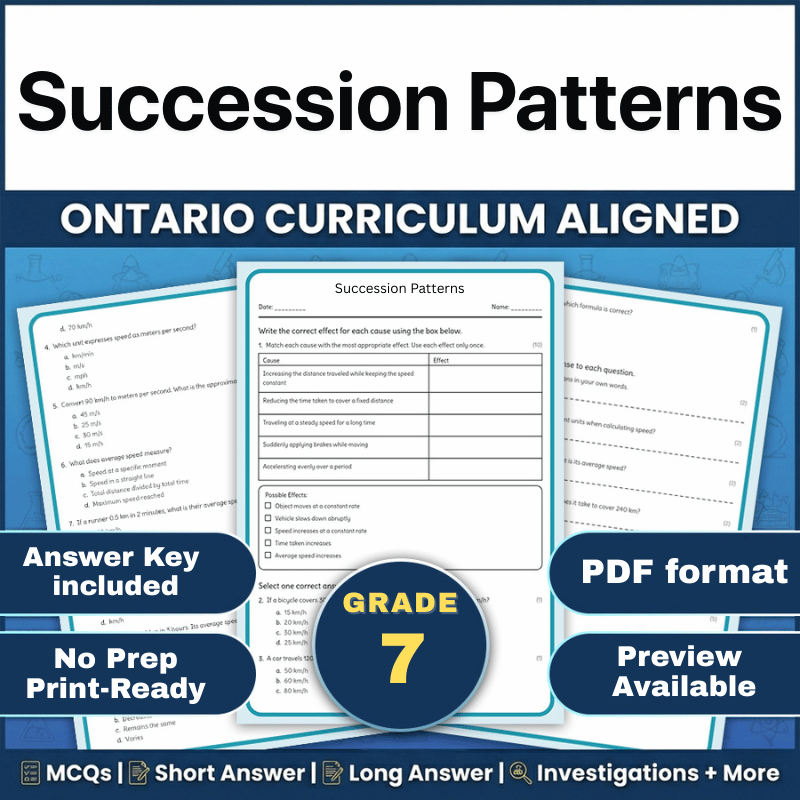
Grade 7 Science | Ecological Succession Patterns Worksheet (Ontario, PDF)
Created byBright Mind ResourcesLearning Objectives
- Describe the process of ecological succession and distinguish between primary and secondary succession.
- Identify the characteristic stages of succession and key factors influencing community change.
- Explain how soil development, seed dispersal, competition, and facilitation drive succession trajectories.
Instant download
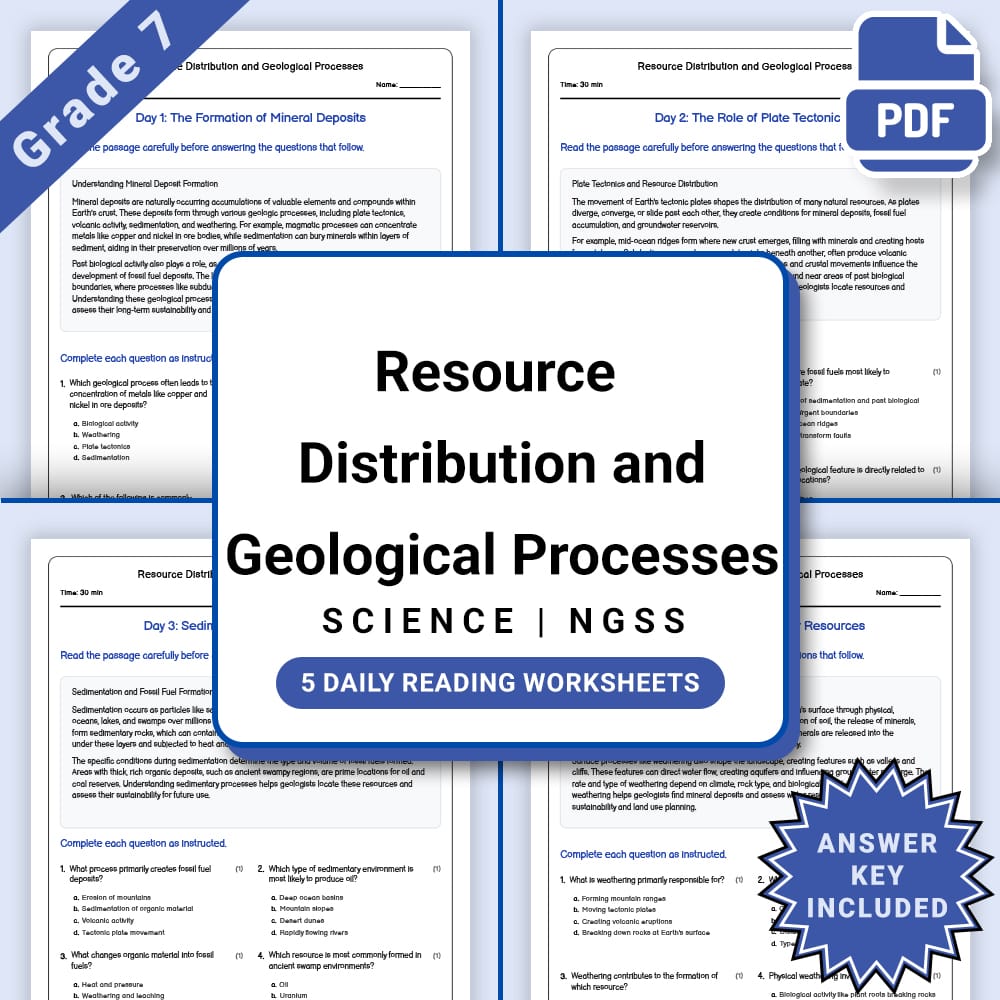
Grade 7 Science – Resource Distribution and Geological Processes (PDF +Answers)
Created byCopper Leaf ClassroomLearning Objectives
- Understand how Earth's geological processes influence the distribution of mineral, energy, and groundwater resources.
- Identify the role of plate tectonics, sedimentation, weathering, and biological activity in resource formation.
- Analyze geologic maps, cross sections, and case studies to evaluate resource locations.
Instant download
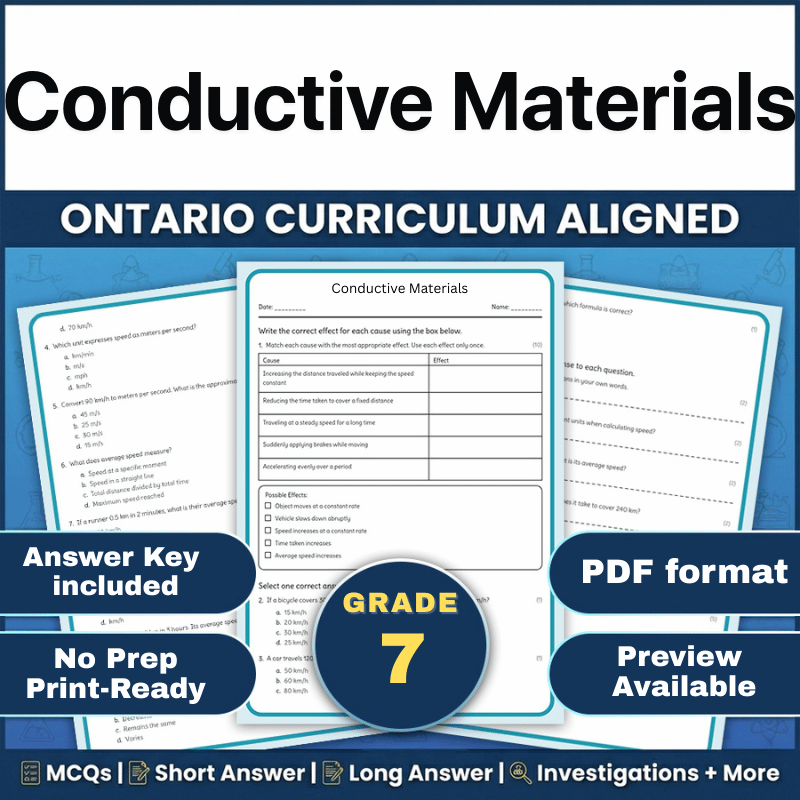
Grade 7 Science | Conductive Materials Worksheet (Ontario, PDF)
Created byBright Mind ResourcesLearning Objectives
- Analyze and compare the thermal conductivity of metals, ceramics, polymers, and composites.
- Understand factors that affect heat transfer, including material structure, density, porosity, and moisture.
- Describe how free electrons and lattice vibrations contribute to thermal conduction differences.
Instant download
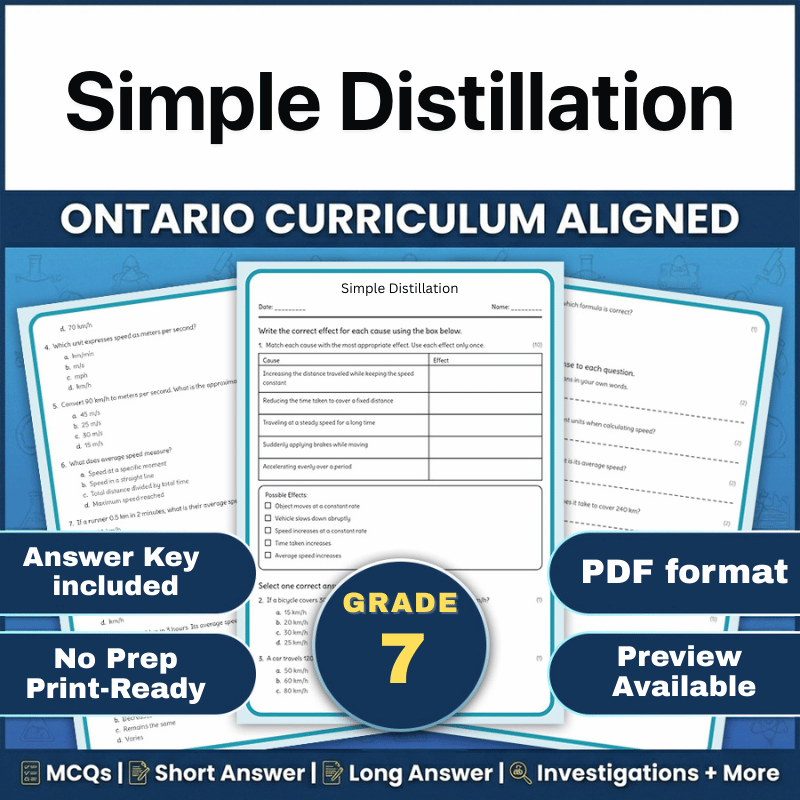
Grade 7 Science – Simple Distillation Worksheet (Ontario) – PDF
Created byBright Mind ResourcesLearning Objectives
- Explain the principle of simple distillation and how it separates liquids based on boiling points.
- Describe the roles of vapor pressure, boiling point differences, and condensation in distillation.
- Identify examples of distillation applications, such as separating ethanol from water.
Instant download
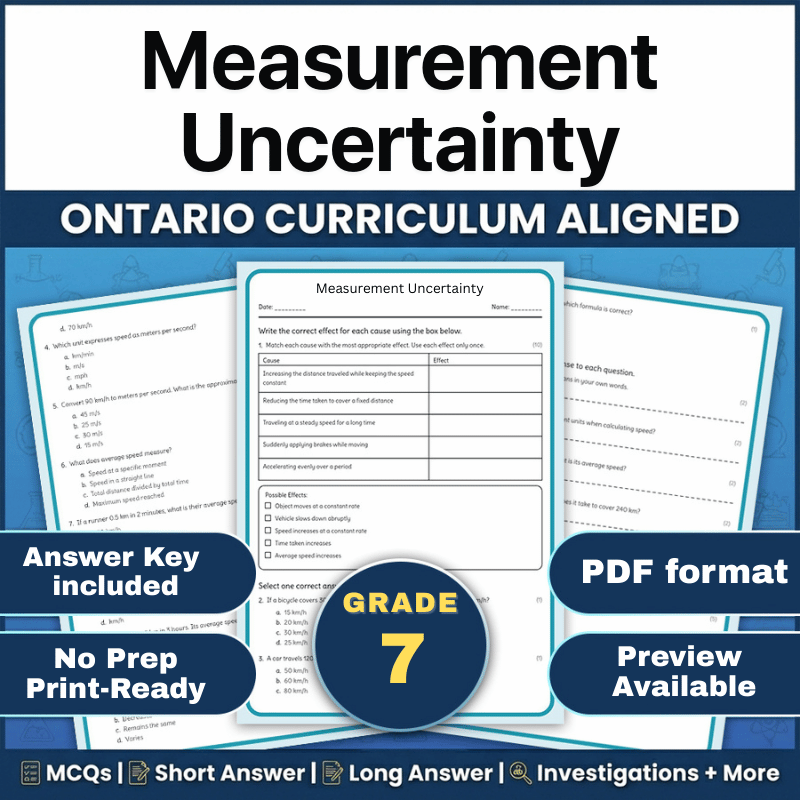
Grade 7 Science | Measurement Uncertainty Worksheet (Ontario) (PDF)
Created byBright Mind ResourcesLearning Objectives
- Understand the significance of measurement accuracy and precision in scientific observations.
- Identify sources of measurement uncertainty and how to estimate their impact.
- Learn techniques for reading instruments accurately and estimating uncertainty propagation.
Instant download
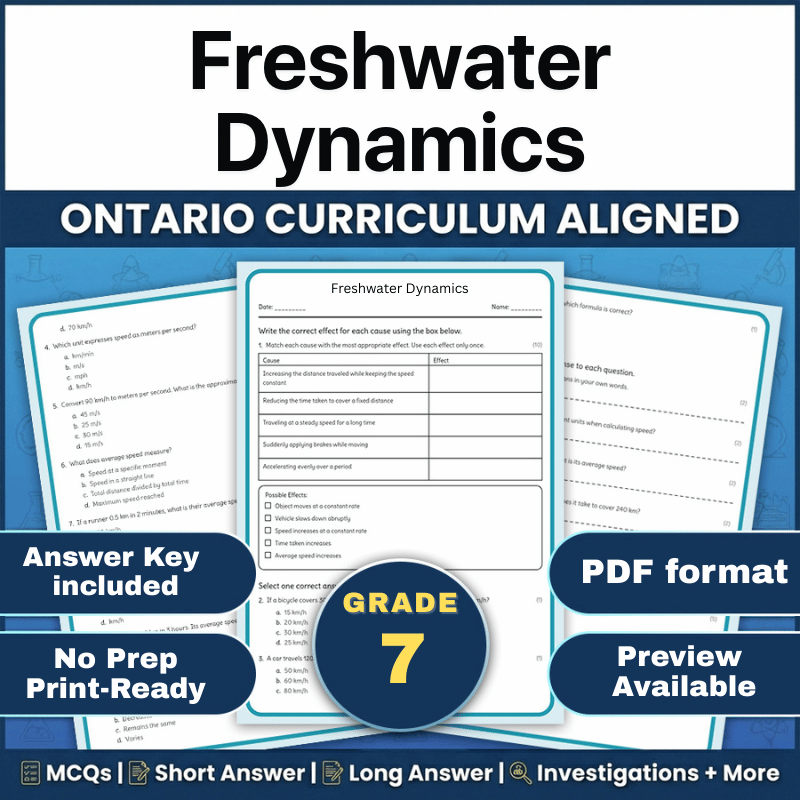
Grade 7 Science | Freshwater Dynamics Worksheet (Ontario) PDF
Created byBright Mind ResourcesLearning Objectives
- Describe the structure of freshwater systems including stratification, oxygen gradients, and light penetration.
- Explain how abiotic gradients influence community composition and vertical zonation in lakes and ponds.
- Discuss seasonal changes such as thermal turnover and their effects on oxygen levels and habitats.
Instant download
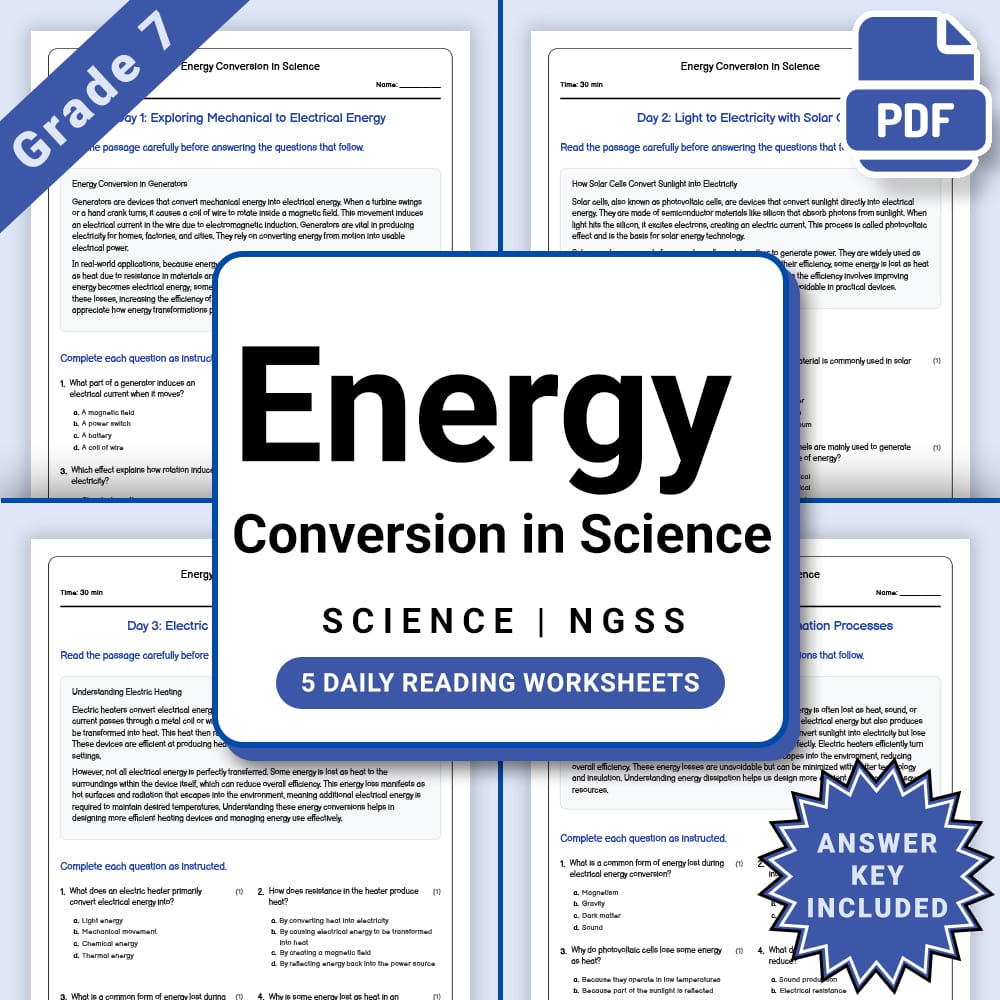
Grade 7 Science – Energy Conversion Daily Reading Worksheet(PDF + Answer Key)
Created byCopper Leaf ClassroomLearning Objectives
- Explain how mechanical energy is transformed into electrical energy by generators.
- Describe how photovoltaic cells convert light to electrical energy.
- Understand the process of electrical heaters converting electrical energy into thermal energy.
Instant download
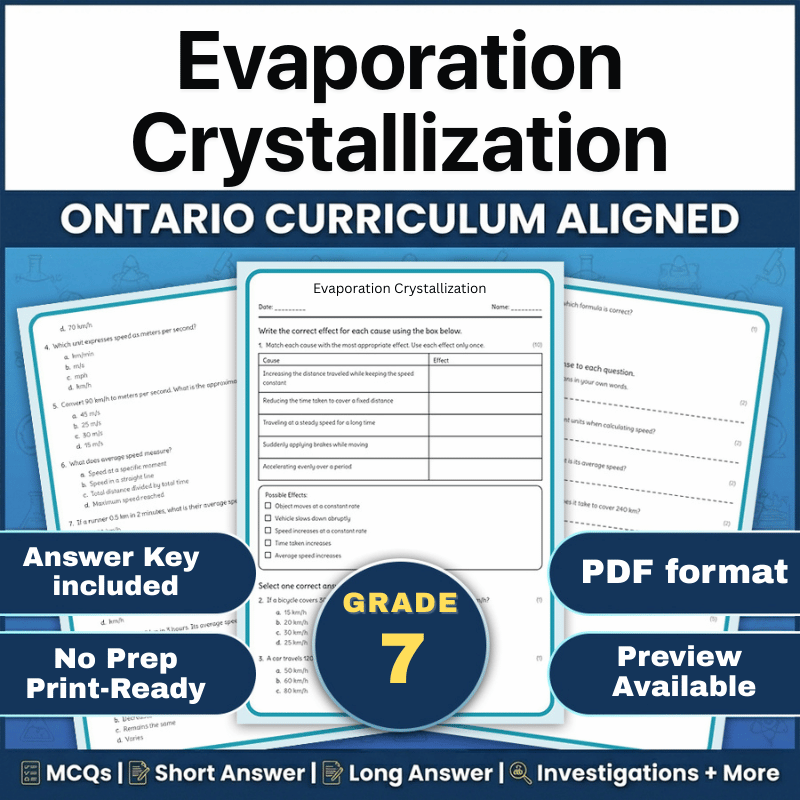
Grade 7 Science | Evaporation Crystallization Worksheet (Ontario Standards)(PDF)
Created byBright Mind ResourcesLearning Objectives
- Understand the processes of evaporation and controlled crystallization used to recover solutes.
- Identify factors affecting crystal size, shape, and purity.
- Explain how nucleation and crystal growth occur during crystallization.
Instant download
Grade 7 Science | Reflective Surfaces Worksheet (Ontario, PDF)
Created byBright Mind ResourcesLearning Objectives
- Understand how surface properties like albedo and emissivity affect radiative heat exchange.
- Evaluate how surface colour and coatings influence solar gain in structures.
- Describe the function of low-emissivity glazing and reflective roofs in climate control.
Instant download
Grade 7 Science | Restoration Strategies Worksheet (Ontario) (PDF)
Created byBright Mind ResourcesLearning Objectives
- Understand key principles of ecological restoration, including reference conditions and active vs passive approaches.
- Identify factors influencing species selection, habitat connectivity, and corridor design in restoration projects.
- Analyze the trade-offs between short-term recovery and long-term ecosystem resilience.
Instant download
Grade 7 Science Worksheet – Substance Basics (Ontario Standards) PDF
Created byBright Mind ResourcesLearning Objectives
- Classify substances as pure or mixtures based on their composition and properties.
- Identify examples of elements, compounds, and mixtures in real-world contexts.
- Understand the criteria that distinguish pure substances from mixtures.
Instant download
Grade 7 Science | Instrumentation Accuracy Worksheet (PDF) Ontario Standards
Created byBright Mind ResourcesLearning Objectives
- Understand how sensor response time influences temperature measurement accuracy.
- Compare different temperature sensing technologies and their calibration needs.
- Identify common error sources and ways to minimize measurement uncertainty.
Instant download
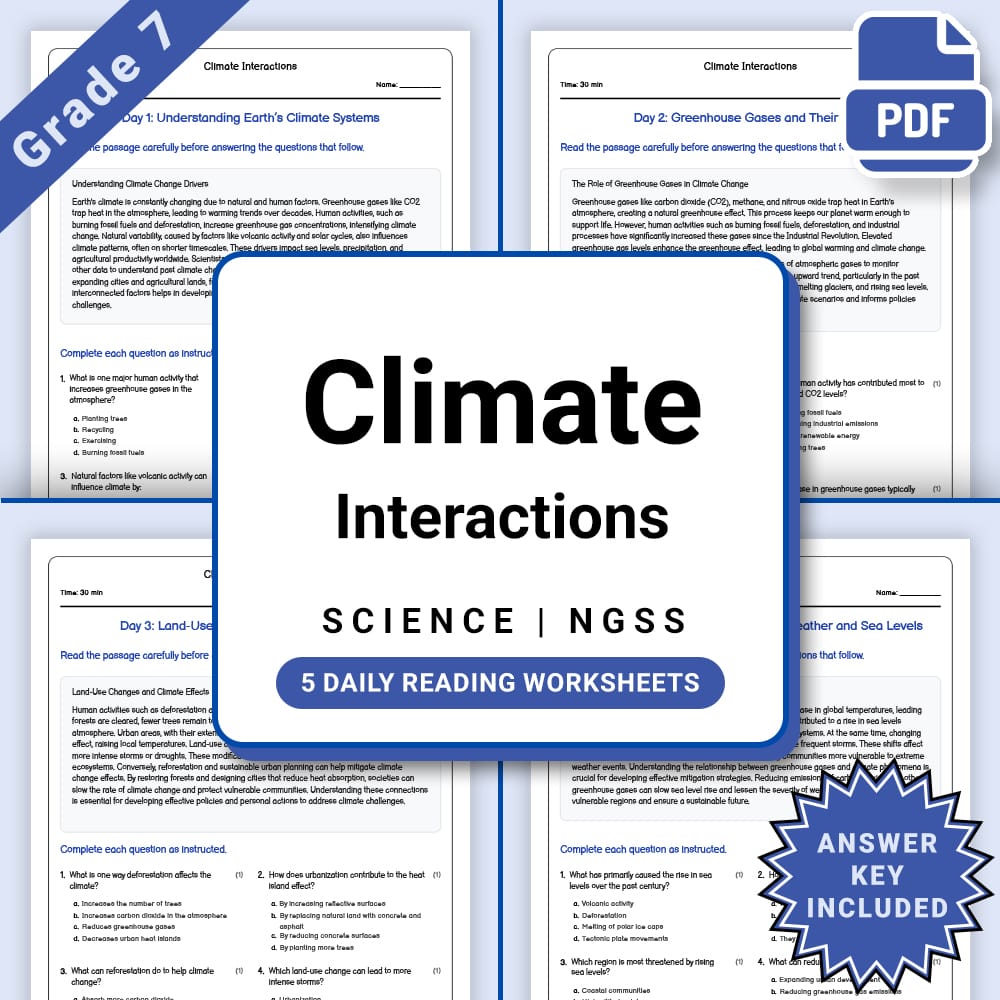
Grade 7 Science – Climate Interactions Worksheet(PDF + Answer Key)
Created byCopper Leaf ClassroomLearning Objectives
- Analyze climate data such as temperature and CO2 records
- Identify patterns and drivers of climate change
- Assess impacts on sea levels, precipitation, and agriculture
Instant download
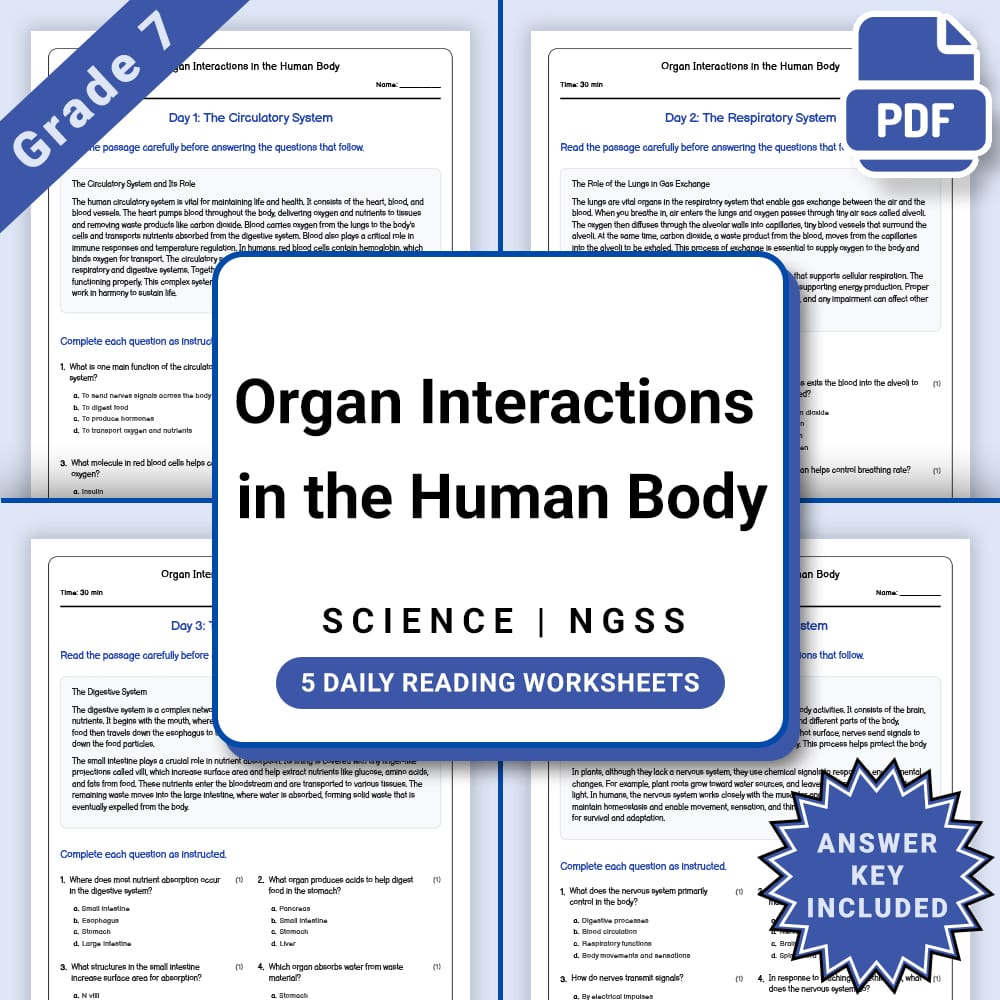
Grade 7 Science – Organ Interactions Daily Reading Worksheet(PDF + Answer Key)
Created byCopper Leaf ClassroomLearning Objectives
- Understand the structure and function of the human circulatory system.
- Explain how blood transports oxygen and nutrients to organs and tissues.
- Identify the roles of different blood components, including hemoglobin.
Instant download
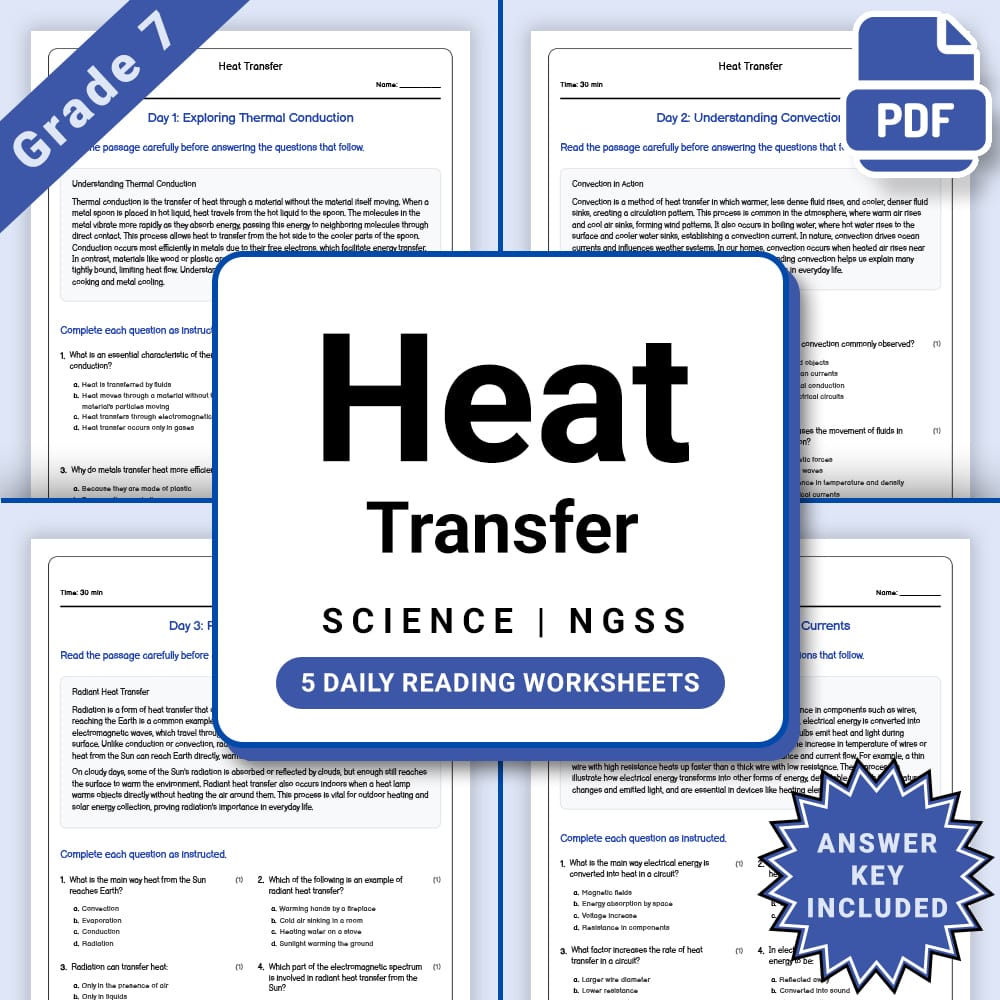
Grade 7 Science – Heat Transfer Daily Reading Worksheet(PDF + Answer Key)
Created byCopper Leaf ClassroomLearning Objectives
- Understand the concept of thermal conduction and how energy transfers through direct contact.
- Identify examples of conduction in everyday life.
- Explain how heat flows from hot to cold objects via conduction.
Instant download
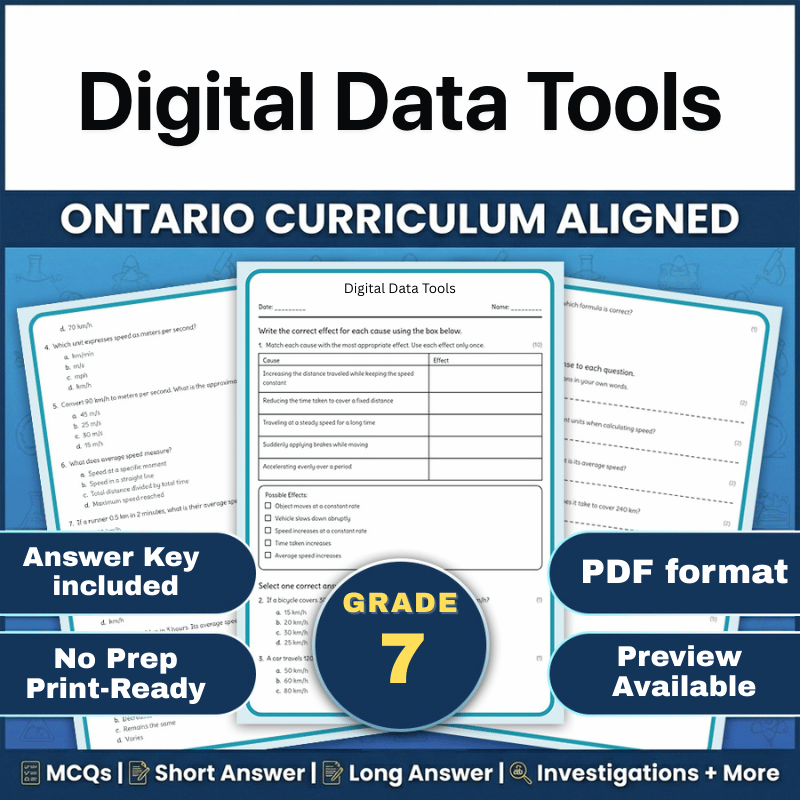
Grade 7 Science | Digital Data Tools Worksheet (Ontario) - PDF
Created byBright Mind ResourcesLearning Objectives
- Identify various digital tools used for data acquisition and organization.
- Understand formats such as CSV, timestamps, and metadata tags that facilitate data interoperability.
- Explain the advantages and limitations of automated logging systems.
Instant download
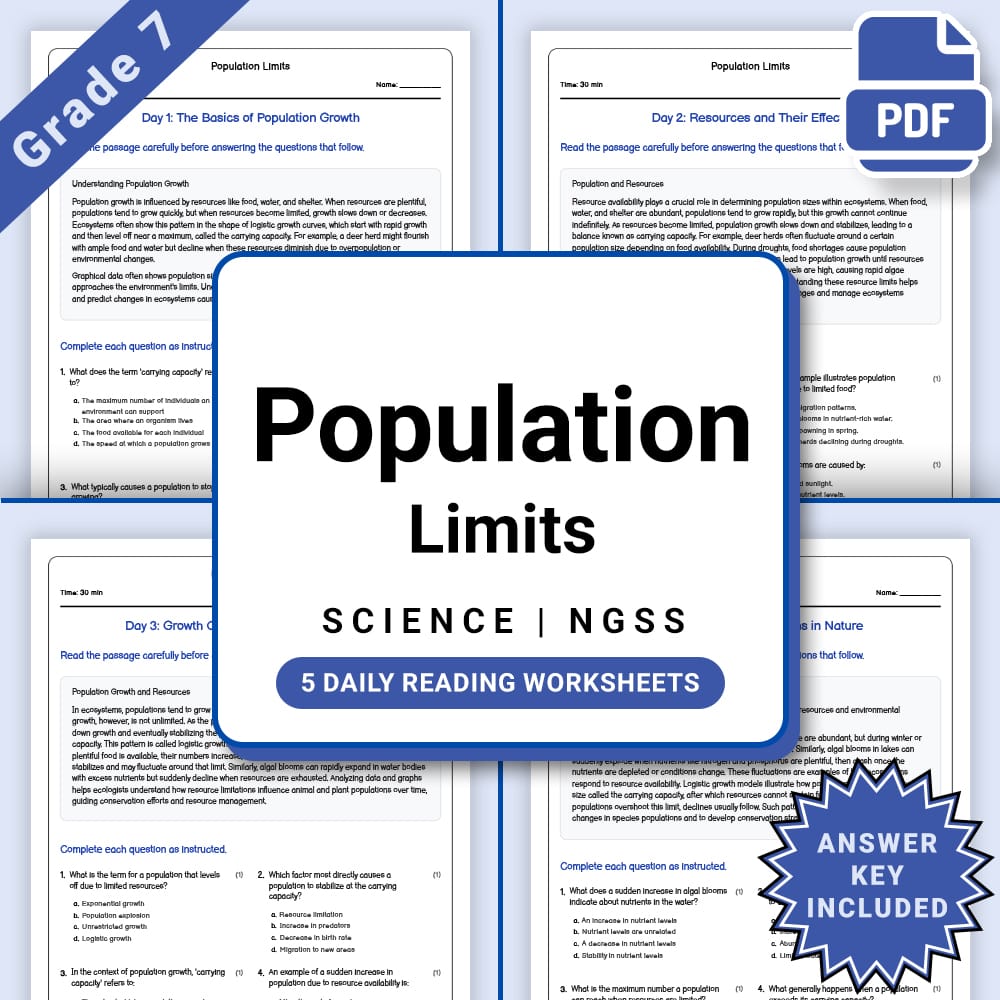
Grade 7 Science – Population Limits Daily Reading Worksheet(PDF + Answer Key)
Created byCopper Leaf ClassroomLearning Objectives
- Understand the concept of carrying capacity and how resource availability influences population size.
- Interpret simple graphical data depicting population changes over time.
- Explain how factors like food, water, and shelter affect animal populations.
Instant download
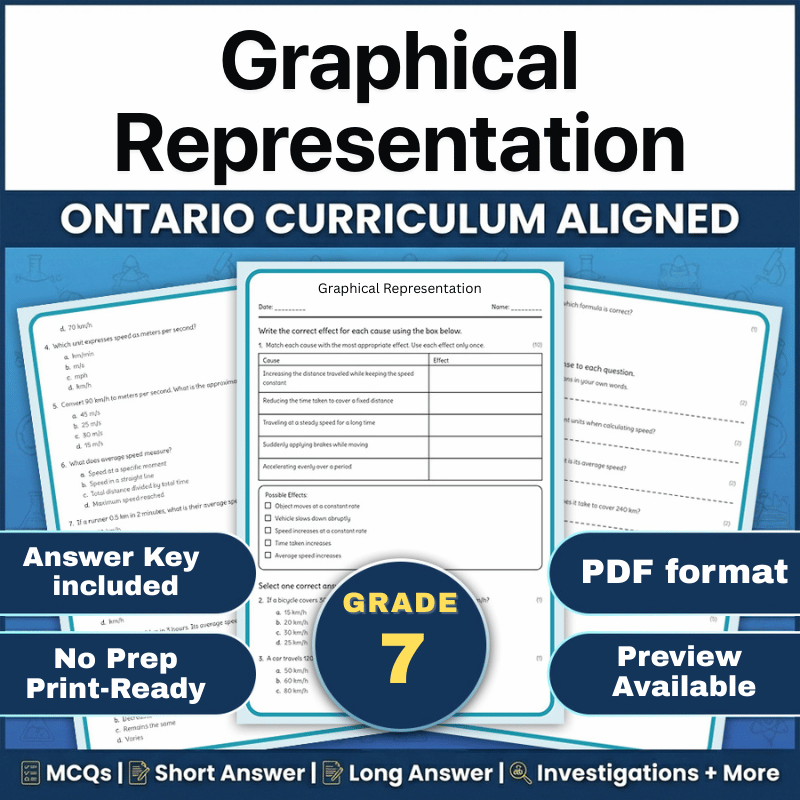
Grade 7 Science | Graphical Representation Worksheet (Ontario) (PDF)
Created byBright Mind ResourcesLearning Objectives
- Understand the different types of graphs and when to use each.
- Learn how to construct and interpret bar charts, histograms, line graphs, and scatter plots.
- Recognize the importance of axis scaling, error bars, trend lines, and annotations for clarity.
Instant download
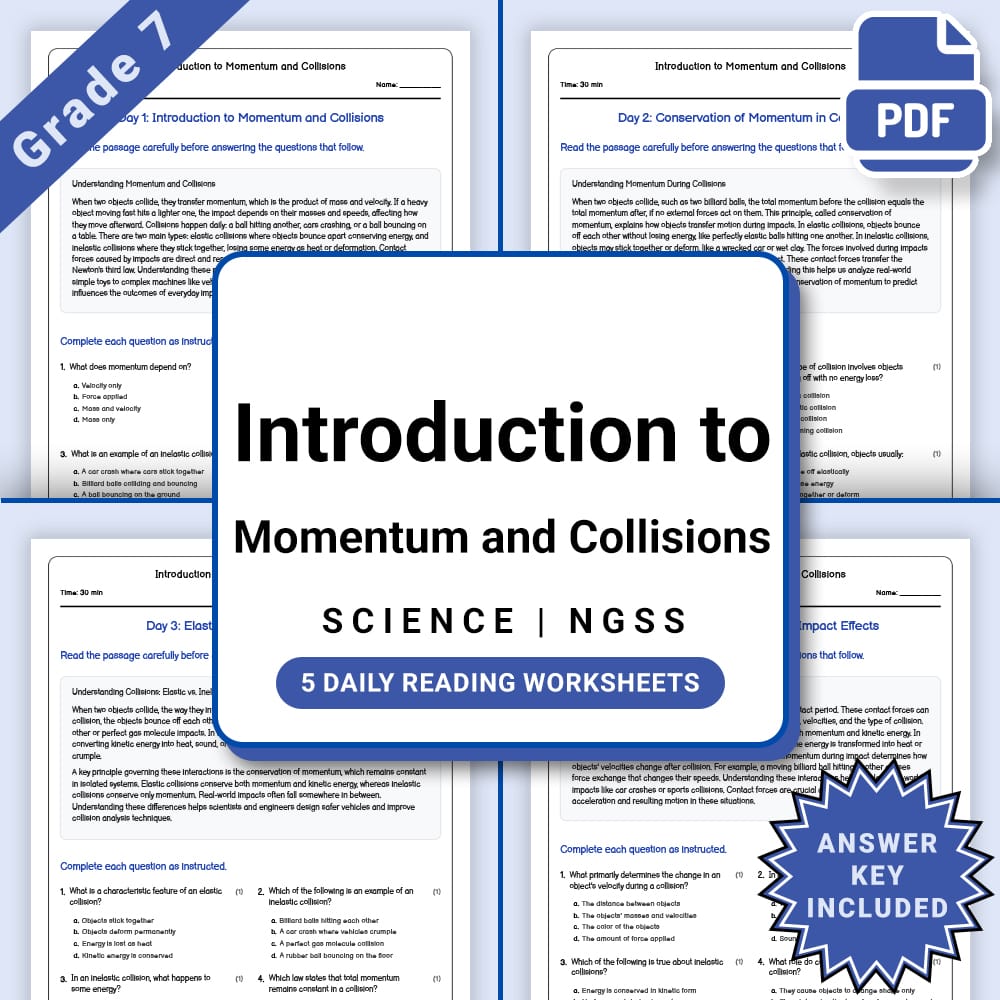
Grade 7 Science – Introduction to Momentum and Collisions (PDF + Answer Key)
Created byCopper Leaf ClassroomLearning Objectives
- Understand the basic concepts of momentum and collisions.
- Identify how momentum is transferred during impacts.
- Differentiate between elastic and inelastic collisions.
Instant download
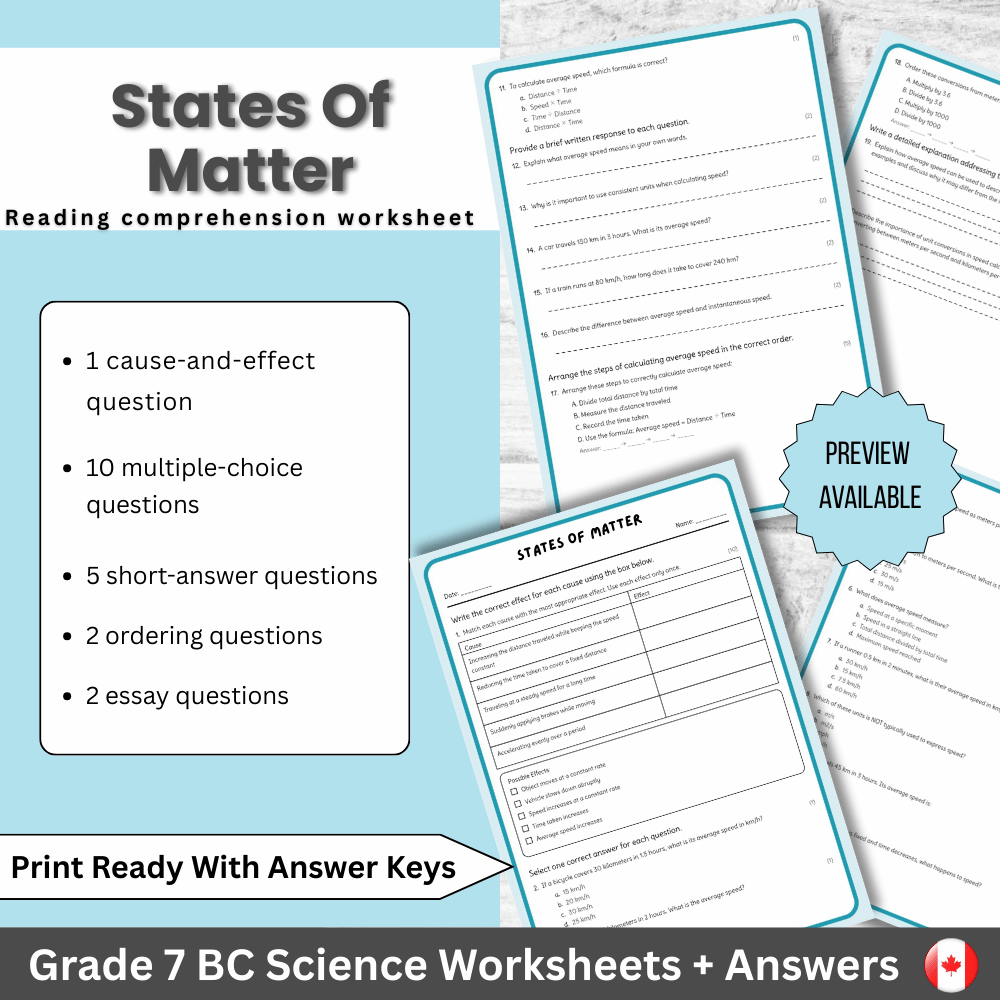
7th Grade Science | States of Matter Worksheet (Answer Key) – BC Standards
Created byBright Mind ResourcesLearning Objectives
- Understand the particle arrangements, spacing, and movement in solids, liquids, and gases.
- Describe how temperature and pressure influence state changes.
- Identify observable characteristics that classify substances as solids, liquids, or gases.
Instant download
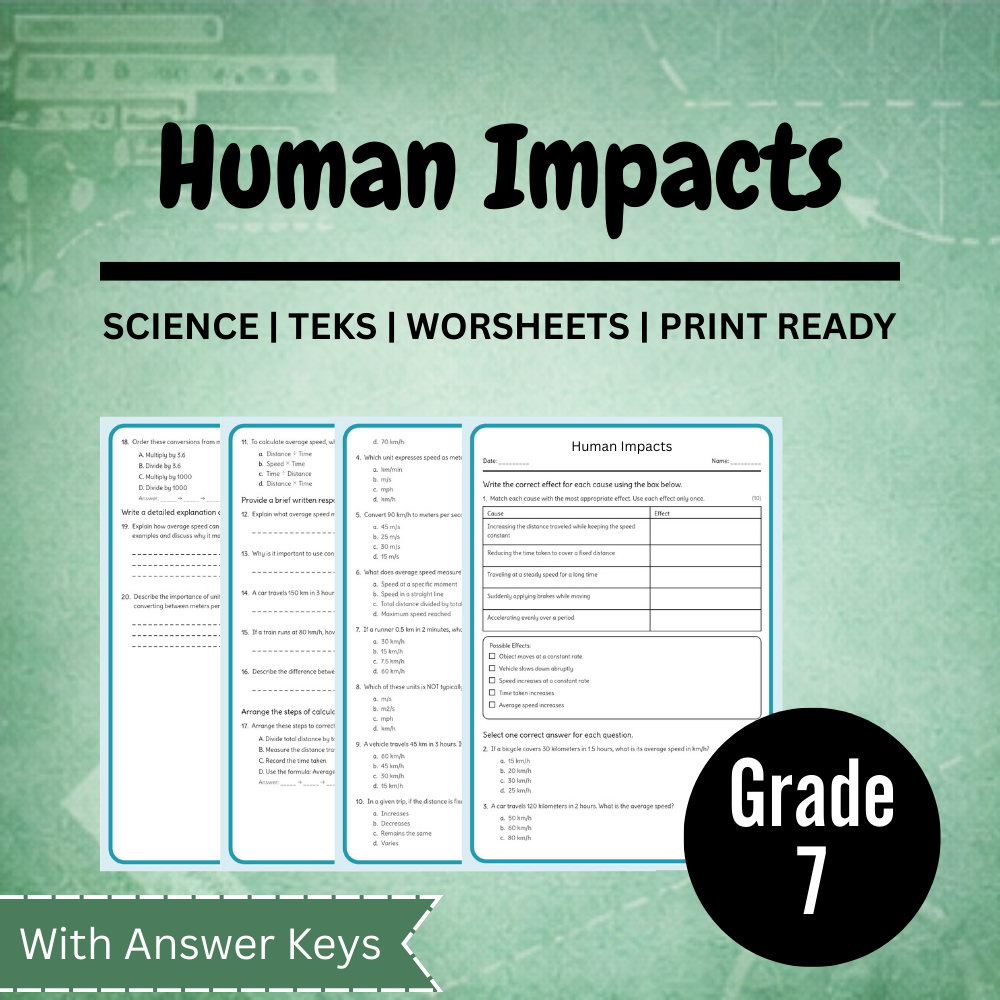
Grade 7 Science – Human Impacts Worksheet (Worksheet + Answer Key) – TEKS Aligned
Created byBright Mind ResourcesLearning Objectives
- Identify major human activities that alter ecosystems, such as habitat fragmentation and pollution.
- Explain how invasive species and pollution affect biodiversity and ecosystem resilience.
- Describe mitigation and restoration strategies for ecosystems impacted by human activities.
Also included in: Grade 7 Science Unit Bundle – Ecosystems, Adaptation & Environmental Impact +2 more
Instant download
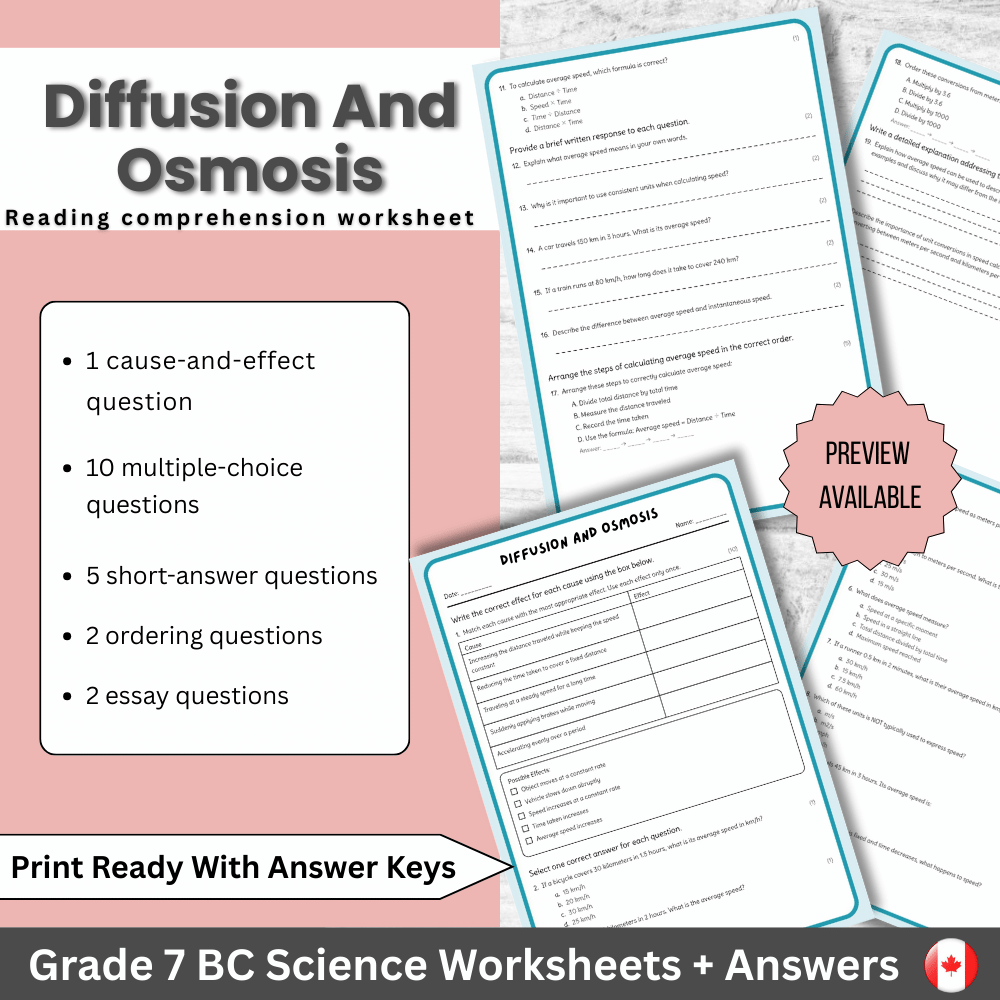
Grade 7 Science | Diffusion & Osmosis Worksheet – BC Standards (PDF)
Created byBright Mind ResourcesLearning Objectives
- Understand the processes of diffusion and osmosis as passive transport mechanisms.
- Identify factors influencing the rates of diffusion and osmosis.
- Explain how diffusion and osmosis affect cells and organisms.
Instant download
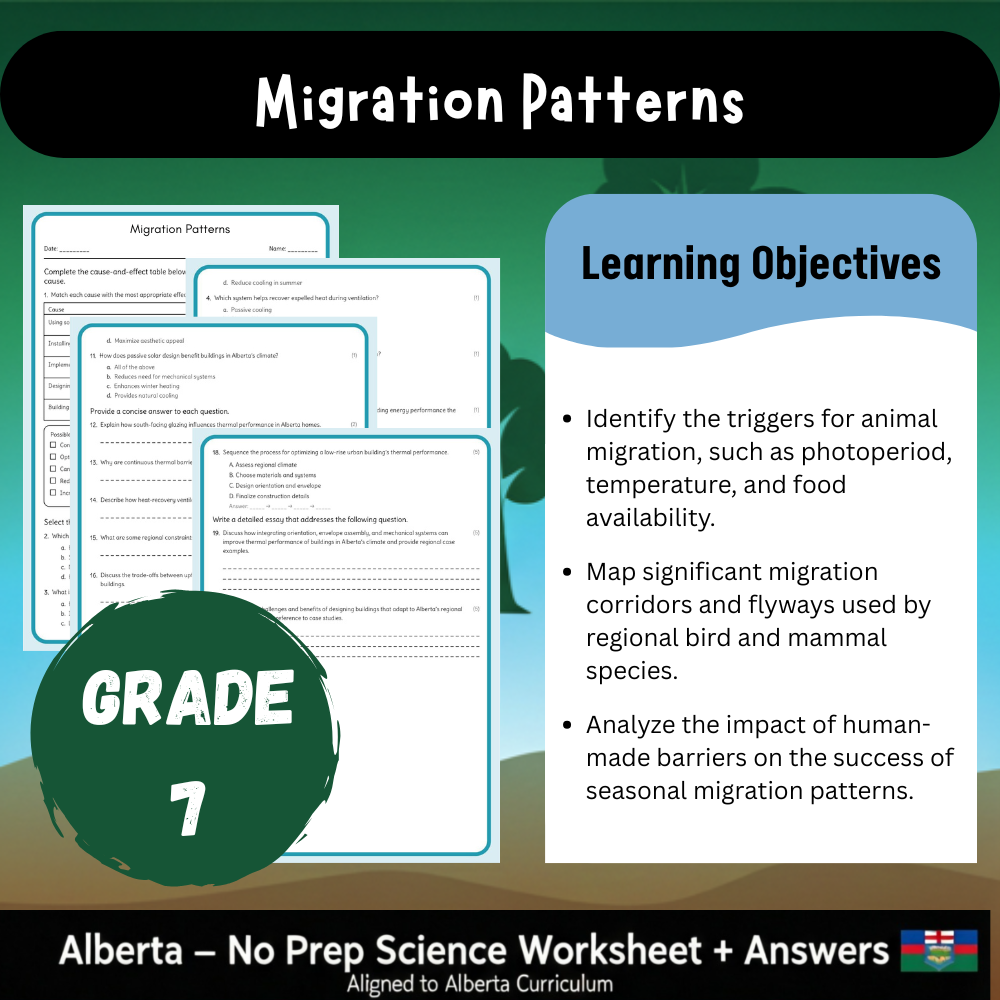
Grade 7 Science | Migration Patterns Worksheet (PDF) – Alberta Standards
Created byBright Mind ResourcesLearning Objectives
- Understand the factors that influence seasonal and annual animal migration
- Identify examples of migration corridors and flyways in Alberta
- Explain how migration connects ecosystems across regions
Instant download
About Grade 7 Science Worksheets
Browse 6,039 printable Grade 7 Science worksheets — ready-to-print PDFs with answer keys where available.
Every worksheet on MyTeachingSheets is created by independent teacher-authors and reviewed before publication. All resources download as printable PDFs for classroom, homework, or at-home practice, and many include answer keys. Preview any worksheet free before buying.