
Grade 7 Science Worksheets
6,039 worksheets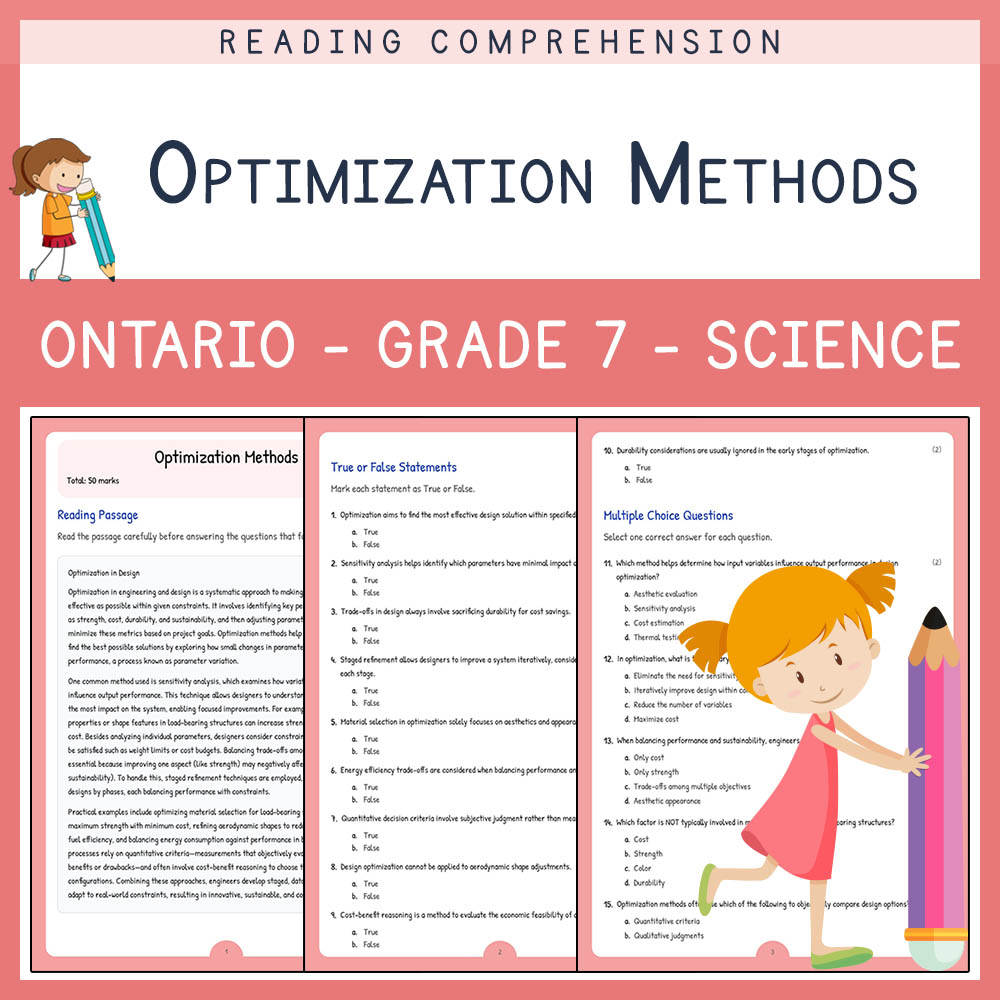
Grade 7 Science Assessment | Optimization Methods Worksheet | Ontario
 Created byLumora Learning
Learning Objectives
- Understand core concepts of optimization in design, including key performance metrics and constraints.
- Identify different methods such as parameter variation and sensitivity analysis used to improve design outcomes.
- Evaluate trade-offs among strength, cost, durability, and sustainability in engineering decisions.
Also included in: Grade 7 Science | STEM Skills and Connections Custom Bundle | Ontario
Instant download
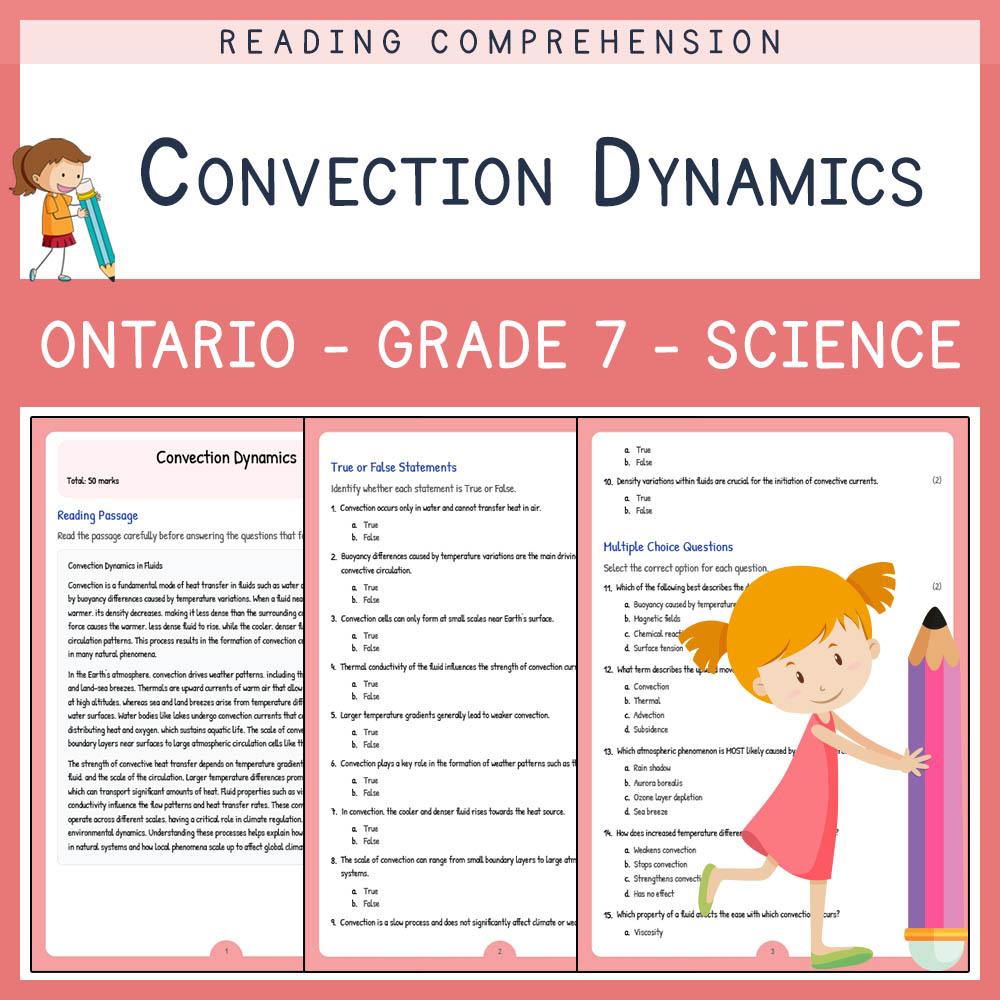
Grade 7 Science Assessment | Convection Dynamics Worksheet | Ontario
Created byLumora LearningLearning Objectives
- Explain the process of convective heat transfer in fluids due to buoyancy and density variations.
- Identify and describe formation of circulation cells in air and water during convection.
- Relate convection phenomena to environmental examples like sea breezes, thermals, and lake overturning.
Instant download
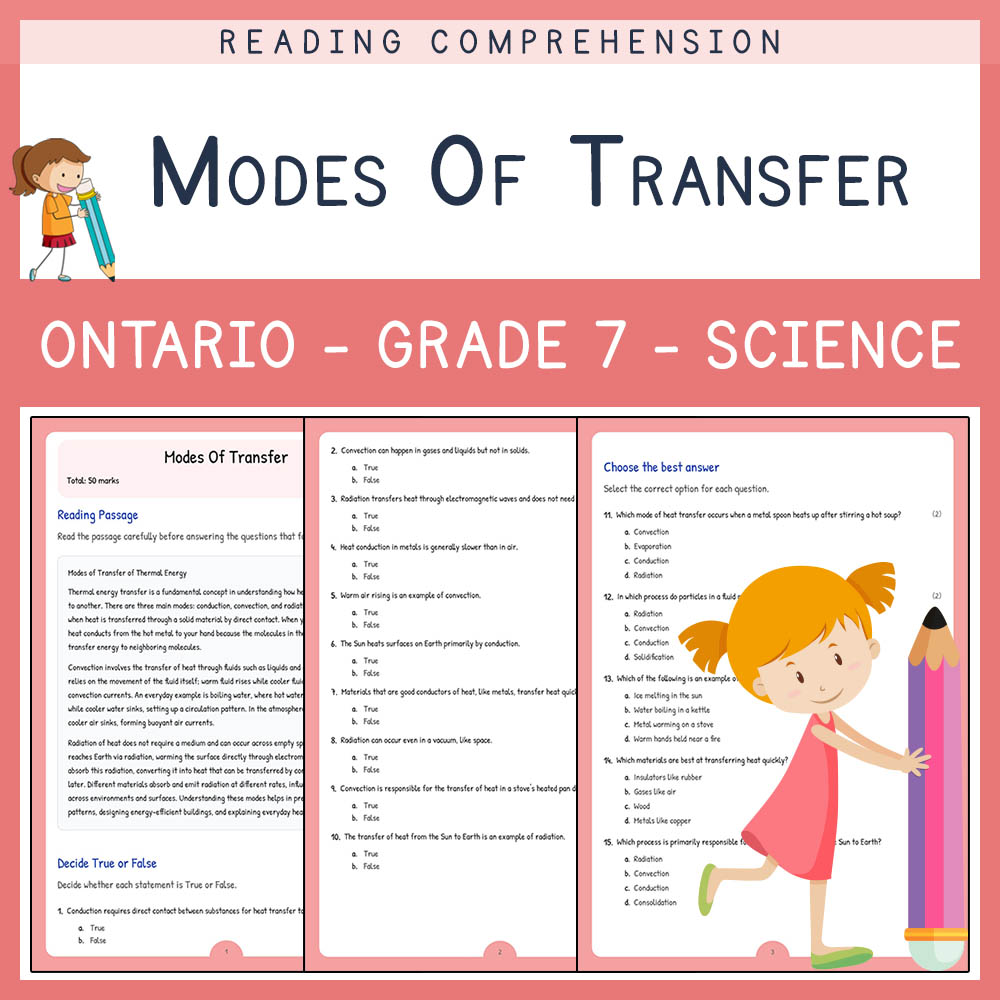
Grade 7 Science | Modes Of Transfer Worksheet | Ontario Standard
Created byLumora LearningLearning Objectives
- Identify and describe the three primary modes of thermal energy transfer: conduction, convection, and radiation.
- Differentiate between the media and mechanisms involved in each mode of transfer.
- Use everyday examples to illustrate how heat moves through solids, fluids, and surfaces.
Instant download
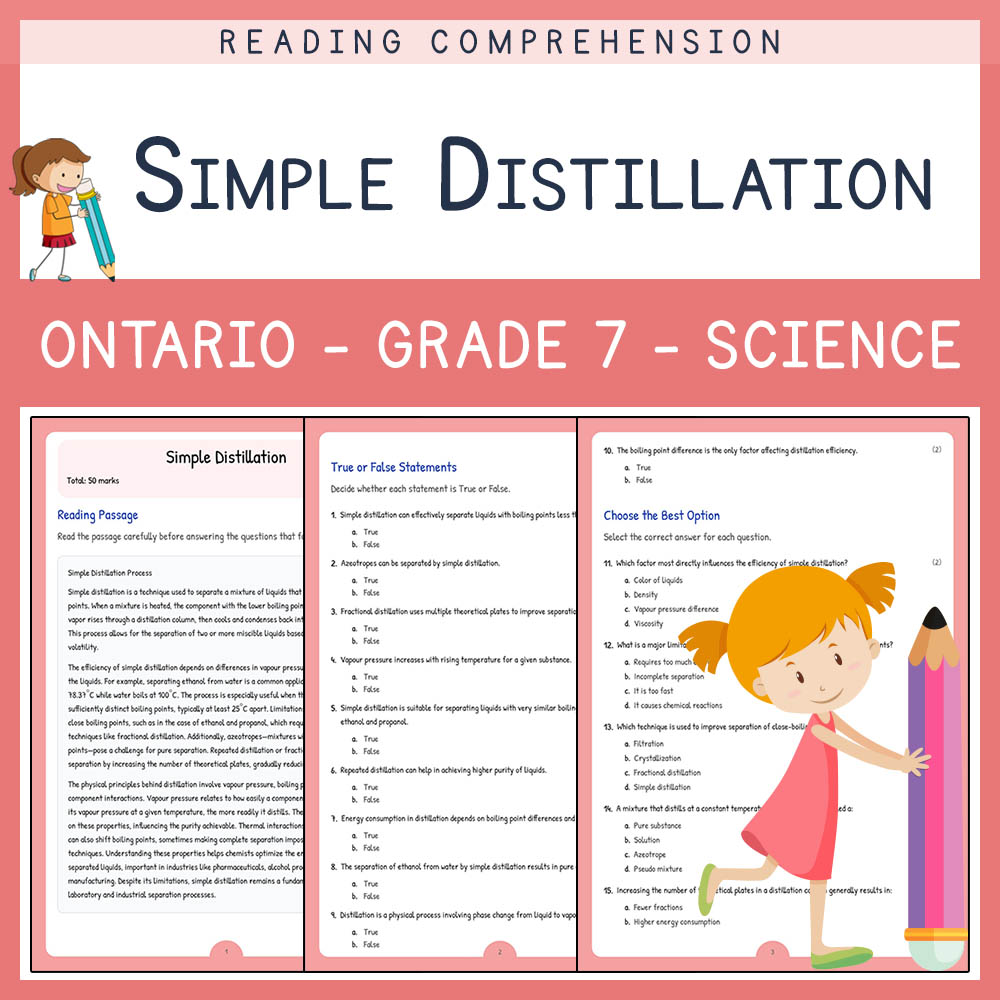
Grade 7 Science Assessment | Simple Distillation Worksheet | Ontario
Created byLumora LearningLearning Objectives
- Understand the principles of simple distillation and its applications.
- Identify the factors affecting vapour pressure and boiling point differences in distillation.
- Explain the limitations of simple distillation with close-boiling mixtures and azeotropes.
Also included in: Grade 7 Science | Pure Substances and Mixtures Unit Bundle | Ontario
Instant download
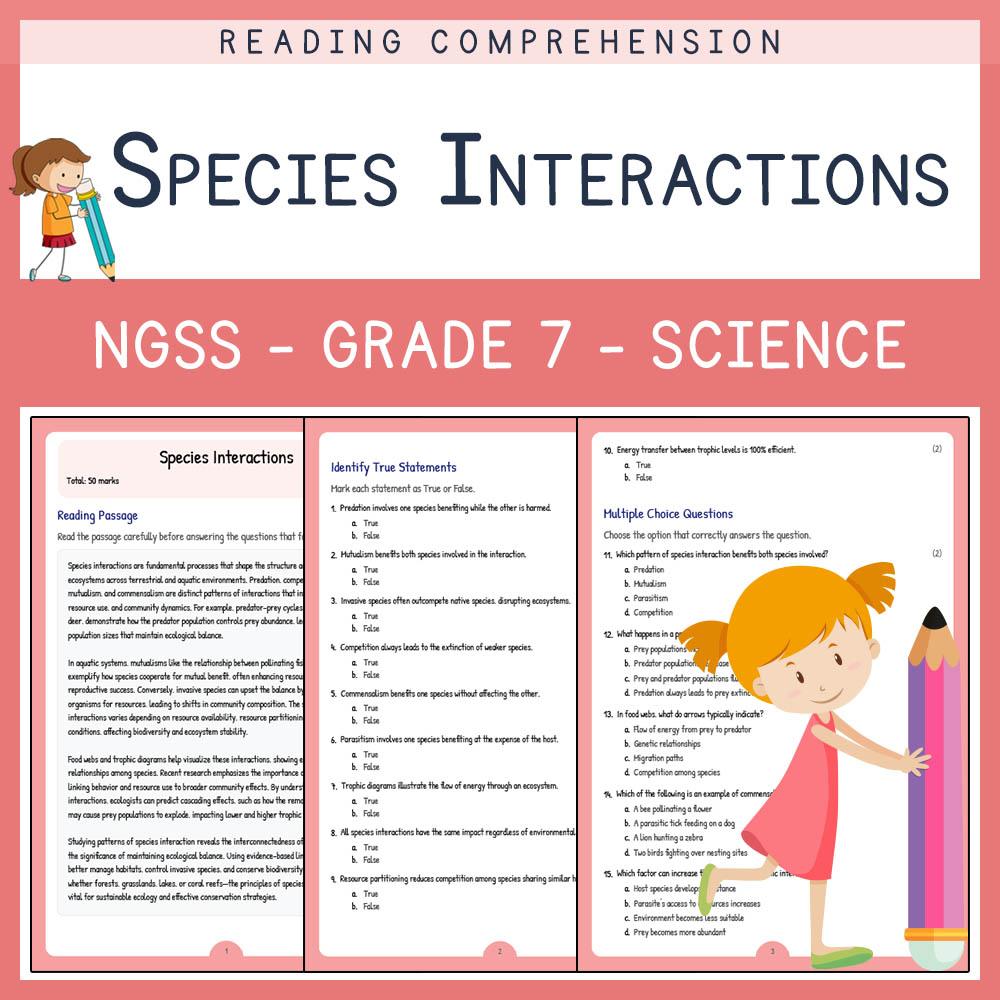
Grade 7 Science | Species Interactions Worksheet & Answer Key (NGSS Aligned)
Created byLumora LearningLearning Objectives
- Describe different patterns of species interactions such as predation, competition, parasitism, mutualism, and commensalism.
- Analyze how species interactions influence community structure and resource partitioning across terrestrial and aquatic ecosystems.
- Apply concepts of food webs and trophic diagrams to illustrate the effects of species interactions on ecosystems.
Instant download
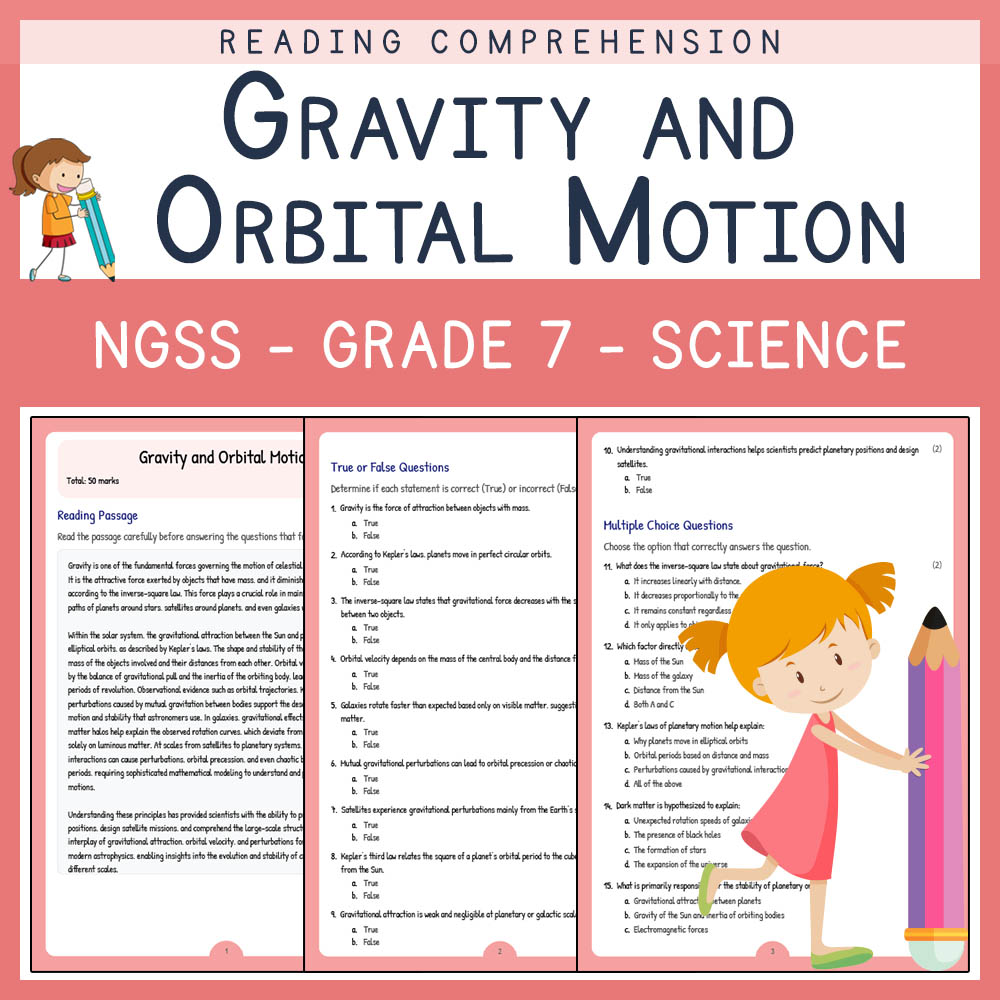
Grade 7 Science | Gravity and Orbital Motion Worksheet (Answer Key & Rubric)
Created byLumora LearningLearning Objectives
- Explain the role of gravity in governing orbital motion within the solar system.
- Describe the mathematical relationships between mass, distance, and orbital velocity.
- Interpret observational evidence such as orbital trajectories and Keplerian patterns.
Instant download
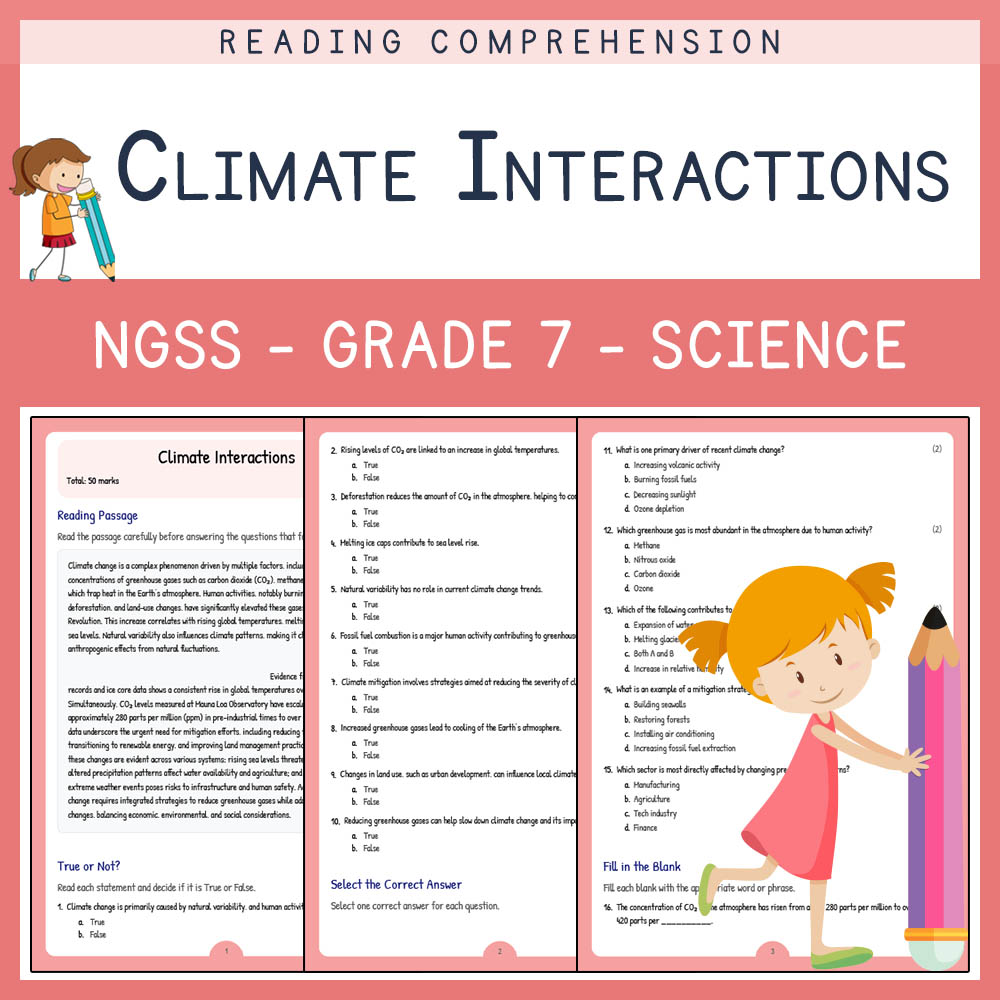
Grade 7 Science | Climate Interactions Worksheet & Answer Key (NGSS Aligned)
Created byLumora LearningLearning Objectives
- Understand the drivers of climate change including greenhouse gases, land-use change, and natural variability.
- Analyze evidence from temperature and CO₂ records to interpret climate trends.
- Assess impacts of climate change on sea level, precipitation, and agriculture.
Instant download
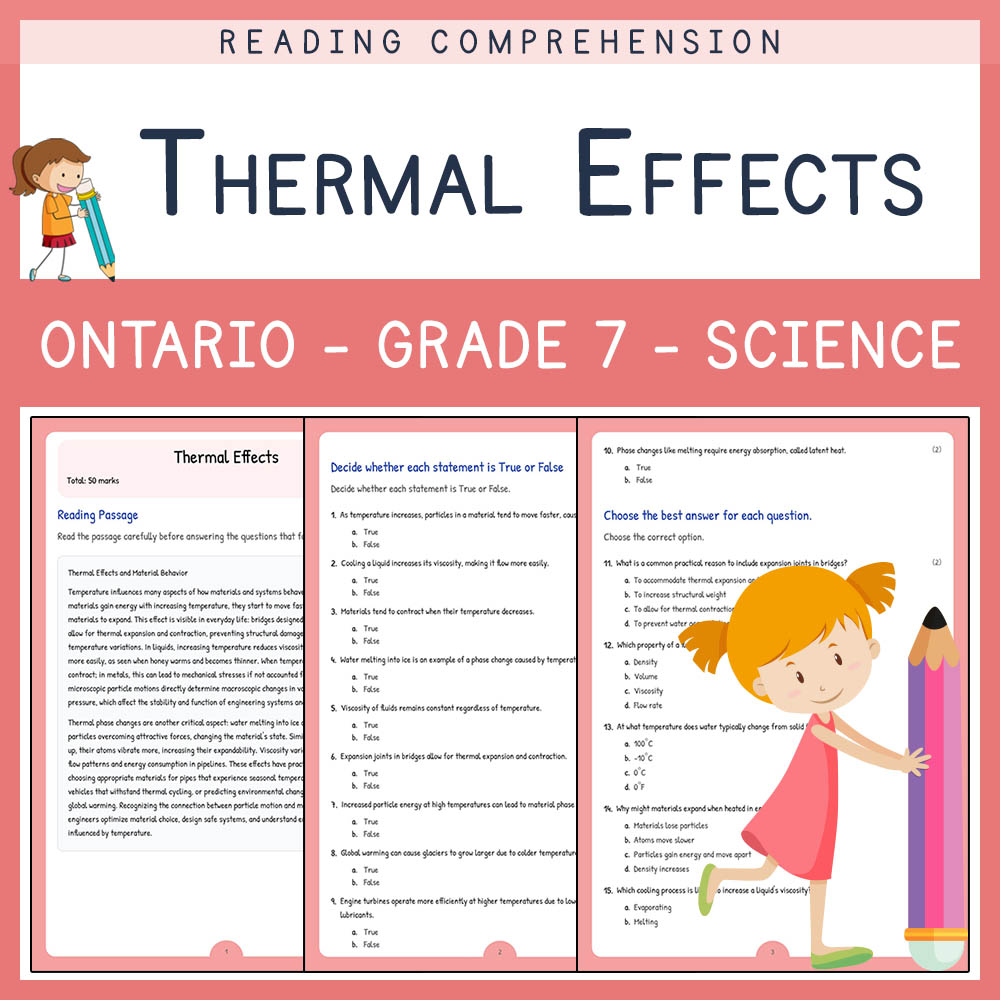
Grade 7 Science Assessment | Thermal Effects Worksheet Elena | Ontario
Created byLumora LearningLearning Objectives
- Understand how temperature influences material properties such as expansion, contraction, phase changes, and viscosity.
- Explain the microscopic particle motion that causes macroscopic thermal effects.
- Identify practical applications and consequences of thermal effects in engineering and environmental contexts.
Instant download
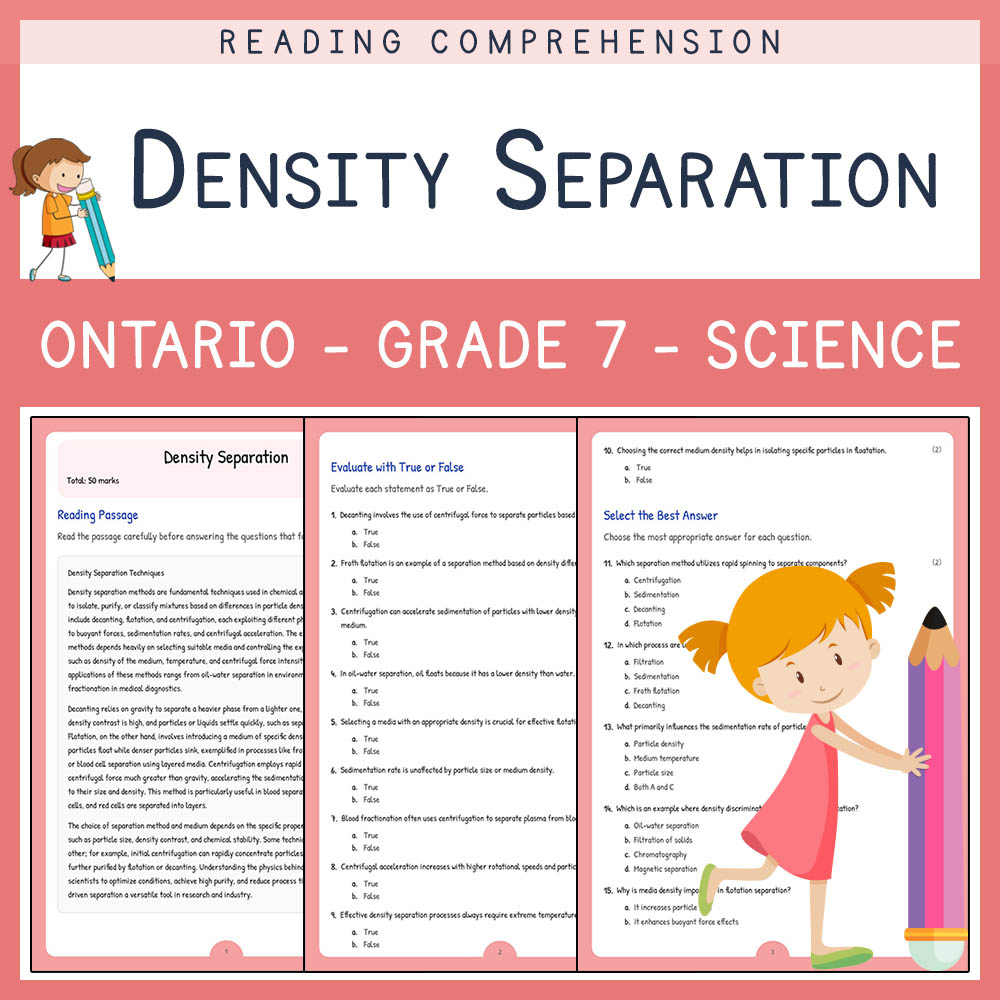
Grade 7 Science | Density Separation Worksheet | Ontario Standards Aligned
Created byLumora LearningLearning Objectives
- Understand the principles of density differences used in separation techniques.
- Identify how buoyant force, sedimentation, and centrifugal force are exploited in separation methods.
- Recognize examples like oil-water separation and blood fractionation that utilize density-driven processes.
Also included in: Grade 7 Science | Pure Substances and Mixtures Unit Bundle | Ontario
Instant download

Grade 7 Science | Energy Flow Worksheet & Answer Key | NGSS Aligned
Created byLumora LearningLearning Objectives
- Understand how energy is transferred through trophic levels in food webs and ecosystems.
- Describe the roles of producers, consumers, and decomposers in energy pyramids.
- Explain the processes of photosynthesis and cellular respiration as mechanisms for energy capture and release.
Instant download
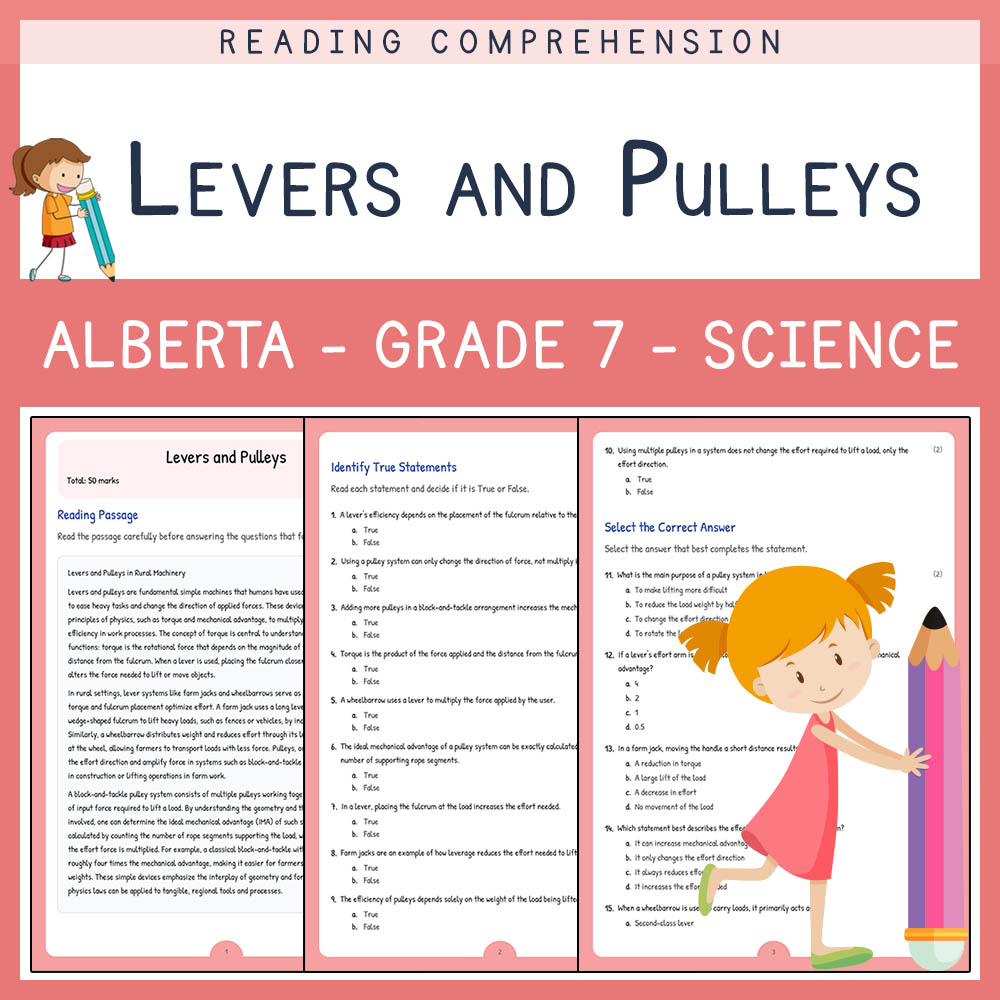
Grade 7 Science Assessment | Levers and Pulleys Worksheet | Alberta
Created byLumora LearningLearning Objectives
- Explain the concepts of torque, fulcrum placement, and mechanical advantage in lever and pulley systems.
- Relate geometric principles to force multiplication in simple machines.
- Calculate input and output forces in lever and pulley configurations using basic arithmetic.
Instant download
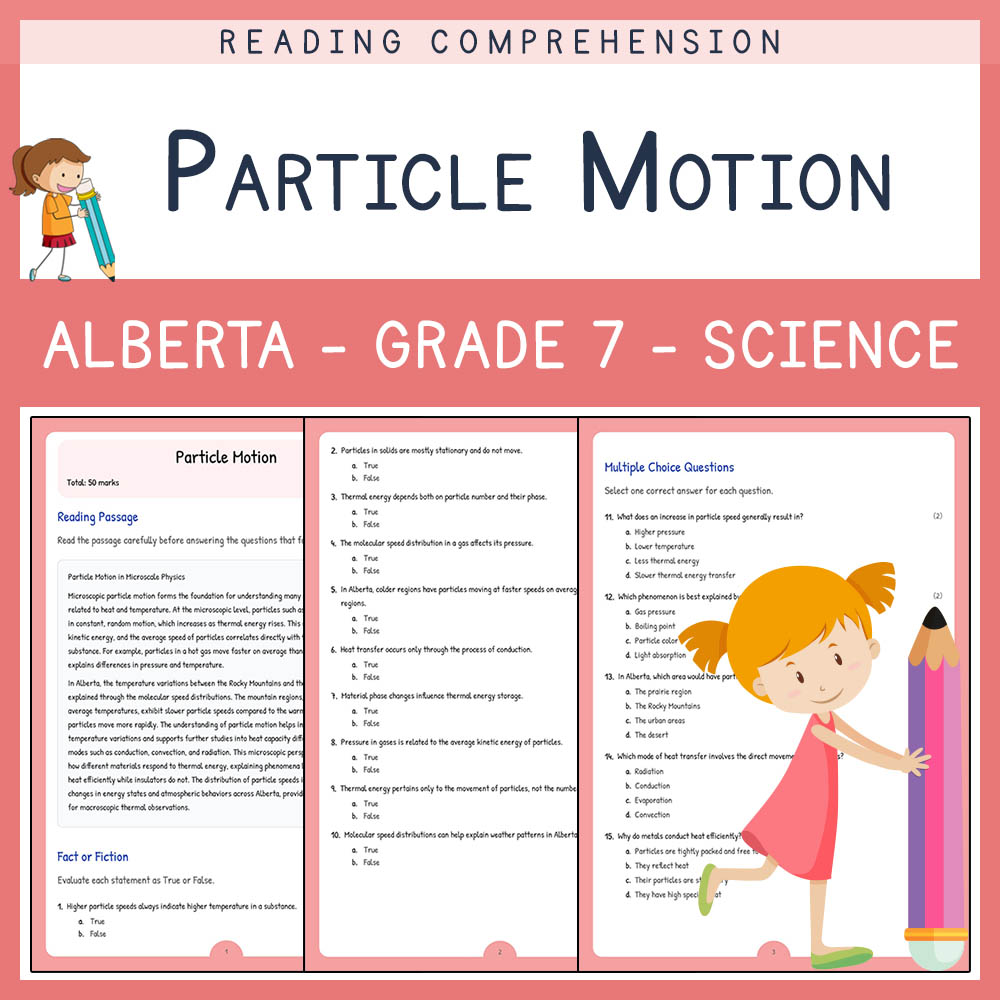
Grade 7 Science | Particle Motion Worksheet | Alberta Standards
Created byLumora LearningLearning Objectives
- Understand microscopic particle motion and its relation to temperature and energy.
- Explain how particle speed distribution influences thermal states and pressure.
- Compare thermal energy among different materials and heat transfer mechanisms.
Instant download
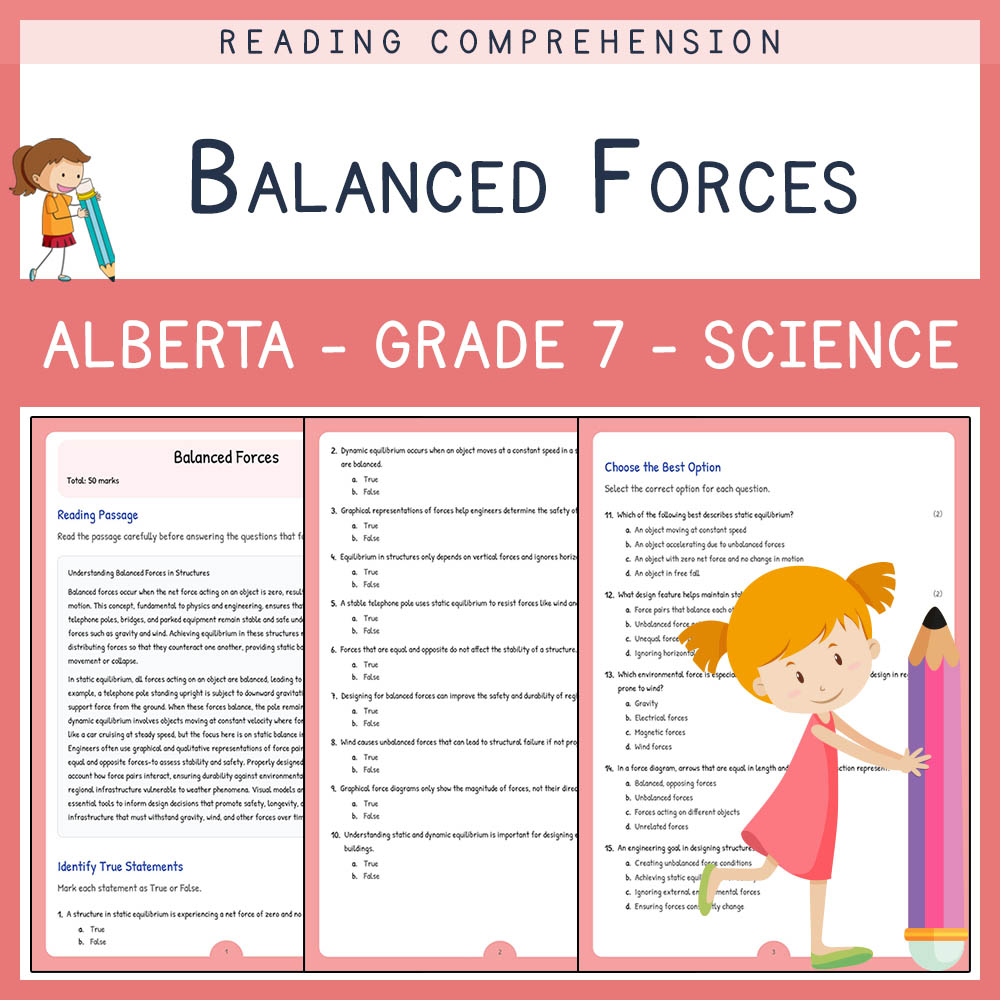
Grade 7 Science Assessment | Balanced Forces Worksheet Elena | Alberta
Created byLumora LearningLearning Objectives
- Define and explain the concept of equilibrium and balanced forces in structures.
- Distinguish between static and dynamic equilibrium in real-world applications.
- Identify graphical representations of force pairs and analyze their implications for safety and durability.
Instant download
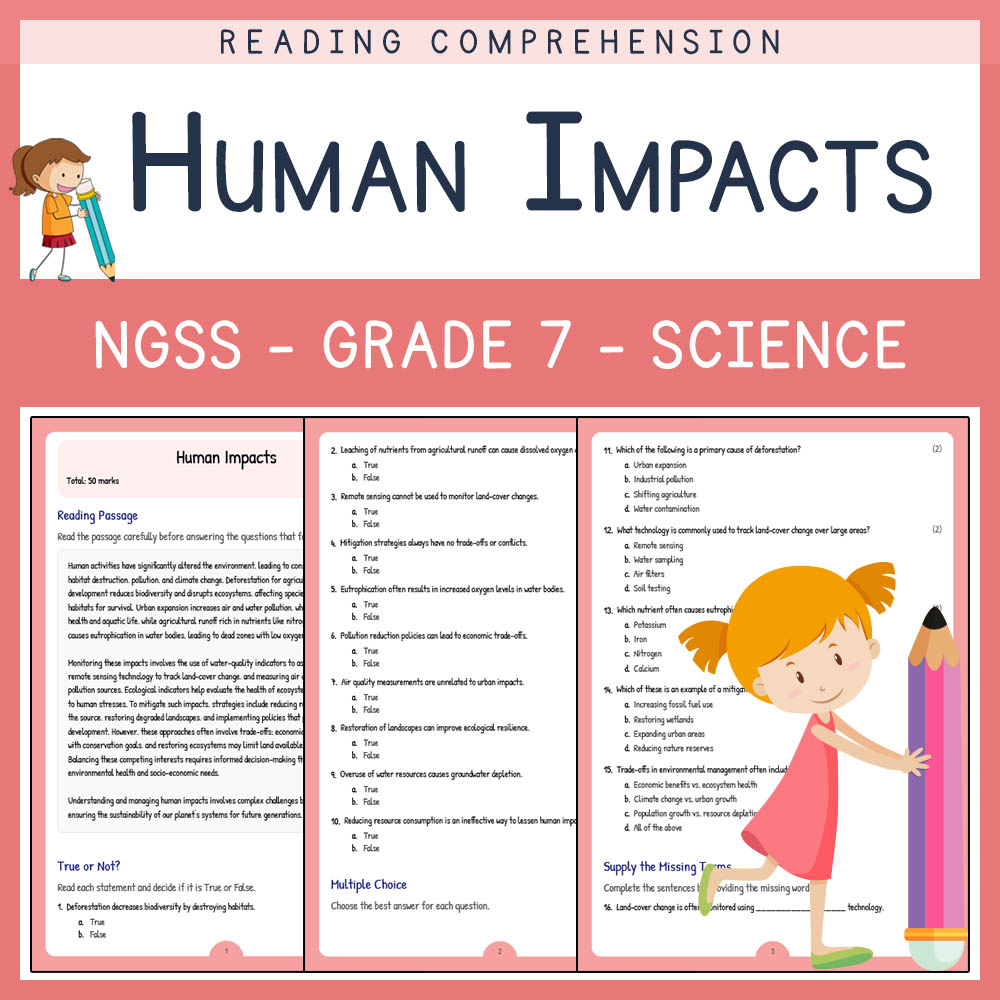
Grade 7 Science | Human Impacts Worksheet & Answer Key for NGSS Standards
Created byLumora LearningLearning Objectives
- Describe human activities that contribute to environmental change, such as deforestation and pollution.
- Identify methods used to monitor and assess environmental impacts, including water-quality indicators and remote sensing.
- Explain mitigation strategies to reduce human impacts, such as policy measures and landscape restoration.
Instant download
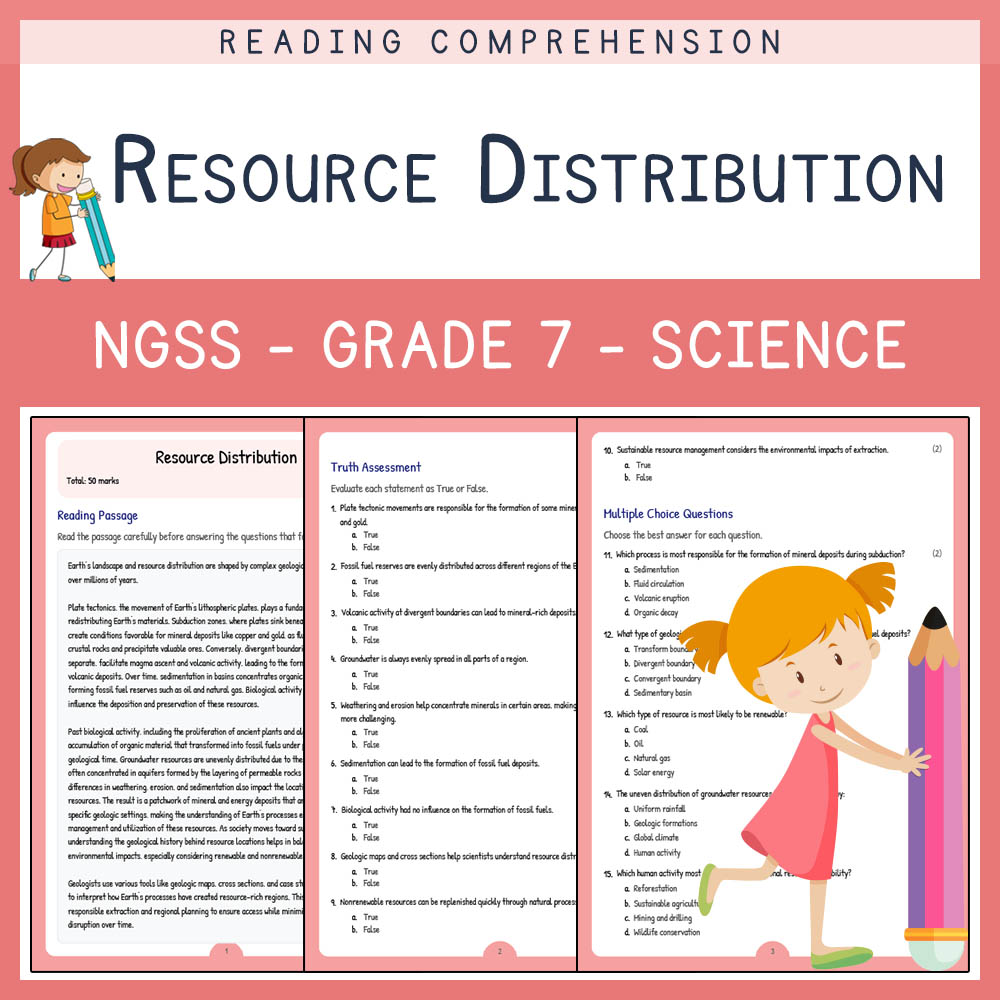
Grade 7 Science | Resource Distribution Worksheet NGSS-Aligned (PDF)
Created byLumora LearningLearning Objectives
- Understand how geologic processes influence the distribution of minerals, energy resources, and groundwater.
- Connect plate tectonics, sedimentation, and biological activity to resource locations.
- Analyze the impacts of resource extraction and consider sustainability factors.
Instant download
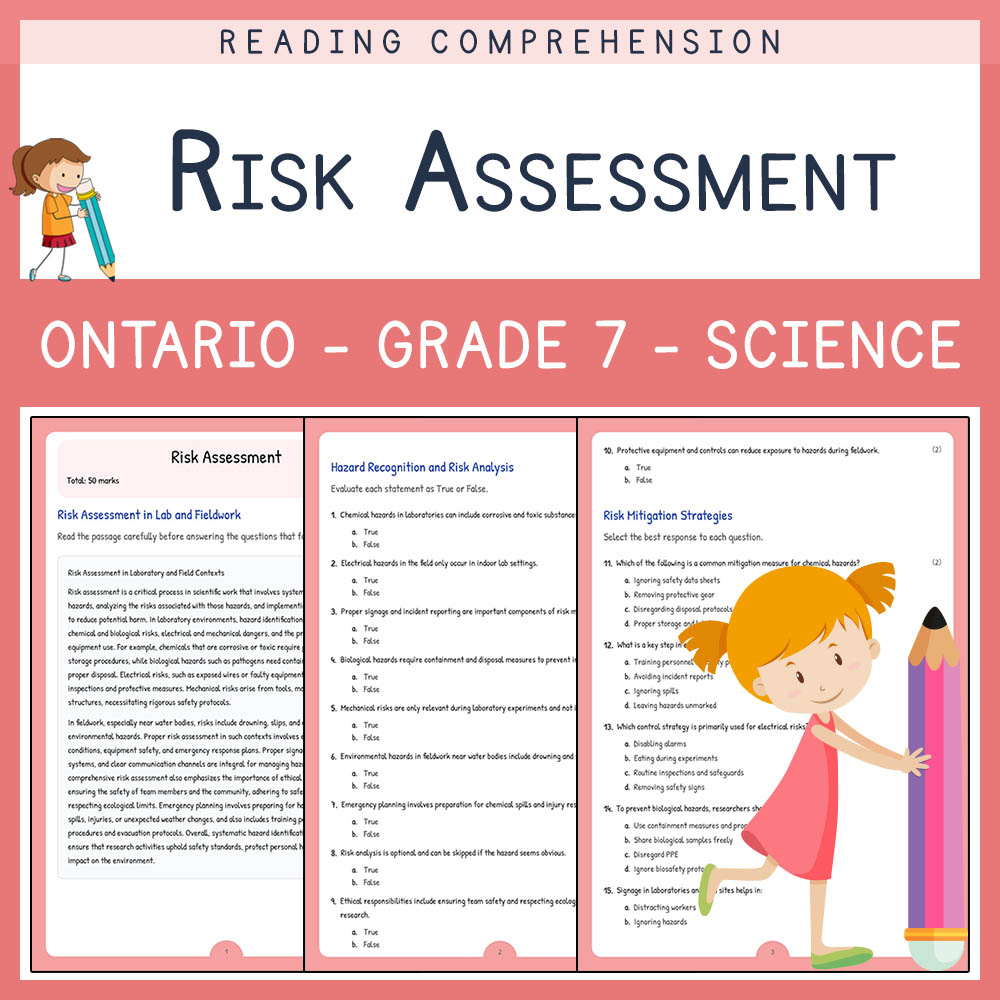
Grade 7 Science | Risk Assessment Worksheet | Ontario Standard
Created byLumora LearningLearning Objectives
- Understand the principles of hazard identification in laboratory and field settings.
- Analyze the different types of risks associated with chemical, biological, electrical, and mechanical hazards.
- Apply appropriate mitigation strategies and control measures to ensure safety and compliance.
Also included in: Grade 7 Science | STEM Skills and Connections Custom Bundle | Ontario
Instant download
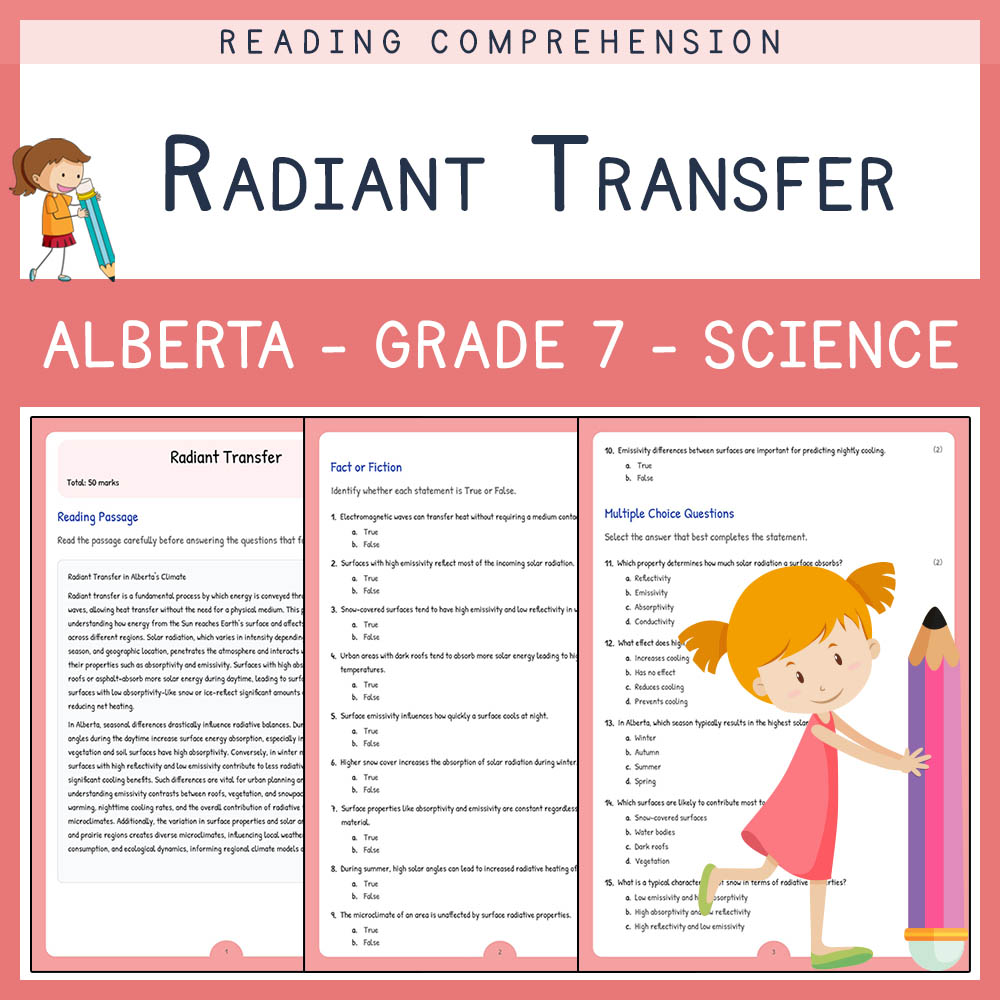
Grade 7 Science | Radiant Transfer Worksheet Elena | Alberta Standard
Created byLumora LearningLearning Objectives
- Understand the principles of radiant transfer and how it conveys energy through electromagnetic waves.
- Identify factors influencing radiative heating and cooling of surfaces such as landscapes, buildings, and vehicles.
- Explain the roles of surface absorptivity and emissivity in local microclimate variations.
Instant download
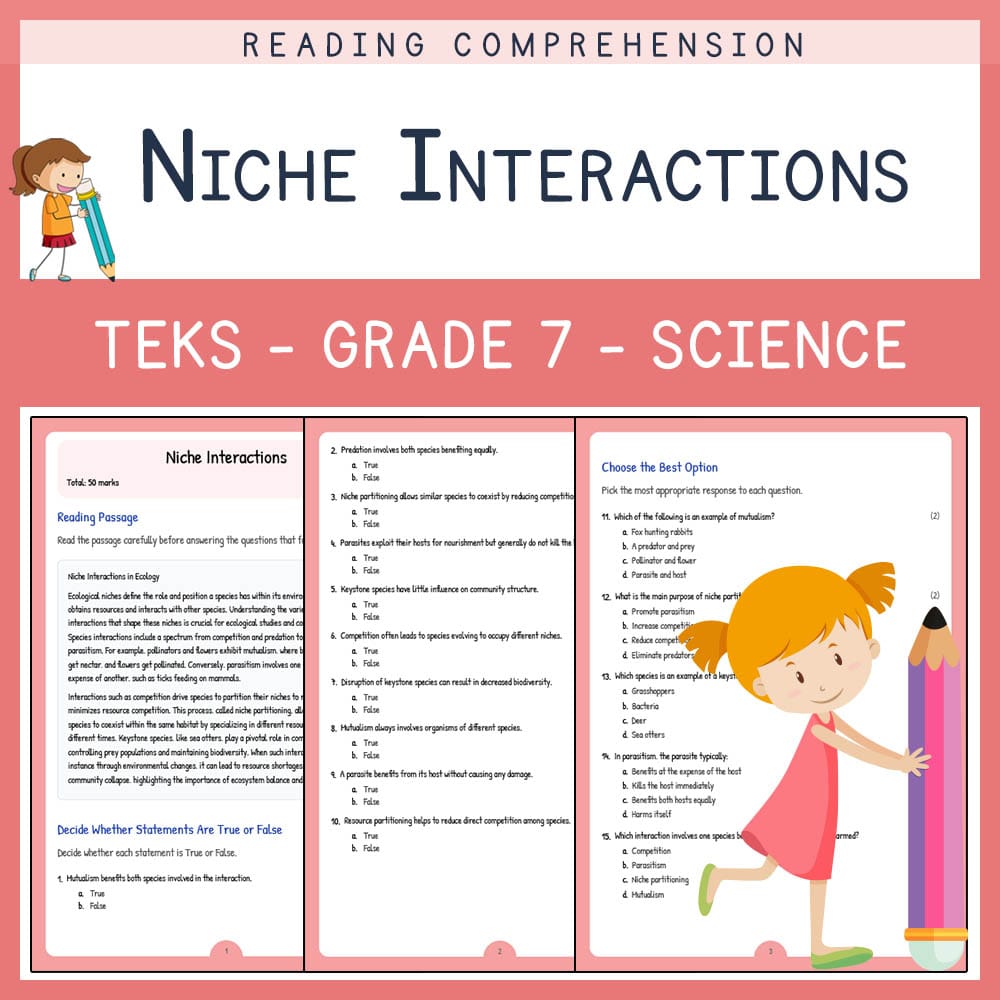
Grade 7 Science | Niche Interactions Worksheet Elena | TEKS-Aligned
Created byLumora LearningLearning Objectives
- Describe different species interactions that influence ecological niches.
- Identify examples of mutualism, predation, competition, and parasitism in ecosystems.
- Explain how niche partitioning reduces competition among species.
Instant download

Grade 7 Science | Empirical Knowledge Worksheet | NGSSS Aligned
Created byLumora LearningLearning Objectives
- Explain how empirical investigations and evidence support scientific explanations
- Evaluate how new data can refine, adjust, or replace scientific models
- Describe uncertainty as a normal part of scientific reasoning and communicate methods transparently
Instant download

Grade 7 Science | Friction and Resistance Worksheet | Florida NGSSS Aligned
Created byLumora LearningLearning Objectives
- Explain how friction and other resistive forces oppose motion
- Describe how surface texture and air resistance affect how quickly objects slow down
- Connect resistive forces to changes in motion and energy during real-world examples
Instant download
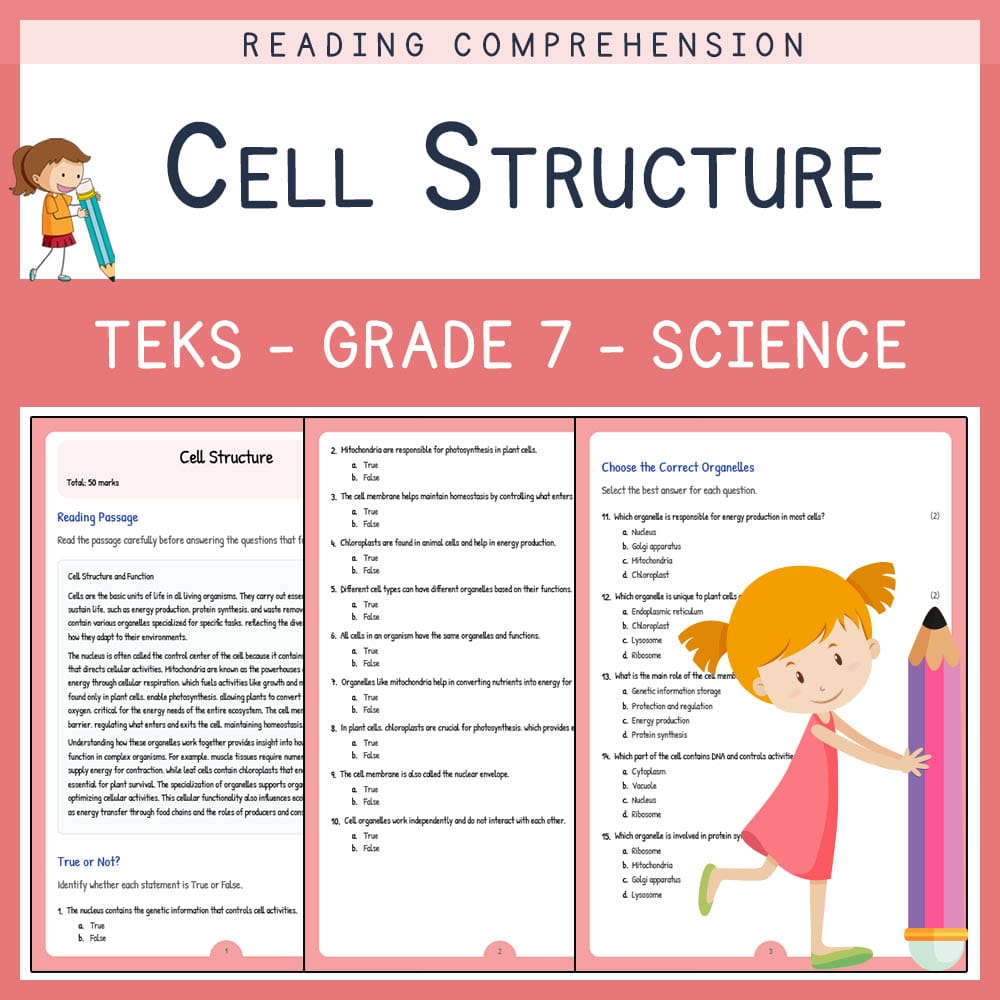
Grade 7 Science | Cell Structure Worksheet Elena | TEKS Aligned
Created byLumora LearningLearning Objectives
- Identify the major organelles within a cell and describe their functions.
- Compare the roles of different organelles such as nucleus, mitochondria, chloroplasts, and cell membranes.
- Explain how cellular structures relate to tissue and organ function in multicellular organisms.
Instant download
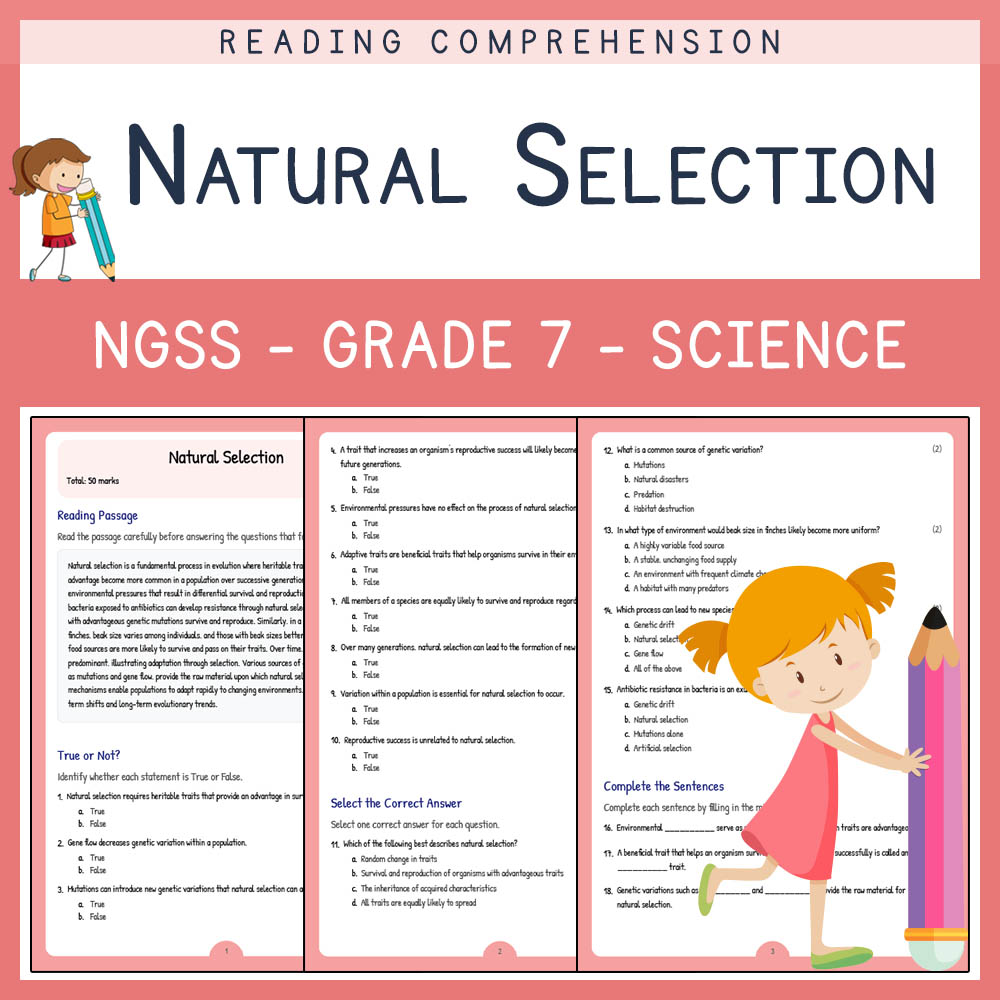
Grade 7 Science | Natural Selection Worksheet with Answer Key | NGSS Aligned
Created byLumora LearningLearning Objectives
- Understand the mechanisms of natural selection and how they lead to adaptation in populations.
- Identify examples of natural selection in real-world scenarios such as antibiotic resistance and beak size variation.
- Analyze how environmental pressures influence evolutionary changes over generations.
Instant download
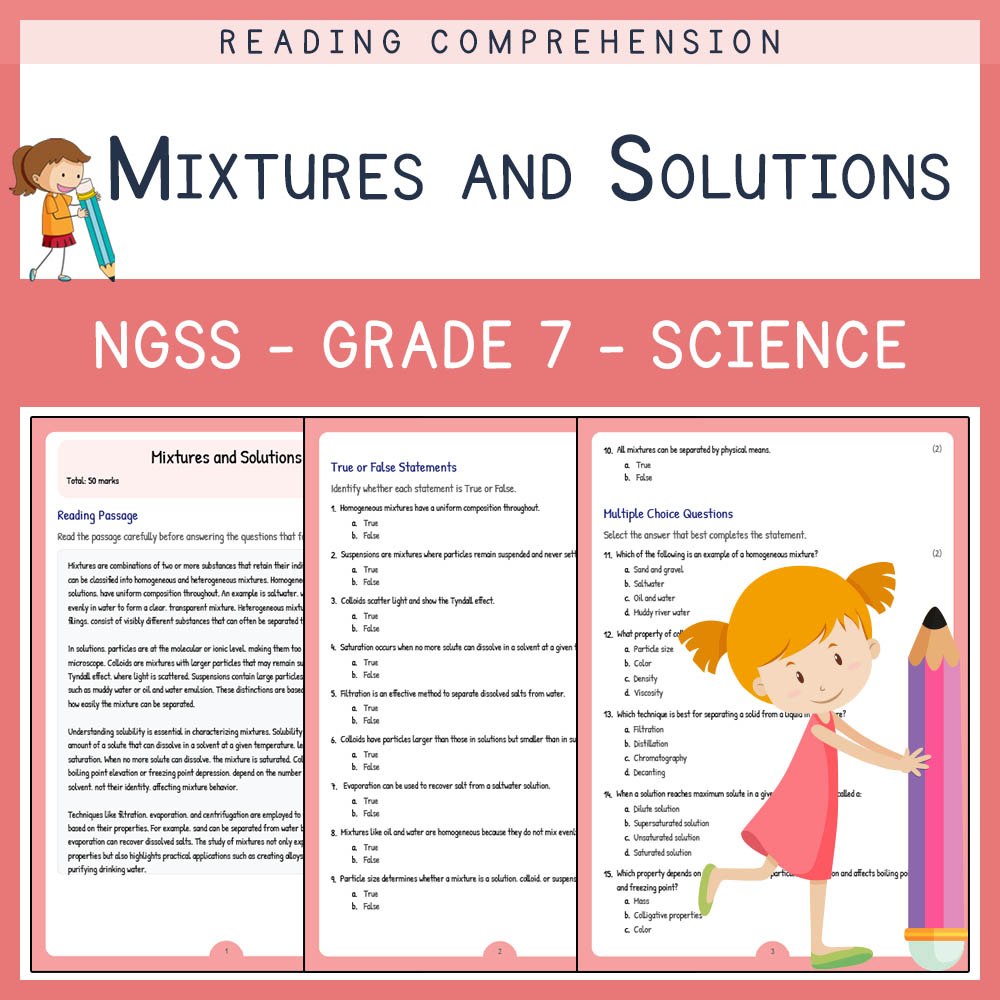
Grade 7 Science |Mixtures and Solutions Worksheet (NGSS Aligned with Answer Key)
Created byLumora LearningLearning Objectives
- Describe the differences between homogeneous and heterogeneous mixtures.
- Identify examples of solutions, colloids, and suspensions based on particle size and separation behavior.
- Explain concepts like solubility, saturation, and colligative effects in mixtures.
Instant download
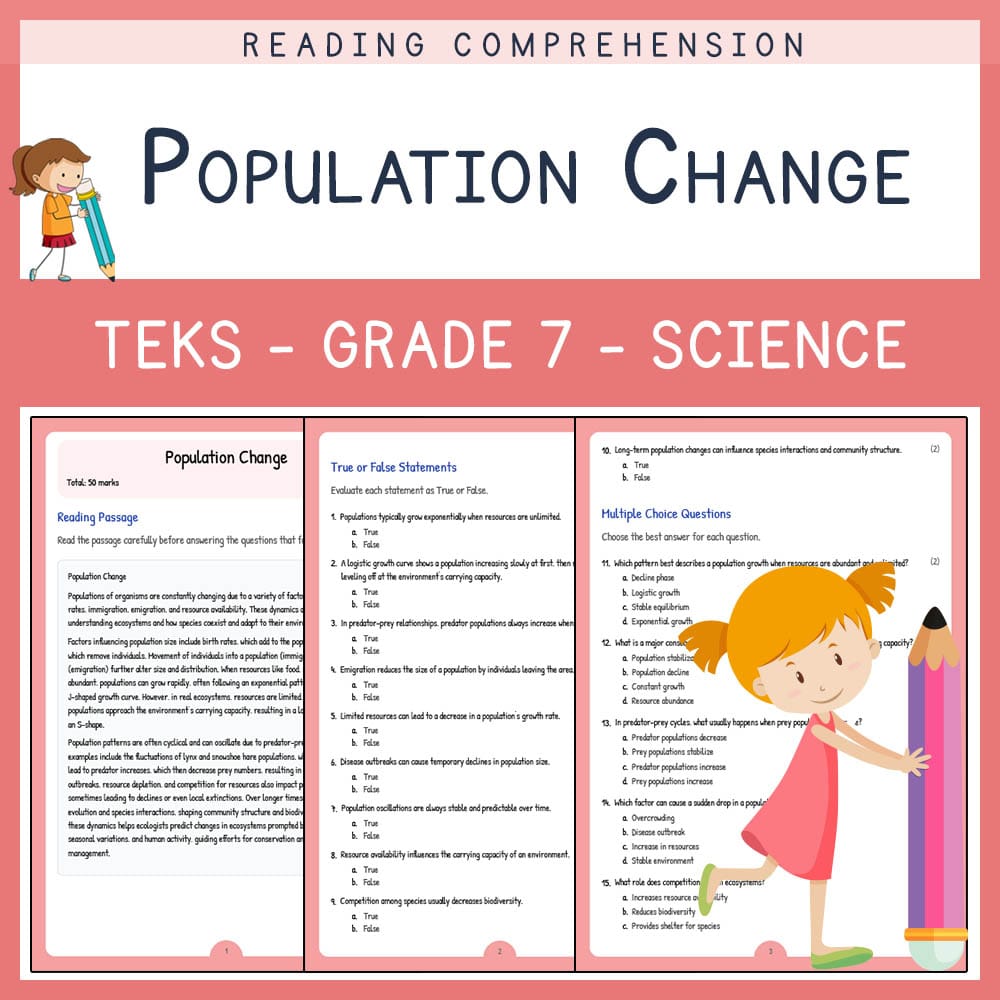
Grade 7 Science | Population Change Worksheet | TEKS-Aligned
Created byLumora LearningLearning Objectives
- Understand the factors that influence population size and distribution.
- Explain the patterns of exponential and logistic growth in populations.
- Identify the effects of limiting factors, disease, resources, and competition on populations.
Instant download
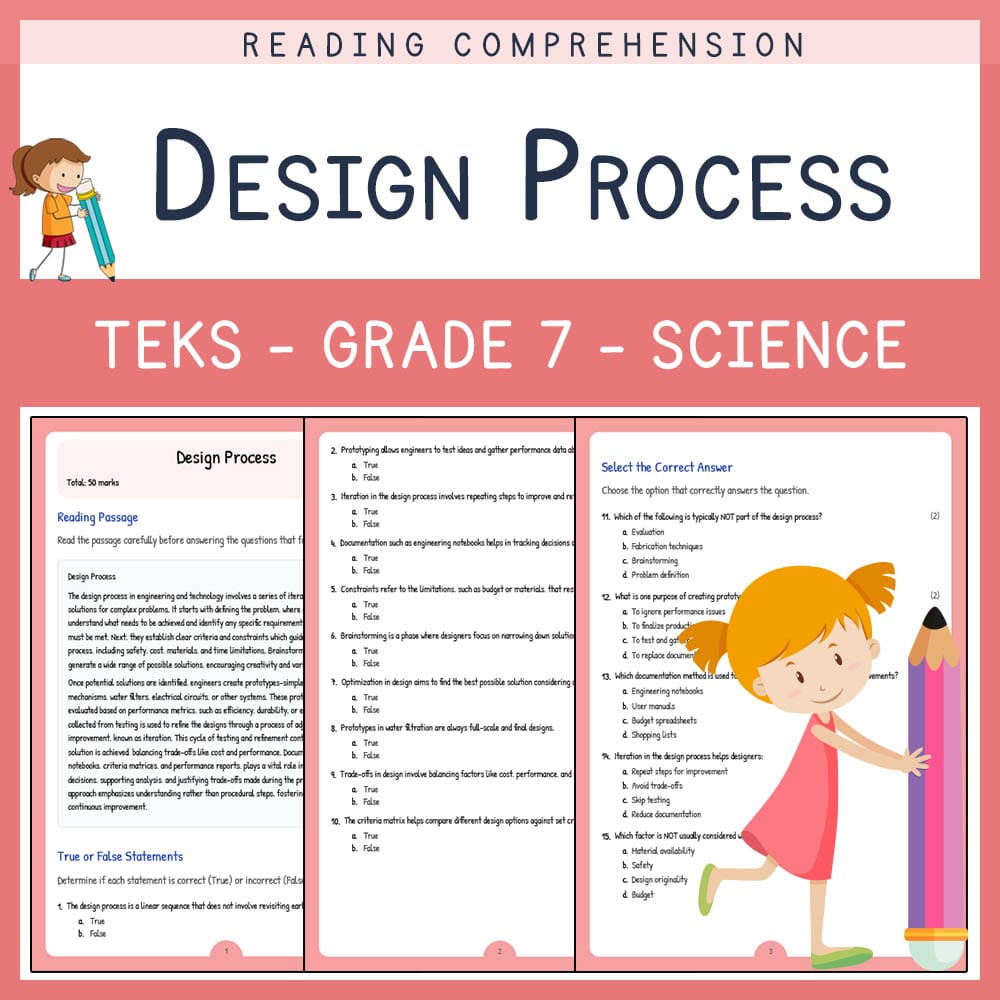
Grade 7 Science | Design Process Worksheet | TEKS Alligned
Created byLumora LearningLearning Objectives
- Understand the key steps in the technological design process including problem definition, criteria and constraints, brainstorming, prototyping, evaluation, and optimization.
- Recognize examples of simple design prototypes such as mechanisms, water filtration models, and electrical circuits.
- Explain the importance of documentation methods like engineering notebooks and criteria matrices in supporting design decisions.
Instant download

Grade 7 Inherited Traits Science Worksheet | Florida NGSSS + Answer Key
 Created byEvergreen Desk Education
Learning Objectives
- Explain how inherited traits are passed from parents to offspring using genetic information in reproductive cells
- Distinguish between inherited traits and environmental causes of differences among individuals
- Use predictable patterns to interpret offspring trait outcomes based on parental variation
Instant download

Grade 7 Science | Inclined Planes Worksheet (Alberta Standard) (PDF)
Created byEvergreen Desk EducationLearning Objectives
- Explain how inclined planes change the effective force needed to move a load.
- Identify and describe force components parallel and perpendicular to a ramp.
- Calculate mechanical advantage using load and input force.
Instant download

Grade 7 Science – Bitumen Separation Worksheet (Alberta Standards) (PDF)
Created byEvergreen Desk EducationLearning Objectives
- Classify bitumen separation steps as physical or chemical processes based on how substances change.
- Explain how density, particle size, temperature, and additives affect emulsions and dissolved organics.
- Use evidence from a process description to describe mixture behavior and expected product outcomes.
Instant download

Mass Wasting and Coasts Worksheet Grade 7 NGSSS Earth Science
Created byEvergreen Desk EducationLearning Objectives
- Explain how tectonic activity, weathering, erosion, and deposition shape Earth’s surface.
- Distinguish between weathering and erosion using examples from real landscapes.
- Describe how deposition can change the location of sediments over time.
Instant download

Grade 7 Science Worksheet | Particle Model of Matter (TEKS) PDF
Created byEvergreen Desk EducationLearning Objectives
- Explain the kinetic particle model using particle spacing, particle motion, and intermolecular forces.
- Predict how changes in temperature or applied force can affect diffusion, thermal expansion, density, pressure response, and compressibility.
- Connect micro-scale particle behavior to measurable macro-scale trends in experiments.
Instant download

7th Grade Science | Solar System Worksheet (TEKS) with Answer Key (PDF)
Created byEvergreen Desk EducationLearning Objectives
- Explain how planetesimals and accretion can lead to planets forming in the early solar system.
- Compare terrestrial planets and gas giants using properties such as size, surface or atmospheric characteristics, and moons.
- Describe how orbital eccentricity and phases relate to how we observe planets from Earth.
Instant download

Grade 7 Science Worksheet | Pollution Effects - Alberta Standards (PDF)
Created byEvergreen Desk EducationLearning Objectives
- Explain how anthropogenic pollutants enter aquatic and terrestrial ecosystems through different exposure pathways.
- Describe how pollution can affect organism health and disrupt food web integrity.
- Connect pollutant sources (nutrient runoff, hydrocarbons, airborne deposition) to measurable ecological changes.
Instant download

Grade 7 Science – Forces Introduction Worksheet (PDF) | Alberta Standards
Created byEvergreen Desk EducationLearning Objectives
- Explain how push and pull forces can change an object’s state of motion.
- Distinguish between contact forces and non-contact forces with real-life examples.
- Describe the relationship between net force and resulting acceleration in qualitative terms.
Instant download

Grade 7 Science – States of Matter Worksheet (TEKS) (PDF)
Created byEvergreen Desk EducationLearning Objectives
- Define states of matter in terms of particle arrangement and particle motion (energy).
- Describe and distinguish phase changes: melting, freezing, vaporization, condensation, and sublimation.
- Explain how temperature and pressure affect phase transitions, including boiling point changes with atmospheric pressure.
Instant download

Grade 7 Science Worksheet | Cell Structure & Organelles (TEKS)
Created byEvergreen Desk EducationLearning Objectives
- Identify major eukaryotic cell organelles (nucleus, mitochondria, chloroplasts, and cell membrane) and describe their primary functions.
- Explain how organelle specialization supports cell survival and contributes to tissue and organ performance in multicellular organisms.
- Connect cellular energy capture in producers (photosynthesis) versus consumers (cellular respiration) to larger-scale ecological interactions.
Instant download

Grade 7 Science Worksheet – Volcanic Landforms (PDF) | BC Standards
Created byEvergreen Desk EducationLearning Objectives
- Explain how magma composition influences volcanic landforms (shield volcanoes vs. stratovolcanoes and deposits).
- Describe how eruption style affects what materials volcanoes produce (lava flows vs. pyroclastic deposits).
- Compare volcanic features formed at different tectonic settings, including subduction zones and hotspots.
Instant download

Grade 7 Science Worksheet – Human Impacts TEKS (PDF)
Created byEvergreen Desk EducationLearning Objectives
- Explain how human activities can alter ecosystems through habitat fragmentation, pollution, and invasive species.
- Describe how these changes can shift biodiversity, food-web structure (trophic structure), and ecosystem services over time.
- Evaluate mitigation and restoration strategies and predict how they may affect ecosystem recovery.
Instant download

Grade 7 Science | Boundary Types Worksheet (PDF) Aligned to BC Standards
Created byEvergreen Desk EducationLearning Objectives
- Identify the three main tectonic boundary types and describe the motion between tectonic plates at each one
- Explain how boundary types create characteristic landforms, volcanic activity, and earthquake patterns
- Use evidence from descriptions to determine which boundary type is most likely occurring
Instant download

Grade 7 Science | Energy Transformations Worksheet (Alberta Standards) (PDF)
Created byEvergreen Desk EducationLearning Objectives
- Explain that energy can change forms through energy transformations while total energy is conserved.
- Identify common energy forms (mechanical, chemical, electrical, thermal) and trace how they transform in real systems.
- Use energy transformation ideas to interpret examples such as hydroelectric power, wind turbines, and fuel combustion.
Instant download

Grade 7 Science Worksheet – Simple Machines Overview (PDF) – Alberta Standards
Created byEvergreen Desk EducationLearning Objectives
- Describe how simple machines change the size and/or direction of a force to make work easier.
- Explain mechanical advantage and connect it to the geometry of a machine.
- Identify and compare lever, pulley, wedge, screw, inclined plane, and wheel-and-axle in everyday contexts.
Instant download

Grade 7 Science | Symbiosis Types Worksheet (Alberta Standards) (PDF)
Created byEvergreen Desk EducationLearning Objectives
- Compare mutualism, commensalism, and parasitism based on how both species are affected.
- Use ecological examples to explain how symbiosis influences population sizes and community structure.
- Describe how adaptations and coevolution can develop in species that interact over time.
Instant download

Grade 7 Science Properties & Classification Worksheet (PDF) | TEKS
Created byEvergreen Desk EducationLearning Objectives
- Define physical and chemical properties and explain how they help classify substances.
- Use quantitative observable criteria (e.g., density, solubility, hardness, conductivity, magnetism, flammability) to distinguish among elements, compounds, and mixtures.
- Apply property-based tests to identify practical examples of metals, dissolving substances, magnetic materials, and combustibility.
Instant download

Grade 7 Science Worksheet | Earthquakes and Faults BC Standards (PDF)
Created byEvergreen Desk EducationLearning Objectives
- Explain how tectonic stress and rock strength lead to sudden slip along faults during earthquakes.
- Compare normal, reverse, and strike-slip fault motion and connect each type to local stress regimes.
- Describe how earthquake waves travel through Earth and how depth, magnitude, and local geology affect intensity.
Instant download

Grade 7 Science Diffusion & Mixing Worksheet | CA Standards PDF
Created byEvergreen Desk EducationLearning Objectives
- Explain how diffusion occurs due to the continual motion of particles moving from higher concentration to lower concentration
- Distinguish mixing from diffusion and describe how mixing can occur without particles stopping or changing into new substances
- Predict how temperature affects the rate of diffusion using the particle model
Instant download

Grade 7 Science Worksheet – Conservation of Mass | Alberta Standards (PDF)
Created byEvergreen Desk EducationLearning Objectives
- Explain conservation of mass in a closed system using the idea that atoms are conserved during physical and chemical changes
- Predict whether measured mass before and after a reaction will be equal in a sealed container and justify the prediction
- Describe how reactants and products relate to mass in observable sealed-container situations
Instant download

Grade 7 Science Worksheet – Solution Concentration (PDF) | Alberta Standards
Created byEvergreen Desk EducationLearning Objectives
- Define solution concentration in terms of solute and solvent and explain what dilution means.
- Compare common concentration measures (mass percent and grams per litre) and identify units.
- Explain how concentration can affect physical properties such as freezing point and boiling point.
Instant download

Grade 7 Interpreting Data Science Worksheet | NGSSS Aligned Practice
Created byEvergreen Desk EducationLearning Objectives
- Analyze graphs (scatter plots, histograms, and line graphs) to describe patterns and relationships in data.
- Evaluate the strength of evidence by considering outliers and possible measurement uncertainty.
- Use summary statistics such as range and averages to compare data sets and support a claim.
Instant download

Grade 7 Science – Load Path Basics Worksheet (Ontario) PDF
Created byEvergreen Desk EducationLearning Objectives
- Describe how loads transfer through structural members using the idea of a load path.
- Differentiate dead loads and live loads and identify common examples of each.
- Recognize where tension, compression, and shear occur in beams, columns, trusses, and connections.
Also included in: Grade 7 Engineering Design & Materials Science Lesson Bundle Ontario +1 more
Instant download
About Grade 7 Science Worksheets
Browse 6,039 printable Grade 7 Science worksheets — ready-to-print PDFs with answer keys where available.
Every worksheet on MyTeachingSheets is created by independent teacher-authors and reviewed before publication. All resources download as printable PDFs for classroom, homework, or at-home practice, and many include answer keys. Preview any worksheet free before buying.