
Grade 9 Worksheets
9,322 grade resources
Hierarchical Organization Worksheet for Grade 9 Science Standards – PDF
JCreated byJ.S SheetsLearning Objectives
- Understand the levels of biological organization from cells to organ systems.
- Identify the functions of tissues, organs, and organ systems in multicellular organisms.
- Explain how components at smaller scales support larger functions in organisms.
Also included in: Grade 9 Evolution, Genetics, and Ecosystems Science Lesson Bundle +1 more
Instant download

Grade 9 Science – Asexual Strategies Worksheet (PDF) Alberta Standards
 Created bySilver Birch Teaching
Learning Objectives
- Describe major asexual reproduction mechanisms (binary fission, budding, spore formation, and vegetative propagation).
- Explain genetic consequences of cloning during asexual reproduction.
- Analyze why asexual strategies may spread quickly in stable environments and why they may be risky when conditions change.
Also included in: Grade 9 Genetics and Reproduction Science Lesson Bundle Worksheets – Alberta +1 more
Instant download

Grade 9 TEKS Authorial Language Worksheet for Text Relationships
 Created bySunny Desk Resources
Learning Objectives
- Identify how authorial language (word choice and connectors) signals relationships between ideas in a paragraph.
- Determine whether statements show cause, reason, contrast, example, or shift in focus based on textual clues.
- Explain how sentence patterns and logical connectors help readers interpret complex writing.
Instant download

Grade 9 Structure Function Connections Worksheet | Practice & PDF
 Created byClear Sky Classroom
Learning Objectives
- Explain how cellular structures support specific functions (information storage, energy conversion, and selective exchange).
- Connect organism-level body structures to the tasks they perform (protection, movement, support).
- Use models and physical properties to justify how form enables a biological function.
Instant download

Grade 9 ELA Worksheet | Mastering Parallel Structure (PDF) for Alberta Standards
 Created byGolden Apple Studio
Learning Objectives
- Explain how parallel structure improves clarity in lists, comparisons, and persuasive writing
- Identify non-parallel elements in sentences and revise them to match grammatical form
- Choose the correct parallel sentence based on consistent use of parts of speech, phrases, or clause patterns
Also included in: Grade 9 Grammar & Sentence Skills ELA Lesson Bundle Worksheets (Alberta) +1 more
Instant download

Grade 9 Science – Speciation & Reproductive Barriers | Daily Reading Worksheet
 Created byBright Mind Resources
Learning Objectives
- Understand the basic concept of speciation and how new species form.
- Identify the different reproductive barriers that lead to speciation.
- Distinguish between allopatric and sympatric speciation.
Also included in: Grade 9 Evolution Science Daily Reading Worksheets Lesson Bundle | TEKS +2 more
Instant download

Grade 9 Science – Human Impacts on Ecosystems Daily Reading Worksheet | NGSS
Created byBright Mind ResourcesLearning Objectives
- Analyze case studies related to land-use change and its effect on biodiversity.
- Interpret empirical data regarding deforestation and ecological consequences.
- Evaluate trade-offs between conservation efforts and human development.
Also included in: Ecosystem Food Webs Grade 9 Science Daily Reading Worksheets Bundle | NGSS +2 more
Instant download

Grade 9 Science | Understanding Net Force - Daily Reading Comprehension
 Created byCoral Reef Learning
Learning Objectives
- Define net force and explain its role in motion
- Distinguish between balanced and unbalanced forces
- Understand how to resolve forces into components
Instant download

Grade 9 Wave Speed Relations Worksheet | NGSS Practice PDF
Created byClear Sky ClassroomLearning Objectives
- Explain how wave speed relates to frequency and wavelength using v = fλ
- Compare how wave speed depends on medium for different wave types (e.g., sound vs. electromagnetic waves)
- Use wave relationships to predict how changes in frequency or wavelength affect wave propagation
Instant download

Grade 9 Science | Investigation Design Controls Worksheet | General Standards
 Created byLumora Learning
Learning Objectives
- Identify the independent, dependent, and controlled variables in a science investigation.
- Design an investigation by choosing controls, safety conditions, and an accurate measurement procedure.
- Explain how controlling variables supports valid conclusions from results.
Instant download

Grade 9 ELA – Draft Consistency in Writing & Reading Practice | Daily Worksheet
 Created byQuiet Forest Education
Learning Objectives
- Understand key concepts related to ELA
- Apply knowledge through practice questions
- Demonstrate comprehension of the material
Also included in: Grammar & Mechanics Grade 9 ELA Daily Reading Worksheets Lesson Bundle | TEKS +1 more
Instant download
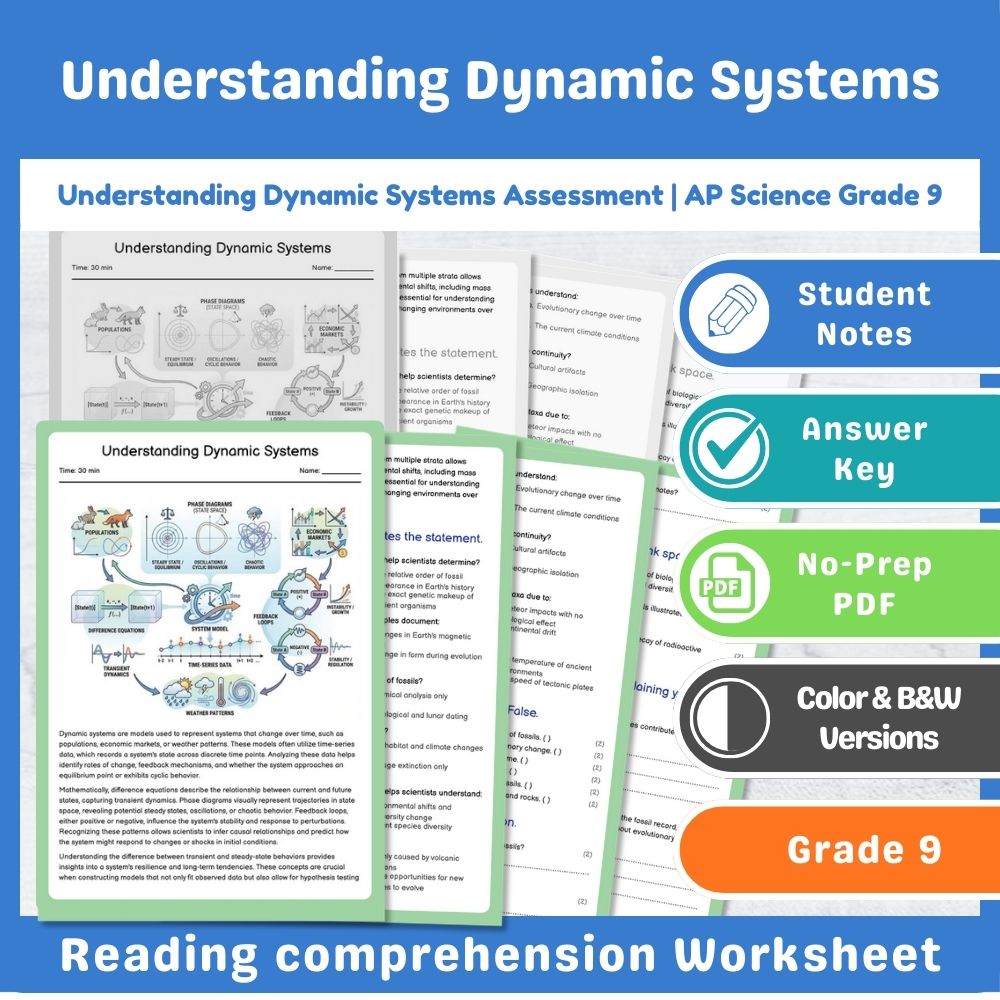
Understanding Dynamic Systems Assessment for Grade 9 Science AP
 Created byPrism Point Learning
Learning Objectives
- Explain how time-series data can be used to analyze changing systems
- Describe the role of difference equations and phase diagrams in modeling dynamics
- Identify feedback loops, equilibrium points, and causal structures in empirical data
Instant download

Grade 9 Science | Molecular Bonding - Daily Reading Comprehension
Created byCoral Reef LearningLearning Objectives
- Understand the concept of ionic bonding and its properties
- Identify examples of ionic compounds and their characteristics
- Describe how ionic bonds influence material properties
Also included in: Matter and Chemical Change Lesson Bundle – Grade 9 Science Alberta +1 more
Instant download

Reaction Evidence Recognizing New Substances Worksheet for Grade 9 Science
JCreated byJ.S SheetsLearning Objectives
- Identify observable evidence that indicates a chemical reaction has formed new substances.
- Connect reaction evidence (gas, precipitate, color, temperature, odor) to changes in bonding and rearrangement of atoms.
- Differentiate chemical changes from physical changes using evidence from reactions such as oxidation and combustion.
Also included in: Grade 9 Forces, Energy, and Matter Transformations Science lesson bundle +1 more
Instant download

Grade 9 Science Worksheet | Molecular Evidence TEKS (PDF)
 Created byEvergreen Desk Education
Learning Objectives
- Explain how DNA, RNA, and protein sequence similarities can indicate common ancestry.
- Use ideas from molecular clocks to describe how divergence times can be estimated from sequence divergence.
- Interpret how conserved genes, gene duplications, and shared regulatory changes support evolutionary relationships.
Instant download

Collaborative Seminars Worksheet | ELA Practice for Grade 9 | Standards-Aligned
JCreated byJ.S SheetsLearning Objectives
- Use structured turn-taking and active listening to contribute to a collaborative seminar
- Respond with evidence-based comments that connect to the central question
- Clarify peers’ ideas through paraphrasing and thoughtful, reasoning-focused questions
Instant download
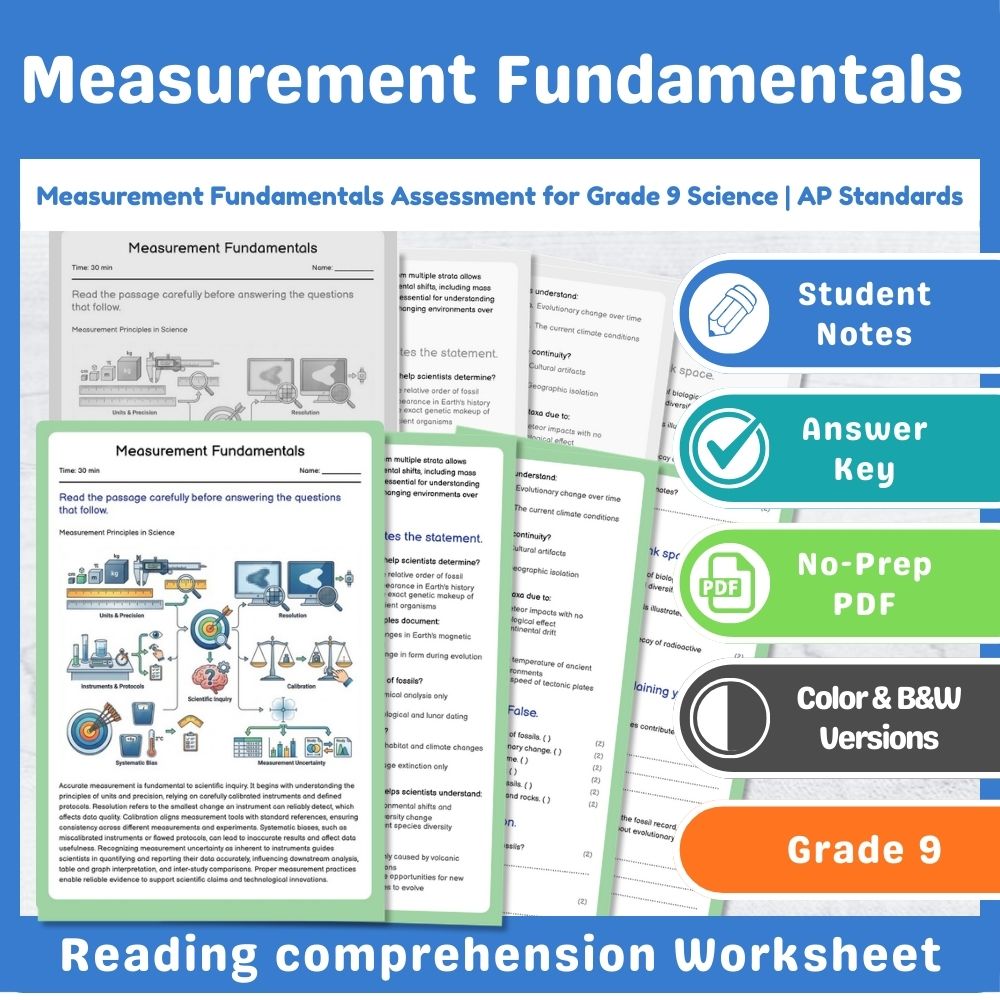
Measurement Fundamentals Assessment for Grade 9 Science | AP Standards
Created byPrism Point LearningLearning Objectives
- Understand the principles of metric measurement and instrument resolution.
- Recognize the importance of calibration in obtaining reliable data.
- Connect raw measurements to data representations and assess measurement uncertainty.
Instant download

Climate and Weather Worksheet | Social Studies | TEKS Grade 9
JCreated byJ.S SheetsLearning Objectives
- Explain the difference between weather and climate and how scientists measure climate patterns.
- Describe how latitude, elevation, and proximity to water influence regional climate zones.
- Analyze how climate change could affect ecosystems and human activities such as agriculture and settlement.
Instant download

Energy Flow Worksheet | TEKS-Aligned Science Practice for Grade 9
JCreated byJ.S SheetsLearning Objectives
- Explain how energy moves directionally through trophic levels from primary producers to consumers and decomposers
- Describe the role of photosynthesis in converting light energy into chemical energy and how it enters food chains
- Interpret why energy transfer is inefficient and how this shapes energy pyramids and population sizes
Instant download

Grade 9 ELA Sentence Variety Worksheet | Writing Skills | BC Curriculum
Created byLumora LearningLearning Objectives
- Distinguish between simple, compound, and complex sentences and explain how their structure affects meaning.
- Use restrictive and nonrestrictive elements to add precise or extra information without changing the intended emphasis.
- Revise sentences by rearranging clauses to improve clarity, pacing, and logical flow.
Instant download

Grade 9 Science | Impulse and Collision Worksheet | BC Aligned
Created byLumora LearningLearning Objectives
- Explain the concept of impulse as force acting over time and its effect on an object's momentum.
- Describe how collisions involve energy transfer and the differences between elastic and inelastic collisions.
- Analyze force-time profiles during collisions to understand impulse magnitude and direction.
Instant download

Grade 9 Science | Reaction Essentials Worksheet | BC Standards
Created byLumora LearningLearning Objectives
- Understand the basic concepts of chemical reactions, including reactants, products, and bond changes.
- Interpret and write symbolic chemical equations, including state symbols and stoichiometric coefficients.
- Explain energy transfer during reactions, distinguishing between energy absorption and release.
Instant download

Light Reactions Assessment | TEKS Grade 9 Science Standards-Aligned
Created byPrism Point LearningLearning Objectives
- Describe the process of light reactions in photosynthesis.
- Identify the roles of pigments, electron flow, and energy carriers.
- Explain how photon energy is converted into chemical energy.
Instant download
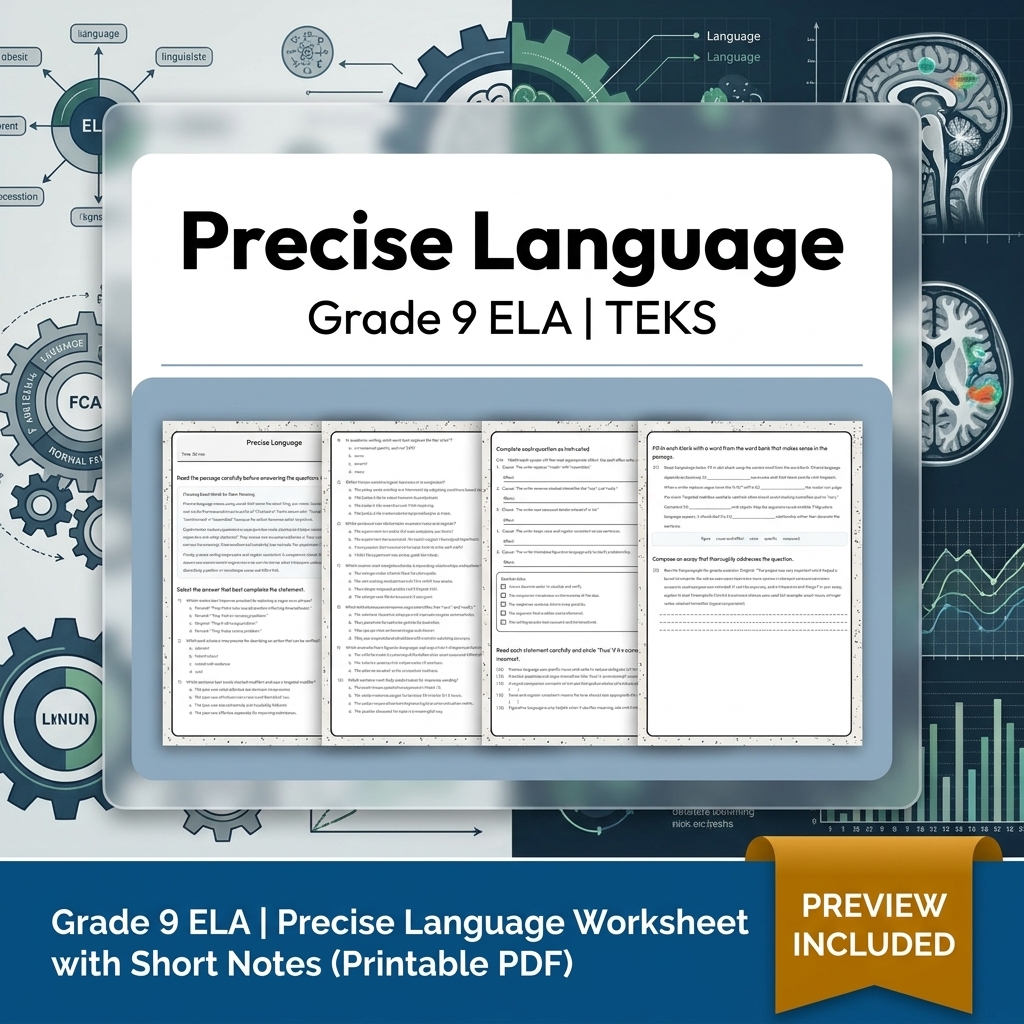
Grade 9 ELA | Precise Language Worksheet with Short Notes (Printable PDF)
 Created byMeadowlark Worksheets
Learning Objectives
- Use precise, concrete word choices (specific nouns and strong verbs) to improve clarity in writing.
- Revise vague wording by replacing fillers and intensifiers with exact modifiers and direct actions.
- Maintain consistent voice and register while strengthening sentence meaning and logical comparisons.
Also included in: Grade 9 Language Conventions ELA Lesson Bundle | TEKS Verb & Agreement +1 more
Instant download

Orbital Cycles Worksheet | Grade 9 Science Standards-Aligned
JCreated byJ.S SheetsLearning Objectives
- Explain how Earth's orbital and axial characteristics influence seasons and climate patterns.
- Describe the phases of the Moon and their predictable cycle.
- Understand how gravitational interactions between Earth, Moon, and Sun create tides.
Instant download

Visual Composition Worksheet for Grade 9 ELA | Ontario Standards
JCreated byJ.S SheetsLearning Objectives
- Analyze how framing, shot size, cropping, colour, lighting, and contrast guide viewer attention and meaning.
- Evaluate how layout choices (placement, size, spacing) shape relationships between ideas in visual texts.
- Use visual composition vocabulary to explain how images and text placement influence interpretation in advertisements or posters.
Instant download

Grade 9 ELA – Formatting Presentation | Daily Reading Worksheet
Created byQuiet Forest EducationLearning Objectives
- Understand the importance of formatting in enhancing readability and professionalism in writing.
- Identify key formatting elements such as font choices, spacing, margins, and headings.
- Recognize how consistent paragraph structure contributes to organization and clarity.
Also included in: Grade 9 Writing and Representing ELA Lesson Bundle for Alberta Standards +1 more
Instant download

Delivery Refinement Worksheet for Grade 9 ELA | Standards-Aligned Practice
JCreated byJ.S SheetsLearning Objectives
- Explain how delivery choices (pace, volume, tone, and physical presence) affect audience understanding and engagement.
- Revise spoken or written presentations by aligning message clarity and emphasis with an audience’s needs.
- Use feedback to improve both message accuracy and presentation effectiveness.
Instant download

Grade 9 Understanding Momentum Conservation Worksheet | NGSS Physics Activity
 Created byBRIGHT PATH RESOURCES
Learning Objectives
- Define linear momentum and explain its significance in physics.
- Describe the principle of conservation of momentum in isolated systems.
- Distinguish between elastic and inelastic collisions using examples.
Also included in: Newtonian Motion Grade 9 Science Daily Reading Worksheets Lesson Bundle | NGSS +1 more
Instant download
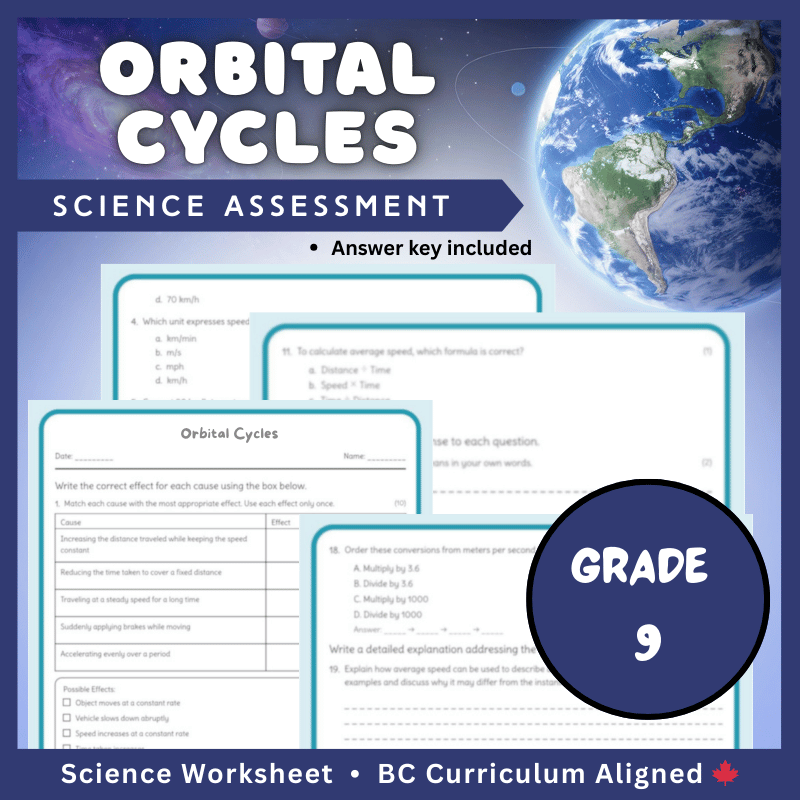
Grade 9 Science | Orbital Cycles Worksheet + Answer Key - BC Standards
Created byBright Mind ResourcesLearning Objectives
- Understand how Earth's and Moon's orbital patterns influence seasonal and lunar phenomena.
- Describe how axial tilt and orbital eccentricity affect climate and seasons.
- Explain the relationship between gravitational forces and tidal patterns.
Instant download

Grade 9 ELA – Source Integration & Writing | Daily Reading Worksheet
Created byQuiet Forest EducationLearning Objectives
- Identify main ideas and supporting details from sources
- Understand how to paraphrase, quote, and summarize source material
- Practice integrating source ideas smoothly into writing
Also included in: Writing Grade 9 ELA Daily Reading Worksheets Lesson Bundle | BC +1 more
Instant download

Grade 9 Simple Machines Worksheet | Practice & Assessment PDF
Created byClear Sky ClassroomLearning Objectives
- Explain how simple machines transfer forces to change effort, load, or direction of motion
- Compare ideal mechanical advantage with practical mechanical advantage and account for friction
- Use input and output relationships (force and displacement) to reason about machine performance
Instant download
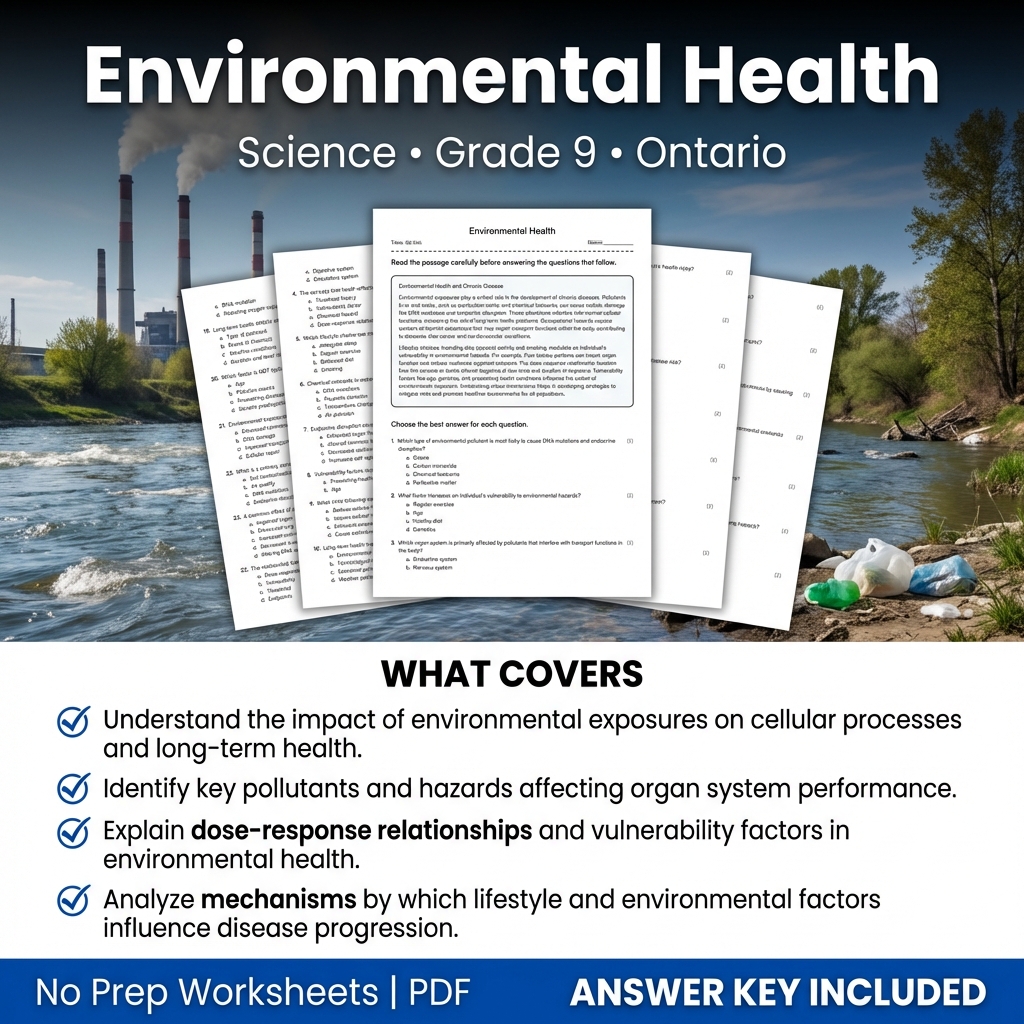
Environmental Health Science Worksheet | Grade 9 Standard Practice
Created byCoral Reef LearningLearning Objectives
- Understand the impact of environmental exposures on cellular processes and long-term health.
- Identify key pollutants and hazards affecting organ system performance.
- Explain dose-response relationships and vulnerability factors in environmental health.
Instant download

Building Bonds Worksheet Grade 9 | Holiday SEL & Relationship Activity
 Created byShaNova Worksheets
Learning Objectives
- Explain how empathy, respect, and communication strengthen a school community.
- Apply cooperation and mutual support strategies to back-to-school challenges.
- Analyze how cultural traditions and historical examples can promote teamwork and inclusion.
Instant download

Audience Adaptation Worksheet Pack | Grade 9 ELA Practice
Created bySunny Desk ResourcesLearning Objectives
- Identify how purpose, context, and audience expectations shape a speech’s tone, vocabulary, and level of explicitness
- Revise speech ideas for different settings (class discussion, public forum, professional meeting) while maintaining clarity and appropriate formality
- Support audience adaptation choices with specific reasons about knowledge, concerns, and communication goals
Also included in: Grade 9 Speaker Reasoning & Academic Conversation Lesson Bundle | CCSS ELA +1 more
Instant download

Algorithm Efficiency and Optimization Computer Science Grade 9
Created byPrism Point LearningLearning Objectives
- Define efficiency, optimize, resource, and performance in the context of algorithms.
- Compare two algorithm approaches and identify which is more efficient without changing the outcome.
- Explain how optimization can improve time, steps, or resource use.
Instant download

Grade 9 ELA Tone Through Word Choice Worksheet | BC Curriculum | Answer Key
Created byLumora LearningLearning Objectives
- Analyze how diction and connotation create tone in a text
- Identify vague or biased word choices that weaken clarity and credibility
- Revise word choice to maintain a consistent, purposeful tone
Instant download

Grade 9 Science | Trophic Dynamics - Daily Reading Comprehension
Created byCoral Reef LearningLearning Objectives
- Understand how energy flows through different levels of a food chain
- Identify the structure of food webs and trophic levels
- Explain why energy decreases as it moves up trophic levels
Instant download

Grade 9 Connotation and Denotation Worksheet | TEKS ELA Vocabulary
Created byGolden Apple StudioLearning Objectives
- Distinguish denotation (literal meaning) from connotation (emotional or cultural associations).
- Analyze how word choice reveals an author’s stance in evaluative contexts.
- Determine whether a given interpretation depends on denotation, connotation, or both.
Also included in: Reading/Vocabulary Development Lesson Bundle | Grade 9 ELA | TEKS +1 more
Instant download

Grade 9 ELA – Argument Foundations & Critical Reading | Daily Reading Worksheet
Created byQuiet Forest EducationLearning Objectives
- Identify the main claim in an argument.
- Determine supporting evidence and reasoning.
- Analyze how evidence supports an author's claim.
Also included in: Grade 9 Writing ELA Lesson Bundle for Daily Reading | General ELA Framework +2 more
Instant download

Research Synthesis Worksheet | Standards-Aligned ELA Practice for Grade 9
JCreated byJ.S SheetsLearning Objectives
- Explain how a thesis guides the selection and organization of evidence in research synthesis.
- Differentiate summary, paraphrase, and direct quotation and use each appropriately with attribution.
- Practice integrating credible sources by matching evidence to claims and maintaining relevance and accuracy.
Instant download

Grade 9 Newtonian Concepts Worksheet | Practice & Assessment PDF
Created byClear Sky ClassroomLearning Objectives
- Explain how Newton’s First Law (inertia) relates force to changes in motion
- Use Newton’s Second Law to predict how acceleration depends on net force and mass
- Describe Newton’s Third Law (action–reaction) and apply it to real situations like recoil and anchored structures
Instant download

Physical vs Chemical Changes Worksheet Grade 9 Science NGSSS
Created byEvergreen Desk EducationLearning Objectives
- Differentiate physical properties and chemical properties of matter using examples
- Distinguish physical changes from chemical changes based on evidence
- Interpret observations (color, temperature, texture, gas/product formation) to classify changes
Instant download
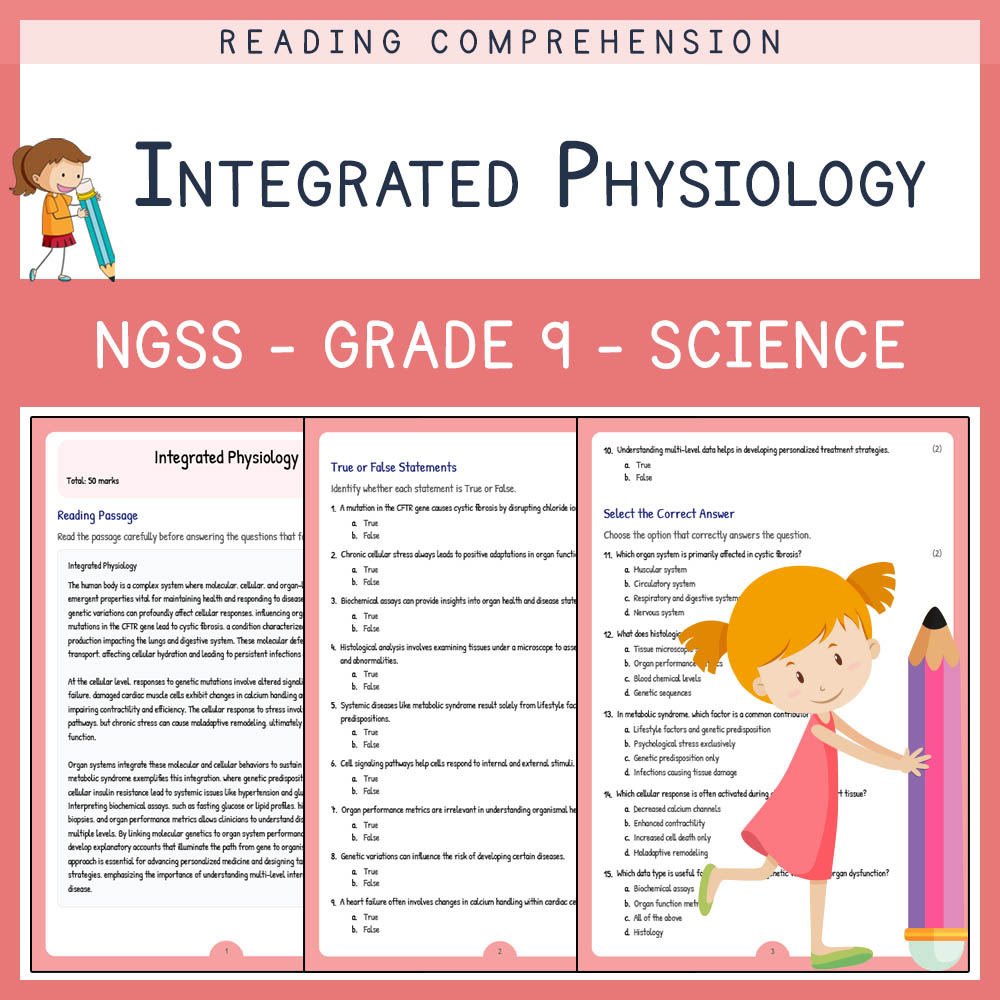
Grade 9 Science | Integrated Physiology Worksheet (Answer Key) NGSS Aligned
Created byLumora LearningLearning Objectives
- Explain how molecular interactions influence cellular functions within organ systems.
- Link genetic variations to specific organ system dysfunctions in clinical scenarios.
- Interpret biochemical assays, histological data, and organ performance metrics to analyze organism health.
Instant download

Tissue Types Worksheet | Grade 9 Science Activities
Created byPrism Point LearningLearning Objectives
- Identify the four major tissue types and match each to its primary function in the body.
- Explain how tissue structure and cell specialization affect the properties of organs.
- Compare epithelial, connective, muscle, and nervous tissues using correct science vocabulary.
Also included in: Cells and Body Systems Lesson Bundle | Grade 9 Science | BC +1 more
Instant download

Grade 9 ELA | Tense Consistency Worksheet | Alberta Standards
Created byLumora LearningLearning Objectives
- Identify and correct shifts in verb tense within narratives and explanatory writing
- Choose verb tenses that match the time relationship (past events, present results, and general truths)
- Apply consistent tense to explain processes, causes, and research findings with clear coherence
Instant download

Grade 9 Science – Earth Seasons Causes & Effects | Daily Reading Worksheet
Created byBright Mind ResourcesLearning Objectives
- Understand the causes of Earth's seasons.
- Identify how Earth's tilt and orbit influence sunlight distribution.
- Describe how day length varies with Earth's position.
Also included in: Earth Systems Grade 9 Science Daily Reading Worksheets Bundle | Florida NGSSS +1 more
Instant download

Wave Properties Worksheet | Assessment Grade 9 Science Printable PDF
Learning Objectives
- Understand the mathematical representations of wave behavior, including amplitude, frequency, wavelength, and phase.
- Relate wave speed to frequency and wavelength through calculations for transverse and longitudinal waves.
- Explain interference and standing waves using sinusoidal functions and superposition.
Also included in: Grade 9 Waves and Their Applications in Technologies for Information Transfer Lesson Bundle +1 more
Instant download
Browse more categories
About Grade 9 Worksheets
Browse 9,322 printable Grade 9 worksheets across algebra, biology, literature, and history — each a ready-to-print PDF with optional answer keys.
Every worksheet on MyTeachingSheets is created by independent teacher-authors and reviewed before publication. All resources download as printable PDFs for classroom, homework, or at-home practice, and many include answer keys. Preview any worksheet free before buying.