
Science Worksheets
44,628 subject resources
Electric and Magnetic Fields: Forces & Motion Grade 9 Worksheets
 Created bythe curious pencil
Learning Objectives
- Interpret field lines as representations of direction and relative magnitude.
- Explain how superposition combines overlapping field effects as vectors.
- Describe magnetic forces acting on moving charged particles.
Also included in: Newton's Laws, Forces & Motion Lesson Bundle | Grade 9 Science NGSS +2 more
Instant download

Human Impacts on Biodiversity and Ecosystems: Grade 9 Worksheet
Created bythe curious pencilLearning Objectives
- Analyze how land-use change affects biodiversity and ecosystem functioning
- Explain how agricultural runoff changes aquatic ecosystem conditions
- Interpret evidence about human impacts on ecosystem dynamics
Also included in: Grade 9 Ecosystem Dynamics & Nutrient Cycling Lesson Bundle | NGSS +2 more
Instant download

Plate Tectonics & Tectonic Forces Worksheet Grade 9 Earth Science
Created bythe curious pencilLearning Objectives
- Explain how tectonic forces shape continental and ocean-floor features
- Describe how seafloor spreading changes Earth's surface
- Explain how subduction contributes to volcanic arc formation
Also included in: Earth Systems: Tectonics & Climate Lesson Bundle | Grade 9 Science NGSS +2 more
Instant download

Mendelian Inheritance Worksheets: Single-Gene Patterns | Grade 9
Created bythe curious pencilLearning Objectives
- Explain dominant and recessive allele interactions during inheritance.
- Construct Punnett squares to predict genotype and phenotype ratios.
- Compare Mendelian inheritance with incomplete dominance and codominance.
Also included in: Genetic Variation & Inheritance Lesson Bundle — Grade 9 Science ngss +2 more
Instant download

Climate Drivers and Earth's Energy Budget Worksheets Grade 9
Created bythe curious pencilLearning Objectives
- Explain how solar flux and albedo affect Earth's energy balance
- Describe how greenhouse gases transfer and re-emit infrared energy
- Explain how ocean heat transport influences regional climate patterns
Also included in: Earth Systems: Tectonics & Climate Lesson Bundle | Grade 9 Science NGSS +2 more
Instant download

Natural Hazards & Resilience Worksheets | Grade 9 Earth Science
Created bythe curious pencilLearning Objectives
- Identify geological and atmospheric processes that produce natural hazards
- Interpret hazard maps and recurrence intervals
- Explain how paleoevidence reveals past hazardous events
Also included in: Earth Systems: Tectonics & Climate Lesson Bundle | Grade 9 Science NGSS +2 more
Instant download

Speciation and Reproductive Isolation Worksheets | Grade 9 Science
Created bythe curious pencilLearning Objectives
- Explain how geographic separation contributes to speciation
- Compare allopatric and sympatric speciation models
- Describe how reproductive isolation reduces gene flow
Also included in: Speciation & Evolutionary Evidence Lesson Bundle | Grade 9 Science | NGSS +2 more
Instant download

Energy Conversion & Efficiency Worksheets Grade 9 Science
Created bythe curious pencilLearning Objectives
- Explain how energy changes form during common energy conversions
- Identify useful outputs and other transfers using energy accounting
- Calculate efficiency from known input and useful output energy
Also included in: Grade 9 Power and Energy Science Lesson Bundle | NGSS +2 more
Instant download

Power and Energy Grade 9 Science Worksheets: System Efficiency
Created bythe curious pencilLearning Objectives
- Distinguish power from energy using appropriate measurement units
- Calculate energy use from power and operating time
- Explain how efficiency affects useful energy output
Also included in: Grade 9 Power and Energy Science Lesson Bundle | NGSS +2 more
Instant download

DNA and Chromosomal Inheritance Worksheets | Grade 9 Science
Created bythe curious pencilLearning Objectives
- Explain how DNA stores and transmits hereditary information.
- Describe how DNA replication preserves information during cell division.
- Explain how meiosis separates homologous chromosomes into gametes.
Also included in: Genetic Variation & Inheritance Lesson Bundle — Grade 9 Science ngss +2 more
Instant download

Genetic Variation Mechanisms: Heredity Worksheets for Grade 9 Science
Created bythe curious pencilLearning Objectives
- Identify major mechanisms that generate genetic variation.
- Explain how mutations can alter DNA and protein function.
- Describe how crossing-over creates new allele combinations.
Also included in: Genetic Variation & Inheritance Lesson Bundle — Grade 9 Science ngss +2 more
Instant download
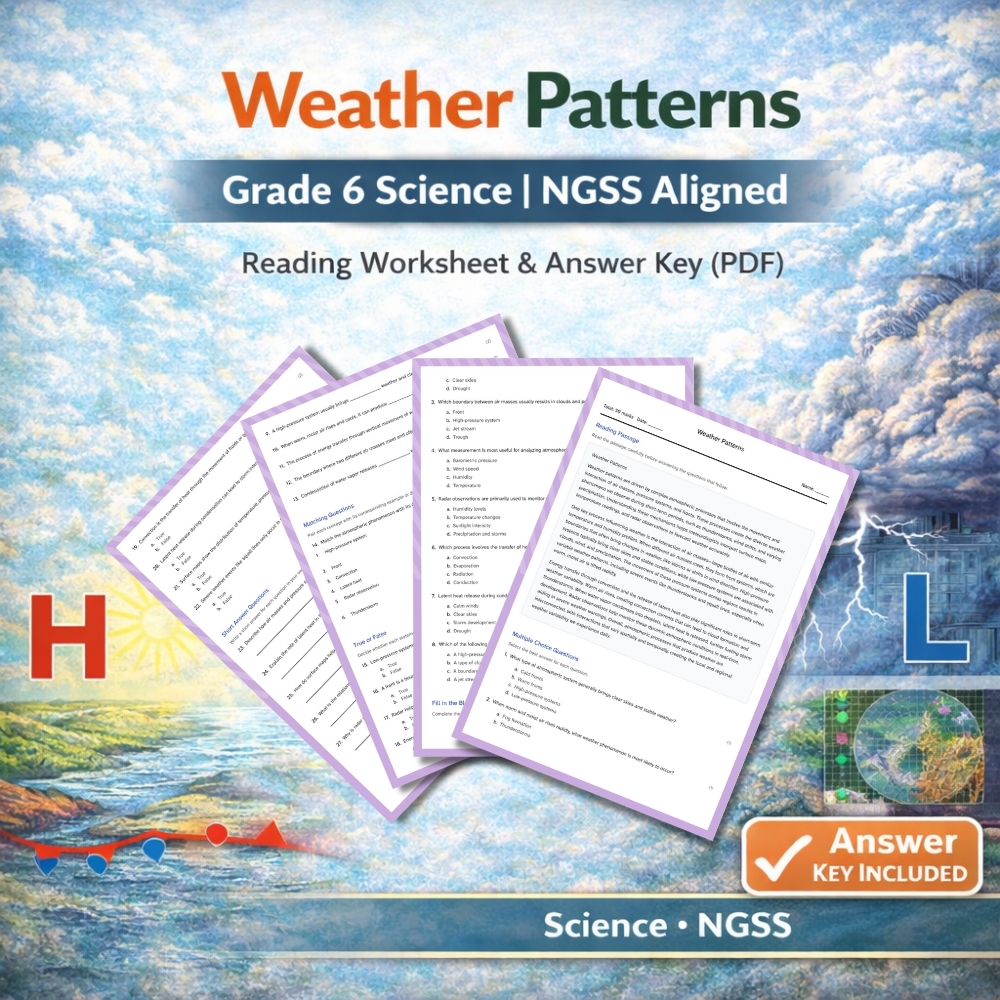
6th Grade Science | Weather Patterns | NGSS ( Worksheet + Answer Key )
 Created byCedar Grove Learning
Learning Objectives
- Explain how atmospheric processes create local and regional weather patterns.
- Interpret surface maps, temperature, and pressure measurements to analyze weather conditions.
- Describe the roles of air masses, pressure systems, and fronts in weather variability.
Also included in: Grade 6 Science | Weather, Water Cycle & Climate NGSS Worksheet Bundle +1 more
Instant download

7th Grade Science | Beam Behavior Reading Worksheet (PDF + Answer Key)
JCreated byJ.S SheetsLearning Objectives
- Understand the key concepts of beam performance under loads, including bending, shear, and deflection.
- Identify how span, support conditions, and load types affect beam stability and comfort.
- Relate real-world examples such as highway overpass girders and building floor joists to beam analysis.
Also included in: Grade 7 Science | Forces, Motion & Structural Concepts (Answer Keys Included) +1 more
Instant download
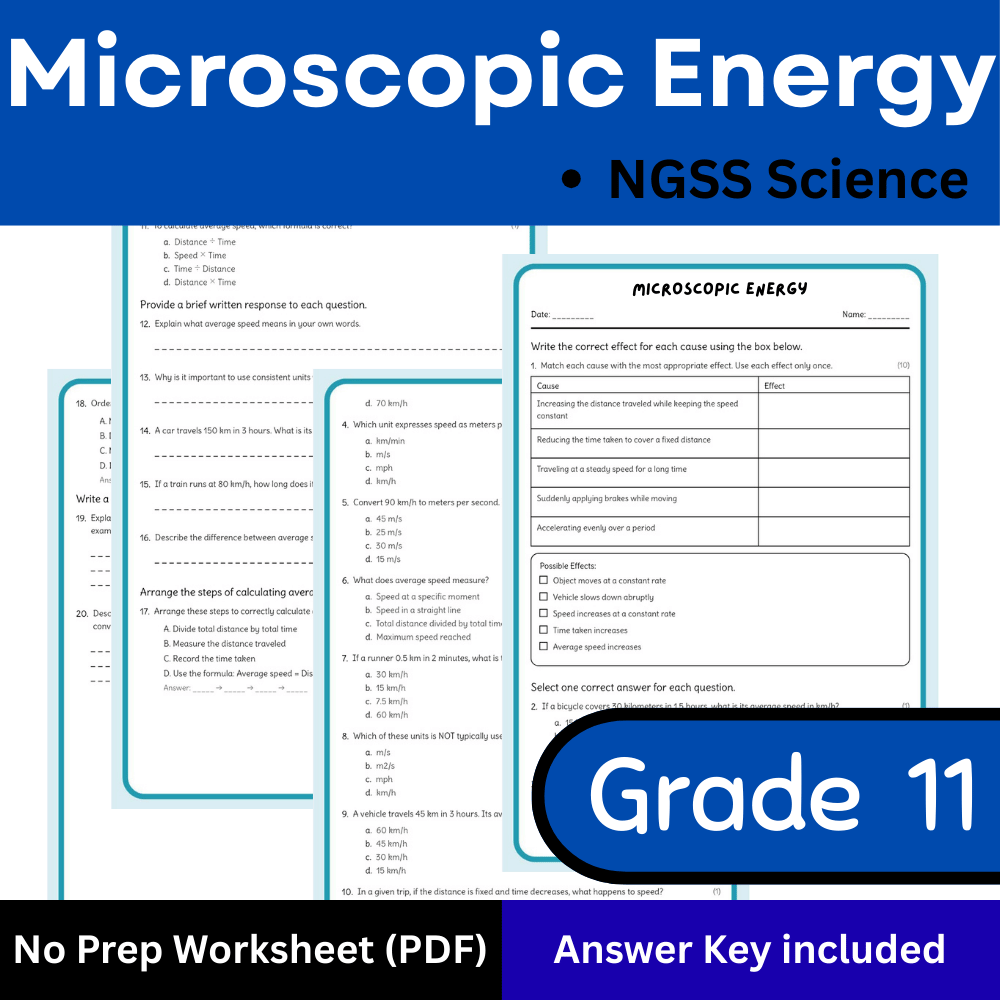
Grade 11 Science – Microscopic Energy Concepts & NGSS Standards + Answer Key
 Created byBright Mind Resources
Learning Objectives
- Explain how energy at the microscopic scale relates to macroscopic thermal and mechanical phenomena.
- Describe models that address internal energy changes, vibrational energy, and energy redistribution in gases, solids, and collisions.
- Connect molecular-scale descriptions to observable properties such as temperature and thermal expansion.
Instant download

Grade 7 Science Worksheet on Stoichiometry | NGSS-Aligned Practice
JCreated byJ.S SheetsLearning Objectives
- Understand how to interpret and balance chemical equations to reflect quantitative relationships.
- Apply mole ratios from balanced equations to calculate amounts of reactants and products.
- Use conservation principles to predict reagent needs and product yields in chemical reactions.
Also included in: Grade 7 Structure and Properties of Matter Science Lesson Bundle: NGSS +1 more
Instant download
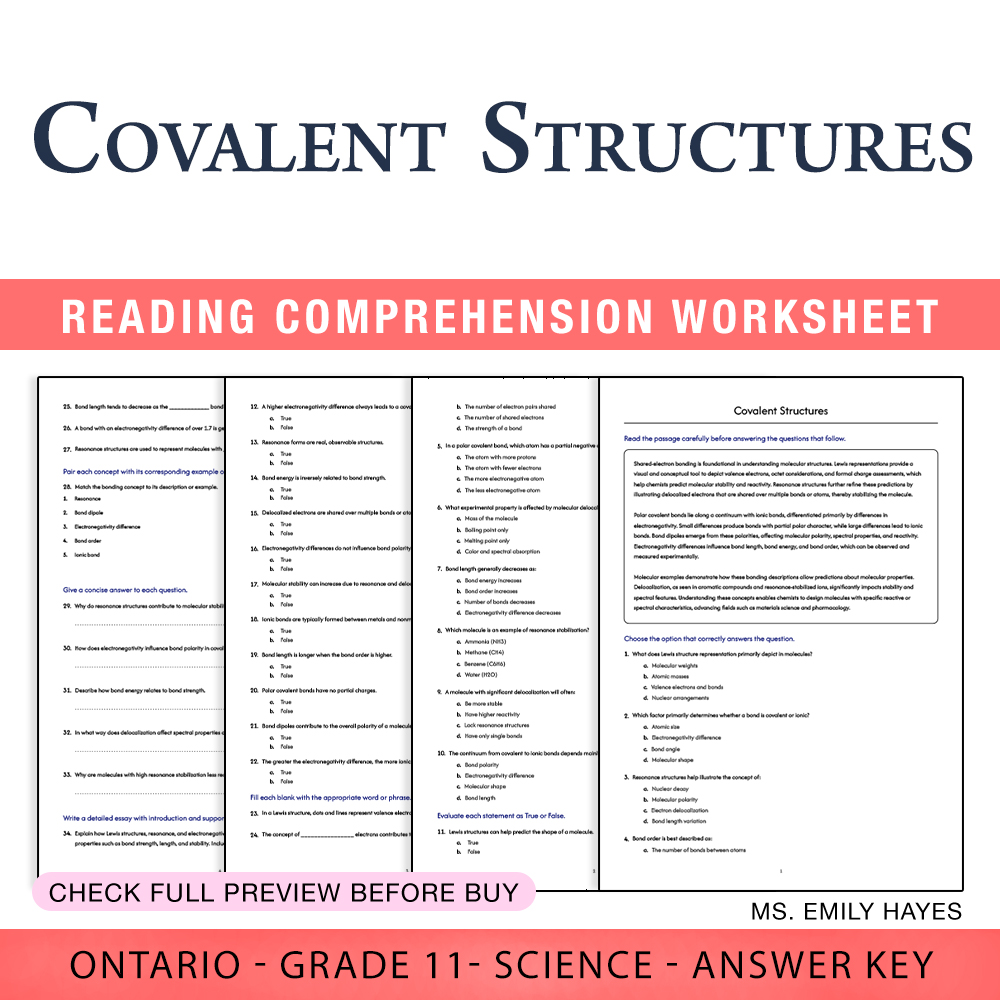
11th Grade Science | Covalent Structures Worksheet (PDF + Answer Key)
 Created byCopper Leaf Classroom
Learning Objectives
- Explain shared-electron bonding through Lewis representations, octet considerations, and formal charge assessment.
- Describe polar covalent bonding along the continuum with ionic bonding using electronegativity differences and bond dipoles.
- Predict bond order, bond length, and bond energy based on molecular descriptions.
Instant download
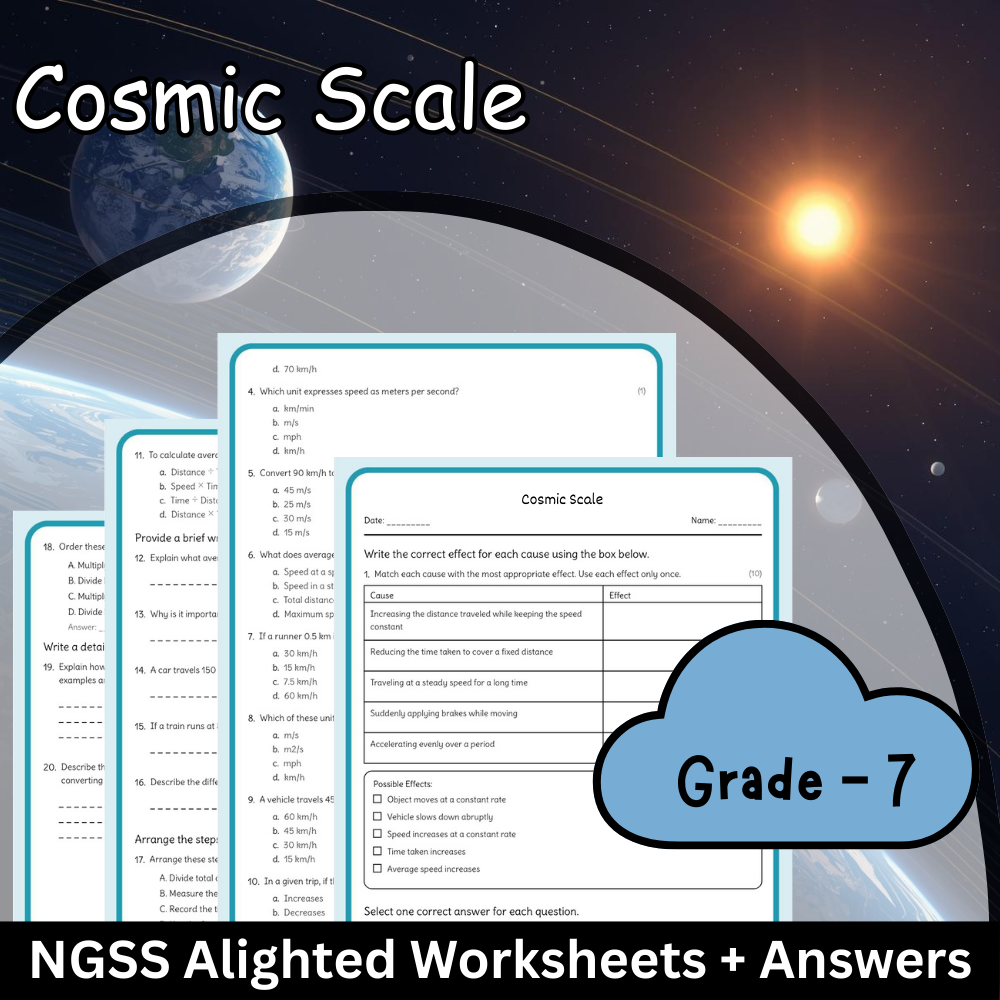
7th Grade Science | Cosmic Scale Worksheet (NGSS Aligned, PDF)
Created byBright Mind ResourcesLearning Objectives
- Understand how to compare sizes and distances within the solar system and beyond using different units of measurement.
- Interpret scaled diagrams and logarithmic representations of astronomical data.
- Analyze orders of magnitude differences and their effects on observation and perception.
Instant download
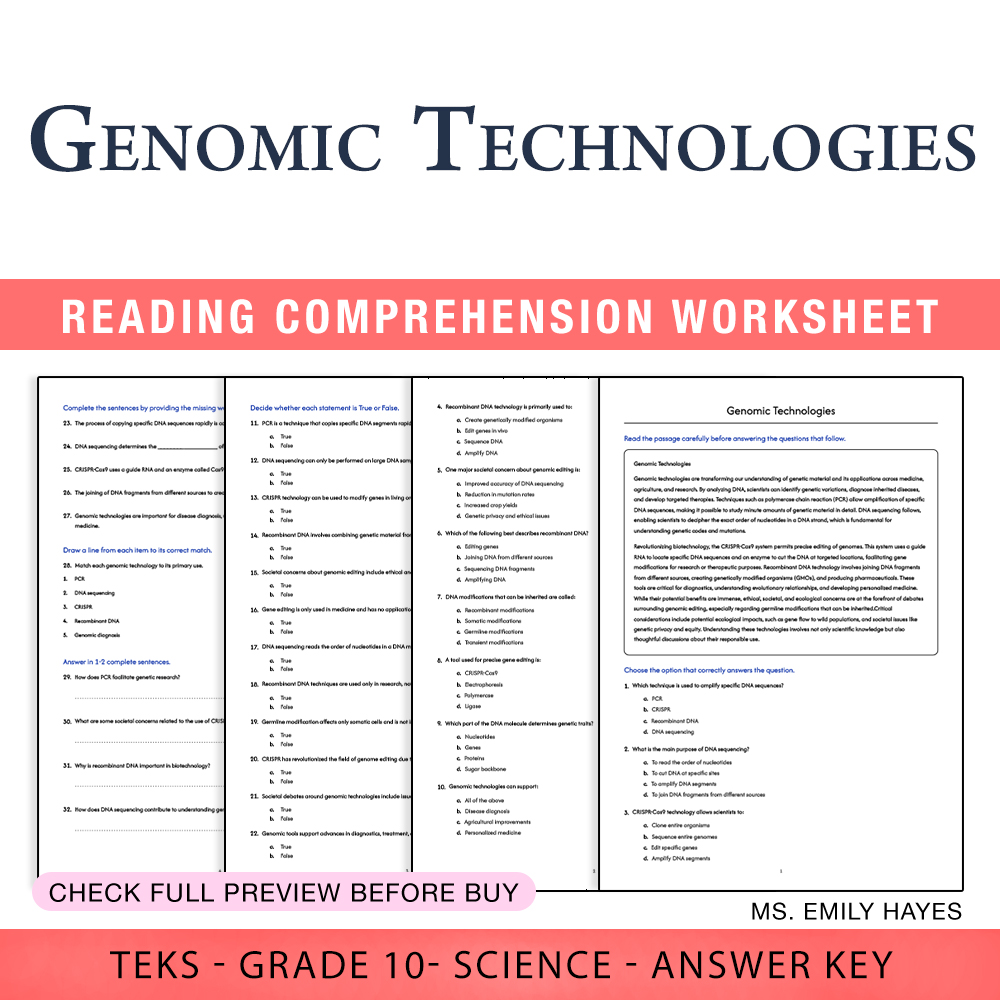
10th Grade Science | Genomic Technologies Worksheet (PDF+ Answer Key)
Created byCopper Leaf ClassroomLearning Objectives
- Understand the various techniques used in genomic research such as PCR, DNA sequencing, and CRISPR.
- Describe how recombinant DNA methods are applied in biotechnology and medicine.
- Explain societal and ecological considerations related to genomic editing.
Instant download

Force Interactions and Vector Representation Grade 10 Worksheets
Created bythe curious pencilLearning Objectives
- Classify contact and noncontact forces using physical examples
- Represent forces with vectors showing magnitude and direction
- Explain Newton's third law using paired object interactions
Also included in: Forces, Momentum, Gravitation & Electromagnetism Lesson Bundle | Grade 10 Science NGSS +2 more
Instant download

Mutation Types and Genetic Variation Worksheets | Grade 10 Science
Created bythe curious pencilLearning Objectives
- Identify point mutations, insertions, and deletions in DNA sequences
- Distinguish chromosomal rearrangements including inversions and translocations
- Explain how replication errors and mutagens produce mutations
Also included in: Genetics & Heredity Lesson Bundle | Grade 10 Science | NGSS +2 more
Instant download

Power Analysis Worksheets: Mechanical & Electrical Power Grade 11
Created bythe curious pencilLearning Objectives
- Calculate mechanical power using work and elapsed time
- Calculate electrical power using current and voltage
- Compare predicted and observed power using measured data
Also included in: Energy Transfer, Conversion & Conservation Lesson Bundle | Grade 11 Science | NGSS +2 more
Instant download

Mendelian Inheritance Worksheets: Genetics & Heredity Grade 10
Created bythe curious pencilLearning Objectives
- Explain dominance and recessive inheritance patterns
- Describe segregation and independent assortment during meiosis
- Use Punnett squares to predict genotype and phenotype ratios
Also included in: Genetics & Heredity Lesson Bundle | Grade 10 Science | NGSS +2 more
Instant download

Natural Selection Worksheets | Grade 11 Biology Evolution Practice
Created bythe curious pencilLearning Objectives
- Explain how heritable variation contributes to natural selection.
- Describe how mutation and recombination produce genetic variation.
- Analyze how environmental pressures affect trait frequencies.
Also included in: Evolution & Population Genetics Lesson Bundle – Grade 11 Science NGSS +2 more
Instant download

Resource Tradeoffs and Sustainable Management Worksheets Grade 10
Created bythe curious pencilLearning Objectives
- Compare energy and mineral resources using multiple management criteria
- Explain tradeoffs associated with fossil fuels, solar, and wind
- Describe environmental effects of open-pit mining and reclamation
Also included in: Resource Tradeoffs Sustainable Management Lesson Bundle | Grade 10 Science NGSS +2 more
Instant download

Model Evaluation and Data Comparison Worksheets | Grade 10 Science
Created bythe curious pencilLearning Objectives
- Compare model predictions with measurements from real systems.
- Interpret uncertainty when evaluating engineering model reliability.
- Explain why statistical comparisons support model evaluation.
Also included in: Engineering Design - Grade 10 Bundle +2 more
Instant download

Cell Division, Regulation and Differentiation Grade 10 Worksheets
Created bythe curious pencilLearning Objectives
- Compare mitosis and meiosis by chromosome number and biological function
- Explain how checkpoints and cyclins regulate cell division
- Describe how apoptosis removes damaged or unnecessary cells
Also included in: Cellular Processes, DNA & Homeostasis Lesson Bundle – Grade 10 Science (ngss) +2 more
Instant download

Mass Conservation in Chemical Reactions Worksheets | Grade 10
Created bythe curious pencilLearning Objectives
- Explain how balanced equations represent conservation of atoms
- Interpret coefficients as mole relationships in chemical reactions
- Use molar masses to compare reactant and product masses
Also included in: Chemical Reactions, Biodiversity & Atomic Structure Lesson Bundle | Grade 10 Science NGSS +2 more
Instant download

Signal Modulation and Transmission Worksheets Grade 10 Science
Created bythe curious pencilLearning Objectives
- Explain how modulation encodes information in carrier signals
- Distinguish amplitude, frequency, and phase modulation methods
- Describe how bandwidth and noise affect communication fidelity
Also included in: Energy Transfers & Electromagnetic Communication Lesson Bundle | Grade 10 Science | ngss +2 more
Instant download

Trophic Relationships and Energy Transfer Worksheets Grade 10
Created bythe curious pencilLearning Objectives
- Explain why energy transfer between trophic levels is inefficient
- Interpret biomass patterns across different trophic levels
- Analyze food web connections and trophic cascade effects
Also included in: Ecosystem Models & Energy Flow Lesson Bundle | Grade 10 Science | NGSS +2 more
Instant download

Trade-Off Optimization in Design Selection Worksheets Grade 10
Created bythe curious pencilLearning Objectives
- Explain how competing design goals create trade-offs
- Compare design options using cost-benefit matrices
- Interpret objective weighting in design comparisons
Also included in: Engineering Design - Grade 10 Bundle +2 more
Instant download

Biodiversity Change & Ecological Resilience Worksheets Grade 10
Created bythe curious pencilLearning Objectives
- Explain how human activities alter biodiversity and ecosystem function
- Analyze habitat fragmentation effects on genetic diversity
- Interpret population monitoring and phylogenetic evidence
Also included in: Grade 10 Science NGSS Full-Year Bundle Worksheets for Full Coverage +1 more
Instant download

Natural Selection and Population Change Worksheets Grade 10
Created bythe curious pencilLearning Objectives
- Explain how heritable variation contributes to natural selection
- Describe how reproductive success changes trait frequencies
- Identify selective mechanisms using real evolutionary examples
Also included in: Evolution & Biodiversity Change Lesson Bundle | Grade 10 Science | NGSS +2 more
Instant download

Energy Accounting and Energy Transfers Worksheets | Grade 10
Created bythe curious pencilLearning Objectives
- Define a system boundary for an energy analysis.
- Identify energy stores and transfers within a system.
- Represent energy transfers using flow diagrams and tables.
Also included in: Energy Transfers & Electromagnetic Communication Lesson Bundle | Grade 10 Science | ngss +2 more
Instant download

Work and Power Relationships Worksheets | Grade 10 Science Physics
Created bythe curious pencilLearning Objectives
- Calculate work from force and displacement using appropriate SI units
- Explain how net work changes an object's kinetic energy
- Calculate average and instantaneous power using appropriate equations
Also included in: Energy & Climate Reconstruction Lesson Bundle | Grade 10 Science | NGSS +2 more
Instant download

Heat Transfer and Thermal Equilibrium Worksheets | Grade 11 Science
Created bythe curious pencilLearning Objectives
- Explain how conduction, convection, and radiation transfer thermal energy
- Compare how temperature differences affect thermal energy transfer
- Explain how latent heat relates to phase transitions
Also included in: Energy Transfer, Conversion & Conservation Lesson Bundle | Grade 11 Science | NGSS +2 more
Instant download

Heritable Traits and Genetic Variation Worksheets | Grade 10 Science
Created bythe curious pencilLearning Objectives
- Explain how mutation and recombination produce heritable genetic variation
- Describe how gene flow changes allele frequencies between populations
- Connect DNA changes and allele frequencies to observable traits
Also included in: Evolution & Biodiversity Change Lesson Bundle | Grade 10 Science | NGSS +2 more
Instant download

Bond Energetics and Energy Changes Worksheets Grade 10 Science
Created bythe curious pencilLearning Objectives
- Explain how bond breaking and formation affect reaction energy.
- Distinguish exothermic and endothermic reactions from energy changes.
- Compare bond strengths using bond enthalpy values.
Also included in: Chemical Reactions, Biodiversity & Atomic Structure Lesson Bundle | Grade 10 Science NGSS +2 more
Instant download

Momentum and Impulse in Collisions Physics Worksheets Grade 10
Created bythe curious pencilLearning Objectives
- Calculate momentum and impulse from physical quantities
- Apply the impulse-momentum theorem to changes in motion
- Use conservation of momentum to analyze collisions
Also included in: Forces, Momentum, Gravitation & Electromagnetism Lesson Bundle | Grade 10 Science NGSS +2 more
Instant download

Carbon Cycling, Fluxes, Sinks & Feedbacks Grade 10 Science Worksheets
Created bythe curious pencilLearning Objectives
- Explain how carbon moves among major Earth-system reservoirs
- Distinguish carbon sources, sinks, fluxes, and long-term storage
- Describe how human activities affect atmospheric carbon dioxide
Also included in: Resource Tradeoffs Sustainable Management Lesson Bundle | Grade 10 Science NGSS +2 more
Instant download

Ocean Circulation and Upwelling Worksheets | Grade 10 Science
Created bythe curious pencilLearning Objectives
- Explain how density differences drive thermohaline circulation.
- Describe how wind and rotation shape ocean circulation.
- Explain how coastal upwelling moves cold, nutrient-rich water.
Also included in: Grade 10 Earth Systems: Plate Tectonics & Water Lesson Bundle | NGSS +2 more
Instant download

Thermal Energy Transfer & Equilibrium Worksheets Grade 10 Science
Created bythe curious pencilLearning Objectives
- Distinguish conduction, convection, and radiation as transfer mechanisms
- Explain how temperature differences drive thermal energy flow
- Calculate thermal energy using mass, specific heat, and temperature change
Also included in: Energy & Climate Reconstruction Lesson Bundle | Grade 10 Science | NGSS +2 more
Instant download

Rock Cycle and Rock Transformations Worksheet | Grade 10 Science
Created bythe curious pencilLearning Objectives
- Explain how crystallization, lithification, metamorphism, and weathering transform rocks
- Interpret mineral assemblages and texture as evidence of rock history
- Use geochemical signatures to interpret how rocks formed and changed
Also included in: Grade 10 Earth Systems: Plate Tectonics & Water Lesson Bundle | NGSS +2 more
Instant download

Cosmic Origins Evidence Worksheet | Grade 10 Earth & Space Science
Created bythe curious pencilLearning Objectives
- Identify major observations that provide evidence about cosmic origins
- Explain how galactic redshift supports an expanding-universe interpretation
- Describe how light-element abundances reveal early-universe conditions
Also included in: Earth & Space Science Lesson Bundle | Grade 10 Science | NGSS +2 more
Instant download

Paleoclimate Evidence and Climate Reconstruction Worksheets Grade 10
Created bythe curious pencilLearning Objectives
- Explain how proxy records reveal past climate conditions
- Interpret evidence from ice cores, tree rings, and sediments
- Describe how isotopic ratios support climate reconstruction
Also included in: Energy & Climate Reconstruction Lesson Bundle | Grade 10 Science | NGSS +2 more
Instant download

Chemical Equilibrium and Le Chatelier's Principle Grade 10 Worksheets
Created bythe curious pencilLearning Objectives
- Explain dynamic equilibrium in reversible chemical reactions
- Predict equilibrium shifts caused by concentration changes
- Predict equilibrium shifts caused by pressure and temperature changes
Also included in: Chemical Reactions, Biodiversity & Atomic Structure Lesson Bundle | Grade 10 Science NGSS +2 more
Instant download

Earth-Moon-Sun Alignment Worksheets: Cycles & Eclipses Grade 10
Created bythe curious pencilLearning Objectives
- Explain how axial tilt changes seasonal insolation and daylength
- Describe how lunar position produces observable phases
- Identify Earth-Moon-Sun alignments that produce solar and lunar eclipses
Also included in: Earth & Space Science Lesson Bundle | Grade 10 Science | NGSS +2 more
Instant download

Molecular Genetics DNA Gene Expression Protein Synthesis Worksheets
Created bythe curious pencilLearning Objectives
- Explain how complementary base pairing supports accurate DNA replication
- Describe how transcription produces messenger RNA from DNA
- Explain how translation connects codons with amino acid sequences
Also included in: Mutation Dynamics & Inheritance Lesson Bundle | Grade 11 Science | NGSS +2 more
Instant download

Electromagnetic Forces and Vector Interactions Worksheets Grade 10
Created bythe curious pencilLearning Objectives
- Describe how electric fields exert forces on charged particles
- Determine magnetic force direction using velocity and field vectors
- Calculate electric and magnetic force magnitudes in simple situations
Also included in: Forces, Momentum, Gravitation & Electromagnetism Lesson Bundle | Grade 10 Science NGSS +2 more
Instant download
Browse more categories
About Science Worksheets
Find Science worksheets spanning core skills, practice, and review. All 44,628 resources are instant PDF downloads for the classroom or home.
Every worksheet on MyTeachingSheets is created by independent teacher-authors and reviewed before publication. All resources download as printable PDFs for classroom, homework, or at-home practice, and many include answer keys. Preview any worksheet free before buying.