
Reading comprehension Worksheets
40,241 type resources
Grade 11 Science | Newton Second Law Worksheet | NGSSS Assessment
 Created byLumora Learning
Learning Objectives
- Explain Newton’s second law using the relationship between net force, mass, and acceleration
- Predict how acceleration changes when net force or mass changes (for the same direction of net force)
- Describe how the direction of acceleration relates to the direction of the net force

Grade 11 Science | Energy Transformations Worksheet | Florida NGSSS Aligned
Created byLumora LearningLearning Objectives
- Explain energy transformations using conservation of energy in a closed system
- Identify how energy forms (kinetic, thermal, chemical, electrical, light) change in real-world examples
- Use energy accounting to track where energy goes during friction, combustion, and electrical device operation

Grade 11 Science | Water Cycle Flux Worksheet | NGSSS Assessment
Created byLumora LearningLearning Objectives
- Explain the main processes of the water cycle and how flux describes the rate of water movement between reservoirs.
- Analyze how ocean circulation and sea surface temperature affect atmospheric humidity, stability, and precipitation.
- Describe how seasonal changes and long-term climate shifts can alter regional water availability and storm patterns.

Grade 11 Science | Plate Tectonics Worksheet | NGSSS Aligned
Created byLumora LearningLearning Objectives
- Explain how internal heat drives mantle convection and leads to plate motion
- Describe the three main types of plate boundaries and the geologic features they produce
- Evaluate evidence of ongoing tectonic activity using earthquakes and volcanoes

Grade 11 Science | Atmospheric Circulation Worksheet | NGSSS Assessment
Created byLumora LearningLearning Objectives
- Explain how uneven solar heating creates pressure gradients that drive atmospheric circulation.
- Describe how the Coriolis effect influences wind direction and large-scale wind belts.
- Compare how global circulation cells transport heat and affect humidity, precipitation, and storm-track locations.
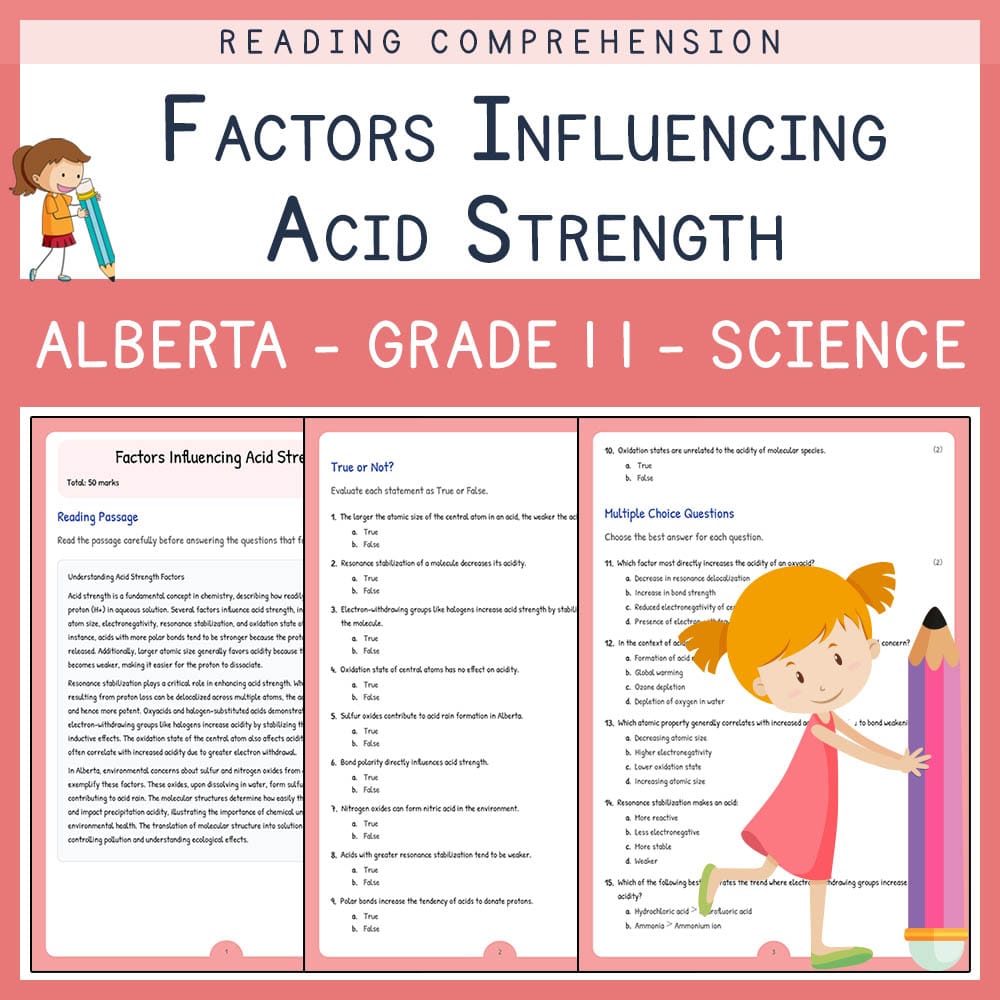
Grade 11 Science | Factors Influencing Acid Strength | Alberta Standards
Created byLumora LearningLearning Objectives
- Understand the key factors affecting acid strength such as bond polarity, atomic size, electronegativity, resonance, and oxidation state.
- Analyze how molecular structures like oxyacids and halogen substituents influence acidity.
- Explore environmental and industrial examples of acid formation, focusing on sulfur and nitrogen oxides.
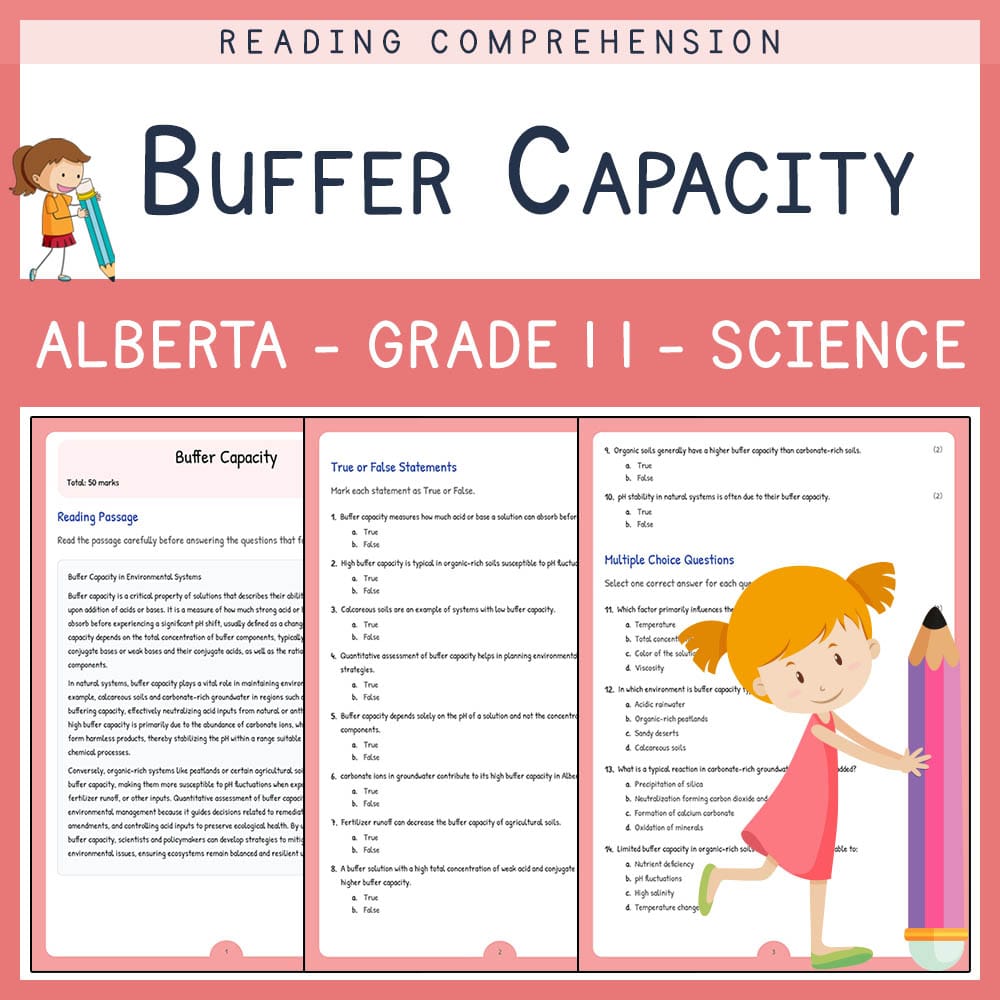
Grade 11 Science | Buffer Capacity Worksheet | Alberta Alberta
Created byLumora LearningLearning Objectives
- Understand the concept of buffer capacity and its importance in environmental systems.
- Identify factors affecting buffer capacity in natural systems.
- Explain how buffer capacity influences pH stability in soils and groundwater.
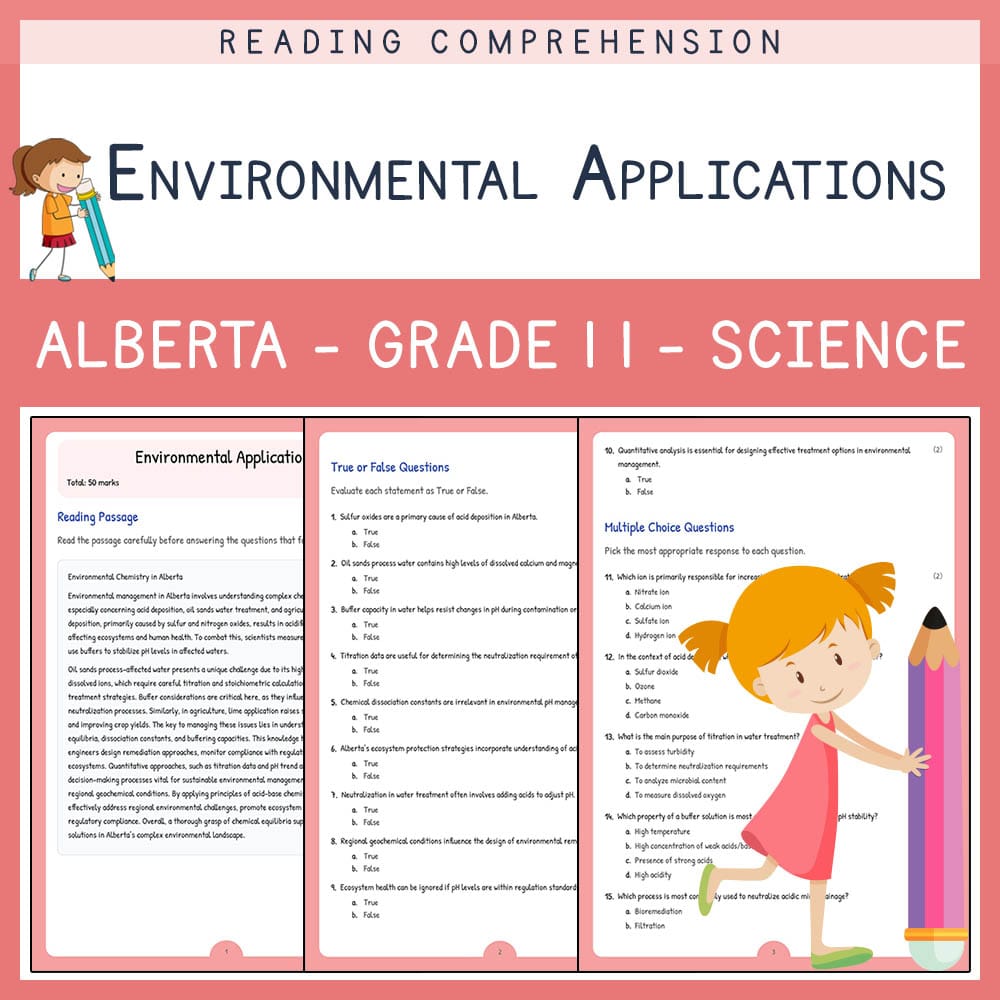
Grade 11 Science | Environmental Applications Worksheet | Alberta Standards
Created byLumora LearningLearning Objectives
- Understand the principles of acid-base chemistry in environmental contexts.
- Analyze pH trends and buffering capacity in ecological systems.
- Apply stoichiometry and titration data to assess neutralization requirements.
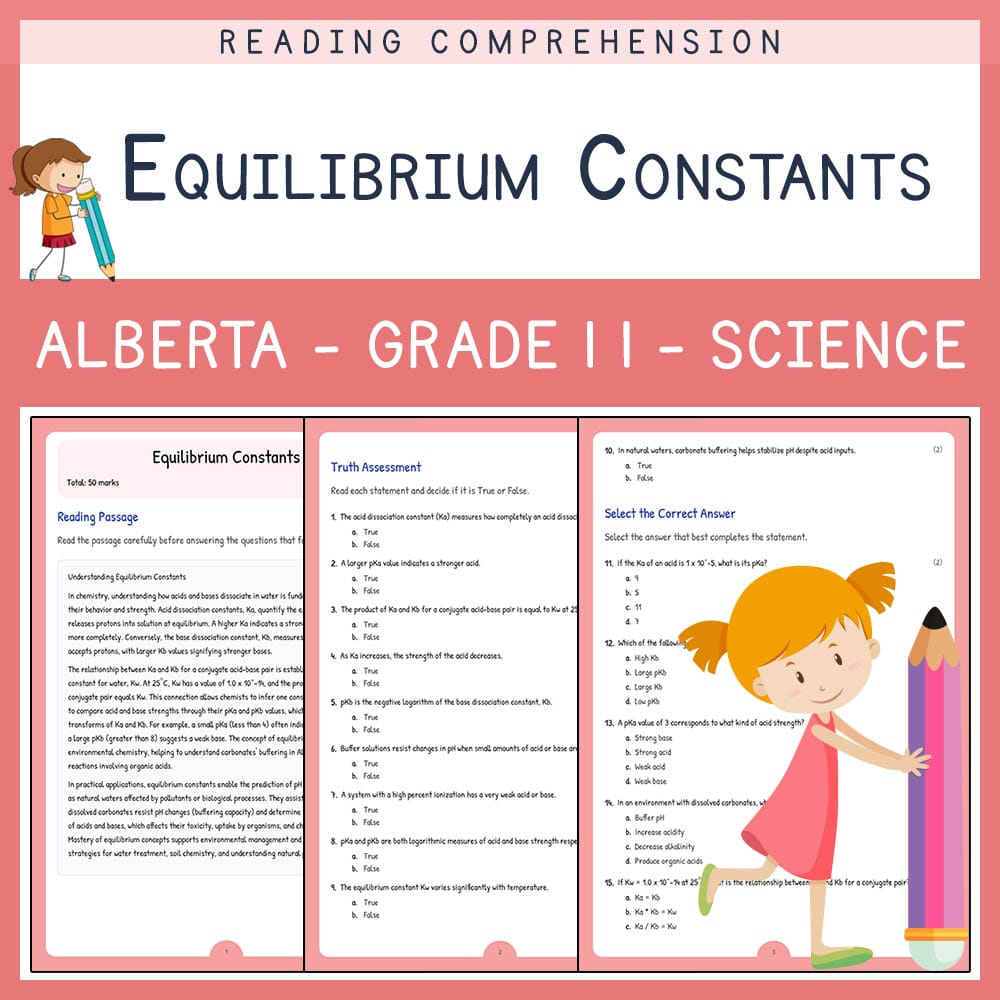
Grade 11 Science | Equilibrium Constants Worksheet Elena| Alberta Standard
Created byLumora LearningLearning Objectives
- Understand the roles of acid dissociation constant (Ka) and base dissociation constant (Kb) in equilibrium
- Connect Ka, Kb, pKa, pKb, and Kw to analyze acid-base systems
- Apply equilibrium concepts to interpret buffering, percent ionization, and pH prediction in environmental systems
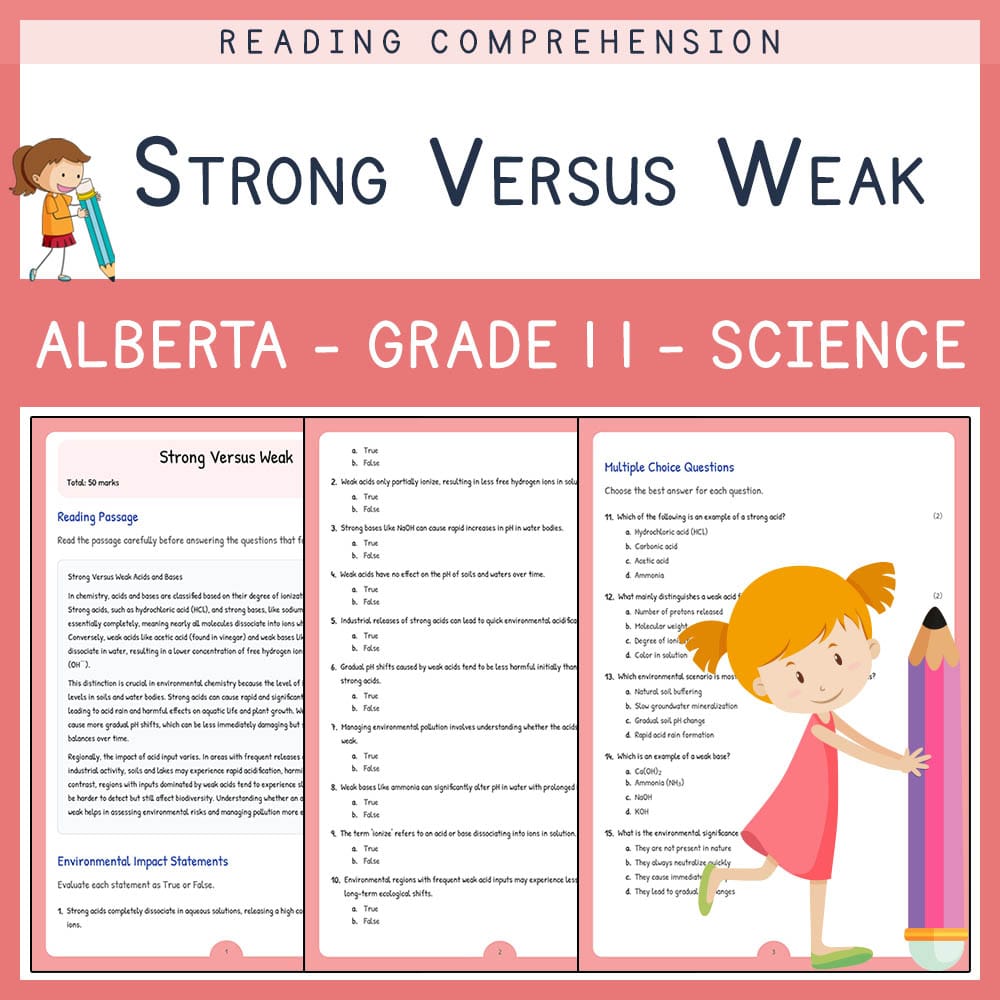
Grade 11 Science | Strong Versus Weak Acid Worksheet | Alberta Standards
Created byLumora LearningLearning Objectives
- Explain the difference between strong and weak acids and bases in terms of ionization.
- Identify examples of strong and weak acids/bases in environmental contexts.
- Understand how the strength of acids and bases impacts their environmental and biological effects.
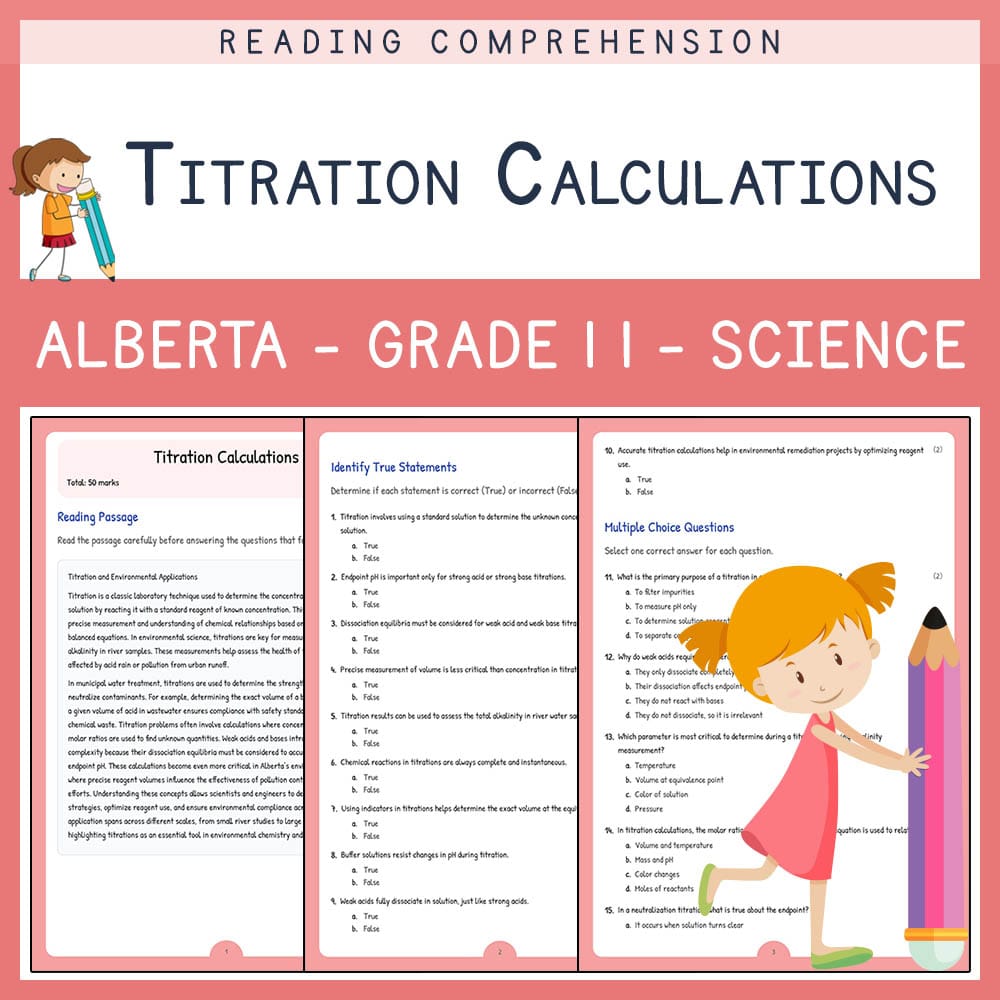
Grade 11 Science | Titration Calculations Worksheet | Alberta Standards
Created byLumora LearningLearning Objectives
- Understand how to perform stoichiometry calculations in titrations.
- Apply concentration relationships to determine unknown values in titration scenarios.
- Analyze endpoint pH variations for acids and bases with different strengths.
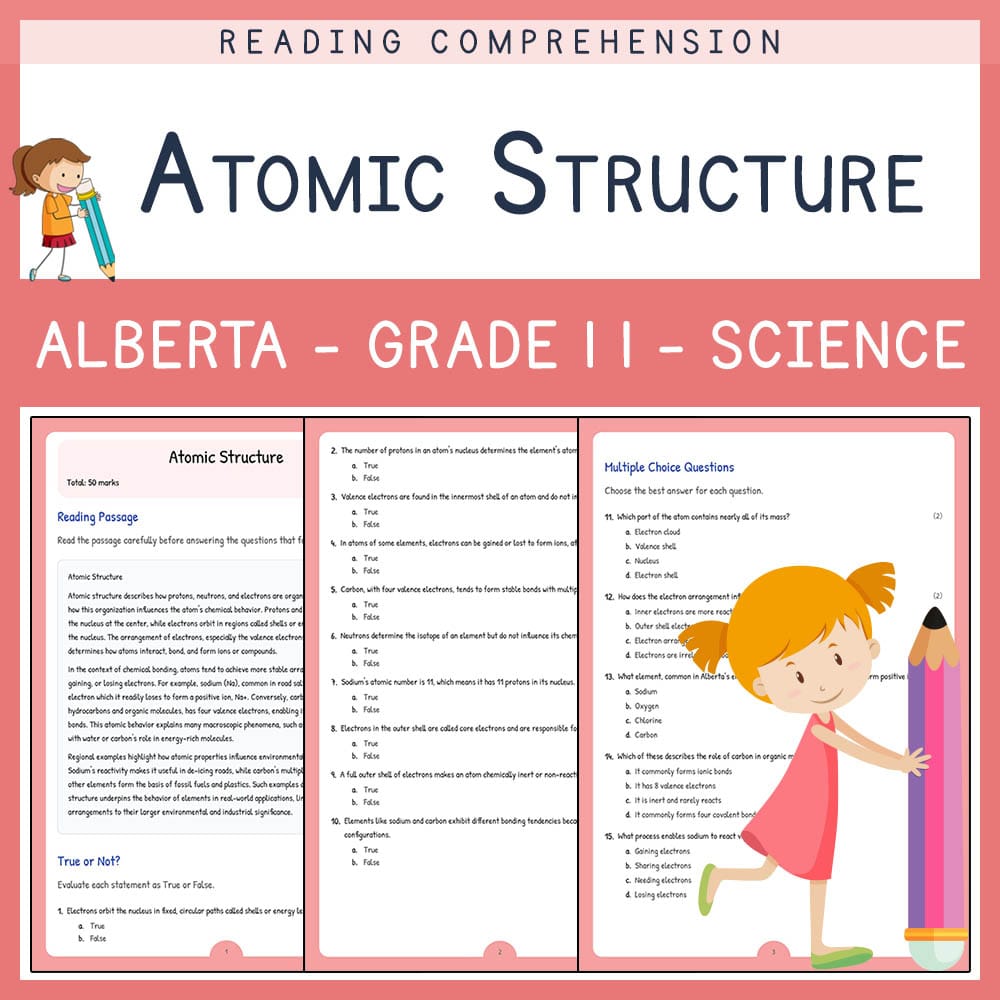
Grade 11 Science | Atomic Structure Worksheet | Alberta Standards
Created byLumora LearningLearning Objectives
- Describe the organization of protons, neutrons, and electrons within an atom.
- Explain how electron arrangements, including shells and valence electrons, influence chemical reactivity and bonding.
- Identify examples of elements used in industry and environment, such as sodium and carbon, and their atomic properties.
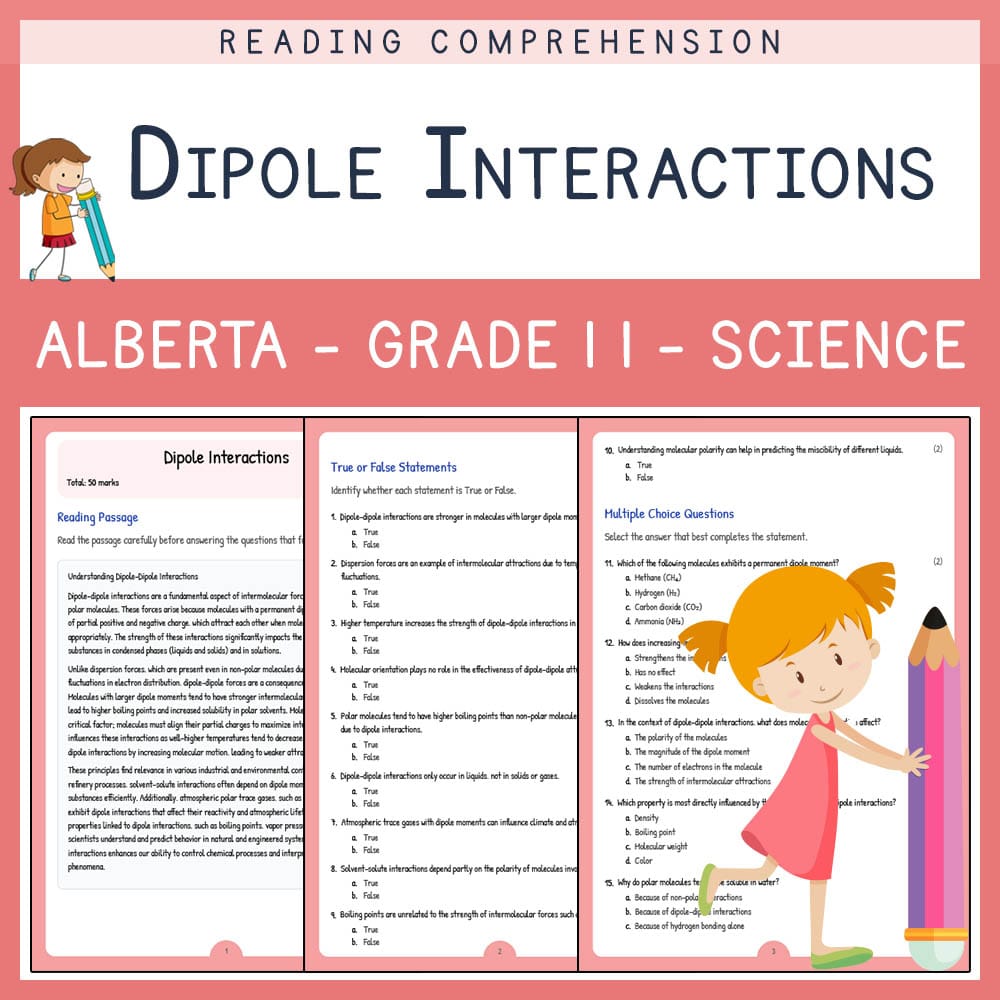
Grade 11 Science | Dipole Interactions Worksheet | Alberta Standards
Created byLumora LearningLearning Objectives
- Understand the concept of molecular dipoles and how they affect intermolecular forces.
- Explain the role of dipole–dipole interactions in determining physical properties such as boiling point and solubility.
- Analyze examples of dipole interactions in real-world applications like solvent–solute interactions and atmospheric gases.
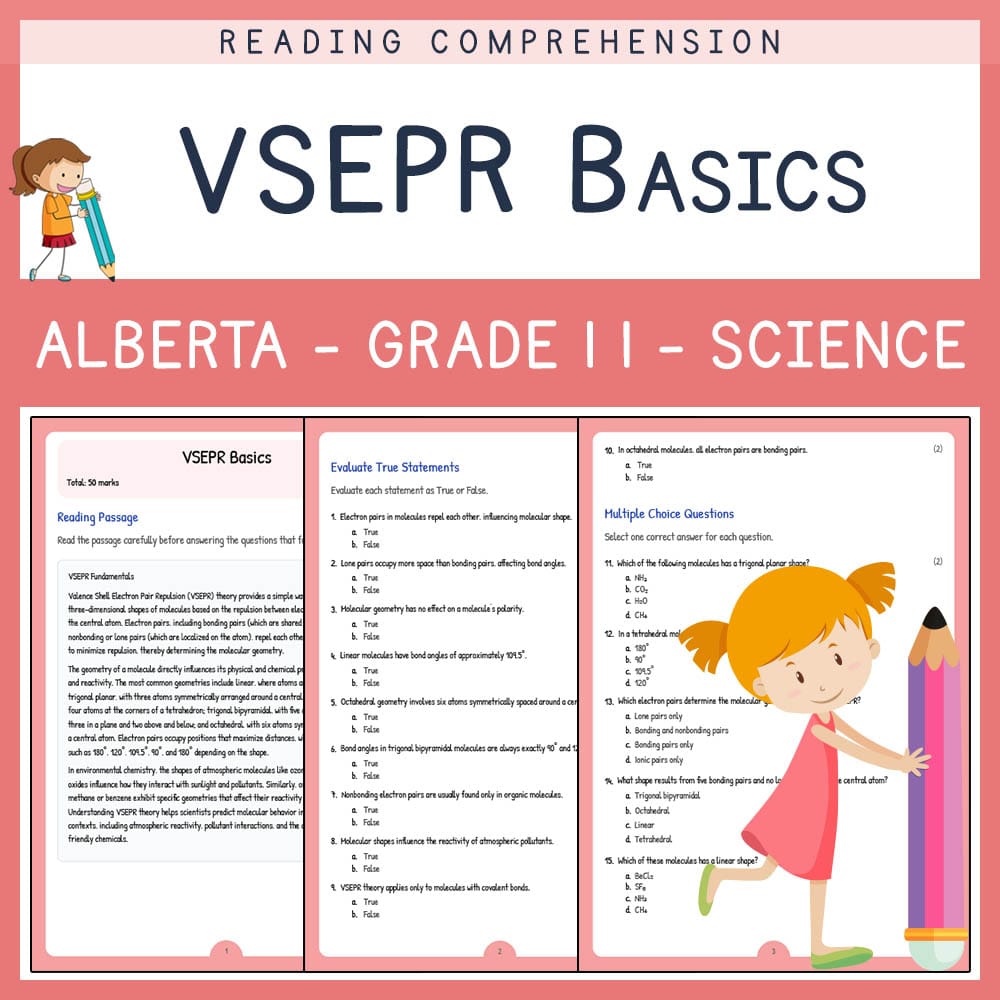
Grade 11 Science | VSEPR Basics Worksheet | Alberta Standards
Created byLumora LearningLearning Objectives
- Explain how electron pair repulsion determines molecular geometry in VSEPR theory.
- Identify common molecular shapes: linear, trigonal planar, tetrahedral, trigonal bipyramidal, and octahedral.
- Describe the role of bonding and nonbonding electron pairs in bond angles and molecular symmetry.
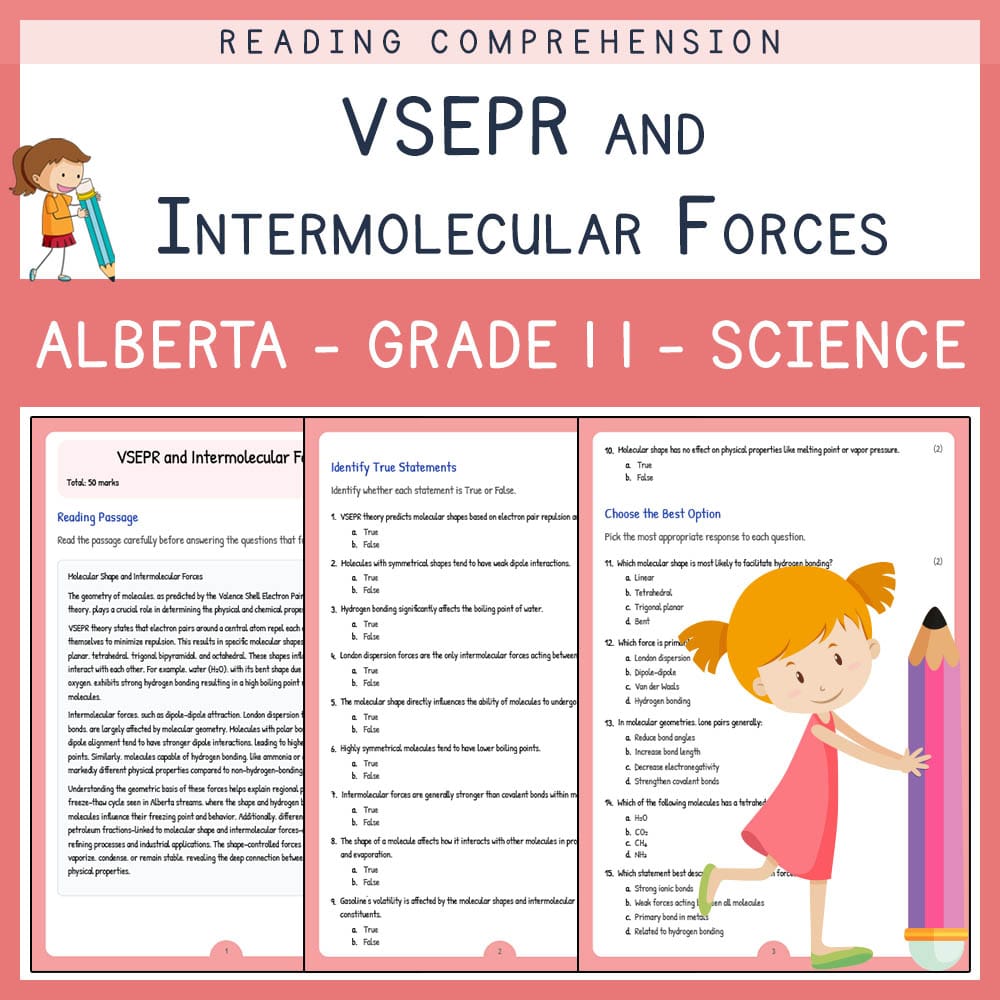
Grade 11 Science | VSEPR and Intermolecular Forces | Alberta Standards
Created byLumora LearningLearning Objectives
- Explain the VSEPR model and how molecular shapes influence intermolecular interactions.
- Describe how molecular geometry affects dipole moments and hydrogen bonding capabilities.
- Analyze the effects of molecular shape on boiling and melting points using real-world examples.
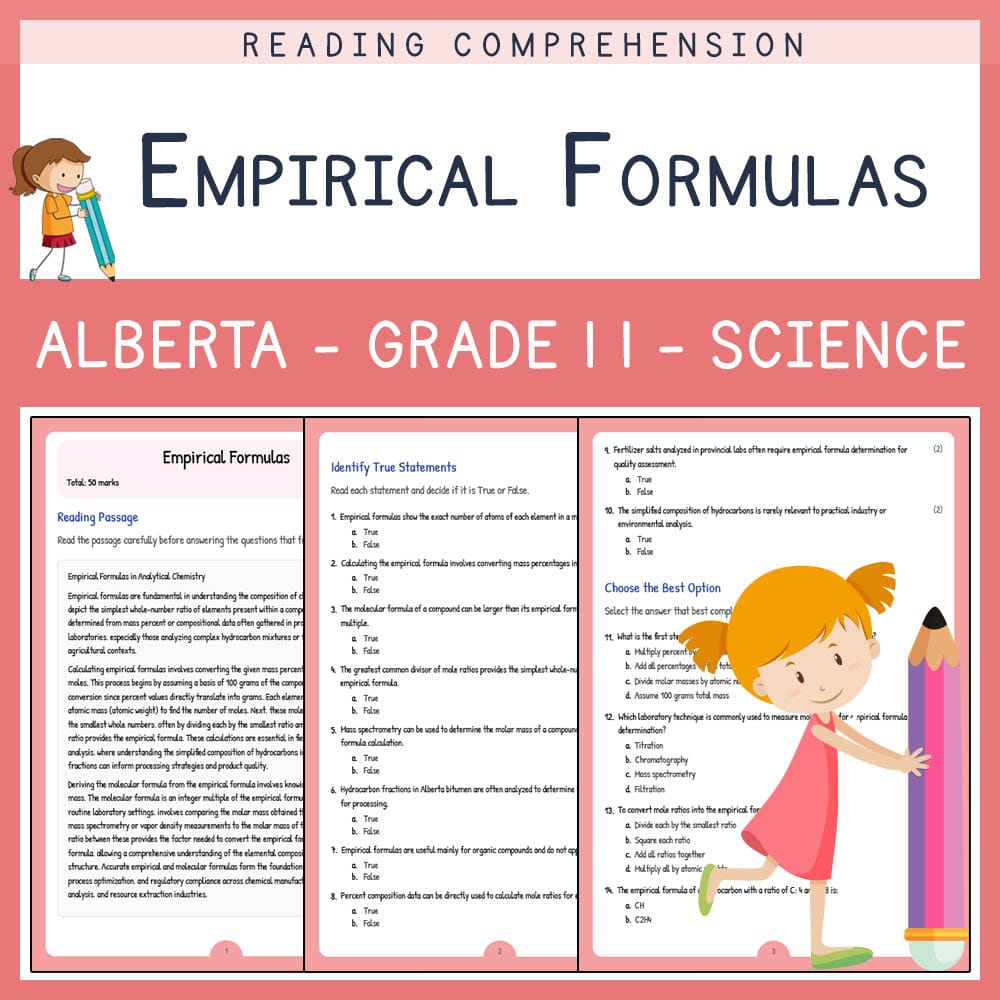
Grade 11 Science | Empirical Formulas Worksheet | Alberta Standards
Created byLumora LearningLearning Objectives
- Understand how empirical formulas are derived from mass percent and compositional data.
- Learn to convert percent composition to mole ratios for elements in a compound.
- Determine empirical and molecular formulas from analytical data.
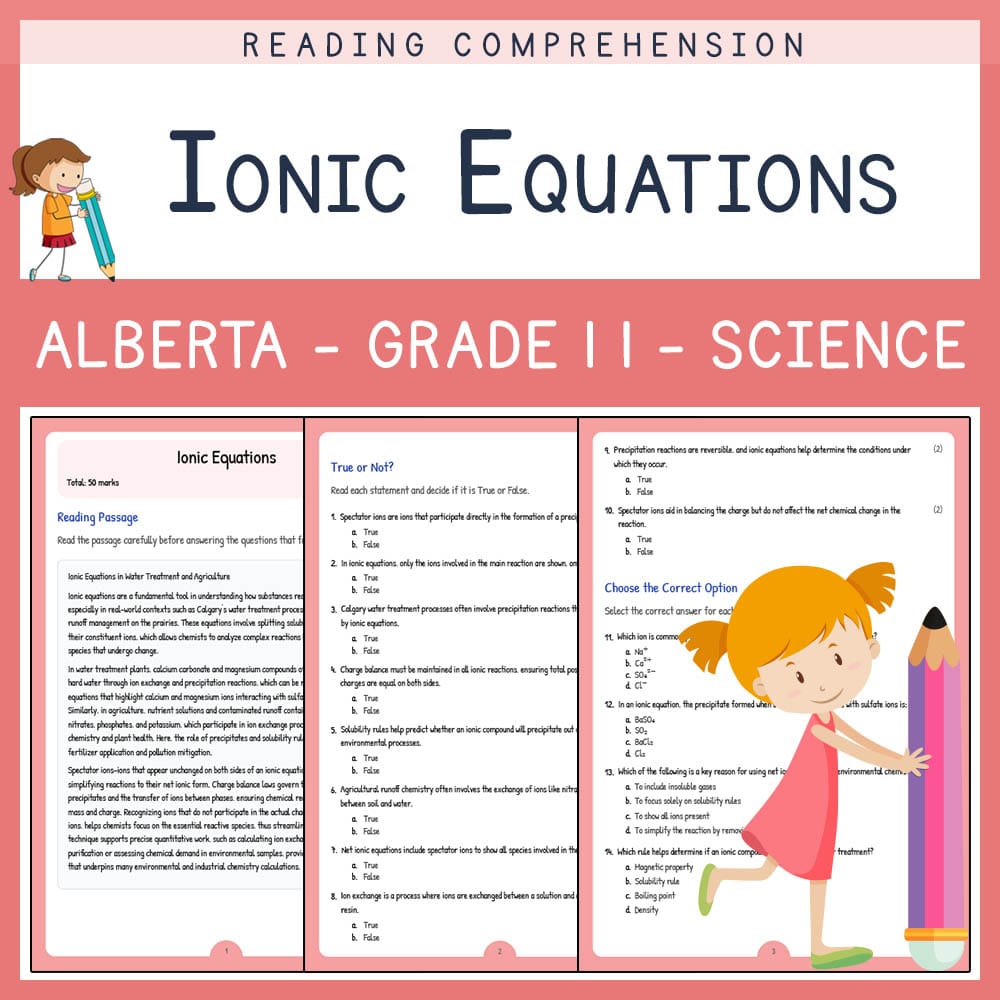
Grade 11 Science | Ionic Equations Worksheet | Alberta Standards
Created byLumora LearningLearning Objectives
- Understand how to convert chemical reactions into ionic equations, including complete and net forms.
- Identify spectator ions and distinguish them from reacting species in aqueous solutions.
- Apply charge balance and solubility rules to balance ionic equations accurately.
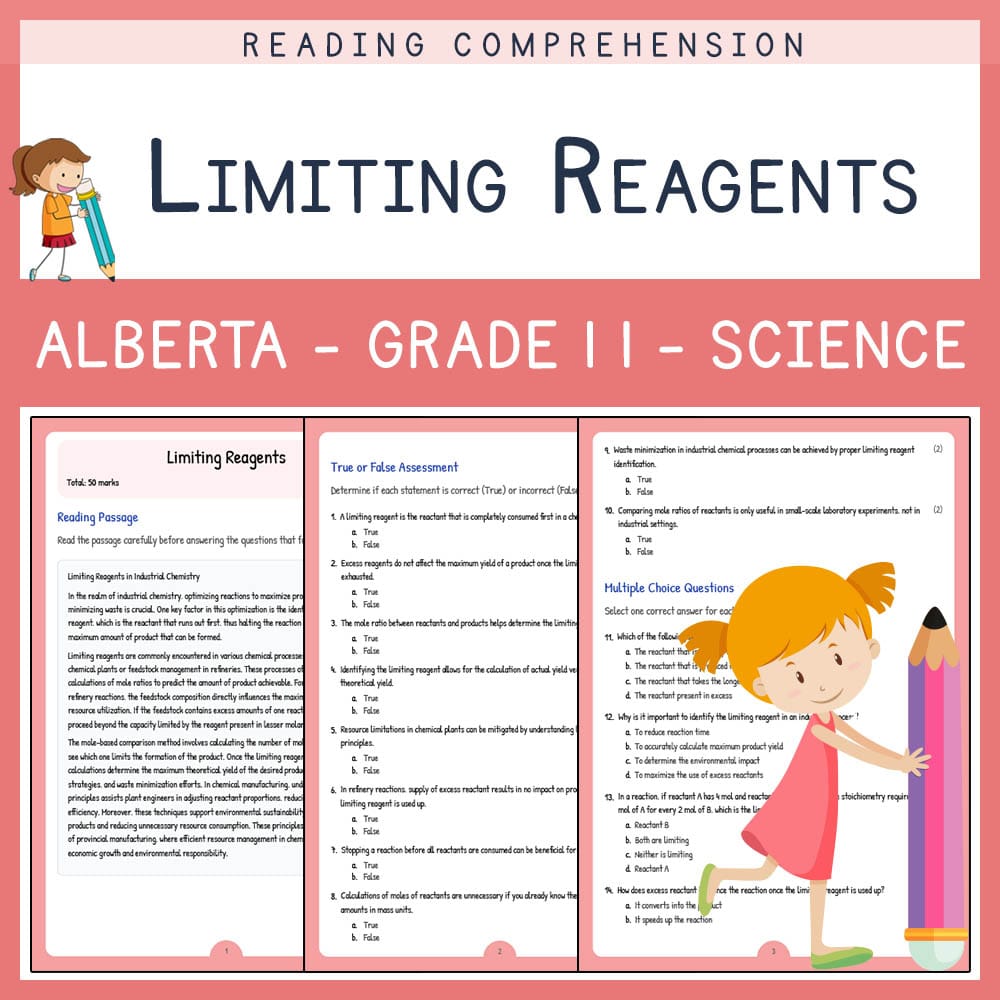
Grade 11 Science | Limiting Reagents Worksheet | Alberta Standards
Created byLumora LearningLearning Objectives
- Understand the concept of limiting and excess reagents in chemical reactions.
- Learn how to compare moles of reactants to determine the limiting reagent.
- Apply mole-based calculations to predict maximum theoretical yield.
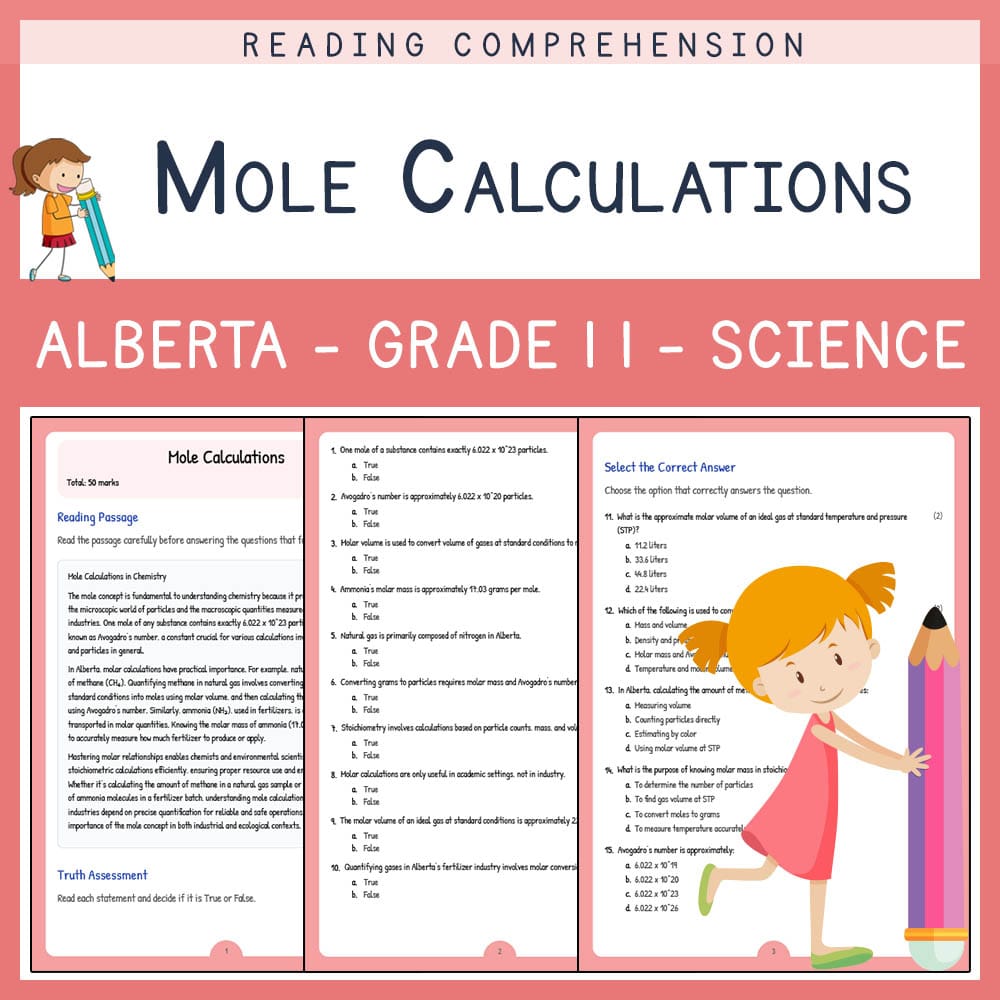
Grade 11 Science | Mole Calculations Worksheet | Alberta Standards
Created byLumora LearningLearning Objectives
- Understand the concept of the mole and its application in quantitative chemistry.
- Learn to convert between grams, moles, and particles using molar mass and Avogadro's number.
- Apply molar calculations to real-world Alberta contexts such as natural gas and fertilizer compounds.
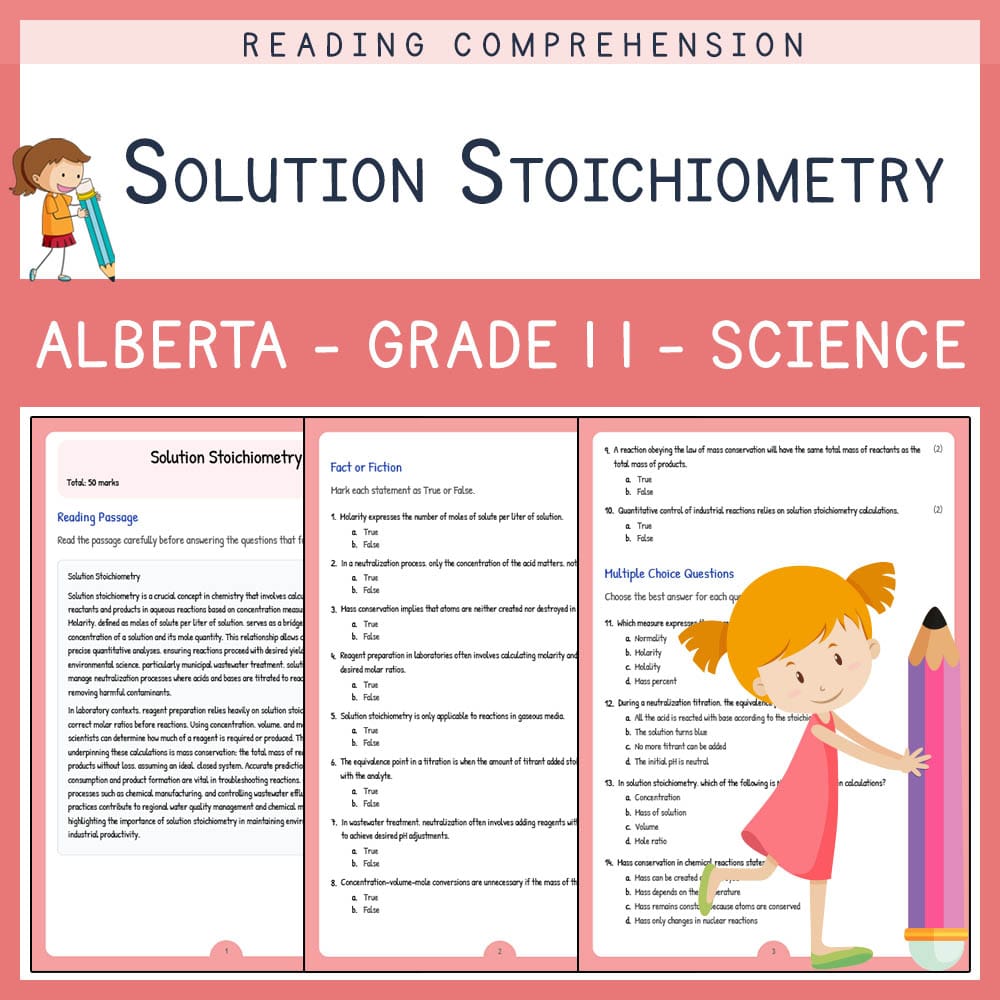
Grade 11 Science | Solution Stoichiometry Worksheet Elena | Alberta Standards
Created byLumora LearningLearning Objectives
- Understand the relationship between concentration, volume, and mole calculations in aqueous reactions.
- Apply mole relationships and equivalence concepts to predict reactant and product amounts.
- Utilize concentration-volume-mole conversions to support quantitative analysis in environmental and industrial contexts.
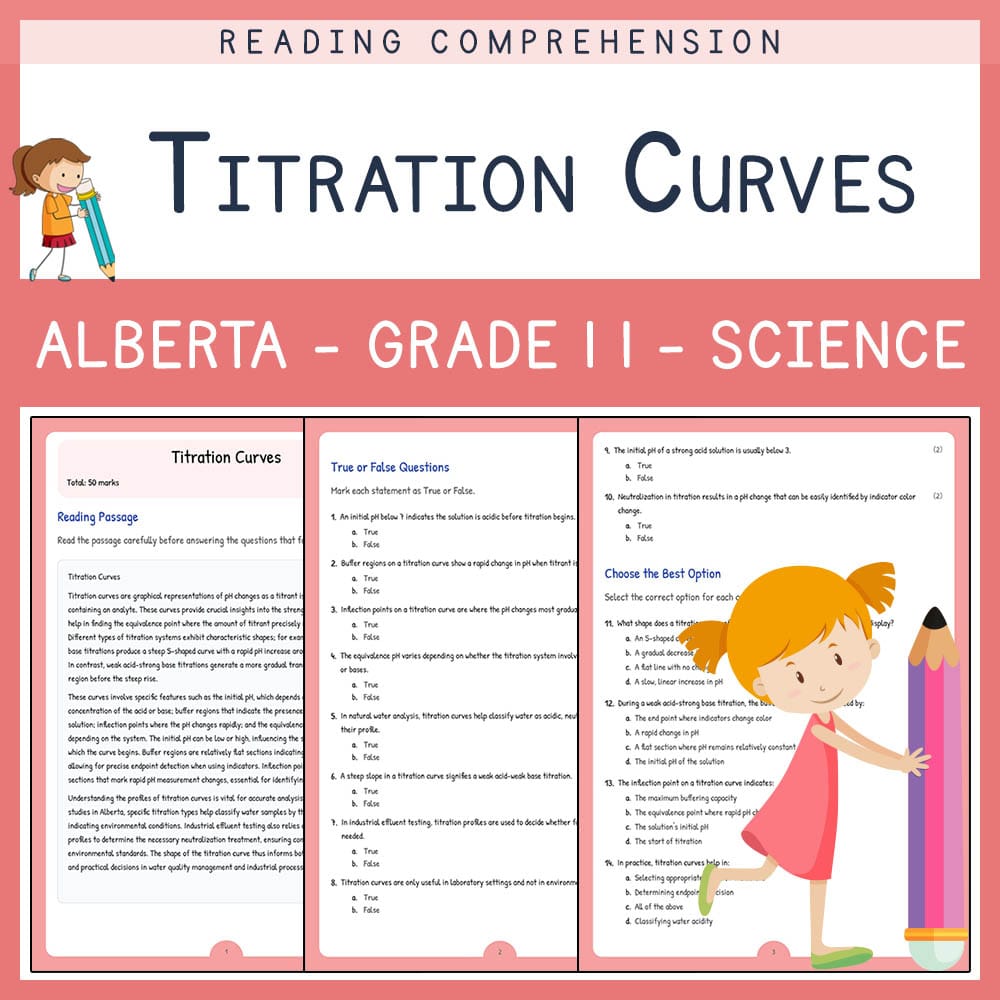
Grade 11 Science | Titration Curves Worksheet | Alberta Standards
Created byLumora LearningLearning Objectives
- Explain the shapes and features of different titration curves, including strong acid–strong base, weak acid–strong base, and weak base–strong acid systems.
- Identify key points on a titration curve such as initial pH, buffer regions, inflection points, and equivalence point pH.
- Determine the appropriate endpoint based on titration curve features for different acid–base systems.
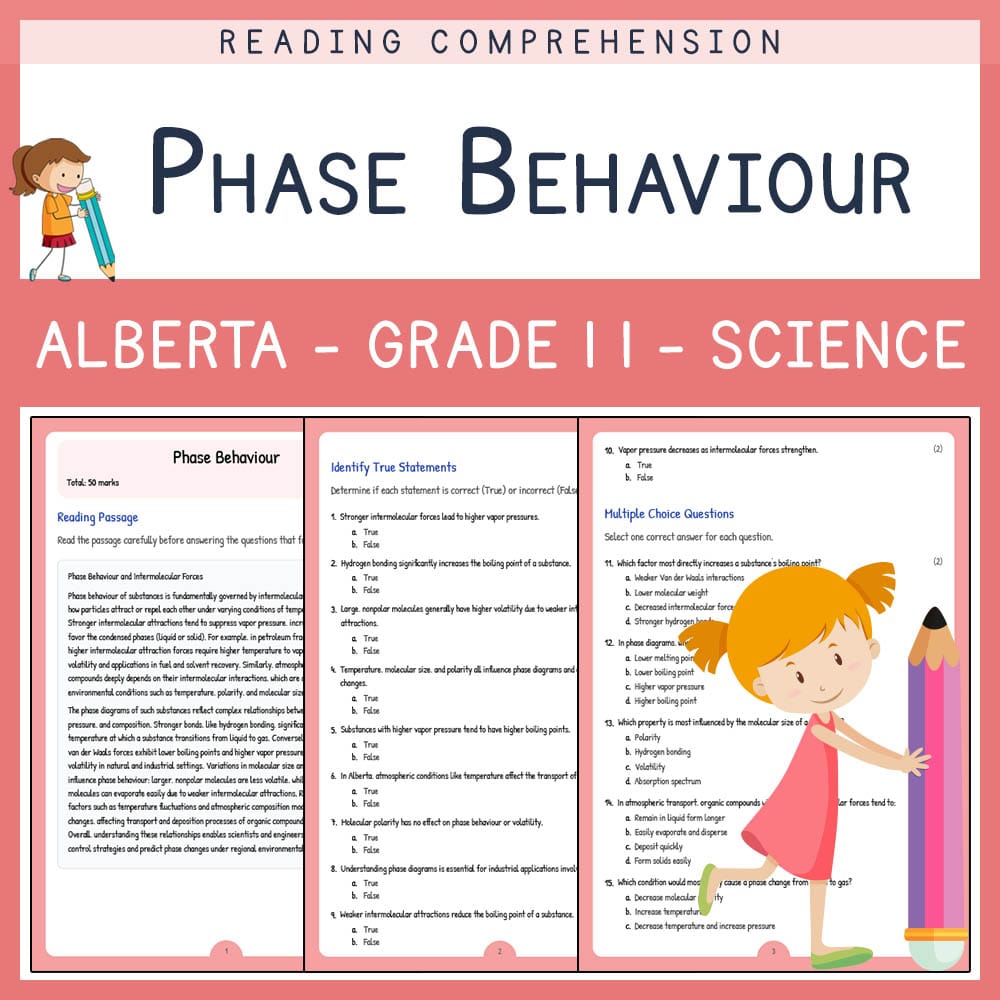
Grade 11 Science Worksheet | Phase Behaviour | Alberta Standards
Created byLumora LearningLearning Objectives
- Understand how intermolecular forces influence phase transitions, vapor pressure, and volatility.
- Explain the connection between intermolecular attractions and physical properties like boiling point and vapor pressure.
- Apply knowledge of phase diagrams considering temperature, molecular size, and polarity in regional environmental contexts.
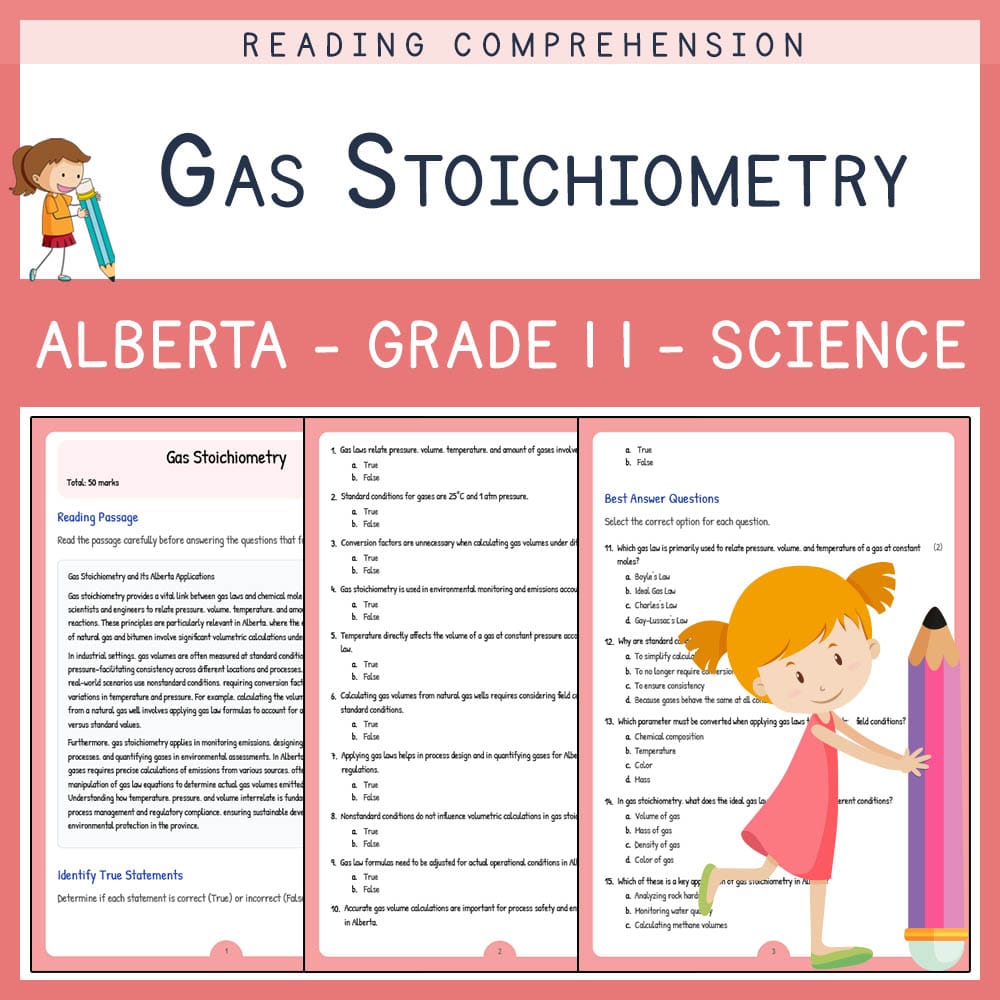
Grade 11 Science | Gas Stoichiometry Worksheet | Alberta Standards
Created byLumora LearningLearning Objectives
- Understand the principles of gas laws and how they relate to mole relationships in gas stoichiometry.
- Apply gas law equations to calculate pressures, volumes, and temperatures of gases in chemical reactions.
- Analyze how standard and nonstandard conditions impact volumetric conversions in industrial contexts.
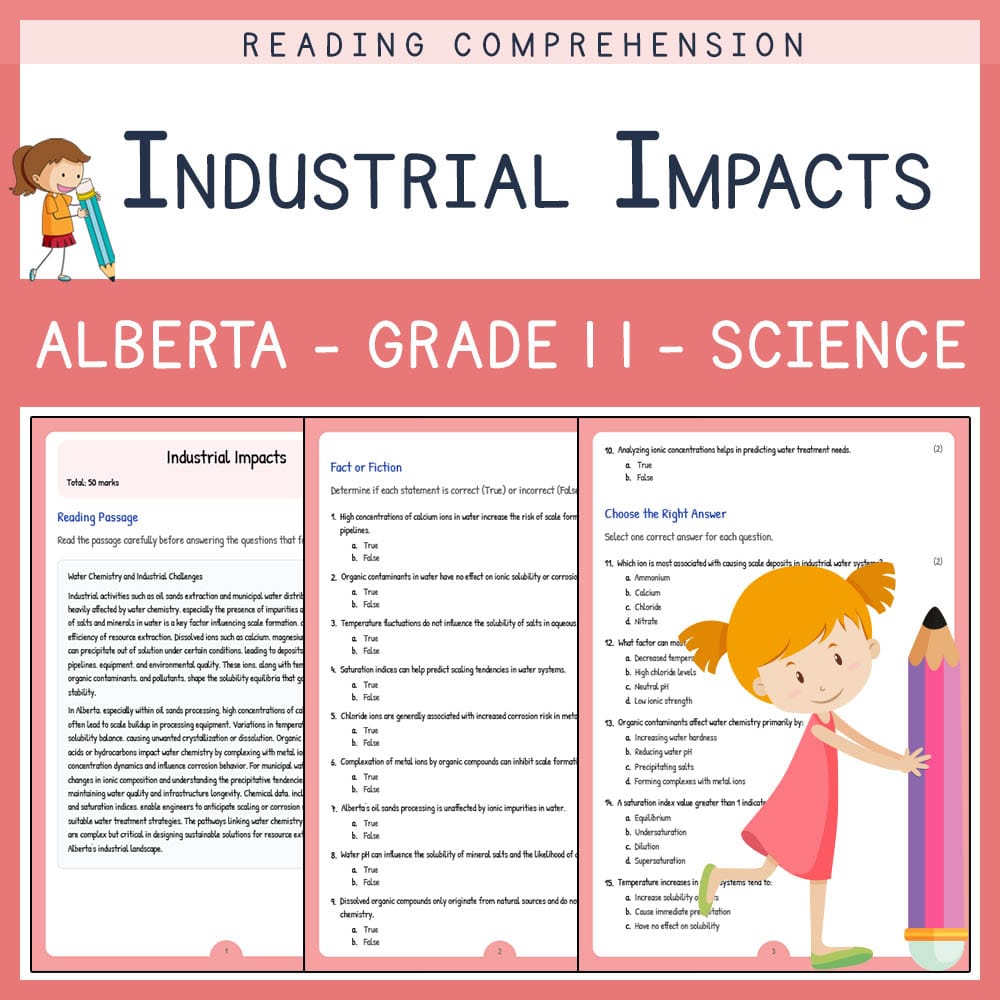
Grade 11 Science | Industrial Impacts Worksheet | Alberta Standards
Created byLumora LearningLearning Objectives
- Understand how dissolved ions, temperature shifts, and organic contaminants influence solubility equilibria in water systems.
- Interpret chemical data to evaluate operational challenges related to scale formation, corrosion, and impurity effects.
- Analyze the impact of environmental impurities on infrastructure, especially in Alberta's oil sands processing and municipal water systems.
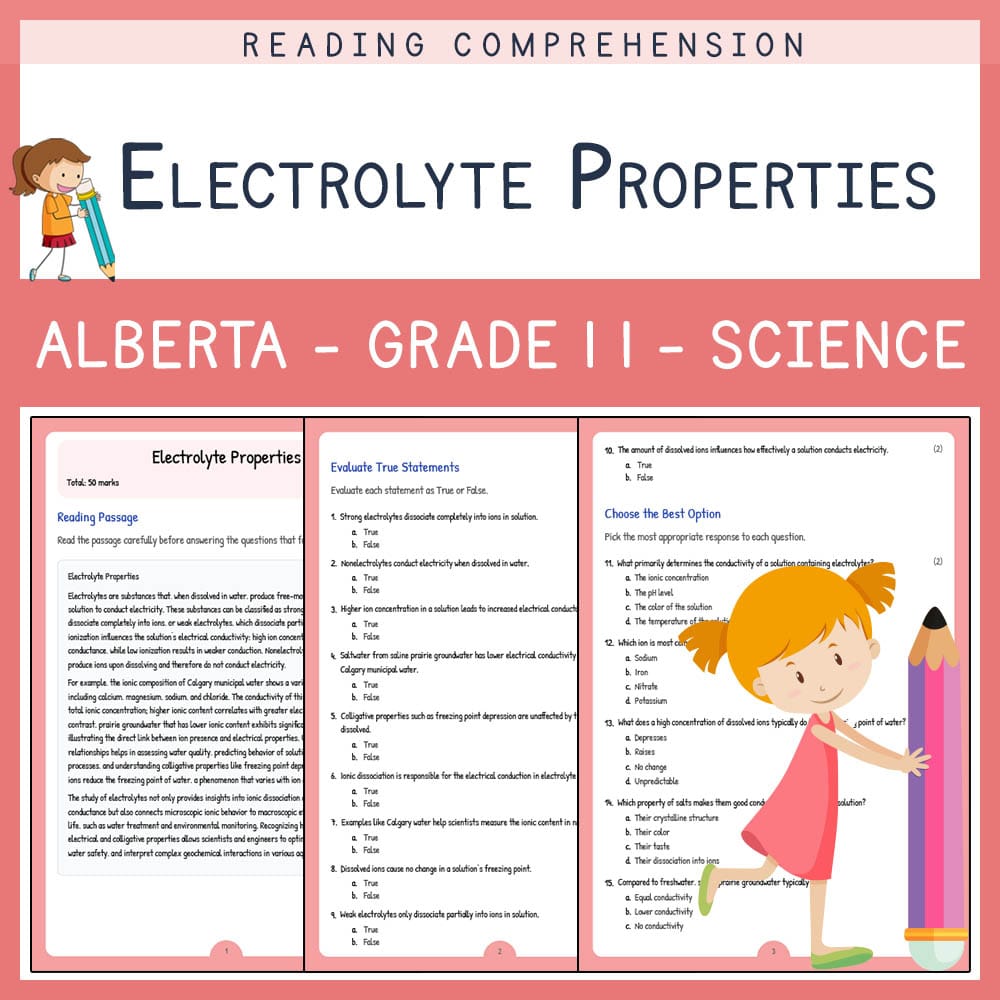
Grade 11 Science | Electrolyte Properties Worksheet | Alberta Standards
Created byLumora LearningLearning Objectives
- Explain the difference between electrolytes and nonelectrolytes based on ion dissociation.
- Describe how ion concentration affects electrical conductance in solutions.
- Identify the impact of solute particles on colligative properties such as freezing point depression.
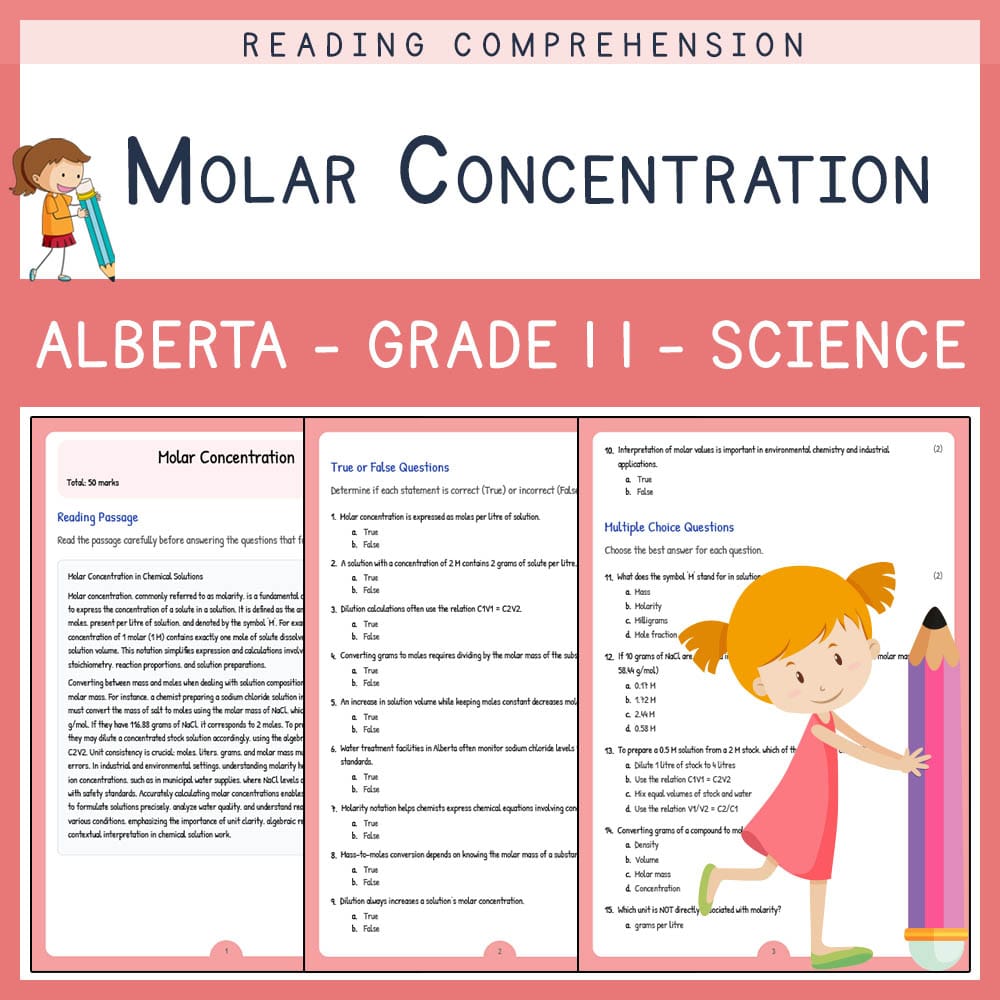
Grade 11 Science | Molar Concentration Worksheet | Alberta Standards
Created byLumora LearningLearning Objectives
- Define molar concentration and understand its notation.
- Convert between mass, moles, and volume in solution preparation.
- Apply dilution calculations to prepare solutions from concentrated stocks.
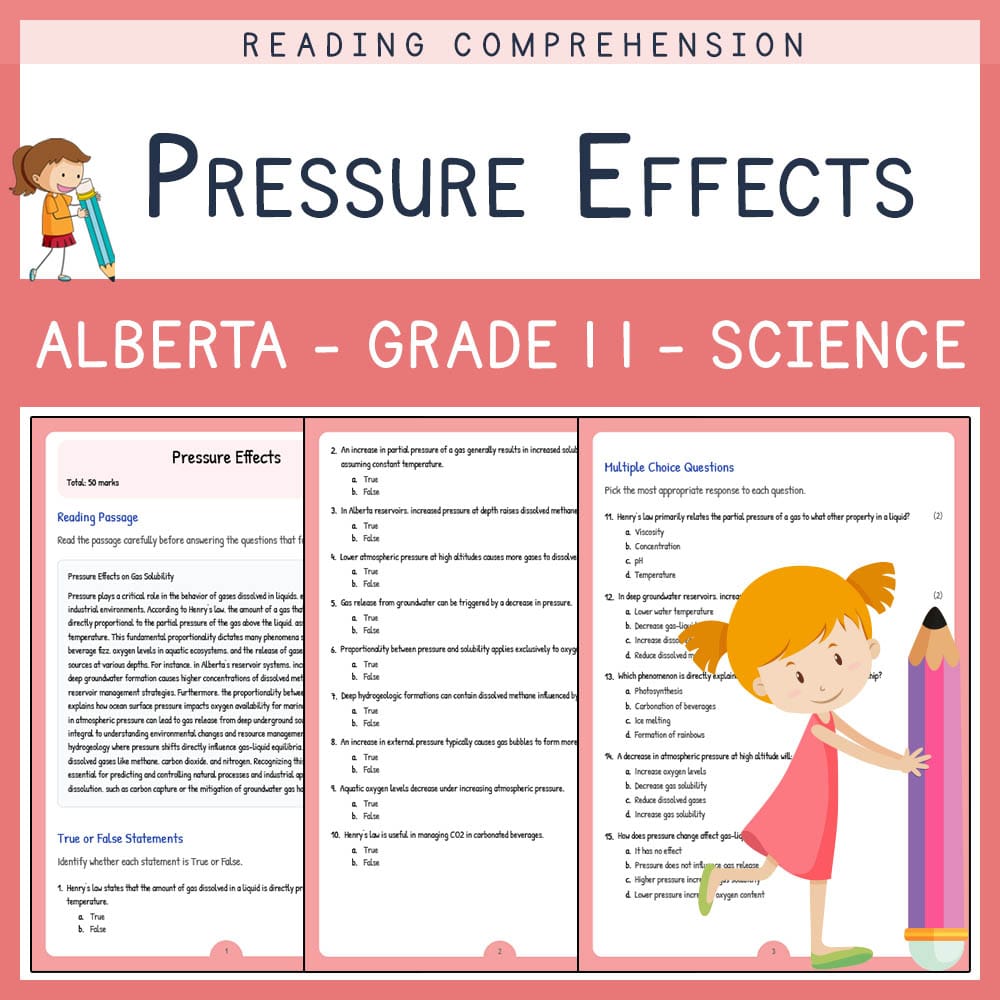
Grade 11 Science | Pressure Effects Worksheet | Alberta Standards
Created byLumora LearningLearning Objectives
- Understand how pressure influences gas solubility according to Henry's law.
- Recognize the practical implications of pressure changes in natural and industrial settings.
- Describe proportionality concepts relating partial pressure and dissolved gas concentrations.

Grade 11 Science | Ionic Strength Worksheet | Alberta Standards
Created byLumora LearningLearning Objectives
- Explain the concept of ionic strength and its impact on activity coefficients.
- Describe how high ionic strength reduces the activity of ions in solutions.
- Discuss the effects of ionic strength on solubility and equilibrium in natural and industrial aqueous systems.
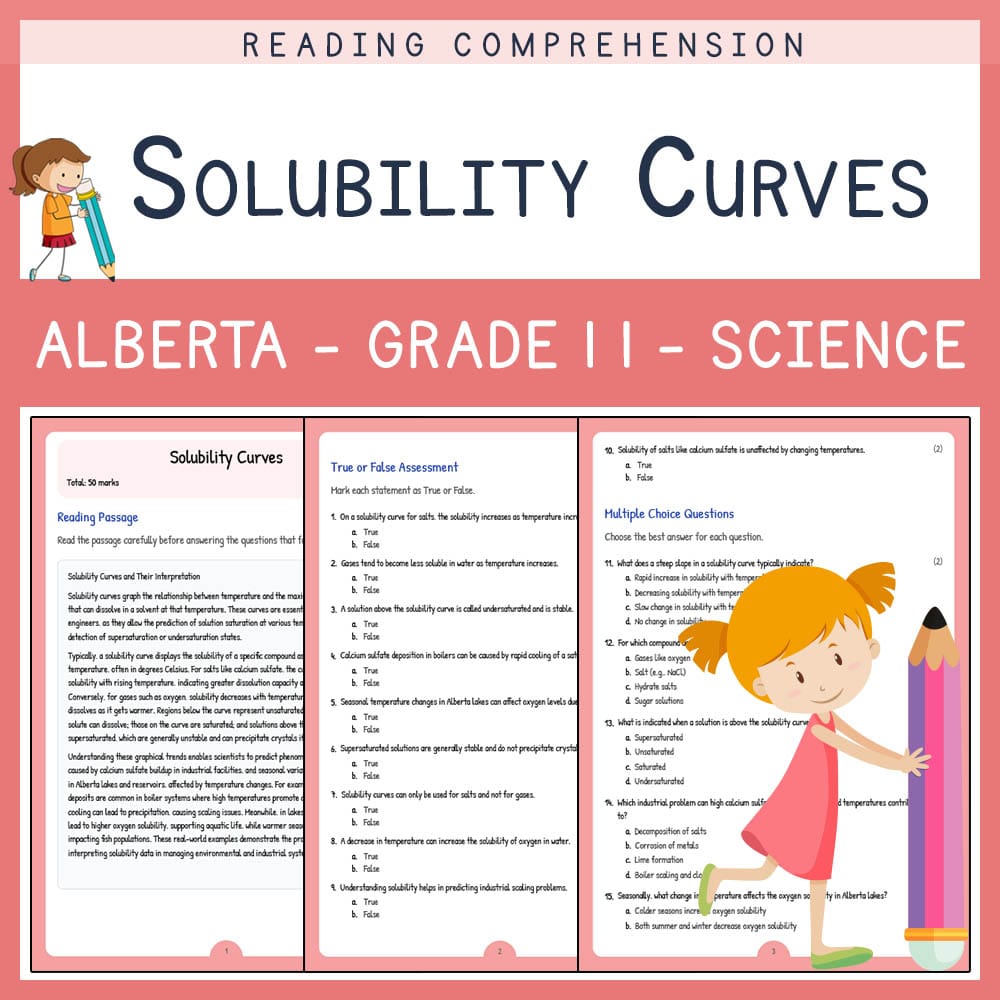
Grade 11 Science | Solubility Curves Worksheet | Alberta Standards
Created byLumora LearningLearning Objectives
- Understand how to read and interpret solubility curves for different compounds.
- Identify regions of unsaturated, saturated, and supersaturated solutions on a graph.
- Connect graphical trends to molecular interactions and predict solution states.
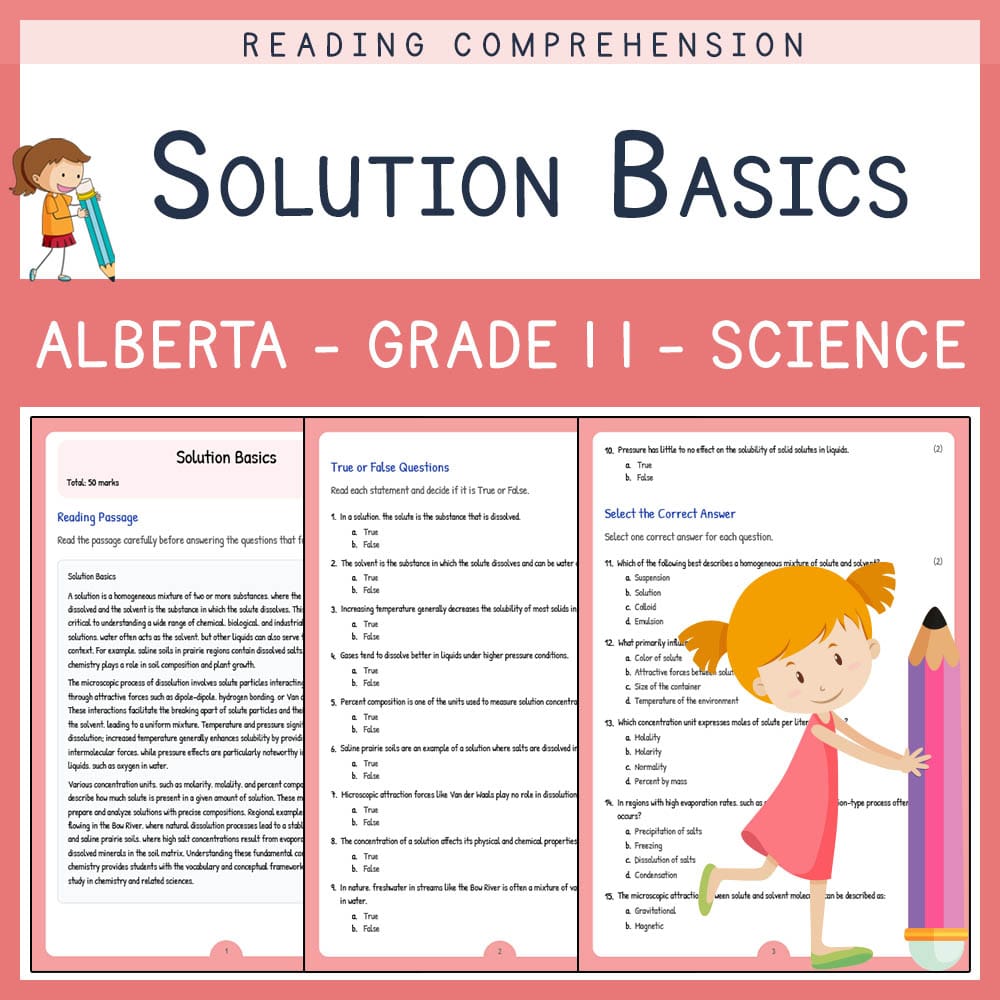
Grade 11 Science | Solution Basics Worksheet | Alberta Standards
Created byLumora LearningLearning Objectives
- Define solute and solvent in the context of solutions.
- Understand concentration units and how they describe solution strength.
- Explain the microscopic interactions during dissolution and how temperature and pressure affect solution formation.
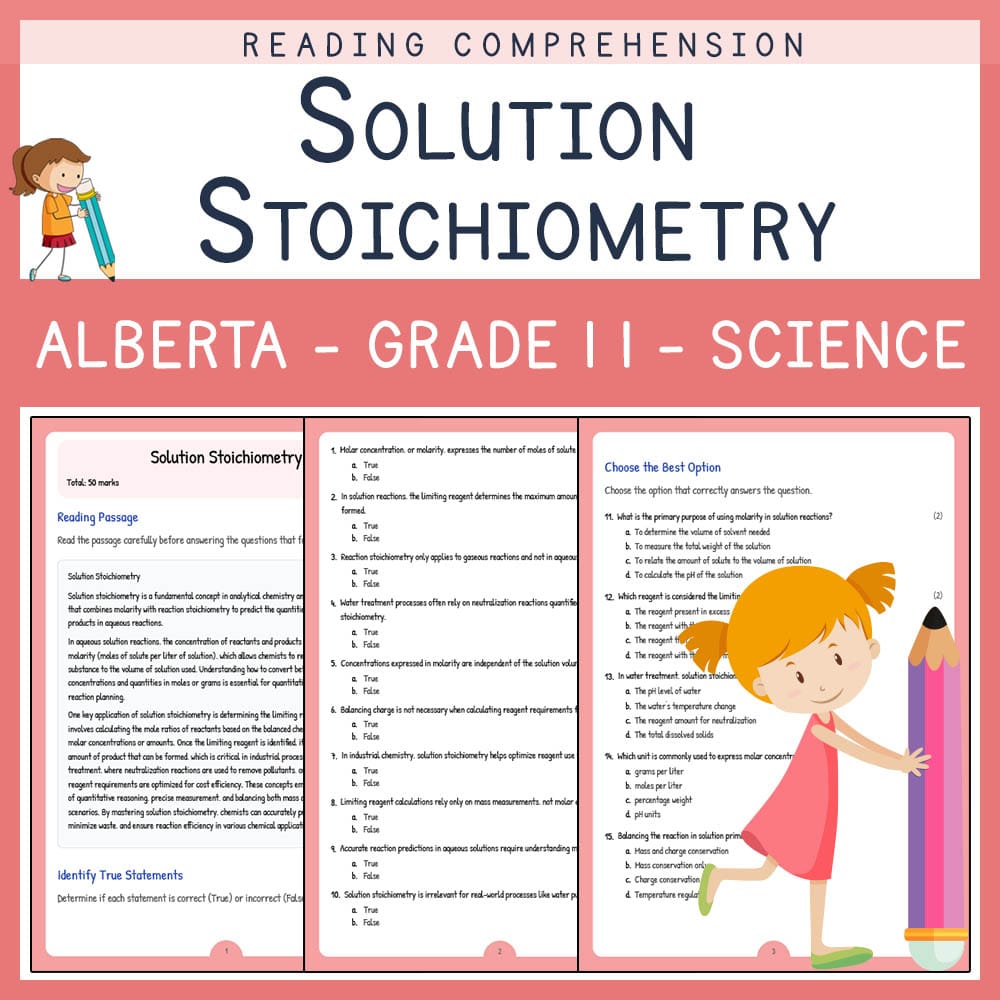
Grade 11 Science | Solution Stoichiometry Worksheet | Alberta Standards
Created byLumora LearningLearning Objectives
- Understand the concept of concentration and how it relates to molar ratios in aqueous reactions.
- Apply mole–mole relationships to predict reactant and product amounts in solution.
- Identify limiting reagents in solution-phase reactions through stoichiometric calculations.
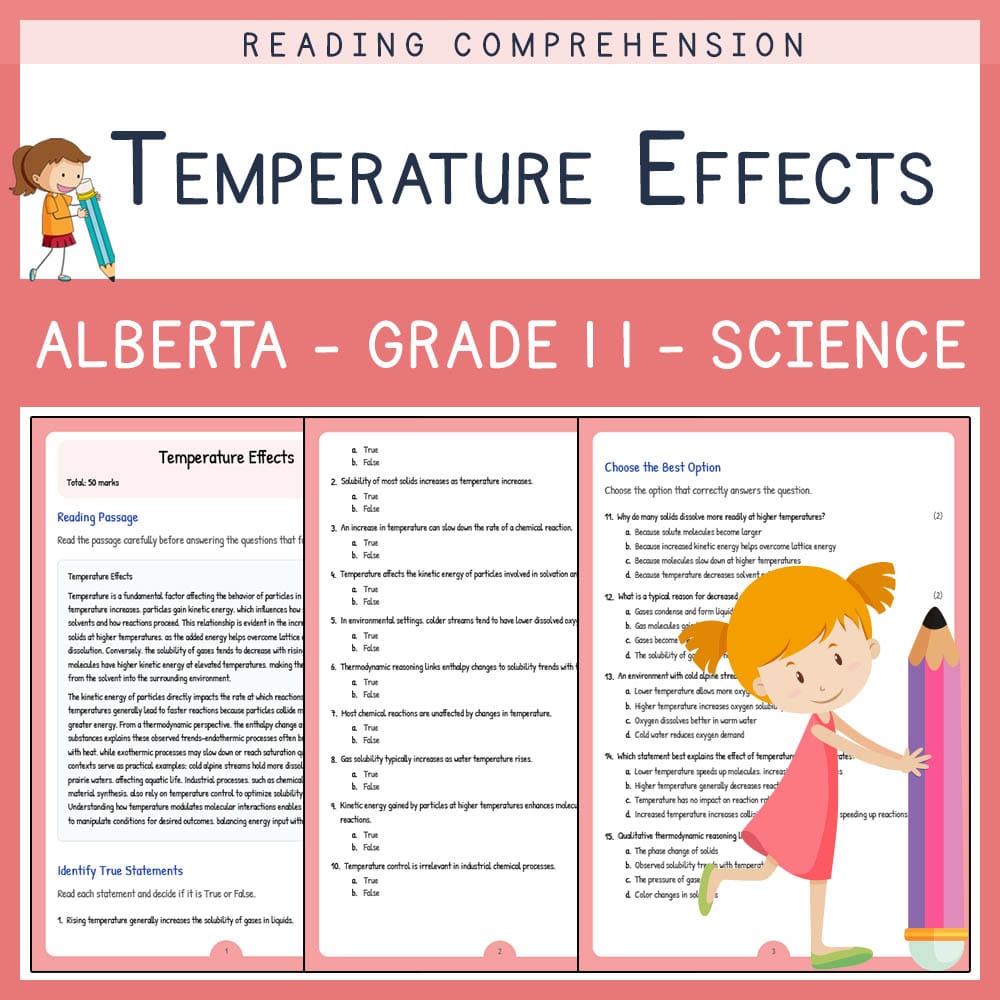
Grade 11 Science | Temperature Effects Worksheet | Alberta Standards
Created byLumora LearningLearning Objectives
- Describe how temperature influences the kinetic energy of particles and solvent–solute interactions.
- Explain why solids dissolve more readily at higher temperatures and why gas solubility decreases with increasing temperature.
- Apply qualitative thermodynamic reasoning to analyze solubility and reaction rate trends with temperature.

Grade 11 Science | Digital Information Worksheet Elena | California Standards
Created byLumora LearningLearning Objectives
- Explain how digital communication encodes sampled signals into discrete binary symbols.
- Compare digital and analog information transmission in terms of noise sensitivity and reliability.
- Describe how error correction can recover intended messages despite channel noise.
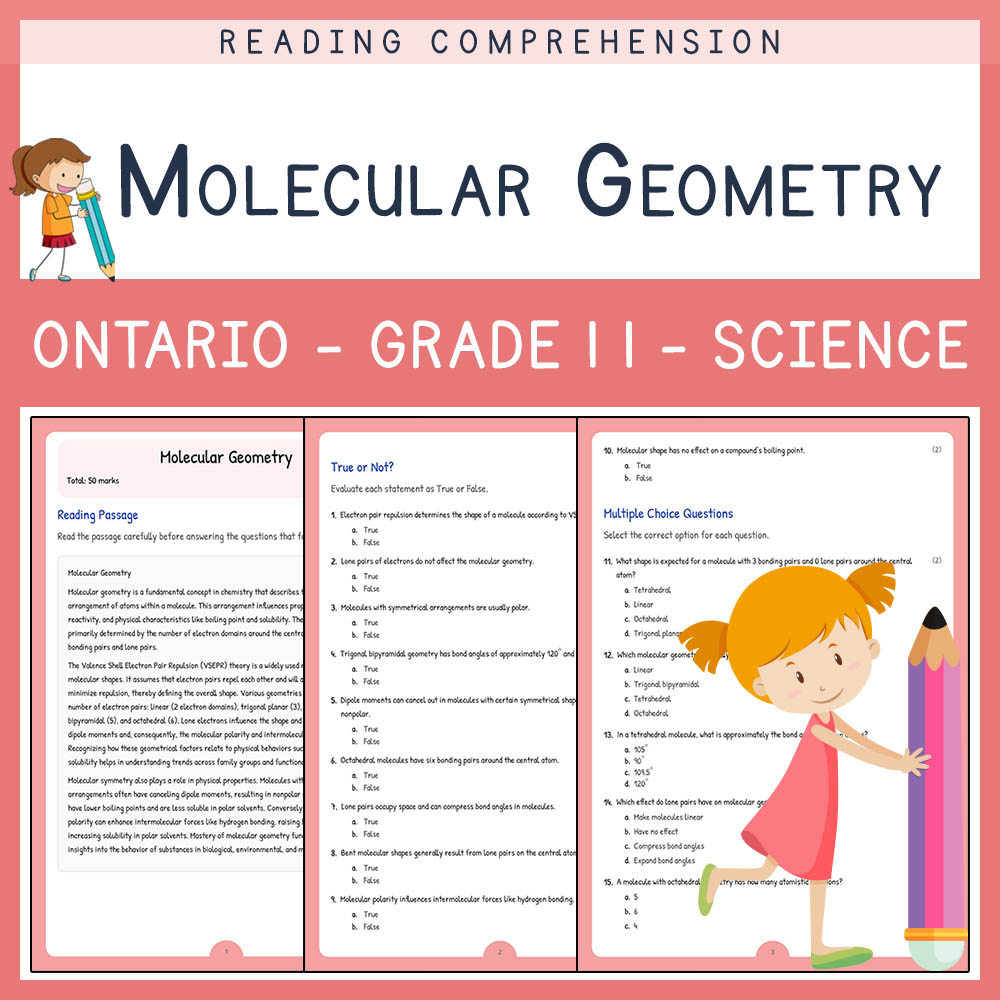
Grade 11 Science Assessment | Molecular Geometry Worksheet Elena | Ontario
Created byLumora LearningLearning Objectives
- Understand the electron-domain and VSEPR models for predicting molecular shapes.
- Identify various molecular geometries and their bond angles.
- Analyze effects of lone pairs and symmetry on molecular polarity and physical properties.

Grade 11 Science | Organ Systems Worksheet | TEKS Aligned
Created byLumora LearningLearning Objectives
- Identify the main functions of human organ systems.
- Describe the structures involved in each organ system.
- Explain how different organ systems interact to maintain homeostasis.

Grade 11 Science | Natural Selection Worksheet | BC-Aligned
Created byLumora LearningLearning Objectives
- Understand how heritable variation influences natural selection.
- Describe the different modes of selection: directional, stabilizing, and disruptive.
- Explain environmental factors that shape selective regimes.

Grade 11 Science | Erosion and Sedimentation Worksheet | BC-Aligned
Created byLumora LearningLearning Objectives
- Understand the processes of weathering, erosion, transportation, and deposition in landscape change.
- Explain how physical and chemical weathering contribute to sediment formation.
- Identify different agents of erosion and their roles in sediment transport.

Grade 11 Science | Phylogenetic Trees Worksheet | TEKS-Aligned
Created byLumora LearningLearning Objectives
- Explain how phylogenetic trees depict evolutionary relationships among organisms.
- Identify key features of rooted and unrooted trees.
- Interpret branching patterns, nodes, and clades in phylogenetic hypotheses.

Grade 11 Science | Reaction Types Worksheet | BC-Aligned
Created byLumora LearningLearning Objectives
- Classify chemical reactions into synthesis, decomposition, single- and double-displacement, combustion, and redox types.
- Describe characteristic atom rearrangements and changes in oxidation states for each reaction type.
- Identify energy changes associated with different reaction classes and relate them to practical examples.
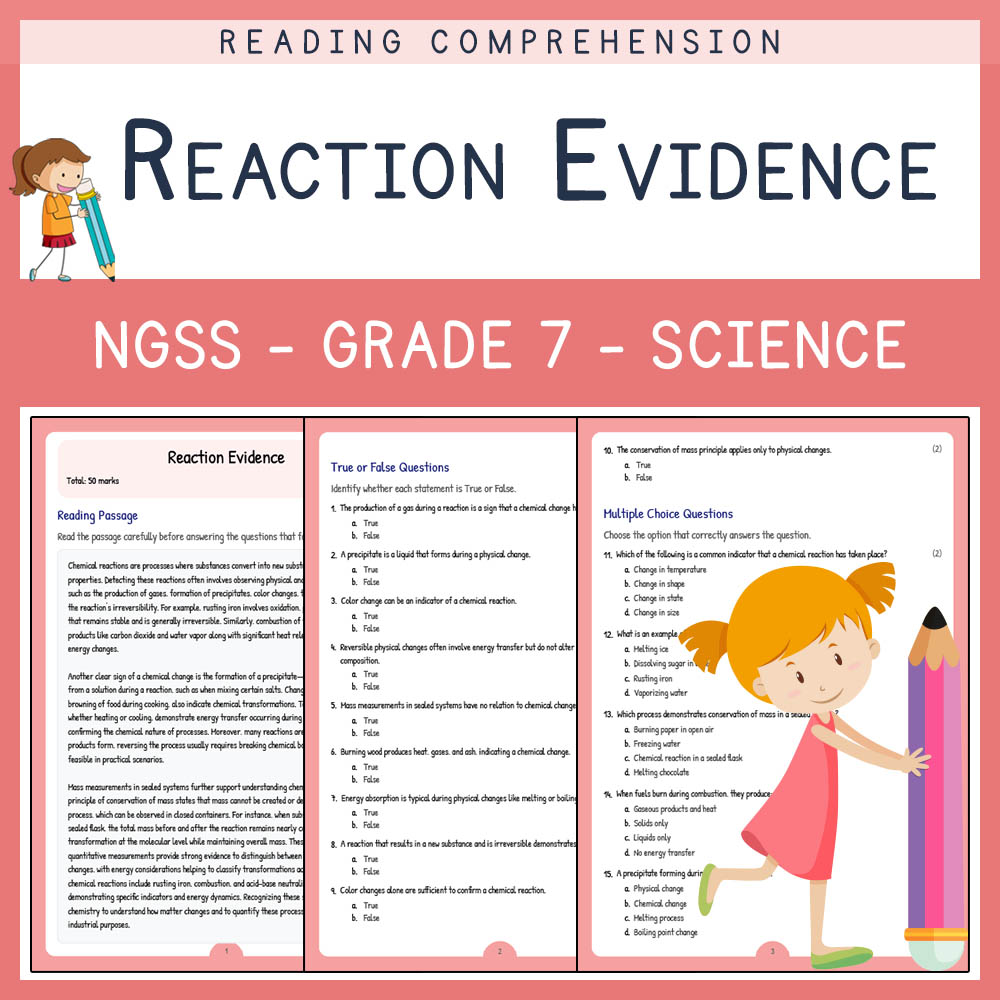
Grade 7 Science | Reaction Evidence Worksheet & Answer Key (NGSS Aligned)
Created byLumora LearningLearning Objectives
- Identify observable indicators that a chemical reaction has occurred, such as gas production, precipitate formation, color change, and temperature change.
- Explain irreversibility in chemical reactions and relate it to composition changes.
- Describe examples of chemical reactions, including rusting, combustion, and neutralization, and discuss how mass measurements in sealed systems demonstrate conservation principles.
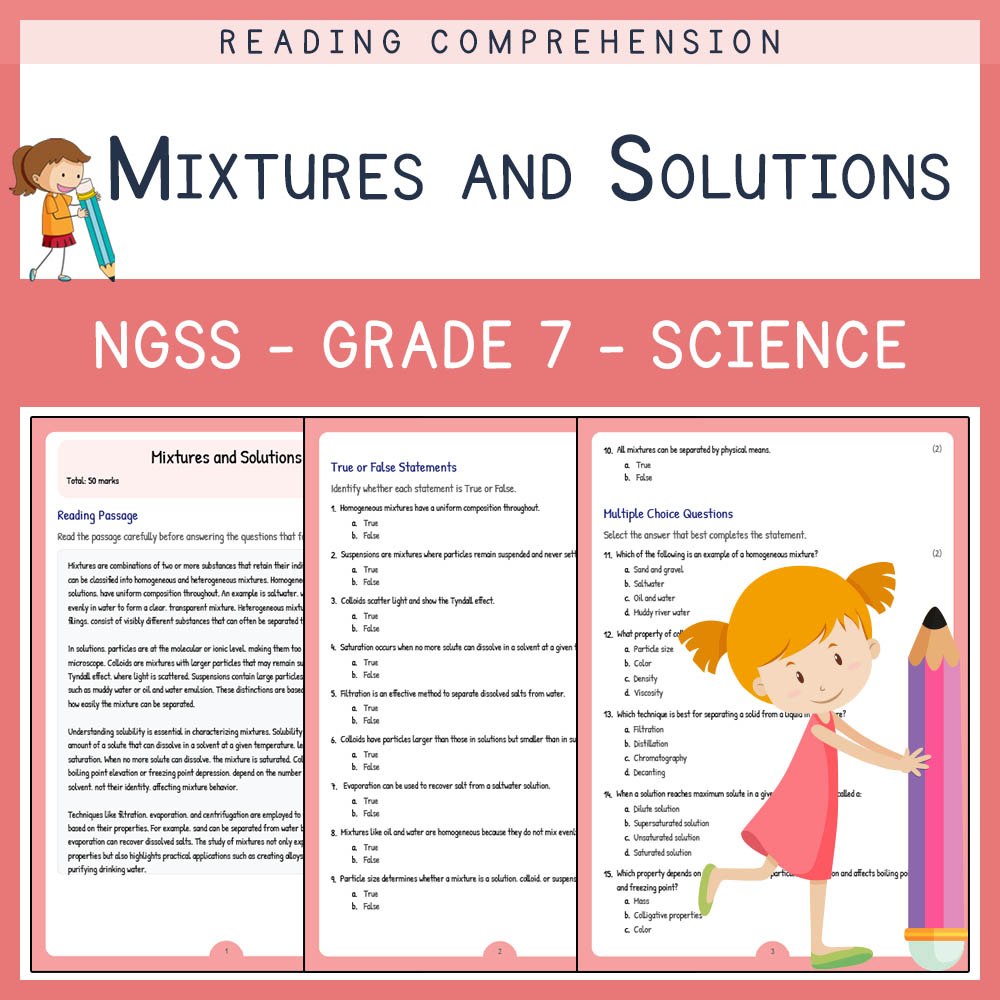
Grade 7 Science |Mixtures and Solutions Worksheet (NGSS Aligned with Answer Key)
Created byLumora LearningLearning Objectives
- Describe the differences between homogeneous and heterogeneous mixtures.
- Identify examples of solutions, colloids, and suspensions based on particle size and separation behavior.
- Explain concepts like solubility, saturation, and colligative effects in mixtures.

Grade 7 Science | Gravity on Objects Worksheet | California Standards
Created byLumora LearningLearning Objectives
- Explain how gravity produces weight and affects the motion of objects near Earth
- Relate gravitational force and acceleration using the role of mass and inertia
- Describe how support forces (normal forces) balance weight when objects are at rest
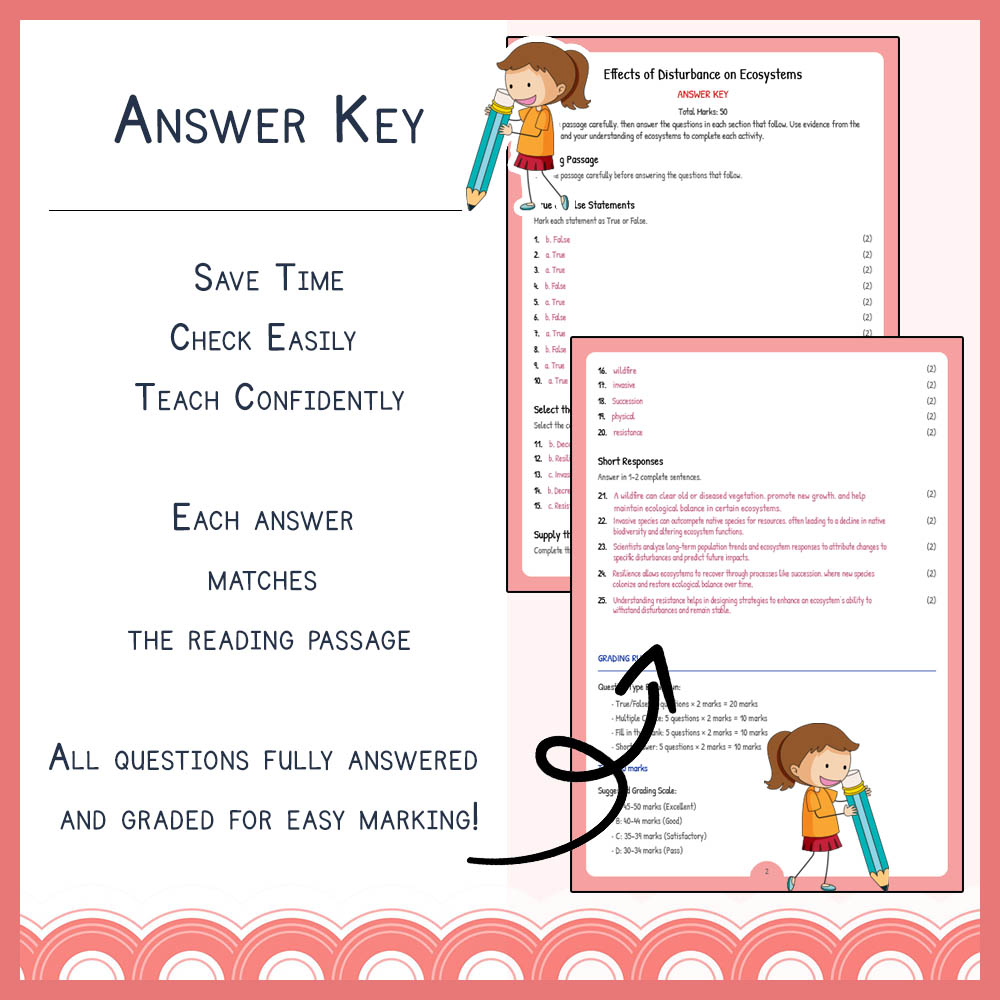
Grade 7 Science | Effects of Disturbance on Ecosystems Worksheet & Answer Key
Created byLumora LearningLearning Objectives
- Understand how physical and biological disturbances influence ecosystem dynamics.
- Interpret empirical data to determine causes of population changes in ecosystems.
- Describe mechanisms of ecosystem resilience, resistance, and succession.
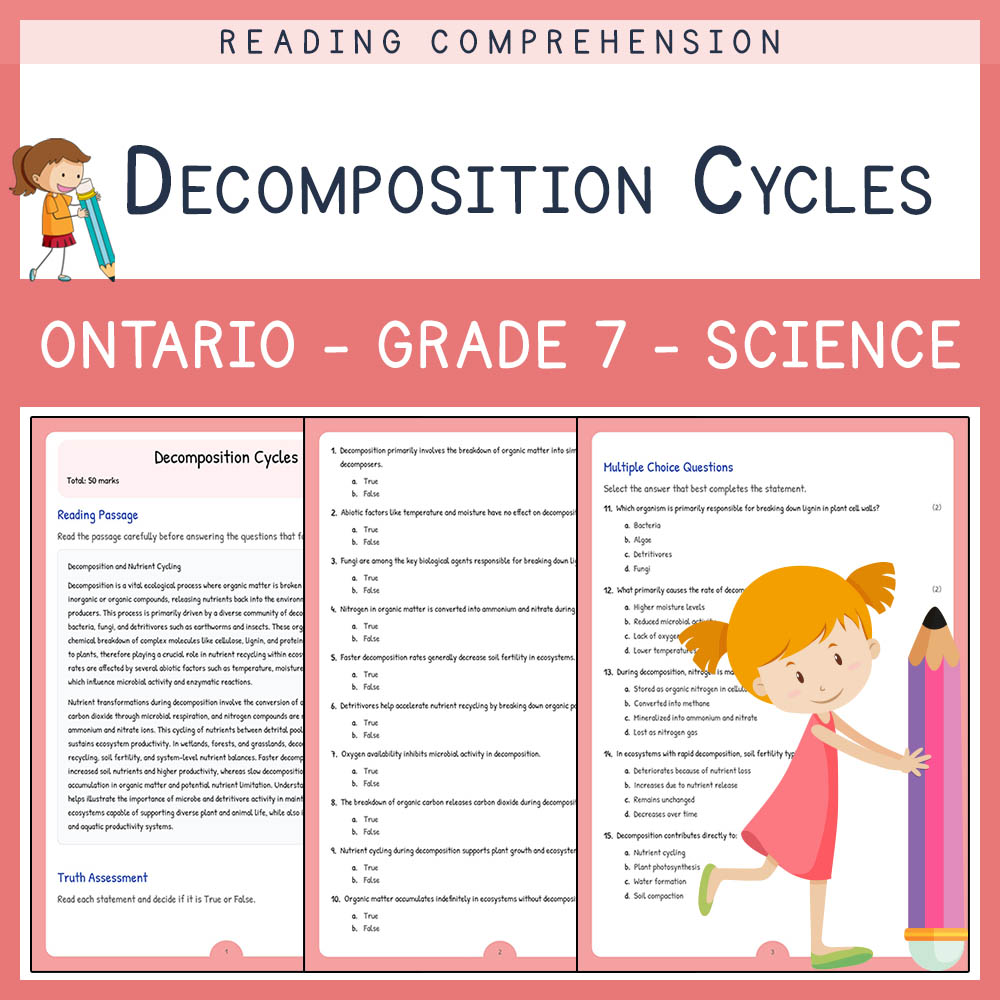
Grade 7 Science | Decomposition Cycles Worksheet & Answer Key (PDF)
Created byLumora LearningLearning Objectives
- Understand the processes involved in decomposition and nutrient cycling.
- Identify roles of detritivores, fungi, bacteria, and abiotic factors in decomposition.
- Describe carbon and nitrogen transformations during organic matter breakdown.
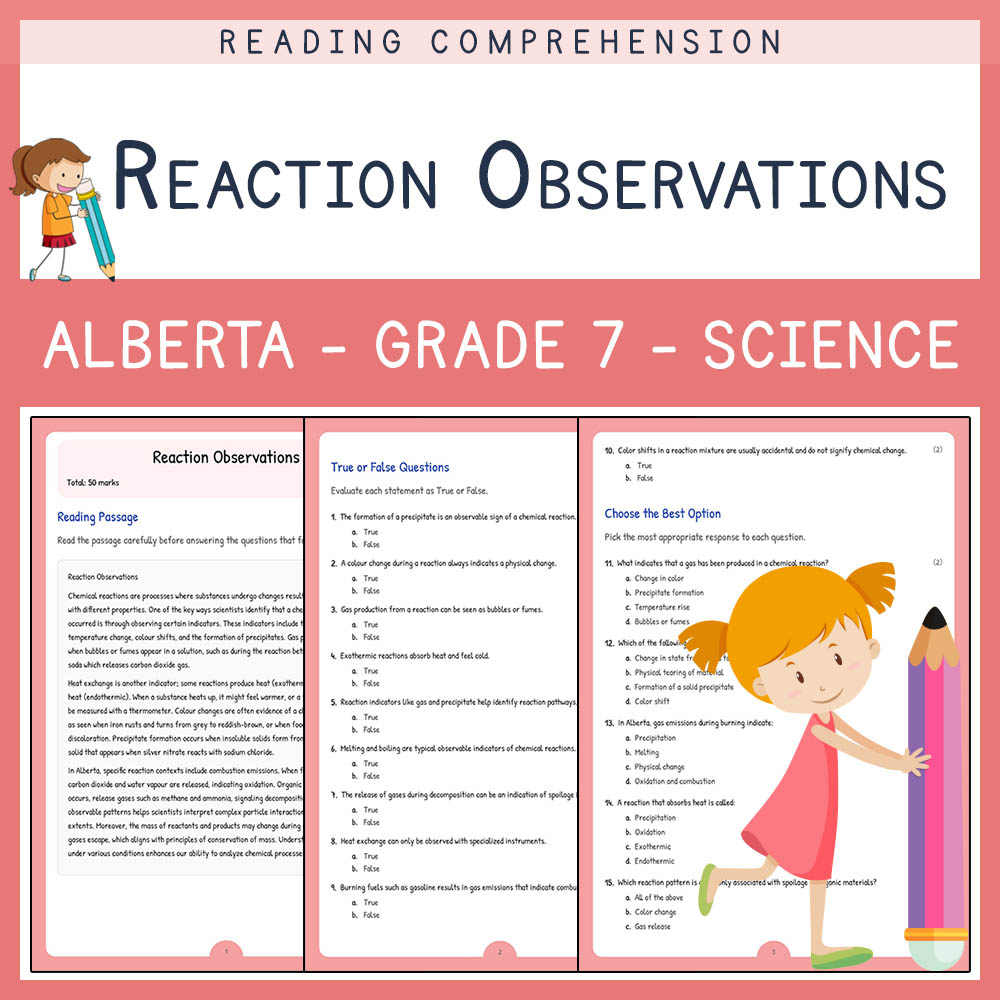
Grade 7 Science | Reaction Observations Worksheet | Alberta Standard
Created byLumora LearningLearning Objectives
- Identify different observable indicators that provide evidence for chemical reactions.
- Describe how gas production, heat exchange, colour changes, and precipitate formation relate to reaction pathways.
- Connect reaction observations to underlying particle interactions and mass changes.
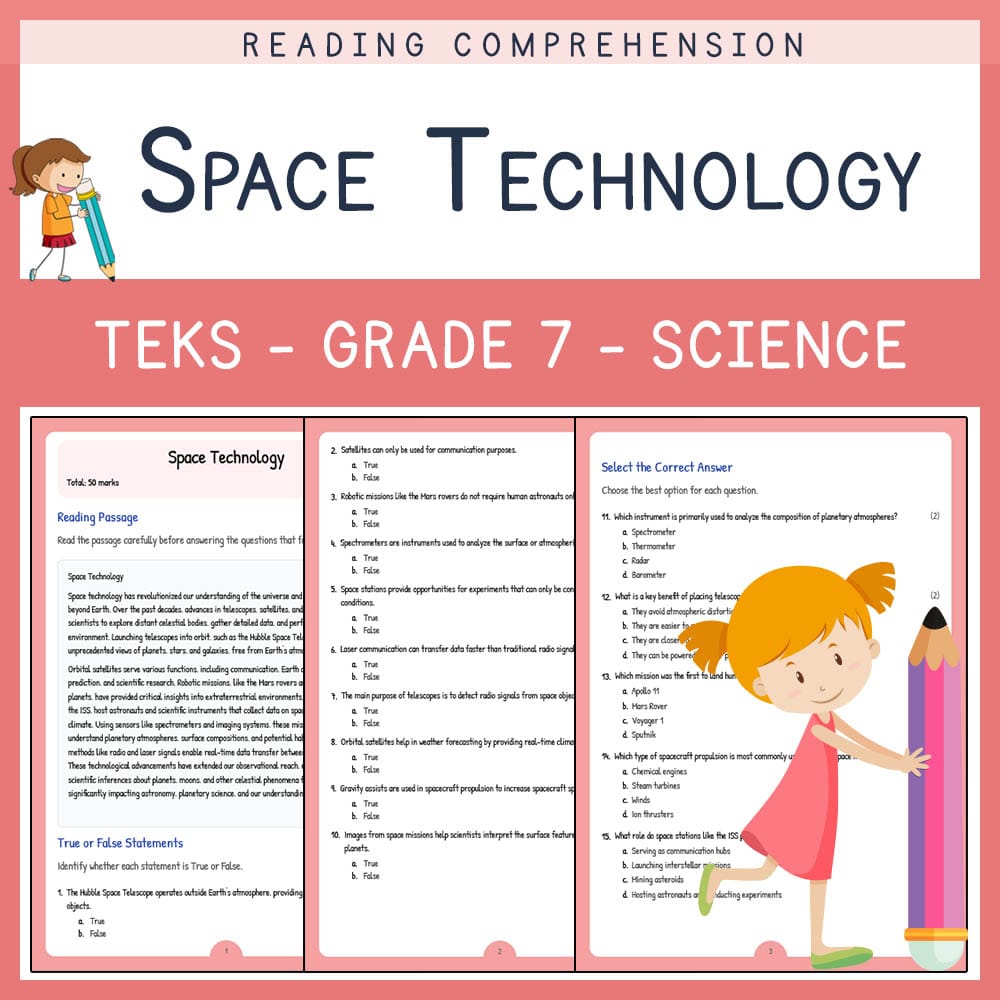
Grade 7 Science | Space Technology Worksheet | TEKS-Aligned
Created byLumora LearningLearning Objectives
- Understand the types of technologies used in space observation and exploration.
- Identify key historical space missions and their contributions.
- Explain how satellites, telescopes, and spacecraft gather data beyond Earth.
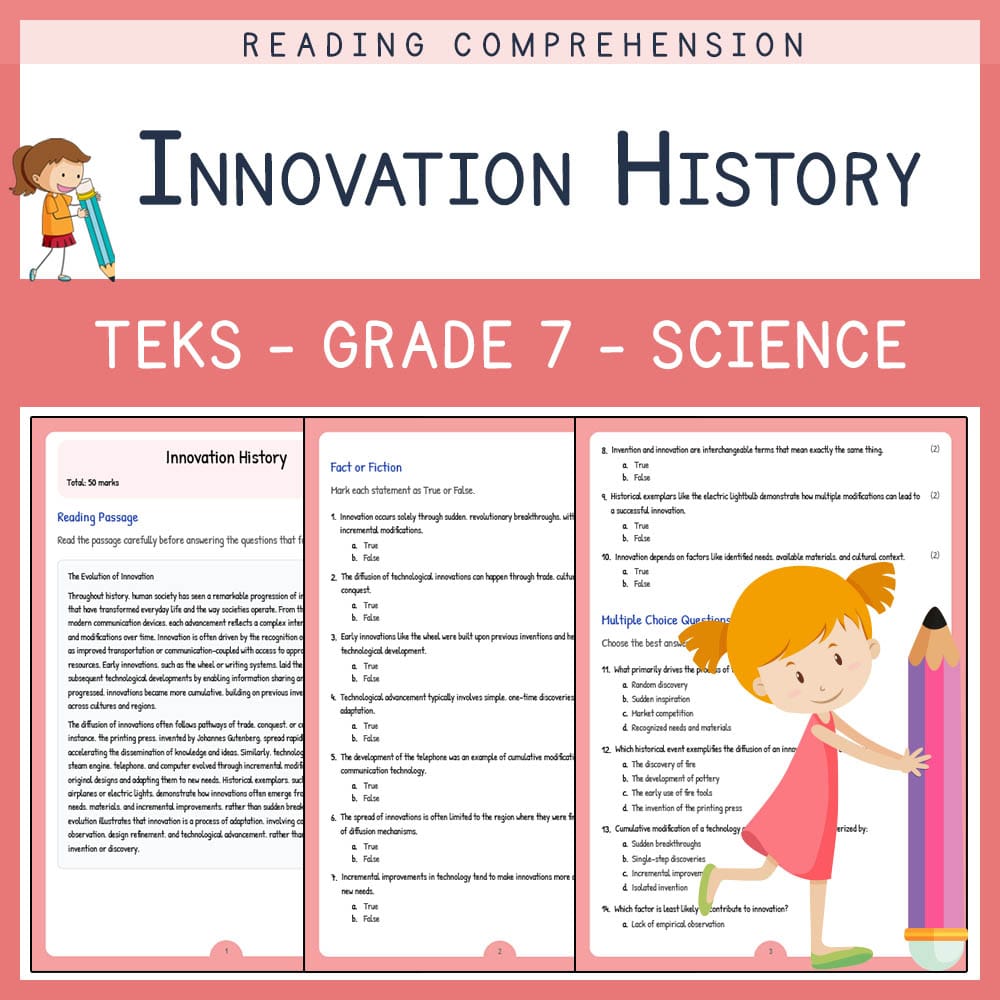
Grade 7 Science | Innovation History Worksheet | TEKS-Aligned
Created byLumora LearningLearning Objectives
- Understand the process and factors that contribute to technological innovation over time.
- Identify examples of inventions and innovations across different historical periods.
- Analyze causes, diffusion, and modifications that lead to technological advancements.
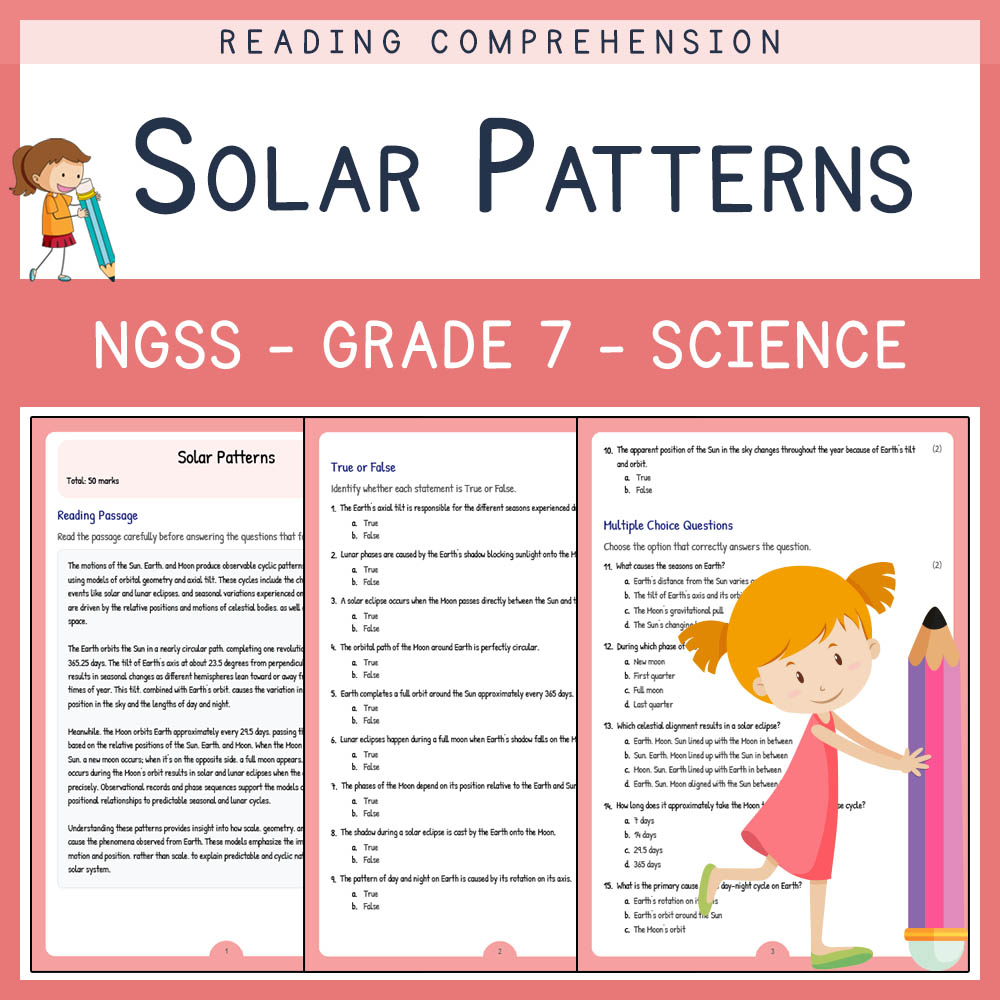
Grade 7 Science | Solar Patterns Worksheet (PDF + Answer Key) Aligned with NGSS
Created byLumora LearningLearning Objectives
- Describe the cyclic patterns produced by the relative motions of the Sun, Earth, and Moon.
- Explain how orbital geometry and axial tilt account for day-night cycles and phases.
- Identify observable evidence of solar system patterns and explain their causal relationships.
Browse more categories
About Reading comprehension Worksheets
Find reading comprehension worksheets for class practice, homework, or self-study. All 40,241 are instant PDF downloads.
Each resource here is built by an independent educator and reviewed for quality. Worksheets print straight from PDF and suit classroom use, homework, or extra practice; most come with answer keys, and you can preview before purchasing.