
Reading comprehension Worksheets
40,241 type resources
Grade 8 Science | Relative Motion Worksheet | BC Aligned
 Created byLumora Learning
Learning Objectives
- Understand how relative motion depends on the observer's frame of reference.
- Identify how velocities add or subtract when objects move in the same or opposite directions.
- Apply proportional relationships among speed, distance, and time in different frames.
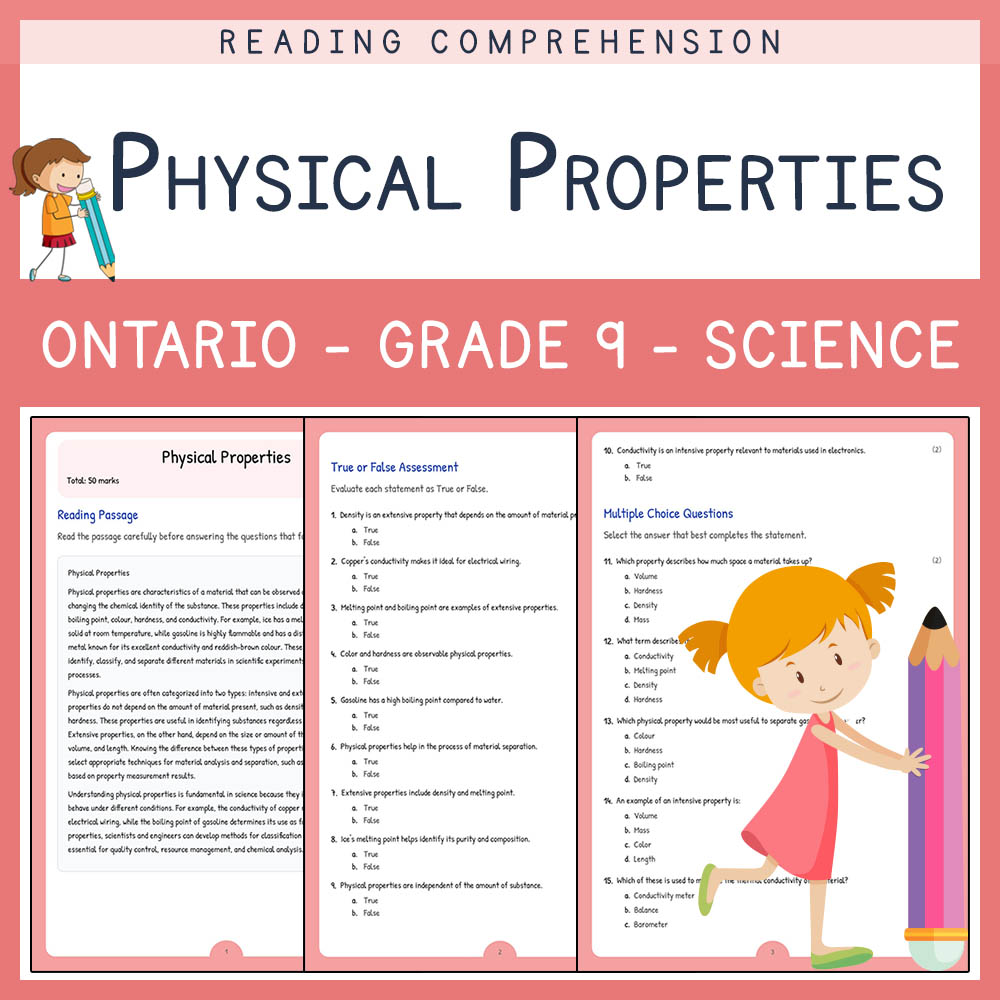
Grade 9 Science | Physical Properties Worksheet Elena | Ontario Standard
Created byLumora LearningLearning Objectives
- Define and understand physical properties as observable or measurable characteristics.
- Distinguish between intensive and extensive properties of materials.
- Identify examples of physical properties in everyday substances such as ice, copper, and gasoline.
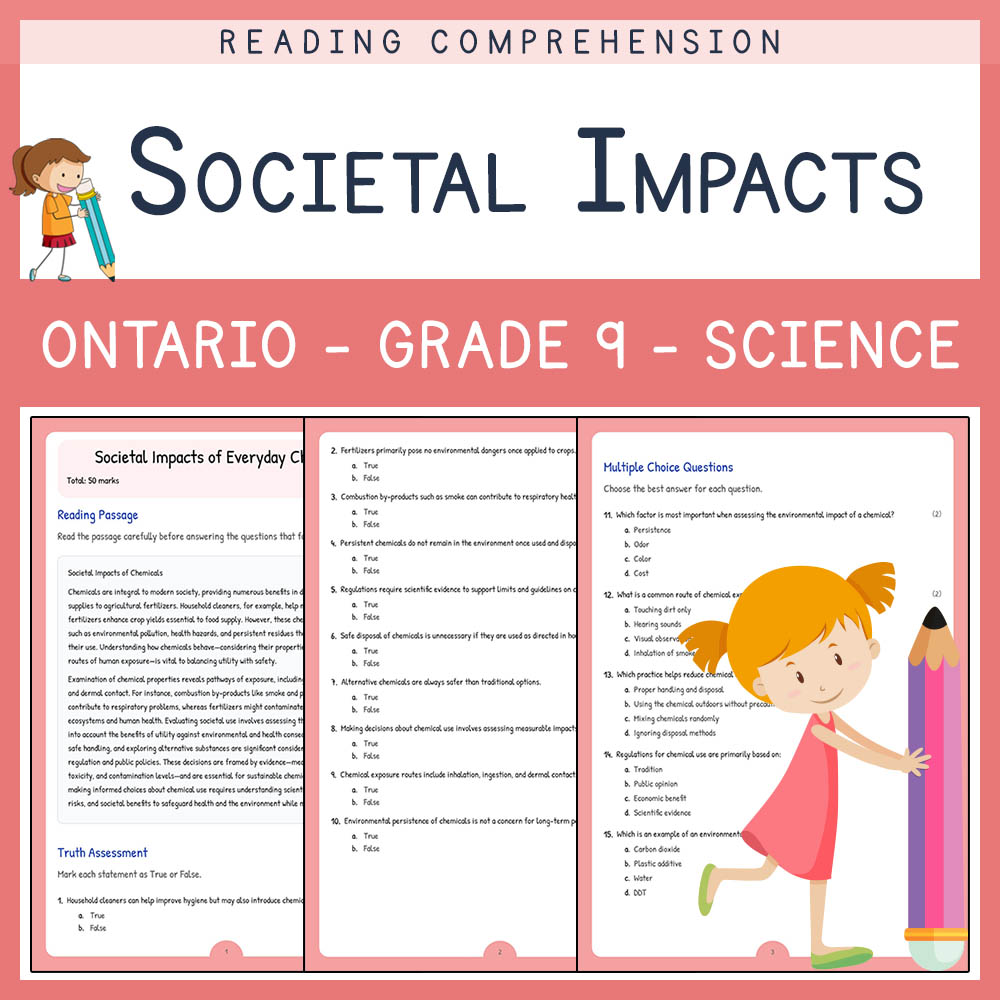
Grade 9 Science | Societal Impacts of Everyday Chemicals Worksheet | Ontario
Created byLumora LearningLearning Objectives
- Analyze the societal uses and benefits of common chemicals.
- Evaluate the risks and environmental impacts associated with chemical applications.
- Understand concepts of safe handling, disposal, and alternatives for chemicals.
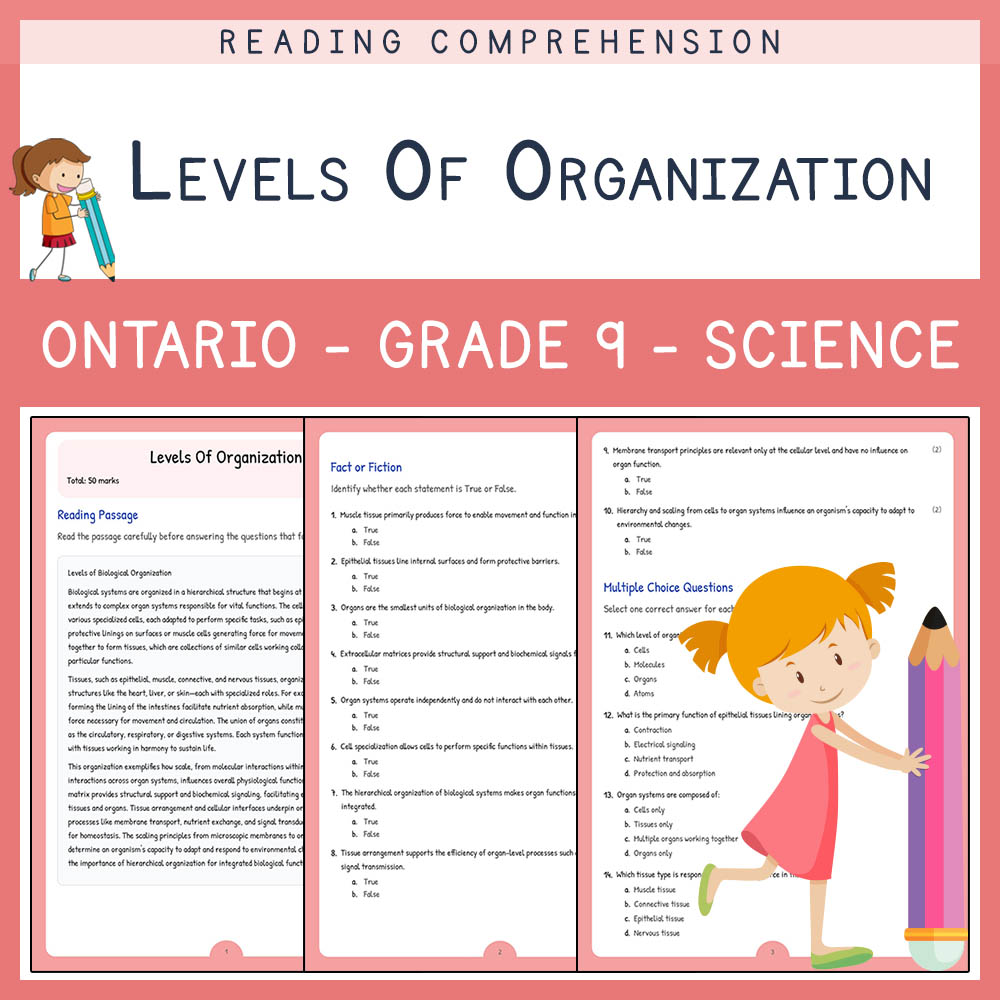
Grade 9 Science | Levels of Organization Worksheet | Ontario Standard
Created byLumora LearningLearning Objectives
- Understand hierarchical relationships among cells, tissues, organs, and systems.
- Identify examples of tissue specialization and extracellular matrices.
- Explain how tissue arrangement supports organ-level functions.
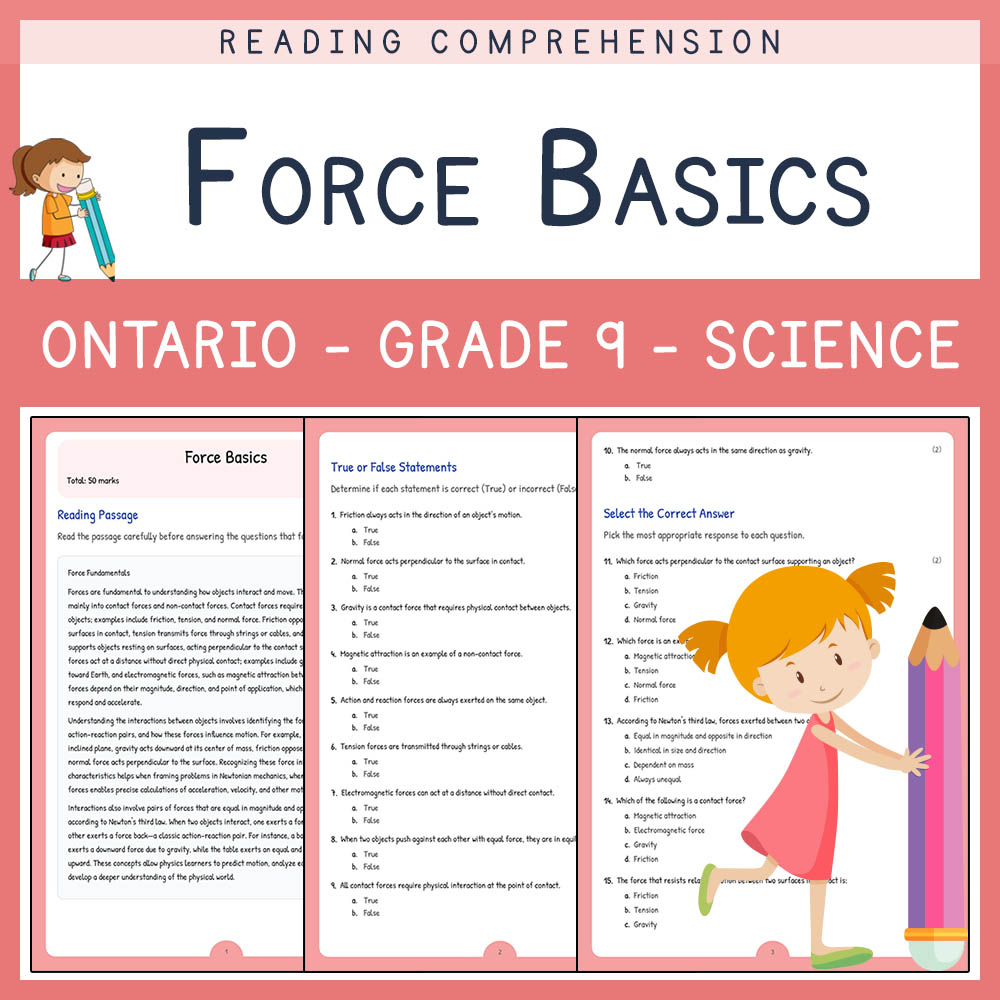
Grade 9 Science | Force Basics Worksheet Elena | Ontario Standard
Created byLumora LearningLearning Objectives
- Distinguish between contact and non-contact forces with examples.
- Identify the magnitude, direction, and point of application in force interactions.
- Understand action-reaction force pairs and their roles in physical interactions.
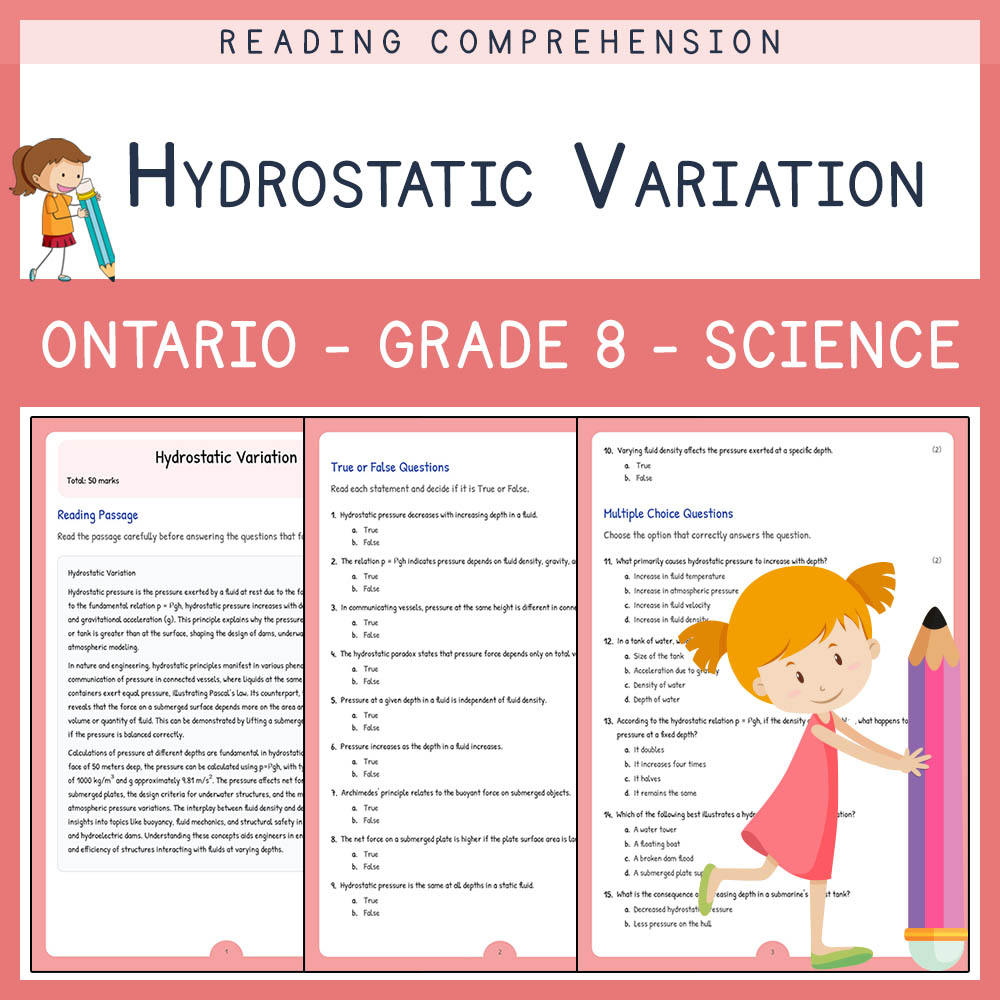
Grade 8 Science | Hydrostatic Variation Worksheet Elena | Ontario
Created byLumora LearningLearning Objectives
- Understand how hydrostatic pressure depends on fluid density and depth.
- Explain communicating vessels and the hydrostatic paradox.
- Calculate pressure at various depths in fluids.

Grade 8 Science | Resource Sustainability Worksheet | NGSSS Aligned
Created byLumora LearningLearning Objectives
- Differentiate between renewable and nonrenewable resources in terms of replenishment time scales.
- Explain how human extraction and consumption of resources can create environmental impacts.
- Describe how long-term sustainability balances human demand with regeneration capacity and mitigation of harmful byproducts.

Grade 8 Science | Climate Data Trends Worksheet | NGSSS Aligned
Created byLumora LearningLearning Objectives
- Interpret temperature, precipitation, and storm-frequency data to identify climate patterns over time
- Distinguish between short-term weather variation and long-term climate trends using averages and extremes
- Explain how El Niño and La Niña can shift rainfall patterns and affect climate indicators
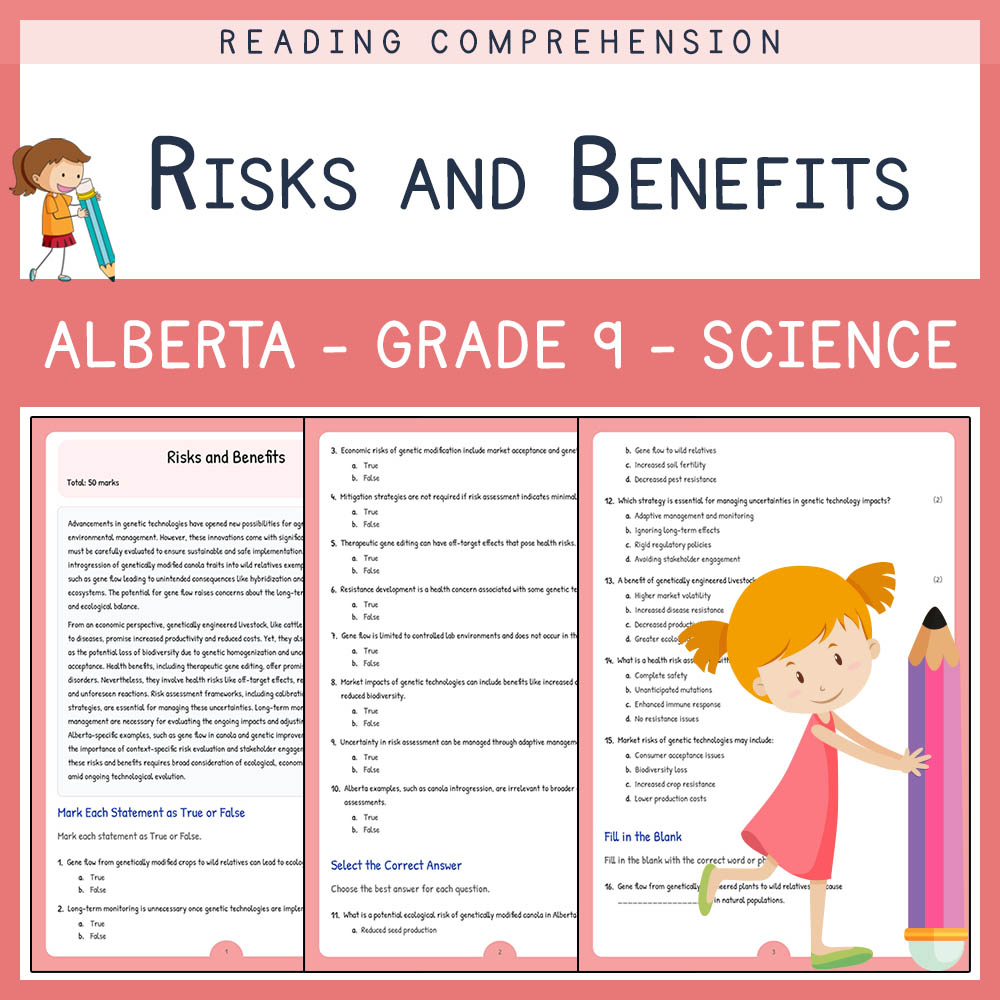
Grade 9 Science | Risks and Benefits Worksheet | Alberta Standards
Created byLumora LearningLearning Objectives
- Understand the ecological, economic, and health risks associated with genetic technologies.
- Evaluate potential benefits and trade-offs of adopting genetic approaches.
- Explain risk assessment, mitigation strategies, and long-term monitoring in biotechnology.
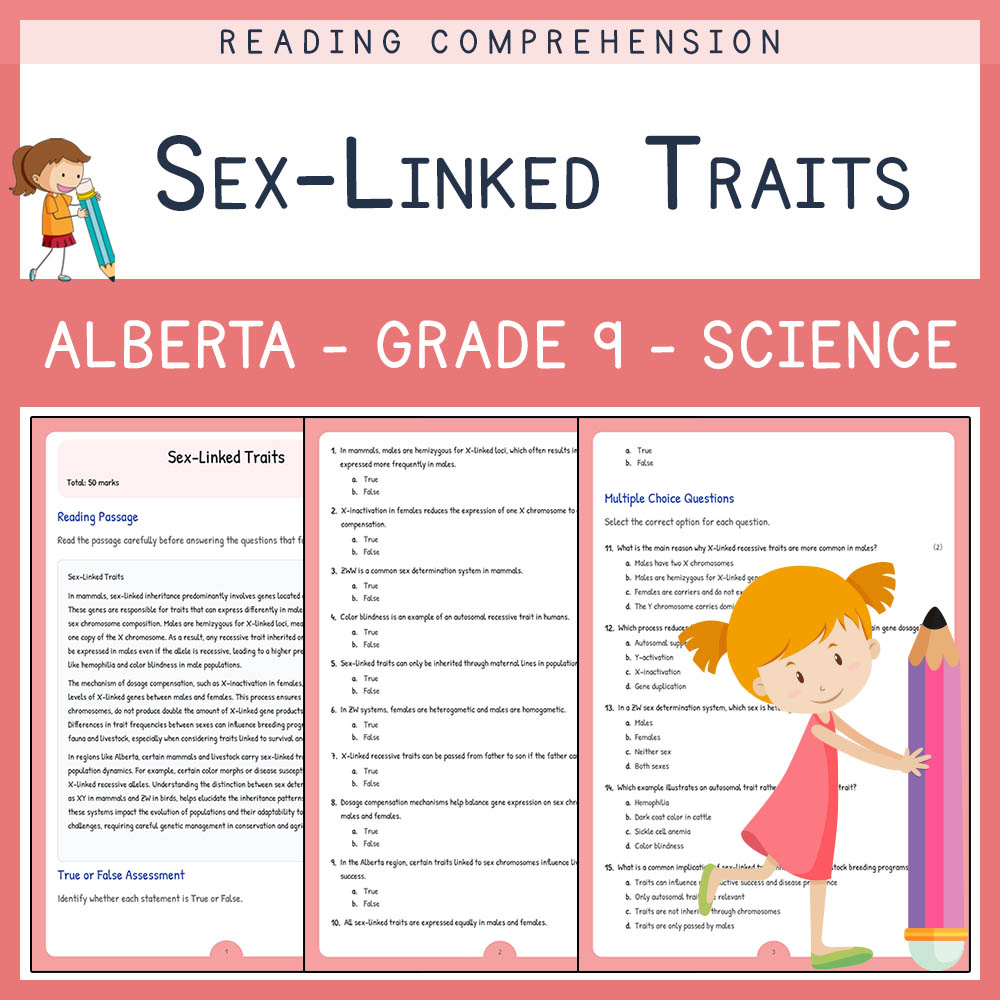
Grade 9 Science | Sex-Linked Traits Worksheet | Alberta Standards
Created byLumora LearningLearning Objectives
- Understand the role of sex chromosomes in inheritance.
- Explain mechanisms of sex-linked trait expression and their implications in regional fauna and livestock.
- Distinguish between different sex determination systems and their genetic consequences.
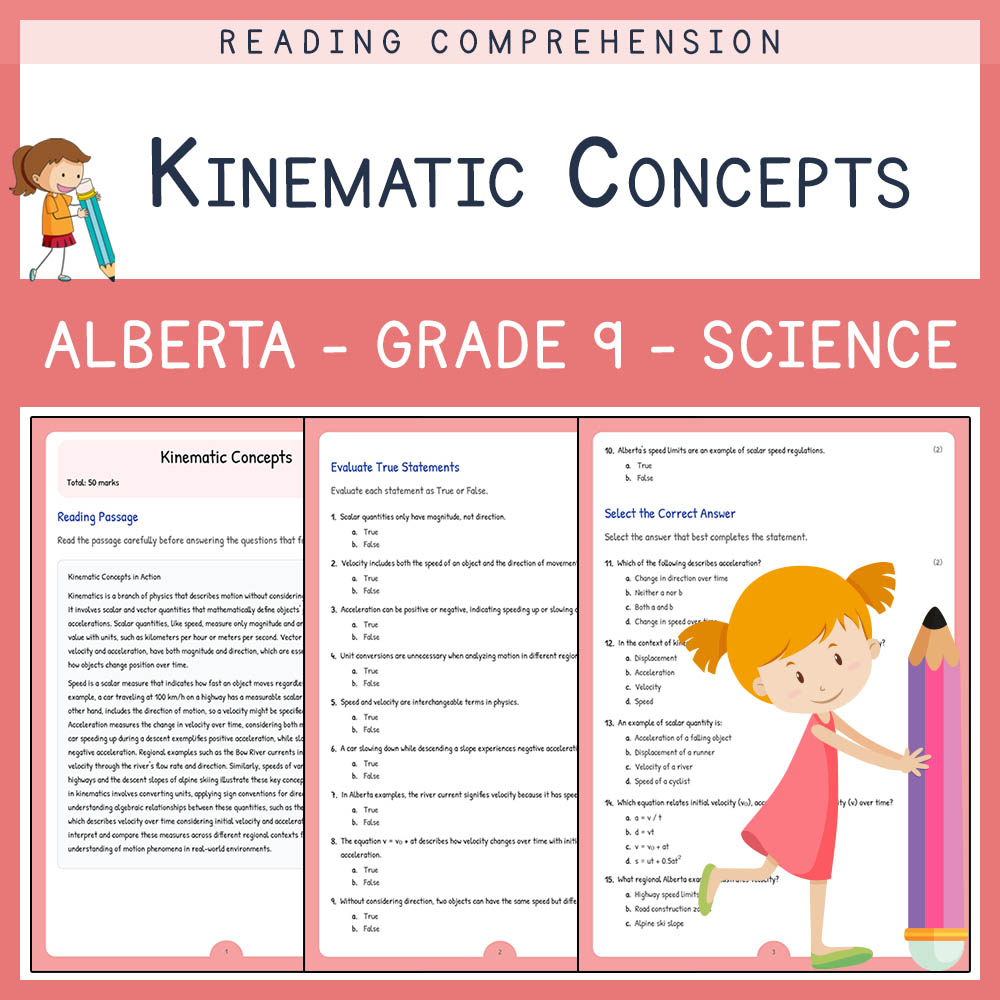
Grade 9 Science | Kinematic Concepts Worksheet | Alberta Standards
Created byLumora LearningLearning Objectives
- Understand how scalar and vector measures describe object motion.
- Identify and differentiate between speed, velocity, and acceleration.
- Apply unit conversions and sign conventions to analyze motion data.
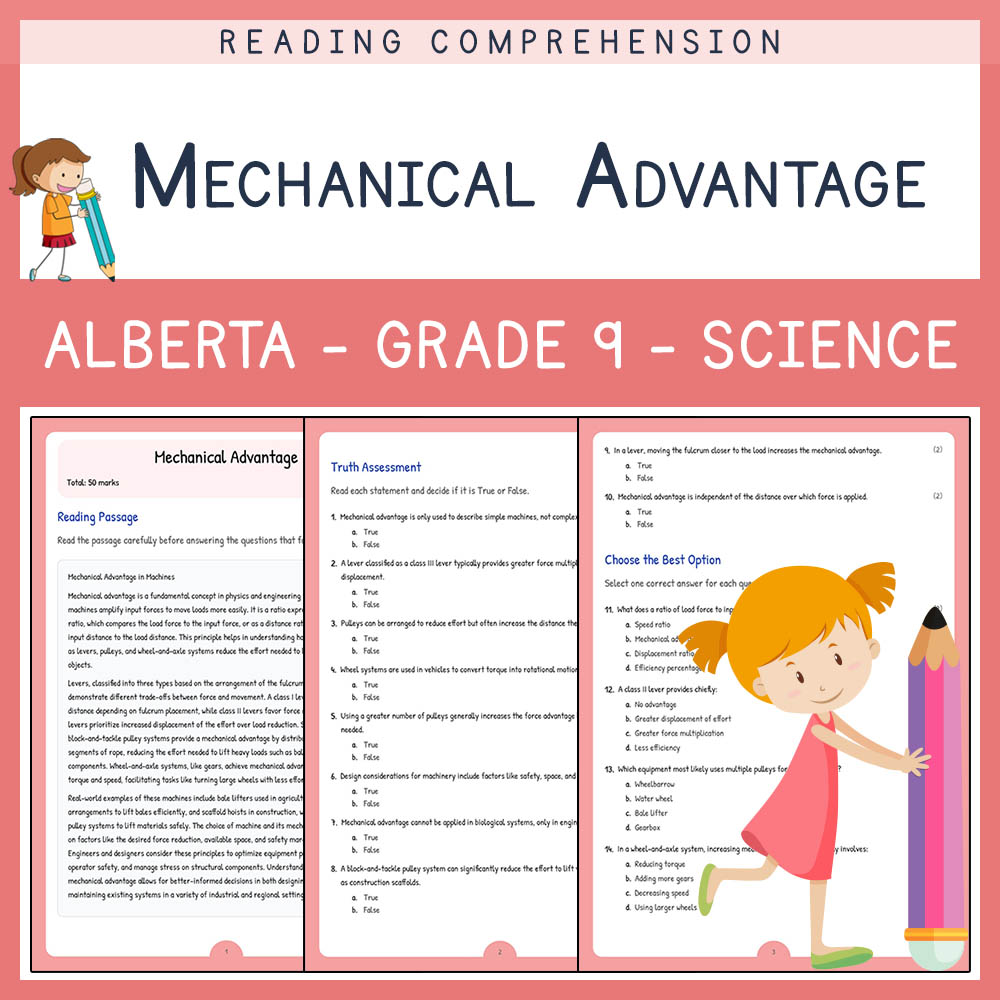
Grade 9 Science | Mechanical Advantage Worksheet | Alberta Standards
Created byLumora LearningLearning Objectives
- Explain the concept of mechanical advantage and how it is used in different machines.
- Calculate mechanical advantage for levers, pulleys, and wheel systems.
- Analyze trade-offs between force reduction and displacement in mechanical systems.
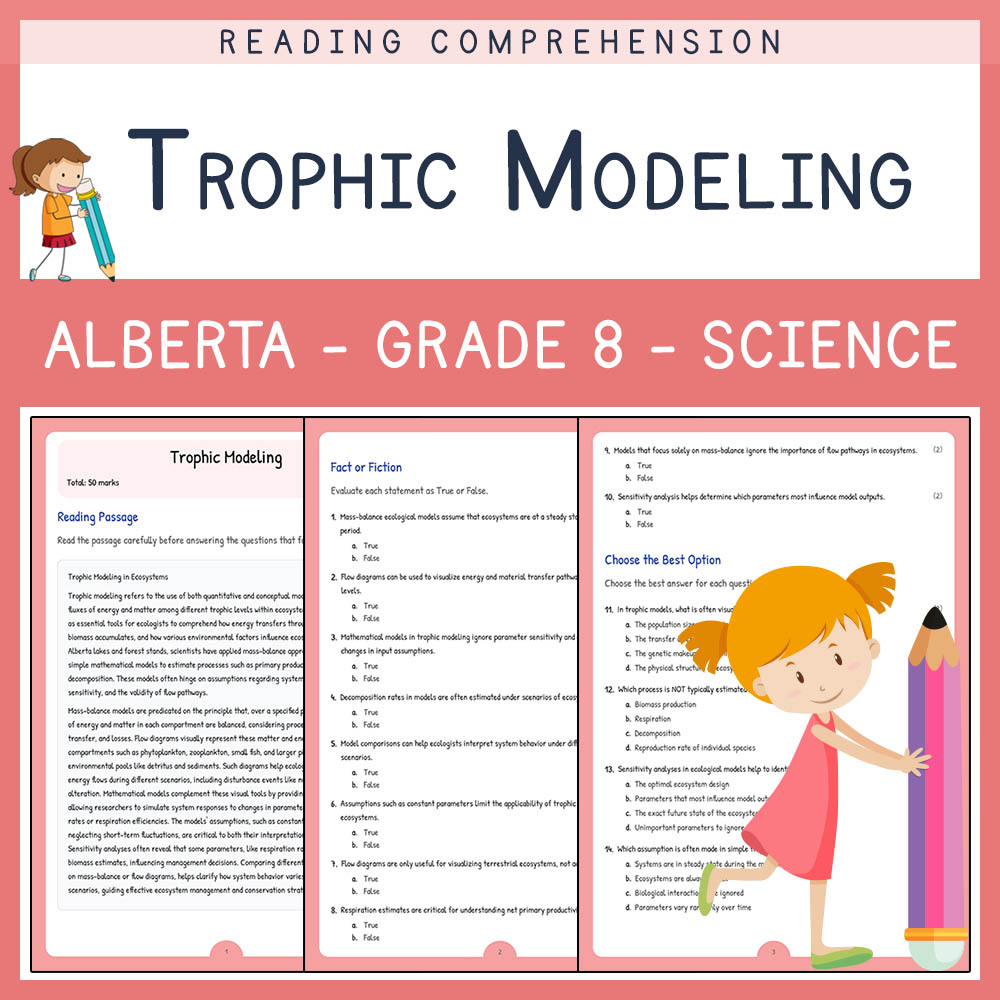
Grade 8 Science | Trophic Modeling Worksheet | Alberta Standards
Created byLumora LearningLearning Objectives
- Understand the basic concepts of trophic modeling and energy fluxes in ecosystems.
- Identify different approaches used for quantifying matter and energy flow among trophic compartments.
- Explain the assumptions and sensitivities of simple mathematical models in ecological systems.
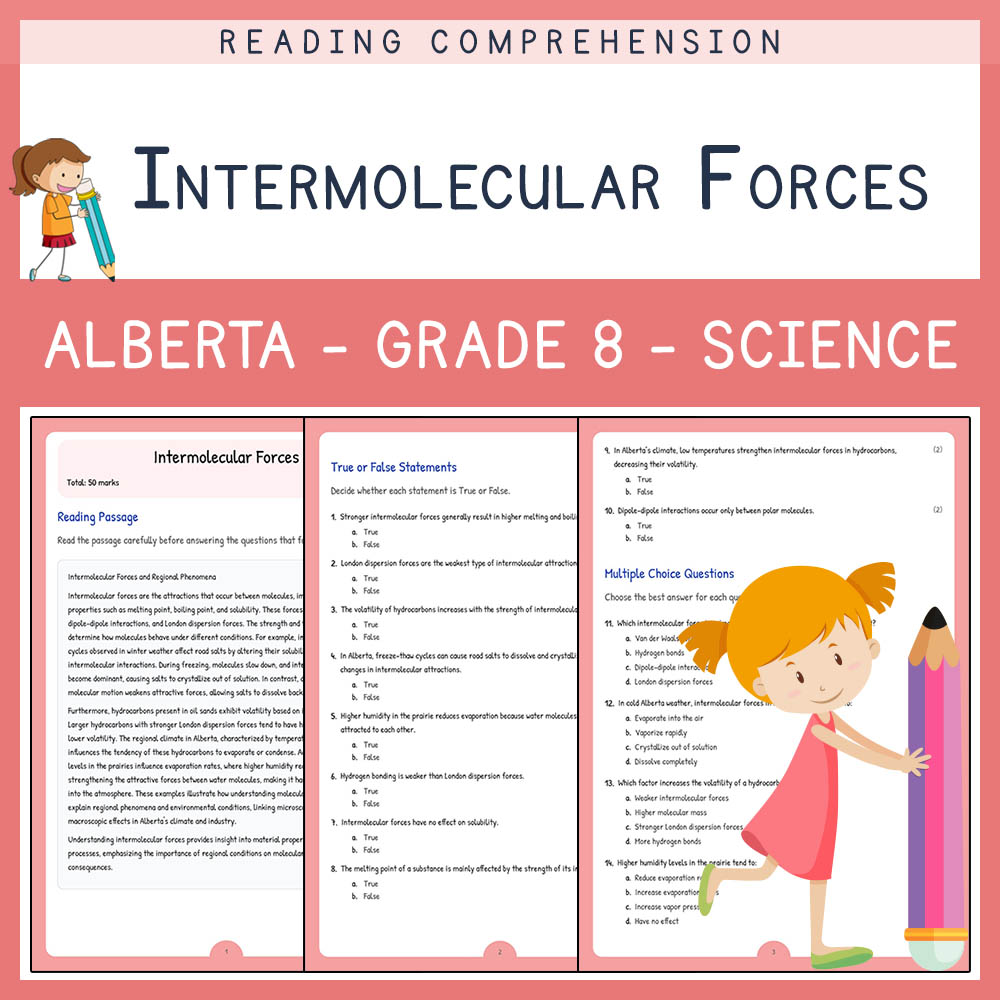
Grade 8 Science | Intermolecular Forces Worksheet | Alberta Standard
Created byLumora LearningLearning Objectives
- Explain how intermolecular forces influence melting point, boiling point, and solubility.
- Describe regional phenomena such as freeze–thaw cycles, hydrocarbon volatility, and humidity effects in terms of molecular interactions.
- Compare the strength of different types of intermolecular forces and their effects on physical properties.
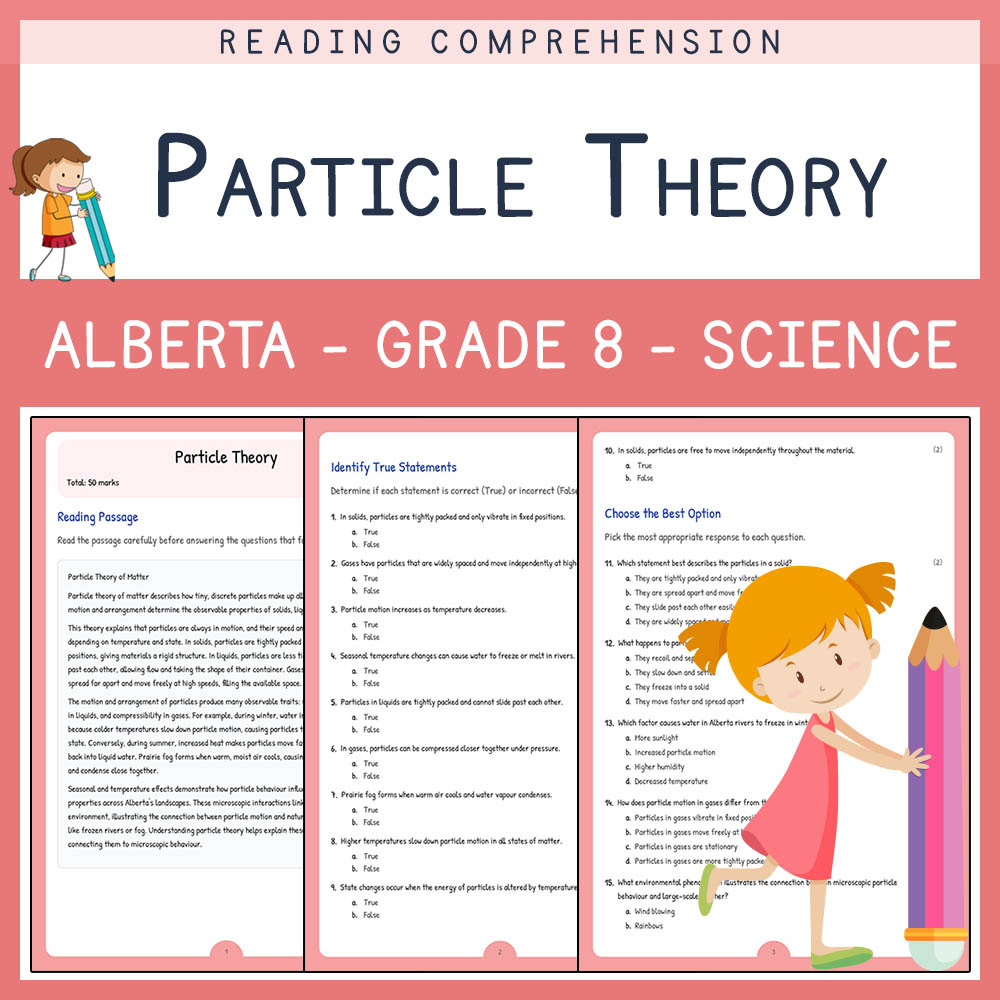
Grade 8 Science | Particle Theory Worksheet | Alberta Standard
Created byLumora LearningLearning Objectives
- Explain the basic concepts of particle theory of matter and how particles behave in solids, liquids, and gases.
- Connect microscopic particle behaviour to observable properties such as rigidity, flow, and compressibility.
- Describe how temperature and seasonal changes affect particle motion and state transitions.
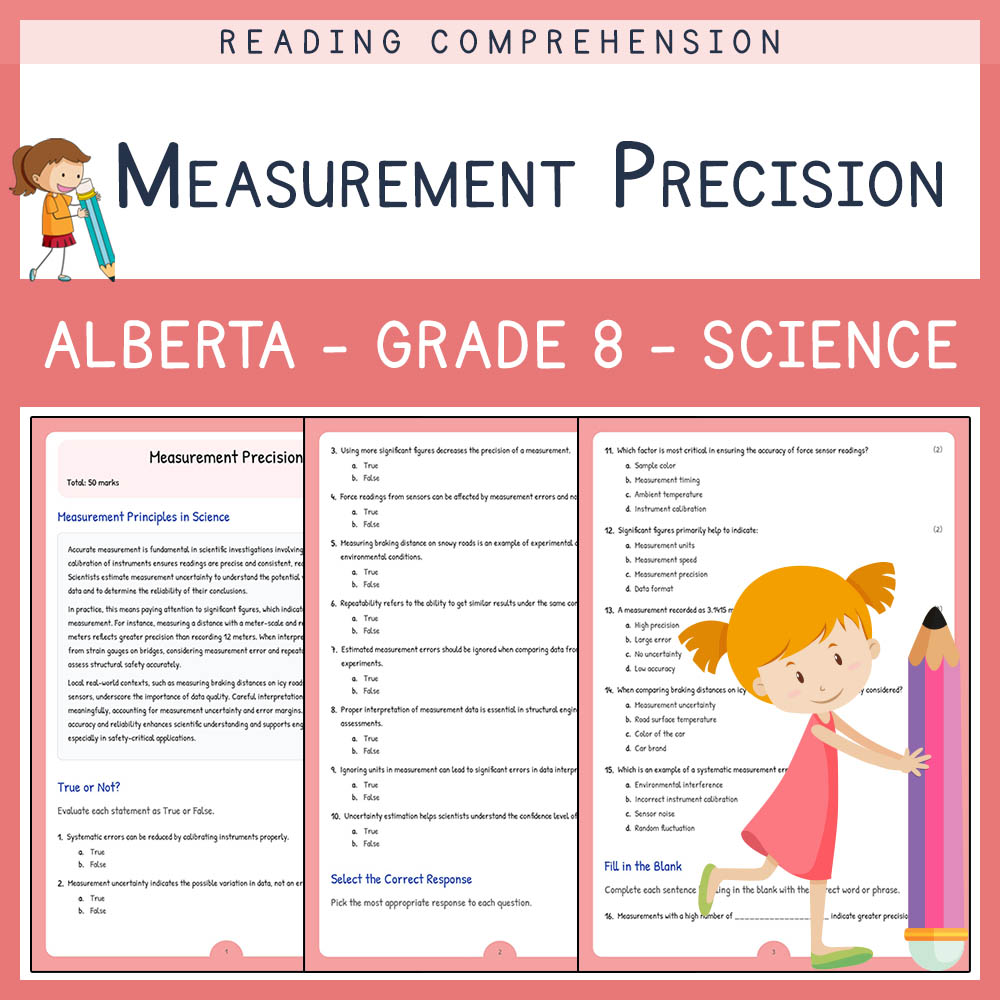
Grade 8 Science | Measurement Precision Worksheet | Alberta Standards
Created byLumora LearningLearning Objectives
- Understand the principles of measurement accuracy and instrument calibration.
- Estimate and interpret measurement uncertainties and errors.
- Apply concepts of significant figures and units in data recording.
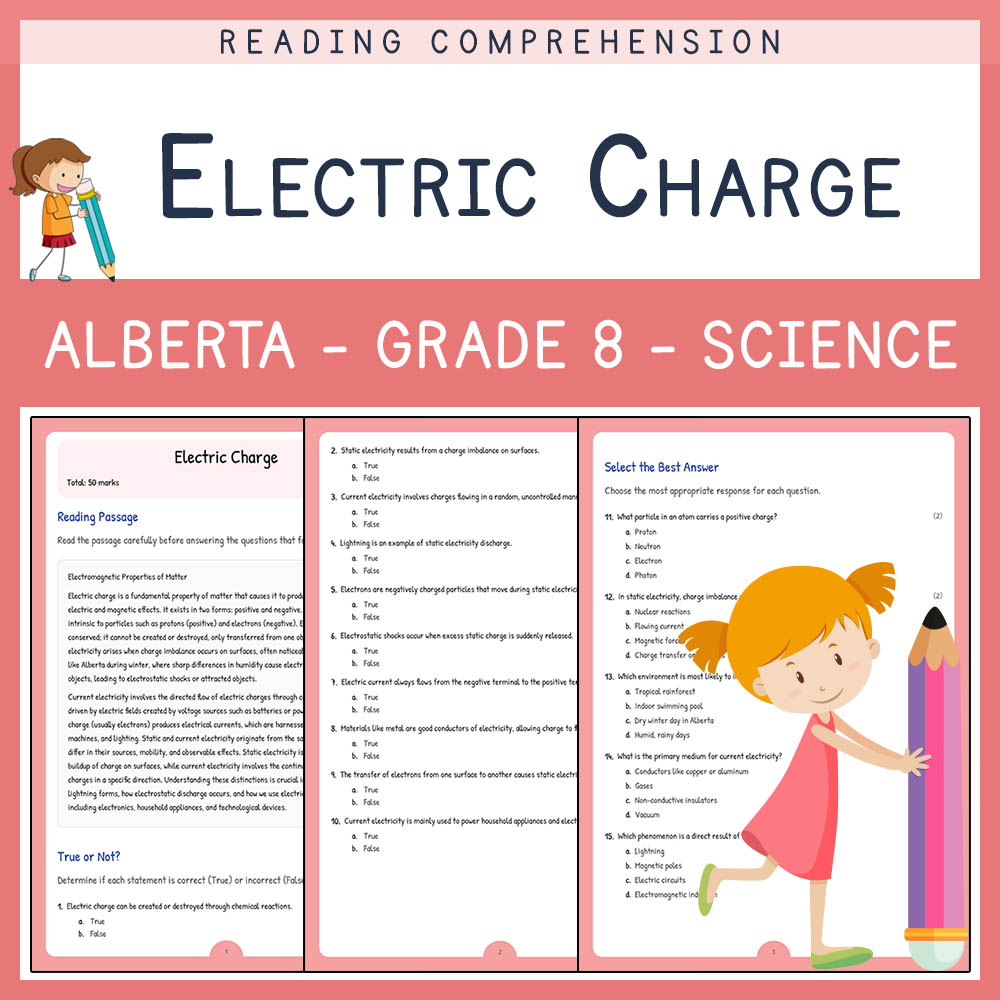
Grade 8 Science | Electric Charge Worksheet | Alberta Standards
Created byLumora LearningLearning Objectives
- Understand the concept of electric charge and its properties.
- Distinguish between static electricity and current electricity.
- Identify real-world phenomena related to electric charge.
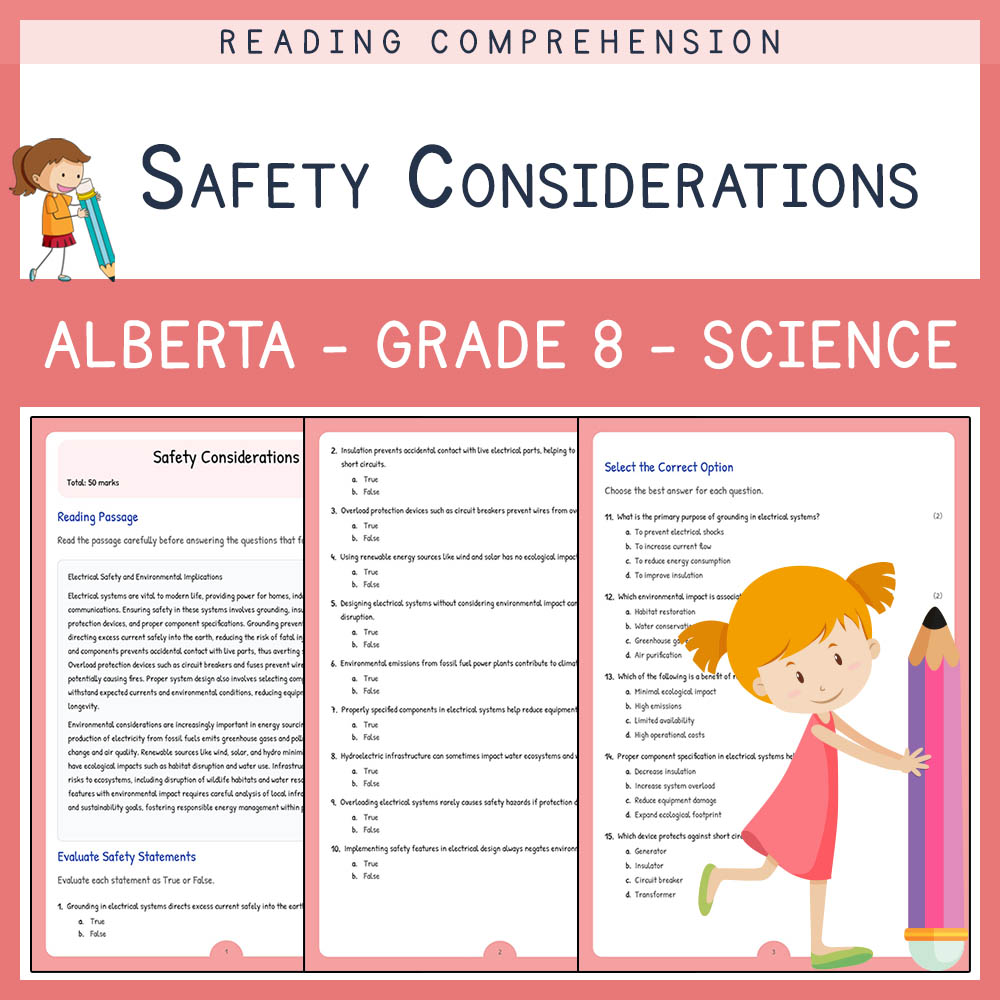
Grade 8 Science | Safety Considerations Worksheet | Alberta Standards
Created byLumora LearningLearning Objectives
- Understand the key safety features used in electrical system design.
- Identify environmental impacts associated with electrical energy sources.
- Evaluate safety and environmental trade-offs in electrical infrastructure.
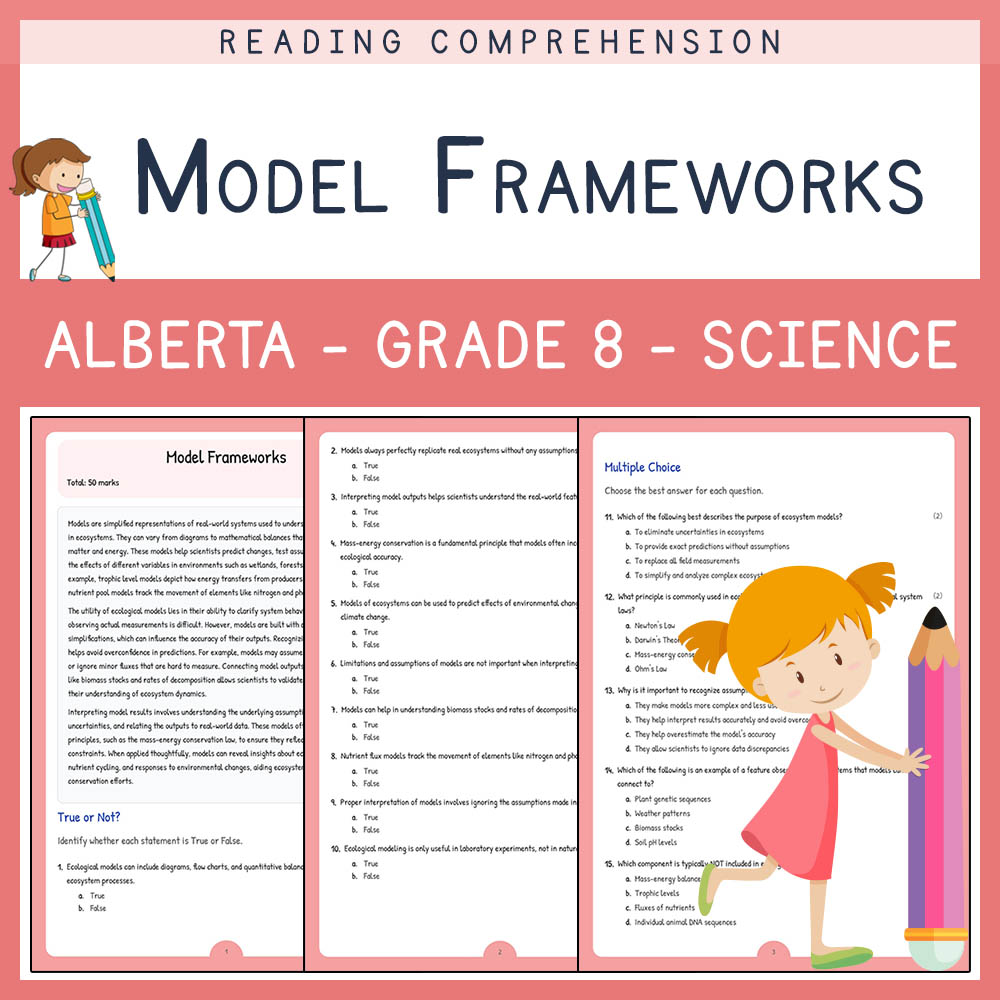
Grade 8 Science | Model Frameworks Worksheet | Alberta Standards
Created byLumora LearningLearning Objectives
- Understand the purpose and components of ecological models.
- Identify how models represent matter and energy movement in ecosystems.
- Interpret model outputs and recognize assumptions and limitations.
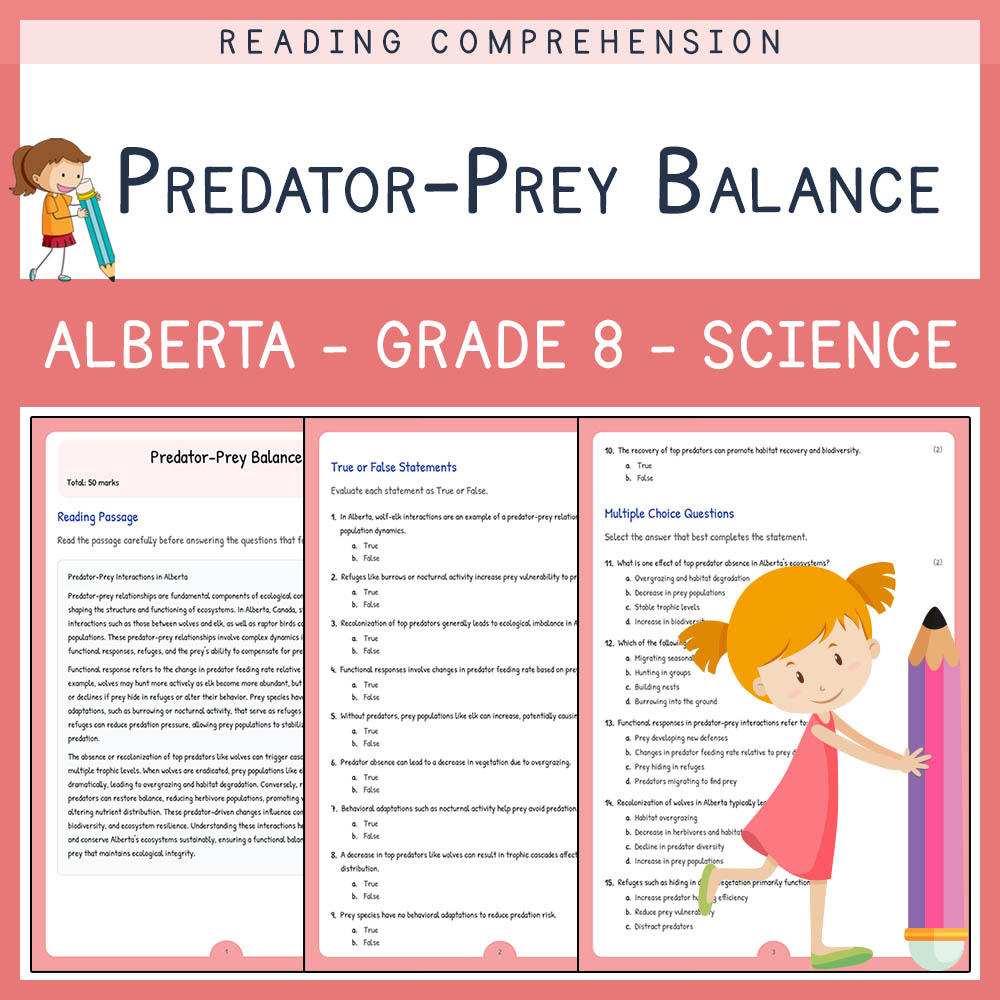
Grade 8 Science Worksheet | Predator–Prey Balance | Alberta Standards
Created byLumora LearningLearning Objectives
- Understand how predator-prey relationships influence population dynamics.
- Identify behavioral and community adaptations resulting from predation.
- Explain cascading effects caused by changes in top predator presence or recolonization.
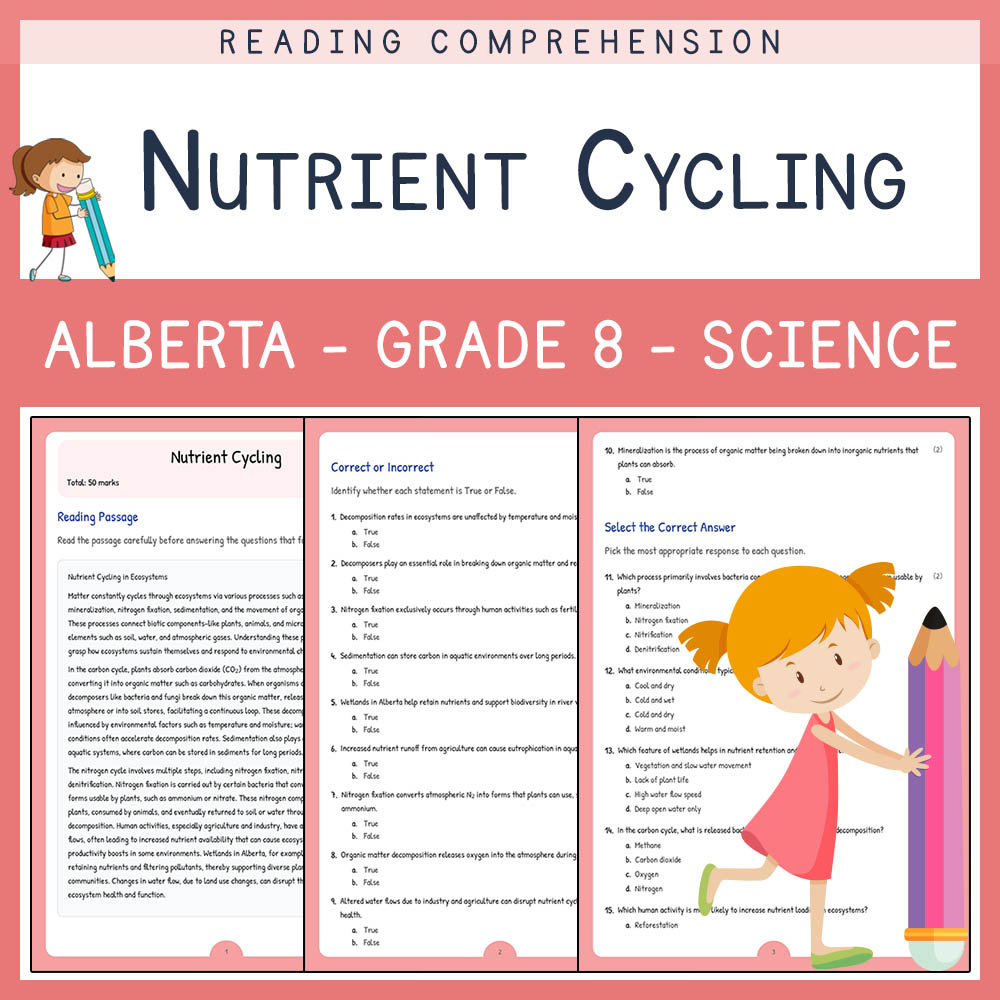
Grade 8 Science | Nutrient Cycling Worksheet | Alberta Standard
Created byLumora LearningLearning Objectives
- Understand the processes involved in nutrient cycling within ecosystems.
- Identify the roles of decomposers, nitrogen fixation, and sedimentation in nutrient pathways.
- Analyze how environmental factors such as temperature and moisture influence nutrient cycling rates.
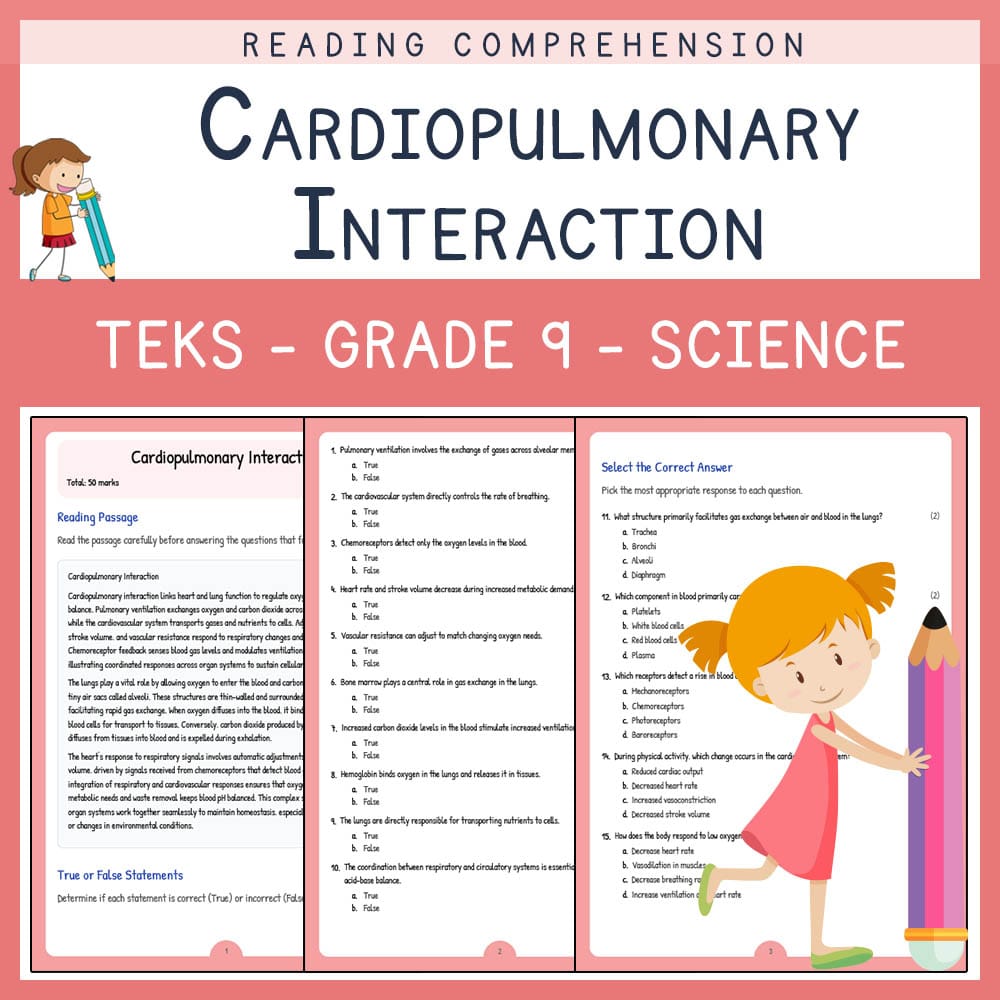
Grade 9 Science | Cardiopulmonary Interaction Worksheet | TEKS Aligned
Created byLumora LearningLearning Objectives
- Explain how the heart and lungs work together to supply oxygen and remove carbon dioxide.
- Identify the roles of pulmonary ventilation and cardiovascular transport in maintaining homeostasis.
- Describe how chemoreceptors regulate respiratory and circulatory responses to blood gas levels.
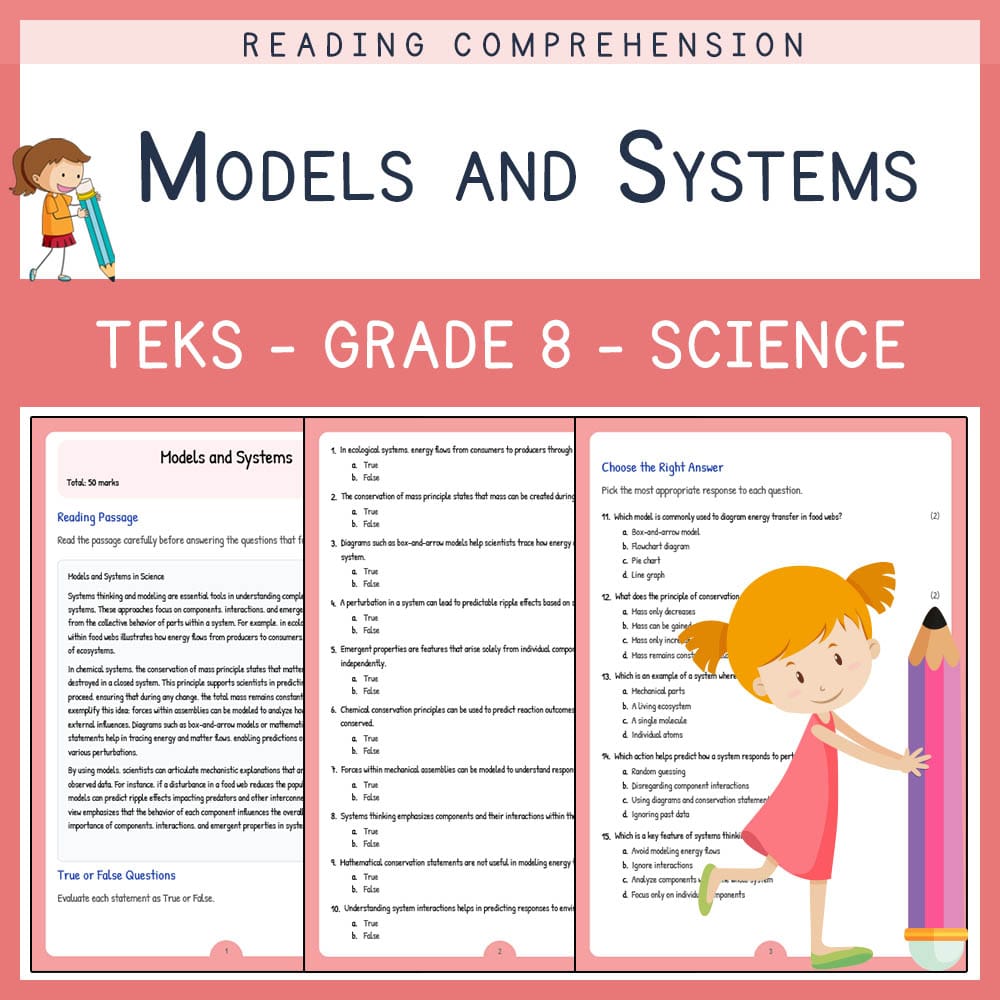
Grade 8 Science | Models and Systems Worksheet | TEKS Aligned
Created byLumora LearningLearning Objectives
- Describe the components and interactions within physical and ecological systems.
- Explain how models and diagrams are used to represent system processes.
- Predict system responses to perturbations using conservation principles.
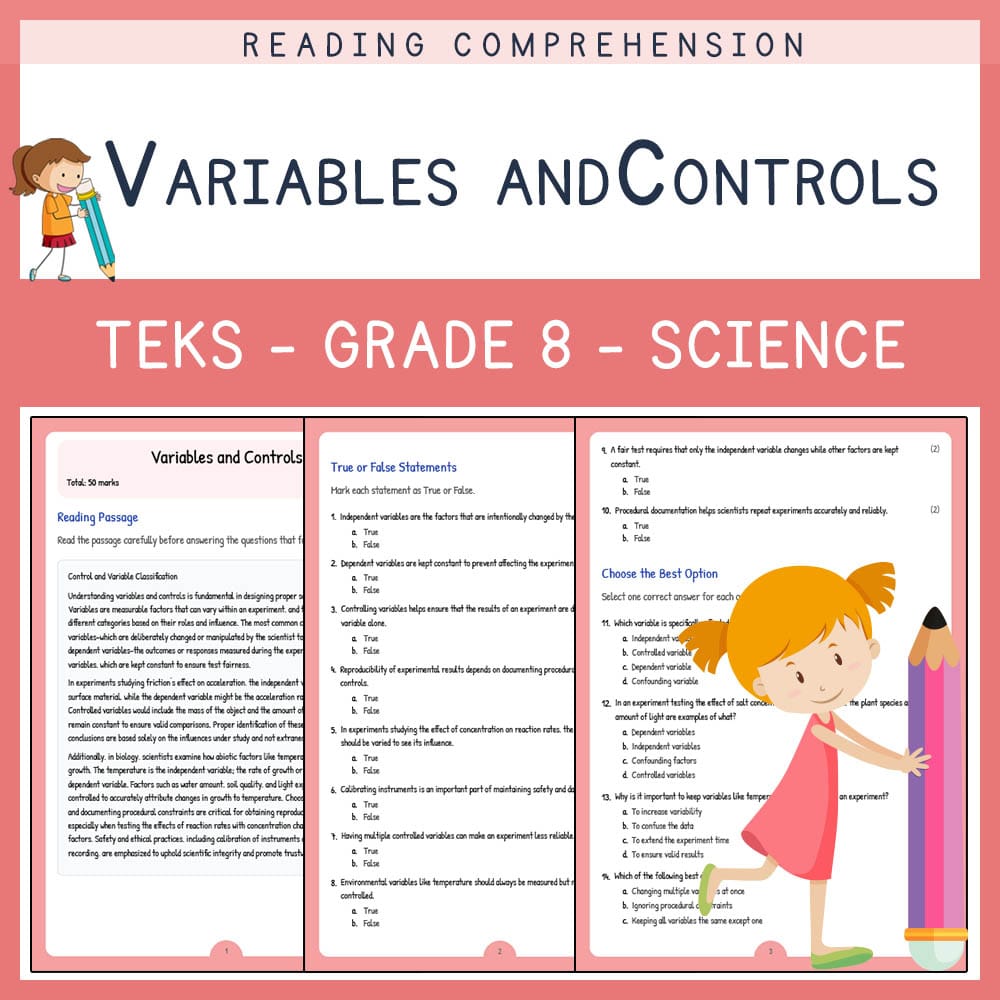
Grade 8 Science | Variables and Controls Worksheet | TEKS Aligned
Created byLumora LearningLearning Objectives
- Identify and classify variables into independent, dependent, and controlled groups within experiments.
- Understand the importance of controls and procedural constraints in scientific investigations.
- Describe how to establish fair tests by appropriate variable management.

Grade 9 Science | Energy Profiles Worksheet | BC Standard
Created byLumora LearningLearning Objectives
- Understand the concept of energy profiles and their role in chemical reactions.
- Identify activation energy and how it affects reaction rates.
- Differentiate between exothermic and endothermic reactions based on enthalpy change.

Grade 8 Science | Adaptation Mechanisms Worksheet | TEKS Aligned
Created byLumora LearningLearning Objectives
- Describe the various types of adaptation—structural, behavioral, and physiological—and their roles in survival.
- Identify examples of adaptation mechanisms in different species and environments.
- Explain the process of natural selection and how it influences trait frequencies across generations.
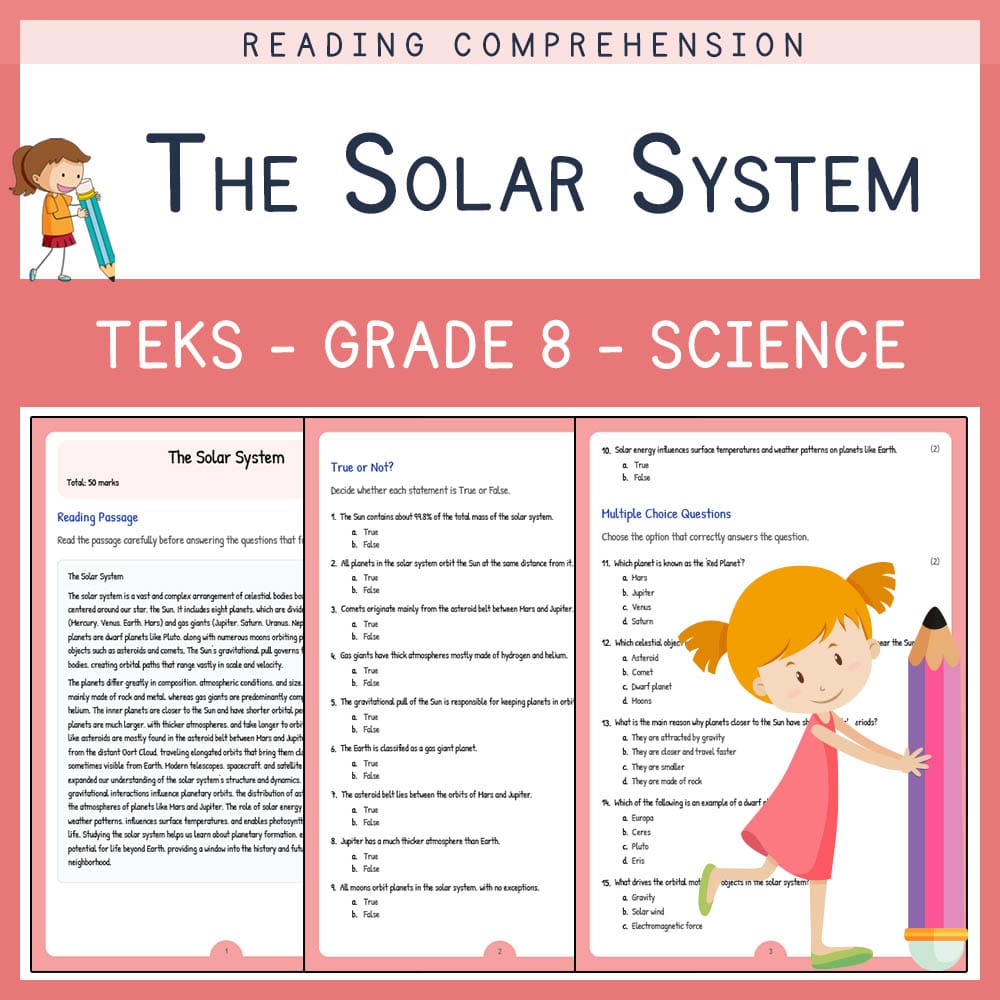
Grade 8 Science | The Solar System Worksheet Elena | TEKS Aligned
Created byLumora LearningLearning Objectives
- Understand the components of the solar system, including planets, moons, and smaller bodies.
- Describe the relative scale and composition of celestial objects in the solar system.
- Explain orbital characteristics and gravitational interactions among planets, asteroids, and comets.

Grade 6 Science | States of Matter Worksheet | NGSSS Aligned
Created byLumora LearningLearning Objectives
- Explain how the shape and volume of solids, liquids, and gases differ due to particle behavior.
- Use models of particle motion to describe changes in state and connect them to energy changes.
- Classify everyday materials as solids, liquids, or gases based on observed properties.

Grade 6 Science | Food Chains Worksheet Elena | Florida NGSSS Aligned
Created byLumora LearningLearning Objectives
- Explain how energy moves through a food chain from producers to higher-level consumers
- Identify trophic levels (producer, primary consumer, secondary consumer) in a given food chain
- Describe how changes in one population can affect other populations in a food chain

Grade 11 Science | Scientific Inquiry Worksheet | NGSSS Aligned
Created byLumora LearningLearning Objectives
- Explain how scientific inquiry connects observations to evidence-based explanations
- Describe how inquiry can be non-linear and use prior knowledge while remaining open to alternative interpretations
- Identify characteristics of scientific explanations (natural causes, testable predictions, and evaluability by others)

Grade 11 Science | Model Revision Worksheet | NGSSS Aligned
Created byLumora LearningLearning Objectives
- Explain why scientific models are revised when new evidence or better methods reveal mismatches.
- Describe the steps of model revision using predictions, evidence, and identification of gaps.
- Distinguish model revision from “starting over” in science.

Grade 11 Science | Natural Selection Worksheet | BC-Aligned
Created byLumora LearningLearning Objectives
- Understand how heritable variation influences natural selection.
- Describe the different modes of selection: directional, stabilizing, and disruptive.
- Explain environmental factors that shape selective regimes.

Grade 11 Science | Ecological Succession Worksheet | NGSSS Standard
Created byLumora LearningLearning Objectives
- Explain the stages of ecological succession and the role of pioneer species
- Describe how disturbances, climate, and soil development influence community change over time
- Analyze how species interactions and productivity shift during succession

Grade 11 Science | Cellular Respiration Worksheet | NGSSS Aligned
Created byLumora LearningLearning Objectives
- Explain how cellular respiration converts chemical energy in glucose into ATP usable by cells
- Describe the role of electron carriers and electron transport in transferring energy during respiration
- Compare how oxygen availability affects the end products of cellular respiration

Grade 11 Science | Physical vs Chemical Worksheet | NGSSS Assessment
Created byLumora LearningLearning Objectives
- Differentiate physical changes from chemical changes by whether new substances form and composition changes.
- Identify evidence of chemical change (e.g., gas, color, temperature, precipitate) and explain why it matters.
- Predict whether a change is likely reversible based on particle/bonding behavior.

Grade 11 Science | Newton Second Law Worksheet | NGSSS Assessment
Created byLumora LearningLearning Objectives
- Explain Newton’s second law using the relationship between net force, mass, and acceleration
- Predict how acceleration changes when net force or mass changes (for the same direction of net force)
- Describe how the direction of acceleration relates to the direction of the net force

Grade 11 Science | Energy Transformations Worksheet | Florida NGSSS Aligned
Created byLumora LearningLearning Objectives
- Explain energy transformations using conservation of energy in a closed system
- Identify how energy forms (kinetic, thermal, chemical, electrical, light) change in real-world examples
- Use energy accounting to track where energy goes during friction, combustion, and electrical device operation

Grade 11 Science | Water Cycle Flux Worksheet | NGSSS Assessment
Created byLumora LearningLearning Objectives
- Explain the main processes of the water cycle and how flux describes the rate of water movement between reservoirs.
- Analyze how ocean circulation and sea surface temperature affect atmospheric humidity, stability, and precipitation.
- Describe how seasonal changes and long-term climate shifts can alter regional water availability and storm patterns.

Grade 11 Science | Plate Tectonics Worksheet | NGSSS Aligned
Created byLumora LearningLearning Objectives
- Explain how internal heat drives mantle convection and leads to plate motion
- Describe the three main types of plate boundaries and the geologic features they produce
- Evaluate evidence of ongoing tectonic activity using earthquakes and volcanoes

Grade 10 Science | Phylogenetic Trees Worksheet | TEKS-Aligned
Created byLumora LearningLearning Objectives
- Understand the purpose and construction of phylogenetic trees.
- Identify shared derived traits, molecular sequences, and fossil data used in determining relationships.
- Explain how classification reflects evolutionary history and common ancestry.

Grade 11 Science | Earth System Feedbacks Worksheet | NGSSS Assessment
Created byLumora LearningLearning Objectives
- Differentiate positive and negative feedback mechanisms in Earth systems
- Analyze how warming, water vapor, ice cover, and clouds interact through feedback
- Evaluate how human activities can strengthen or weaken Earth system feedback pathways

Grade 6 Science | Particle Models Worksheet | California Standard
Created byLumora LearningLearning Objectives
- Explain how particle models represent matter using atoms and molecules
- Use particle models to predict how substances change when reactions occur
- Connect particle arrangements to observable properties and evidence of chemical change

Grade 10 Science | Positive Feedback Worksheet | TEKS-Aligned
Created byLumora LearningLearning Objectives
- Understand the concept of positive feedback in human physiology.
- Identify examples of positive feedback mechanisms like childbirth and clotting.
- Explain how positive feedback amplifies physiological responses.

Grade 11 Science | Atmospheric Circulation Worksheet | NGSSS Assessment
Created byLumora LearningLearning Objectives
- Explain how uneven solar heating creates pressure gradients that drive atmospheric circulation.
- Describe how the Coriolis effect influences wind direction and large-scale wind belts.
- Compare how global circulation cells transport heat and affect humidity, precipitation, and storm-track locations.
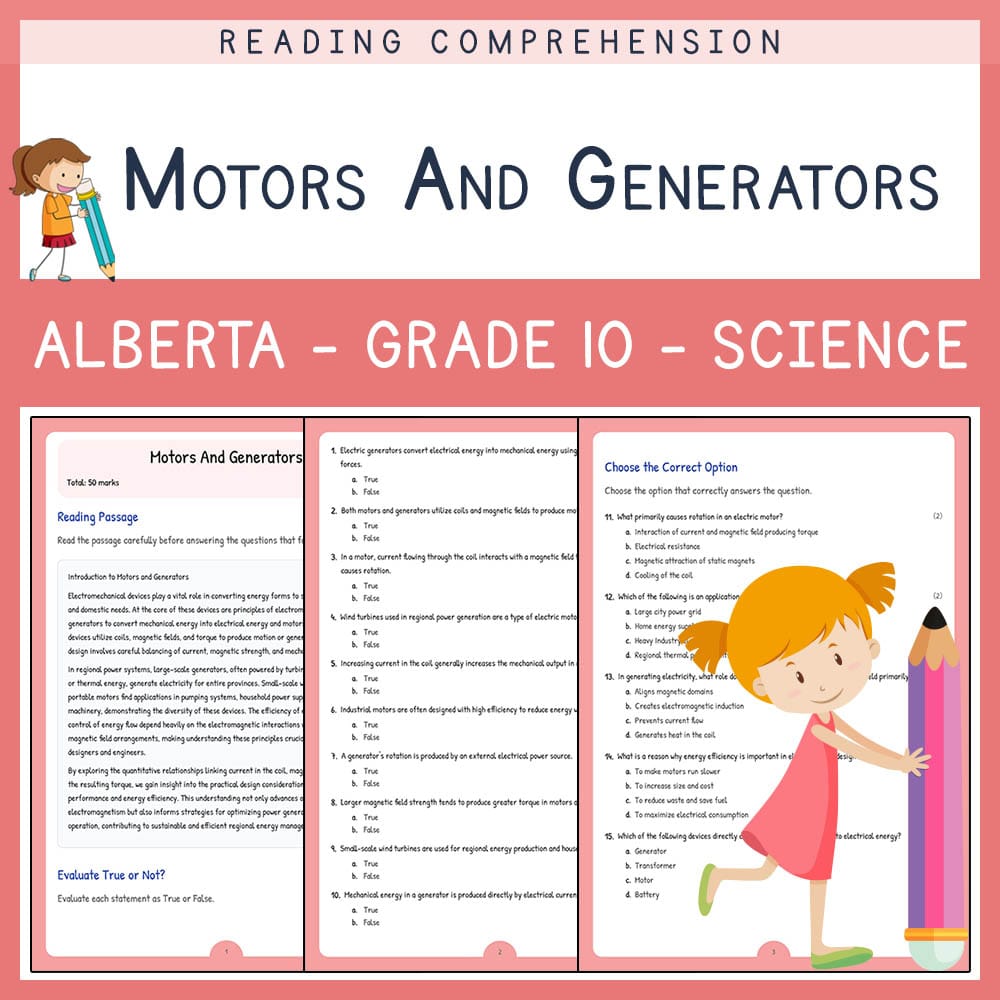
Grade 10 Science | Motors and Generators Worksheet | Alberta Standards
Created byLumora LearningLearning Objectives
- Explain the working principles of electric motors and generators through electromagnetic forces.
- Describe coil and magnetic field interactions in producing rotation in electromechanical devices.
- Compare common applications of motors and generators in regional energy systems and industry.
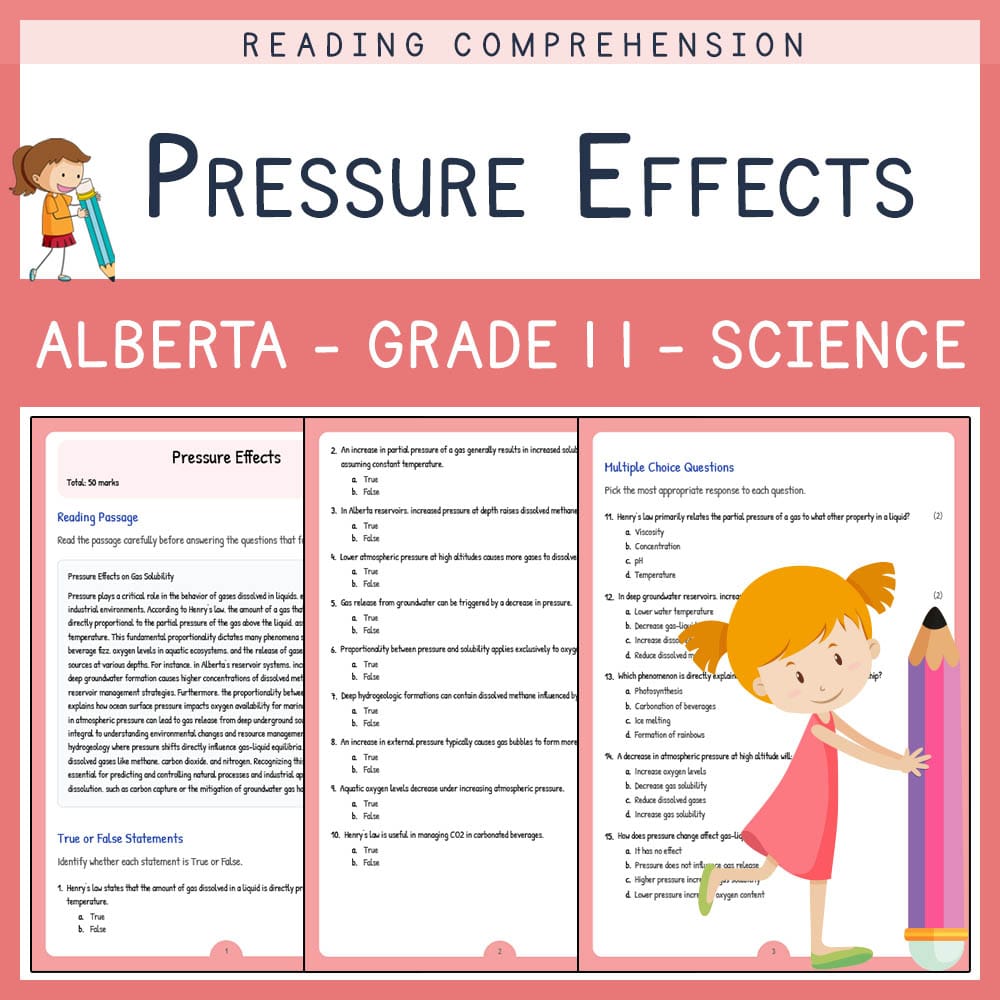
Grade 11 Science | Pressure Effects Worksheet | Alberta Standards
Created byLumora LearningLearning Objectives
- Understand how pressure influences gas solubility according to Henry's law.
- Recognize the practical implications of pressure changes in natural and industrial settings.
- Describe proportionality concepts relating partial pressure and dissolved gas concentrations.
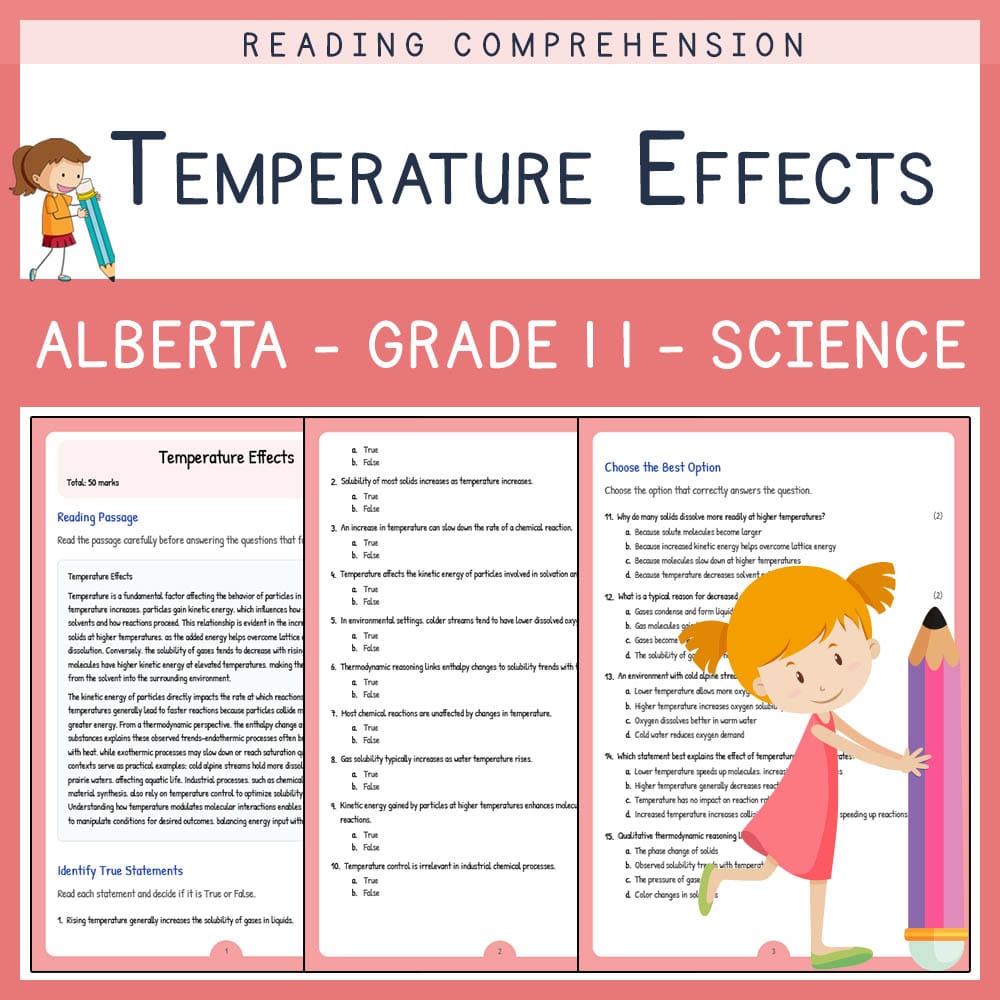
Grade 11 Science | Temperature Effects Worksheet | Alberta Standards
Created byLumora LearningLearning Objectives
- Describe how temperature influences the kinetic energy of particles and solvent–solute interactions.
- Explain why solids dissolve more readily at higher temperatures and why gas solubility decreases with increasing temperature.
- Apply qualitative thermodynamic reasoning to analyze solubility and reaction rate trends with temperature.
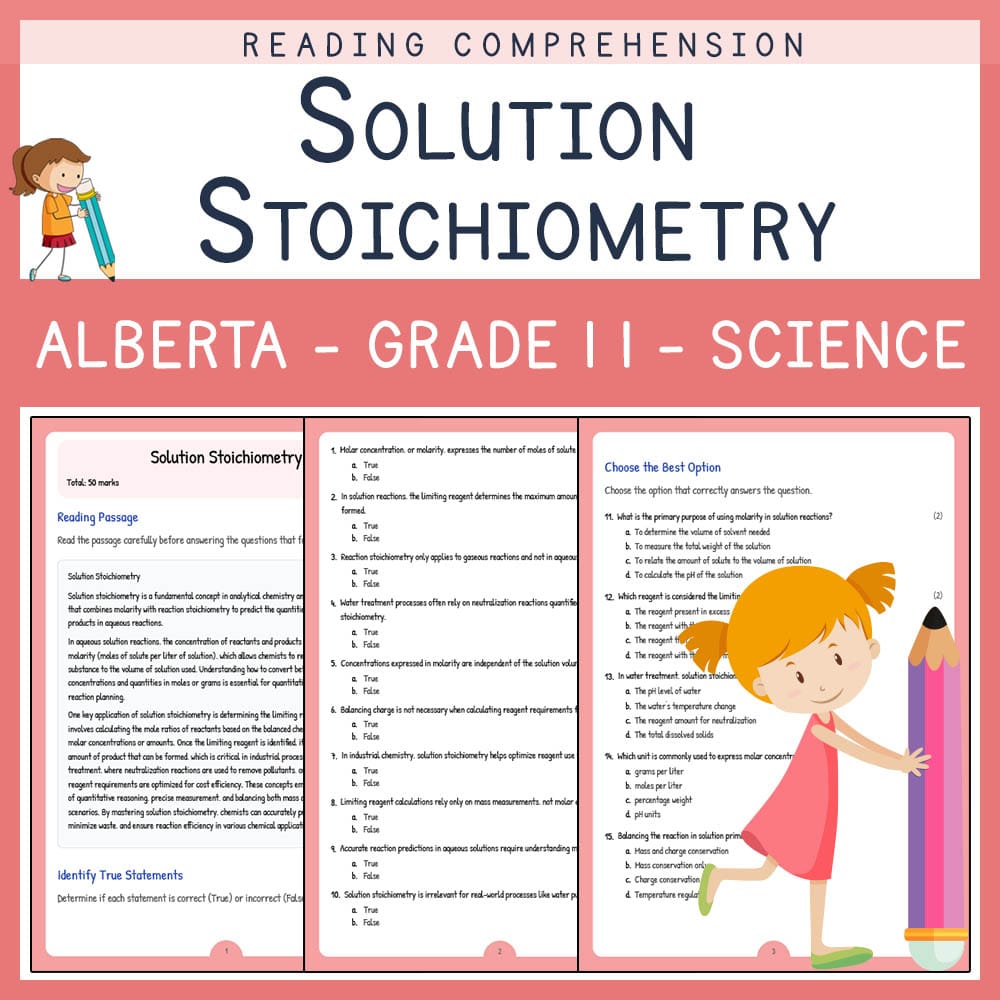
Grade 11 Science | Solution Stoichiometry Worksheet | Alberta Standards
Created byLumora LearningLearning Objectives
- Understand the concept of concentration and how it relates to molar ratios in aqueous reactions.
- Apply mole–mole relationships to predict reactant and product amounts in solution.
- Identify limiting reagents in solution-phase reactions through stoichiometric calculations.
Browse more categories
About Reading comprehension Worksheets
Find reading comprehension worksheets for class practice, homework, or self-study. All 40,241 are instant PDF downloads.
Each resource here is built by an independent educator and reviewed for quality. Worksheets print straight from PDF and suit classroom use, homework, or extra practice; most come with answer keys, and you can preview before purchasing.