
Reading comprehension Worksheets
40,241 type resources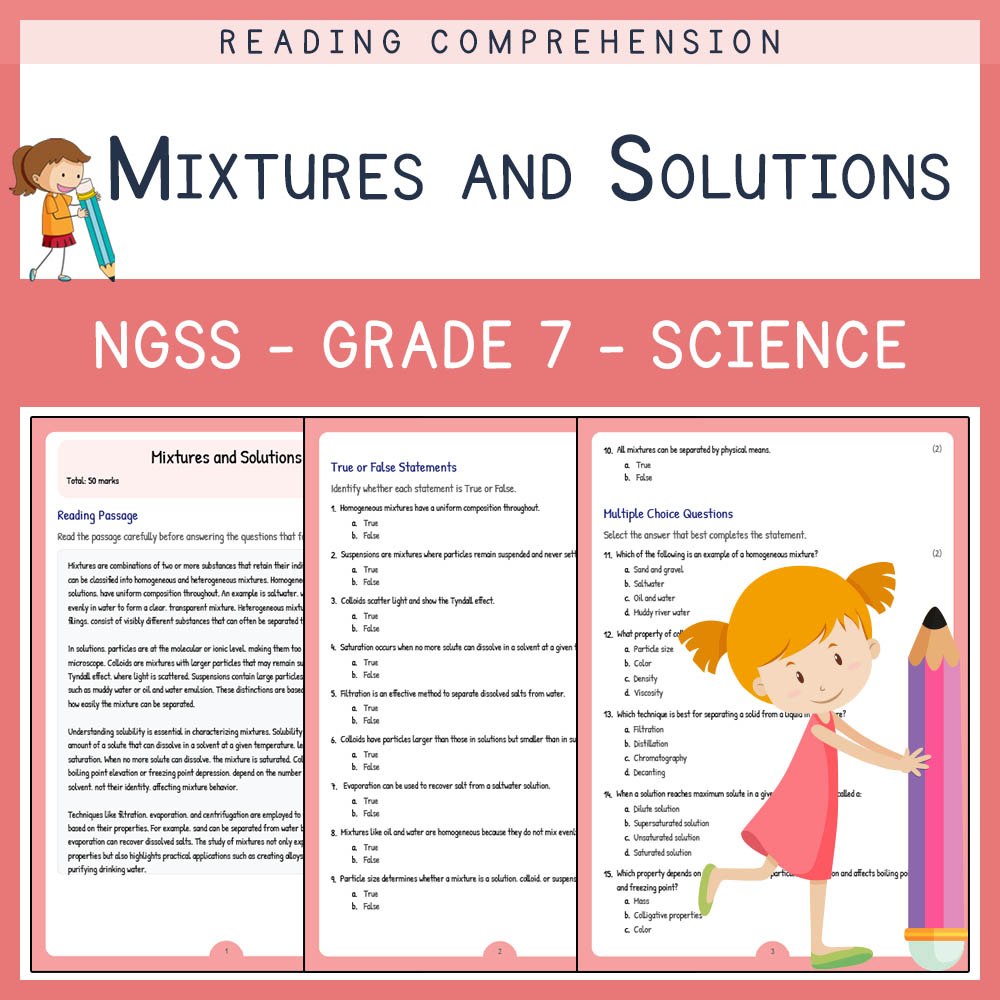
Grade 7 Science |Mixtures and Solutions Worksheet (NGSS Aligned with Answer Key)
 Created byLumora Learning
Learning Objectives
- Describe the differences between homogeneous and heterogeneous mixtures.
- Identify examples of solutions, colloids, and suspensions based on particle size and separation behavior.
- Explain concepts like solubility, saturation, and colligative effects in mixtures.
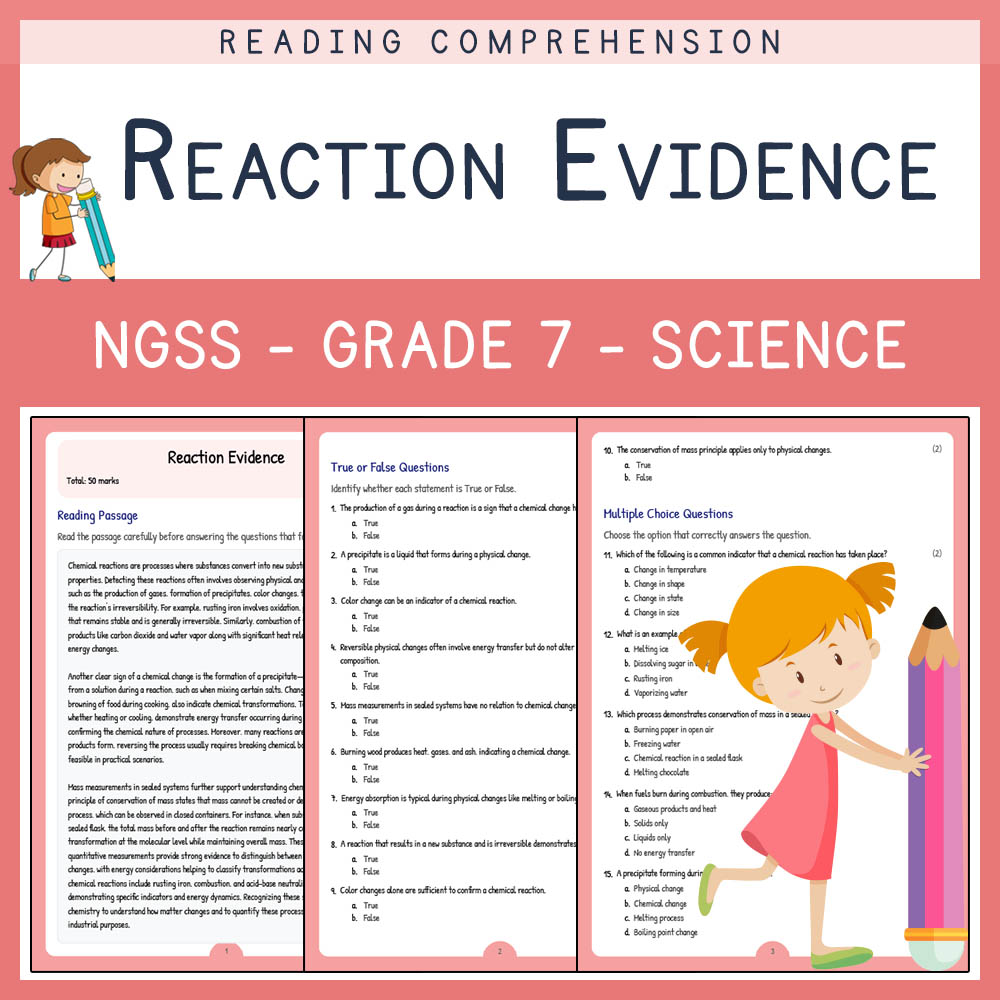
Grade 7 Science | Reaction Evidence Worksheet & Answer Key (NGSS Aligned)
Created byLumora LearningLearning Objectives
- Identify observable indicators that a chemical reaction has occurred, such as gas production, precipitate formation, color change, and temperature change.
- Explain irreversibility in chemical reactions and relate it to composition changes.
- Describe examples of chemical reactions, including rusting, combustion, and neutralization, and discuss how mass measurements in sealed systems demonstrate conservation principles.

Grade 9 Science | Earth Magnetism Worksheet (Alberta Standards) (PDF)
 Created byEvergreen Desk Education
Learning Objectives
- Explain how the Earth’s magnetic field is related to compass direction and navigation.
- Describe dip (inclination) and declination and how they change with location.
- Connect auroras and ionospheric phenomena to Earth’s magnetism.

Grade 9 Health Worksheet | Understanding Addictive Behaviours (PDF)
 Created bySunny Desk Resources
Learning Objectives
- Explain that addictive behaviours can include activities beyond substances, such as gambling or excessive screen time.
- Identify early signs and common triggers that contribute to addictive patterns.
- Describe healthy coping strategies, including setting boundaries and seeking support.

Grade 9 Science Worksheet on Electrical Quantities (PDF) | Alberta Standards
Created byEvergreen Desk EducationLearning Objectives
- Define electric current, voltage, and resistance and describe what each quantity represents in a circuit
- Use SI units, symbols, and typical magnitudes to interpret and compare values in real electrical systems
- Apply relationships between voltage, current, and resistance to reason about energy transfer and component choice

Transmission Tradeoffs Worksheet | NGSS Grade 9 Science Assessment
 Created bySkylark Worksheets
Learning Objectives
- Explain how bandwidth, sampling criteria, and signal-to-noise ratio affect communication performance
- Compare digital and analog transmission by using quantitative ideas like bit error rate and channel capacity
- Evaluate how modulation, coding, and error-correcting techniques improve reliability under noise and interference

Grade 9 Science | Motors and Generators Worksheet (Alberta Standards) (PDF)
Created byEvergreen Desk EducationLearning Objectives
- Explain how electric motors convert electrical energy into mechanical work.
- Describe how generators produce electrical energy using electromagnetic induction.
- Compare motor and generator operation by tracing key energy conversions and magnetic interactions.

Grade 11 Science | Integrated Systems Worksheet (TEKS) (PDF)
Created byEvergreen Desk EducationLearning Objectives
- Explain how cellular specialization and intercellular communication can produce emergent tissue, organ, and organism functions
- Compare chemical signaling, gap junction communication, and extracellular matrix organization in coordinating cell behavior
- Use systems thinking to predict how disruption of signaling or organization could affect organism-level health

Chemical Bonding Worksheet | NGSS Grade 9 Science Assessment
Created bySkylark WorksheetsLearning Objectives
- Explain ionic, covalent, and metallic bonding using electron transfer, electron sharing, and electron mobility models.
- Use bond energy and polarity ideas to predict relative stability, melting point, and conductivity of substances.
- Interpret Lewis structures and connect atomic electron configurations to molecular geometry and intermolecular attractions.

Equilibrium Constants Worksheet Grade 11 Chemistry Alberta PDF
Created byEvergreen Desk EducationLearning Objectives
- Explain how acid dissociation constants (Ka) and base dissociation constants (Kb) describe the position of equilibrium for proton-transfer reactions
- Connect Ka and Kb to pKa and pKb values and use them to compare acid/base strength
- Use the relationship Kw = Ka·Kb to find missing constants and relate conjugate pairs

Grade 11 Science | Genetic Mutations Worksheet (TEKS) with Answer Key (Printable PDF)
Created byEvergreen Desk EducationLearning Objectives
- Explain how genetic mutations change DNA and how those changes can alter protein structure and function.
- Differentiate silent, missense, nonsense, and frameshift mutations based on their effects on reading frames and amino acids.
- Describe common sources of mutations and predict how mutations may affect phenotype, regulation, or genetic variation.

Grade 9 Health Worksheet | Effective Communication Skills (Ontario PDF)
Created bySunny Desk ResourcesLearning Objectives
- Explain how verbal, non-verbal, and digital communication work together to build understanding and trust.
- Use active listening strategies to show respect and clarify meaning during conversations.
- Apply consent, boundaries, and respectful conflict-resolution skills to support healthy relationships.

Concentration Calculations Worksheet Grade 11 Chemistry Alberta PDF
Created byEvergreen Desk EducationLearning Objectives
- Convert between pH (or pOH) and hydrogen (or hydroxide) ion concentration using base-10 logarithms and inverse logarithms.
- Use Kw (and pKw or 14.00 at 25°C) to interrelate [H+] and [OH-] and check calculation consistency.
- Apply significant figures and correct units (mol/L) when reporting ionic concentrations from pH/pOH data.

Grade 8 Health Worksheet | Evaluating Effort & Fitness Components (PDF)
Created bySunny Desk ResourcesLearning Objectives
- Identify how fitness components (cardiovascular endurance, muscular strength, flexibility, and body composition) relate to effort during physical activity.
- Differentiate moderate versus vigorous exertion using observable signs of intensity and safe self-assessment.
- Use effort evaluation to set realistic activity goals and track improvements over time.

Grade 12 Science | Design Principles Worksheet (TEKS) PDF
Created byEvergreen Desk EducationLearning Objectives
- Identify independent and dependent measures and explain why their operational definitions matter for valid inference.
- Apply experimental design strategies such as control, replication, randomization, and blocking to reduce bias and confounding.
- Plan and justify statistical analyses (e.g., ANOVA, regression) by checking assumptions and interpreting results within valid limits.

Grade 12 Science | Energy Conservation Worksheet (TEKS) Practice (PDF)
Created byEvergreen Desk EducationLearning Objectives
- Integrate the first and second laws of thermodynamics to analyze chemical energy changes using internal energy, enthalpy, and entropy.
- Predict reaction spontaneity and equilibrium direction using Gibbs free energy and its temperature dependence.
- Explain how energy conservation and coupled reactions influence overall energy flow in combustion and electrochemical systems.

Grade 12 Science Data Analysis Worksheet (TEKS) – Comprehensive Practice (PDF)
Created byEvergreen Desk EducationLearning Objectives
- Interpret and describe patterns in scientific data using graphs, descriptive statistics, and trend language.
- Fit and compare mathematical models using residuals and goodness-of-fit metrics while checking assumptions.
- Communicate uncertainty and limitations clearly, including how error bars and decision thresholds affect conclusions.

Grade 3 ELA Worksheet | Informative and Explanatory Writing (PDF) – CCSS
 Created byGolden Apple Studio
Learning Objectives
- Explain what informative and explanatory writing is and what it aims to do for the reader.
- Identify how informative writing organizes ideas using logical structure and key details.
- Use transition words and relationship phrases to show how facts connect.

Grade 7 Inherited Traits Science Worksheet | Florida NGSSS + Answer Key
Created byEvergreen Desk EducationLearning Objectives
- Explain how inherited traits are passed from parents to offspring using genetic information in reproductive cells
- Distinguish between inherited traits and environmental causes of differences among individuals
- Use predictable patterns to interpret offspring trait outcomes based on parental variation

Grade 8 Science Worksheet | Braking Distance & Stopping Power (PDF)
Created byEvergreen Desk EducationLearning Objectives
- Explain how reaction time and braking time combine to determine stopping distance.
- Describe how tire-road friction affects decelerating force and stopping distance in different road conditions.
- Compare how unbalanced forces and brake fade can increase the distance needed to stop.

Grade 12 Science | Oral Presentation Worksheet (TEKS) with Answer Key (PDF)
Created byEvergreen Desk EducationLearning Objectives
- Create concise, evidence-based scientific abstracts and oral openings that clearly state a testable hypothesis.
- Apply slide design norms and timing constraints to support audience understanding during oral presentations.
- Interpret and respond to data-based questions using precise technical terminology appropriate for disciplinary audiences.

Grade 12 Science Data Visuals Worksheet | TEKS Standards (PDF)
Created byEvergreen Desk EducationLearning Objectives
- Select an appropriate data visualization (scatter plot, histogram, boxplot, time series) that matches the type of question and data.
- Construct clear graphs and charts using correct axis scaling, labeling, legends, and statistically meaningful annotations.
- Interpret uncertainty and model comparisons by reading error bars, confidence intervals, and log-scale transformations accurately.

Grade 8 Science worksheet on Material Corrosion (Alberta Standards) (PDF)
Created byEvergreen Desk EducationLearning Objectives
- Explain how corrosion involves chemical change and forms new substances on materials.
- Describe how moisture and salinity (salt) influence the rate and location of corrosion.
- Identify evidence that corrosion has occurred, based on mass change and observable changes.

Academic Vocabulary Worksheet | Grade 12 ELA CCSS Vocabulary Skills
Created byGolden Apple StudioLearning Objectives
- Determine the precise meaning of general academic and domain-specific terms using context clues in reading and writing tasks.
- Differentiate between similar academic terms (e.g., analyze vs. evaluate) and choose language that matches the purpose of a prompt.
- Apply academic vocabulary accurately in short responses and analytical writing to reduce ambiguity.

Grade 7 Ecosystem Energy Flow Worksheet | Food Webs | Florida NGSSS
Created byEvergreen Desk EducationLearning Objectives
- Explain how energy moves through ecosystems from producers to consumers to decomposers.
- Describe why each energy transfer to the next trophic level reduces the amount of usable energy.
- Use trophic-level ideas to predict how changes in one organism group can affect other groups.

Grade 8 Science Worksheet | Intermolecular Forces (PDF) – Alberta Standards
Created byEvergreen Desk EducationLearning Objectives
- Explain how intermolecular forces affect melting point, boiling point, and vapour pressure.
- Connect intermolecular forces to solubility by comparing attractions between different particles.
- Use real-world Alberta examples to describe how force strength influences phase change and evaporation.

Grade 8 Science Worksheet | Phase Transitions (Alberta Standard) PDF
Created byEvergreen Desk EducationLearning Objectives
- Describe how phase transitions change particle arrangement and energy without forming new substances
- Differentiate melting, freezing, vaporization, and condensation and identify the direction of energy flow
- Explain how phase transitions influence real-world systems such as river flow, snowpack melt timing, and condensation in cities

Grade 12 Science Resource Impacts Worksheet (BC Standards) (PDF)
Created byEvergreen Desk EducationLearning Objectives
- Explain how human resource use can change Earth systems through soil, water, air, and ecosystems.
- Analyze trade-offs between economic benefits and long-term system resilience.
- Evaluate strategies that reduce impacts and support restoration and sustainable management.

Grade 8 Science Worksheet | Understanding Circular Motion (PDF) – Alberta Standards
Created byEvergreen Desk EducationLearning Objectives
- Explain why an object moving at constant speed can still require a net inward (centripetal) force
- Analyze how centripetal force depends on mass, speed, and turn radius
- Predict what happens when the inward force is insufficient during a turn

Grade 12 Science – Variables Control Worksheet (TEKS) (PDF)
Created byEvergreen Desk EducationLearning Objectives
- Identify independent, dependent, and confounding variables in biological and environmental investigations.
- Select appropriate strategies to control confounding variables, including randomization and matched controls.
- Explain how blinding and replication reduce bias and improve the reliability of conclusions.

Grade 3 ELA – Time and Sequence Worksheet (PDF) | CCSS Standards
Created byGolden Apple StudioLearning Objectives
- Use time and sequence words (first, next, then, after, before, after) to describe events in order.
- Identify how key details match specific moments in an informational passage.
- Explain relationships between events using before-and-after language.

Grade 12 Health Worksheet | Substance Risks & Harm Reduction (PDF)
Created bySunny Desk ResourcesLearning Objectives
- Explain how harm reduction reduces health and social risks related to substance use without promoting use.
- Identify evidence-based safety practices that lower the likelihood of acute harm (e.g., overdose, injury, unsafe mixing).
- Evaluate common myths about alcohol and drugs using risk, physiology, and safer decision-making.

Energy Forms Worksheet Grade 10 Science Alberta | Thermal Kinetic Chemical
Created byEvergreen Desk EducationLearning Objectives
- Differentiate kinetic energy and potential energy in real-world examples
- Explain how mechanical energy conservation works in idealized systems
- Predict how non-conservative forces change the distribution of kinetic and potential energy

Grade 10 ELA Worksheet | Transitions And Style CCSS (PDF)
Created byGolden Apple StudioLearning Objectives
- Analyze how transitions help readers follow relationships among claims, evidence, and concluding ideas.
- Revise writing to improve style by controlling pacing, varying sentence structures, and choosing precise vocabulary.
- Use clarity strategies to avoid unclear pronoun reference, repetitive phrasing, and logic gaps between sentences.

Grade 5 ELA Worksheet | Understanding Theme & Details (PDF)
Created byGolden Apple StudioLearning Objectives
- Identify a story’s theme by connecting key details such as character decisions, repeated actions, and recurring images.
- Explain how cause-and-effect relationships within a plot support a central idea over time.
- Distinguish between plot events and theme by using evidence from the text.

Grade 10 Science – Electron Configuration Worksheet (PDF) | BC Standards
Created byEvergreen Desk EducationLearning Objectives
- Describe how electrons fill energy levels and orbitals in an atom using quantized rules.
- Identify valence electrons from an electron configuration and explain their role in bonding and reactivity.
- Relate electron configuration patterns to groups and periods on the periodic table.

Grade 10 Health | Community Engagement Worksheet (NHES) (PDF)
Created bySunny Desk ResourcesLearning Objectives
- Explain how community engagement supports improved health outcomes.
- Identify strategies communities use to raise awareness, build coalitions, and advocate for policy change.
- Analyze roles different community members play in creating sustainable health initiatives.

Grade 10 Science | Electric Circuits Worksheet (PDF) | BC Standards
Created byEvergreen Desk EducationLearning Objectives
- Explain how electrical energy is converted and transferred in an electric power system (generators, transformers, transmission lines, and loads).
- Analyze how resistive losses, reactive effects, and transmission distance reduce delivered energy and overall system efficiency.
- Compare centralized and distributed generation in terms of efficiency trade-offs, resilience, grid reliability, and environmental impact.

Grade 6 Science | Gas Pressure Worksheet (BC Standards) (PDF)
Created byEvergreen Desk EducationLearning Objectives
- Explain gas pressure using the particle model and collisions with container walls
- Describe how changing particle speed, collision frequency, and gas volume affects pressure
- Predict how temperature and pressure are related in sealed and unsealed situations

6th Grade Science Worksheet | Stewardship Practices (PDF) Aligned with Alberta Standards
Created byEvergreen Desk EducationLearning Objectives
- Describe how different stewardship practices (community planting, shelterbelts, urban canopy programs, and Indigenous knowledge) support local landscapes.
- Explain how stewardship actions can improve habitat connectivity, carbon storage, and water regulation.
- Identify stewardship examples from Alberta and connect them to the environmental benefits they provide.

Grade 10 Science – Mass Conservation Worksheet (PDF) BC Standards
Created byEvergreen Desk EducationLearning Objectives
- Explain the law of conservation of mass and describe when it applies (closed systems).
- Analyze chemical reactions to account for total mass of reactants and products, including gases and dissolved ions.
- Use mass conservation to evaluate and interpret balanced equations and quantitative results.

Grade 10 Science – Variation and Heredity Worksheet (TEKS) (PDF)
Created byEvergreen Desk EducationLearning Objectives
- Explain how mutation, recombination, and gene flow create genetic variation within populations
- Describe how heritable traits influence survival and reproduction in particular environments
- Analyze how natural selection changes allele frequencies across generations without directed intent

Grade 6 Health Worksheet | Understanding Health Services & NHES Standards (PDF)
Created bySunny Desk ResourcesLearning Objectives
- Identify common types of health services (clinics, counseling, and emergency care) and what they are used for
- Explain how to choose an appropriate health service for different needs and urgency levels
- Use local and national resources to contact health services efficiently

Grade 10 Science Worksheet | Transport Mechanisms TEKS (PDF)
Created byEvergreen Desk EducationLearning Objectives
- Distinguish between passive, active, and bulk transport based on energy use and concentration gradients
- Explain how facilitated diffusion and ATP-driven pumps move molecules and ions across membranes
- Analyze how osmotic effects influence cells such as red blood cells and plant vacuoles

Grade 10 Science | Electric Fields Worksheet (PDF) BC Standards
Created byEvergreen Desk EducationLearning Objectives
- Explain what an electric field represents and how it relates to force on a charge
- Interpret electric field line direction for positive and negative charges and infer relative field strength
- Use the principle of superposition to reason about net electric fields from multiple charges

Grade 7 Health | Environmental Factors Worksheet (NHES) PDF
Created bySunny Desk ResourcesLearning Objectives
- Explain how environmental factors such as pollution, safety, and healthcare access can affect health
- Identify examples of environmental conditions that support or hinder healthy choices
- Describe ways students can advocate for healthier community environments

Grade 7 Health - Conflict Resolution Worksheet (NHES) PDF
Created bySunny Desk ResourcesLearning Objectives
- Explain how de-escalation communication can reduce conflict and create a safer conversation.
- Use respectful dialogue moves to express needs and recognize other viewpoints during disagreements.
- Apply negotiation and compromise strategies to reach a workable solution that benefits both sides.

Grade 7 ELA Worksheet | Mastering Pronoun Usage (CCSS PDF)
Created byGolden Apple StudioLearning Objectives
- Use correct pronoun case (subjective, objective, and possessive) to make sentences clear and accurate.
- Apply pronoun-antecedent agreement so pronouns match the nouns or pronouns they refer to.
- Choose the correct reflexive and personal pronouns (myself/yourself/himself, etc.) to improve precision and cohesion.
Browse more categories
About Reading comprehension Worksheets
Find reading comprehension worksheets for class practice, homework, or self-study. All 40,241 are instant PDF downloads.
Each resource here is built by an independent educator and reviewed for quality. Worksheets print straight from PDF and suit classroom use, homework, or extra practice; most come with answer keys, and you can preview before purchasing.