
Grade 10 Worksheets
9,388 grade resources
Genetic Variation Sources and Consequences Worksheet | Grade 10 Science
JCreated byJ.S SheetsLearning Objectives
- Explain how random assortment, crossing over, and independent segregation create new allele combinations during meiosis.
- Describe how mutations and gene flow introduce genetic variation within and between populations.
- Connect genetic variation to the ability of populations to change over generations through natural selection.
Also included in: Grade 10 Genetics, Evolution, and Cell Science Lesson Bundle: General +2 more
Instant download

Grade 10 Science | Reaction Stoichiometry - Daily Reading Comprehension
 Created byCoral Reef Learning
Learning Objectives
- Understand the concept of the mole and its relation to particles and mass
- Learn to interpret and write balanced chemical equations
- Perform mass-to-mass stoichiometric calculations
Also included in: Chemistry Foundations Lesson Bundle: Grade 10 Science Advanced Placement (AP) +1 more
Instant download
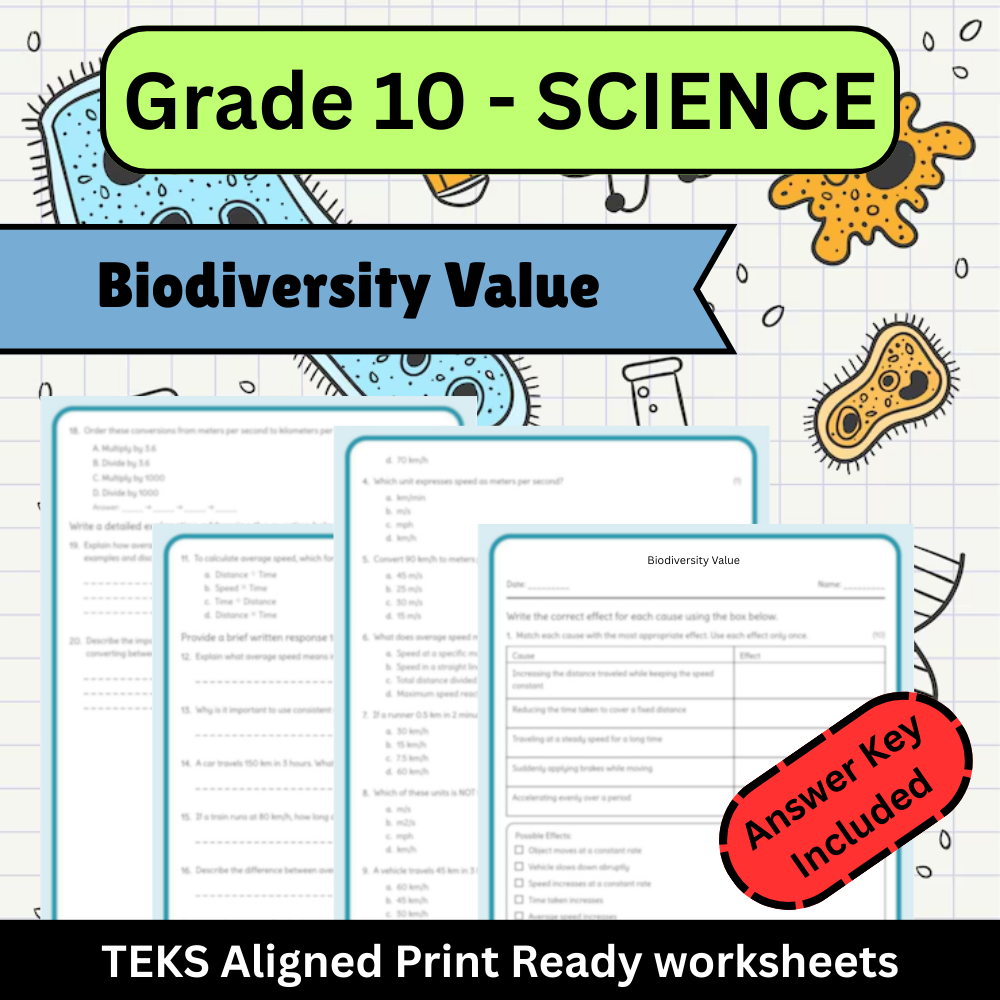
Grade 10 Science | Biodiversity Value Worksheet (Worksheet + Answer Key) – TEKS Aligned
 Created byBright Mind Resources
Learning Objectives
- Understand the different levels of biodiversity and their importance
- Explain how biodiversity contributes to ecosystem resilience and services
- Identify threats to biodiversity and conservation strategies
Also included in: Grade 10 Science | Ecosystems & Biodiversity Unit Worksheet Bundle(TEKS-Aligned) +5 more
Instant download

Global Interaction Worksheet | Grade 10 Social Studies TEKS Activity
 Created byThe Resource Hub
Learning Objectives
- Explain how global interdependence connects economies, societies, and governments across borders
- Analyze how economic ties can influence security, development, and policy decisions
- Evaluate how human rights concerns and international organizations affect cooperation among nations
Also included in: Global Conflicts & Decolonization Lesson Bundle | Grade 10 Social Studies TEKS +1 more
Instant download

Carbon Cycling Between Air and Living Things Worksheet | Grade 10 TEKS
 Created byBRIGHT PATH RESOURCES
Learning Objectives
- Identify the main idea of a text about carbon cycling.
- Define key terms related to carbon reservoirs and processes.
- Explain how carbon moves between the atmosphere and living organisms.
Also included in: Grade 10 Metabolism & Energy Processes Science Worksheets Bundle | TEKS +1 more
Instant download

Motion Graphs Worksheet Grade 10 Science Activities | NGSSS Practice
 Created byPrism Point Learning
Learning Objectives
- Interpret slope on position-time and velocity-time graphs to determine velocity and acceleration.
- Use graph features (sign, curvature, and flat sections) to reason about changing direction and acceleration.
- Connect motion graph representations to how forces affect an object over time.
Also included in: Grade 10 Physical Science Lesson Bundle | Florida NGSSS
Instant download

Atmospheric Processes Worksheet | Science Practice for Grade 10 Alberta
JCreated byJ.S SheetsLearning Objectives
- Understand how pressure patterns, moisture transport, and thermal gradients influence weather and climate.
- Identify regional phenomena such as Chinook winds, frontal systems, and convective storms and their impacts.
- Explain how atmospheric composition, aerosols, and surface albedo modulate energy balance.
Also included in: Grade 10 Earth Systems & Climate Science Lesson Bundle – Alberta Framework +1 more
Instant download

Surface Processes Worksheet | Grade 10 AP Science Practice Activities
Created byPrism Point LearningLearning Objectives
- Differentiate weathering, erosion, sediment transport, and deposition and describe how each reshapes landforms over time.
- Interpret how climate drivers, lithology, and human modification influence rates and observable signatures of surface change.
- Use conceptual and graphical ideas (channel profiles, sediment grain size, and sediment budgets) to explain morphological change.
Also included in: Earth Systems, Climate & Adaptation Lesson Bundle: Grade 10 Science AP
Instant download

Modeling Evidence Test Prep Worksheet | Grade 10 Science Ontario
Created byPrism Point LearningLearning Objectives
- Construct conceptual and quantitative models to represent observed phenomena using theory and data.
- Estimate parameters and evaluate model fit using residuals and patterns in residual plots.
- Validate models against independent data and communicate predictive limits and uncertainty.
Also included in: Grade 10 Evidence-Based Science Data Analysis Lesson Bundle: Ontario
Instant download

Grade 10 Science — Worksheet MCQ Paper for Mastering Molecular Geometry
Created byThe Resource HubLearning Objectives
- Explain the concept of molecular geometry using electron-domain models.
- Predict the three-dimensional shape of molecules based on electron pair arrangements.
- Describe how molecular shape influences polarity and intermolecular forces.
Also included in: Grade 10 Science Chemistry Foundations Lesson Bundle for AP Curriculum +1 more
Instant download

Grade 10 Social Studies | Immigration Shifts Worksheet (Ontario Standards)
 Created bySunny Desk Resources
Learning Objectives
- Explain how changes in Canadian immigration policy shifted who could enter the country and how newcomers arrived over time
- Analyze the demographic and economic effects of immigration reforms on cities, labour markets, and public services
- Evaluate continuity and change in settlement patterns and citizenship norms in the context of global migration
Also included in: Grade 10 Modern Canadian History Social Studies Lesson Bundle (Ontario) +1 more
Instant download

Grade 10 Social Studies — Revolutions and Ideologies MCQ Worksheet
Created byThe Resource HubLearning Objectives
- Explain how revolutions can challenge existing political structures through demands for independence, rights, and social justice
- Identify key events of the French Revolution and how they affected governance and society
- Analyze how nationalism, liberalism, and socialism shaped revolutionary goals
Also included in: Grade 10 Modern World History Social Studies Custom Bundle California
Instant download

Grade 10 Health Self-Awareness Growth Worksheet (Ontario) PDF
Created bySunny Desk ResourcesLearning Objectives
- Explain how self-awareness supports emotional regulation and healthier decision-making.
- Identify personal strengths, emotions, reactions, and values through reflection.
- Apply simple reflection strategies to build resilience and a positive self-image.
Also included in: Grade 10 Social-Emotional Learning Health Lesson Bundle (Ontario) +1 more
Instant download

Grade 10 Reaction Stoichiometry Worksheet | AP Practice & PDF
 Created byClear Sky Classroom
Learning Objectives
- Use the mole concept and molar mass to convert between grams and moles in chemical reactions
- Apply balanced chemical equations to perform mass-to-mass stoichiometric calculations using mole ratios
- Identify the limiting reagent and estimate theoretical yield from balanced equations
Also included in: Grade 10 Chemistry Foundations Science Lesson Bundle: AP Worksheet Set +1 more
Instant download
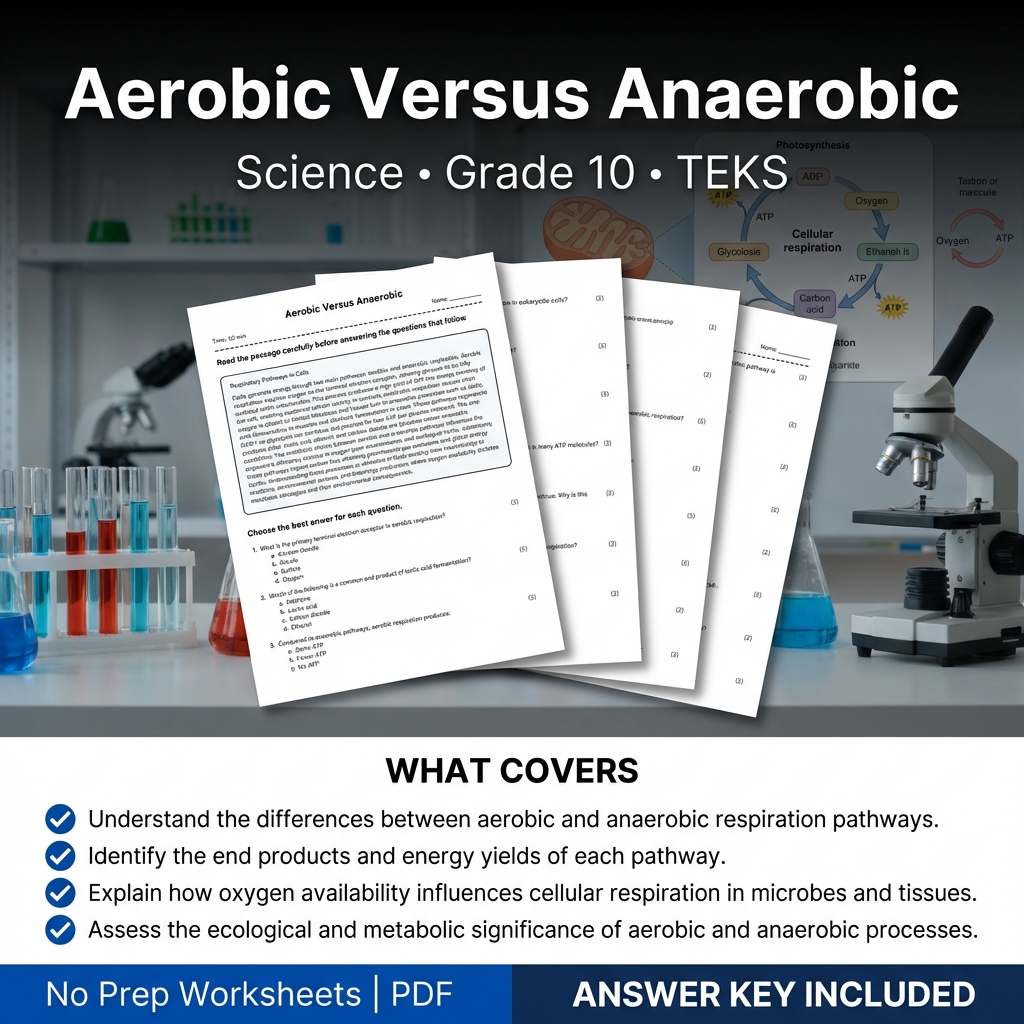
Grade 10 Science Worksheet on Aerobic vs Anaerobic Respiration | TEKS
Created byCoral Reef LearningLearning Objectives
- Understand the differences between aerobic and anaerobic respiration pathways.
- Identify the end products and energy yields of each pathway.
- Explain how oxygen availability influences cellular respiration in microbes and tissues.
Instant download

Grade 10 Holiday D Day for Mastering Historic Beginnings | PDF + Answer Key
 Created byShaNova Worksheets
Learning Objectives
- Explain key factors that led to the Allied decision to invade Normandy in WWII, focusing on strategy and timing.
- Use cause-and-effect reasoning to connect primary-source evidence (maps, letters, firsthand accounts) to historical outcomes.
- Practice analyzing historical materials with empathy by recognizing how individuals experienced major events.
Also included in: Grade 10 D Day Holiday Reading Skills Custom Bundle | Common Core ELA
Instant download

Grade 10 Purpose and Context Worksheet | Alberta ELA Text Analysis
 Created byLumora Learning
Learning Objectives
- Explain how purpose influences what information a text includes, emphasizes, or omits
- Analyze context (time period, stakeholders, audience, and uncertainty) to evaluate credibility and relevance
- Distinguish promotional messaging from critical review by identifying differences in goals and evidence
Instant download

Grade 10 Science | Mutations and Traits Worksheet | NGSSS Aligned
Created byLumora LearningLearning Objectives
- Explain how mutations can change gene function or gene regulation and influence traits
- Identify common sources of mutations and distinguish among types by scale
- Analyze how environment can affect whether a mutation increases or decreases fitness
Instant download

Grade 10 Science – Measurement Uncertainty & Error | Daily Reading Worksheet
Created byBright Mind ResourcesLearning Objectives
- Define uncertainty and error in measurement
- Differentiate between systematic and random errors
- Interpret measurement uncertainty using concepts such as precision and accuracy
Also included in: Nature of Science Grade 10 Science Worksheets Lesson Bundle | Florida NGSSS +1 more
Instant download

Grade 10 Social Studies – Great Depression Worksheet (PDF) BC Standards
Created bySunny Desk ResourcesLearning Objectives
- Explain major causes of the Great Depression, including financial instability and reduced aggregate demand.
- Analyze economic impacts using trade-flow and employment examples across industrial economies.
- Evaluate how governments responded through Keynesian-style intervention and protectionist measures.
Also included in: Grade 10 Conflict, Justice & Rights Social Studies Lesson Bundle (BC) +1 more
Instant download

Grade 10 Social Studies — Worksheet MCQ Paper for Mastering the Great Depression
Created byThe Resource HubLearning Objectives
- Explain key causes and major consequences of the Great Depression in Canada
- Compare how different Canadian regions experienced the economic crisis
- Analyze how unemployment, relief, and political protest influenced expectations of government responsibility
Also included in: Grade 10 Canadian History Since World War I Social Studies Custom Bundle Ontario +1 more
Instant download

Grade 10 Social Studie — Worksheet MCQ Paper for Mastering Economic Development
Created byThe Resource HubLearning Objectives
- Explain how post-World War II economic growth increased standards of living in many countries.
- Describe the role of international institutions in promoting economic stability and development.
- Analyze how economic interdependence can create opportunities and also widen disparities between countries.
Also included in: Grade 10 Modern World History Social Studies Custom Bundle California
Instant download

Grade 10 Science | Limiting Reagent Worksheet | BC Aligned
Created byLumora LearningLearning Objectives
- Understand the concept of limiting reagent in chemical reactions.
- Learn how to compare stoichiometric ratios and available amounts in moles.
- Identify the limiting reactant in a chemical process.
Instant download

Science Worksheet Measurement and Interpretation | Standards-Aligned Grade 10
JCreated byJ.S SheetsLearning Objectives
- Select appropriate measurement units, instruments, and calibration methods to produce meaningful data.
- Interpret graphs and data tables by identifying trends, patterns, and the impact of outliers.
- Use significant figures and scale to compare measurements accurately and justify conclusions with evidence.
Also included in: Grade 10 Scientific Reasoning, Models & Evidence Science Lesson Bundle +1 more
Instant download

Grade 10 Science | Particle Interactions Worksheet (NGSS 10) (PDF)
 Created bySilver Birch Teaching
Learning Objectives
- Analyze how crystal structures, molecular interactions, and electrical forces influence macroscopic material properties.
- Differentiate between ionic lattices and molecular solids based on properties like melting point, solubility, and conductivity.
- Explain how lattice energy, dispersion forces, and hydrogen bonding affect phase transitions and physical properties.
Also included in: Grade 10 Chemical Reactions & Equilibrium Science Lesson Bundle NGSS +1 more
Instant download

Grade 10 Social Studies | Nuclear Deterrence Worksheet (PDF)
Created bySunny Desk ResourcesLearning Objectives
- Explain deterrence theory and how it shaped Cold War nuclear strategy and crisis decisions.
- Analyze how arms races, technical capabilities, and geography affected superpower policy.
- Evaluate the Cuban Missile Crisis as a case study in risk, restraint, and crisis management.
Also included in: Grade 10 Conflict, Justice & Rights Social Studies Lesson Bundle (BC) +1 more
Instant download

Grade 10 Social Studies Worksheet | Scientific Developments (PDF) (TEKS)
Created bySunny Desk ResourcesLearning Objectives
- Explain how major European intellectual movements (Renaissance, Reformation, and Enlightenment) challenged traditional beliefs and shaped new ways of thinking.
- Analyze how the scientific revolution promoted inquiry, evidence, and technological progress.
- Evaluate the lasting impact of these developments on modern political, religious, and cultural institutions.
Also included in: Grade 10 Global Conflicts Social Studies Full-Year Worksheet Bundle – TEKS +1 more
Instant download

Atmospheric Patterns Worksheet | AP Science Grade 10 Practice
JCreated byJ.S SheetsLearning Objectives
- Understand the structure and circulation of atmospheric pressure systems.
- Identify and explain the role of circulation cells in regional climate and weather phenomena.
- Interpret hypsometric, wind-field, and pressure-surface representations related to frontal systems and storm tracks.
Instant download

RNA Types and Protein Translation Worksheet | TEKS Grade 10 Science
Created byBRIGHT PATH RESOURCESLearning Objectives
- Identify the roles of mRNA, tRNA, and rRNA in translating genetic information into proteins.
- Explain how RNA differs from DNA in basic structure and pairing rules during transcription.
- Distinguish the functions of RNA types by matching them to steps in protein synthesis.
Also included in: Grade 10 Genetics & Molecular Biology Science Worksheets Bundle | TEKS +1 more
Instant download

Grade 10 Science – Membrane Transport & Cell Function | Daily Reading Worksheet
Created byBright Mind ResourcesLearning Objectives
- Understand the structure and function of cell membranes
- Identify mechanisms of membrane transport such as diffusion, osmosis, and facilitated transport
- Relate membrane properties to cellular functions like nutrient uptake and waste removal
Also included in: Grade 10 Science Daily Reading: Cells & Systems Lesson Bundle | Alberta +1 more
Instant download

Science Worksheet Wave Properties Grade 10 | Standards-Aligned Practice
JCreated byJ.S SheetsLearning Objectives
- Explain how waves transfer energy without transporting matter overall.
- Use amplitude, wavelength, frequency, and wave speed to describe wave behavior.
- Apply the relationship v = fλ to predict how frequency and wavelength change for waves traveling at the same speed.
Also included in: Grade 10 Matter, Energy, and Waves Science Lesson Bundle – Florida (NGSSS) +1 more
Instant download

Grade 10| World Ocean Day Worksheet for Conservation Priorities|PDF + Answer Key
Created byShaNova WorksheetsLearning Objectives
- Explain why marine protected areas, sustainable fishing, and pollution reduction are key ocean conservation strategies.
- Identify how human activities threaten marine biodiversity and ecosystem resilience.
- Describe how international cooperation and individual actions can support long-term ocean health.
Also included in: Grade 10 World Ocean Day Holiday Custom Bundle NGSS Worksheet Set
Instant download

Grade 10 Science – Properties of Metals & Nonmetals | Daily Reading Worksheet
 Created byQuiet Forest Education
Learning Objectives
- Understand the concept of physical properties and how they are measured.
- Differentiate between intensive and extensive properties.
- Identify measurable attributes such as density, melting point, and conductivity.
Also included in: Matter and Chemical Change Grade 10 Science Daily Reading Bundle | Ontario +1 more
Instant download

Net Force Motion Worksheet | NGSS Physics Activity with Answer Key
Learning Objectives
- Explain how net force determines acceleration using Newton’s second law (F = ma).
- Use vector addition to calculate net force when multiple forces act on an object.
- Interpret constant-acceleration motion using kinematics and motion graphs.
Instant download

Grade 10 Holiday | Women’s History Month Kickoff | PDF + Answer Key
Created byShaNova WorksheetsLearning Objectives
- Identify influential women throughout history and their contributions to social movements and civic policies.
- Understand key vocabulary related to leadership, activism, and social change.
- Analyze biographies of significant women and recognize societal challenges they faced.
Also included in: Grade 10 Women's History Month Holiday Worksheets Bundle for Engagement
Instant download

Grade 10 AP Science Wave Behavior Worksheet Activities Physics
Created byPrism Point LearningLearning Objectives
- Differentiate transverse and longitudinal waves using amplitude, wavelength, frequency, and wave speed
- Explain how reflection, refraction, and interference affect wave behavior at boundaries
- Use superposition to reason about standing-wave formation and energy transfer
Instant download

Grade 10 Science – Signal Transmission & Modulation | Daily Reading Worksheet
Created byBright Mind ResourcesLearning Objectives
- Understand the basic concepts of signal modulation techniques.
- Identify different types of modulation such as amplitude, frequency, and phase.
- Recognize the factors affecting signal transmission like bandwidth, noise, attenuation, and dispersion.
Also included in: Signal Modulation Grade 10 Science Daily Reading Worksheets Bundle | NGSS +2 more
Instant download
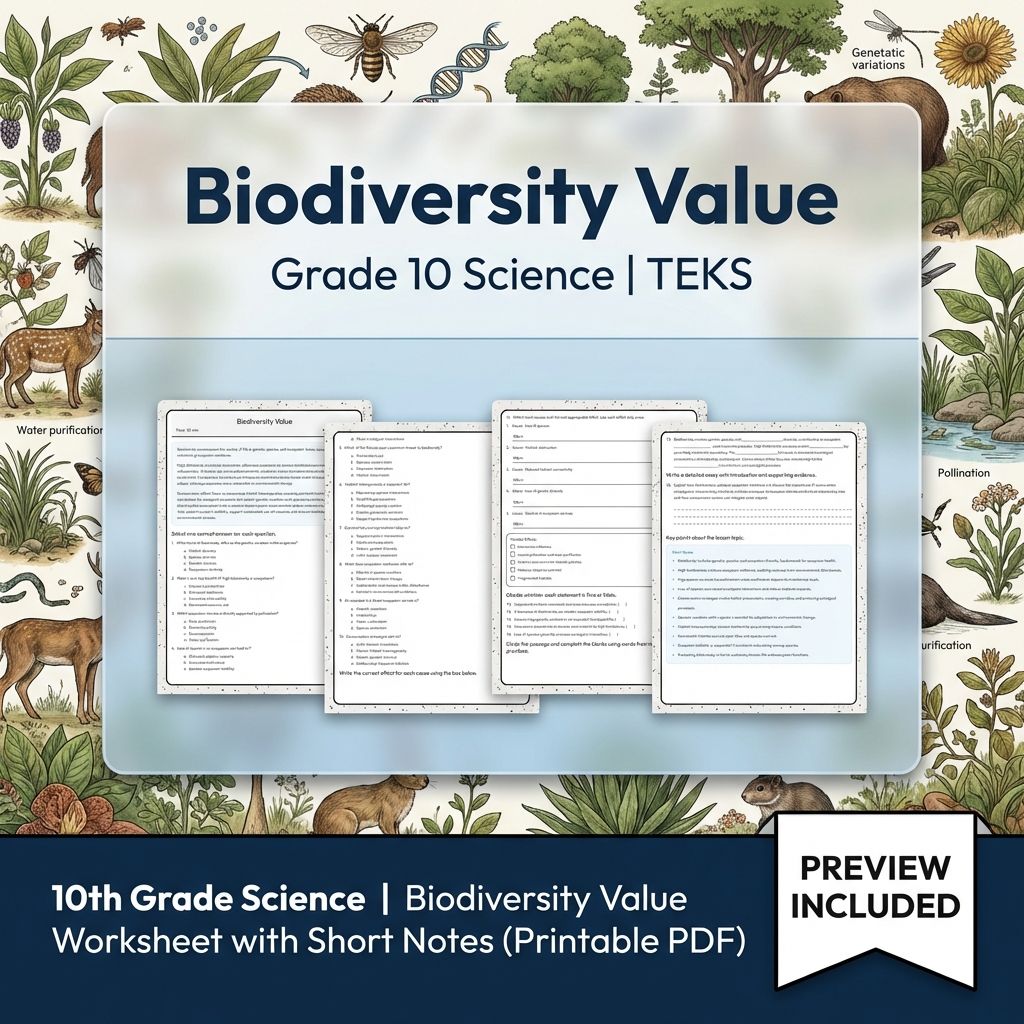
10th Grade Science | Biodiversity Value Worksheet with Short Notes (PDF)
 Created byMeadowlark Worksheets
Learning Objectives
- Understand the components of biodiversity and their importance for ecosystem resilience.
- Explain how biodiversity contributes to ecosystem services such as pollination and water purification.
- Identify threats to biodiversity and their impacts.
Instant download

Grade 10 Science – Reaction Particles & Collision Concepts | Reading Worksheet
Created byBright Mind ResourcesLearning Objectives
- Understand how particle collisions influence chemical reactions
- Explain the role of energy in overcoming reaction barriers
- Describe how factors like temperature and catalysts affect reaction rates
Also included in: Stoichiometry Forces and Energy Lesson Bundle Grade 10 Science | General +1 more
Instant download

Directional Energy Flow in Food Chains Worksheet | TEKS Grade 10 Science
Created byBRIGHT PATH RESOURCESLearning Objectives
- Explain how energy moves through a food chain from producers to consumers.
- Identify which organisms receive energy at each trophic level.
- Describe the role of decomposers in recycling matter.
Also included in: Grade 10 Ecology & Environmental Interactions Science Worksheets | TEKS +1 more
Instant download

Grade 10 Worksheet B: Wave Properties Worksheet | NGSS Practice PDF
Created byClear Sky ClassroomLearning Objectives
- Use amplitude, wavelength, frequency, and propagation speed to characterize sinusoidal waves.
- Apply the relationship v = fλ to predict wave speed from frequency and wavelength.
- Interpret superposition and interference, including standing waves, using phase and trigonometric ideas.
Also included in: Grade 10 Wave Properties & Communication Science Lesson Bundle | NGSS +1 more
Instant download

Rise of Nationalism Worksheet | Standards-Aligned Practice for Grade 10
JCreated byJ.S SheetsLearning Objectives
- Define nationalism and explain how it shapes people’s sense of belonging to a nation.
- Analyze how nationalist movements encouraged independence and changed political boundaries.
- Evaluate how nationalism contributed to both cohesion within nations and conflict between groups or states.
Instant download
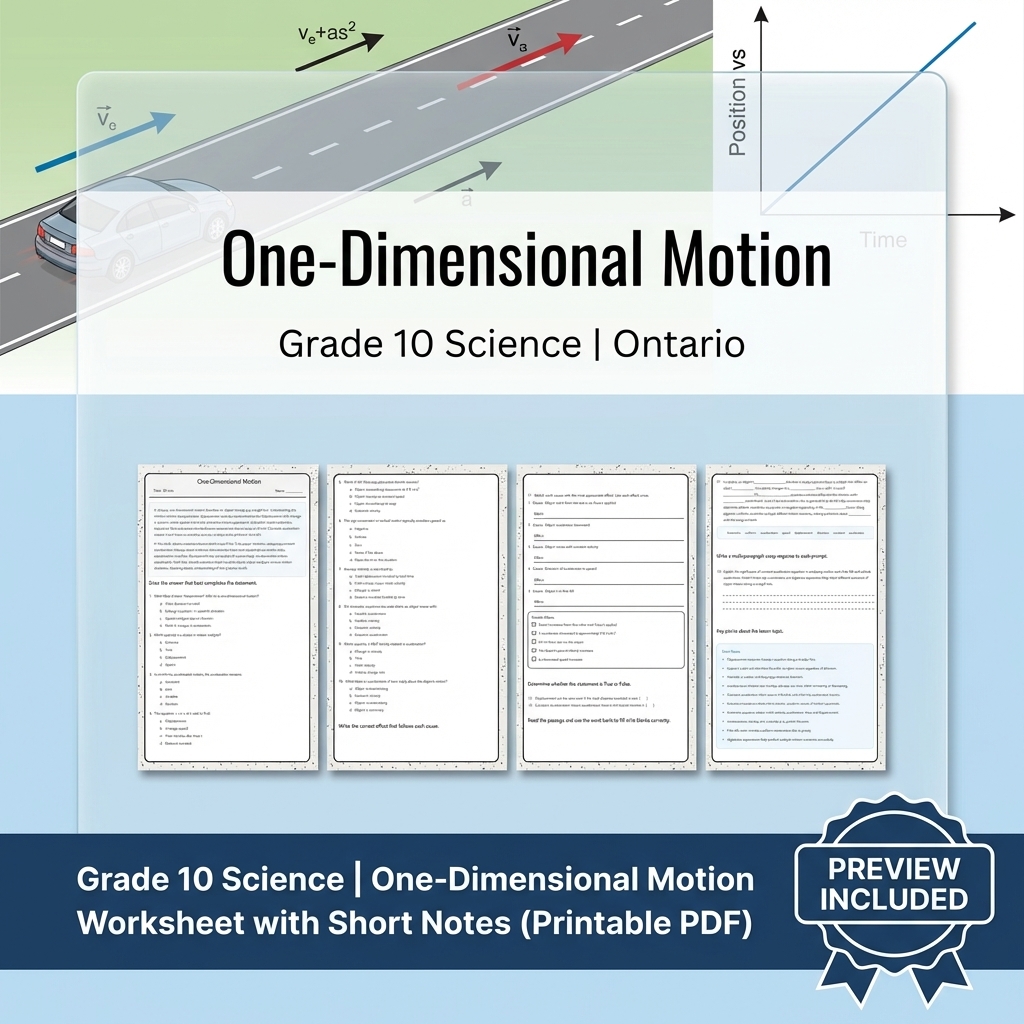
Grade 10 Science | One-Dimensional Motion Worksheet with Short Notes
Created byMeadowlark WorksheetsLearning Objectives
- Define and relate key kinematic quantities such as displacement, speed, velocity, and acceleration.
- Understand the concepts of average and instantaneous motion in one dimension.
- Apply constant-acceleration equations to scenarios like free-fall and uniformly accelerated motion.
Also included in: Grade 10 Science Lesson Group: Motion & Forces Ontario Curriculum Bundle +1 more
Instant download

Grade 10 Health – Social Influences on Health Daily Worksheet |Ontario Standards
Created byQuiet Forest EducationLearning Objectives
- Understand key concepts related to Health
- Apply knowledge through practice questions
- Demonstrate comprehension of the material
Also included in: Healthy Living Grade 10 Health Daily Reading Worksheets Bundle | Ontario +2 more
Instant download

Gravitation Fields Practice Worksheet | NGSS Grade 10 Science
JCreated byJ.S SheetsLearning Objectives
- Understand the concept of gravitational fields and how they relate to point-source inverse-square behavior.
- Apply Newtonian gravitational force equations to calculate orbital velocities and periods.
- Describe how gravitational field vectors represent the strength and direction of the field around masses.
Also included in: Grade 10 Forces, Momentum & Collisions Science Lesson Bundle – NGSS
Instant download

Gravitation Fields Worksheet | NGSS Physics Activity with Answer Key
Learning Objectives
- Explain how Newton’s law of gravitation leads to an inverse-square gravitational field for a point mass.
- Calculate gravitational field strength and gravitational potential energy changes near Earth and for other mass distributions (using the point-mass approximation).
- Use gravitational field and force ideas to reason about orbital motion and tidal effects qualitatively and quantitatively.
Instant download

Biodiversity Change Practice Worksheet | Grade 10 Science NGSS Review
Created byPrism Point LearningLearning Objectives
- Explain how human activities can cause biodiversity loss through habitat fragmentation, invasive species, and climate-driven changes.
- Compare evidence sources for biodiversity change, including fossil extinctions, population monitoring, and genetic diversity metrics.
- Describe how phylogenetic analysis and conservation planning support recovery and ecosystem resilience.
Also included in: Grade 10 Evolution & Speciation Science Lesson Bundle (NGSS)
Instant download

Grade 10 Science | Spheres Overview - Daily Reading Comprehension
Created byCoral Reef LearningLearning Objectives
- Identify the four main Earth's spheres: geosphere, hydrosphere, atmosphere, and biosphere.
- Describe the basic properties of each sphere.
- Explain how matter and energy flow among the Earth's spheres.
Also included in: Earth and Space Systems Lesson Bundle – Grade 10 Science Alberta +1 more
Instant download
Browse more categories
About Grade 10 Worksheets
Find Grade 10 worksheets covering algebra, biology, literature, and history. All 9,388 resources download instantly as PDFs for classwork, homework, or review.
MyTeachingSheets worksheets are made by real teacher-authors and checked before they go live. Download any as a print-ready PDF for lessons, homework, or independent practice — most include answer keys, and previews are always free.