
Grade 10 Worksheets
9,388 grade resources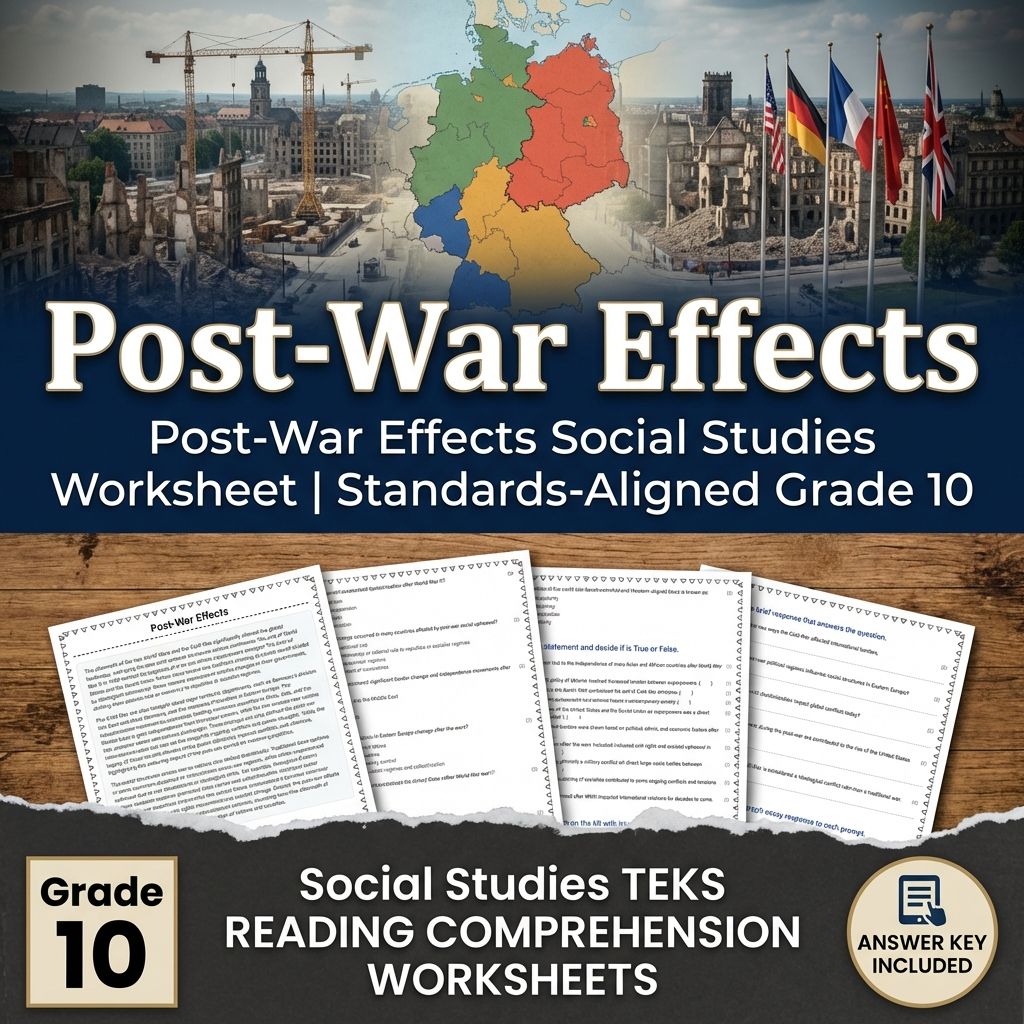
Post-War Effects Social Studies Worksheet | Standards-Aligned Grade 10
JCreated byJ.S SheetsLearning Objectives
- Analyze how the aftermath of the World Wars and Cold War influenced global borders and politics.
- Identify the emergence of new superpowers and their impact on international relations.
- Assess social changes resulting from post-war political regimes and conflicts.
Instant download
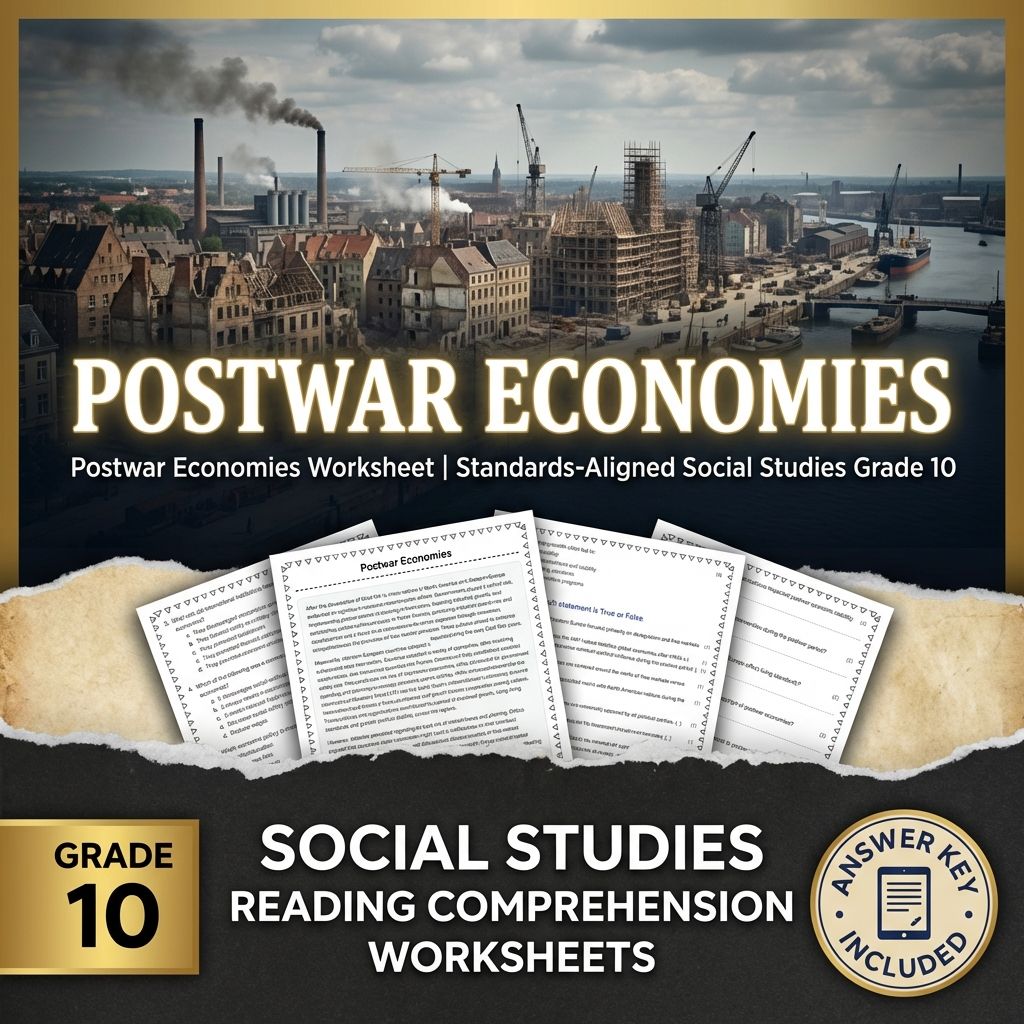
Postwar Economies Worksheet | Standards-Aligned Social Studies Grade 10
JCreated byJ.S SheetsLearning Objectives
- Analyze the policies that shaped postwar economic growth in North America and Western Europe.
- Compare the roles of government intervention, labor movements, and international institutions in economic development.
- Evaluate the impacts of postwar economic policies on living standards and political stability.
Instant download

Postwar Economies Worksheet | Standards-Aligned Social Studies Grade 10
JCreated byJ.S SheetsLearning Objectives
- Explain how post-World War II governments supported economic recovery through reconstruction and state intervention.
- Compare how North America and Western Europe developed welfare states and managed mixed economies.
- Analyze how labor movements and international institutions influenced growth, living standards, and political stability.
Instant download
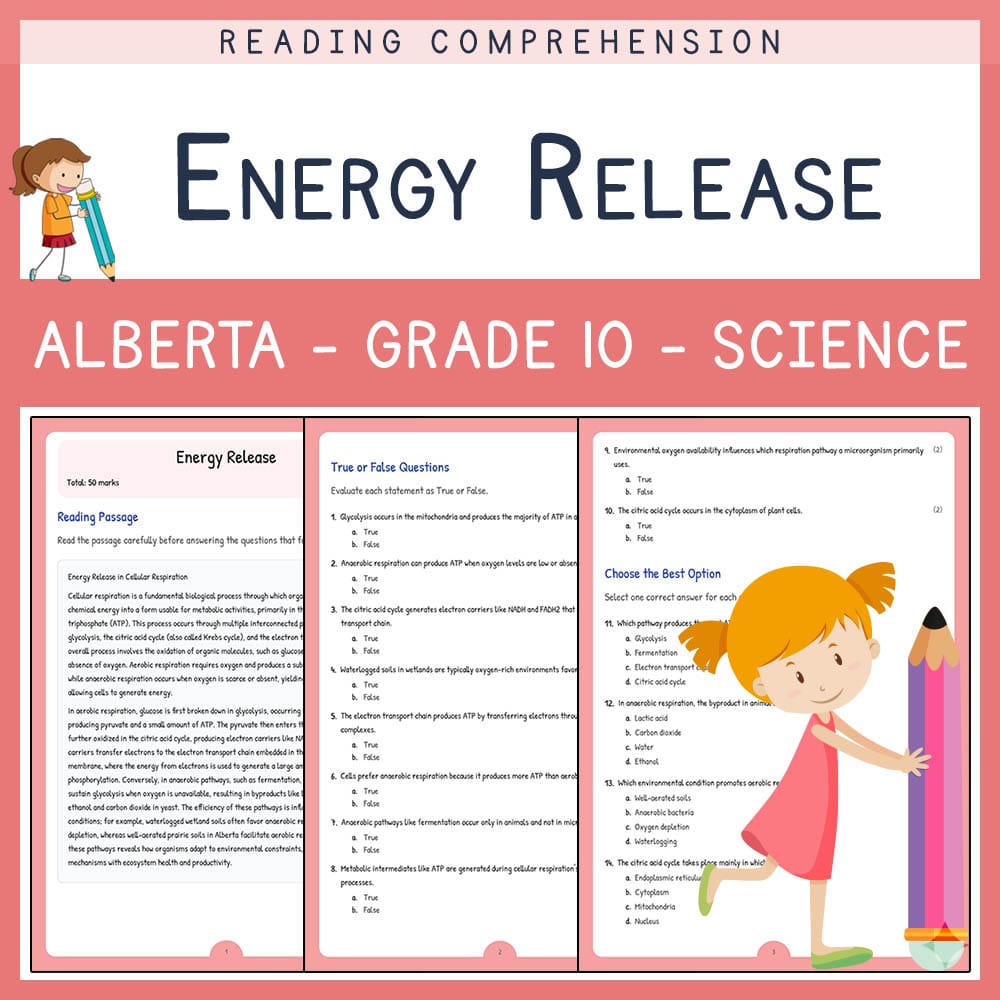
Grade 10 Science | Energy Release Worksheet | Alberta Standards
 Created byLumora Learning
Learning Objectives
- Explain the pathways of aerobic and anaerobic respiration and their roles in energy production.
- Identify environmental factors that influence the dominance of respiration pathways in ecosystems.
- Describe the processes of glycolysis, citric acid cycle, and electron transport in cellular respiration.
Also included in: Grade 10 Science | Cells and Systems Custom Bundle Worksheets | Alberta
Instant download

Grade 10 Social Studies Worksheet – Postwar Economies (PDF)
 Created bySunny Desk Resources
Learning Objectives
- Explain how postwar governments used state intervention and reconstruction policies to support economic expansion.
- Compare the development of welfare states and the influence of labor movements in North America and Western Europe.
- Interpret how economic indicators and international institutions relate to living standards and political stability.
Also included in: Grade 10 Conflict, Justice & Rights Social Studies Lesson Bundle (BC) +1 more
Instant download
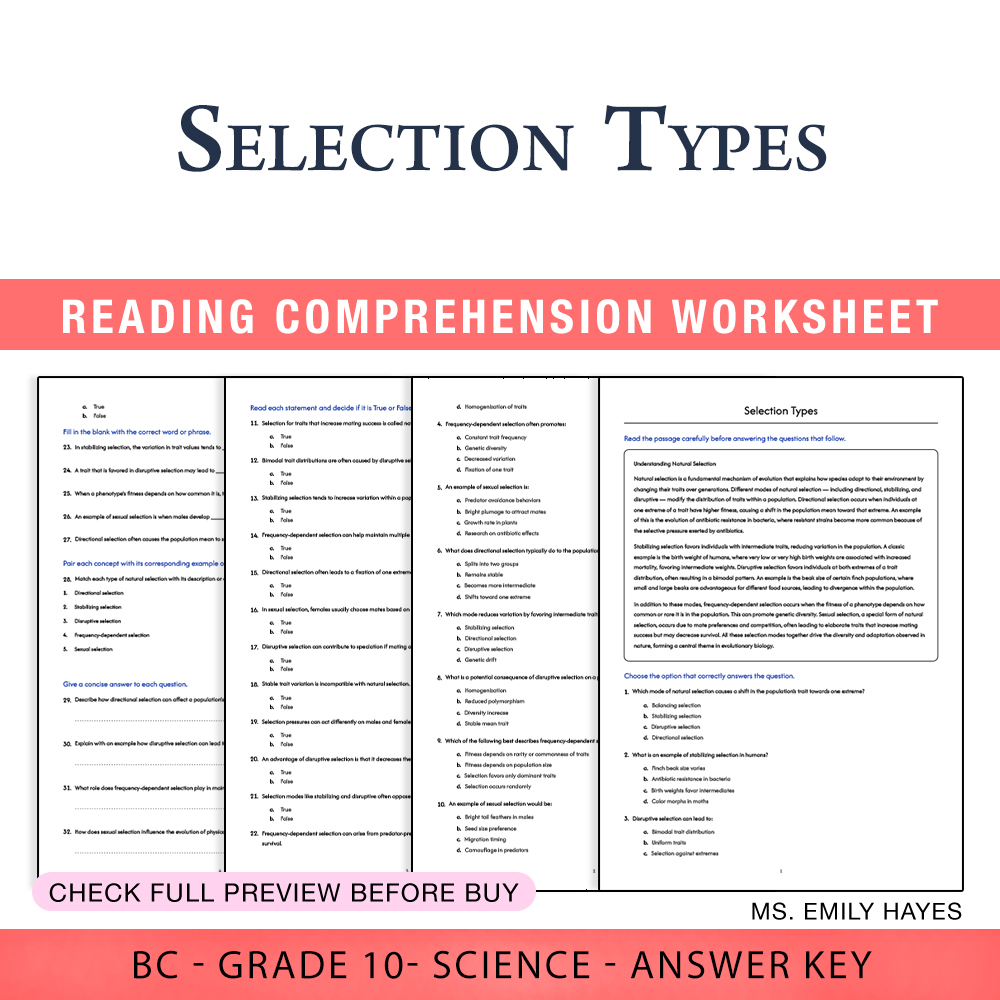
Grade 10 Science | Selection Types Worksheet (PDF+ Answer Key)
 Created byCopper Leaf Classroom
Learning Objectives
- Understand the different modes of natural selection and how they affect trait distributions in populations.
- Identify examples and characteristics of directional, stabilizing, and disruptive selection.
- Explain how frequency-dependent and sexual selection influence evolutionary processes.
Also included in: Grade 10 Science BC | Evolution, Biodiversity & Ecology (PDF + Answer Key) +1 more
Instant download

Induction Principles Worksheet | Alberta Grade 10 Science | Assessment
JCreated byJ.S SheetsLearning Objectives
- Understand the fundamental concepts of electromagnetic induction, including Faraday’s law and flux change.
- Explain how mechanical motion converts to electrical energy in generators and turbines.
- Identify the physical principles behind transformers and energy conversion devices.
Also included in: Grade 10 Science Practice Worksheets: Alberta Science Full-Year Bundle
Instant download

Grade 10 Health Monitoring Progress Worksheet (NHES Standards) PDF
Created bySunny Desk ResourcesLearning Objectives
- Explain why monitoring health goal progress is important for feedback, motivation, and accountability.
- Identify effective methods for record-keeping (journals, apps, charts) for short- and long-term health goals.
- Use reflection and regular review to adjust strategies and improve health behaviors over time.
Also included in: Grade 10 Health Goal-Setting Lesson Bundle (NHES) | Action Planning +1 more
Instant download

Origins of Cinco Worksheet | Grade 10 Holiday Reading & Comprehension
 Created byCedar Grove Learning
Learning Objectives
- Explain the historical background of Cinco de Mayo and its connection to the Battle of Puebla in 1862.
- Use key vocabulary related to history and patriotism (e.g., resistance, invasion, victory, national identity).
- Analyze how historical events can shape community memory and cultural identity.
Also included in: Grade 10 Cinco de Mayo Holiday Lesson Bundle – May Reading & Comprehension +1 more
Instant download
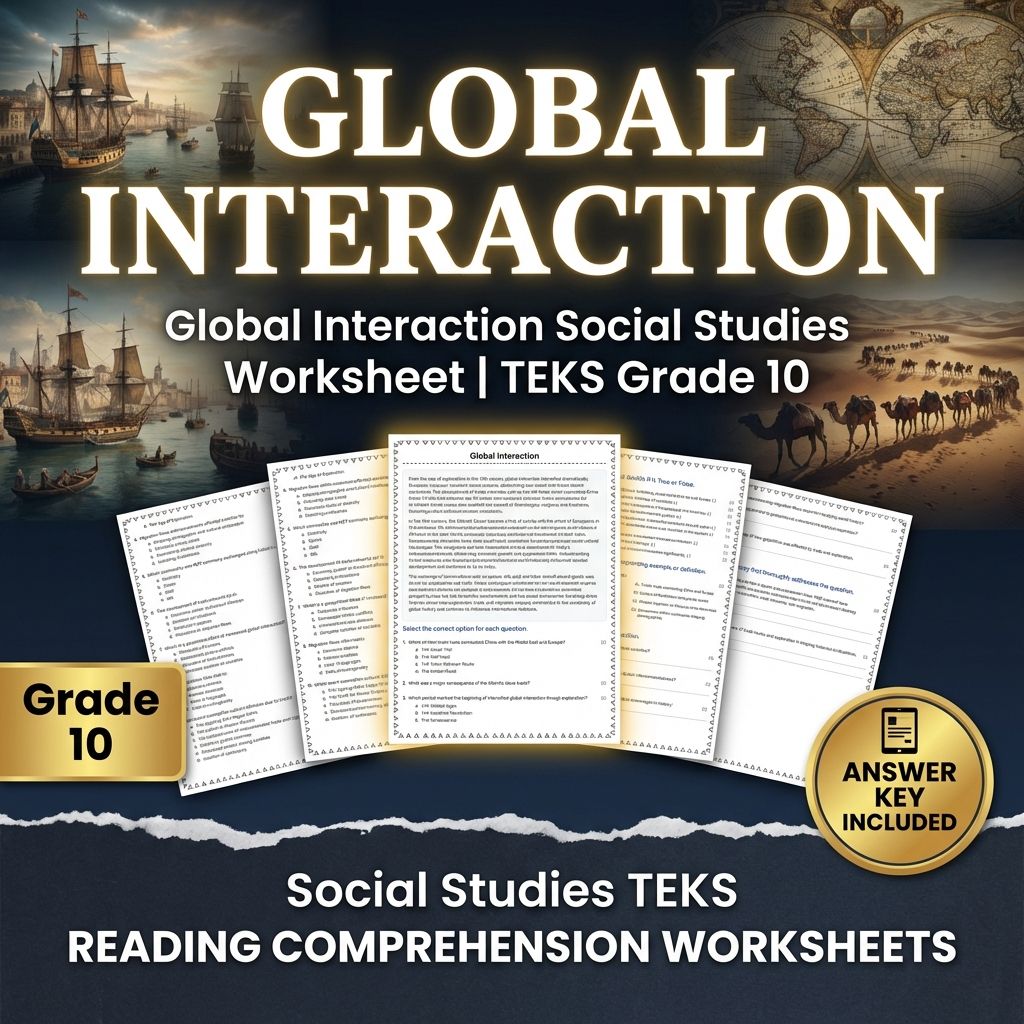
Global Interaction Social Studies Worksheet | TEKS Grade 10
JCreated byJ.S SheetsLearning Objectives
- Analyze the major patterns of global interaction and exchange from 1450 onward.
- Identify key examples such as the Atlantic slave trade and the Silk Road.
- Evaluate the effects of exploration, trade networks, and migration flows on civilizations.
Instant download

Grade 10 Science | Sphere Connections Worksheet | AP Aligned
Created byLumora LearningLearning Objectives
- Understand how the geosphere, hydrosphere, atmosphere, and biosphere interact through coupled processes.
- Identify examples of systems thinking and flow diagrams in Earth systems.
- Explain how perturbations propagate across Earth's spheres and affect observable indicators.
Instant download

Settlement Patterns Worksheet | Grade 10 Social Studies TEKS Activity
 Created byThe Resource Hub
Learning Objectives
- Explain how environmental conditions influence where people choose to settle
- Analyze the role of resource availability in shaping settlement size and location
- Describe how technological advancements affect migration, urban growth, and economic activity
Also included in: Global Conflicts & Decolonization Lesson Bundle | Grade 10 Social Studies TEKS +1 more
Instant download

Grade 10 ATP and Cellular Energy Worksheet | Cellular Respiration Ontario
 Created byChalk and Compass
Learning Objectives
- Explain why ATP is a central energy carrier and describe the role of high-energy phosphate bonds.
- Distinguish endergonic and exergonic processes and describe how ATP couples energy to cellular work.
- Identify two conceptual ways ATP is regenerated and explain ATP turnover in maintaining cellular processes.
Also included in: Cells, Photosynthesis, Respiration & Microbes Lesson Bundle – Grade 10 Science +1 more
Instant download

Grade 10 Science — Worksheet MCQ Paper for Human Footprints
Created byThe Resource HubLearning Objectives
- Understand how human activities alter Earth's land, water, and atmospheric systems.
- Identify key indicators used to assess environmental changes caused by humans.
- Analyze the relationships between land-use change, greenhouse gas emissions, and environmental impacts.
Also included in: Grade 10 Earth and Space Sciences Lesson Bundle | AP Curriculum +1 more
Instant download

Quantitative Communication Worksheet | AP Science Grade 10 Practice
JCreated byJ.S SheetsLearning Objectives
- Understand conventions and strategies for communicating quantitative results effectively.
- Explain the use of uncertainty notation, significant digits, and graphical annotations.
- Demonstrate how numerical summaries, confidence intervals, and visual aids support credible conclusions.
Instant download

Grade 10 Science – Tension & Normal Forces | Daily Reading Worksheet
 Created byBright Mind Resources
Learning Objectives
- Identify and describe tension forces in ropes and connectors.
- Explain the concept of normal force and its role in supporting objects.
- Apply the concepts of tension and normal force to analyze forces on inclined surfaces.
Also included in: Grade 10 Forces & Motion Science Daily Reading Worksheets Lesson Bundle | BC +1 more
Instant download

Grade 10 ELA – Claim & Evidence Reading Practice | Daily Worksheet
 Created byQuiet Forest Education
Learning Objectives
- Identify the main claim in a literary text.
- Select textual evidence that supports interpretive statements.
- Explain how specific details advance meaning in a literary passage.
Also included in: Literary Analysis Grade 10 ELA Daily Reading Worksheets Lesson Bundle | CCSS +1 more
Instant download

Grade 10 Science | Adaptation Strategies Worksheet (AP Standards) (PDF)
 Created byEvergreen Desk Education
Learning Objectives
- Evaluate how adaptation strategies can reduce climate and Earth-system risks while creating trade-offs for carbon management, ecosystems, and land-use decisions.
- Use systems thinking to compare scenarios and explain how interventions can produce unintended consequences.
- Apply cost-benefit reasoning and uncertainty analysis to judge which resilience measures are scalable and effective over time.
Also included in: Grade 10 Earth and Climate Systems Science Lesson Bundle Worksheets (AP) +1 more
Instant download

Grade 10 Health Worksheet | Adjusting Goals NHES Standards (PDF)
Created bySunny Desk ResourcesLearning Objectives
- Explain why health goals need flexibility when circumstances and priorities change.
- Use objective progress checks to decide whether to modify a goal or the action plan.
- Apply strategies to stay motivated when setbacks or changes make old plans unrealistic.
Also included in: Grade 10 Health Goal-Setting Lesson Bundle (NHES) | Action Planning +1 more
Instant download

Grade 10 Balancing Chemical Equations Worksheet | Ontario Science Activity
Created byChalk and CompassLearning Objectives
- Distinguish chemical equation subscripts from stoichiometric coefficients when balancing equations.
- Explain why balanced equations satisfy conservation of mass by matching atom counts on both sides.
- Describe a systematic approach to balancing multi-step chemical equations conceptually.
Also included in: Chemistry Foundations & Chemical Reactions Lesson Bundle: Grade 10 Science +1 more
Instant download

Grade 10 Science | Model Foundations Worksheet (AP Standards) (PDF)
Created byEvergreen Desk EducationLearning Objectives
- Define the core purposes of scientific models and distinguish between model components and observable features.
- Compare how conceptual, mathematical, and physical analogue models represent the same system and where they may fail.
- Explain how assumptions and parameter calibration bound a model’s applicability and prediction accuracy.
Also included in: Grade 10 Scientific Modeling & Quantitative Reasoning Science Lesson Bundle (AP) +1 more
Instant download

Grade 10 Laboratory Protocols Safety PPE Worksheet | Ontario Science
Created byChalk and CompassLearning Objectives
- Identify appropriate personal protective equipment (PPE) for common laboratory tasks.
- Apply laboratory safety principles to glove choice, eyewear protection, and ventilation needs.
- Explain how to label, store, and segregate reagents and handle lab waste safely.
Also included in: Grade 10 Science Variables & Control Data Analysis Lesson Bundle | Ontario +1 more
Instant download

Grade 10 Science – Friction & Resistance | Daily Reading Worksheet
Created byQuiet Forest EducationLearning Objectives
- Understand the difference between static and kinetic friction
- Learn about coefficients of friction and their significance
- Explore how surface properties affect friction
Also included in: Motion and Forces Grade 10 Science Daily Reading Worksheets Bundle | Ontario +1 more
Instant download

Genetic Drift Assessment Grade 10 Science | TEKS Standards-Aligned
 Created byPrism Point Learning
Learning Objectives
- Understand the concept of genetic drift and its impact on small populations.
- Differentiate between genetic drift and natural selection.
- Identify factors that influence genetic drift such as founder effects and bottlenecks.
Also included in: Grade 10 Evolution and Heredity Science Lesson Bundle for TEKS Standards
Instant download

Grade 10 Science | Design Tradeoffs Worksheet Elena | California Standards
Created byLumora LearningLearning Objectives
- Explain how optimization requires balancing competing criteria under engineering constraints.
- Identify common design tradeoffs in structural and materials decisions (e.g., stiffness vs. mass or cost).
- Use tradeoff reasoning to justify why a feasible design can be better or worse overall than another.
Instant download

Halloween Creative Costumes Worksheet Grade 10 Holiday Activity
 Created byShaNova Worksheets
Learning Objectives
- Analyze how costumes reflect identity, creativity, and social ideas.
- Explain the historical role of disguises in Halloween traditions.
- Use evidence from a passage to answer comprehension and vocabulary questions.
Also included in: Grade 10 Halloween Day Holiday Lesson Bundle – October Framework
Instant download
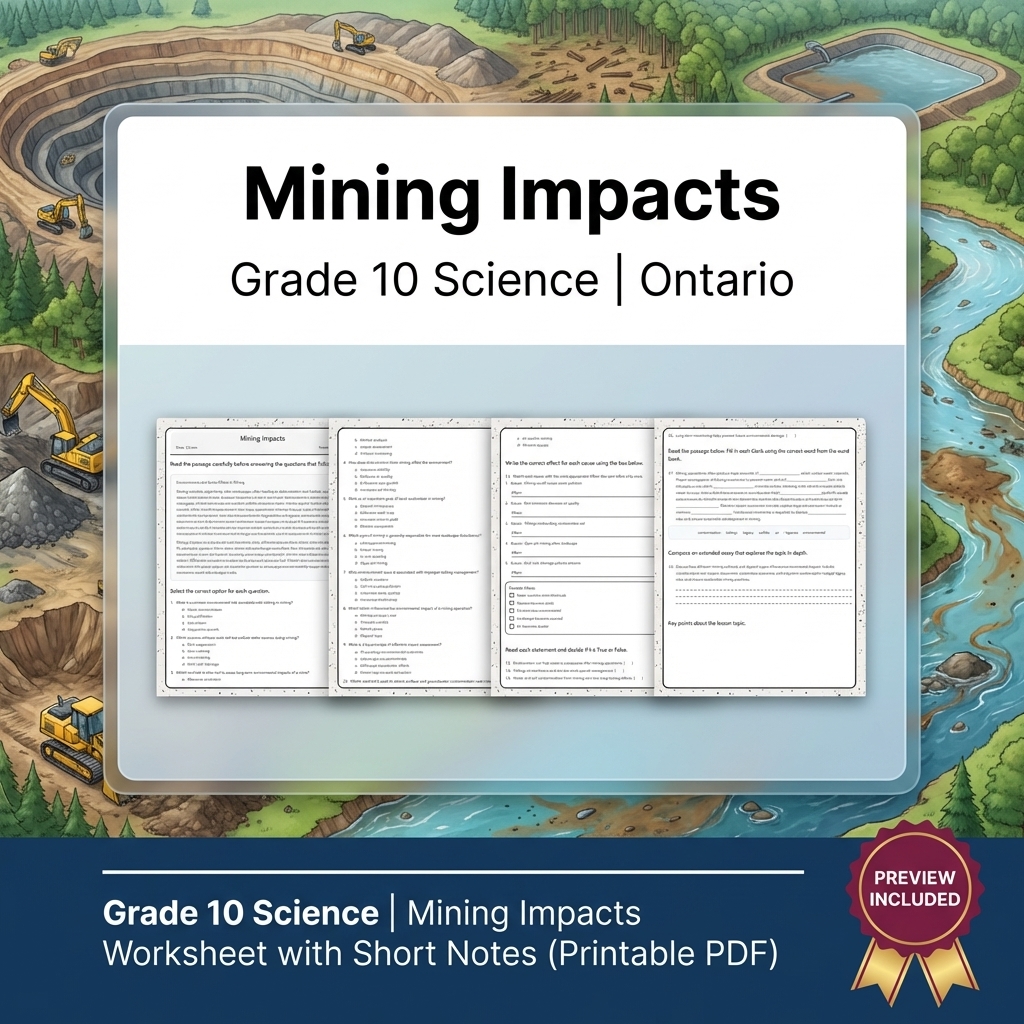
Grade 10 Science | Mining Impacts Worksheet with Short Notes (Printable PDF)
 Created byMeadowlark Worksheets
Learning Objectives
- Understand the environmental consequences of mineral extraction, including landscape changes, water, and soil contamination.
- Recognize methods for impact assessment, reclamation, and monitoring in mining operations.
- Identify how deposit type and extraction method influence environmental outcomes.
Also included in: Grade 10 Science Lesson Group Bundle | Ontario Curriculum and STEM Topics +1 more
Instant download

Grade 10 Membrane Dynamics Worksheet | Practice & Assessment PDF
 Created byClear Sky Classroom
Learning Objectives
- Explain how membrane composition and protein transport mechanisms create electrochemical gradients and compartmentalization
- Compare diffusion, carrier-mediated transport, and vesicular trafficking using flux-rate and energetics ideas
- Interpret how selective permeability influences ion distribution and signal propagation
Also included in: Grade 10 Population, Genetics, and Cellular Processes Science Lesson Bundle AP +1 more
Instant download

Grade 10 AP Science Meiosis & Variation Worksheet | Practice Pack
Created byPrism Point LearningLearning Objectives
- Explain how homologous pairing, crossing-over, and independent assortment create genetic variation during meiosis.
- Describe how chromosomal segregation affects the genotype and phenotype of offspring, including nondisjunction outcomes.
- Use cytogenetic and molecular representations to connect meiotic events with inheritance patterns and population data.
Also included in: Grade 10 AP Science Life Systems Lesson Bundle | Worksheet Pack
Instant download

Grade 10 Social Studies Worksheet | Feminist Change & Gender Rights (PDF)
Created bySunny Desk ResourcesLearning Objectives
- Explain how feminist movements in the twentieth century contributed to changes in voting rights, employment, and legal protections.
- Compare different waves of feminist thought and describe how ideology shaped public policy and cultural norms.
- Analyze how intersectional perspectives (including Indigenous and postcolonial experiences) reveal different outcomes in gender rights.
Also included in: Grade 10 Conflict, Justice & Rights Social Studies Lesson Bundle (BC) +1 more
Instant download

Grade 10 Solar Context Worksheet | Practice & Assessment PDF
Created byClear Sky ClassroomLearning Objectives
- Explain how Earth’s tilt and orbit change solar angle and length of daylight to produce seasons and diurnal energy input.
- Describe how solar irradiance influences surface temperatures, ecosystems, and atmospheric circulation.
- Connect gravity-driven motions (Earth–Moon–Sun) to natural patterns such as tides and climate-relevant energy changes.
Instant download

Grade 10 Science – Selective Mechanisms & Evolution | Daily Reading Worksheet
Created byBright Mind ResourcesLearning Objectives
- Understand the concept of natural selection and how variation affects survival
- Identify examples of selective pressures such as antibiotic resistance and industrial melanism
- Explain how traits become more or less common in populations over generations
Also included in: Evolution Grade 10 Science Daily Reading Worksheets Lesson Bundle | NGSS +2 more
Instant download

Hazard Risk Reduction Worksheet | Grade 10 Science | California Standards
Created byPrism Point LearningLearning Objectives
- Explain how natural hazards form through Earth processes and how human actions affect risk
- Compare risk-reduction strategies by linking them to hazard type, exposure, and vulnerability
- Evaluate tradeoffs among early warning, land-use planning, engineered barriers, and drought/flood management
Instant download

Grade 10 ELA Worksheet | Clarity Revision Strategies (Alberta Standard) (PDF)
 Created byGolden Apple Studio
Learning Objectives
- Revise sentences by choosing more precise words and replacing vague references with specific nouns.
- Improve clarity by restructuring sentences so each one directly supports the controlling idea.
- Strengthen coherence by using consistent terminology and clear cause-and-effect relationships.
Also included in: Grade 10 Writing Process, Revision & Clarity ELA Lesson Bundle – Alberta +1 more
Instant download

Grade 10 Science – Understanding Orbits & Energy | Daily Reading Worksheet
Created byBright Mind ResourcesLearning Objectives
- Explain the concept of gravitational attraction and how it influences orbital motion.
- Identify the differences between circular and elliptical orbits.
- Describe how orbital speed relates to central mass and orbital radius.
Also included in: Grade 10 Forces & Motion Science Daily Reading Worksheets Lesson Bundle | BC +1 more
Instant download

Grade 10 Science – Motion in a Plane & Velocity Analysis | Reading Worksheet
Created byBright Mind ResourcesLearning Objectives
- Describe the components of two-dimensional motion, including horizontal and vertical parts.
- Explain how projectile trajectories are analyzed under uniform gravity neglecting air resistance.
- Decompose initial velocity into orthogonal components using trigonometry.
Also included in: Grade 10 Force & Motion Science Daily Reading Lesson Bundle – Ontario +1 more
Instant download

Negative Feedback Assessment | TEKS Grade 10 Science Standards
Created byPrism Point LearningLearning Objectives
- Define negative feedback as a regulatory process that maintains internal stability.
- Explain how sensors, control centers, and effectors work together in negative feedback mechanisms.
- Identify physiological variables regulated by negative feedback, such as temperature, blood glucose, and blood pressure.
Also included in: Grade 10 Homeostasis and Feedback Science Lesson Bundle | TEKS
Instant download

Grade 10 Science – Cell Architecture & Function | Daily Reading Worksheet
Created byBright Mind ResourcesLearning Objectives
- Identify key organelles within a cell and describe their functions.
- Understand the structural differences between prokaryotic and eukaryotic cells.
- Explain how cellular structures support specific physiological roles.
Also included in: Grade 10 AP Science Daily Reading Lesson Bundle: Ecology, Genetics & Cells +2 more
Instant download

Grade 10 Science – Mechanisms of Evolution & Daily Reading Worksheet
Created byBright Mind ResourcesLearning Objectives
- Understand the key mechanisms driving evolution: natural selection, genetic drift, gene flow, and mutation.
- Describe how these mechanisms influence allele frequencies within populations.
- Explain the role of natural selection in adaptation and evolution.
Also included in: Grade 10 Evolution & Genetics Science Daily Reading Lesson Bundle | BC +1 more
Instant download

Migration Patterns Worksheet | Standards-Aligned Grade 10 Social Studies
JCreated byJ.S SheetsLearning Objectives
- Explain how economic, political, and conflict-related factors influence migration patterns over time
- Analyze how migration affects cultural diversity, labor markets, and social policies
- Use evidence from a text to identify pull factors and push factors in migration
Instant download

Migration & Exchange Worksheet | Standards-Aligned Social Studies Practice
JCreated byJ.S SheetsLearning Objectives
- Explain how migration can influence language, religion, and technology in developing societies.
- Analyze how trade routes and empires shaped cultural exchange and blended identities.
- Evaluate the effects of voluntary and forced migration on social change over time.
Instant download
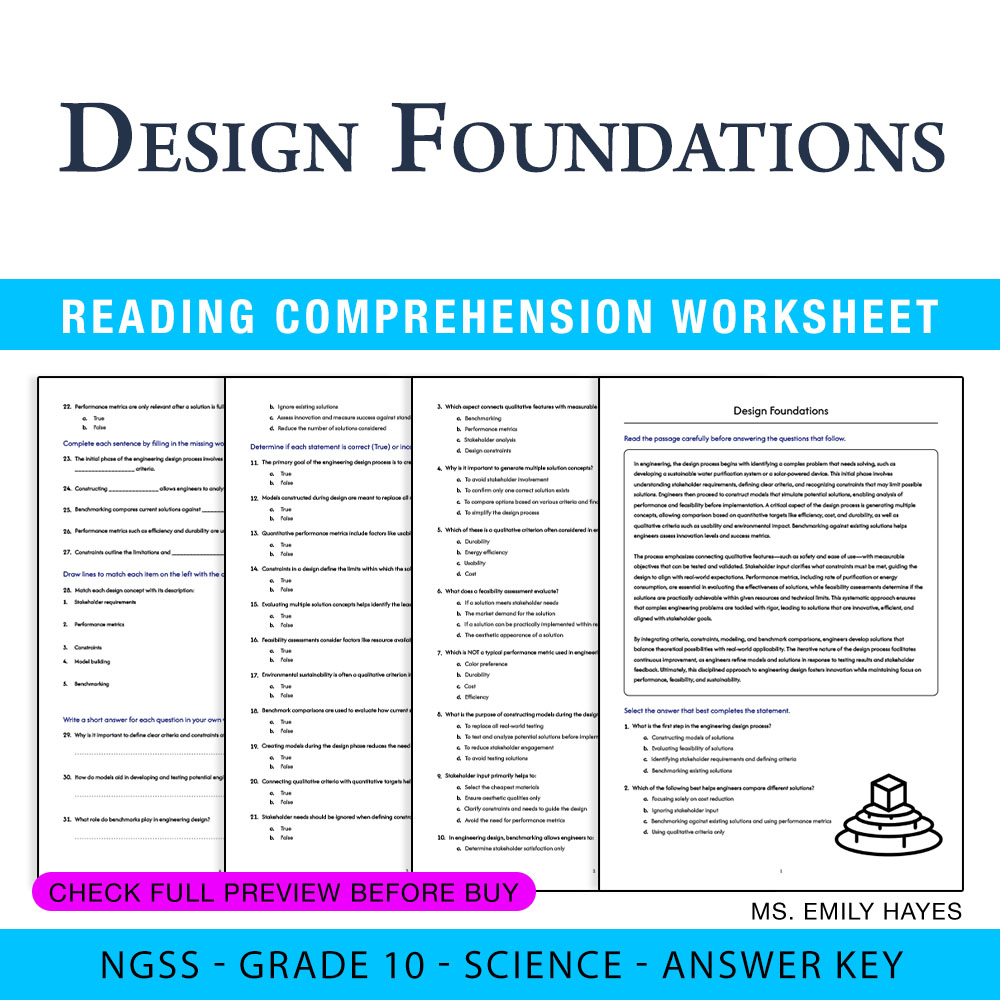
Grade 10 Science | Design Foundations Worksheet (PDF+ Answer Key)
Created byCopper Leaf ClassroomLearning Objectives
- Understand the engineering design process and its key steps.
- Apply criteria and constraints to develop feasible solutions for complex problems.
- Construct models and generate multiple solution concepts based on stakeholder needs.
Instant download

Grade 10 Science | Energy Forms Worksheet | BC Standards
Created byLumora LearningLearning Objectives
- Identify different forms of energy such as kinetic, potential, thermal, chemical, radiant, and nuclear.
- Explain how systems store and transfer energy during various processes.
- Recognize examples of energy transformation in physical and biological systems.
Instant download

Grade 10 Science | Statistical Reasoning Worksheet (Ontario Standard) (PDF)
Created byEvergreen Desk EducationLearning Objectives
- Identify and interpret measures of central tendency and spread to describe variability in classroom science data
- Distinguish statistical significance from practical significance when drawing conclusions from samples
- Explain how confidence intervals and comparative tests provide evidence while accounting for assumptions and limits
Also included in: Grade 10 Scientific Inquiry & Data Reasoning Science Lesson Bundle: Ontario +1 more
Instant download

Grade 10 Particle Interactions Worksheet | NGSS Chemistry Science Activity
 Created byBRIGHT PATH RESOURCES
Learning Objectives
- Understand key concepts related to Science
- Apply knowledge through practice questions
- Demonstrate comprehension of the material
Also included in: Matter and Its Interactions Grade 10 Science Lesson Bundle | NGSS +1 more
Instant download

Grade 10 Science Worksheet Periodic Trends | Standards-Aligned Practice
JCreated byJ.S SheetsLearning Objectives
- Explain how effective nuclear charge and electron shielding influence atomic size, ionization energy, and ion formation
- Describe periodic trends across periods and down groups using changes in electron arrangements
- Predict typical ion charges and bonding tendencies based on valence electrons
Also included in: Grade 10 Matter, Energy, and Waves Science Lesson Bundle – Florida (NGSSS) +1 more
Instant download

Population Growth Worksheet | Science Grade 10 Assessment & Student Practice
Learning Objectives
- Use birth rate and death rate ideas to explain how populations increase or decrease over time.
- Compare exponential growth and logistic growth models, including the role of carrying capacity.
- Identify density-dependent and density-independent limiting factors and connect them to changes in population abundance.
Also included in: Grade 10 Ecosystem Dynamics Lesson Bundle | NGSS Science Ecology
Instant download

Grade 10 Trophic Relationships in Ecosystems Worksheet | NGSS Science
Created byBRIGHT PATH RESOURCESLearning Objectives
- Identify different trophic levels in terrestrial ecosystems.
- Understand energy transfer in food chains and food webs.
- Describe the roles of keystone species and trophic cascades.
Also included in: Grade 10 Ecology Lesson Bundle | Daily Reading | ngss Science +1 more
Instant download
Browse more categories
About Grade 10 Worksheets
Find Grade 10 worksheets covering algebra, biology, literature, and history. All 9,388 resources download instantly as PDFs for classwork, homework, or review.
MyTeachingSheets worksheets are made by real teacher-authors and checked before they go live. Download any as a print-ready PDF for lessons, homework, or independent practice — most include answer keys, and previews are always free.