
Grade 10 Worksheets
9,388 grade resources
Grade 10 Health – Self-Awareness Growth Daily Worksheet | Ontario Standards
 Created byQuiet Forest Education
Learning Objectives
- Recognize personal strengths and qualities.
- Reflect on how emotions influence behavior.
- Understand the importance of self-awareness for mental health.
Also included in: Social-Emotional Learning Grade 10 Health Daily Worksheets Bundle | Ontario +2 more
Instant download

Grade 10 Science – Energy Forms & Types | Daily Reading Worksheet
 Created byBright Mind Resources
Learning Objectives
- Understand key concepts related to Science
- Apply knowledge through practice questions
- Demonstrate comprehension of the material
Also included in: Grade 10 Energy Science Daily Reading Worksheets Lesson Bundle | BC +1 more
Instant download

Grade 10 Science – Orbital Gravity Models | Daily Reading Worksheet
Created byBright Mind ResourcesLearning Objectives
- Understand the basic concepts of gravity and how it affects celestial bodies.
- Identify the relationship between centripetal acceleration and orbital motion.
- Describe how gravitational forces sustain planetary and satellite orbits.
Also included in: Grade 10 Climate Linkages Science Daily Reading Worksheets Bundle | CA Standards +1 more
Instant download

Grade 10 Science Planetary Motion Worksheet | NGSS Space Systems Activity
 Created byBRIGHT PATH RESOURCES
Learning Objectives
- Understand Kepler's Three Laws of Planetary Motion
- Relate orbital parameters such as period, eccentricity, and semi-major axis
- Comprehend conservation of angular momentum in planetary orbits
Also included in: Next Generation Science Standards Space Science Daily Reading Bundle | Grade 10 +1 more
Instant download

Grade 10 Science – Ocean Dynamics Worksheet (NGSS) PDF
 Created bySilver Birch Teaching
Learning Objectives
- Describe circulation patterns driven by density contrasts, wind forcing, and Earth's rotation.
- Explain the roles of thermohaline circulation, gyres, and coastal upwelling in ocean dynamics.
- Analyze how observations from ARGO floats, satellite altimetry, and salinity-temperature profiles contribute to understanding ocean processes.
Also included in: Grade 10 Earth Systems Science Lesson Bundle for NGSS ngss10 Worksheets +1 more
Instant download

Grade 10 Health | Conflict Resolution Worksheet (PDF) Aligned with NHES
 Created bySunny Desk Resources
Learning Objectives
- Explain how active listening and empathy reduce conflict escalation.
- Identify common conflict triggers and describe calm, respectful responses.
- Apply a simple problem-solving process to propose solutions in real-life scenarios.
Also included in: Grade 10 Health Support & Communication Skills Lesson Bundle | NHES +1 more
Instant download

Grade 10 Science – Cell Theory Daily Reading Worksheet with Answer Key
JCreated byJ.S SheetsLearning Objectives
- Define cell theory and its three main principles.
- Describe how microscopy advances contributed to understanding cell diversity.
- Compare unicellular and multicellular organisms.
Also included in: Grade 10 Science Lesson Group Bundle | Cell Structure & Function TEKS +1 more
Instant download

Grade 10 Science | Atomic Structure - Daily Reading Comprehension
 Created byCoral Reef Learning
Learning Objectives
- Identify subatomic particles: protons, neutrons, and electrons.
- Understand the roles of each subatomic particle in an atom.
- Describe how subatomic particles influence atomic properties.
Also included in: Chemistry Foundations Lesson Bundle: Grade 10 Science Advanced Placement (AP) +1 more
Instant download
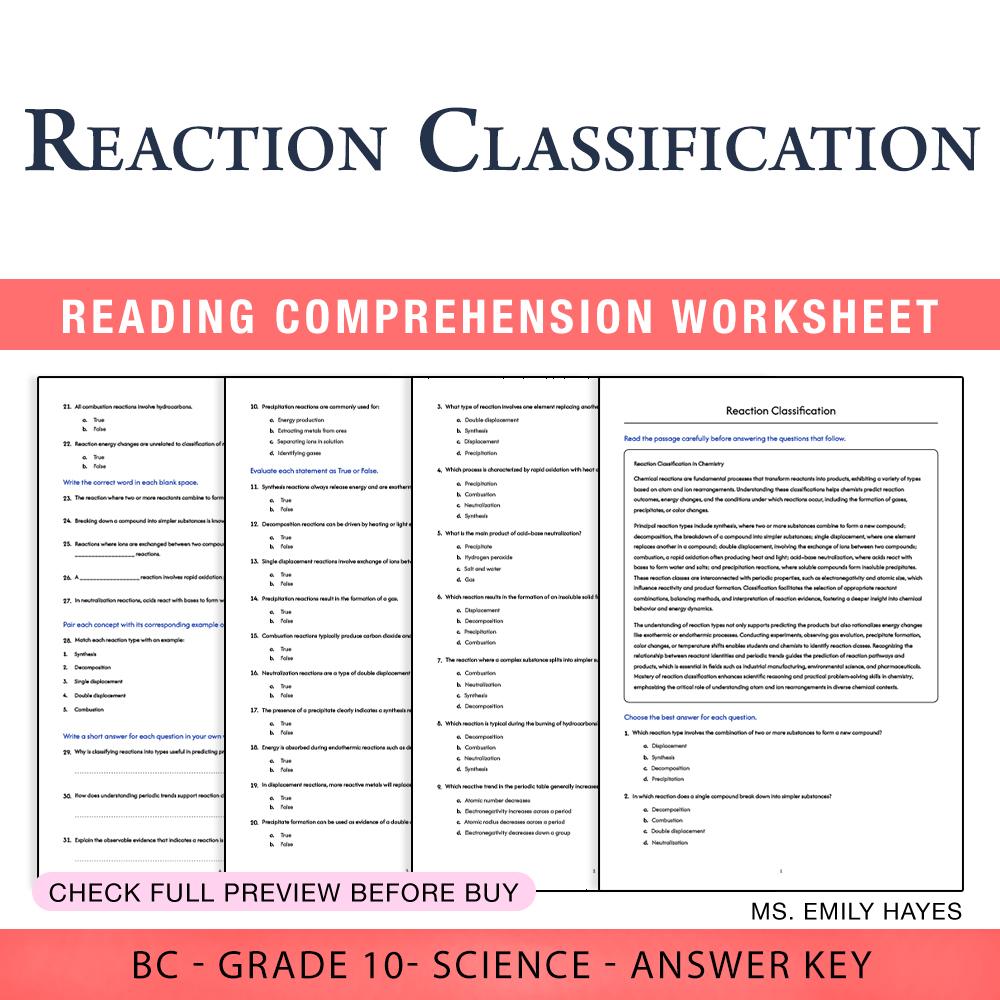
Grade 10 Science | Reaction Classification Worksheet (PDF + Answer Key)
 Created byCopper Leaf Classroom
Learning Objectives
- Identify the different types of chemical reactions and their characteristics.
- Describe characteristic features and products of synthesis, decomposition, displacement, combustion, acid–base neutralization, and precipitation reactions.
- Relate reaction classes to reactant identities and periodic properties for better prediction and interpretation.
Also included in: Grade 10 Science BC| Chemistry, Reactions & Atomic Structure (PDF+ Answer Keys) +1 more
Instant download

Speciation and Diversity Worksheet | Grade 10 Evolution Science Activity
 Created byPrism Point Learning
Learning Objectives
- Explain how reproductive isolation and limited gene flow can lead to speciation.
- Describe how divergent selection pressures and genetic drift can cause populations to diverge over time.
- Connect the mechanisms of evolution to patterns of biodiversity and lineage diversification.
Instant download

Grade 10 Science | Meiosis Worksheet | TEKS-Aligned
 Created byLumora Learning
Learning Objectives
- Explain the process of meiosis and its role in reducing chromosome number for gamete formation.
- Identify how genetic recombination and independent assortment contribute to genetic diversity.
- Describe the stages of meiosis, including homologous pairing and separation of sister chromatids.
Also included in: Grade 10 Science | Genetics & Molecular Biology Lesson Bundle | TEKS Aligned +1 more
Instant download

Mechanisms Overview Worksheet | Grade 10 Science Activities
Created byPrism Point LearningLearning Objectives
- Explain how natural selection, genetic drift, gene flow, and mutation can change allele frequencies in populations
- Distinguish between deterministic (selection) and random (drift) influences on evolution
- Describe how movement of alleles between populations (gene flow) affects evolutionary change
Also included in: Grade 10 Evolution, Speciation & Biodiversity Lesson Bundle | BC Science +1 more
Instant download

Alveolar Gas Diffusion & Respiratory Exchange Worksheet | TEKS Grade 10
Created byBRIGHT PATH RESOURCESLearning Objectives
- Identify the main idea of alveolar gas exchange
- Explain how oxygen enters blood and carbon dioxide leaves blood in the alveoli
- Describe how concentration gradients drive diffusion during respiratory exchange
Also included in: Grade 10 Homeostasis & Body Systems Science Worksheets Bundle | TEKS +1 more
Instant download

Grade 10 Science – Energy & Energy Accounting | Daily Reading Worksheet
Created byBright Mind ResourcesLearning Objectives
- Understand the concept of energy transfers and stores in systems
- Identify different types of energy flow in simple mechanical and electrical systems
- Use energy flow diagrams to analyze energy distribution
Also included in: Grade 10 Energy Science Lesson Bundle Daily Reading Worksheets | NGSS +2 more
Instant download

The Roles of Educators Worksheet | Grades 9 - 10 Holiday Printable PDF
Learning Objectives
- Identify and describe key roles educators play beyond teaching academic content
- Explain how educator values such as dedication, leadership, and service influence students and communities
- Use reading evidence to support claims about the impact of educators during Teacher Appreciation Week
Also included in: Grade 11 Teaching in Holiday Custom Bundle: C3 Framework Worksheets +1 more
Instant download

Grade 10 Science – Mineral Overview & Crystal Habit | Daily Reading Worksheet
Created byQuiet Forest EducationLearning Objectives
- Understand the basic properties used to identify minerals
- Learn about different crystal habits and their significance
- Familiarize with classifications of minerals based on properties
Also included in: Earth Science Grade 10 Daily Reading Worksheets Bundle | Ontario Framework +1 more
Instant download

Ecosystem Modeling and Perturbation Predictions Worksheets Grade 10
 Created byTeachers Club
Learning Objectives
- Describe how models represent energy and matter flows in ecosystems
- Interpret model predictions of ecosystem responses to disturbances
- Compare steady-state and transient ecosystem dynamics
Also included in: Grade 10 Science Ecosystems NGSS Worksheets & Lesson Bundle +1 more
Instant download

Adaptive Radiation Worksheet|TEKS Grade 10 Science Assessment PDF
JCreated byJ.S SheetsLearning Objectives
- Define adaptive radiation and explain why it leads to multiple closely related species
- Describe how ecological niches and natural selection contribute to divergent adaptations
- Interpret how phylogenetic patterns can show the timing and branching of diversification
Instant download

Grade 10 Work Energy Theorem and Power Worksheet | NGSS Physics Activity
 Created byAmber Owl Education
Learning Objectives
- Explain how net work on an object changes its kinetic energy using the work–energy theorem
- Calculate average and instantaneous power from energy transfer and work–energy relationships
- Convert between common units of energy and power (joules, watts, and kW) during problem solving
Instant download

Grade 10 Research Based Writing Worksheet | TEKS Source Ethics
Created bySunny Desk ResourcesLearning Objectives
- Use credible sources to support claims and explanations in research-based writing.
- Distinguish the writer’s ideas from source wording by summarizing and quoting accurately.
- Integrate evidence by linking each source to the purpose of the paragraph or essay.
Instant download

Human Impact Evidence Grade 10 Science Assessment | General
Created byPrism Point LearningLearning Objectives
- Understand how human activities influence Earth's systems through measurable evidence.
- Identify sources and transport processes that link human actions to environmental changes.
- Analyze data from climate records, satellite observations, and chemical measurements to support claims.
Also included in: Grade 10 Climate Systems Science Lesson Bundle Assessments – General
Instant download

Grade 10 Science | Organelles Daily Reading Comprehension
Created byCoral Reef LearningLearning Objectives
- Understand the structure and function of membrane-bound organelles in eukaryotic cells
- Identify key non-membrane-bound organelles and their roles
- Explain how organelle functions relate to cell activities like protein synthesis and energy production
Also included in: Cells and Systems Lesson Bundle | Grade 10 Science | Alberta Framework +1 more
Instant download

Sphere Connections Worksheet | Grade 10 AP Science Practice Activities
Created byPrism Point LearningLearning Objectives
- Explain how the geosphere, hydrosphere, atmosphere, and biosphere interact through coupled Earth-system processes.
- Use box-and-arrow models and flow diagrams to trace how changes propagate across spheres.
- Apply mass-balance reasoning to predict observable indicators such as streamflow, soil moisture, and primary productivity.
Also included in: Earth Systems, Climate & Adaptation Lesson Bundle: Grade 10 Science AP
Instant download

Grade 10 Science | Quantitative Communication Worksheet (AP Standards) (PDF)
 Created byEvergreen Desk Education
Learning Objectives
- Use uncertainty notation and significant digits correctly when reporting quantitative results.
- Interpret and communicate confidence intervals and compare results across studies using clear numerical reasoning.
- Annotate graphs with labels, units, and uncertainty information while stating assumptions and limitations transparently.
Also included in: Grade 10 Scientific Modeling & Quantitative Reasoning Science Lesson Bundle (AP) +1 more
Instant download

Grade 10 Science — Worksheet MCQ Paper for Mastering Energy Currency
 Created byThe Resource Hub
Learning Objectives
- Understand the role of adenosine triphosphate (ATP) as the main energy currency in biological systems.
- Explain how energy transfer occurs through redox reactions, bond energy changes, and free energy diagrams.
- Describe the relationship between energy turnover, cellular organization, and metabolic processes.
Also included in: Grade 10 Biology and Ecosystems Lesson Bundle | AP Science +1 more
Instant download
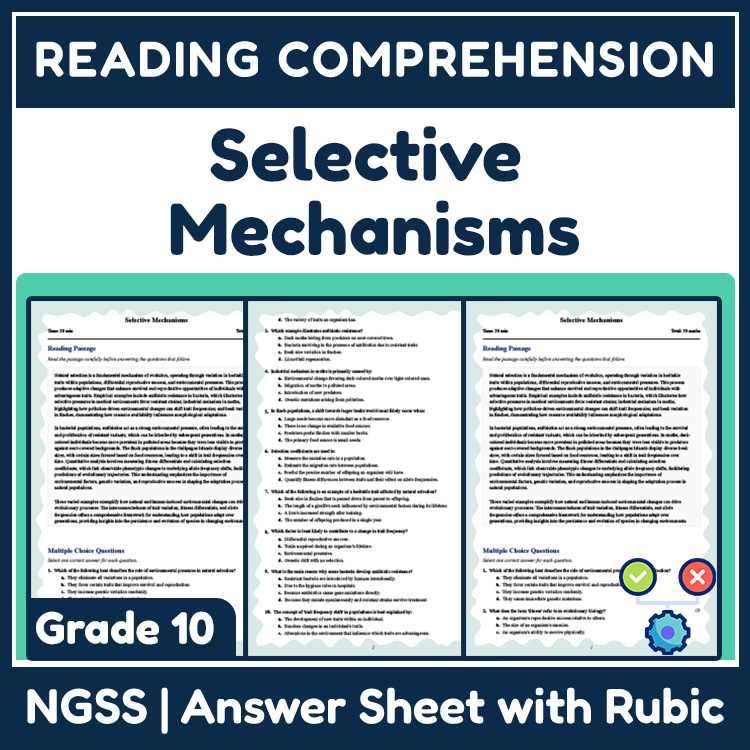
10th Grade Science | Selective Mechanisms Reading Worksheet (PDF + Rubric)
JCreated byJ.S SheetsLearning Objectives
- Understand the process of natural selection and how it leads to adaptation in populations.
- Identify examples of selective mechanisms such as antibiotic resistance, industrial melanism, and beak variation in finches.
- Explain how environmental pressures influence trait frequency changes across generations.
Also included in: Grade 10 Science | Evolution & Biodiversity Unit Worksheet Bundle
Instant download

Grade 10 Math – Vertex and Focus Worksheet (Ontario Standards) (PDF)
 Created byClear Sky Classroom
Learning Objectives
- Understand the geometric relationship between the vertex and focus of a parabola.
- Apply the vertex and focus concepts to solve real-world problems involving parabola-shaped phenomena.
- Calculate the position of the vertex and focus in various applied contexts.
Also included in: Grade 10 Math Quadratic Relations Applied Lesson Bundle for Ontario +1 more
Instant download

Grade 10 ELA Vocabulary Worksheet | Academic Words & Context Practice (PDF)
 Created byGolden Apple Studio
Learning Objectives
- Use academic and domain-specific vocabulary to clarify claims, describe evidence, and explain reasoning in informational writing.
- Distinguish technical terms from everyday synonyms by focusing on precise meaning and context.
- Strengthen coherence by applying vocabulary that signals relationships, processes, and categories.
Also included in: Grade 10 Academic Vocabulary & Word Analysis ELA Lesson Bundle: General ELA +1 more
Instant download

Earth System Cycles and Matter Transfers Worksheets | Grade 10
Created byBRIGHT PATH RESOURCESLearning Objectives
- Identify the major Earth system reservoirs: atmosphere, hydrosphere, geosphere, and biosphere.
- Explain how the water cycle redistributes water through evaporation, precipitation, runoff, and groundwater.
- Describe how carbon moves through biological processes and exchanges with the atmosphere and oceans.
Also included in: Grade 10 Earth Science Worksheets Bundle | Climate & Earth Systems +4 more
Instant download

Grade 10 Science – Stellar Evolution & Life Cycle | Daily Reading Worksheet
Created byBright Mind ResourcesLearning Objectives
- Understand how stars form from nebulae
- Identify the stages in a star's birth and early development
- Recognize key features of star formation and initial stabilization
Also included in: Stellar Evolution Grade 10 Science Daily Reading Worksheets Bundle | FL NGSSS +1 more
Instant download

Grade 10 Signal Integration in Human Physiology Worksheet with Answer Key
Created byBRIGHT PATH RESOURCESLearning Objectives
- Understand the fundamental mechanisms of signal transduction in the body
- Identify different types of signal transmission pathways
- Explain key concepts such as receptor specificity and second-messenger systems
Also included in: Human Physiology Grade 10 Science Daily Reading Worksheets Lesson Bundle | Ngss +1 more
Instant download

Model-Data Fit Worksheet Grade 10 AP Science Graph Analysis Skills
Created byPrism Point LearningLearning Objectives
- Explain how residuals and goodness-of-fit help evaluate whether a model matches observed data
- Use residual patterns and parameter sensitivity to identify when a model component is missing or inadequate
- Justify model acceptance or rejection using quantitative comparison and uncertainty
Also included in: AP Science Inquiry Skills Lesson Bundle | Grade 10 | Modeling & CER
Instant download

Industrial Processes Worksheet | Alberta Grade 10 Science Practice PDF
JCreated byJ.S SheetsLearning Objectives
- Understand key concepts of reaction stoichiometry, mass conservation, and rate control in industrial chemical processes.
- Analyze Alberta-specific examples such as bitumen upgrading, hydrogen production, and ammonia synthesis.
- Apply principles of mass-accounting practices, yield estimation, and the interplay of kinetics and thermodynamics in process design.
Also included in: Grade 10 Science Practice Worksheets: Alberta Science Full-Year Bundle
Instant download

Grade 10 Holiday | Summer Solstice for Mastering Earth's Tilt | PDF + Answer Key
 Created byShaNova Worksheets
Learning Objectives
- Explain how Earth’s axial tilt and orbit influence the length of daylight during the summer solstice
- Use and define key vocabulary related to astronomy and seasonal change (solstice, axis, latitude, hemisphere)
- Analyze how cultural celebrations can connect to astronomical events like the longest day
Instant download

Grade 10 Science – Biodiversity & Conservation | Daily Reading Worksheet
Created byBright Mind ResourcesLearning Objectives
- Understand the concept of biodiversity and its importance.
- Identify factors that lead to biodiversity loss.
- Analyze the impact of human activities on ecosystems.
Also included in: Evolution Grade 10 Science Daily Reading Worksheets Lesson Bundle | NGSS +2 more
Instant download

Grade 10 Science – Data Analysis & Central Tendency | Daily Reading Worksheet
Created byQuiet Forest EducationLearning Objectives
- Define and understand measures of central tendency: mean, median, and mode.
- Calculate the mean, median, and mode for a given dataset.
- Interpret how measures of central tendency help summarize and analyze scientific data.
Also included in: Scientific Investigation Grade 10 Science Daily Worksheets Bundle | Ontario +1 more
Instant download

Grade 10 Parts of Speech Worksheet | ELA Grammar and Language Practice
Created bySunny Desk ResourcesLearning Objectives
- Identify and use key parts of speech (nouns, verbs, adjectives, adverbs, pronouns) accurately in sentences.
- Choose correct prepositions, conjunctions, and determiners to show clear relationships such as time and possession.
- Maintain pronoun clarity by using consistent pronouns with clear antecedents.
Also included in: Grade 10 Grammar & Sentence Structure Lesson Bundle | General ELA +1 more
Instant download

Grade 10 ELA Editing for Effect Worksheet (Alberta) | PDF
Created byGolden Apple StudioLearning Objectives
- Apply editing strategies to improve grammar, punctuation, tense consistency, subject-verb agreement, pronoun references, and spelling conventions.
- Revise for clarity, coherence, readability, and sentence variety while preserving the intended meaning.
- Use a final checklist to align surface correctness with overall message in reports, commentary, and timed writing responses.
Also included in: Grade 10 ELA Word Choice, Tone & Punctuation Lesson Bundle: Alberta +1 more
Instant download

Economic Shifts Worksheet | TEKS-Aligned Social Studies Practice for Grade 10
JCreated byJ.S SheetsLearning Objectives
- Explain how industrialization and urban growth changed labor markets and productivity.
- Analyze how global capitalism and financial systems affected economic power and social structures.
- Evaluate how economic disparities can influence political power and social change.
Instant download

Grade 10 Science – Understanding Evolutionary Evidence | Daily Reading Worksheet
Created byBright Mind ResourcesLearning Objectives
- Identify different types of evidence supporting evolution
- Comprehend how fossil, anatomical, developmental, and molecular data contribute to evolutionary studies
- Analyze case studies such as island finch radiations and transitional fossils
Also included in: Grade 10 Evolution & Genetics Science Daily Reading Lesson Bundle | BC +1 more
Instant download

Evolution Evidence Assessment for Grade 10 Science | NGSSS Standards
Created byPrism Point LearningLearning Objectives
- Explain how multiple lines of evidence support evolution and common ancestry.
- Describe how fossils, comparative anatomy, biogeography, and genetics each provide evolutionary evidence.
- Use scientific vocabulary to interpret patterns of descent with modification over time.
Also included in: Grade 10 Cells, Genetics & Evolution Science Lesson Bundle | Florida NGSSS +1 more
Instant download

Grade 10 Science – Force Types Worksheet (Ontario) PDF
Created byEvergreen Desk EducationLearning Objectives
- Classify forces as contact or non-contact based on how they act on objects
- Describe each force type using its origin, direction, and magnitude (including units)
- Explain why forces are vectors and how multiple forces can change an object’s motion
Also included in: Grade 10 Kinematics Forces & Mechanics Science Lesson Bundle Ontario Worksheets +1 more
Instant download

Grade 10 Science – Sphere Interactions Models Daily Reading Worksheet
Created byBright Mind ResourcesLearning Objectives
- Understand how Earth's atmosphere affects water cycle processes
- Identify the interactions between air temperature, clouds, and precipitation
- Analyze how changes in land and water systems influence environmental outcomes
Also included in: Climate Grade 10 Science Daily Reading Worksheets Lesson Bundle | General +1 more
Instant download

Grade 10 Science – Trait Origins in Genetics | Daily Reading Worksheet
Created byBright Mind ResourcesLearning Objectives
- Understand key concepts related to Science
- Apply knowledge through practice questions
- Demonstrate comprehension of the material
Also included in: Evolution Grade 10 Science Daily Reading Worksheets Lesson Bundle | NGSS +2 more
Instant download

Particle Interactions worksheet | NGSS Grade 10 Science printable PDF assessment
Learning Objectives
- Explain how crystal structure and molecular arrangement influence bulk physical properties.
- Compare ionic, metallic, and molecular solids using particle interactions and electrical conductivity.
- Use particle-level forces (lattice energy, dispersion forces, and hydrogen bonding) to predict melting points and solubility trends.
Also included in: Matter and Its Interactions Lesson Bundle | Grade 10 Science | NGSS
Instant download

Land Use Effects Worksheet Practice Test | Grade 10 Science NGSS
Created byPrism Point LearningLearning Objectives
- Explain how land-cover change from human activities affects ecosystem function, hydrologic cycles, and biodiversity.
- Use empirical indicators (e.g., soil erosion, habitat fragmentation, nutrient loading, and sediment runoff) to connect land use to ecological outcomes.
- Interpret how different land-use types can increase or decrease risks such as eutrophication and biodiversity loss.
Instant download

Grade 10 Science – Friction and Resistance Worksheet (Ontario Standard) (PDF)
Created byEvergreen Desk EducationLearning Objectives
- Distinguish between static friction and kinetic friction and explain how each affects motion.
- Use coefficients of friction to relate frictional force to the normal force on different surfaces.
- Qualitatively describe how air resistance and viscous drag depend on velocity, including the idea of terminal speed.
Also included in: Grade 10 Kinematics Forces & Mechanics Science Lesson Bundle Ontario Worksheets +1 more
Instant download
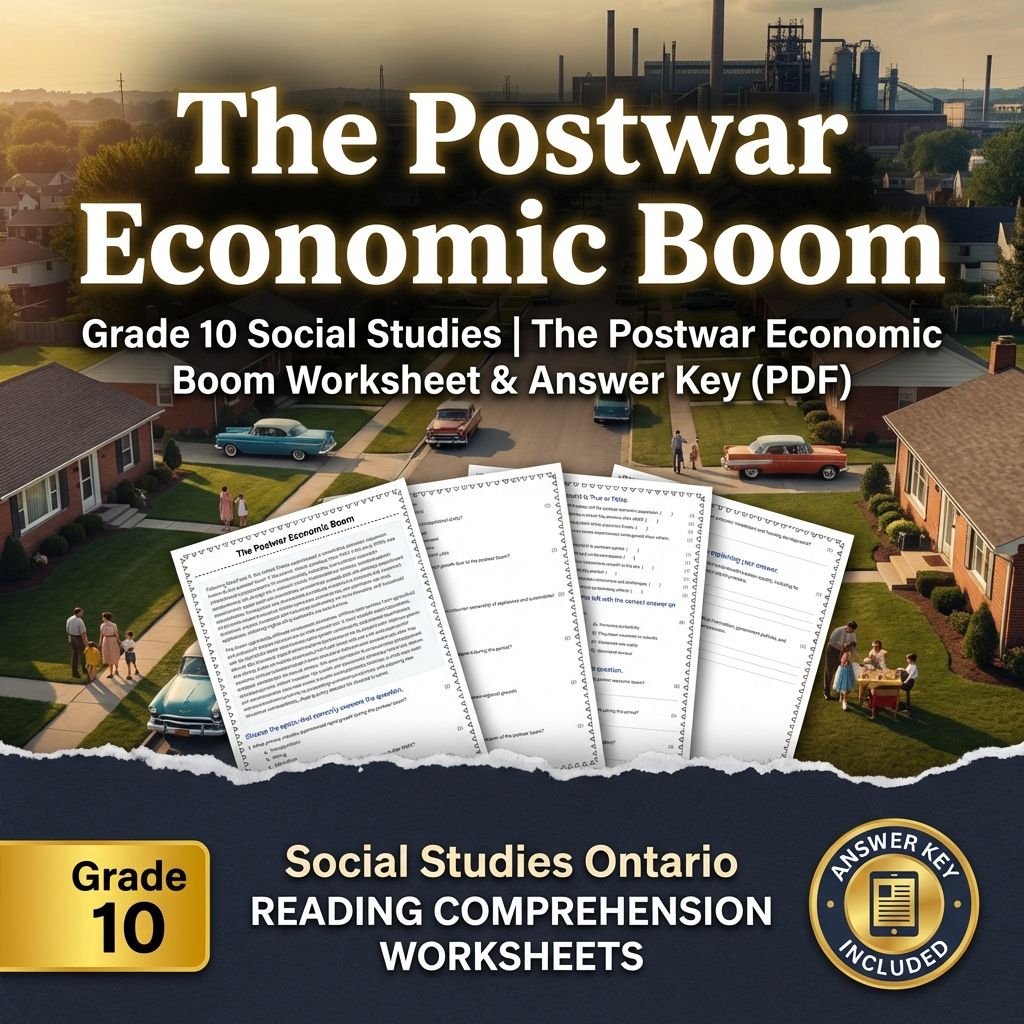
Grade 10 Social Studies | The Postwar Economic Boom Worksheet & Answer Key (PDF)
JCreated byJ.S SheetsLearning Objectives
- Analyze the causes and effects of the postwar economic expansion.
- Identify key factors such as technological innovation and fiscal policies.
- Evaluate changes in occupational structures, living standards, and regional inequality.
Instant download
Browse more categories
About Grade 10 Worksheets
Find Grade 10 worksheets covering algebra, biology, literature, and history. All 9,388 resources download instantly as PDFs for classwork, homework, or review.
MyTeachingSheets worksheets are made by real teacher-authors and checked before they go live. Download any as a print-ready PDF for lessons, homework, or independent practice — most include answer keys, and previews are always free.