
Grade 10 Worksheets
9,388 grade resources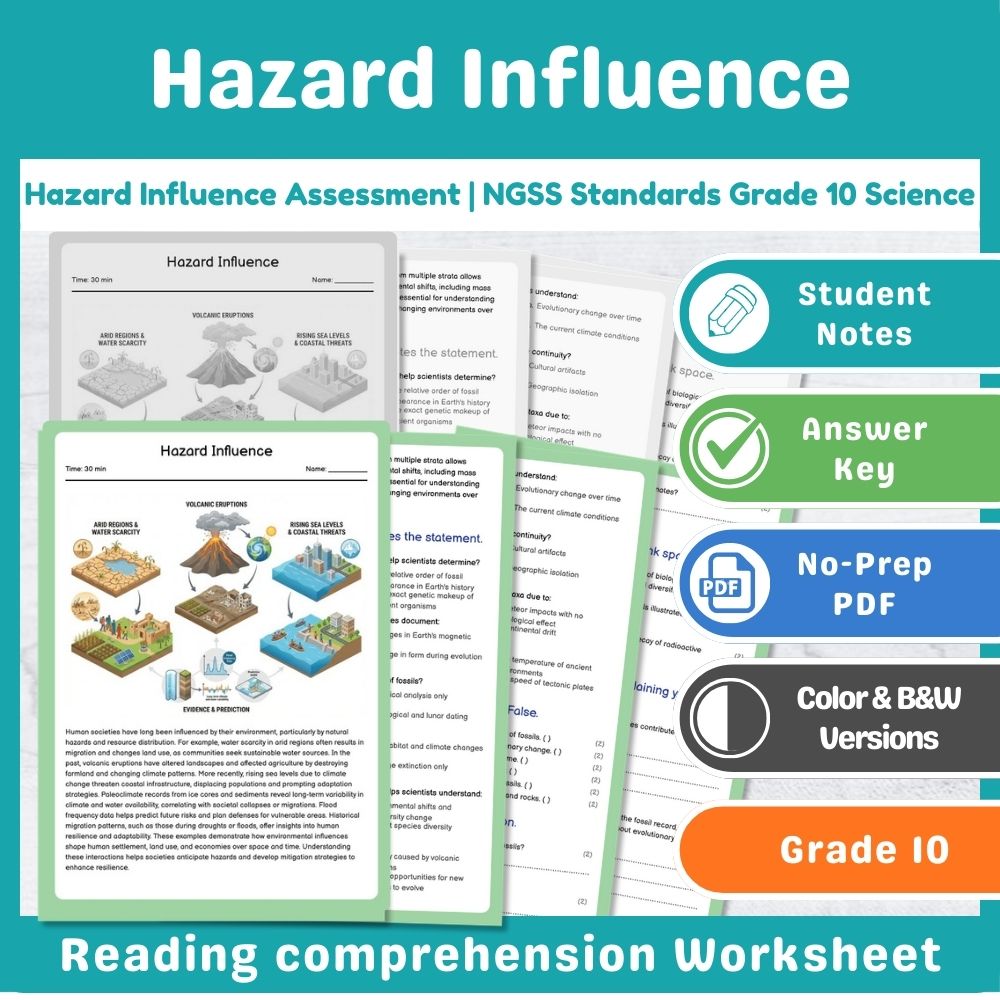
Hazard Influence Assessment | NGSS Standards Grade 10 Science
 Created byPrism Point Learning
Learning Objectives
- Understand how freshwater availability, natural hazards, and climate variability impact human settlement and land use.
- Analyze examples such as water scarcity, volcanic eruptions, and sea-level rise to evaluate societal responses.
- Interpret paleoclimate records, flood data, and migration patterns to recognize links between environmental factors and society.
Also included in: Grade 10 Science Resource Tradeoffs Assessment | NGSS Standards-Aligned
Instant download

Grade 10 Science | Heat Transfer Worksheet with Short Notes (Printable PDF)
 Created byMeadowlark Worksheets
Learning Objectives
- Understand the mechanisms of heat transfer: conduction, convection, and radiation.
- Identify factors affecting heat transfer rates and material properties.
- Describe real-world examples of heat transfer processes in nature and engineering.
Also included in: Grade 10 Science Lesson Bundle | Energy & Thermodynamics Worksheets +1 more
Instant download
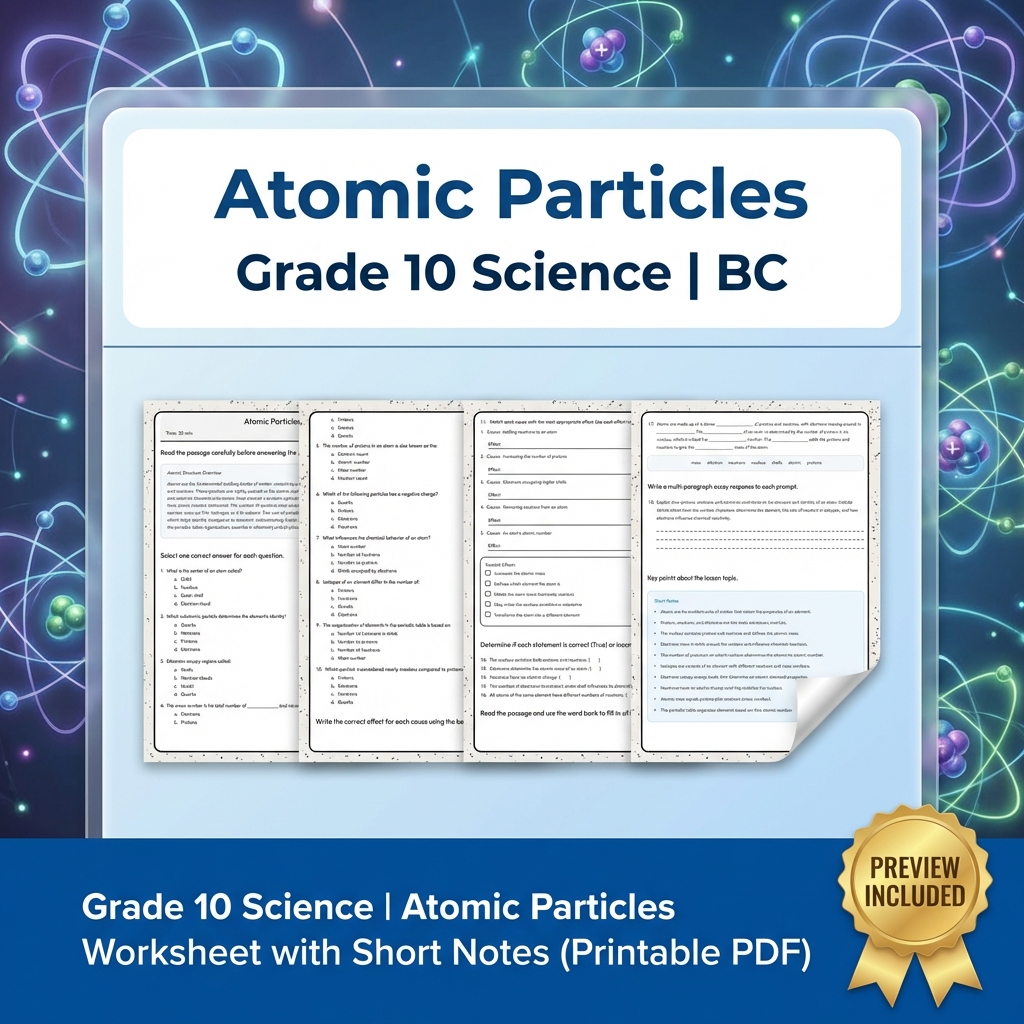
Grade 10 Science | Atomic Particles Worksheet with Short Notes (Printable PDF)
Created byMeadowlark WorksheetsLearning Objectives
- Understand the internal structure of atoms including protons, neutrons, and electrons.
- Explain how the number of protons determines the element.
- Describe how electrons occupy shells and influence chemical behavior.
Also included in: Grade 10 Science Lesson Bundle | BC Framework Worksheets Pack +1 more
Instant download
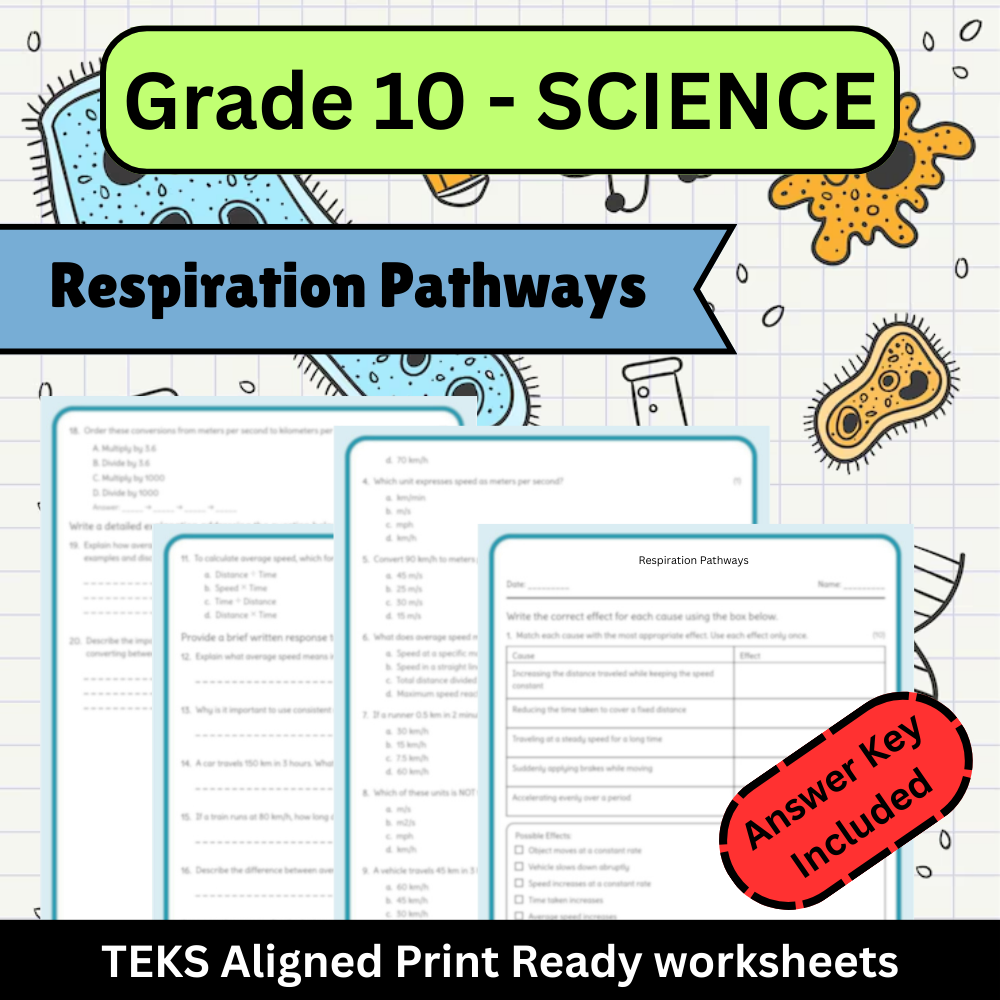
Grade 10 Science | Respiration Pathways Worksheet + Answer Key (TEKS Aligned)
 Created byBright Mind Resources
Learning Objectives
- Describe the processes involved in cellular respiration, including glycolysis, the citric acid cycle, and the electron transport chain.
- Explain how oxygen functions as the final electron acceptor in aerobic respiration.
- Identify where in the cell these processes occur and what energy molecules are produced.
Also included in: Grade 10 Science Unit Bundle – Photosynthesis, Respiration & Energy TEKS +5 more
Instant download
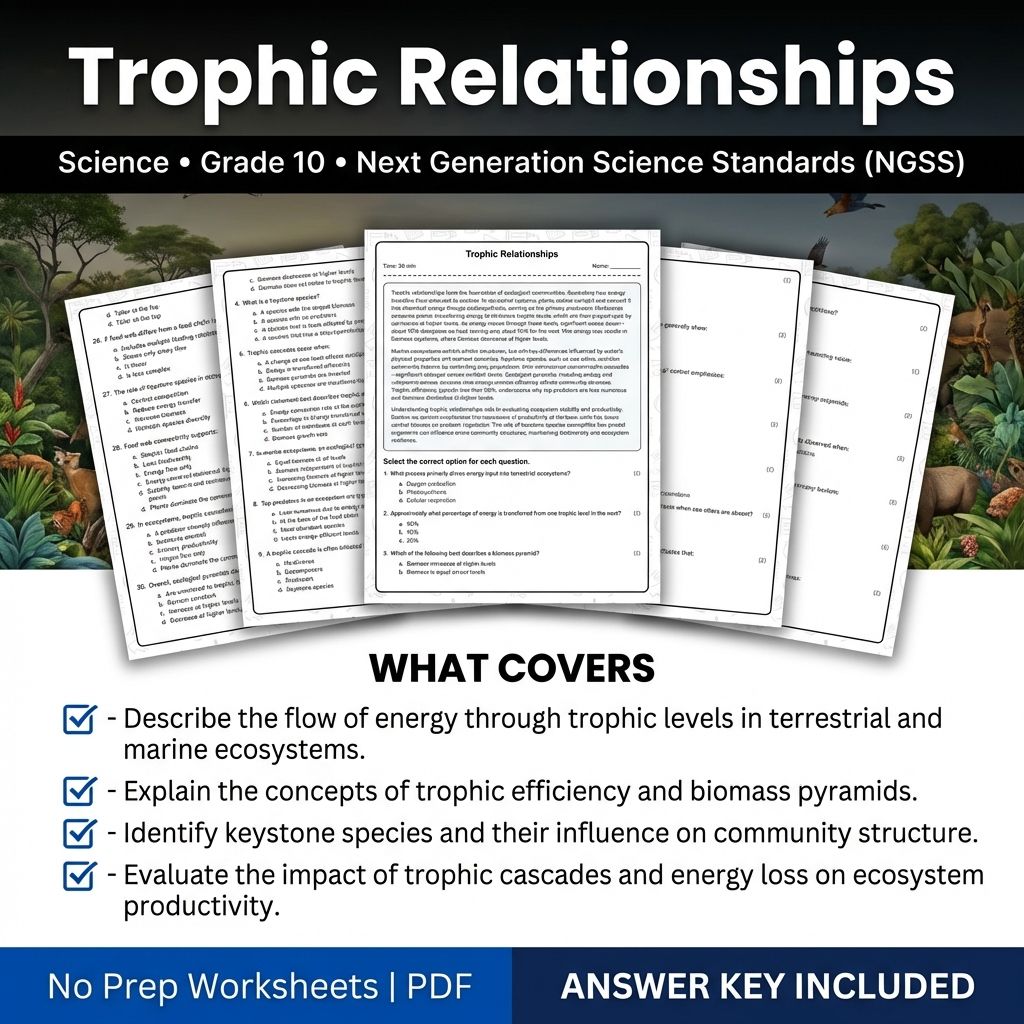
Grade 10 Science | Trophic Relationships Worksheet & Answer Key (PDF)
 Created byCoral Reef Learning
Learning Objectives
- Describe the flow of energy through trophic levels in terrestrial and marine ecosystems.
- Explain the concepts of trophic efficiency and biomass pyramids.
- Identify keystone species and their influence on community structure.
Also included in: Grade 10 Science Worksheets Bundle| Ecosystems & Population Dynamics(Answer Key) +1 more
Instant download
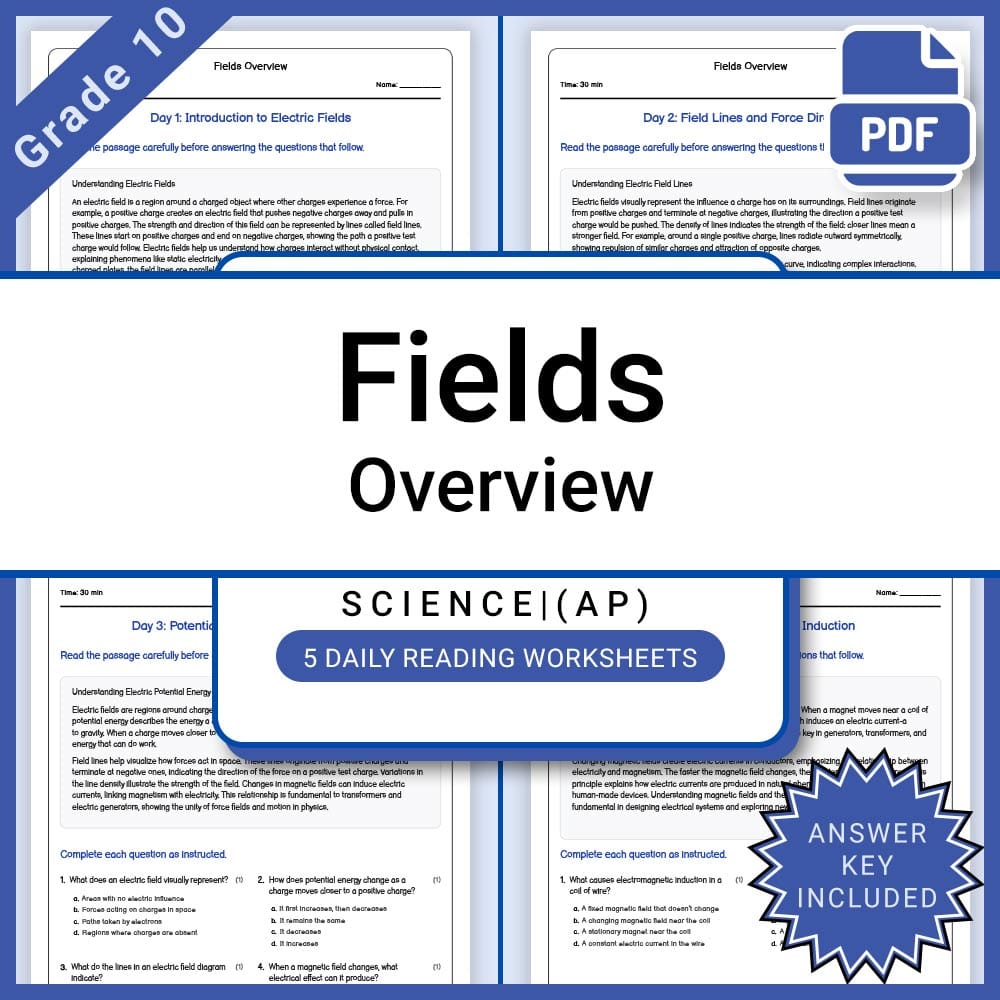
Grade 10 Science – Fields Overview Daily Reading Worksheet with Answer Key
JCreated byJ.S SheetsLearning Objectives
- Understand the concept of electric fields and how they influence charges
- Describe field-line representations for electric forces
- Relate electric fields to potential energy differences
Instant download
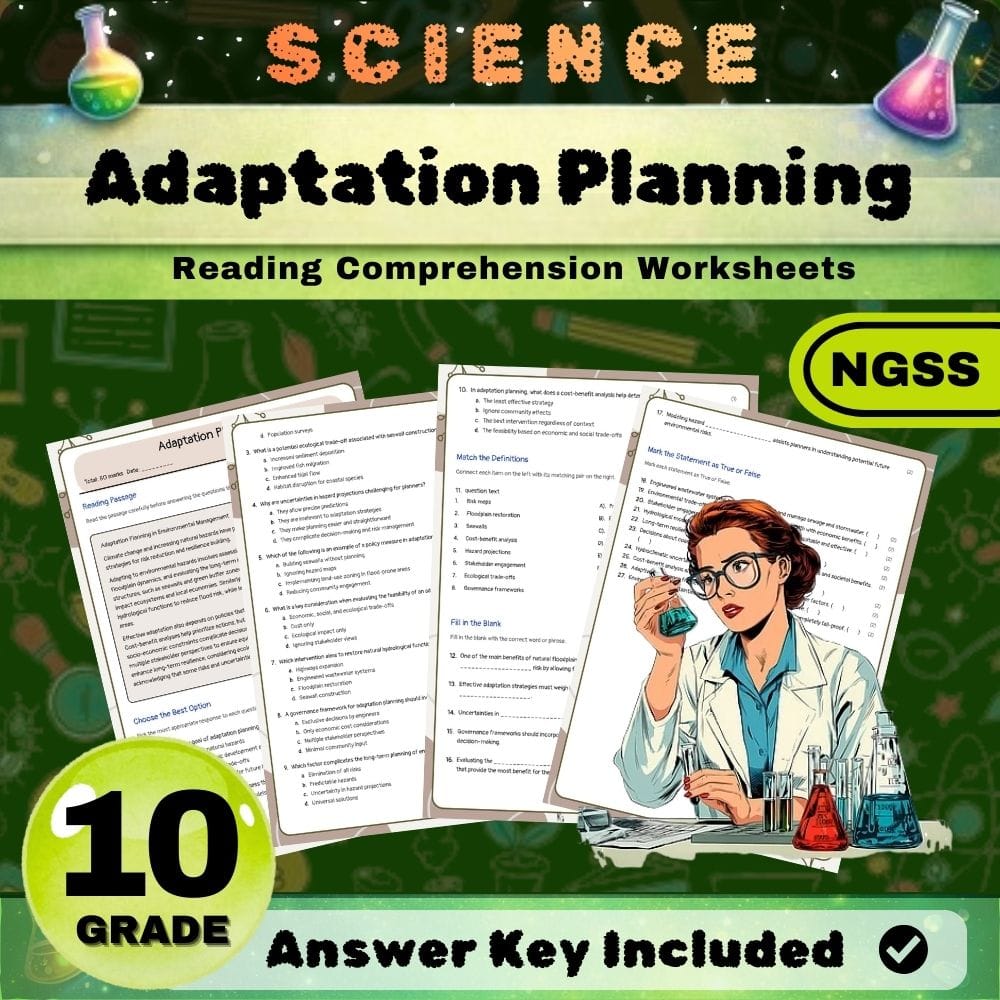
Grade 10 Science Worksheet | Adaptation Planning NGSS (PDF)
 Created byMaple Path Learning
Learning Objectives
- Evaluate infrastructural and policy responses to reduce vulnerability to natural hazards and environmental change.
- Analyze trade-offs among economic, social, and ecological considerations in adaptation strategies.
- Apply risk maps, hazard frequency analyses, and cost-benefit comparisons to assess adaptation feasibility.
Also included in: Grade 10 Science Earth and Human Activity Lesson Bundle | NGSS +1 more
Instant download
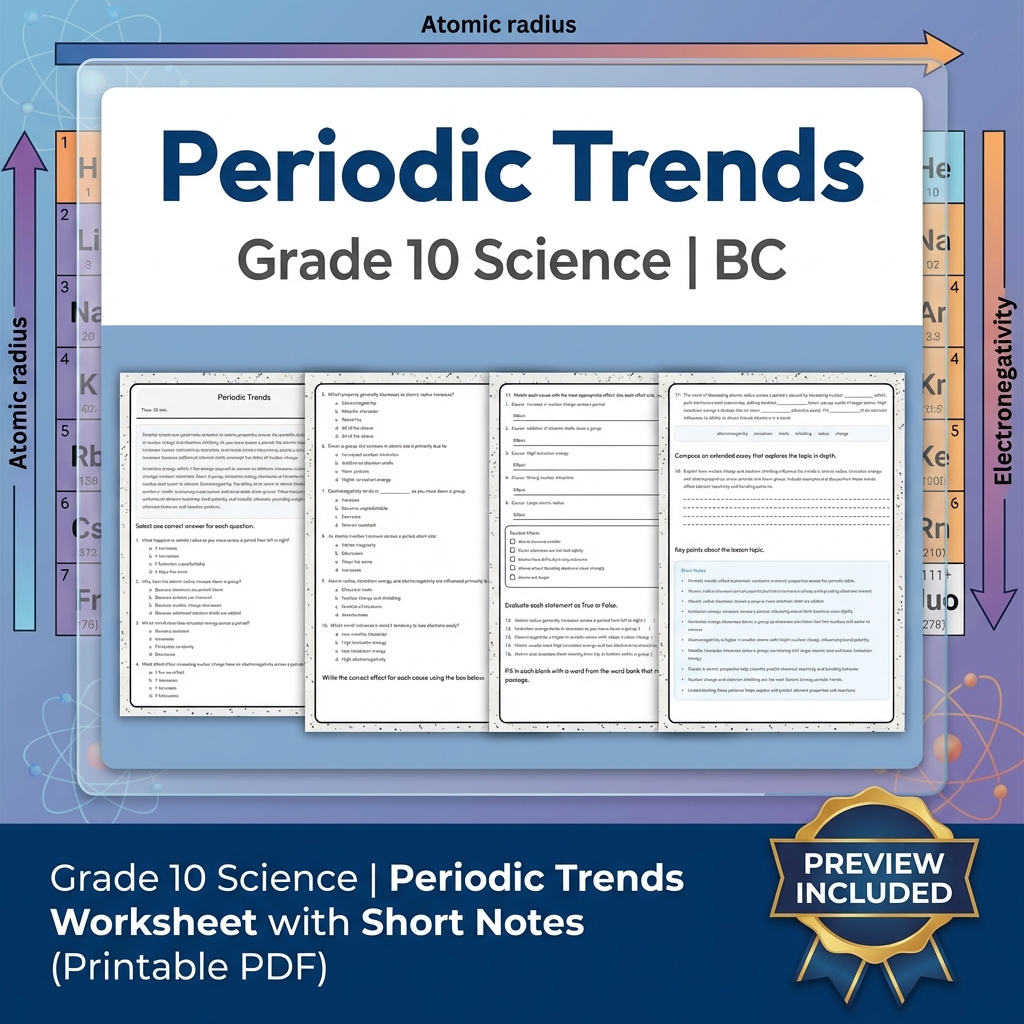
Grade 10 Science | Periodic Trends Worksheet with Short Notes (Printable PDF)
Created byMeadowlark WorksheetsLearning Objectives
- Understand the main periodic trends such as atomic radius, ionization energy, and electronegativity.
- Explain how nuclear charge and electron shielding influence atomic properties.
- Analyze how trends vary across periods and down groups in the periodic table.
Also included in: Grade 10 Science Lesson Bundle | BC Framework Worksheets Pack +1 more
Instant download
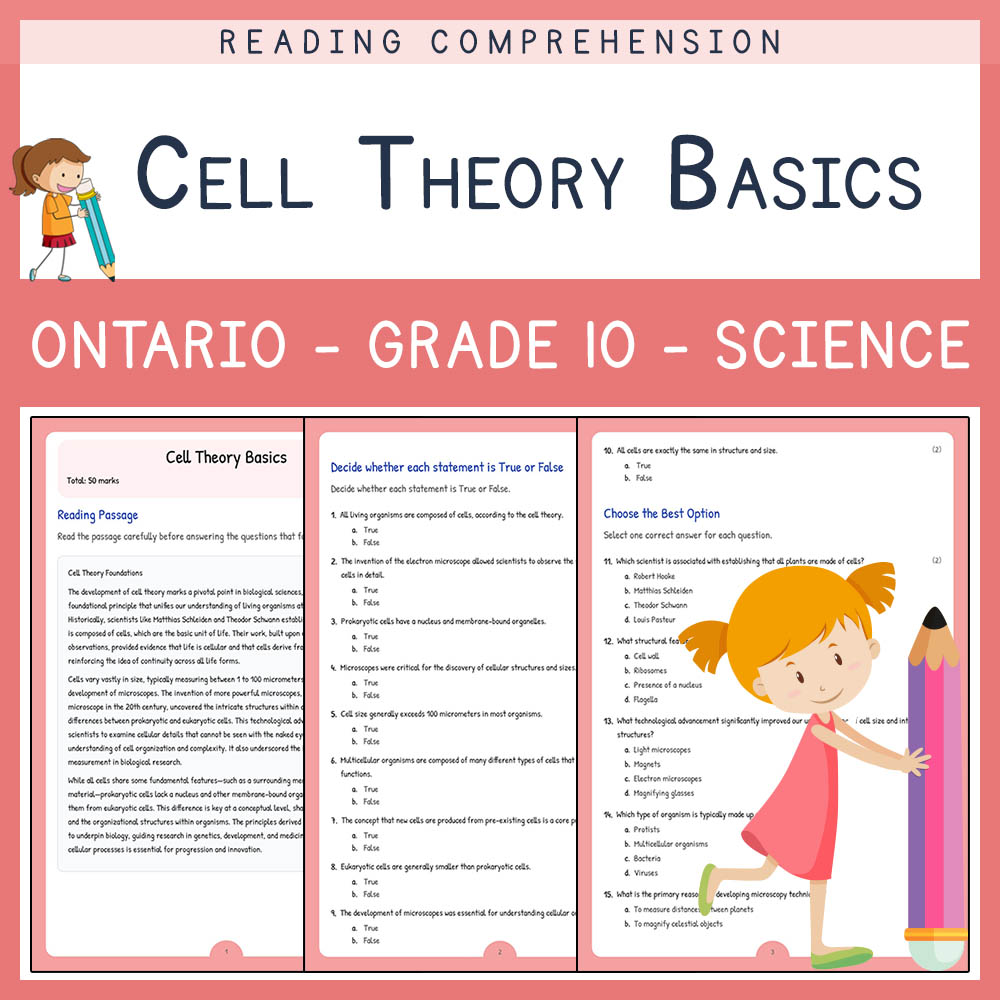
Grade 10 Science | Cell Theory Basics Worksheet | Ontario Standard
 Created byLumora Learning
Learning Objectives
- Define the principles of cell theory and understand its historical significance.
- Compare and contrast unicellular and multicellular organisms at a conceptual level.
- Describe the basic dimensions and scales relevant to cells and microscopy development.
Instant download

Grade 10 Science | Heat Engines Worksheet with Short Notes (Printable PDF)
Created byMeadowlark WorksheetsLearning Objectives
- Describe the basic principles of heat engines and how they convert thermal energy into mechanical work.
- Identify different types of heat engines and their common designs.
- Analyze factors affecting the efficiency of heat engines, including temperature differences and cycle design.
Also included in: Grade 10 Science Lesson Bundle | Energy & Thermodynamics Worksheets +1 more
Instant download

Periodic Patterns Assessment for Grade 10 Science – AP Standards-Aligned
Created byPrism Point LearningLearning Objectives
- Analyze the organization of the periodic table and interpret trends such as atomic radius, ionization energy, and electronegativity.
- Understand how electron configurations and nuclear effects influence periodic patterns.
- Compare elements across periods and groups to predict their chemical behavior and reactivity.
Also included in: Lesson Bundle | Grade 10 Science Assessment Paired with AP Standards
Instant download

10th Grade Science | Biodiversity Overview Worksheet (PDF+ Answer Key)
 Created byCopper Leaf Classroom
Learning Objectives
- Understand the fundamental concepts of biodiversity at genetic, species, and ecosystem levels.
- Identify factors that influence biodiversity patterns such as habitat, climate, and disturbance.
- Analyze how environmental gradients and evolutionary history affect biodiversity.
Also included in: Grade 10 Science BC | Evolution, Biodiversity & Ecology (PDF + Answer Key) +1 more
Instant download

Grade 10 Social Studies — Worksheet MCQ Paper for Community Groups
 Created byThe Resource Hub
Learning Objectives
- Explain how community groups contribute to democratic pluralism through advocacy, service delivery, and policy influence.
- Analyze how resource capacity and legitimacy affect the outcomes of community organizations.
- Compare charity models with rights-based advocacy and describe continuity and change over time.
Also included in: Grade 10 Rights, Policy, and Civic Participation Social Studies Custom Bundle +1 more
Instant download

Grade 10 Science | Trophic Efficiency Worksheet | TEKS-Aligned
Created byLumora LearningLearning Objectives
- Understand the concept of trophic efficiency and how energy transfer occurs between trophic levels.
- Analyze factors influencing energy transfer and biomass in ecosystems.
- Evaluate the impact of trophic efficiency variations on food web structure and ecosystem stability.
Instant download

Heat Transfer Assessment | BC Standards Grade 10 Science
Created byPrism Point LearningLearning Objectives
- Explain the mechanisms of heat transfer: conduction, convection, and radiation.
- Identify factors affecting the rate of heat transfer in different materials.
- Describe the properties of materials that make them good conductors or insulators.
Also included in: Grade 10 Science | Energy Assessment - BC Standards-Aligned Mini Bundle
Instant download

Grade 10 Science | Ocean Dynamics Reading Worksheet (PDF + Rubric) for NGSS
JCreated byJ.S SheetsLearning Objectives
- Understand the key circulation patterns in the ocean driven by density contrasts, wind forcing, and Earth's rotation.
- Describe the processes involved in thermohaline circulation, gyres, and coastal upwelling.
- Analyze how ocean observations from ARGO floats, satellites, and profiles inform climate and regional sea-level studies.
Also included in: Grade 10 Science Unit | Earth Systems & Climate Change Worksheets Bundle
Instant download

Grade 10 Science – Genetic Mutations Worksheet for Mastery
Created byThe Resource HubLearning Objectives
- Understand the different types of genetic mutations and their effects on genes and proteins.
- Identify examples of point mutations, insertions, deletions, and chromosomal alterations.
- Explain how mutations can lead to phenotypic variation and genetic disorders.
Also included in: Grade 10 Science DNA & Genetics Worksheet Bundle (Mastery & Reinforcement) +1 more
Instant download

Grade 10 Social Studies | Indigenous Rights Worksheet (PDF) & Standards
 Created bySunny Desk Resources
Learning Objectives
- Explain how postwar legal challenges affected First Nations, Métis, and Inuit rights and sovereignty.
- Analyze how assimilationist policies and resource disputes contributed to displacement and cultural suppression.
- Connect treaty obligations to social justice, economic development, and community resilience in contemporary reconciliation.
Also included in: Grade 10 Modern Canadian History Social Studies Lesson Bundle (Ontario) +1 more
Instant download

Grade 10 Science | Trait Origins Reading Worksheets (PDF + Rubric)
JCreated byJ.S SheetsLearning Objectives
- Understand the processes that lead to heritable trait variation, including mutation, recombination, gene flow, and chromosomal changes.
- Identify examples of genetic variation such as point mutations and regulatory changes that affect traits.
- Explain how population-level processes like genetic drift and nonrandom mating influence trait distribution over generations.
Also included in: Grade 10 Science | Evolution & Biodiversity Unit Worksheet Bundle
Instant download
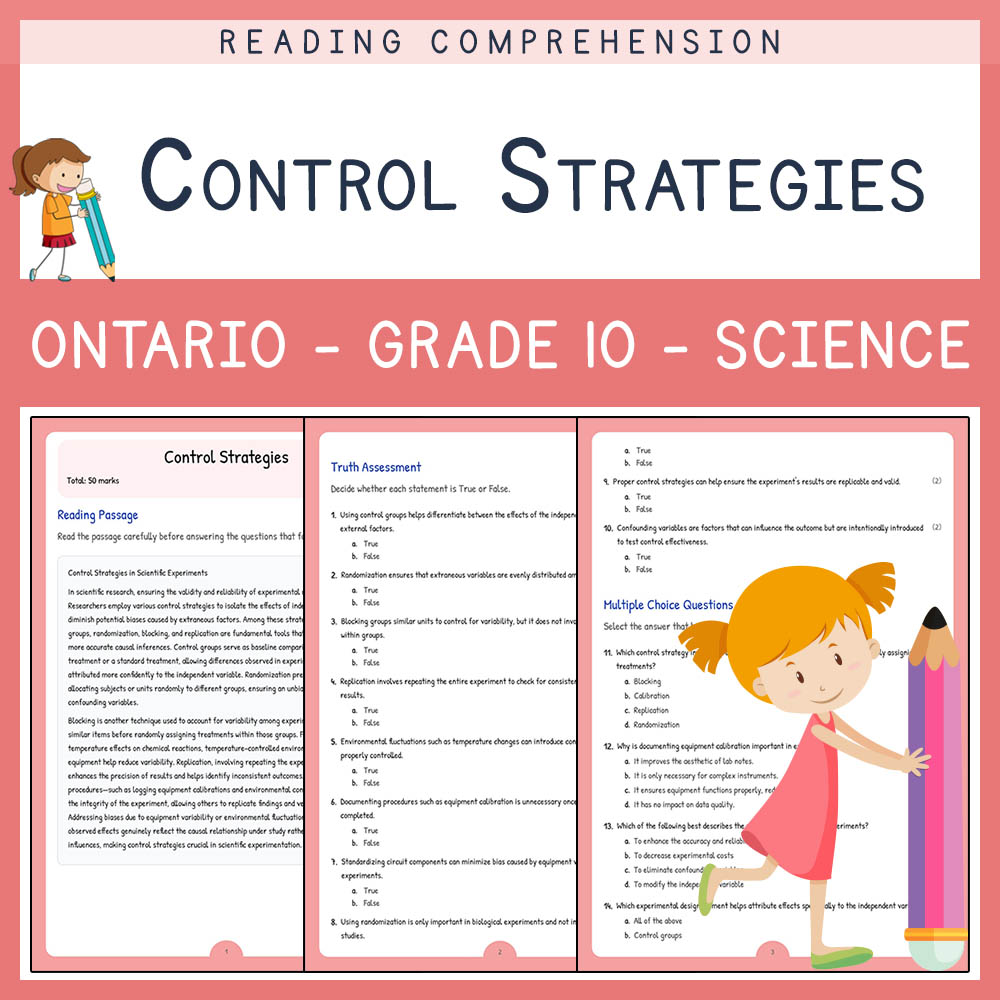
Grade 10 Science | Control Strategies Worksheet | Ontario Standards
Created byLumora LearningLearning Objectives
- Understand the purpose and application of control groups, randomization, blocking, and replication in experiments.
- Identify common sources of bias and confounding such as equipment variability and environmental fluctuations.
- Explain the rationale for control selection and levels of control in experimental design.
Instant download

Grade 10 Science | Thermodynamics Worksheet | TEKS-Aligned
Created byLumora LearningLearning Objectives
- Describe the principles of the first and second laws of thermodynamics and their significance in biochemical reactions.
- Explain how Gibbs free energy indicates the spontaneity of metabolic pathways.
- Understand how cellular metabolism optimizes energy efficiency through mechanisms like compartmentalization and enzyme control.
Also included in: Grade 10 Science | Metabolism & Energy Processes Lesson Bundle | TEKS Aligned +1 more
Instant download

Evolutionary Synthesis Assessment | BC Standards Grade 10 Science
Created byPrism Point LearningLearning Objectives
- Understand how fossil, anatomical, developmental, and molecular evidence contribute to evolutionary understanding.
- Identify mechanisms like natural selection, genetic drift, and gene flow that drive biodiversity.
- Analyze case studies such as island finch radiation and transitional fossils to interpret evolutionary processes.
Instant download

Grade 10 Science – Vectors and Components Daily Reading Worksheet + Answer Key
JCreated byJ.S SheetsLearning Objectives
- Define what a vector is and identify vectors in different contexts.
- Describe how a vector can be broken down into horizontal and vertical components.
- Use trigonometry to relate the components of a vector to its magnitude and direction.
Also included in: Grade 10 Science Lesson Group Bundle – Physics and Fields +1 more
Instant download

Grade 10 Science | Energy Resources Worksheet | Ontario Standards
Created byLumora LearningLearning Objectives
- Understand the geological formation and distribution of coal, petroleum, and natural gas.
- Describe the processes involved in organic matter maturation, migration, and trapping of energy resources.
- Differentiate between conventional and unconventional reservoirs and their implications for energy extraction.
Instant download

Mendelian Patterns Assessment | NGSS Standards-Aligned Grade 10 Science
Created byPrism Point LearningLearning Objectives
- Explain the concepts of dominance, segregation, and independent assortment in inheritance.
- Use Punnett squares and pedigree charts to predict offspring phenotypes and genotypes.
- Analyze inheritance patterns including linked genes and polygenic influences.
Also included in: Grade 10 Science | DNA, Mendelian Patterns & Mutation NGSS Assessment
Instant download

Biodiversity Overview Assessment | BC Standards Grade 10 Science
Created byPrism Point LearningLearning Objectives
- Define biodiversity and explain its levels including genetic, species, and ecosystem diversity.
- Identify factors that influence patterns of biodiversity such as habitat availability, climate stability, and disturbance rates.
- Analyze how interactions among species and environmental gradients contribute to biodiversity variation.
Instant download

Oscillations Basics Grade 10 Assessment | AP Physics Standards
Created byPrism Point LearningLearning Objectives
- Define simple harmonic motion, period, frequency, amplitude, and phase.
- Describe how energy partitions between kinetic and potential forms during oscillations.
- Relate sinusoidal representations and phase-space sketches to oscillation behaviors.
Also included in: Lesson Grade 10 Science Assessment Bundle | AP Standards-Aligned
Instant download

Ohm's Law Worksheet | Grade 10 Science Activities
Created byPrism Point LearningLearning Objectives
- Use Ohm’s law to calculate relationships among voltage, current, and resistance in circuit problems.
- Determine equivalent resistance for series and parallel resistor networks.
- Explain how temperature affects resistance and predict qualitative changes in circuit behaviour.
Also included in: Grade 10 Work, Energy & Electricity Lesson Bundle | Alberta Science
Instant download

Grade 10 Science | Nutrient Cycles - Daily Reading Comprehension
Created byCoral Reef LearningLearning Objectives
- Understand the nitrogen cycle and its importance in ecosystems
- Identify processes that convert nitrogen into usable forms
- Explain how decomposers and producers contribute to nutrient cycling
Instant download

Grade 10 Right Triangle Solutions Worksheet | Trigonometry Practice
 Created byBRIGHT PATH RESOURCES
Learning Objectives
- Choose the correct trigonometric ratio (sin, cos, or tan) based on which sides are given relative to an acute angle in a right triangle
- Use trigonometric ratios to calculate missing side lengths and acute angle measures in right triangles
- Justify computations by relating the chosen ratio to opposite, adjacent, and hypotenuse sides
Also included in: Grade 10 Geometry Math Lesson Bundle: CCSS Trig & Similarity +1 more
Instant download

Revolutionary Ideas Worksheet | Grade 10 Social Studies TEKS Activity
Created byThe Resource HubLearning Objectives
- Explain how Enlightenment ideas influenced political revolutions from the 18th to the 20th centuries
- Compare the causes and goals of the American and French Revolutions
- Describe how revolutions for independence and social change reshaped ideas about rights, sovereignty, and citizenship
Also included in: Global Conflicts & Decolonization Lesson Bundle | Grade 10 Social Studies TEKS +1 more
Instant download

Atomic Structure Review Practice Worksheet | Grade 10 Science Ontario
Created byPrism Point LearningLearning Objectives
- Identify subatomic particles and relate them to atomic number and mass number
- Explain how isotopes and average atomic mass connect to measured atomic mass
- Describe basic electron configuration and valence electrons in determining chemical behavior
Instant download

Grade 10 Science – Action & Reaction Forces Reading Worksheet | BC Standards
Created byBright Mind ResourcesLearning Objectives
- Define action and reaction forces and understand their characteristics.
- Recognize examples of force pairs in daily life.
- Explain how forces act on different objects and their effect on motion.
Also included in: Grade 10 Forces & Motion Science Daily Reading Worksheets Lesson Bundle | BC +1 more
Instant download

Grade 10 AA Triangle Similarity Worksheet | Geometry Practice CCSS
Created byBRIGHT PATH RESOURCESLearning Objectives
- Use the AA triangle similarity criterion to decide when two triangles are similar from angle information.
- Identify corresponding vertices and corresponding sides when triangles are similar.
- Use proportional side relationships from similarity to find missing side lengths.
Also included in: Grade 10 Geometry Math Lesson Bundle: CCSS Trig & Similarity +1 more
Instant download

Representing Data Test Prep Worksheets | Grade 10 Science
Created byPrism Point LearningLearning Objectives
- Select an appropriate table or graph type for a given science data set and purpose.
- Interpret axis labels and scaling choices to explain trends accurately.
- Use error bars and best-fit lines responsibly to communicate uncertainty and patterns.
Also included in: Grade 10 Evidence-Based Science Data Analysis Lesson Bundle: Ontario
Instant download

Global Interaction Worksheet | Grade 10 Social Studies TEKS Activity
Created byThe Resource HubLearning Objectives
- Explain major patterns of global interaction and exchange after 1450, including exploration, trade networks, and migration flows
- Analyze how global interactions encouraged cultural diffusion and economic growth
- Evaluate how global exchange contributed to geopolitical shifts and conflicts
Also included in: Global Conflicts & Decolonization Lesson Bundle | Grade 10 Social Studies TEKS +1 more
Instant download

Ocean Atmosphere Coupling Worksheet for Grade 10 Science – Standards-Aligned
JCreated byJ.S SheetsLearning Objectives
- Explain how the ocean and atmosphere exchange heat and moisture and how that shapes weather and climate
- Describe why the ocean responds more slowly than the atmosphere due to its high heat capacity
- Connect sea-surface temperature changes to evaporation, storm development, rainfall belts, and wind patterns
Also included in: Grade 10 Earth and Space Systems Models Science lesson bundle – General +1 more
Instant download

Grade 10 Searching Algorithms Worksheet | Linear vs Binary Search Activity
Created byPrism Point LearningLearning Objectives
- Explain how linear search works and when it is efficient.
- Describe how binary search works and why it requires a sorted list.
- Compare searching algorithms by time efficiency and suitability for different data sets.
Instant download

Exploration Causes Worksheet | Grade 10 Social Studies TEKS Activity
Created byThe Resource HubLearning Objectives
- Identify major economic, technological, and political causes that led Europeans to explore new regions
- Explain how navigation tools and improved shipbuilding enabled long-distance ocean voyages
- Describe how European exploration affected indigenous populations through trade, settlement, and unintended disease
Also included in: Global Conflicts & Decolonization Lesson Bundle | Grade 10 Social Studies TEKS +1 more
Instant download

Grade 10 Science – Astronomical Climate Cycles & Earth's Climate | Worksheet
Created byBright Mind ResourcesLearning Objectives
- Understand how solar energy influences Earth's climate
- Identify the astronomical factors affecting climate patterns
- Analyze evidence from geological records for climate cycles
Also included in: Grade 10 Climate Linkages Science Daily Reading Worksheets Bundle | CA Standards +1 more
Instant download

Grade 10 Science | Bonding Models Worksheet | AP Aligned
Created byLumora LearningLearning Objectives
- Describe the major types of chemical bonding: ionic, covalent, and metallic.
- Explain how electron-sharing and electron-transfer models represent bonding.
- Relate bonding types to observable material properties such as conductivity, melting point, and solubility.
Instant download

Quantifying Solution Concentration Worksheet | Grade 10 Science
Created bySunny Desk ResourcesLearning Objectives
- Define concentration as the proportion of solute in a solvent by mass, volume, or amount of substance.
- Calculate and compare concentrations using molarity and mass percent.
- Explain how dilution and mixing change concentration and relate to environmental compliance.
Also included in: Grade 10 Chemistry Lesson Bundle | Alberta Science Reaction & Analysis +1 more
Instant download

Population Dynamics Assessment for Grade 10 Science | TEKS
Created byPrism Point LearningLearning Objectives
- Understand the factors influencing population changes over time.
- Identify and analyze models used to predict population growth patterns.
- Evaluate the impact of environmental and biological interactions on populations.
Also included in: Grade 10 Ecosystems Science Lesson Bundle for TEKS Assessment Worksheets
Instant download

Energy Release Worksheet | Grade 10 Science Activities
Created byPrism Point LearningLearning Objectives
- Explain how aerobic and anaerobic respiration release usable cellular energy by transforming chemical bonds into ATP.
- Describe how oxygen availability affects whether glycolysis is followed by aerobic pathways or anaerobic pathways.
- Connect differences in soil oxygen levels (e.g., wetlands vs. prairie topsoils) to which respiration pathways dominate.
Also included in: Cell Organization & Homeostasis Grade 10 Science Lesson Bundle | Alberta
Instant download

Energy Capture Worksheet | Grade 10 Science Activities
Created byPrism Point LearningLearning Objectives
- Explain how photosynthesis captures solar energy and converts it into chemical energy stored in carbohydrates.
- Describe the role of chlorophyll and light-dependent reactions in energy capture.
- Analyze how environmental factors (light intensity, season, and water availability) affect biomass production.
Also included in: Cell Organization & Homeostasis Grade 10 Science Lesson Bundle | Alberta
Instant download

Data Visualization Worksheet AP Science Grade 10 Graphing Skills
Created byPrism Point LearningLearning Objectives
- Identify appropriate graphical and tabular representations for quantitative and qualitative data and explain why each choice fits the data.
- Interpret scatterplots, histograms, boxplots, and residual plots by describing patterns, variability, and outliers.
- Explain how axis scales, trend lines, and uncertainty information (error bars or confidence intervals) affect conclusions from data.
Also included in: AP Science Inquiry Skills Lesson Bundle | Grade 10 | Modeling & CER
Instant download

Grade 10 Science – Molecular Coding & Protein Synthesis | Reading Worksheet
Created byBright Mind ResourcesLearning Objectives
- Understand the process of transcription and translation
- Identify how DNA sequences determine amino acid chains
- Recognize the effects of mutations on protein structure
Also included in: Homeostasis Grade 10 Science Daily Reading Worksheets Lesson Bundle | NGSS +2 more
Instant download

Grade 10 Maths – Comparative Financial Options Worksheet (Ontario Standard)
 Created byClear Sky Classroom
Learning Objectives
- Calculate and compare interest earned from different savings accounts and investment vehicles.
- Analyze loan terms and interest rates to determine the most cost-effective option.
- Apply percentage calculations to real-world financial scenarios.
Also included in: Grade 10 Maths Lesson Group | Ontario Financial & Analytical Skills Bundle +1 more
Instant download
Browse more categories
About Grade 10 Worksheets
Find Grade 10 worksheets covering algebra, biology, literature, and history. All 9,388 resources download instantly as PDFs for classwork, homework, or review.
MyTeachingSheets worksheets are made by real teacher-authors and checked before they go live. Download any as a print-ready PDF for lessons, homework, or independent practice — most include answer keys, and previews are always free.