
Grade 10 Worksheets
9,388 grade resources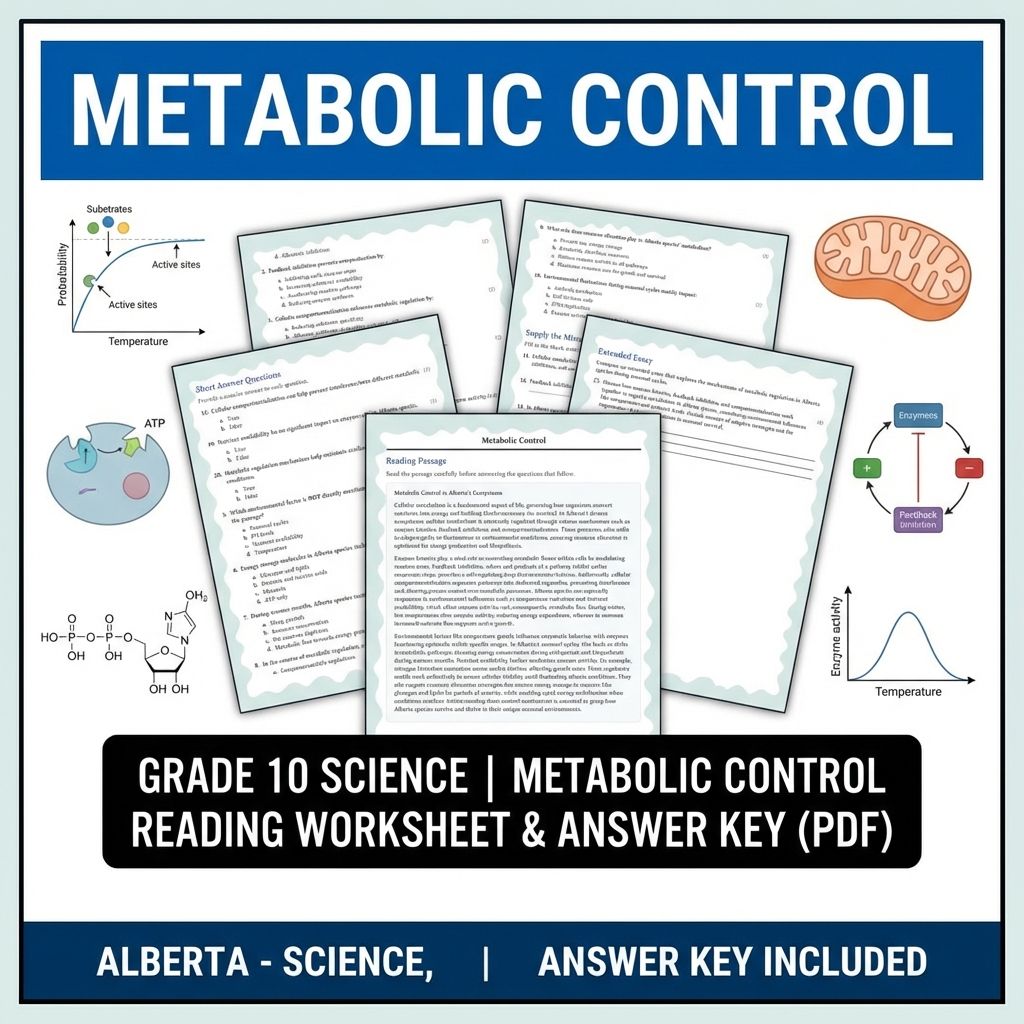
Grade 10 Science | Metabolic Control Reading Worksheet & Answer Key (PDF)
JCreated byJ.S SheetsLearning Objectives
- Understand how enzyme kinetics regulate cellular metabolism.
- Identify feedback inhibition mechanisms in metabolic pathways.
- Explain the impact of environmental factors on enzyme activity in Alberta species.
Also included in: Grade 10 Science | Cell Systems, Energy, & Homeostasis (Standards-Aligned) +1 more
Instant download

Grade 10 Worksheet B: Biodiversity Change Worksheet | NGSS Practice PDF
 Created byClear Sky Classroom
Learning Objectives
- Explain how fossil extinctions, current species-loss rates, and human activities contribute to biodiversity change.
- Evaluate how habitat fragmentation, invasive species, and climate shifts affect genetic diversity and ecosystem resilience.
- Use evidence from phylogenetic analysis and population monitoring to infer lineage survival and conservation recovery potential.
Also included in: Grade 10 Evolution and Speciation Science Lesson Bundle | NGSS Worksheet B +1 more
Instant download

Grade 10 Variables & Constraints Worksheet | Practice & Assessment PDF
Created byClear Sky ClassroomLearning Objectives
- Differentiate independent, dependent, and controlled variables and explain how each is used in an investigation.
- Identify constraints (such as time, equipment limits, and measurement boundaries) that shape how an experiment or comparison can be designed.
- Select operational definitions and justify variable choices to produce interpretable results under given constraints.
Also included in: Grade 10 Science Practices in Science: Lesson Bundle for Advanced Placement (AP) +1 more
Instant download

Modern Nursing Insights Worksheet | May Grade 10 Holiday Standard
 Created byCedar Grove Learning
Learning Objectives
- Explain how modern nurses use scientific knowledge, communication, and empathy to support patient wellness
- Describe how public health nursing contributes to prevention and addresses health disparities
- Identify the ethical and teamwork responsibilities nurses follow in healthcare settings
Also included in: Grade 10 National Nurses Day Holiday Lesson Bundle for May Worksheets +1 more
Instant download

Grade 10 Social Studies | Environmental Policy Worksheet (Ontario PDF)
 Created bySunny Desk Resources
Learning Objectives
- Explain how contemporary Canadian environmental policy responds to climate change and industrial impacts
- Describe how resource management regulations affect economic priorities and intergovernmental relations
- Analyze the role of First Nations, Métis, and Inuit environmental stewardship in treaty-based conservation
Also included in: Grade 10 Modern Canadian History Social Studies Lesson Bundle (Ontario) +1 more
Instant download

Adaptation Planning Worksheet | NGSS Grade 10 Science printable PDF
Learning Objectives
- Evaluate how infrastructure and policy adaptations can reduce vulnerability to natural hazards and environmental change.
- Compare economic, social, and ecological trade-offs when planning adaptation strategies.
- Use risk mapping, hazard frequency thinking, and cost–benefit reasoning to judge feasibility and long-term resilience.
Also included in: Earth and Human Activity Lesson Bundle Grade 10 Science NGSS
Instant download

Grade 10 Science – Representing Data Worksheet (Ontario Standards) (PDF)
 Created byEvergreen Desk Education
Learning Objectives
- Choose appropriate graphs and tables to represent different types of quantitative data and patterns
- Apply correct axis scaling and labeling to support accurate interpretation of graphs
- Use annotations, legends, and accessibility choices to communicate trends clearly and avoid misinterpretation
Also included in: Grade 10 Scientific Inquiry & Data Reasoning Science Lesson Bundle: Ontario +1 more
Instant download

Grade 10 Science – Trade-Offs & Optimization Daily Reading Worksheet
 Created byBright Mind Resources
Learning Objectives
- Understand the concept of trade-offs in engineering design.
- Learn how to analyze multiple objectives using cost-benefit matrices.
- Explore Pareto fronts and sensitivity analysis for optimization.
Also included in: Grade 10 Engineering Design Science Daily Reading Lesson Bundle | NGSS +2 more
Instant download
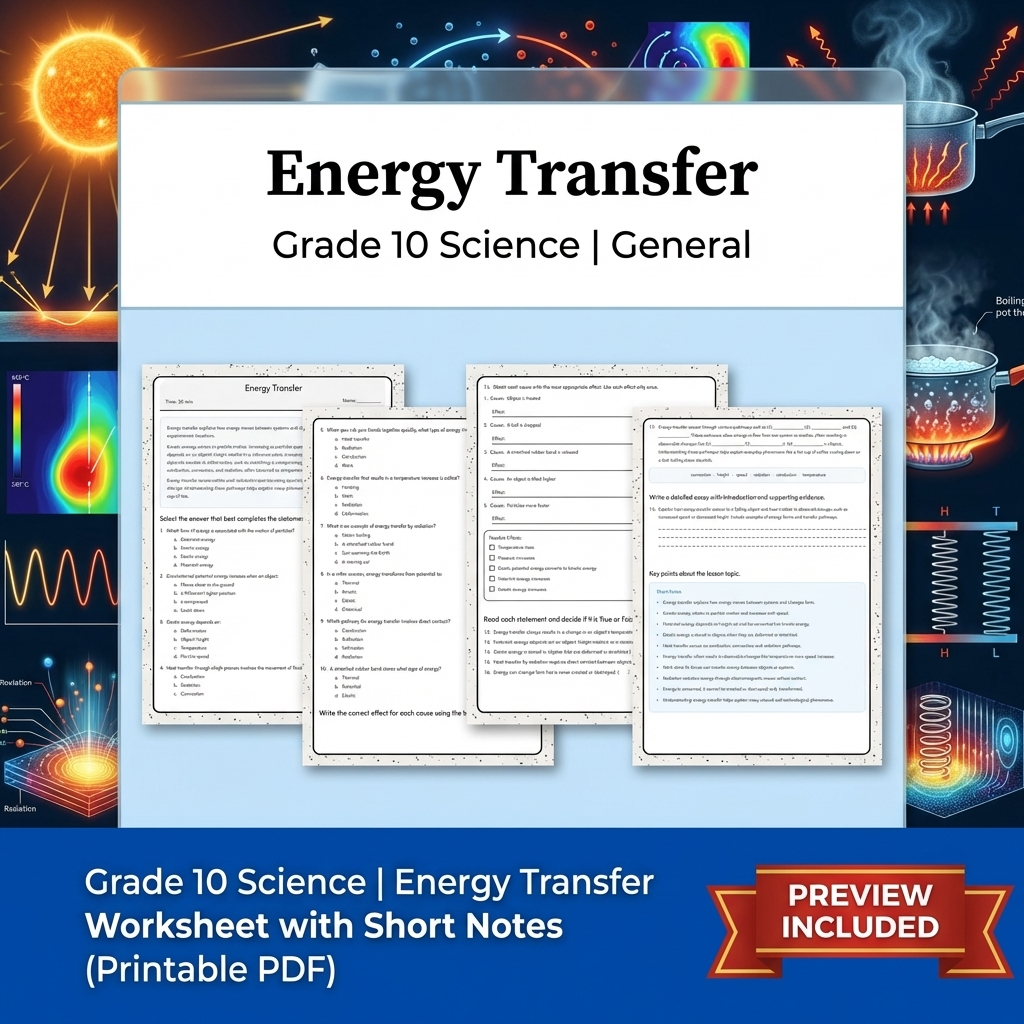
Grade 10 Science | Energy Transfer Worksheet with Short Notes (Printable PDF)
 Created byMeadowlark Worksheets
Learning Objectives
- Explain how energy moves between systems and changes form during various processes.
- Identify different types of energy such as kinetic, gravitational potential, and elastic energy.
- Describe pathways for energy transfer including heating, work, and radiation.
Also included in: Grade 10 Forces and Energy Science Lesson Bundle for General Framework +1 more
Instant download

Grade 10 Science – Geologic Time NGSS Worksheet (PDF) – ngss10
 Created bySilver Birch Teaching
Learning Objectives
- Understand how stratigraphic sequences, radiometric dating, and crater counting establish Earth's geologic chronology.
- Explain the concepts of half-life decay, isotopic ratios, and cross-cutting relationships in dating geological events.
- Describe how terrestrial and lunar time scales are integrated to understand Earth's history within solar system evolution.
Also included in: Grade 10 Earth and Space Science Lesson Bundle Worksheets for NGSS +1 more
Instant download

Cell Biochemistry | Master Reactions, Compartments, Enzymes Grade 10 Science
JCreated byJ.S SheetsLearning Objectives
- Explain how cell membranes regulate the exchange of materials and why compartmentalization improves biochemical efficiency
- Describe how enzymes lower activation energy and enable coordinated reaction pathways
- Connect ATP’s role in energy storage and transfer to cellular processes such as biosynthesis, repair, and cell division
Also included in: Grade 10 Genetics, Evolution, and Cell Science Lesson Bundle: General +2 more
Instant download

Grade 10 Science – Body Temperature Regulation Daily Worksheet + Answer Key
JCreated byJ.S SheetsLearning Objectives
- Understand how the hypothalamus controls body temperature
- Identify mechanisms such as vasodilation, vasoconstriction, sweating, and shivering
- Explain feedback processes involved in thermal regulation
Also included in: Grade 10 Science Lesson Bundle | Human Physiology & Regulatory Systems +1 more
Instant download
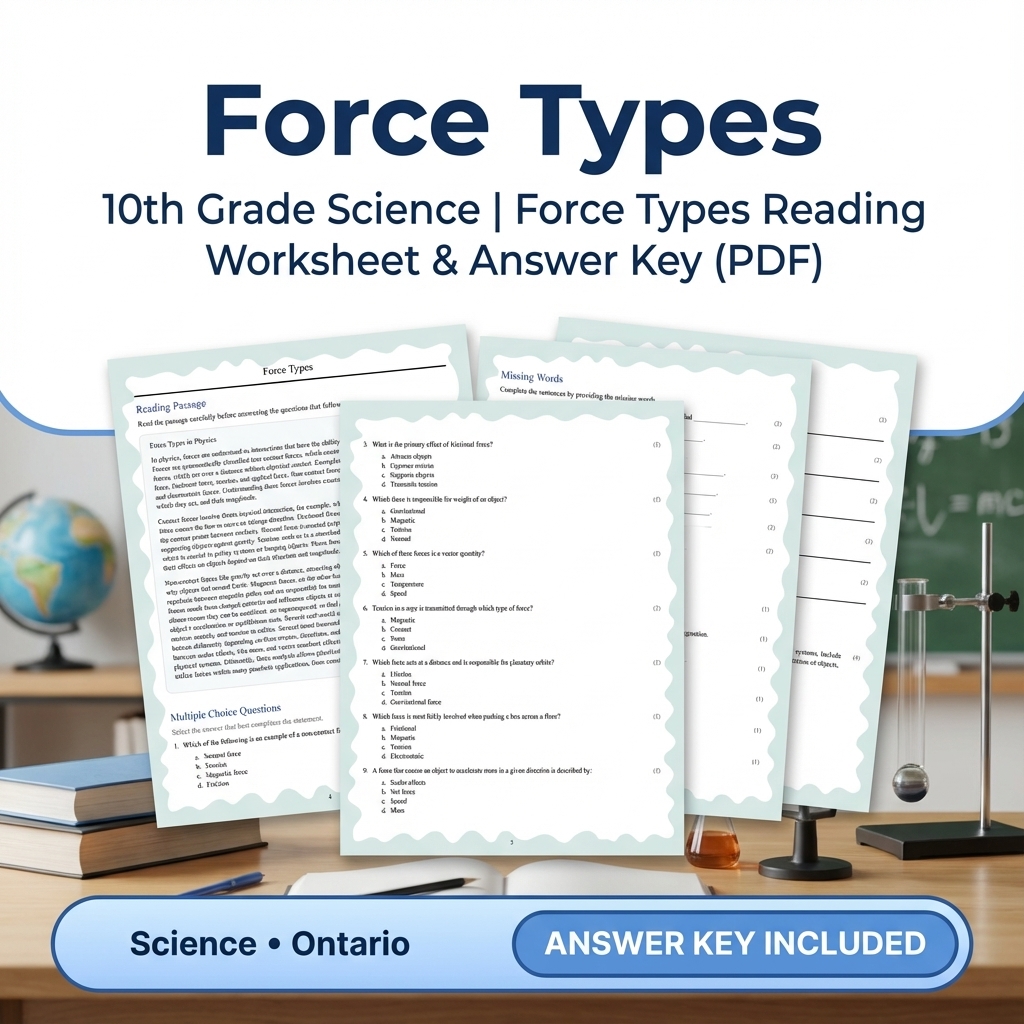
10th Grade Science | Force Types Reading Worksheet & Answer Key (PDF)
JCreated byJ.S SheetsLearning Objectives
- Understand the different types of contact and non-contact forces.
- Identify examples and effects of force types in real-world contexts.
- Distinguish between scalar and vector effects of forces.
Also included in: Grade 10 Science Unit Bundle – Motion, Forces & Mechanics (Answer Keys Included) +1 more
Instant download

Grade 10 Health – Body Systems Worksheet (NHES) PDF
Created bySunny Desk ResourcesLearning Objectives
- Explain the main structures and functions of the circulatory, respiratory, and digestive systems.
- Describe how body systems work together to maintain homeostasis.
- Analyze how lifestyle factors can influence normal body processes and overall health.
Also included in: Grade 10 Health Skills in Health Lesson Bundle: NHES Worksheet Practice +1 more
Instant download

Relative Velocity Worksheet | Science | Standard BC | Grade 10
JCreated byJ.S SheetsLearning Objectives
- Understand the concept of relative velocity and how it is calculated by vector subtraction.
- Apply classical addition rules for velocities at speeds much smaller than light.
- Analyze different reference frames and how they affect perceived motion.
Instant download

Grade 10 Science – Wave Properties Daily Reading Worksheet | Florida NGSSS
Created byBright Mind ResourcesLearning Objectives
- Identify and describe the basic properties of waves
- Explain how wave energy is transferred through different mediums
- Understand the phenomena of reflection, refraction, and superposition in waves
Also included in: Physical Science Grade 10 Daily Reading Worksheets Lesson Bundle | Florida NGSSS +1 more
Instant download
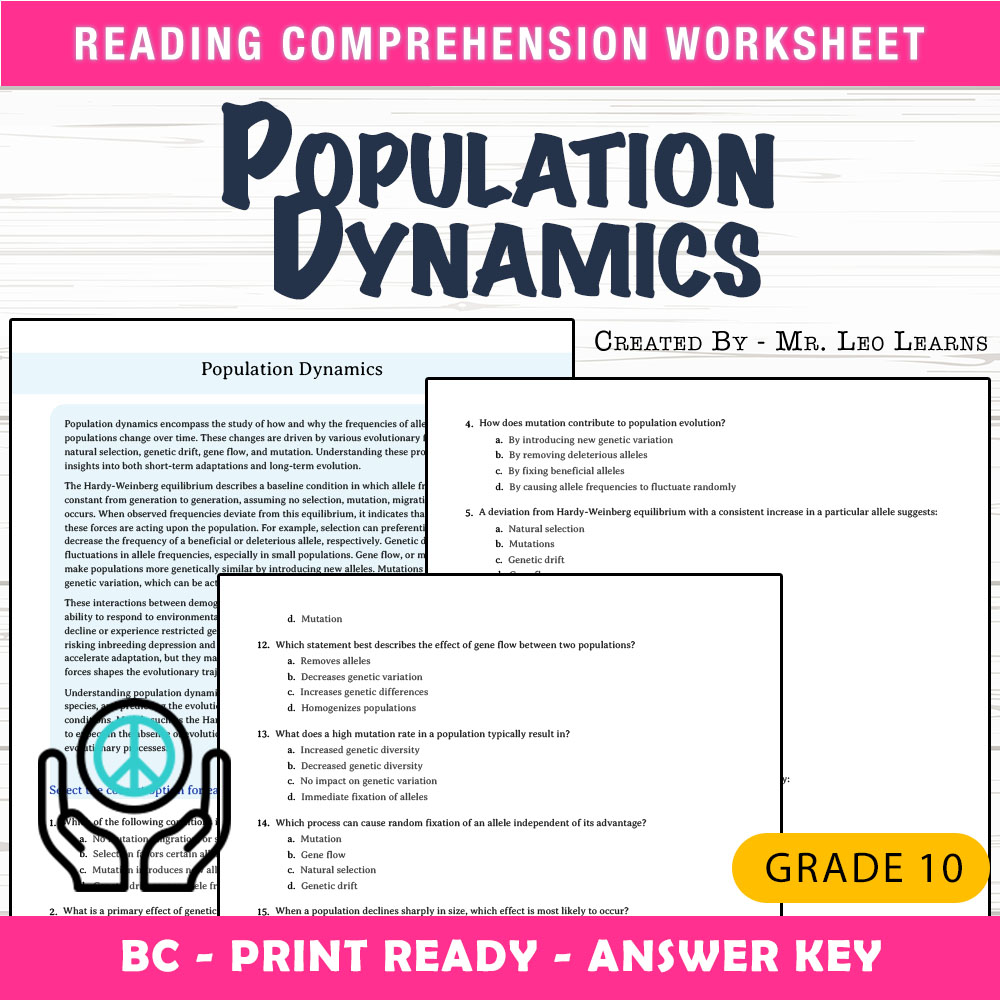
Grade 10 Science — Worksheet MCQ Paper for Mastering Population Dynamics
 Created byThe Resource Hub
Learning Objectives
- Understand the principles of population genetics and evolutionary forces.
- Describe the Hardy-Weinberg equilibrium and conditions for its validity.
- Identify signals of natural selection, genetic drift, gene flow, and mutation in populations.
Also included in: Grade 10 Science Unit on Evolution & Biodiversity +1 more
Instant download

Grade 10 Math – Circle Equations Worksheet (Ontario) (PDF)
Created byClear Sky ClassroomLearning Objectives
- Understand the standard form of a circle equation and identify the center and radius from it.
- Apply the equation of a circle to solve real-world problems involving distance and geometric relationships.
- Interpret and analyze how the algebraic form of a circle relates to its geometric properties, including symmetry and tangents.
Also included in: Grade 10 Maths Lesson Group: Ontario Algebra and Geometry Worksheets +1 more
Instant download

Grade 10 Social Studies — Alliances Strategy Worksheet MCQ Paper
Created byThe Resource HubLearning Objectives
- Explain how alliance systems and diplomatic negotiations influenced strategic decisions during 1939–1945.
- Analyze how coalition warfare depended on coordination, industrial capacity, and resource allocation.
- Evaluate continuity and change in coalition dynamics and command structures over time.
Also included in: Grade 10 Canadian History Since World War I Social Studies Custom Bundle Ontario +1 more
Instant download

Science Energy in Cells Worksheet | NGSSS Grade 10 Assessment & Practice
JCreated byJ.S SheetsLearning Objectives
- Explain how cells obtain and use energy to perform work, including building molecules and maintaining organization.
- Describe cellular respiration and how breaking down carbohydrates releases energy stored in ATP.
- Compare energy capture in photosynthesis with energy release in cellular respiration.
Also included in: Grade 10 Life Science Evolution, Genetics & Cells Lesson Bundle – Florida NGSSS +1 more
Instant download
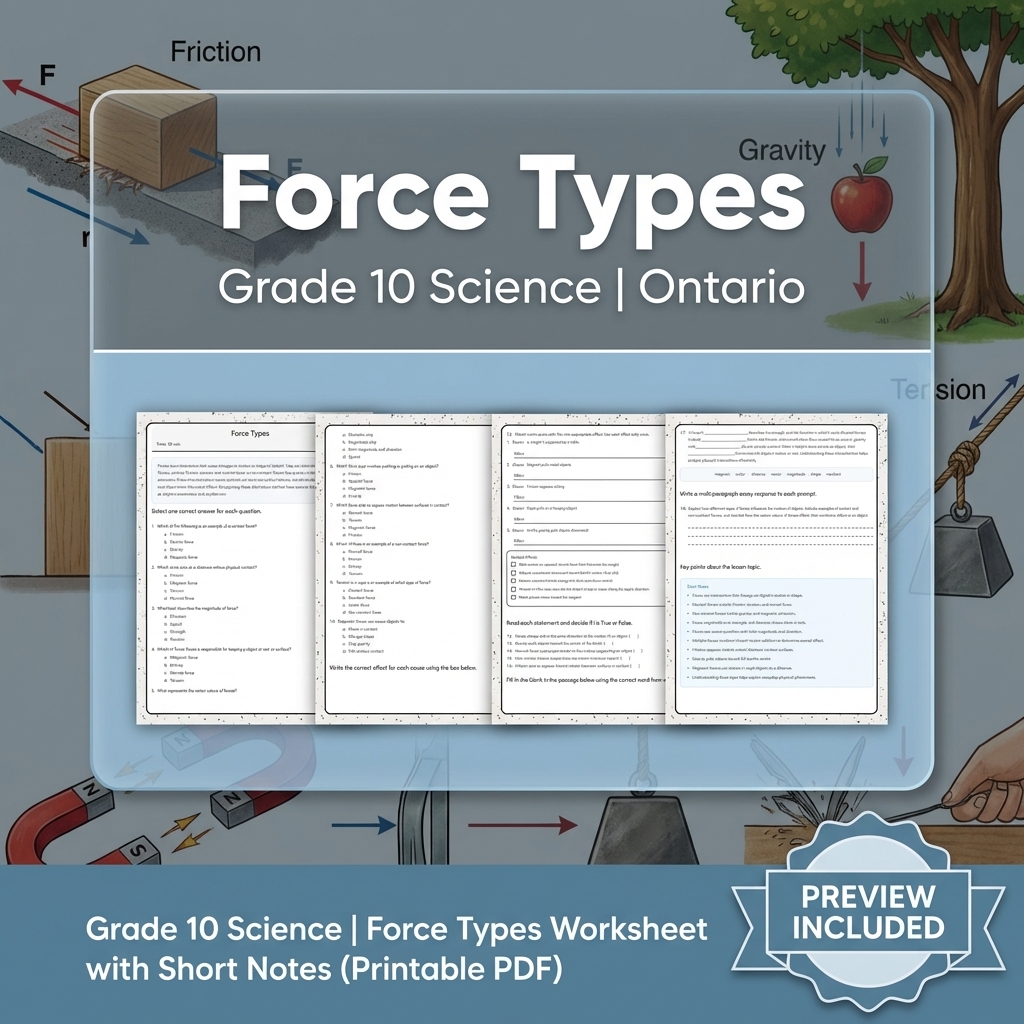
Grade 10 Science | Force Types Worksheet with Short Notes (Printable PDF)
Created byMeadowlark WorksheetsLearning Objectives
- Understand different types of contact and non-contact forces.
- Identify the origin, direction, and magnitude of forces.
- Explain how forces influence the motion and state of objects.
Also included in: Grade 10 Science Lesson Group: Motion & Forces Ontario Curriculum Bundle +1 more
Instant download

Grade 10 Science | Analytical Techniques - Daily Reading Comprehension
 Created byCoral Reef Learning
Learning Objectives
- Understand the principles of spectroscopic methods used in analytical chemistry.
- Identify different spectroscopic techniques and their applications.
- Interpret instrumental data obtained from spectroscopy.
Also included in: Matter and Chemical Change Lesson Bundle: Grade 10 Science Alberta +1 more
Instant download

Grade 10 Science | Human Footprints AP Worksheet with Answer Key (PDF)
Created byEvergreen Desk EducationLearning Objectives
- Explain how land-use change, greenhouse gas emissions, aerosol loading, and resource extraction alter Earth system components.
- Use evidence types (emission inventories and land-cover time series) to describe and quantify human-caused perturbations to carbon, water, and energy cycles.
- Interpret observable consequences (runoff regime changes, soil degradation, coastal subsidence) as linked to cumulative anthropogenic forcing.
Also included in: Grade 10 Earth and Climate Systems Science Lesson Bundle Worksheets (AP) +1 more
Instant download

Grade 10 Science | Reaction Energetics Worksheet | BC Aligned
 Created byLumora Learning
Learning Objectives
- Understand the concept of energy changes during chemical reactions.
- Differentiate between exothermic and endothermic reactions based on bond energies.
- Explain how bond energies influence reaction direction and feasibility.
Instant download

Grade 10 Science | Membrane Dynamics - Daily Reading Comprehension
Created byCoral Reef LearningLearning Objectives
- Identify basic components of cellular membranes and their functions.
- Explain the mechanisms of membrane transport including diffusion, carrier-mediated transport, and vesicular trafficking.
- Understand how membranes establish electrochemical gradients and compartmentalization.
Also included in: Biology and Ecosystems Lesson Bundle – Grade 10 Science Advanced Placement +1 more
Instant download

Grade 10 Science | Wave Properties Worksheet | NGSSS Aligned
Created byLumora LearningLearning Objectives
- Explain how waves transfer energy without transporting matter overall using amplitude, wavelength, frequency, and wave speed.
- Use the relationship between frequency, wavelength, and wave speed to predict how changes affect wave properties.
- Describe how reflection, refraction, and superposition can alter the observed behavior of sound and water waves.
Instant download

Grade 10 Science – Climate Drivers & Factors | Daily Reading Worksheet
Created byBright Mind ResourcesLearning Objectives
- Understand key factors influencing Earth's climate such as radiative forcing, greenhouse gases, and albedo.
- Recognize how ocean-atmosphere interactions affect climate patterns.
- Interpret energy-balance models and paleoclimate proxies to analyze climate change.
Also included in: Grade 10 Earth Science Daily Reading Worksheets Lesson Bundle | AP +2 more
Instant download

Grade 10 Function Evaluation Worksheet | Function Notation Practice CCSS
 Created byBRIGHT PATH RESOURCES
Learning Objectives
- Evaluate functions by substituting an input value into a given function rule.
- Use a function graph to find outputs for specific inputs.
- Solve for the input when an output value is given for an absolute value function.
Also included in: Grade 10 Functions Lesson Bundle | Math | CCSS-Aligned +1 more
Instant download

Grade 10 Science – DNA Replication & Enzymes | Daily Reading Worksheet
Created byBright Mind ResourcesLearning Objectives
- Understand the basic process of DNA replication
- Identify key enzymes involved in DNA replication
- Recognize the significance of DNA replication for cellular function
Also included in: DNA & Genetics Grade 10 Science Daily Reading Worksheets Lesson Bundle | TEKS +2 more
Instant download

Seismic Tomography Practice Worksheet | Grade 10 Science Assessment
 Created byPrism Point Learning
Learning Objectives
- Explain how P-waves and S-waves differ and how their travel times relate to seismic velocity
- Describe how attenuation and seismic data are used to infer temperature, composition, and phase changes in Earth’s interior
- Interpret tomographic images to understand subduction slabs and mantle plumes
Also included in: Grade 10 Earth Systems Science Lesson Bundle: Ontario Review Worksheets
Instant download

Grade 10 | International Women Day for Mastering Leadership | PDF + Answer Key
 Created byShaNova Worksheets
Learning Objectives
- Analyze current examples of women leaders across various fields such as politics, science, arts, and social movements.
- Reflect on the qualities that make women effective leaders and their impact on society.
- Discuss the barriers women face in leadership roles and explore strategies to promote gender equity.
Also included in: Grade 10 Holiday International Women’s Day Worksheets Bundle
Instant download

Inheritance Patterns Assessment for Grade 10 Science TEKS Standards
Created byPrism Point LearningLearning Objectives
- Explain how dominant and recessive alleles influence trait expression.
- Describe Mendelian principles such as segregation and independent assortment.
- Analyze pedigrees to trace trait inheritance across generations.
Also included in: Lesson Grade 10 Genetics: DNA, RNA, Protein Science Lesson Bundle TEKS
Instant download

Evolution Evidence Multiple Lines of Proof Worksheet for Grade 10 Science
JCreated byJ.S SheetsLearning Objectives
- Explain how fossil records, including transitions and extinction events, support evolutionary change over geologic time.
- Use comparative anatomy, biogeography, and genetic evidence to describe common ancestry and descent with modification.
- Evaluate statements about evolution evidence using scientific reasoning and accurate terminology.
Also included in: Grade 10 Life Science Evolution, Genetics & Cells Lesson Bundle – Florida NGSSS +1 more
Instant download

Grade 10 Science | Planetary Motion Assessment (NGSS) Worksheet (PDF)
Created bySilver Birch TeachingLearning Objectives
- Explain how Kepler's laws and Newtonian gravitation describe planetary orbits.
- Analyze the role of conservation of angular momentum in orbital dynamics.
- Interpret observational data such as orbital elements and spectral lines to understand planetary motion.
Also included in: Grade 10 Earth and Space Science Lesson Bundle Worksheets for NGSS +1 more
Instant download
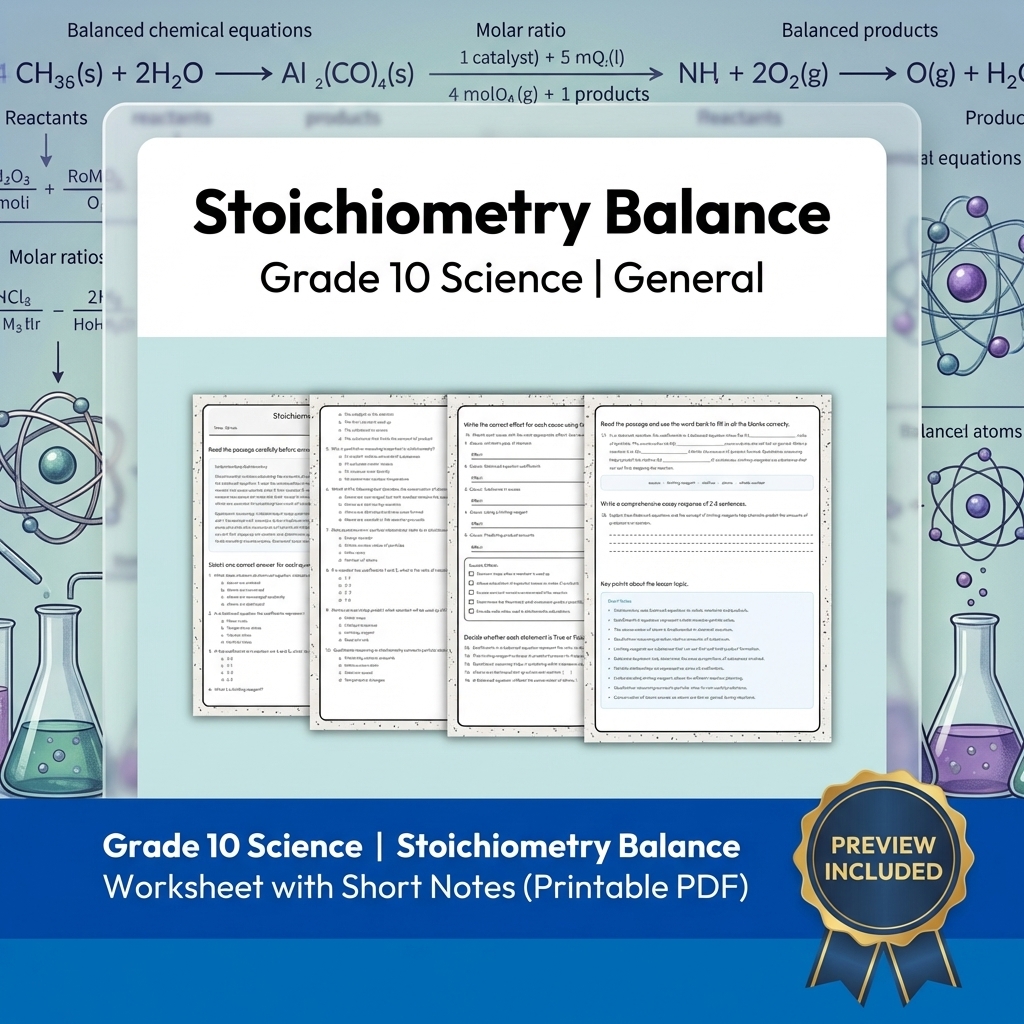
Grade 10 Science | Stoichiometry Balance Worksheet with Short Notes
Created byMeadowlark WorksheetsLearning Objectives
- Understand the concept of balanced chemical equations and how coefficients relate to particle numbers.
- Apply conservation of atoms to interpret and predict relative amounts of reactants and products.
- Explain the role of limiting reagents in chemical reactions and how ratios determine the extent of reaction.
Also included in: Grade 10 Forces and Energy Science Lesson Bundle for General Framework +1 more
Instant download

Active Listening Worksheet | Standards-Aligned Grade 10 ELA Practice
JCreated byJ.S SheetsLearning Objectives
- Identify the central idea and supporting details by listening for meaning, not just wording.
- Interpret implied intent and recognize listening signals such as emphasis and changes in pace.
- Respond appropriately by paraphrasing, asking clarifying questions, and making respectful acknowledgements.
Instant download

Grade 10 Science | Variables & Constraints Worksheet (AP Standard PDF)
Created byEvergreen Desk EducationLearning Objectives
- Differentiate independent, dependent, and controlled variables in science investigations.
- Identify boundary conditions and practical constraints that affect how an experiment is designed and measured.
- Justify variable choices by explaining how they help isolate causal relationships and produce interpretable comparisons.
Also included in: Grade 10 Scientific Modeling & Quantitative Reasoning Science Lesson Bundle (AP) +1 more
Instant download

Grade 10 Science – Cosmic Origins & Evidence from CMB | Daily Reading Worksheet
Created byBright Mind ResourcesLearning Objectives
- Understand what the cosmic microwave background (CMB) radiation is and how it provides evidence for the early universe.
- Identify key observations supporting the expansion of the universe, including redshift data and large-scale structure.
- Explain how CMB anisotropies and elemental abundances help constrain models of the universe's origins.
Also included in: Grade 10 Space & Geologic Time Science Lesson Bundle | NGSS Daily Reading +2 more
Instant download

Grade 10 Science Gravitation Fields Worksheet | NGSS Physics Activity
Created byBRIGHT PATH RESOURCESLearning Objectives
- Understand the concept of gravitational force between two masses
- Learn how to represent gravitational fields graphically
- Explore the inverse-square law behavior of gravity
Also included in: Forces & Motion Grade 10 Science Daily Reading Worksheets Lesson Bundle | NGSS +1 more
Instant download

Geologic Time Reading Rock Record Worksheet | Science Standard Grade 10
JCreated byJ.S SheetsLearning Objectives
- Explain how relative dating methods (superposition and cross-cutting relationships) help order geologic events.
- Describe how unconformities reveal gaps in deposition or erosion within the rock record.
- Use the fossil record, including index fossils, to connect rock layers to specific geologic intervals.
Also included in: Grade 10 Earth and Space Systems Science Lesson Bundle – Florida NGSSS +1 more
Instant download

Grade 10 Health – Advocacy Strategies Worksheet (PDF) aligned to NHES
Created bySunny Desk ResourcesLearning Objectives
- Explain how advocacy strategies promote health policies and environmental changes that benefit community well-being
- Analyze how raising awareness and collaborating with stakeholders can lead to measurable health outcomes
- Apply ethical principles and evidence-based reasoning when planning a health advocacy campaign
Also included in: Grade 10 Health Social Influences & Advocacy Lesson Bundle (NHES) +1 more
Instant download

Grade 10 Science | Tissue Organization - Daily Reading Comprehension
Created byCoral Reef LearningLearning Objectives
- Identify different types of tissues in plants and animals
- Understand the structure and function of plant vascular tissues
- Describe the roles of animal epithelial and connective tissues
Also included in: Cells and Systems Lesson Bundle | Grade 10 Science | Alberta Framework +1 more
Instant download

Grade 10 Health – Self-Awareness Growth Daily Worksheet | Ontario Standards
 Created byQuiet Forest Education
Learning Objectives
- Recognize personal strengths and qualities.
- Reflect on how emotions influence behavior.
- Understand the importance of self-awareness for mental health.
Also included in: Social-Emotional Learning Grade 10 Health Daily Worksheets Bundle | Ontario +2 more
Instant download

Grade 10 Science – Energy Forms & Types | Daily Reading Worksheet
Created byBright Mind ResourcesLearning Objectives
- Understand key concepts related to Science
- Apply knowledge through practice questions
- Demonstrate comprehension of the material
Also included in: Grade 10 Energy Science Daily Reading Worksheets Lesson Bundle | BC +1 more
Instant download

Grade 10 Science – Orbital Gravity Models | Daily Reading Worksheet
Created byBright Mind ResourcesLearning Objectives
- Understand the basic concepts of gravity and how it affects celestial bodies.
- Identify the relationship between centripetal acceleration and orbital motion.
- Describe how gravitational forces sustain planetary and satellite orbits.
Also included in: Grade 10 Climate Linkages Science Daily Reading Worksheets Bundle | CA Standards +1 more
Instant download

Grade 10 Science Planetary Motion Worksheet | NGSS Space Systems Activity
Created byBRIGHT PATH RESOURCESLearning Objectives
- Understand Kepler's Three Laws of Planetary Motion
- Relate orbital parameters such as period, eccentricity, and semi-major axis
- Comprehend conservation of angular momentum in planetary orbits
Also included in: Next Generation Science Standards Space Science Daily Reading Bundle | Grade 10 +1 more
Instant download

Grade 10 Science – Ocean Dynamics Worksheet (NGSS) PDF
Created bySilver Birch TeachingLearning Objectives
- Describe circulation patterns driven by density contrasts, wind forcing, and Earth's rotation.
- Explain the roles of thermohaline circulation, gyres, and coastal upwelling in ocean dynamics.
- Analyze how observations from ARGO floats, satellite altimetry, and salinity-temperature profiles contribute to understanding ocean processes.
Also included in: Grade 10 Earth Systems Science Lesson Bundle for NGSS ngss10 Worksheets +1 more
Instant download

Grade 10 Health | Conflict Resolution Worksheet (PDF) Aligned with NHES
Created bySunny Desk ResourcesLearning Objectives
- Explain how active listening and empathy reduce conflict escalation.
- Identify common conflict triggers and describe calm, respectful responses.
- Apply a simple problem-solving process to propose solutions in real-life scenarios.
Also included in: Grade 10 Health Support & Communication Skills Lesson Bundle | NHES +1 more
Instant download
Browse more categories
About Grade 10 Worksheets
Find Grade 10 worksheets covering algebra, biology, literature, and history. All 9,388 resources download instantly as PDFs for classwork, homework, or review.
MyTeachingSheets worksheets are made by real teacher-authors and checked before they go live. Download any as a print-ready PDF for lessons, homework, or independent practice — most include answer keys, and previews are always free.