
Grade 10 Science Worksheets
7,038 worksheets
Grade 10 Science – Evolutionary Evidence | Daily Reading Worksheet
 Created byBright Mind Resources
Learning Objectives
- Identify different types of evidence supporting evolution
- Understand how fossils, genetics, and ecology provide insights into species change
- Recognize how interdisciplinary data help reconstruct evolutionary history
Also included in: Grade 10 Evolution Science Daily Reading Worksheets Lesson Bundle | TEKS +2 more
Instant download

Grade 10 Science – Ecosystem Structure Daily Reading Worksheet | NGSS Aligned
Created byBright Mind ResourcesLearning Objectives
- Identify biotic components such as producers, consumers, and decomposers.
- Differentiate between biotic and abiotic factors in ecosystems.
- Understand the role of energy flow, trophic levels, and nutrient cycling.
Also included in: Ecosystems Grade 10 Science Daily Reading Worksheets Bundle | NGSS +2 more
Instant download

Grade 10 Science – Carrying Capacity & Ecosystems Worksheet | TEKS Aligned
Created byBright Mind ResourcesLearning Objectives
- Understand key concepts related to Science
- Apply knowledge through practice questions
- Demonstrate comprehension of the material
Also included in: Grade 10 Ecosystems Science Lesson Bundle Daily Reading | TEKS +2 more
Instant download

Grade 10 Science – Metabolic Regulation & Enzyme Control | Reading Worksheet
Created byBright Mind ResourcesLearning Objectives
- Understand key concepts related to Science
- Apply knowledge through practice questions
- Demonstrate comprehension of the material
Also included in: Grade 10 Energy in Biological Systems Science Daily Reading Lesson Bundle | TEKS +2 more
Instant download

Grade 10 Science – Genetic Drift & Evolution | Daily Reading Worksheet
Created byBright Mind ResourcesLearning Objectives
- Define genetic drift and explain how it differs from natural selection.
- Identify examples of genetic drift such as founder effect and population bottleneck.
- Describe how genetic drift influences genetic diversity in populations.
Also included in: Grade 10 Evolution Science Daily Reading Worksheets Lesson Bundle | TEKS +2 more
Instant download

Grade 10 Science – Rock Cycle & Types of Rocks | Daily Reading Worksheet
Created byBright Mind ResourcesLearning Objectives
- Identify the main types of rocks: igneous, sedimentary, and metamorphic.
- Describe how rocks form through geological processes.
- Explain the steps involved in the rock cycle and how different rocks are interconnected.
Also included in: Earth Science Grade 10 Science Daily Reading Worksheets Lesson Bundle | Ontario +1 more
Instant download

Grade 10 Science – Transitional Fossils & Evolution | Daily Reading Worksheet
Created byBright Mind ResourcesLearning Objectives
- Understand what transitional fossils are and why they are important
- Identify examples of fossils that show intermediate features between major groups
- Explain how fossils aid in understanding evolutionary processes
Also included in: Grade 10 Evolution Science Daily Reading Worksheets Lesson Bundle | TEKS +2 more
Instant download

Grade 10 Science – Modeling Evidence & Scientific Models | Reading Worksheet
Created byBright Mind ResourcesLearning Objectives
- Understand the purpose and types of models used in scientific investigations.
- Identify different types of models, including conceptual and quantitative models.
- Evaluate how models are constructed and validated with evidence.
Also included in: Inquiry Grade 10 Science Daily Reading Worksheets Lesson Bundle | Ontario +1 more
Instant download

Grade 10 Science – Understanding Forces & Motion | Daily Reading Worksheet
Created byBright Mind ResourcesLearning Objectives
- Define balanced forces and explain their effect on motion.
- Identify forces acting on an object in various scenarios.
- Differentiate between balanced and unbalanced forces.
Also included in: Grade 10 Energy & Models Science Lesson Bundle | CA Standards Daily Reading +1 more
Instant download

Grade 10 Science – Energy Forms Daily Reading Worksheet | Alberta Standards
Created byBright Mind ResourcesLearning Objectives
- Understand the differences between kinetic and potential energy.
- Identify real-world examples of energy transformation.
- Explain the conservation of energy principle in ideal systems.
Also included in: Energy & Systems Interactions Grade 10 Science lesson bundle | Alberta +1 more
Instant download

Grade 10 Science – Adaptive Radiation & Evolution | Daily Reading Worksheet
Created byBright Mind ResourcesLearning Objectives
- Define adaptive radiation and explain its significance in evolution
- Identify examples of adaptive radiation in nature
- Describe the processes that lead to diversification into multiple species
Also included in: Grade 10 Evolution Science Daily Reading Worksheets Lesson Bundle | TEKS +2 more
Instant download

Grade 10 Science – Metabolic Control & Enzymes Daily Reading Worksheet
Created byBright Mind ResourcesLearning Objectives
- Understand the basic concepts of cellular metabolism
- Learn how enzymes regulate metabolic pathways
- Explore feedback inhibition and compartmentalization
Also included in: Grade 10 Science Daily Reading: Cells & Systems Lesson Bundle | Alberta +1 more
Instant download

Grade 10 Science – Newton's First Law & Motion | Daily Reading Worksheet
 Created byQuiet Forest Education
Learning Objectives
- Explain the concept of inertia and how it relates to an object at rest and in uniform motion.
- Describe what happens to an object when no external forces act upon it.
- Identify examples of Newton's First Law in everyday life.
Also included in: Motion and Forces Grade 10 Science Daily Reading Worksheets Bundle | Ontario +1 more
Instant download

Grade 10 Science – Microbe Diversity & Structure | Daily Reading Worksheet
Created byQuiet Forest EducationLearning Objectives
- Identify and describe different types of microorganisms such as bacteria, archaea, viruses, fungi, and protists.
- Understand basic cellular and genetic differences among microbial groups.
- Explain how microbes reproduce and occupy ecological niches.
Also included in: Cell Biology Grade 10 Science Daily Reading Worksheets Bundle | Ontario +1 more
Instant download

Grade 10 Science – Thermodynamic Limits & Energy Conservation | Worksheet
Created byBright Mind ResourcesLearning Objectives
- Understand key concepts related to Science
- Apply knowledge through practice questions
- Demonstrate comprehension of the material
Also included in: Grade 10 Energy Science Daily Reading Worksheets Lesson Bundle | BC +1 more
Instant download

Grade 10 Science – Ocean Dynamics & Currents | Daily Reading Worksheet
Created byBright Mind ResourcesLearning Objectives
- Understand the fundamental circulation patterns in ocean systems.
- Identify the roles of thermohaline circulation, gyres, and coastal upwelling.
- Recognize how observational tools like ARGO floats and satellites contribute to ocean studies.
Also included in: Earth Systems Grade 10 Science Daily Reading Worksheets Bundle | NGSS +2 more
Instant download

Grade 10 Science – Circulatory System Daily Reading Worksheet | NGSS Aligned
Created byBright Mind ResourcesLearning Objectives
- Understand the structure and function of the circulatory system.
- Identify components such as blood vessels, chambers of the heart, and blood flow pathways.
- Explain how blood circulation supports other physiological systems.
Also included in: Homeostasis Grade 10 Science Daily Reading Worksheets Lesson Bundle | NGSS +2 more
Instant download

Grade 10 Science – Systems Analysis & Engineering | Daily Reading Worksheet
Created byBright Mind ResourcesLearning Objectives
- Identify key components of engineering systems
- Understand system boundaries and interfaces
- Recognize emergent behaviors in multi-component designs
Also included in: Grade 10 Engineering Design Science Daily Reading Lesson Bundle | NGSS +2 more
Instant download

Grade 10 Science – Genetic Mutation & Variation | Daily Reading Worksheet
Created byBright Mind ResourcesLearning Objectives
- Understand different types of genetic mutations, including point mutations, insertions, deletions, and chromosomal rearrangements.
- Identify the mechanisms that cause mutations, such as replication errors, chemical changes, and environmental factors.
- Relate specific examples like sickle cell anemia to the effects of mutations on protein function and phenotype.
Also included in: Grade 10 Genetics Science Daily Reading Lesson Bundle | NGSS +2 more
Instant download

Grade 10 Science – Heat Transfer & Thermodynamics Daily Reading Worksheet
Created byBright Mind ResourcesLearning Objectives
- Identify the three main mechanisms of heat transfer: conduction, convection, and radiation.
- Explain the processes by which thermal energy moves through different materials and environments.
- Connect heat transfer mechanisms to real-world applications and phenomena.
Also included in: Grade 10 Energy Science Lesson Bundle Daily Reading Worksheets | NGSS +2 more
Instant download

Grade 10 Science – Hydrologic Systems & Water Cycle | Daily Reading Worksheet
Created byBright Mind ResourcesLearning Objectives
- Understand the components and processes of hydrologic systems, including precipitation, surface runoff, infiltration, and groundwater flow.
- Interpret stream hydrographs and analyze water-table fluctuations.
- Recognize how human activities influence river basins and landscape features.
Also included in: Earth Systems Grade 10 Science Daily Reading Worksheets Bundle | NGSS +2 more
Instant download

Grade 10 Science – Feedback Control & Homeostasis | Daily Reading Worksheet
Created byBright Mind ResourcesLearning Objectives
- Understand the principles of homeostasis and feedback mechanisms
- Identify examples of negative and positive feedback loops
- Explain how sensors, control centers, and effectors maintain internal stability
Also included in: Homeostasis Grade 10 Science Daily Reading Worksheets Lesson Bundle | NGSS +2 more
Instant download

Grade 10 Science – Geologic Time & Dating Methods | Daily Reading Worksheet
Created byBright Mind ResourcesLearning Objectives
- Describe the methods used to determine Earth's age and history.
- Explain relative and absolute dating techniques including radiometric methods.
- Identify key events in Earth's history using stratigraphic records and crater counts.
Also included in: Grade 10 Space & Geologic Time Science Lesson Bundle | NGSS Daily Reading +2 more
Instant download

Grade 10 Science – Biodiversity Drivers & Ecosystem Factors | Reading Worksheet
Created byBright Mind ResourcesLearning Objectives
- Analyze factors influencing species richness and composition.
- Evaluate the impact of habitat fragmentation, invasive species, land-use change, and climate shifts.
- Understand mechanisms like genetic diversity and connectivity in ecosystem resilience.
Also included in: Ecosystems Grade 10 Science Daily Reading Worksheets Bundle | NGSS +2 more
Instant download

Grade 10 Science – Ecosystem Resilience & Stability | Daily Reading Worksheet
Created byBright Mind ResourcesLearning Objectives
- Understand the concept of ecosystem resilience and its importance in ecological stability.
- Identify factors that influence recovery pathways after disturbances.
- Analyze the role of feedback mechanisms and thresholds in ecosystems.
Also included in: Ecosystems Grade 10 Science Daily Reading Worksheets Bundle | NGSS +2 more
Instant download

Grade 10 Science – Cell Division & Cell Cycle | Daily Reading Worksheet
Created byBright Mind ResourcesLearning Objectives
- Understand the basic processes of mitosis and its role in cell division
- Learn about the cell cycle and checkpoints that regulate division
- Identify the significance of cell division for growth, repair, and reproduction
Also included in: Homeostasis Grade 10 Science Daily Reading Worksheets Lesson Bundle | NGSS +2 more
Instant download

Grade 10 Science – Signal Transduction & Cellular Response | Reading Worksheet
Created byBright Mind ResourcesLearning Objectives
- Understand the basic concepts of how signals are transmitted in the nervous system
- Identify mechanisms involved in signal integration, including receptor binding and transduction cascades
- Recognize examples of signal pathways such as neuromuscular reflex arcs and hypothalamic-pituitary communication
Also included in: Homeostasis Grade 10 Science Daily Reading Worksheets Lesson Bundle | NGSS +2 more
Instant download

Grade 10 Science – Climate Data & Trends Daily Reading Worksheet | NGSS Aligned
Created byBright Mind ResourcesLearning Objectives
- Interpret scientific climate data and identify key temperature and precipitation trends.
- Understand how various sources, like ice cores and satellite data, contribute to climate analysis.
- Assess the significance of model projections and their uncertainty in climate science.
Also included in: Grade 10 Daily Reading Science: Environmental Systems Lesson Bundle | NGSS +2 more
Instant download

Grade 10 Science – Water Scarcity & Human Settlements | Daily Reading Worksheet
Created byBright Mind ResourcesLearning Objectives
- Understand key concepts related to Science
- Apply knowledge through practice questions
- Demonstrate comprehension of the material
Also included in: Grade 10 Daily Reading Science: Environmental Systems Lesson Bundle | NGSS +2 more
Instant download
Grade 10 Science | Chemical Properties Worksheet (Ontario Standards) (PDF)
Created byBright Mind ResourcesLearning Objectives
- Understand various chemical properties such as reactivity with oxygen, acids, and water.
- Identify indicators of chemical change, including pH and gas evolution.
- Explain reaction mechanisms and bonding changes during chemical transformations.
Instant download
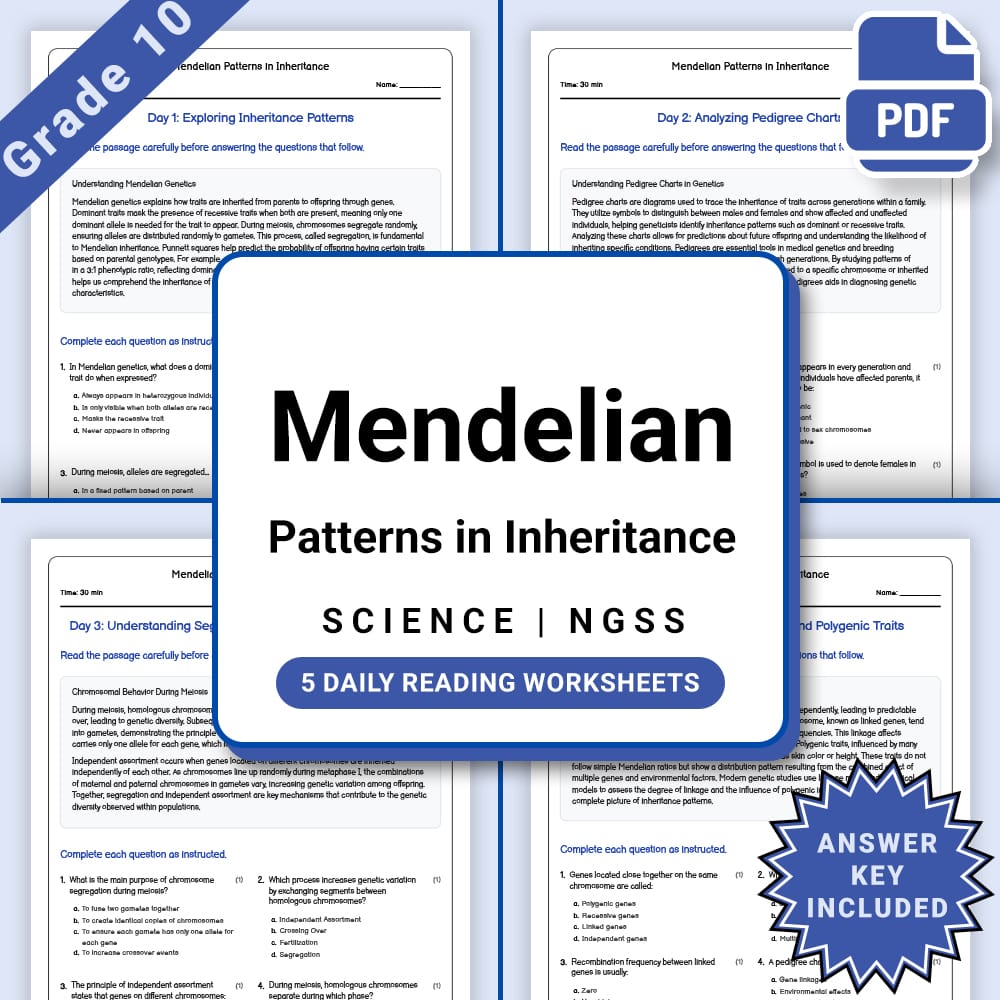
Grade 10 Science – Mendelian Patterns Worksheet (PDF +Answer Key)
 Created byCopper Leaf Classroom
Learning Objectives
- Identify dominant and recessive traits using Punnett squares.
- Understand the concepts of segregation and independent assortment.
- Relate chromosome behavior during meiosis to inheritance patterns.
Instant download
Grade 10 Science | Periodic Trends Worksheet (Ontario Standard) PDF
Created byBright Mind ResourcesLearning Objectives
- Analyze patterns across the periodic table, including atomic radius, ionization energy, and electronegativity.
- Classify metals, nonmetals, and metalloids based on shared properties.
- Explain the relationship between group and period trends and valence electron patterns.
Instant download
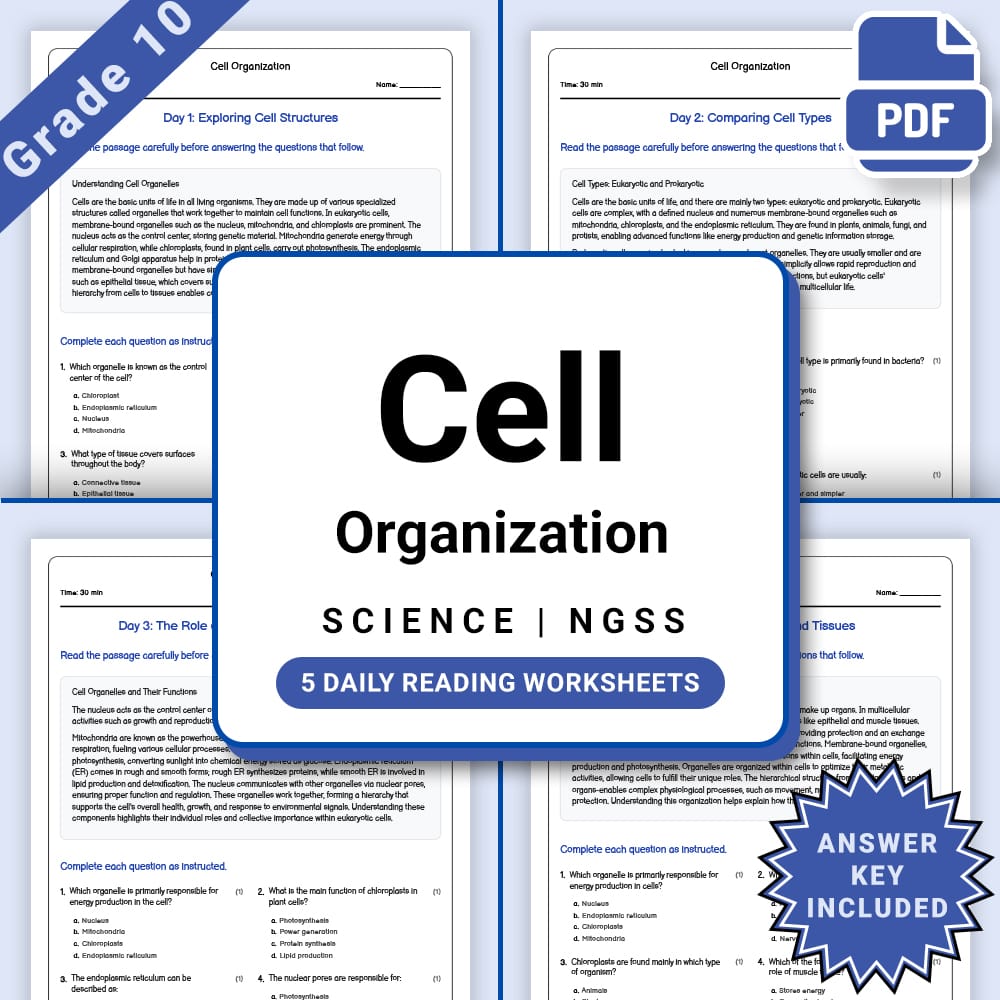
Grade 10 Science – Cell Organization Worksheet (PDF +Answer Key)
Created byCopper Leaf ClassroomLearning Objectives
- Understand the structure and function of key cellular organelles
- Compare eukaryotic and prokaryotic cells
- Explain how cellular specialization contributes to tissue and organ functions
Instant download
Grade 10 Science – Free-Body Analysis Worksheet (Ontario, PDF)
Created byBright Mind ResourcesLearning Objectives
- Understand the concept of free-body diagrams and how to represent forces acting on an object.
- Learn procedures for identifying individual forces, resolving components, and selecting coordinate axes.
- Analyze the relationship between resultant force, acceleration, and vector decomposition.
Instant download
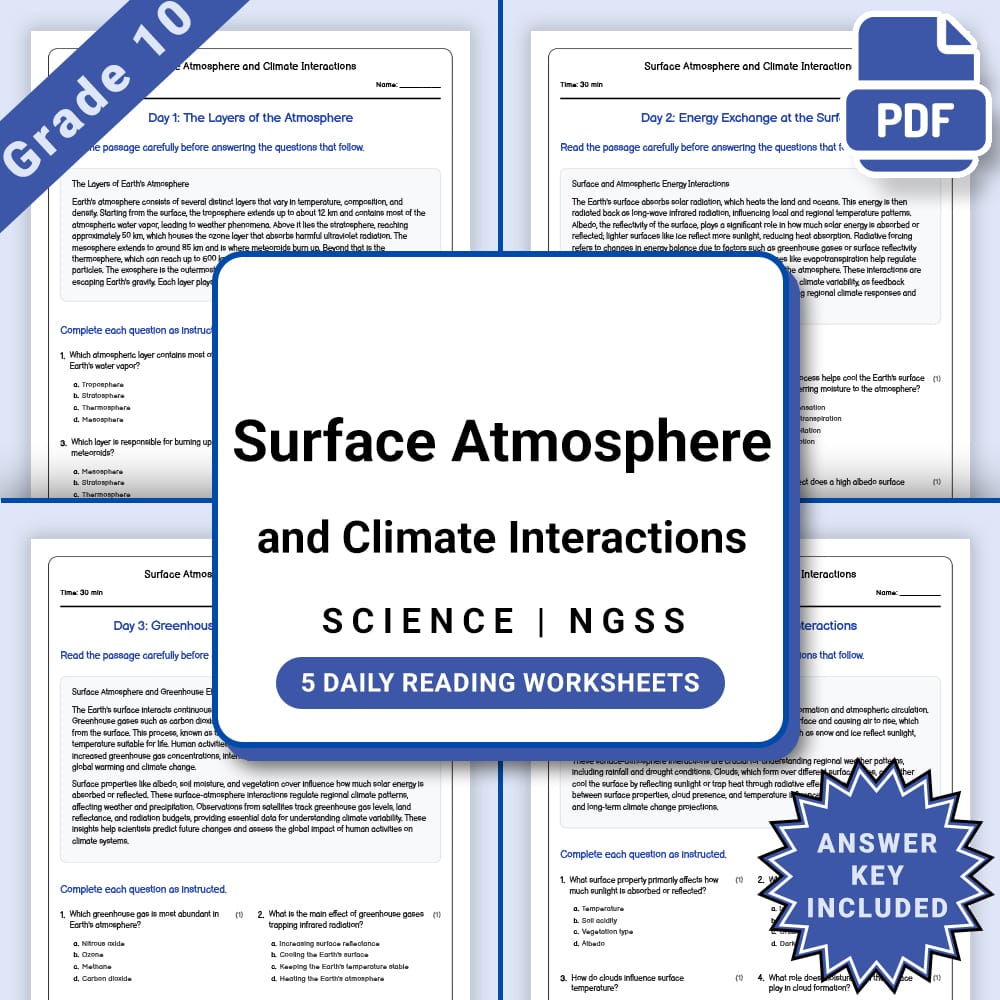
Grade 10 Science – Surface Atmosphere and Climate Interactions (PDF +Answers)
Created byCopper Leaf ClassroomLearning Objectives
- Identify the different layers of the Earth's atmosphere and their characteristics.
- Understand how surface and atmospheric interactions influence climate variability.
- Analyze the role of greenhouse gases, radiation budgets, and surface reflectance in climate processes.
Instant download
Grade 10 Science | Mineral Properties and Classifications Worksheet (PDF)
Created byBright Mind ResourcesLearning Objectives
- Identify key properties used to classify minerals, including crystal habit, hardness, cleavage, and specific gravity.
- Differentiate between ores, industrial minerals, and gemstones based on their features and formation settings.
- Understand common mineral formation environments such as hydrothermal veins, magmatic segregation, and sedimentary concentration.
Instant download
Grade 10 Science | Membrane Transport Worksheet – Ontario (PDF)
Created byBright Mind ResourcesLearning Objectives
- Describe plasma membrane structure according to the fluid mosaic model, including phospholipids, proteins, and cholesterol.
- Differentiate between transport protein types: channels, carriers, and pumps, based on their structure and selectivity.
- Explain passive transport mechanisms—simple diffusion, facilitated diffusion, and osmosis—in terms of concentration gradients and membrane permeability.
Instant download
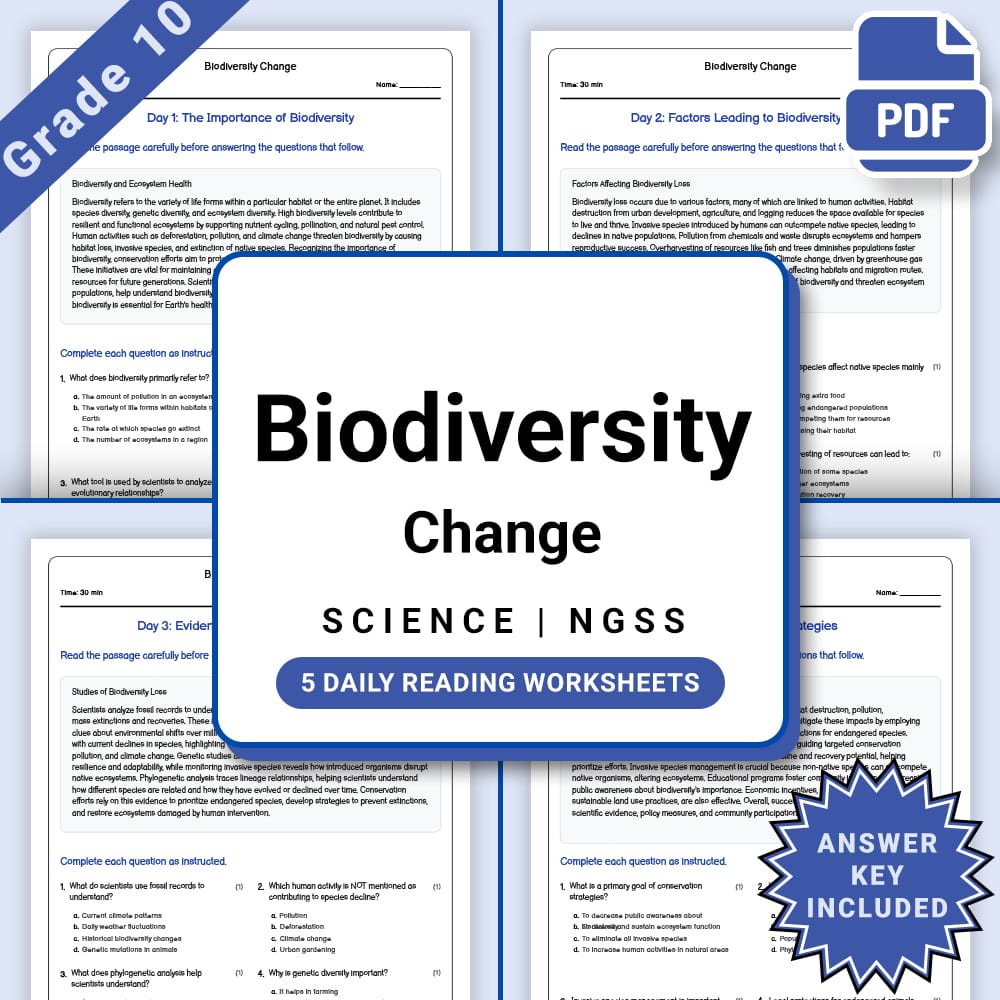
Grade 10 Science – Biodiversity Change Worksheet (PDF +Answer Key)
Created byCopper Leaf ClassroomLearning Objectives
- Understand the concept of biodiversity and its importance in ecosystems.
- Identify factors that cause biodiversity to change over time.
- Evaluate evidence used to assess biodiversity loss and recovery.
Instant download
Grade 10 Science | ATP and Energy Worksheet (Ontario Standards) (PDF)
Created byBright Mind ResourcesLearning Objectives
- Understand the molecular structure of ATP and its role as a central energy carrier.
- Explain how energy is released through phosphate bond hydrolysis.
- Describe mechanisms of energy coupling that drive cellular work.
Instant download
Grade 10 Science | Mixture Separation Worksheet (Ontario Standards) (PDF)
Created byBright Mind ResourcesLearning Objectives
- Understand different separation techniques based on properties like solubility, particle size, and boiling point.
- Distinguish between homogeneous solutions, colloids, and suspensions in terms of particle dispersion and optical properties.
- Connect qualitative and quantitative indicators to material classification and recovery efficiency in separation processes.
Instant download
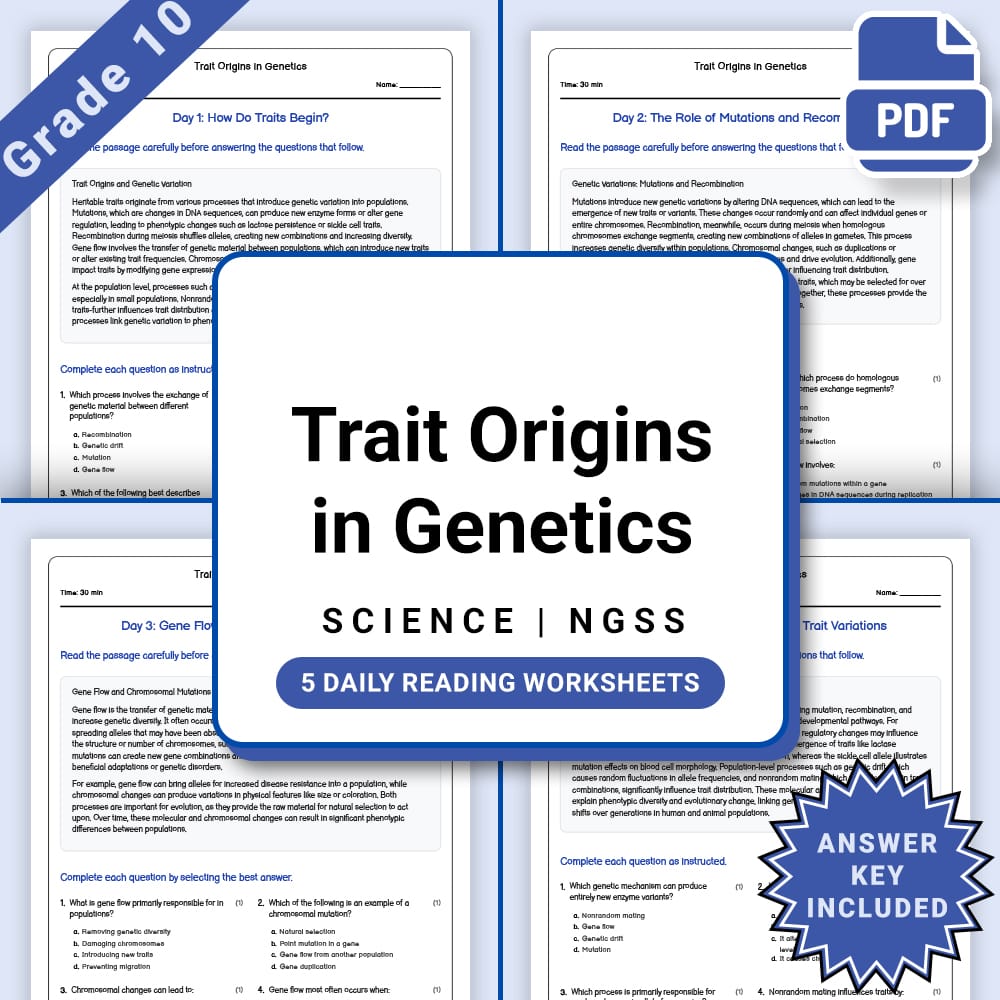
Grade 10 Science – Trait Origins in Genetics Worksheet (PDF +Answer Key)
Created byCopper Leaf ClassroomLearning Objectives
- Understand the sources of genetic variation such as mutation, recombination, gene flow, and chromosomal changes.
- Recognize how these variations influence trait development and phenotypic diversity.
- Identify examples of mutations that result in new enzyme variants or regulatory changes affecting traits.
Instant download
Grade 10 Science – Electron Configuration Daily Reading Worksheet + Answer Key
JCreated byJ.S SheetsLearning Objectives
- Understand key concepts related to Science
- Apply knowledge through practice questions
- Demonstrate comprehension of the material
Also included in: Grade 10 Science Lesson Group - AP Curriculum - Daily Reading Worksheets
Instant download
Grade 10 Science –Understanding Selective Mechanisms Worksheet (PDF +Answer Key)
Created byCopper Leaf ClassroomLearning Objectives
- Explain how natural selection favors certain traits over others.
- Identify examples of adaptive traits in different species.
- Describe how environmental pressures influence trait frequencies.
Instant download
Grade 10 Science – Ore Formation Worksheet (Ontario) (PDF)
Created byBright Mind ResourcesLearning Objectives
- Describe principal ore-forming processes such as magmatic differentiation, hydrothermal circulation, sedimentary concentration, and metamorphic remobilization.
- Identify spatial controls influencing ore deposits including structural traps, permeability contrasts, and host-rock chemistry.
- Recognize typical mineral assemblages associated with different deposit types and tectonic settings.
Instant download
Grade 10 Science | Volcanism and Orogeny Worksheet (Ontario Standards) (PDF)
Created byBright Mind ResourcesLearning Objectives
- Explain the process of magma generation and ascent in volcanoes.
- Differentiate between effusive and explosive volcanic eruptions.
- Describe volcanic landforms and their formation processes.
Instant download
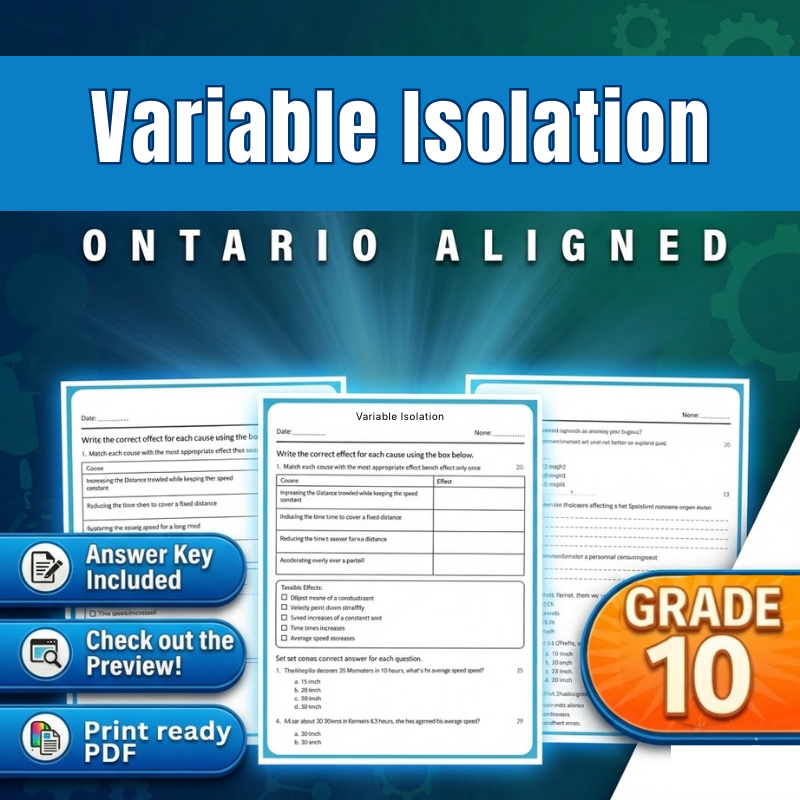
Grade 10 Science | Variable Isolation Worksheet (Ontario) (PDF)
Created byBright Mind ResourcesLearning Objectives
- Understand the principles of variable isolation in experimental design.
- Identify factors influencing multifactor inquiry outcomes.
- Evaluate trade-offs in experimental complexity versus clarity of results.
Instant download
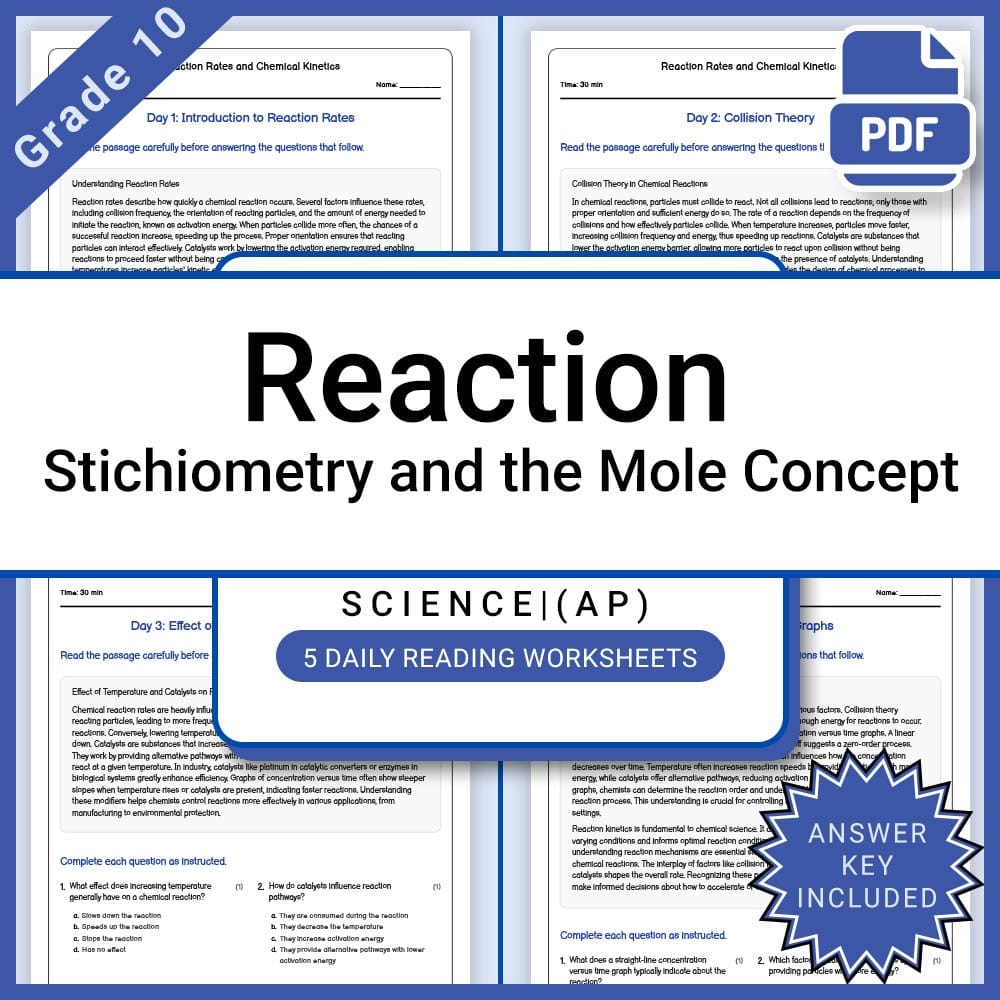
Grade 10 Science – Reaction Stoichiometry Daily Reading Worksheet + Answer Key
JCreated byJ.S SheetsLearning Objectives
- Understand the definition of a mole and molar mass
- Interpret chemical equations in terms of mole ratios
- Apply stoichiometric calculations to mass and gas volume conversions
Also included in: Grade 10 Science Lesson Group - AP Curriculum - Daily Reading Worksheets
Instant download
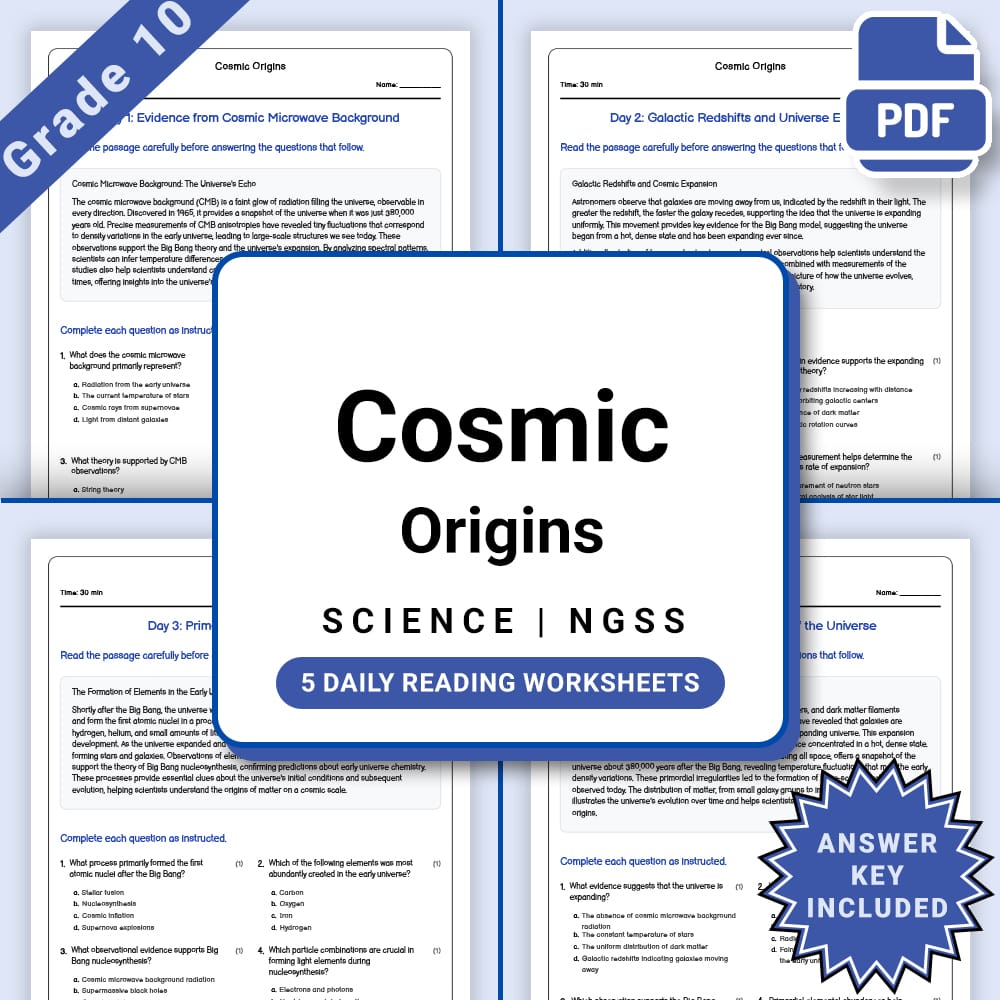
Grade 10 Science – Cosmic Origins Daily Reading Worksheet(PDF +Answer Key)
Created byCopper Leaf ClassroomLearning Objectives
- Interpret data from cosmic microwave background radiation.
- Understand how galactic redshifts support an expanding universe.
- Analyze elemental abundances to learn about early universe conditions.
Instant download
About Grade 10 Science Worksheets
Find Science worksheets built for Grade 10. All 7,038 cover core skills, practice, and review, each an instant PDF download.
Every worksheet on MyTeachingSheets is created by independent teacher-authors and reviewed before publication. All resources download as printable PDFs for classroom, homework, or at-home practice, and many include answer keys. Preview any worksheet free before buying.