
Grade 10 Science Worksheets
7,038 worksheets
Grade 10 Worksheet B: Plate Boundaries Worksheet | NGSS Practice PDF
 Created byClear Sky Classroom
Learning Objectives
- Identify the main features and processes of divergent, convergent (subduction and collision), and transform plate boundaries.
- Explain how mantle convection and crustal deformation relate to earthquakes and volcanic activity.
- Analyze geologic evidence to determine which plate boundary process best fits a given scenario.
Also included in: Grade 10 Earth Systems Science Lesson Bundle: NGSS Worksheet B +1 more
Instant download

Grade 10 Molecular Geometry Worksheet | Practice & Assessment PDF
Created byClear Sky ClassroomLearning Objectives
- Define molecular geometry using electron-domain (VSEPR) models and identify how bonding and nonbonding domains affect shape.
- Use simple orbital hybridization ideas to predict 3D molecular arrangements and approximate bond angles.
- Relate molecular geometry to polarity and to intermolecular forces that influence macroscopic properties.
Also included in: Grade 10 Chemistry Foundations Science Lesson Bundle: AP Worksheet Set +1 more
Instant download

Grade 10 Periodic Patterns Worksheet | Practice & Assessment PDF
Created byClear Sky ClassroomLearning Objectives
- Explain how effective nuclear charge and electron shielding influence trends across periods and down groups in the periodic table
- Predict relative atomic radius, ionization energy, and electronegativity for elements based on their position
- Connect electron configurations and nuclear effects to macroscopic properties such as metallic character and acid–base behavior
Also included in: Grade 10 Chemistry Foundations Science Lesson Bundle: AP Worksheet Set +1 more
Instant download

Grade 10 Force Relations Worksheet | Practice & Assessment PDF
Created byClear Sky ClassroomLearning Objectives
- Explain how net force and mass determine acceleration using Newton’s second law
- Use force–motion relationships to predict changes in velocity and displacement
- Identify and justify how inertia affects motion when forces change
Instant download

Grade 10 Stoichiometric Analysis Worksheet | Practice & Assessment PDF
Created byClear Sky ClassroomLearning Objectives
- Use balanced chemical equations and mole ratios to convert between mass, moles, and particle quantities.
- Identify the limiting reactant and determine theoretical yields in multi-step reaction problems.
- Convert solution concentration units (molarity and mass percent) to moles and vice versa for stoichiometric calculations.
Also included in: Grade 10 Chemistry Foundations Science Lesson Bundle: AP Worksheet Set +1 more
Instant download

Grade 10 Model Foundations Worksheet | Practice & AP Standards PDF
Created byClear Sky ClassroomLearning Objectives
- Define the core purposes and forms of scientific models, including conceptual diagrams, mathematical relations, and simplified physical analogues.
- Explain how model components are mapped to observable features and how parameters are calibrated using data.
- Compare strengths and limitations of discrete model representations and justify assumptions that bound where a model applies.
Also included in: Grade 10 Science Practices in Science: Lesson Bundle for Advanced Placement (AP) +1 more
Instant download

Grade 10 Molecular Messages Worksheet | AP Practice PDF
Created byClear Sky ClassroomLearning Objectives
- Explain how DNA stores genetic information and how replication fidelity preserves that information
- Describe how transcription and translation convert DNA sequence information into functional proteins
- Use the genetic code and messenger intermediates to connect molecular sequence changes to phenotypic outcomes
Also included in: Grade 10 Population, Genetics, and Cellular Processes Science Lesson Bundle AP +1 more
Instant download

Grade 10 Analytical Techniques Worksheet | Practice & Assessment PDF
Created byClear Sky ClassroomLearning Objectives
- Distinguish qualitative versus quantitative analytical chemistry and explain how each supports substance identification and concentration measurement.
- Describe how spectroscopic, chromatographic, and titrimetric methods produce measurable data and how that data is interpreted.
- Explain detection limits and how they affect whether a substance is reported as detected or not detected.
Instant download

Grade 10 Environmental Chemistry Worksheet | Alberta Practice PDF
Created byClear Sky ClassroomLearning Objectives
- Explain how chemical reactions in air, water, and soil affect environmental quality.
- Interpret how reaction rate and seasonal conditions influence transport and transformation of pollutants.
- Use chemical pathway ideas (e.g., photochemistry, nutrient cycling, redox) to predict ecological outcomes.
Instant download

Grade 10 Rate Factors Worksheet | Alberta Practice & PDF
Created byClear Sky ClassroomLearning Objectives
- Explain how temperature, concentration, surface area, and catalysts affect reaction rates using collision and activation-energy ideas
- Interpret how changing conditions in real systems can slow down or speed up chemical reactions
- Use evidence from a text to identify main ideas and make connections to rate control strategies
Instant download

Grade 10 Solution Concentration Worksheet | Practice & Assessment PDF
Created byClear Sky ClassroomLearning Objectives
- Define solution concentration using mass percent, parts per million (ppm), and molarity
- Convert between units of concentration and interpret what the values mean in real situations
- Use concentration ideas to predict effects of dilution and mixing on solution properties
Instant download

Grade 10 Atmospheric Processes Worksheet | Practice & PDF
Created byClear Sky ClassroomLearning Objectives
- Explain how pressure patterns, moisture transport, and thermal gradients drive weather systems.
- Describe regional atmospheric phenomena in Alberta, including chinook winds, frontal passages, and convective storms.
- Evaluate how atmospheric composition, aerosols, and surface albedo influence Earth’s energy balance and precipitation outcomes.
Instant download

Grade 10 Mutation Driven Change Worksheet | Practice & Standards PDF
Created byClear Sky ClassroomLearning Objectives
- Explain how mutations can create new alleles and introduce variation into a population
- Describe how mutations may or may not affect traits, survival, and gene expression
- Connect mutation-driven variation and natural selection to changes in allele frequency over generations
Instant download

Grade 10 Hydroecological Links Worksheet | Alberta Practice PDF
Created byClear Sky ClassroomLearning Objectives
- Explain how hydrology (water timing, flow, and storage) shapes habitat suitability for river, floodplain, and wetland ecosystems in Alberta.
- Describe how water availability influences nutrient cycling and primary productivity in aquatic and riparian food webs.
- Evaluate how altered hydrologic regimes (drought, regulation, land-use change) can trigger cascading ecological effects.
Instant download

Grade 10 Orbital Forcing Worksheet | Alberta Practice PDF
Created byClear Sky ClassroomLearning Objectives
- Explain how eccentricity, axial tilt, and precession change insolation and seasonal contrast.
- Describe how orbital cycles operate over thousands to hundreds of thousands of years.
- Connect orbital forcing to glacial-interglacial rhythms and long-term climate change in Earth history.
Instant download

Grade 10 Paleoclimate Records Worksheet | Alberta Practice PDF
Created byClear Sky ClassroomLearning Objectives
- Describe how proxy archives (tree rings, lake sediments, peat deposits) preserve evidence of past climate variability.
- Explain steps used to extract a time signal from proxy data and assess natural climate variability versus recent change.
- Interpret multi-proxy reconstructions to infer past temperature, precipitation, and fire regime patterns in Alberta.
Instant download

Grade 10 Pattern Analysis Worksheet | Alberta Use Practice PDF
Created byClear Sky ClassroomLearning Objectives
- Identify temporal and spatial patterns in Earth and space data using appropriate observations and summaries.
- Distinguish between trends, cycles, and random variation when interpreting climate and hydrology records.
- Evaluate how data quality and sampling frequency affect confidence in conclusions drawn from patterns.
Instant download

Grade 10 Planetary Comparisons Worksheet | Alberta Practice PDF
Created byClear Sky ClassroomLearning Objectives
- Compare terrestrial planets (Earth, Mars, Venus) using atmosphere, greenhouse effects, magnetic protection, and volatiles.
- Explain how solar proximity and remote-sensing evidence help scientists infer surface conditions and habitability.
- Use evidence-based reasoning to predict how different planetary histories affect climate and water availability.
Instant download

Grade 10 Remote Sensing Worksheet | Practice & Assessment PDF
Created byClear Sky ClassroomLearning Objectives
- Describe how satellite and aerial remote sensing collect data using different sensor types
- Explain how spectral information and multi-spectral indices can be used to monitor environmental change
- Interpret common derived products (e.g., snowpack mapping and vegetation/water indicators) for system-scale monitoring
Instant download

Grade 10 Resource Cycles Worksheet | Alberta Practice PDF
Created byClear Sky ClassroomLearning Objectives
- Describe how Earth systems move and transform materials through resource cycles
- Identify reservoirs and flux pathways for water, carbon, nutrients, and minerals
- Explain how residence time and flux rates affect ecosystem function and long-term availability of resources
Instant download

Grade 10 Surface Change Climate Links Worksheet | California Standards Use PDF
Created byClear Sky ClassroomLearning Objectives
- Explain how changes in Earth’s surface can drive changes in climate and weather patterns using physical mechanisms.
- Use evidence from long-term records (ice cores and sediment layers) to make and evaluate climate-related claims.
- Match environmental changes to expected effects on atmospheric composition, energy distribution, temperature, and precipitation.
Instant download

Grade 10 Organ Systems Worksheet | Practice & Assessment PDF
Created byClear Sky ClassroomLearning Objectives
- Explain how organ structure supports organ function in different organ systems (e.g., digestion and gas exchange).
- Describe how tissues work together within an organ to carry out physiological processes.
- Analyze how organs interface with external environments and maintain internal balance (homeostasis).
Instant download

Grade 10 Kinematic Graphs Worksheet | Practice & Alberta PDF
Created byClear Sky ClassroomLearning Objectives
- Interpret position, velocity, and acceleration graphs to describe motion using slopes and areas under curves.
- Connect graphical features (positive/negative slope, curvature, and signed area) to instantaneous and average kinematic quantities.
- Use kinematic graph reasoning to estimate acceleration and relate it to forces in real transportation scenarios.
Instant download

Grade 10 Constraint-Based Design Worksheet | Practice & PDF
Created byClear Sky ClassroomLearning Objectives
- Explain how constraints affect observational and comparative study design and the trade-offs among replication, precision, and scope.
- Justify the use of proxy measures and describe how they relate to a target variable under practical limitations.
- Apply uncertainty-aware reasoning (including sensitivity analysis) to evaluate the robustness of conclusions.
Also included in: Grade 10 Science Practices in Science: Lesson Bundle for Advanced Placement (AP) +1 more
Instant download

Grade 10 Comparative Design Worksheet | AP Practice PDF
Created byClear Sky ClassroomLearning Objectives
- Identify independent and dependent variables in comparative observational studies and controlled trials.
- Explain how replication, controls, matching, and randomization help reduce bias.
- Describe how ethical or resource constraints affect which causal inferences are justified from data.
Also included in: Grade 10 Science Practices in Science: Lesson Bundle for Advanced Placement (AP) +1 more
Instant download

Grade 10 Surface Processes Worksheet | Practice & Assessment PDF
Created byClear Sky ClassroomLearning Objectives
- Characterize weathering, erosion, and deposition as connected surface processes that reshape landscapes over time.
- Use concepts and simple graphical evidence to explain fluvial incision, mass wasting, and sediment transport patterns.
- Interpret sediment budgets and depositional signatures (e.g., grain-size distributions, channel profiles, delta growth) in relation to climate, lithology, and human impacts.
Also included in: Grade 10 Earth & Space Sciences Science Lesson Bundle: Advanced Placement (AP) +1 more
Instant download

Grade 10 Sphere Connections Worksheet | AP Practice & PDF
Created byClear Sky ClassroomLearning Objectives
- Explain how the geosphere, hydrosphere, atmosphere, and biosphere interact through coupled processes such as the water cycle and biogeochemical fluxes.
- Use box-and-arrow and flow-diagram reasoning to predict how a disturbance propagates across Earth system spheres.
- Connect observable indicators (streamflow, soil moisture, primary productivity) to underlying mass-balance ideas.
Also included in: Grade 10 Earth & Space Sciences Science Lesson Bundle: Advanced Placement (AP) +1 more
Instant download

Grade 10 Human Footprints Worksheet | Practice & Assessment PDF
Created byClear Sky ClassroomLearning Objectives
- Explain how human land-use change, greenhouse gas emissions, aerosols, and resource extraction perturb Earth’s carbon, water, and energy cycles
- Use emission inventories and land-cover time series to describe environmental change over time
- Interpret observable consequences (runoff changes, soil degradation, coastal subsidence) as indicators of cumulative anthropogenic forcing
Also included in: Grade 10 Earth & Space Sciences Science Lesson Bundle: Advanced Placement (AP) +1 more
Instant download

Grade 10 Climate Drivers Worksheet | AP Practice & PDF
Created byClear Sky ClassroomLearning Objectives
- Explain how radiative forcing, greenhouse gases, and albedo variations influence Earth’s energy balance and temperature.
- Analyze how ocean-atmosphere coupling and feedbacks affect the timing and regional impacts of climate change.
- Distinguish internal variability from external forcing and evaluate credibility of climate inferences using paleoclimate proxies.
Also included in: Grade 10 Earth & Space Sciences Science Lesson Bundle: Advanced Placement (AP) +1 more
Instant download
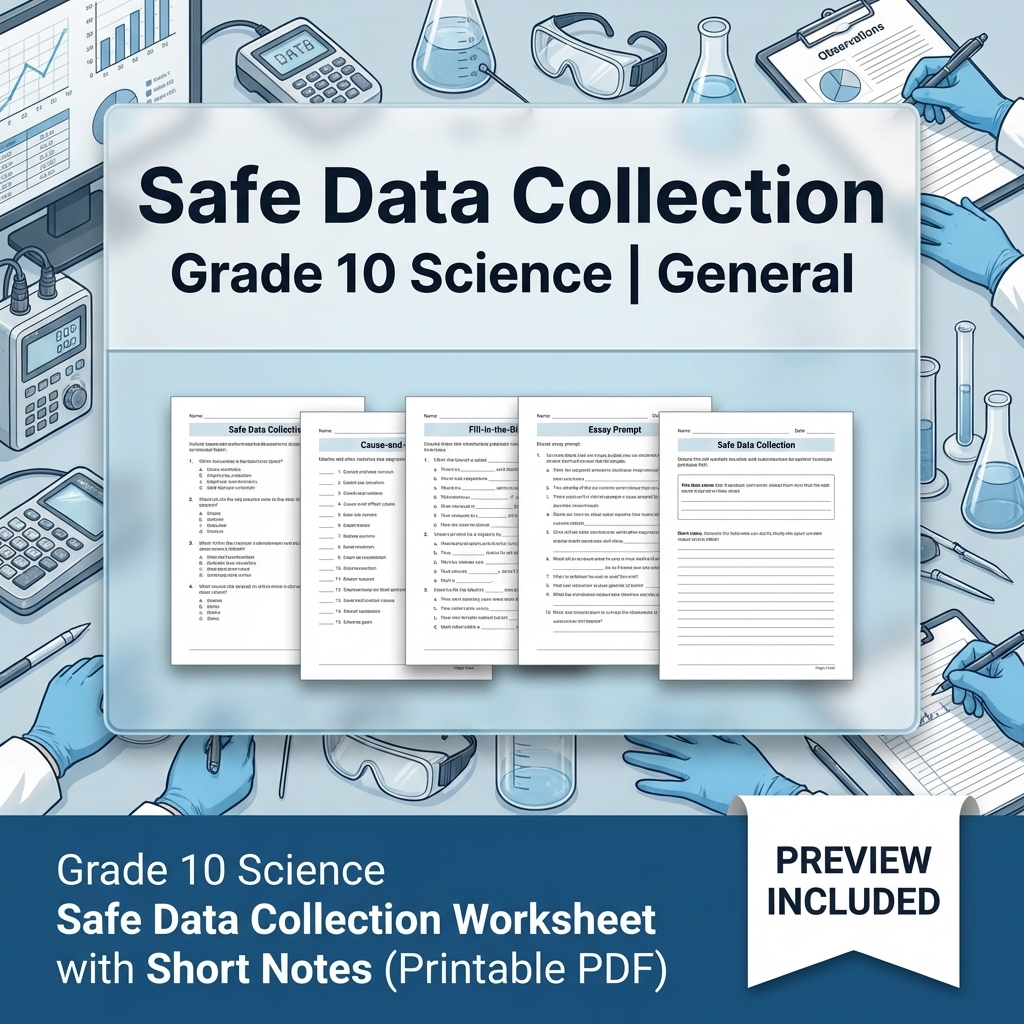
Grade 10 Science Safe Data Collection Worksheet with Short Notes (Printable PDF)
 Created byMeadowlark Worksheets
Learning Objectives
- Understand the importance of safe and appropriate methods in data collection.
- Identify variables, controls, and safe handling practices during experiments.
- Recognize safety considerations in managing risks and preventing contamination.
Also included in: Grade 10 Measurement Uncertainty Science Lesson Bundle: General +1 more
Instant download
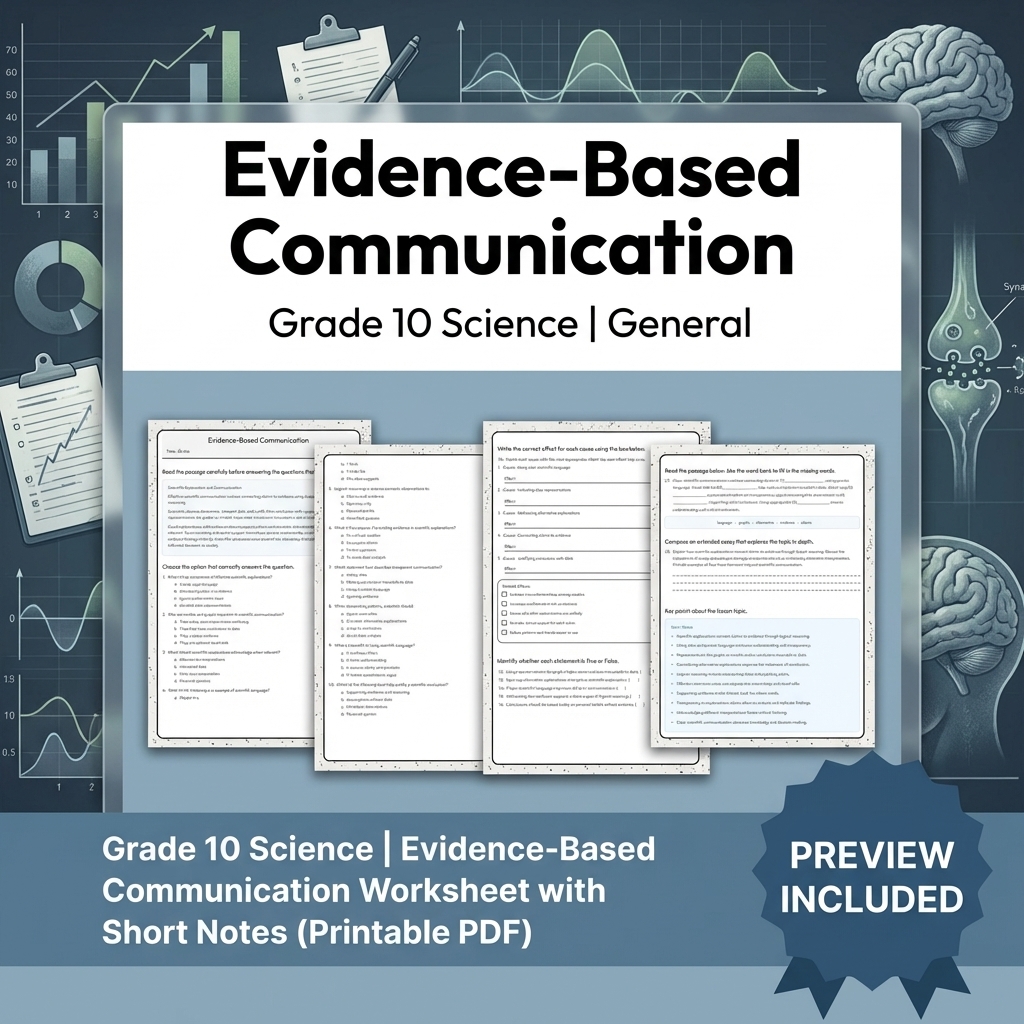
Grade 10 Science | Evidence-Based Communication Worksheet with Short Notes
Created byMeadowlark WorksheetsLearning Objectives
- Understand how to connect claims to evidence through logical reasoning.
- Use appropriate scientific language to describe observations and interpret data.
- Justify conclusions by addressing how evidence supports claims and considering alternative explanations.
Also included in: Grade 10 Measurement Uncertainty Science Lesson Bundle: General +1 more
Instant download
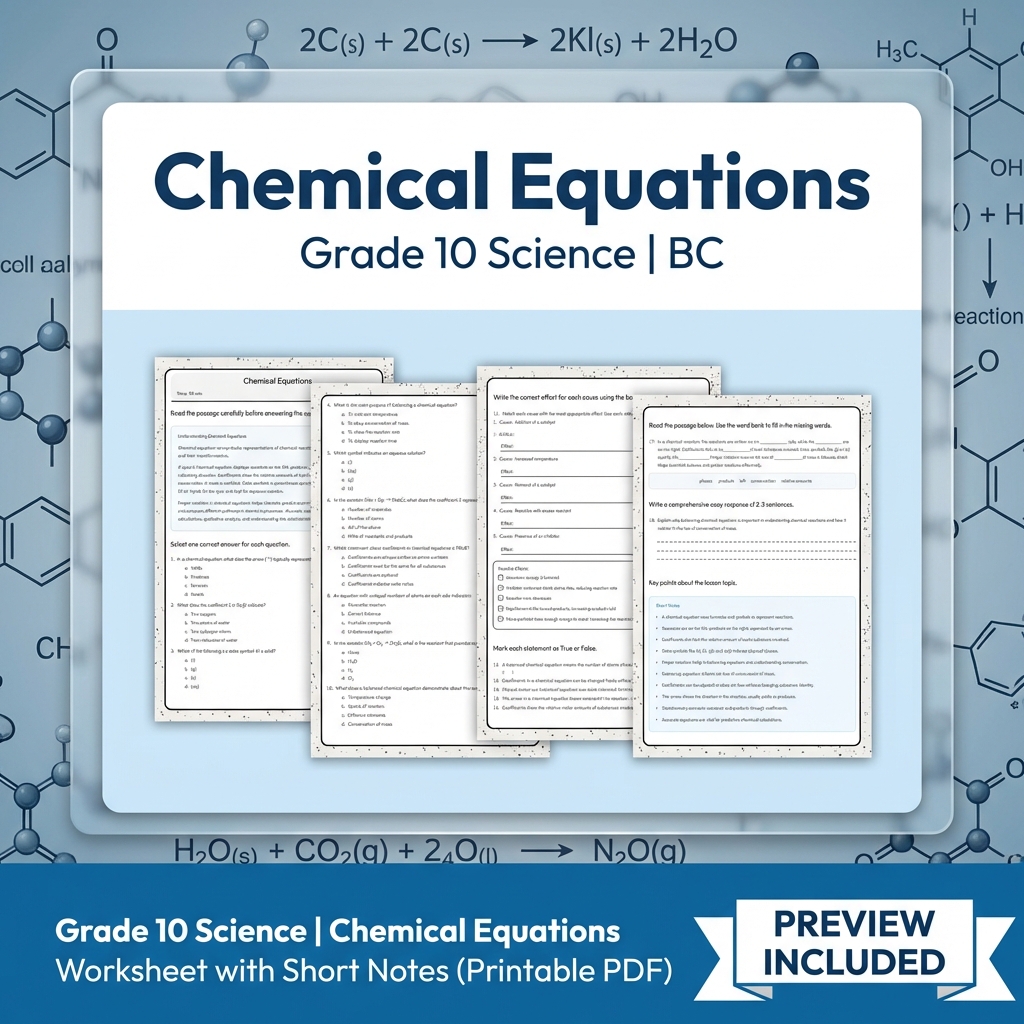
Grade 10 Science | Chemical Equations Worksheet with Short Notes (Printable PDF)
Created byMeadowlark WorksheetsLearning Objectives
- Understand the components of a chemical equation including reactants, products, coefficients, and state symbols.
- Learn how to interpret and write balanced chemical equations correctly.
- Predict qualitative outcomes of chemical reactions based on equation representation.
Also included in: Grade 10 Science Lesson Bundle | BC Framework Worksheets Pack +1 more
Instant download
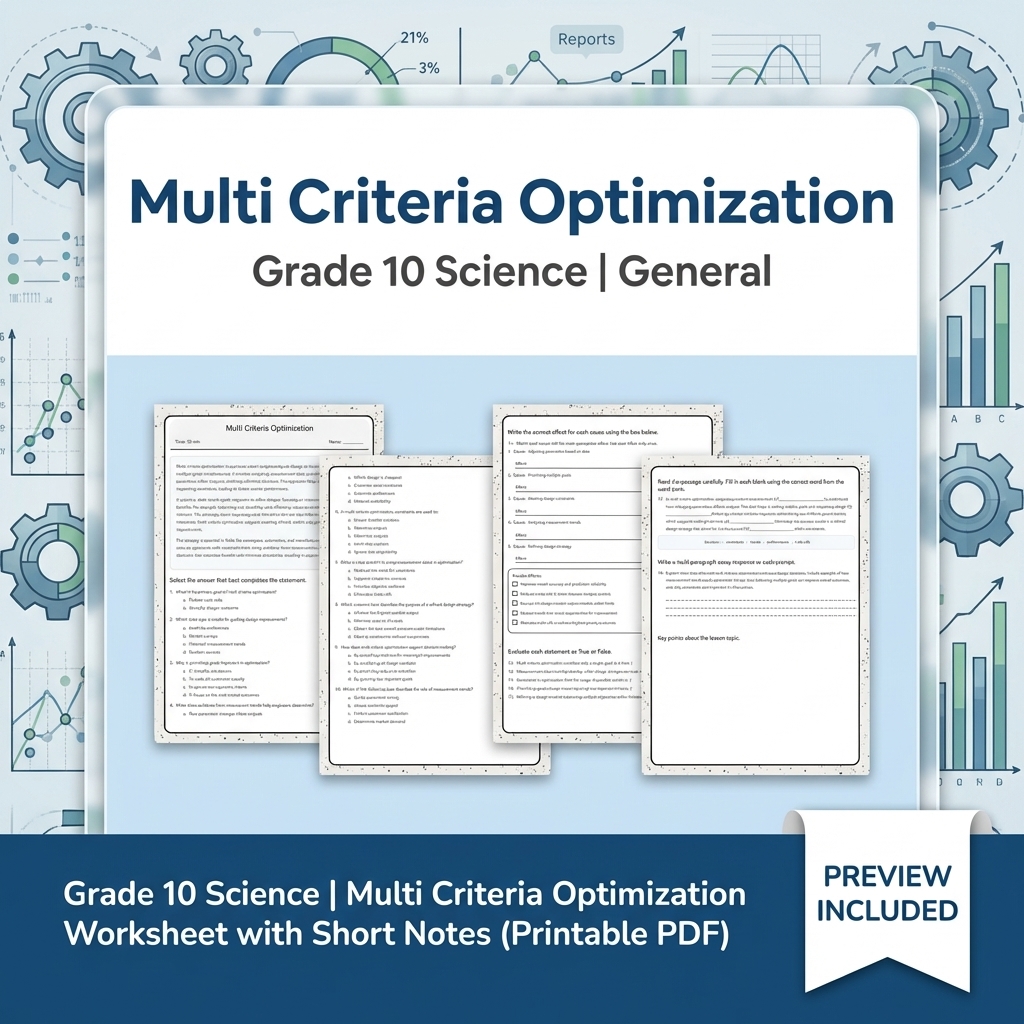
Grade 10 Science | Multi Criteria Optimization Worksheet with Short Notes
Created byMeadowlark WorksheetsLearning Objectives
- Understand how data-informed optimization improves design performance.
- Identify multiple criteria involved in optimization processes.
- Analyze how measurement trends influence decision-making in optimization.
Also included in: Grade 10 Design Tradeoffs in Science Lesson Bundle: Systems & Optimization +1 more
Instant download
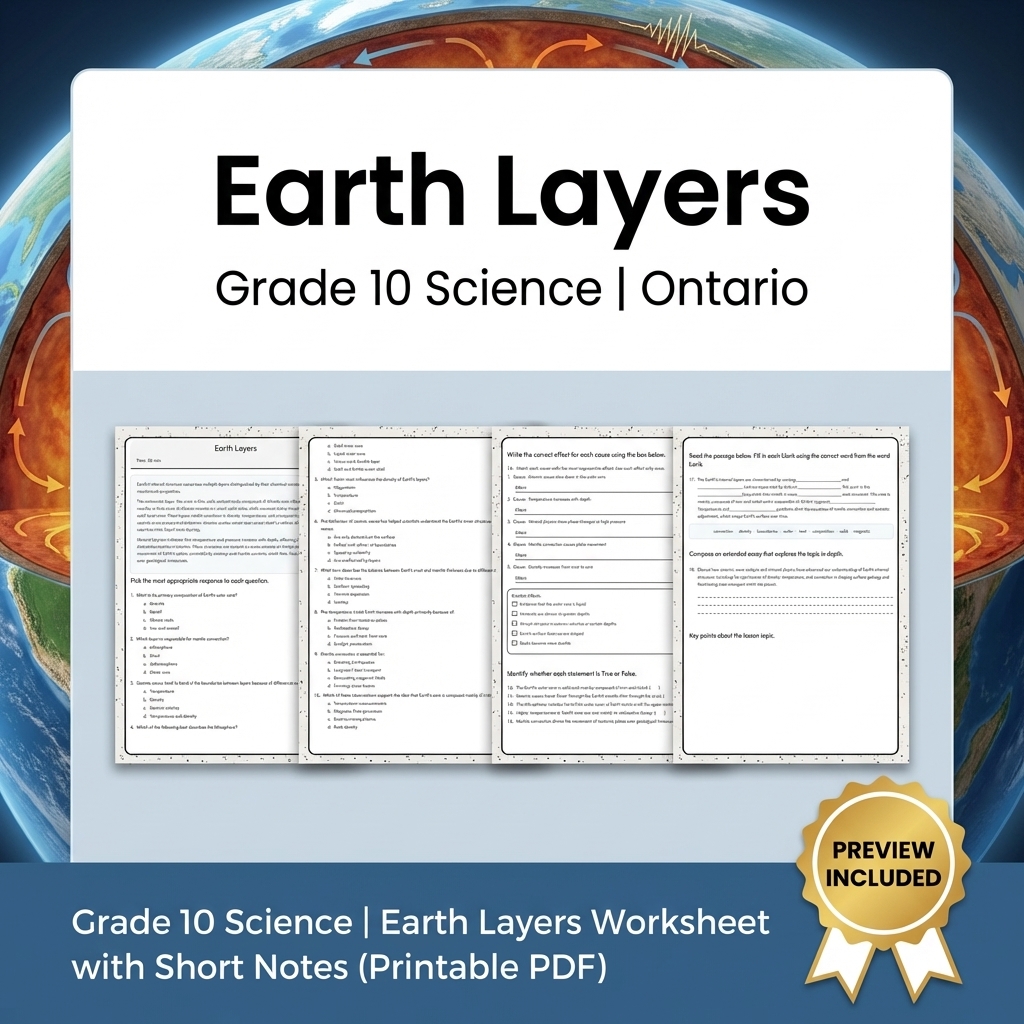
Grade 10 Science | Earth Layers Worksheet with Short Notes (Printable PDF)
Created byMeadowlark WorksheetsLearning Objectives
- Describe the chemical and mechanical layering of Earth's interior, including crust, mantle, and core.
- Explain how seismic wave behaviour and mineral physics inform models of Earth's internal structure.
- Discuss the concepts of density, composition, and temperature gradients within Earth.
Also included in: Grade 10 Science Lesson Group Bundle | Ontario Curriculum and STEM Topics +1 more
Instant download
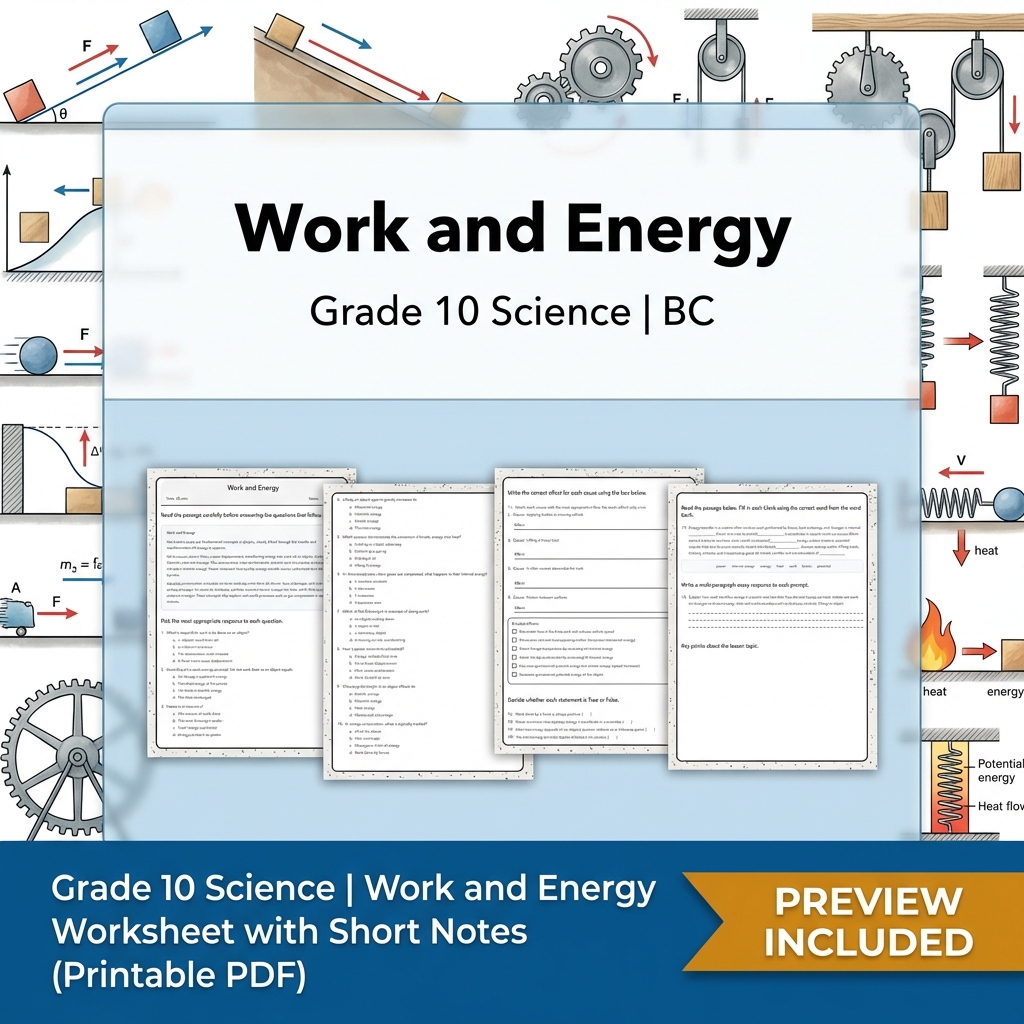
Grade 10 Science | Work and Energy Worksheet with Short Notes (Printable PDF)
Created byMeadowlark WorksheetsLearning Objectives
- Understand the relationship between work and energy and how work transfers energy in different systems.
- Explain the work–energy principle and its implications for calculating changes in kinetic energy.
- Calculate power as the rate at which energy is transferred in various physical processes.
Also included in: Grade 10 Science Lesson Bundle | Energy & Thermodynamics Worksheets +1 more
Instant download
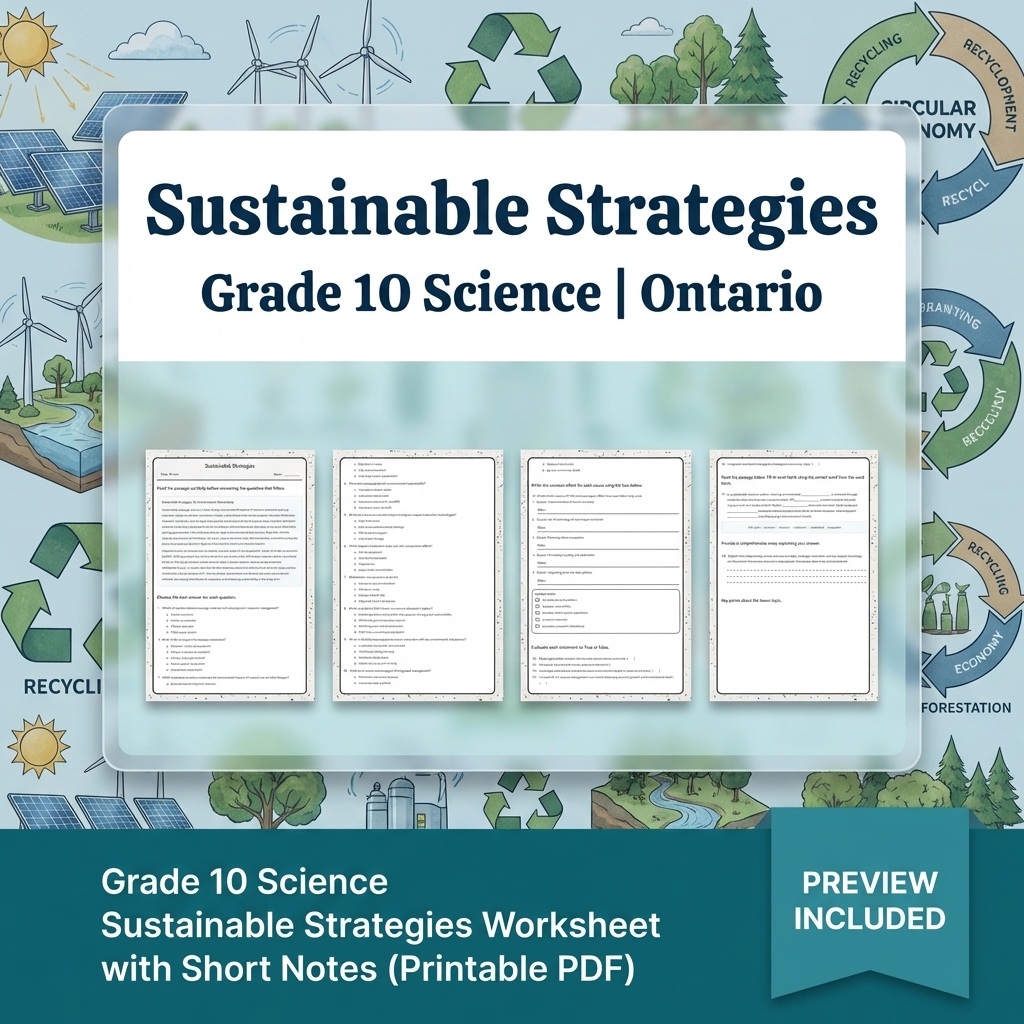
Grade 10 Science Sustainable Strategies Worksheet with Short Notes
Created byMeadowlark WorksheetsLearning Objectives
- Understand various approaches to reducing environmental impact in resource management.
- Identify principles of circular economy, recycling, and landscape restoration.
- Evaluate trade-offs between economic development and environmental stewardship.
Also included in: Grade 10 Science Lesson Group Bundle | Ontario Curriculum and STEM Topics +1 more
Instant download
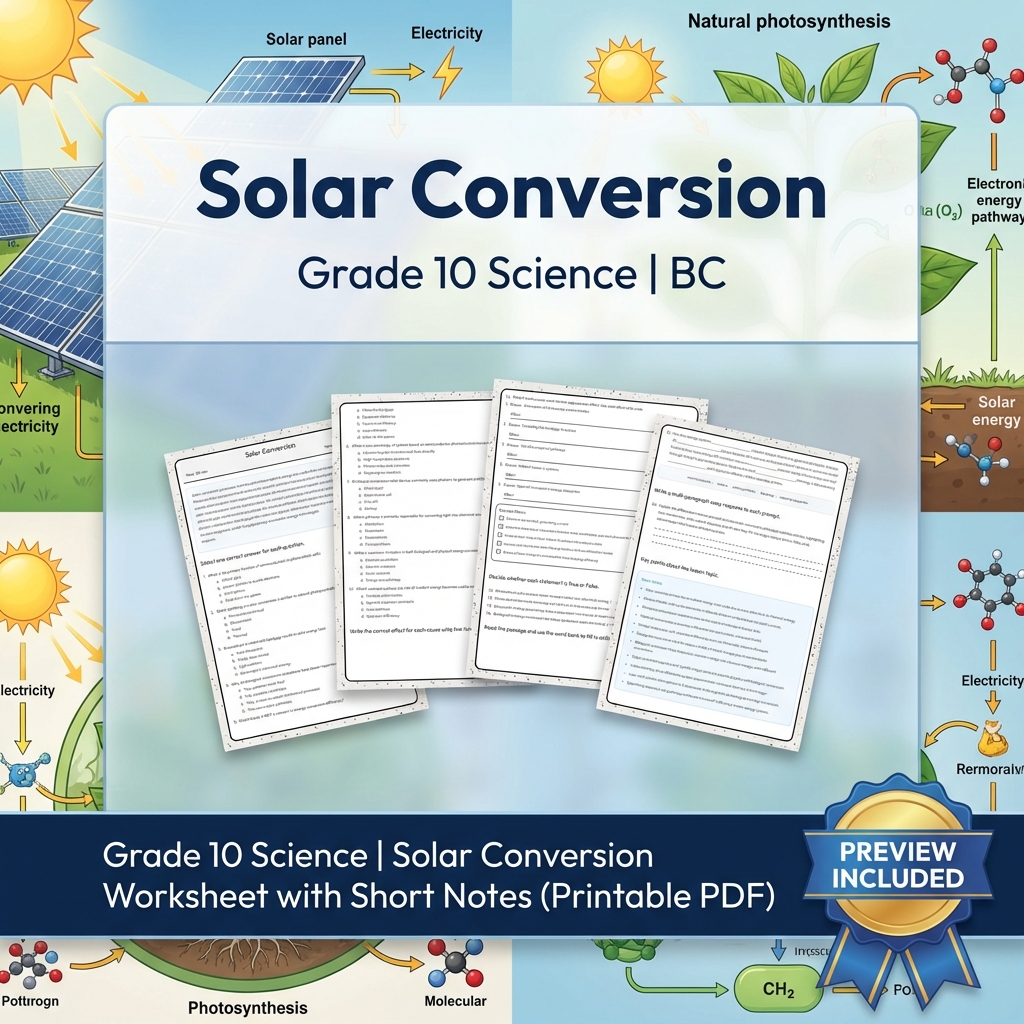
Grade 10 Science | Solar Conversion Worksheet with Short Notes (Printable PDF)
Created byMeadowlark WorksheetsLearning Objectives
- Understand the mechanisms of photovoltaic and photoelectrochemical energy conversion.
- Explain how semiconductors absorb photons to generate electrical currents.
- Describe the processes involved in biological and physical energy conversion mechanisms.
Also included in: Grade 10 Science Lesson Bundle | Energy & Thermodynamics Worksheets +1 more
Instant download
Grade 10 Science | Ocean Atmosphere Coupling Worksheet with Short Notes
Created byMeadowlark WorksheetsLearning Objectives
- Understand how ocean and atmosphere interactions transfer heat and moisture.
- Explain the role of water's high heat capacity in climate variability.
- Describe how sea surface temperature changes influence weather patterns.
Also included in: Grade 10 Earth Systems Science Lesson Bundle: General Framework Worksheets +1 more
Instant download
Grade 10 Science | Stoichiometric Ratios Worksheet with Short Notes (PDF)
Created byMeadowlark WorksheetsLearning Objectives
- Understand how stoichiometric ratios connect quantities of reactants and products using mole concepts.
- Translate between mass and moles via molar masses to predict material changes.
- Apply ratios from balanced equations to calculate product yields from reactant masses and vice versa.
Also included in: Grade 10 Science Lesson Bundle | BC Framework Worksheets Pack +1 more
Instant download
Grade 10 Science | Bonding Types Worksheet with Short Notes (Printable PDF)
Created byMeadowlark WorksheetsLearning Objectives
- Understand the different types of chemical bonds: ionic, covalent, and metallic.
- Identify properties associated with each bonding type, such as melting point and conductivity.
- Explain how electron transfer, sharing, or delocalization leads to bond formation.
Also included in: Grade 10 Science Lesson Bundle | BC Framework Worksheets Pack +1 more
Instant download
Grade 10 Science | Uniform Circular Motion Worksheet with Short Notes
Created byMeadowlark WorksheetsLearning Objectives
- Understand the kinematic relations v = rω and a_c = v^2/r in circular motion.
- Explain how inward net force maintains curved trajectories.
- Link angular velocity to linear speed and centripetal acceleration.
Also included in: Grade 10 Science Lesson Group: Motion & Forces Ontario Curriculum Bundle +1 more
Instant download
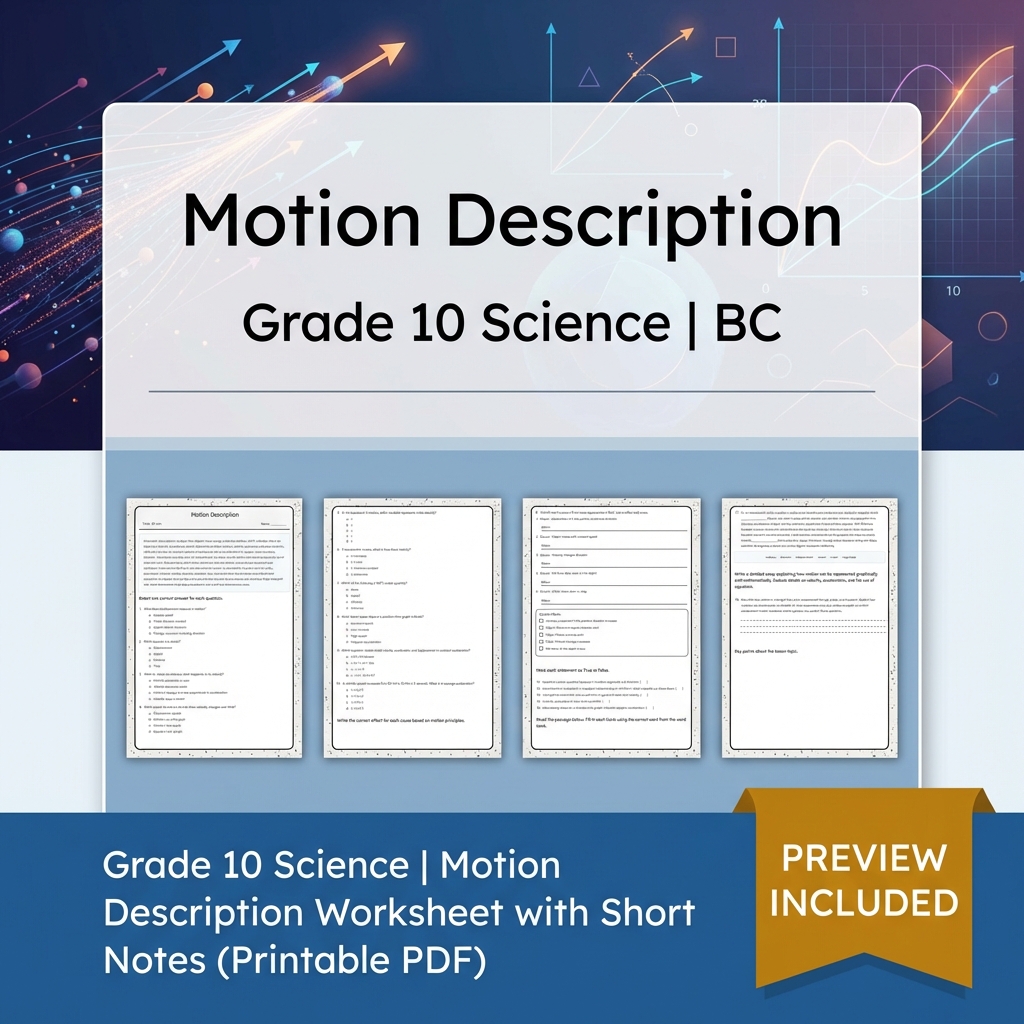
Grade 10 Science | Motion Description Worksheet with Short Notes (Printable PDF)
Created byMeadowlark WorksheetsLearning Objectives
- Understand key kinematic concepts such as position, displacement, speed, velocity, and acceleration.
- Interpret motion graphs and relate them to variable relationships in motion.
- Apply equations of motion to predict future states in constant acceleration scenarios.
Also included in: Grade 10 Science Lesson Bundle | Physics and Forces Worksheets | BC Framework +1 more
Instant download
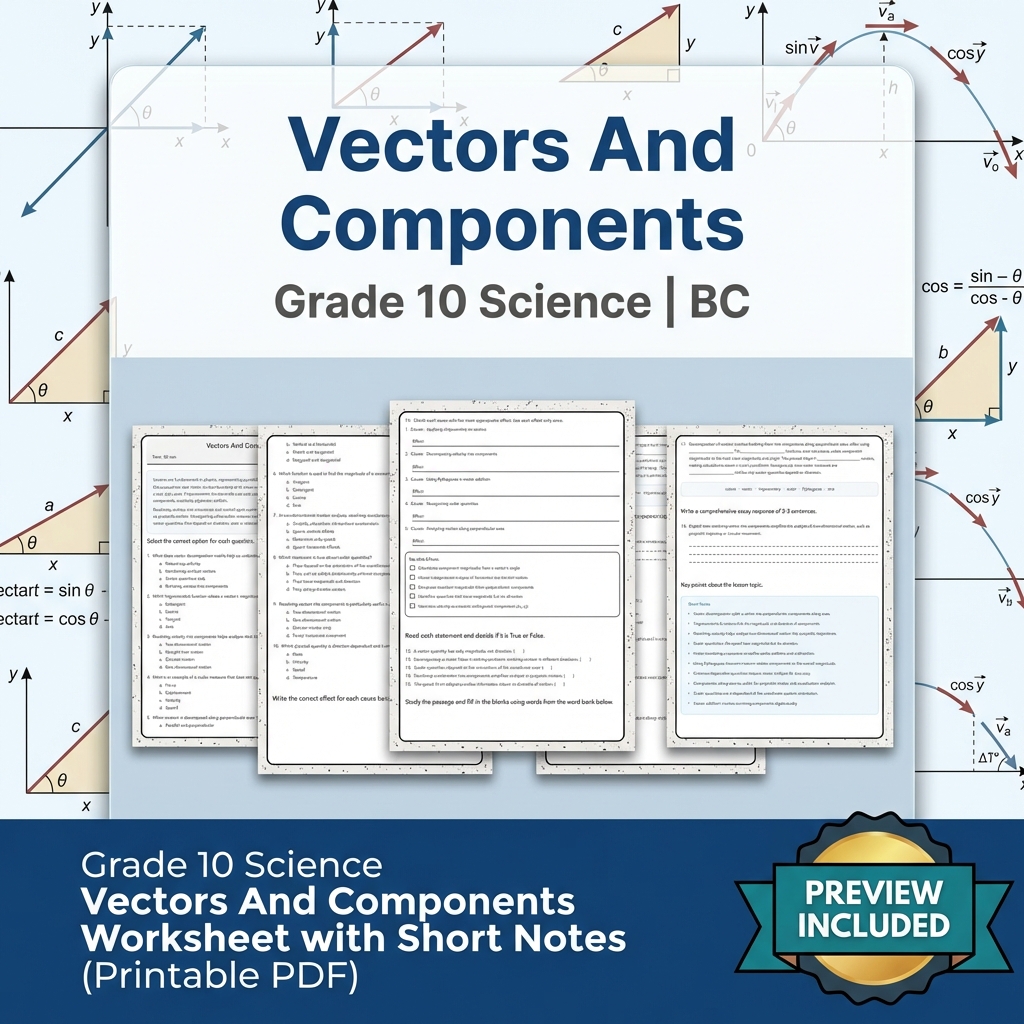
Grade 10 Science Vectors And Components Worksheet with Short Notes (PDF)
Created byMeadowlark WorksheetsLearning Objectives
- Understand how to decompose vectors into orthogonal components using trigonometry.
- Apply vector addition algebraically by resolving components.
- Describe the significance of resolving velocity and acceleration into horizontal and vertical components.
Also included in: Grade 10 Science Lesson Bundle | Physics and Forces Worksheets | BC Framework +1 more
Instant download
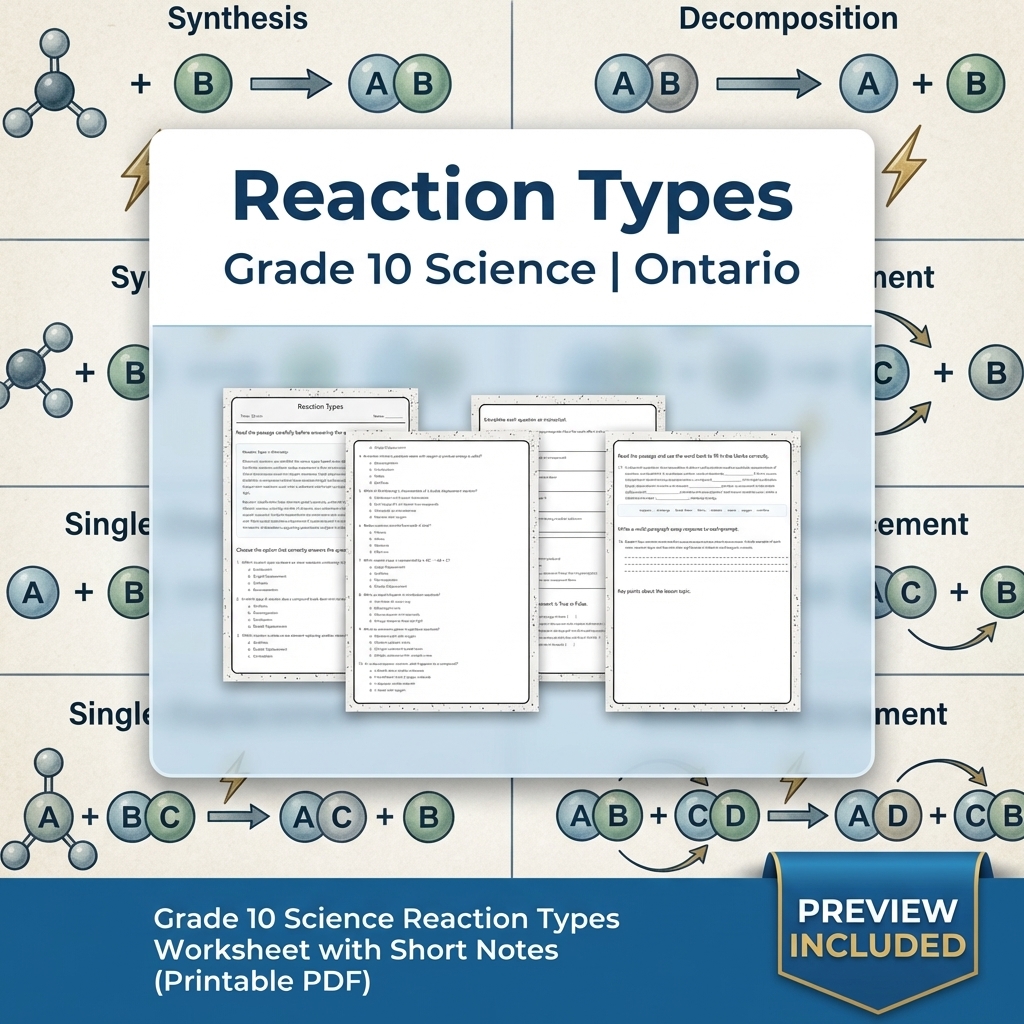
Grade 10 Science Reaction Types Worksheet with Short Notes (Printable PDF)
Created byMeadowlark WorksheetsLearning Objectives
- Classify chemical reactions into synthesis, decomposition, single displacement, double displacement, and combustion categories.
- Identify characteristic reactant-product patterns in various reaction types.
- Understand redox considerations and predict potential products based on reaction patterns.
Also included in: Grade 10 Science Lesson Group Bundle with Ontario Framework +1 more
Instant download
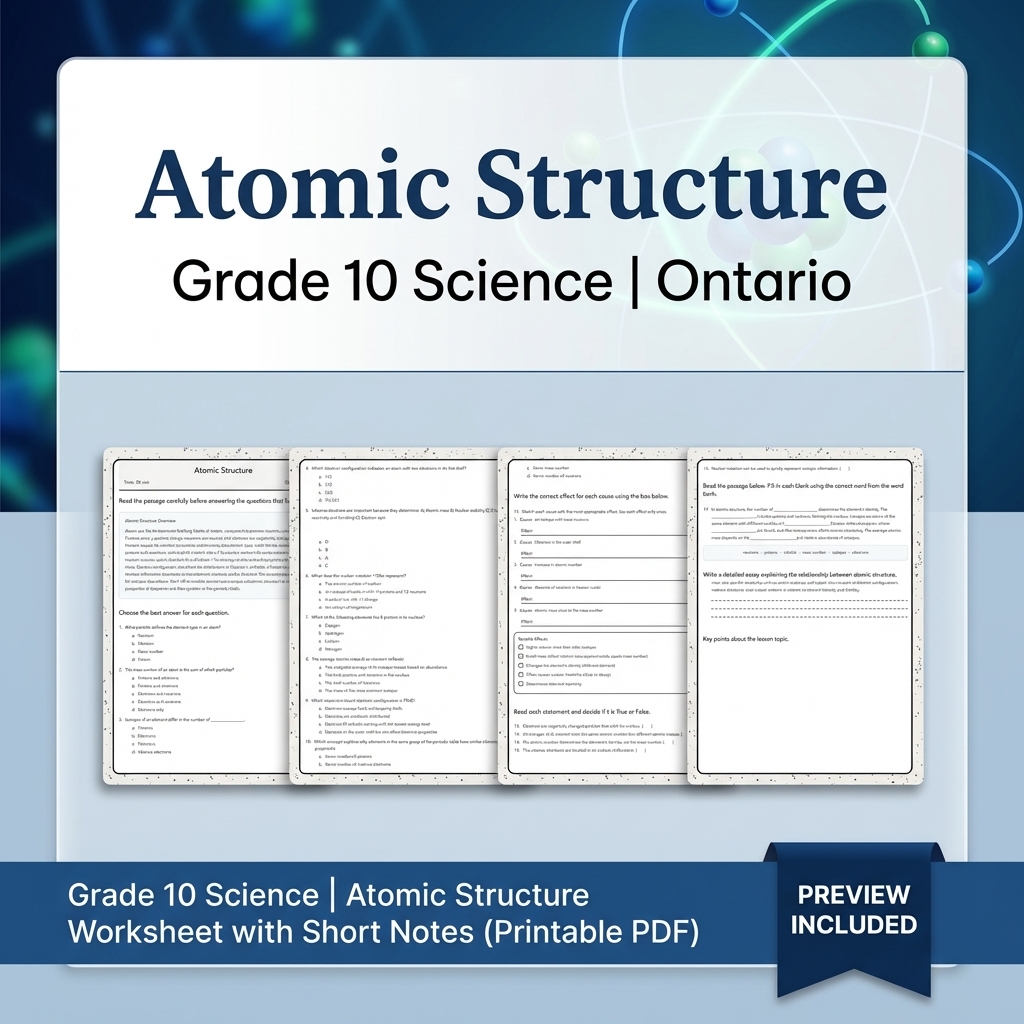
Grade 10 Science | Atomic Structure Worksheet with Short Notes (Printable PDF)
Created byMeadowlark WorksheetsLearning Objectives
- Understand the basic components of atomic structure including protons, neutrons, and electrons.
- Explain the concepts of atomic number, mass number, and isotopes with examples.
- Describe electron configuration, valence electrons, and their influence on chemical behavior and bonding.
Also included in: Grade 10 Science Lesson Group Bundle with Ontario Framework +1 more
Instant download
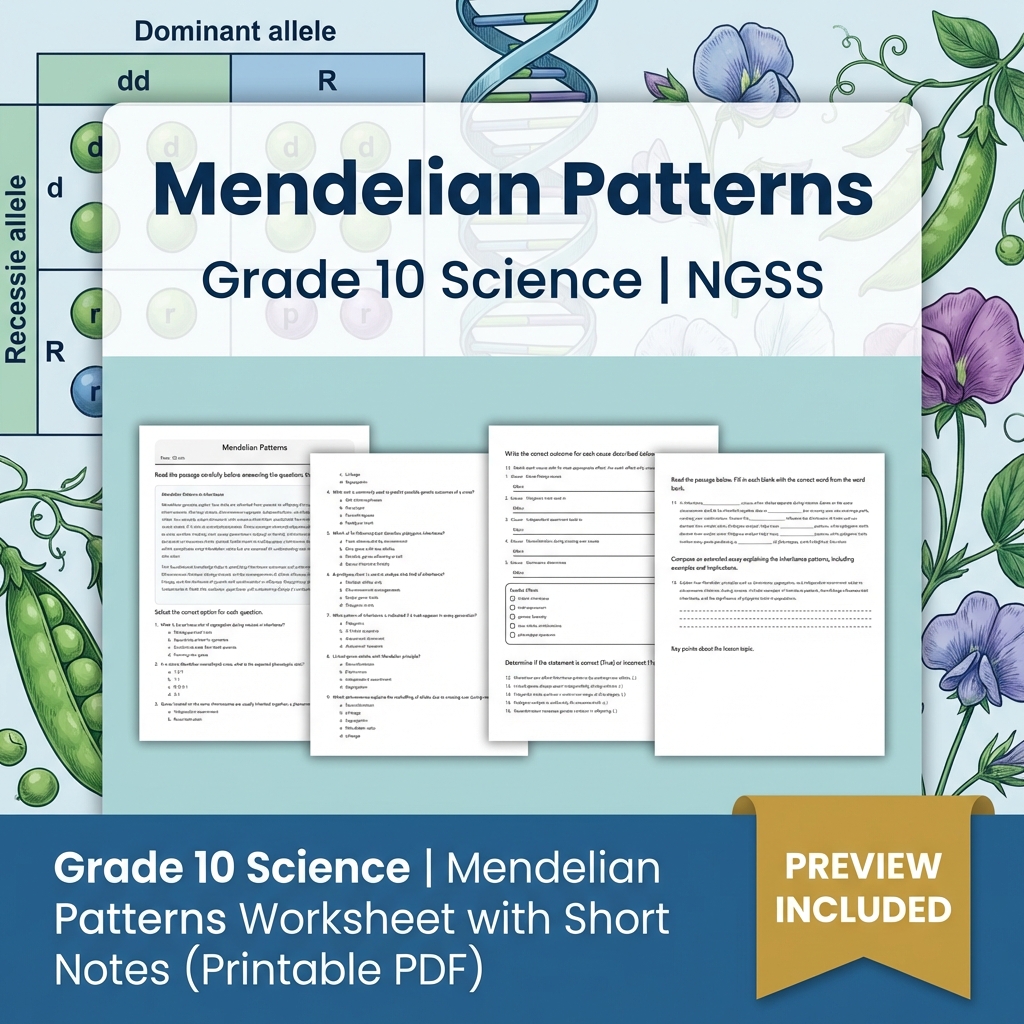
Grade 10 Science | Mendelian Patterns Worksheet with Short Notes (Printable PDF)
Created byMeadowlark WorksheetsLearning Objectives
- Understand core concepts of inheritance, including dominance, segregation, and independent assortment.
- Apply Punnett squares and pedigree analysis to predict inheritance outcomes.
- Analyze the effects of linked genes and polygenic traits on inheritance ratios.
Also included in: Grade 10 Science | Heredity, Inheritance & Traits NGSS Unit Bundle (worksheets) +1 more
Instant download

Grade 10 Science | Cosmic Origins Worksheet with Short Notes (Printable PDF)
Created byMeadowlark WorksheetsLearning Objectives
- Understand the observational evidence supporting models of cosmic origin.
- Analyze the significance of cosmic microwave background radiation and galactic redshifts.
- Explain how elemental abundances inform about early-universe conditions.
Also included in: Grade 10 Science | Earth's Place in the Universe NGSS Unit Bundle (Worksheets) +1 more
Instant download
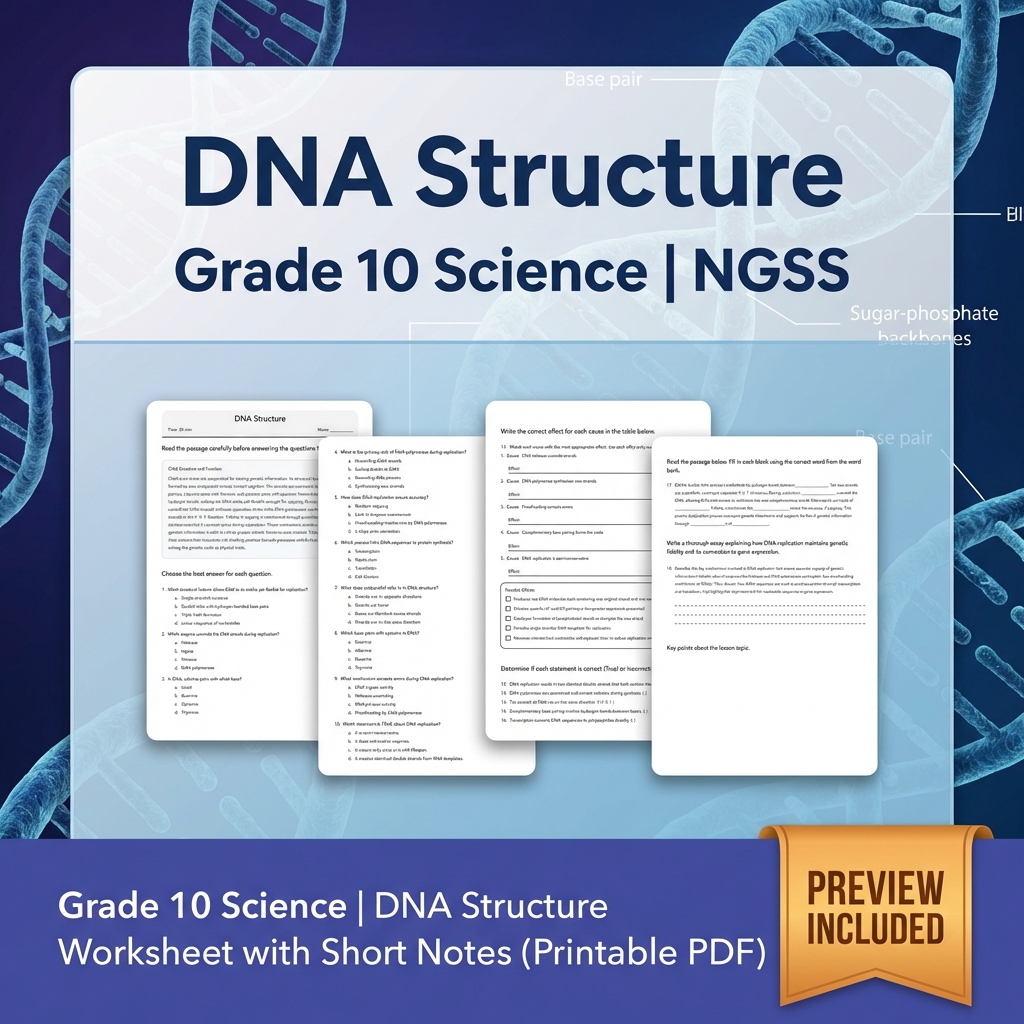
Grade 10 Science | DNA Structure Worksheet with Short Notes (Printable PDF)
Created byMeadowlark WorksheetsLearning Objectives
- Describe the structural features of DNA, including the double helix, complementary base pairing, and antiparallel strands.
- Explain mechanisms of DNA replication, including roles of DNA polymerase and helicase, and how fidelity is maintained.
- Connect DNA sequences to processes like transcription and translation, illustrating how genetic information directs protein synthesis.
Also included in: Grade 10 Science | Heredity, Inheritance & Traits NGSS Unit Bundle (worksheets) +1 more
Instant download
About Grade 10 Science Worksheets
Find Science worksheets built for Grade 10. All 7,038 cover core skills, practice, and review, each an instant PDF download.
Every worksheet on MyTeachingSheets is created by independent teacher-authors and reviewed before publication. All resources download as printable PDFs for classroom, homework, or at-home practice, and many include answer keys. Preview any worksheet free before buying.