
Grade 10 Science Worksheets
7,038 worksheets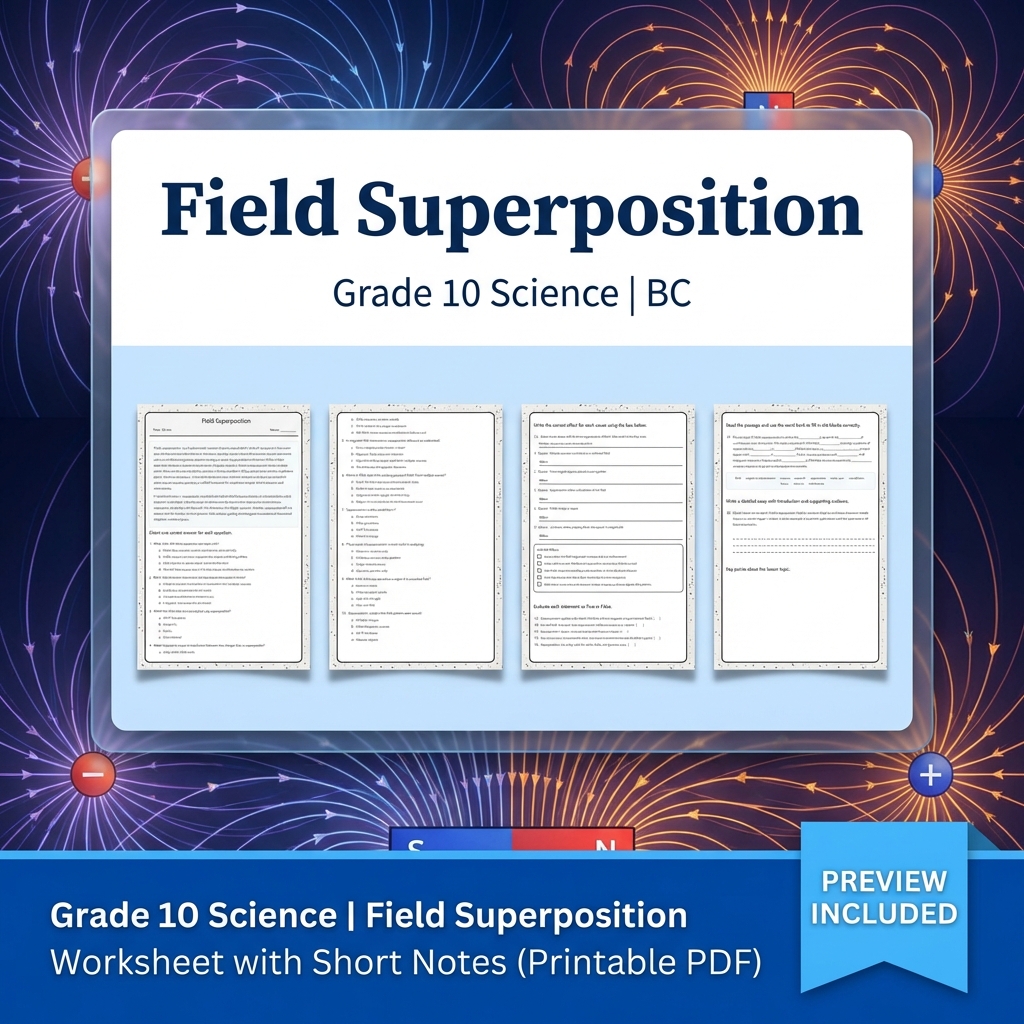
Grade 10 Science | Field Superposition Worksheet with Short Notes (PDF)
 Created byMeadowlark Worksheets
Learning Objectives
- Understand the principle of field superposition and its application in analyzing multiple sources.
- Calculate the net field at a point resulting from multiple sources using vector addition.
- Identify regions of enhanced and canceled fields due to superposition effects.
Also included in: Grade 10 Science Lesson Bundle | Physics and Forces Worksheets | BC Framework +1 more
Instant download
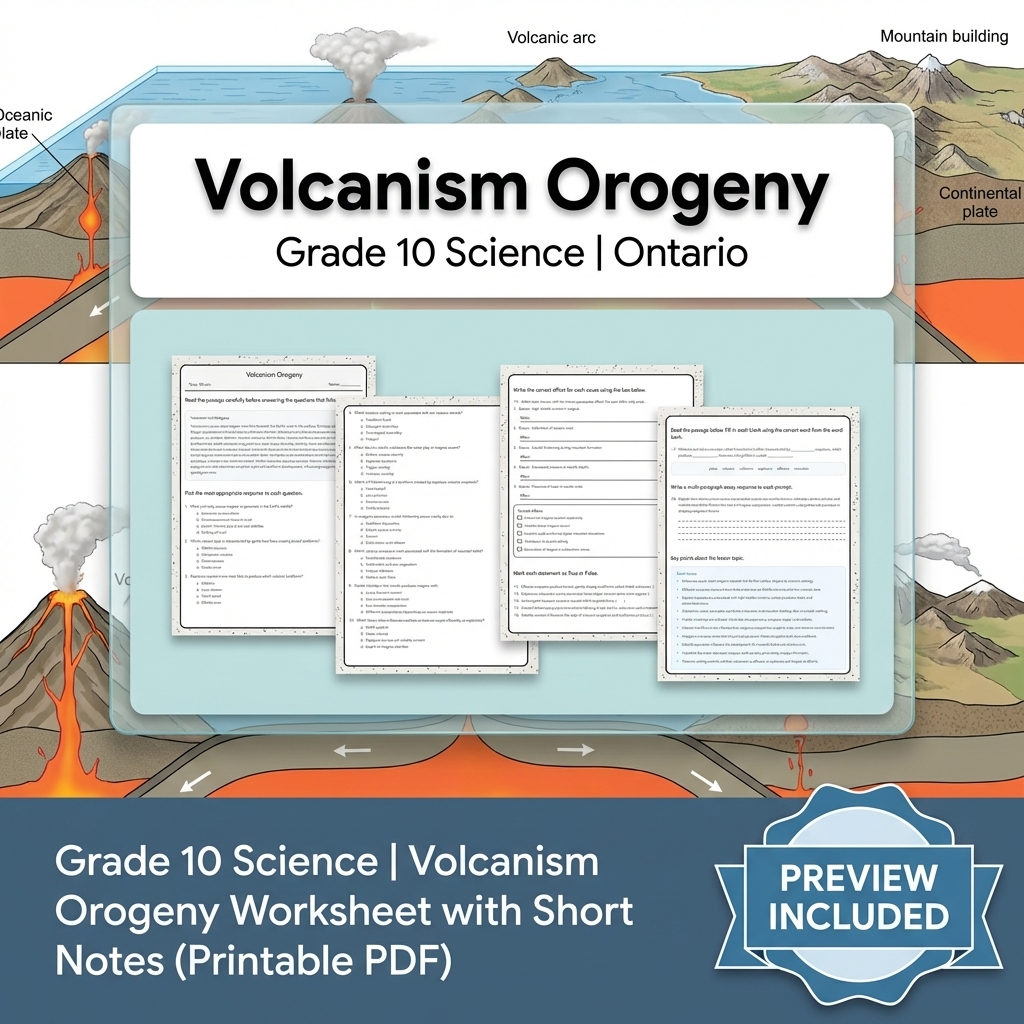
Grade 10 Science | Volcanism Orogeny Worksheet with Short Notes (Printable PDF)
Created byMeadowlark WorksheetsLearning Objectives
- Describe the processes of magma generation, ascent, and eruption styles.
- Compare effusive and explosive volcanism and their landforms.
- Explain how subduction zones and collision processes influence volcanic activity and mountain building.
Also included in: Grade 10 Science Lesson Group Bundle | Ontario Curriculum and STEM Topics +1 more
Instant download
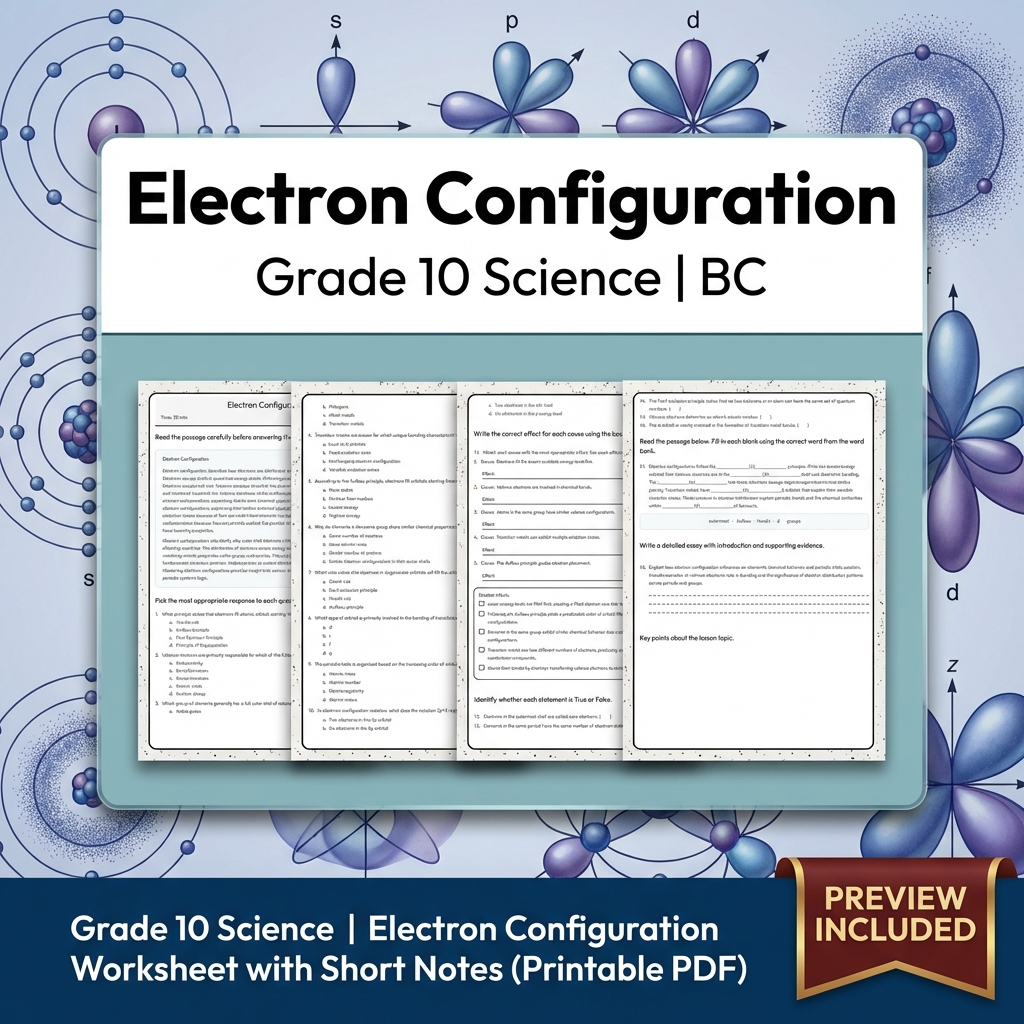
Grade 10 Science | Electron Configuration Worksheet with Short Notes (PDF)
Created byMeadowlark WorksheetsLearning Objectives
- Understand how electrons occupy energy levels and orbitals in atoms.
- Explain the significance of valence electrons in bonding and reactivity.
- Relate electron configuration patterns to elements' positions in the periodic table.
Also included in: Grade 10 Science Lesson Bundle | BC Framework Worksheets Pack +1 more
Instant download
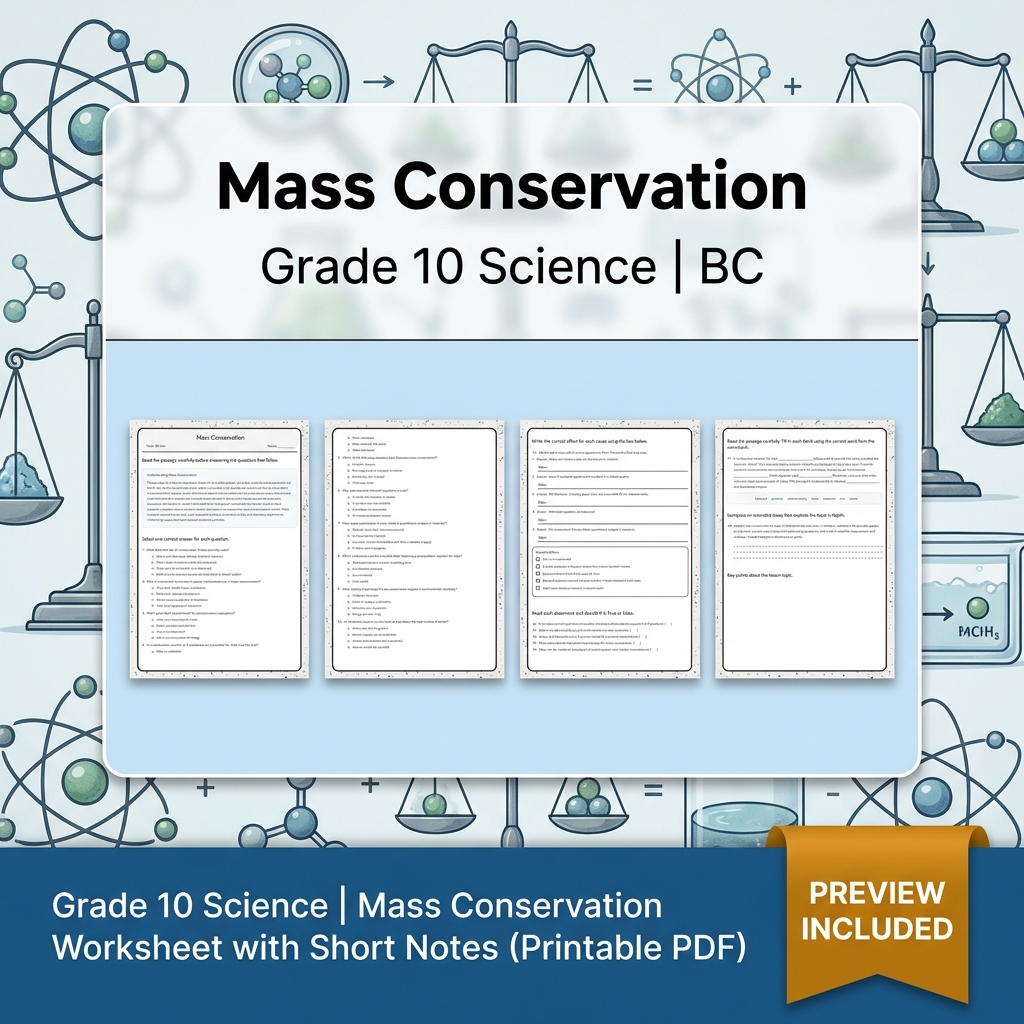
Grade 10 Science | Mass Conservation Worksheet with Short Notes (Printable PDF)
Created byMeadowlark WorksheetsLearning Objectives
- Understand the principle that total mass of reactants equals total mass of products in a closed system.
- Recognize the importance of accounting for all substances, including gases and ions, in mass balance.
- Identify how mass conservation underlies balanced chemical equations and stoichiometric calculations.
Also included in: Grade 10 Science Lesson Bundle | BC Framework Worksheets Pack +1 more
Instant download
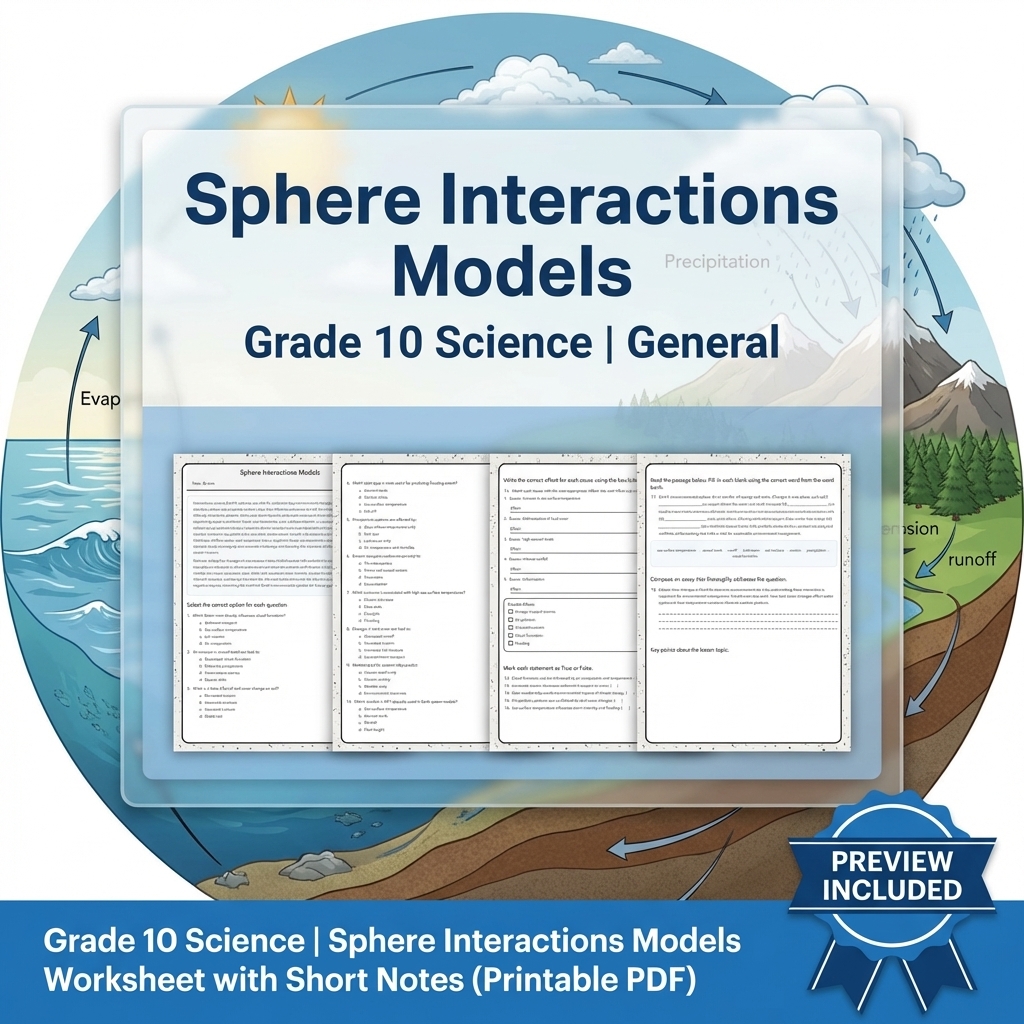
Grade 10 Science | Sphere Interactions Models Worksheet with Short Notes
Created byMeadowlark WorksheetsLearning Objectives
- Understand how Earth's spheres interact through energy and matter transfers.
- Identify factors influencing evaporation, cloud formation, and precipitation.
- Analyze how land cover changes impact soil moisture and erosion.
Also included in: Grade 10 Earth Systems Science Lesson Bundle: General Framework Worksheets +1 more
Instant download
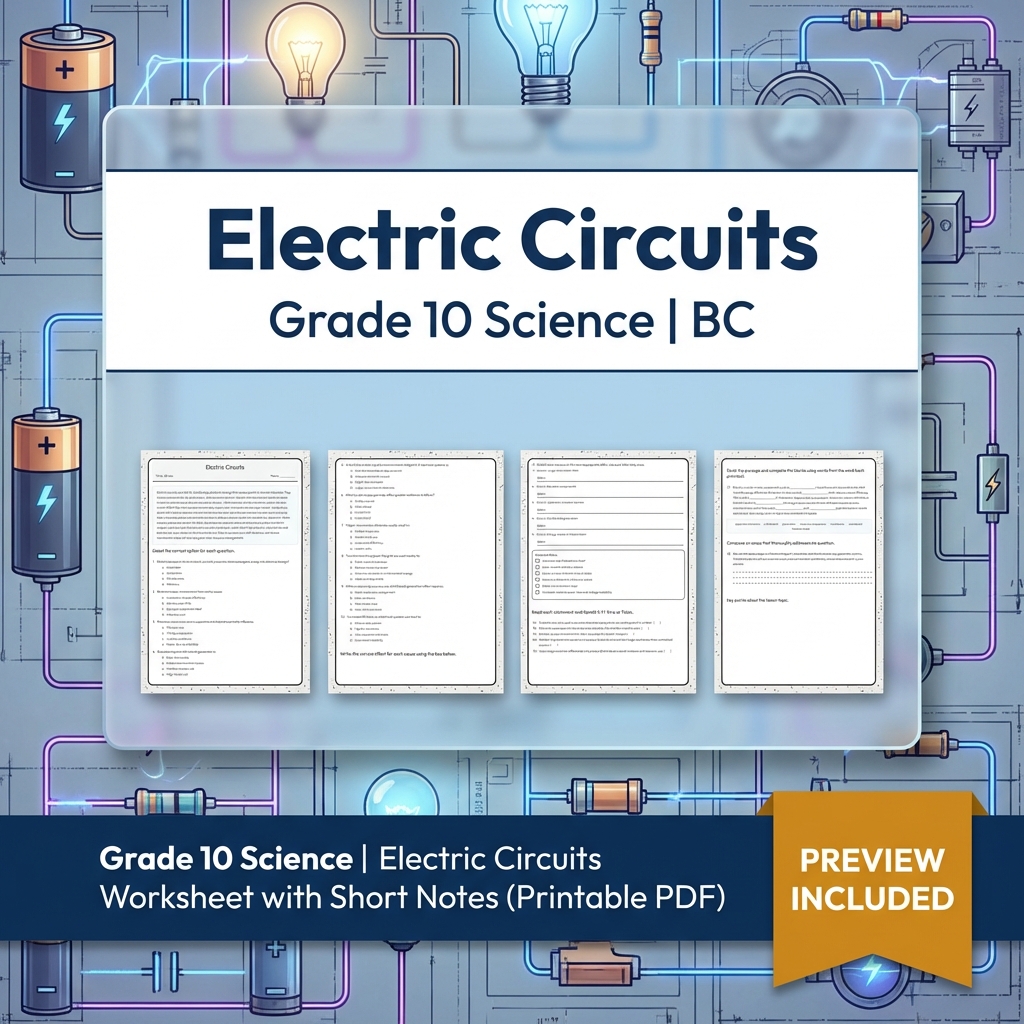
Grade 10 Science | Electric Circuits Worksheet with Short Notes (Printable PDF)
Created byMeadowlark WorksheetsLearning Objectives
- Understand the components and functions of electric circuits.
- Analyze how energy transfer and losses affect system efficiency.
- Evaluate the differences between centralized and distributed energy generation.
Also included in: Grade 10 Science Lesson Bundle | Energy & Thermodynamics Worksheets +1 more
Instant download
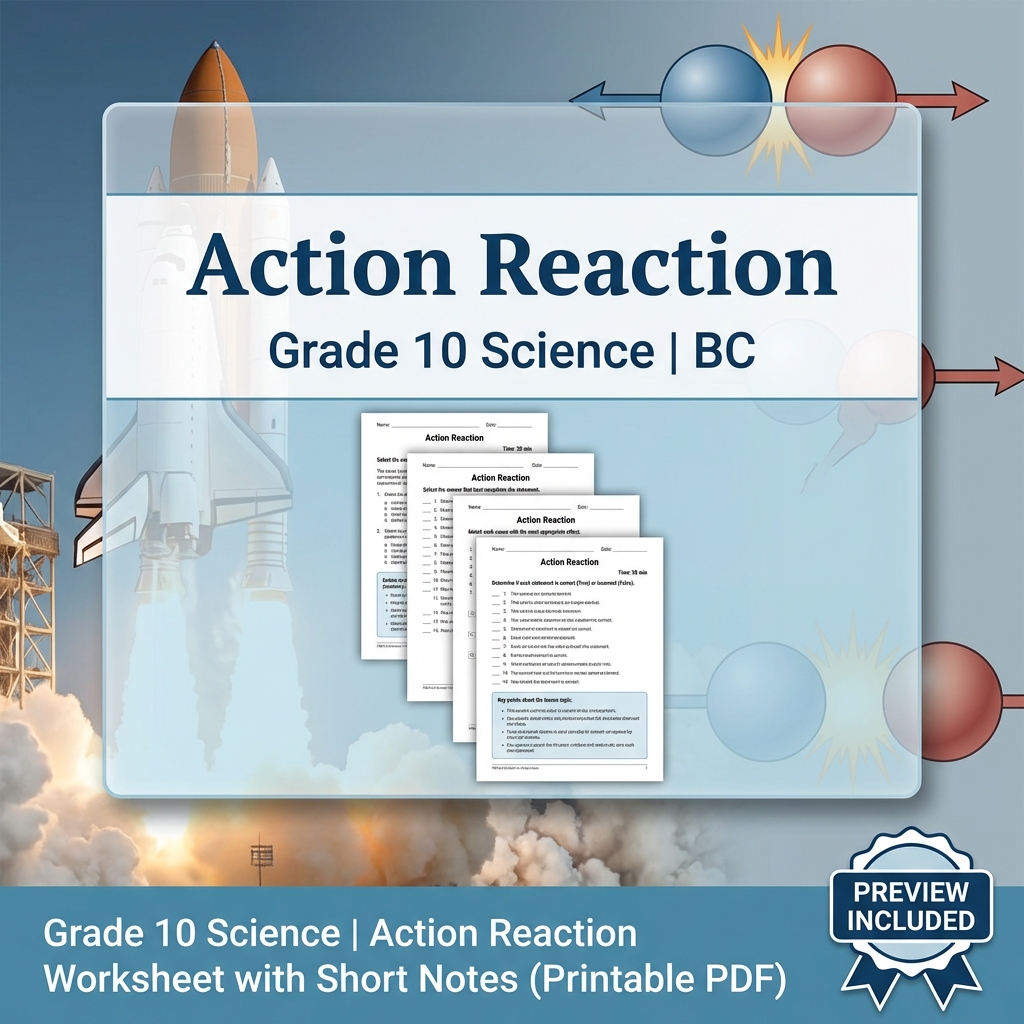
Grade 10 Science | Action Reaction Worksheet with Short Notes (Printable PDF)
Created byMeadowlark WorksheetsLearning Objectives
- Understand the concept of paired forces in action and reaction.
- Identify examples of action-reaction pairs in real-world situations.
- Explain how forces of different objects are equal in magnitude and opposite in direction.
Also included in: Grade 10 Science Lesson Bundle | Physics and Forces Worksheets | BC Framework +1 more
Instant download
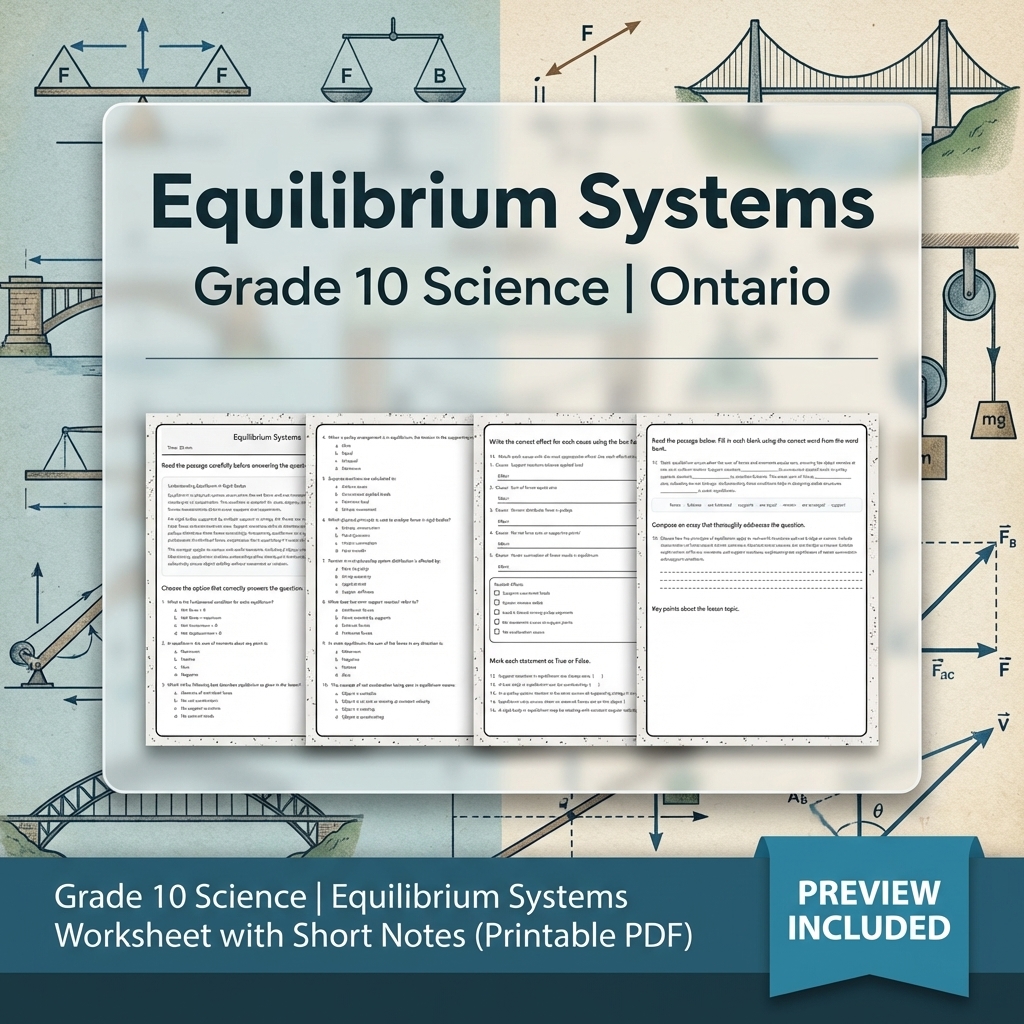
Grade 10 Science | Equilibrium Systems Worksheet with Short Notes
Created byMeadowlark WorksheetsLearning Objectives
- Explain the conditions for static equilibrium using vector summation of forces and moments.
- Apply ΣF = 0 to analyze rigid body supports and suspensions.
- Describe tension distribution in simple pulley systems.
Also included in: Grade 10 Science Lesson Group: Motion & Forces Ontario Curriculum Bundle +1 more
Instant download
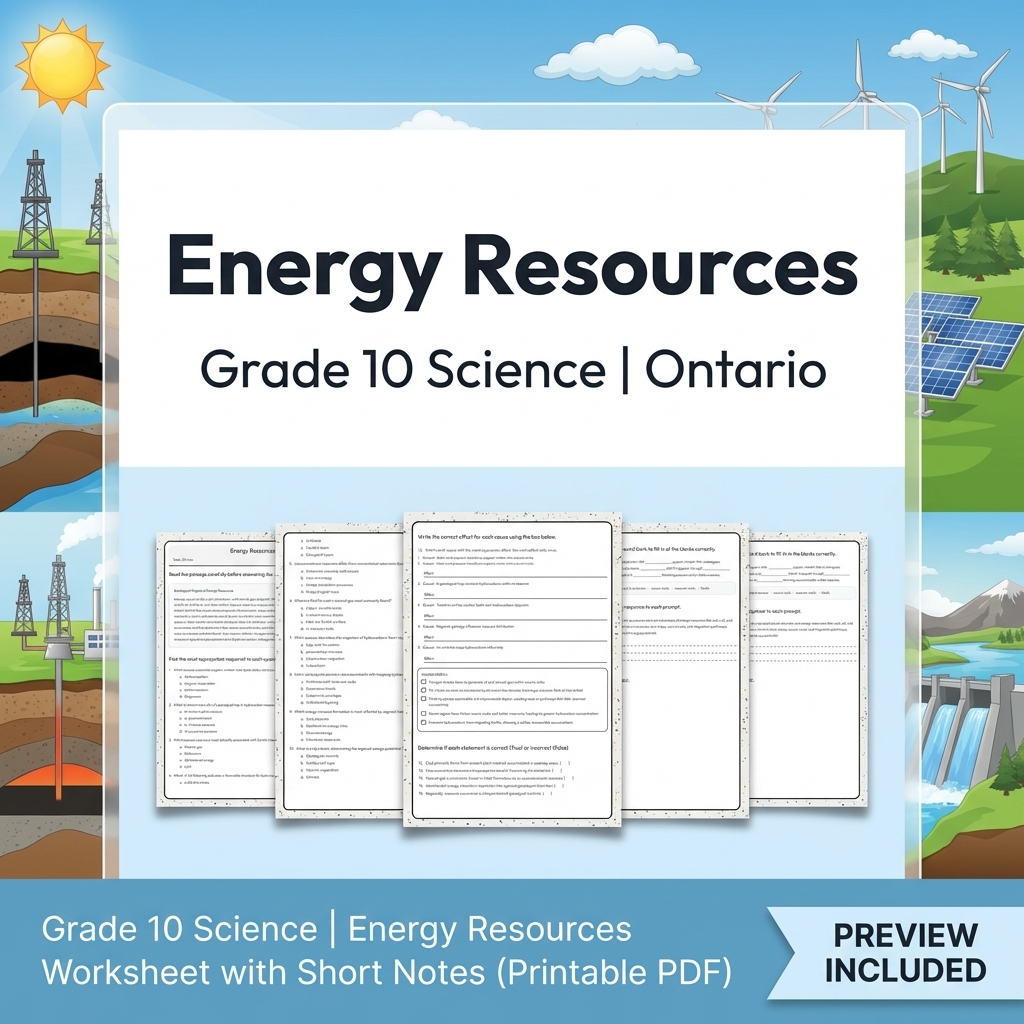
Grade 10 Science | Energy Resources Worksheet with Short Notes (Printable PDF)
Created byMeadowlark WorksheetsLearning Objectives
- Understand the geological formation and distribution of coal, petroleum, natural gas, and geothermal energy.
- Identify key concepts such as source rocks, migration, reservoirs, and traps in hydrocarbon formation.
- Differentiate between conventional and unconventional energy reservoirs.
Also included in: Grade 10 Science Lesson Group Bundle | Ontario Curriculum and STEM Topics +1 more
Instant download
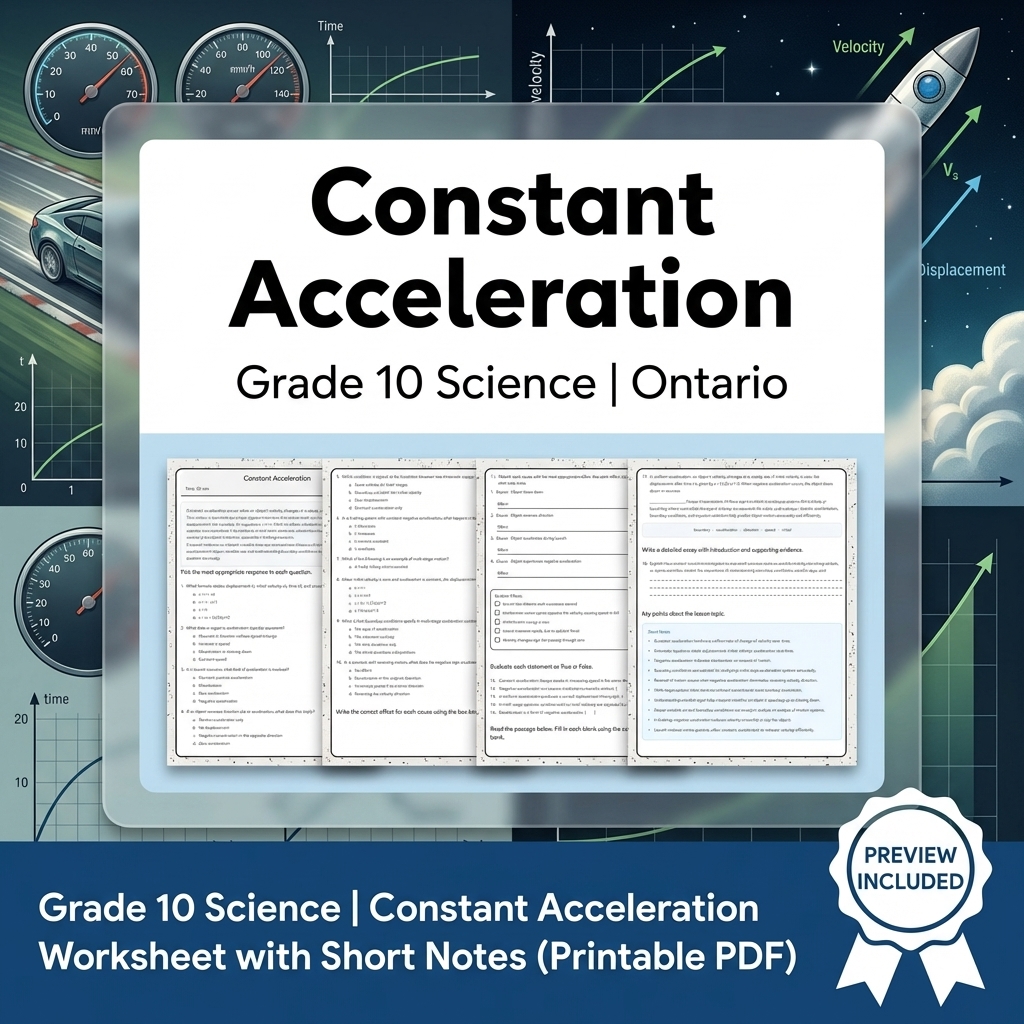
Grade 10 Science | Constant Acceleration Worksheet with Short Notes
Created byMeadowlark WorksheetsLearning Objectives
- Understand the fundamental principles of uniformly accelerated motion.
- Apply kinematic formulas to systems with varying initial velocities and displacements.
- Interpret the significance of negative acceleration and change in motion direction in one-dimensional motion.
Also included in: Grade 10 Science Lesson Group: Motion & Forces Ontario Curriculum Bundle +1 more
Instant download
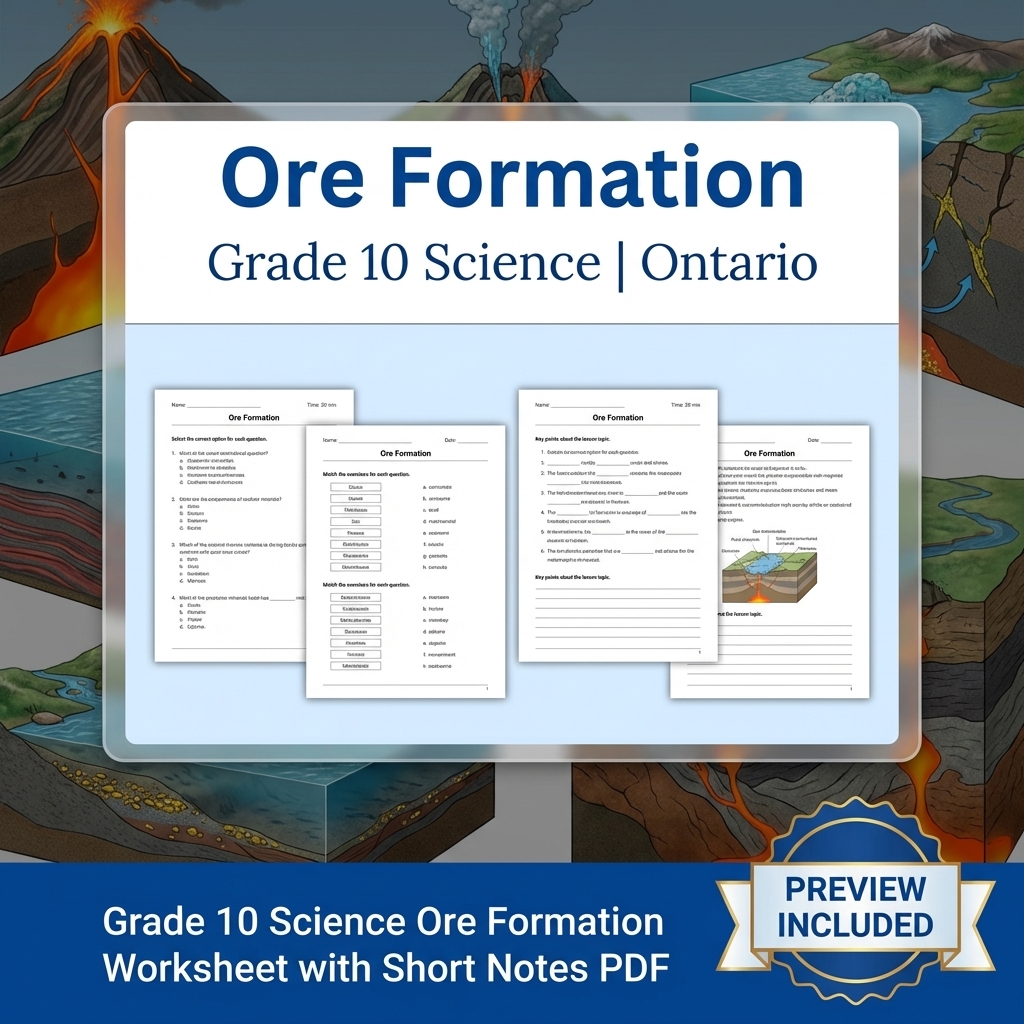
Grade 10 Science Ore Formation Worksheet with Short Notes PDF
Created byMeadowlark WorksheetsLearning Objectives
- Understand the principal processes involved in ore formation, including magmatic, hydrothermal, sedimentary, and metamorphic mechanisms.
- Identify the spatial controls and mineral assemblages associated with different ore deposits and tectonic settings.
- Describe how structural traps, permeability contrasts, and host-rock chemistry influence resource concentration.
Also included in: Grade 10 Science Lesson Group Bundle | Ontario Curriculum and STEM Topics +1 more
Instant download
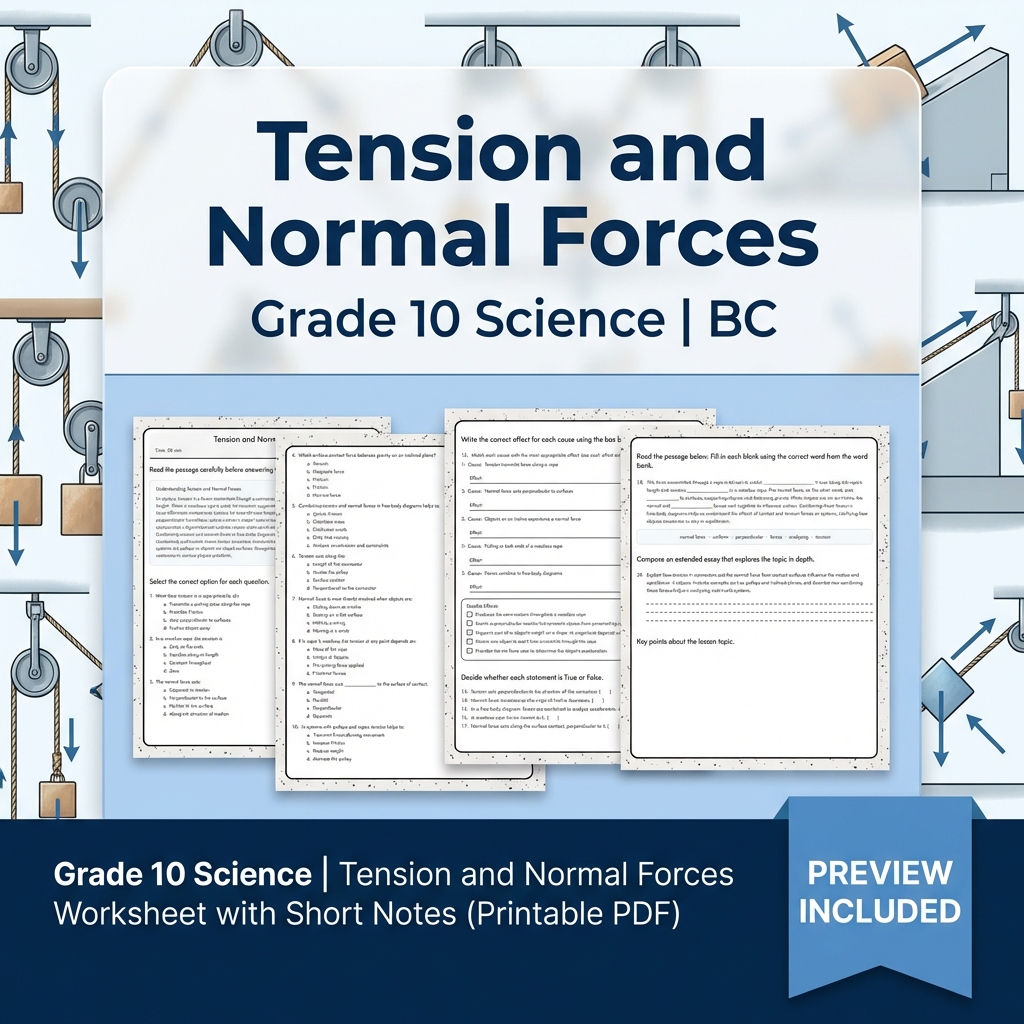
Grade 10 Science | Tension and Normal Forces Worksheet with Short Notes (PDF)
Created byMeadowlark WorksheetsLearning Objectives
- Understand how tension transmits forces along connectors and its uniform magnitude in massless ropes.
- Describe how the normal force arises from contact and acts perpendicular to surfaces.
- Explain how combining tension and normal forces helps analyze motion and constraints in physical systems.
Also included in: Grade 10 Science Lesson Bundle | Physics and Forces Worksheets | BC Framework +1 more
Instant download
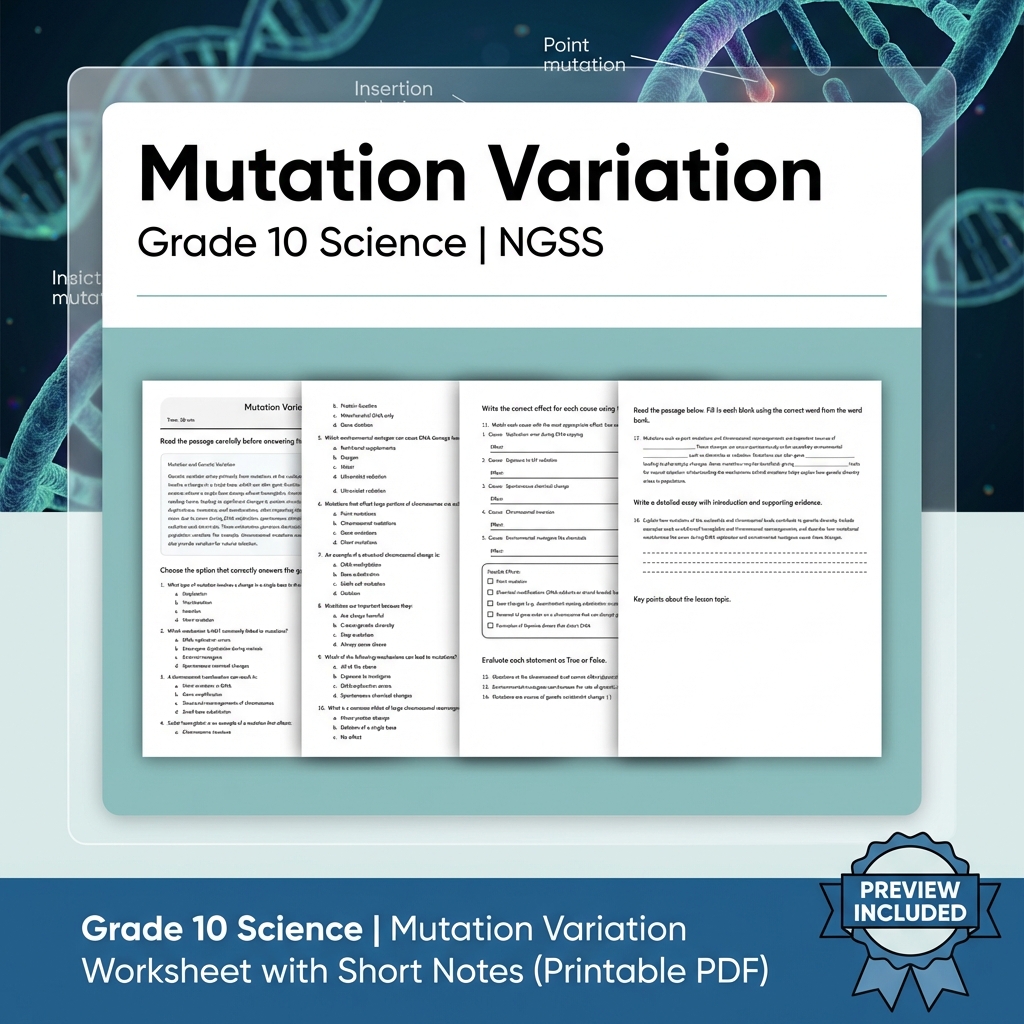
Grade 10 Science | Mutation Variation Worksheet with Short Notes (Printable PDF)
Created byMeadowlark WorksheetsLearning Objectives
- Understand how mutations at the nucleotide and chromosomal levels contribute to genetic variation.
- Identify different types of mutations including point mutations, insertions, deletions, and structural rearrangements.
- Explain how mutational mechanisms such as replication errors, chemical changes, and environmental factors cause genetic changes.
Also included in: Grade 10 Science | Heredity, Inheritance & Traits NGSS Unit Bundle (worksheets) +1 more
Instant download

Grade 10 Science | Earth Moon Sun Worksheet with Short Notes (Printable PDF)
Created byMeadowlark WorksheetsLearning Objectives
- Explain the mechanisms behind lunar phases, solar and lunar eclipses, and seasonal changes.
- Describe how the relative positions of Earth, Moon, and Sun influence tidal cycles.
- Understand how axial tilt and orbital inclination affect insolation and daylength variation.
Also included in: Grade 10 Science | Earth's Place in the Universe NGSS Unit Bundle (Worksheets) +1 more
Instant download
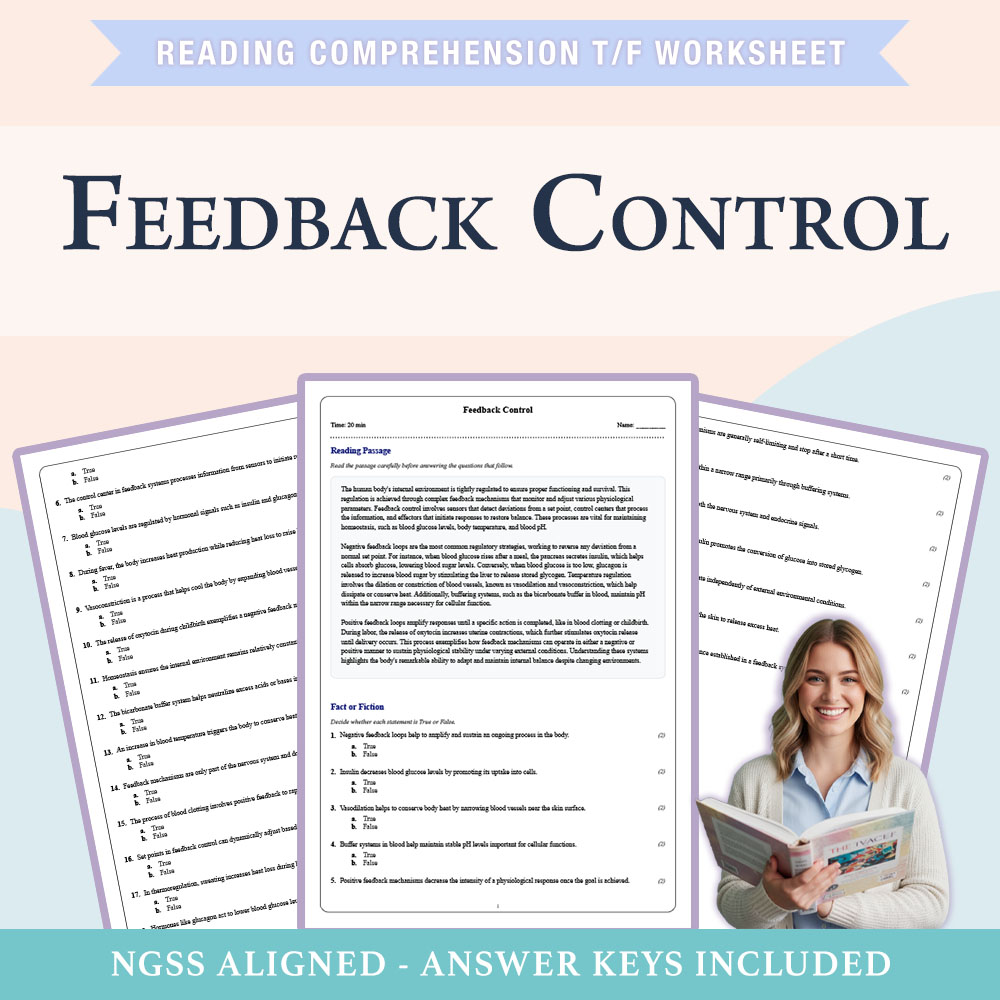
10th Grade Science | Feedback Control Worksheet (PDF + Answer Key)
 Created byCopper Leaf Classroom
Learning Objectives
- Understand the mechanisms of homeostasis and feedback loops in the human body.
- Identify examples of negative and positive feedback in physiological processes.
- Explain the roles of sensors, control centers, and effectors in maintaining internal stability.
Also included in: Grade 10 Science Bundle | Cellular Systems & Energy Pathways (PDF + Answer Key) +1 more
Instant download
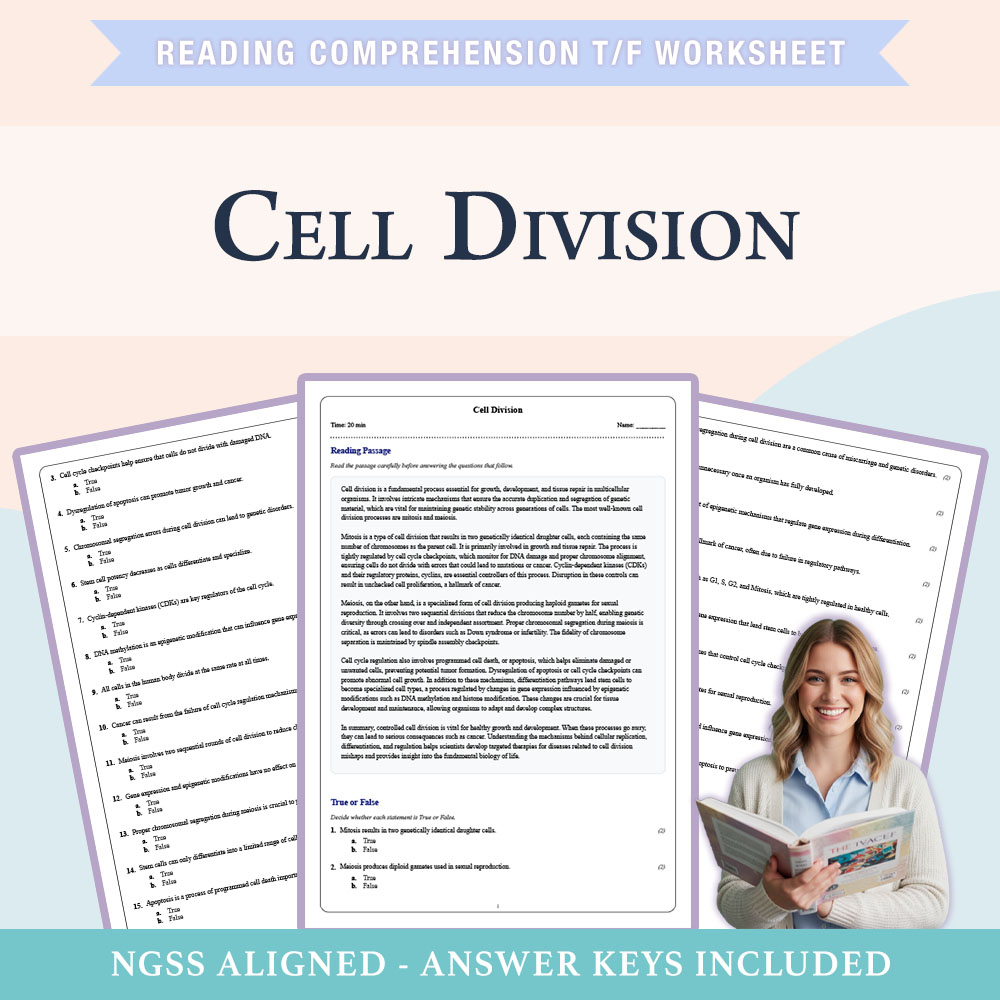
Grade 10 Science | Cell Division Worksheet (PDF + Answer Key)
Created byCopper Leaf ClassroomLearning Objectives
- Understand the processes of mitosis and meiosis and their roles in cellular replication.
- Identify mechanisms of cell cycle regulation and consequences of dysregulation such as cancer.
- Describe differentiation pathways and how gene expression and epigenetics influence cell fate.
Also included in: Grade 10 Science Bundle | Cellular Systems & Energy Pathways (PDF + Answer Key) +1 more
Instant download
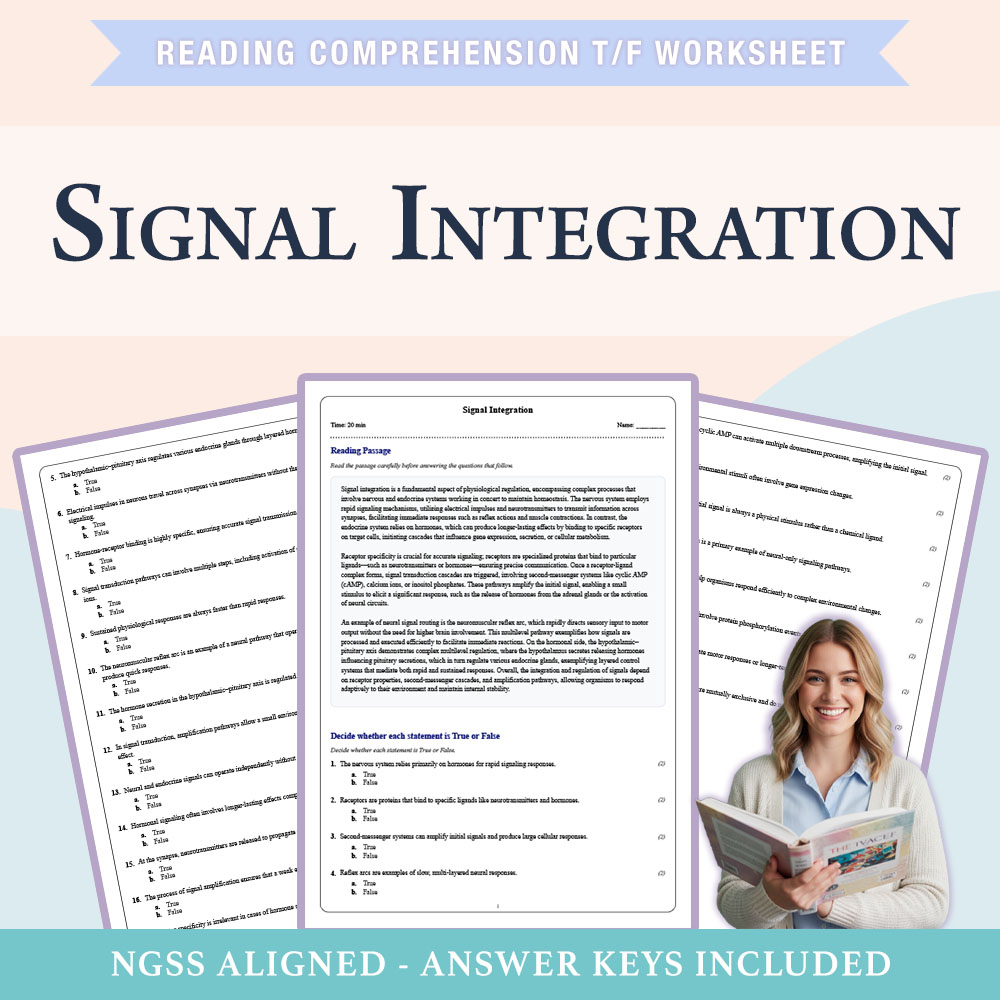
Grade 10 Science | Signal Integration Worksheet (PDF + Answer Key)
Created byCopper Leaf ClassroomLearning Objectives
- Explain the mechanisms of signal transduction in nervous and endocrine systems.
- Identify key components involved in receptor specificity and signal amplification.
- Describe examples of signal routing such as reflex arcs and hypothalamic–pituitary communication.
Also included in: Grade 10 Science Bundle | Cellular Systems & Energy Pathways (PDF + Answer Key) +1 more
Instant download
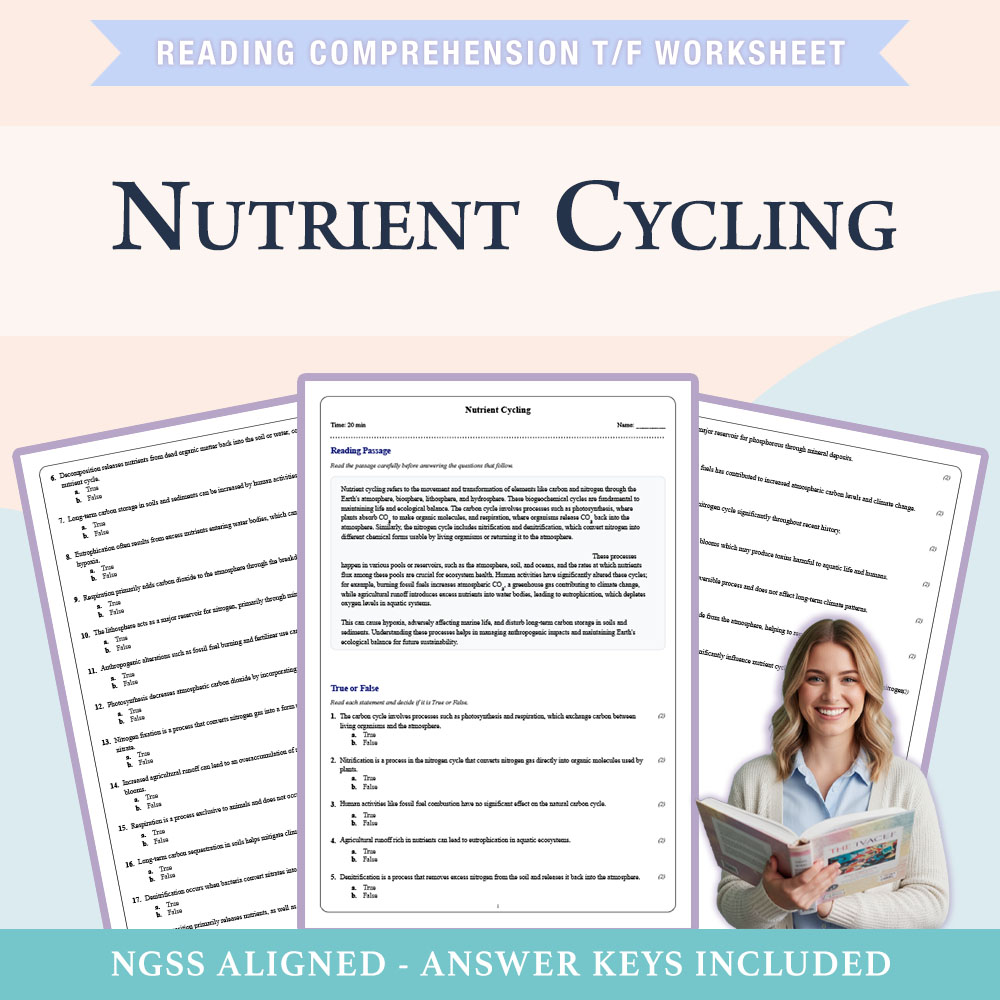
Grade 10 Science | Nutrient Cycling Worksheet (PDF + Answer Key)
Created byCopper Leaf ClassroomLearning Objectives
- Understand major biogeochemical cycles, including carbon and nitrogen fluxes across Earth's spheres.
- Recognize processes such as photosynthesis, respiration, nitrification, denitrification, and decomposition.
- Appreciate human impacts like fossil fuel combustion and agricultural runoff on nutrient reservoirs and flux rates.
Also included in: Grade 10 Science Unit | Ecosystem Dynamics & Biodiversity (PDF +Answer Key) +1 more
Instant download
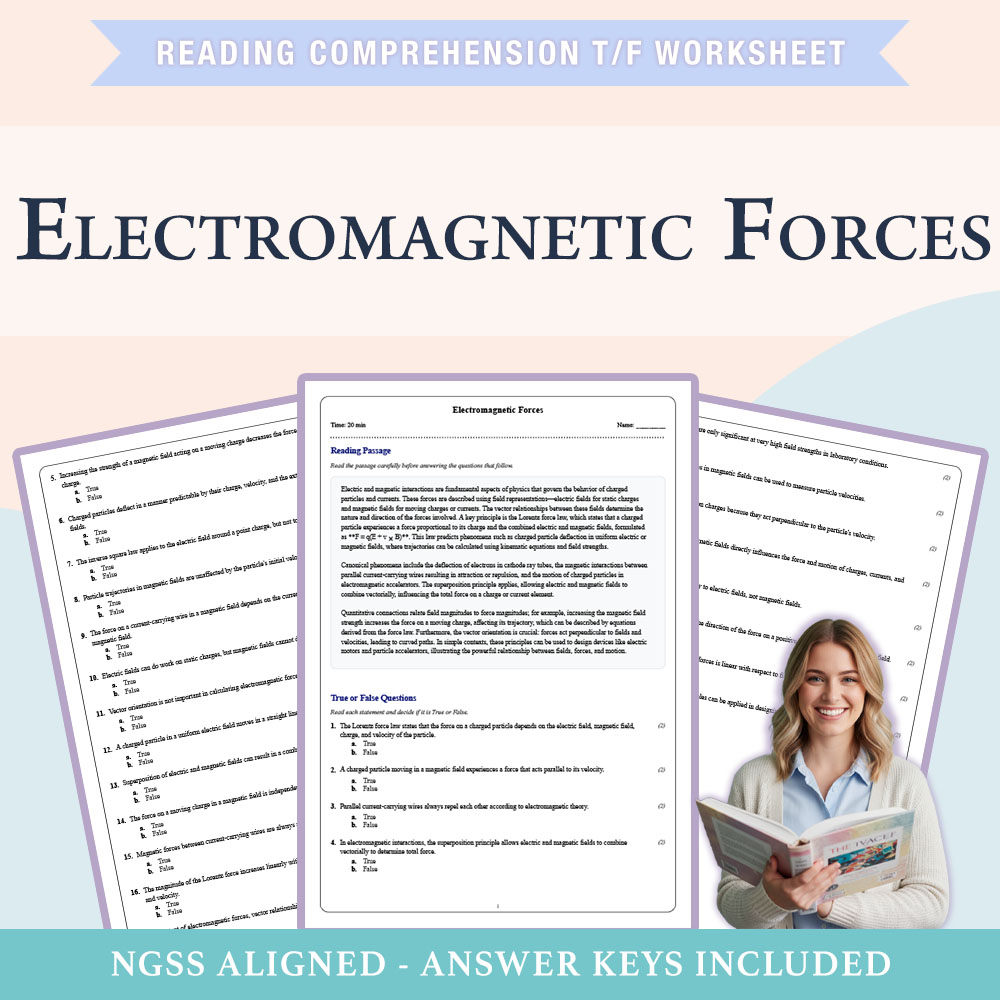
Grade 10 Science | Electromagnetic Forces Worksheet (PDF + Answer Key)
Created byCopper Leaf ClassroomLearning Objectives
- Understand how electric and magnetic fields influence charges and currents.
- Identify phenomena involving electromagnetic forces, such as particle deflection and wire interactions.
- Explain the Lorentz force law and its applications in simple contexts.
Also included in: Grade 10 Science Bundle | Forces, Motion & Fields Worksheets (PDF + Answer Keys) +1 more
Instant download
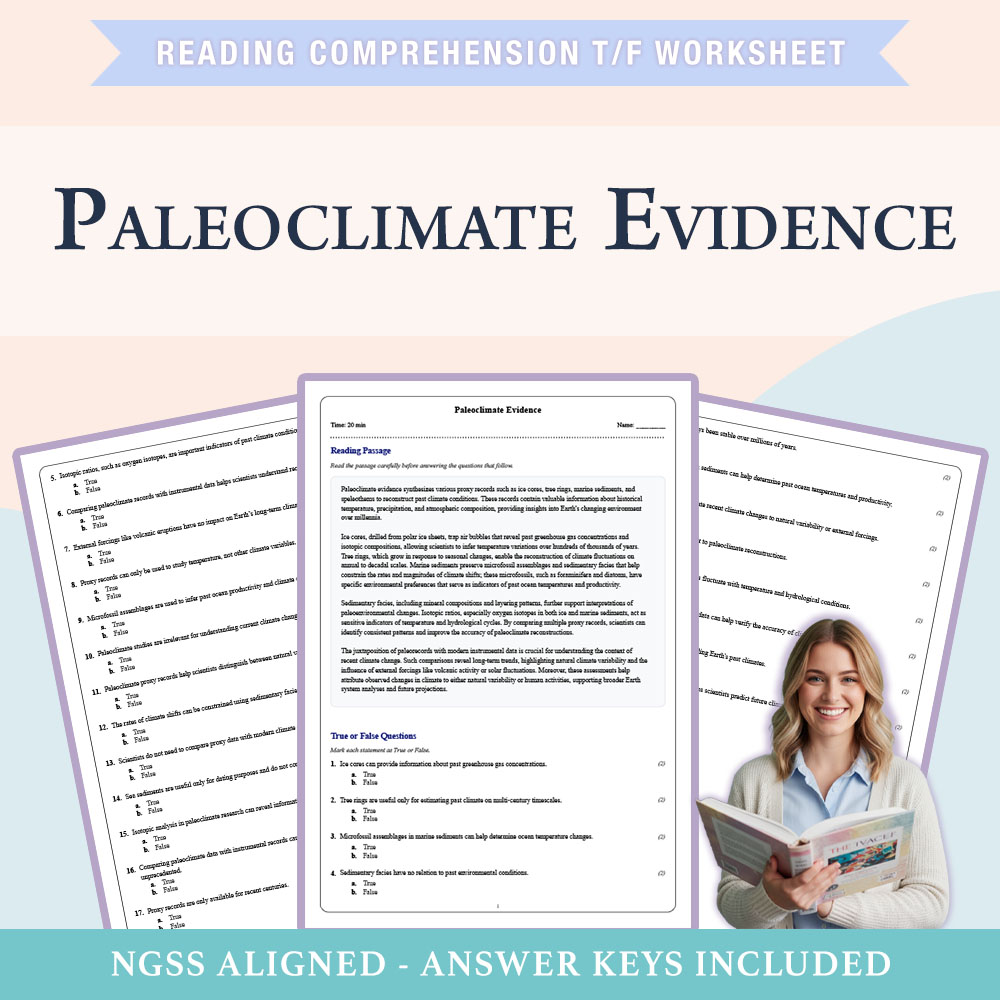
Grade 10 Science | Paleoclimate Evidence Worksheet (PDF +Answer Key)
Created byCopper Leaf ClassroomLearning Objectives
- Understand the methods used to reconstruct past climate conditions through proxy records.
- Explain how isotopic ratios, microfossil assemblages, and sedimentary features help interpret climate shifts.
- Analyze the importance of comparing paleorecords with instrumental data for understanding recent climate trends.
Also included in: Grade 10 Science | Earth Systems & Climate Change Bundle (PDF + Answer Key) +1 more
Instant download
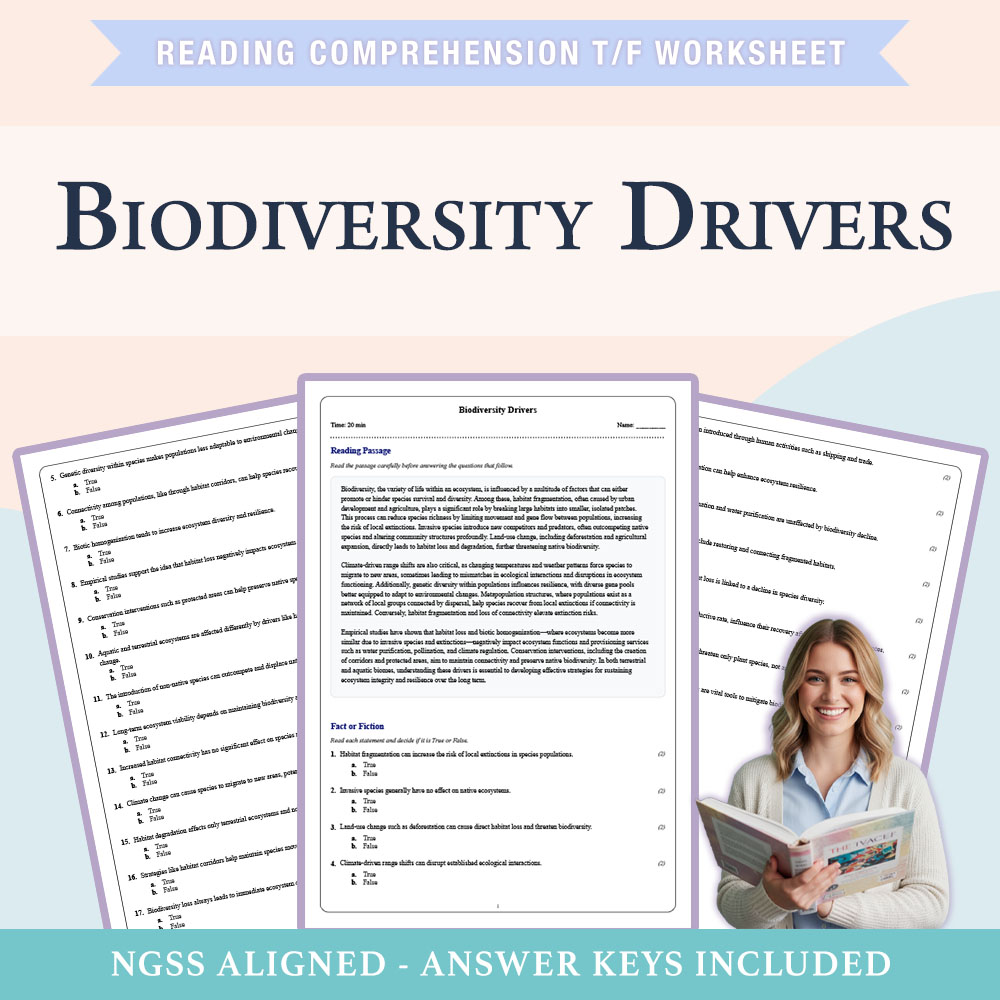
Grade 10 Science | Biodiversity Drivers Worksheet (PDF + Answer Key)
Created byCopper Leaf ClassroomLearning Objectives
- Understand the key factors influencing species richness and ecosystem composition.
- Evaluate the impact of habitat fragmentation, invasive species, land-use changes, and climate shifts on biodiversity.
- Analyze the mechanisms that mediate extinction risk and recovery in various ecosystems.
Also included in: Grade 10 Science Unit | Ecosystem Dynamics & Biodiversity (PDF +Answer Key) +1 more
Instant download
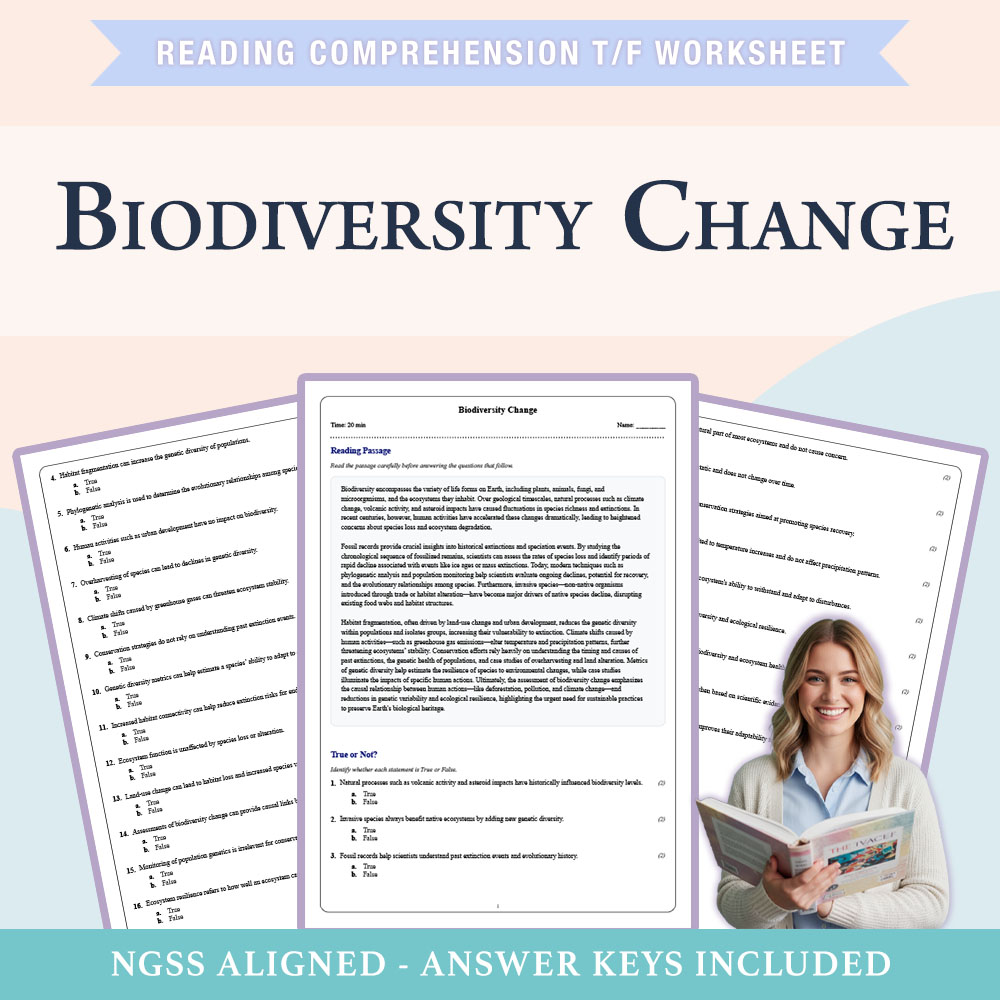
Grade 10 Science | Biodiversity Change Worksheet (PDF + Answer Key)
Created byCopper Leaf ClassroomLearning Objectives
- Understand the factors influencing biodiversity loss and recovery.
- Identify the role of fossil records, invasive species, and habitat fragmentation in ecosystem changes.
- Explore conservation strategies based on scientific evidence and case studies.
Also included in: Grade 10 Science | Evolution & Biodiversity Unit Bundle (PDF + Answer Key) +1 more
Instant download
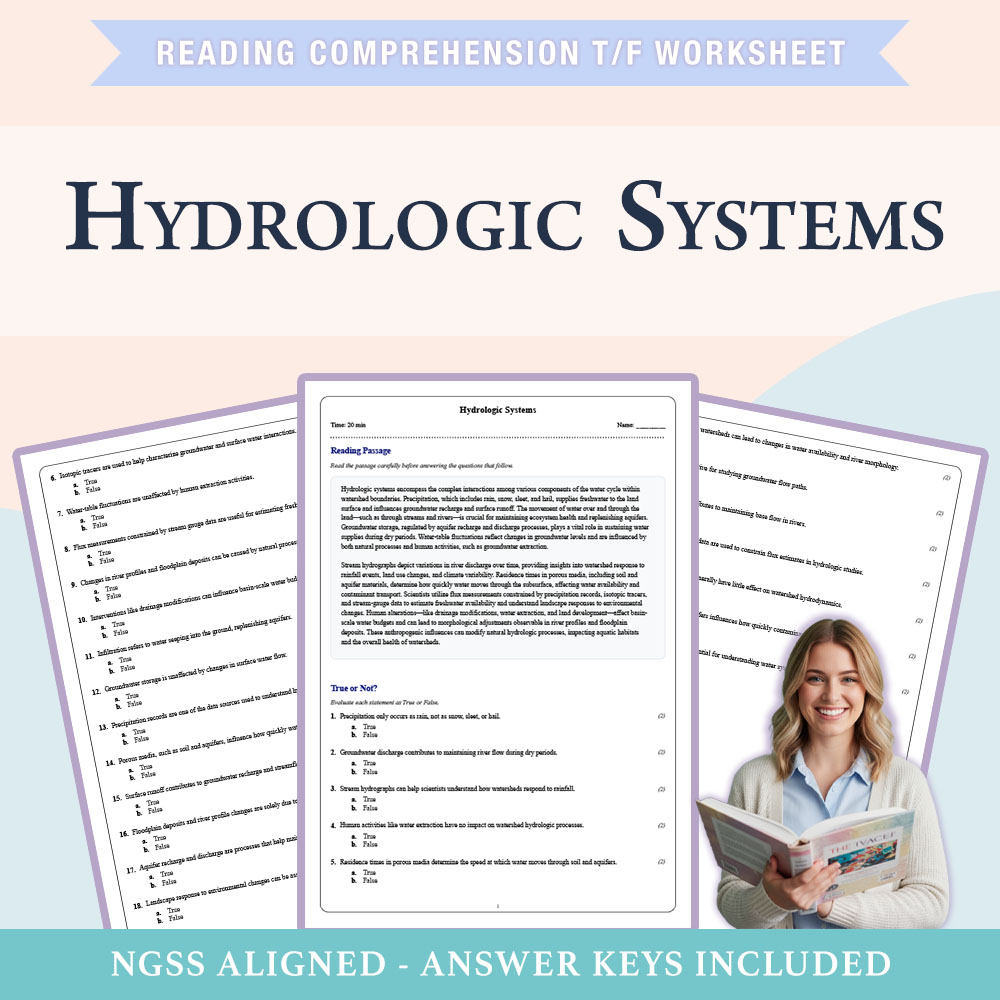
Grade 10 Science | Hydrologic Systems Worksheet (PDF +Answer Key)
Created byCopper Leaf ClassroomLearning Objectives
- Understand the components and interactions within hydrologic systems, including precipitation, runoff, and groundwater.
- Recognize human impacts on watershed processes and their effects on water availability and landscape features.
- Interpret data sources such as stream gauges and isotopic tracers used to analyze freshwater resources.
Also included in: Grade 10 Science | Earth Systems & Climate Change Bundle (PDF + Answer Key) +1 more
Instant download
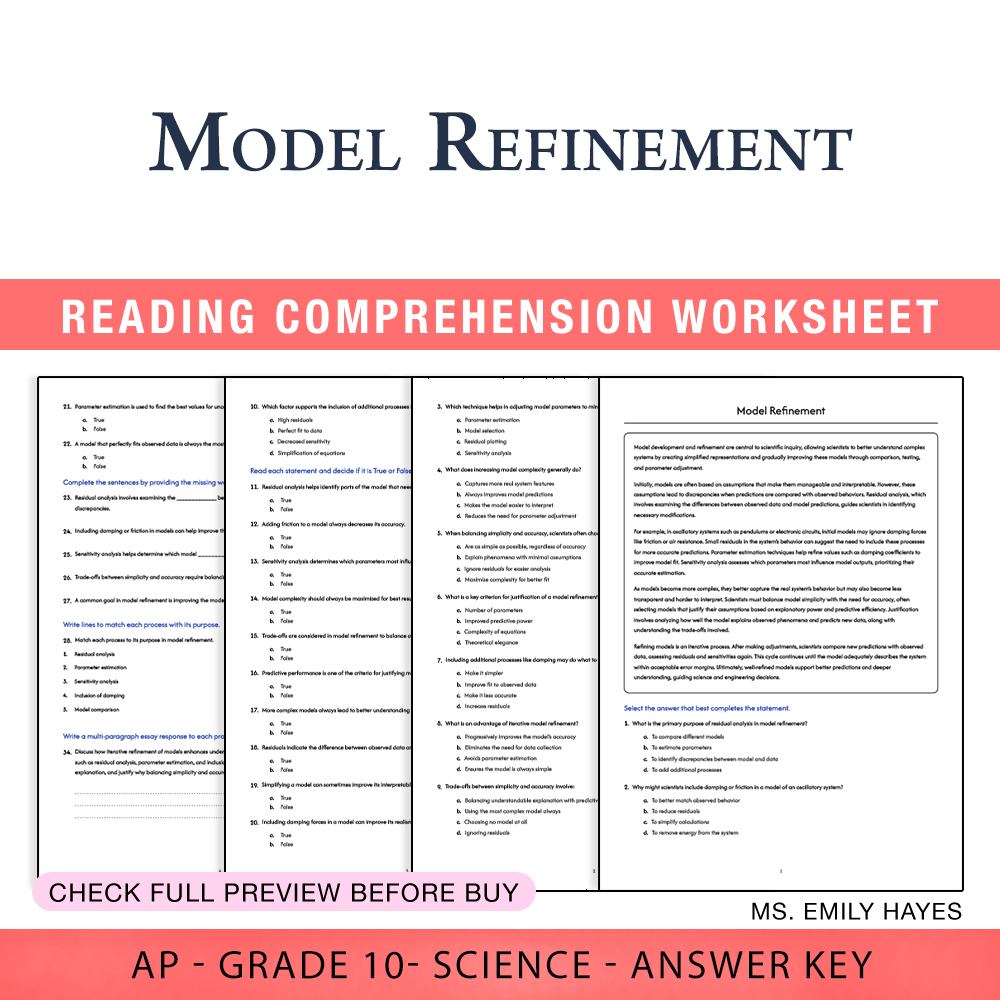
10th Grade Science | Model Refinement Worksheet (PDF+ Answer Key)
Created byCopper Leaf ClassroomLearning Objectives
- Understand the iterative process of model refinement based on observed data and residual analysis.
- Learn how to estimate and adjust parameters in physical and mathematical models.
- Identify additional processes such as damping or friction to improve model accuracy.
Also included in: Grade 10 Science AP | Data Analysis & Modeling Skills (PDF + Answer Key) +1 more
Instant download
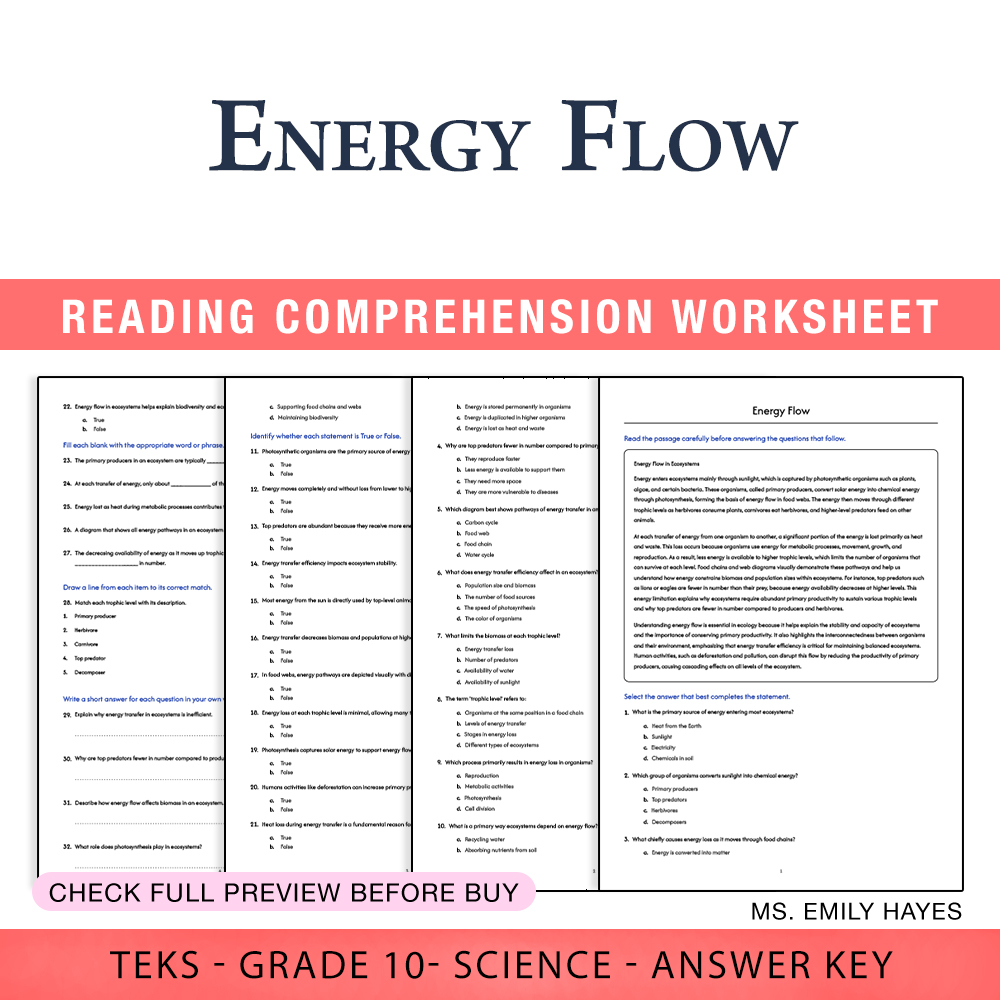
Grade 10 Science | Energy Flow Worksheet (PDF+ Answer Key)
Created byCopper Leaf ClassroomLearning Objectives
- Understand how energy enters and moves through ecosystems via trophic levels.
- Explain the concept of energy transfer and loss in food chains and webs.
- Describe the relationship between energy flow, biomass, and population sizes.
Instant download
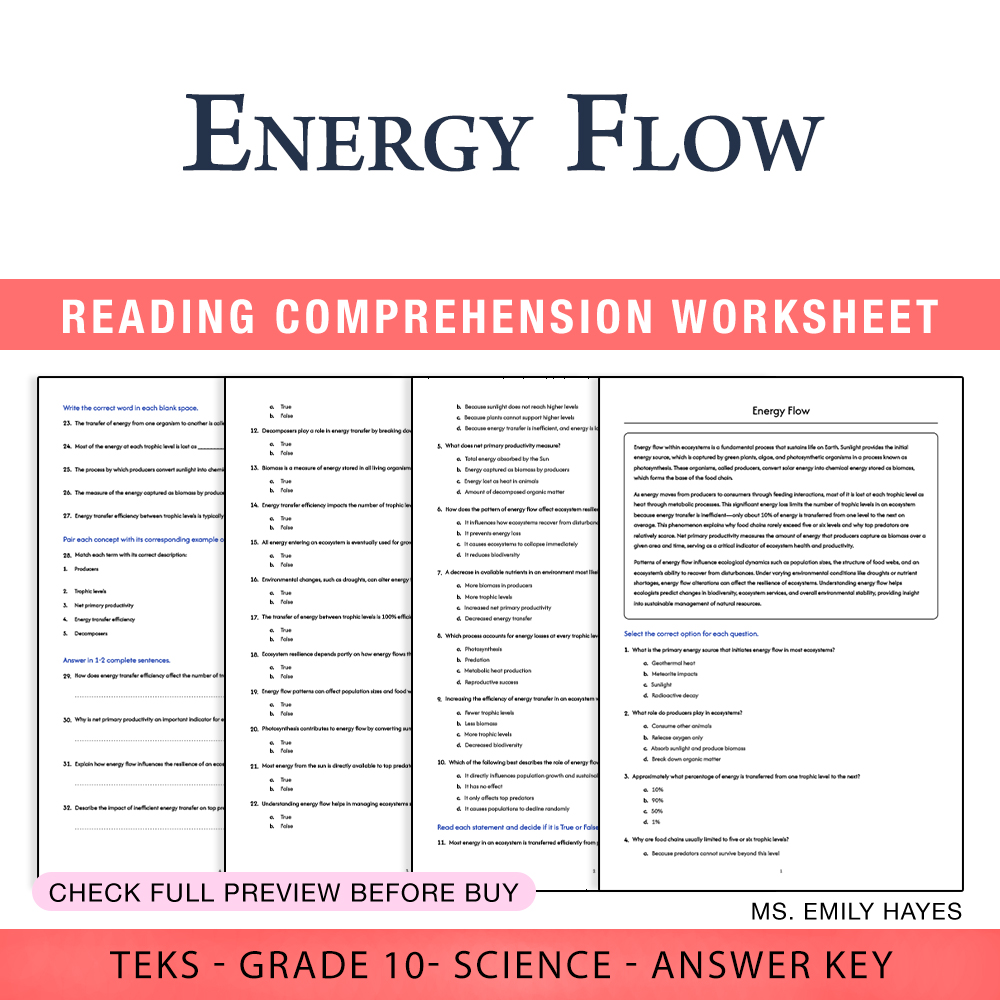
10th Grade Science | Energy Flow Worksheet (PDF+ Answer Key)
Created byCopper Leaf ClassroomLearning Objectives
- Describe how energy flows through ecosystems from sunlight to various trophic levels.
- Explain the concept of energy transfer efficiency and its effects on ecological populations and food webs.
- Identify the role of net primary productivity in ecosystems.
Instant download
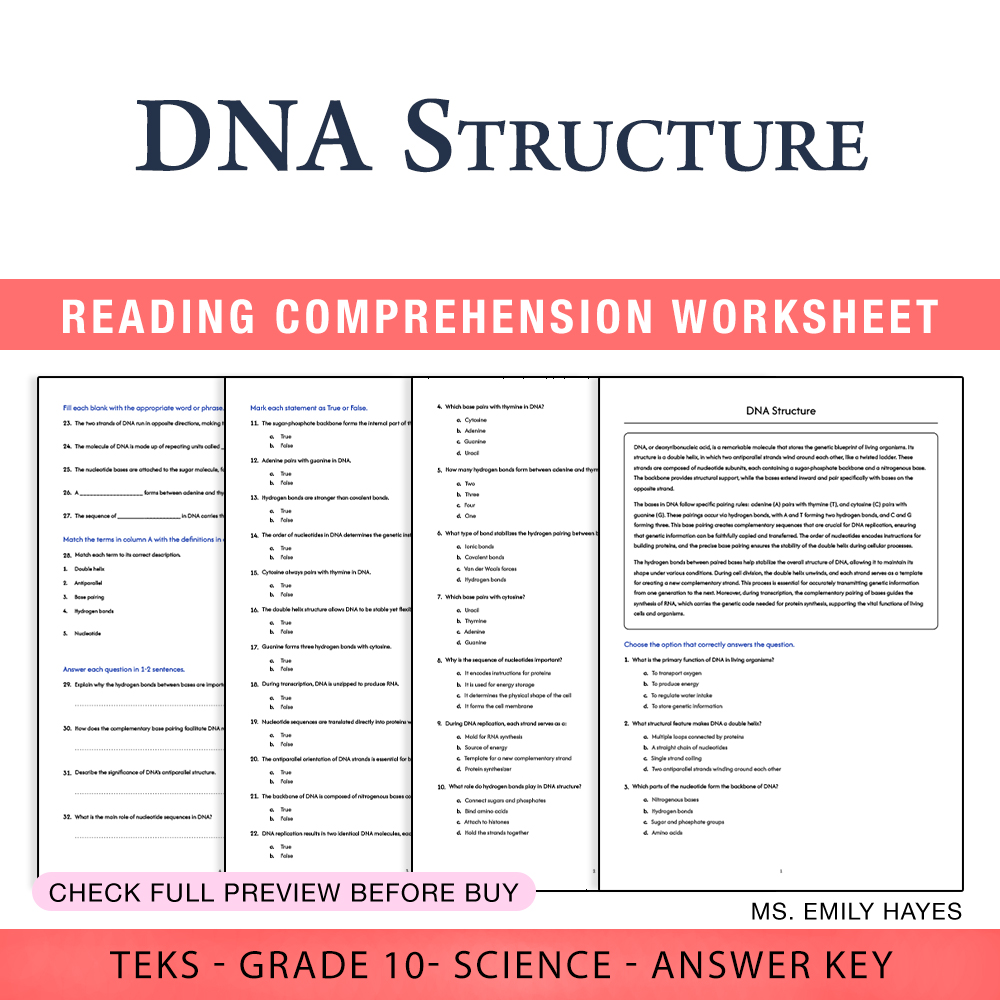
10th Grade Science | DNA Structure Worksheet (PDF+ Answer Key)
Created byCopper Leaf ClassroomLearning Objectives
- Describe the double helix structure of DNA and its components.
- Explain the base pairing rules and their significance in genetic information.
- Understand how hydrogen bonds stabilize the DNA double helix.
Instant download
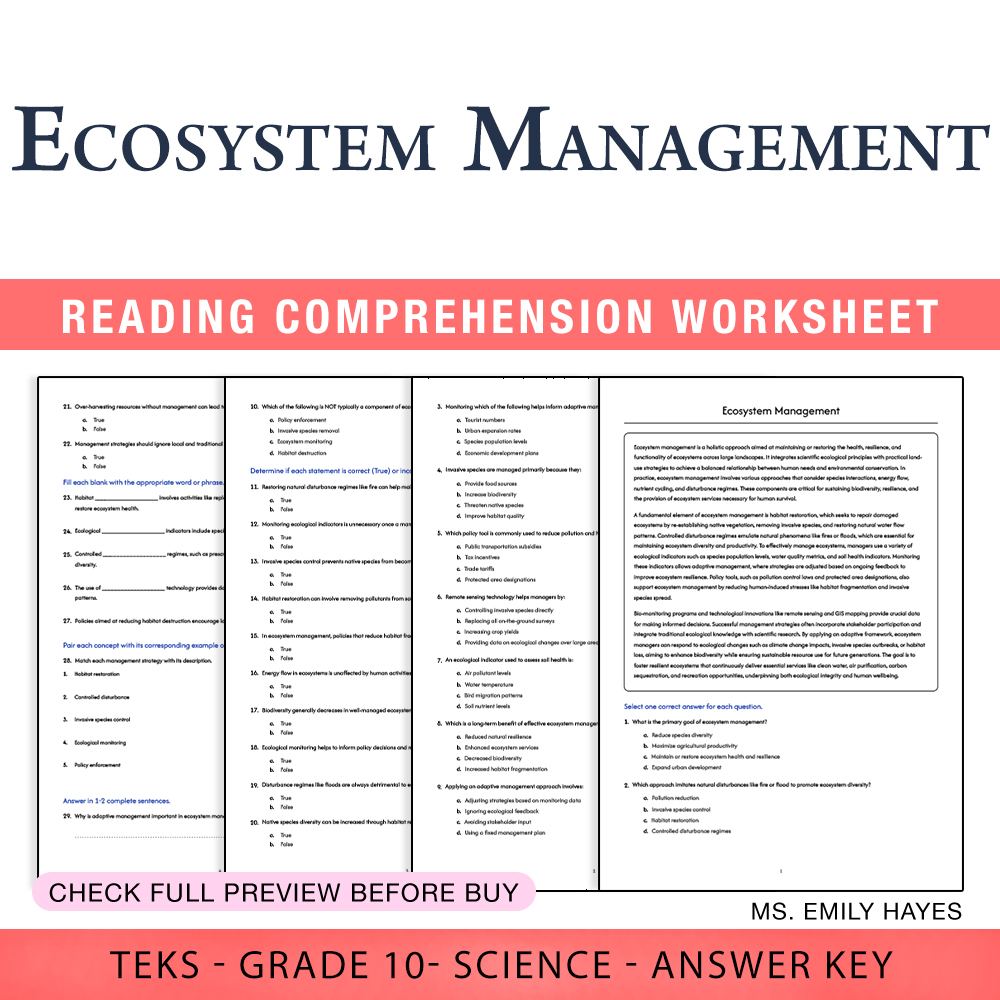
Grade 10 Science | Ecosystem Management Worksheet (PDF+ Answer Key)
Created byCopper Leaf ClassroomLearning Objectives
- Understand the principles and strategies used in ecosystem management.
- Identify various ecological components such as species interactions, energy flow, and nutrient cycles.
- Evaluate management approaches including habitat restoration and controlling invasive species.
Instant download
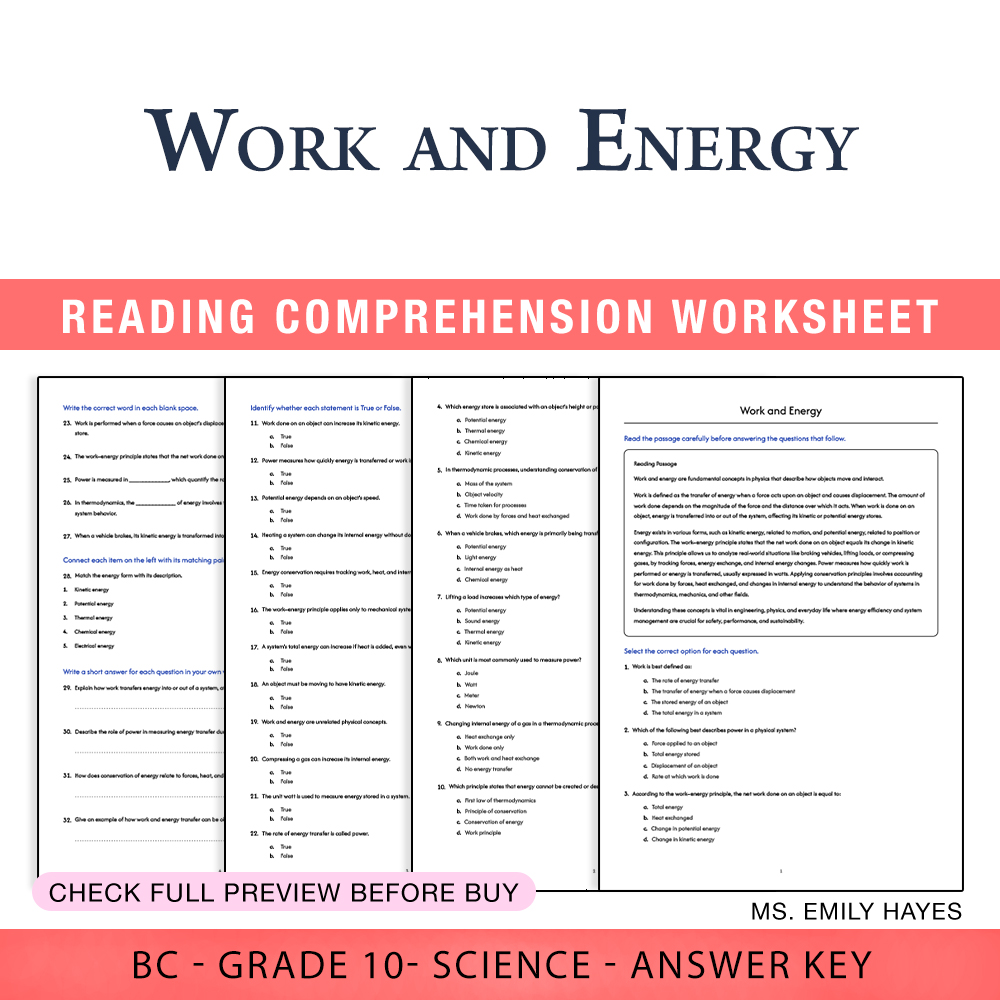
Grade 10 Science | Work and Energy Worksheet (PDF + Answer Key)
Created byCopper Leaf ClassroomLearning Objectives
- Explain the relationship between work and energy transfer in physical systems.
- Apply the work–energy principle to analyze different scenarios involving forces and motion.
- Calculate power as the rate of energy transfer in various applications.
Also included in: Grade 10 Science BC – Energy, Thermodynamics & Ecosystems (PDF + Answer Key) +1 more
Instant download
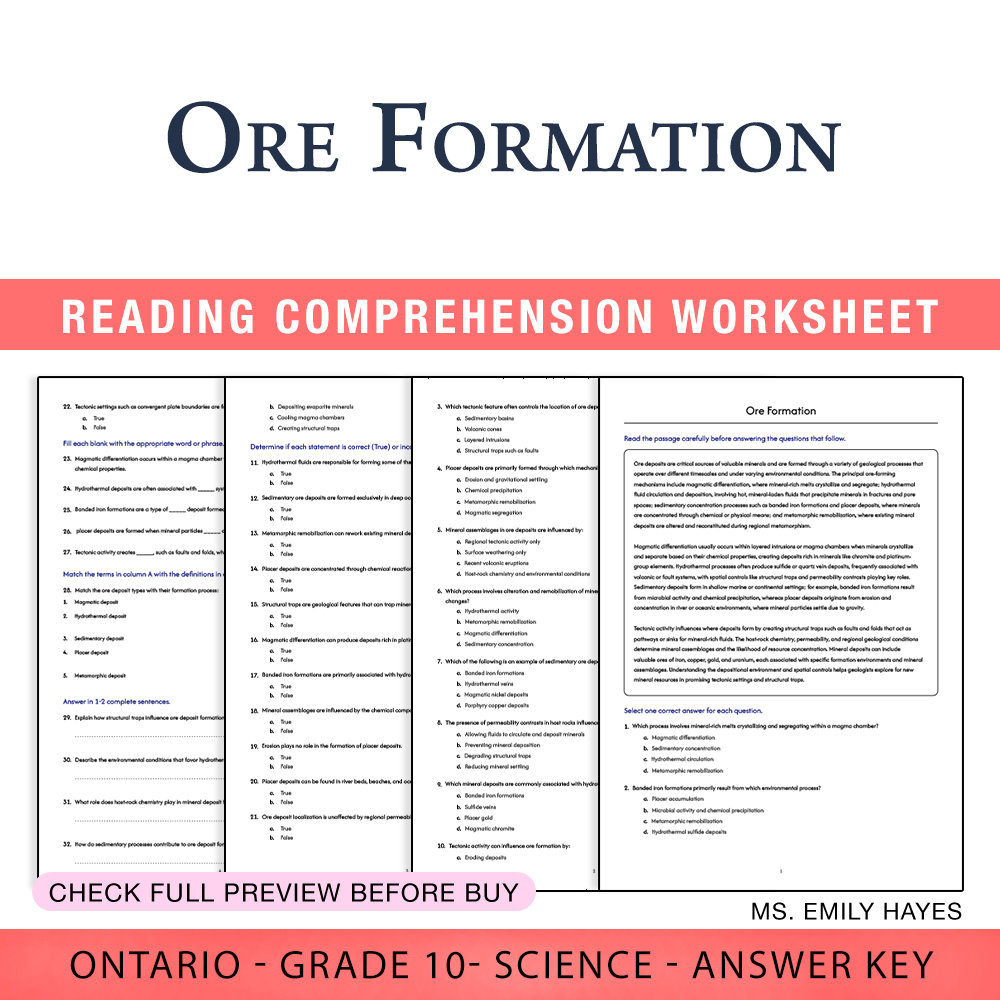
Grade 10 Science | Ore Formation Worksheet (PDF + Answer Key)
Created byCopper Leaf ClassroomLearning Objectives
- Describe the principal processes involved in ore formation including magmatic, hydrothermal, sedimentary, and metamorphic mechanisms.
- Identify the spatial controls such as structural traps, permeability contrasts, and host-rock chemistry that influence ore deposit localization.
- Recognize and explain typical mineral assemblages associated with different ore deposit types and tectonic settings.
Instant download
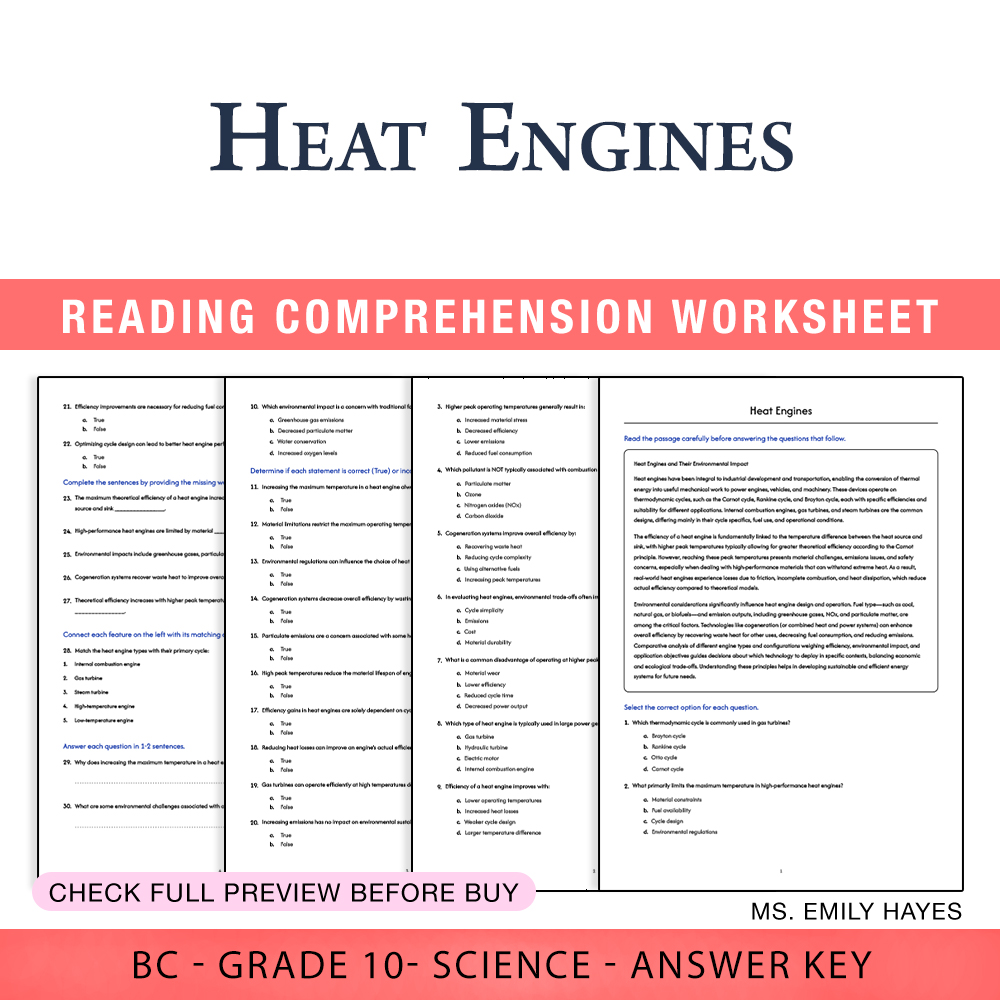
Grade 10 Science | Heat Engines Concept Worksheet (PDF + Answer Key)
Created byCopper Leaf ClassroomLearning Objectives
- Explain how heat engines convert thermal energy into mechanical work.
- Identify different types of heat engines and their designs.
- Analyze factors affecting the efficiency of heat engines, including temperature differences and cycle design.
Also included in: Grade 10 Science BC – Energy, Thermodynamics & Ecosystems (PDF + Answer Key) +1 more
Instant download
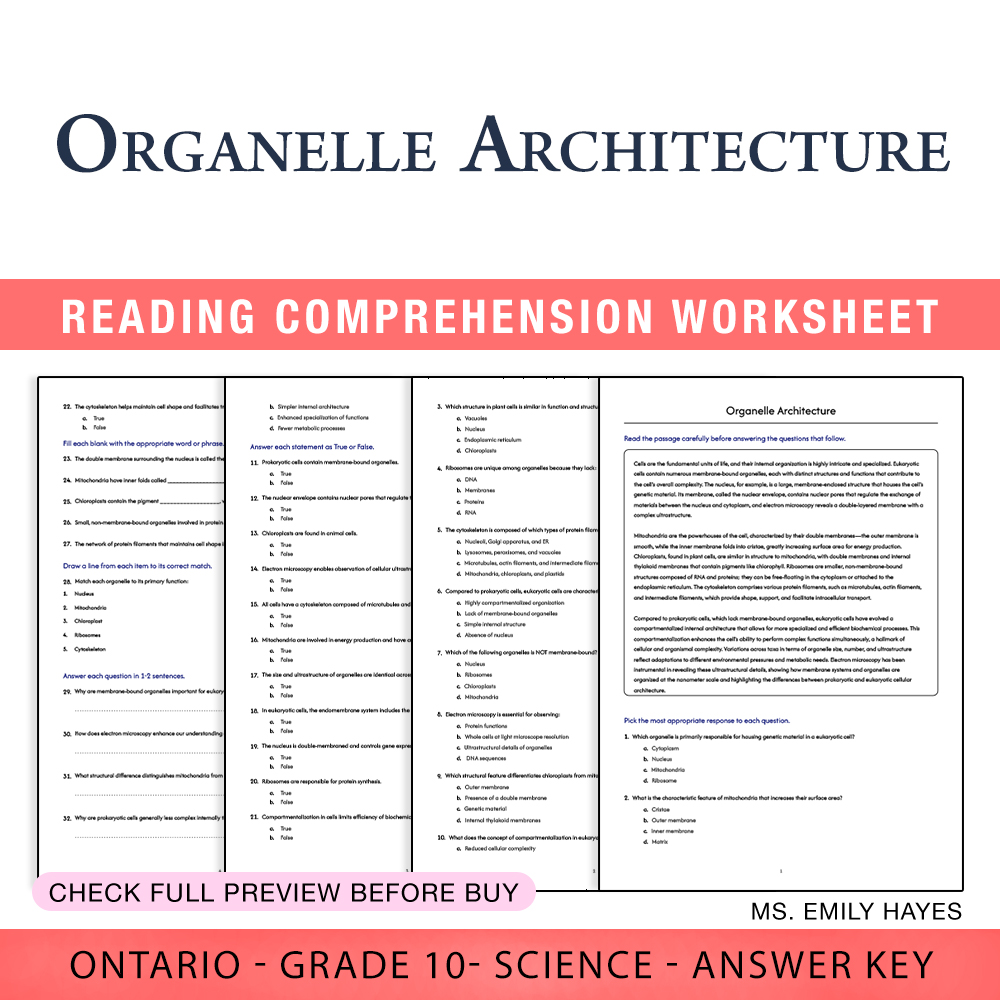
Grade 10 Science | Organelle Architecture Worksheet (PDF + Answer Key)
Created byCopper Leaf ClassroomLearning Objectives
- Describe the major cellular organelles and membrane-bound compartments, emphasizing their structural characteristics and ultrastructure.
- Compare the internal organization of prokaryotic and eukaryotic cells, focusing on compartmentalization and morphological differences.
- Explain how cellular compartmentalization contributes to cellular complexity and function observed across different taxa.
Instant download
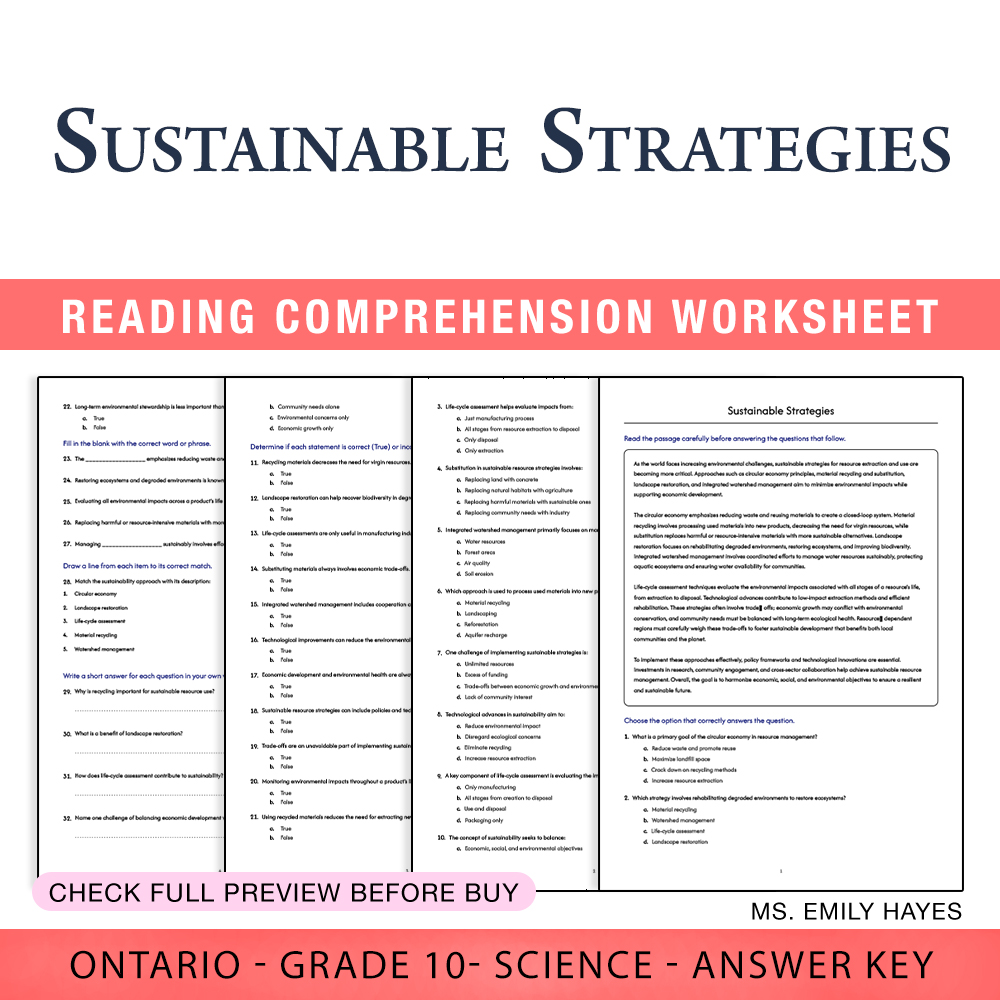
Grade 10 Science | Sustainable Strategies Worksheet (PDF + Answer Key)
Created byCopper Leaf ClassroomLearning Objectives
- Understand key approaches for reducing the environmental footprint of resource extraction and use.
- Describe principles of circular economy, recycling, substitution, and landscape restoration.
- Analyze trade-offs between economic development, community needs, and environmental stewardship in resource-dependent regions.
Instant download
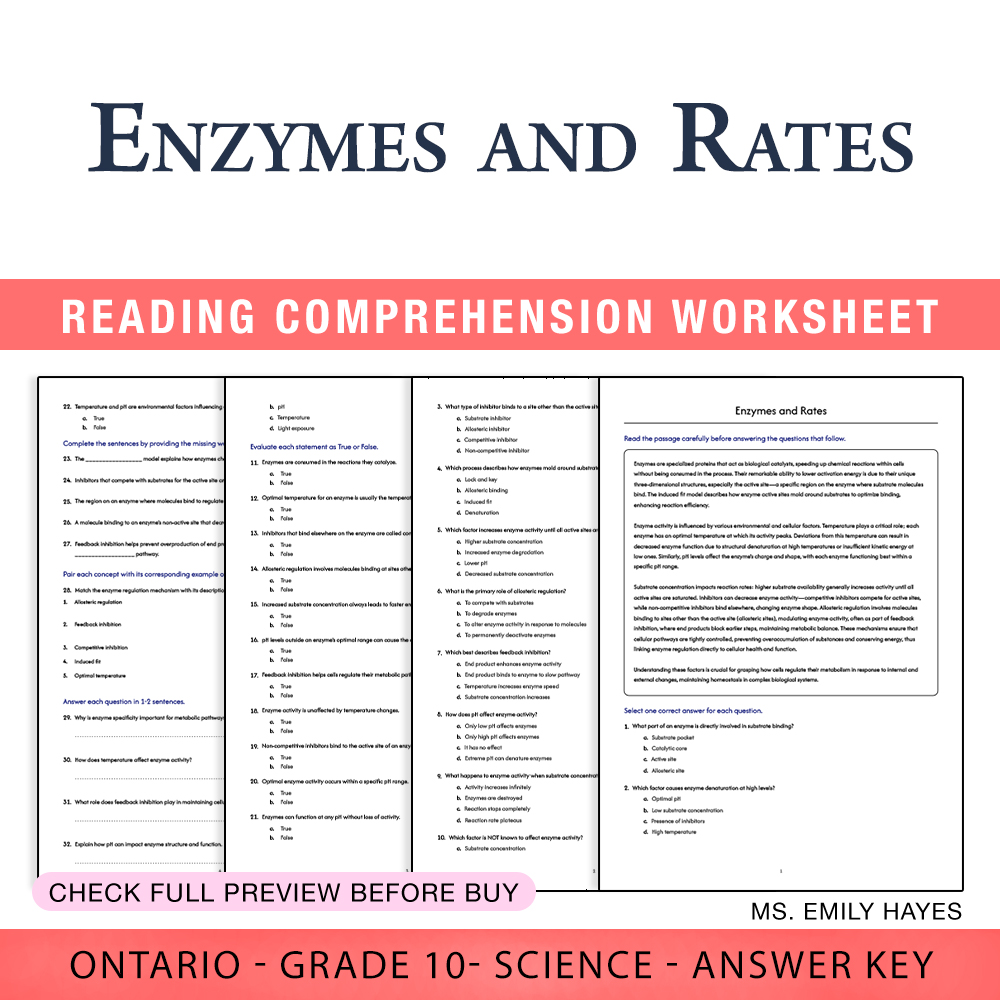
Grade 10 Science | Enzymes and Rates Worksheet (PDF + Answer Key)
Created byCopper Leaf ClassroomLearning Objectives
- Describe the properties and functions of enzymes in biological systems.
- Explain how factors like temperature, pH, substrate concentration, and inhibitors affect enzyme activity.
- Discuss mechanisms like allosteric regulation and feedback inhibition and their roles in metabolic pathways.
Instant download
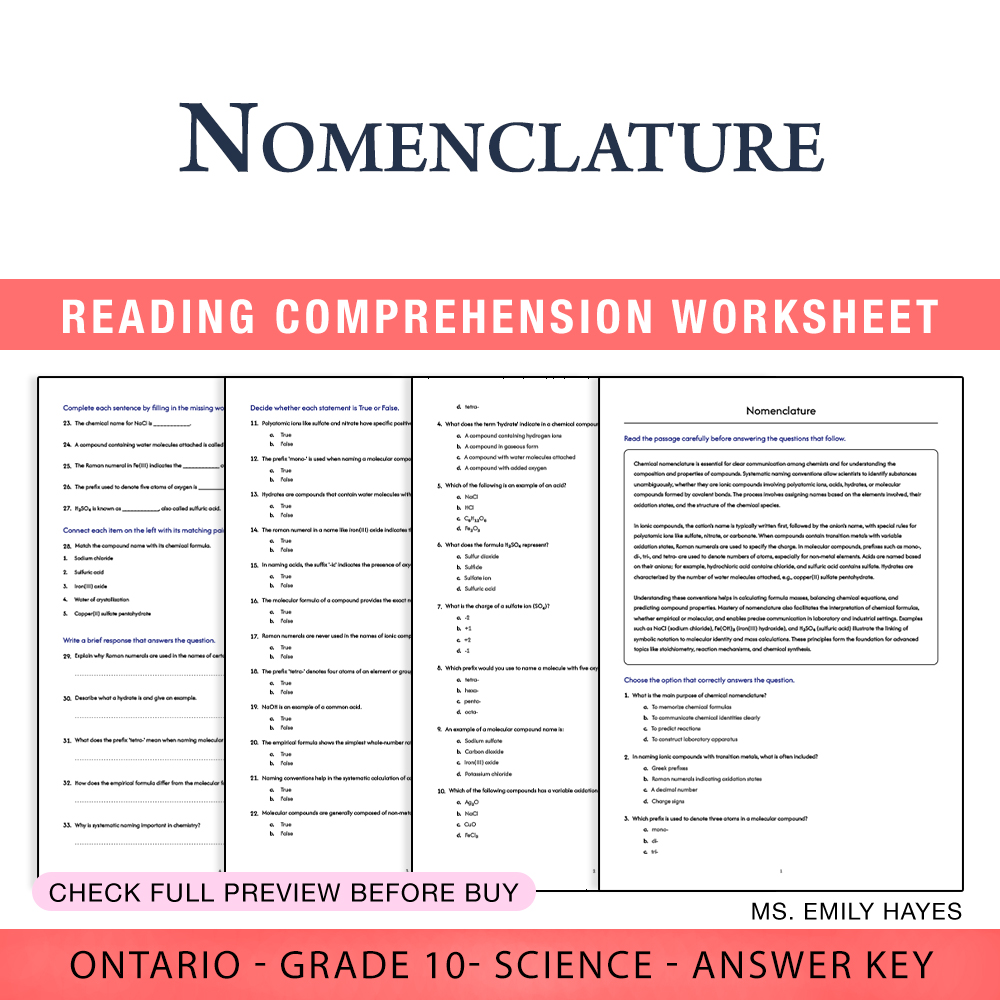
Grade 10 Science | Nomenclature Worksheet (PDF + Answer Key)
Created byCopper Leaf ClassroomLearning Objectives
- Understand and apply systematic naming conventions for ionic and molecular compounds.
- Identify and name polyatomic ions, acids, hydrates, and compounds with variable oxidation states.
- Construct and interpret empirical and molecular formulas based on charge balance and formula mass.
Instant download
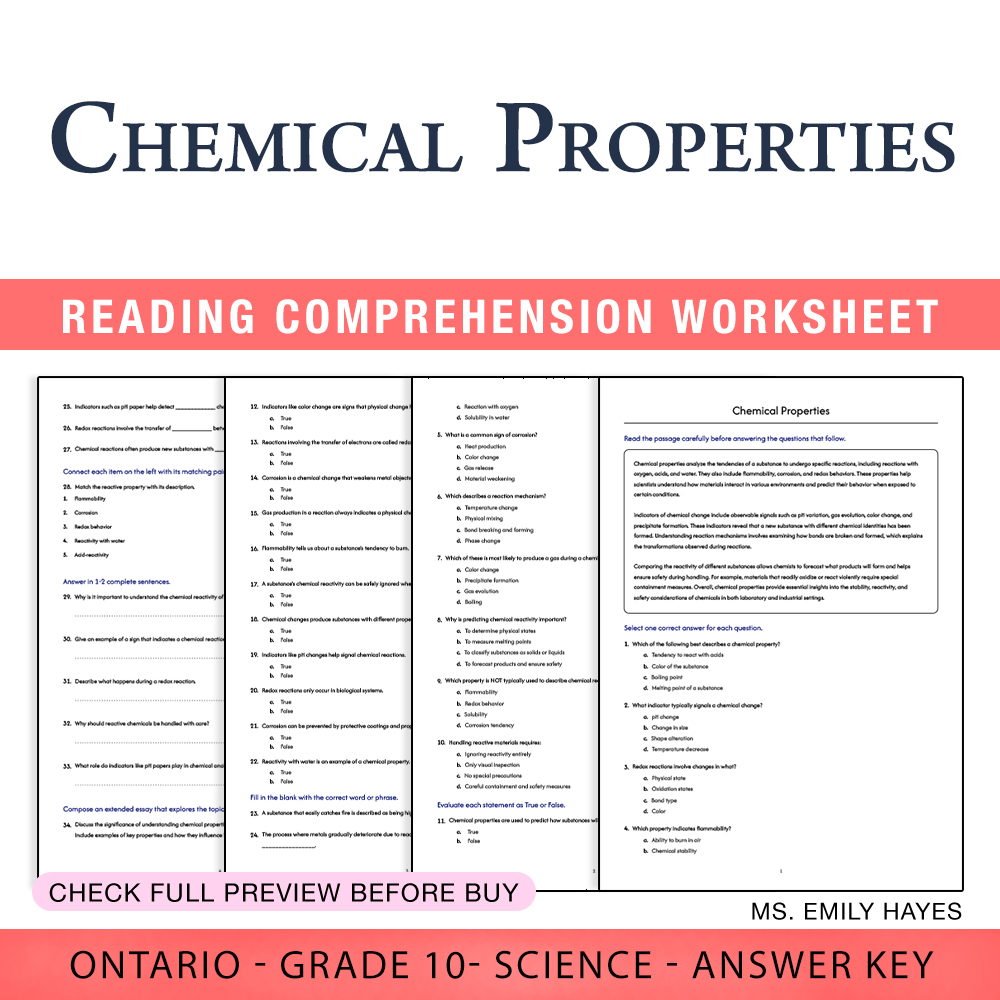
Grade 10 Science | Chemical Properties Worksheet (PDF + Answer Key)
Created byCopper Leaf ClassroomLearning Objectives
- Understand and describe the key chemical properties such as reactivity with oxygen, acids, and water.
- Identify signs of chemical change, including indicators like pH changes and gas evolution.
- Explain reaction mechanisms and bonding changes during chemical transformations.
Instant download
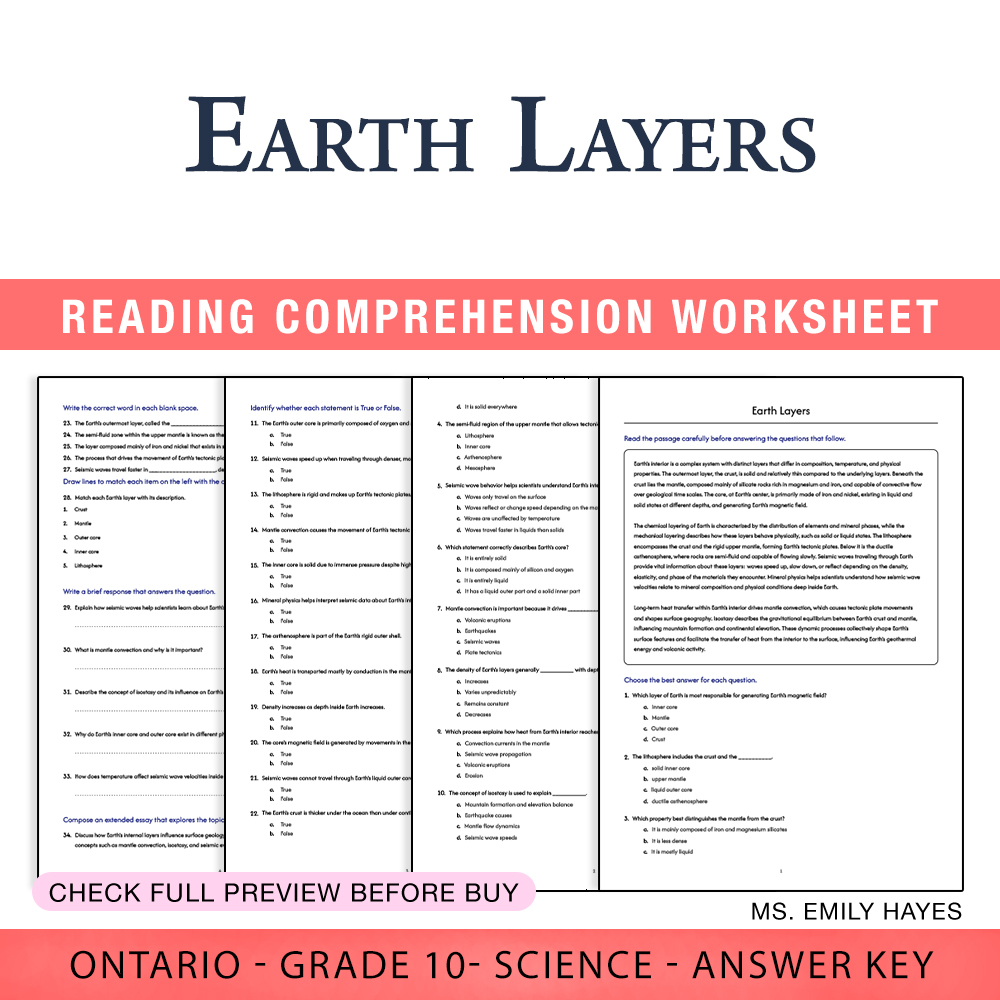
Grade 10 Science | Earth Layers Worksheet (PDF + Answer Key)
Created byCopper Leaf ClassroomLearning Objectives
- Describe the different layers of Earth's internal structure, including the crust, mantle, and core.
- Explain the mechanical and chemical layering of Earth and how seismic waves reveal these layers.
- Understand the concepts of lithosphere, asthenosphere, and the role of density, temperature, and composition in Earth's interior.
Instant download
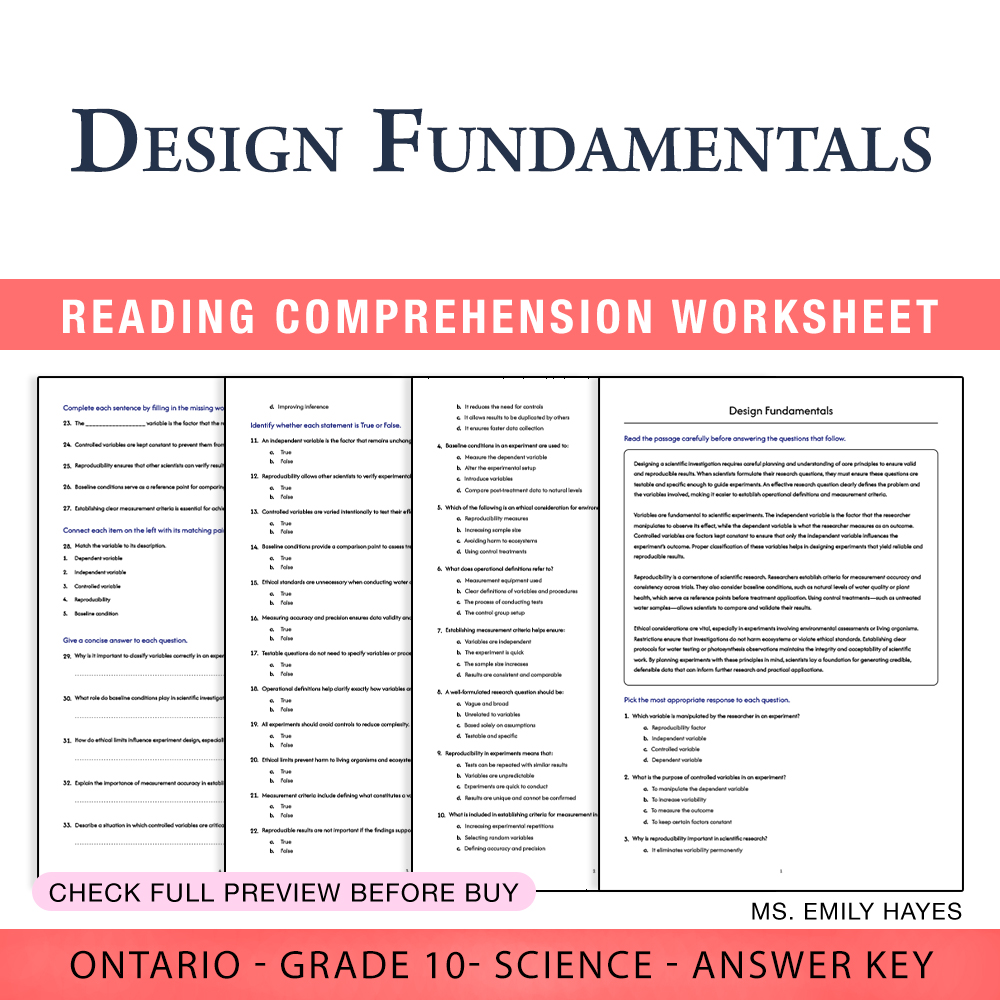
Grade 10 Science | Design Fundamentals Worksheet (PDF + Answer Key)
Created byCopper Leaf ClassroomLearning Objectives
- Understand core principles for formulating testable questions and operational definitions.
- Distinguish between independent, dependent, and controlled variables in scientific investigations.
- Identify criteria for ensuring reproducibility and measurement consistency.
Instant download
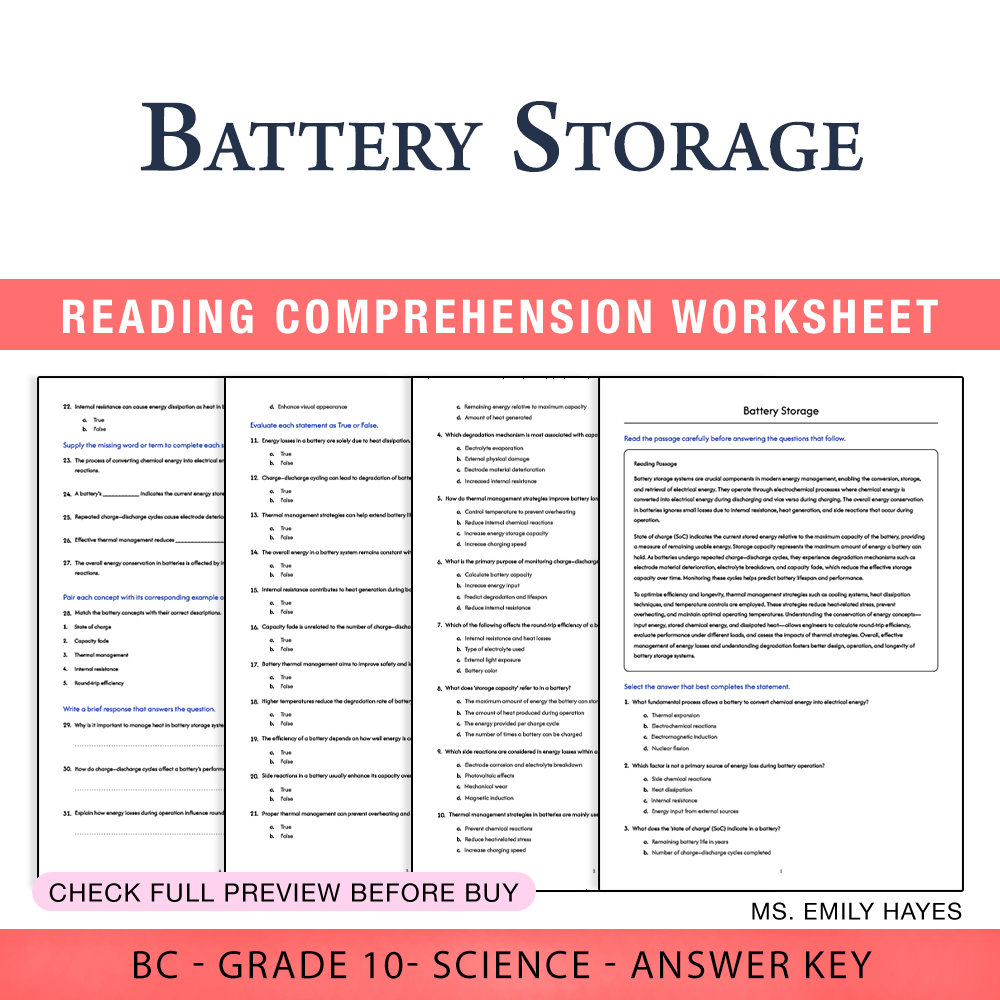
Grade 10 Science | Battery Storage Worksheet (PDF + Answer Key)
Created byCopper Leaf ClassroomLearning Objectives
- Explain how battery storage converts chemical energy to electrical energy and back, understanding energy conservation and losses.
- Describe the concepts of state of charge, storage capacity, and charge–discharge cycles in batteries.
- Analyze how energy losses affect round-trip efficiency and how thermal management impacts battery performance and longevity.
Also included in: Grade 10 Science BC – Energy, Thermodynamics & Ecosystems (PDF + Answer Key) +1 more
Instant download
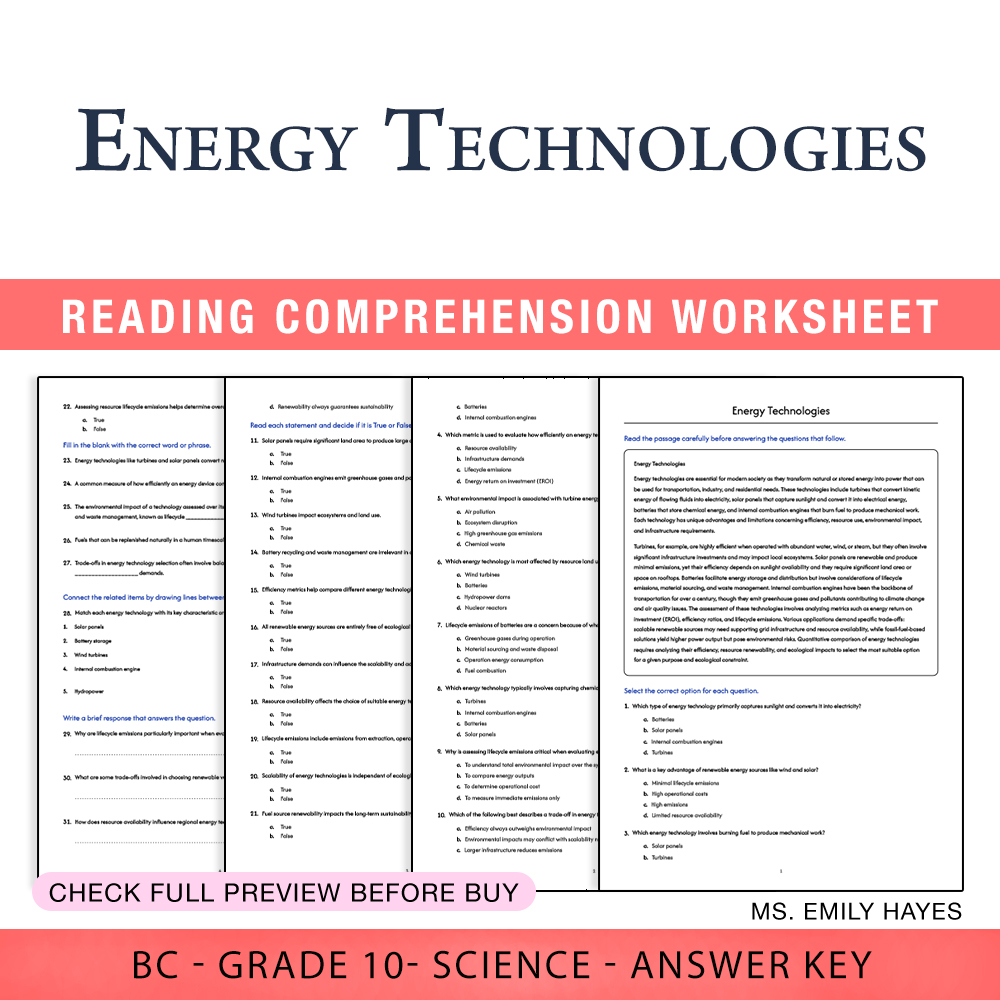
Grade 10 Science | Energy Technologies Worksheet (PDF + Answer Key)
Created byCopper Leaf ClassroomLearning Objectives
- Understand how different energy technologies convert natural or stored energy into usable power.
- Evaluate the efficiency, renewability, and environmental impacts of various energy devices and systems.
- Compare and contrast different energy technologies based on lifecycle emissions, waste, and infrastructure demands.
Also included in: Grade 10 Science BC – Energy, Thermodynamics & Ecosystems (PDF + Answer Key) +1 more
Instant download
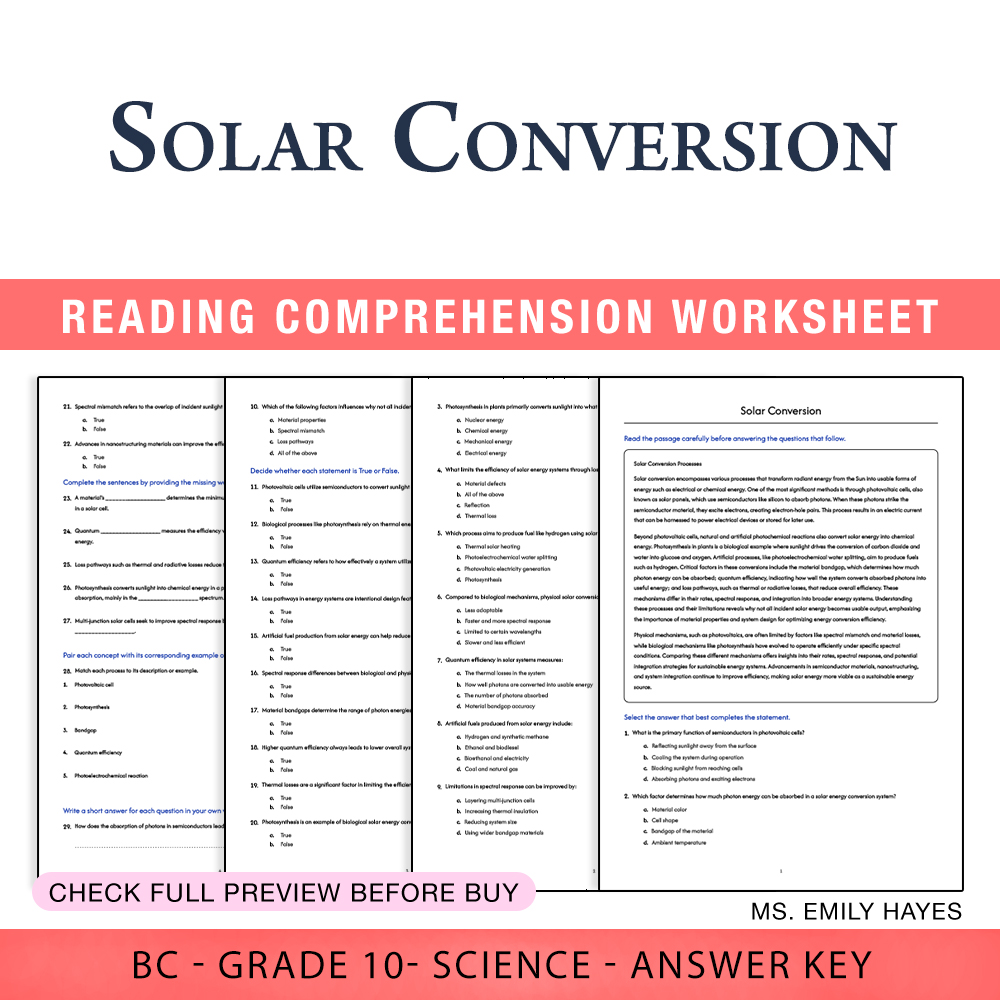
Grade 10 Science | Solar Conversion Worksheet (PDF + Answer Key)
Created byCopper Leaf ClassroomLearning Objectives
- Understand the processes involved in solar energy transformation into electrical and chemical energy.
- Describe how semiconductors absorb photons and generate electrical currents.
- Explain the role of bandgaps, quantum efficiency, and loss pathways in energy conversion.
Also included in: Grade 10 Science BC – Energy, Thermodynamics & Ecosystems (PDF + Answer Key) +1 more
Instant download
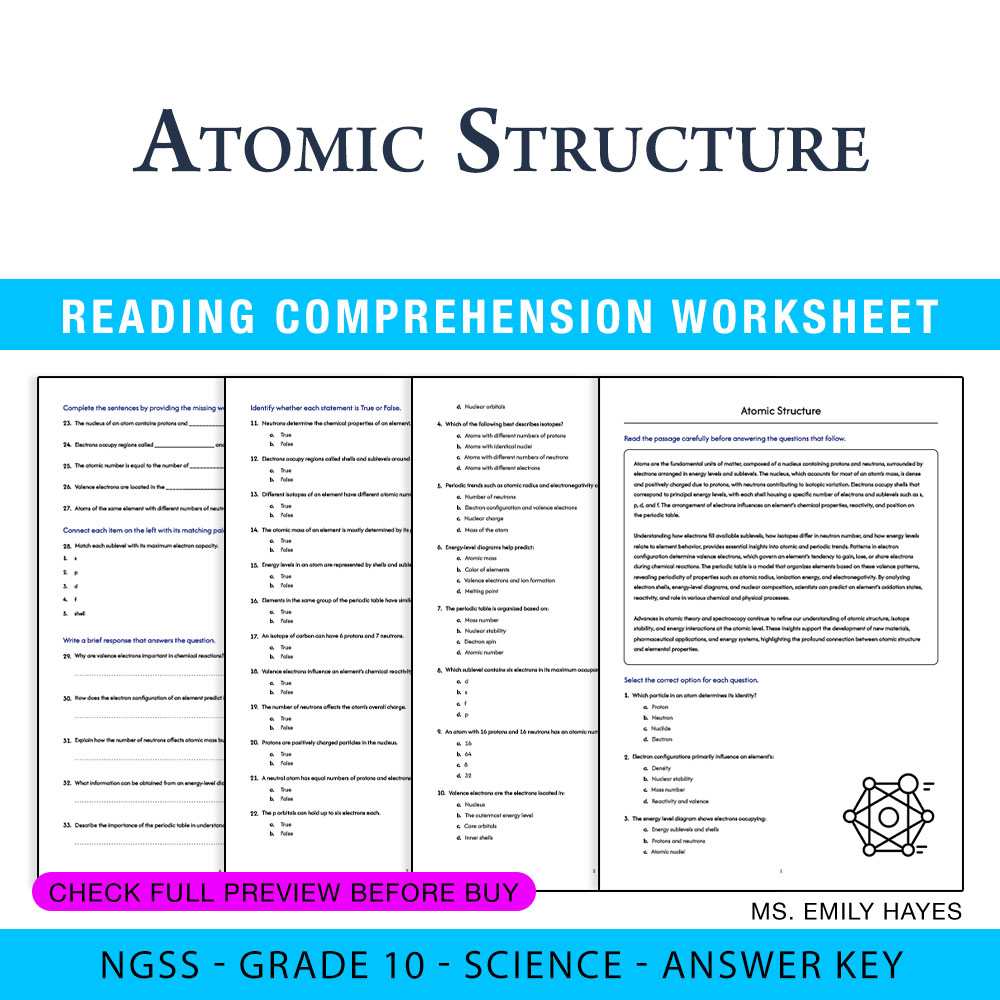
10th Grade Science | Atomic Structure Worksheet (PDF+ Answer Key)
Created byCopper Leaf ClassroomLearning Objectives
- Describe the structure of atomic nuclei and electron configurations.
- Explain periodic trends based on electron arrangements and isotope compositions.
- Interpret energy-level diagrams, sublevel occupancy, and periodicity for elemental behavior.
Instant download
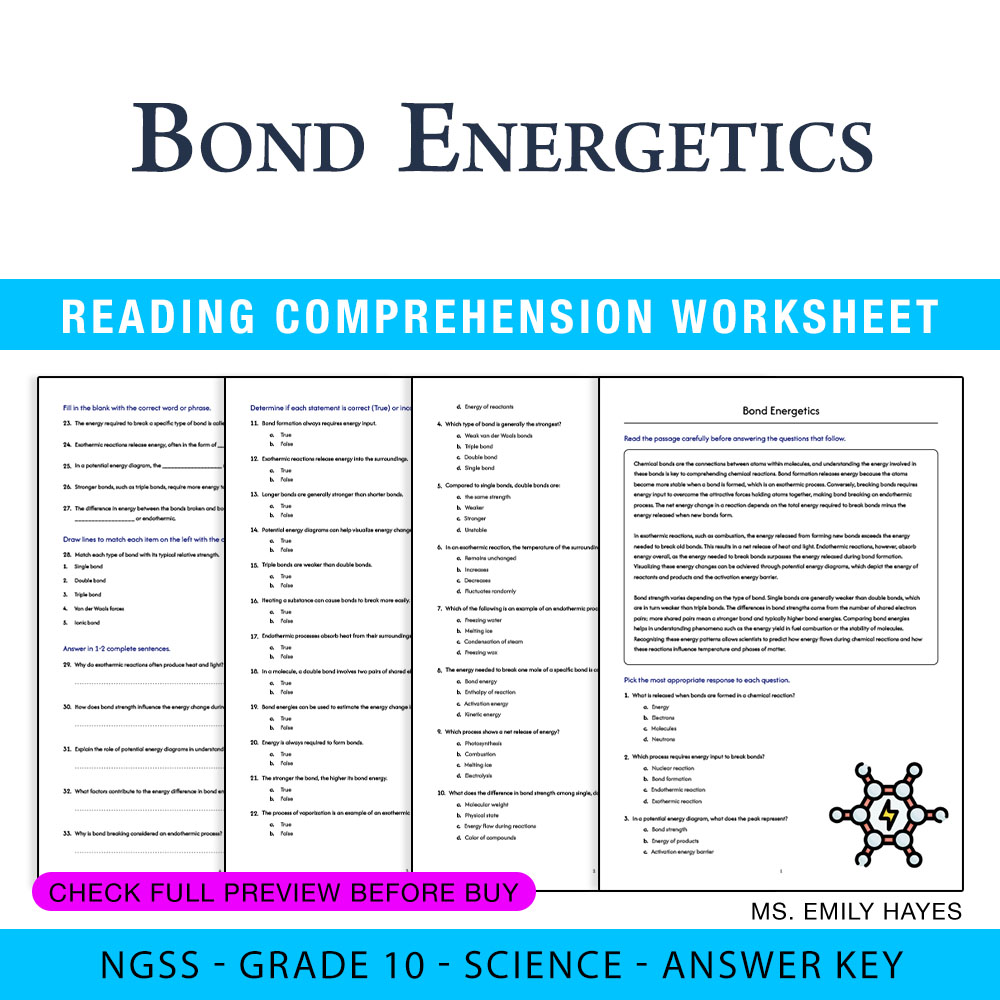
Grade 10 Science | Bond Energetics Worksheet (PDF+ Answer Key)
Created byCopper Leaf ClassroomLearning Objectives
- Explain how bond formation and breaking relate to energy changes in chemical reactions.
- Differentiate between exothermic and endothermic processes using bond energy concepts.
- Apply potential energy diagrams to understand energy flow during chemical reactions.
Instant download
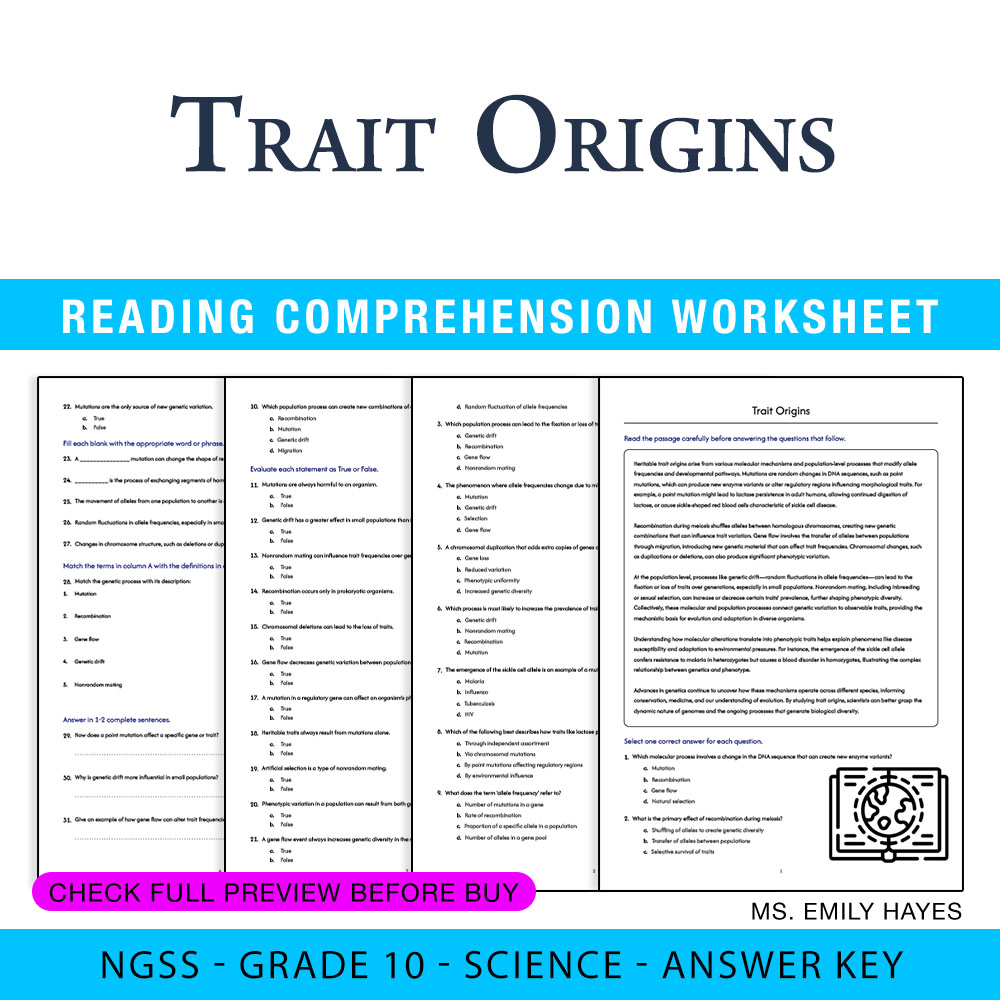
Grade 10 Science | Trait Origins Worksheet (PDF + Answer Key)
Created byCopper Leaf ClassroomLearning Objectives
- Explain the molecular processes that lead to heritable trait variations, including mutation, recombination, gene flow, and chromosomal changes.
- Describe how population processes such as genetic drift and nonrandom mating influence trait distribution across generations.
- Connect molecular genetic changes to phenotypic traits, illustrating examples like lactase persistence and sickle cell allele emergence.
Instant download
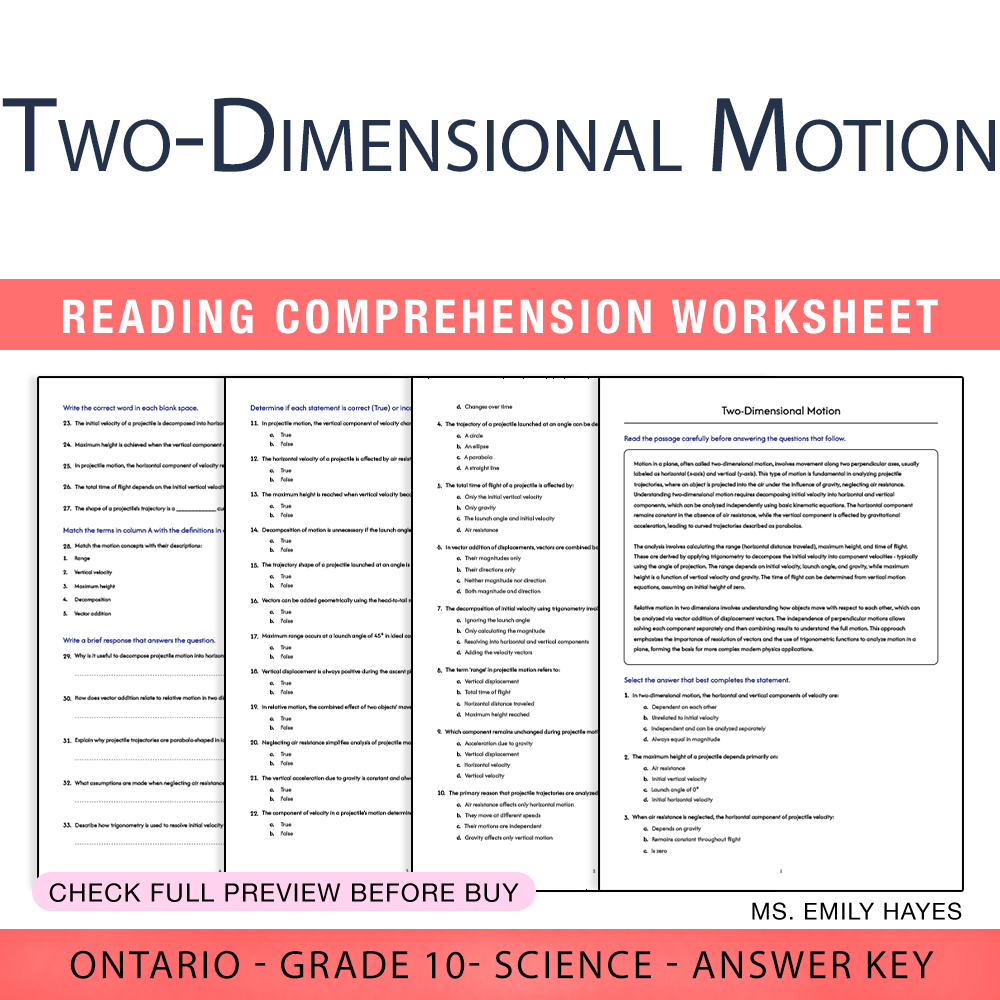
Grade 10 Science | Two-Dimensional Motion Worksheet (PDF + Answer Key)
Created byCopper Leaf ClassroomLearning Objectives
- Understand the decomposition of motion into orthogonal components in projectile motion.
- Derive and apply formulas for range, maximum height, and time of flight.
- Analyze relative motion in two dimensions and understand vector addition of displacements.
Instant download
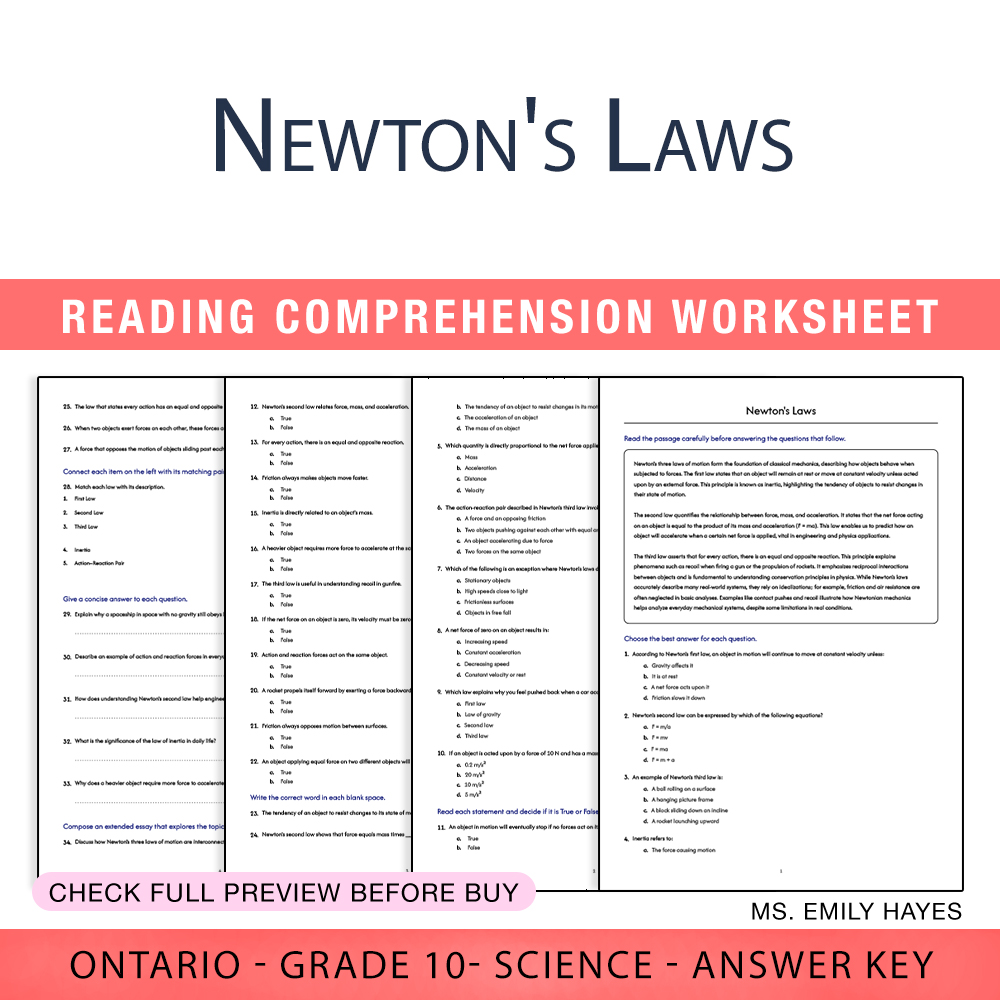
10th Grade Science | Newton's Laws Worksheet (PDF + Answer Key)
Created byCopper Leaf ClassroomLearning Objectives
- Understand and describe the three laws of motion articulated by Sir Isaac Newton.
- Connect concepts of inertia, net force, and reciprocal interactions in physical systems.
- Apply Newton's second law to predict the motion of objects based on force and mass.
Instant download
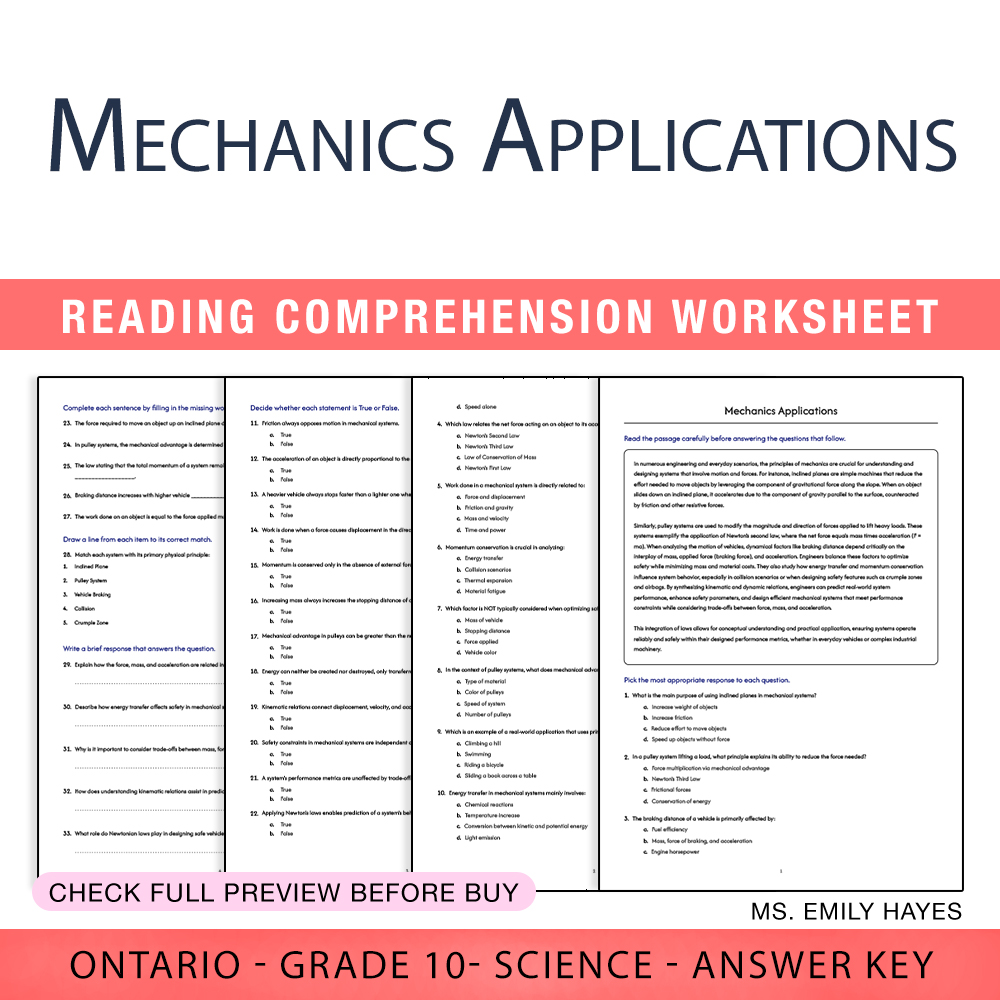
10th Grade Science | Mechanics Applications Worksheet (PDF + Answer Key)
Created byCopper Leaf ClassroomLearning Objectives
- Analyze and interpret kinematic relations in various mechanical systems.
- Apply Newtonian dynamics to solve practical problems involving forces, motion, and energy.
- Connect concepts of work, momentum, and safety parameters such as stopping distance.
Instant download
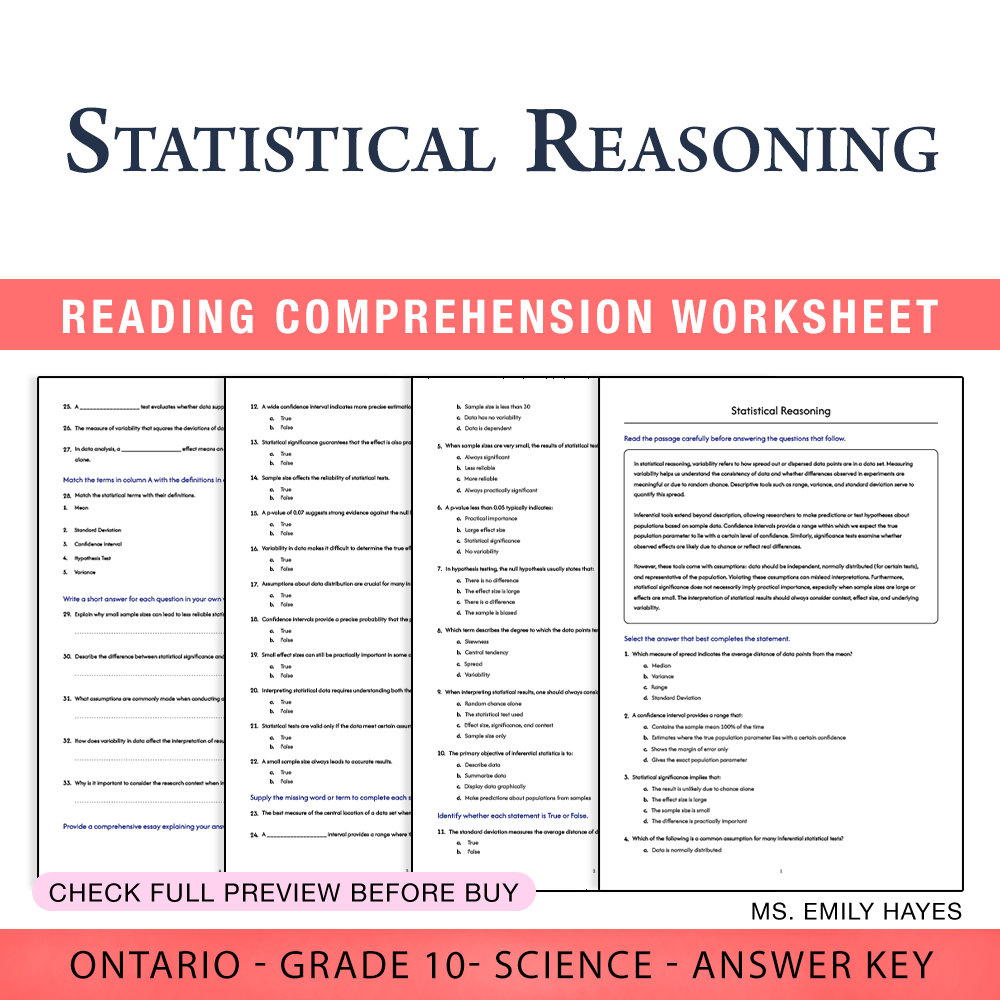
Grade 10 Science | Statistical Reasoning Worksheet (PDF + Answer Key)
Created byCopper Leaf ClassroomLearning Objectives
- Understand and interpret measures of central tendency and variability in data sets.
- Apply inferential tools such as confidence intervals and hypothesis tests appropriately.
- Identify limitations and assumptions behind statistical analyses.
Instant download
About Grade 10 Science Worksheets
Find Science worksheets built for Grade 10. All 7,038 cover core skills, practice, and review, each an instant PDF download.
Every worksheet on MyTeachingSheets is created by independent teacher-authors and reviewed before publication. All resources download as printable PDFs for classroom, homework, or at-home practice, and many include answer keys. Preview any worksheet free before buying.