
Grade 10 Science Worksheets
7,038 worksheets
Population Growth Models & Carrying Capacity Worksheet | NGSS Grade 10
 Created byAmber Owl Education
Learning Objectives
- Explain how birth rate and death rate influence population size over time
- Compare exponential and logistic growth patterns using carrying capacity
- Describe how density-dependent and density-independent factors limit populations
Instant download
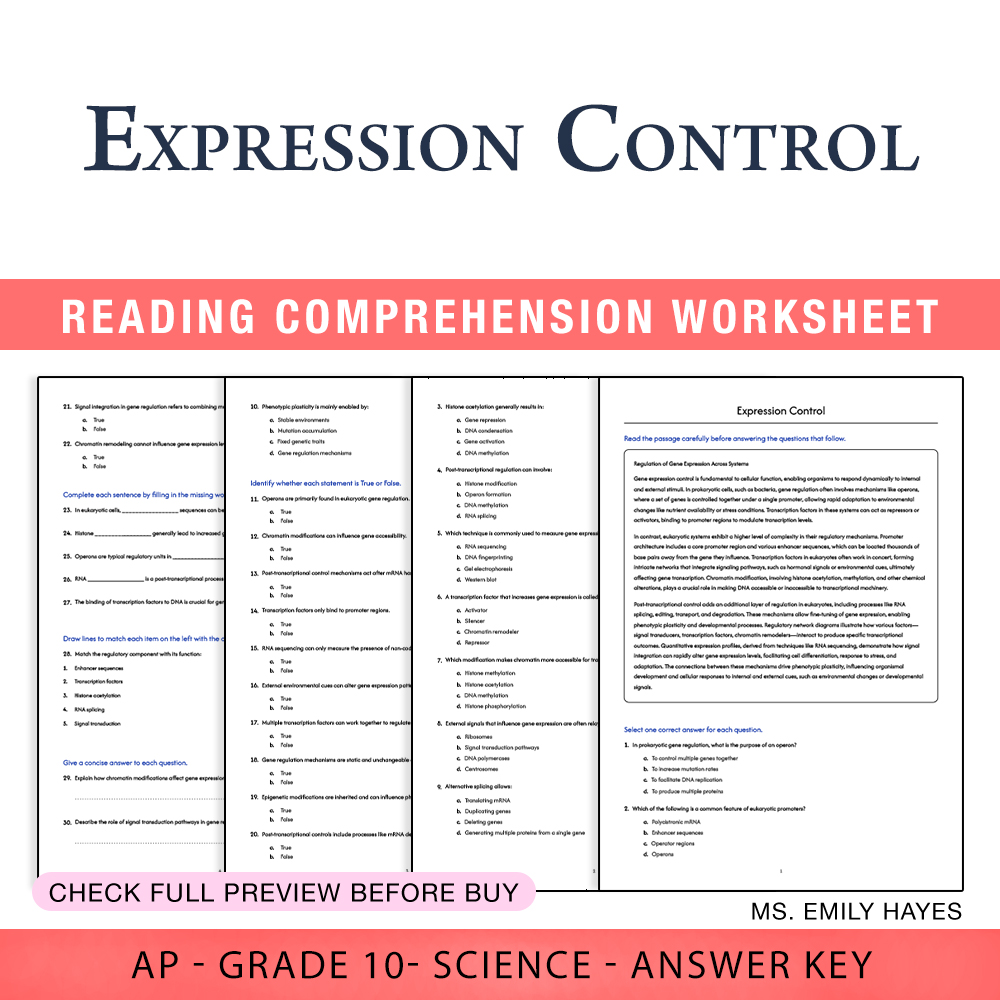
10th Grade Science | Expression Control Worksheet (PDF+ Answer Key)
 Created byCopper Leaf Classroom
Learning Objectives
- Understand mechanisms regulating gene expression in prokaryotic and eukaryotic systems.
- Identify the roles of promoters, transcription factors, chromatin modifications, and post-transcriptional controls.
- Interpret regulatory network diagrams and expression profiles to analyze signal integration effects.
Also included in: Grade 10 Science | Key Concepts in Biology & Ecosystems (PDF+ Answer Key) +1 more
Instant download
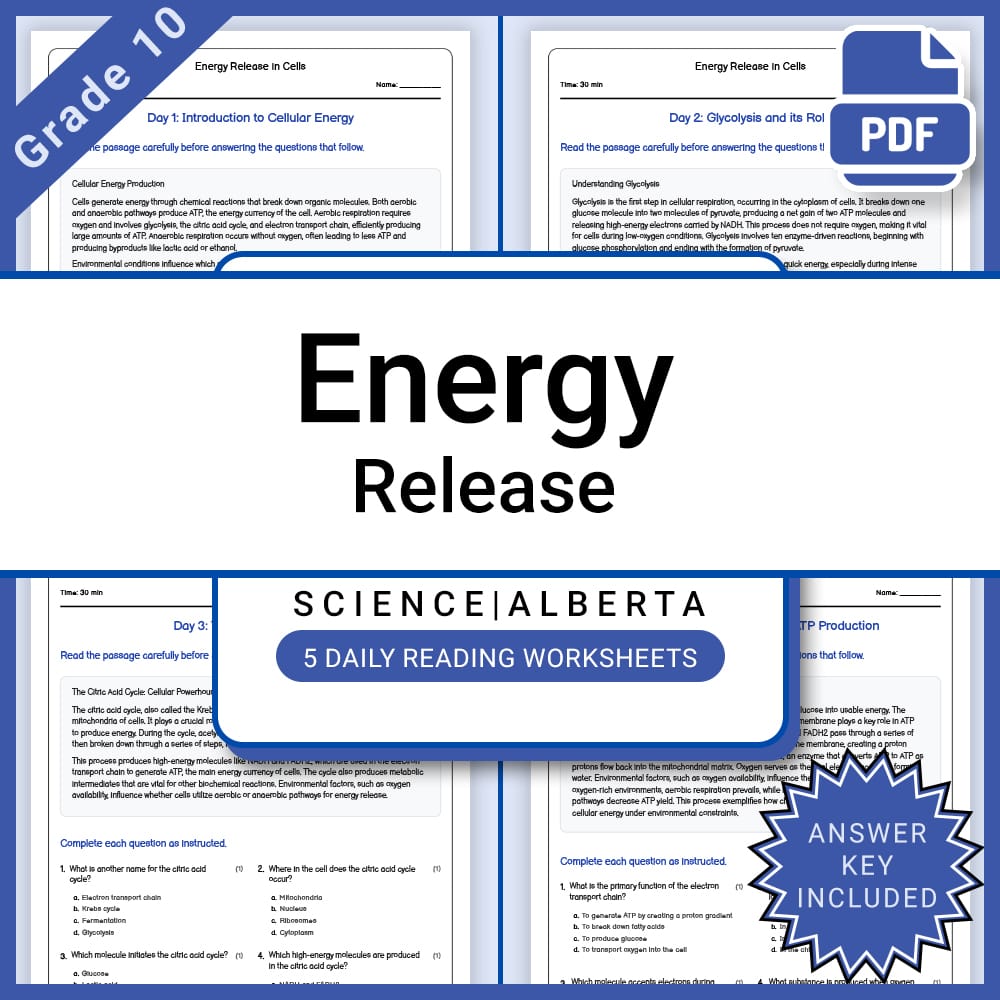
Grade 10 Science – Energy Release in Cells Daily Reading Worksheet + Answer Key
JCreated byJ.S SheetsLearning Objectives
- Understand the basic processes of aerobic and anaerobic respiration
- Identify the pathways involved in cellular energy production
- Explain how oxygen availability influences energy pathways
Also included in: Grade 10 Science Lesson Group: Alberta Curriculum — Daily Reading Worksheets +1 more
Instant download

Grade 10 Science | Unbalanced Force Effects Worksheet | California Standards
 Created byLumora Learning
Learning Objectives
- Explain how net (unbalanced) force changes an object’s motion by producing acceleration.
- Interpret changes in speed and direction using the magnitude and direction of net force.
- Connect force diagrams and vector reasoning to predicted motion over time.
Instant download

Thermochemistry Worksheet Grade 10 AP Science Practice Activities Pack
 Created byPrism Point Learning
Learning Objectives
- Explain thermochemical representations and how enthalpy changes relate to reaction stoichiometry.
- Use calorimetric energy accounting (q = mcΔT and energy conservation) to determine heat transfer.
- Apply Hess’s law and bond-enthalpy ideas to predict overall reaction enthalpy and reaction favorability.
Instant download

Mendelian Inheritance and Probability Worksheet | Genetics | Grade 10 NGSS
Created byAmber Owl EducationLearning Objectives
- Explain how dominance and segregation relate to outcomes in single-gene crosses.
- Use Punnett squares to predict offspring phenotypes from given parental genotypes.
- Interpret pedigree patterns using Mendelian inheritance and simple probability.
Instant download

Cellular Specialization Assessment | TEKS Grade 10 Science Worksheet
Created byPrism Point LearningLearning Objectives
- Understand how cells develop distinct structures and organelle compositions for specific functions.
- Identify relationships between organelle abundance and cell function, such as mitochondria in muscle cells.
- Explain how specialized cells form tissues and organ systems in multicellular organisms.
Also included in: Grade 10 Cell Structure and Function Unit Science Lesson Bundle TEKS
Instant download

Grade 10 Science – Multiple Evidence in Biological Change | Reading Worksheet
 Created byBright Mind Resources
Learning Objectives
- Understand how fossils provide timelines and evidence of evolutionary change.
- Identify different sources of evidence used to study biological evolution.
- Explain how comparative anatomy and molecular data support evolutionary theories.
Also included in: Evolution Grade 10 Science Daily Reading Worksheets Lesson Bundle | General +1 more
Instant download
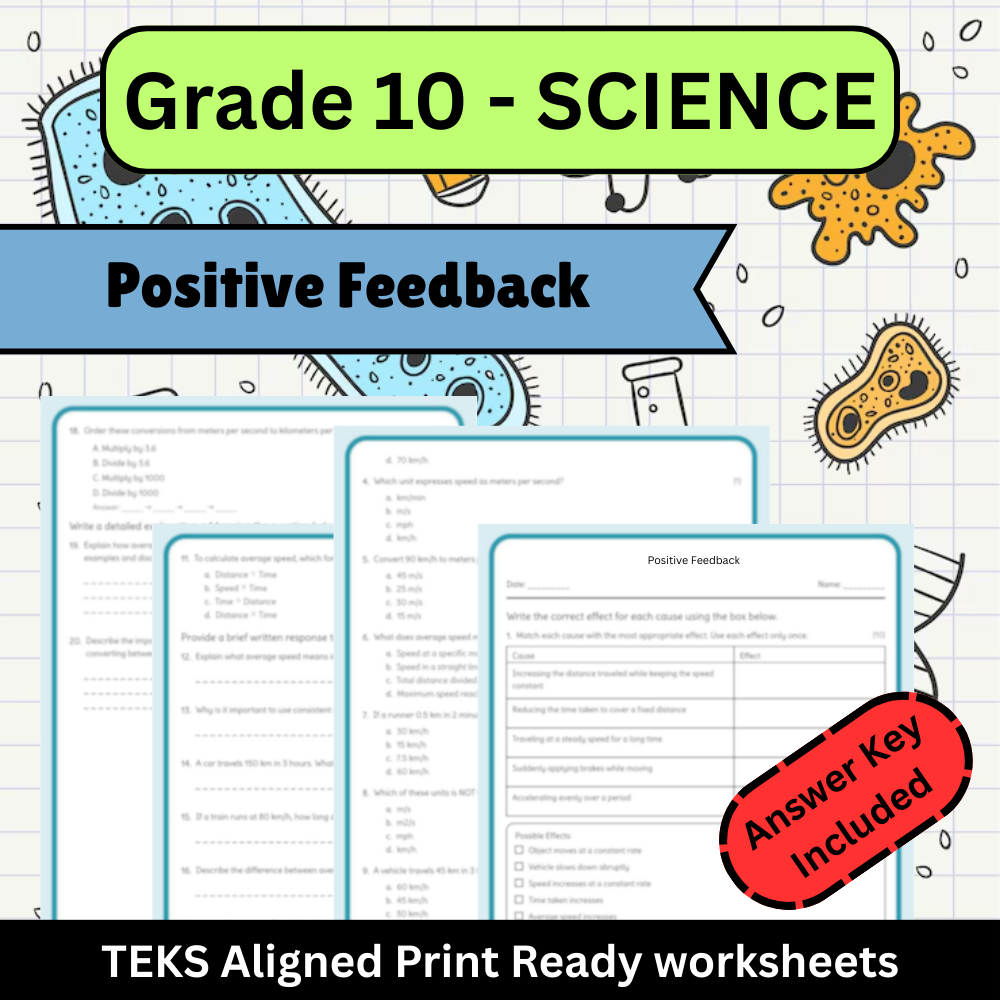
Grade 10 Science | Positive Feedback Mechanisms Worksheet (Worksheet + Answer Key)
Created byBright Mind ResourcesLearning Objectives
- Understand the concept of positive feedback in biological systems.
- Identify real-world examples of positive feedback mechanisms.
- Differentiate between positive feedback and negative feedback.
Also included in: Grade 10 Science | Body Systems & Homeostasis Worksheet Bundle (TEKS Aligned) +5 more
Instant download
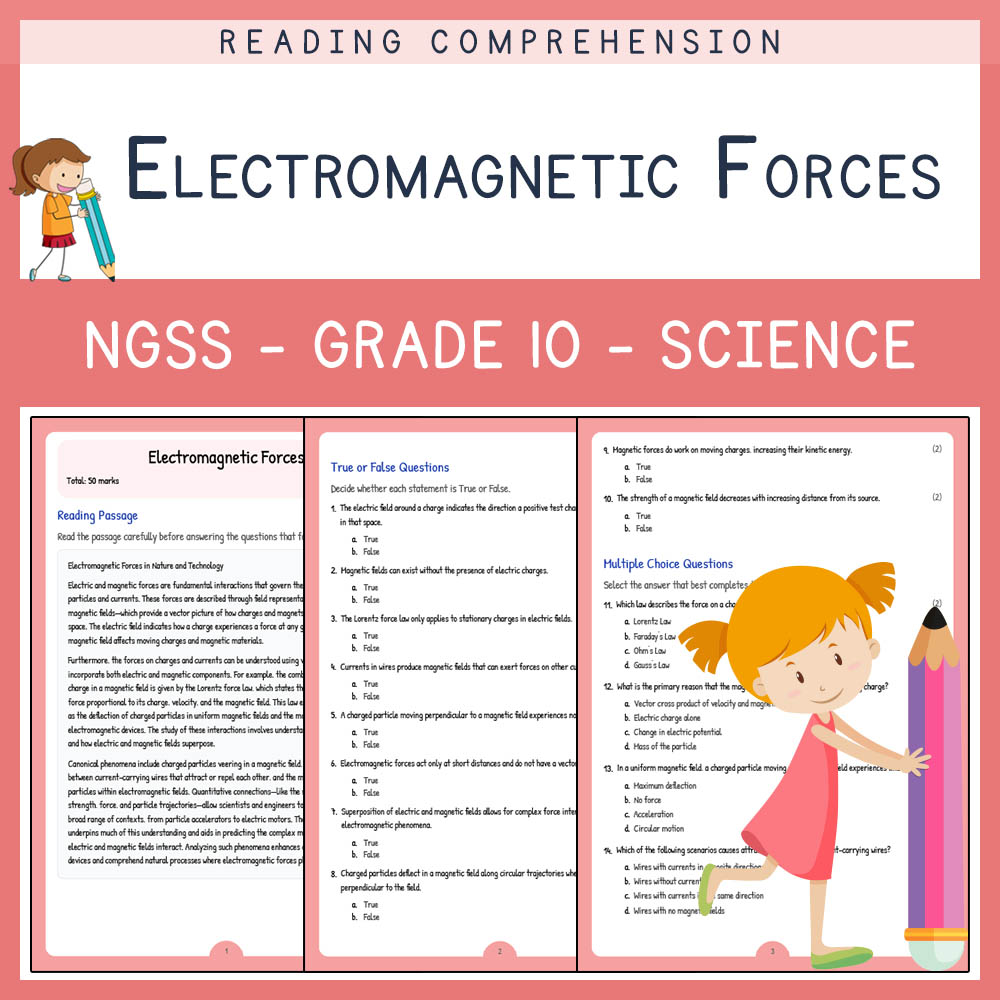
Grade 10 Science | Electromagnetic Forces Worksheet & Answer Key (NGSS Aligned)
Created byLumora LearningLearning Objectives
- Understand the principles of electric and magnetic fields and their vector relationships.
- Analyze forces on charges and currents within electric and magnetic fields, including the Lorentz force law.
- Apply concepts to phenomena such as charged particle deflection and magnetic interactions between current-carrying wires.
Instant download

Grade 10 Valence Patterns Worksheet | Practice & PDF
 Created byClear Sky Classroom
Learning Objectives
- Explain how valence electron patterns in electron configurations relate to trends in bonding and reactivity.
- Predict typical ion charges and bonding tendencies using periodic group patterns.
- Describe how changes across periods reflect recurring valence structures and periodic trends.
Instant download
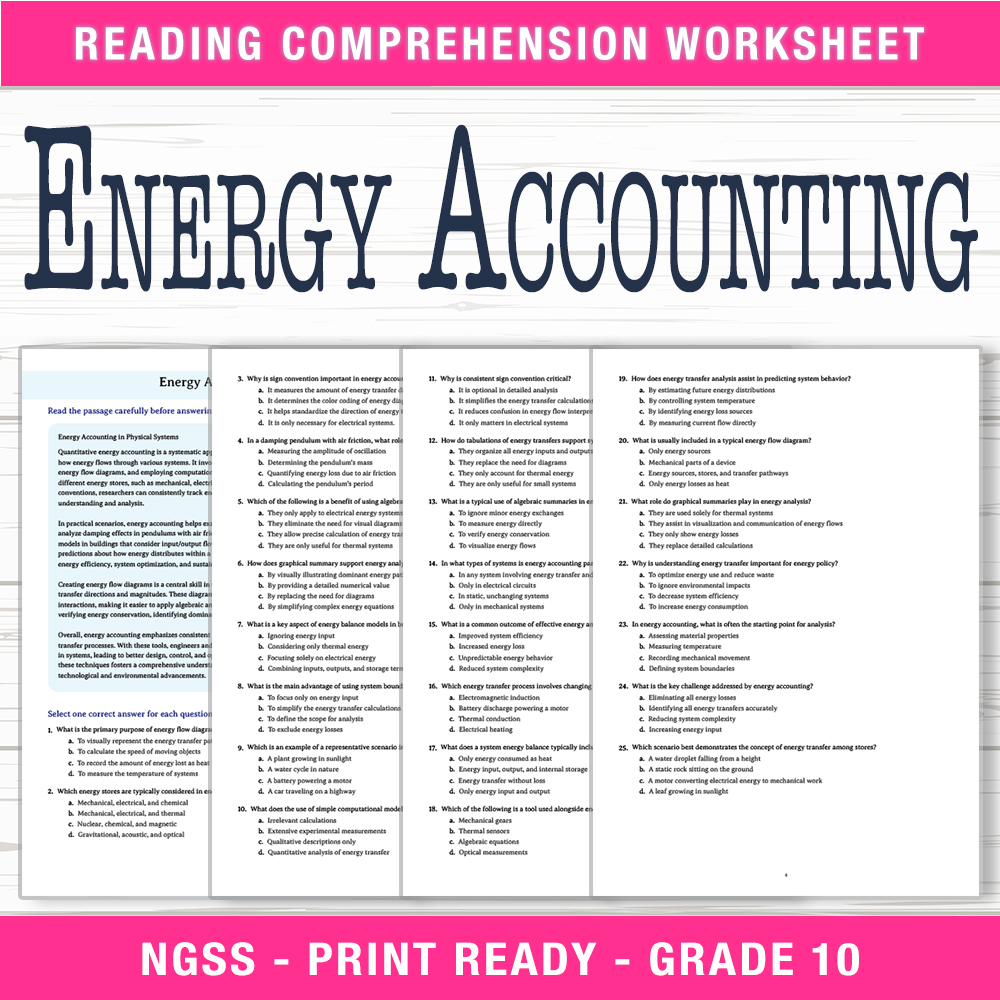
Grade 10 Science | Energy Accounting Worksheet (PDF + Answer Key)
 Created byRiverstone Classroom
Learning Objectives
- Understand the principles of energy flow and transfer within physical systems.
- Apply sign conventions and energy balance equations to real-world scenarios.
- Develop skills in creating energy flow diagrams and using algebraic methods to analyze energy distribution.
Instant download
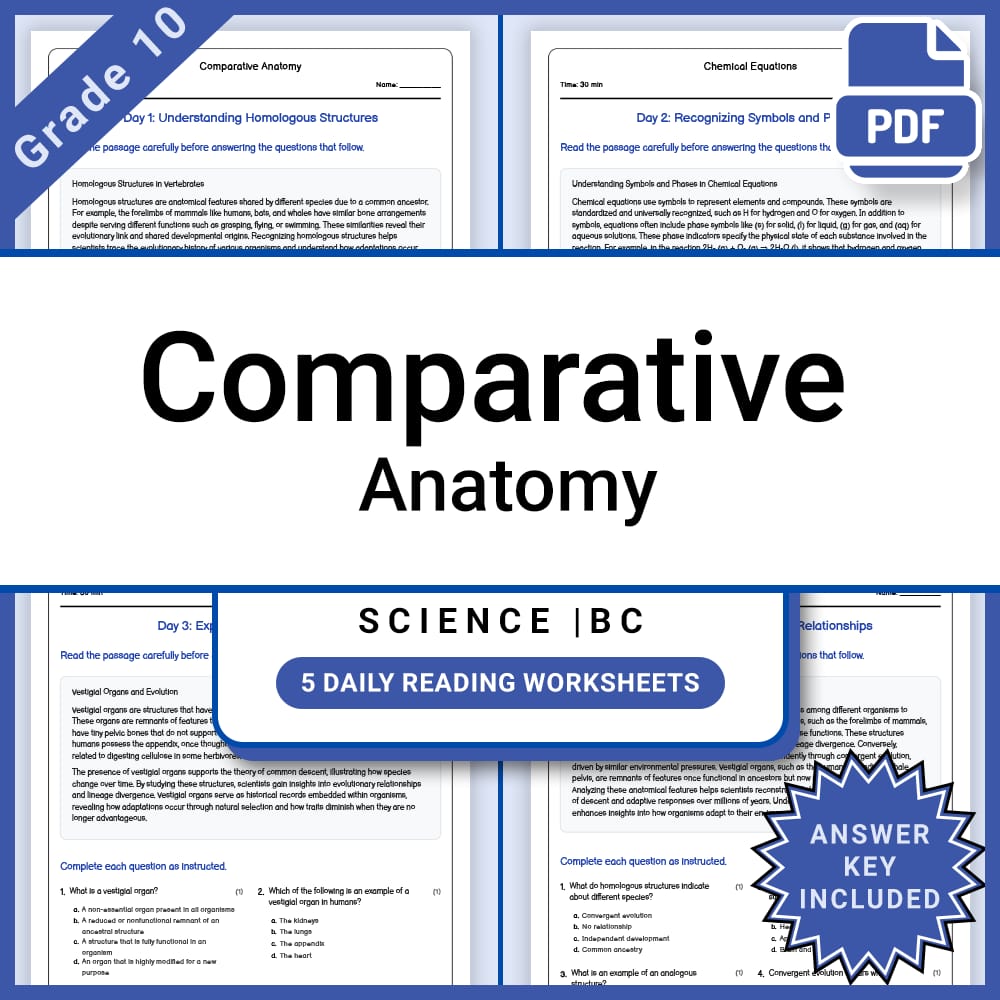
Grade 10 Science – Comparative Anatomy Daily Reading Worksheet + Answer Key
JCreated byJ.S SheetsLearning Objectives
- Understand the concept of homologous structures and their significance in evolution
- Identify structural similarities that indicate common ancestry
- Differentiate between homologous and analogous structures
Also included in: Grade 10 Science Lesson Bundle | Genetics, Evolution, Biodiversity & More +1 more
Instant download
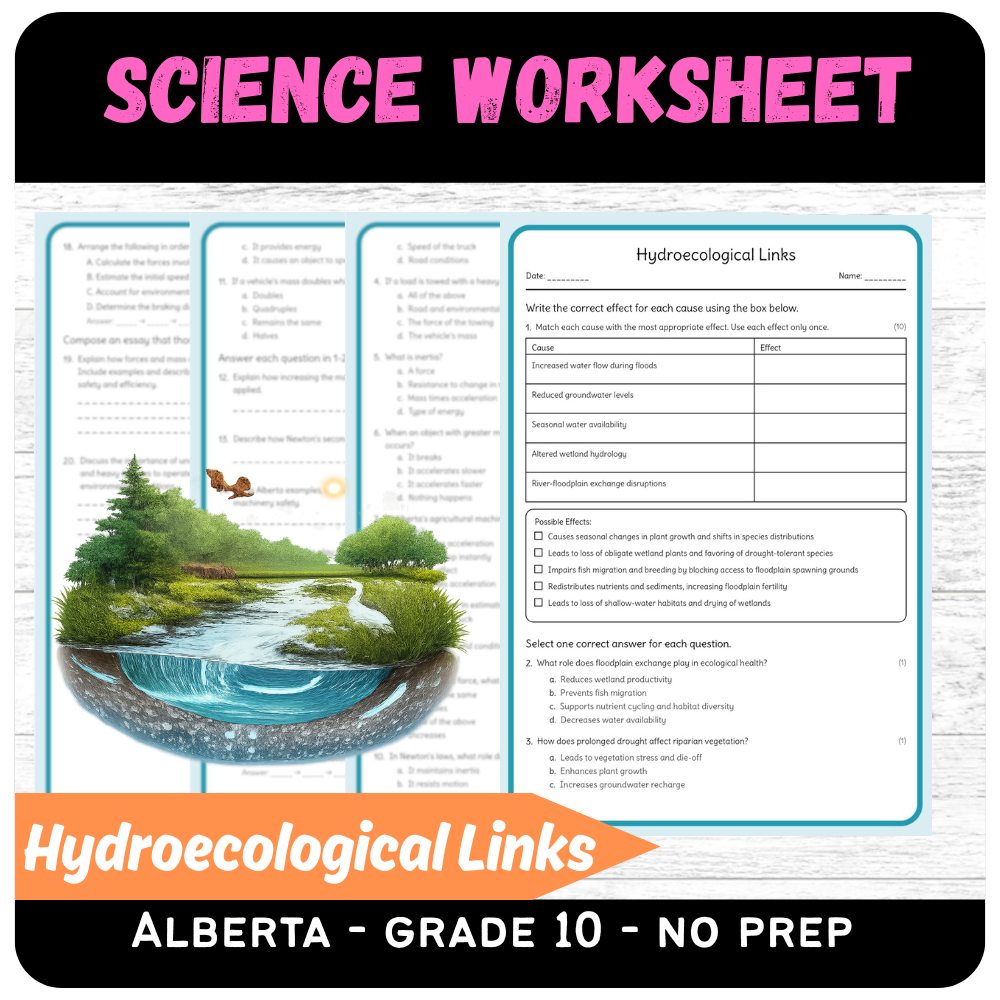
Grade 10 Science | Hydro ecological Links Worksheet (PDF) – Alberta Standards
Created byBright Mind ResourcesLearning Objectives
- Understand how water flow influences habitat and ecosystem functions.
- Identify the effects of hydrologic regime changes on ecosystems.
- Describe interactions between groundwater, vegetation, and hydrology in Alberta environments.
Instant download

Grade 10 Science Worksheet | Aerobic vs Anaerobic Respiration (TEKS)
 Created byEvergreen Desk Education
Learning Objectives
- Compare aerobic and anaerobic respiration by identifying where they occur and the role of oxygen
- Explain how ATP yield and end products differ between aerobic respiration and lactic/alcoholic fermentation
- Analyze how oxygen availability affects cellular metabolism and microbial ecological niches
Instant download
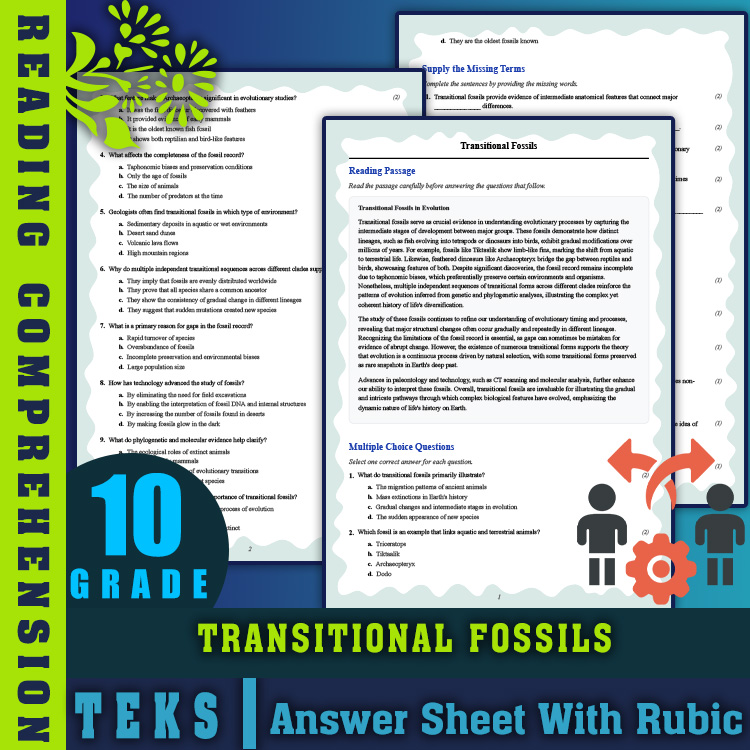
10th Grade Science | Speciation Processes Reading Worksheet (PDF + Answer Key)
JCreated byJ.S SheetsLearning Objectives
- Understand the concept of speciation and the factors that lead to the formation of new species.
- Identify different modes of speciation such as allopatric, sympatric, and parapatric.
- Explain reproductive barriers and their role in speciation.
Instant download

Grade 10 Science – Natural Selection & Evolution | Daily Reading Worksheet
Created byBright Mind ResourcesLearning Objectives
- Understand the basic concept of natural selection
- Identify how traits affect survival and reproduction
- Recognize examples of adaptation
Also included in: Life Science Grade 10 Science Daily Reading Worksheets Lesson Bundle | FL NGSSS +1 more
Instant download
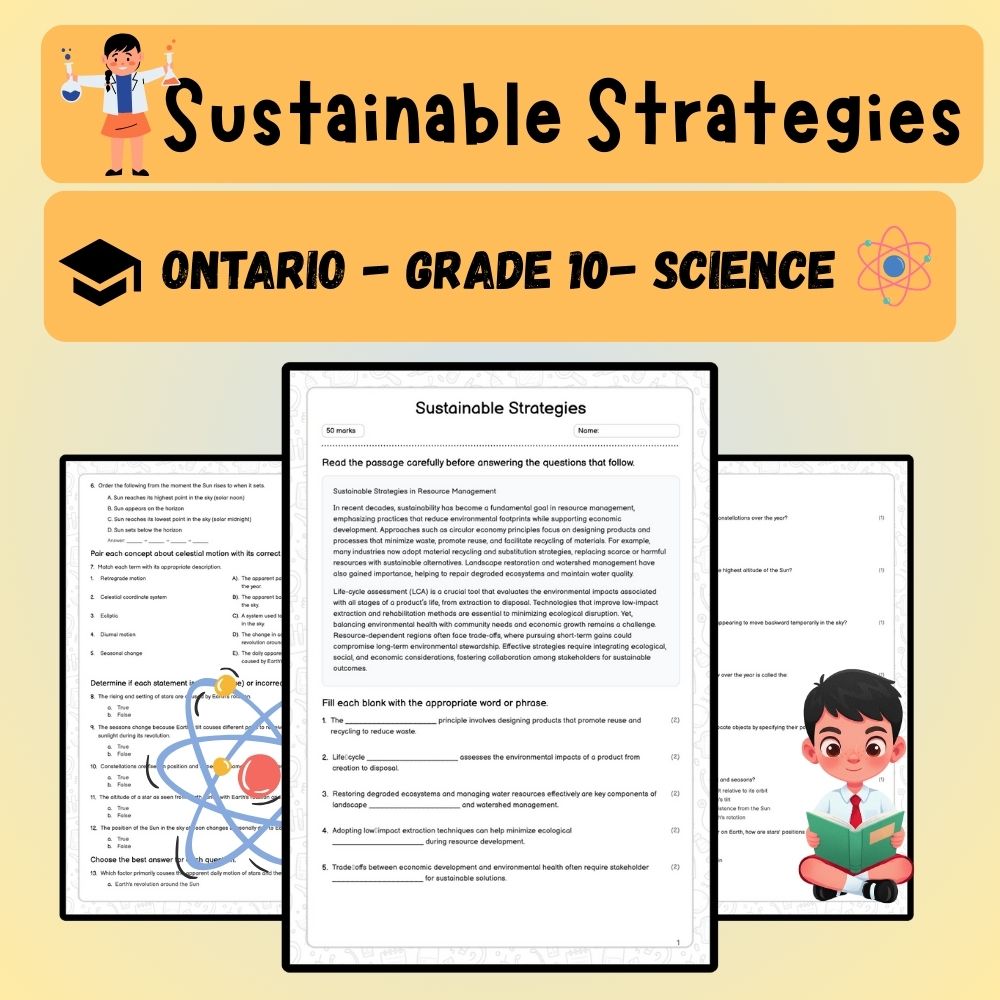
Grade 10 Science | Sustainable Strategies Worksheet (PDF) aligned with Ontario standards
Created byPrism Point LearningLearning Objectives
- Understand approaches for reducing environmental impact in resource extraction and use.
- Identify principles of circular economy, recycling, and substitution methods.
- Explain landscape restoration and watershed management strategies.
Also included in: Grade 10 Science UNIT Bundle | Earth Processes & Resources Ontario Standards +1 more
Instant download
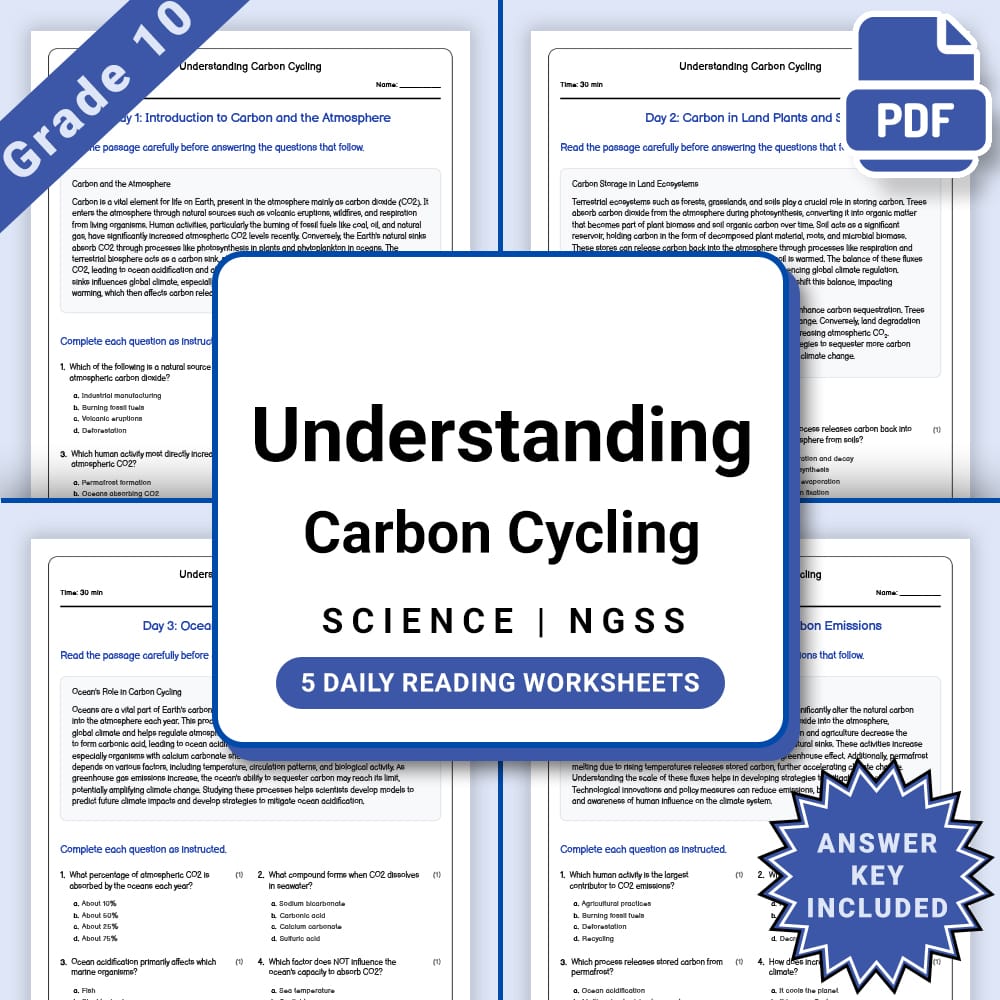
Grade 10 Science – Understanding Carbon Cycling Worksheet (PDF +Answer Key)
Created byCopper Leaf ClassroomLearning Objectives
- Identify the main sources of atmospheric carbon dioxide.
- Recognize the primary sinks that remove carbon from the atmosphere.
- Understand how biogeochemical processes influence climate change.
Instant download

Grade 10 Science | Atomic Structure - Daily Reading Comprehension
 Created byCoral Reef Learning
Learning Objectives
- Identify the basic components of an atom and their functions
- Understand the structure of electrons, protons, and neutrons
- Explain atomic number, mass number, and isotopes
Instant download

Grade 10 Science | Safe Data Collection Worksheet | General Standards
Created byLumora LearningLearning Objectives
- Identify independent, dependent, and controlled variables and explain why they improve the usability of data.
- Describe safety practices that reduce risk, contamination, and measurement bias during an investigation.
- Use structured data recording methods (units, tables, repeats, and notes) to strengthen evidence for a hypothesis.
Instant download

Grade 10 Conservation in Multi-Body Collisions Worksheet | NGSS Physics
Created byAmber Owl EducationLearning Objectives
- Use vector components to analyze momentum in two-dimensional collisions.
- Apply conservation of linear momentum to an isolated two-body or multi-body system.
- Differentiate elastic and inelastic collisions using kinetic energy changes and speed distributions.
Instant download

Measurement Uncertainty Science Worksheet Grade 10 Scientific Inquiry
 Created byBRIGHT PATH RESOURCES
Learning Objectives
- Explain what measurement uncertainty means
- Interpret why measurements are reported as ranges
- Compare overlapping and separated uncertainty ranges
Also included in: Grade 10 Science Worksheets Bundle | Scientific Inquiry & Evidence +1 more
Instant download

Observational Evidence for Cosmic Origins Worksheet | Grade 10 NGSS
Created byAmber Owl EducationLearning Objectives
- Explain how cosmic microwave background radiation, galactic redshifts, and primordial element abundances provide evidence for cosmic evolution.
- Interpret spectral redshift and connect it to an expanding-universe model.
- Describe how CMB anisotropies and hydrogen-to-helium ratios constrain early-universe conditions.
Instant download

Grade 10 Science | System Optimization in Communication Systems - Comprehension
Created byCoral Reef LearningLearning Objectives
- Understand how transmission power influences signal range and quality.
- Learn about the trade-offs between power, range, throughput, and reliability.
- Explore the basics of antenna gain, impedance matching, and their impact on communication.
Instant download

Grade 10 Evolutionary Predictions Worksheet | General Practice PDF
Created byClear Sky ClassroomLearning Objectives
- Explain how selection changes allele frequencies over time and how that leads to shifts in trait distributions.
- Use evidence (molecular similarity, fossil sequences, and present-day variation) to justify evolutionary predictions.
- Interpret how new environmental pressures can alter which genotypes contribute more offspring.
Instant download

Grade 10 Model Refinement Worksheet | AP Practice & Review PDF
Created byClear Sky ClassroomLearning Objectives
- Explain how residual analysis and model comparison reveal where a model fails to match observed behavior.
- Use parameter estimation and sensitivity assessment to justify changes to a model’s parameter values.
- Evaluate trade-offs between model simplicity and predictive accuracy when refining model structure.
Also included in: Grade 10 Science Practices in Science: Lesson Bundle for Advanced Placement (AP) +1 more
Instant download
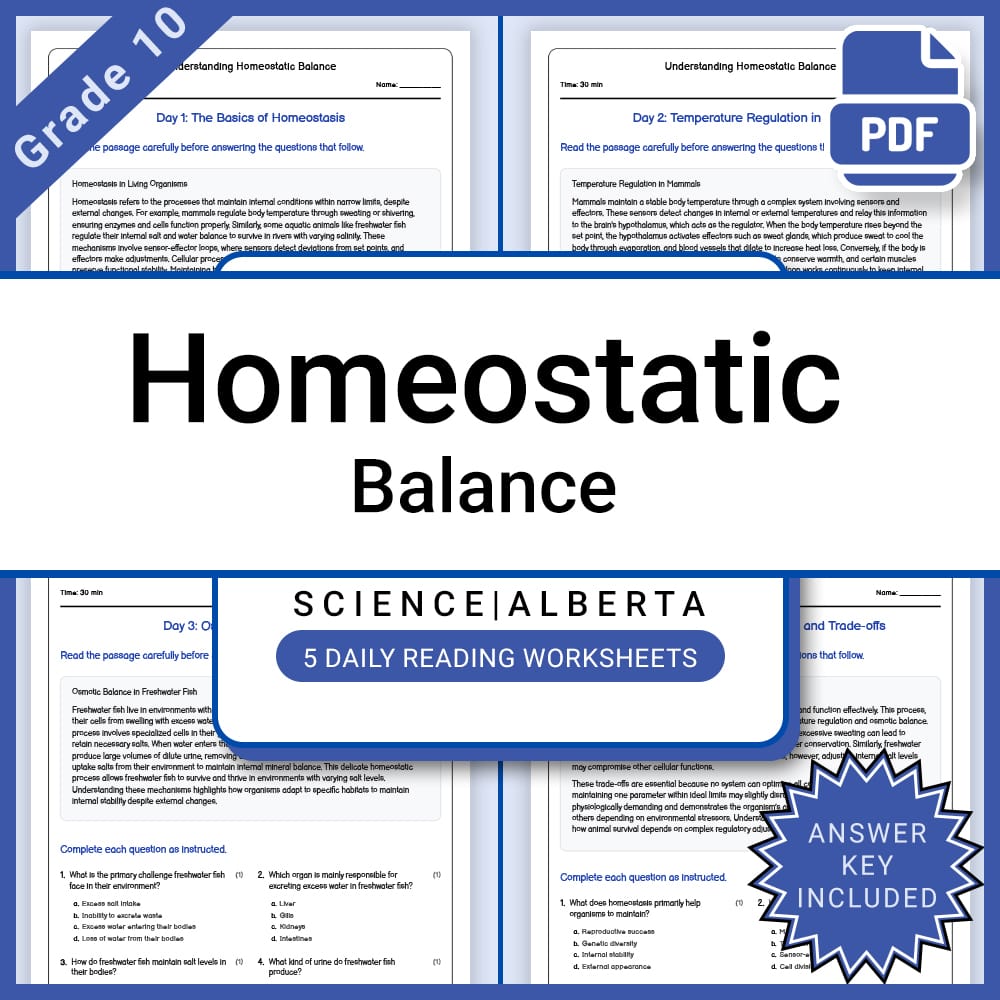
Grade 10 Science – Homeostasis Daily Reading Worksheet with Answer Key
JCreated byJ.S SheetsLearning Objectives
- Define homeostasis and explain its importance for living organisms.
- Identify key mechanisms involved in maintaining internal stability.
- Describe examples of homeostasis in mammals and aquatic life.
Also included in: Grade 10 Science Lesson Group: Alberta Curriculum — Daily Reading Worksheets +1 more
Instant download

Grade 10 Science | Ion Formation in Science - Daily Reading Comprehension
Created byCoral Reef LearningLearning Objectives
- Understand how atoms form ions through loss or gain of electrons
- Identify the relationship between outer electron energy levels and ion charges
- Explain how electron transfer leads to stable outer electron configurations
Instant download

Grade 10 Bond Energetics in Chemistry Worksheet | NGSS Chemistry Activity
Created byBRIGHT PATH RESOURCESLearning Objectives
- Understand how chemical bonds form and the associated energy changes
- Distinguish between exothermic and endothermic reactions based on bond energies
- Interpret potential energy diagrams related to chemical reactions
Also included in: Matter and Its Interactions Grade 10 Science Lesson Bundle | NGSS +1 more
Instant download
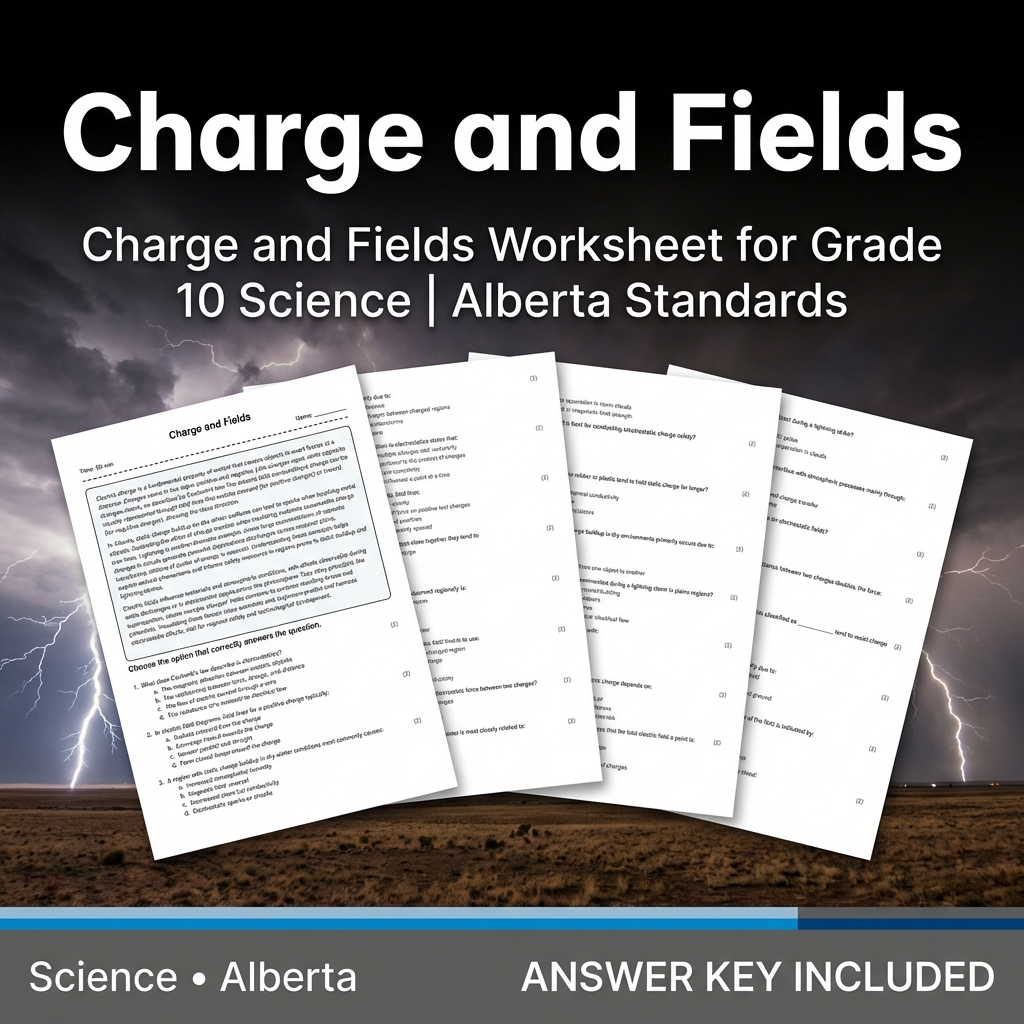
Charge and Fields Worksheet for Grade 10 Science | Alberta Standards
Created byCoral Reef LearningLearning Objectives
- Explain the concept of electric charge, including magnitude and sign.
- Describe how electric field lines represent forces at a distance.
- Apply Coulomb's law to calculate electrostatic forces between charges.
Instant download
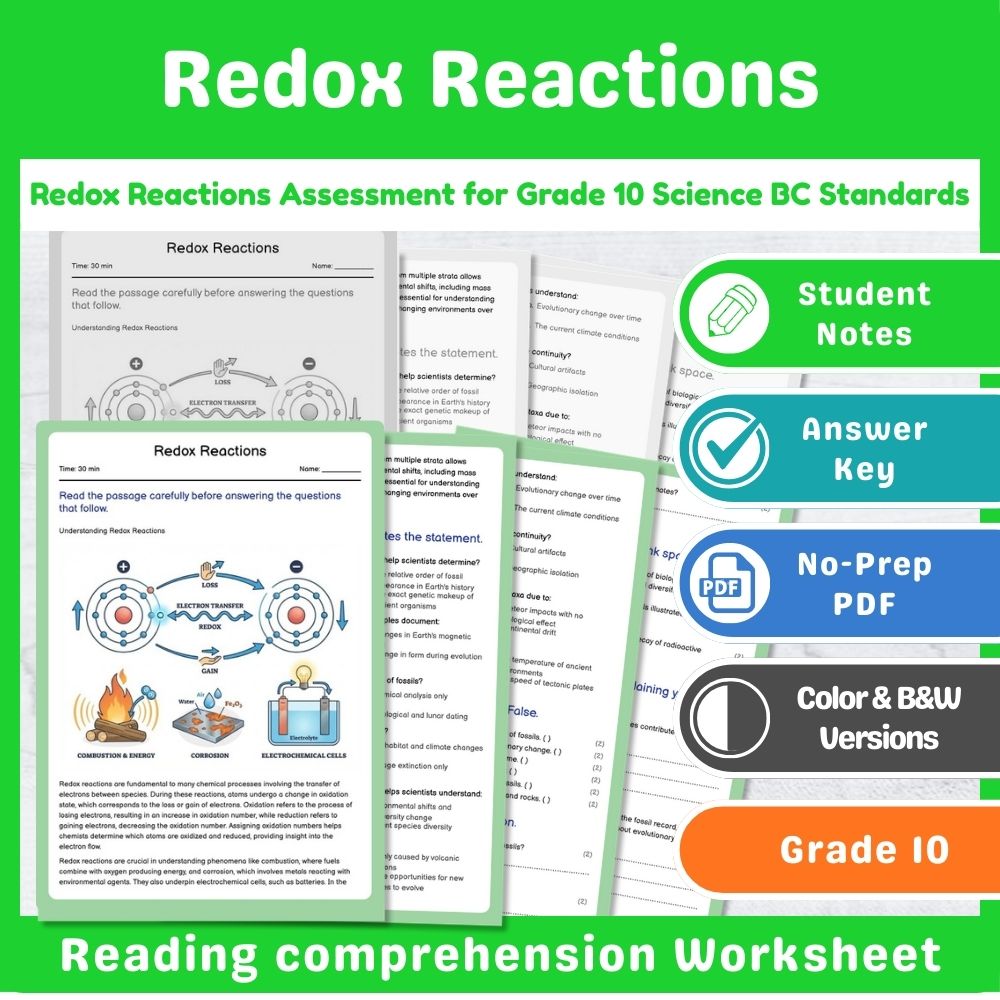
Redox Reactions Assessment for Grade 10 Science BC Standards
Created byPrism Point LearningLearning Objectives
- Understand the concept of oxidation and reduction in chemical reactions.
- Identify oxidation numbers and track electron transfer during redox processes.
- Explain the significance of redox reactions in everyday phenomena like combustion and corrosion.
Instant download
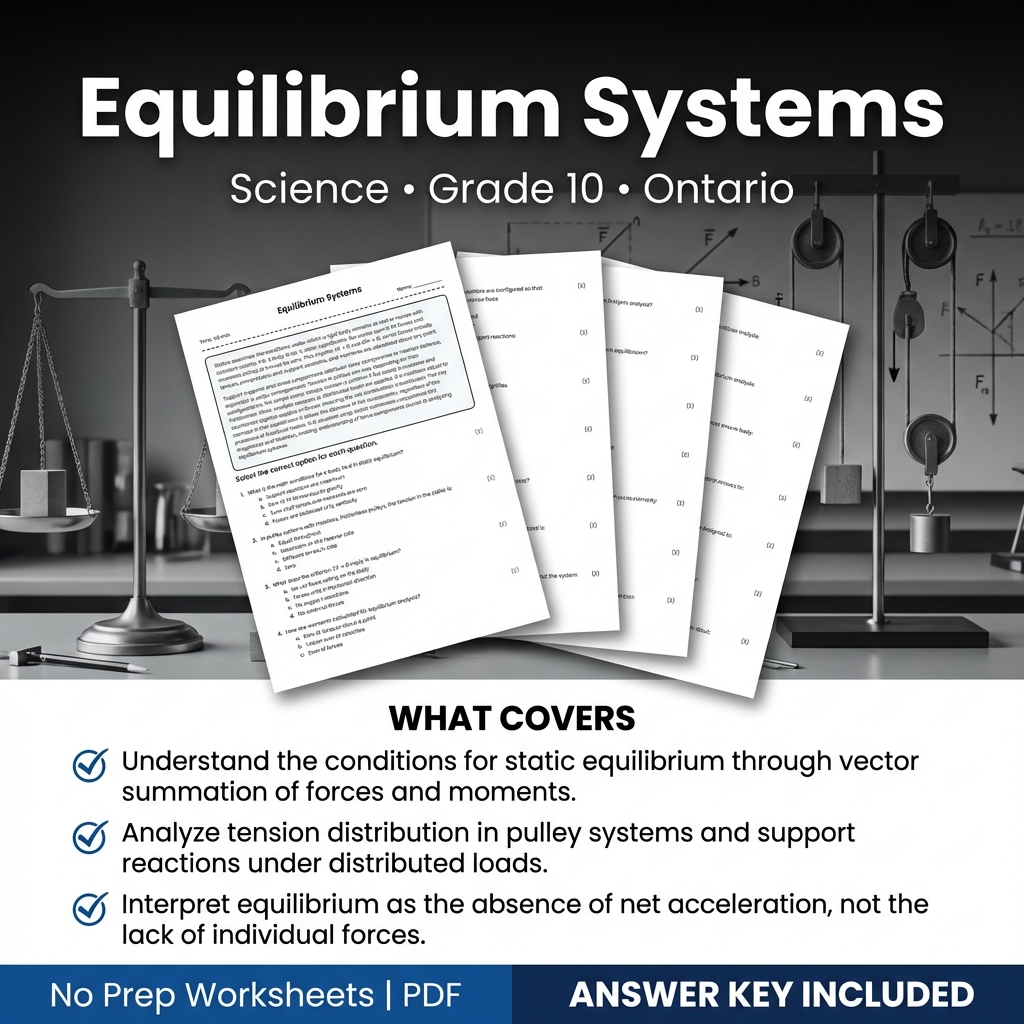
Equilibrium Systems Grade 10 Science Worksheet | Ontario Standards
Created byCoral Reef LearningLearning Objectives
- Understand the conditions for static equilibrium through vector summation of forces and moments.
- Analyze tension distribution in pulley systems and support reactions under distributed loads.
- Interpret equilibrium as the absence of net acceleration, not the lack of individual forces.
Instant download
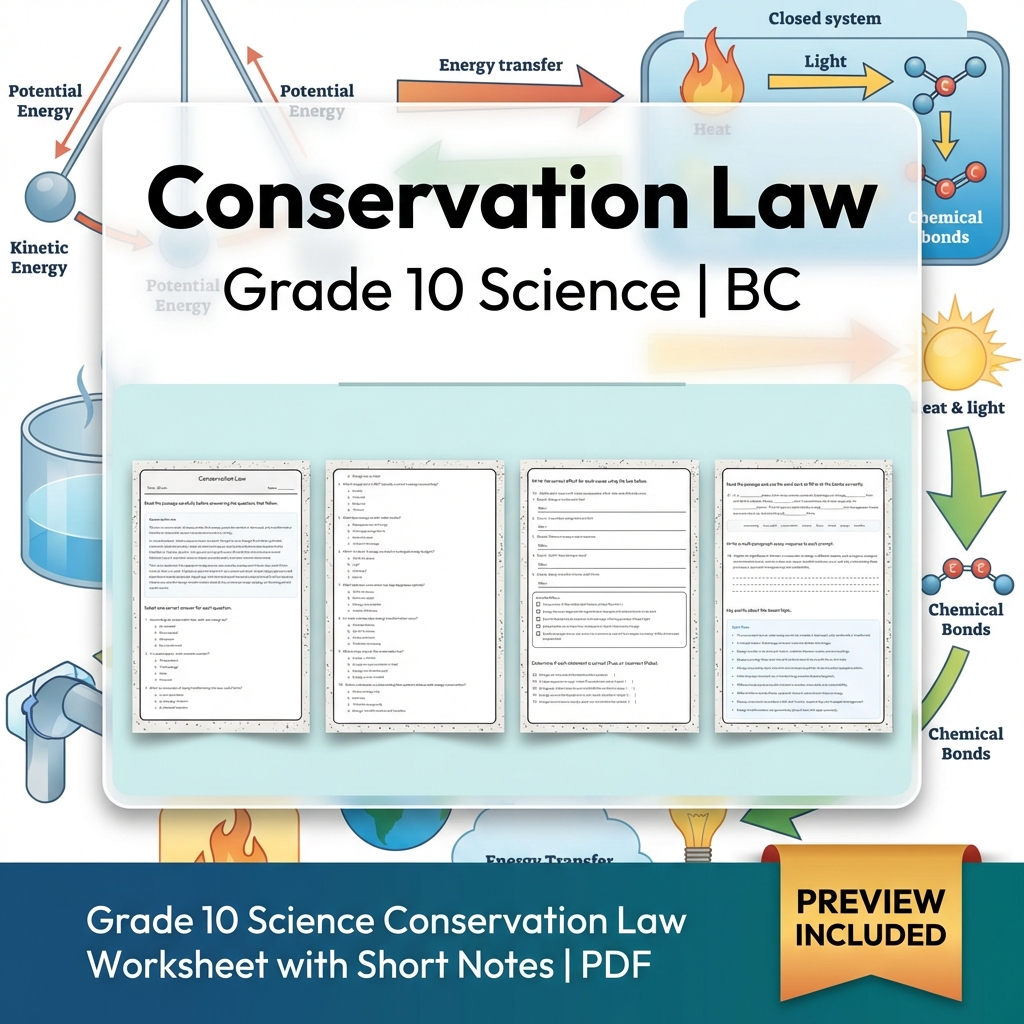
Grade 10 Science Conservation Law Worksheet with Short Notes | PDF
 Created byMeadowlark Worksheets
Learning Objectives
- Understand the core principles of the conservation of energy.
- Identify different forms energy can take and how it is transferred.
- Explain scenarios involving energy transformation in systems.
Also included in: Grade 10 Science Lesson Bundle | Energy & Thermodynamics Worksheets +1 more
Instant download
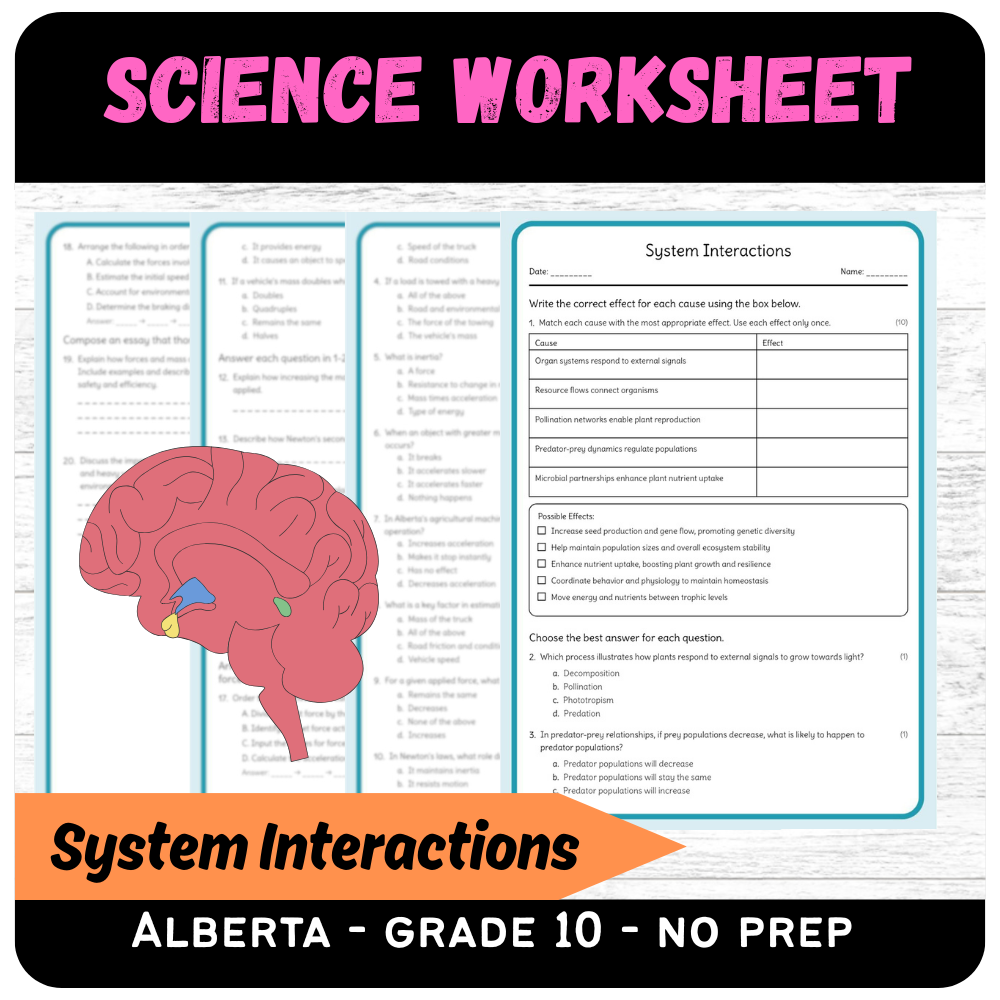
Grade 10 Science – System Interactions Worksheet (PDF) | Alberta Standards
Created byBright Mind ResourcesLearning Objectives
- Describe how biological systems exchange materials and information across different scales.
- Explain the concept of emergent properties in ecosystems resulting from system interactions.
- Analyze examples of system coupling such as pollination, predator-prey relationships, and microbe partnerships.
Instant download

Grade 10 Science | Heat Transfer - Daily Reading Comprehension
Created byCoral Reef LearningLearning Objectives
- Understand key concepts related to Science
- Apply knowledge through practice questions
- Demonstrate comprehension of the material
Instant download

Model Revision Evidence Assessment | Florida NGSSS Grade 10 Science
Created byPrism Point LearningLearning Objectives
- Explain how scientific models remain tentative when new evidence does not match expected patterns.
- Evaluate the quality of evidence by considering consistency, explanatory power, and predictive accuracy.
- Identify reasoning steps used to resolve conflicts between observations and a model’s prior assumptions.
Also included in: Grade 10 Scientific Reasoning Science Lesson Bundle – Florida NGSSS +1 more
Instant download

Atmosphere and Climate Differences on Terrestrial Planets Worksheet
 Created bySunny Desk Resources
Learning Objectives
- Compare Earth, Mars, and Venus using atmosphere, greenhouse effects, and surface conditions
- Explain how a planet’s magnetic field can influence the impact of solar wind on its atmosphere
- Interpret how volatile inventories and solar distance help account for differences in liquid water
Also included in: Earth Systems, Climate, and Sustainability Lesson Bundle | Grade 10 Science | Alberta +1 more
Instant download
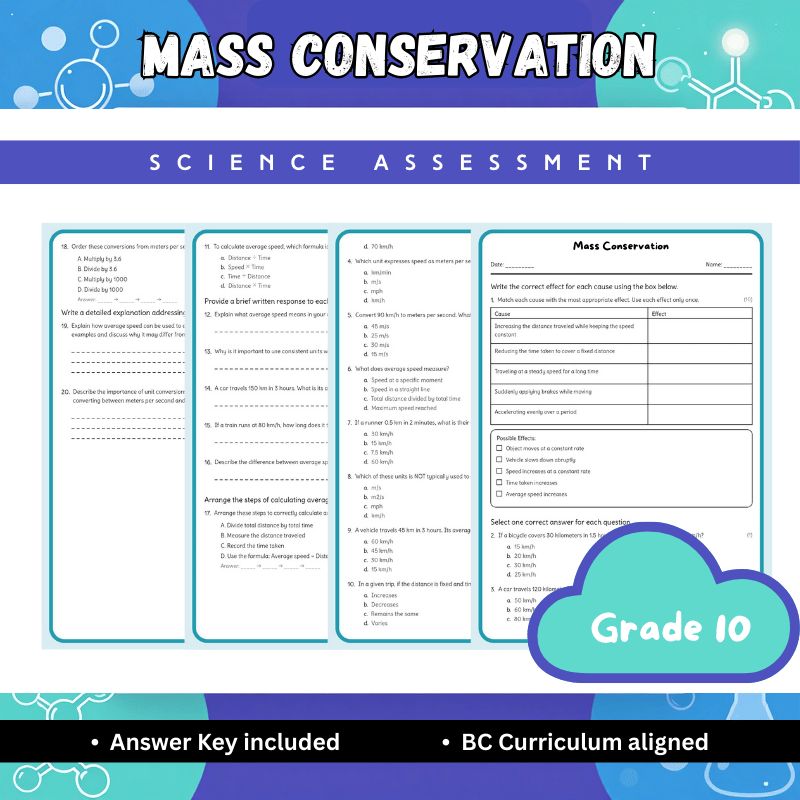
Grade 10 Science | Mass Conservation Worksheet (PDF) – BC Standard & Practice
Created byBright Mind ResourcesLearning Objectives
- Understand the principle of conservation of mass in chemical reactions.
- Explain why balancing chemical equations is necessary for mass conservation.
- Apply the law of mass conservation to compare material quantities before and after reactions.
Instant download

Biological Networks & System Interactions Grade 10 Worksheets
Created bySunny Desk ResourcesLearning Objectives
- Explain how organisms exchange matter and information in interacting biological systems
- Describe how interactions in networks (pollination, predator–prey, plant–microbe) can create emergent outcomes
- Use evidence from a passage to distinguish resilience and function in coupled ecosystems
Also included in: Cell Structure, Homeostasis & Energy Lesson Bundle: Grade 10 Science Alberta +1 more
Instant download
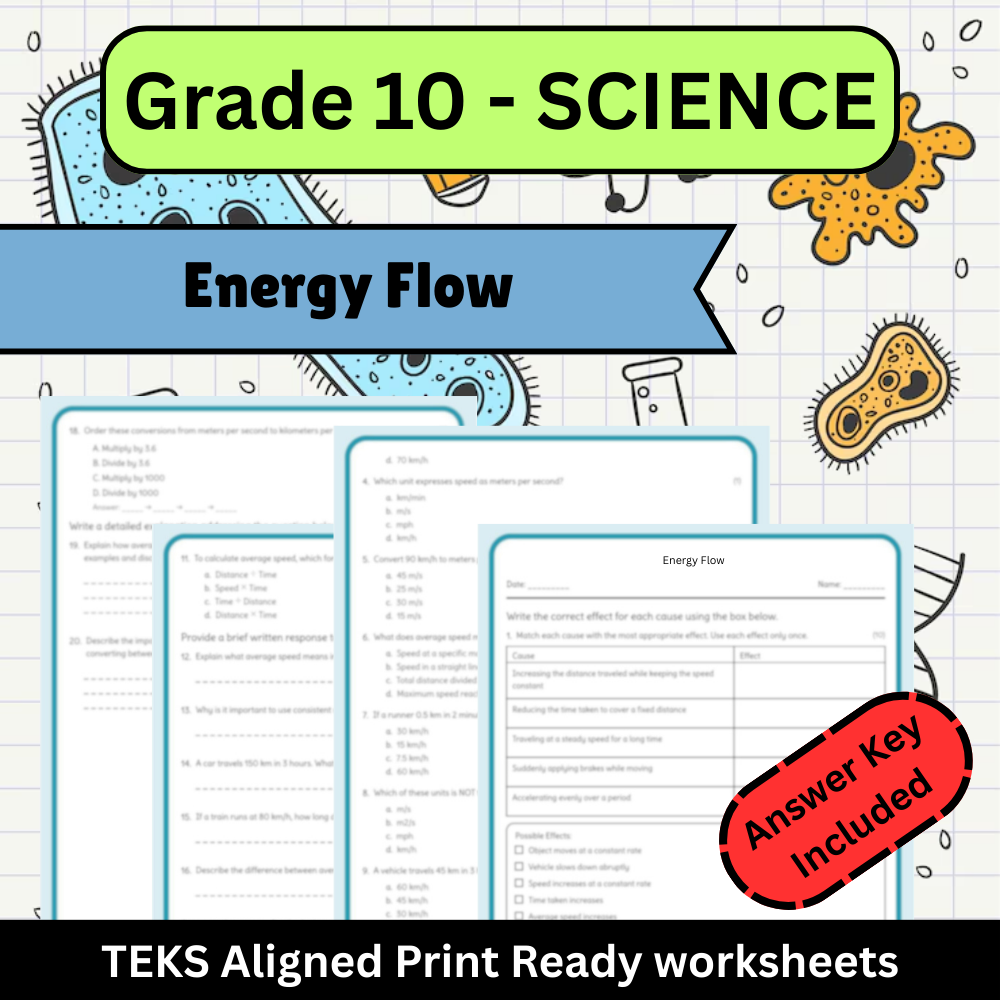
Grade 10 Science | Energy Flow Worksheet (Worksheet + Answer Key) – TEKS Aligned
Created byBright Mind ResourcesLearning Objectives
- Explain how energy enters and moves through ecosystems via trophic levels.
- Identify the role of primary producers and the transfer of energy in food chains and webs.
- Describe how energy decreases at higher trophic levels and its impact on biomass and populations.
Also included in: Grade 10 Science | Ecosystems & Biodiversity Unit Worksheet Bundle(TEKS-Aligned) +5 more
Instant download

Grade 10 Electron Configuration Worksheet | Practice & Assessment PDF
Created byClear Sky ClassroomLearning Objectives
- Explain how electron configuration shows where electrons are likely to be found in energy levels and orbitals.
- Identify how valence electrons relate to an element’s chemical reactivity and bonding behavior.
- Predict trends in element properties using electron configuration patterns across periods and groups.
Instant download
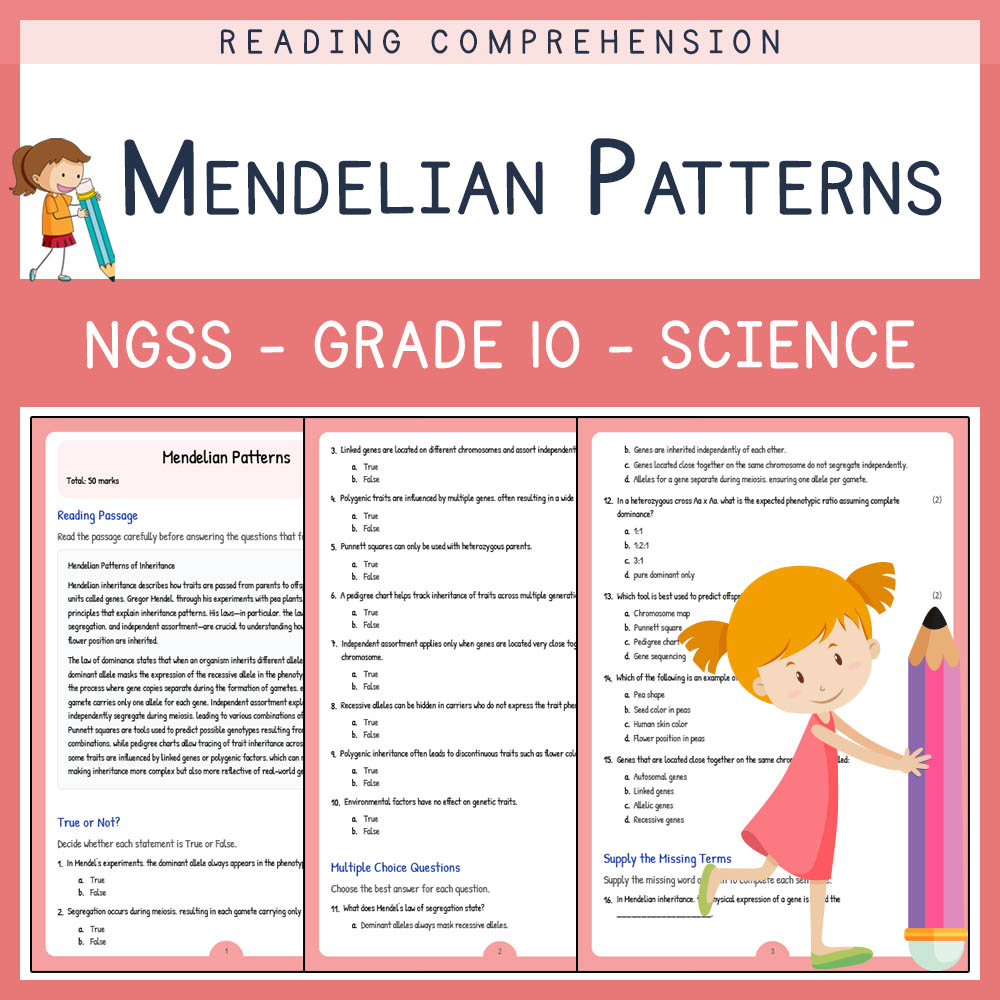
Grade 10 Science | Mendelian Patterns Worksheet & Answer Key (NGSS Aligned)
Created byLumora LearningLearning Objectives
- Explain Mendel's laws of inheritance, including dominance, segregation, and independent assortment.
- Use Punnett squares and pedigree charts to predict offspring phenotypes and genotypes.
- Analyze how linked genes and polygenic traits influence inherited characteristics.
Instant download

Energy Conversion in Mechanical-Electrical Systems Grade 10 Worksheets
Created bySunny Desk ResourcesLearning Objectives
- Trace energy transformations across mechanical and electrical components in integrated systems.
- Apply work–energy and conservation of energy ideas to evaluate system performance with losses.
- Connect kinematics concepts to electrical power generation in real-world systems.
Also included in: Energy, Electricity & Momentum Transfer Lesson Bundle | Grade 10 Science | Alberta +1 more
Instant download

Grade 10 Surface Albedo & Greenhouse Radiative Effects Science Worksheet
Created byAmber Owl EducationLearning Objectives
- Explain how the surface atmosphere system exchanges energy through radiation and evapotranspiration
- Describe how albedo and greenhouse gases influence radiative forcing and climate variability
- Interpret how precipitation patterns can change through feedbacks involving clouds, moisture, and land surface conditions
Instant download

Grade 10 Science – Friction & Drag | Daily Reading Worksheet
Created byBright Mind ResourcesLearning Objectives
- Understand the concepts of static and kinetic friction
- Identify how friction depends on surface characteristics and normal force
- Explain how drag opposes motion in fluids
Also included in: Grade 10 Forces & Motion Science Daily Reading Worksheets Lesson Bundle | BC +1 more
Instant download

Sustainability Assessment Worksheets | Grade 10 Science
Created bySunny Desk ResourcesLearning Objectives
- Explain how sustainability assessments use environmental, economic, and social indicators together to judge long-term viability of resource use.
- Identify how metrics such as renewal rates, pollutant loads, and ecosystem service trends help compare resource-management options.
- Evaluate statements about sustainability and make defensible choices based on assessment indicators.
Also included in: Earth Systems, Climate, and Sustainability Lesson Bundle | Grade 10 Science | Alberta +1 more
Instant download
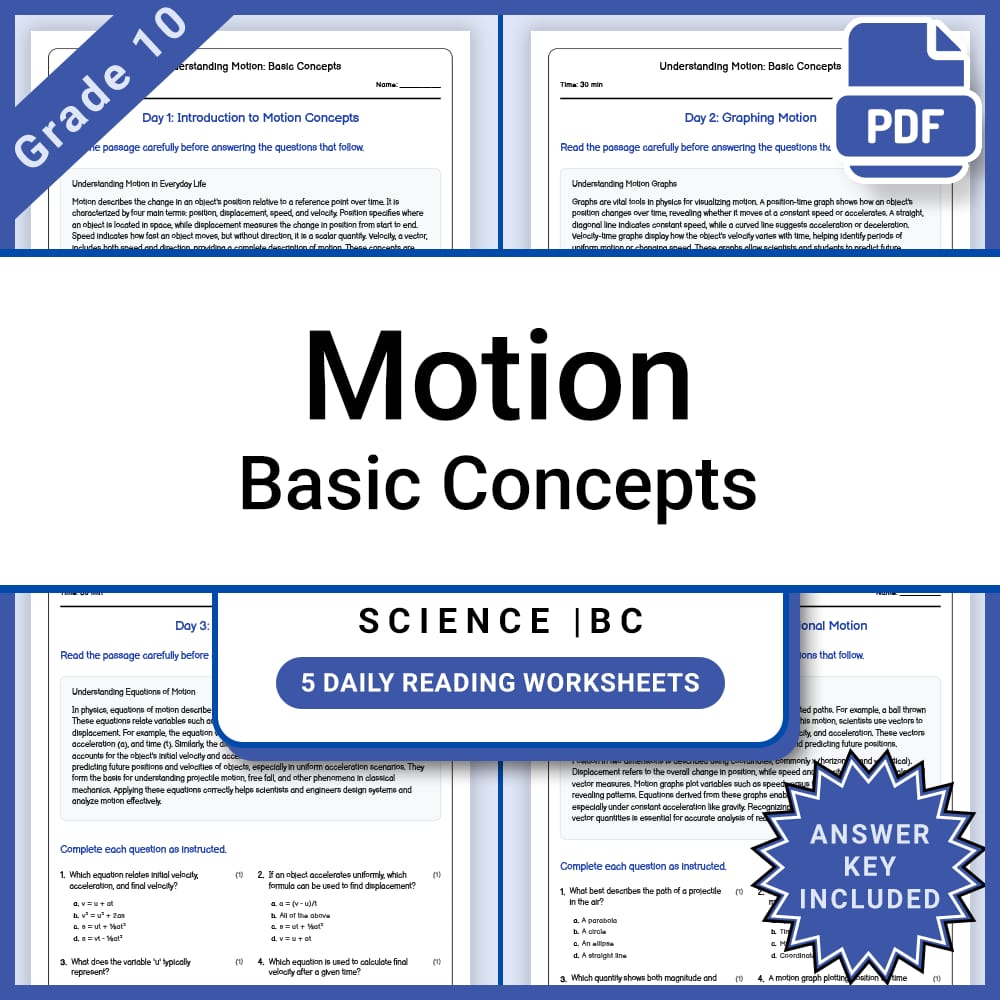
Grade 10 Science – Motion Daily Reading Worksheet with Answer Key
JCreated byJ.S SheetsLearning Objectives
- Define key motion terms: position, displacement, speed, velocity, and acceleration.
- Differentiate between scalar and vector quantities.
- Describe how motion graphs and equations relate variables in motion.
Also included in: Grade 10 Science Lesson Group Bundle – Physics and Fields +1 more
Instant download
About Grade 10 Science Worksheets
Find Science worksheets built for Grade 10. All 7,038 cover core skills, practice, and review, each an instant PDF download.
Every worksheet on MyTeachingSheets is created by independent teacher-authors and reviewed before publication. All resources download as printable PDFs for classroom, homework, or at-home practice, and many include answer keys. Preview any worksheet free before buying.