
Grade 11 Science Worksheets
6,616 worksheets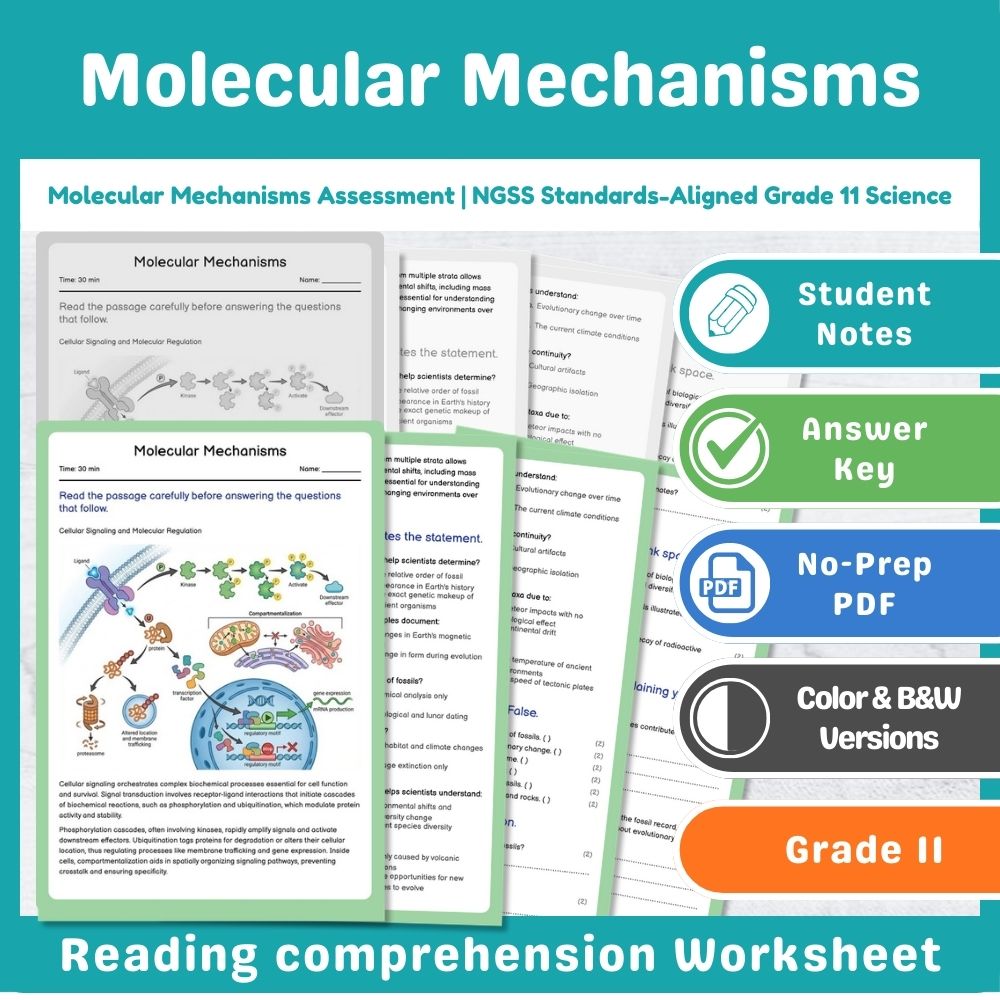
Molecular Mechanisms Assessment | NGSS Standards-Aligned Grade 11 Science
 Created byPrism Point Learning
Learning Objectives
- Explain the biochemical mechanisms involved in cellular signaling pathways.
- Identify key motifs and processes such as phosphorylation cascades, ubiquitination, and transcriptional regulation.
- Describe how intracellular compartmentalization and membrane transport influence molecular mechanisms.
Instant download

Inheritance Patterns Assessment for Grade 11 Science | Standards-Aligned
Created byPrism Point LearningLearning Objectives
- Explain how observable traits are connected to genetic inheritance patterns across generations.
- Describe the role of Punnett squares in predicting offspring genotypes and phenotypes.
- Differentiate between autosomal and sex-linked inheritance, including dominance and recessiveness.
Also included in: Grade 11 Biological Evidence Science Lesson Bundle | General Framework
Instant download

Feedback Control Loops Assessment | General Standards-Aligned Assessment Grade 11 Science
Created byPrism Point LearningLearning Objectives
- Understand the concept of feedback mechanisms in maintaining homeostasis.
- Differentiate between negative and positive feedback loops.
- Identify real-life examples of feedback control in the human body.
Also included in: Grade 11 Biological Evidence Science Lesson Bundle | General Framework
Instant download
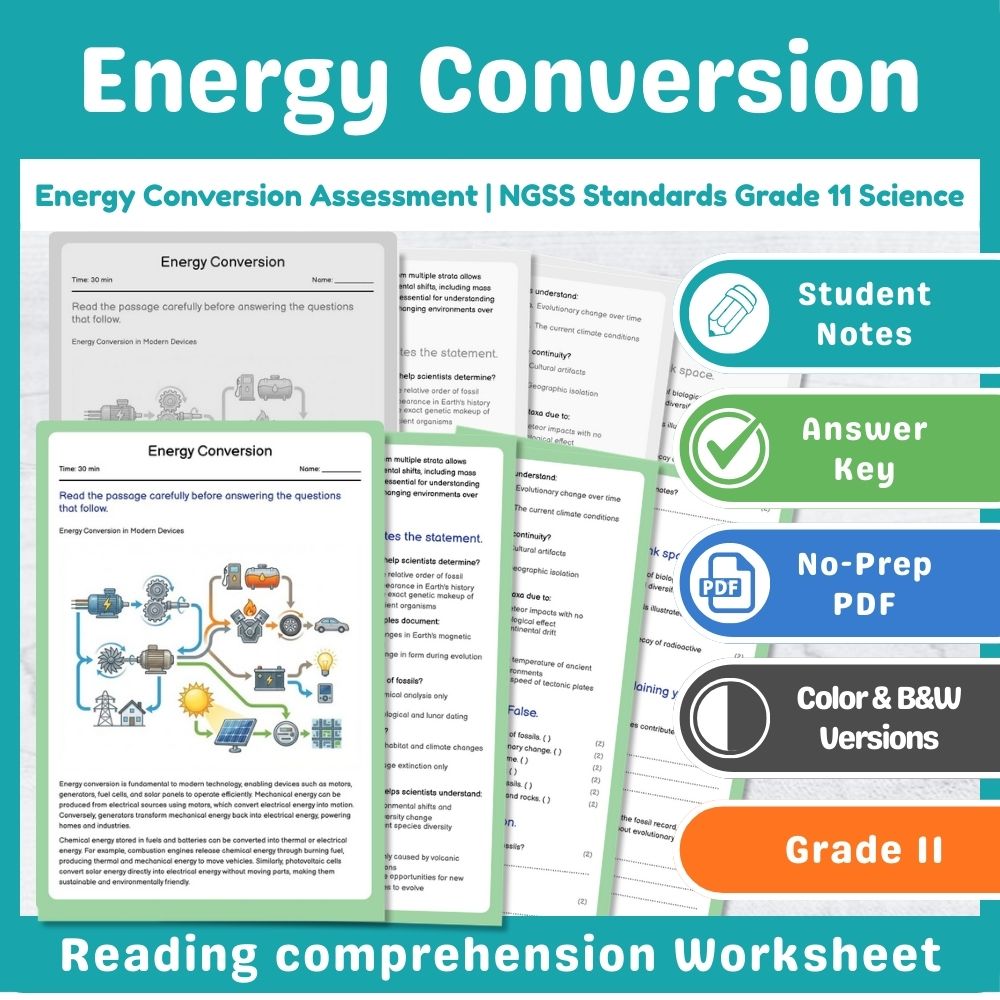
Energy Conversion Assessment | NGSS Standards Grade 11 Science
Created byPrism Point LearningLearning Objectives
- Understand the different forms of energy and their conversions
- Design and evaluate devices that convert energy between mechanical, electrical, chemical, and thermal forms
- Analyze efficiency and energy losses in energy conversion systems
Instant download
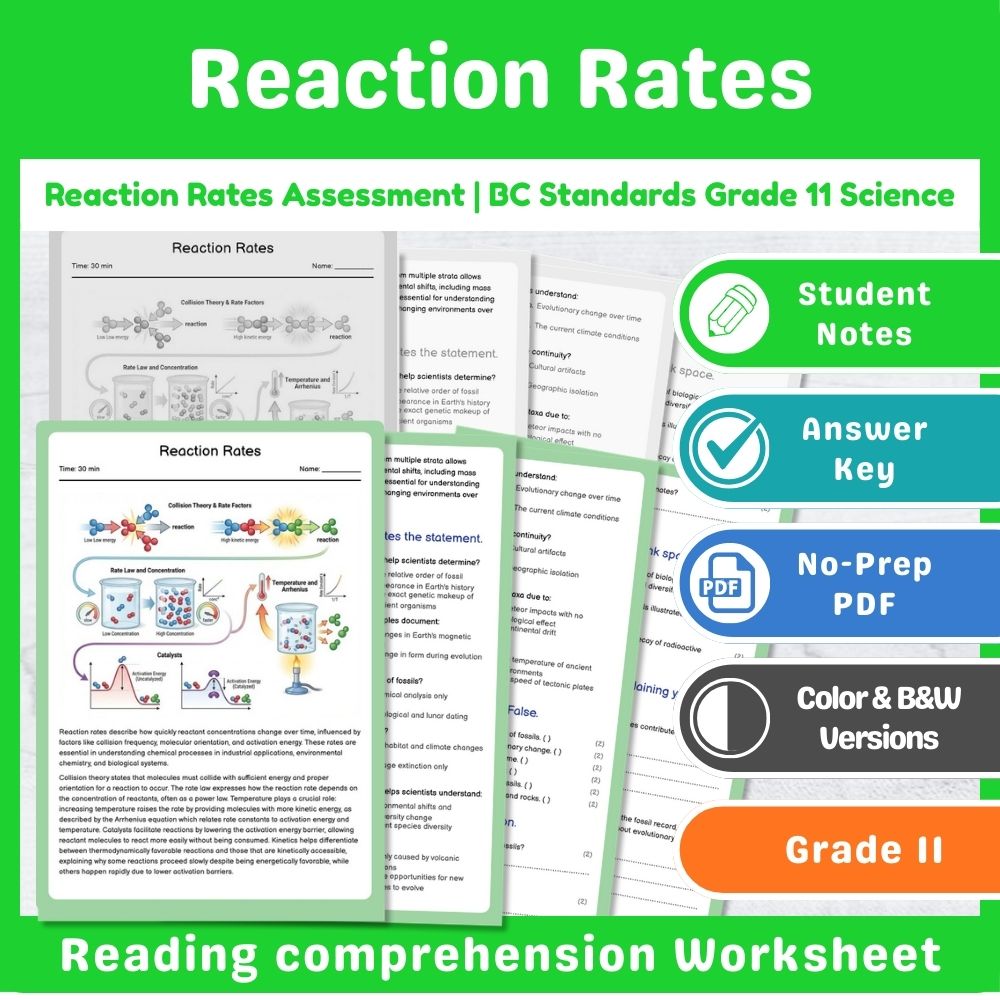
Reaction Rates Assessment | BC Standards Grade 11 Science
Created byPrism Point LearningLearning Objectives
- Explain the factors influencing reaction rates, including collision frequency, molecular orientation, and activation energy.
- Describe rate laws and how they relate reactant concentrations to reaction speed.
- Understand the Arrhenius equation and how temperature affects rate constants.
Also included in: Grade 11 Science | Thermochemistry Assessment Bundle – Standards-Aligned
Instant download
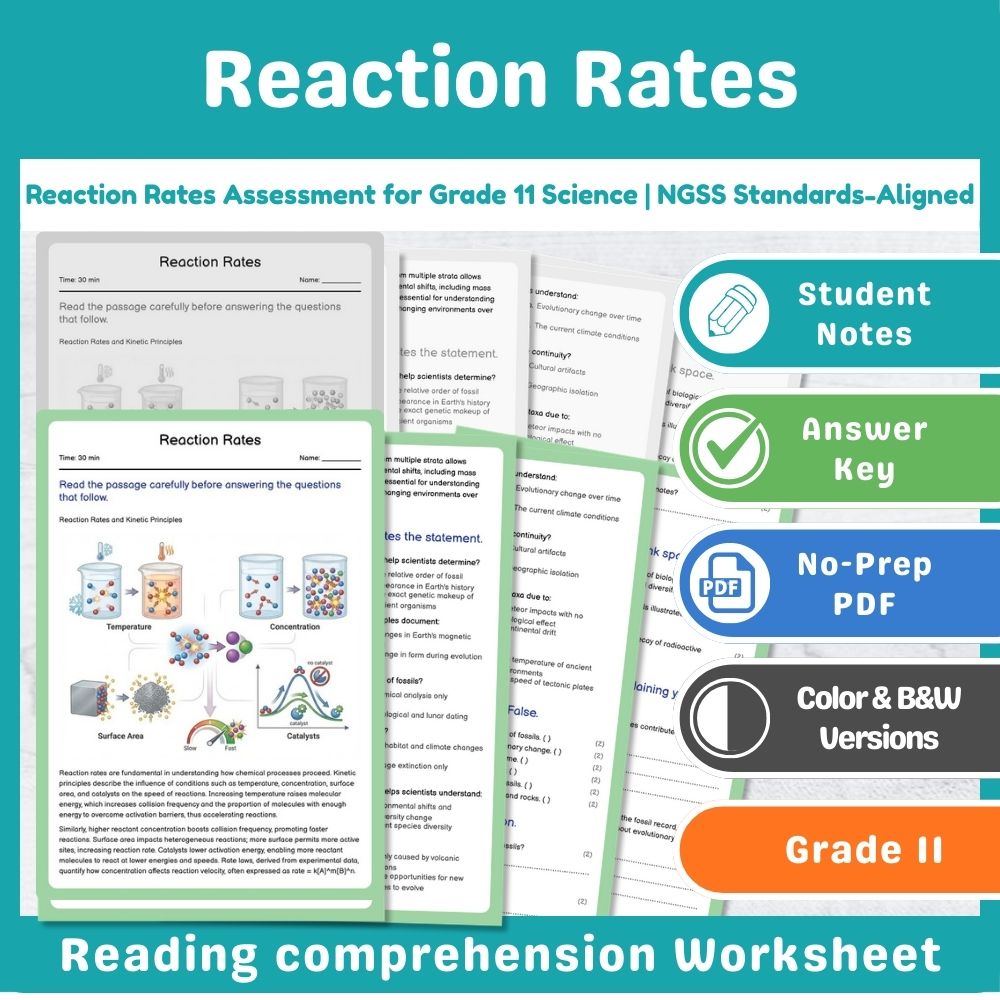
Reaction Rates Assessment for Grade 11 Science | NGSS Standards-Aligned
Created byPrism Point LearningLearning Objectives
- Explain how temperature, concentration, surface area, and catalysts influence reaction rates through collision and activation energies.
- Apply rate laws and concentration dependencies to elementary reaction steps.
- Interpret potential energy diagrams and Arrhenius parameters to understand temperature's effect on reaction rates.
Also included in: Grade 11 Science Mini Bundle – Matter and Its Interactions NGSS Unit
Instant download
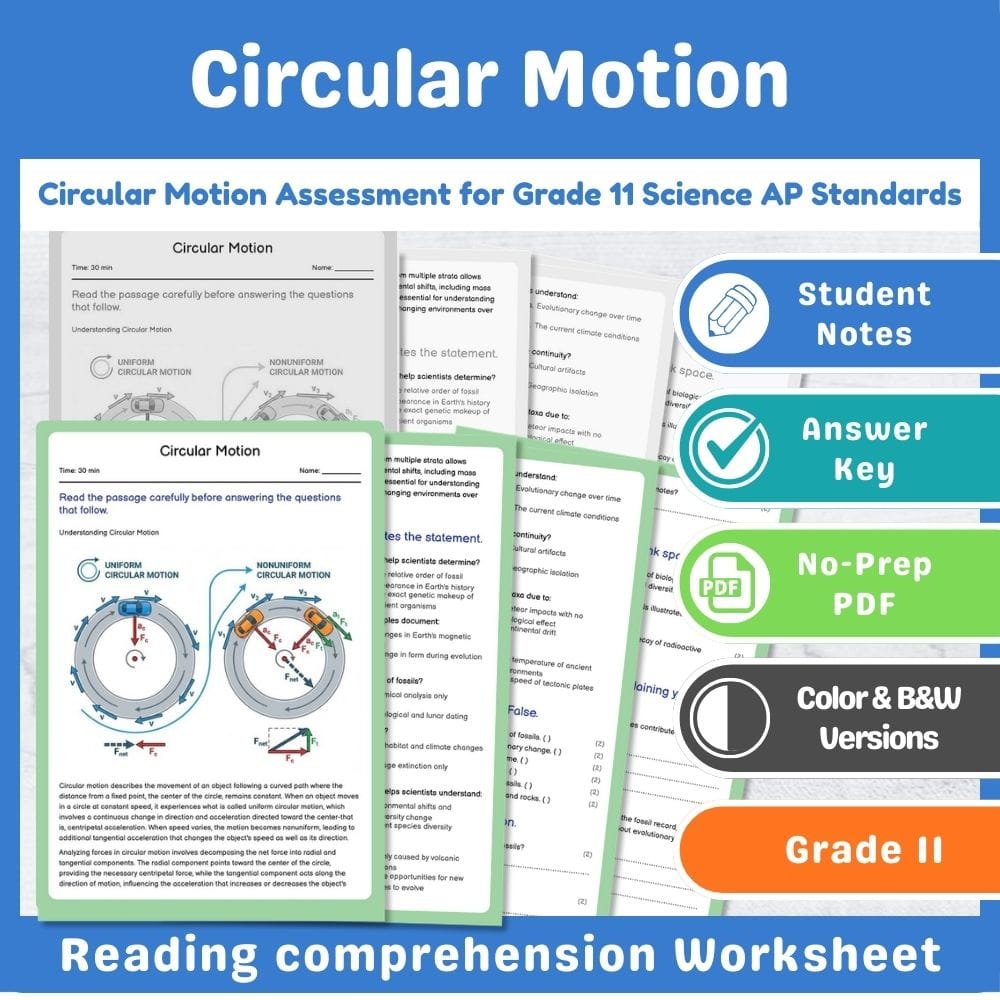
Circular Motion Assessment for Grade 11 Science AP Standards
Created byPrism Point LearningLearning Objectives
- Describe uniform and nonuniform circular motion with emphasis on centripetal and tangential accelerations.
- Model net forces in circular motion by analyzing radial and tangential components.
- Express acceleration vectors in polar coordinates and relate them to the change in velocity direction.
Instant download
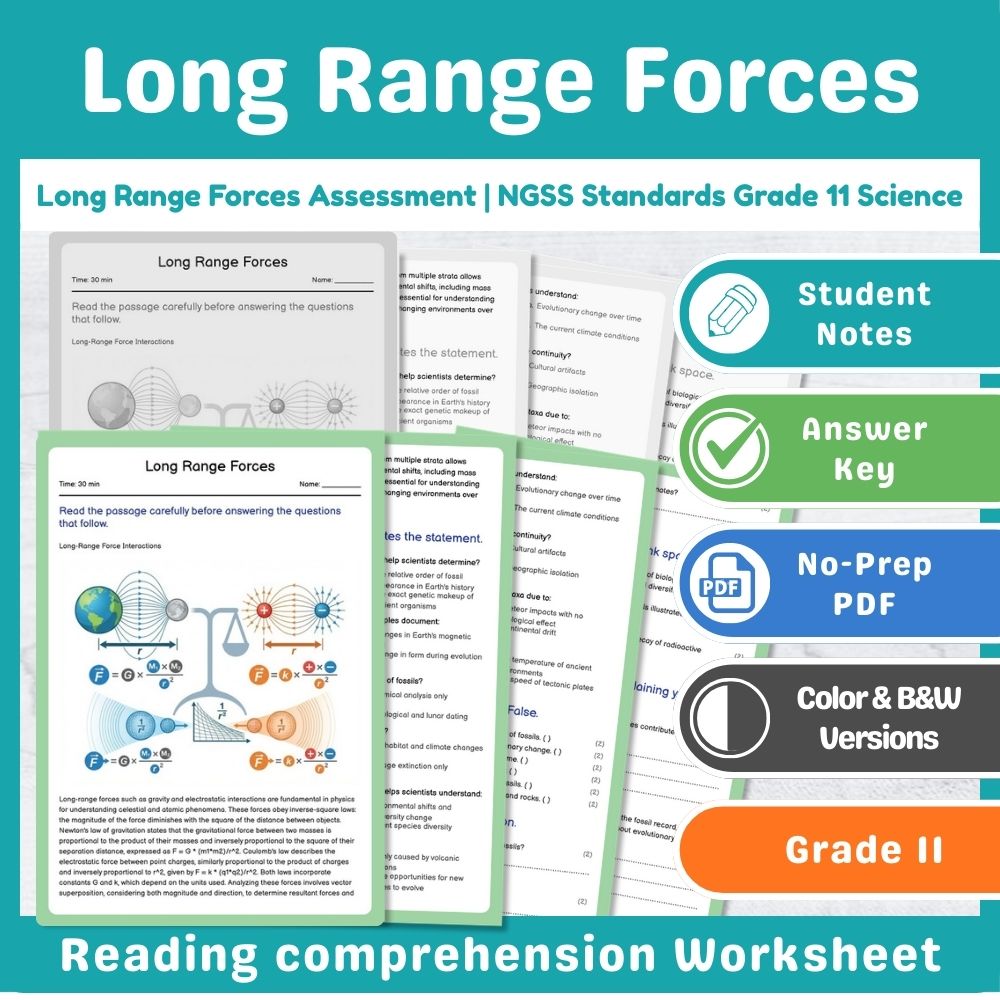
Long Range Forces Assessment | NGSS Standards Grade 11 Science
Created byPrism Point LearningLearning Objectives
- Understand how inverse-square laws describe gravitational and electrostatic forces.
- Apply Newton's law of universal gravitation and Coulomb's law to solve force problems.
- Use vector addition to determine net forces and predict motion trajectories.
Also included in: Grade 11 Physics Mini Bundle – Impulse, Forces & Conservation Assessment
Instant download
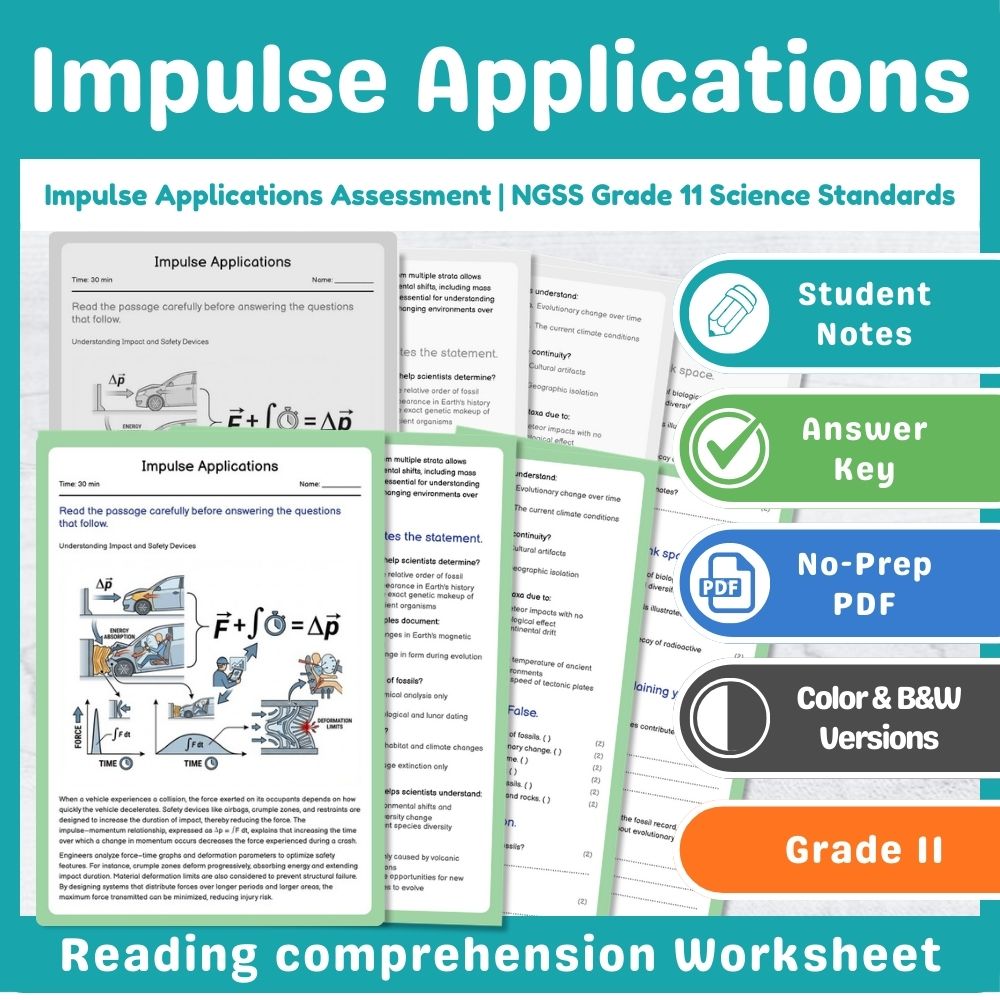
Impulse Applications Assessment | NGSS Grade 11 Science Standards
Created byPrism Point LearningLearning Objectives
- Understand the relationship between impulse and momentum in collision scenarios.
- Apply the impulse–momentum theorem to analyze crash-protection systems.
- Evaluate and refine design parameters to minimize forces during collisions.
Also included in: Grade 11 Physics Mini Bundle – Impulse, Forces & Conservation Assessment
Instant download
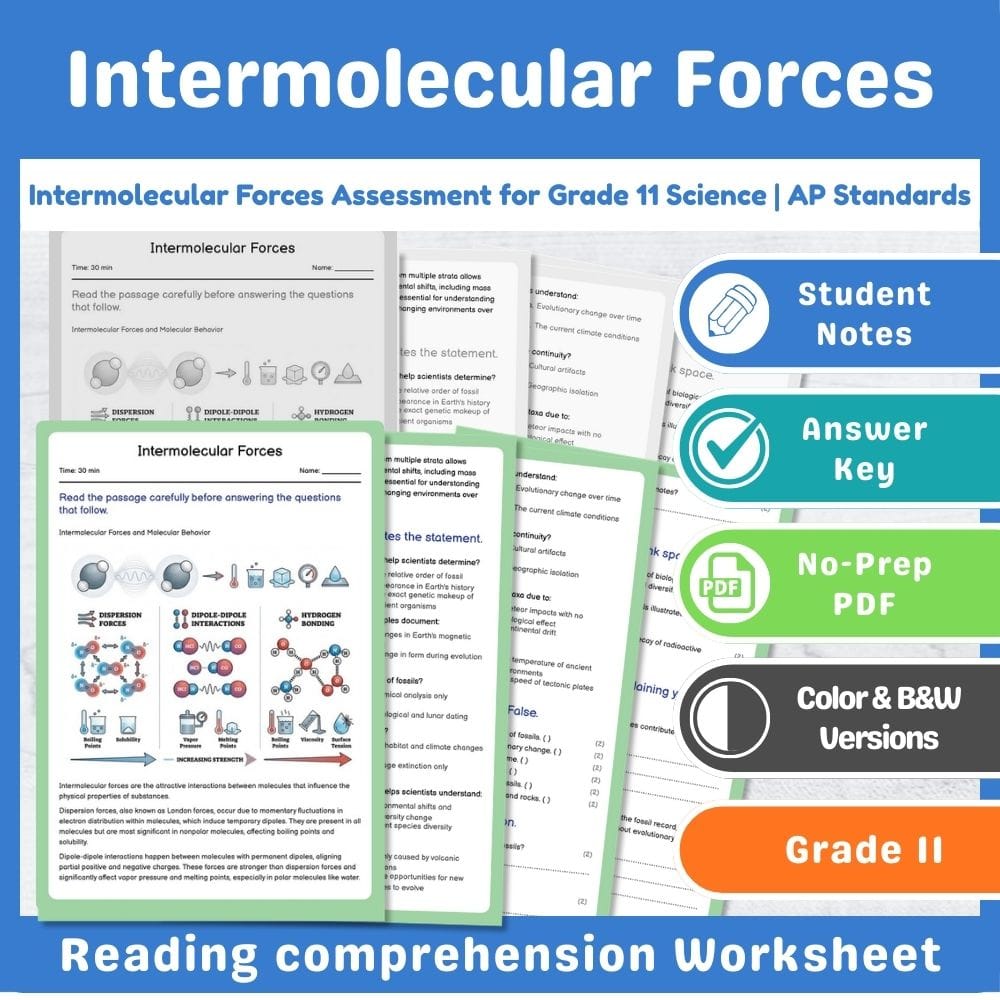
Intermolecular Forces Assessment for Grade 11 Science | AP Standards
Created byPrism Point LearningLearning Objectives
- Describe the different types of intermolecular forces: dispersion, dipole-dipole, and hydrogen bonding.
- Explain how intermolecular forces influence boiling point, vapor pressure, and solubility.
- Relate molecular polarity and surface interactions to phase behavior and macroscopic trends.
Instant download
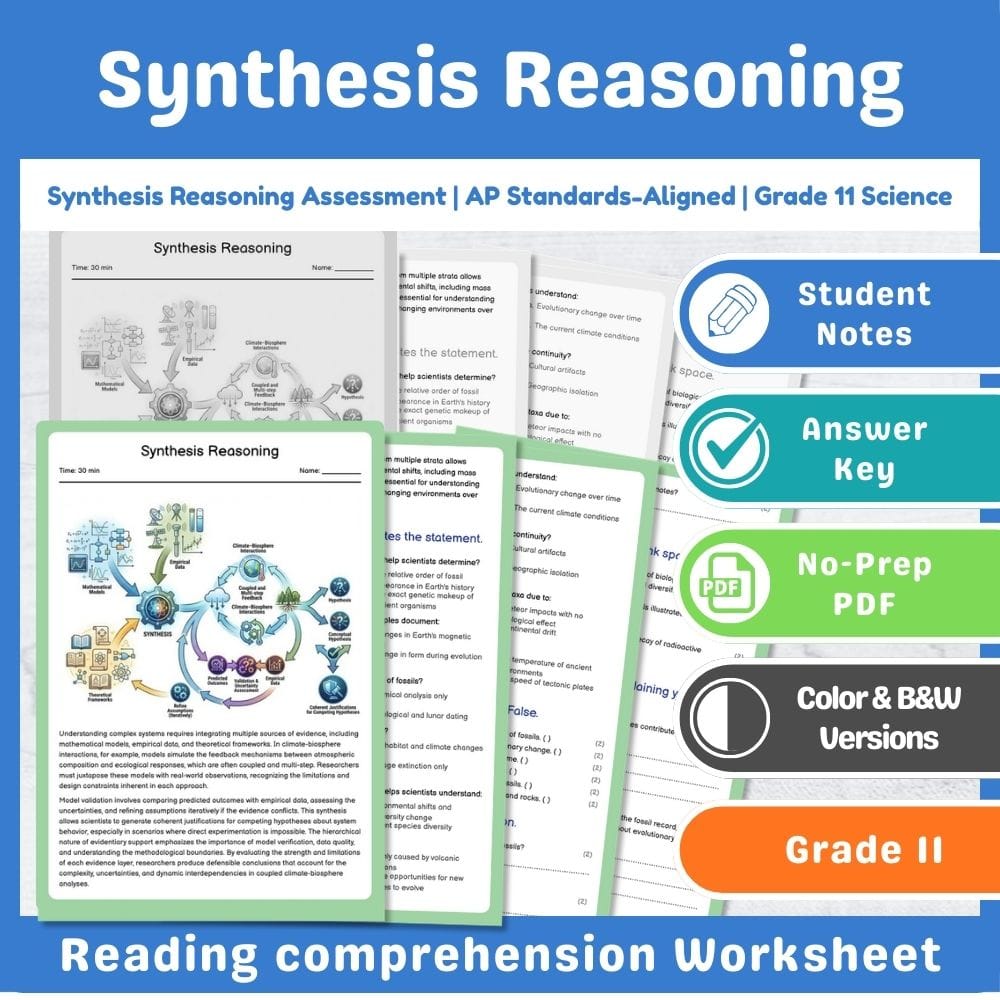
Synthesis Reasoning Assessment | AP Standards-Aligned | Grade 11 Science
Created byPrism Point LearningLearning Objectives
- Evaluate complex phenomena through model-based inference and quantitative reasoning.
- Integrate empirical summaries, model expectations, and design constraints for hypothesis testing.
- Apply uncertainty quantification and validation outcomes to support scientific conclusions.
Also included in: Grade 11 Science Mini Bundle | AP Science Practices & Skills
Instant download

Buffer Principles Assessment | Alberta Standards Grade 11 Science
Created byPrism Point LearningLearning Objectives
- Explain how buffers resist pH changes through conjugate acid-base pairs.
- Identify factors that influence the effective buffering range in systems like soils and water treatment.
- Describe real-world applications of buffer systems in agriculture, wetlands, and water management.
Also included in: Grade 11 Acids, Bases & pH Chemistry Science Lesson Bundle | Alberta +1 more
Instant download

pH Fundamentals Assessment | Alberta Standards + Grade 11 Science
Created byPrism Point LearningLearning Objectives
- Understand key concepts related to Science
- Apply knowledge through practice questions
- Demonstrate comprehension of the material
Also included in: Grade 11 Acids, Bases & pH Chemistry Science Lesson Bundle | Alberta +1 more
Instant download

Titration Theory Assessment for Grade 11 Science | Alberta Standards
Created byPrism Point LearningLearning Objectives
- Explain the principles and process of titration in quantitative analysis.
- Identify the importance of proper calibration and indicator selection during titration.
- Calculate unknown concentrations using titrant volume and concentration relationships.
Also included in: Grade 11 Chemical Reactions & Stoichiometry Science Lesson Bundle – Alberta +1 more
Instant download

Neutralization Stoichiometry Assessment for Grade 11 Science - Alberta
Created byPrism Point LearningLearning Objectives
- Understand the concept of neutralization reactions involving acids and bases.
- Apply molarity, limiting reagent, and titration principles in solving neutralization problems.
- Perform stoichiometric calculations to determine reagent quantities needed for neutralization.
Also included in: Grade 11 Acids, Bases & pH Chemistry Science Lesson Bundle | Alberta +1 more
Instant download

Solution Stoichiometry Assessment | Alberta Standards Grade 11 Science
Created byPrism Point LearningLearning Objectives
- Explain the concept of molarity and its role in solution stoichiometry.
- Calculate reactant and product quantities using mole-mole relationships in aqueous solutions.
- Identify limiting reagents in solution reactions based on concentration and stoichiometry.
Also included in: Grade 11 Solutions and Solubility Science Lesson Bundle | Alberta Framework +1 more
Instant download

VSEPR and Forces Assessment | Alberta Standards Grade 11 Science
Created byPrism Point LearningLearning Objectives
- Describe the VSEPR model and predict molecular geometries based on electron pair arrangements.
- Explain how molecular shapes influence intermolecular forces such as dipole interactions and hydrogen bonding.
- Relate molecular shape to physical properties like boiling and melting points, with real-world examples.
Also included in: Grade 11 Matter and Chemical Bonding Science Lesson Bundle for Alberta +1 more
Instant download

Gas Stoichiometry Assessment for Grade 11 Science | Alberta Standards
Created byPrism Point LearningLearning Objectives
- Understand the application of gas laws in stoichiometric calculations involving gases.
- Relate pressure, volume, and temperature conditions to mole quantities of gases.
- Calculate gas volumes under standard and non-standard conditions for industrial or environmental contexts.
Also included in: Grade 11 Chemical Reactions & Stoichiometry Science Lesson Bundle – Alberta +1 more
Instant download

Bond Polarity Assessment | Alberta Standards Grade 11 Science
Created byPrism Point LearningLearning Objectives
- Understand the concept of bond polarity and how it relates to partial charges and dipoles.
- Distinguish between polar bonds and polar molecules using examples like HCl and H2O.
- Explain the implications of bond polarity for solubility, pollutant transport, and solvent selection.
Also included in: Grade 11 Matter and Chemical Bonding Science Lesson Bundle for Alberta +1 more
Instant download

Atomic Structure Assessment for Grade 11 Science | Alberta Standards
Created byPrism Point LearningLearning Objectives
- Describe the organization of protons, neutrons, and electrons within atoms.
- Explain how electron arrangements, including shells and valence electrons, influence reactivity and bonding.
- Identify atomic features of Alberta elements used in industry and their macroscopic chemical behaviors.
Also included in: Grade 11 Matter and Chemical Bonding Science Lesson Bundle for Alberta +1 more
Instant download

Ionic Strength Assessment | Alberta Standards Grade 11 Science
Created byPrism Point LearningLearning Objectives
- Understand the concept of ionic strength and how it relates to ion concentration and charge.
- Explain how ionic strength affects activity coefficients and solubility in solutions.
- Analyze real-world examples of ionic strength effects in natural waters and industrial processes.
Also included in: Grade 11 Solutions and Solubility Science Lesson Bundle | Alberta Framework +1 more
Instant download

Dispersion Forces Assessment for Grade 11 Science – Alberta Standards
Created byPrism Point LearningLearning Objectives
- Explain the concept of London dispersion forces and how they arise from transient electron fluctuations.
- Describe how atomic and molecular size and shape influence the strength of dispersion forces.
- Link the microscopic interactions of dispersion forces to macroscopic properties such as melting points, viscosity, and phase behavior in nonpolar substances.
Also included in: Grade 11 Matter and Chemical Bonding Science Lesson Bundle for Alberta +1 more
Instant download

Advanced Models Assessment | Alberta Standards Grade 11 Science
Created byPrism Point LearningLearning Objectives
- Explain how molecular orbital theory accounts for delocalization, metallic conduction, and semiconductor behavior.
- Describe how band structure and molecular symmetry influence the spectroscopic features and reactivity of transition metal complexes.
- Assess the electronic properties of materials used in energy technologies through advanced bonding models.
Also included in: Grade 11 Matter and Chemical Bonding Science Lesson Bundle for Alberta +1 more
Instant download

Lewis Structures Assessment | Alberta Standard Assessment Grade 11 Science
Created byPrism Point LearningLearning Objectives
- Understand the concept of Lewis electron-dot structures for molecules.
- Identify how to represent shared electrons and bonds.
- Interpret Lewis structures to predict molecular shapes and properties.
Also included in: Grade 11 Matter and Chemical Bonding Science Lesson Bundle for Alberta +1 more
Instant download

Solution Stoichiometry Assessment | Alberta Standards Grade 11 Science
Created byPrism Point LearningLearning Objectives
- Understand how to use concentration measures like molarity to determine quantities of reactants and products in aqueous reactions.
- Apply mole relationships and equivalence principles to solve solution-based stoichiometry problems.
- Use mass conservation and volume-mole conversions to predict outcomes of chemical reactions in solution.
Also included in: Grade 11 Chemical Reactions & Stoichiometry Science Lesson Bundle – Alberta +1 more
Instant download

Dipole Interactions Assessment for Grade 11 Science | Alberta Standards
Created byPrism Point LearningLearning Objectives
- Explain the concept of molecular polarity and its influence on intermolecular forces.
- Analyze how dipole-dipole interactions affect physical properties like boiling point and solubility.
- Describe real-world applications of dipole interactions in refinery processes and atmospheric chemistry.
Also included in: Grade 11 Matter and Chemical Bonding Science Lesson Bundle for Alberta +1 more
Instant download

Concentration Calculations Assessment Grade 11 Science | Alberta
Created byPrism Point LearningLearning Objectives
- Understand how to convert between ion concentrations and pH or pOH using logarithmic relationships.
- Apply procedures for calculating [H+] from pH, [OH-] from pOH, and use Kw to find related concentrations.
- Relate ionic concentrations to real-world water samples such as river water in Alberta for environmental assessments.
Also included in: Grade 11 Acids, Bases & pH Chemistry Science Lesson Bundle | Alberta +1 more
Instant download
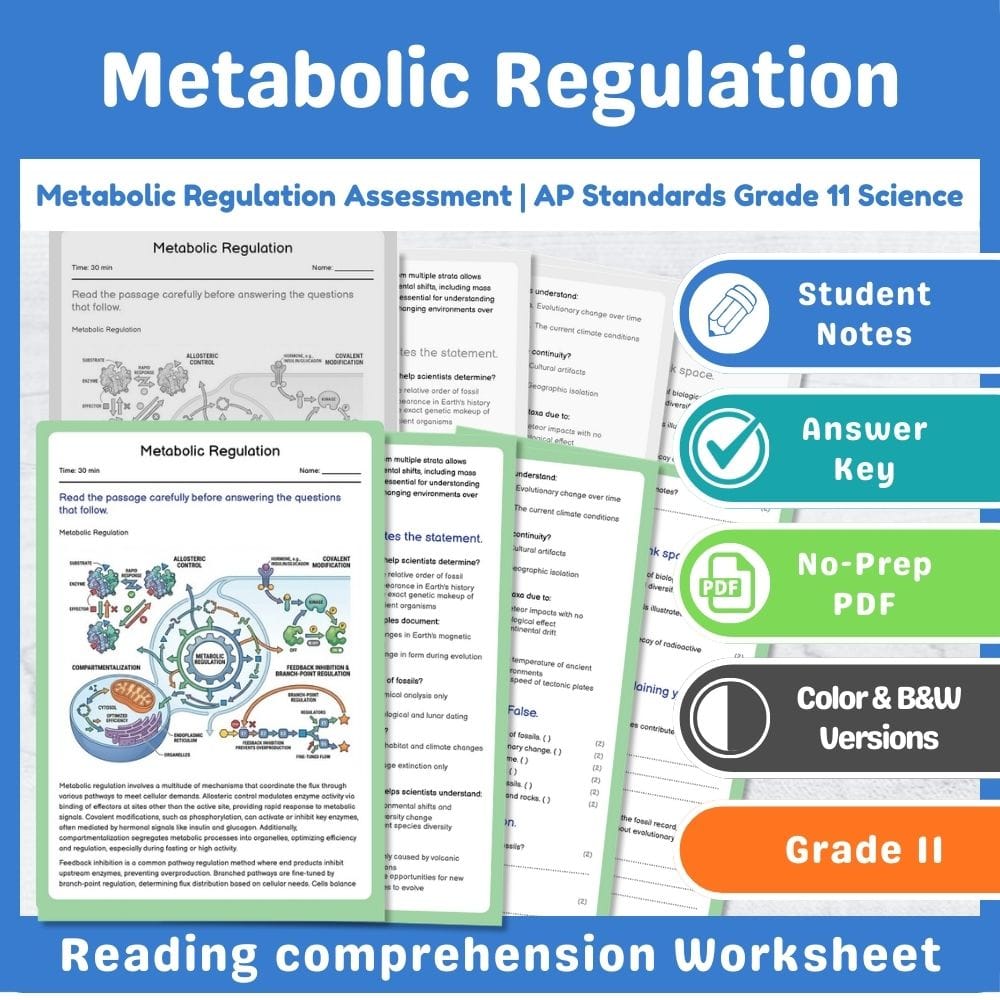
Metabolic Regulation Assessment | AP Standards Grade 11 Science
Created byPrism Point LearningLearning Objectives
- Describe mechanisms that regulate metabolic pathway flux including allosteric control and covalent modification.
- Explain how hormones and compartmentalization influence metabolic homeostasis during fasting and activity.
- Use pathway diagrams and models to analyze feedback inhibition and branch-point regulation.
Instant download

Bonding Types Assessment | Alberta Standard Grade 11 Science Worksheet
Created byPrism Point LearningLearning Objectives
- Compare electron transfer, sharing, and delocalized models in bonding.
- Identify structural motifs linked to ionic, covalent, and metallic bonds.
- Relate bond types to properties such as electrical conductivity, hardness, and solubility.
Also included in: Grade 11 Matter and Chemical Bonding Science Lesson Bundle for Alberta +1 more
Instant download

Mantle Convection Assessment for Grade 11 Science – Standards-Aligned
Created byPrism Point LearningLearning Objectives
- Understand the process of mantle convection and how it drives plate tectonics.
- Identify geophysical techniques used to observe mantle flow and dynamics.
- Explain the roles of slab pull, ridge push, and mantle plumes in Earth's geological activity.
Also included in: Grade 11 Science Assessment | Plate Tectonics BC Standards Mini Bundle
Instant download
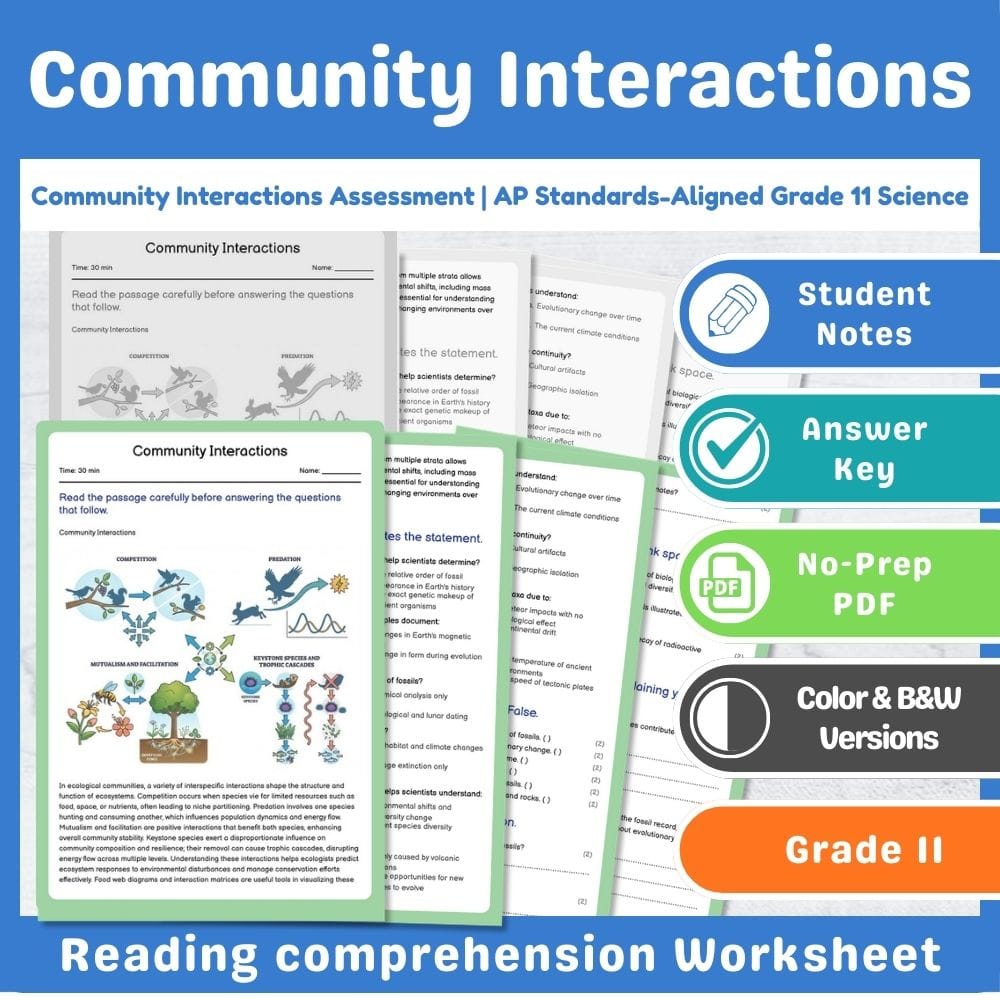
Community Interactions Assessment | AP Standards-Aligned Grade 11 Science
Created byPrism Point LearningLearning Objectives
- Analyze different types of interspecific interactions within ecological communities.
- Interpret food web diagrams and interaction matrices to understand energy flow and interaction strength.
- Evaluate the roles of keystone species, trophic cascades, and niche partitioning in community assembly and resilience.
Instant download
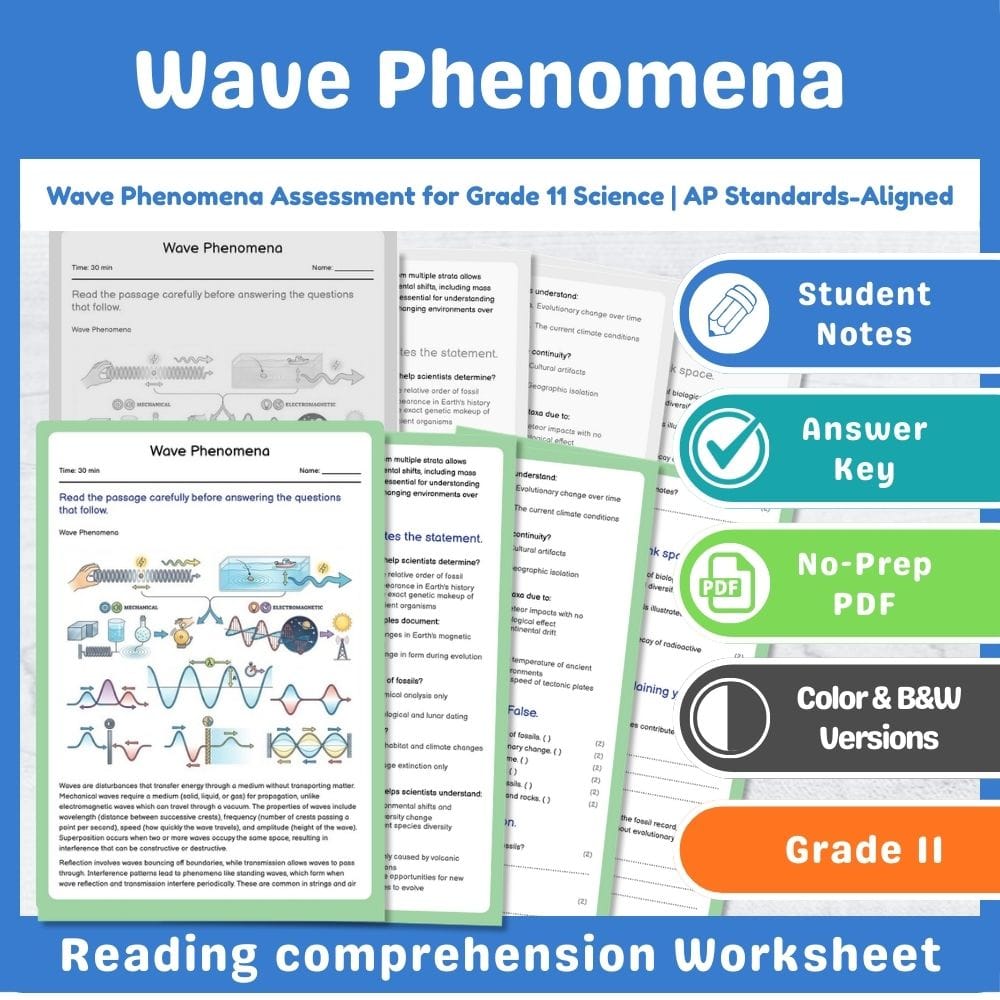
Wave Phenomena Assessment for Grade 11 Science | AP Standards-Aligned
Created byPrism Point LearningLearning Objectives
- Understand the properties of mechanical waves including wavelength, frequency, speed, and amplitude.
- Analyze wave behaviors such as reflection, transmission, interference, and standing waves.
- Relate sinusoidal and graphical models to energy transport and modal patterns in waves.
Instant download
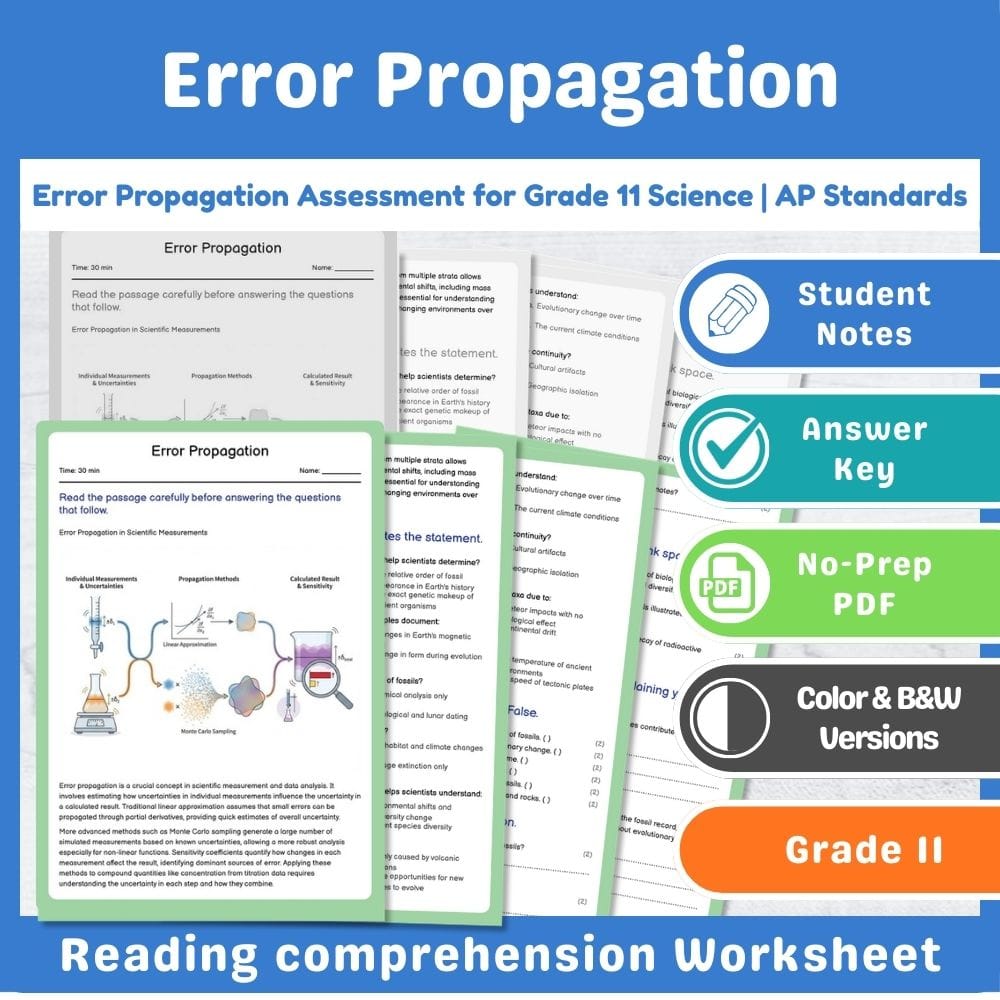
Error Propagation Assessment for Grade 11 Science | AP Standards
Created byPrism Point LearningLearning Objectives
- Understand the mathematical frameworks for propagating measurement uncertainty.
- Apply error propagation methods such as linear approximation and Monte Carlo sampling to complex quantities.
- Interpret the sources of error in experimental measurements and assess their impact on final results.
Also included in: Grade 11 Science Mini Bundle | AP Science Practices & Skills
Instant download
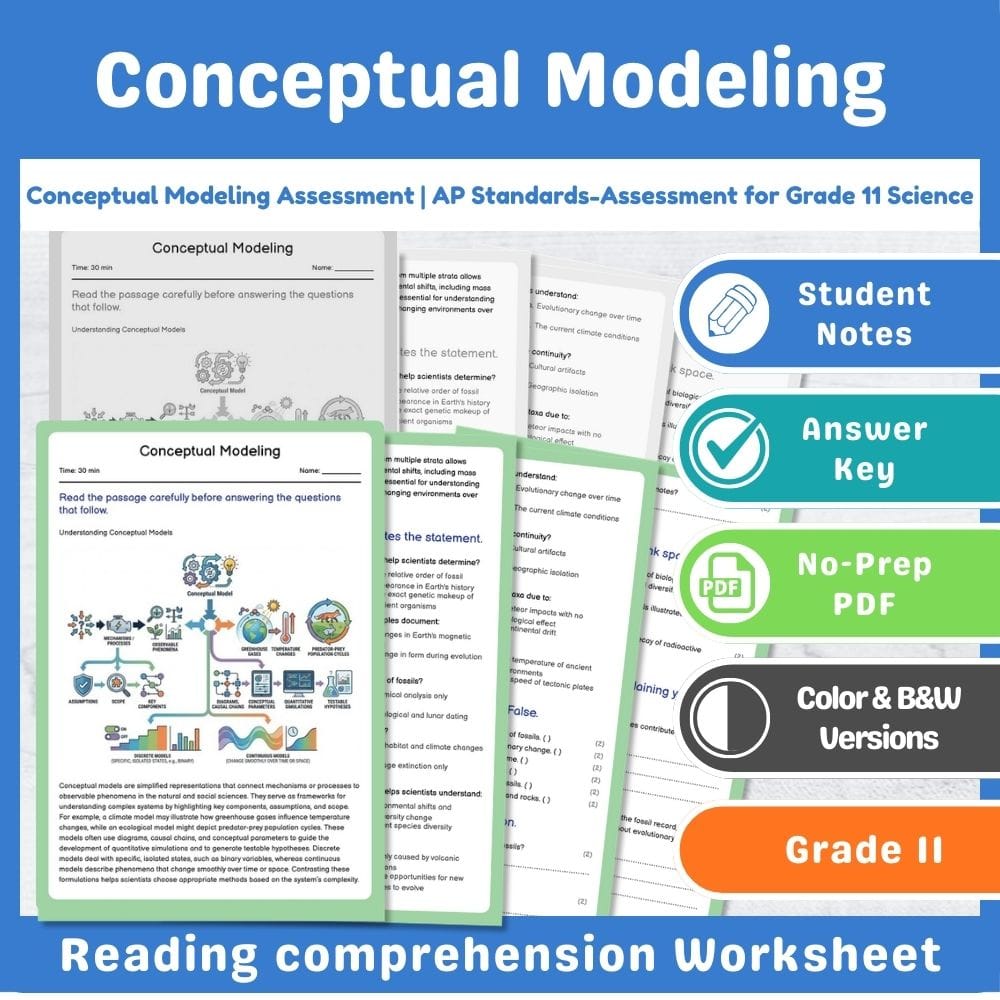
Conceptual Modeling Assessment | AP Standards-Aligned Assessment for Grade 11 Science
Created byPrism Point LearningLearning Objectives
- Define and describe the purpose of conceptual models in scientific research.
- Identify components, assumptions, and scope of conceptual models.
- Differentiate between discrete and continuous formulations in models.
Also included in: Grade 11 Science Mini Bundle | AP Science Practices & Skills
Instant download
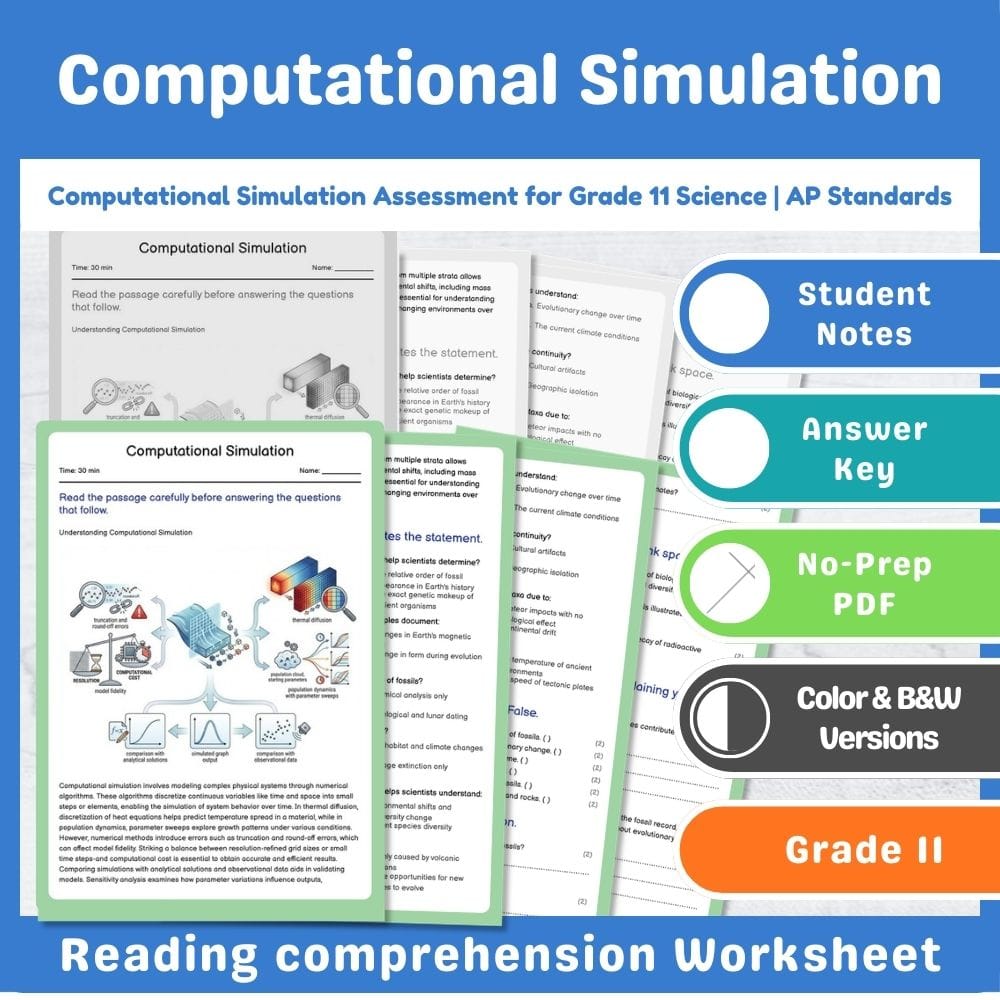
Computational Simulation Assessment for Grade 11 Science | AP Standards
Created byPrism Point LearningLearning Objectives
- Understand the principles of numerical methods used in simulating dynamic systems.
- Identify sources of numerical error and their impact on model fidelity.
- Compare simulated outputs with analytical and observational data for model validation.
Also included in: Grade 11 Science Mini Bundle | AP Science Practices & Skills
Instant download
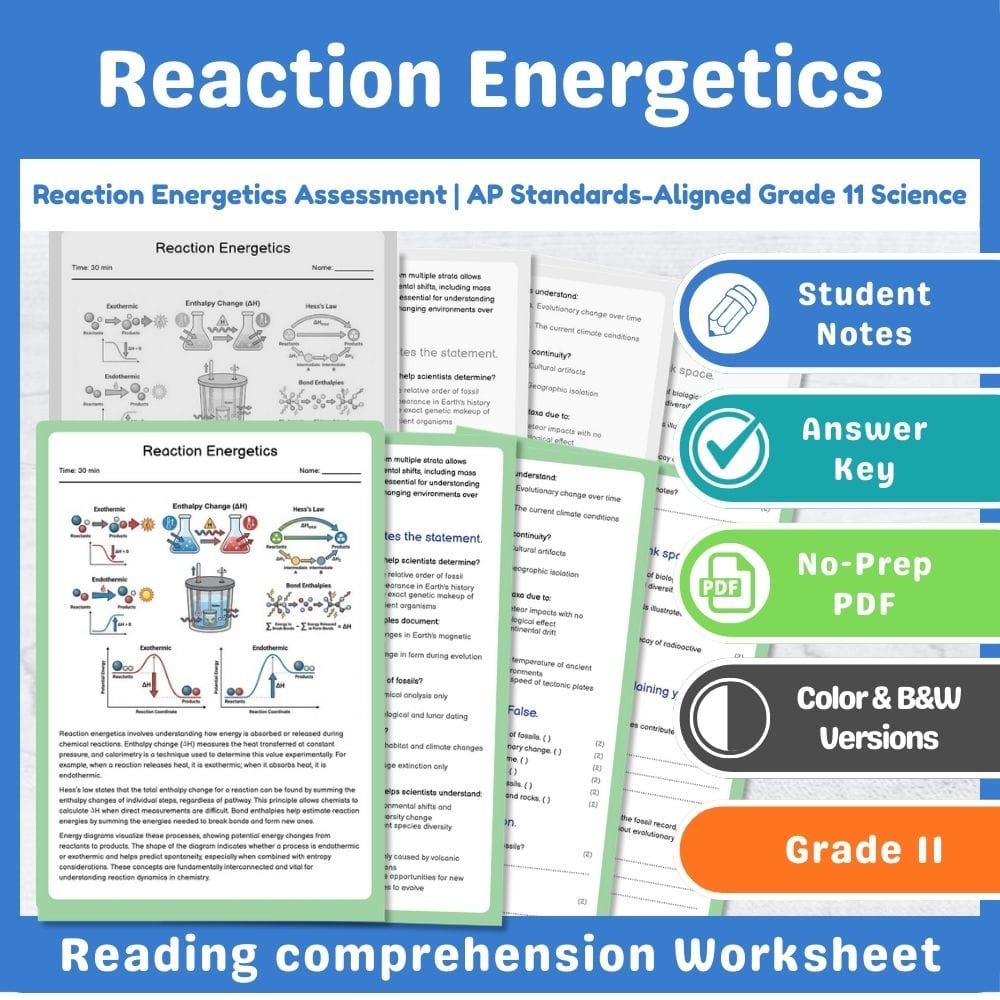
Reaction Energetics Assessment | AP Standards-Aligned Grade 11 Science
Created byPrism Point LearningLearning Objectives
- Explain the concepts of enthalpy changes and calorimetric methods in measuring reaction heat.
- Apply Hess’s law to determine overall reaction energies from individual steps.
- Relate bond enthalpies and formation energies to macroscopic enthalpy and chemical stability.
Instant download
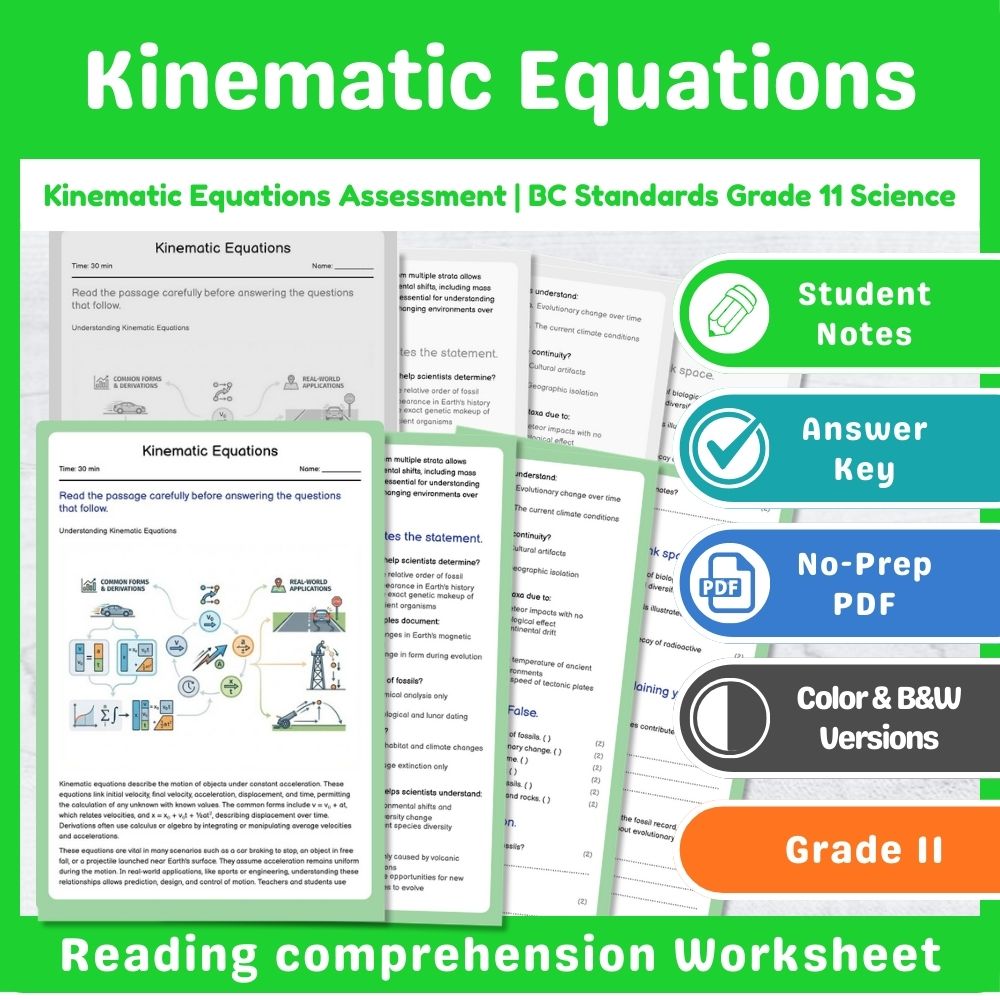
Kinematic Equations Assessment | BC Standards Grade 11 Science
Created byPrism Point LearningLearning Objectives
- Understand the fundamental kinematic equations used for constant acceleration motion.
- Apply the equations to solve for displacement, velocity, acceleration, and time in one-dimensional motion.
- Derive the equations using algebraic and calculus methods.
Also included in: Grade 11 Science Assessment Bundle | Classical Mechanics & Motion Topics
Instant download
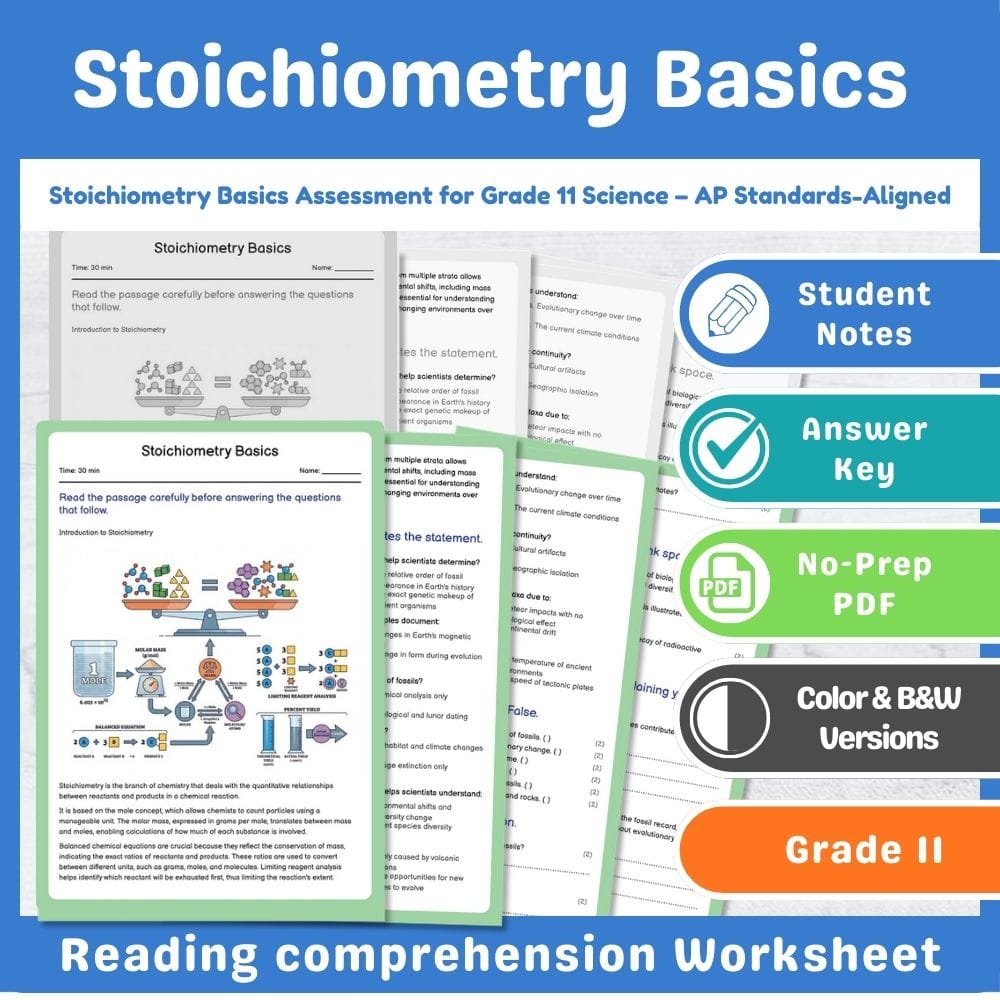
Stoichiometry Basics Assessment for Grade 11 Science – AP Standards-Aligned
Created byPrism Point LearningLearning Objectives
- Understand mole relationships and molar masses for chemical calculations.
- Interpret and balance chemical equations for mass and mole conversions.
- Apply limiting reagent concepts and calculate percent yield.
Instant download

Population Growth Assessment for Grade 11 Science TEKS standards
Created byPrism Point LearningLearning Objectives
- Understand the key factors influencing population dynamics, including birth rates, death rates, immigration, and emigration.
- Differentiate between exponential and logistic growth models and their real-world applications.
- Analyze the impact of density-dependent and density-independent factors on population trajectories.
Instant download

Carrying Capacity Limits Assessment | TEKS Standards Grade 11 Science
Created byPrism Point LearningLearning Objectives
- Understand the concept of carrying capacity and its significance in ecology.
- Identify factors that influence the carrying capacity of environments.
- Differentiate between density-dependent and density-independent effects on populations.
Instant download
System Interactions Assessment | NGSS Standards Grade 11 Science
Created byPrism Point LearningLearning Objectives
- Understand Earth's major reservoirs and energy exchanges among atmosphere, hydrosphere, geosphere, and biosphere.
- Analyze the role of solar energy input and radiative balance in Earth's system.
- Describe mechanisms of heat transfer and feedbacks that influence system states over different timescales.
Instant download

Period Trends and Chemical Interactions Assessment | Alberta Grade 11 Science
Created byPrism Point LearningLearning Objectives
- Explain how atomic radius, ionization energy, and electronegativity vary across the periodic table.
- Describe how these trends influence element bonding preferences and material properties.
- Connect periodic patterns to practical examples like corrosion and alloy selection.
Also included in: Grade 11 Matter and Chemical Bonding Science Lesson Bundle for Alberta +1 more
Instant download
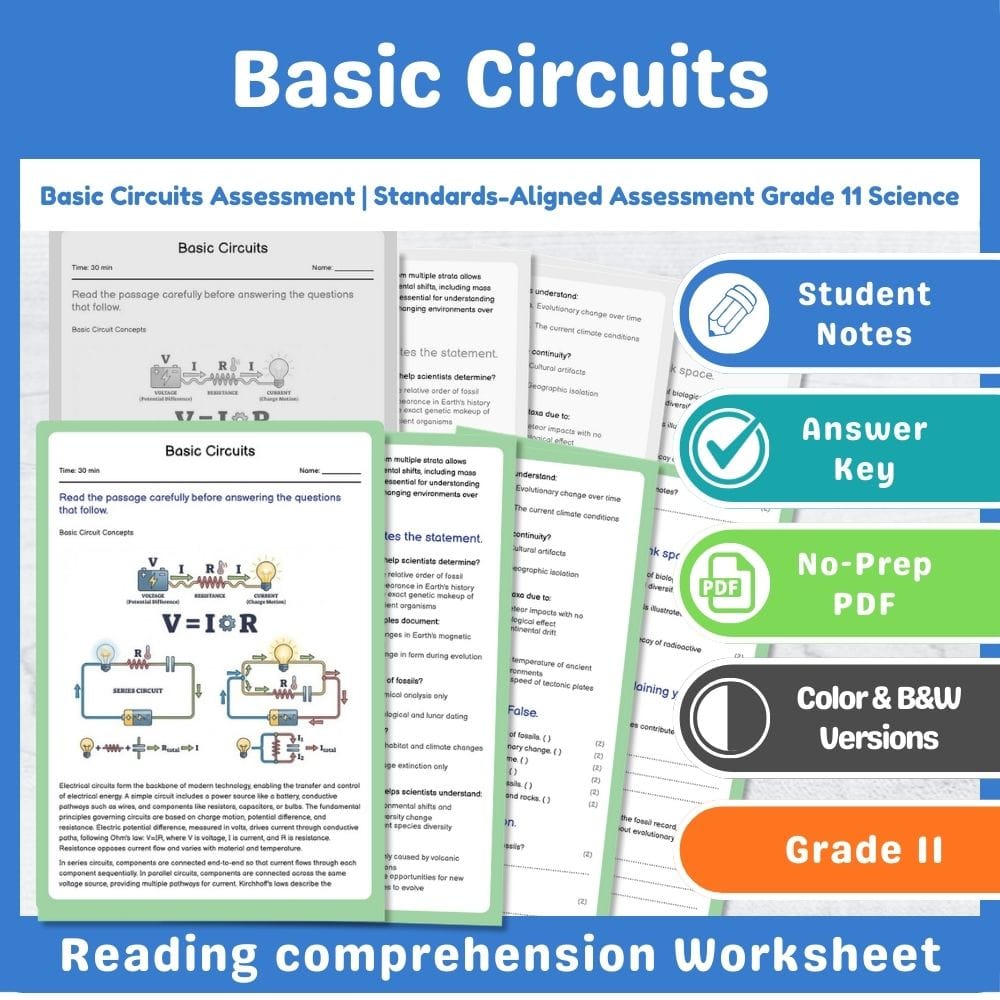
Basic Circuits Assessment | Standards-Aligned Assessment Grade 11 Science
Created byPrism Point LearningLearning Objectives
- Explain the concepts of electric potential difference, current, resistance, and energy transfer in DC circuits.
- Apply Ohm's law and Kirchhoff's laws to analyze series and parallel circuits.
- Calculate power dissipation and energy in simple electrical systems using algebraic methods.
Instant download
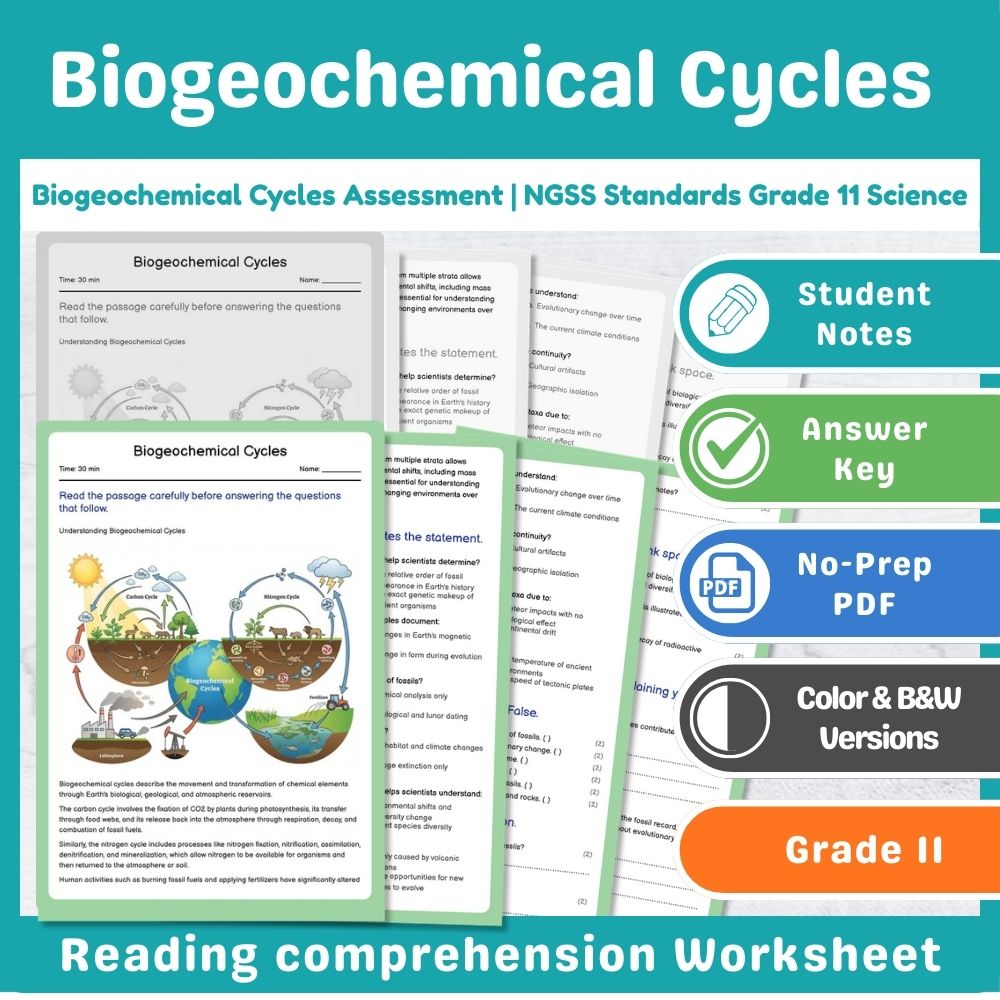
Biogeochemical Cycles Assessment | NGSS Standards Grade 11 Science
Created byPrism Point LearningLearning Objectives
- Understand the key processes involved in biogeochemical cycles such as carbon, nitrogen, phosphorus, and water.
- Identify the reservoirs and flow pathways of elements through biological, geological, and atmospheric systems.
- Explain human impacts like fossil fuel combustion and fertilizer use on nutrient pools and fluxes.
Also included in: Grade 11 Science Mini Bundle | Ecosystems Interactions & Energy NGSS
Instant download

Chemical Equilibrium Assessment for Grade 11 Science | BC Standards
Created byPrism Point LearningLearning Objectives
- Understand the concept of chemical equilibrium and the factors that affect it.
- Learn how to write and interpret equilibrium constant expressions.
- Apply Le Chatelier’s principle to predict shifts in equilibrium in response to concentration, temperature, and pressure changes.
Also included in: Grade 11 Science | Thermochemistry Assessment Bundle – Standards-Aligned
Instant download
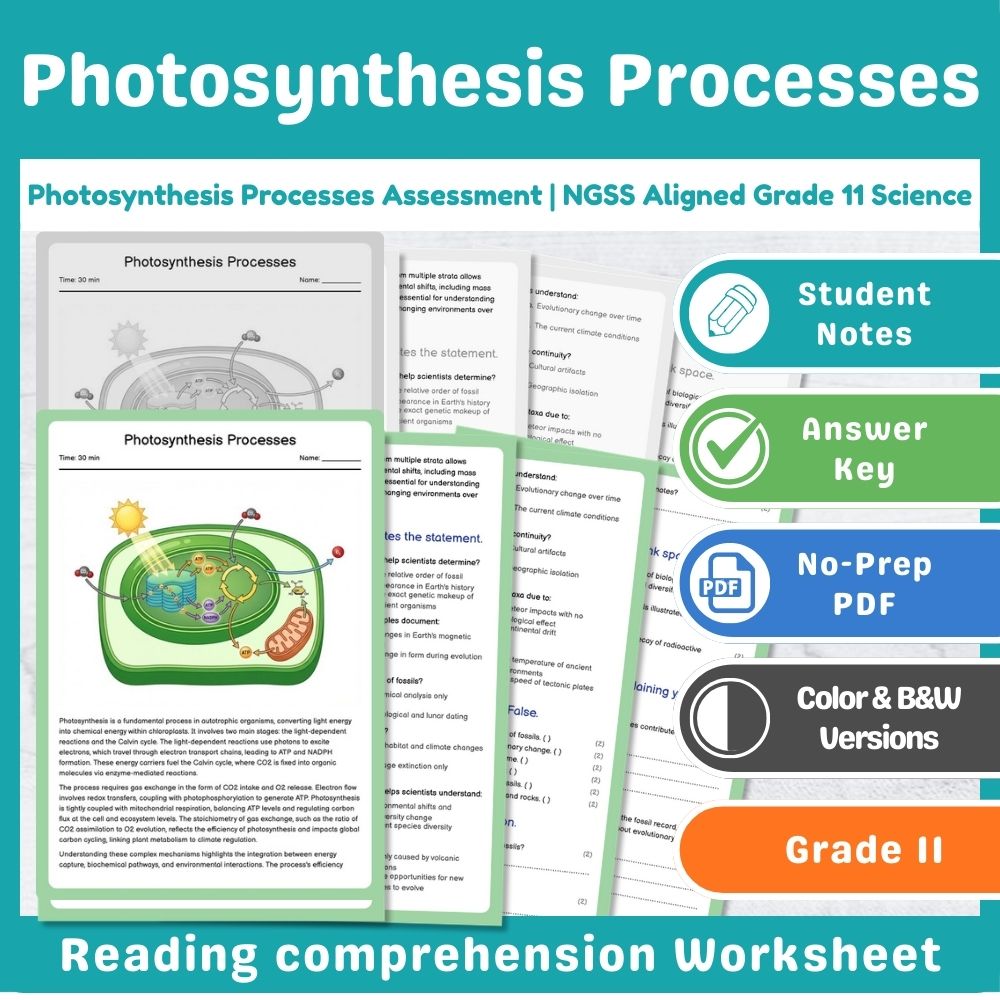
Photosynthesis Processes Assessment | NGSS Aligned Grade 11 Science
Created byPrism Point LearningLearning Objectives
- Explain the light-driven and biochemical stages of photosynthesis, including electron transport, photophosphorylation, and the Calvin cycle.
- Describe the integration of photosynthesis with mitochondrial respiration, focusing on gas exchange, ATP balance, and carbon flux.
- Analyze the stoichiometry of CO2 uptake and O2 release during photosynthesis and respiration.
Instant download

Testable Hypotheses Assessment | General Standards Grade 11 Science
Created byPrism Point LearningLearning Objectives
- Understand key concepts related to Science
- Apply knowledge through practice questions
- Demonstrate comprehension of the material
Also included in: Grade 11 Scientific Evidence & Modeling Science Lesson Bundle: General
Instant download

Newton Second Law Assessment Grade 11 Science NGSSS Standards
Created byPrism Point LearningLearning Objectives
- Explain Newton’s second law using the relationship between net force, mass, and acceleration
- Predict the direction and relative magnitude of acceleration based on net force and mass
- Apply Newton’s second law to situations involving identical pushes on different masses and multiple forces acting together
Also included in: Lesson Grade 11 Forces Energy & Chemistry Science Assessment Lesson Bundle | Florida (NGSSS) +1 more
Instant download
About Grade 11 Science Worksheets
Browse 6,616 printable Grade 11 Science worksheets — ready-to-print PDFs with answer keys where available.
Each resource here is built by an independent educator and reviewed for quality. Worksheets print straight from PDF and suit classroom use, homework, or extra practice; most come with answer keys, and you can preview before purchasing.