
Grade 11 Science Worksheets
6,616 worksheets
Sustainability Strategies Test Practice | Grade 11 Science
 Created byPrism Point Learning
Learning Objectives
- Explain how adaptive management and ecosystem-based management support sustainable resource use.
- Evaluate trade-offs among economic, social, and ecological objectives when designing policies and protected areas.
- Use sustainability indicators (e.g., ecological footprints, carrying capacity, ecosystem service valuation) to guide monitoring and decision-making.
Also included in: Grade 11 Ecology and Sustainability Science Lesson Bundle – Ontario
Instant download

Work and Power Worksheet Grade 11 Physics NGSSS Science Activity
Created byPrism Point LearningLearning Objectives
- Explain when work is done by a force and how work depends on force and displacement.
- Distinguish power from work by describing power as the rate of energy transfer.
- Use work and power ideas to compare real situations such as lifting and stair climbing.
Instant download

Henderson Equation Worksheet | Grade 11 Science Practice
Created byPrism Point LearningLearning Objectives
- Explain what the Henderson–Hasselbalch equation describes in terms of pH, pKa, and concentration ratios.
- Use the Henderson–Hasselbalch equation to predict how changing acid/base concentrations affects buffer pH.
- Interpret buffer behavior in real environmental or industrial water systems.
Instant download

Mendelian Patterns Worksheet | Grade 11 Science Practice
Created byPrism Point LearningLearning Objectives
- Explain how segregation and independent assortment affect allele transmission from parents to offspring
- Use dominant and recessive relationships to predict phenotypes from genotypes
- Calculate and interpret Punnett square probabilities for monohybrid and dihybrid crosses
Also included in: Genetics & Molecular Biology Lesson Bundle | Grade 11 Science | TEKS
Instant download

Ecosystem Models Test Prep Worksheets | Grade 11 Science
Created byPrism Point LearningLearning Objectives
- Explain how ecosystem models represent interactions and feedbacks among species.
- Compare conceptual, mathematical, and computational ecosystem model types and what each can predict.
- Interpret model parameters such as interaction strengths, disturbance regimes, migration, and resource availability.
Also included in: Grade 11 Ecosystem Dynamics Science Lesson Bundle NGSS Test Prep Pack
Instant download

DNA Structure Test Prep Printable Worksheet | Grade 11 Science
Created byPrism Point LearningLearning Objectives
- Explain how nucleotides form DNA strands, including base composition and strand directionality.
- Describe antiparallel double-helical geometry and base-pairing specificity.
- Connect chromatin organization (nucleosomes and higher-order packing) to DNA accessibility for replication and transcription.
Instant download

DNA Information Worksheet Grade 11 Biology Genetics NGSSS Activity
Created byPrism Point LearningLearning Objectives
- Explain how DNA stores genetic information and how complementary base pairing supports accurate copying.
- Describe how DNA sequence relates to protein production and inherited traits.
- Evaluate how variation in DNA among individuals can influence phenotypes and contribute to evolutionary change.
Also included in: Ecology, Evolution & Genetics Lesson Bundle | Grade 11 Science NGSSS
Instant download

Circular Motion Test Prep Printables | Grade 11 Science
Created byPrism Point LearningLearning Objectives
- Explain centripetal acceleration and the centripetal force requirement for uniform circular motion.
- Differentiate tangential acceleration from centripetal acceleration in non-uniform circular motion.
- Use relationships among speed, angular velocity, radius, period, and frequency for circular motion problems.
Also included in: Grade 11 Science Review & Test Prep Lesson Bundle for Ontario
Instant download

Field Sampling Test Prep Printable | Grade 11 Science Ontario
Created byPrism Point LearningLearning Objectives
- Explain how transects, quadrats, and timed searches collect environmental data for population and community assessment.
- Apply sampling design principles such as replication, randomization, and stratification to improve data quality.
- Identify sources of bias related to detectability and sample effort and describe how they affect estimates.
Also included in: Grade 11 Ecology and Sustainability Science Lesson Bundle – Ontario
Instant download

Ionic and Covalent Bonding Worksheet for Grade 11 Chemistry Practice
Created byPrism Point LearningLearning Objectives
- Explain how electron transfer leads to ionic bonding and alternating charge patterns in ionic solids
- Describe how electron sharing leads to covalent bonding and directional bonding
- Relate bonding type to properties such as melting point, conductivity, brittleness, and solubility
Instant download

Biological Organization Worksheet Practice | Grade 11 Science NGSS
Created byPrism Point LearningLearning Objectives
- Explain hierarchical organization from organelles to organ systems and how each level supports the next
- Describe how specialized cell types and tissue integration enable nutrient distribution and communication
- Use models to predict how circulatory and other systems coordinate to maintain internal balance at cellular interfaces
Also included in: Cellular Processes & Energy Flows Grade 11 Science Lesson Bundle NGSS
Instant download

Internal and External Processes Worksheet Grade 11 Earth Science Activity
Created byPrism Point LearningLearning Objectives
- Explain how internal geologic processes (plate tectonics, volcanism, uplift) change Earth’s surface over time
- Describe how external processes (weathering, erosion, deposition) transport and reshape surface materials
- Analyze how the balance between uplift and erosion influences landforms, slope stability, and sediment distribution
Instant download

Reaction Stoichiometry Practice Worksheet | Grade 11 Science Review
Created byPrism Point LearningLearning Objectives
- Use balanced chemical equations and mole ratios to determine limiting reactants and theoretical yields.
- Convert among mass, moles, and gas volumes (at standard conditions) using the mole concept.
- Calculate percent composition and use empirical/molecular formulas from compositional data.
Instant download

Work And Energy Worksheet | Grade 11 Science Review & Practice
Created byPrism Point LearningLearning Objectives
- Use the work–energy theorem to relate net work to changes in kinetic energy
- Differentiate kinetic, gravitational potential, and elastic potential energy and compute each from appropriate conditions
- Explain how conservative and non-conservative forces affect energy conservation and the role of friction
Also included in: Grade 11 Science Review & Test Prep Lesson Bundle for Ontario
Instant download

Climate Forecasting Worksheet | Grade 11 Climate Science Analysis Activity
Created byPrism Point LearningLearning Objectives
- Explain how climate forecasts combine observations with outputs from climate models.
- Identify how historical trends and measurable indicators are used to evaluate model predictions.
- Describe the types of impacts climate forecasts can support, including precipitation, temperature extremes, and sea-level rise.
Instant download

Conservation of Matter Worksheet | Grade 11 Chemistry Science Activity
Created byPrism Point LearningLearning Objectives
- Explain why matter is conserved in biological systems even as organisms grow and change.
- Describe how elements such as carbon and nitrogen move among atmosphere, soil, water, and living tissue.
- Use conservation of matter ideas to interpret ecosystem productivity and nutrient cycling.
Instant download

Power Analysis Test Prep Worksheet | Grade 11 Science NGSS
Created byPrism Point LearningLearning Objectives
- Compute mechanical and electrical power using P = W/t and interpret units.
- Use measured electrical quantities with P = IV and compare predictions to observations.
- Analyze efficiency by relating useful output power to input power and explain discrepancies.
Also included in: Grade 11 Energy Transfer & Conservation Science Lesson Bundle (NGSS)
Instant download

Molecular Geometry Worksheet | Grade 11 Science Activities
Created byPrism Point LearningLearning Objectives
- Explain how the VSEPR model uses electron-pair repulsions to predict molecular shapes.
- Identify common molecular geometries (linear, trigonal planar, tetrahedral, trigonal bipyramidal, octahedral) from bonding and lone pairs.
- Relate molecular geometry to polarity and intermolecular forces.
Instant download

Newtonian Forces Test Prep Worksheets | Grade 11 Science Review
Created byPrism Point LearningLearning Objectives
- Apply Newton’s three laws to relate net force, mass, and acceleration in translational motion.
- Use free-body diagrams to identify contact forces, normal force, friction, tension, and gravitational weight.
- Analyze static and kinetic friction using coefficients and the conditions for impending or ongoing motion.
Also included in: Grade 11 Science Review & Test Prep Lesson Bundle for Ontario
Instant download

Population Dynamics Worksheet Practice Test | Grade 11 Science
Created byPrism Point LearningLearning Objectives
- Explain how exponential and logistic growth models differ and identify the role of carrying capacity.
- Interpret demographic parameters (birth rate, death rate, age structure, sex ratio) in population trajectories.
- Describe density-dependent and density-independent factors and predict how they affect population size.
Also included in: Grade 11 Ecology and Sustainability Science Lesson Bundle – Ontario
Instant download

Gene Expression Worksheet Grade 11 Biology Activity NGSSS Science
Created byPrism Point LearningLearning Objectives
- Explain how transcription and translation connect DNA information to protein production
- Describe how proteins influence observable traits in cells and organisms
- Identify ways gene expression is regulated in different cell types and environments
Also included in: Ecology, Evolution & Genetics Lesson Bundle | Grade 11 Science NGSSS
Instant download

Periodic Patterns Test Prep Worksheets | Grade 11 Science
Created byPrism Point LearningLearning Objectives
- Explain how electron configuration helps predict periodic trends in atomic radius, ionization energy, and reactivity.
- Describe patterns across groups and periods, including metallic character and typical ion formation.
- Use subatomic particle counts and electron models to connect isotopes and isotopic notation to common spectral behavior.
Instant download

Work And Energy Worksheet | Grade 11 Science Practice
Created byPrism Point LearningLearning Objectives
- Explain how work relates to energy transfer and the work–energy idea
- Differentiate kinetic and potential energy and describe energy conversions
- Predict how conservative and non-conservative forces affect mechanical energy
Also included in: Grade 11 Science Lesson Bundle — Work, Energy & Motion (BC)
Instant download

Microscopic Energy Practice Worksheets | Grade 11 Science
Created byPrism Point LearningLearning Objectives
- Explain how microscopic particle motion and interactions relate to macroscopic temperature and thermal expansion.
- Model internal energy changes in gases using particle kinetic energy and interparticle potential energy.
- Compare how energy appears at the microscopic level in gases versus solids using ideas like vibrational motion.
Also included in: Grade 11 Energy Transfer & Conservation Science Lesson Bundle (NGSS)
Instant download

System Decomposition Worksheet | Grade 11 Science Engineering Activity
Created byPrism Point LearningLearning Objectives
- Explain how breaking a complex engineering task into subsystems helps manage design complexity.
- Describe how subsystem interfaces affect requirements and system performance.
- Evaluate how trade-offs in one component can change constraints in connected components.
Instant download

Metabolic Integration Assessment | NGSS Standards Grade 11 Science
Created byPrism Point LearningLearning Objectives
- Explain how interconnected metabolic pathways regulate energy flow across different tissues.
- Describe enzyme kinetics, allosteric regulation, and pathway branching in metabolism.
- Illustrate examples of metabolic processes such as fermentation and gluconeogenesis and their roles in energy supply.
Instant download

Biogeochemical Cycles Assessment for Grade 11 Science TEKS
Created byPrism Point LearningLearning Objectives
- Understand the key processes involved in the carbon, nitrogen, and phosphorus cycles.
- Identify the roles of different biogeochemical cycles in ecosystems.
- Explain how human activities perturb natural nutrient cycles and their effects.
Instant download

DNA Maintenance Assessment for Grade 11 Science | Standards-Aligned Assessment
Created byPrism Point LearningLearning Objectives
- Explain the molecular mechanisms of DNA replication and repair that maintain genetic information.
- Describe the roles of DNA polymerase fidelity, proofreading, and excision repair pathways in preserving genome integrity.
- Understand the causes and consequences of mutations, their rates, and how repair failures impact genome stability.
Instant download
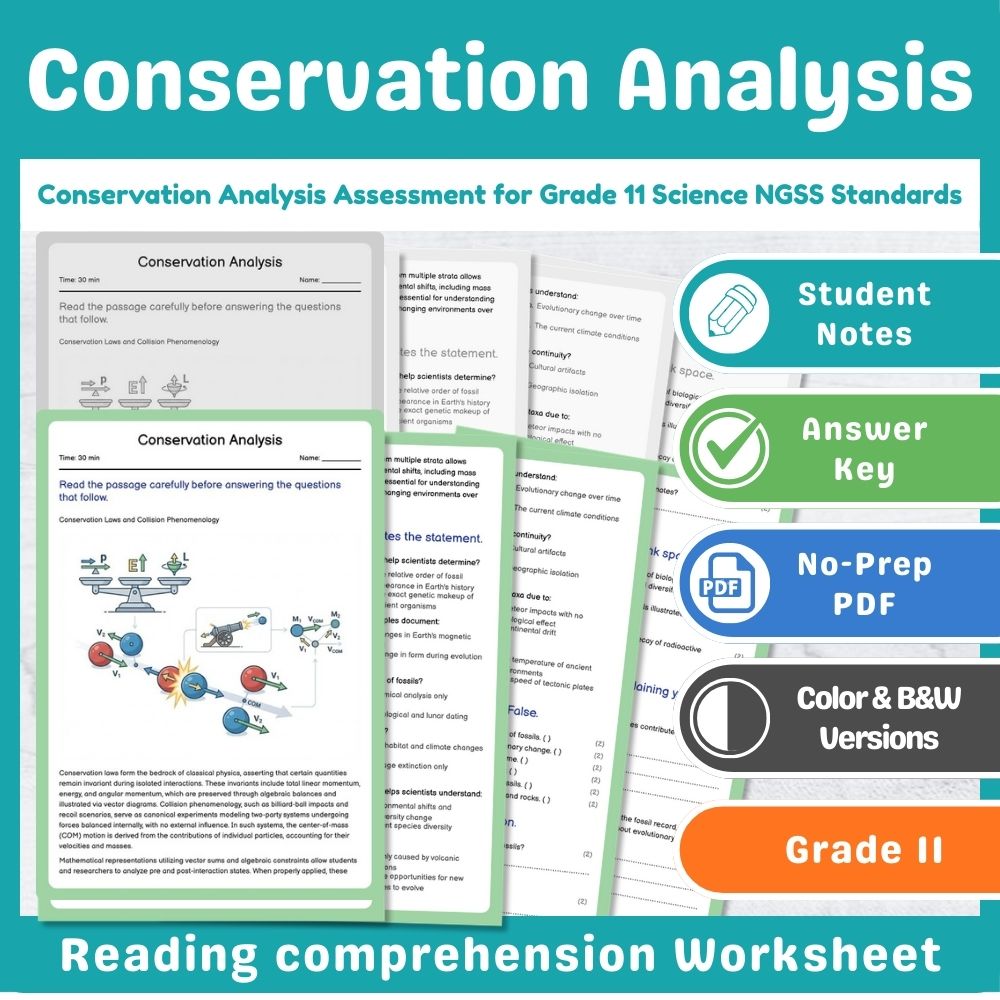
Conservation Analysis Assessment for Grade 11 Science NGSS Standards
Created byPrism Point LearningLearning Objectives
- Understand the principles of conservation laws in physics.
- Analyze collision phenomenology using algebraic balances and vector diagrams.
- Extract center-of-mass motion from system contributions and constraints.
Also included in: Grade 11 Physics Mini Bundle – Impulse, Forces & Conservation Assessment
Instant download
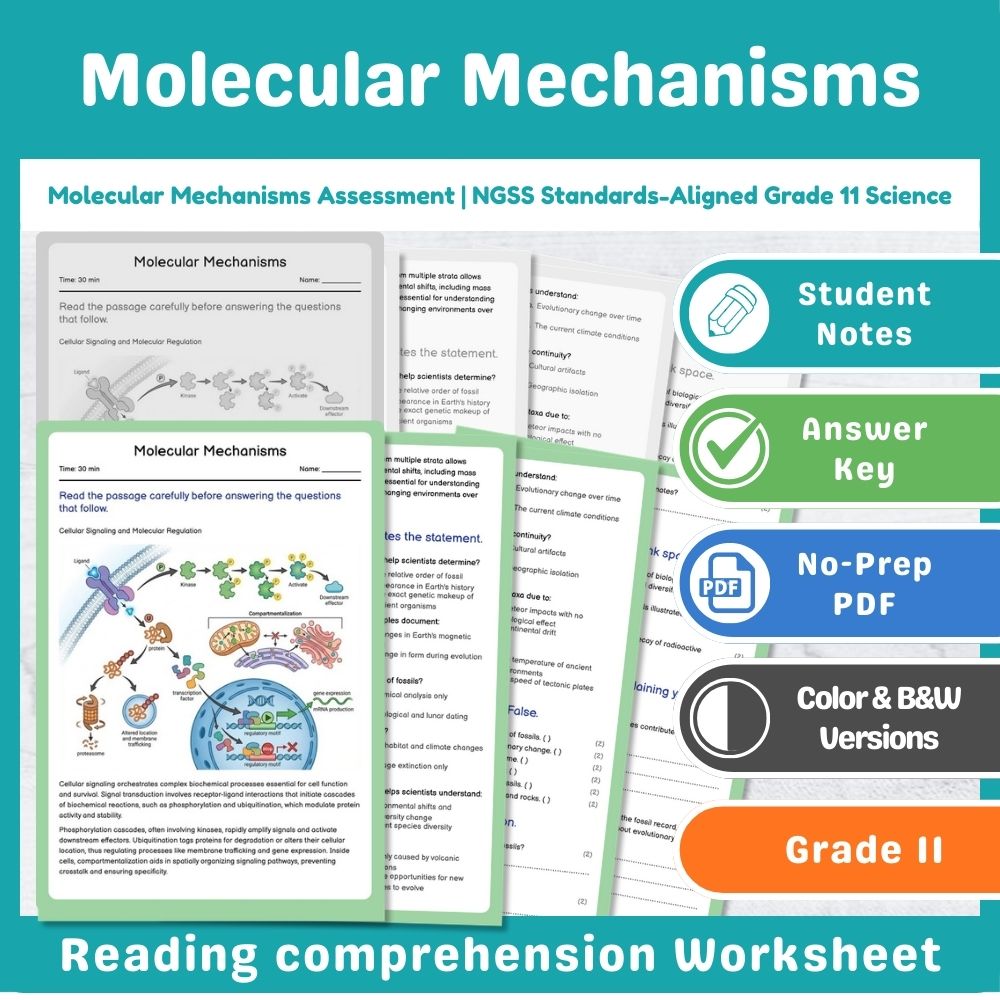
Molecular Mechanisms Assessment | NGSS Standards-Aligned Grade 11 Science
Created byPrism Point LearningLearning Objectives
- Explain the biochemical mechanisms involved in cellular signaling pathways.
- Identify key motifs and processes such as phosphorylation cascades, ubiquitination, and transcriptional regulation.
- Describe how intracellular compartmentalization and membrane transport influence molecular mechanisms.
Instant download

Groundwater Systems Assessment for Grade 11 Science | BC Standards
Created byPrism Point LearningLearning Objectives
- Understand the concepts of aquifers, porosity, and permeability in groundwater systems.
- Differentiate between confined and unconfined aquifers and their responses to recharge and pumping.
- Identify factors affecting groundwater flow, quality, and sustainability.
Also included in: Grade 11 Science Assessment | Plate Tectonics BC Standards Mini Bundle
Instant download

Protein Synthesis Assessment for Grade 11 Science TEKS Standards
Created byPrism Point LearningLearning Objectives
- Explain the process of transcription and translation in protein synthesis.
- Identify the roles of RNA polymerase, mRNA, tRNA, ribosomes, and amino acids.
- Describe the significance of codon redundancy and wobble in genetic decoding.
Also included in: Grade 11 Molecular Genetics Science Lesson Bundle: TEKS Assessments
Instant download

Water Cycle Flux Assessment for Grade 11 Science | NGSSS Standards
Created byPrism Point LearningLearning Objectives
- Explain how water moves between the atmosphere and hydrosphere using the major processes of the water cycle flux.
- Analyze how ocean currents and sea surface temperature affect evaporation, humidity, and atmospheric stability.
- Evaluate how long-term and seasonal ocean-atmosphere interactions can change regional precipitation patterns, including El Niño and La Niña.
Also included in: Lesson Bundle: Grade 11 Earth and Space Science Assessments | Florida NGSSS +1 more
Instant download

Inheritance Patterns Assessment for Grade 11 Science | Standards-Aligned
Created byPrism Point LearningLearning Objectives
- Explain how observable traits are connected to genetic inheritance patterns across generations.
- Describe the role of Punnett squares in predicting offspring genotypes and phenotypes.
- Differentiate between autosomal and sex-linked inheritance, including dominance and recessiveness.
Also included in: Grade 11 Biological Evidence Science Lesson Bundle | General Framework
Instant download

Physiological Regulation Assessment for Grade 11 Science TEKS
Created byPrism Point LearningLearning Objectives
- Describe the mechanisms involved in maintaining internal stability in the human body.
- Explain the roles of sensors, control centers, and effectors in physiological regulation.
- Identify examples of negative and positive feedback mechanisms in human physiology.
Also included in: Grade 11 Homeostasis & Human Body Systems Science: Lesson Bundle TEKS
Instant download

Carbon Pathways Assessment | AP Standards for Grade 11 Science
Created byPrism Point LearningLearning Objectives
- Explain how carbon is stored and transferred among air, ocean, terrestrial biosphere, and sediments.
- Utilize flux diagrams and isotopic tracers to distinguish natural from anthropogenic carbon sources.
- Analyze the impact of ocean uptake, soil carbon, and fossil fuel emissions on atmospheric CO2 levels.
Also included in: Lesson Grade 11 Science Assessment Bundle | Earth Systems & Climate
Instant download
Community Interactions Assessment | NGSS Standards Grade 11 Science
Created byPrism Point LearningLearning Objectives
- Analyze various species interactions within communities, including competition, mutualism, predation, parasitism, facilitation, and niche partitioning.
- Explain the roles of keystone species, trophic cascades, and interaction networks in shaping community structure.
- Evaluate examples such as sea otter-kelp forest dynamics and pollinator networks to understand the consequences of species interactions.
Also included in: Grade 11 Science Mini Bundle | Ecosystems Interactions & Energy NGSS
Instant download
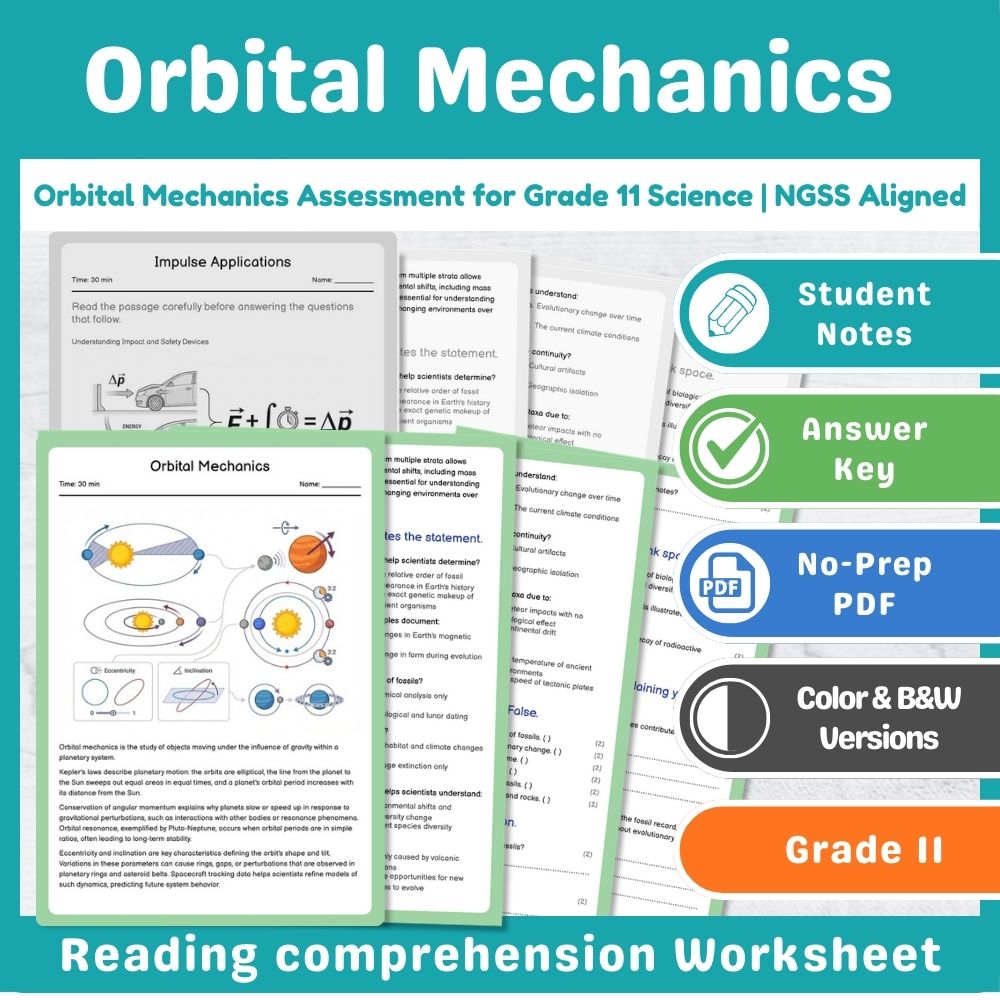
Orbital Mechanics Assessment for Grade 11 Science | NGSS Aligned
Created byPrism Point LearningLearning Objectives
- Explain the fundamental principles of orbital motion and Kepler's laws.
- Analyze the effects of gravitational interactions and orbital perturbations.
- Describe phenomena such as orbital resonance, eccentricity, and inclination.
Also included in: Grade 11 Science Mini Bundle | Cosmic/Orbital Mechanics Assessment NGSS
Instant download

Geologic Change Assessment | NGSS Standards for Grade 11 Science
Created byPrism Point LearningLearning Objectives
- Understand and interpret stratigraphic, sedimentary, and metamorphic evidence of Earth's surface and subsurface processes.
- Apply radiometric dating, fossil correlation, and sedimentary facies analysis to time Earth's major geologic events.
- Analyze depositional sequences, unconformities, and regional metamorphic belts to reconstruct Earth's geologic history.
Instant download

Genetic Drift Assessment | TEKS Standards Grade 11 Science
Created byPrism Point LearningLearning Objectives
- Understand the concept of genetic drift and how it causes changes in allele frequencies.
- Identify the effects of bottleneck and founder events on populations.
- Differentiate between genetic drift and natural selection in evolutionary processes.
Also included in: Grade 11 Evolution, Speciation & Phylogeny Science Lesson Bundle | TEKS
Instant download

Population Genetics Assessment for Grade 11 Science | AP Standards
Created byPrism Point LearningLearning Objectives
- Explain the principles of allele frequency change in populations.
- Apply Hardy-Weinberg equilibrium to real-world genetic data.
- Analyze the effects of forces such as selection, drift, migration, and mutation on genetic variation.
Instant download
Cellular Energy Pathways Assessment | NGSS-Aligned Grade 11 Science
Created byPrism Point LearningLearning Objectives
- Describe the sequence of energy transformations during cellular respiration, including glycolysis, pyruvate oxidation, the citric acid cycle, and oxidative phosphorylation.
- Explain the role of electron transport chains and proton gradients in ATP production within mitochondria.
- Calculate the approximate energy yield from different substrates used in cellular respiration and relate this to organism metabolic rates and resource consumption.
Instant download

Quantitative Modeling Assessment | Advanced Placement Grade 11 Science
Created byPrism Point LearningLearning Objectives
- Understand the application of differential equations, network models, and statistical inference in biological systems.
- Learn to parameterize models, perform sensitivity analysis, and validate models with empirical data.
- Compare different modeling approaches and recognize their limitations in biological research.
Instant download
Climate Dynamics Assessment | NGSS Standards–Assessment for Grade 11 Science
Created byPrism Point LearningLearning Objectives
- Understand the components influencing climate variability, including atmospheric composition and large-scale circulation patterns.
- Analyze mechanisms such as greenhouse gas forcing, albedo feedbacks, and ocean-atmosphere interactions.
- Evaluate the evidence from instrumental records, satellite data, and paleoclimate proxies related to climate change.
Instant download

Model Validation Assessment for Grade 11 Science | AP Standards-Aligned
Created byPrism Point LearningLearning Objectives
- Understand methods for evaluating the credibility of scientific models.
- Identify techniques such as cross-validation, residual analysis, and dataset comparison.
- Evaluate the risks of overfitting and the importance of identifying limitations in models.
Also included in: Grade 11 Science Mini Bundle | AP Science Practices & Skills
Instant download

Conservation of Mass Assessment | Florida NGSSS Grade 11 Science
Created byPrism Point LearningLearning Objectives
- Explain the conservation of mass in terms of closed systems and atomic rearrangement.
- Use balanced chemical equations to connect reactant and product amounts to measurable mass.
- Apply conservation of mass to interpret evidence from experiments involving solids and gases.
Also included in: Lesson Grade 11 Forces Energy & Chemistry Science Assessment Lesson Bundle | Florida (NGSSS) +1 more
Instant download

Carrying Capacity Assessment for Grade 11 Science | NGSSS Standards
Created byPrism Point LearningLearning Objectives
- Explain how birth rate, death rate, immigration, and emigration affect population change over time
- Define carrying capacity and describe how limiting factors slow population growth
- Interpret how competition, predation, and disease influence survival and reproduction
Also included in: Grade 11 Population, Genetics & Energy Systems Science Lesson Bundle: Florida NGSSS +1 more
Instant download

Earth Systems Assessment for Grade 11 Science | Florida NGSSS Standards
Created byPrism Point LearningLearning Objectives
- Explain how Earth’s geosphere, hydrosphere, atmosphere, and biosphere interact through energy flow and matter cycling
- Use cause-and-effect reasoning to describe how unequal heating drives atmospheric and ocean circulation
- Describe major processes such as the water cycle and biogeochemical cycling and connect them to regional or global patterns
Also included in: Lesson Bundle: Grade 11 Earth and Space Science Assessments | Florida NGSSS +1 more
Instant download
About Grade 11 Science Worksheets
Browse 6,616 printable Grade 11 Science worksheets — ready-to-print PDFs with answer keys where available.
Each resource here is built by an independent educator and reviewed for quality. Worksheets print straight from PDF and suit classroom use, homework, or extra practice; most come with answer keys, and you can preview before purchasing.