
Grade 11 Science Worksheets
6,616 worksheets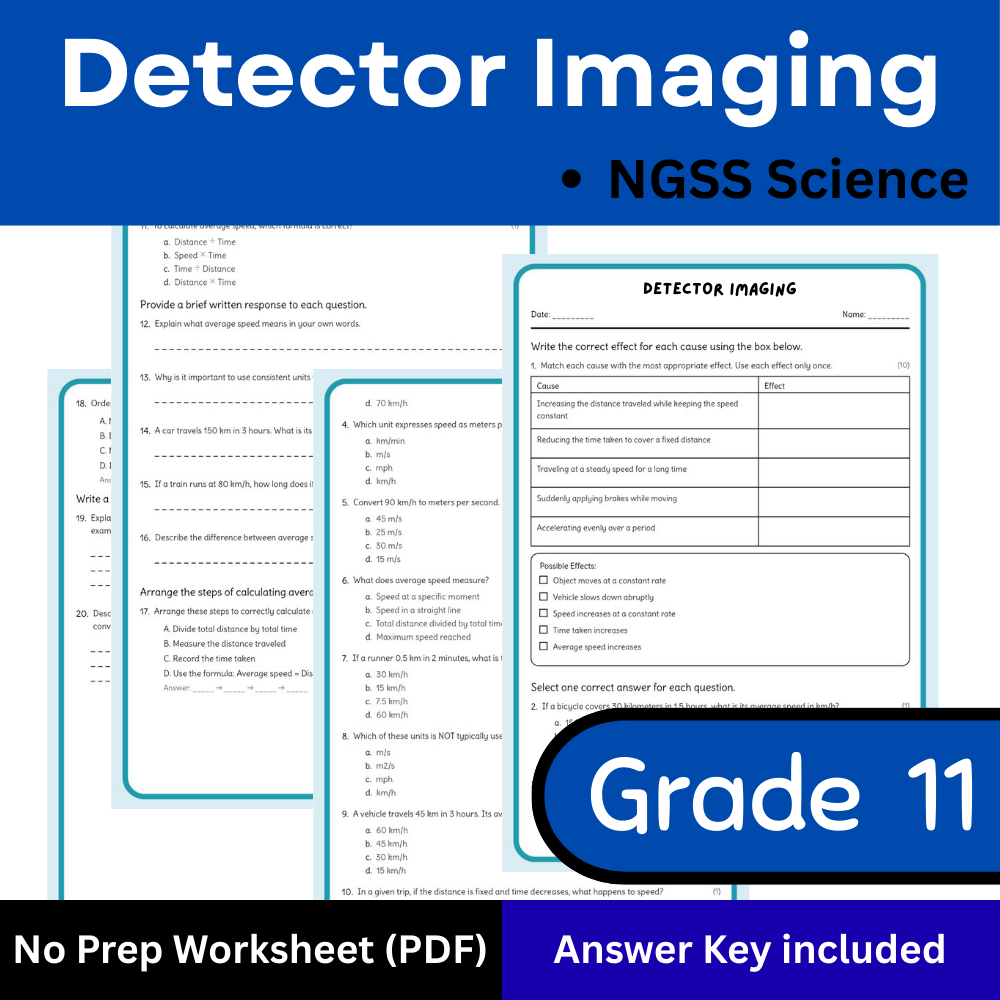
Grade 11 Science – Detector Imaging Worksheet (PDF) | NGSS Aligned Practice
 Created byBright Mind Resources
Learning Objectives
- Analyze how different electromagnetic frequencies are absorbed by matter through detector measurements.
- Evaluate the reliability and limitations of calibration and instruments across UV, visible, IR, and X-ray bands.
- Understand the response of CCDs and photodiodes in different spectrums and assess measurement uncertainties.
Instant download
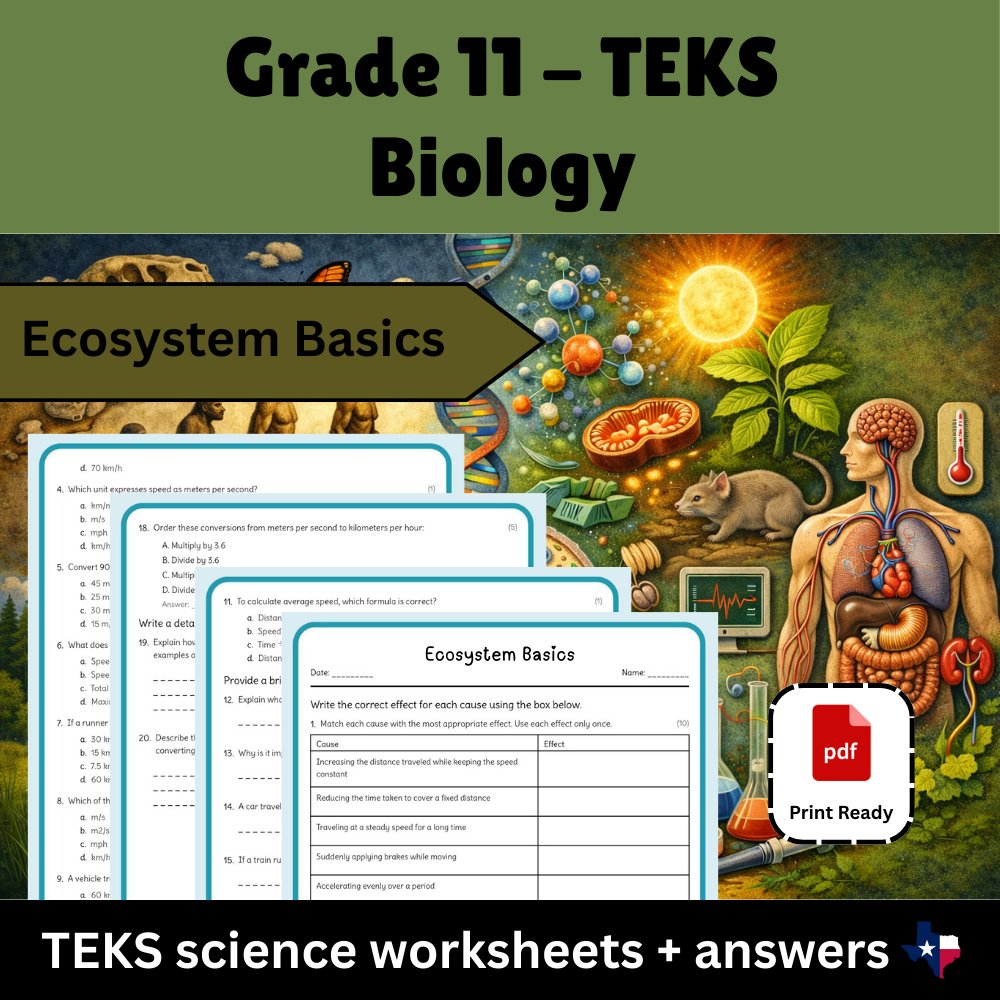
Grade 11 Science | Ecosystem Basics Worksheet (Worksheet + Answer Key) – TEKS-Aligned
Created byBright Mind ResourcesLearning Objectives
- Define the fundamental components of an ecosystem and their interactions.
- Explain how energy flows through food chains and food webs.
- Describe nutrient cycling processes such as carbon and nitrogen cycles.
Also included in: Grade 11 Science - Ecosystem & Biogeochemical Cycles Unit Worksheet Pack - TEKS +2 more
Instant download
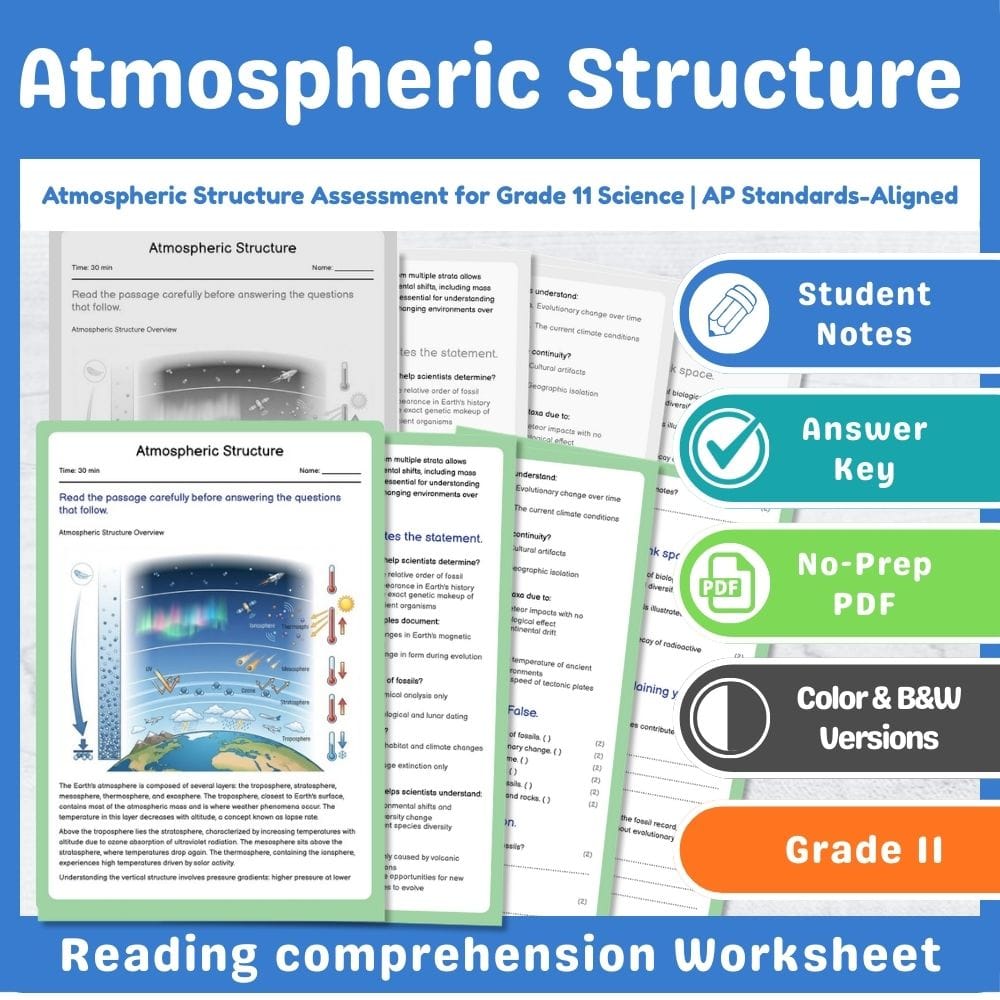
Atmospheric Structure Assessment for Grade 11 Science | AP Standards-Aligned
 Created byPrism Point Learning
Learning Objectives
- Describe the vertical and horizontal layers of the atmosphere and their characteristics.
- Explain pressure gradients, temperature profiles, and their role in atmospheric circulation.
- Interpret sounding profiles, pressure maps, and radiative diagrams to understand weather patterns.
Also included in: Lesson Grade 11 Science Assessment Bundle | Earth Systems & Climate
Instant download
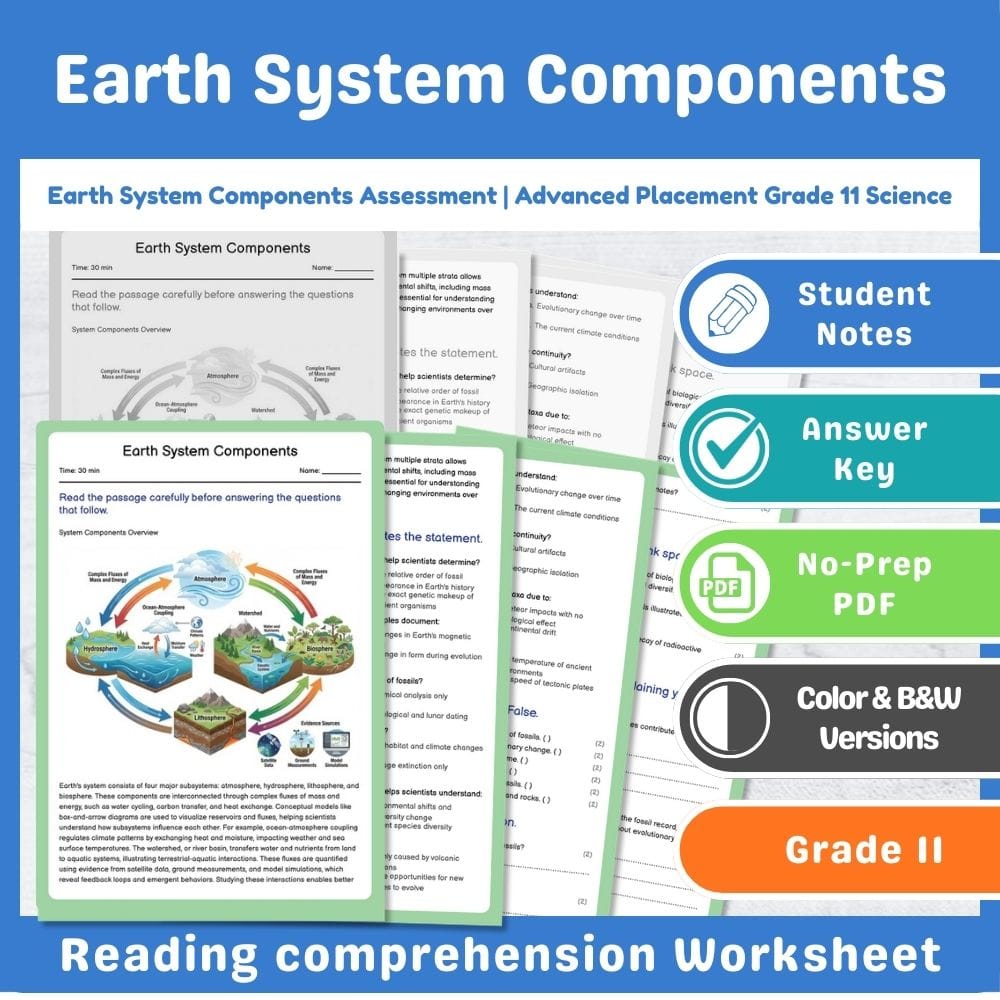
Earth System Components Assessment | Advanced Placement Grade 11 Science
Created byPrism Point LearningLearning Objectives
- Identify the major Earth subsystems and explain their roles and interactions.
- Understand mass and energy fluxes among atmosphere, hydrosphere, lithosphere, and biosphere.
- Use conceptual models to analyze subsystem exchanges and feedback mechanisms.
Also included in: Lesson Grade 11 Science Assessment Bundle | Earth Systems & Climate
Instant download
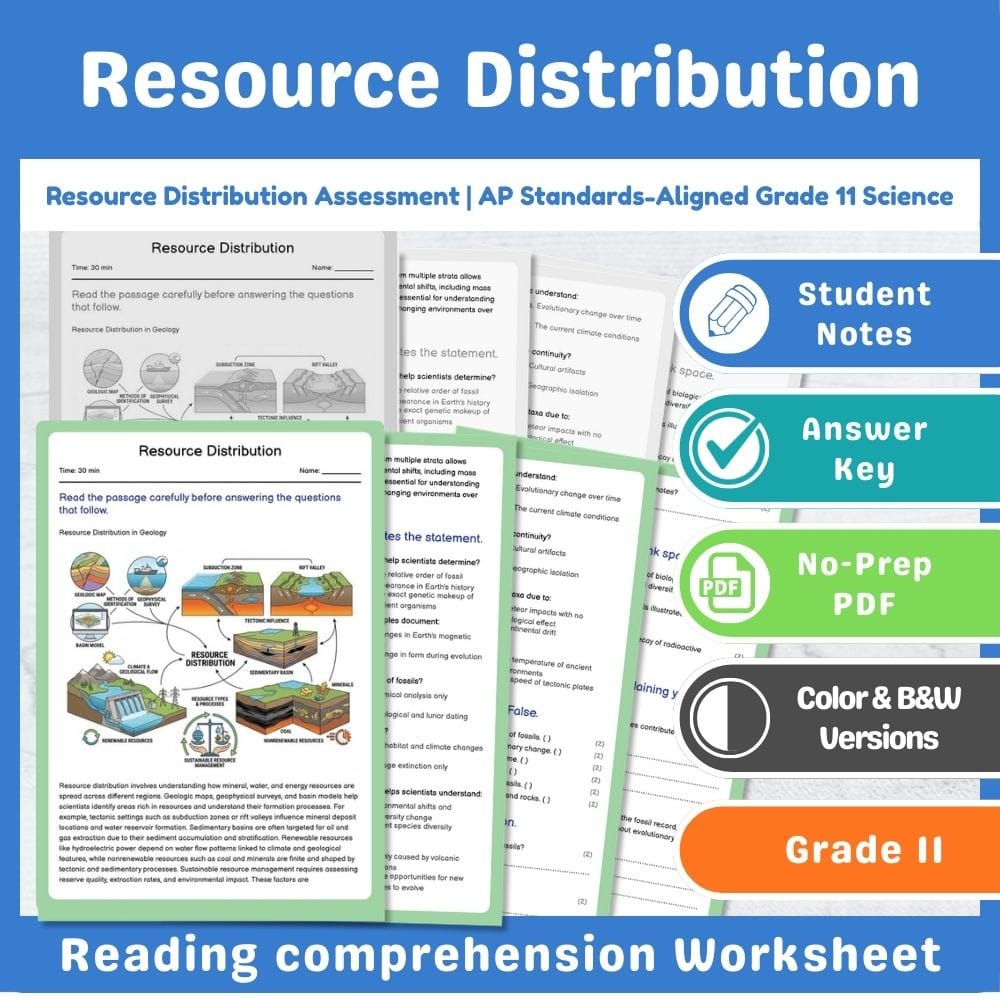
Resource Distribution Assessment | AP Standards-Aligned Grade 11 Science
Created byPrism Point LearningLearning Objectives
- Map and analyze the spatial patterns of mineral, water, and energy resources using various geologic tools.
- Distinguish between renewable and nonrenewable reservoirs and evaluate their sustainability.
- Assess resource occurrence in relation to tectonic setting and sedimentary processes using geologic information.
Also included in: Lesson Grade 11 Science Assessment Bundle | Earth Systems & Climate
Instant download
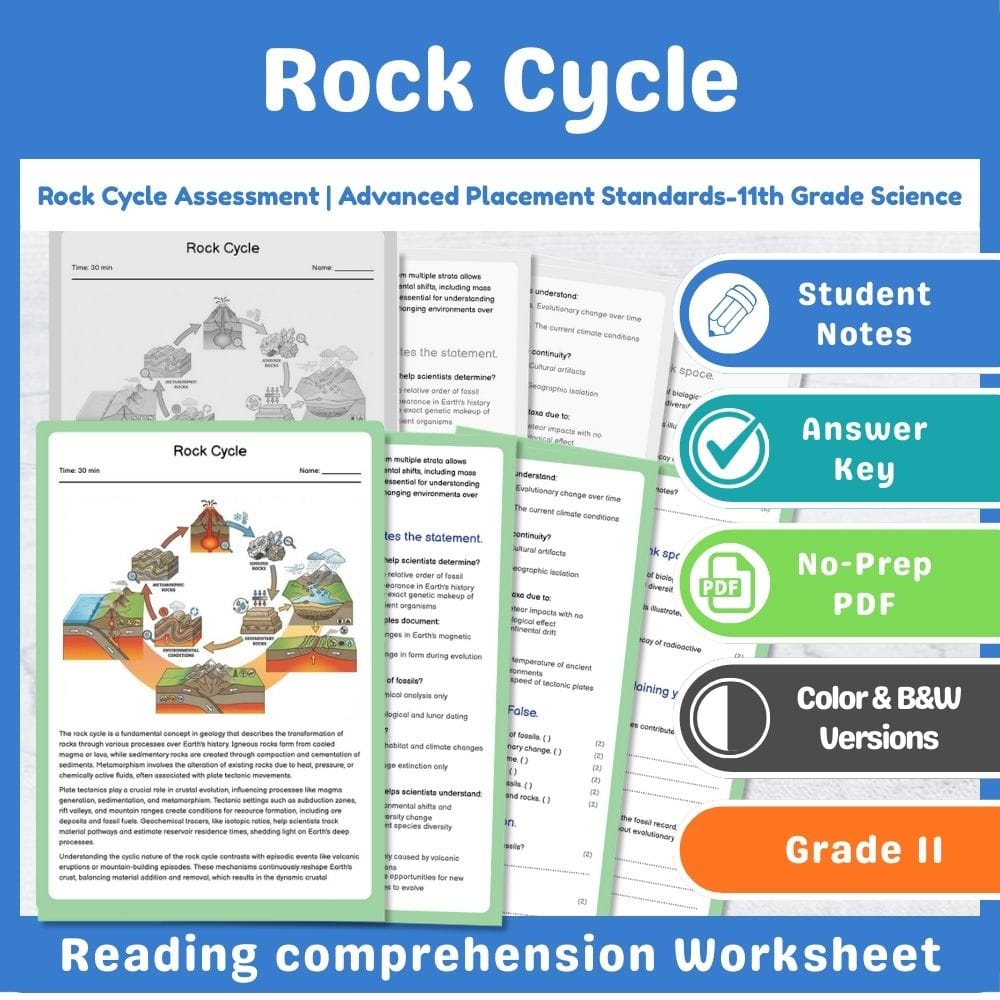
Rock Cycle Assessment | Advanced Placement Standards-Aligned 11th Grade Science
Created byPrism Point LearningLearning Objectives
- Explain the processes of rock formation, metamorphism, and destruction over geologic time.
- Identify the role of plate tectonics in shaping crustal evolution.
- Analyze geochemical tracers and stratigraphic data related to resource formation.
Also included in: Lesson Grade 11 Science Assessment Bundle | Earth Systems & Climate
Instant download
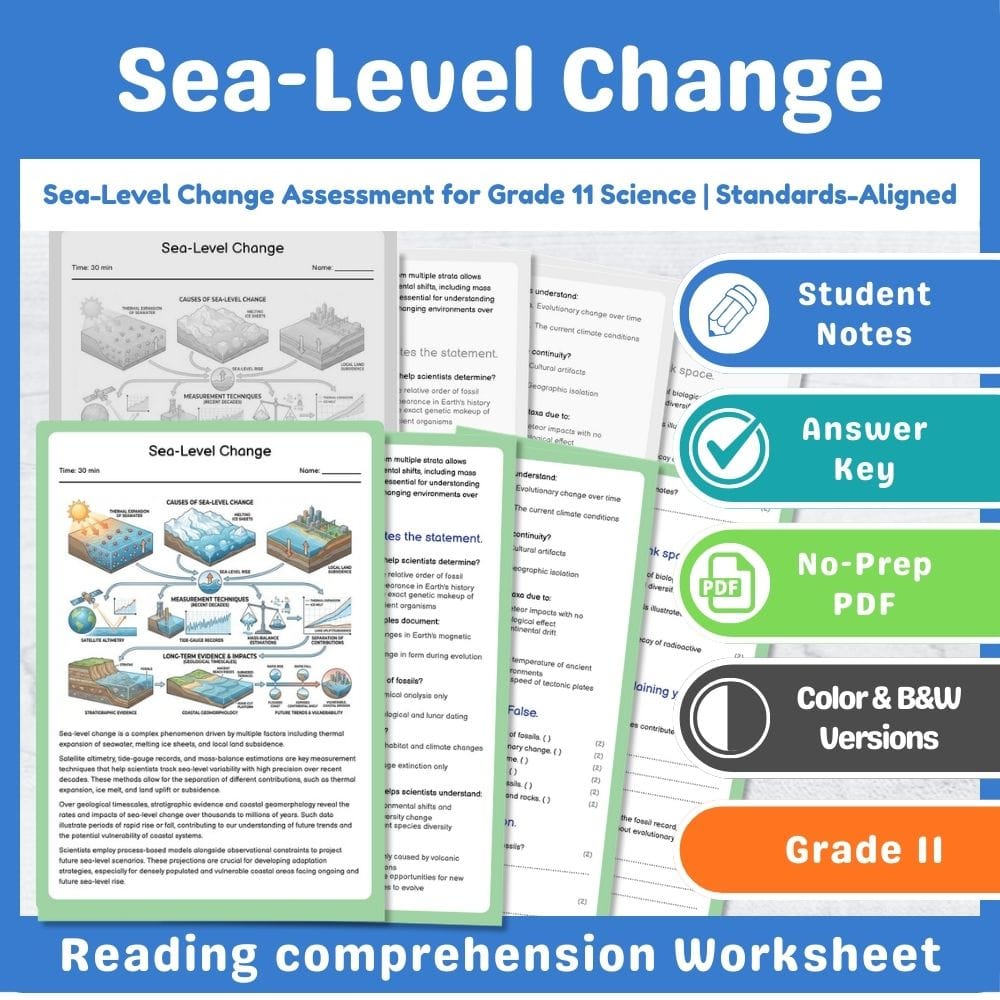
Sea-Level Change Assessment for Grade 11 Science | Standards-Aligned
Created byPrism Point LearningLearning Objectives
- Understand the causes of sea-level variability, including thermal expansion and ice-sheet mass loss.
- Analyze methods used to measure sea-level changes, such as satellite altimetry and tide-gauge records.
- Evaluate the impacts of sea-level change over different timescales using stratigraphic and geomorphological evidence.
Also included in: Lesson Grade 11 Science Assessment Bundle | Earth Systems & Climate
Instant download
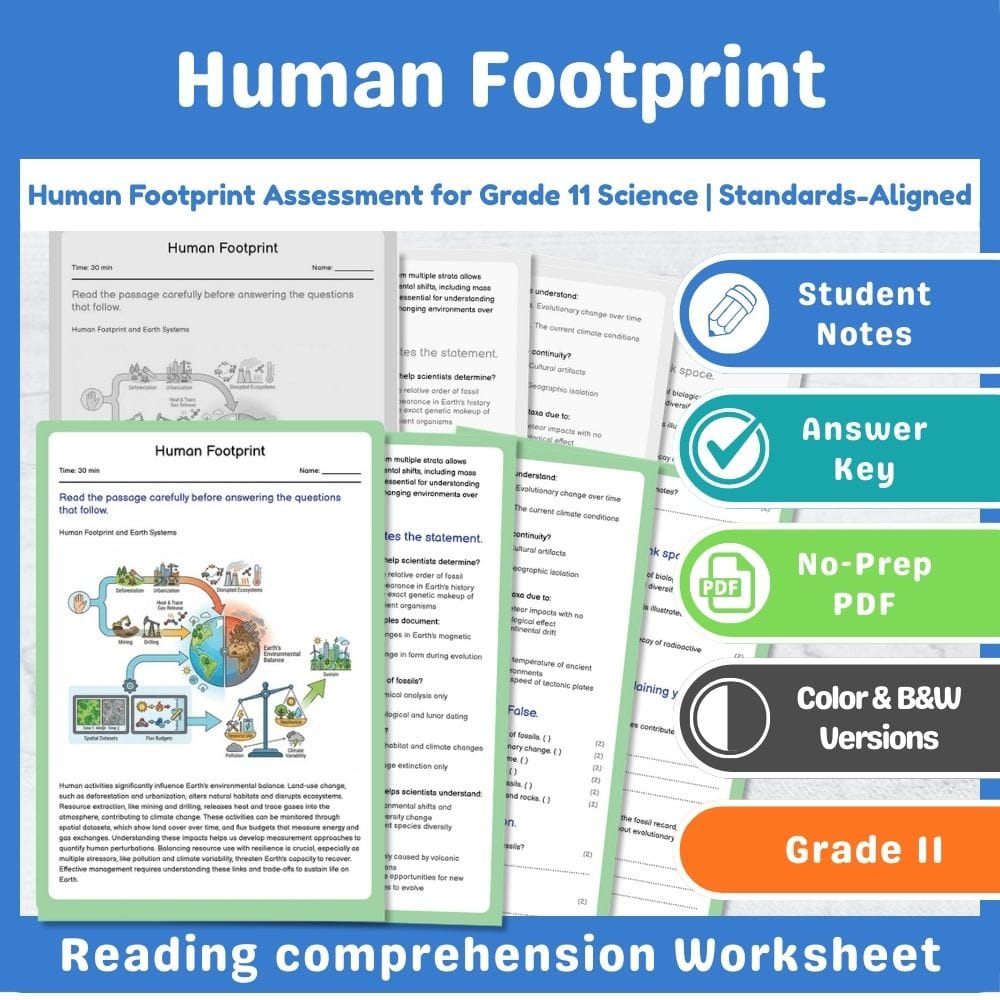
Human Footprint Assessment for Grade 11 Science | Standards-Aligned
Created byPrism Point LearningLearning Objectives
- Understand how human activities alter Earth's systems through land-use change, resource extraction, and emission of gases.
- Analyze spatial datasets and time-series data to identify environmental impacts of human actions.
- Evaluate measurement approaches for quantifying anthropogenic perturbations.
Also included in: Lesson Grade 11 Science Assessment Bundle | Earth Systems & Climate
Instant download

Grade 11 Science – Scientific Methods & Inquiry | Daily Reading Worksheet
Created byBright Mind ResourcesLearning Objectives
- Identify the key steps involved in the scientific method
- Understand the role of measurement technologies in scientific research
- Recognize the importance of hypothesis formulation and variable control
Also included in: Grade 11 Daily Reading & Graphs Science lesson bundle Worksheets | Ontario +1 more
Instant download
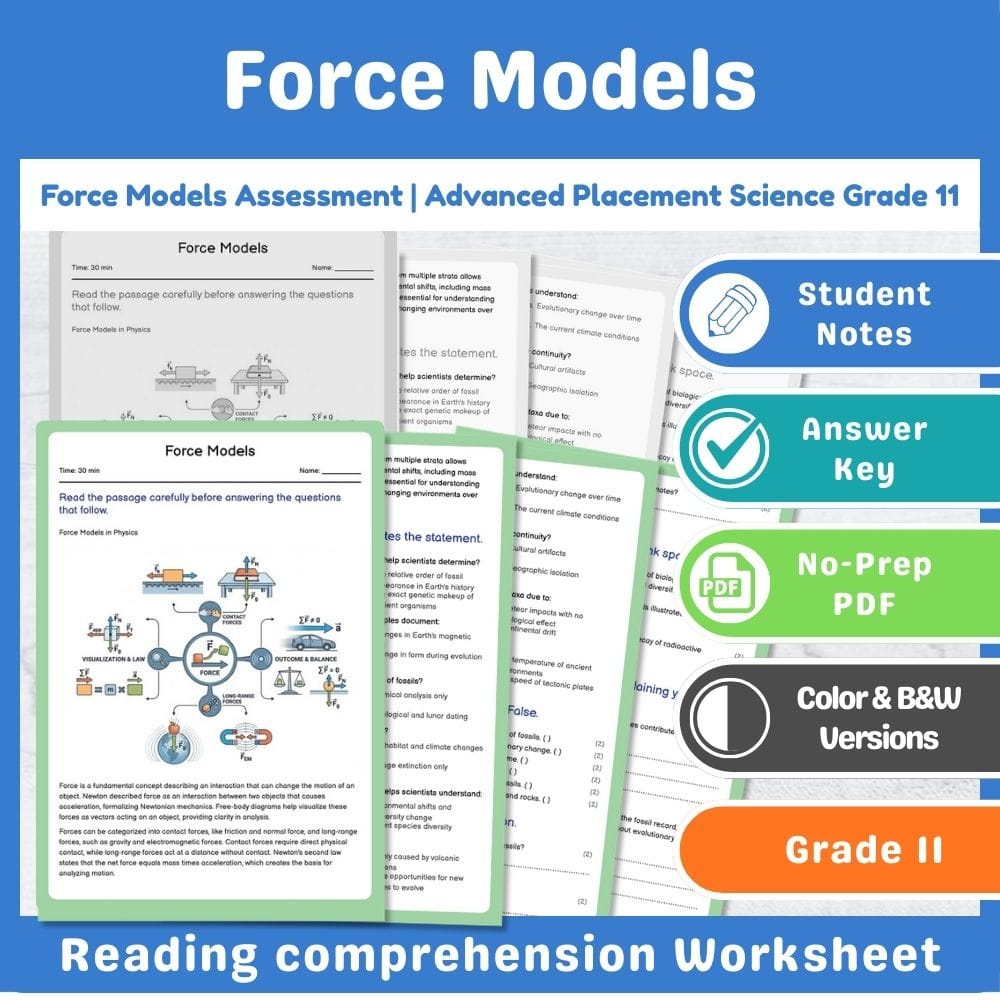
Force Models Assessment | Advanced Placement Science Grade 11
Created byPrism Point LearningLearning Objectives
- Explain the concept of force as an interaction between objects.
- Understand and apply Newton's laws of motion using free-body diagrams.
- Distinguish between contact and long-range forces such as gravity and electromagnetic forces.
Instant download

Grade 11 Science | Electron Configuration Worksheet (PDF) BC Standards
 Created byEvergreen Desk Education
Learning Objectives
- Explain how quantum numbers describe electron orbitals and how electron spin affects configurations.
- Apply the Aufbau principle, Pauli exclusion principle, and Hund’s rule to write electron configurations.
- Use valence electrons and electron arrangements to predict ion charges and periodic reactivity trends.
Instant download
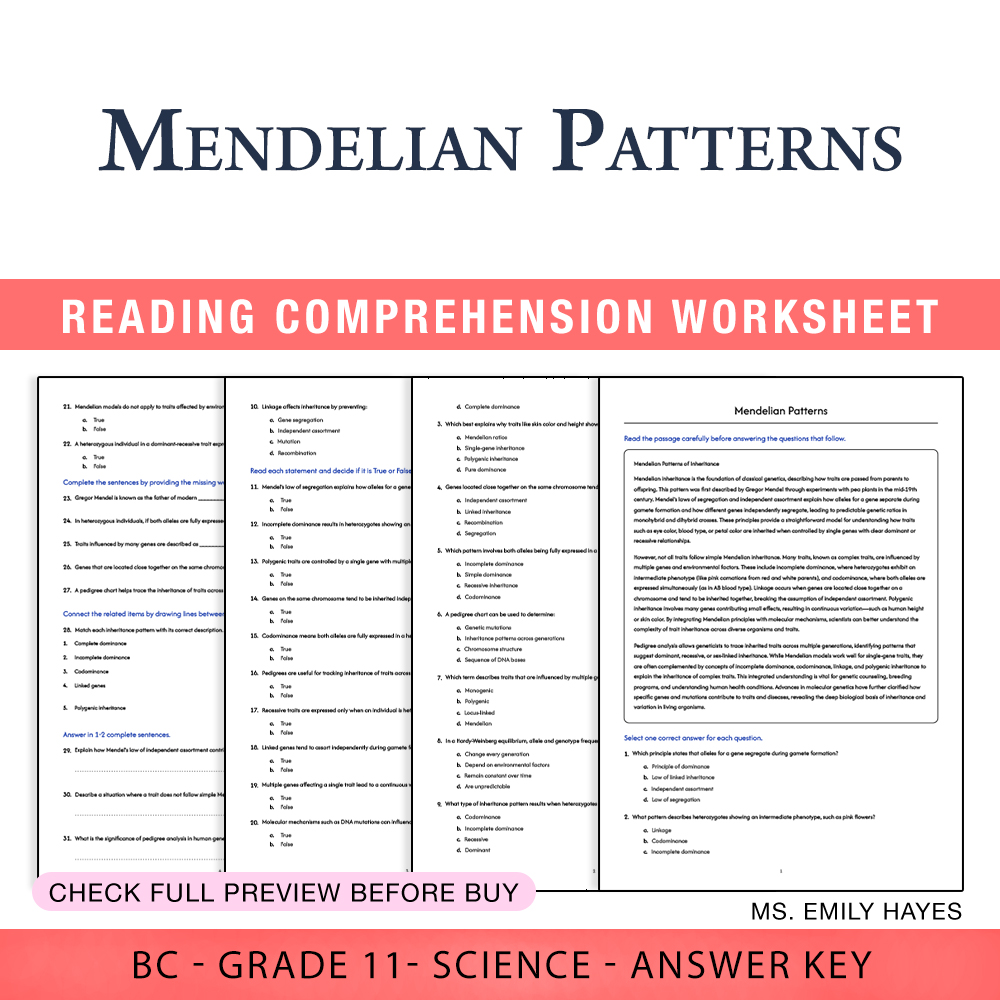
11th Grade Science | Mendelian Patterns Worksheet (PDF + Answer Key)
 Created byCopper Leaf Classroom
Learning Objectives
- Understand how Mendelian inheritance explains trait segregation and patterns in offspring.
- Identify the concepts of dominant and recessive alleles and predict genotypic and phenotypic ratios.
- Describe how pedigrees trace inheritance across generations.
Also included in: Grade 11 Science BC | Genetics, Evolution & Cell Biology (PDF + Answer Keys) +1 more
Instant download

Conceptual Modeling Worksheet for Grade 11 Science | AP Standards Practice
JCreated byJ.S SheetsLearning Objectives
- Define and explain the purpose of conceptual models in scientific analysis.
- Identify key components, assumptions, and scope of conceptual models.
- Differentiate between discrete and continuous formulations in modeling.
Instant download
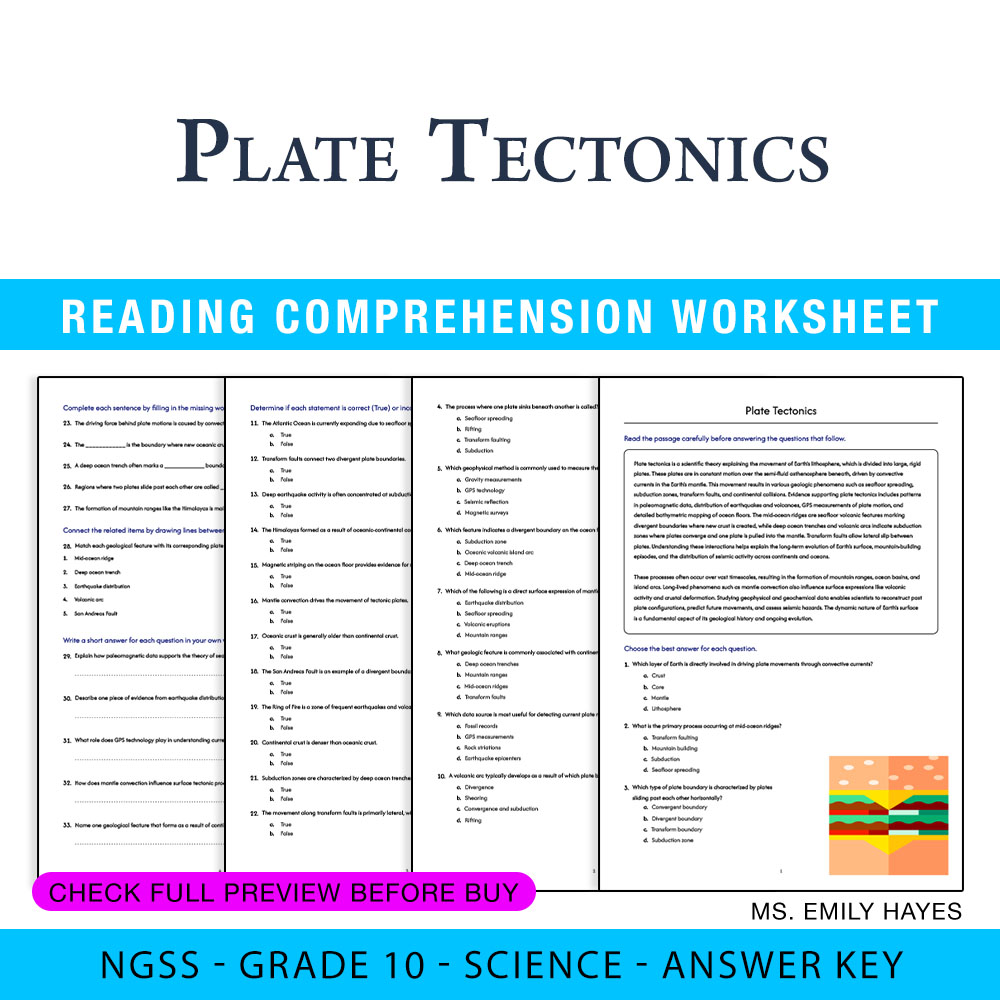
11th Grade Science | Plate Tectonics Worksheet (PDF+ Answer Key)
Created byCopper Leaf ClassroomLearning Objectives
- Explain the mechanisms of seafloor spreading, subduction, transform faulting, and continental collision.
- Interpret geologic evidence such as paleomagnetic patterns, earthquake distributions, GPS data, and bathymetric maps related to plate movements.
- Describe the surface expressions of deep mantle convection phenomena like mid-ocean ridges, volcanic arcs, and mountain ranges.
Instant download

Grade 11 Radiometric Dating Worksheet | BC Practice & PDF
 Created byClear Sky Classroom
Learning Objectives
- Explain how radiometric dating uses parent and daughter isotopes plus known decay rates to estimate absolute ages
- Compare isotope systems and identify which geological materials and timescales each system is best suited for
- Describe how closed-system behavior and closure temperature influence whether isotopic ages are reliable
Instant download
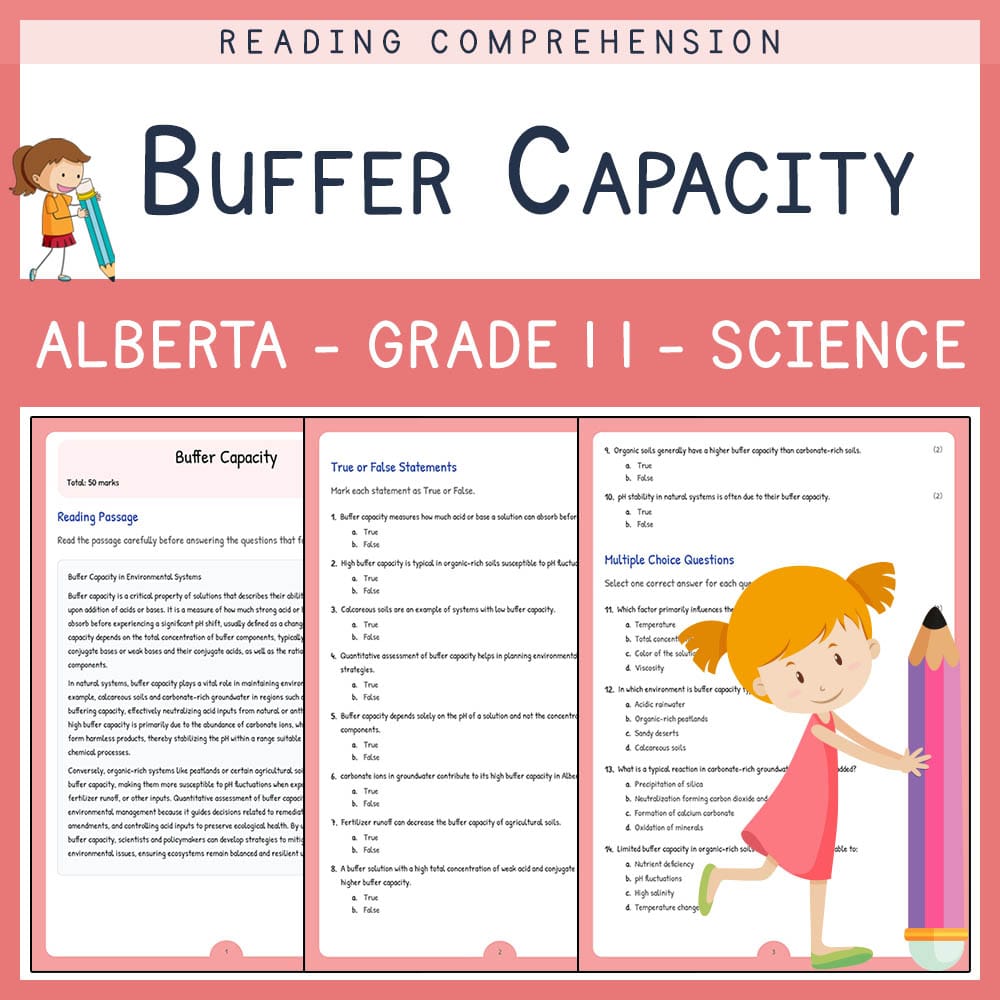
Grade 11 Science | Buffer Capacity Worksheet | Alberta Alberta
 Created byLumora Learning
Learning Objectives
- Understand the concept of buffer capacity and its importance in environmental systems.
- Identify factors affecting buffer capacity in natural systems.
- Explain how buffer capacity influences pH stability in soils and groundwater.
Instant download

Grade 11 Science | Cell Organization - Daily Reading Comprehension
 Created byCoral Reef Learning
Learning Objectives
- Understand the hierarchy of cell organization from cells to organ systems.
- Identify different cell types and their specific functions.
- Explain the process of cellular differentiation and specialization.
Instant download
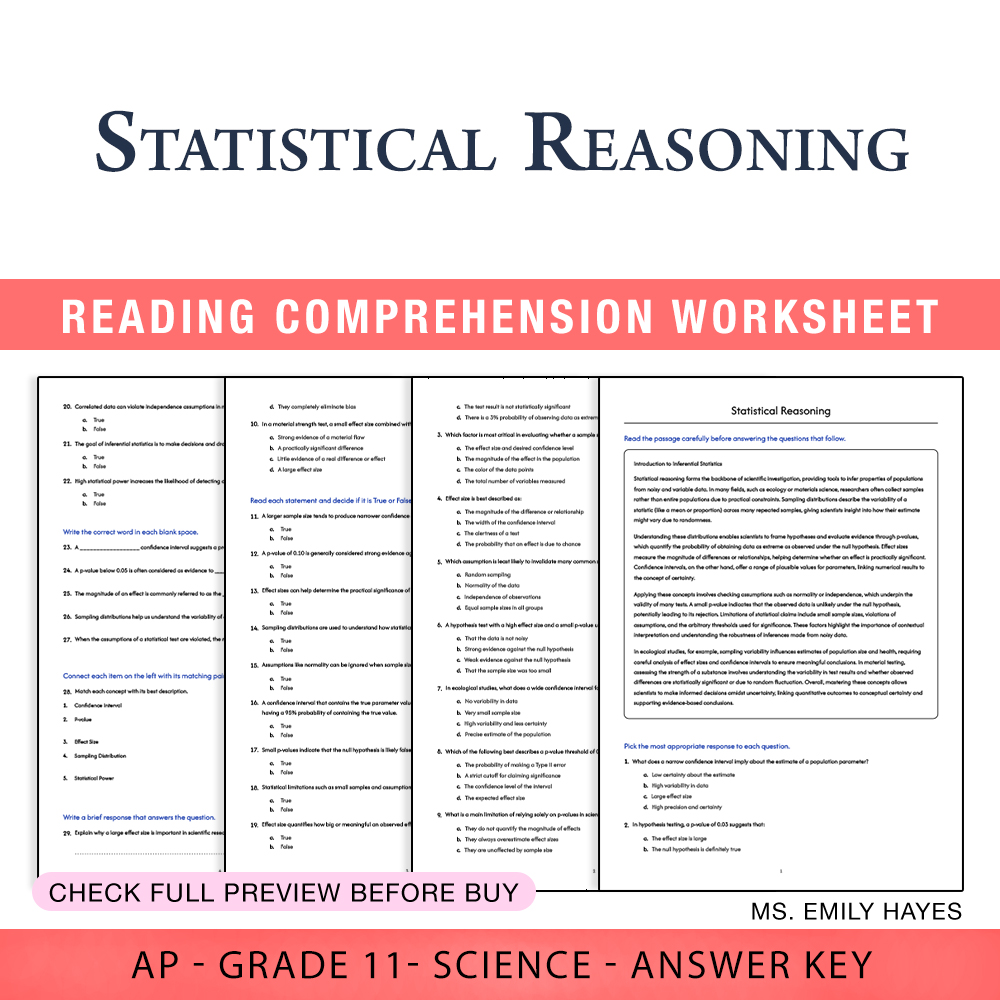
11th Grade Science | Statistical Reasoning Worksheet (PDF+ Answer Key)
Created byCopper Leaf ClassroomLearning Objectives
- Understand the role of sampling distributions in inferential statistics.
- Interpret p-values, effect sizes, and confidence intervals in context.
- Evaluate the assumptions and limitations of statistical tests in scientific investigations.
Also included in: Grade 11 Science AP | Science Practices & Inquiry Skills(PDF+ Answer Key) +1 more
Instant download
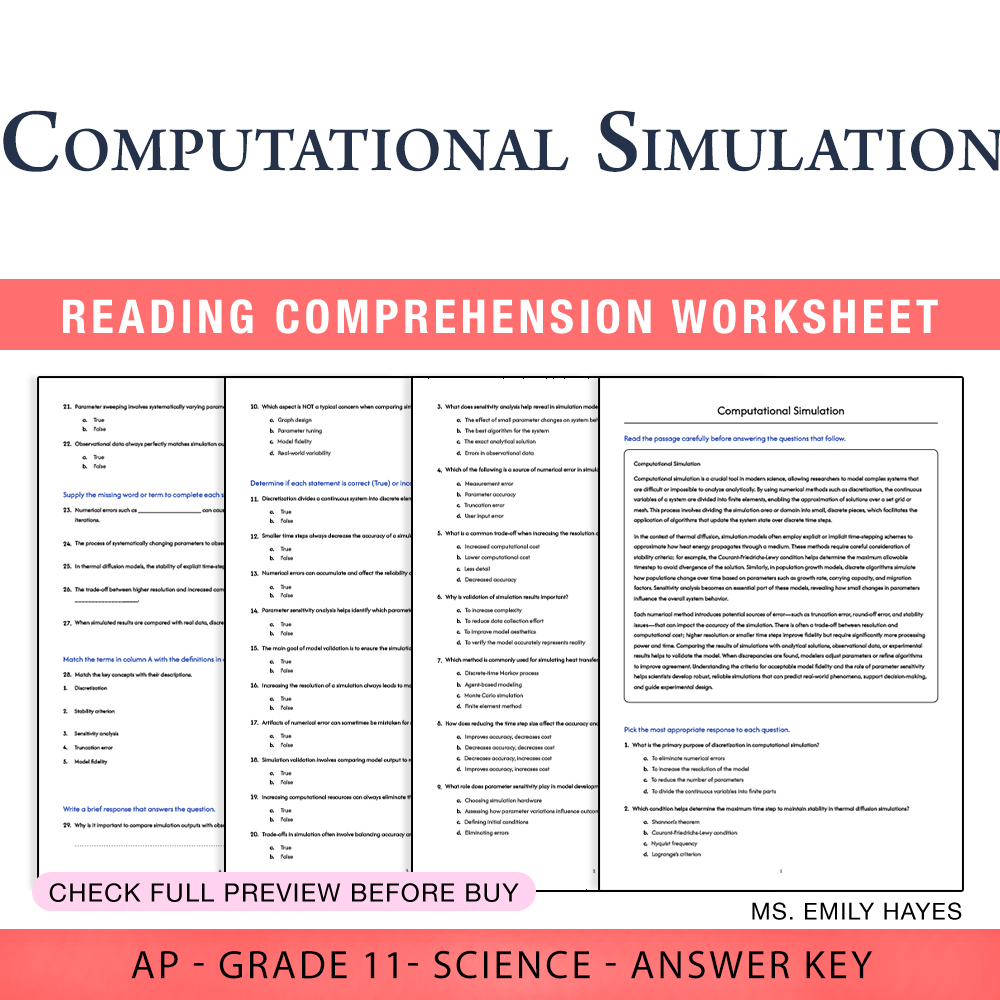
11th Grade Science | Computational Simulation Worksheet (PDF+ Answer Key)
Created byCopper Leaf ClassroomLearning Objectives
- Describe the numerical methods used for simulating dynamic systems, including discretization, time-stepping, and parameter sweeps.
- Analyze the sources of numerical error and the trade-offs between resolution and computational cost in simulations.
- Compare simulated outputs with analytical solutions and observational data to evaluate model fidelity.
Also included in: Grade 11 Science AP | Science Practices & Inquiry Skills(PDF+ Answer Key) +1 more
Instant download
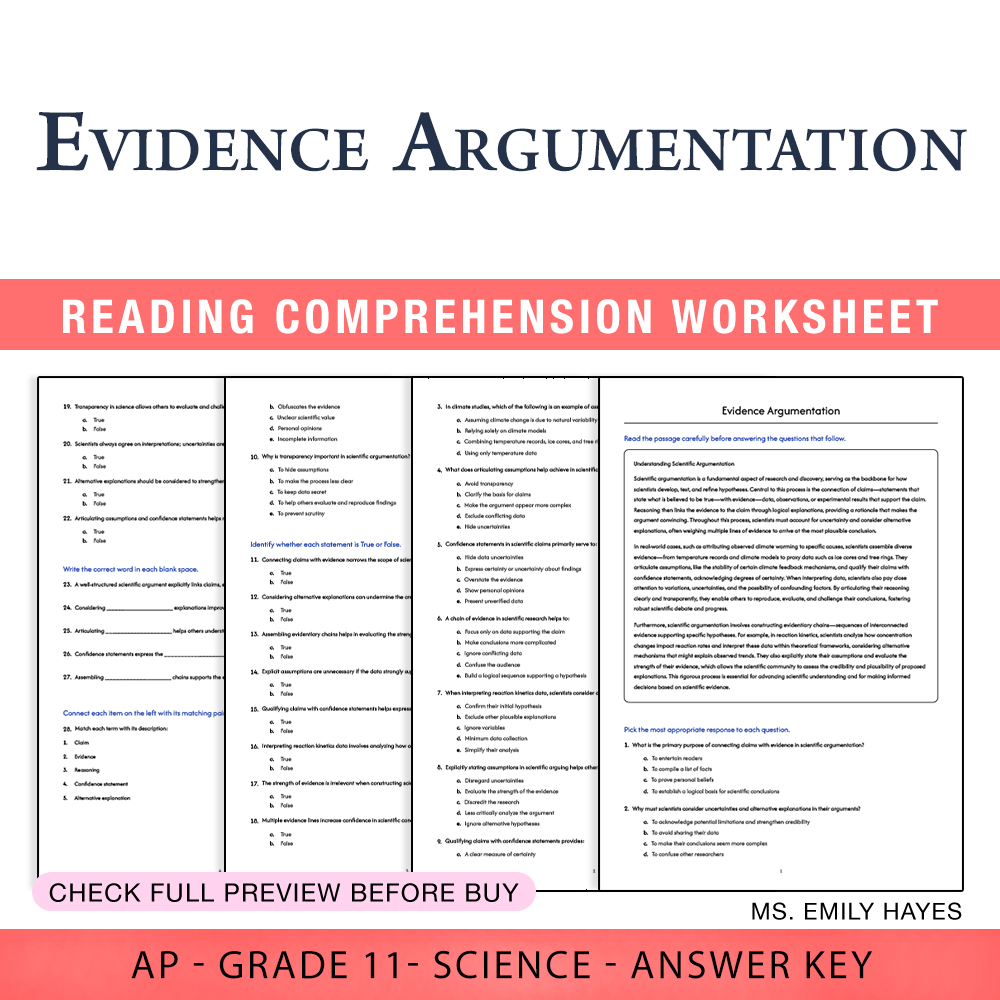
Grade 11 Science | Evidence Argumentation Worksheet (PDF+ Answer Key)
Created byCopper Leaf ClassroomLearning Objectives
- Understand how to construct scientific claims supported by evidence and reasoning.
- Learn methods to articulate assumptions, confidence statements, and alternative explanations.
- Analyze case studies involving attribution of warming trends and interpretation of reaction kinetics data.
Also included in: Grade 11 Science AP | Science Practices & Inquiry Skills(PDF+ Answer Key) +1 more
Instant download
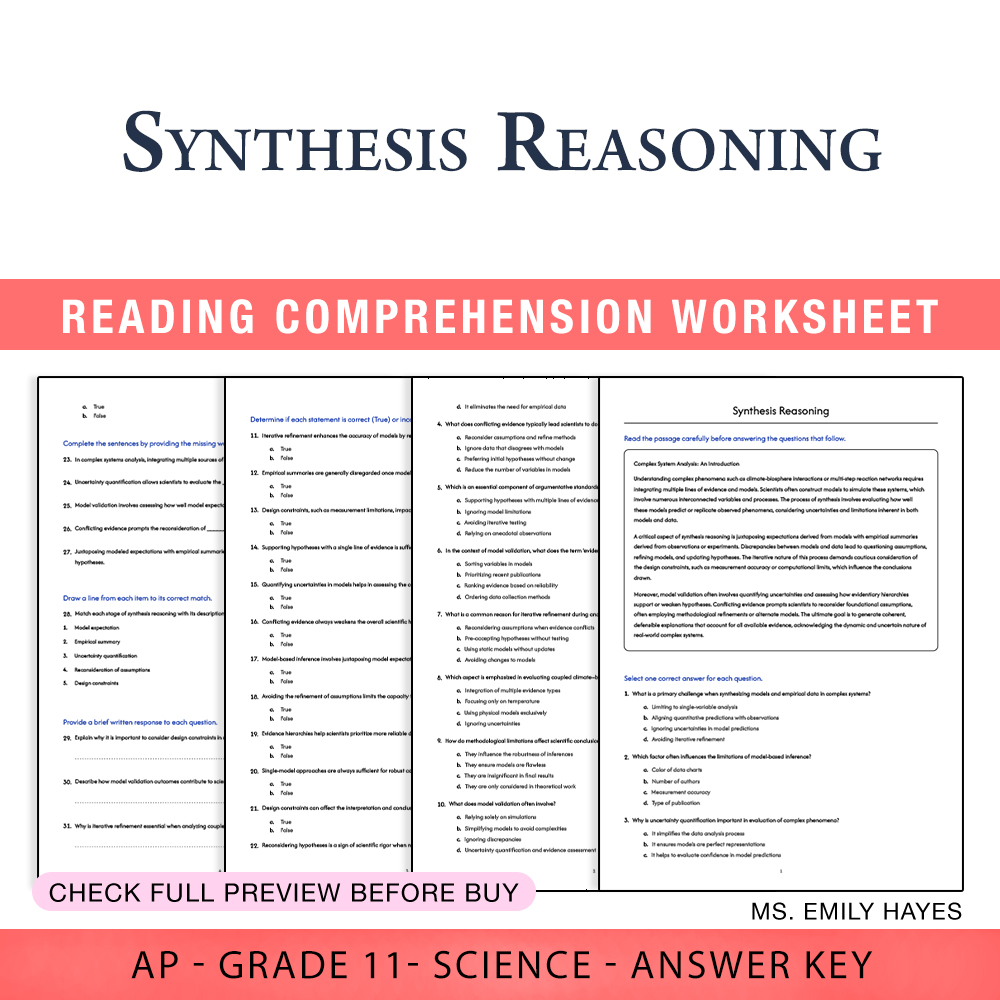
11th Grade Science | Synthesis Reasoning Worksheet (PDF+ Answer Key)
Created byCopper Leaf ClassroomLearning Objectives
- Understand how to integrate quantitative data, models, and evidence to evaluate complex scientific phenomena.
- Develop skills in comparing modeled expectations with empirical observations, considering design constraints and limitations.
- Learn how to justify hypotheses through synthesis of uncertainty quantification, validation outcomes, and evidentiary hierarchies.
Also included in: Grade 11 Science AP | Science Practices & Inquiry Skills(PDF+ Answer Key) +1 more
Instant download
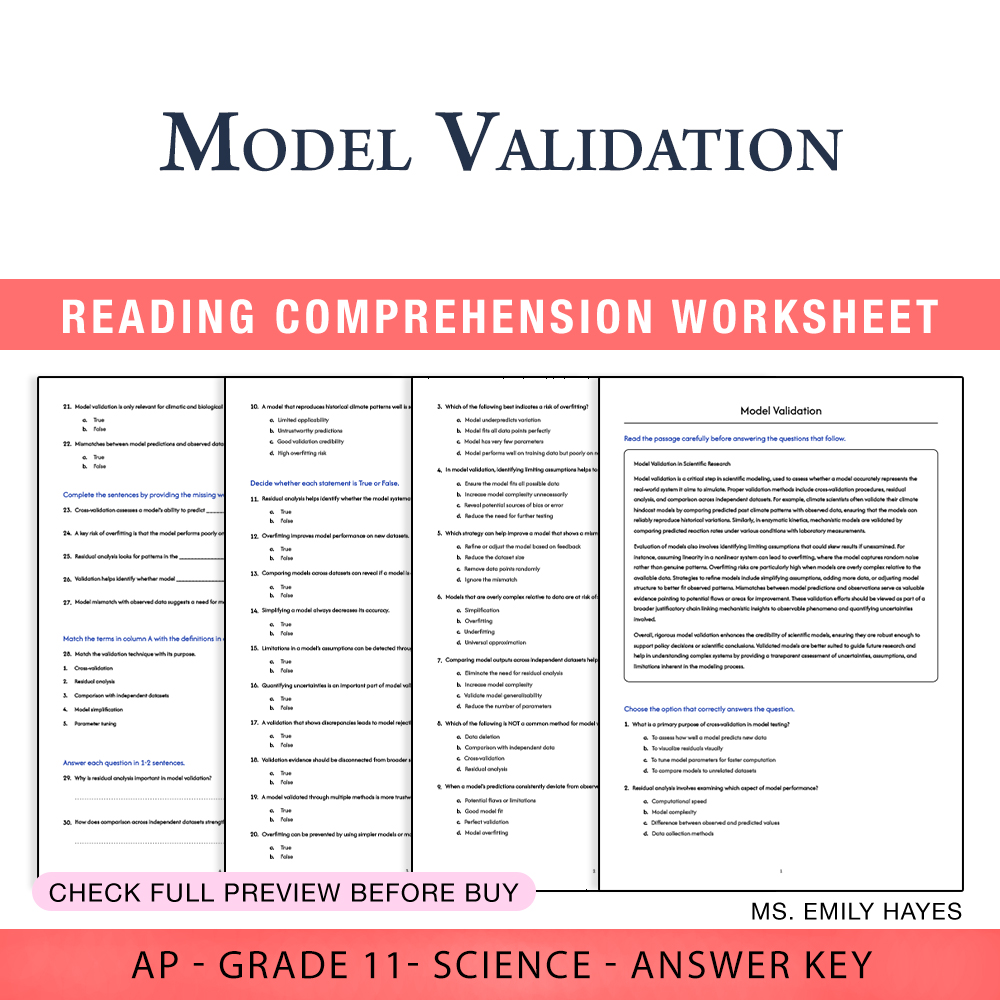
11th Grade Science | Model Validation Worksheet (PDF+ Answer Key)
Created byCopper Leaf ClassroomLearning Objectives
- Understand the methods used for evaluating the credibility of scientific models.
- Identify key techniques such as cross-validation, residual analysis, and dataset comparison.
- Evaluate the limitations and risks associated with model overfitting and assumptions.
Also included in: Grade 11 Science AP | Science Practices & Inquiry Skills(PDF+ Answer Key) +1 more
Instant download

Grade 11 Science – Seismic Profiles & Earth's Internal Structure | Worksheet
Created byBright Mind ResourcesLearning Objectives
- Understand the different types of seismic waves and their behaviors
- Identify how seismic waves reveal Earth's internal layers
- Compare P-waves and S-waves and their significance in geophysics
Also included in: Geology Grade 11 Science Daily Reading Worksheets Lesson Bundle | BC +1 more
Instant download
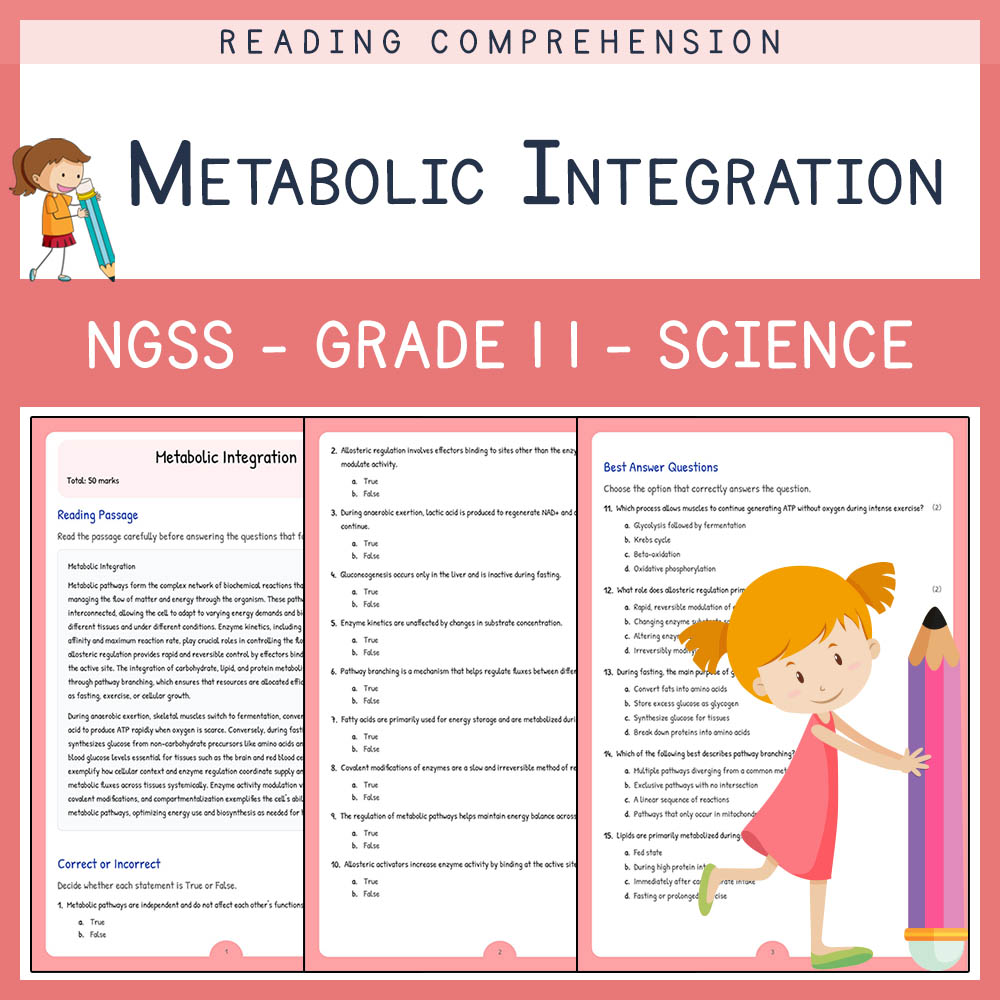
Grade 11 Science | Metabolic Integration Worksheet (Answer Key) for NGSS Alignment
Created byLumora LearningLearning Objectives
- Understand the concept of interconnected metabolic pathways and their regulation.
- Explain enzyme kinetics and the role of allosteric regulation in metabolism.
- Analyze how pathway branching controls fluxes between carbohydrate, lipid, and protein metabolism.
Instant download

11th Grade Science | Stoichiometry Basics Worksheet (PDF+ Answer Key)
Created byCopper Leaf ClassroomLearning Objectives
- Understand mole relationships, molar mass, and their role in chemical equations.
- Interpret balanced chemical equations for quantitative analysis.
- Apply limiting reagent concepts and calculate percent yields.
Also included in: Grade 11 Science | Chemistry Foundations AP Worksheet Bundle (PDF+ Answer Keys) +1 more
Instant download

Grade 11 Science | Molecular Phylogeny Worksheet | TEKS Aligned
Created byLumora LearningLearning Objectives
- Understand how DNA, RNA, and protein sequences are used to infer evolutionary relationships.
- Describe the process and importance of sequence alignment in molecular phylogeny.
- Explain how models of molecular evolution help estimate divergence times.
Instant download

Grade 11 Science | Adaptive Radiation Worksheet | TEKS-Aligned
Created byLumora LearningLearning Objectives
- Understand the concept of adaptive radiation and its role in biodiversity.
- Identify ecological and evolutionary factors that promote adaptive radiation.
- Analyze patterns of speciation and trait diversification in adaptive radiation events.
Instant download
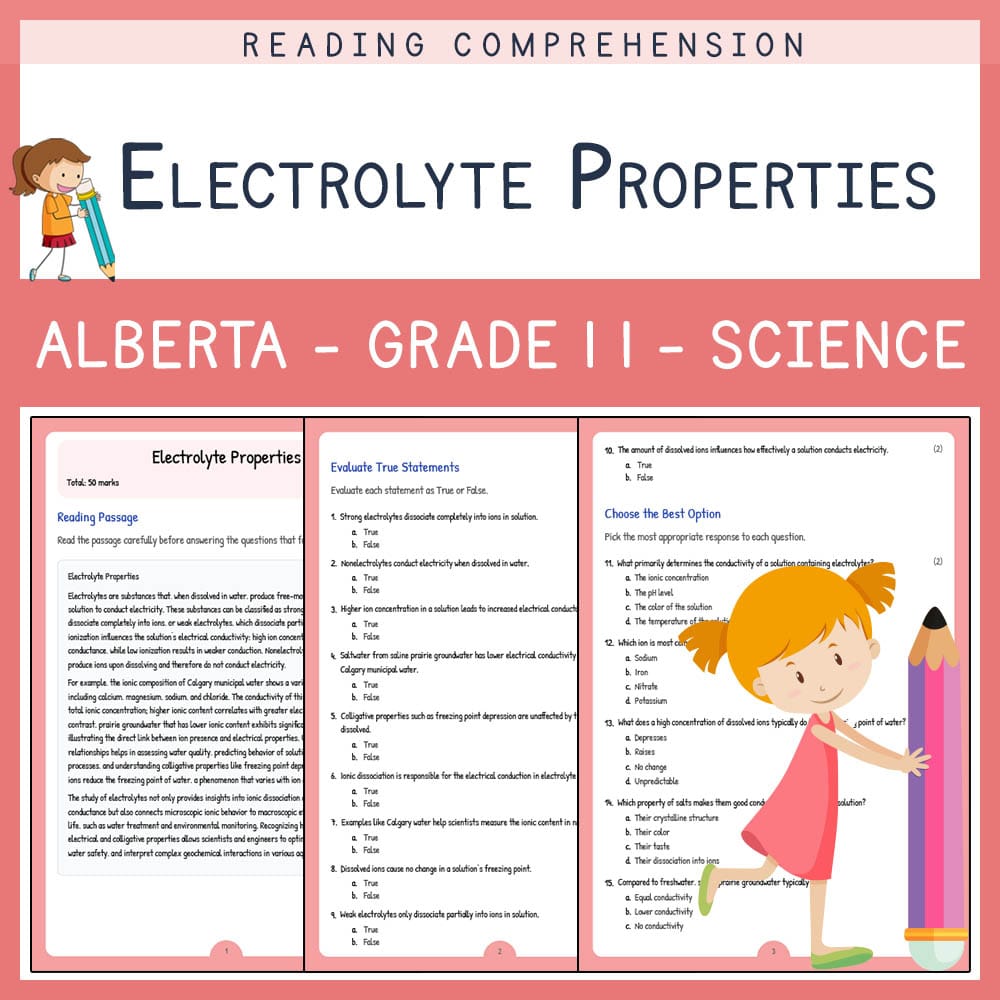
Grade 11 Science | Electrolyte Properties Worksheet | Alberta Standards
Created byLumora LearningLearning Objectives
- Explain the difference between electrolytes and nonelectrolytes based on ion dissociation.
- Describe how ion concentration affects electrical conductance in solutions.
- Identify the impact of solute particles on colligative properties such as freezing point depression.
Instant download

Grade 11 Science | Scientific Inquiry - Daily Reading Comprehension
Created byCoral Reef LearningLearning Objectives
- Understand how observations of seasons provide evidence for natural patterns.
- Learn to identify evidence used in scientific explanations of seasonal changes.
- Develop skills in analyzing scientific passages related to seasonal observations.
Instant download

Grade 11 Science | Chemical Energy Capture - Daily Reading Comprehension
Created byCoral Reef LearningLearning Objectives
- Understand the process of photosynthesis and how light energy is converted into chemical energy in plants.
- Identify the key components involved in photosynthesis.
- Explain the significance of photosynthesis to ecosystems and life on Earth.
Instant download

Electric Circuits Worksheet for Grade 11 Science | Standards-Aligned Practice
JCreated byJ.S SheetsLearning Objectives
- Describe how charge, current, potential difference, and resistance relate to direct-current circuit behavior.
- Apply Ohm’s law to determine voltage, current, or resistance in simple circuit situations.
- Use series and parallel resistor concepts to predict equivalent resistance and current distribution.
Instant download

Circular Motion Worksheet for Grade 11 Science | Standards-Aligned Practice
JCreated byJ.S SheetsLearning Objectives
- Explain uniform vs. non-uniform circular motion and identify tangential vs. centripetal acceleration components
- Apply centripetal force relationships using v^2/r and ω^2r to solve force and motion problems
- Connect period and frequency with angular speed and interpret how changing radius and speed affect centripetal acceleration
Instant download

Grade 11 Science – Molecular Phylogeny & Evolution | Daily Reading Worksheet
Created byBright Mind ResourcesLearning Objectives
- Understand the concept of molecular phylogeny and its role in studying evolutionary relationships.
- Identify homologous DNA, RNA, and protein sequences through sequence alignment.
- Explain how models of molecular evolution and molecular clocks are used to estimate divergence times.
Also included in: Grade 11 Evolution Science Lesson Bundle Daily Reading Worksheets | TEKS +2 more
Instant download
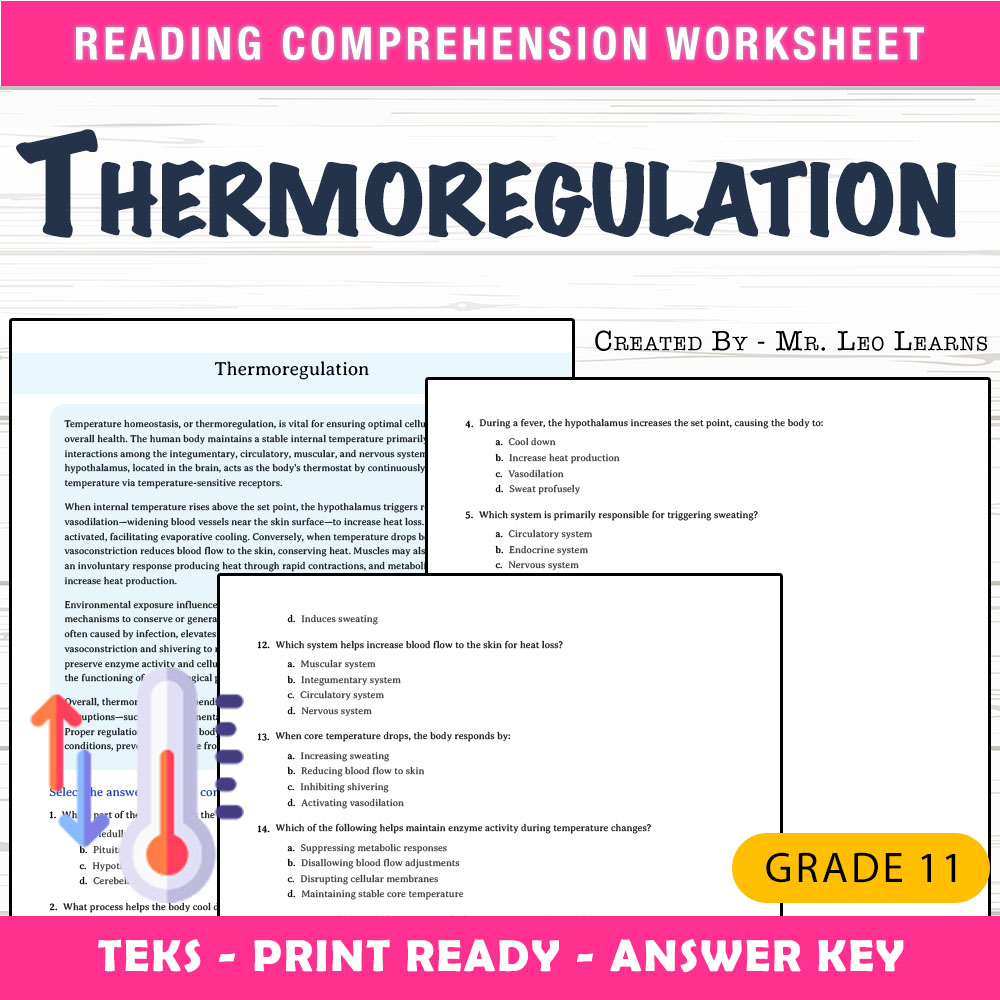
Grade 11 Science – Thermoregulation Worksheet for Mastery
 Created byThe Resource Hub
Learning Objectives
- Explain the role of the hypothalamus in temperature regulation.
- Identify mechanisms of heat production, conservation, and dissipation.
- Understand how the integumentary, circulatory, muscular, and nervous systems interact in thermoregulation.
Also included in: Grade 11 Science | Human Body Systems & Physiology Worksheet Bundle +1 more
Instant download
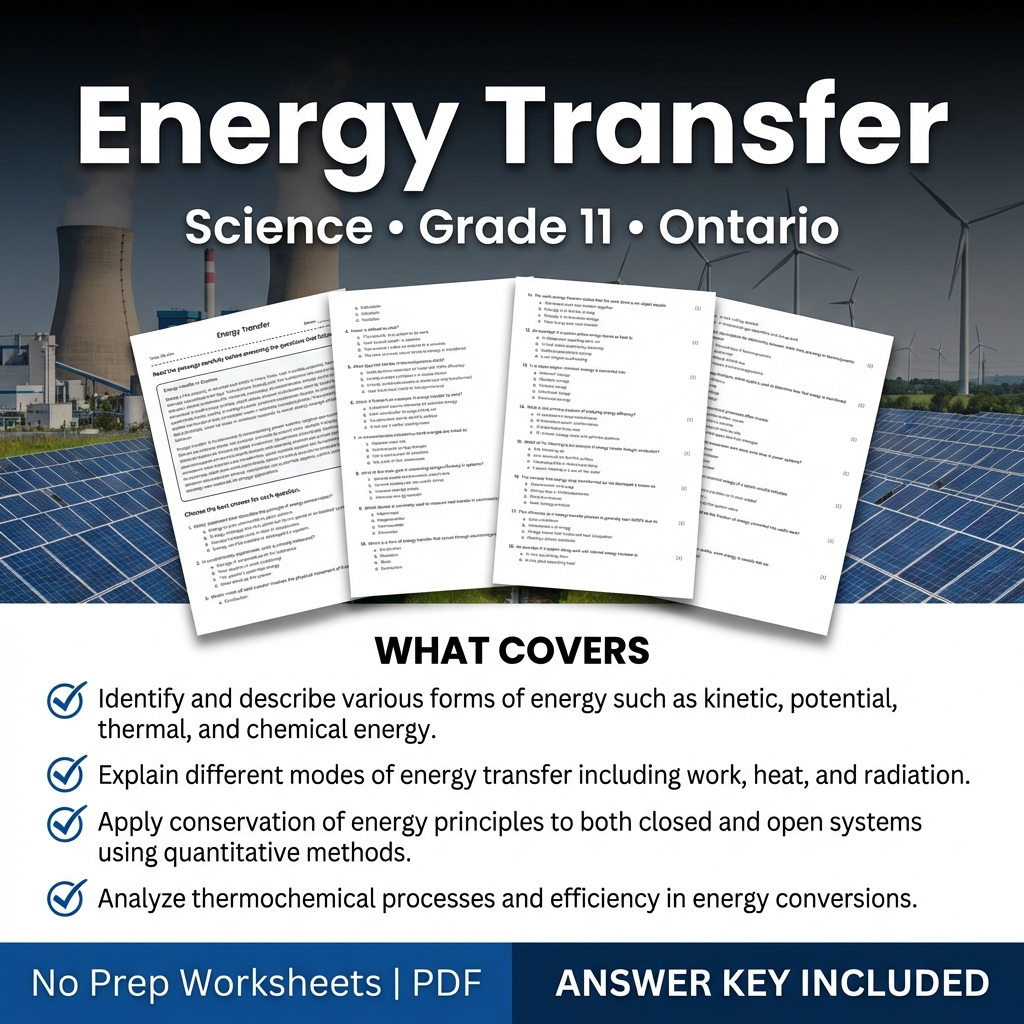
Energy Transfer Worksheet for Grade 11 Science | Ontario Standards
Created byCoral Reef LearningLearning Objectives
- Identify and describe various forms of energy such as kinetic, potential, thermal, and chemical energy.
- Explain different modes of energy transfer including work, heat, and radiation.
- Apply conservation of energy principles to both closed and open systems using quantitative methods.
Instant download
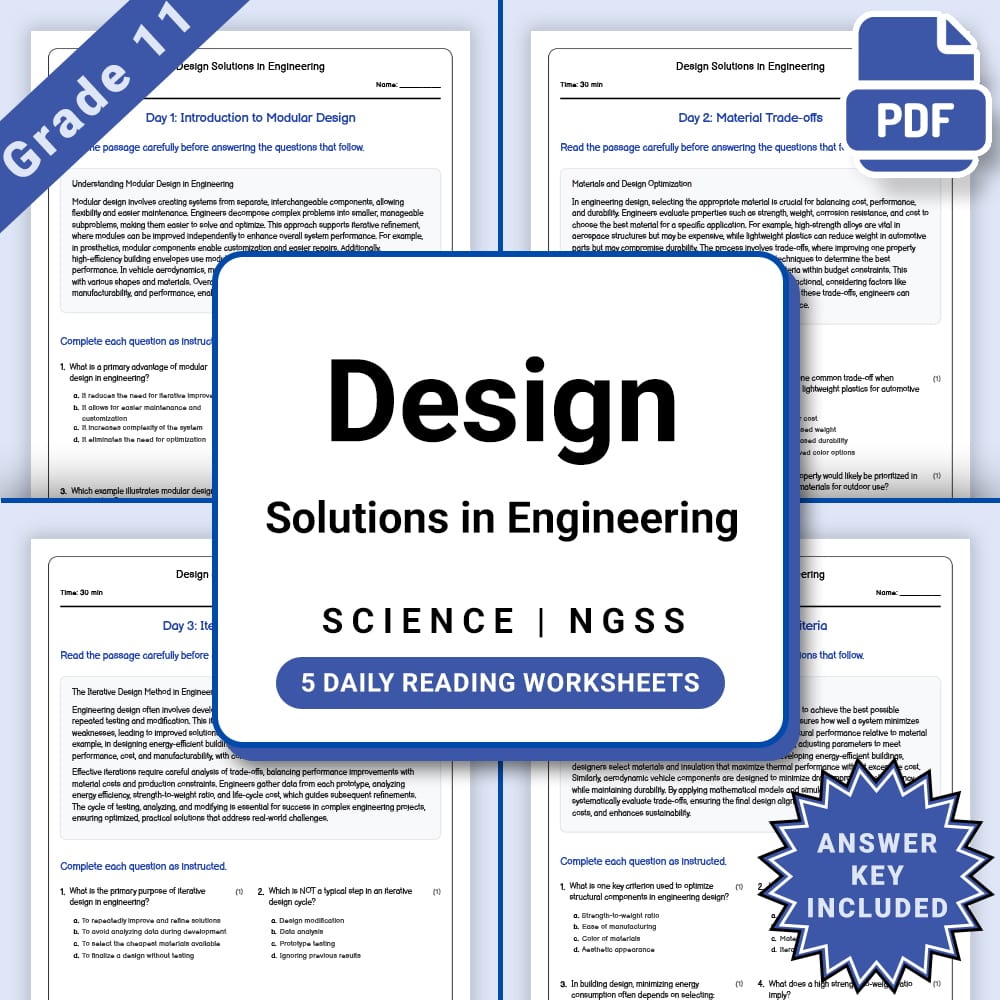
Grade 11 Science – Design Solutions in Engineering Worksheet(PDF +Answer Key)
Created byCopper Leaf ClassroomLearning Objectives
- Understand the importance of modular design in engineering solutions.
- Identify how decomposing complex problems simplifies the design process.
- Apply principles of optimization and trade-offs in engineering design.
Instant download

Grade 11 Science – Resources & Hazards Daily Reading Worksheet | BC Standards
Created byBright Mind ResourcesLearning Objectives
- Identify different types of natural resources and their geological origins.
- Understand various geohazards and their impacts on communities and infrastructure.
- Assess the importance of sustainable resource extraction and hazard mitigation strategies.
Also included in: Geology Grade 11 Science Daily Reading Worksheets Lesson Bundle | BC +1 more
Instant download

Seafloor Spreading Worksheet for Grade 11 Science | Standards-Aligned Practice
JCreated byJ.S SheetsLearning Objectives
- Understand the process of seafloor spreading and how it shapes ocean basins.
- Describe how magnetic stripes on the ocean floor provide evidence for seafloor spreading.
- Explain how age and bathymetric data support the theory of plate tectonics.
Instant download

Grade 11 Science – Trophic Levels in Ecosystems | Daily Worksheet + Answer Key
JCreated byJ.S SheetsLearning Objectives
- Define and identify different trophic levels in an ecosystem.
- Explain the flow of energy and matter between trophic levels.
- Describe the concepts of biomass and energy pyramids.
Also included in: Grade 11 Science Lesson Bundle TEKS Ecosystems and Ecology Worksheets +1 more
Instant download
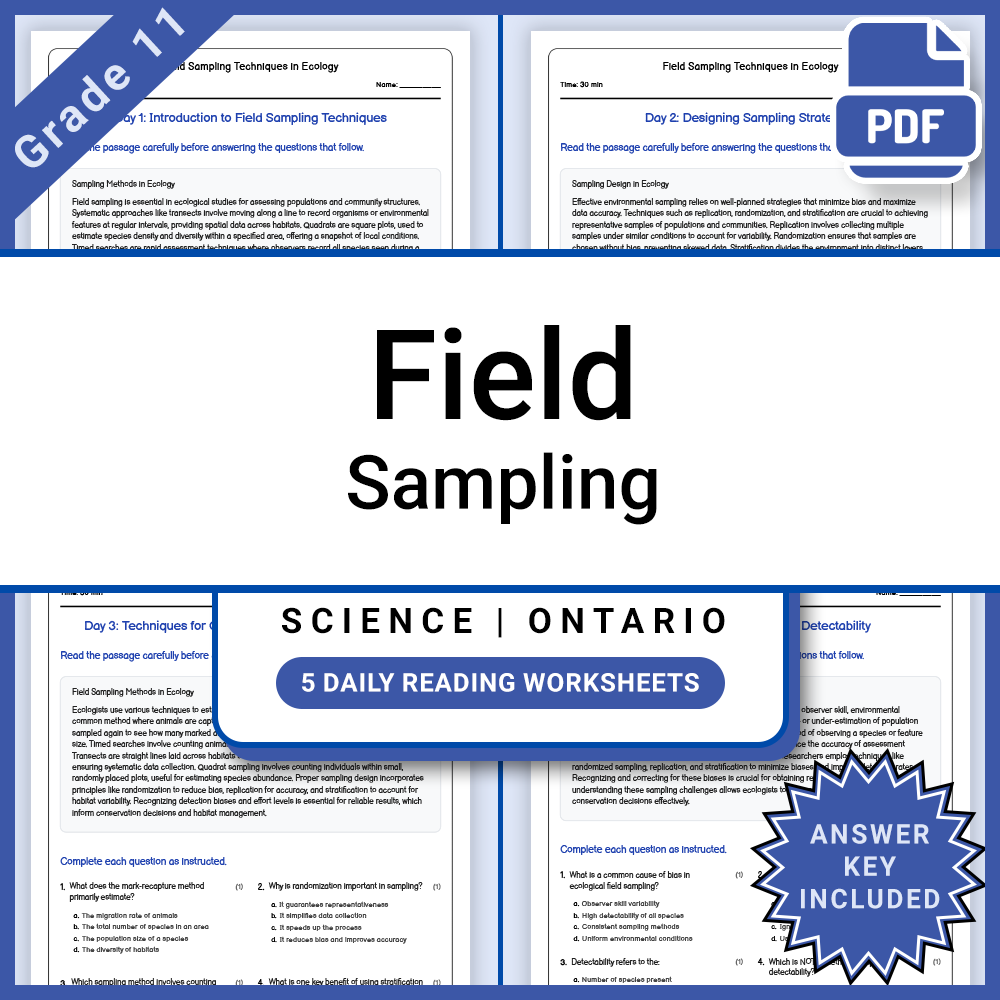
Grade 11 Science – Field Sampling Techniques Daily Worksheet + Answer Key
JCreated byJ.S SheetsLearning Objectives
- Understand different systematic approaches to sampling in ecological studies
- Identify methods such as transects, quadrats, timed searches, and mark–recapture
- Explain principles of sampling design including replication, randomization, and stratification
Also included in: Grade 11 Science Lesson Bundle | Ecosystem Dynamics and Sustainability +1 more
Instant download

Grade 11 Science | Newton Second Law - Daily Reading Comprehension
Created byCoral Reef LearningLearning Objectives
- Understand how net force, mass, and acceleration are related
- Identify the factors affecting the acceleration of objects
- Explain why objects with different masses accelerate differently under the same force
Instant download
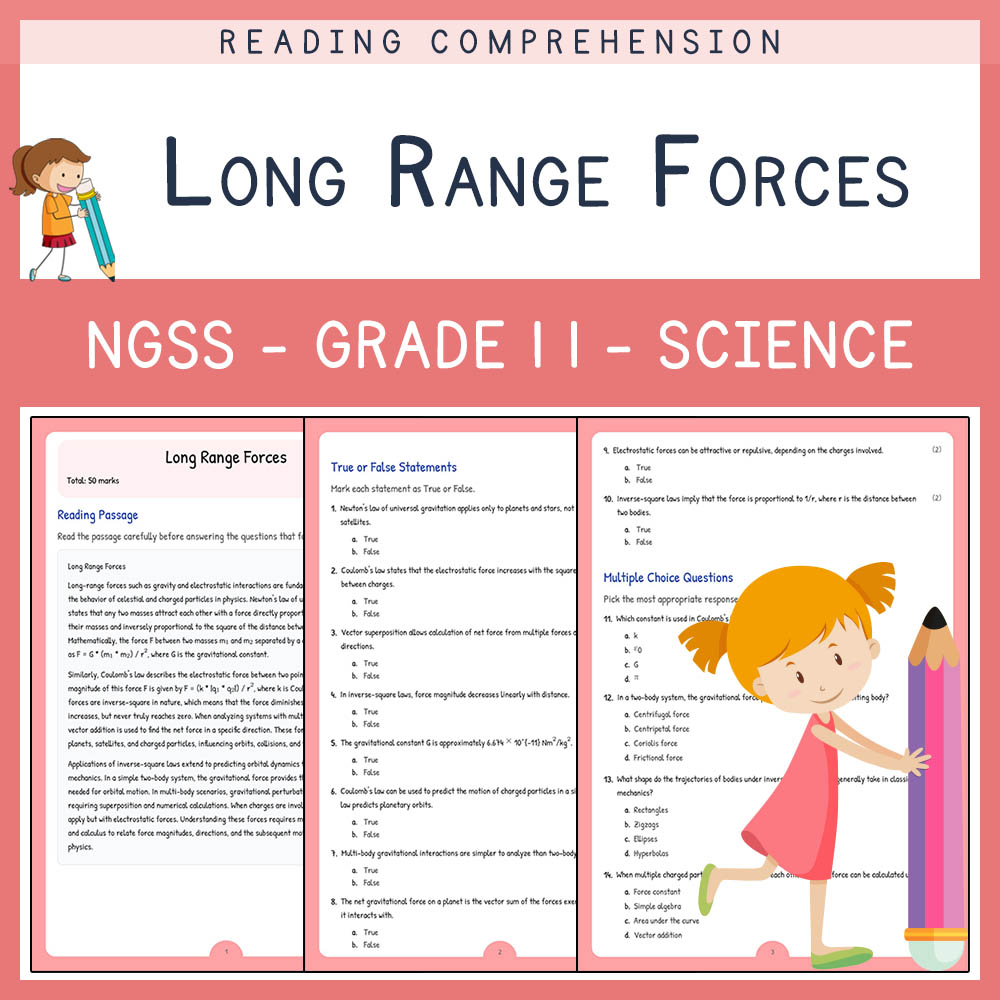
Grade 11 Science | Long Range Forces Worksheet (PDF & Answer Key) NGSS Aligned
Created byLumora LearningLearning Objectives
- Understand the mathematical formulations of Newton's law of universal gravitation and Coulomb's law.
- Apply vector superposition principles to calculate net forces between bodies.
- Analyze classical mechanics problems involving orbital dynamics and charged-particle trajectories.
Instant download

Grade 11 Science | Friction Forces Worksheet | BC-Aligned
Created byLumora LearningLearning Objectives
- Understand the origins and types of friction, including static and kinetic.
- Explain how friction depends on normal force and surface properties.
- Apply the concept of coefficients of friction to real-world situations.
Also included in: Grade 11 Science | Physics Custom Bundle | BC-Aligned Worksheet Set
Instant download

Grade 11 Science | Human Footprint Worksheet | AP-aligned
Created byLumora LearningLearning Objectives
- Understand how human activities alter Earth systems through land-use change, resource extraction, and emissions.
- Analyze spatial datasets, land cover changes, and flux budgets to connect local actions with regional environmental impacts.
- Evaluate measurement approaches for quantifying human-induced perturbations and assess trade-offs between resource use and system resilience.
Also included in: Grade 11 Science | Earth and Space Sciences Custom Bundle | AP
Instant download
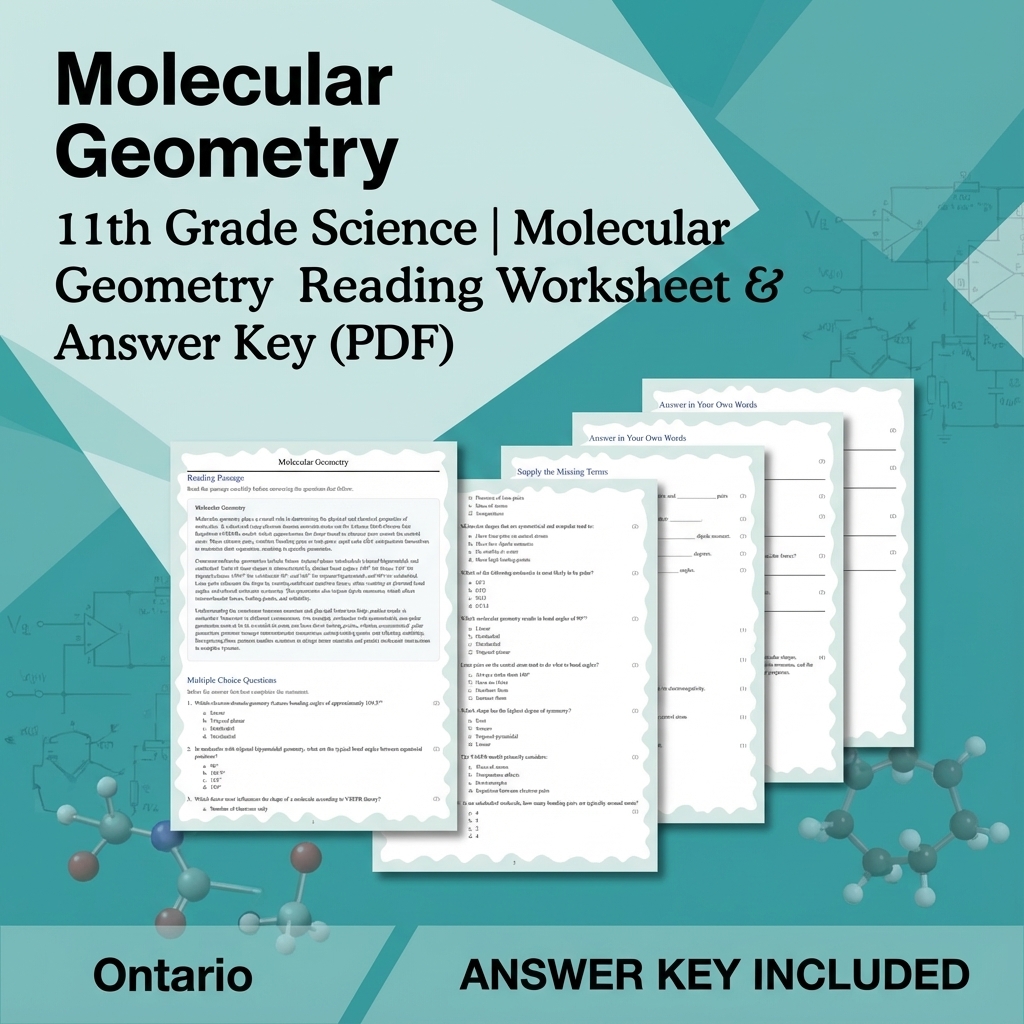
11th Grade Science | Molecular Geometry Reading Worksheet & Answer Key (PDF)
JCreated byJ.S SheetsLearning Objectives
- Understand electron-domain considerations and VSEPR approximations for predicting molecular shapes.
- Identify molecular geometries such as linear, trigonal planar, tetrahedral, trigonal bipyramidal, and octahedral.
- Analyze the effects of lone pairs and molecular symmetry on physical properties like polarity, boiling point, and solubility.
Also included in: Grade 11 Science Unit Bundle | Chemical Bonding & Reaction Energetics +1 more
Instant download
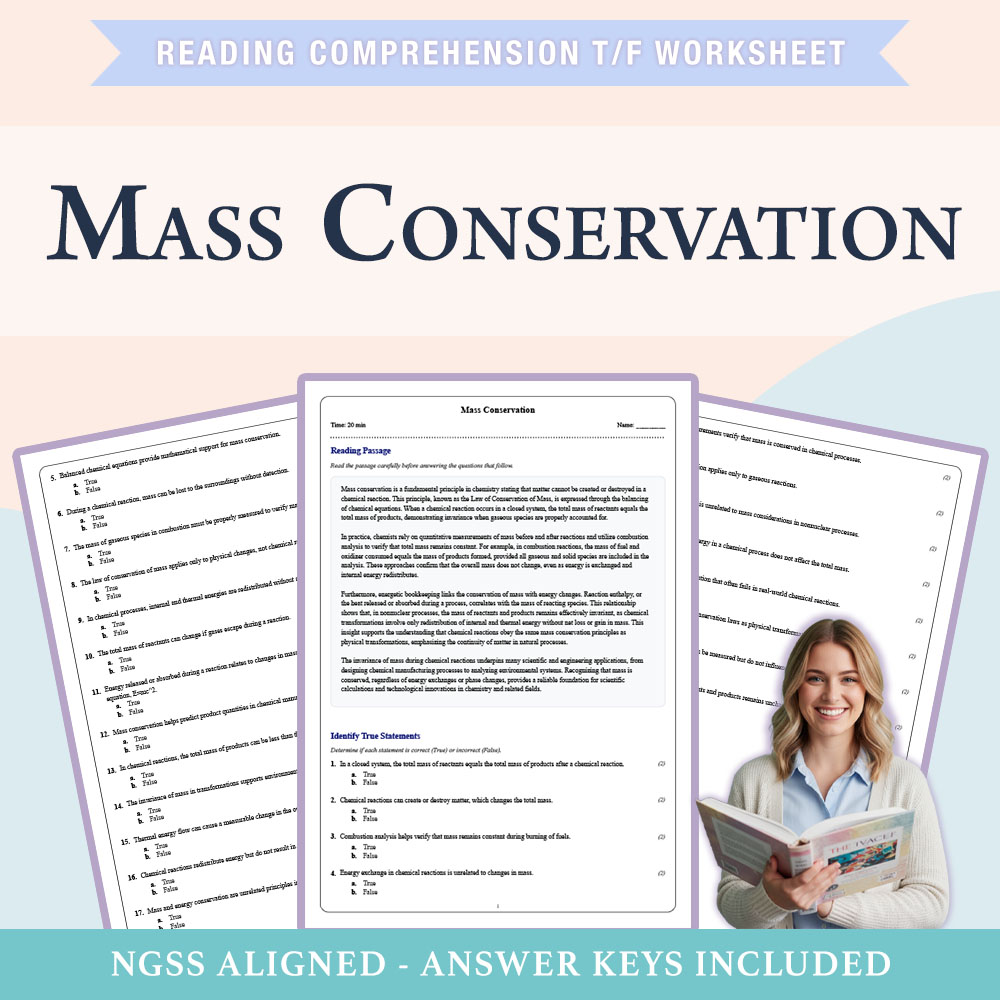
11th Grade Science | Mass Conservation Worksheet (PDF + Answer Key)
Created byCopper Leaf ClassroomLearning Objectives
- Understand the principle of mass conservation in chemical reactions.
- Explain how balanced chemical equations support mass invariance.
- Describe how combustion analysis demonstrates mass conservation.
Also included in: Grade 11 Science | Reaction and Bonding Unit Worksheets (PDF + Answer Keys) +1 more
Instant download
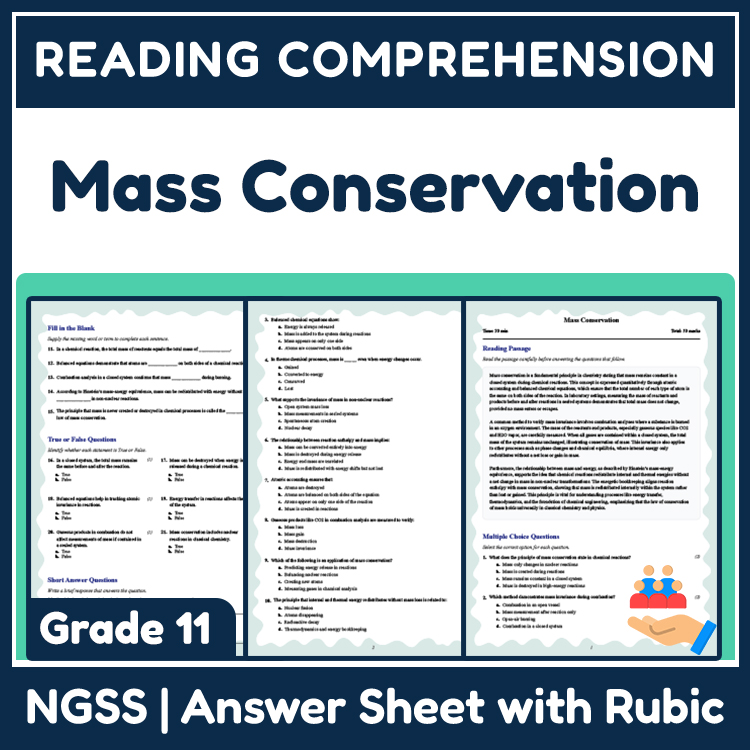
11th Grade Science | Mass Conservation Reading Worksheet & Answer Key (PDF)
JCreated byJ.S SheetsLearning Objectives
- Understand the principle of mass conservation in chemical reactions.
- Explain how balanced equations demonstrate mass invariance.
- Describe methods like combustion analysis and closed-system measurements to verify mass conservation.
Also included in: Grade 11 Science Unit | Chemical Reactions & Bonding Worksheets
Instant download
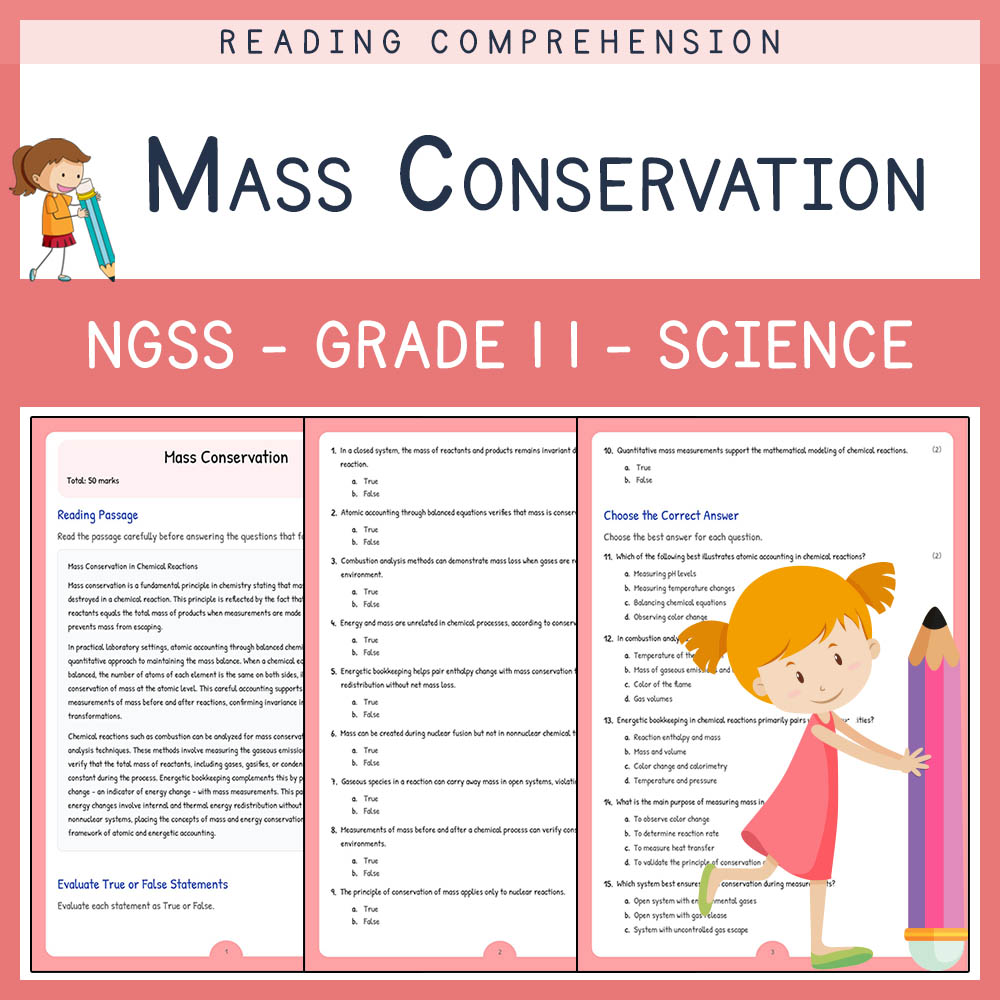
Grade 11 Science | Mass Conservation Worksheet with Answer Key (PDF)
Created byLumora LearningLearning Objectives
- Explain the principle of conservation of mass in chemical reactions.
- Apply balanced equations to demonstrate mass invariance.
- Describe methods such as closed-system measurements and combustion analysis for mass conservation.
Instant download
About Grade 11 Science Worksheets
Browse 6,616 printable Grade 11 Science worksheets — ready-to-print PDFs with answer keys where available.
Each resource here is built by an independent educator and reviewed for quality. Worksheets print straight from PDF and suit classroom use, homework, or extra practice; most come with answer keys, and you can preview before purchasing.