
Grade 11 Science Worksheets
6,616 worksheets
Grade 11 Science | Polyprotic Systems in Environmental Science - Daily Reading Comprehension
 Created byCoral Reef Learning
Learning Objectives
- Understand the concept of polyprotic acids and their dissociation stages.
- Identify different polyprotic acids and analyze their dissociation constants.
- Explain the environmental significance of carbonate and phosphate buffers.
Also included in: Acids, Bases and pH Lesson Bundle – Grade 11 Science Alberta +1 more
Instant download
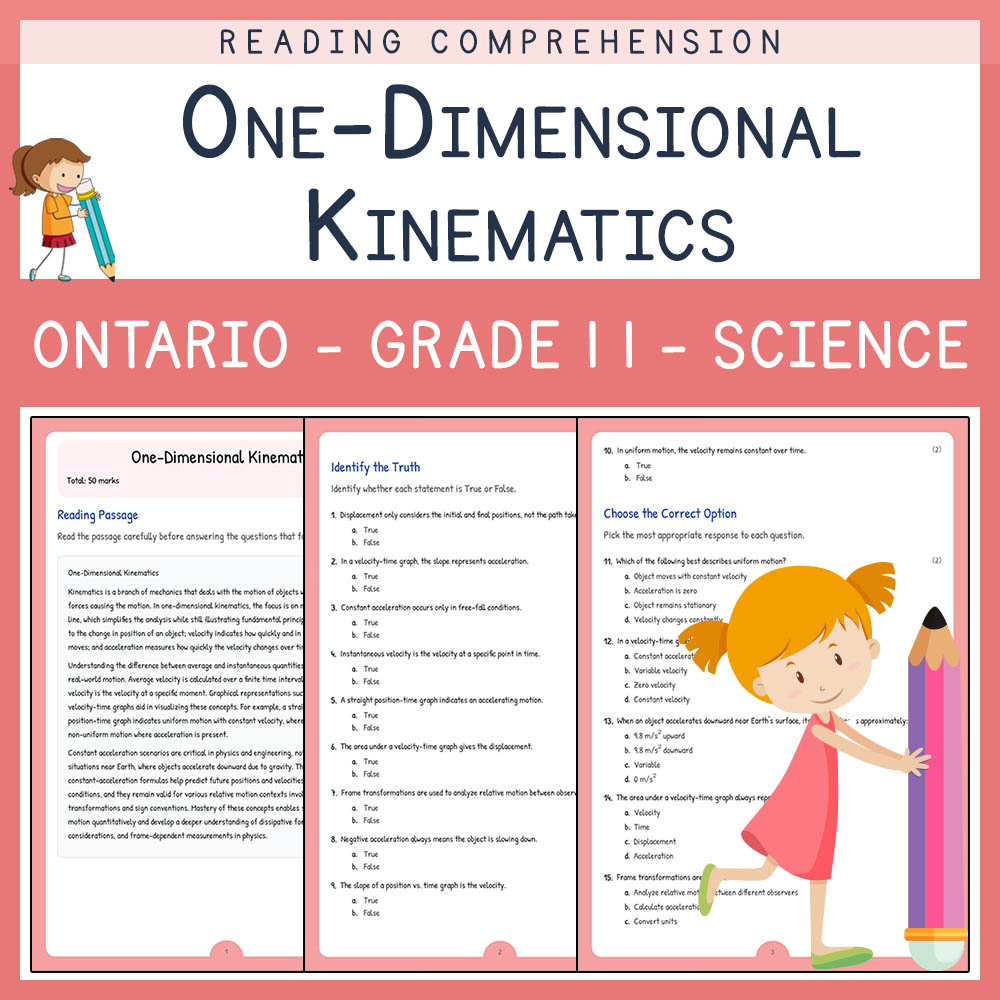
Grade 11 Science | One-Dimensional Kinematics Worksheet Elena | Ontario
 Created byLumora Learning
Learning Objectives
- Comprehend the concepts of displacement, velocity, and acceleration as functions of time.
- Distinguish between uniform and non-uniform motion using algebraic and graphical methods.
- Apply constant-acceleration formulas to real-world problems including free-fall and relative motion scenarios.
Also included in: Grade 11 Science | Physics Lesson Bundle | Ontario Standard
Instant download
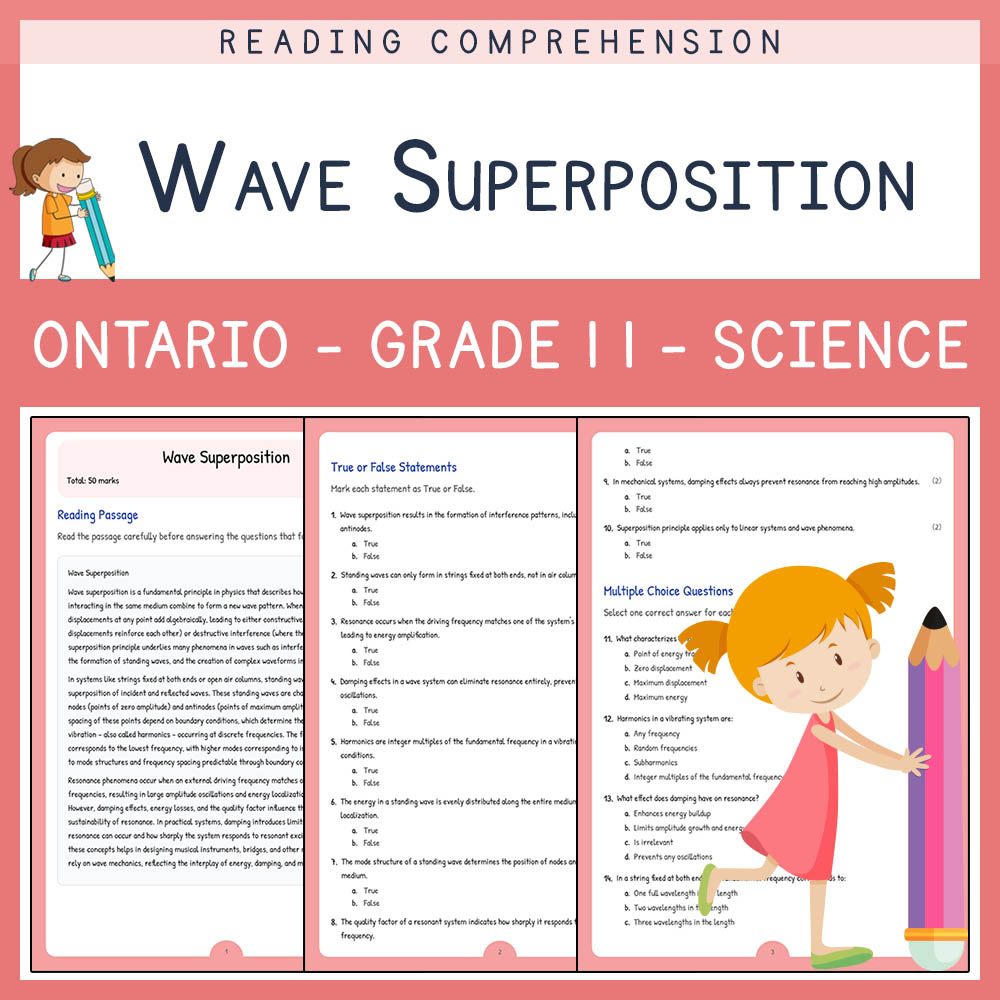
Grade 11 Science | Wave Superposition Worksheet Elena | Ontario Standard
Created byLumora LearningLearning Objectives
- Explain the principle of wave superposition and how it leads to interference patterns.
- Identify the formation of nodes and antinodes in standing waves.
- Describe resonant frequencies, harmonics, and the mode structures in bounded media.
Also included in: Grade 11 Science | Physics Lesson Bundle | Ontario Standard
Instant download
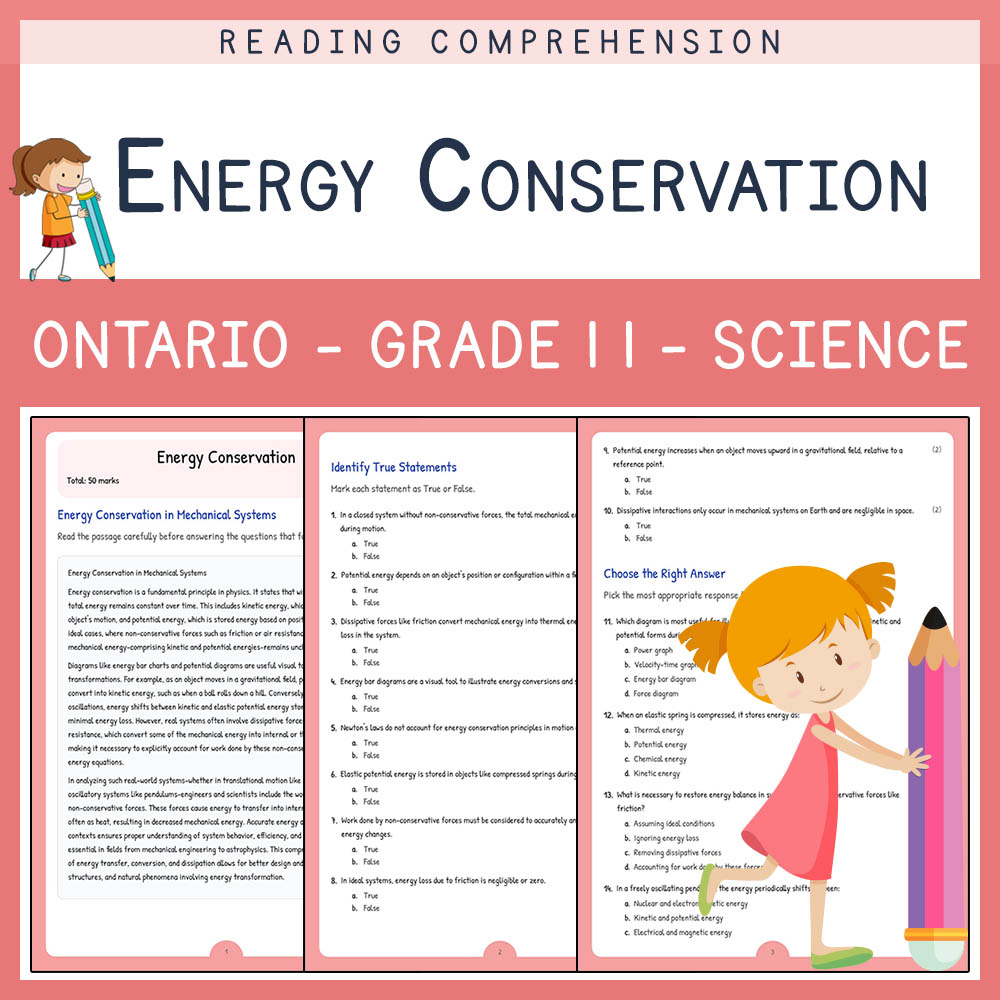
Grade 11 Science Assessment | Energy Conservation Worksheet Elena | Ontario
Created byLumora LearningLearning Objectives
- Understand the principles of energy conservation within closed systems.
- Identify different forms of energy and how they convert during motion in gravitational and elastic fields.
- Explain the effects of non-conservative forces on mechanical energy and how energy is redistributed as thermal or internal energy.
Also included in: Grade 11 Science | Physics Lesson Bundle | Ontario Standard
Instant download
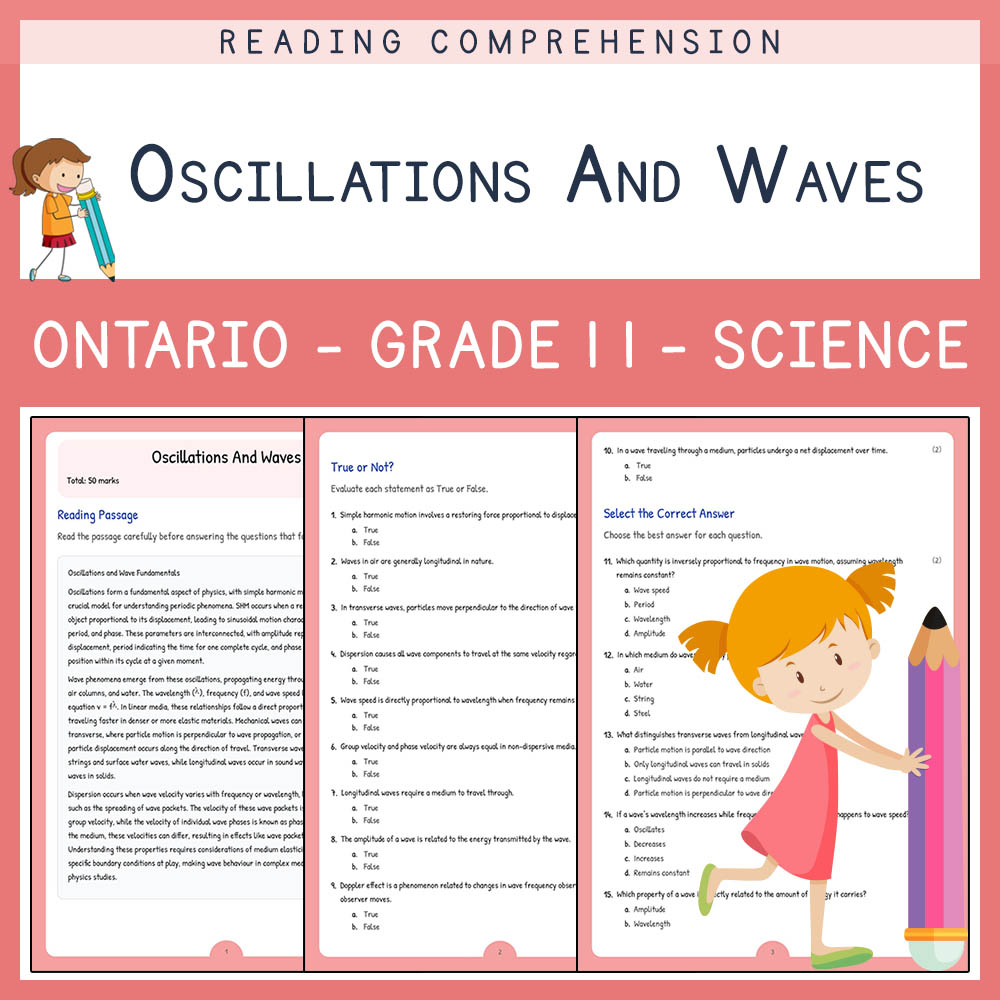
Grade 11 Science | Oscillations And Waves Worksheet Elena | Ontario
Created byLumora LearningLearning Objectives
- Explain simple harmonic motion and how amplitude, period, angular frequency, and phase relate to restoring forces.
- Describe wave properties such as wavelength, frequency, period, and wave speed, and their relationships.
- Differentiate between transverse and longitudinal waves and their propagation mechanisms.
Also included in: Grade 11 Science | Physics Lesson Bundle | Ontario Standard
Instant download
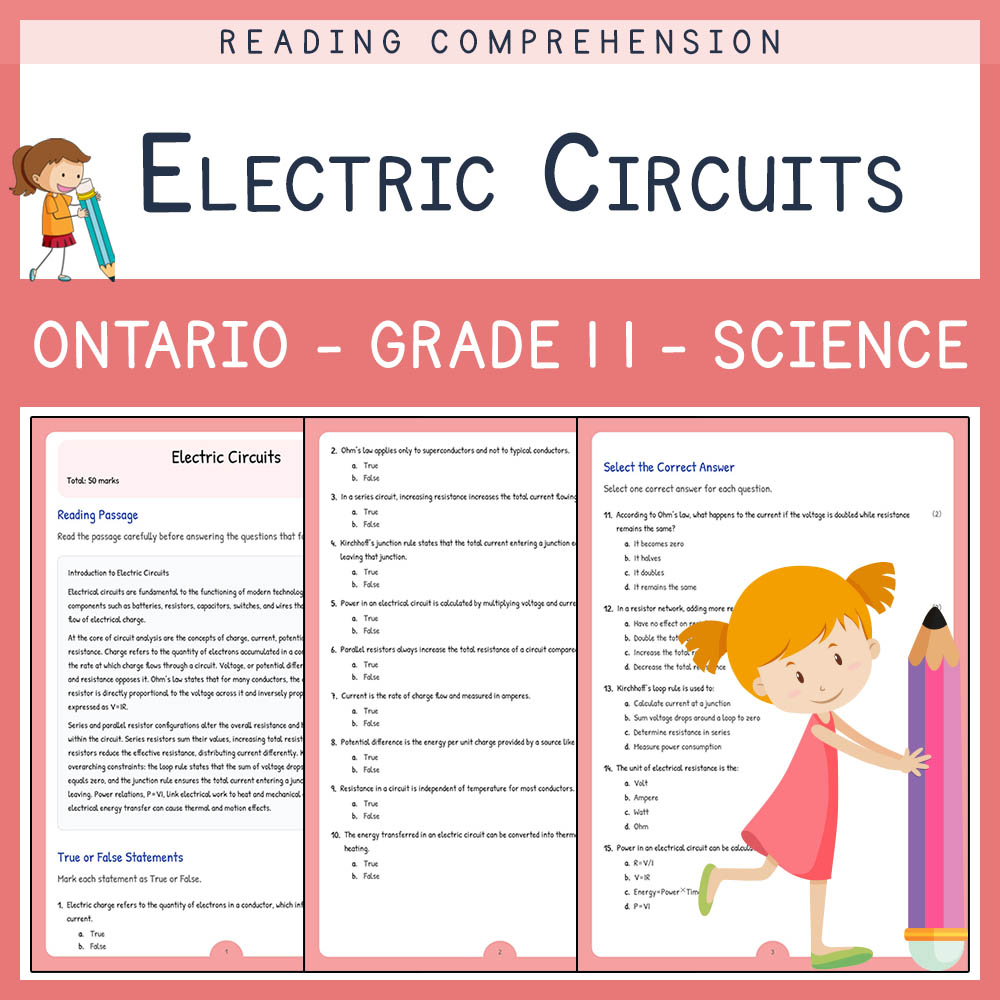
Grade 11 Science | Electric Circuits Worksheet Elena | Ontario Standard
Created byLumora LearningLearning Objectives
- Understand the basic principles and components of electric circuits.
- Explain Ohm's law and its application to series and parallel circuits.
- Describe Kirchhoff's loop and junction rules and their use in circuit analysis.
Also included in: Grade 11 Science | Physics Lesson Bundle | Ontario Standard
Instant download
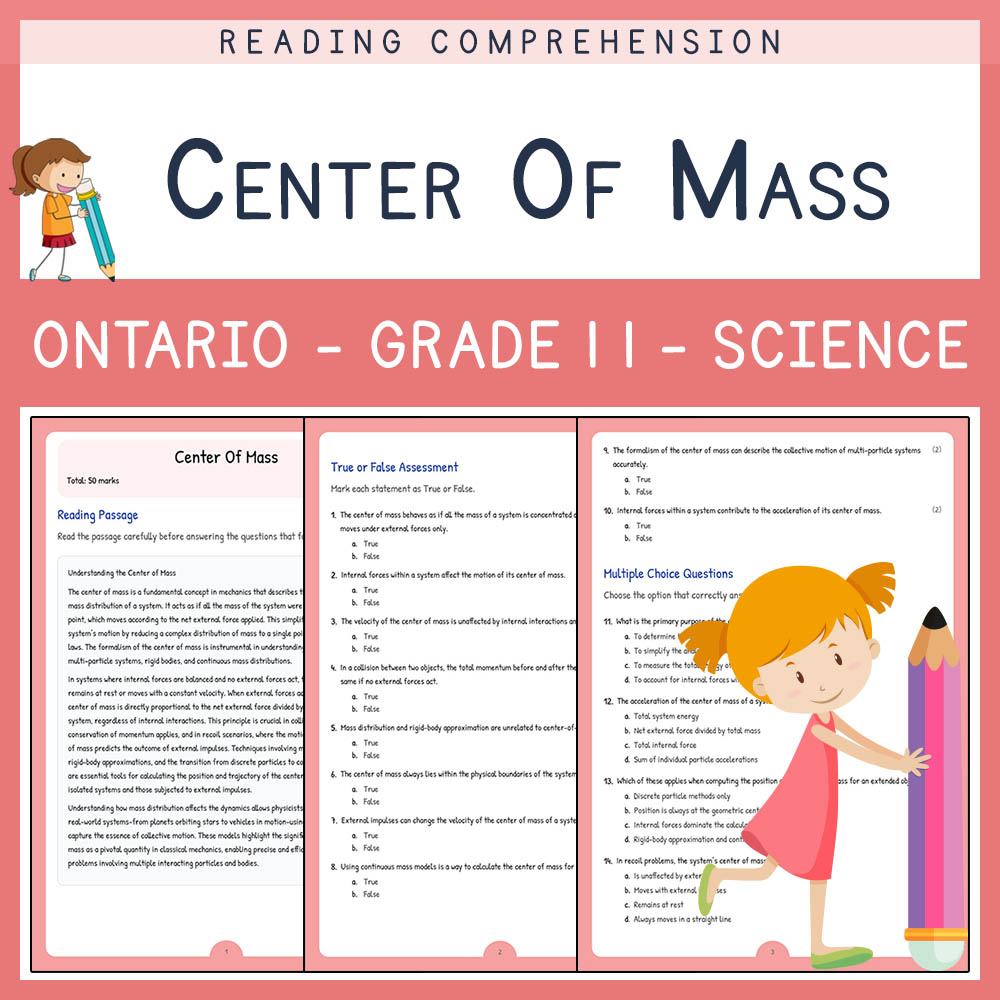
Grade 11 Science Assessment | Center Of Mass Worksheet Elena | Ontario
Created byLumora LearningLearning Objectives
- Understand the concept of center of mass and its importance in physics.
- Apply formalism relating external net force to the acceleration of the center of mass.
- Calculate system momentum and use it to solve collision and recoil problems.
Also included in: Grade 11 Science | Physics Lesson Bundle | Ontario Standard
Instant download
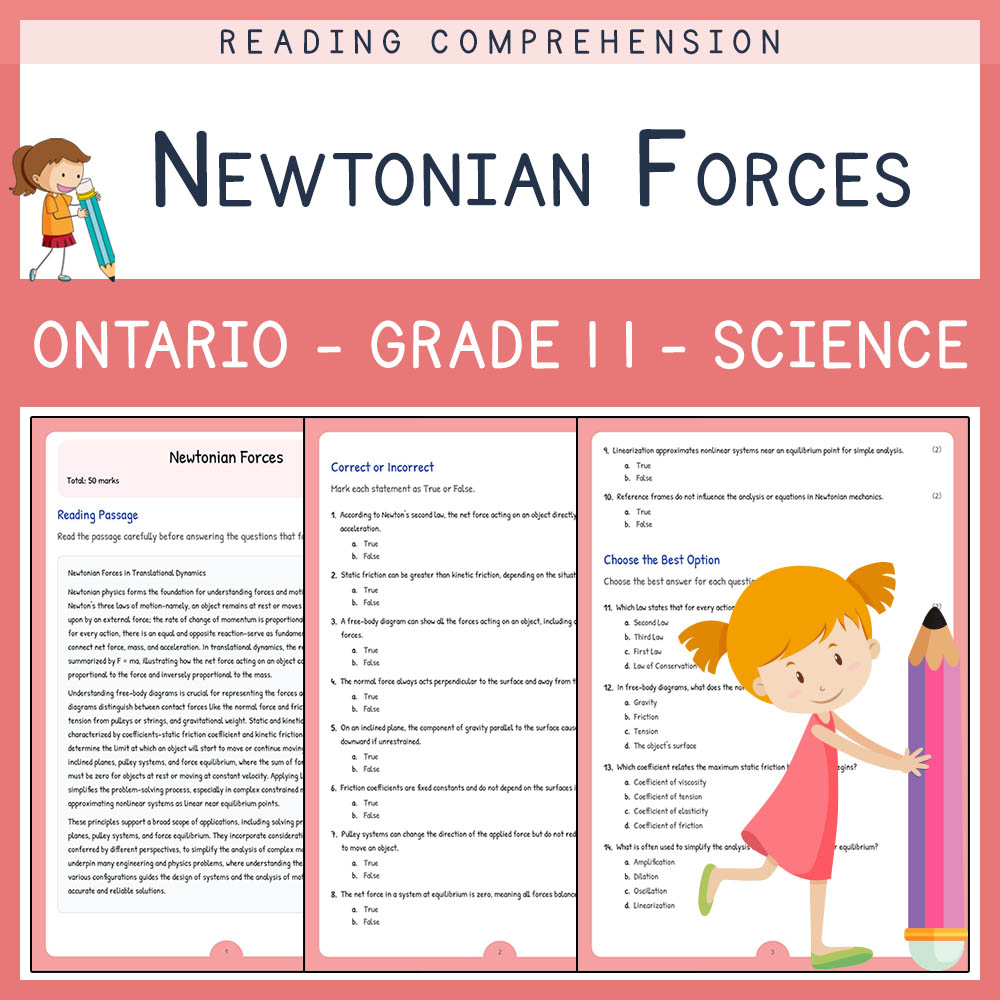
Grade 11 Science Assessment | Newtonian Forces Worksheet Elena | Ontario
Created byLumora LearningLearning Objectives
- Understand the application of Newton's three laws to translational dynamics and net force.
- Identify and interpret free-body diagrams including contact forces, normal and frictional components, tension, and weight.
- Analyze static and kinetic friction and the conditions governing impending motion on inclined planes and pulleys.
Also included in: Grade 11 Science | Physics Lesson Bundle | Ontario Standard
Instant download
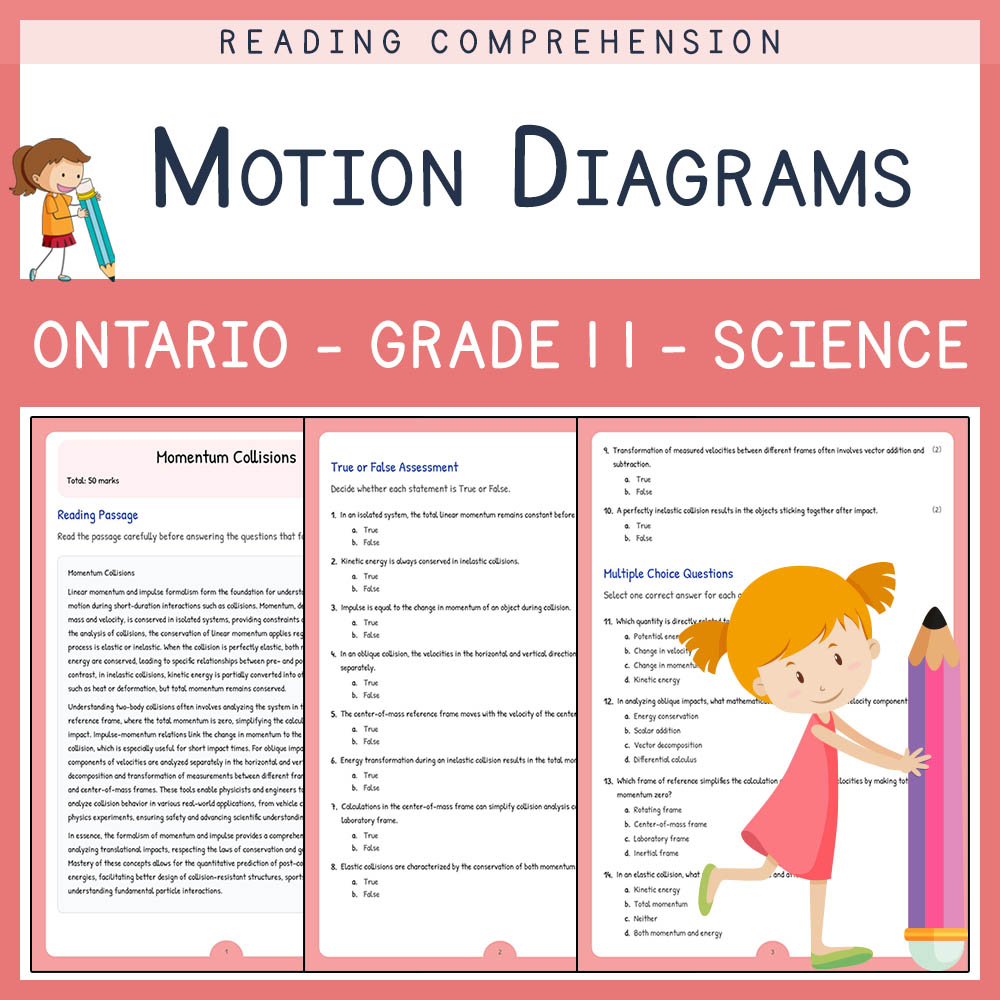
Grade 11 Science | Motion Diagrams Worksheet Elena | Ontario Standard
Created byLumora LearningLearning Objectives
- Understand how position, velocity, and acceleration are represented through motion diagrams and kinematic graphs.
- Interpret position–time and velocity–time plots to determine displacement, velocity, and acceleration.
- Apply SI units and kinematic equations for uniform acceleration in straight-line and two-dimensional motion.
Also included in: Grade 11 Science | Physics Lesson Bundle | Ontario Standard
Instant download
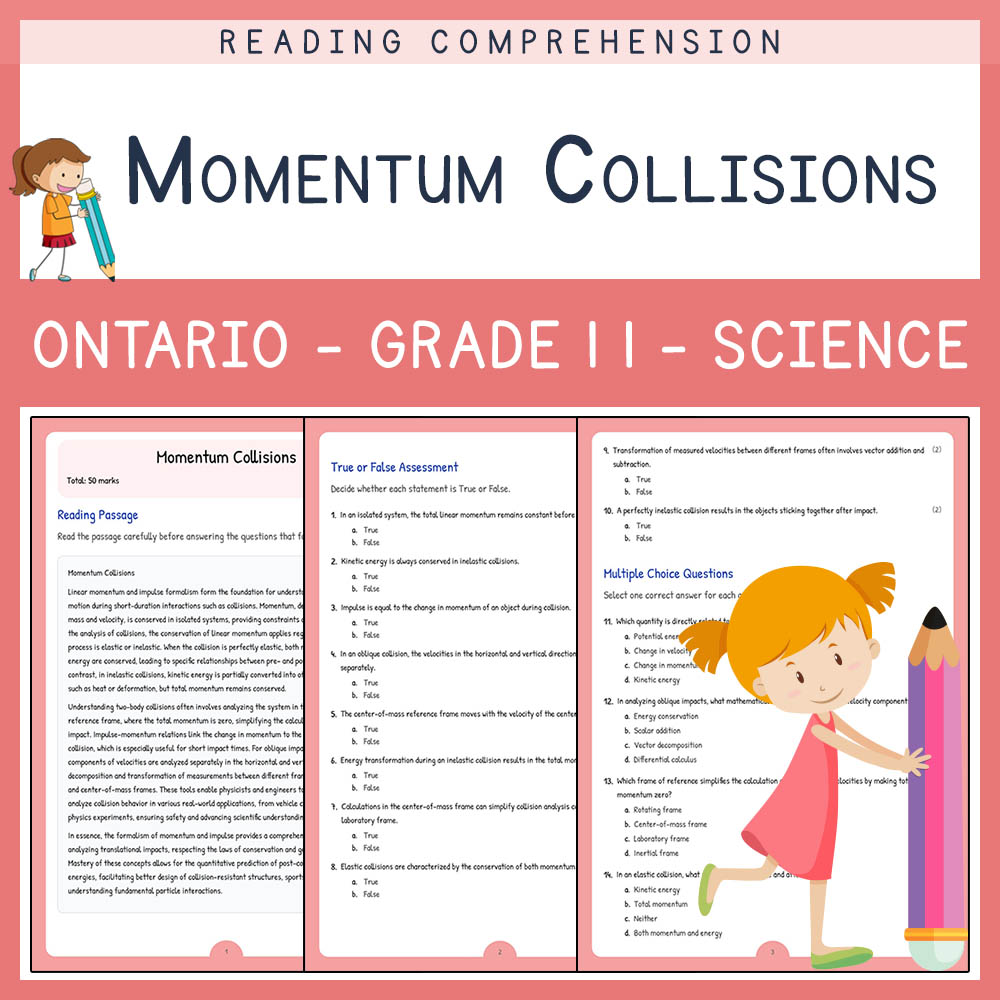
Grade 11 Science | Momentum Collisions Worksheet Elena | Ontario Standard
Created byLumora LearningLearning Objectives
- Understand the principles of linear momentum and impulse in translational motion during collisions.
- Analyze elastic and inelastic collisions using conservation of momentum and kinetic energy.
- Apply impulse-momentum relations and vector decomposition to determine post-collision velocities in two-body impacts.
Also included in: Grade 11 Science | Physics Lesson Bundle | Ontario Standard
Instant download

Grade 11 Science Assessment | Work and Energy Worksheet Elena | Ontario
Created byLumora LearningLearning Objectives
- Understand the formalism of work and energy in mechanical systems.
- Identify different forms of energy: kinetic, gravitational potential, and elastic potential.
- Explain the work–energy theorem and its application to isolated and non-isolated systems.
Also included in: Grade 11 Science | Physics Lesson Bundle | Ontario Standard
Instant download
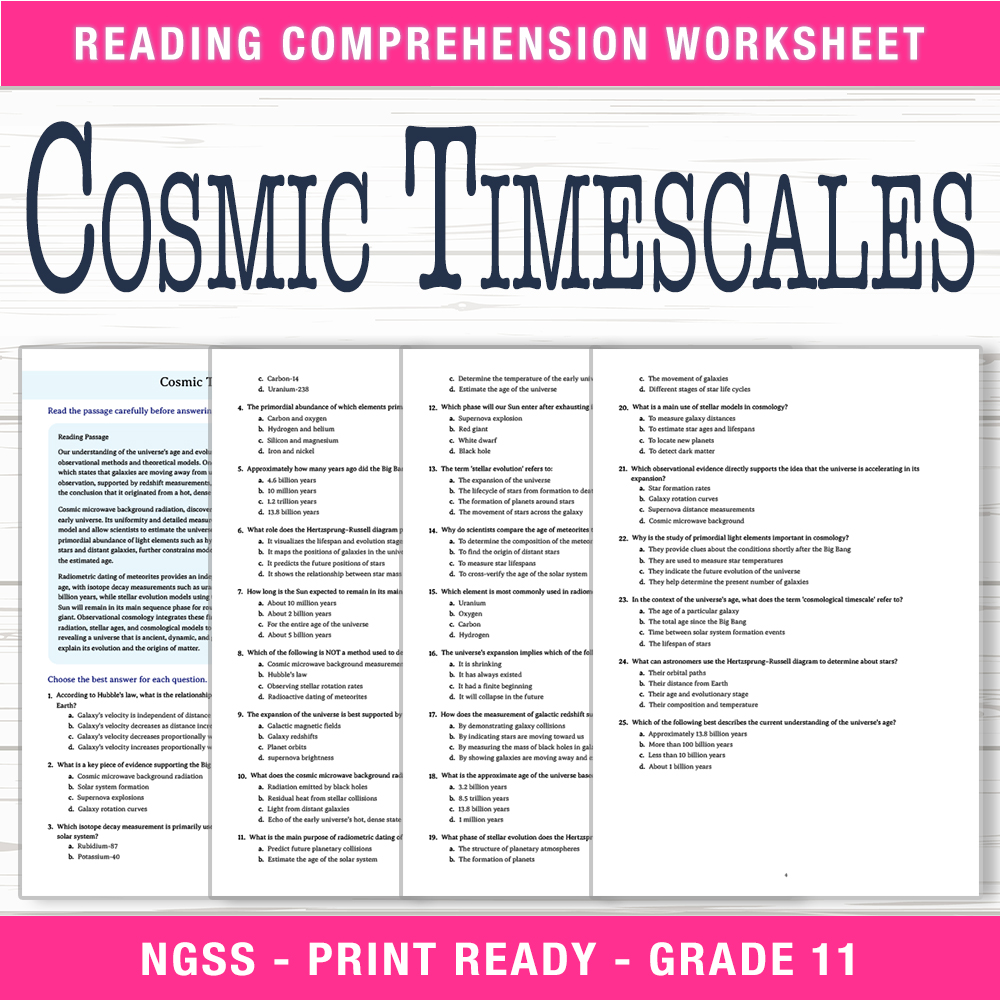
Grade 11 Science – Cosmic Timescales Worksheet (PDF + Answer Key)
 Created byRiverstone Classroom
Learning Objectives
- Understand how astronomical observations constrain the age and evolution of the universe and solar system.
- Learn about key methods such as Hubble's law, cosmic microwave background, and radiometric dating used in cosmology.
- Explore stellar evolution and how the Hertzsprung–Russell diagram contextualizes the lifespan of stars including the Sun.
Instant download

Grade 11 Ecosystem Change and Resilience Worksheet | NGSS Ecology Activity
 Created byBRIGHT PATH RESOURCES
Learning Objectives
- Identify components of ecosystems and understand how they interact
- Explain the drivers of ecosystem stability and change
- Analyze case studies related to ecosystem disturbance and recovery
Also included in: Ecosystems Interactions Energy and Dynamics Grade 11 Science Bundle | NGSS +1 more
Instant download
Grade 11 Science – Projectile Motion Worksheet (PDF) | Ontario Standards
 Created byBright Mind Resources
Learning Objectives
- Understand the principles of two-dimensional projectile motion and independence of orthogonal components.
- Apply kinematic equations and trigonometric relations to analyze projectile trajectories.
- Predict the time of flight, maximum height, and range of projectiles under ideal conditions.
Instant download
Grade 11 Science – Erosion & Sedimentation Worksheet (PDF) | BC Standards
Created byBright Mind ResourcesLearning Objectives
- Describe the processes of weathering, erosion, transport, and deposition in landscape change.
- Identify the types of weathering and the factors influencing sedimentation rates.
- Explain how sediment lithification preserves environmental signals.
Instant download
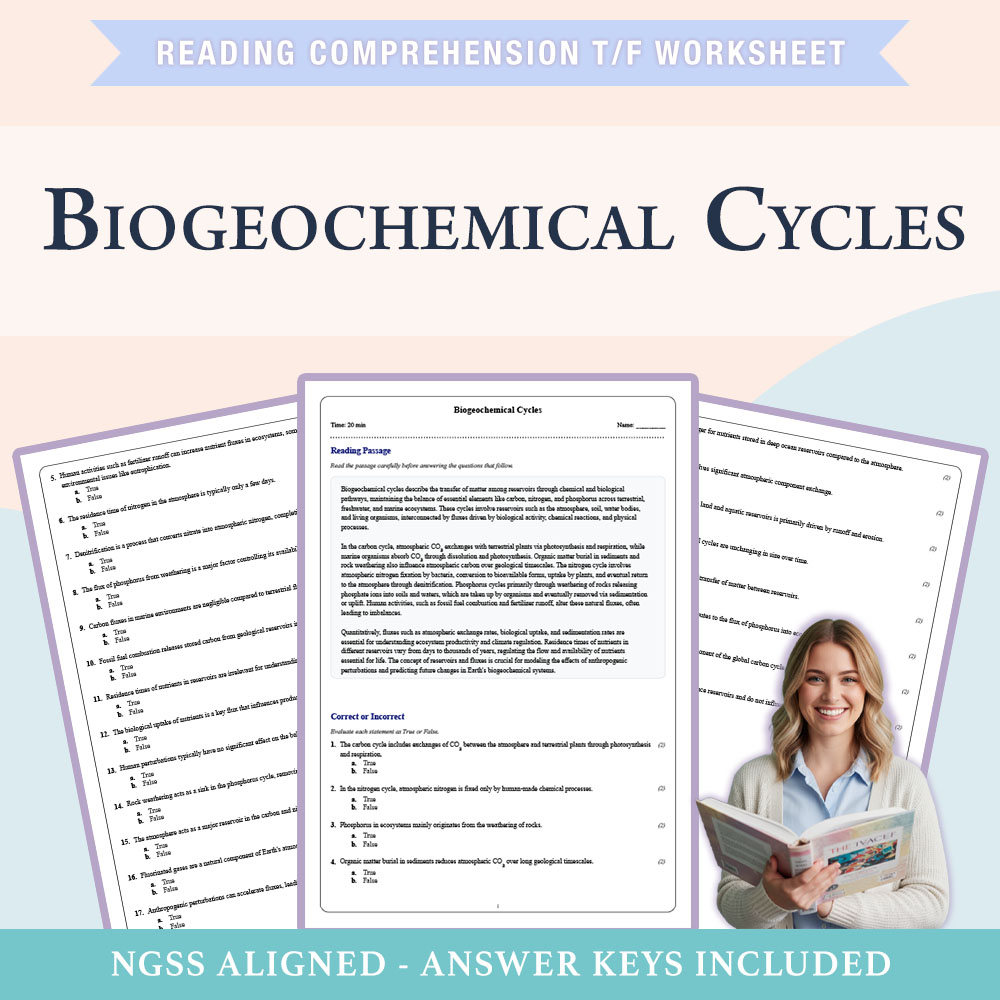
11th Grade Science | Biogeochemical Cycles Worksheet (PDF + Answer Key)
 Created byCopper Leaf Classroom
Learning Objectives
- Explain the main reservoirs and fluxes involved in the carbon, nitrogen, and phosphorus cycles.
- Identify the key biological and chemical pathways in biogeochemical cycles.
- Describe the impact of anthropogenic perturbations on natural biogeochemical fluxes.
Also included in: Grade 11 Science | Earth Systems & Climate Change Bundle (PDF +Answer Key) +1 more
Instant download

Grade 11 Seasons and Orbits Worksheet | Florida NGSS Practice PDF
 Created byClear Sky Classroom
Learning Objectives
- Explain how Earth’s axial tilt and orbit affect solar angle, day length, and seasonal temperature patterns across latitudes.
- Describe how Earth’s rotation and revolution relate to observable cycles such as day length changes over the year.
- Connect the Moon’s orbit and gravitational interaction with Earth to real-world effects like tides.
Instant download
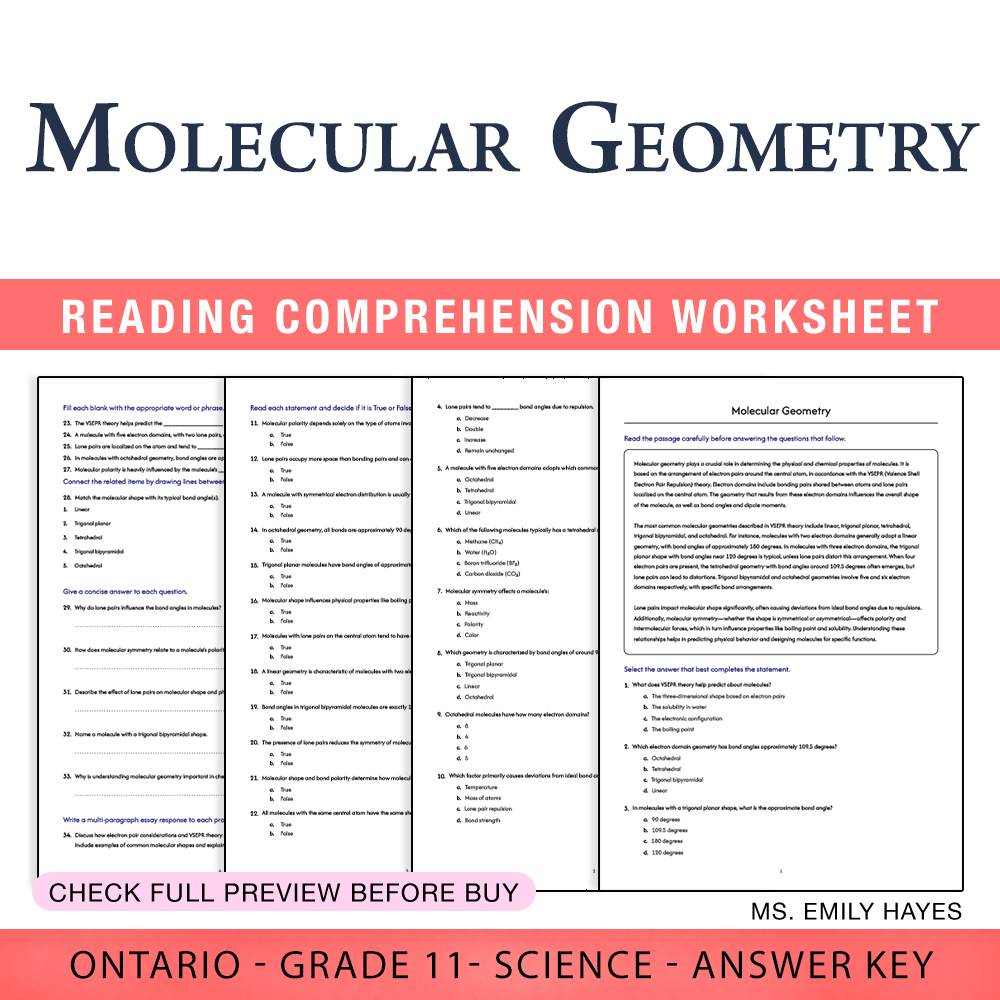
11th Grade Science | Molecular Geometry Worksheet (PDF + Answer Key)
Created byCopper Leaf ClassroomLearning Objectives
- Understand and identify the different electron-domain geometries (linear, trigonal planar, tetrahedral, trigonal bipyramidal, octahedral).
- Predict molecular shapes based on VSEPR theory and electron pair considerations.
- Interpret the relationship between molecular geometry and polarity, dipole moments, and physical properties.
Instant download
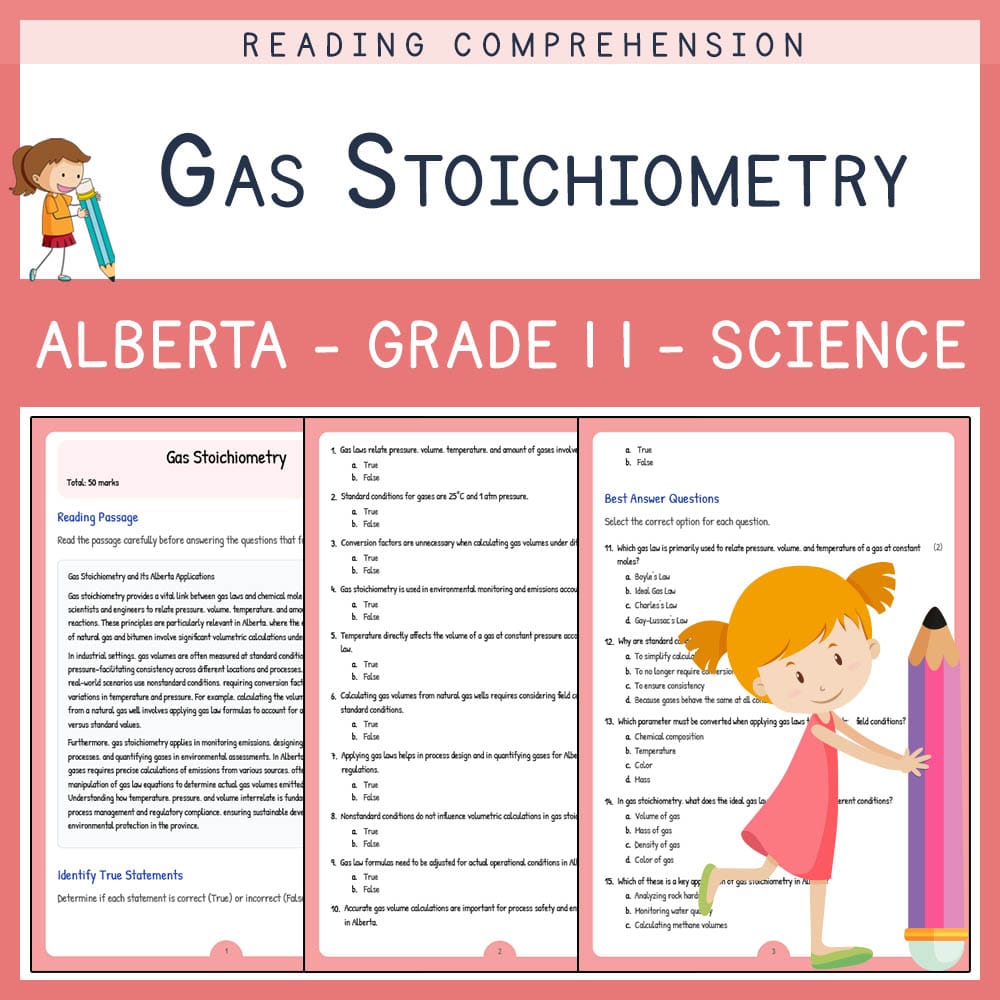
Grade 11 Science | Gas Stoichiometry Worksheet | Alberta Standards
Created byLumora LearningLearning Objectives
- Understand the principles of gas laws and how they relate to mole relationships in gas stoichiometry.
- Apply gas law equations to calculate pressures, volumes, and temperatures of gases in chemical reactions.
- Analyze how standard and nonstandard conditions impact volumetric conversions in industrial contexts.
Instant download

Grade 11 Kinetic Potential Energy Worksheet | NGSS Practice & PDF
Created byClear Sky ClassroomLearning Objectives
- Distinguish kinetic energy from potential energy and identify which one is associated with motion versus position.
- Explain how gravitational potential energy and elastic potential energy change with height and with spring compression/stretching.
- Use energy-transfer reasoning to predict how kinetic and potential energy trade off during motion.
Instant download
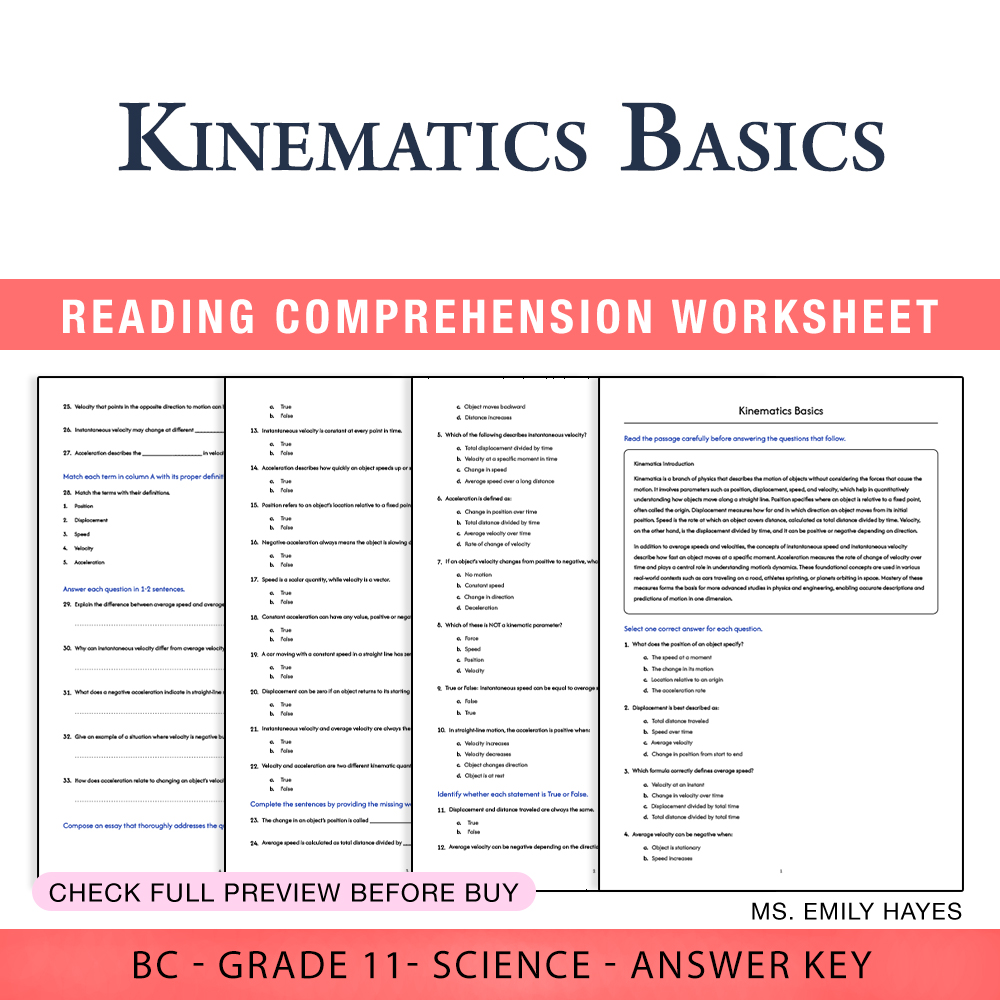
11th Grade Science | Kinematics Basics Worksheet (PDF + Answer Key)
Created byCopper Leaf ClassroomLearning Objectives
- Define and distinguish between position, displacement, speed, and velocity.
- Understand how average and instantaneous measures describe motion.
- Apply concepts of velocity and acceleration to real-world linear motion scenarios.
Also included in: Grade 11 Science BC | Motion, Energy & Force Concepts (PDF+ Answer Keys) +1 more
Instant download

Grade 11 Science – Community Interactions Worksheet (AP Standards) (PDF)
 Created byEvergreen Desk Education
Learning Objectives
- Distinguish competition, predation, mutualism, and facilitation as interspecific interactions and predict their community effects.
- Use food web and interaction-matrix ideas to explain how energy flow and interaction strength can shape community structure.
- Explain how keystone species, trophic cascades, and niche partitioning can influence community assembly and resilience to disturbance.
Also included in: Grade 11 Biology and Ecosystems Science Lesson Bundle (AP) +1 more
Instant download
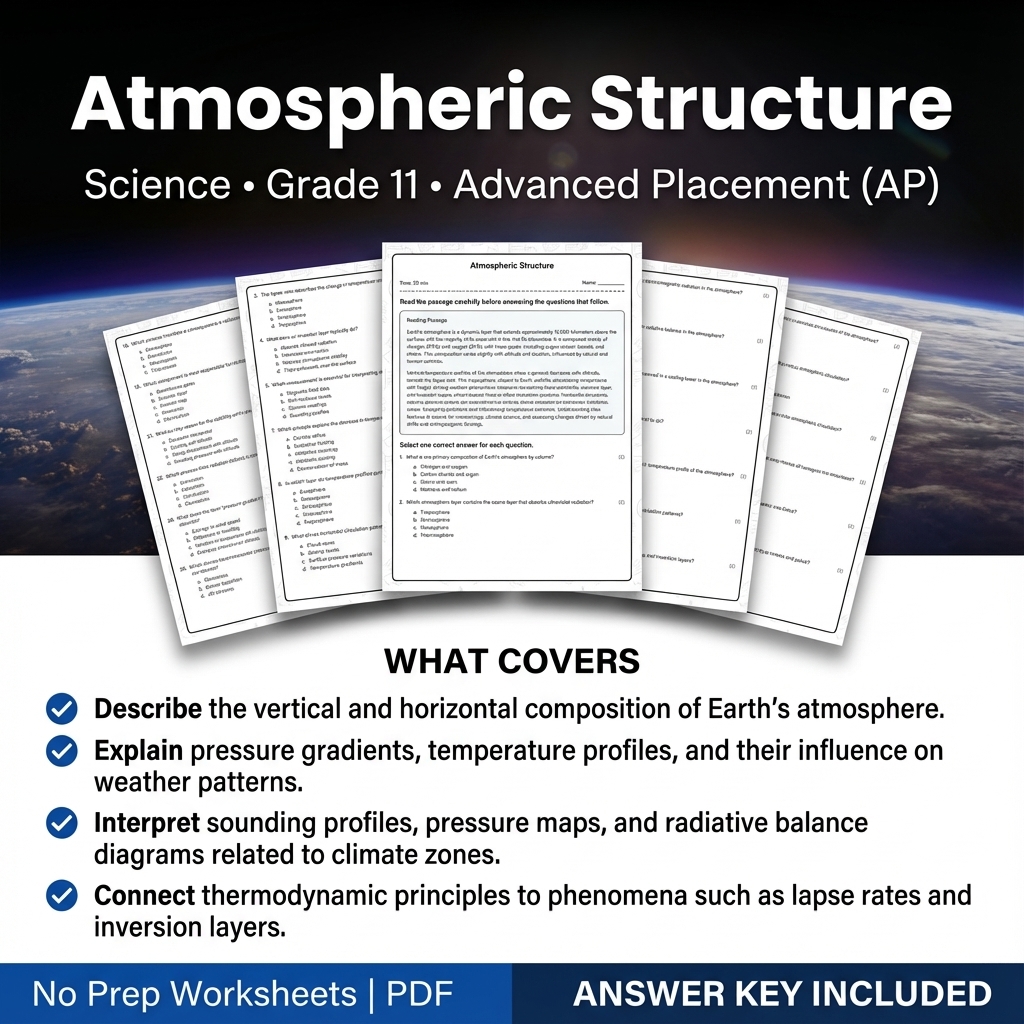
11th Grade Science | Atmospheric Structure Worksheet (Printable PDF + Answer Key)
Created byCoral Reef LearningLearning Objectives
- Describe the vertical and horizontal composition of Earth's atmosphere.
- Explain pressure gradients, temperature profiles, and their influence on weather patterns.
- Interpret sounding profiles, pressure maps, and radiative balance diagrams related to climate zones.
Also included in: Grade 11 Science Unit Bundle – Earth Systems, Energy & Cycles Worksheets +1 more
Instant download
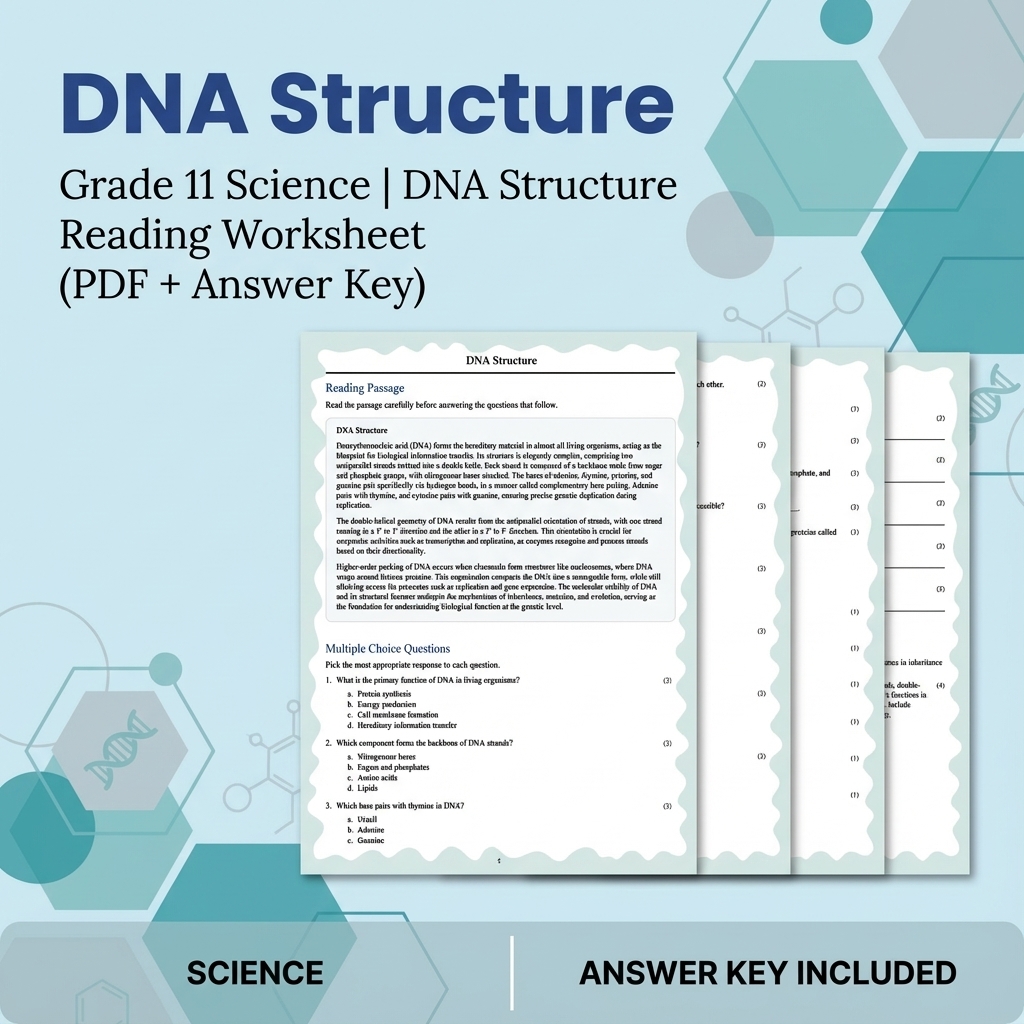
Grade 11 Science | DNA Structure Reading Worksheet (PDF + Answer Key)
JCreated byJ.S SheetsLearning Objectives
- Describe the molecular components and structure of DNA, including nucleotides, strands, and helical geometry.
- Explain the concept of base-pairing specificity and antiparallel strand orientation.
- Understand the higher-order packing of chromatin and its relevance to genetic accessibility.
Also included in: Grade 11 Science UNIT Bundle | Cellular Processes & Metabolic Pathways +1 more
Instant download
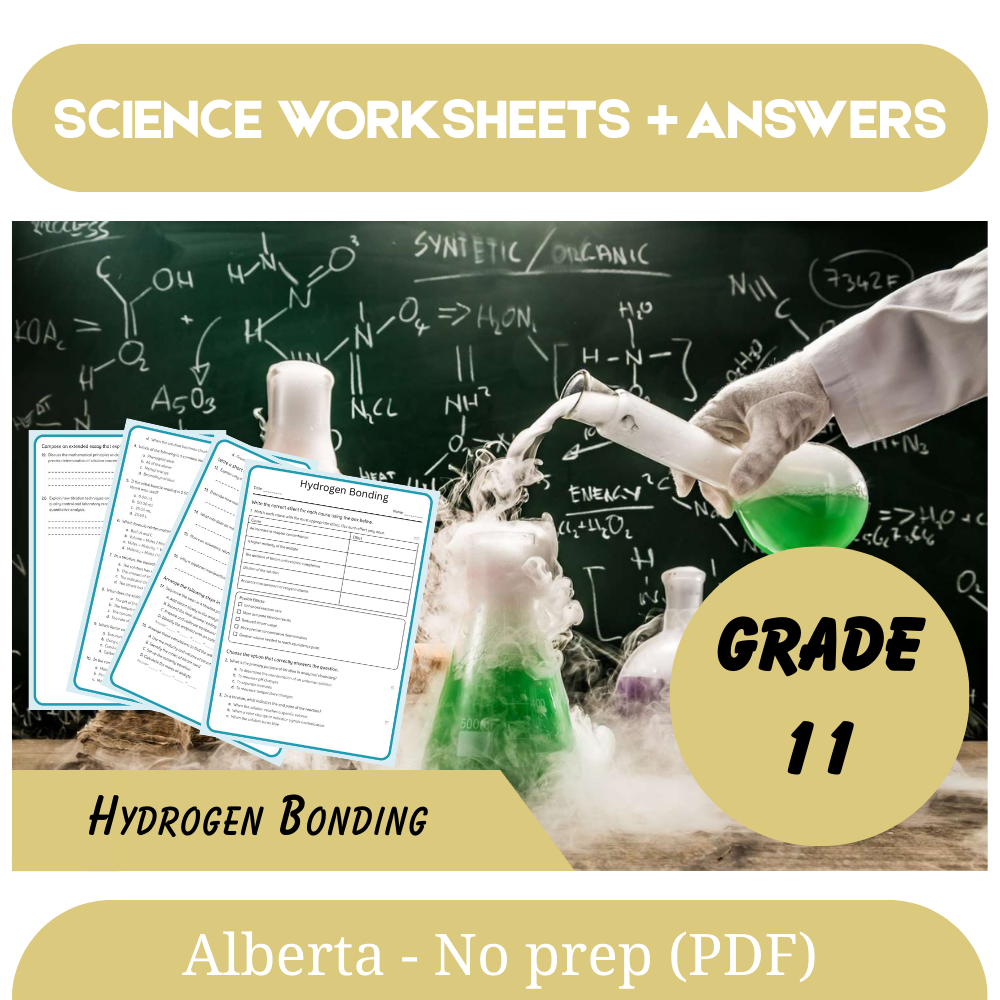
Grade 11 Science – Hydrogen Bonding (Worksheet + Answer Key) – Alberta Standards
Created byBright Mind ResourcesLearning Objectives
- Understand the concept of hydrogen bonding and its directional nature.
- Identify the effects of hydrogen bonding on water and biological molecules.
- Analyze how hydrogen bonds influence melting and boiling points.
Instant download
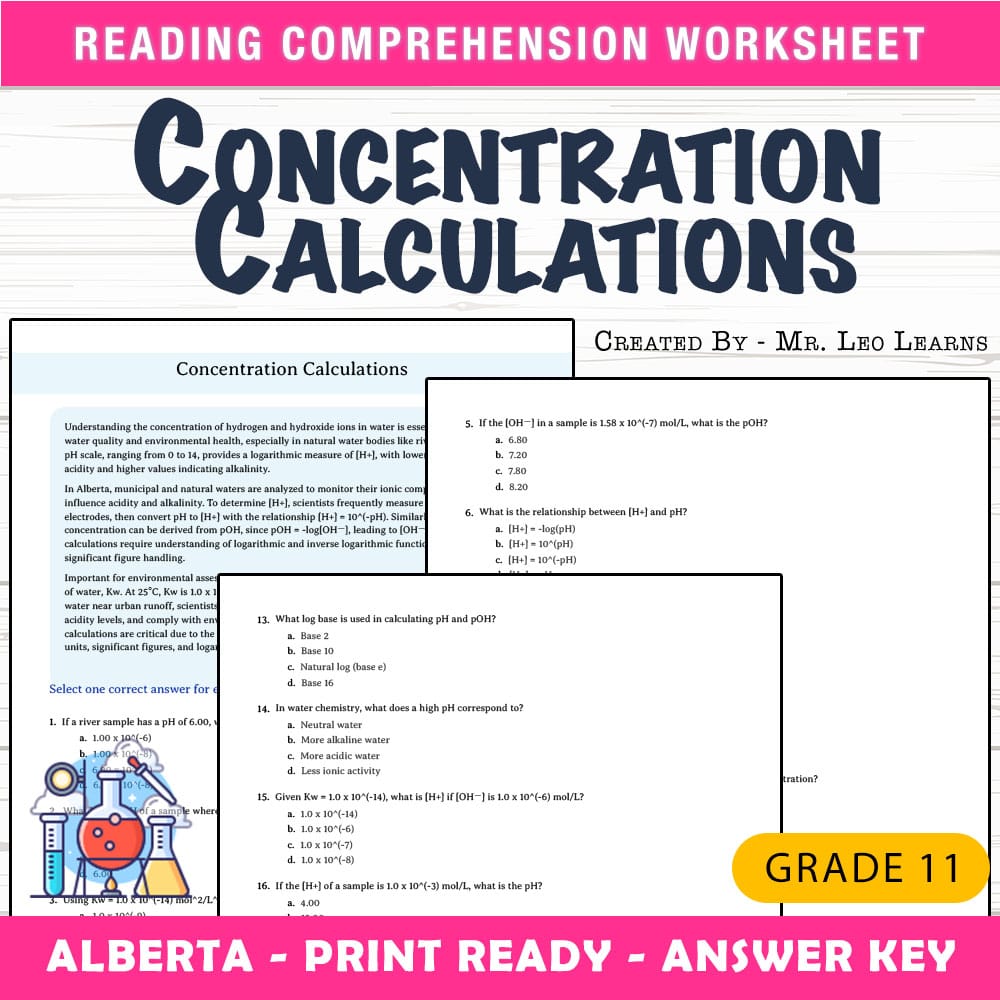
Grade 11 Science — Worksheet MCQ Paper for Mastering Concentration Calculations
 Created byThe Resource Hub
Learning Objectives
- Understand how to convert between ion concentrations [H+] and [OH−] and pH or pOH using logarithmic relationships.
- Apply procedures to determine [H+], [OH−], and use Kw to relate concentrations in water samples.
- Interpret ionic concentrations in natural waters such as river water near urban runoff with emphasis on precision and units.
Also included in: Grade 11 Science Acids Bases and pH Worksheets Bundle | Alberta +1 more
Instant download
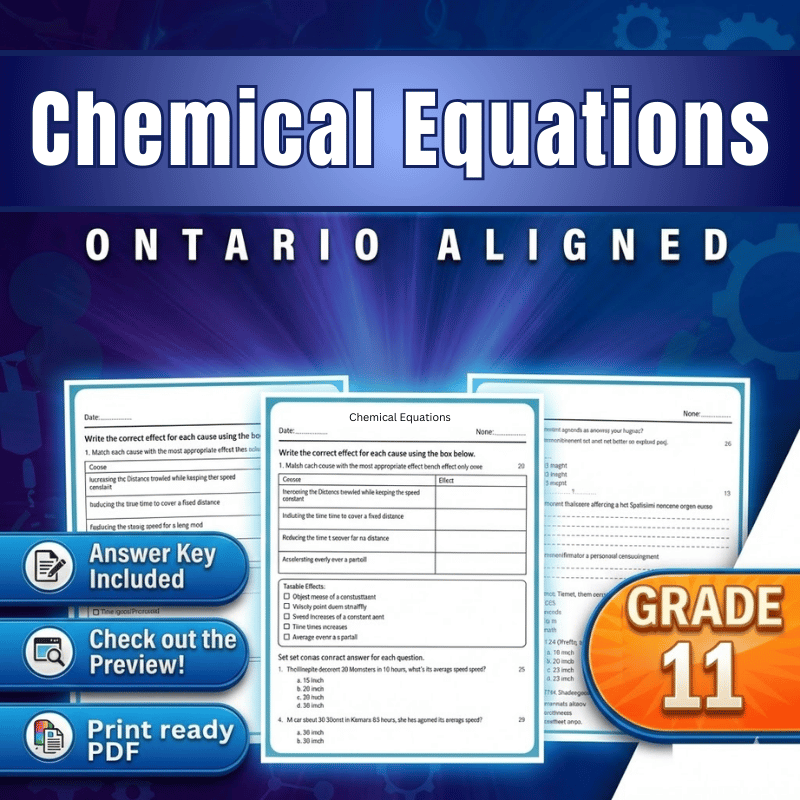
Grade 11 Science | Chemical Equations Worksheet (Ontario) – PDF
Created byBright Mind ResourcesLearning Objectives
- Understand the principles of balanced chemical equations and the law of conservation of mass.
- Classify different types of chemical reactions including synthesis, decomposition, combustion, and displacement reactions.
- Interpret reaction notation including states of matter and phases.
Instant download
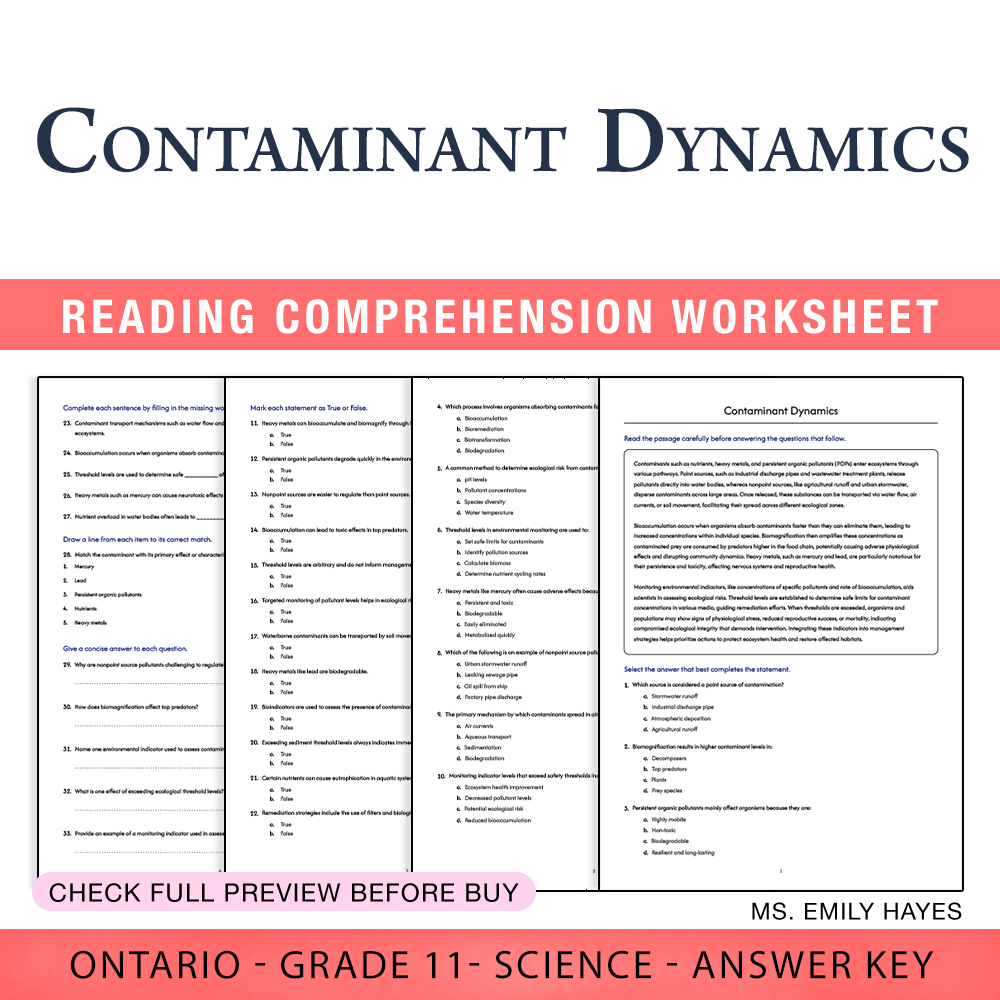
Grade 11 Science | Contaminant Dynamics Worksheet (PDF + Answer Key)
Created byCopper Leaf ClassroomLearning Objectives
- Describe the pathways and transport mechanisms of physical and chemical contaminants in ecosystems.
- Explain the concepts of bioaccumulation and biomagnification and their impacts on ecosystems.
- Analyze the effects of nutrients, heavy metals, and persistent organic pollutants on community structure and food-web integrity.
Instant download
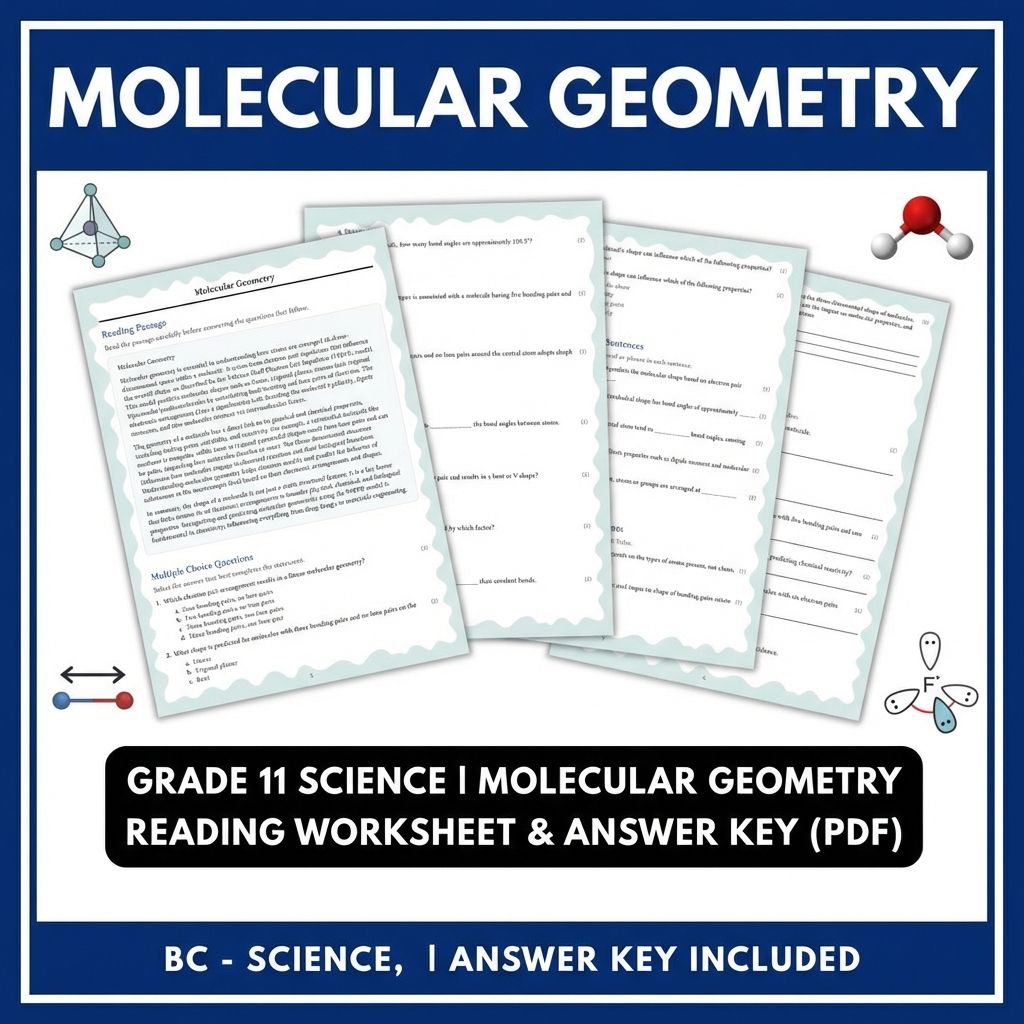
Grade 11 Science | Molecular Geometry Reading Worksheet & Answer Key (PDF)
JCreated byJ.S SheetsLearning Objectives
- Explain how electron pair repulsions influence the three-dimensional shapes of molecules.
- Identify and predict molecular geometries such as linear, trigonal planar, tetrahedral, trigonal bipyramidal, and octahedral using the VSEPR model.
- Understand how molecular geometry affects properties like polarity, dipole moments, and intermolecular interactions.
Instant download
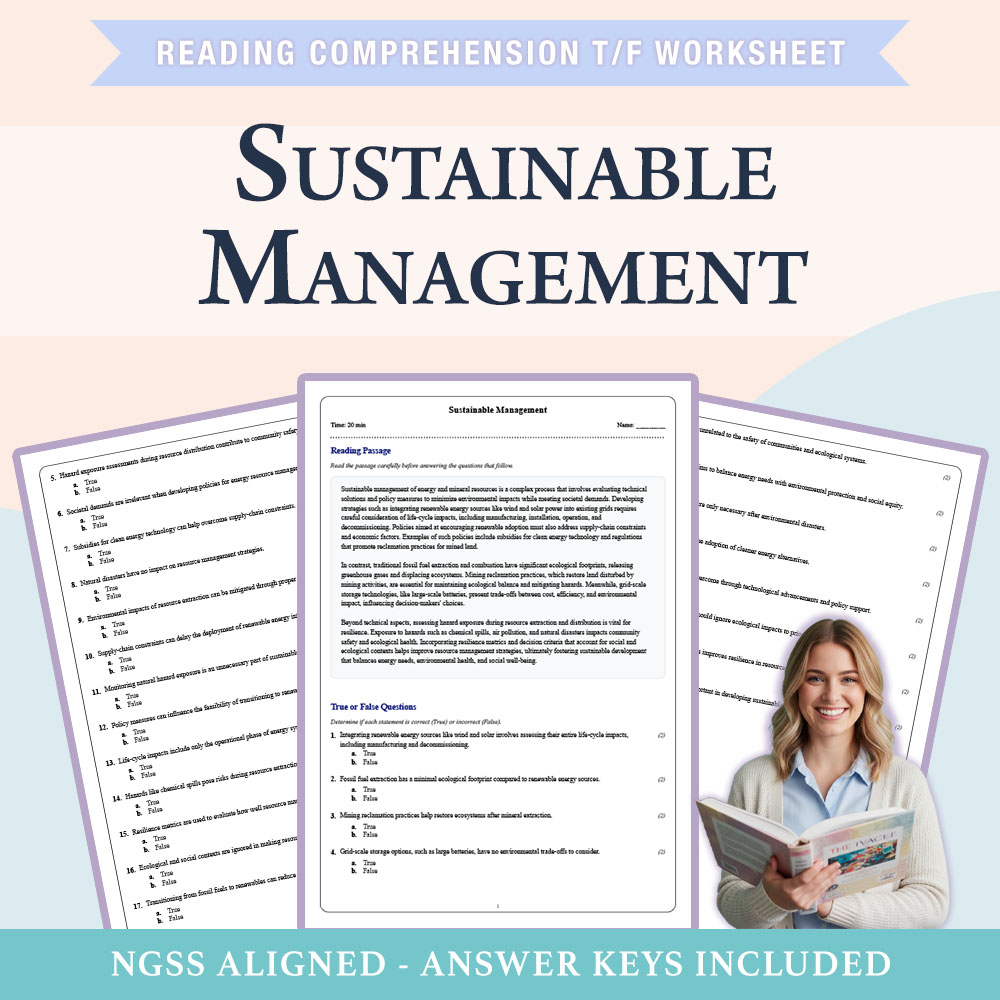
11th Grade Science | Sustainable Management Worksheet (PDF + Answer Key)
Created byCopper Leaf ClassroomLearning Objectives
- Understand the concept of sustainable management in energy and mineral resources.
- Differentiate between technical and policy solutions in resource management.
- Analyze the environmental and social impacts of energy production and resource extraction.
Also included in: Grade 11 Science | Climate Change & Environmental Management (PDF + Answer Key) +1 more
Instant download

Grade 11 Science | Feedbacks and Forcing Worksheet | General Standard
Created byLumora LearningLearning Objectives
- Explain how climate forcing initiates change and how feedbacks amplify or reduce that change over time
- Describe key feedback mechanisms such as ice-albedo, water vapor, and carbon-cycle feedbacks
- Use feedback strength and timescales to interpret why climate responses may accelerate rather than remain linear
Instant download
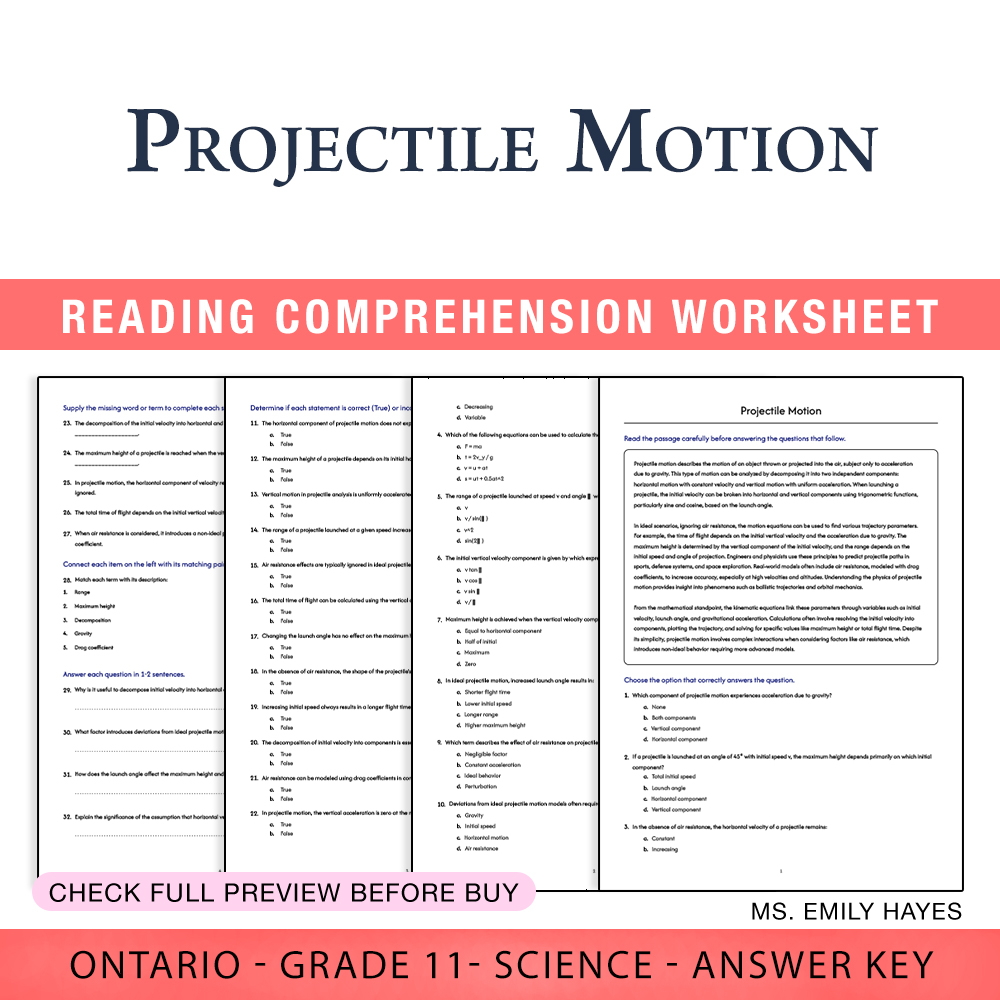
Grade 11 Science | Projectile Motion Worksheet (PDF + Answer Key)
Created byCopper Leaf ClassroomLearning Objectives
- Understand the components of projectile motion and their independence.
- Apply kinematic equations and trigonometric relations to solve projectile problems.
- Predict the trajectory parameters such as time of flight, maximum height, and range.
Instant download
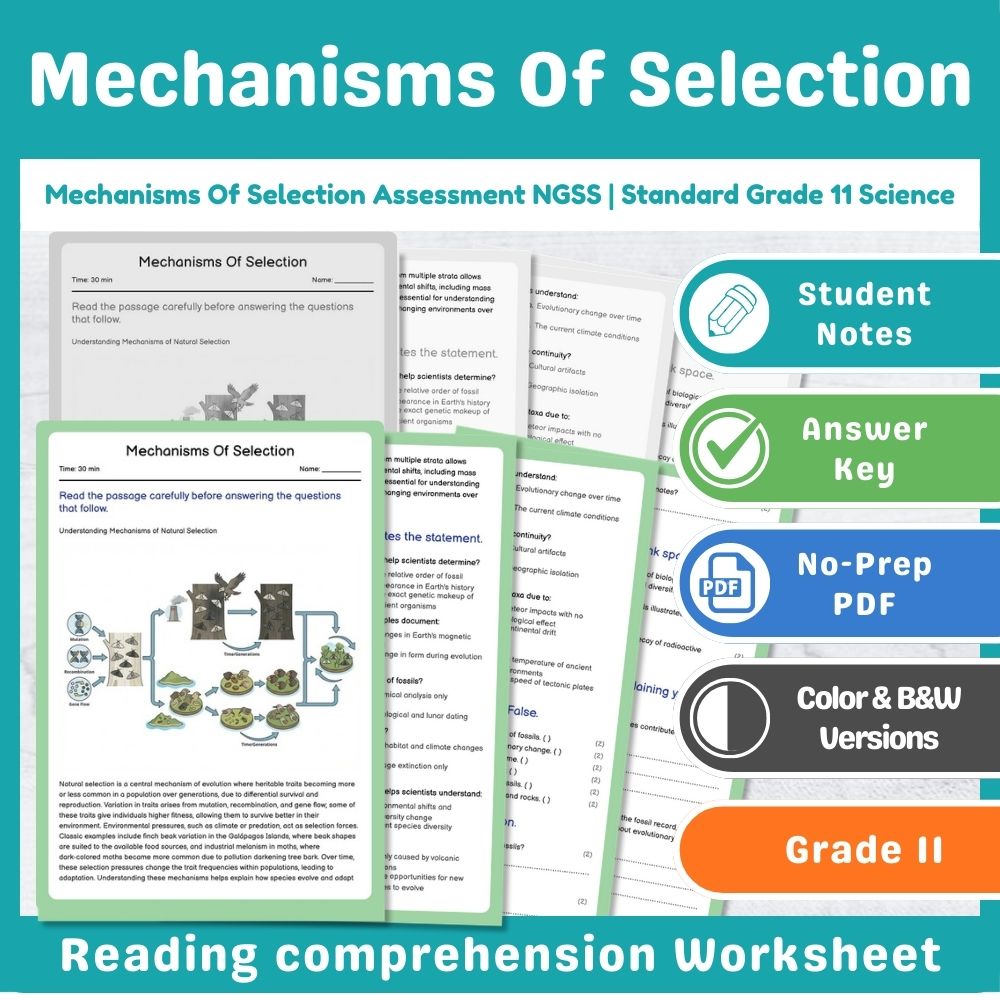
Mechanisms Of Selection Assessment NGSS | Standard Grade 11 Science
 Created byPrism Point Learning
Learning Objectives
- Explain the key concepts of natural selection, including heritable variation and differential survival.
- Analyze factors influencing selection pressure, such as mutation, recombination, and environment.
- Use examples like finch beak variation and industrial melanism to illustrate evolutionary mechanisms.
Instant download
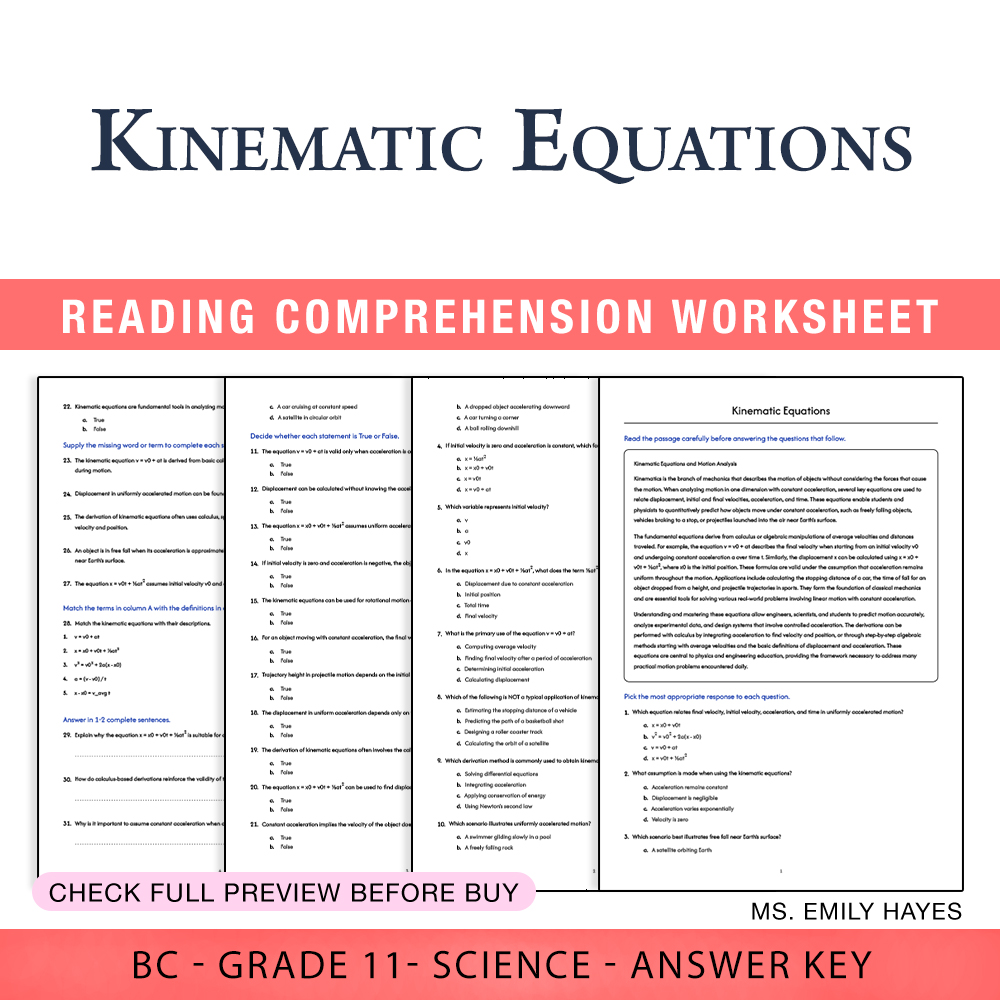
11th Grade Science | Kinematic Equations Worksheet (PDF + Answer Key)
Created byCopper Leaf ClassroomLearning Objectives
- Understand the derivation and applications of constant-acceleration kinematic equations.
- Identify and manipulate key equations such as v = v0 + at and x = x0 + v0t + ½at² to solve motion problems.
- Apply kinematic equations to solve real-world problems involving free fall, vehicle braking, and launch motion.
Also included in: Grade 11 Science BC | Motion, Energy & Force Concepts (PDF+ Answer Keys) +1 more
Instant download
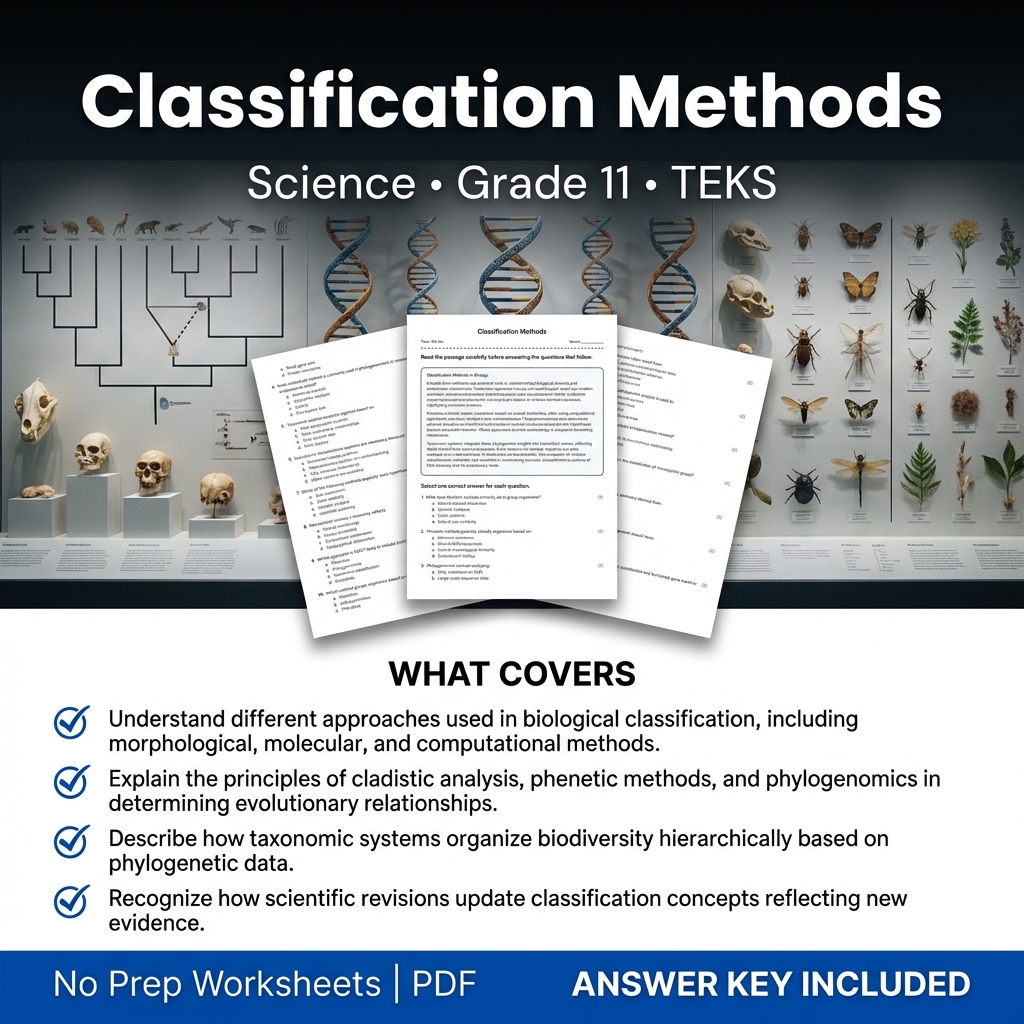
Grade 11 Science Worksheet on Classification Methods | TEKS Aligned
Created byCoral Reef LearningLearning Objectives
- Understand different approaches used in biological classification, including morphological, molecular, and computational methods.
- Explain the principles of cladistic analysis, phenetic methods, and phylogenomics in determining evolutionary relationships.
- Describe how taxonomic systems organize biodiversity hierarchically based on phylogenetic data.
Instant download
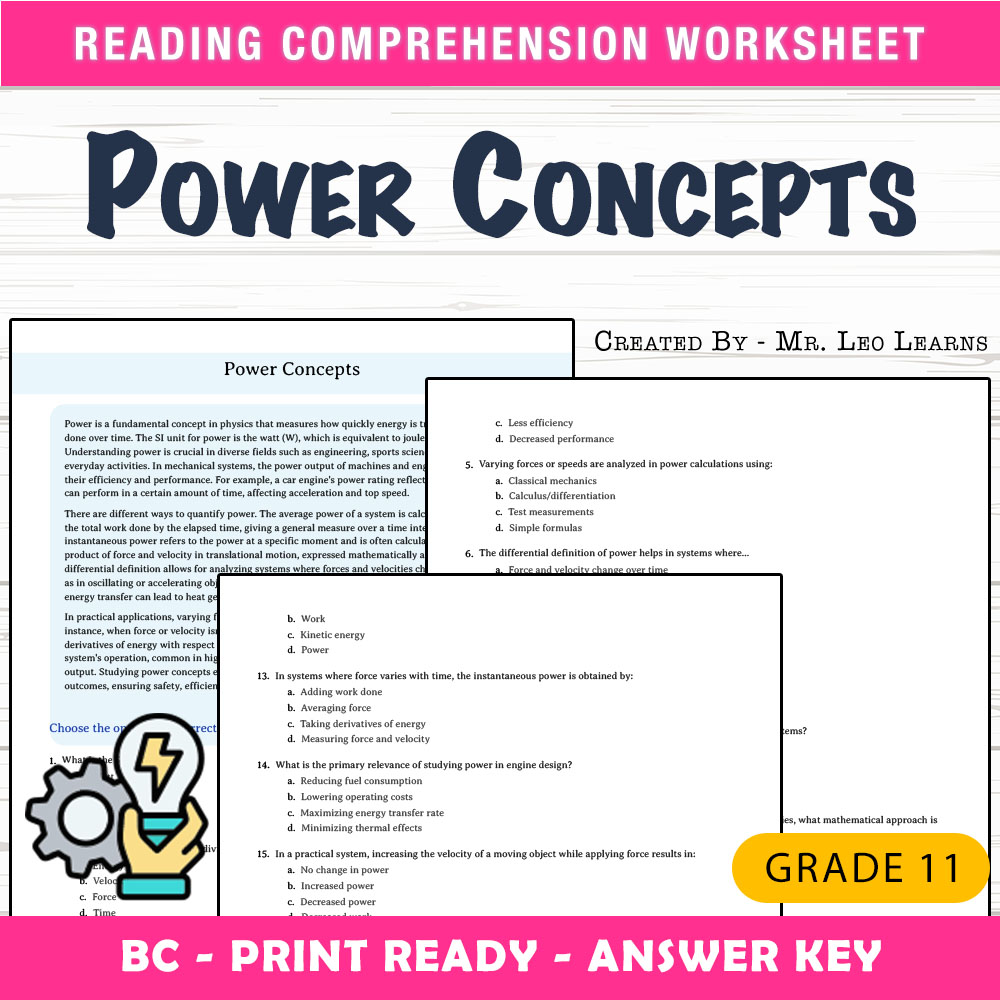
Grade 11 Science — Worksheet MCQ Paper for Power Concepts
Created byThe Resource HubLearning Objectives
- Understand the definition and measurement of power in energy transfer systems.
- Differentiate between average power and instantaneous power in physical systems.
- Apply formulas to calculate power in various scenarios involving force, velocity, and energy transfer.
Also included in: Grade 11 Science BC Physics Unit Bundle | Motion, Energy & Forces Worksheets +1 more
Instant download
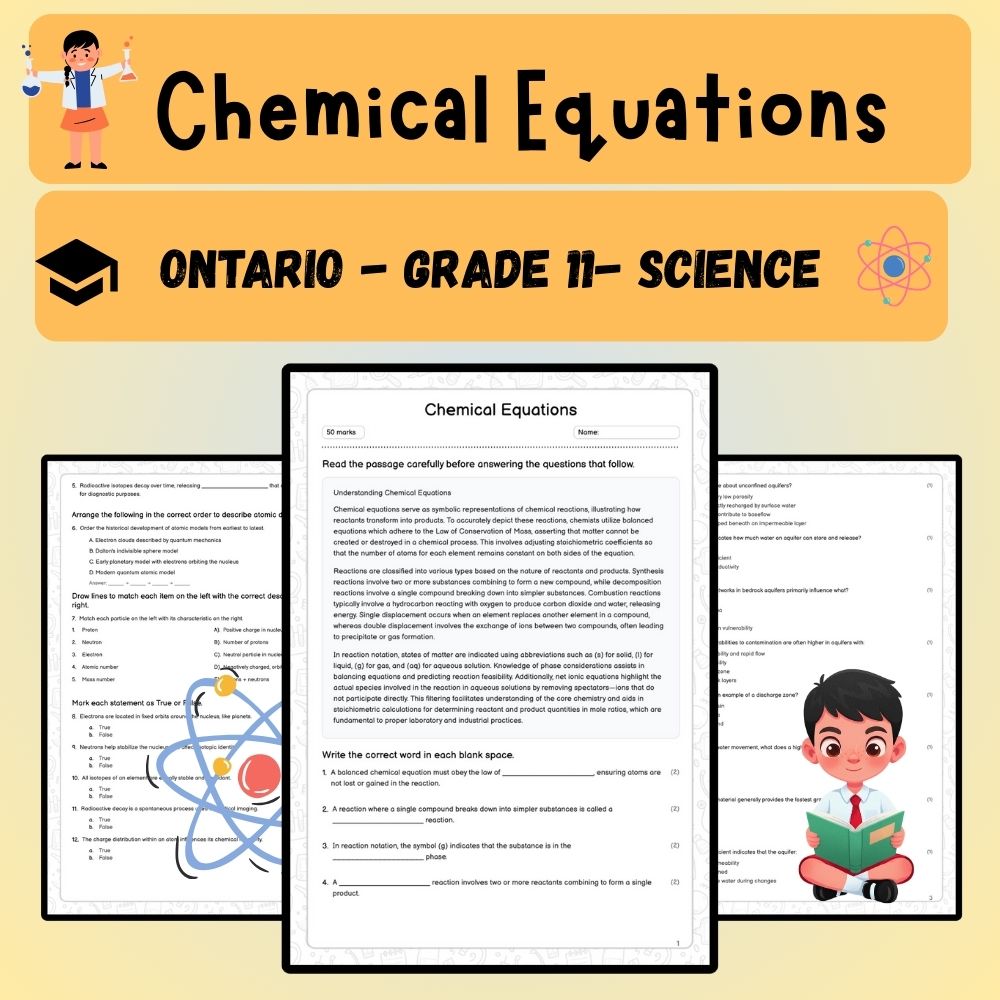
Grade 11 Science | Chemical Equations Worksheet (Answer Key) - Ontario Standard
Created byPrism Point LearningLearning Objectives
- Understand the representation of chemical change through balanced symbolic equations.
- Identify and classify different types of chemical reactions, including synthesis, decomposition, combustion, and displacement reactions.
- Interpret reaction notation with states of matter and phase considerations.
Also included in: Grade 11 Science Unit Bundle | Chemistry & Atomic Structure Worksheets +1 more
Instant download
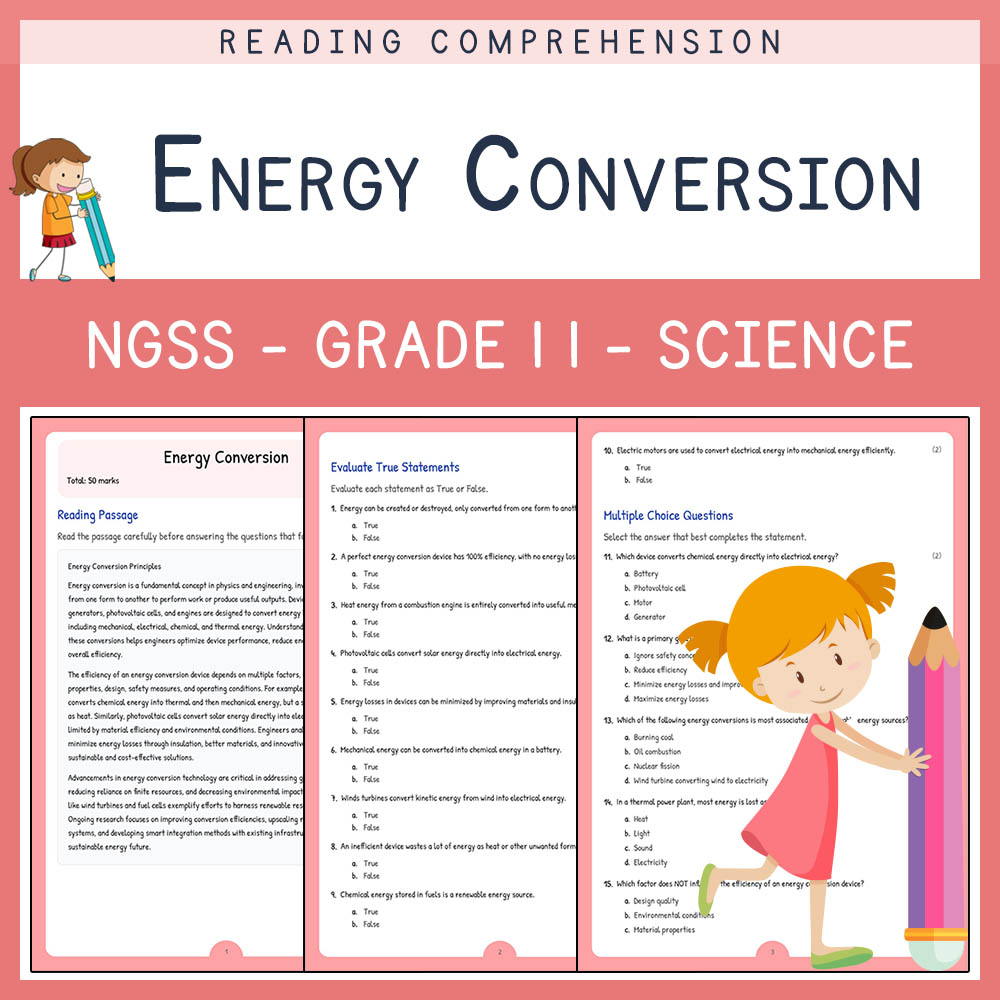
Grade 11 Science | Energy Conversion Worksheet & Answer Key (PDF) NGSS Standards
Created byLumora LearningLearning Objectives
- Understand the principles of energy conversion between different forms such as mechanical, electrical, chemical, and thermal.
- Design and evaluate devices that perform energy conversions while considering efficiency, safety, and cost.
- Analyze energy losses in various energy conversion systems and propose improvements to optimize performance.
Instant download
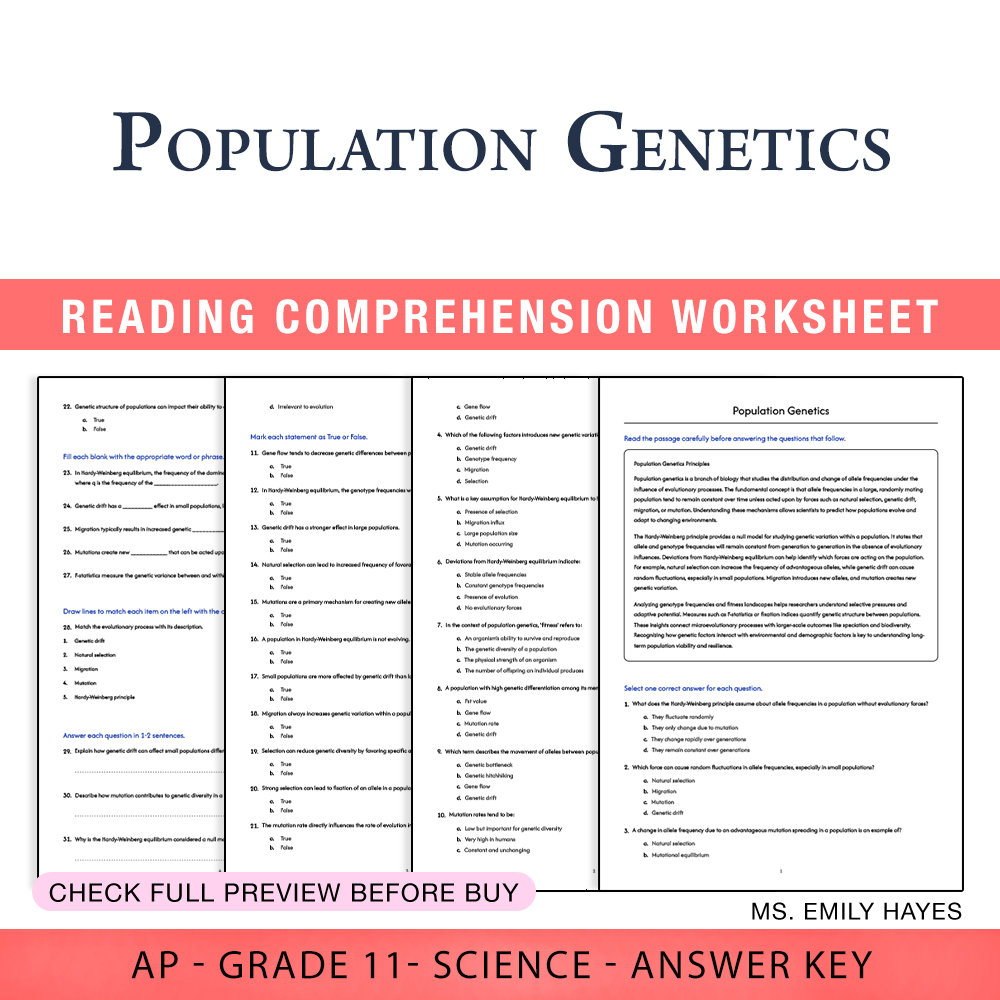
Grade 11 Science | Population Genetics Worksheet (PDF+ Answer Key)
Created byCopper Leaf ClassroomLearning Objectives
- Understand principles of allele frequency change in populations
- Apply Hardy-Weinberg equilibrium as a null model for microevolution
- Identify forces such as selection, genetic drift, migration, and mutation shaping genetic variation
Also included in: Grade 11 Science | Biology & Ecosystems AP Worksheet Bundle (PDF+ Answer Keys) +1 more
Instant download

Grade 11 Science | Stoichiometric Calculations Reading Worksheet & Answer Key
JCreated byJ.S SheetsLearning Objectives
- Understand and apply the mole concept for quantitative relationships in chemical reactions.
- Use molar mass conversions and Avogadro’s number to relate masses, moles, and particle counts.
- Analyze limiting reagents, calculate theoretical yields, and determine percent yields in chemical reactions.
Also included in: Grade 11 Science Unit Bundle | Chemical Bonding & Reaction Energetics +1 more
Instant download
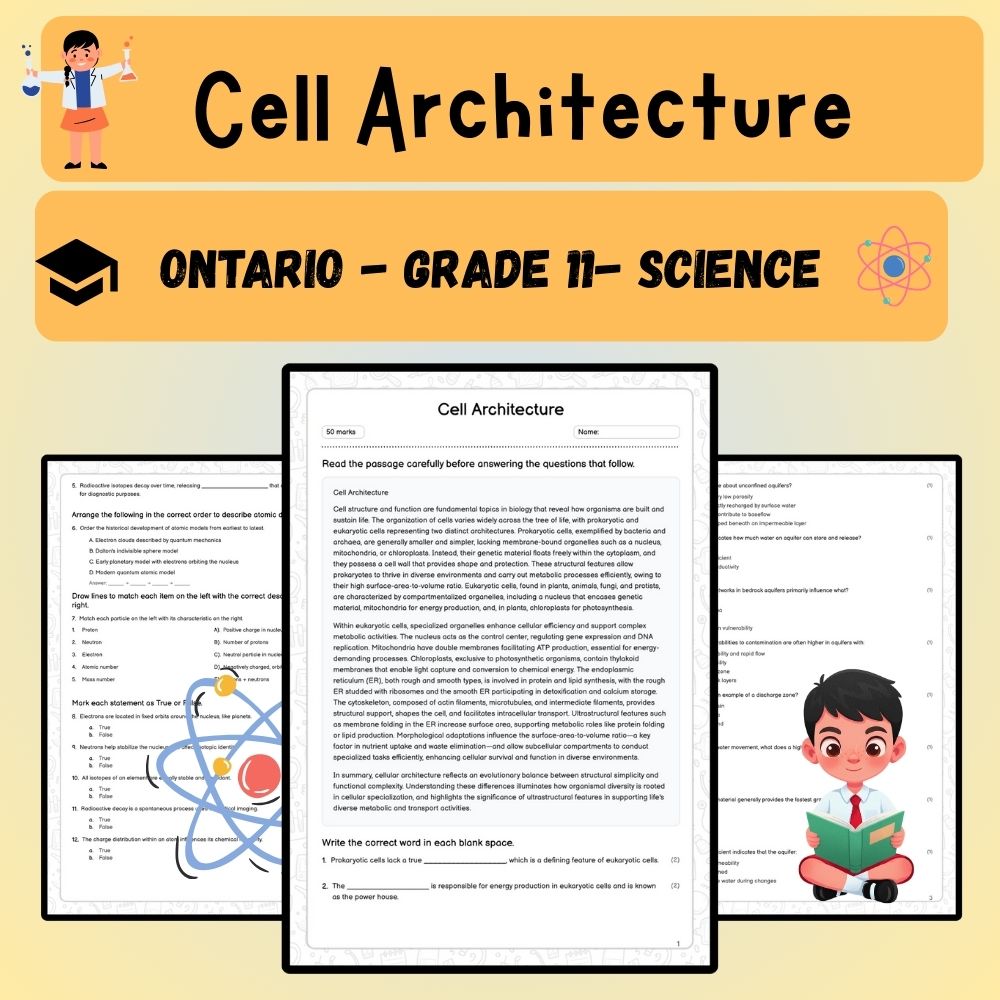
Grade 11 Science | Cell Architecture Worksheet – Ontario Standards
Created byPrism Point LearningLearning Objectives
- Compare the structural features of prokaryotic and eukaryotic cells.
- Identify key organelles and their functions within a cell.
- Understand how ultrastructures support metabolic and transport roles.
Also included in: Grade 11 Science | Cellular Metabolism & DNA Processes Worksheet Bundle +1 more
Instant download
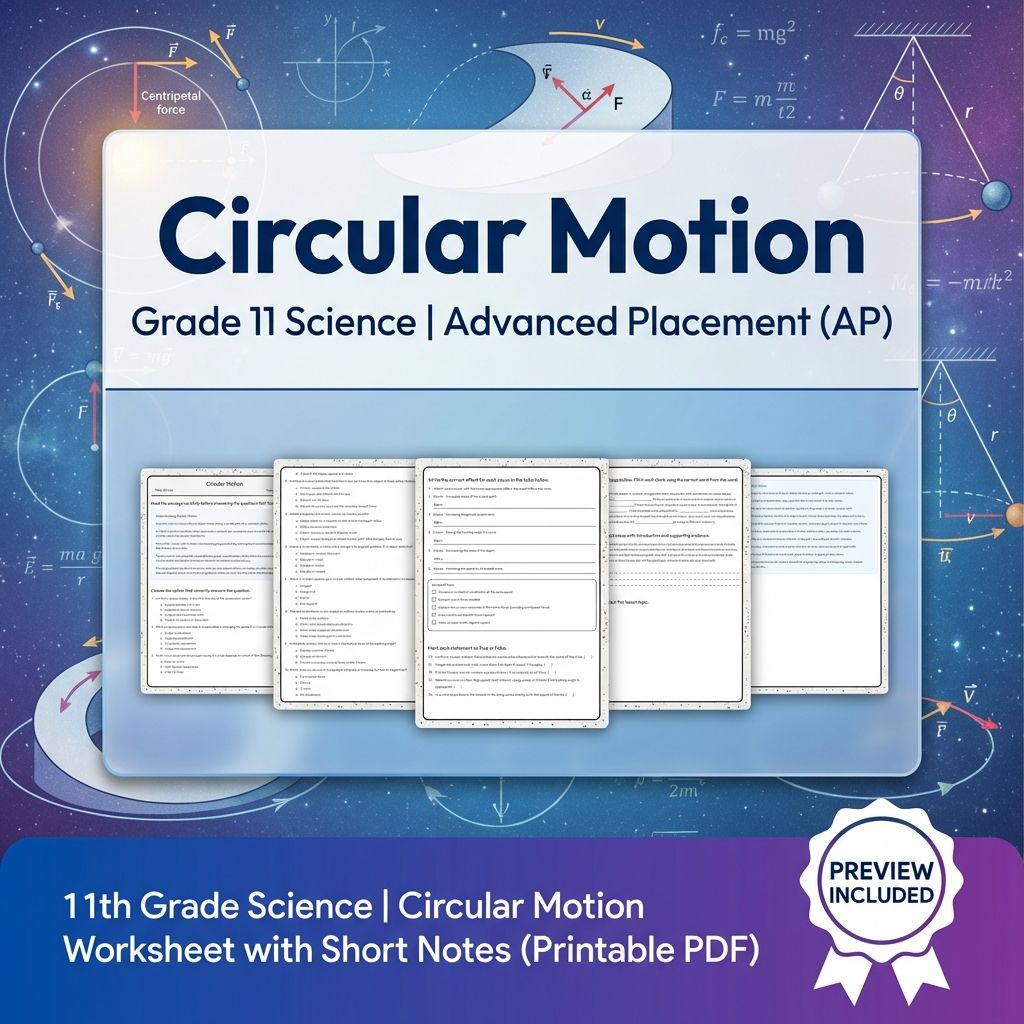
11th Grade Science | Circular Motion Worksheet with Short Notes (PDF)
 Created byMeadowlark Worksheets
Learning Objectives
- Explain the concepts of uniform and nonuniform circular motion, including centripetal and tangential accelerations.
- Model net forces in circular motion using radial and tangential components.
- Describe the kinematic properties of objects in polar coordinates and relate acceleration vectors to velocity changes.
Also included in: Grade 11 Physics Unit Worksheet Pack | Kinematics, Forces & Energy (Collection) +1 more
Instant download

Calvin Cycle Assessment for Grade 11 Science TEKS Standards
Created byPrism Point LearningLearning Objectives
- Understand the steps and enzymes involved in the Calvin cycle.
- Explain the role of ATP and NADPH in carbon fixation and reduction.
- Identify the output molecules of the Calvin cycle and their significance.
Also included in: Grade 11 Photosynthesis and Respiration Science Lesson Bundle | TEKS
Instant download

Fermentation Pathways Assessment for Grade 11 Science TEKS Standards
Created byPrism Point LearningLearning Objectives
- Explain the process of anaerobic fermentation pathways and their role in ATP regeneration.
- Differentiate between lactic acid and alcoholic fermentation in terms of products and energy yield.
- Describe how cells adapt biochemical pathways to maintain energy production without oxygen.
Also included in: Grade 11 Photosynthesis and Respiration Science Lesson Bundle | TEKS
Instant download
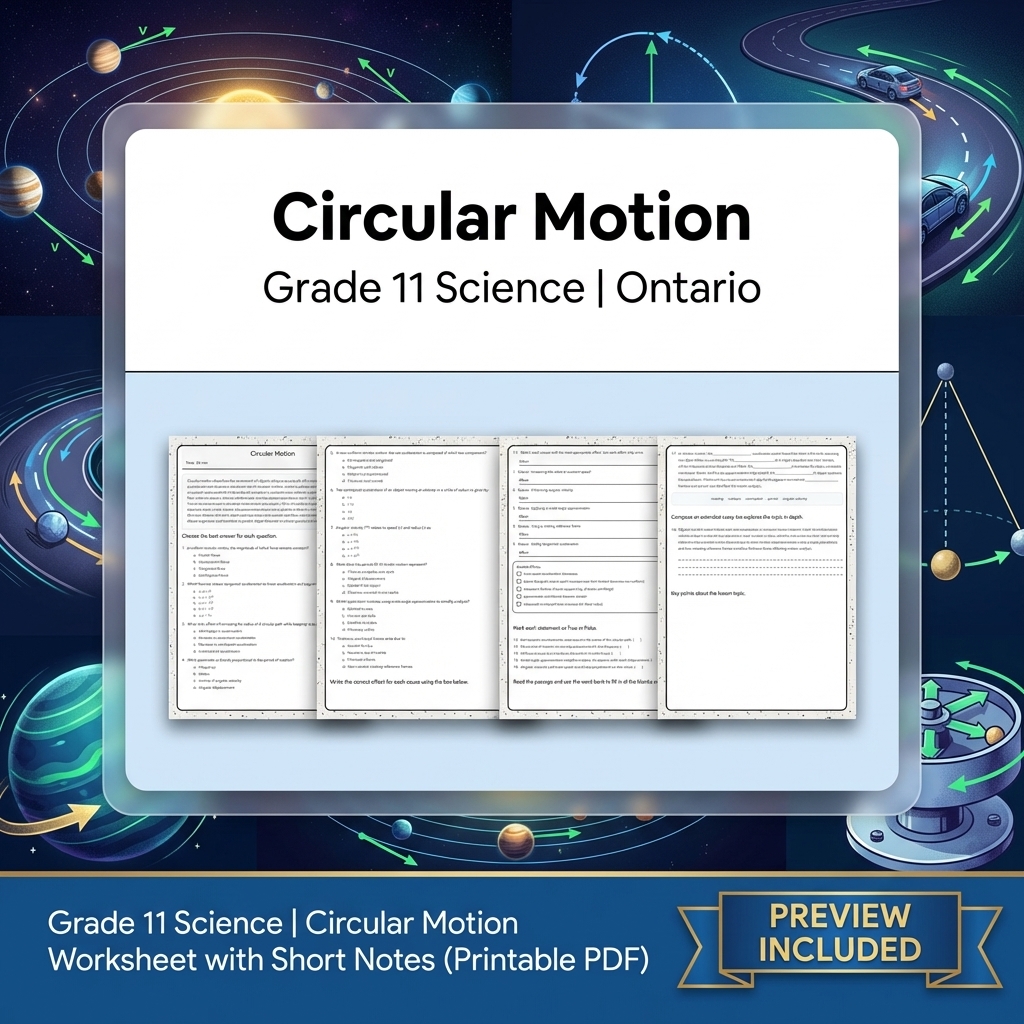
Grade 11 Science | Circular Motion Worksheet with Short Notes (Printable PDF)
Created byMeadowlark WorksheetsLearning Objectives
- Analyze uniform and non-uniform circular motion including centripetal and tangential accelerations.
- Understand the relationships among speed, angular velocity, radius, and centripetal force.
- Apply concepts of period, frequency, and small-angle approximations to real-world circular systems.
Also included in: Grade 11 Science Lesson Bundle: Motion, Energy, Waves & Circuits – Ontario +1 more
Instant download
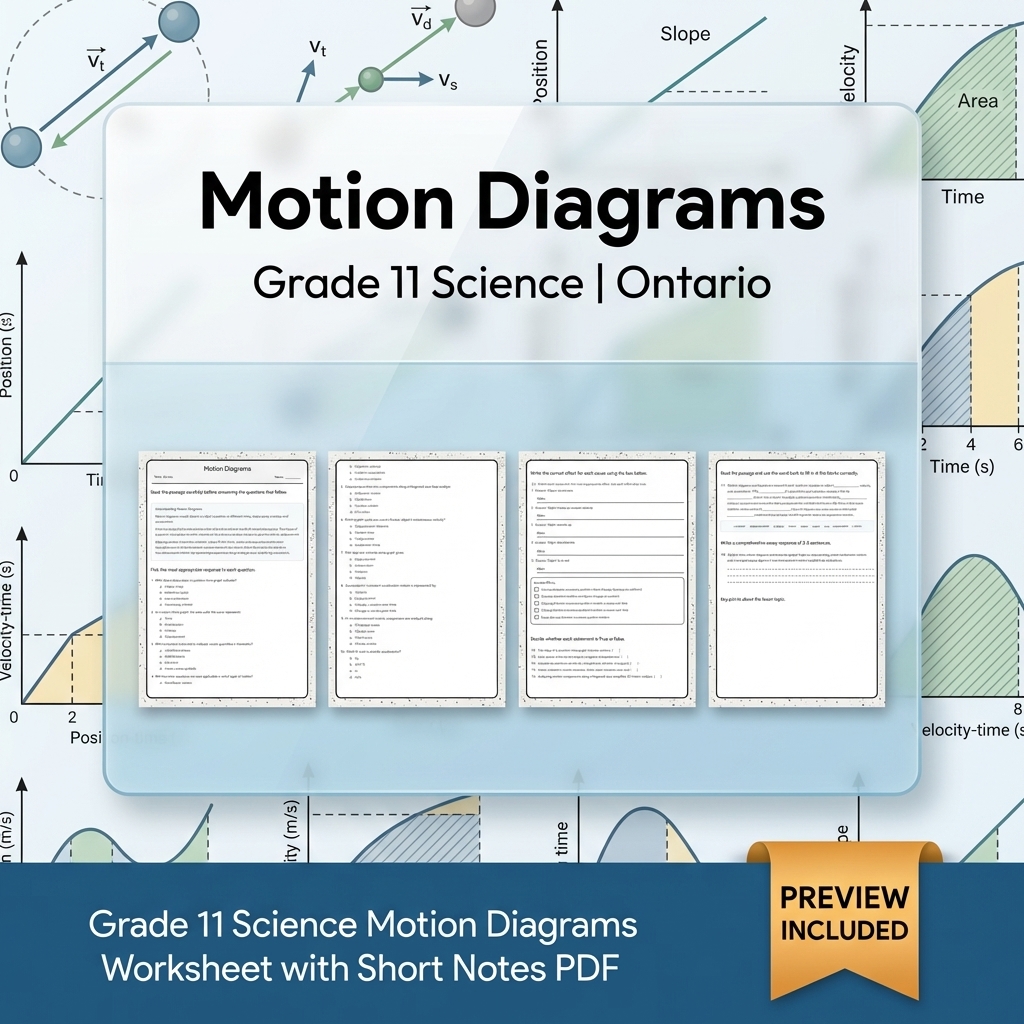
Grade 11 Science Motion Diagrams Worksheet with Short Notes PDF
Created byMeadowlark WorksheetsLearning Objectives
- Understand how position, velocity, and acceleration are represented through motion diagrams and graphs.
- Interpret slope and area in position-time and velocity-time plots to connect displacement, velocity, and acceleration.
- Apply scalar and vector notation, SI units, and kinematic equations to analyze straight-line and two-dimensional motion under constant acceleration.
Also included in: Grade 11 Science Lesson Bundle: Motion, Energy, Waves & Circuits – Ontario +1 more
Instant download
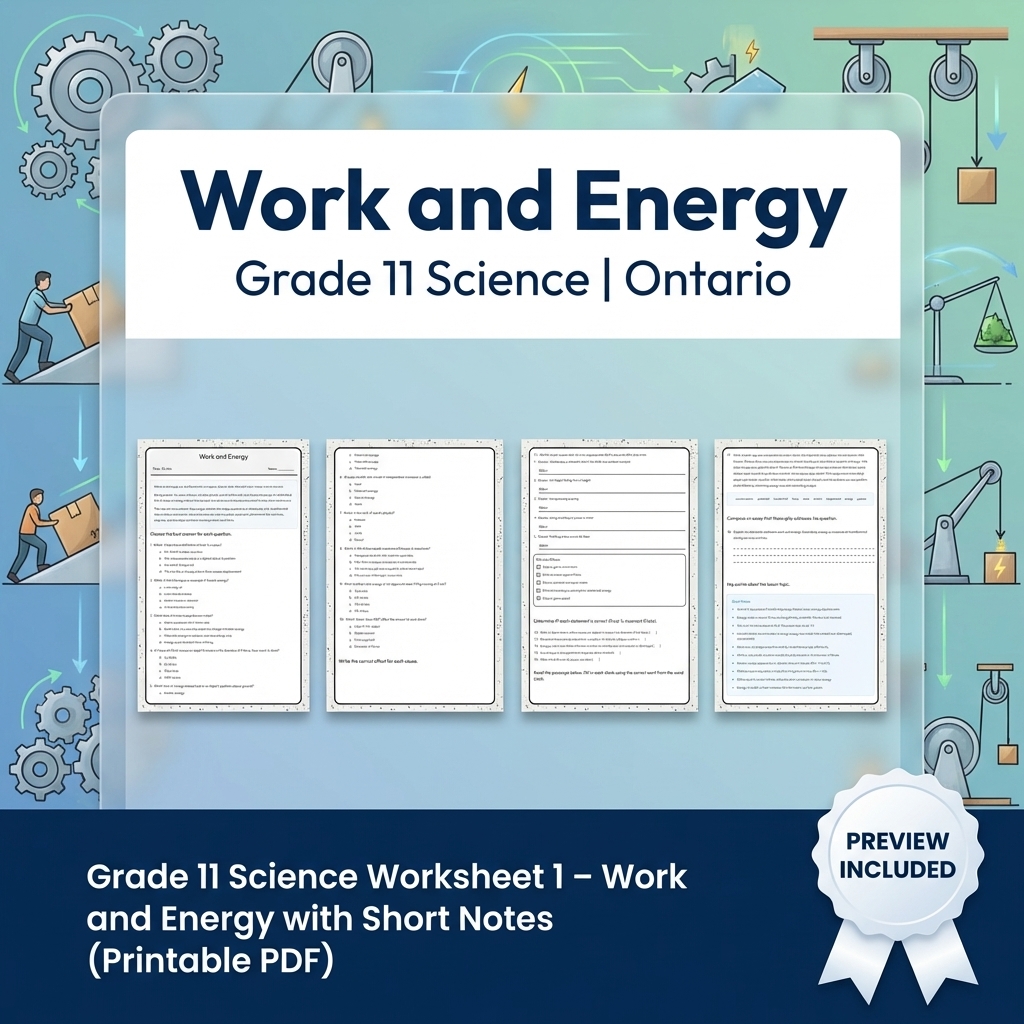
Grade 11 Science Worksheet Work and Energy with Short Notes (Printable PDF)
Created byMeadowlark WorksheetsLearning Objectives
- Understand the basic concepts of work and energy in physics.
- Identify different types of energy and their real-world examples.
- Calculate work done using force and displacement.
Also included in: Grade 11 Science Lesson Bundle: Motion, Energy, Waves & Circuits – Ontario +1 more
Instant download
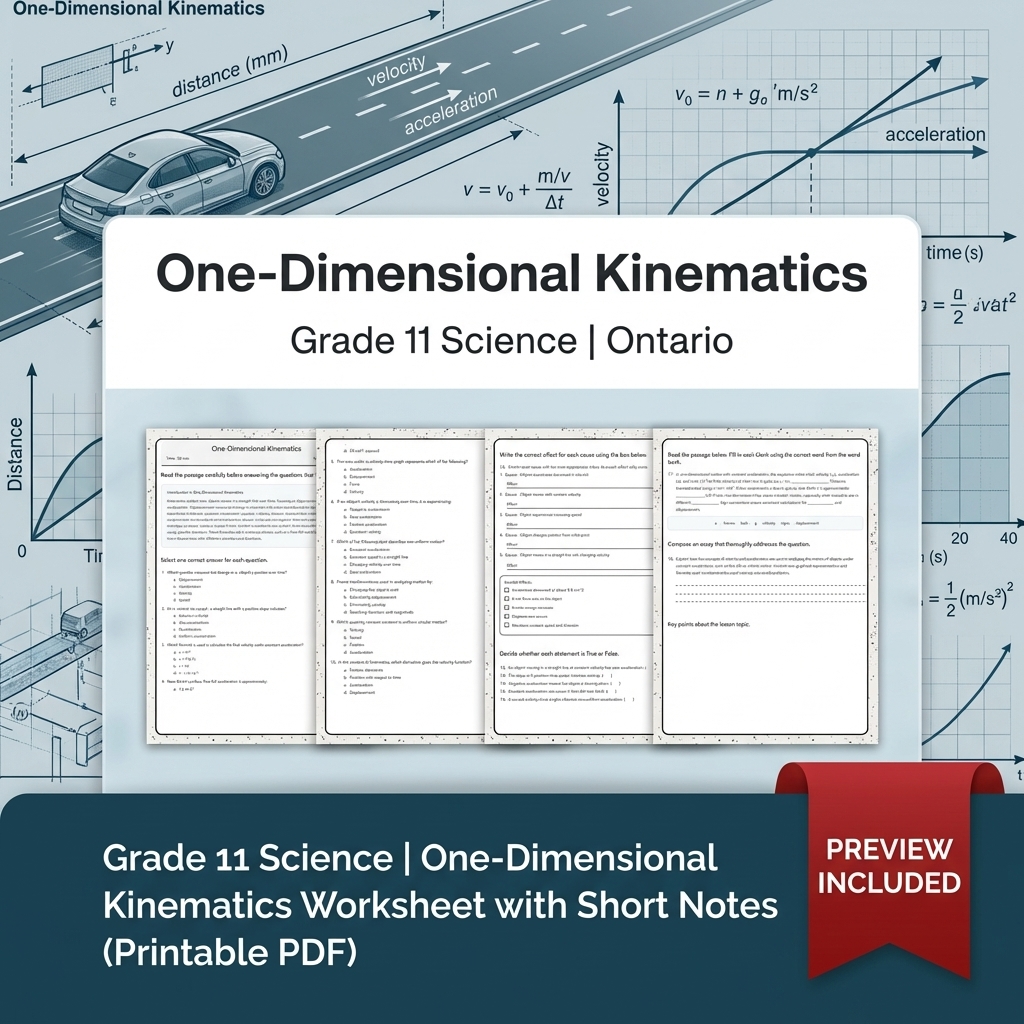
Grade 11 Science | One-Dimensional Kinematics Worksheet with Short Notes
Created byMeadowlark WorksheetsLearning Objectives
- Understand the concepts of displacement, velocity, and acceleration as functions of time.
- Differentiate between uniform and non-uniform motion using graphical and algebraic methods.
- Apply constant-acceleration formulas to real-world scenarios such as free-fall and relative motion.
Also included in: Grade 11 Science Lesson Bundle: Motion, Energy, Waves & Circuits – Ontario +1 more
Instant download
About Grade 11 Science Worksheets
Browse 6,616 printable Grade 11 Science worksheets — ready-to-print PDFs with answer keys where available.
Each resource here is built by an independent educator and reviewed for quality. Worksheets print straight from PDF and suit classroom use, homework, or extra practice; most come with answer keys, and you can preview before purchasing.