
Grade 11 Science Worksheets
6,616 worksheets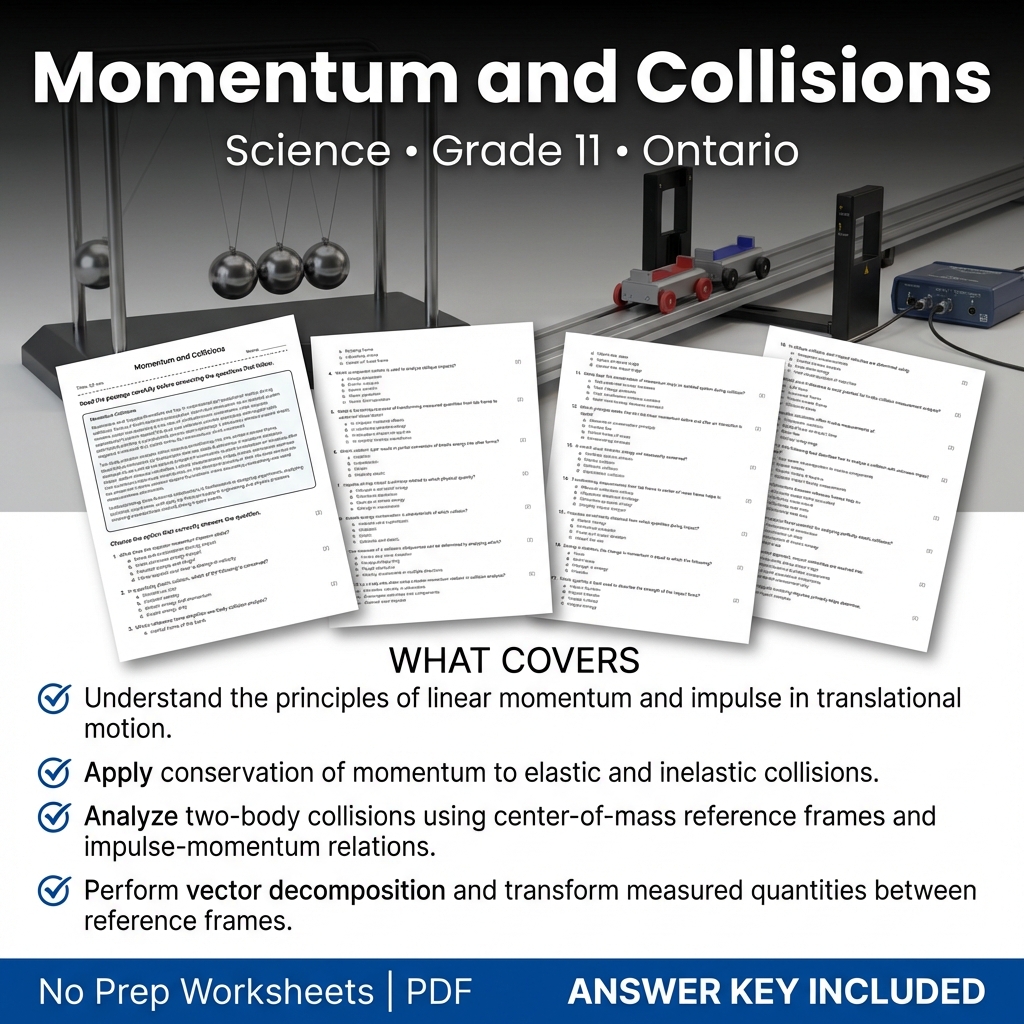
Momentum and Collisions Worksheet | Grade 11 Science | Ontario Standards
 Created byCoral Reef Learning
Learning Objectives
- Understand the principles of linear momentum and impulse in translational motion.
- Apply conservation of momentum to elastic and inelastic collisions.
- Analyze two-body collisions using center-of-mass reference frames and impulse-momentum relations.
Instant download

Grade 11 Science Worksheet – Disease Impacts TEKS (PDF)
 Created byEvergreen Desk Education
Learning Objectives
- Explain how pathogens and environmental factors can disrupt organ system function through infection, inflammation, toxins, and genetic or lifestyle changes
- Analyze how chronic diseases affect metabolism, immunity, and vascular health over time
- Evaluate how lung and immune impairments reduce oxygen delivery and increase susceptibility to complications
Instant download

Grade 11 Stellar Evolution Worksheet | NGSS Practice PDF
 Created byClear Sky Classroom
Learning Objectives
- Explain how stellar fusion creates the balance that powers stars during the main sequence
- Describe how changes in fuel supply shift stars into new evolutionary stages
- Compare the endpoints of stars of different masses (white dwarfs, neutron stars, black holes)
Instant download

Grade 11 Science | Understanding Natural Selection - Daily Reading Comprehension
Created byCoral Reef LearningLearning Objectives
- Define natural selection and its key components.
- Identify how heritable variations influence evolution.
- Describe different modes of selection: directional, stabilizing, and disruptive.
Instant download
Phase Behaviour Worksheet for Grade 11 Science | Alberta Standards
Created byCoral Reef LearningLearning Objectives
- Understand how intermolecular forces influence phase transitions and vapor pressure.
- Explain the relationship between molecular strength of attraction and boiling points.
- Analyze how temperature, molecular size, and polarity affect phase diagrams in different environments.
Instant download

Grade 11 Molecular Building Worksheet | Practice & Assessment PDF
Created byClear Sky ClassroomLearning Objectives
- Explain how macromolecules assemble into cellular structures from membranes to organelles.
- Compare prokaryotic and eukaryotic cellular organization using ultrastructural features.
- Connect subcellular localization (compartmentalization) to where biochemical pathways occur.
Also included in: Grade 11 Systems Integration and Genetics Science Lesson Bundle: AP +1 more
Instant download

Grade 11 Science | Mendelian Patterns Worksheet | TEKS-Aligned
 Created byLumora Learning
Learning Objectives
- Describe the principles of Mendelian inheritance, including segregation and independent assortment.
- Explain how dominant and recessive alleles influence phenotypes from genotypes.
- Predict genetic variation outcomes in monohybrid and dihybrid crosses using Punnett squares.
Instant download

Grade 11 Science – Hazard Management & Earthquake Risks | Reading Worksheet
 Created byBright Mind Resources
Learning Objectives
- Understand the causes and effects of earthquakes
- Identify earthquake hazard zones using geological maps
- Recognize signs of earthquake risk and prepare mitigation strategies
Also included in: Geology Grade 11 Science Daily Reading Worksheets Lesson Bundle | BC +1 more
Instant download

Grade 11 Degree Dissociation Worksheet | Practice & Assessment PDF
Created byClear Sky ClassroomLearning Objectives
- Explain what degree of dissociation (α) represents for weak acids and weak bases in solution.
- Predict how initial concentration and common-ion effects change percent dissociation using equilibrium ideas.
- Apply dissociation concepts to real Alberta soil and fertilizer scenarios, including nutrient availability and aluminum mobility.
Instant download
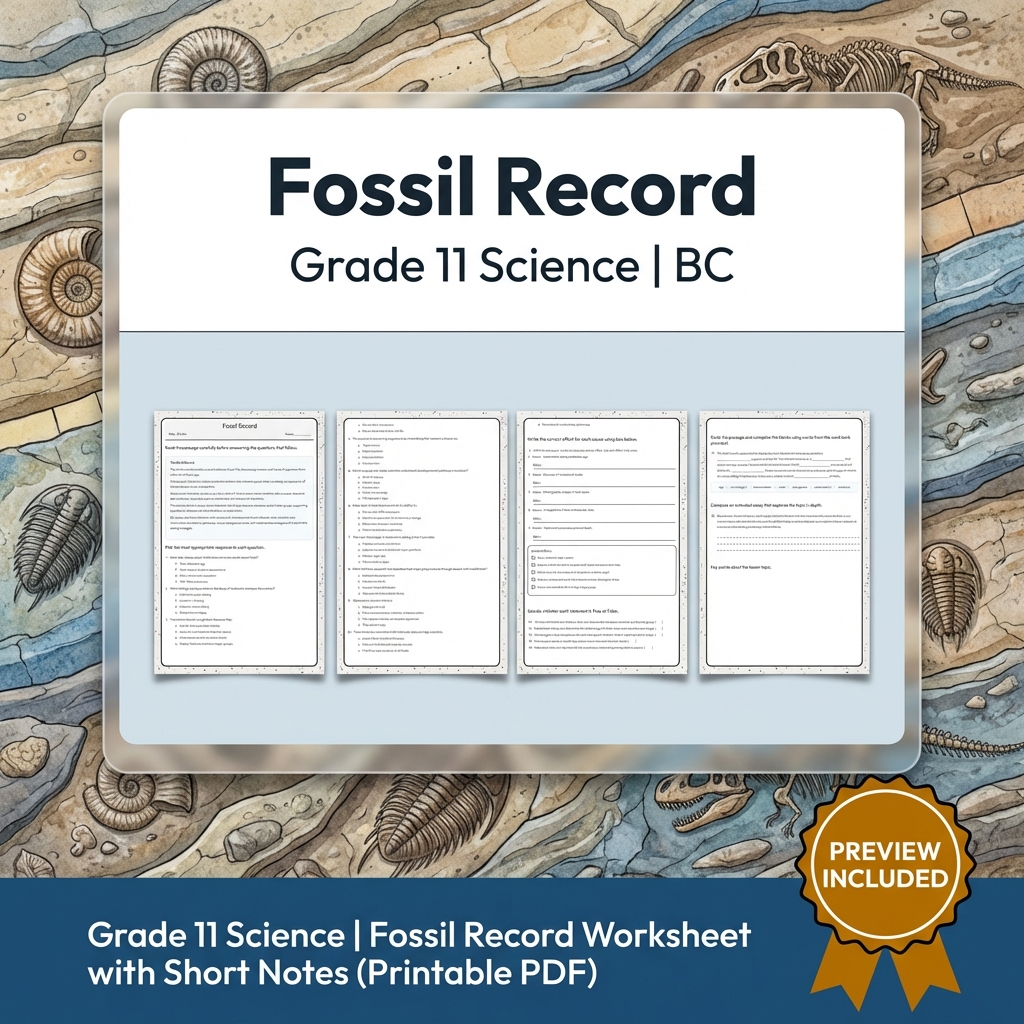
Grade 11 Science | Fossil Record Worksheet with Short Notes (Printable PDF)
 Created byMeadowlark Worksheets
Learning Objectives
- Understand how the fossil record documents evolutionary change over deep time.
- Identify different methods used to date fossils and their significance.
- Explain the importance of transitional fossils in understanding evolutionary pathways.
Also included in: Grade 11 Science Lesson Bundle BC Framework Worksheets for Biology and Genetics +1 more
Instant download

Grade 11 Science | Reaction Rates Worksheet | BC-Aligned
Created byLumora LearningLearning Objectives
- Understand the factors that influence reaction rates, including collision frequency and activation energy.
- Explain how rate laws describe the dependence of reaction rate on reactant concentrations.
- Describe the role of catalysts and the Arrhenius equation in chemical kinetics.
Also included in: Grade 11 Science | Chemistry Lesson Bundle Worksheet | BC-Aligned
Instant download

Grade 11 Science | Mountain Building - Daily Reading Comprehension
Created byCoral Reef LearningLearning Objectives
- Understand the basic concepts of mountain formation and tectonic activity
- Identify the key structural features associated with mountain building
- Explain the processes that contribute to mountain uplift and erosion
Instant download

Grade 11 Solution Stoichiometry Worksheet | Practice & Standards PDF
Created byClear Sky ClassroomLearning Objectives
- Use molar concentration to convert between solution volume and moles of solute in aqueous reactions.
- Apply mole-to-mole stoichiometry to predict product amounts from balanced chemical equations.
- Identify and determine the limiting reagent in solution-phase stoichiometry using concentrations.
Instant download

Grade 11 Atomic Structure Worksheet | Practice & Assessment PDF
Created byClear Sky ClassroomLearning Objectives
- Explain how protons, neutrons, and electrons determine an atom’s identity and overall charge.
- Use the electron energy level model to predict electron arrangement and likely bonding behavior.
- Relate atomic structure to physical and chemical properties such as stability and reactivity.
Instant download

Grade 11 Model Based Solutions Worksheet | Practice & PDF Use NGSS
Created byClear Sky ClassroomLearning Objectives
- Explain how models represent relationships among variables to predict system behavior before building prototypes.
- Compare multiple solution approaches by analyzing assumptions, calculations, and simulation results against constraints and criteria.
- Identify common limitations and failure modes of models and describe how to refine models using new evidence.
Instant download

Grade 11 Science | Membrane Transport - Daily Reading Comprehension
Created byCoral Reef LearningLearning Objectives
- Understand the structure of cell membranes and their role in regulating substances entering and exiting the cell.
- Identify different mechanisms of membrane transport: diffusion, osmosis, facilitated diffusion, and active transport.
- Explain how ion gradients are established and how they store potential energy used in cellular processes.
Instant download

Grade 11 Science | Covalent Structures - Daily Reading Comprehension
Created byCoral Reef LearningLearning Objectives
- Understand the concept of covalent bonding and Lewis structures
- Identify shared-electron bonding in molecules
- Analyze the role of electronegativity in covalent and ionic bonding
Instant download

Integrated Cycles Worksheet | TEKS Grade 11 Science Practice PDF
JCreated byJ.S SheetsLearning Objectives
- Explain how photosynthesis and cellular respiration form interconnected carbon and energy cycles in organisms and ecosystems.
- Describe how day-night changes, tissue specialization, and sugar transport coordinate whole-plant energy distribution.
- Model and interpret energy flow trade-offs between carbon fixation, oxidation, and biomass production.
Instant download
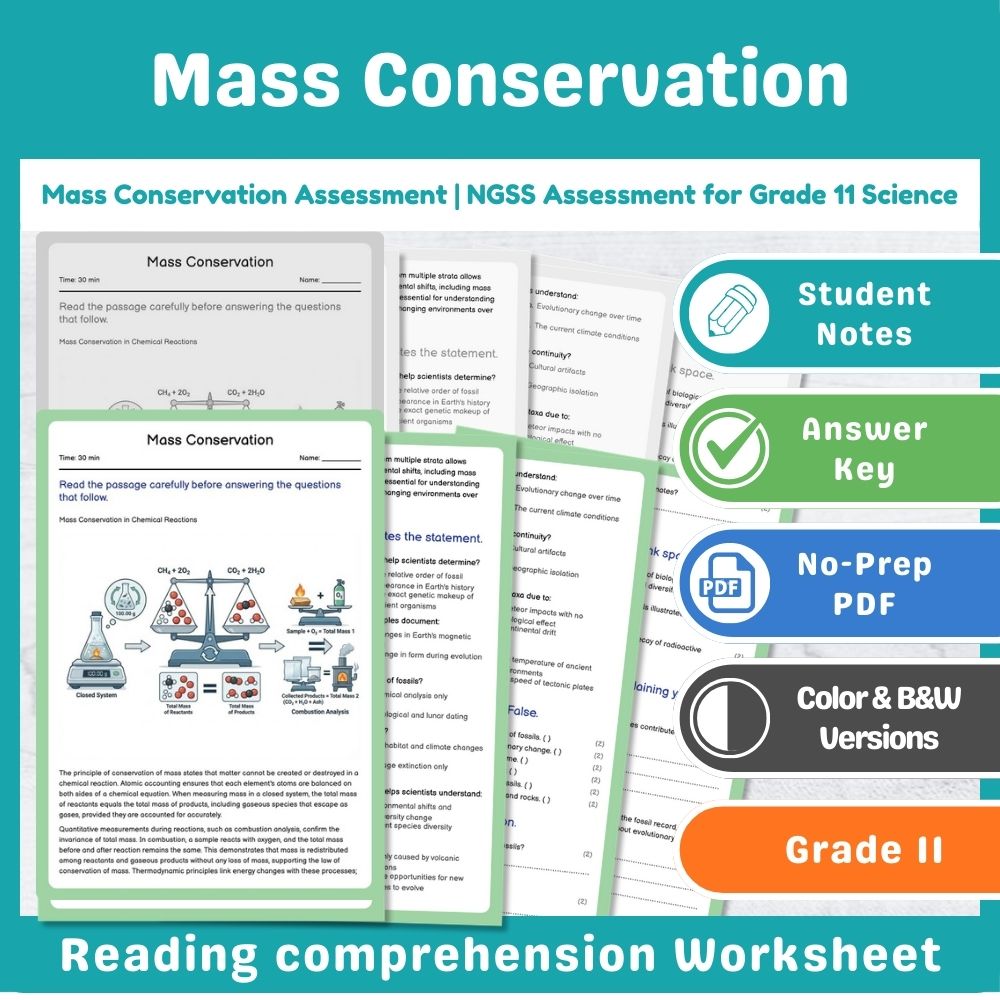
Mass Conservation Assessment | NGSS Assessment for Grade 11 Science
 Created byPrism Point Learning
Learning Objectives
- Explain the principle of atomic accounting in chemical reactions.
- Describe how mass is conserved in closed systems and combustion processes.
- Understand the relationship between energy, mass, and thermodynamics in chemical transformations.
Also included in: Grade 11 Science Mini Bundle – Matter and Its Interactions NGSS Unit
Instant download

Grade 11 Science – Introduction to Projectile Motion Daily Reading Worksheet
 Created byQuiet Forest Education
Learning Objectives
- Understand the components of projectile motion in horizontal and vertical directions.
- Identify how independence of motion applies to projectile trajectories.
- Apply basic kinematic equations and trigonometric relations to analyze projectile motion.
Also included in: Wave & Motion Science Grade 11 Daily Reading Worksheets Bundle | Ontario +1 more
Instant download

Science Worksheet Explanatory Models Grade 11 | Standards-Aligned Practice
JCreated byJ.S SheetsLearning Objectives
- Explain how scientific models represent and clarify natural phenomena when direct observation is limited
- Identify how explanatory models connect evidence to reasoning through variables, relationships, and assumptions
- Evaluate a model by considering its limits, predictions, and ability to interpret new data
Also included in: Grade 11 Models, Evidence & Explanations Science Lesson Bundle | Florida (NGSSS) +1 more
Instant download

Grade 11 Circular Motion Worksheet | Practice & NGSS PDF
Created byClear Sky ClassroomLearning Objectives
- Distinguish uniform vs. nonuniform circular motion using tangential and centripetal acceleration concepts
- Model required net forces by resolving forces into radial and tangential components
- Use polar-coordinate reasoning to connect acceleration direction with the changing direction of velocity
Also included in: Grade 11 Physics Motion & Energy Science Lesson Bundle | Advanced Placement (AP) +1 more
Instant download

Grade 11 Science – Energy Organelles Daily Reading Worksheet | TEKS Aligned
Created byBright Mind ResourcesLearning Objectives
- Identify the structure and function of mitochondria
- Understand how mitochondria produce energy through oxidative phosphorylation
- Describe the role of mitochondrial membranes and enzyme complexes
Also included in: Grade 11 Cell Systems Life Science Daily Reading Lesson Bundle | TEKS +2 more
Instant download

Grade 11 Molecular Geometry Worksheet | BC Practice PDF
Created byClear Sky ClassroomLearning Objectives
- Use the VSEPR model to predict the three-dimensional shapes of molecules from bonding pairs and lone pairs.
- Relate molecular geometry to molecular polarity and dipole moments.
- Connect intermolecular forces to macroscopic properties such as boiling point and solubility.
Instant download

Grade 11 Science – Understanding Newton's Second Law & Daily Reading Worksheet
Created byBright Mind ResourcesLearning Objectives
- Explain the relationship between force, mass, and acceleration.
- Identify examples of Newton's second law in everyday life.
- Describe how forces affect motion and acceleration.
Also included in: Physical Science Grade 11 Science Worksheets Lesson Bundle | Florida NGSSS +1 more
Instant download

Grade 11 Science – Materials Science & Properties | Daily Reading Worksheet
Created byBright Mind ResourcesLearning Objectives
- Understand key material properties such as stress–strain behaviour, Young’s modulus, and toughness
- Identify different degradation mechanisms like corrosion and phase changes
- Describe property characterization techniques used in materials science
Also included in: Grade 11 Daily Reading & Graphs Science lesson bundle Worksheets | Ontario +1 more
Instant download

Work and Power Assessment | Florida NGSSS Standards for Grade 11 Science
Created byPrism Point LearningLearning Objectives
- Explain the relationship between force, displacement, and work in everyday and physics contexts
- Compare power and work using rate concepts and time intervals
- Apply work-energy and power ideas to scenarios such as lifting and climbing
Also included in: Lesson Grade 11 Forces Energy & Chemistry Science Assessment Lesson Bundle | Florida (NGSSS) +1 more
Instant download

Chemical Kinetics Worksheet for Grade 11 Science | Standards-Aligned Practice
JCreated byJ.S SheetsLearning Objectives
- Determine reaction orders and write rate laws using experimental rate data and units consistency
- Explain reaction rates using collision theory and activation energy concepts
- Use the Arrhenius equation and temperature dependence to interpret how reaction mechanisms change reaction rates
Instant download

Grade 11 Science | Nutrient Cycling Pathways Worksheet | California Standards
Created byLumora LearningLearning Objectives
- Explain how carbon and nitrogen enter and leave living systems through coupled chemical and biological processes.
- Describe the role of decomposers in breaking down organic matter and returning nutrients to ecosystems.
- Connect organismal feeding and waste production to biogeochemical cycles and nutrient pathways.
Instant download

Grade 11 Science – Refinement Using Data & System Performance | Worksheet
Created byBright Mind ResourcesLearning Objectives
- Understand how data feedback informs improvements in engineering designs
- Interpret data to identify areas for performance enhancement
- Apply evidence-based reasoning to refine systems while considering constraints
Also included in: Systems Grade 11 Science Daily Reading Worksheets Bundle | California Standards +1 more
Instant download

Grade 11 Science | Fermentation Pathways Worksheet | TEKS-Aligned
Created byLumora LearningLearning Objectives
- Explain the process of anaerobic fermentation pathways and their importance in energy production.
- Differentiate between lactic acid fermentation and alcoholic fermentation, including their outputs and implications.
- Identify key biochemical reactions involved in fermentation and their role in redox balancing and ATP synthesis.
Instant download

Grade 11 Science – Energy Flow & Ecosystem Productivity | Reading Worksheet
Created byBright Mind ResourcesLearning Objectives
- Understand the basic principles of energy transfer across trophic levels.
- Identify the roles of producers, consumers, and decomposers in ecosystems.
- Explain concepts of primary production, gross and net productivity, and secondary production.
Also included in: Grade 11 Ecosystems Science Daily Reading Lesson Bundle | Ontario +1 more
Instant download

Grade 11 Ionic And Covalent Bonding Worksheet | General Practice PDF
Created byClear Sky ClassroomLearning Objectives
- Differentiate ionic and covalent bonding based on electron movement or electron sharing
- Predict how bonding type affects properties such as melting point, electrical conductivity, brittleness, and solubility
- Use atomic structure ideas (valence electrons, charge, and electron distribution) to explain material behavior
Instant download

Resource Influences NGSS Grade 11 Science Worksheet | MCQ Assessment
 Created byCedar Grove Learning
Learning Objectives
- Understand how natural resource availability impacts human settlement and land use decisions.
- Analyze the effects of natural hazards and climate change on economic development.
- Evaluate feedbacks between resource extraction and ecosystem services to assess sustainability.
Instant download

Integrated Systems Worksheet Pack | Grade 11 Science Practice
Created byPrism Point LearningLearning Objectives
- Explain how cellular specialization and communication create emergent functions at tissue, organ, and organism levels
- Describe how chemical signaling, gap junctions, and the extracellular matrix coordinate cell behavior
- Relate disruptions in signaling or organization to changes in whole-system health
Also included in: Cell Structure & Function Lesson Bundle | Grade 11 Science | teks
Instant download

Grade 11 Science – Understanding Equilibrium Systems Daily Reading Worksheet
Created byBright Mind ResourcesLearning Objectives
- Define and explain the concept of chemical equilibrium.
- Differentiate between homogeneous and heterogeneous equilibrium systems.
- Express equilibrium constants such as Kc and Kp
Also included in: Grade 11 Chemistry Concepts Science Daily Reading Worksheets Lesson Bundle | AP +2 more
Instant download

Grade 11 Science Daily Reading: Molecular Genetics | NGSS Biology Worksheet
 Created byBRIGHT PATH RESOURCES
Learning Objectives
- Explain how DNA structure enables genes to store information.
- Describe how base pairing and strand orientation help maintain genetic information.
- Identify how gene location and chromosomal organization relate to functional proteins and traits.
Also included in: Heredity Variation Grade11 Science Daily Reading Worksheets Lesson Bundle | NGSS +1 more
Instant download
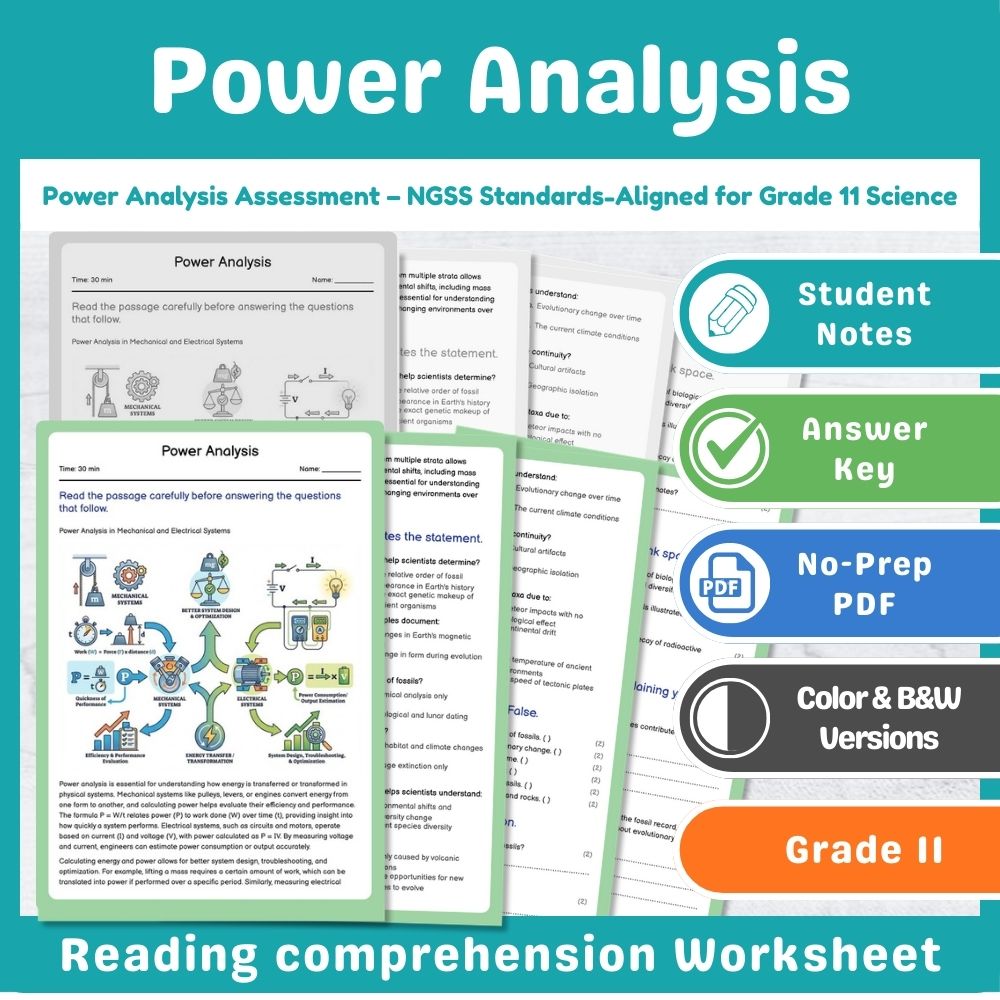
Power Analysis Assessment – NGSS Standards-Aligned for Grade 11 Science
Created byPrism Point LearningLearning Objectives
- Understand the principles of power calculation in mechanical and electrical systems.
- Apply formulas P = W/t and P = IV to analyze energy transfer and power output.
- Measure relevant data and compare theoretical predictions with actual observations.
Instant download

Grade 11 Science | Design Problem Definition Worksheet | General Standards
Created byLumora LearningLearning Objectives
- Explain how design problem statements separate what must be achieved from what limits the design.
- Differentiate performance criteria from constraints in a design problem.
- Create measurable outcomes that connect a need to quantitative specifications.
Instant download

Orbital Mechanics Worksheet | NGSS Grade 11 Science MCQ Assessment
Created byCedar Grove LearningLearning Objectives
- Understand Kepler's laws of planetary motion and their applications.
- Analyze gravitational interactions and their effects on orbital resonance and stability.
- Interpret observational data to evaluate orbital characteristics such as eccentricity and inclination.
Instant download

Endocrine Control Worksheet | Grade 11 Science Activities
Created byPrism Point LearningLearning Objectives
- Explain how endocrine glands release hormones into the bloodstream to coordinate long-term body processes.
- Describe how negative and positive feedback loops regulate hormone levels and physiological outcomes.
- Use receptor and second-messenger ideas to connect hormone signals to cellular responses.
Also included in: Homeostasis & Body Systems Lesson Bundle | Grade 11 Science | Texas TEKS
Instant download

Energy Balance Worksheet for Grade 11 Science | AP Standards Practice
JCreated byJ.S SheetsLearning Objectives
- Understand the components of the global energy balance and their roles in climate variability.
- Interpret radiative flux diagrams and albedo maps to analyze Earth's energy system.
- Explain phenomena such as seasonal cycles and polar amplification through feedback mechanisms.
Instant download

Grade 11 Quantitative Modeling Worksheet | AP Practice & PDF
Created byClear Sky ClassroomLearning Objectives
- Explain how quantitative models represent biological systems across scales using equations, networks, and statistical relationships.
- Use model parameterization, sensitivity analysis, and validation to connect model predictions to empirical data.
- Compare competing models and describe limitations and sources of uncertainty in biological modeling.
Also included in: Grade 11 Systems Integration and Genetics Science Lesson Bundle: AP +1 more
Instant download

Grade 11 Science – Atomic Structure Worksheet (AP Standards) PDF
Created byEvergreen Desk EducationLearning Objectives
- Describe the roles of protons, neutrons, and electrons in determining atomic identity and behavior
- Explain how emission spectra and mass spectrometry provide evidence for discrete energy levels and isotopes
- Calculate atomic mass using isotopic abundances and interpret what the results imply
Also included in: Grade 11 Chemistry Foundations Science Lesson Bundle: AP Advanced Placement +1 more
Instant download

Grade 11 Science | Energy Organelles Worksheet (TEKS) (PDF)
Created byEvergreen Desk EducationLearning Objectives
- Explain how mitochondria convert chemical energy into ATP using oxidative phosphorylation and electron transport
- Describe how chloroplasts convert light energy into chemical energy through the light reactions and the Calvin cycle
- Compare the structure and function of mitochondria and chloroplasts and relate them to cellular energy demands
Instant download

Reaction Energetics Worksheet | Standards-Aligned Grade 11 Science Practice
JCreated byJ.S SheetsLearning Objectives
- Explain how bond enthalpies and overall enthalpy change (ΔH) determine whether a reaction is exothermic or endothermic
- Calculate reaction enthalpy changes using Hess’s law and standard enthalpies of formation
- Estimate reaction heat using calorimetry relationships between heat flow and temperature change
Instant download

Glycolysis Pathways Review Practice Assessment | Grade 11 Science
Created byPrism Point LearningLearning Objectives
- Describe the main stages of glycolysis from glucose phosphorylation to pyruvate formation.
- Explain how substrate-level phosphorylation and redox cofactor changes affect energy yield in glycolysis.
- Compare aerobic and anaerobic fates of pyruvate and predict how they influence ATP production.
Instant download

Resource Development Worksheet for Grade 11 Science | California Standards
JCreated byJ.S SheetsLearning Objectives
- Understand the differences between renewable and nonrenewable resources and their regional distribution.
- Explain how resource demand impacts ecosystems and sustainability.
- Analyze the relationship between resource use, environmental outcomes, and human development.
Also included in: Grade 11 Human Impact Climate Systems Science Lesson Bundle +1 more
Instant download
About Grade 11 Science Worksheets
Browse 6,616 printable Grade 11 Science worksheets — ready-to-print PDFs with answer keys where available.
Each resource here is built by an independent educator and reviewed for quality. Worksheets print straight from PDF and suit classroom use, homework, or extra practice; most come with answer keys, and you can preview before purchasing.