
Grade 12 Science Worksheets
4,240 worksheets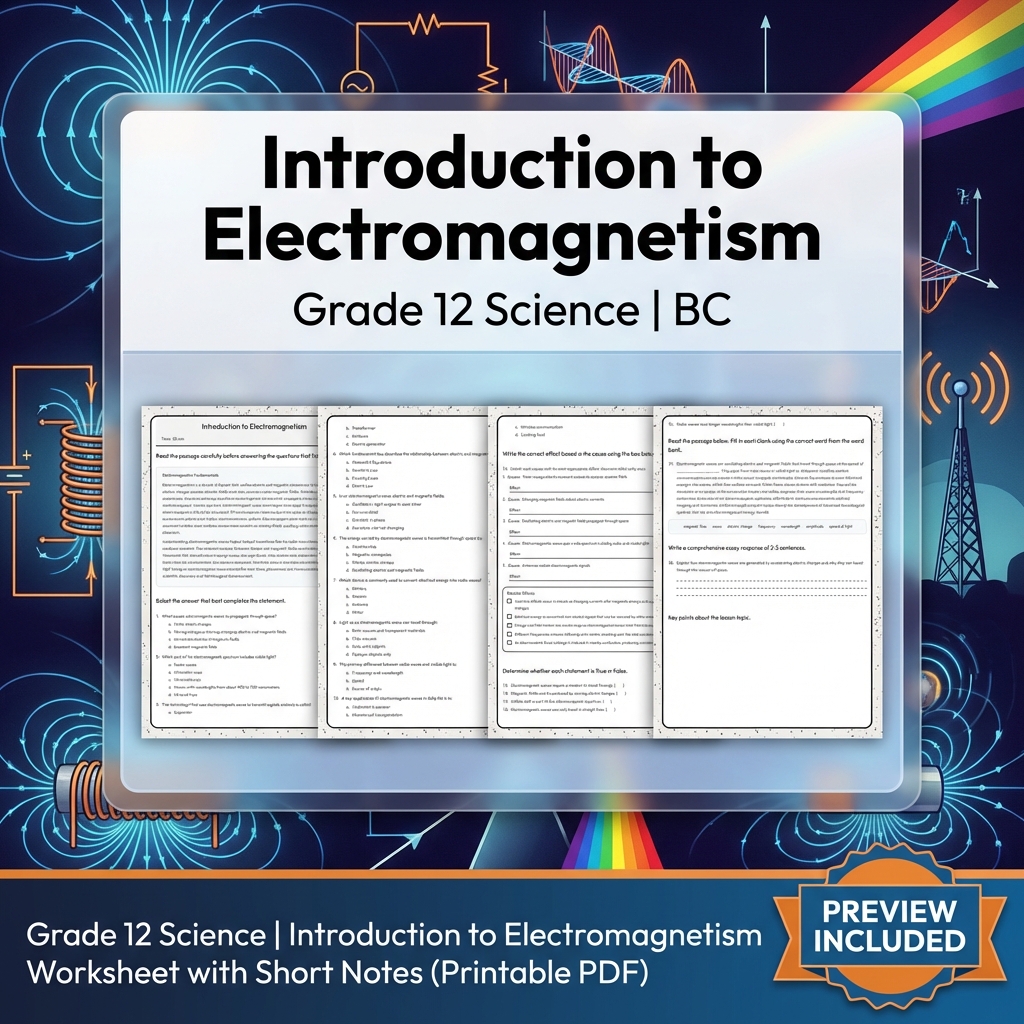
Grade 12 Science | Introduction to Electromagnetism Worksheet with Short Notes
 Created byMeadowlark Worksheets
Learning Objectives
- Understand the fundamental principles linking electric charges, currents, and magnetic fields.
- Explain how time-varying fields generate electromagnetic waves.
- Identify real-world applications of electromagnetism such as antennas and circuit components.
Also included in: Grade 12 Science Lesson Bundle | Wave, Quantum, Electromagnetism Worksheets +1 more
Instant download
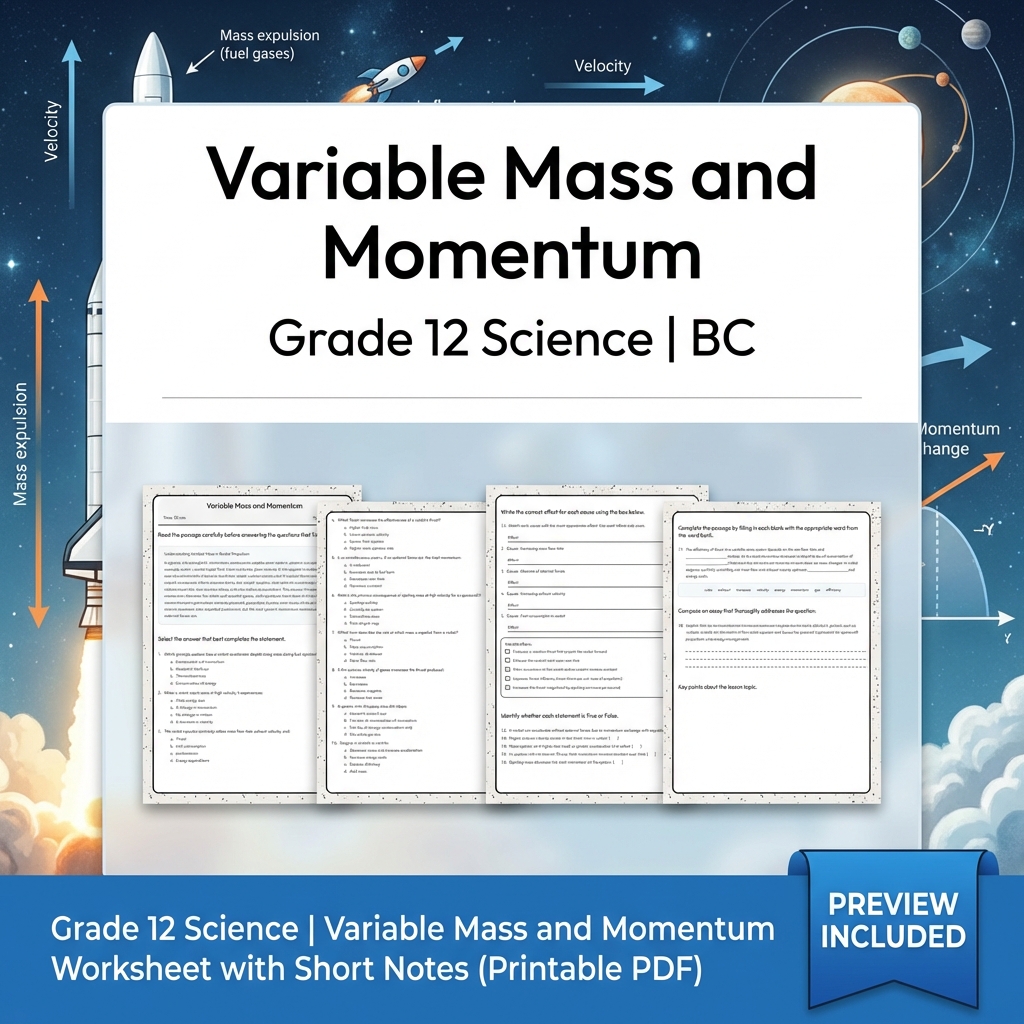
Grade 12 Science | Variable Mass and Momentum Worksheet with Short Notes ( PDF)
Created byMeadowlark WorksheetsLearning Objectives
- Explain how systems with changing mass conserve momentum.
- Describe how ejecting or accreting mass affects the motion of a body.
- Derive the qualitative basis for the rocket equation through momentum exchange.
Also included in: Grade 12 Science Lesson Bundle | Wave, Quantum, Electromagnetism Worksheets +1 more
Instant download
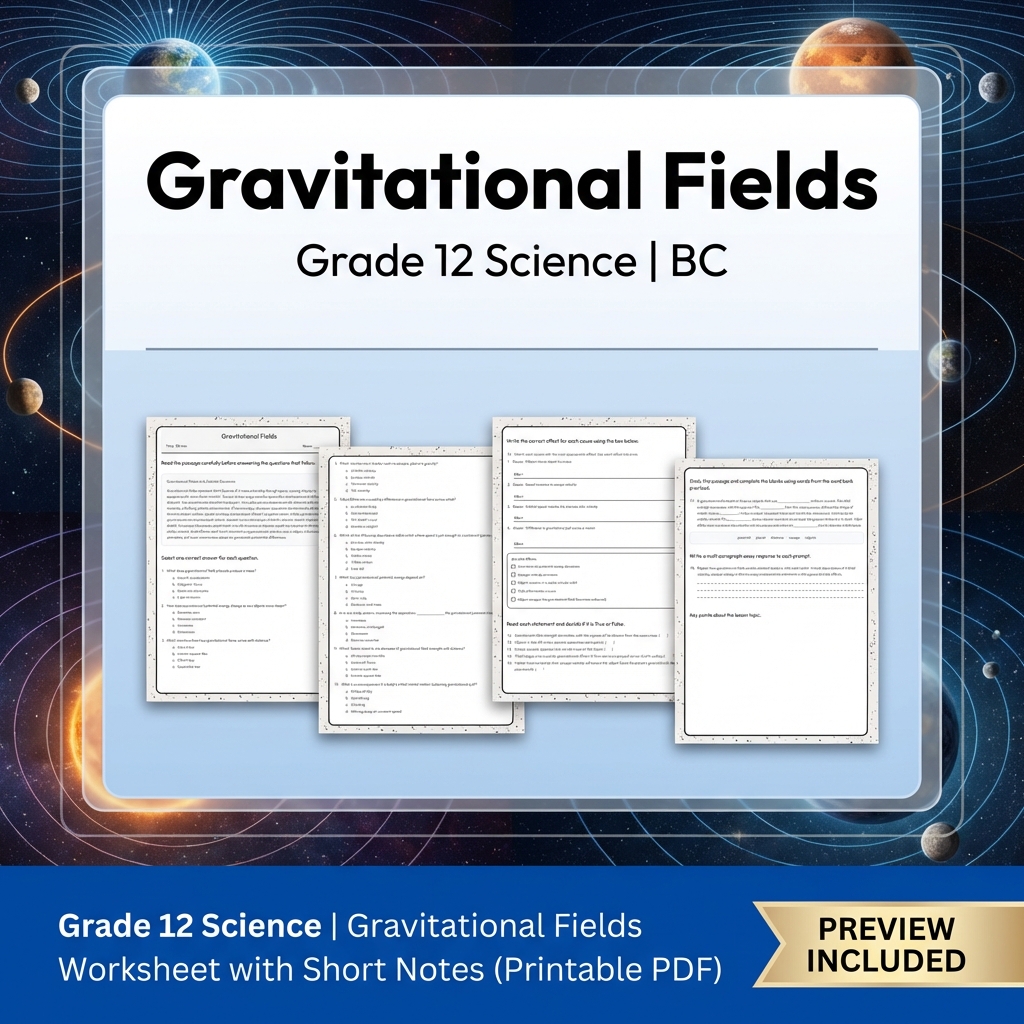
Grade 12 Science | Gravitational Fields Worksheet with Short Notes (PDF)
Created byMeadowlark WorksheetsLearning Objectives
- Describe the concept of gravitational fields as long-range forces producing central accelerations.
- Define gravitational potential and potential energy in two-body systems.
- Explain how field strength varies with distance from mass sources.
Also included in: Grade 12 Science Lesson Bundle | Wave, Quantum, Electromagnetism Worksheets +1 more
Instant download
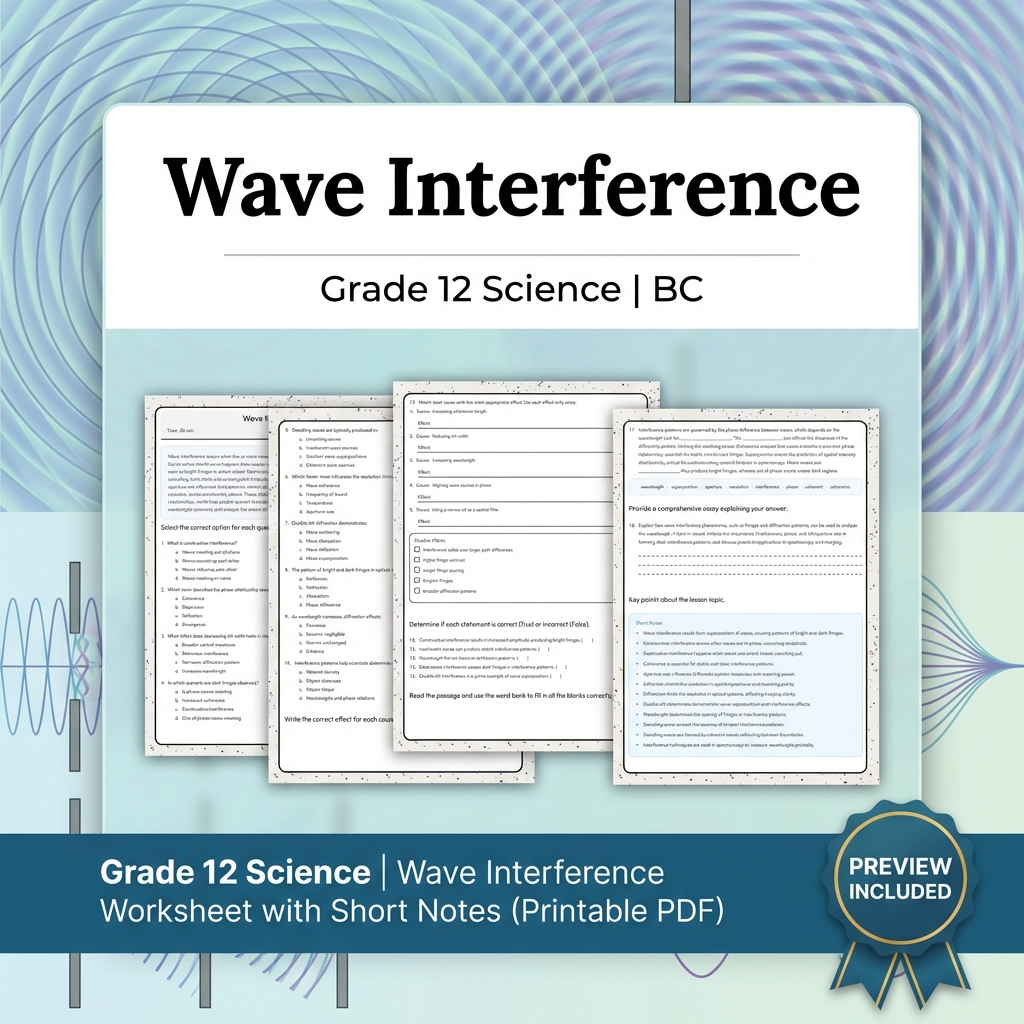
Grade 12 Science | Wave Interference Worksheet with Short Notes (Printable PDF)
Created byMeadowlark WorksheetsLearning Objectives
- Explain the principles of wave interference, including constructive and destructive interference.
- Describe coherence requirements for wave interference phenomena.
- Analyze patterns produced by single- and double-slit diffraction.
Also included in: Grade 12 Science Lesson Bundle | Wave, Quantum, Electromagnetism Worksheets +1 more
Instant download
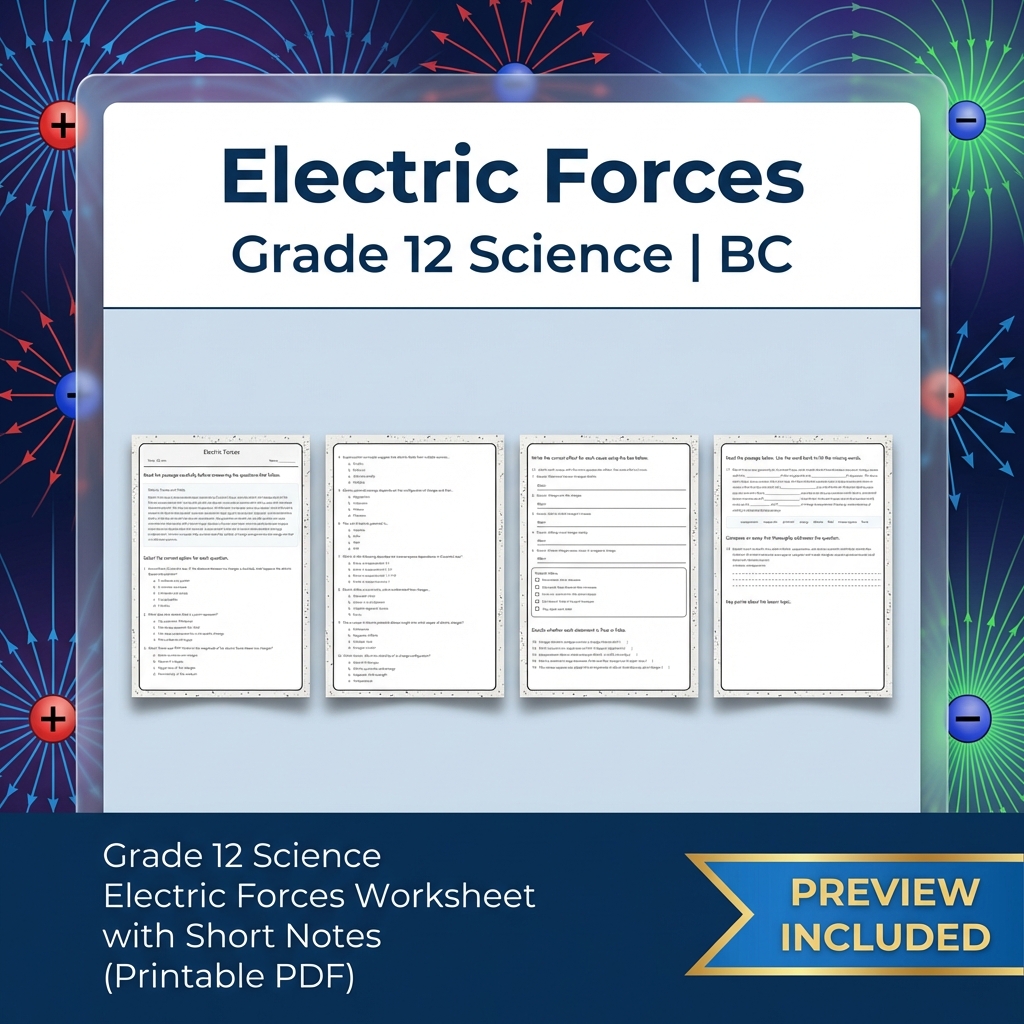
Grade 12 Science Electric Forces Worksheet with Short Notes (Printable PDF)
Created byMeadowlark WorksheetsLearning Objectives
- Understand Coulomb’s law and how it defines the magnitude and direction of electric forces between point charges.
- Explain the concept of electric fields as spatial maps of force per unit charge.
- Describe superposition and how multiple charges influence electric force and potential.
Also included in: Grade 12 Science Lesson Bundle | Wave, Quantum, Electromagnetism Worksheets +1 more
Instant download
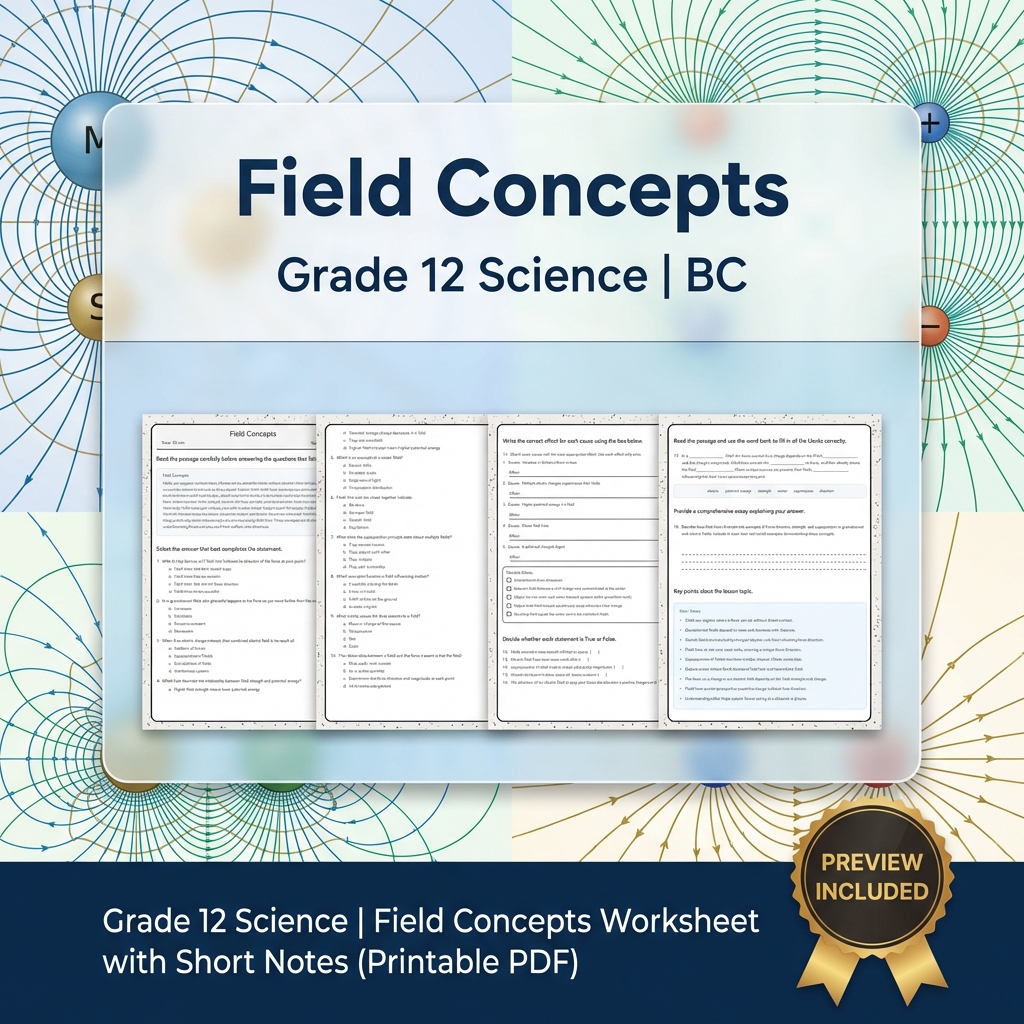
Grade 12 Science | Field Concepts Worksheet with Short Notes (Printable PDF)
Created byMeadowlark WorksheetsLearning Objectives
- Explain the nature of vector fields such as gravitational and electric fields.
- Describe how field lines visualize the direction and strength of a field.
- Understand the superposition principle for multiple sources in fields.
Also included in: Grade 12 Science Lesson Bundle | Wave, Quantum, Electromagnetism Worksheets +1 more
Instant download
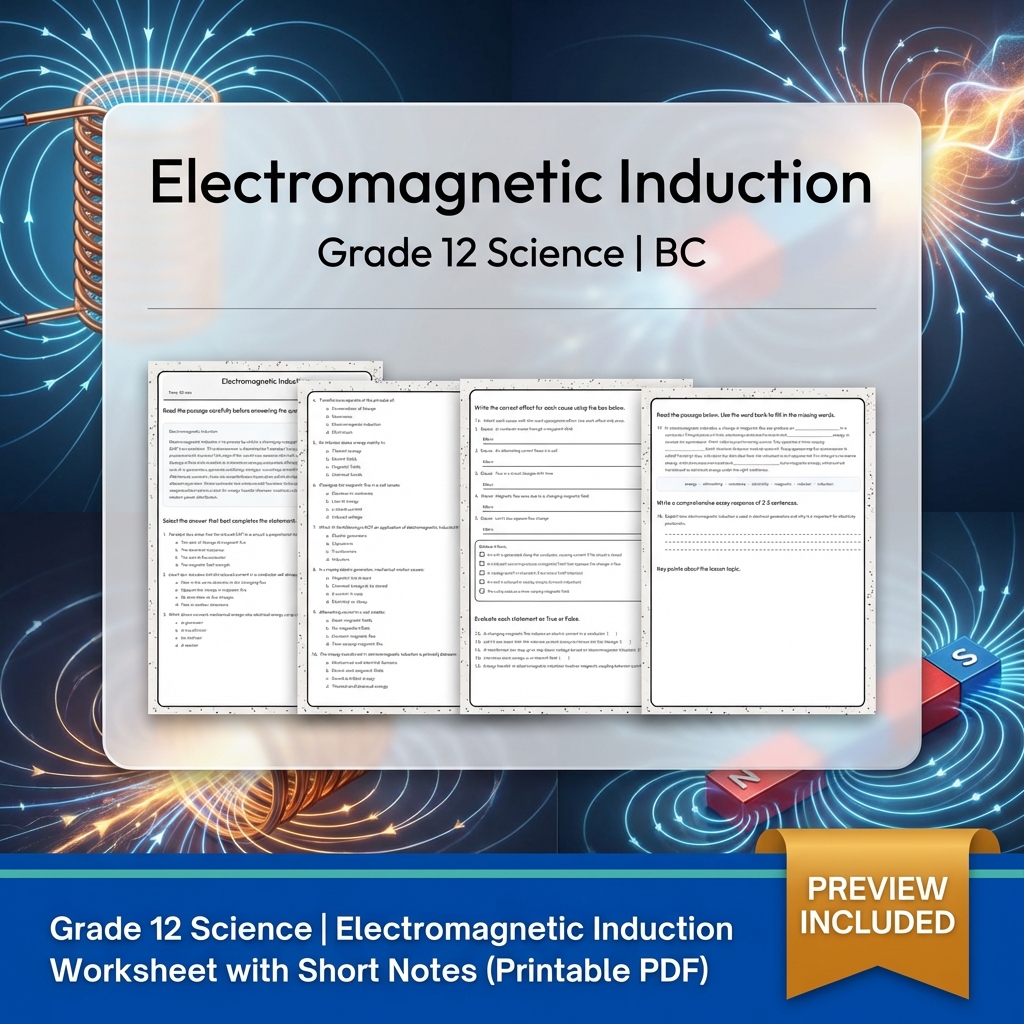
Grade 12 Science | Electromagnetic Induction Worksheet with Short Notes (PDF)
Created byMeadowlark WorksheetsLearning Objectives
- Explain the process of electromagnetic induction and its underlying principles.
- Describe how moving conductors and alternating currents produce induced voltages.
- Understand the practical applications of electromagnetic induction in generators, transformers, and inductors.
Also included in: Grade 12 Science Lesson Bundle | Wave, Quantum, Electromagnetism Worksheets +1 more
Instant download
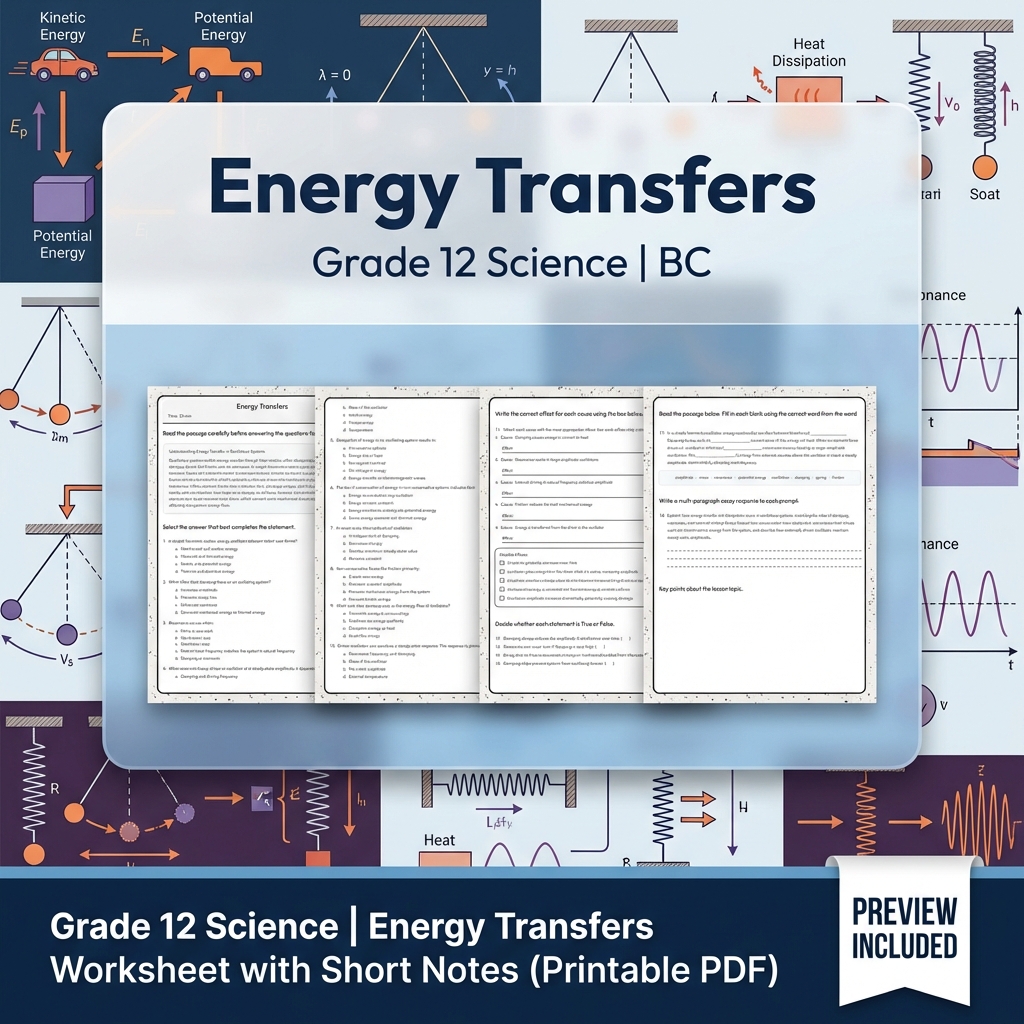
Grade 12 Science | Energy Transfers Worksheet with Short Notes (Printable PDF)
Created byMeadowlark WorksheetsLearning Objectives
- Understand the principles of energy transfer and dissipation in oscillatory systems.
- Define and explain simple harmonic motion, resonance, and damping effects.
- Analyze how non-conservative forces affect energy flow and amplitude in oscillators.
Also included in: Grade 12 Science Lesson Bundle | Wave, Quantum, Electromagnetism Worksheets +1 more
Instant download
Grade 12 Science Quantum Photons Worksheet with Short Notes PDF
Created byMeadowlark WorksheetsLearning Objectives
- Explain the concept of photons and their energy quantization.
- Understand the photoelectric effect and its significance in quantum physics.
- Relate the energy of photons to their frequency using E = hf.
Also included in: Grade 12 Science Lesson Bundle | Wave, Quantum, Electromagnetism Worksheets +1 more
Instant download
Grade 12 Science Momentum Conservation Worksheet with Short Notes (PDF)
Created byMeadowlark WorksheetsLearning Objectives
- Understand the principle of conservation of linear momentum in isolated systems.
- Define momentum and impulse, and explain their relationship.
- Describe centre-of-mass motion and its conservation in negligible external force scenarios.
Also included in: Grade 12 Science Lesson Bundle | Wave, Quantum, Electromagnetism Worksheets +1 more
Instant download

Grade 12 Science – Atomic Models Daily Reading Worksheet + Answer Key
JCreated byJ.S SheetsLearning Objectives
- Identify key historical figures in atomic theory.
- Describe the development of atomic models from Dalton to Bohr.
- Understand empirical evidence supporting atomic theories.
Also included in: Grade 12 Science Lesson Group Bundle | TEKS Standards +1 more
Instant download

Grade 12 Science – Stoichiometry Calculations Daily Worksheet + Answer Key
JCreated byJ.S SheetsLearning Objectives
- Understand and apply the mole concept to convert between mass, moles, and particles.
- Calculate molar mass, empirical, and molecular formulas.
- Perform percent composition calculations.
Also included in: Grade 12 Science Lesson Group Bundle | TEKS Standards +1 more
Instant download

Grade 12 Science – Balancing Reactions Daily Reading Worksheet with Answer Key
JCreated byJ.S SheetsLearning Objectives
- Understand the representation of chemical reactions through symbolic equations.
- Apply the law of conservation of mass to balance chemical equations.
- Classify different reaction types: synthesis, decomposition, single and double replacement, and combustion.
Also included in: Grade 12 Science Lesson Group Bundle | TEKS Standards +1 more
Instant download

Grade 12 Science – Thermodynamics Energy Conservation Worksheet + Answer Key
JCreated byJ.S SheetsLearning Objectives
- Understand the principles of energy, internal energy, enthalpy, entropy, and Gibbs free energy
- Learn how the first and second laws of thermodynamics apply to chemical systems
- Predict spontaneity and equilibrium in reactions using thermodynamic concepts
Also included in: Grade 12 Science Lesson Group Bundle | TEKS Standards +1 more
Instant download

Grade 12 Enthalpy Change Worksheet | NGSS Practice PDF
 Created byClear Sky Classroom
Learning Objectives
- Explain the meaning of enthalpy change (ΔH) and distinguish exothermic and endothermic reactions using sign conventions.
- Calculate or interpret reaction enthalpies using ideas behind Hess’s law and standard enthalpies of formation.
- Apply calorimetry and bond-energy/thermochemical reasoning to predict heat absorbed or released and its environmental relevance.
Instant download

Grade 12 Science – Periodic Trends & Atomic Radius | Daily Reading Worksheet
 Created byBright Mind Resources
Learning Objectives
- Understand the concept of atomic radius and its significance
- Identify trends in atomic radius across periods and down groups
- Interpret how atomic structure influences atomic size
Also included in: Grade 12 Chemistry Daily Reading Worksheets Lesson Bundle | Alberta Science +1 more
Instant download

Wave Behaviour Worksheet | Grade 12 Science | Alberta Standards
JCreated byJ.S SheetsLearning Objectives
- Describe the key characteristics of wave behaviour, including wavelength, frequency, amplitude, and speed.
- Use quantitative models to predict wave propagation in different media and contexts.
- Explain real-world examples of wave phenomena such as acoustic waves, seismic waves, and optical refraction.
Instant download
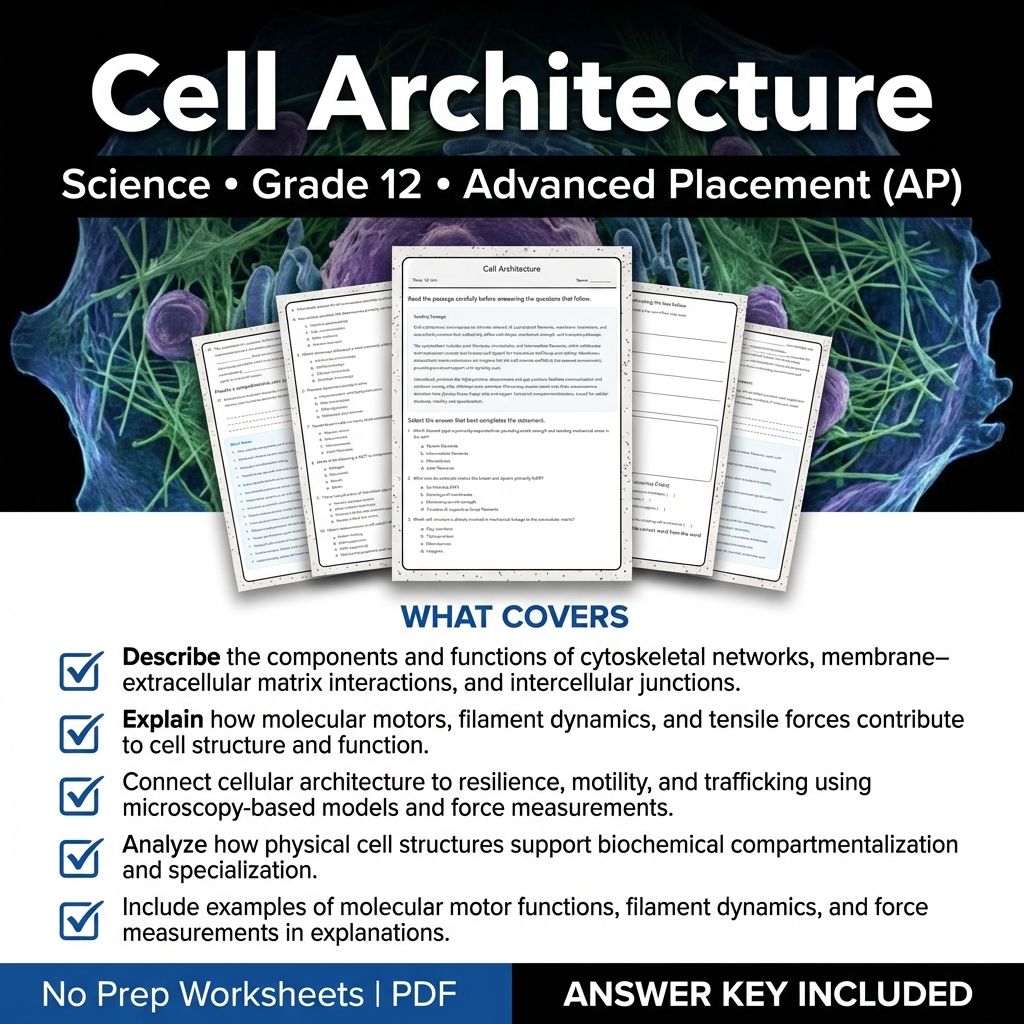
12th Grade Science | Cell Architecture Worksheet with Answer Key (PDF)
 Created byCoral Reef Learning
Learning Objectives
- Describe the components and functions of cytoskeletal networks, membrane–extracellular matrix interactions, and intercellular junctions.
- Explain how molecular motors, filament dynamics, and tensile forces contribute to cell structure and function.
- Connect cellular architecture to resilience, motility, and trafficking using microscopy-based models and force measurements.
Also included in: Grade 12 Science Unit Worksheet Bundle – Cell Biology, Genetics & Ecology +1 more
Instant download
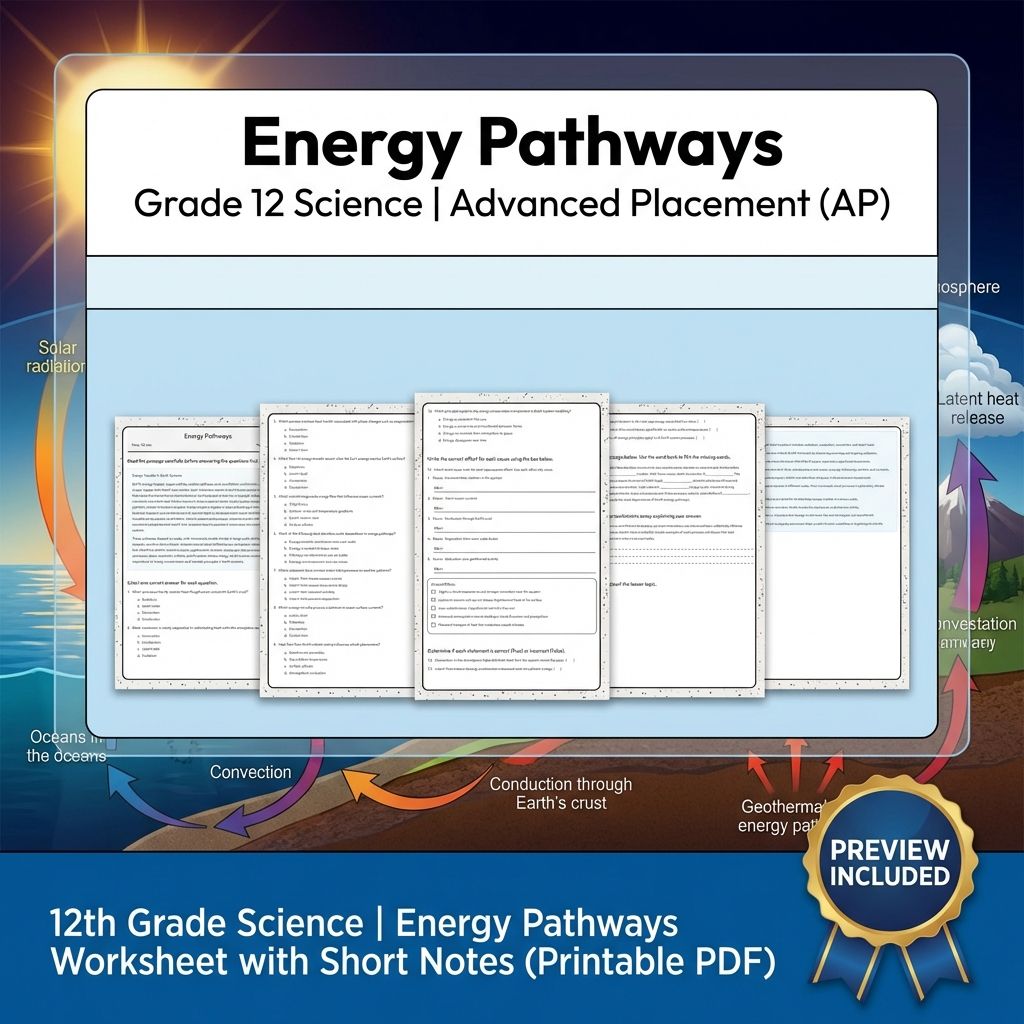
12th Grade Science | Energy Pathways Worksheet with Short Notes (Printable PDF)
Created byMeadowlark WorksheetsLearning Objectives
- Describe the different mechanisms of energy transfer within Earth systems.
- Explain how radiative balance, conduction, convection, and latent heat influence weather, ocean currents, and geothermal activity.
- Use quantitative reasoning to analyze energy budgets and flux diagrams.
Also included in: Grade 12 Science Unit Bundle: Earth Systems, Climate & Tectonics Worksheet Pack +1 more
Instant download

Grade 12 Science | Radiometric Dating - Daily Reading Comprehension
Created byCoral Reef LearningLearning Objectives
- Understand the principles of isotopes and radioactive decay
- Identify different methods of radiometric dating
- Explain concepts like half-life, closure temperature, and isotope systematics
Instant download

Grade 12 Science | Evidence Based Claims Worksheet | NGSSS Aligned
 Created byLumora Learning
Learning Objectives
- Explain what makes a scientific claim evidence-based rather than opinion-based.
- Identify how evidence, mechanisms, and predictions work together to support or challenge an explanation.
- Evaluate claims for reliability by checking whether they can be tested and revised when new data appear.
Instant download
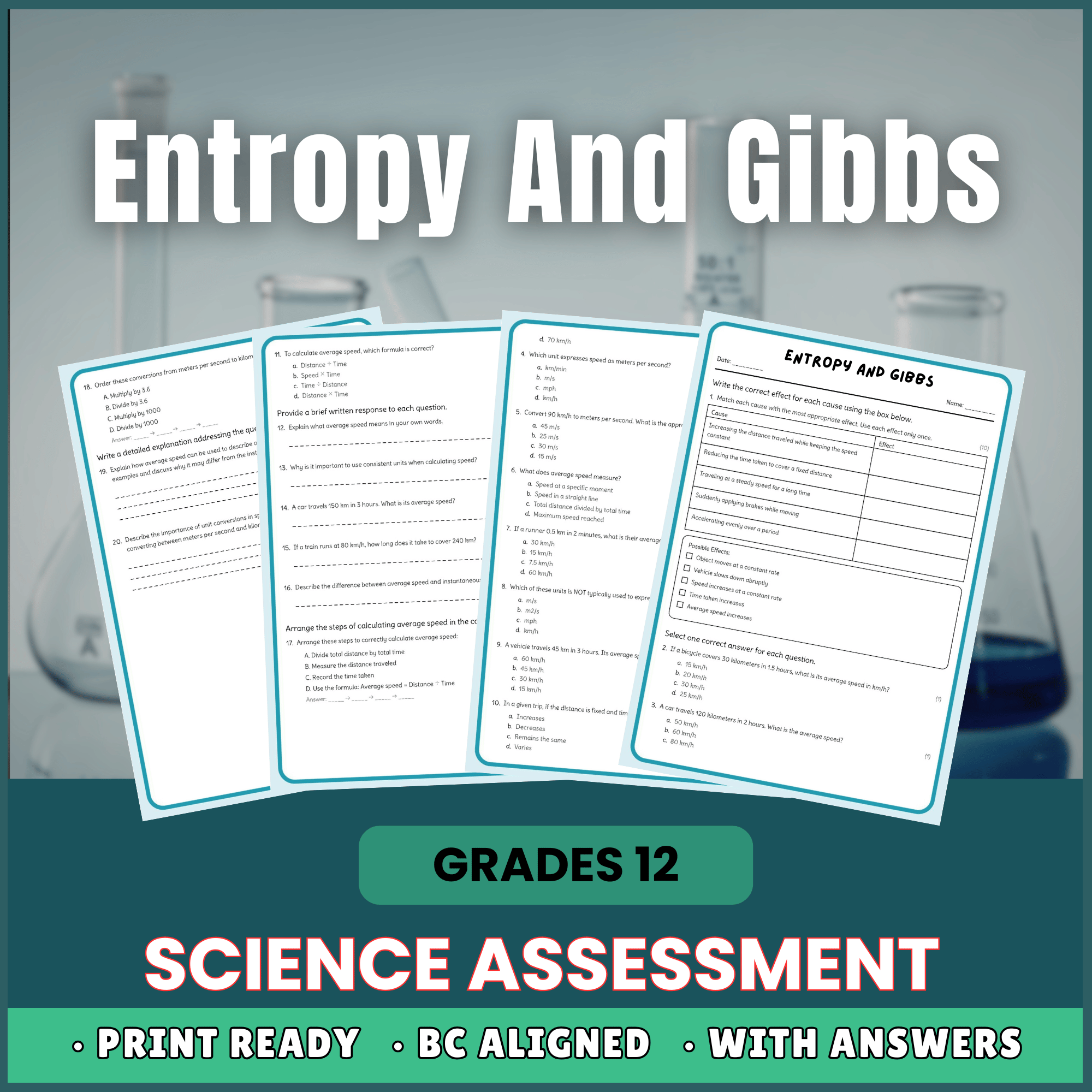
Grade 12 Science – Entropy & Gibbs Free Energy Worksheet (Answer Key) – BC
Created byBright Mind ResourcesLearning Objectives
- Understand the concept of entropy as a measure of energy dispersal and system disorder.
- Explain how Gibbs free energy predicts the spontaneity of chemical processes.
Instant download

Grade 12 Science – Redox Processes Worksheet (TEKS) PDF
 Created byEvergreen Desk Education
Learning Objectives
- Use oxidation numbers to identify oxidation and reduction in chemical reactions.
- Write and balance redox equations in acidic and basic media using electron-transfer logic.
- Connect galvanic and electrolytic cells to standard reduction potentials and use cell notation to calculate cell EMF.
Instant download

Grade 12 Science | Statistical Reasoning Worksheet (TEKS) PDF
Created byEvergreen Desk EducationLearning Objectives
- Explain how hypothesis tests, confidence intervals, p-values, effect sizes, and statistical power relate to one another in scientific studies
- Evaluate assumptions for parametric vs. nonparametric methods and identify suitable tests (t-tests, chi-square tests, and regression) for given scenarios
- Interpret correlation vs. causation and use diagnostic checks (residuals, assumptions, and validation via bootstrap/permutation) to support conclusions
Instant download

Grade 12 Science – Devices & Radiation Reading Worksheet | California Standards
Created byBright Mind ResourcesLearning Objectives
- Understand the basic principles of light reflection, refraction, and absorption.
- Identify how electromagnetic radiation interacts with different materials and devices.
- Describe how imaging and communication systems use wave behavior to function effectively.
Also included in: Energy Grade 12 Science Daily Reading Worksheets Lesson Bundle | CA Standards +1 more
Instant download
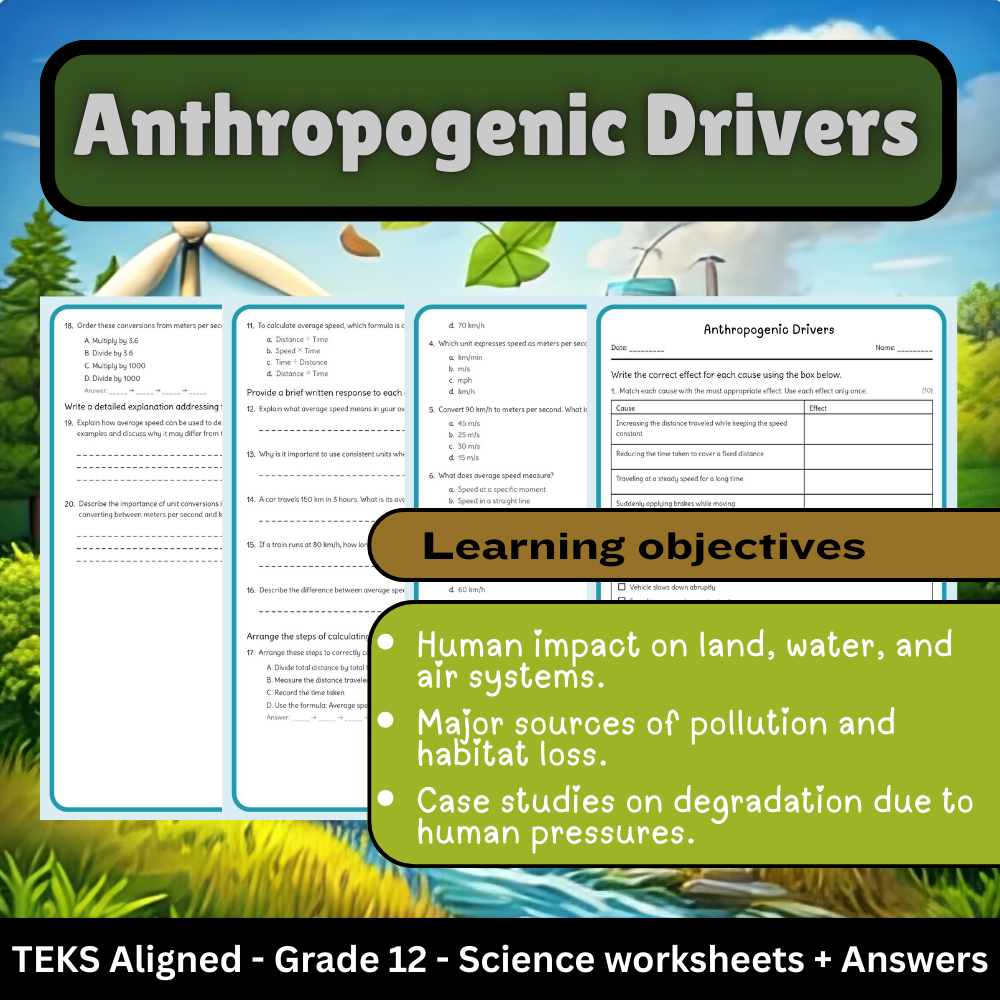
Grade 12 Science | Anthropogenic Drivers Worksheet + Answer Key) – TEKS Aligned
Created byBright Mind ResourcesLearning Objectives
- Understand how human activities impact land, water, and air systems.
- Identify major anthropogenic sources of pollution and habitat loss.
- Analyze case phenomena relating to ecosystem degradation due to human pressures.
Instant download
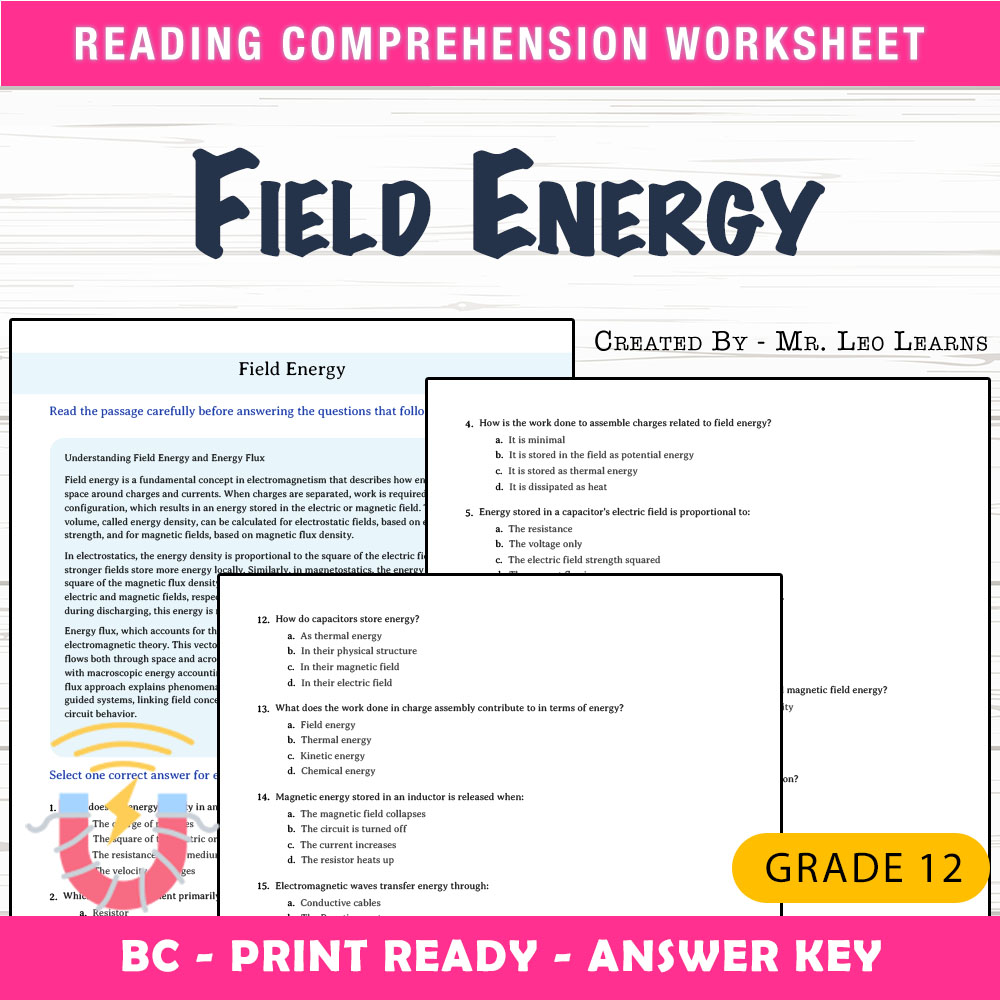
Grade 12 Science — Worksheet MCQ Paper for Mastering Field Energy
 Created byThe Resource Hub
Learning Objectives
- Understand the concept of energy stored in electric and magnetic fields.
- Define energy density for electrostatic and magnetic fields.
- Explain how capacitors and inductors store and release energy in circuits.
Also included in: Grade 12 Science | Physics 12 Wave & Quantum Concepts Worksheet Bundle +1 more
Instant download
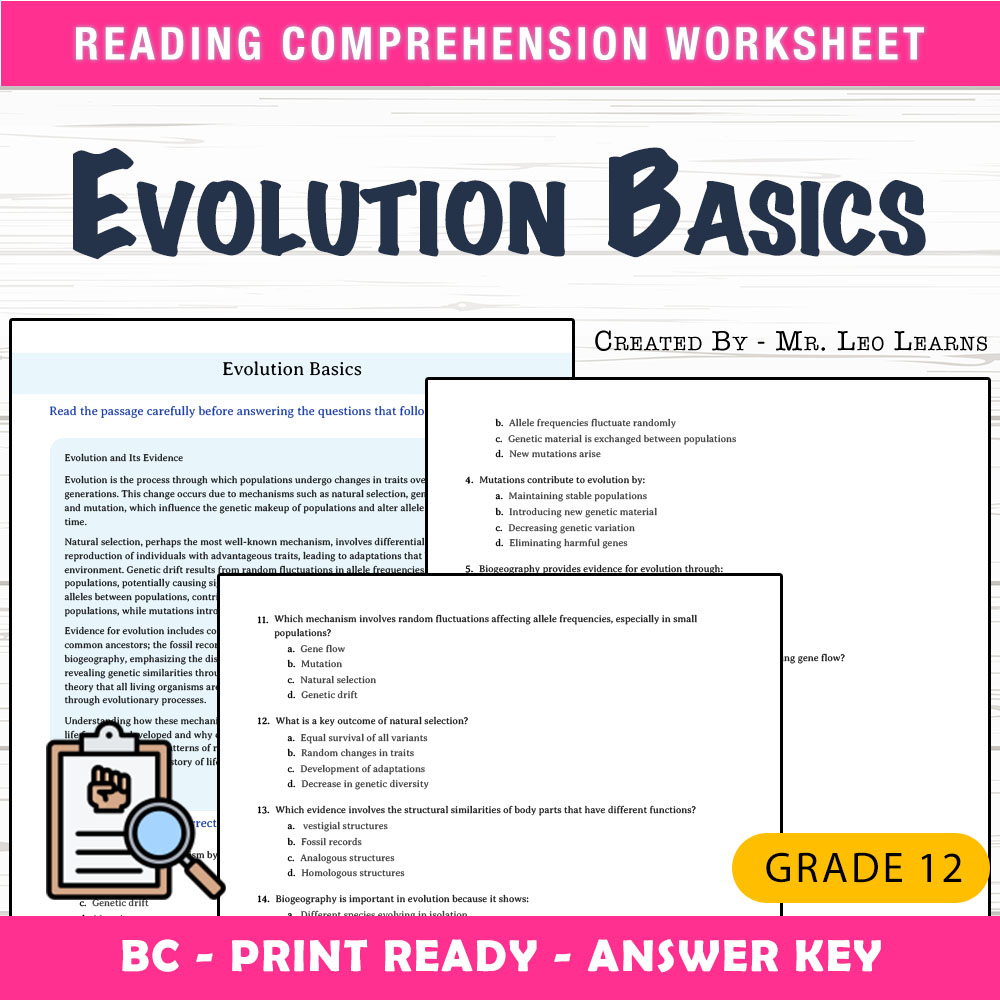
Grade 12 Science — Worksheet MCQ Paper for Mastering Evolution Basics
Created byThe Resource HubLearning Objectives
- Understand the fundamental concepts of evolution and how populations change over time.
- Identify and explain the mechanisms driving evolutionary change such as natural selection, genetic drift, gene flow, and mutation.
- Recognize the types of evidence used to support evolutionary theory, including fossil records, comparative anatomy, biogeography, and molecular data.
Also included in: Grade 12 Science BC | Biology Unit Worksheet Pack with MCQs (15 Worksheets) +1 more
Instant download
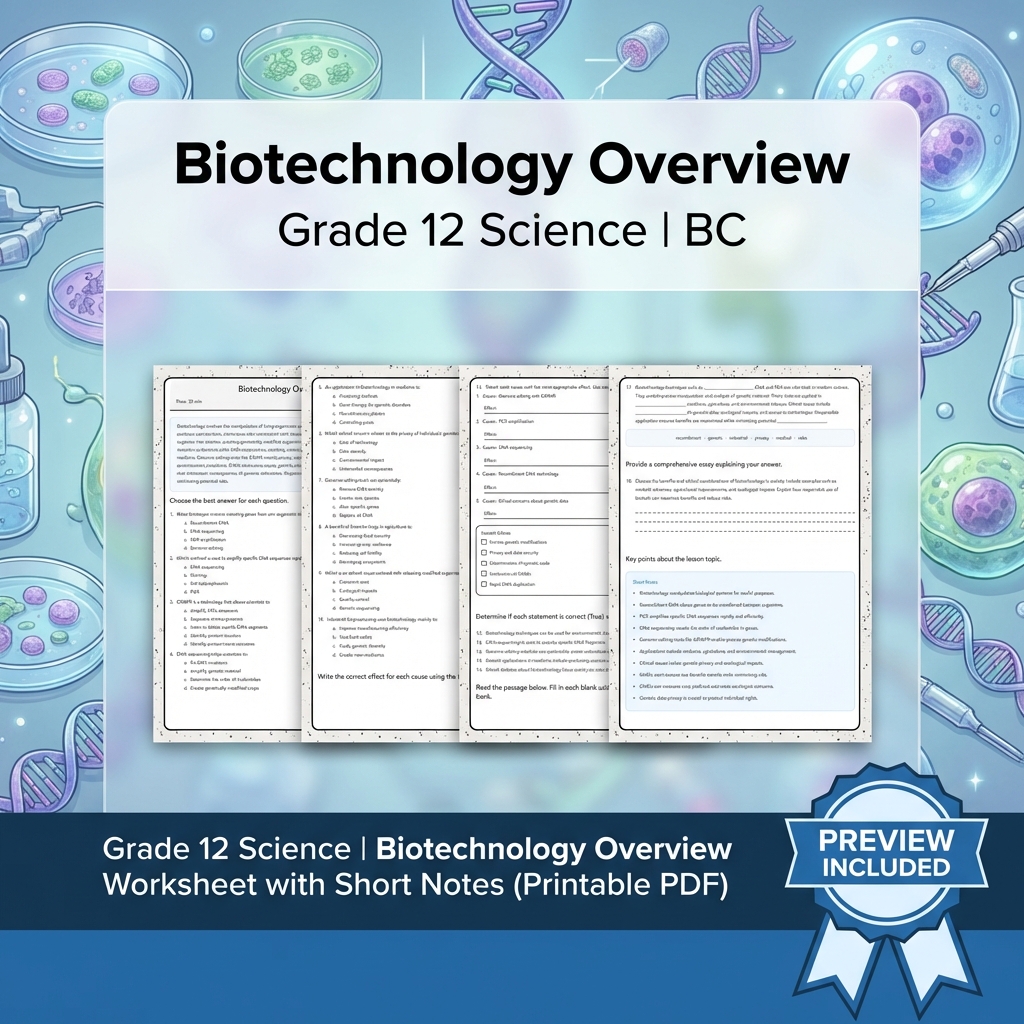
Grade 12 Science | Biotechnology Overview Worksheet with Short Notes (PDF)
Created byMeadowlark WorksheetsLearning Objectives
- Understand key techniques used in biotechnology such as recombinant DNA, PCR, and genome editing.
- Identify applications of biotechnology in medicine, agriculture, and industry.
- Evaluate ethical considerations associated with biotechnological advances.
Also included in: Grade 12 Science Lesson Bundle | Genetics & Evolution Worksheets +1 more
Instant download

Grade 12 DNA To Proteins Worksheet | Practice & Assessment PDF
Created byClear Sky ClassroomLearning Objectives
- Explain how base pairing in DNA and RNA enables faithful information transfer during gene expression
- Describe how codons in messenger RNA determine the order of amino acids in a protein
- Connect changes in DNA sequence (mutations) to changes in protein structure and function
Instant download
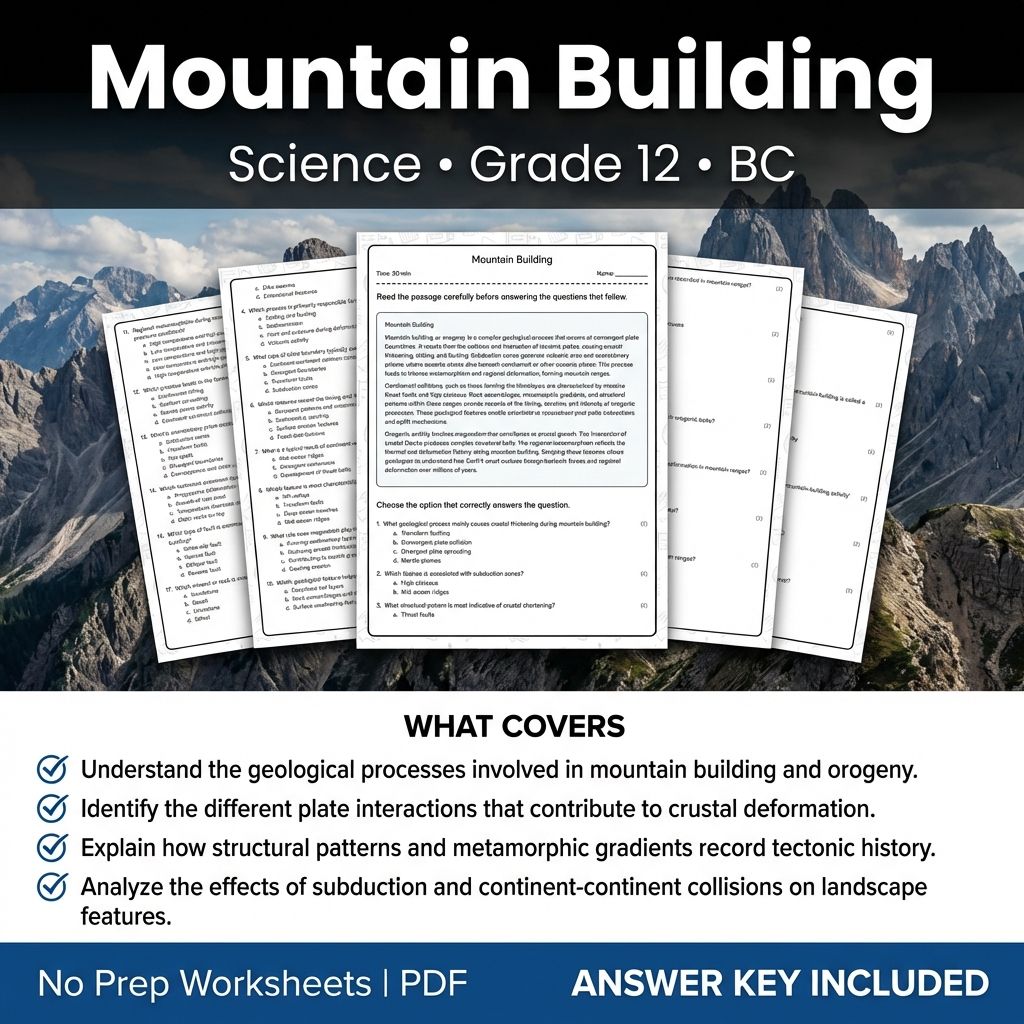
Mountain Building Science Worksheet Grade 12 | Standard BC Practice
Created byCoral Reef LearningLearning Objectives
- Understand the geological processes involved in mountain building and orogeny.
- Identify the different plate interactions that contribute to crustal deformation.
- Explain how structural patterns and metamorphic gradients record tectonic history.
Instant download
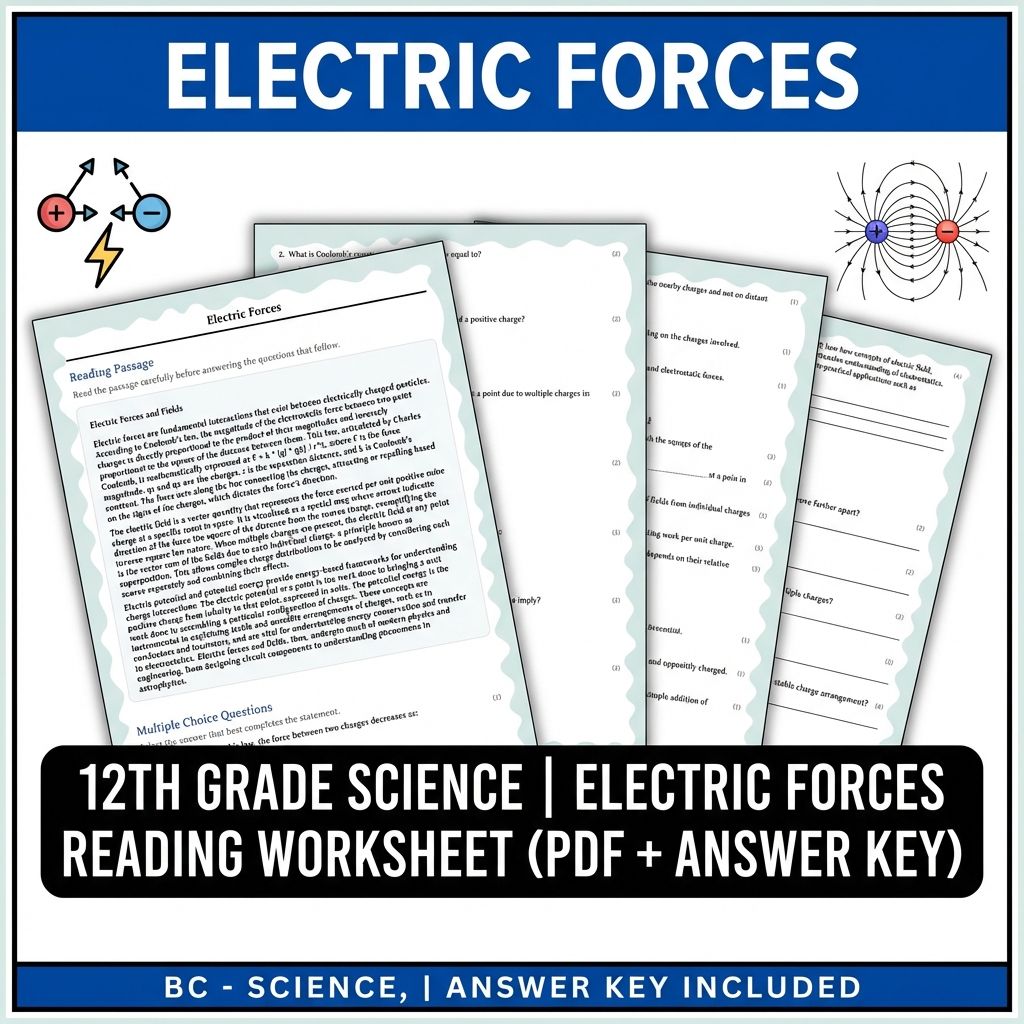
12th Grade Science | Electric Forces Reading Worksheet (PDF + Answer Key)
JCreated byJ.S SheetsLearning Objectives
- Explain Coulomb’s law and calculate the magnitude and direction of electric forces between point charges.
- Describe the concept of electric field as a spatial representation of force per unit charge.
- Understand superposition principle for multiple electric sources and its effect on net force.
Instant download

Grade 12 Science | Dynamics of Systems Worksheet Elena | AP Aligned
Created byLumora LearningLearning Objectives
- Analyze multi-body systems with constraints using equation relations.
- Apply free-body diagrams to component analysis in pulley and connected-mass systems.
- Understand the propagation of tension and normal forces in idealized systems.
Instant download

Grade 12 Science – Chemical Fate & Pollution Processes | Daily Reading Worksheet
Created byBright Mind ResourcesLearning Objectives
- Understand the processes involved in the transport and transformation of chemicals in soil and water systems.
- Identify key factors influencing chemical partitioning, degradation, and persistence.
- Apply knowledge of chemical fate to case studies involving agricultural runoff and petrochemical spills.
Also included in: Grade 12 Environmental & STSE Science Daily Reading Lesson Bundle | Alberta +1 more
Instant download

Grade 12 Electron Configuration Worksheet | Alberta Chemistry Practice
Created byEvergreen Desk EducationLearning Objectives
- Explain how Aufbau, Pauli exclusion, and Hund’s rules determine electron configuration for main-group elements.
- Predict valence electrons and common ion charges from electron configurations and subshell filling.
- Use configuration logic to justify periodic trends in bonding tendency and chemical reactivity.
Instant download

Grade 12 Science – Genomic Technologies & DNA Structure | Reading Worksheet
Created byBright Mind ResourcesLearning Objectives
- Understand the structure and components of DNA.
- Explain the principles of DNA replication and double helix structure.
- Identify key genomic technologies such as PCR, DNA sequencing, and CRISPR.
Also included in: Biological Concepts Grade 12 Science Daily Reading Lesson Bundle | TEKS +2 more
Instant download

Grade 12 Science – Biodiversity Conservation & TEKS Daily Reading Worksheet
Created byBright Mind ResourcesLearning Objectives
- Identify different types of biodiversity
- Understand causes of biodiversity loss
- Recognize conservation strategies and their importance
Also included in: Biological Concepts Grade 12 Science Daily Reading Lesson Bundle | TEKS +2 more
Instant download
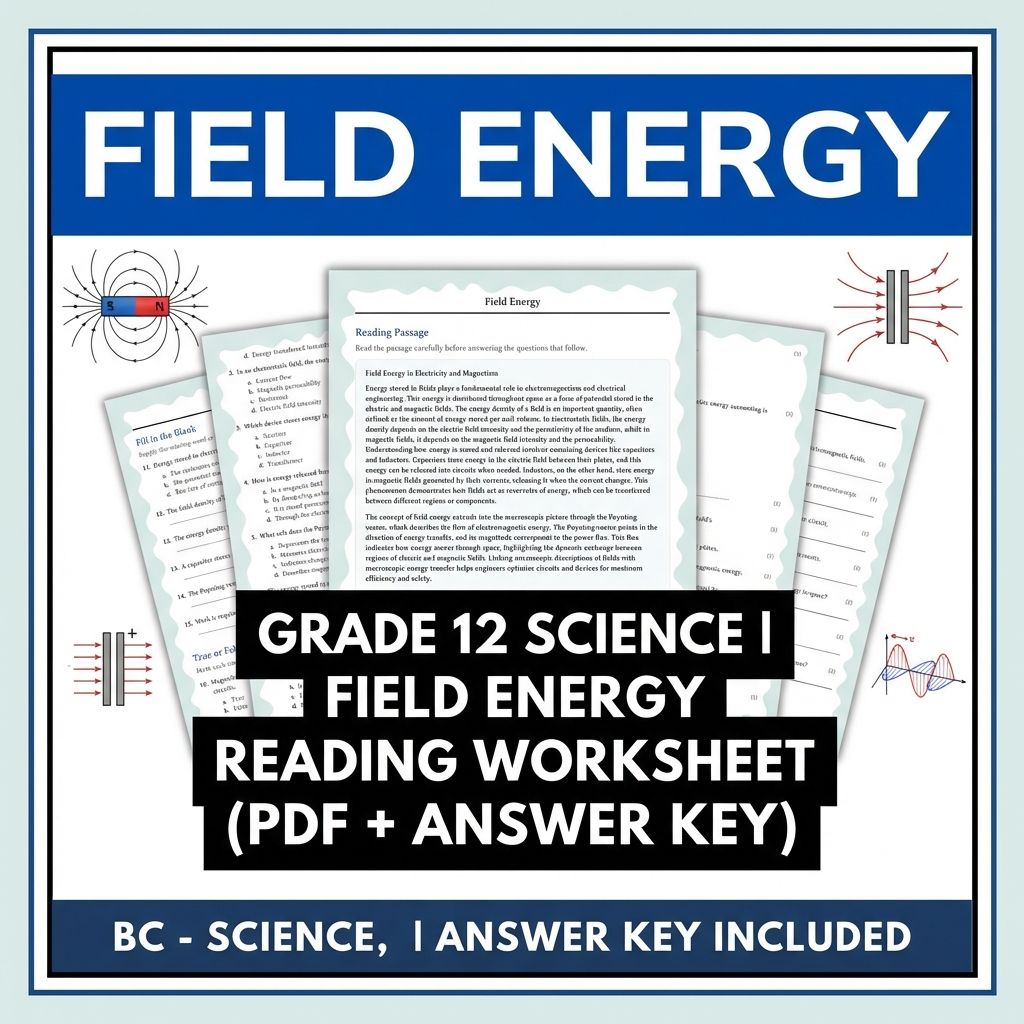
Grade 12 Science | Field Energy Reading Worksheet (PDF + Answer Key)
JCreated byJ.S SheetsLearning Objectives
- Define energy density in electrostatic and magnetic fields.
- Explain how capacitors and inductors store and release energy in circuits.
- Describe the concept of field energy as distributed in space and how work is required to assemble charge configurations.
Instant download

Grade 12 Science | Modeling Systems Worksheet | TEKS Aligned
Created byLumora LearningLearning Objectives
- Understand the role of conceptual and quantitative models in system analysis.
- Differentiate between deterministic and stochastic modeling frameworks.
- Apply principles of dimensional analysis, scaling, and sensitivity testing.
Instant download

Grade 12 Science | Molecular Geometry Worksheet Elena | AP Aligned
Created byLumora LearningLearning Objectives
- Understand the principles of valence-shell electron-pair repulsion and hybridization models in predicting molecular shapes.
- Identify how molecular geometry influences polarity and symmetry.
- Relate three-dimensional molecular structures to observable properties such as dipole moments and intermolecular forces.
Instant download

Grade 12 Science | Bonding Basics Worksheet Elena | AP Standard
Created byLumora LearningLearning Objectives
- Describe the principal types of chemical bonding: ionic, covalent, and metallic.
- Explain how charge distribution, lattice structures, and shared-electron models characterize bonding.
- Analyze how different bond types influence bulk properties such as electrical conductivity, melting point, and solubility.
Instant download

Grade 12 Science | Bonding Models Worksheet Elena | AP Standards
Created byLumora LearningLearning Objectives
- Explain the principles of molecular orbital theory and band concepts as extensions of valence-bond descriptions.
- Analyze bonding order, delocalization, and electronic structures in diatomic and extended systems.
- Use energy-level diagrams and symmetry considerations to predict magnetic behavior, bond strength, and electronic transitions.
Instant download
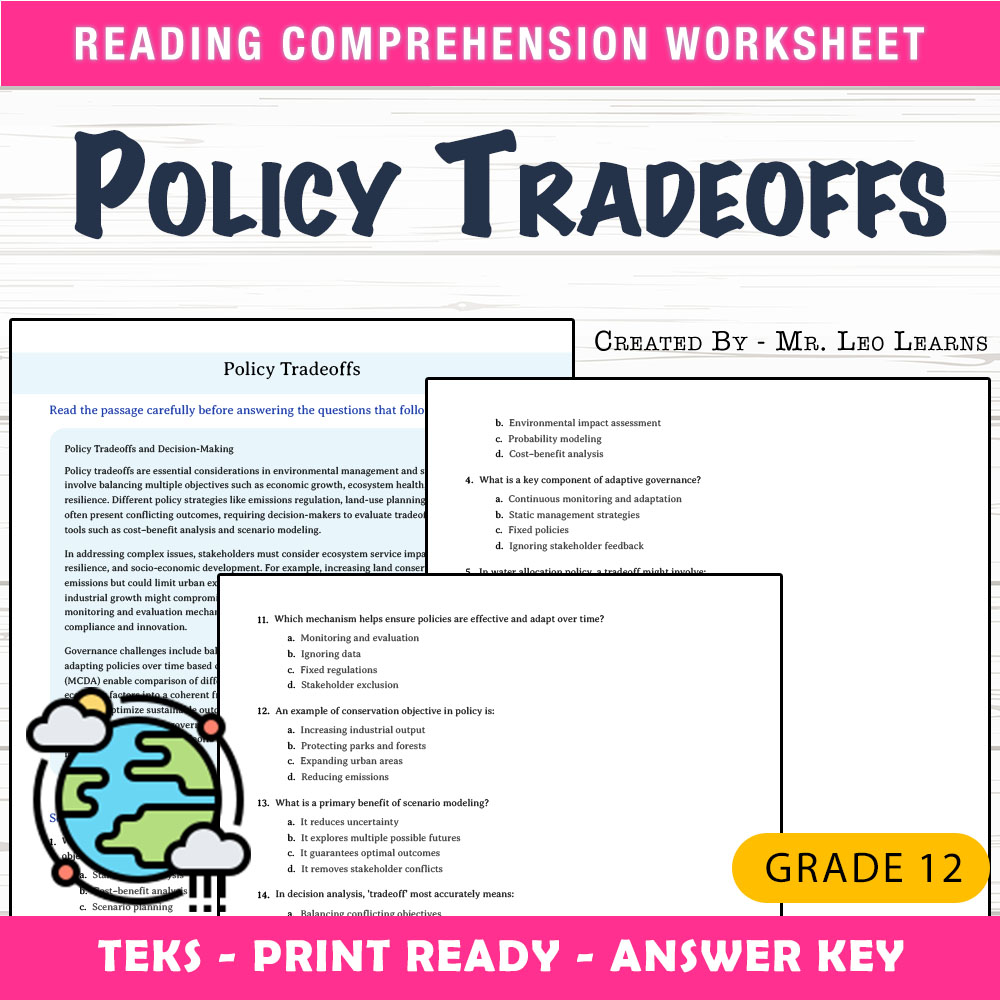
Grade 12 Science | Policy Tradeoffs Worksheet for Mastery
Created byThe Resource HubLearning Objectives
- Understand the concept of policy tradeoffs in environmental decision-making.
- Analyze case studies involving mitigation, adaptation, conservation, and socio-economic objectives.
- Apply cost–benefit reasoning and multi-criteria decision analysis to compare outcomes.
Also included in: Grade 12 Science | Sustainability & Environmental Management Worksheet Bundle +1 more
Instant download
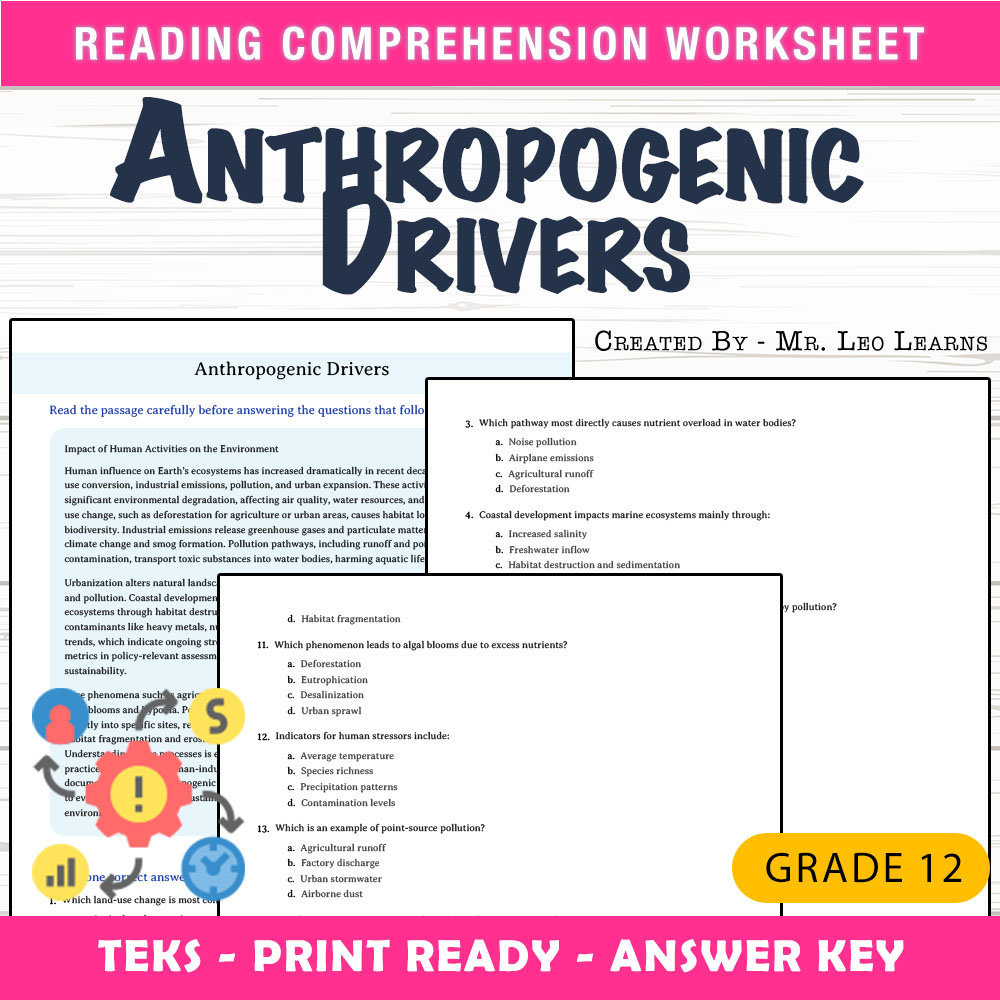
Grade 12 Science — Anthropogenic Drivers Worksheet for Mastery
Created byThe Resource HubLearning Objectives
- Analyze human activities such as land-use change, emissions, and urbanization on ecosystems.
- Identify key human-induced environmental stressors and their pathways.
- Evaluate metrics used to assess environmental degradation due to anthropogenic pressures.
Also included in: Grade 12 Science | Sustainability & Environmental Management Worksheet Bundle +1 more
Instant download
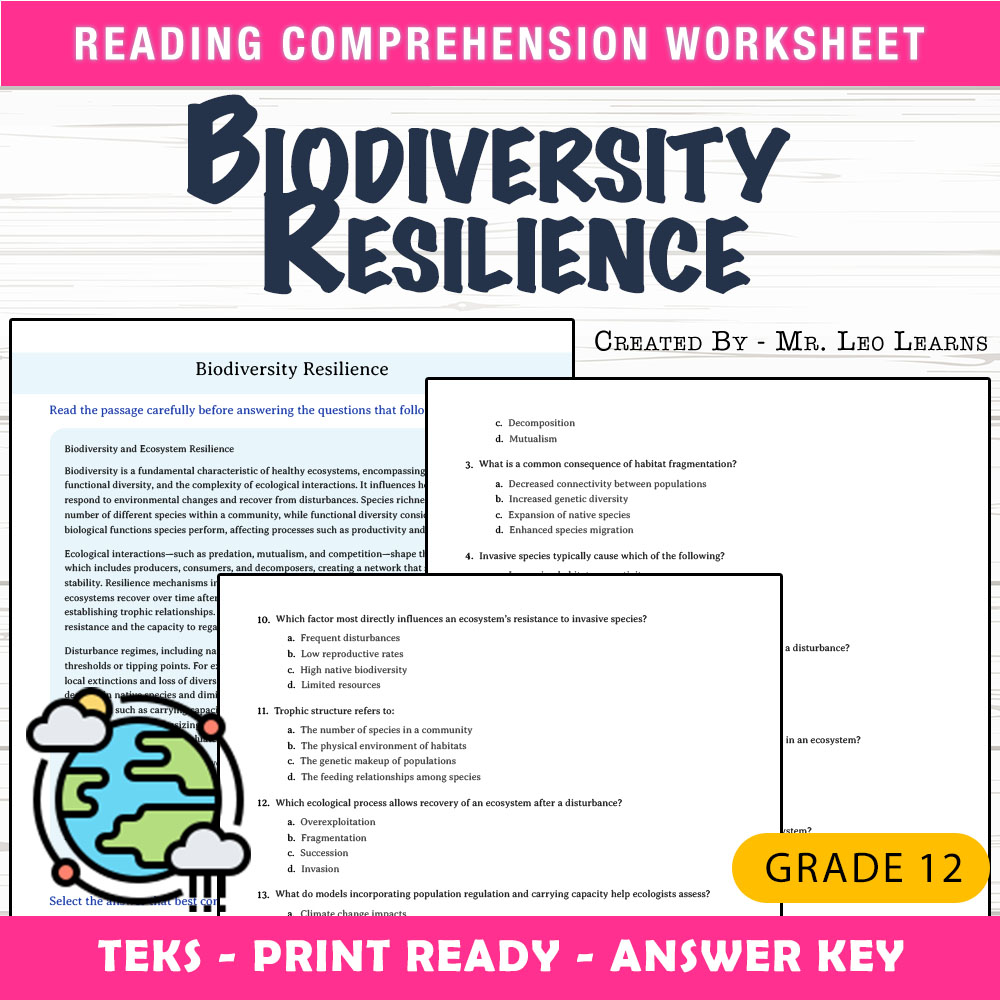
Grade 12 Science — Biodiversity Resilience Worksheet for Mastery
Created byThe Resource HubLearning Objectives
- Understand key concepts of biodiversity patterns, ecological interactions, and resilience mechanisms.
- Analyze how species richness, functional diversity, and trophic structures contribute to ecosystem stability.
- Assess the impact of disturbance regimes, invasive species, and habitat fragmentation on ecosystems.
Also included in: Grade 12 Science | Sustainability & Environmental Management Worksheet Bundle +1 more
Instant download
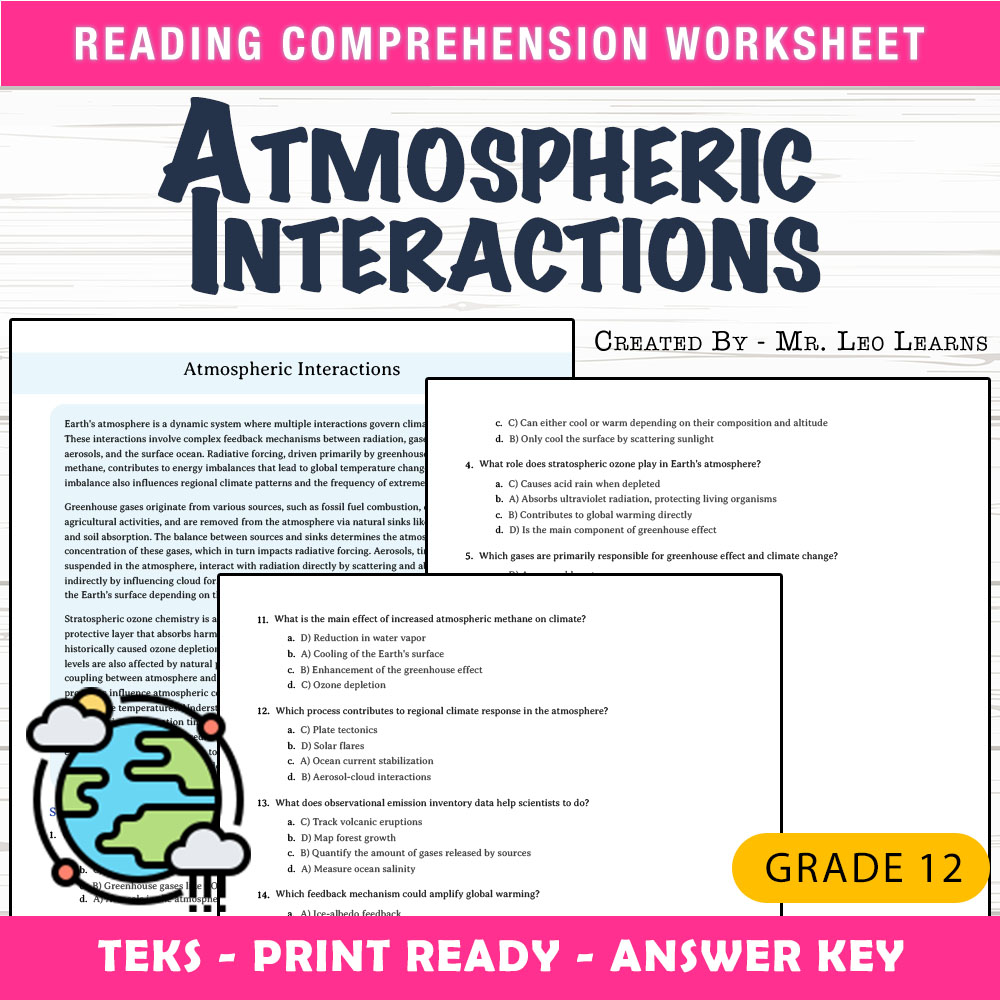
Grade 12 Science | Atmospheric Interactions Worksheet for Mastery
Created byThe Resource HubLearning Objectives
- Understand key atmospheric processes influencing climate and air quality.
- Interpret observational datasets related to atmospheric composition and energy balance.
- Explain the roles of radiative forcing, greenhouse gases, aerosols, and ozone chemistry in climate systems.
Also included in: Grade 12 Science | Sustainability & Environmental Management Worksheet Bundle +1 more
Instant download
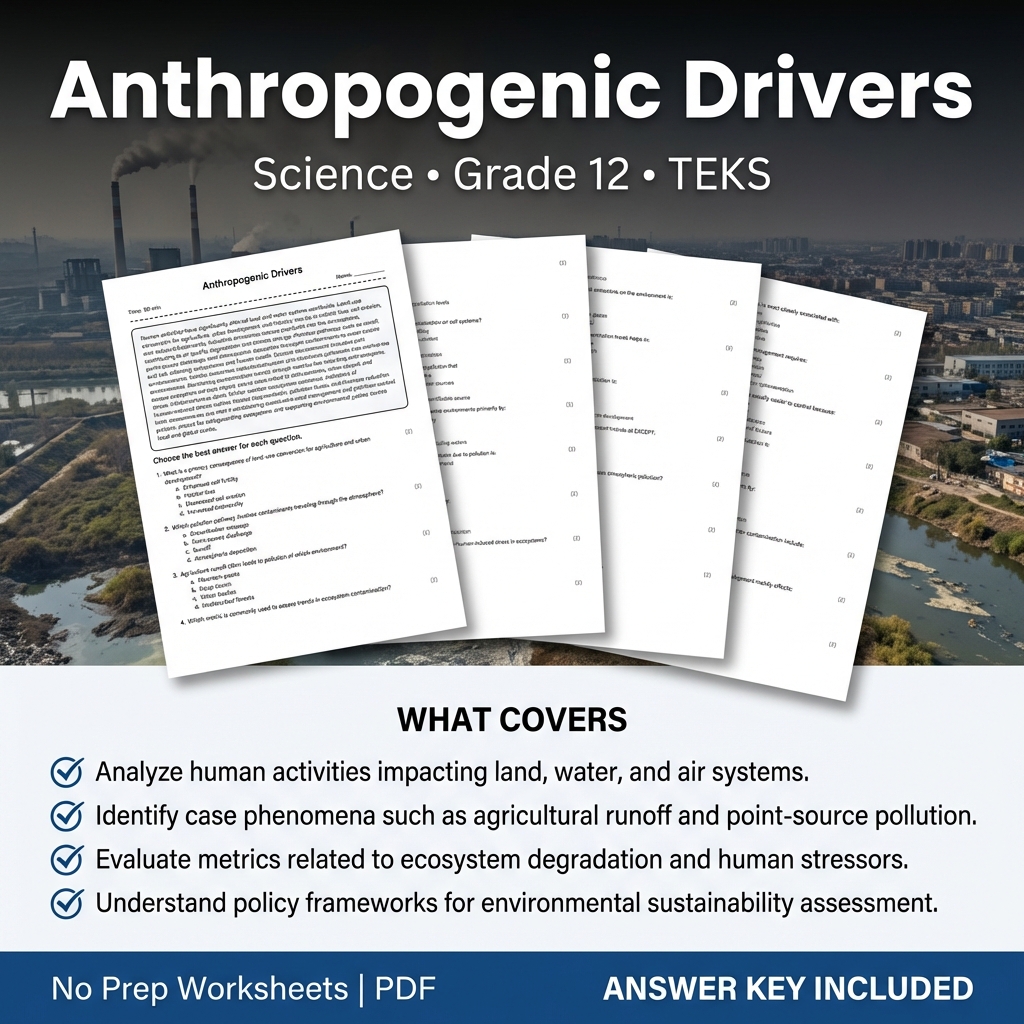
Anthropogenic Drivers Grade 12 Science Worksheet | TEKS Aligned Practice
Created byCoral Reef LearningLearning Objectives
- Analyze human activities impacting land, water, and air systems.
- Identify case phenomena such as agricultural runoff and point-source pollution.
- Evaluate metrics related to ecosystem degradation and human stressors.
Instant download

Grade 12 Science | Kepler Orbit Evidence Worksheet | California Standards
Created byLumora LearningLearning Objectives
- Understand how orbital motion patterns relate to gravitational interactions.
- Recognize the significance of Kepler’s laws in planetary systems.
- Analyze evidence supporting the universality of gravitational physics.
Instant download
About Grade 12 Science Worksheets
Explore Grade 12 Science worksheets for classwork, homework, or review. Our 4,240 printables download instantly as PDFs.
MyTeachingSheets worksheets are made by real teacher-authors and checked before they go live. Download any as a print-ready PDF for lessons, homework, or independent practice — most include answer keys, and previews are always free.