
Grade 12 Science Worksheets
4,240 worksheets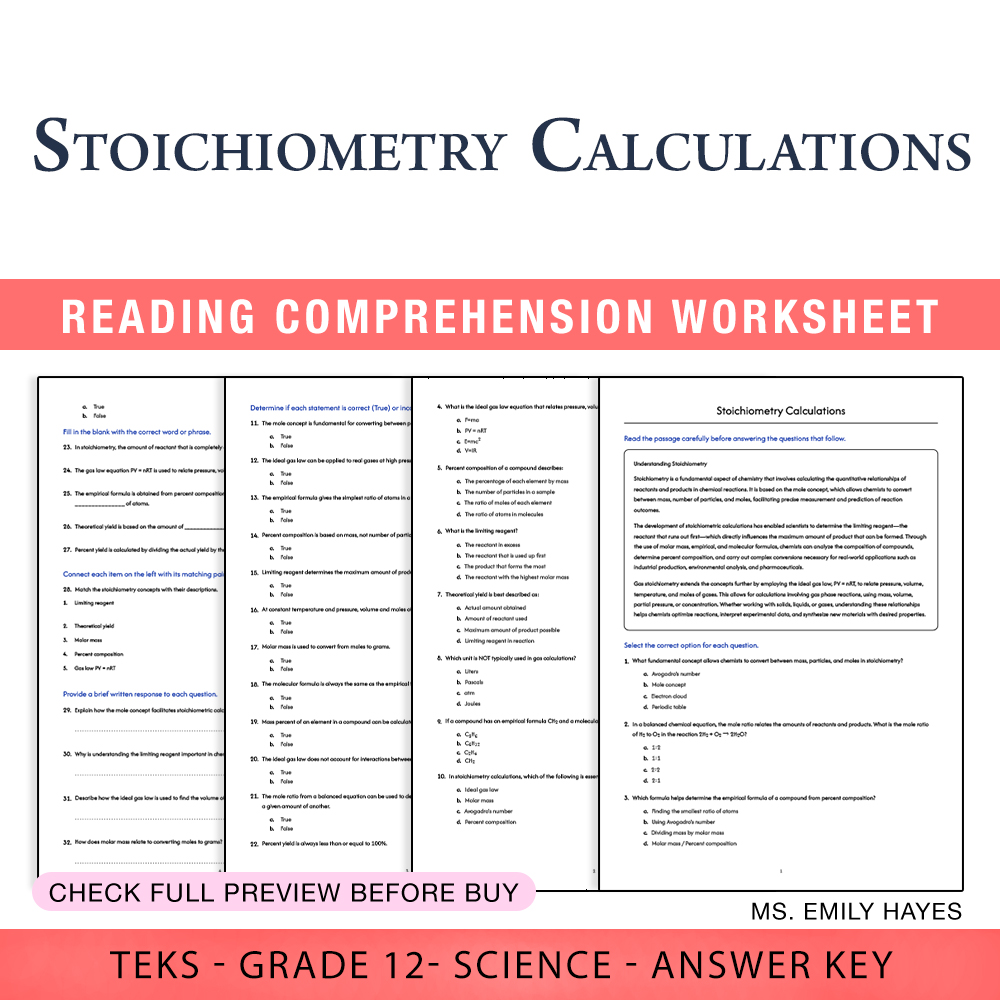
Grade 12 Science | Stoichiometry Calculations Worksheet (PDF+ Answer Key)
 Created byCopper Leaf Classroom
Learning Objectives
- Understand and perform mole conversions between mass, moles, and particles.
- Apply molar masses, empirical and molecular formulas, and percent composition in calculations.
- Determine limiting reagents and theoretical yields using stoichiometric methods.
Instant download
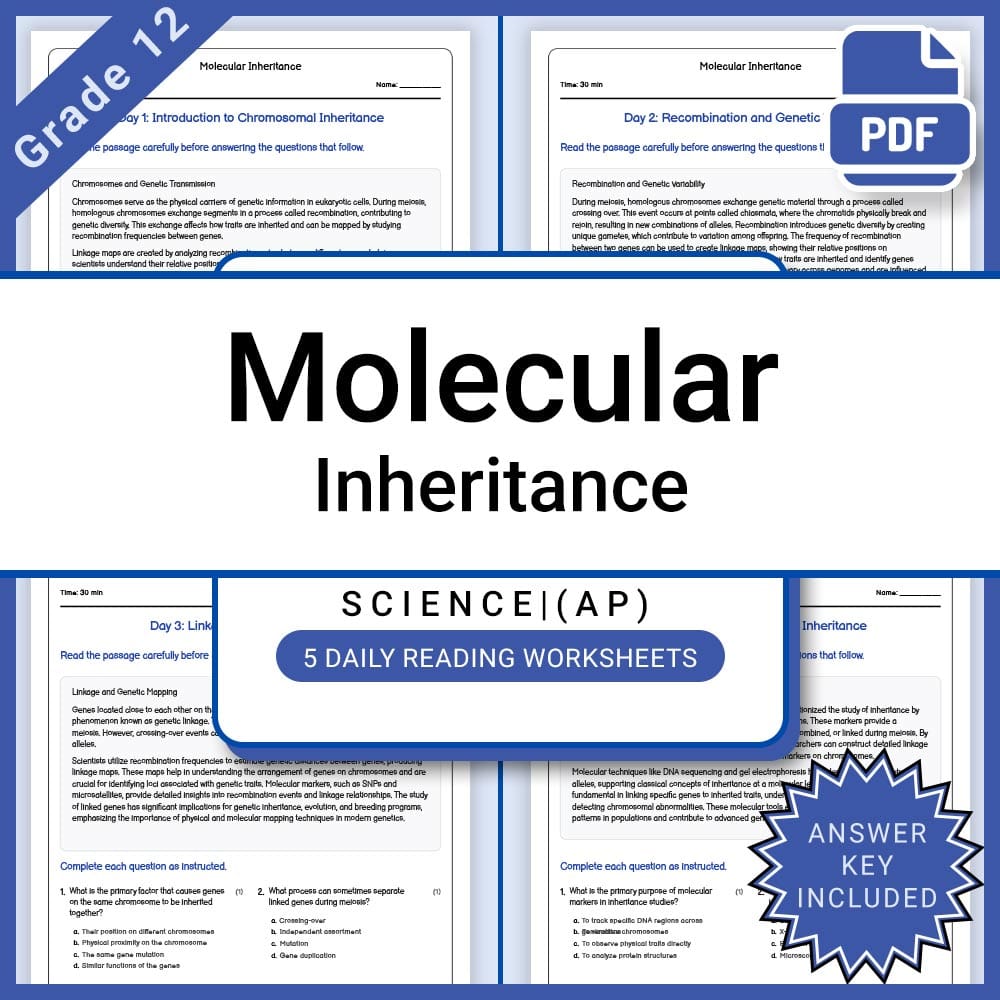
Grade 12 Science – Molecular Inheritance Daily Reading Worksheet + Answer Key
JCreated byJ.S SheetsLearning Objectives
- Understand the chromosomal basis of inheritance
- Explain genetic recombination and linkage mapping
- Describe molecular mechanisms behind inheritance patterns
Also included in: Grade 12 Science Biology and Ecosystems Lesson Bundle | AP Framework +1 more
Instant download
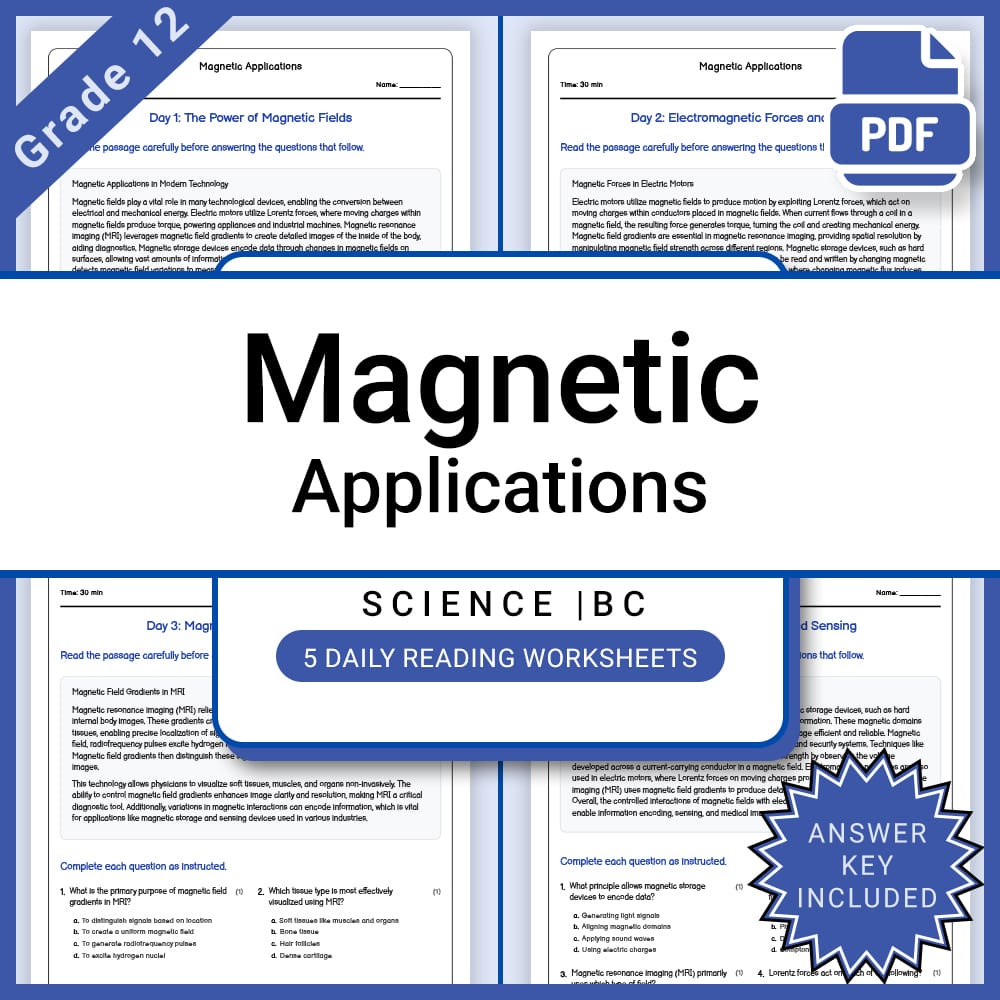
Grade 12 Science – Magnetic Applications Daily Reading Worksheet + Answer Key
JCreated byJ.S SheetsLearning Objectives
- Understand how magnetic and electromagnetic principles are used in technology
- Explain how Lorentz forces generate torque in electric motors
- Describe how magnetic field gradients enable imaging techniques such as magnetic resonance
Also included in: Grade 12 Science Lesson Group | Physics, Energy, Waves & Electromagnetism +1 more
Instant download

Grade 12 Science | Variable Mass & Momentum in Physics - Reading Comprehension
 Created byCoral Reef Learning
Learning Objectives
- Explain the concept of momentum and how it is conserved in systems with changing mass.
- Describe how ejected or accreted mass affects the motion of a system.
- Derive the qualitative basis of the rocket equation through momentum exchange.
Instant download
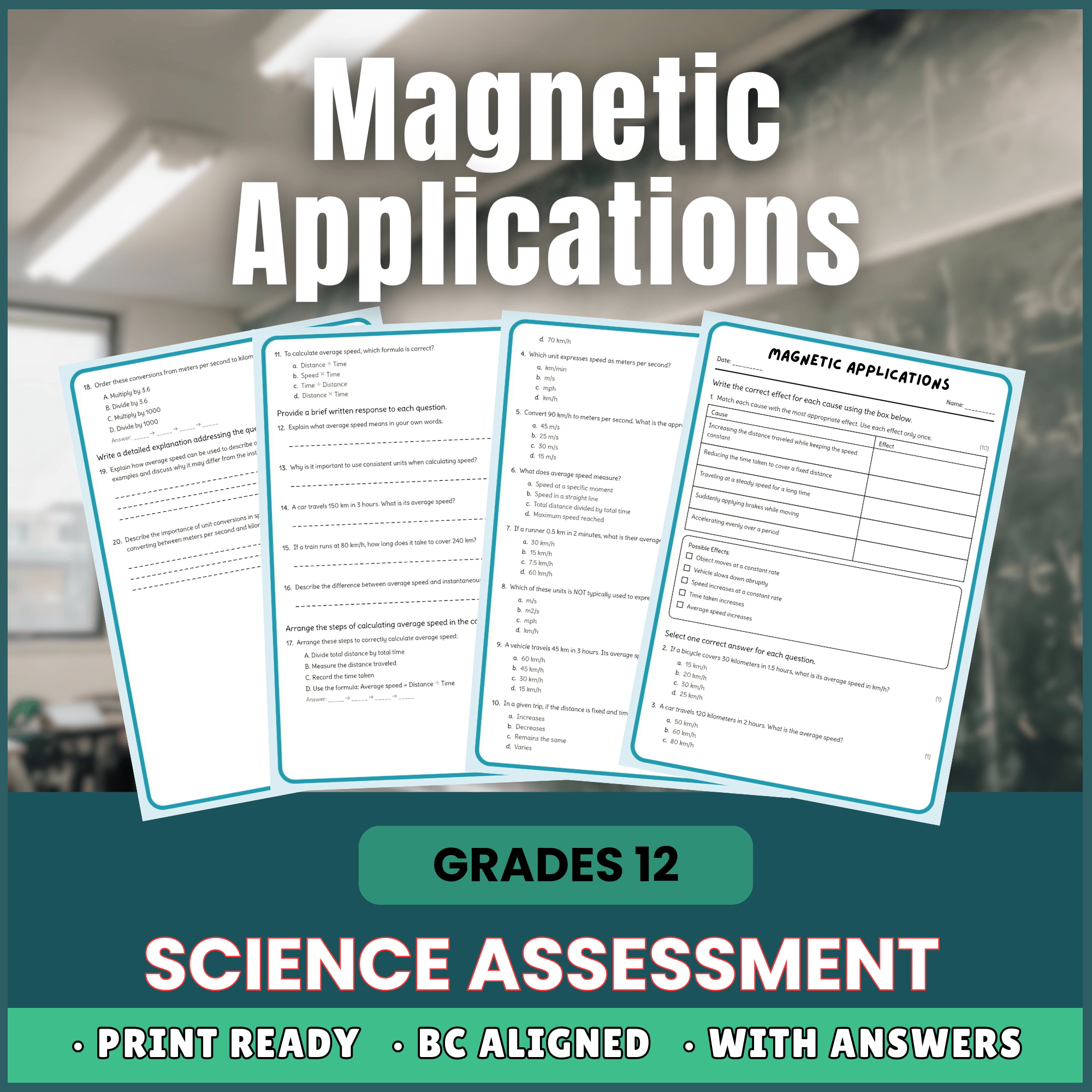
Grade 12 Science | Magnetic Applications Worksheet (Answer Key) – BC Standards
 Created byBright Mind Resources
Learning Objectives
- Describe how Lorentz forces generate torque in electric motors.
- Explain how magnetic field gradients enable imaging techniques like magnetic resonance.
- Understand the principles of magnetic storage, induction sensing, and the Hall effect.
Instant download
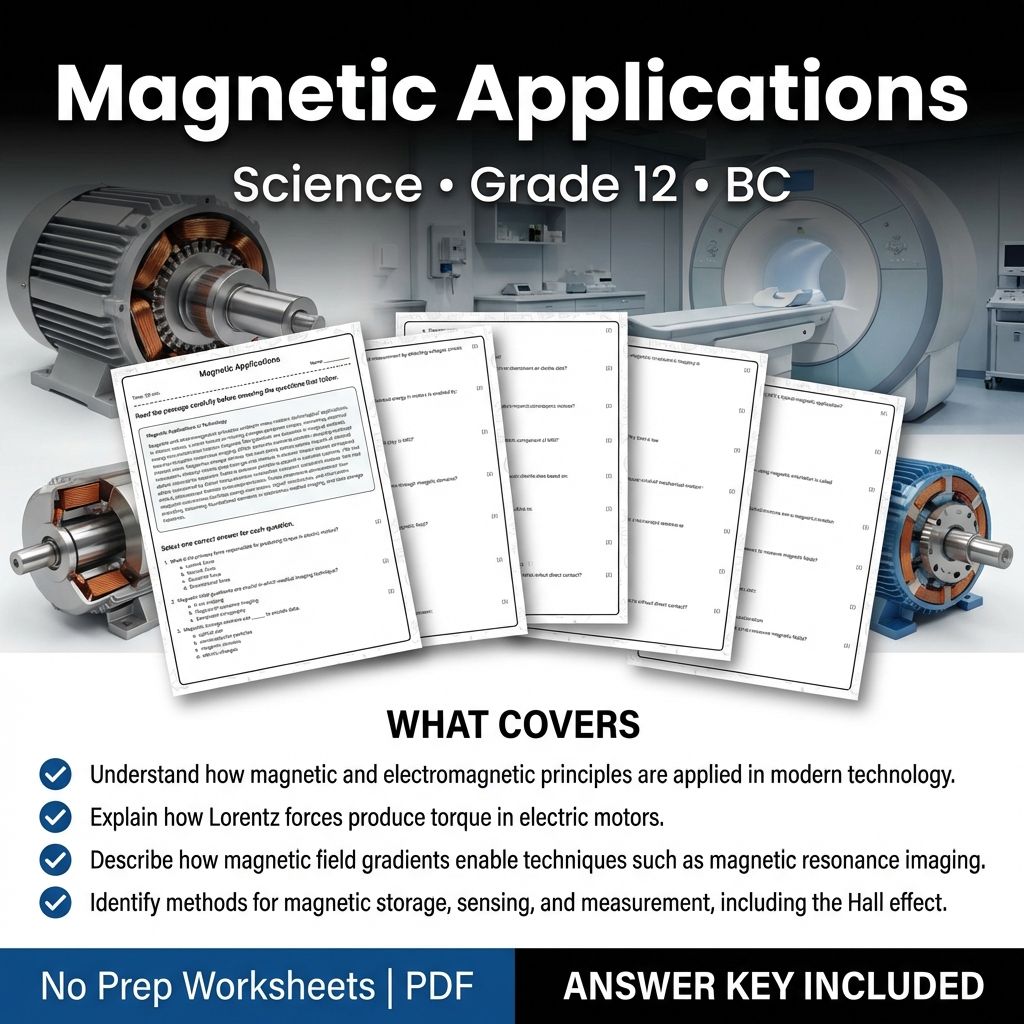
Magnetic Applications Worksheet for Grade 12 Science – BC Standards
Created byCoral Reef LearningLearning Objectives
- Understand how magnetic and electromagnetic principles are applied in modern technology.
- Explain how Lorentz forces produce torque in electric motors.
- Describe how magnetic field gradients enable techniques such as magnetic resonance imaging.
Instant download

Grade 12 Electrochemical Cells Worksheet | BC Practice PDF
 Created byClear Sky Classroom
Learning Objectives
- Distinguish galvanic (spontaneous) and electrolytic (nonspontaneous) electrochemical cells using electrode roles and redox behavior.
- Explain how standard reduction potentials and cell potential relate to overall electromotive force (emf).
- Apply conventions for anode/cathode, oxidation/reduction, and salt-bridge function to analyze real electrochemical processes.
Instant download
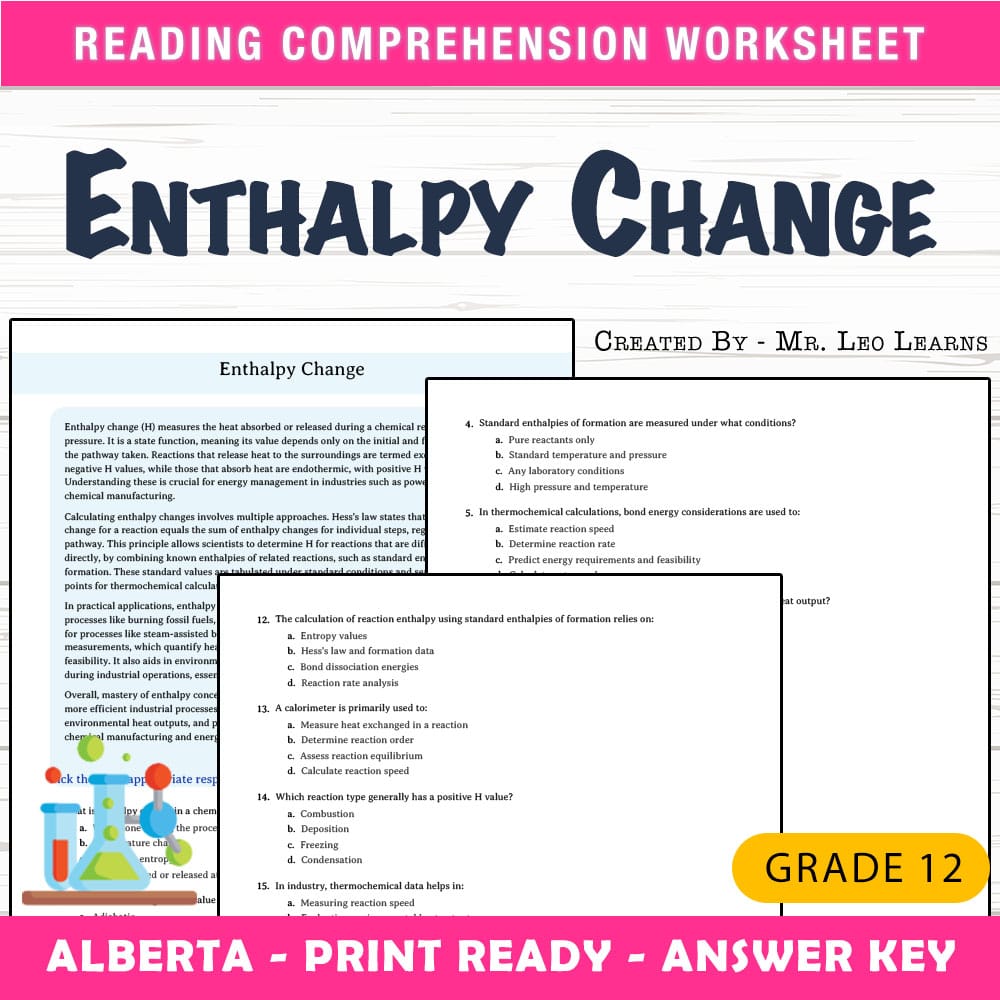
Grade 12 Science — Enthalpy Change Worksheet MCQ Paper
 Created byThe Resource Hub
Learning Objectives
- Understand the concept of enthalpy change and its significance in chemical reactions.
- Interpret conventions for exothermic and endothermic processes.
- Apply Hess’s law and standard enthalpies of formation to calculate reaction enthalpies.
Also included in: Grade 12 Chemistry Worksheets Bundle | Alberta Science Mastery +1 more
Instant download
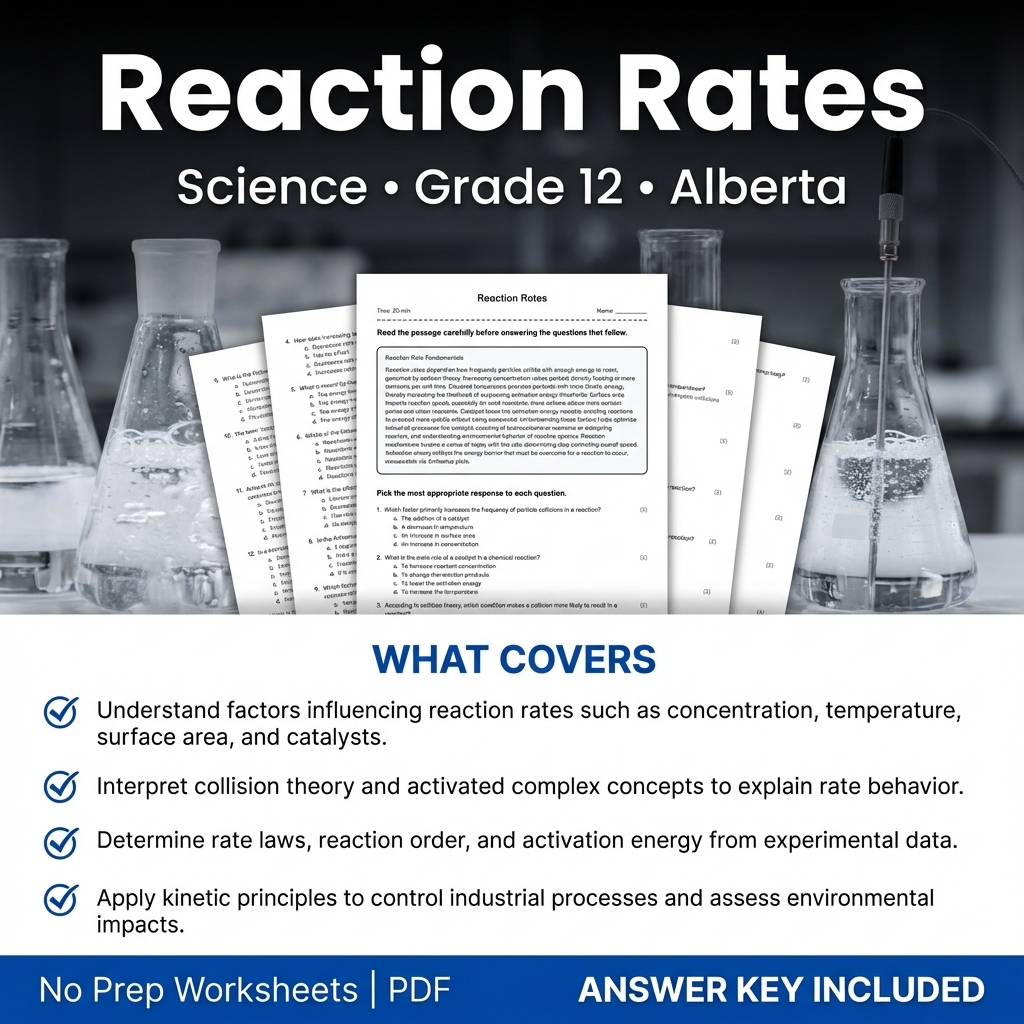
Reaction Rates Worksheet | Alberta Grade 12 Science Practice
Created byCoral Reef LearningLearning Objectives
- Understand factors influencing reaction rates such as concentration, temperature, surface area, and catalysts.
- Interpret collision theory and activated complex concepts to explain rate behavior.
- Determine rate laws, reaction order, and activation energy from experimental data.
Instant download

Grade 12 Science Wave Models Worksheet (BC) | Assessment with Answer Key (PDF)
 Created byEvergreen Desk Education
Learning Objectives
- Describe how wave models use wavelength, frequency, amplitude, and period to predict wave behavior
- Differentiate transverse and longitudinal waves and connect each to real-world examples
- Explain superposition, interference, and dispersion using wave-parameter reasoning
Instant download

Equilibrium Calculations Worksheet Practice | Grade 12 AP Science
 Created byPrism Point Learning
Learning Objectives
- Use ICE tables and the reaction quotient to determine equilibrium concentrations and constants.
- Predict how changes in pressure, including volume effects, shift equilibrium position.
- Apply common-ion reasoning to anticipate changes in equilibrium concentrations.
Instant download
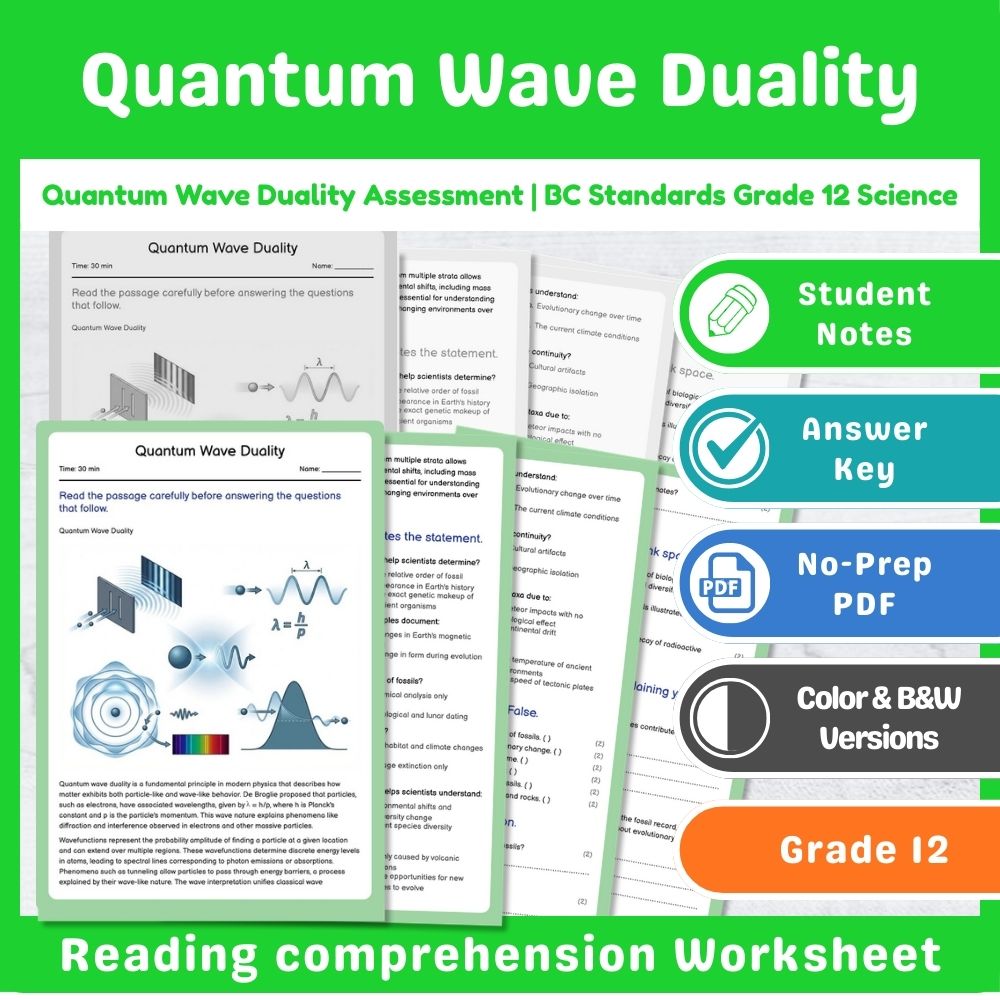
Quantum Wave Duality Assessment | BC Standards Grade 12 Science
Created byPrism Point LearningLearning Objectives
- Understand the concept of wave-particle duality in quantum mechanics.
- Describe how de Broglie wavelength relates to particles and their wave properties.
- Explain phenomena like diffraction, interference, and tunneling using wavefunctions.
Also included in: Grade 12 Science Wave & Quantum Assessment Mini Bundle – BC Standards
Instant download

Grade 12 Science | Energy Transformation - Daily Reading Comprehension
Created byCoral Reef LearningLearning Objectives
- Identify different types of energy such as kinetic, potential, and thermal.
- Describe how energy changes from one form to another during physical activities.
- Explain the observable effects of energy transformations in everyday life.
Instant download

Bond Polarity Worksheet | Standards-Aligned Grade 12 Science Practice
JCreated byJ.S SheetsLearning Objectives
- Explain the concept of bond polarity and how electronegativity differences influence dipole moments.
- Identify polar and nonpolar bonds based on electronegativity values and molecular structure.
- Analyze how bond polarity affects molecular interactions, solubility, and physical properties in environmental and industrial contexts.
Instant download
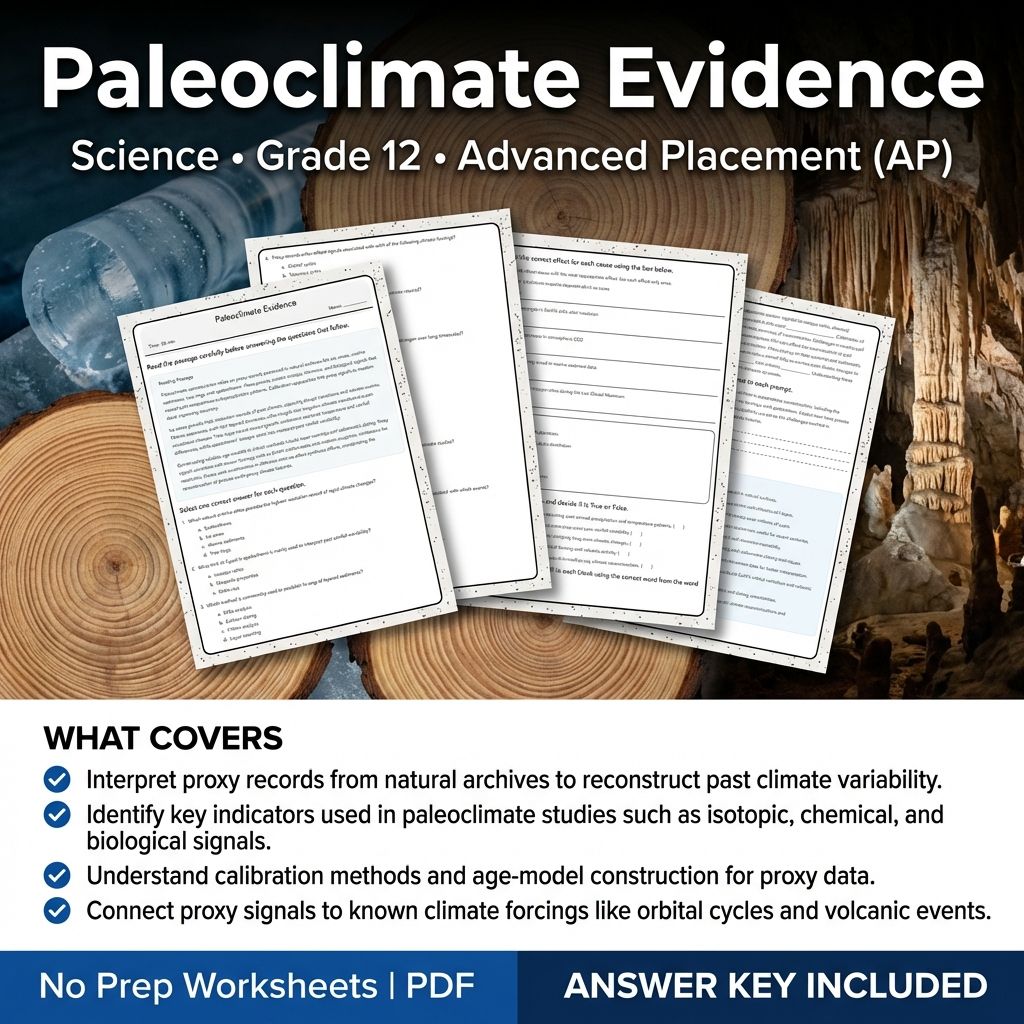
12th Grade Science | Paleoclimate Evidence Worksheet with Answer Key (Printable PDF)
Created byCoral Reef LearningLearning Objectives
- Interpret proxy records from natural archives to reconstruct past climate variability.
- Identify key indicators used in paleoclimate studies such as isotopic, chemical, and biological signals.
- Understand calibration methods and age-model construction for proxy data.
Also included in: Grade 12 Science Unit Worksheets Pack | Earth's Systems & Surface Processes +1 more
Instant download
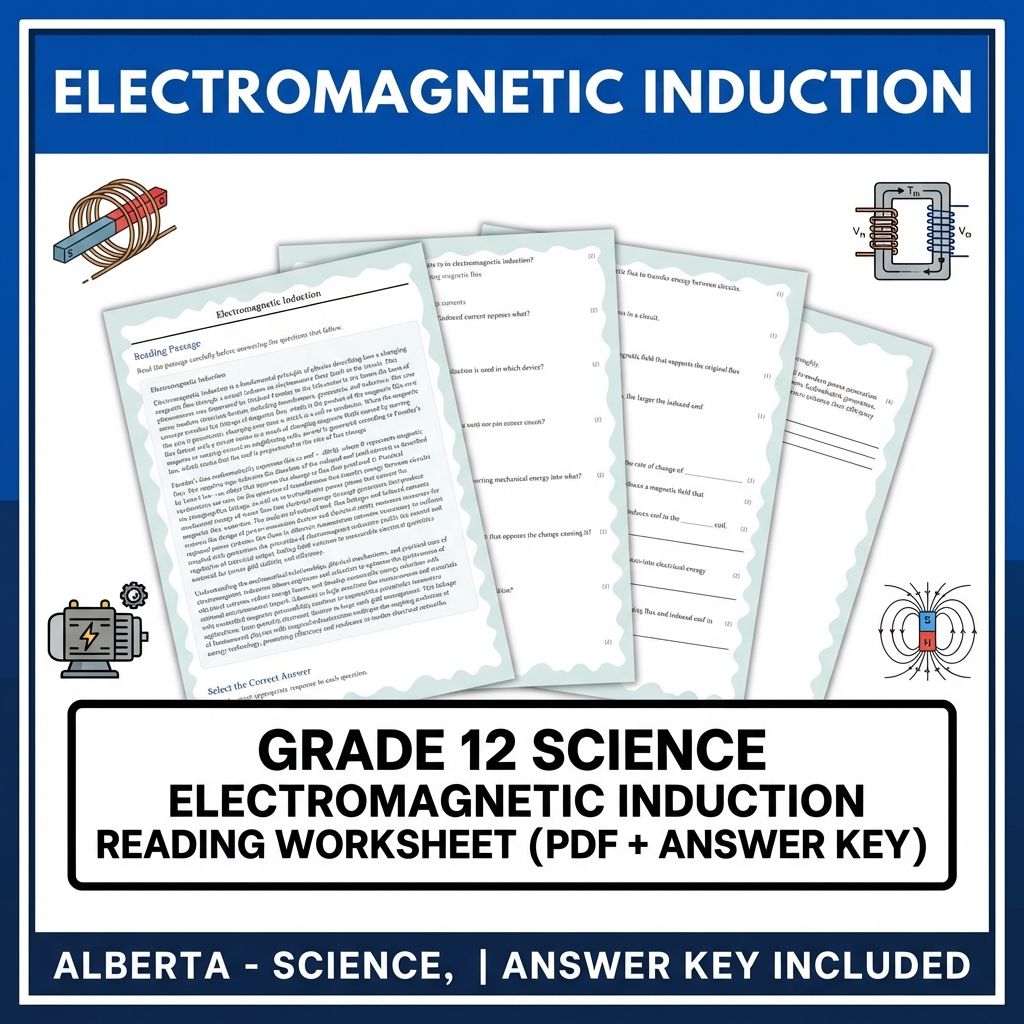
Grade 12 Science | Electromagnetic Induction Worksheet (PDF + Answer Key)
JCreated byJ.S SheetsLearning Objectives
- Understand the principles of electromagnetic induction as described by Faraday’s law.
- Explain how changing magnetic flux induces an electromotive force (emf) in circuits.
- Describe the practical applications of electromagnetic induction in power systems and renewable energy generation.
Also included in: Grade 12 Science UNIT Bundle – Waves, Nuclear & Electromagnetism Worksheets +1 more
Instant download

Projectile Motion Worksheet | AP Science Practice for Grade 12
JCreated byJ.S SheetsLearning Objectives
- Understand the components of projectile motion and their independence.
- Apply vector decomposition to analyze initial velocity in projectile launches.
- Calculate range, time of flight, and maximum height using parametric equations.
Instant download
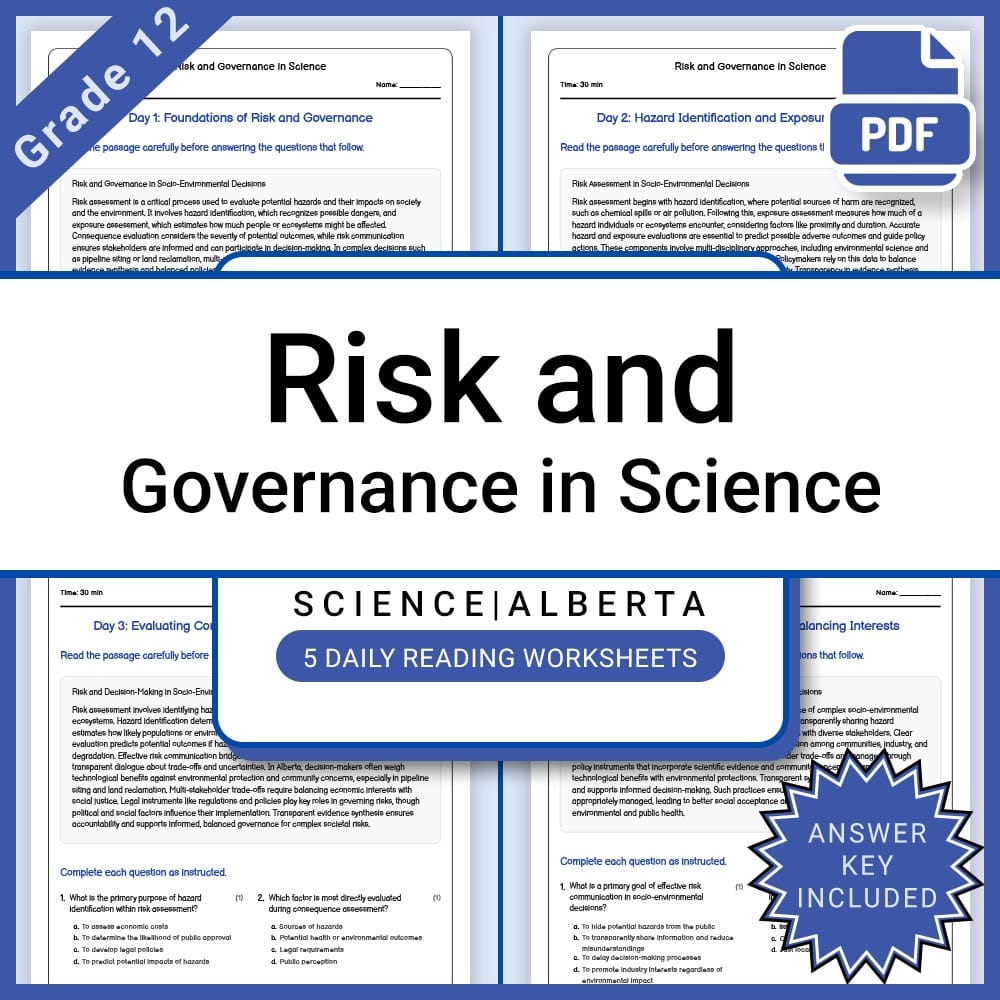
Grade 12 Science Risk and Governance Daily Reading Worksheet with Answer Key
JCreated byJ.S SheetsLearning Objectives
- Identify key components of risk assessment and governance frameworks
- Understand hazard identification, exposure assessment, and consequence evaluation
- Recognize the importance of stakeholder involvement and transparency in risk management
Also included in: Grade 12 Science Lesson Bundle | Alberta Framework and Real-World Applications +1 more
Instant download

DNA Mutations and Traits Worksheets: Grade 12 Biology Practice
 Created bySunny Desk Resources
Learning Objectives
- Identify how point mutations, insertions, and deletions alter DNA
- Explain how chromosomal rearrangements can affect gene products
- Predict silent, frameshift, loss-of-function, and novel-function outcomes
Also included in: Biology 30 - Grade 12 Bundle +1 more
Instant download

Geometric Optics Worksheets: Snell’s Law & Lens Imaging Grade 12
Created bySunny Desk ResourcesLearning Objectives
- Apply Snell’s law to predict refraction at an interface
- Calculate focal length using the lens model
- Determine image position from lens relationships
Also included in: Physics 30 - Grade 12 Bundle +1 more
Instant download

Electric Circuits Quantitative Analysis Worksheets Grade 12 Physics
Created bySunny Desk ResourcesLearning Objectives
- Apply Ohm’s law to calculate voltage, current, or resistance
- Analyze series circuits to predict current and voltage distributions
- Analyze parallel circuits to predict current and voltage distributions
Also included in: Physics 30 - Grade 12 Bundle +1 more
Instant download

Crystal Structures and Band Theory Worksheets | Grade 12 Chemistry
Created bySunny Desk ResourcesLearning Objectives
- Describe how unit-cell packing relates to macroscopic solid properties.
- Differentiate ionic, metallic, and covalent crystal structures.
- Explain band gaps and electron mobility in solids.
Also included in: Chemistry 30 - Grade 12 Bundle +1 more
Instant download

Grade 12 Science | Photosynthetic Systems - Daily Reading Comprehension
Created byCoral Reef LearningLearning Objectives
- Understand the fundamental mechanisms of photosynthesis, including light absorption and energy conversion
- Identify the structure and function of pigments, electron transport chains, and Calvin cycle components
- Analyze energy budgets, quantum yields, and flux measurements in photosynthetic processes
Also included in: Biology and Ecosystems Lesson Bundle | Grade 12 Science | AP +1 more
Instant download
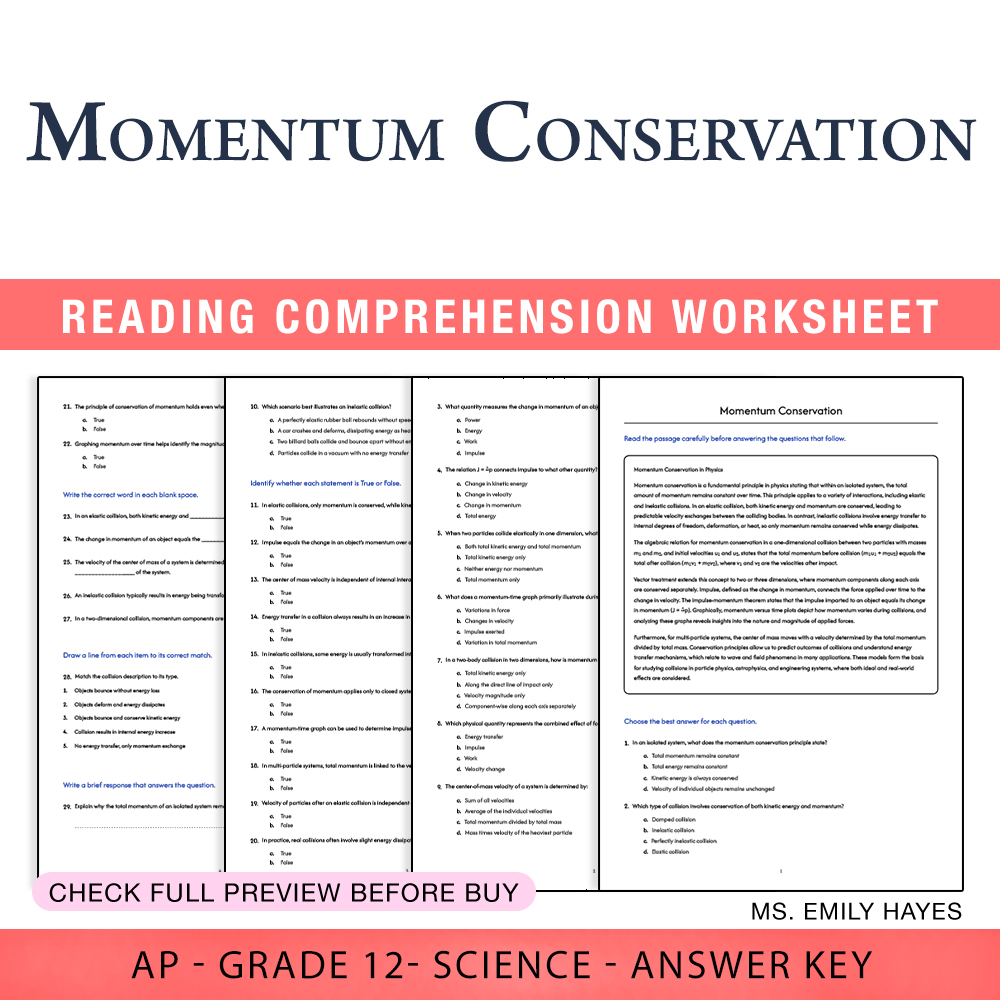
12th Grade Science | Momentum Conservation Worksheet (PDF + Answer Key)
Created byCopper Leaf ClassroomLearning Objectives
- Define linear momentum and impulse as conserved quantities in isolated systems.
- Describe momentum conservation during elastic and inelastic collisions using algebraic and vector models.
- Relate pre- and post-interaction velocities through impulse-momentum relations and analyze center-of-mass motion.
Also included in: Grade 12 Science AP – Energy, Motion & Electricity Mastery(PDF+ Answer Key) +1 more
Instant download
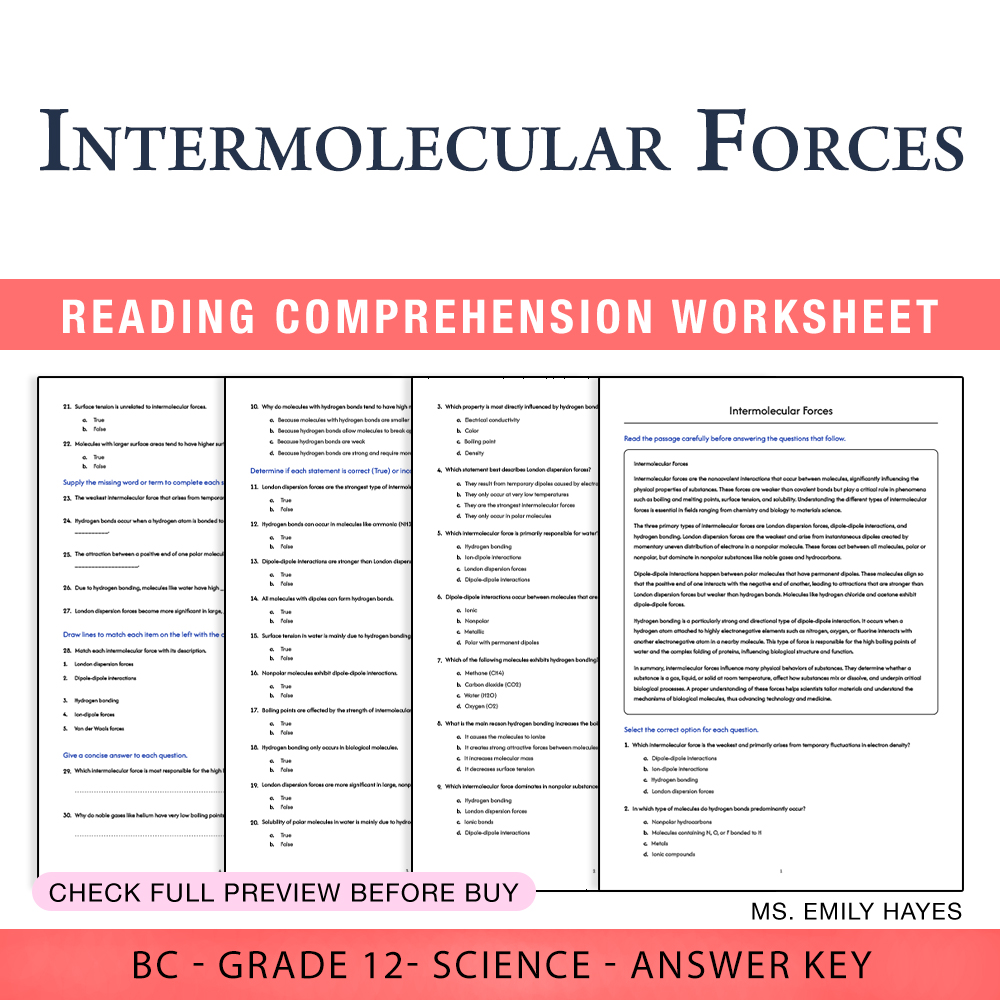
12th Grade Science | Intermolecular Forces Worksheet (PDF + Answer Key)
Created byCopper Leaf ClassroomLearning Objectives
- Describe the three main types of intermolecular forces: London dispersion forces, dipole-dipole interactions, and hydrogen bonding.
- Explain how intermolecular forces influence boiling points, melting points, surface tension, and solubility.
- Identify which types of molecules exhibit each kind of intermolecular force.
Also included in: Grade 12 Science BC – Thermochemistry to Atomic Structures (PDF+ Answer Keys) +1 more
Instant download
Grade 12 Science | Environmental Monitoring Worksheet (PDF)
Created byBright Mind ResourcesLearning Objectives
- Understand key principles of environmental monitoring network design and indicator selection.
- Analyze methods of data collection and interpretation for watershed health and air quality assessment.
Instant download
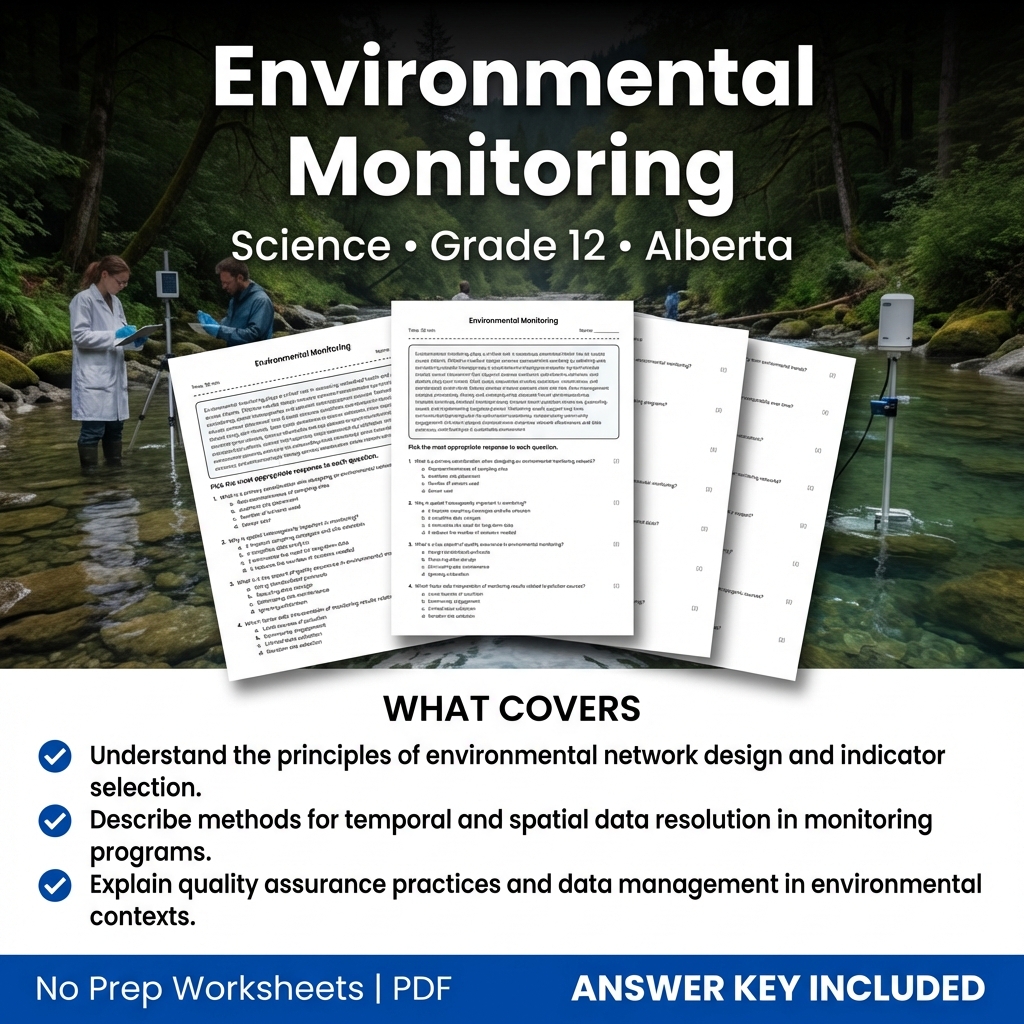
Environmental Monitoring Worksheet for Grade 12 Science - Alberta Standards
Created byCoral Reef LearningLearning Objectives
- Understand the principles of environmental network design and indicator selection.
- Describe methods for temporal and spatial data resolution in monitoring programs.
- Explain quality assurance practices and data management in environmental contexts.
Instant download
Grade 12 Science | Evolutionary Forces Worksheet | Alberta Standards
 Created byLumora Learning
Learning Objectives
- Describe how mutation, natural selection, genetic drift, and gene flow influence allele frequencies over time.
- Explain how environmental pressures drive phenotypic variation and adaptation.
- Analyze cases such as boreal range shifts and pest selection in Alberta to understand real-world applications of evolution.
Also included in: Grade 12 Science | Biology Worksheet Pack Custom Bundle | Alberta
Instant download
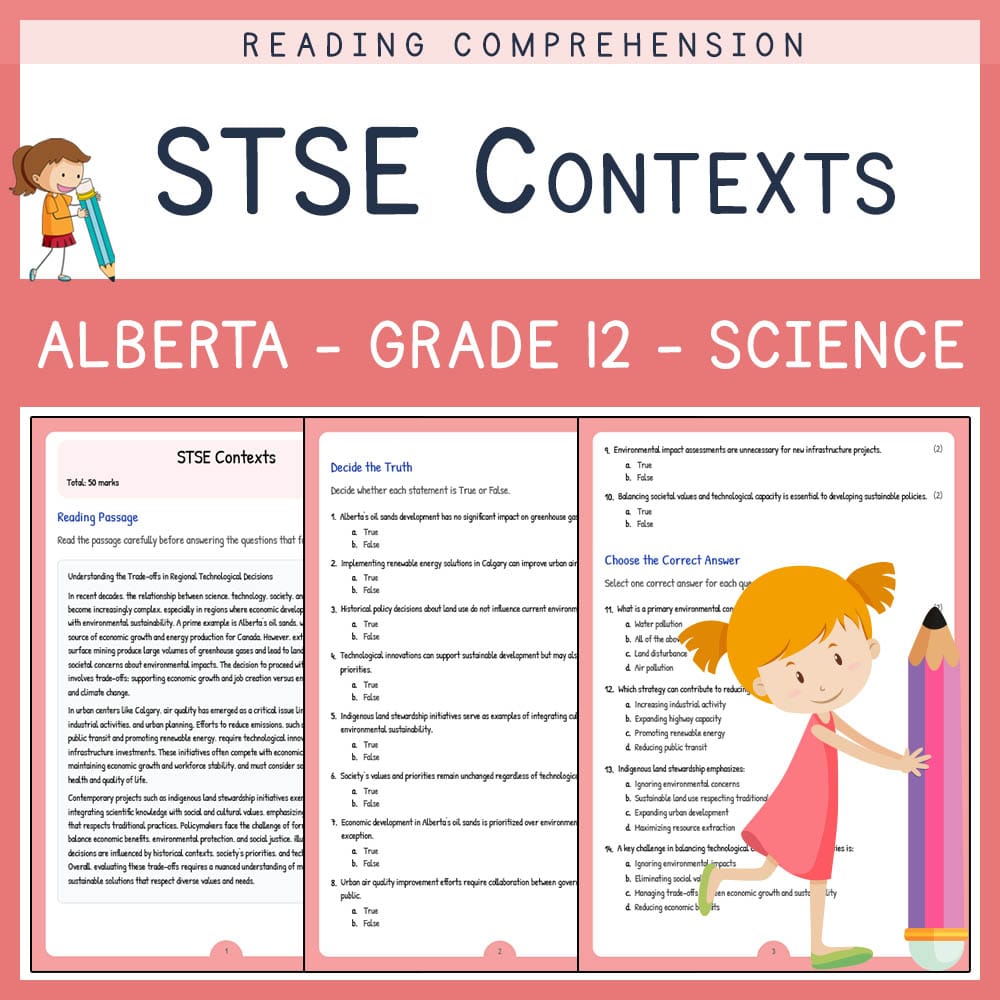
Grade 12 Science | STSE Contexts Worksheet | Alberta Standards
Created byLumora LearningLearning Objectives
- Analyze regional phenomena to understand the interactions among science, technology, society, and the environment.
- Evaluate trade-offs among technological choices considering economic, environmental, and social factors.
- Interpret historical and contemporary case studies related to policy decisions and infrastructure projects.
Also included in: Grade 12 Science | Science Custom Bundle | Alberta Standards Worksheets
Instant download

Grade 12 Science – Integrated Synthesis Worksheet (PDF) | Alberta Standards
Created byBright Mind ResourcesLearning Objectives
- Understand how biochemical, chemical, and physical processes interact in environmental phenomena in Alberta landscapes.
- Apply cross-disciplinary reasoning to analyze complex environmental patterns and management challenges.
Instant download
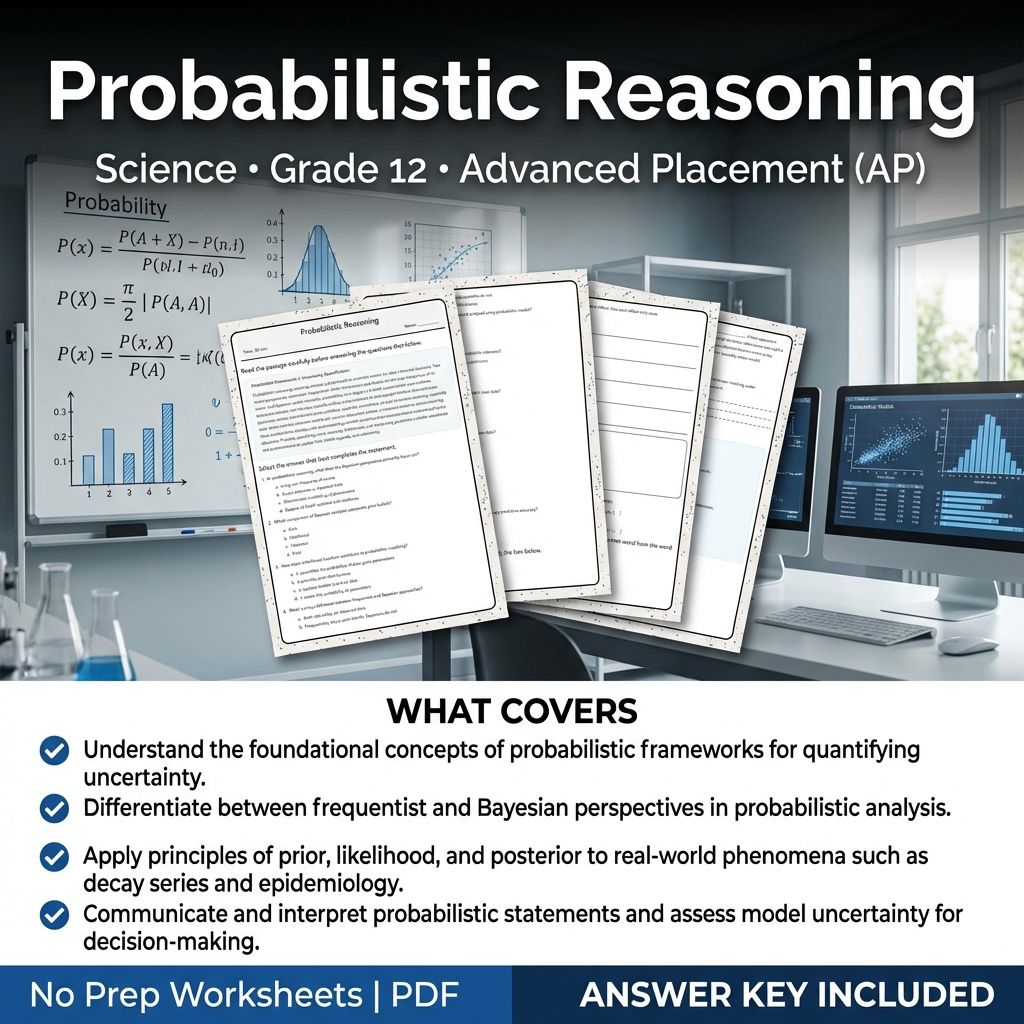
12th Grade Science | Probabilistic Reasoning Worksheet & Answer Key (Printable PDF)
Created byCoral Reef LearningLearning Objectives
- Understand the foundational concepts of probabilistic frameworks for quantifying uncertainty.
- Differentiate between frequentist and Bayesian perspectives in probabilistic analysis.
- Apply principles of prior, likelihood, and posterior to real-world phenomena such as decay series and epidemiology.
Also included in: Grade 12 Science Unit Bundle | Uncertainty, Data Analysis & Modeling Worksheets +1 more
Instant download

Science Grade 12 Worksheet Plate Motions | Standards-Aligned Practice
JCreated byJ.S SheetsLearning Objectives
- Explain how Earth’s internal energy drives tectonic plate movement over geologic time
- Compare the main types of plate boundaries (divergent, convergent, transform) and their characteristic geologic features
- Use evidence such as seafloor magnetic stripes, rock age patterns, and earthquake distribution to support the plate motion model
Also included in: Grade 12 Earth and Space Systems Science Lesson Bundle – Florida NGSSS +1 more
Instant download
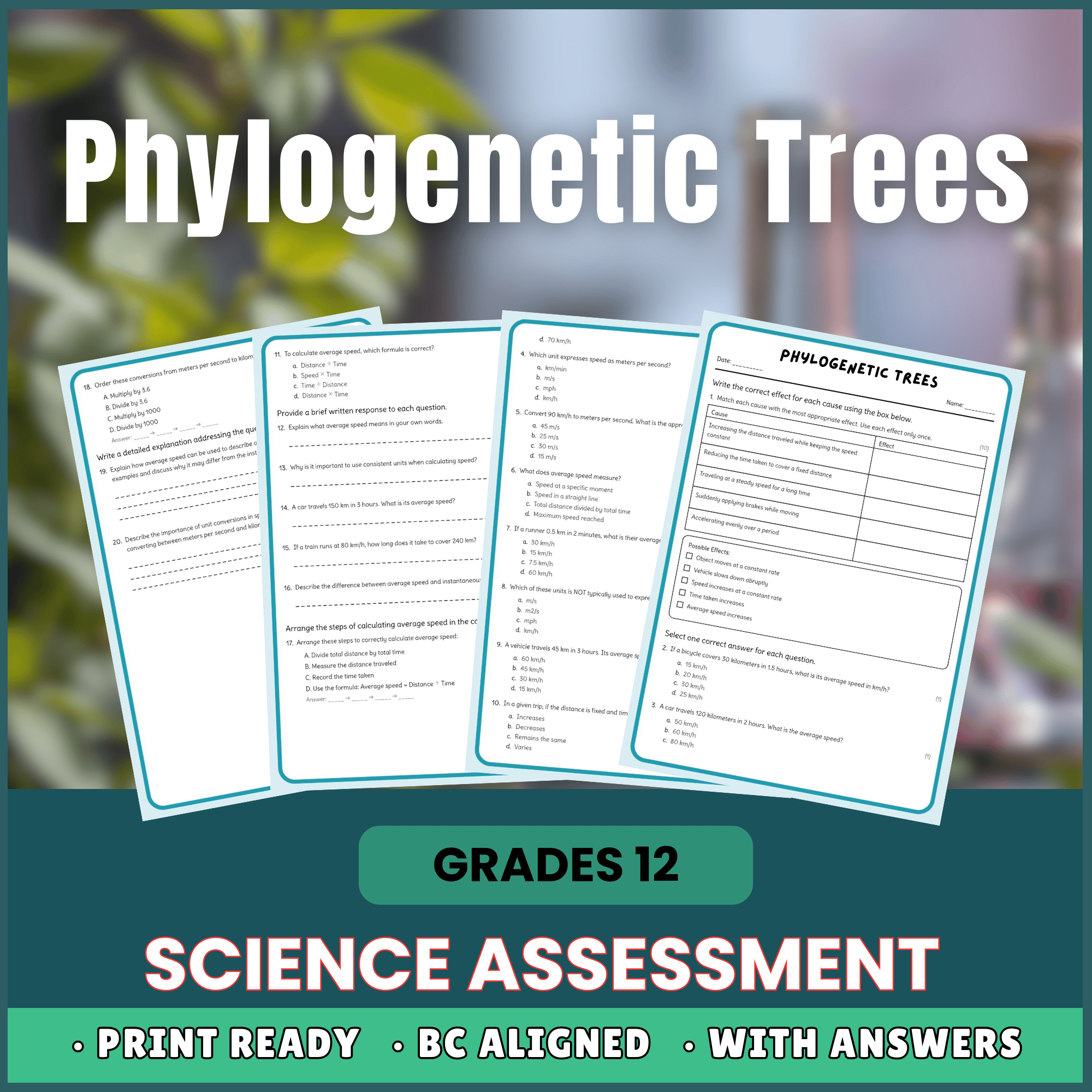
Grade 12 Science | Phylogenetic Trees Practice Worksheet (PDF)
Created byBright Mind ResourcesLearning Objectives
- Understand how phylogenetic trees represent evolutionary relationships among organisms.
- Identify shared derived characters used to construct phylogenies.
- Explain the role of molecular clock models in estimating divergence times.
Instant download

Evolution Mechanisms Assessment | TEKS Standards Grade 12 Science
Created byPrism Point LearningLearning Objectives
- Describe the mechanisms that generate biological diversity, including natural selection, genetic drift, gene flow, and mutation.
- Identify evidence from paleontology, comparative anatomy, and molecular homology supporting evolution.
- Explain population-level processes, adaptive landscapes, and selection pressures related to phenotype fitness.
Also included in: Grade 12 Genetics and Evolution Science Lesson Bundle Unit | TEKS
Instant download

Population Genetics Assessment for Grade 12 Science | Standards-Aligned
Created byPrism Point LearningLearning Objectives
- Explain the principles of Hardy–Weinberg equilibrium and its assumptions.
- Describe the effects of selection, genetic drift, and migration on allele frequencies.
- Interpret measures such as heterozygosity, effective population size, and fixation indices in microevolution.
Also included in: Grade 12 Genetics and Evolution Science Lesson Bundle Unit | TEKS
Instant download

Cell Division Assessment | TEKS Standards Grade 12 Science Evaluation
Created byPrism Point LearningLearning Objectives
- Describe the processes of mitosis and meiosis and their roles in cell division.
- Explain chromosome segregation, homologous recombination, and the consequences of nondisjunction.
- Analyze chromosomal alterations, karyotype analysis, and indicators of aneuploidy in inheritance and phenotype.
Also included in: Grade 12 Genetics and Evolution Science Lesson Bundle Unit | TEKS
Instant download

Phylogenetics Assessment for Grade 12 Science – Standards-Aligned Worksheet
Created byPrism Point LearningLearning Objectives
- Understand methods used to reconstruct evolutionary relationships, including character matrix analysis and molecular sequence alignment.
- Identify and interpret different types of phylogenetic trees such as cladograms and phylograms.
- Evaluate homology, monophyly, paraphyly, and polyphyly in the context of taxonomy and evolutionary analysis.
Also included in: Grade 12 Genetics and Evolution Science Lesson Bundle Unit | TEKS
Instant download

Cell Architecture Assessment | TEKS Grade 12 Science Standards
Created byPrism Point LearningLearning Objectives
- Describe the structural features of prokaryotic and eukaryotic cells.
- Identify the functions of various cellular organelles.
- Explain the relationship between cell structure and function.
Also included in: Grade 12 Genetics and Evolution Science Lesson Bundle Unit | TEKS
Instant download

Grade 12 Science – Ecosystem Networks Worksheet (AP Standard) (PDF)
Created byEvergreen Desk EducationLearning Objectives
- Explain how energy flows through trophic levels and how primary productivity relates to biomass formation.
- Describe decomposition and nutrient cycling, including nutrient fluxes across producers, consumers, and decomposers.
- Use ecosystem network representations to connect topology with resilience and stability of communities.
Also included in: Grade 12 Biology and Ecosystems Science Lesson Bundle – Advanced Placement (AP) +1 more
Instant download
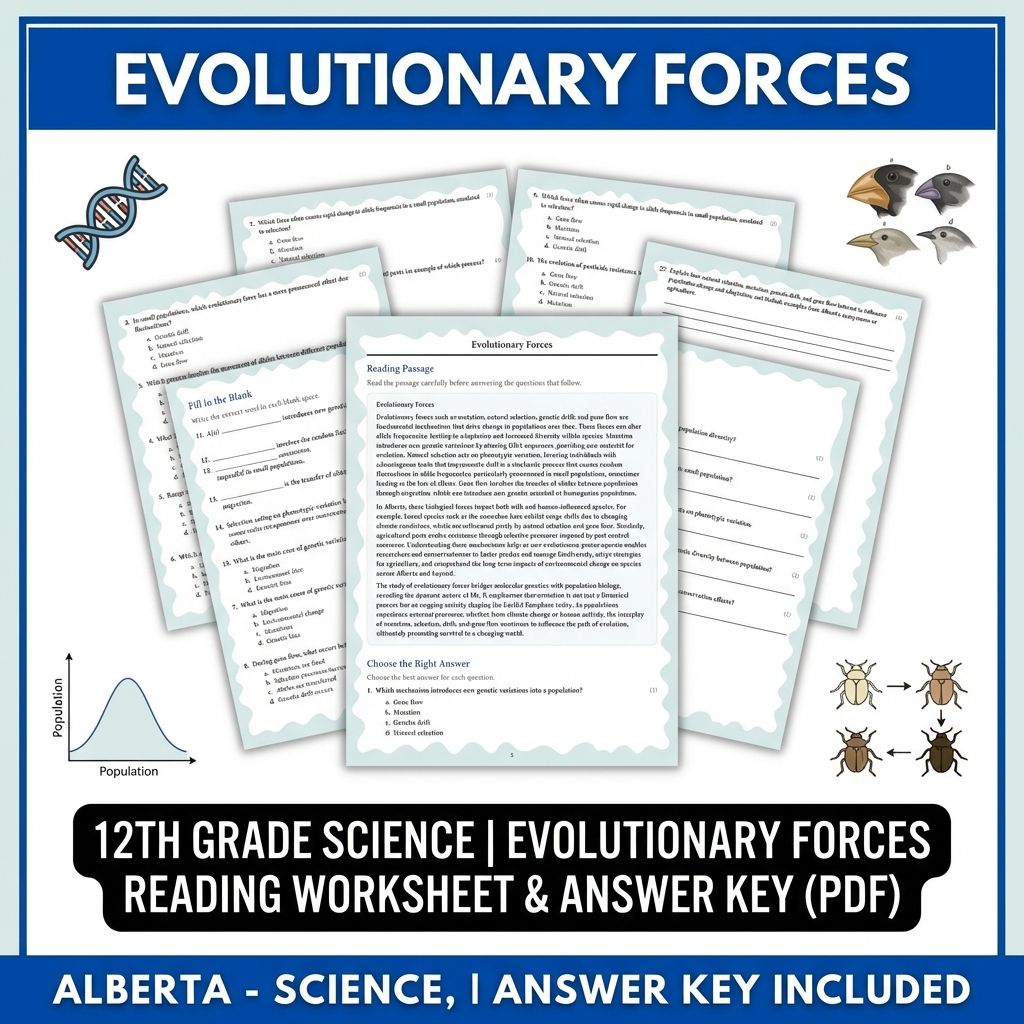
12th Grade Science | Evolutionary Forces Reading Worksheet & Answer Key (PDF)
JCreated byJ.S SheetsLearning Objectives
- Explain how mutation, natural selection, genetic drift, and gene flow influence allele frequencies over time.
- Describe how these forces lead to adaptation and diversity in populations.
- Analyze examples of evolutionary mechanisms in Alberta's ecosystems and agriculture.
Also included in: Grade 12 Science UNIT Bundle: Molecular Genetics, Evolution & Ecology Activities +1 more
Instant download
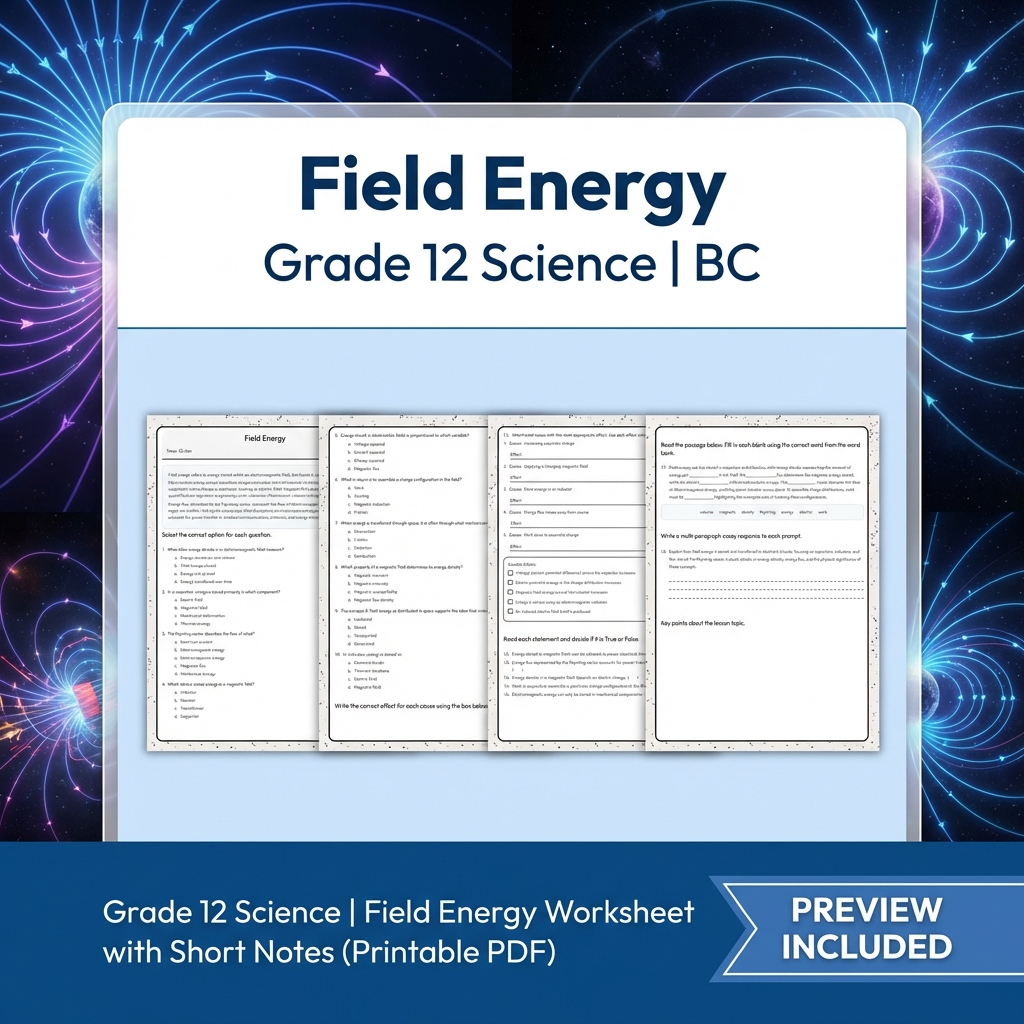
Grade 12 Science | Field Energy Worksheet with Short Notes (Printable PDF)
 Created byMeadowlark Worksheets
Learning Objectives
- Define energy density for electrostatic and magnetic fields.
- Explain how capacitors and inductors store and release energy in circuits.
- Describe the concept of field energy as distributed in space.
Also included in: Grade 12 Science Lesson Bundle | Wave, Quantum, Electromagnetism Worksheets +1 more
Instant download
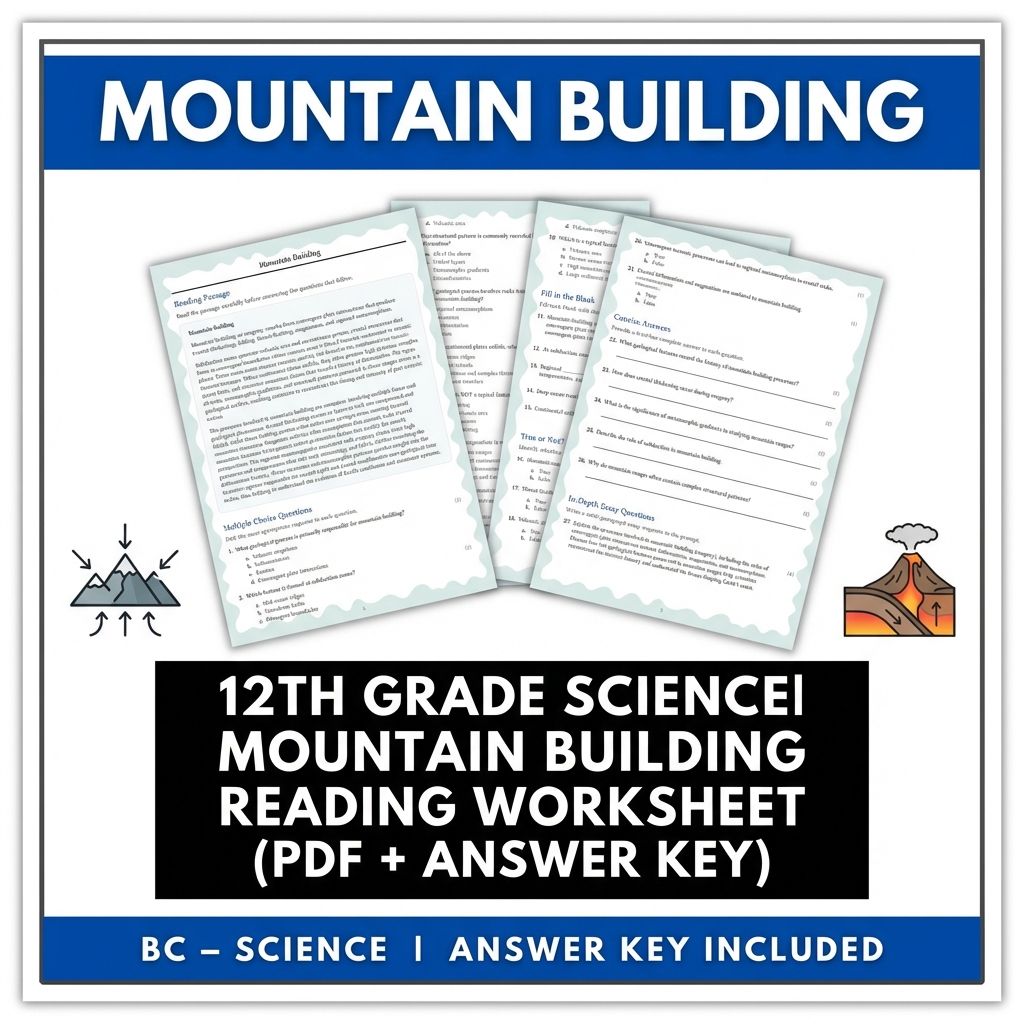
12th Grade Science | Mountain Building Reading Worksheet (PDF + Answer Key)
JCreated byJ.S SheetsLearning Objectives
- Understand the geological processes involved in mountain building, including convergence, subduction, and continental collision.
- Describe how structural features and metamorphic patterns in mountain ranges record tectonic history.
- Explain the roles of crustal thickening, folding, thrust faulting, and magmatism in orogeny.
Instant download

Electron Configuration Worksheet Practice | Grade 12 AP Science
Created byPrism Point LearningLearning Objectives
- Assign electron configurations using the aufbau filling order and the Pauli exclusion principle.
- Use Hund’s rule and quantum numbers to predict electron occupancy in orbitals.
- Explain common exceptions in transition-element configurations and relate them to periodic trends.
Instant download
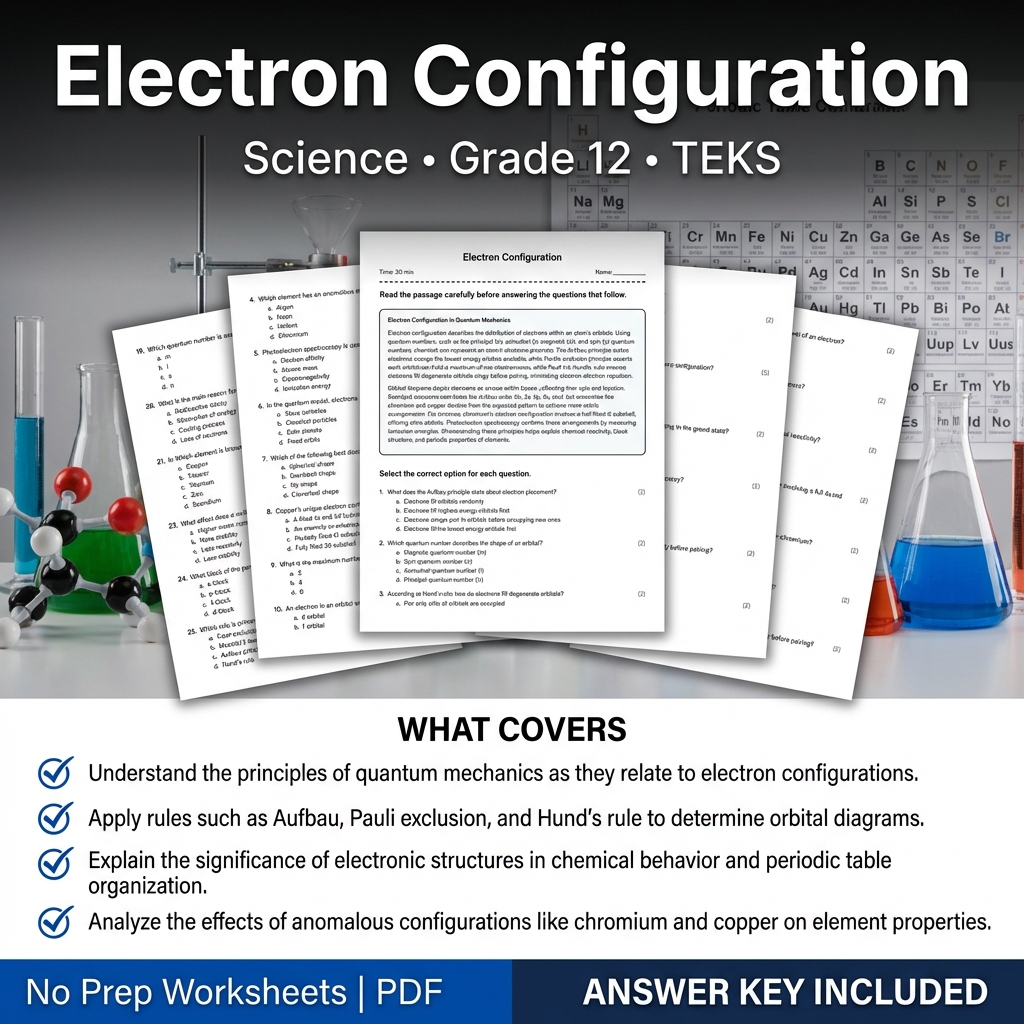
Electron Configuration Worksheet for Grade 12 Science | TEKS Aligned
Created byCoral Reef LearningLearning Objectives
- Understand the principles of quantum mechanics as they relate to electron configurations.
- Apply rules such as Aufbau, Pauli exclusion, and Hund’s rule to determine orbital diagrams.
- Explain the significance of electronic structures in chemical behavior and periodic table organization.
Instant download

Grade 12 Science | Reaction Rates in Chemistry - Daily Reading Comprehension
Created byCoral Reef LearningLearning Objectives
- Understand the factors that influence the rate of chemical reactions
- Describe the collision theory and how it explains reaction speed
- Identify the role of catalysts and activated complexes in reaction mechanisms
Also included in: Chemistry 30 Reading Comprehension Lesson Bundle – Grade 12 Science Alberta +1 more
Instant download

Grade 12 Science – Engineering Trade-Offs & Decision-Making | Reading Worksheet
Created byBright Mind ResourcesLearning Objectives
- Define what an engineering trade-off is.
- Identify common trade-offs in engineered systems.
- Analyze how trade-offs affect system performance and safety.
Also included in: Engineering Design Grade 12 Science Daily Reading Worksheets Bundle | General +1 more
Instant download
Grade 12 Science – Limiting Reagent Worksheet (PDF) | Alberta Standards
Created byBright Mind ResourcesLearning Objectives
- Identify the limiting reagent in a chemical reaction using stoichiometric ratios.
- Calculate theoretical and percent yields based on balanced chemical equations.
- Understand the impact of excess reagents and side reactions on industrial chemical processes.
Instant download
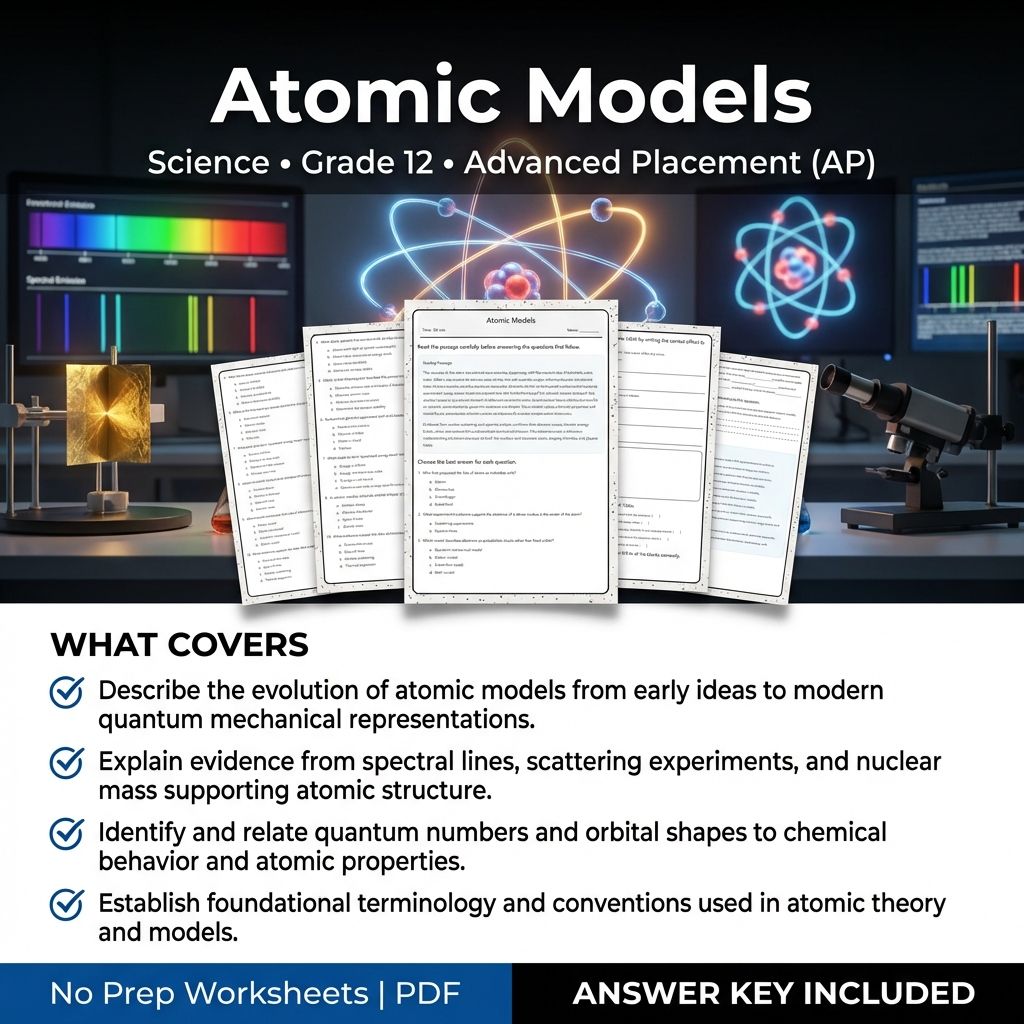
12th Grade Science | Atomic Models Worksheet & Answer Key (PDF) for Classroom Use
Created byCoral Reef LearningLearning Objectives
- Describe the evolution of atomic models from early ideas to modern quantum mechanical representations.
- Explain evidence from spectral lines, scattering experiments, and nuclear mass supporting atomic structure.
- Identify and relate quantum numbers and orbital shapes to chemical behavior and atomic properties.
Also included in: Grade 12 Science Unit Worksheet Bundle – Advanced Chemistry Concepts & Topics +1 more
Instant download
About Grade 12 Science Worksheets
Explore Grade 12 Science worksheets for classwork, homework, or review. Our 4,240 printables download instantly as PDFs.
MyTeachingSheets worksheets are made by real teacher-authors and checked before they go live. Download any as a print-ready PDF for lessons, homework, or independent practice — most include answer keys, and previews are always free.