
Grade 6 Worksheets
8,578 grade resources
6th Grade Science Atoms & Particles Worksheet | Matter Properties (PDF)
 Created byEvergreen Desk Education
Learning Objectives
- Explain how matter can be modeled as particles and how atoms form elements.
- Describe how different particle compositions lead to measurable properties of substances.
- Use particle model ideas to interpret properties like density, melting point, and reactivity.
Instant download
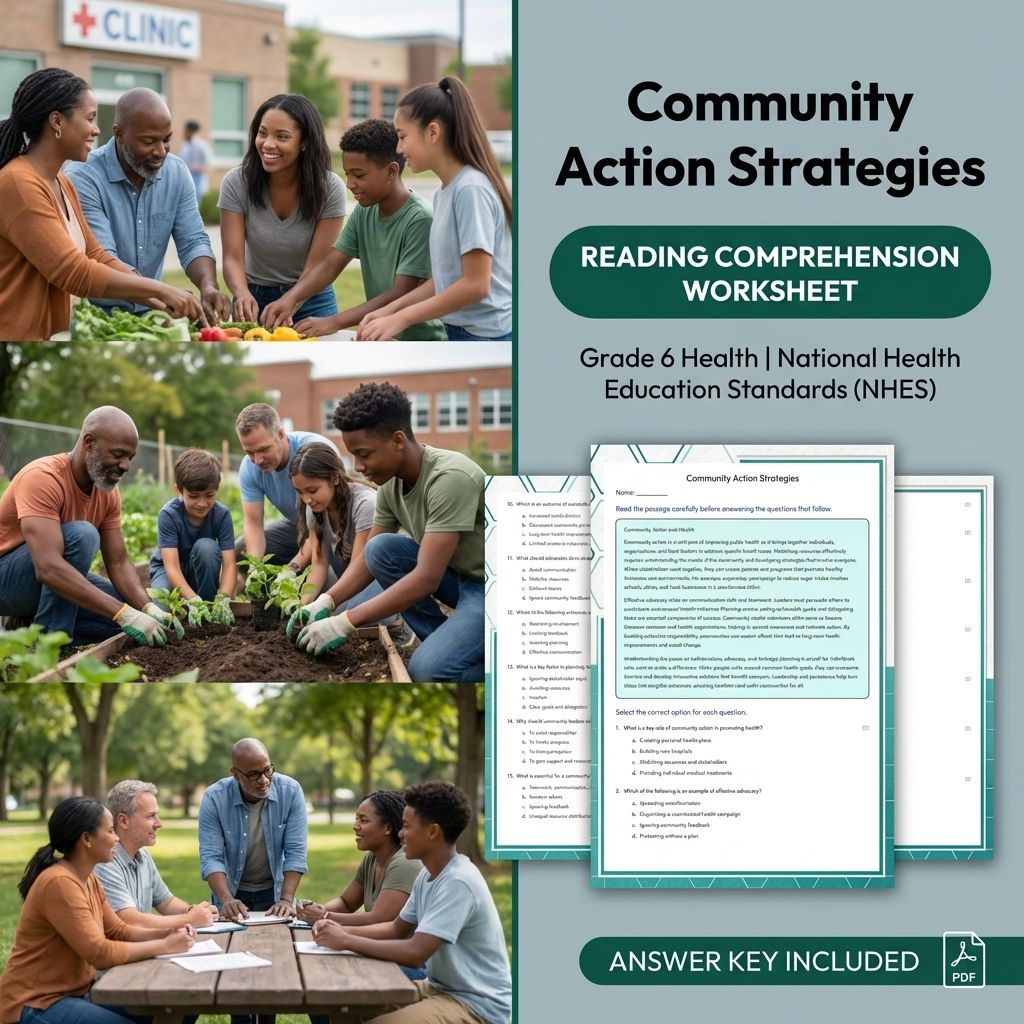
6th Grade Health | Community Action Strategies Worksheet for Standard NHES
 Created bySkylark Worksheets
Learning Objectives
- Understand the importance of community action in promoting health.
- Identify effective strategies for organizing community health initiatives.
- Learn how to communicate persuasively to involve stakeholders.
Also included in: Grade 6 Health Unit | Advocacy & Communication Worksheets (Answer Key Included) +1 more
Instant download
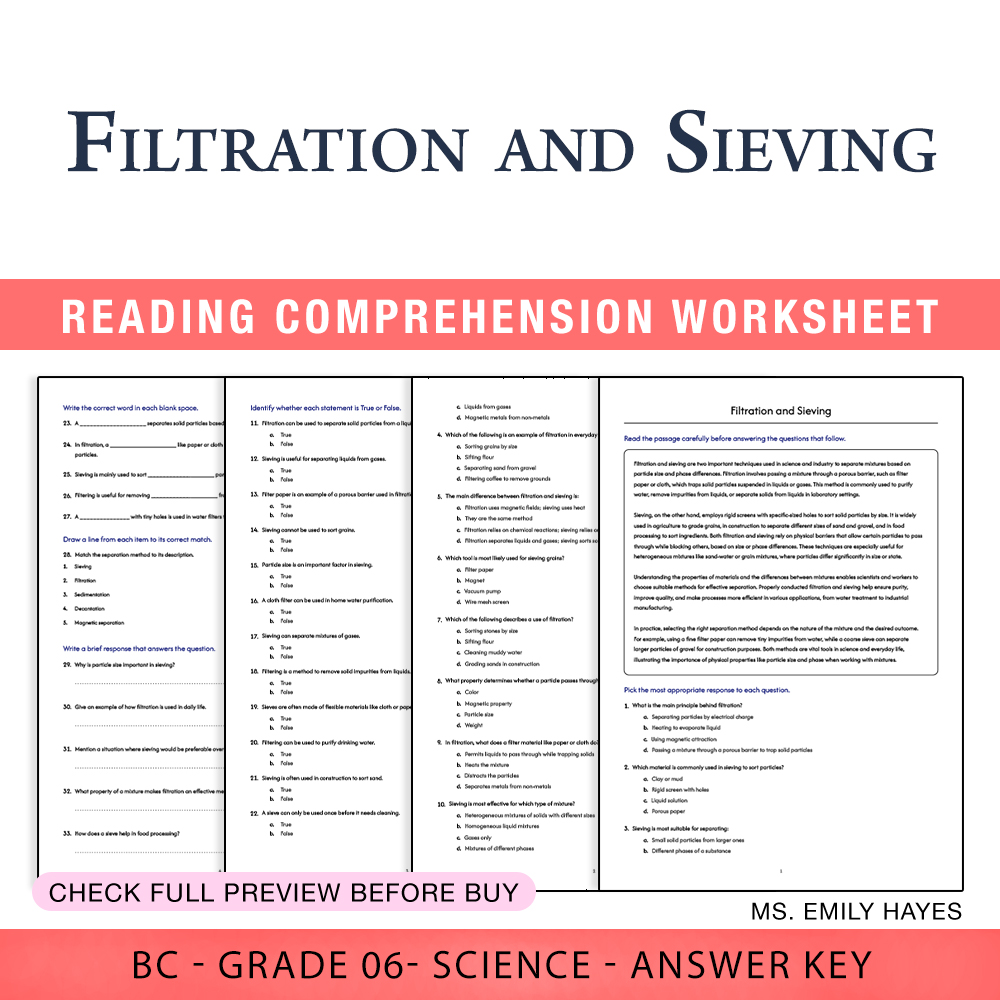
6th Grade Science | Filtration and Sieving Practice Worksheet (PDF+ Answer Key)
 Created byCopper Leaf Classroom
Learning Objectives
- Understand the differences between filtration and sieving as methods for separating mixtures.
- Identify suitable materials and techniques used in filtration and sieving processes.
- Explain real-world applications of filtration and sieving in everyday life and industry.
Also included in: Grade 6 Science BC| Reaction Rates & Chemical Properties (PDF+ Answer Keys) +1 more
Instant download
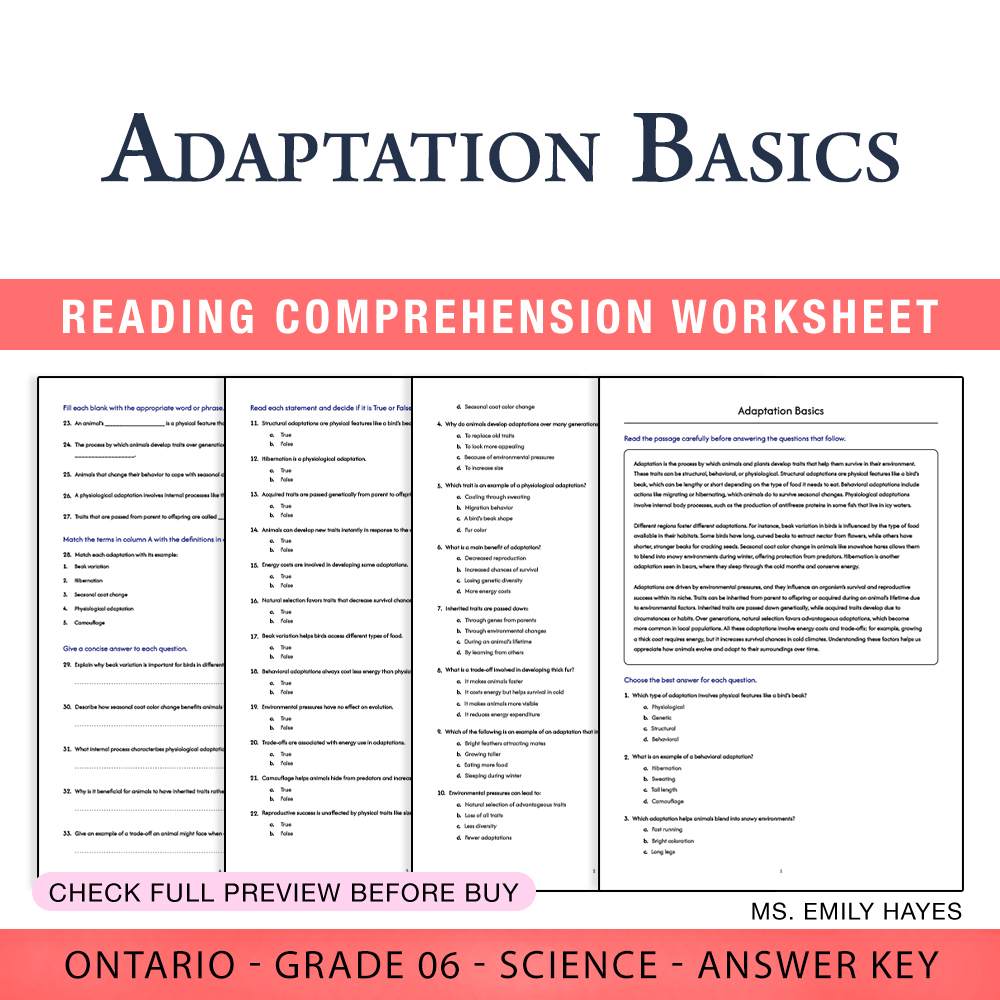
6th Grade Science | Adaptation Basics Worksheet (PDF+ Answer Key)
Created byCopper Leaf ClassroomLearning Objectives
- Understand the three main types of animal adaptations: structural, behavioral, and physiological.
- Identify regional examples of adaptations such as beak variation, seasonal coat color change, and hibernation.
- Explain how adaptations contribute to survival and reproductive success within specific niches.
Instant download
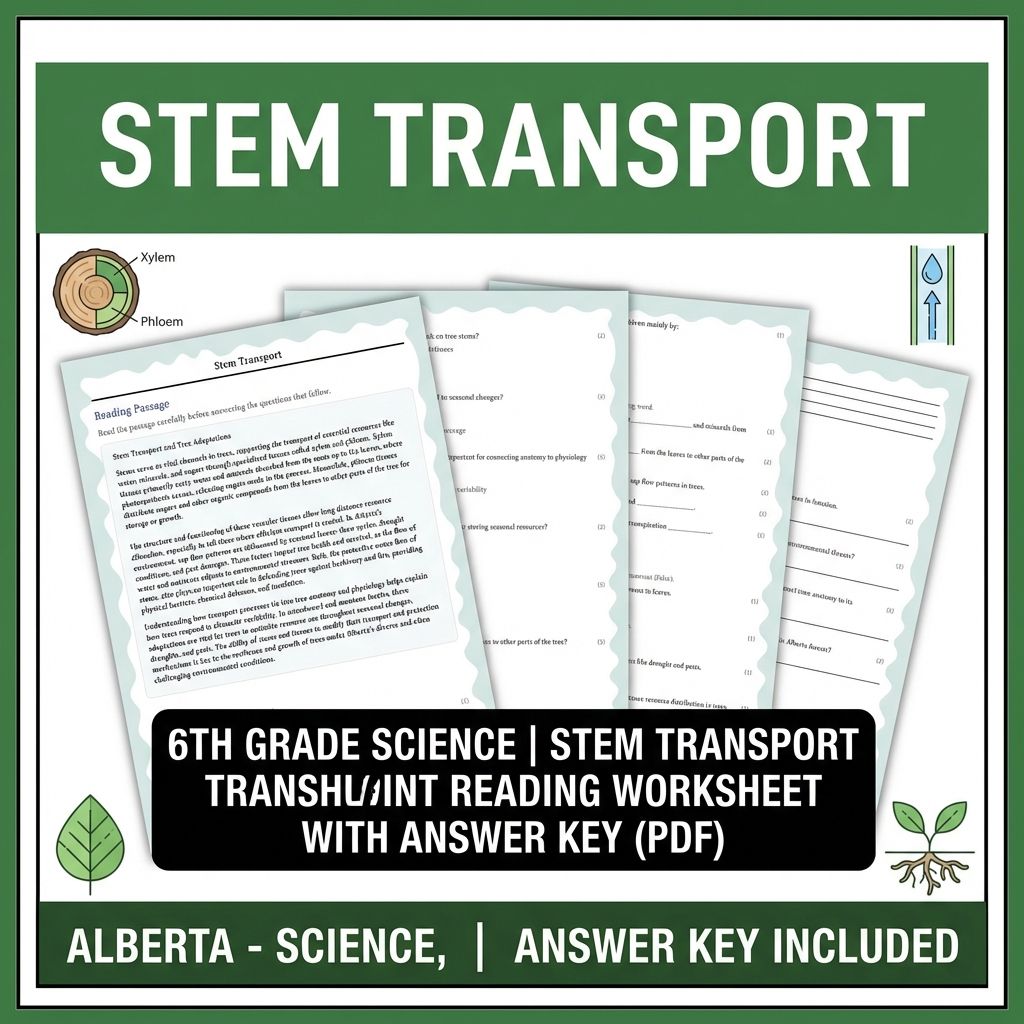
6th Grade Science | Stem Transport Reading Worksheet with Answer Key (PDF)
JCreated byJ.S SheetsLearning Objectives
- Understand how stems and vascular tissues transport water, minerals, and sugars in trees.
- Explain the roles of xylem and phloem in resource transport.
- Describe how environmental factors like freeze–thaw cycles and drought influence sap flow.
Also included in: Grade 6 Science Unit Bundle | Ecosystems and Biodiversity (Answer Keys Included) +1 more
Instant download
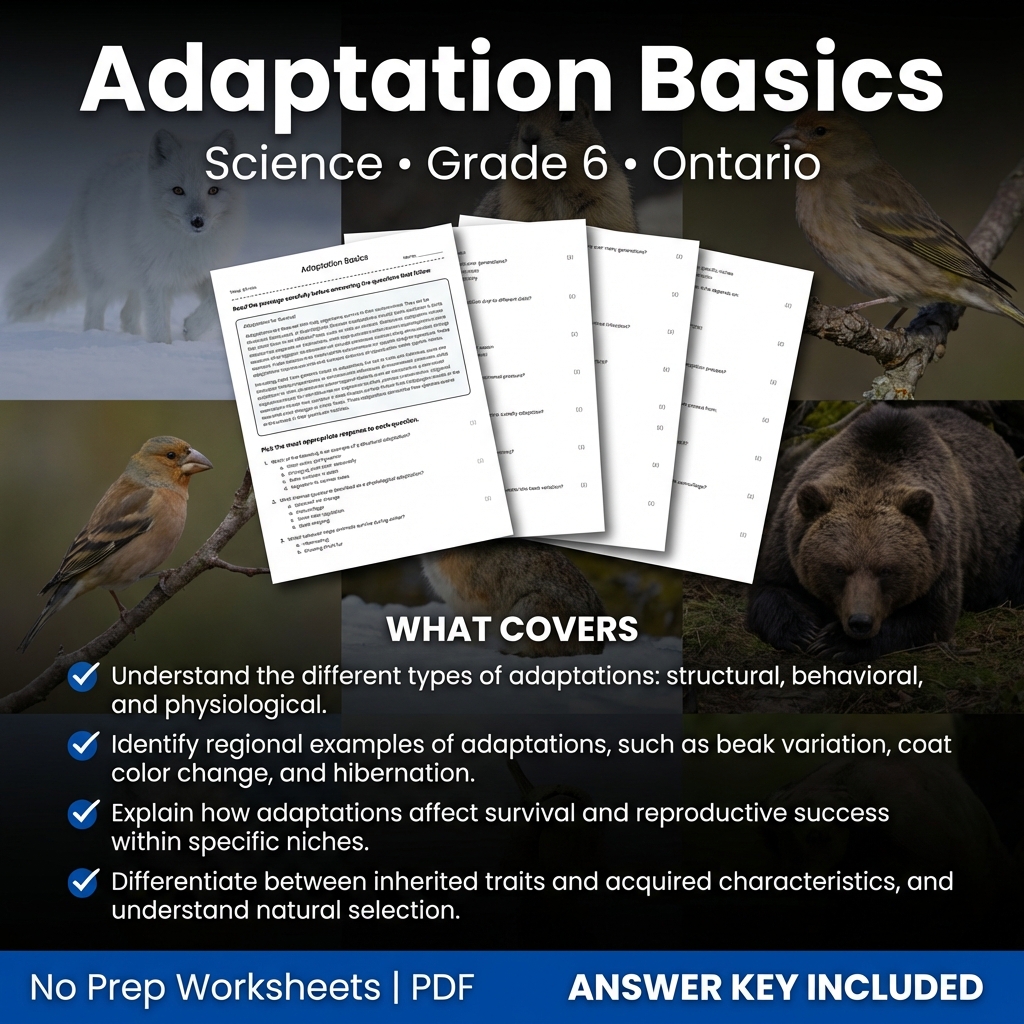
Adaptation Basics Science Worksheet | Ontario Grade 6 Assessment
 Created byCoral Reef Learning
Learning Objectives
- Understand the different types of adaptations: structural, behavioral, and physiological.
- Identify regional examples of adaptations, such as beak variation, coat color change, and hibernation.
- Explain how adaptations affect survival and reproductive success within specific niches.
Instant download

Resource Limits Worksheet | Grade 6 Science NGSS Practice & Assessment
 Created byPrism Point Learning
Learning Objectives
- Explain how limiting resources affect individual organisms and population sizes
- Interpret measurement patterns (such as resource gradients) to predict where species will be most abundant
- Connect carrying capacity to population fluctuations in different environments
Also included in: Grade 6 Species Interactions Science Lesson Bundle | NGSS
Instant download
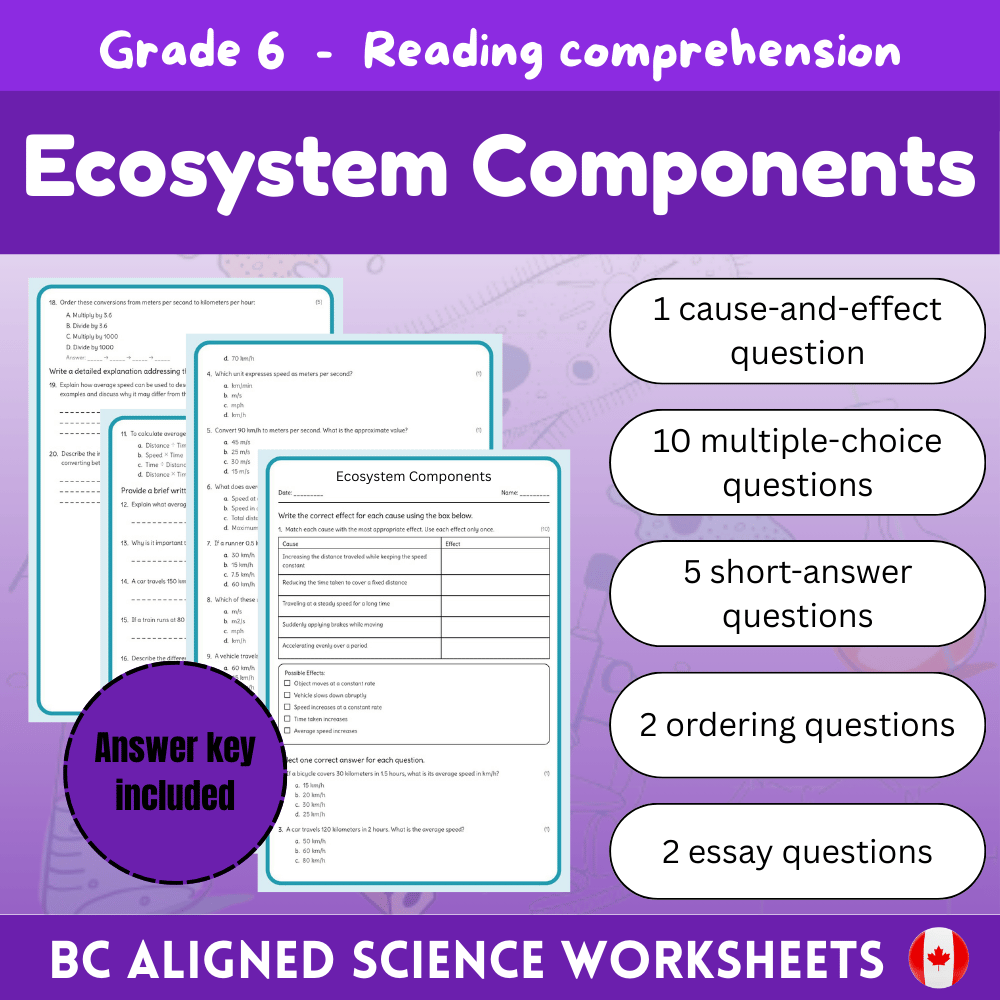
6th Grade Science | Ecosystem Components Worksheet + Answer Key (PDF)
 Created byBright Mind Resources
Learning Objectives
- Understand the roles of biotic and abiotic factors in an ecosystem.
- Identify different components that make up an ecosystem.
- Explain how biotic and abiotic factors interact to influence habitats.
Instant download

6th Grade Science – Design Problem Worksheet (General Standards) (PDF)
 Created byMaple Path Learning
Learning Objectives
- Understand the key components of a design problem, including needs and constraints.
- Learn how to generate solution ideas using sketches, measurements, and goals.
- Explore real-world examples of designing protective cases for fragile items.
Instant download

Grade 6 Seasonal Music Traditions Worksheet – Christmas Carols & Holiday Songs
 Created byCedar Grove Learning
Learning Objectives
- Understand the history and significance of Christmas carols and holiday songs.
- Identify common themes and lyrical messages in Christmas music.
- Recognize how Christmas music fosters community bonding and festive atmosphere.
Instant download
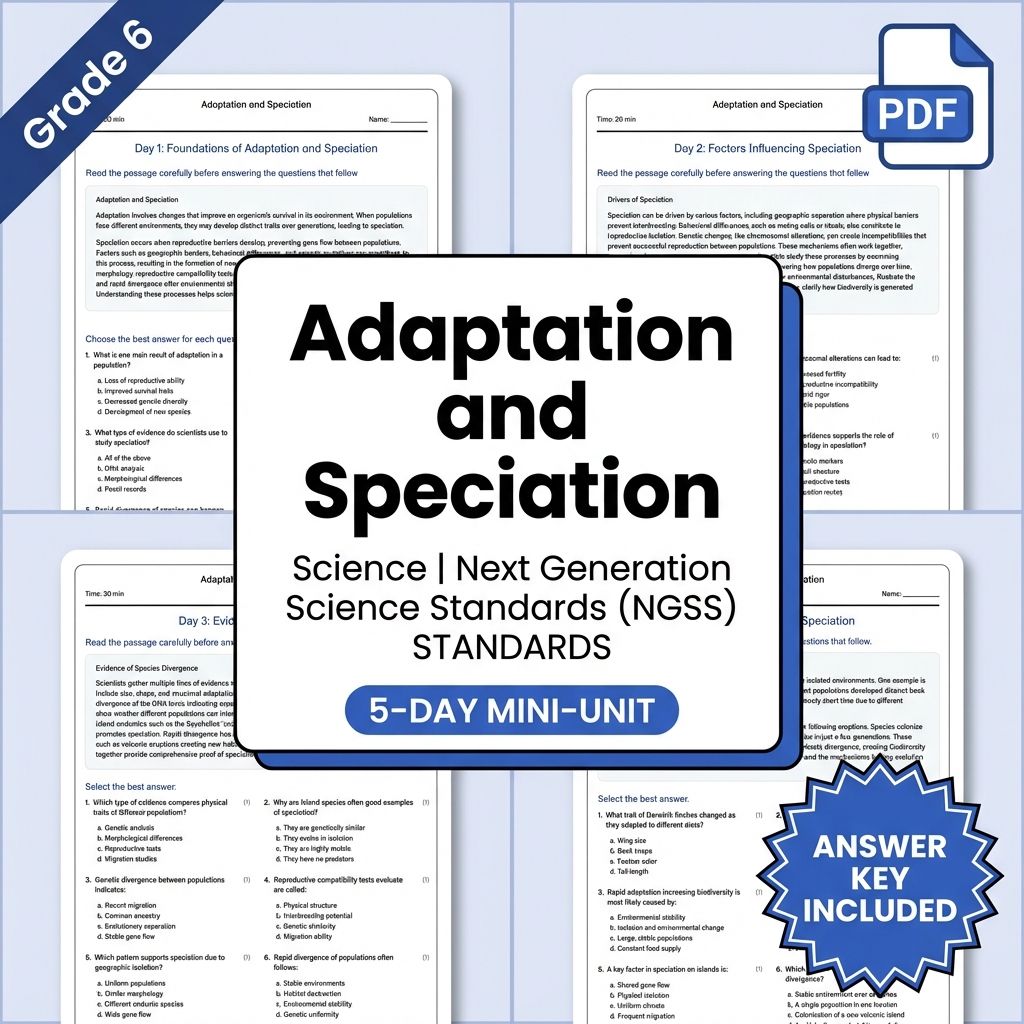
6th Grade Science | Adaptation and Speciation Daily Worksheet (PDF + Answer Key)
Created byCopper Leaf ClassroomLearning Objectives
- Understand the processes of adaptation and how they lead to species divergence.
- Identify the factors contributing to speciation, including geographic and genetic changes.
- Recognize evidence used by scientists to study speciation events.
Instant download

6th Grade Science Worksheet – Climate Data Patterns (PDF)
Created byMaple Path LearningLearning Objectives
- Understand how climate data is collected and organized over long periods.
- Interpret graphs of temperature and precipitation to identify patterns.
- Compare current climate data with historical baselines to detect shifts.
Instant download
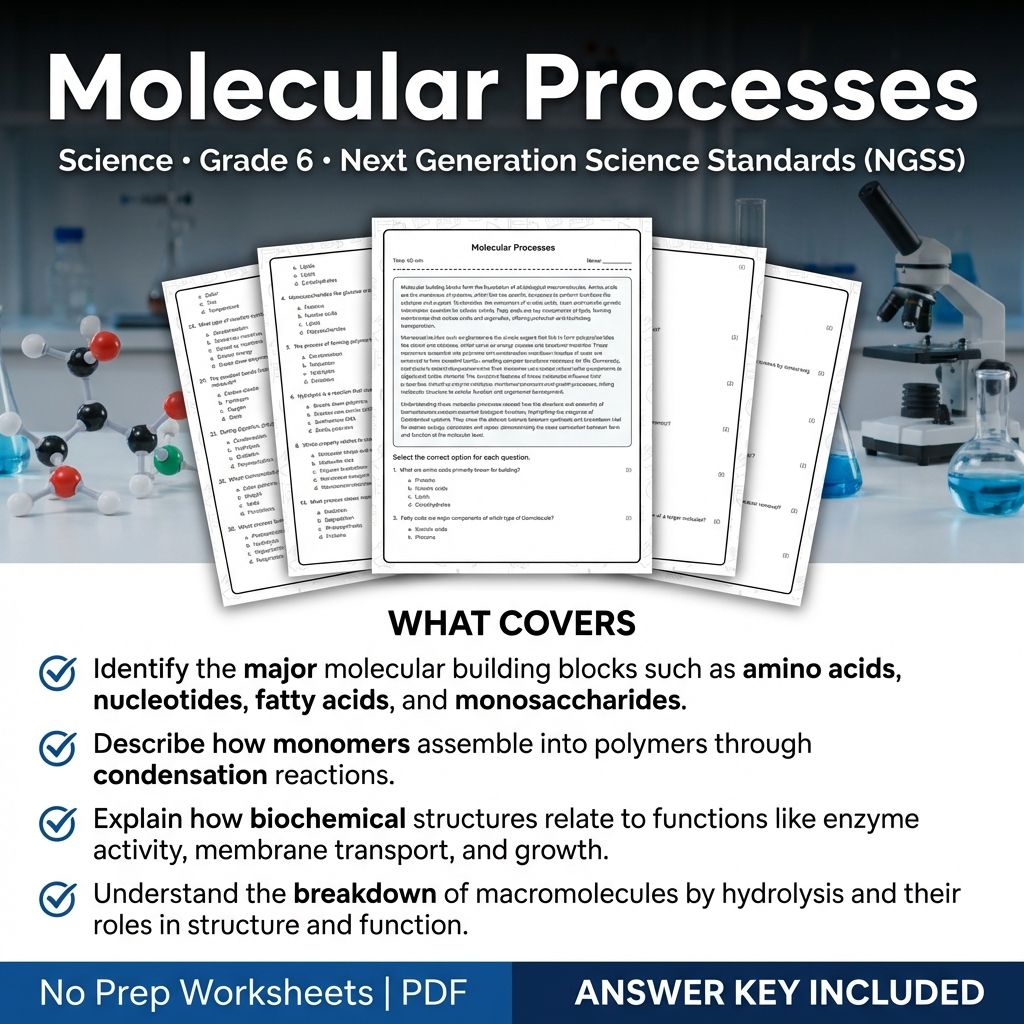
6th Grade Science Worksheet | Molecular Processes NGSS Practice & Review (Printable PDF & Answer Key)
Created byCoral Reef LearningLearning Objectives
- Identify the major molecular building blocks such as amino acids, nucleotides, fatty acids, and monosaccharides.
- Describe how monomers assemble into polymers through condensation reactions.
- Explain how biochemical structures relate to functions like enzyme activity, membrane transport, and growth.
Instant download
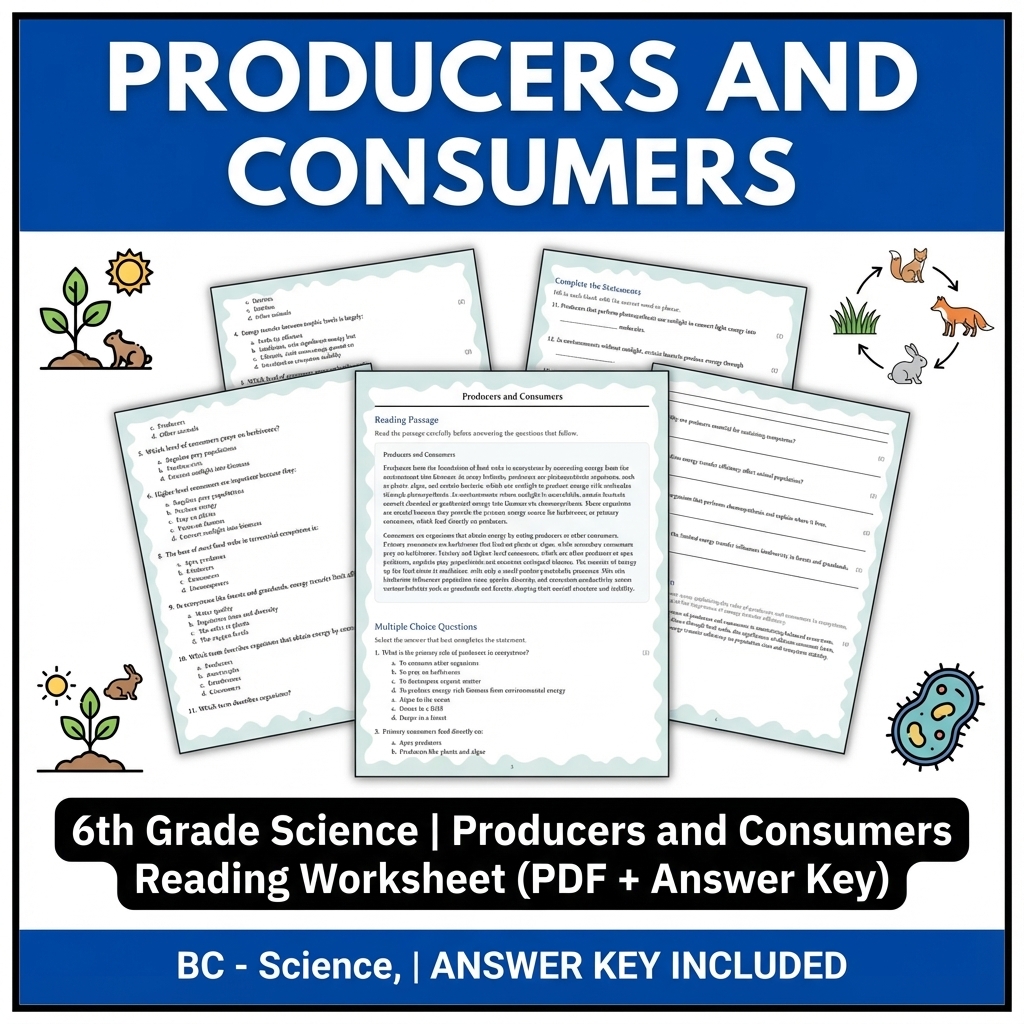
6th Grade Science | Producers and Consumers Reading Worksheet (PDF + Answer Key)
JCreated byJ.S SheetsLearning Objectives
- Understand the roles of producers and consumers in ecosystems.
- Identify different types of consumers and their position in food webs.
- Explain how energy transfer efficiency influences population sizes and ecosystem stability.
Instant download

6th Grade Science | Mass and Density Reading Worksheet (PDF + Rubric)
JCreated byJ.S SheetsLearning Objectives
- Understand the concepts of mass and volume and how they relate through density.
- Learn how to calculate density using sample measurements.
- Interpret density values to distinguish between objects that sink or float.
Instant download
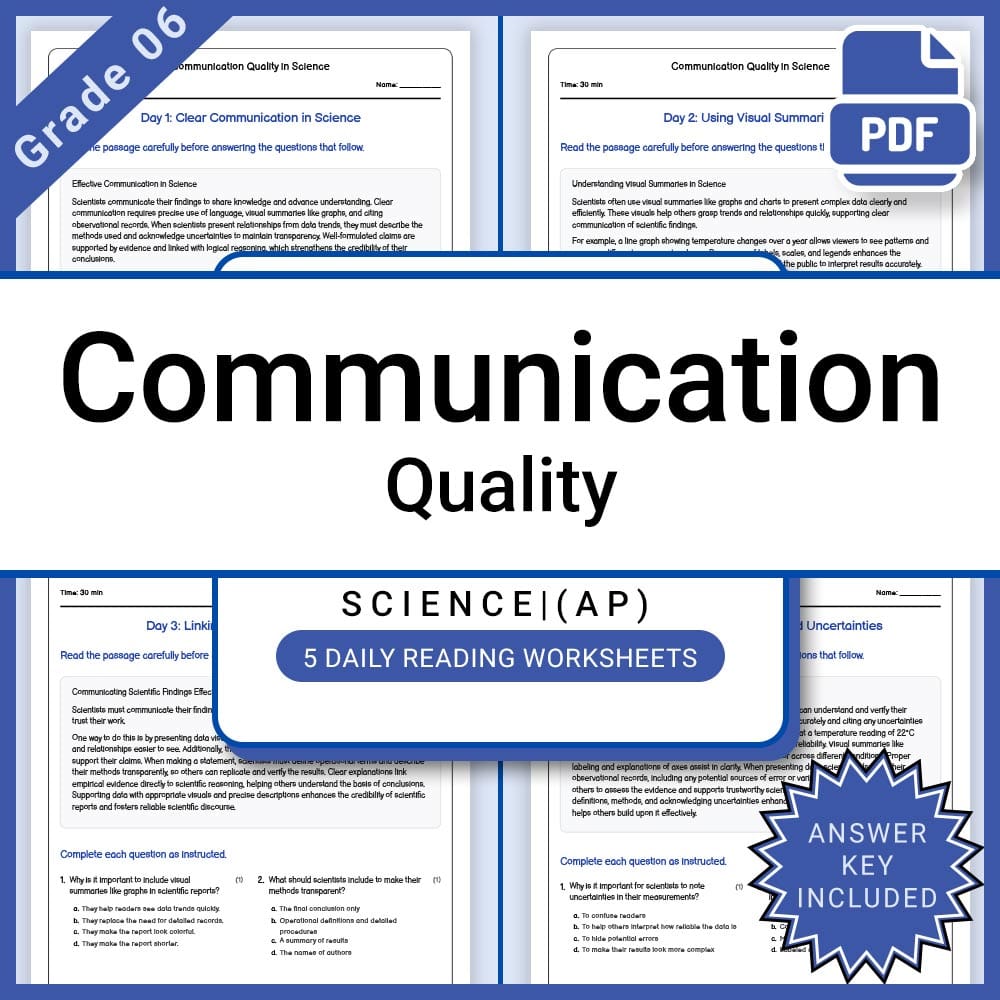
Grade 6 Science – Communication Quality Daily Reading Worksheet + Answer Key
JCreated byJ.S SheetsLearning Objectives
- Understand how to formulate clear scientific claims supported by evidence.
- Learn the importance of visual summaries and proper citation of observations.
- Develop skills to present scientific data transparently and coherently.
Also included in: Grade 6 Science Lesson Group Bundle TEKS Standards +1 more
Instant download
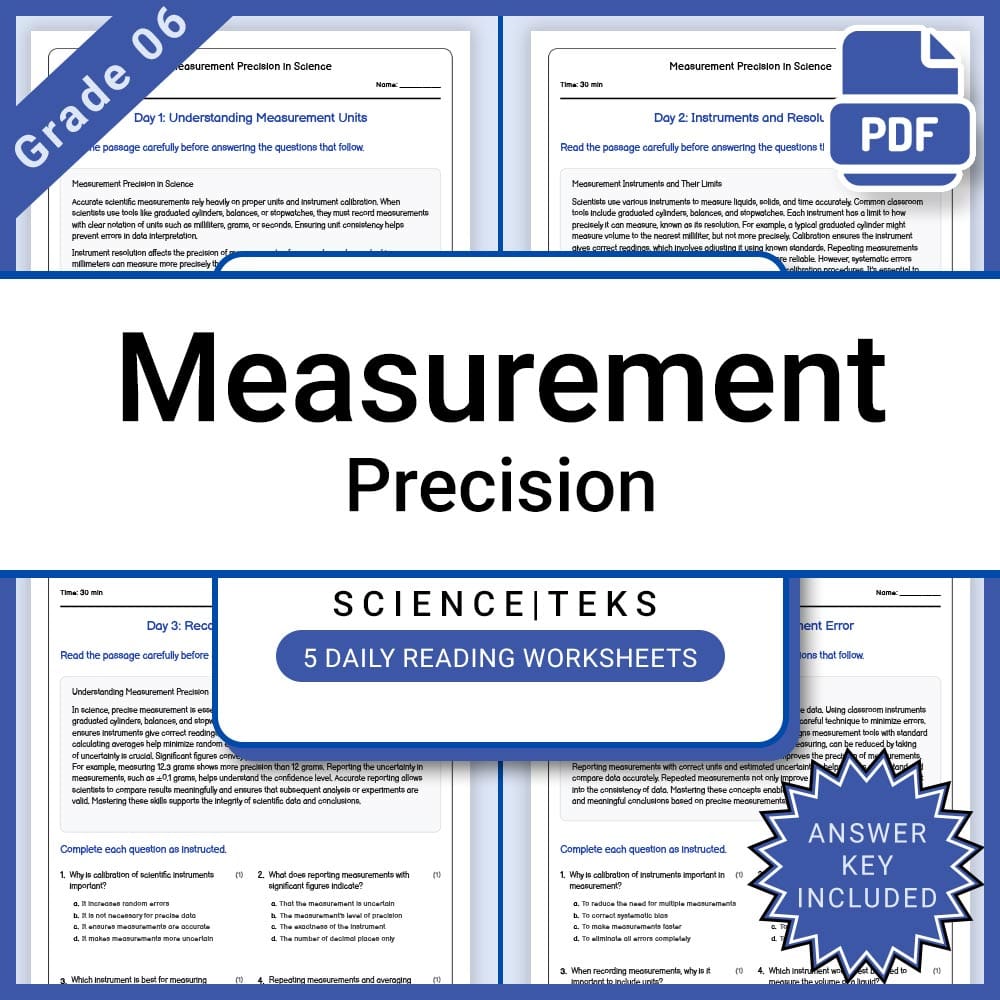
Grade 6 Science – Measurement Precision Daily Reading Worksheet with Answer Key
JCreated byJ.S SheetsLearning Objectives
- Understand the conventions of measurement units in scientific experiments
- Learn how to maintain unit consistency in data collection
- Recognize instrument resolution and its impact on measurement accuracy
Also included in: Grade 6 Science Lesson Group Bundle TEKS Standards +1 more
Instant download
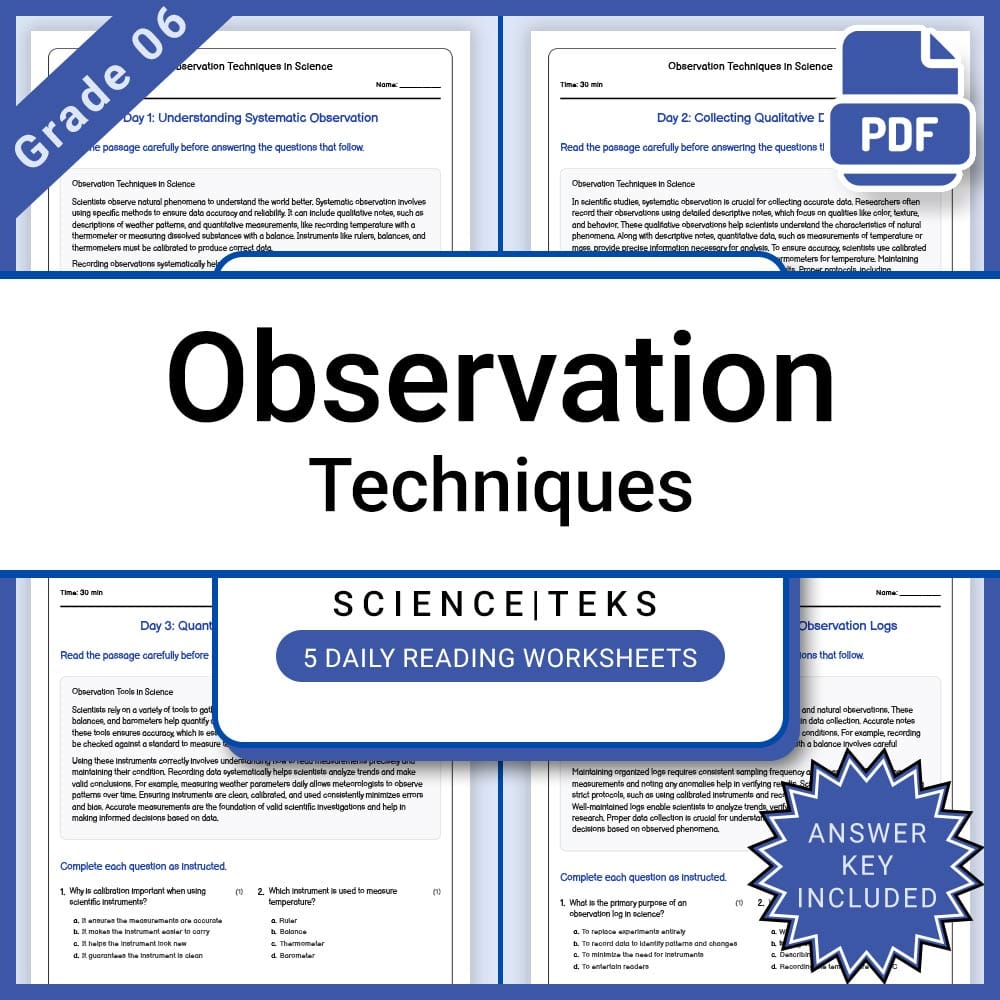
Grade 6 Science Observation Techniques Daily Reading Worksheet with Answer Key
JCreated byJ.S SheetsLearning Objectives
- Understand the concept of systematic observation in scientific studies.
- Differentiate between qualitative notes and quantitative measurements.
- Identify common instruments used in scientific observation such as rulers, balances, and thermometers.
Also included in: Grade 6 Science Lesson Group Bundle TEKS Standards +1 more
Instant download
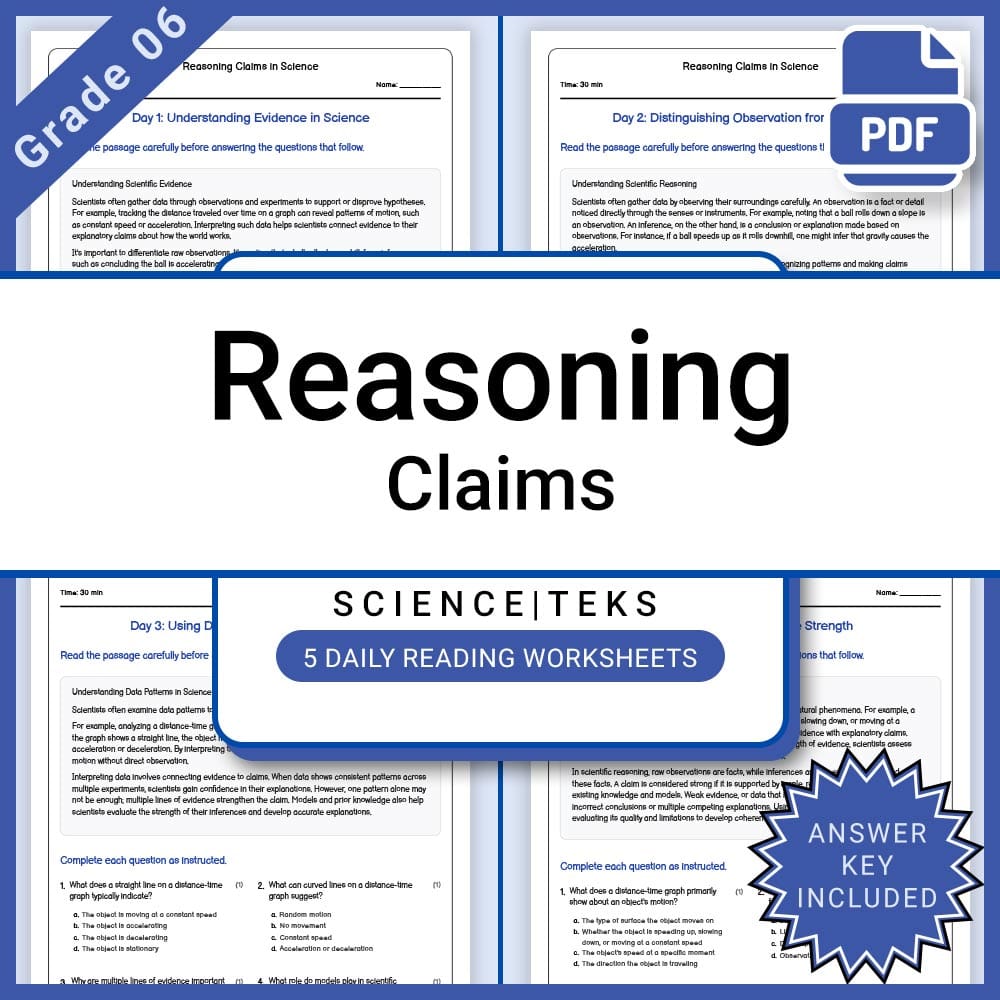
Grade 6 Science – Reasoning Claims Daily Reading Worksheet with Answer Key
JCreated byJ.S SheetsLearning Objectives
- Understand how scientific evidence supports explanatory claims.
- Interpret patterns and data in scientific contexts like graphs.
- Distinguish between raw observations and inferences.
Also included in: Grade 6 Science Lesson Group Bundle TEKS Standards +1 more
Instant download
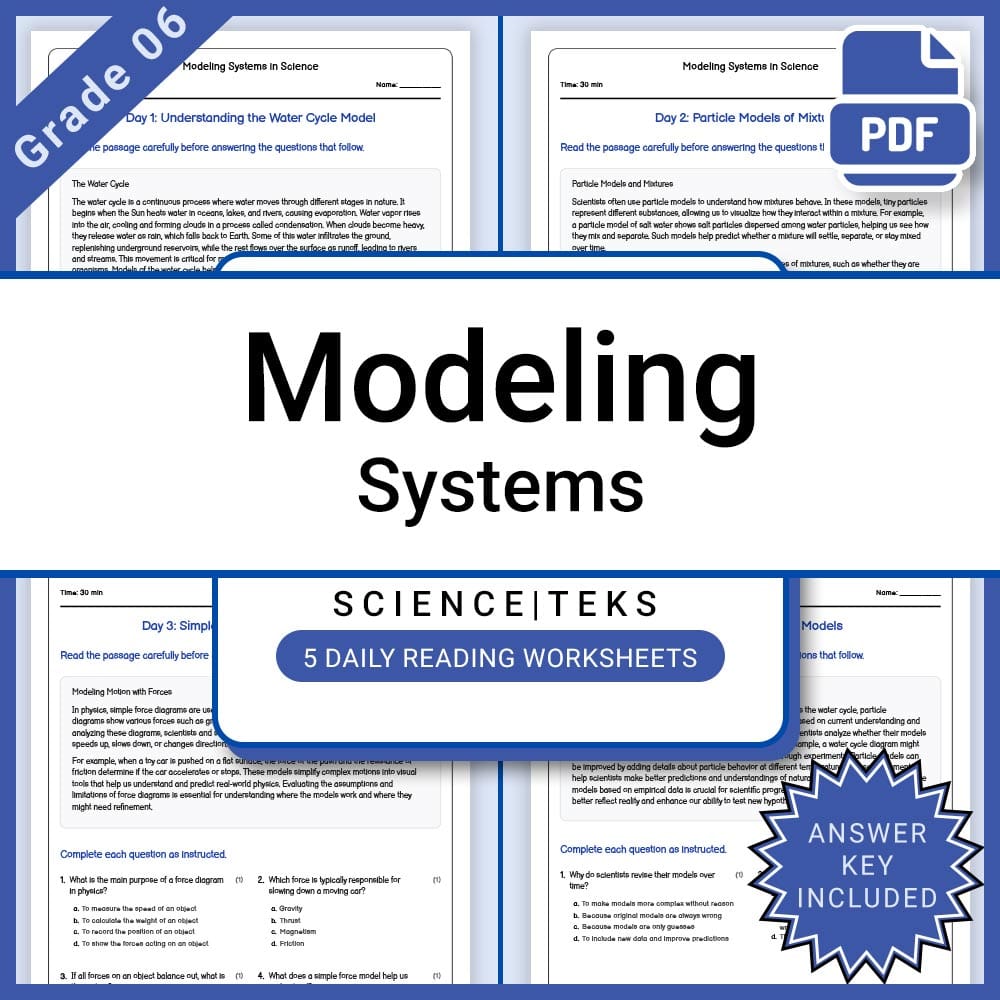
Grade 6 Science – Modeling Systems Daily Reading Worksheet + Answer Key
JCreated byJ.S SheetsLearning Objectives
- Understand how the water cycle model illustrates natural processes
- Interpret diagrams and models used in science to represent systems
- Identify the assumptions and limitations of different scientific models
Also included in: Grade 6 Science Lesson Group Bundle TEKS Standards +1 more
Instant download
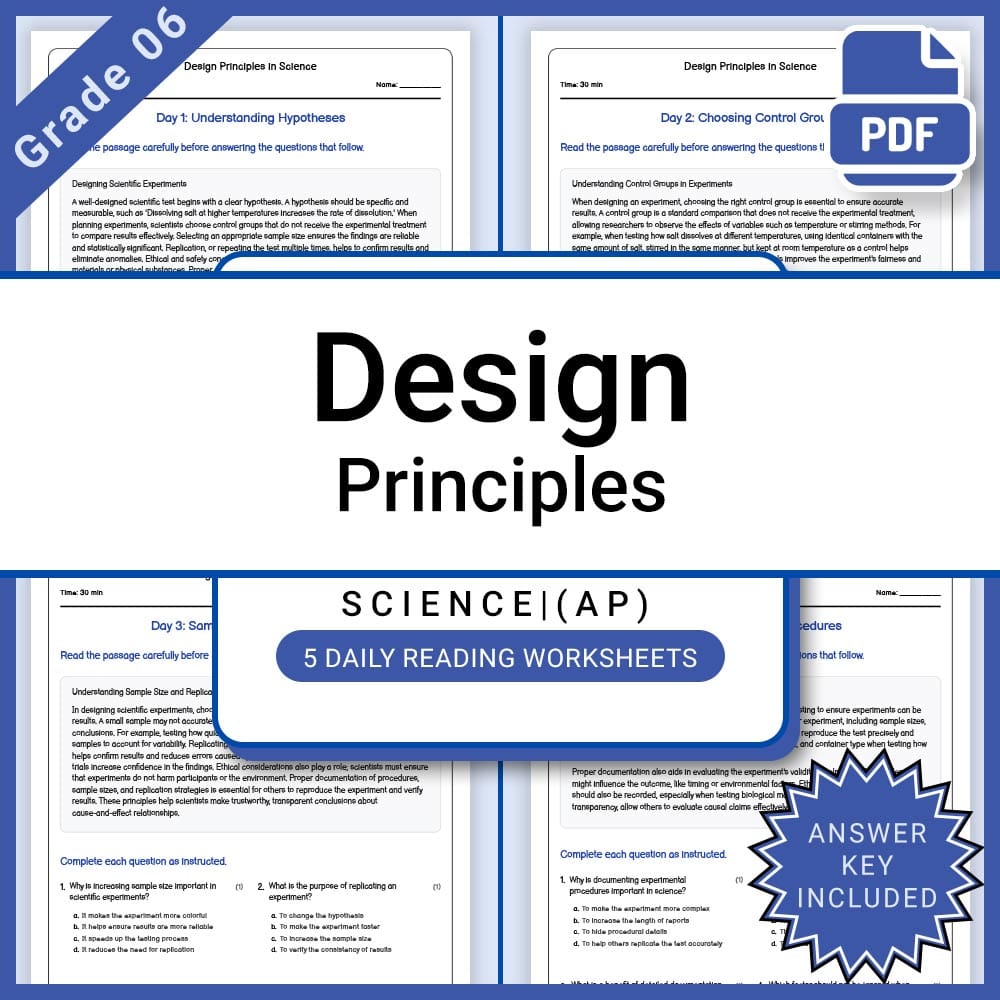
Grade 6 Science – Design Principles Daily Reading Worksheet + Answer Key
JCreated byJ.S SheetsLearning Objectives
- Understand the importance of formulating clear, measurable hypotheses.
- Identify appropriate control groups in experiments.
- Recognize how sample size and replication affect experimental validity.
Also included in: Grade 6 Science Lesson Group Bundle TEKS Standards +1 more
Instant download
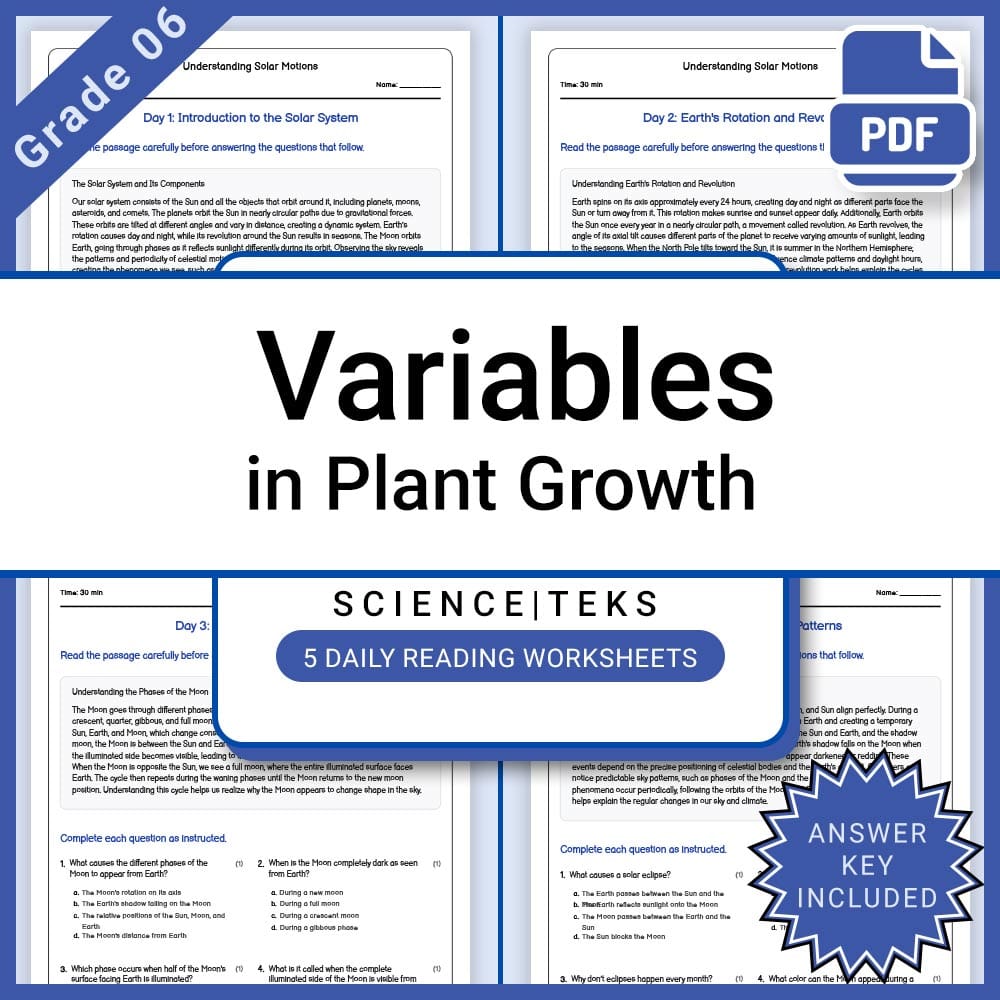
Grade 6 Science – Variables in Plant Growth Daily Reading Worksheet + Answer Key
JCreated byJ.S SheetsLearning Objectives
- Identify independent, dependent, and controlled variables in a scientific experiment.
- Understand the importance of operational definitions in controlled testing.
- Recognize potential confounding variables and how to control them.
Also included in: Grade 6 Science Lesson Group Bundle TEKS Standards +1 more
Instant download
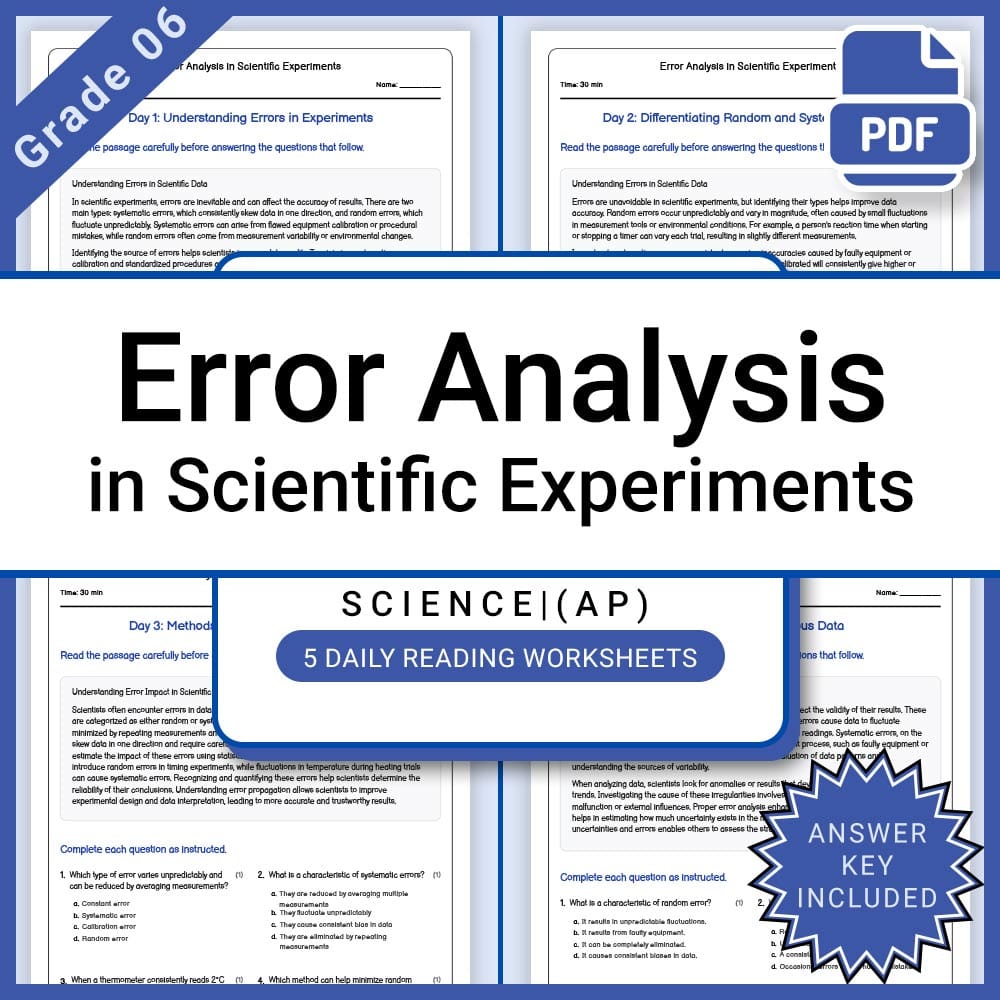
Grade 6 – Error Analysis in Scientific Experiments Worksheet with Answer Key
JCreated byJ.S SheetsLearning Objectives
- Understand the distinction between systematic and random errors.
- Identify common sources of error in experimental data.
- Learn methods to estimate and account for errors in measurements.
Also included in: Grade 6 Science Lesson Group Bundle TEKS Standards +1 more
Instant download
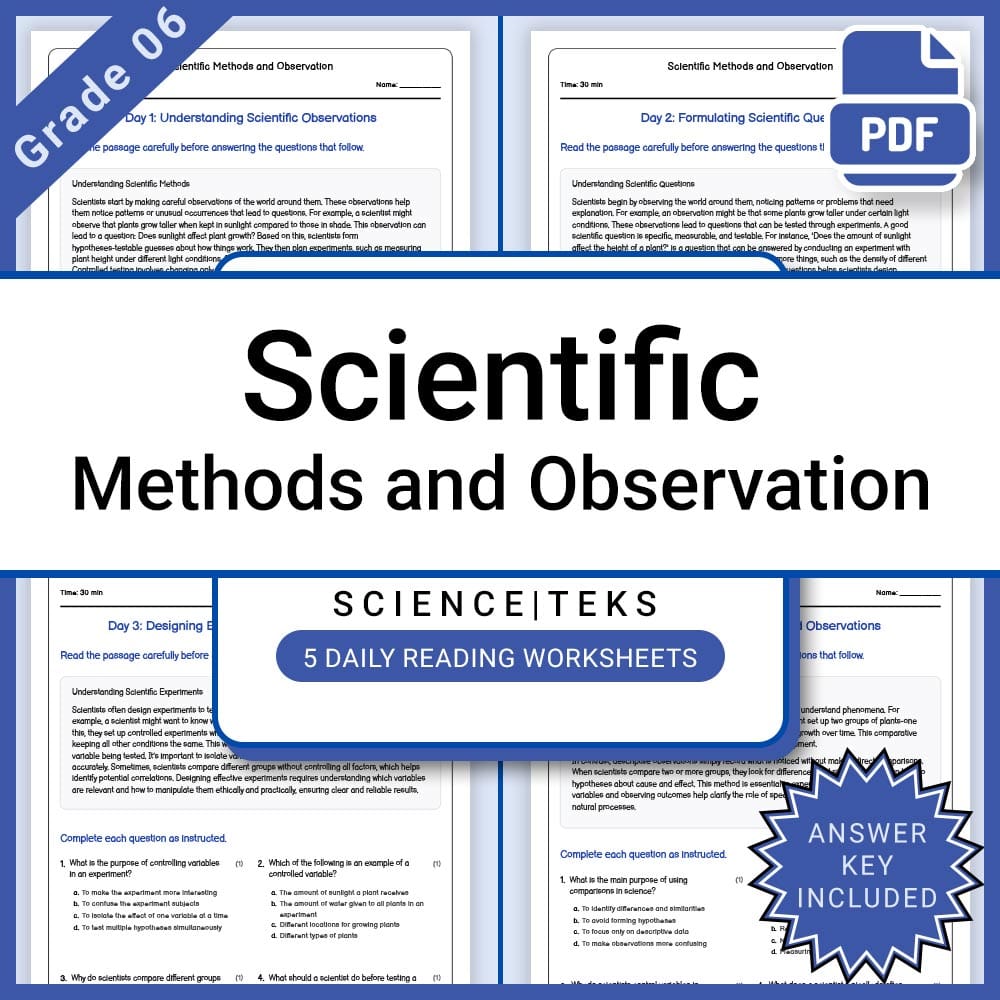
Grade 6 Science – Scientific Methods and Observation Worksheet + Answer Key
JCreated byJ.S SheetsLearning Objectives
- Differentiate between observation and hypothesis in scientific investigations.
- Understand the role of prior observation in forming testable questions.
- Learn how to select appropriate methods like controlled testing and comparative observation based on phenomena.
Also included in: Grade 6 Science Lesson Group Bundle TEKS Standards +1 more
Instant download

Data Representation Worksheet | TEKS Aligned Grade 6 Science Practice
JCreated byJ.S SheetsLearning Objectives
- Identify how tables and graphs (line, bar, and scatter) represent data and reveal patterns
- Select appropriate axis labels, units, and scales to make graphs accurate and readable
- Interpret trends, relationships, central tendency summaries, and outliers in data displays
Instant download
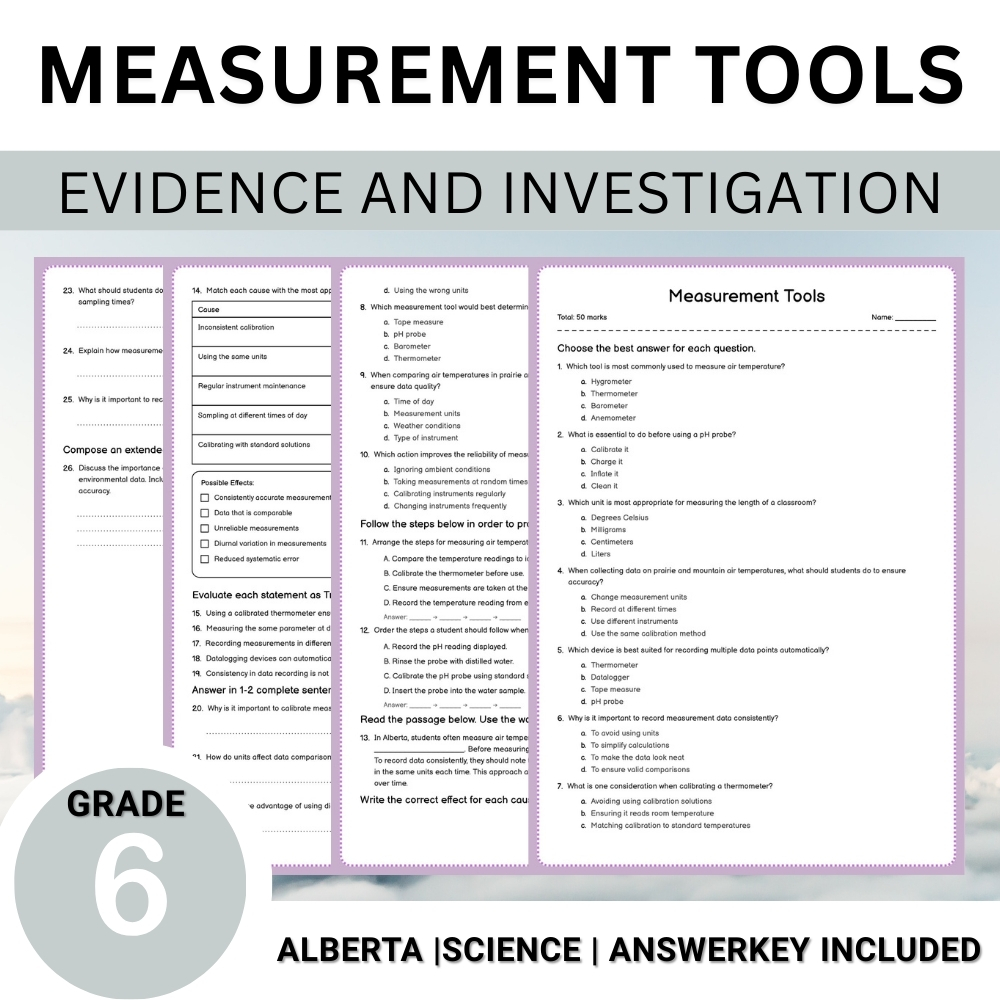
Grade 6 Science | Measurement Tools Worksheet (Printable PDF + Assessment)
Learning Objectives
- Identify common measurement instruments such as thermometers, pH probes, and tape measures.
- Understand how to calibrate and select appropriate units for accurate data collection.
- Learn methods for consistent recording and representation of measurement data.
Also included in: Grade 6 Science Unit | Data & Measurement Worksheets Bundle (Assessment & Practice) +1 more
Instant download
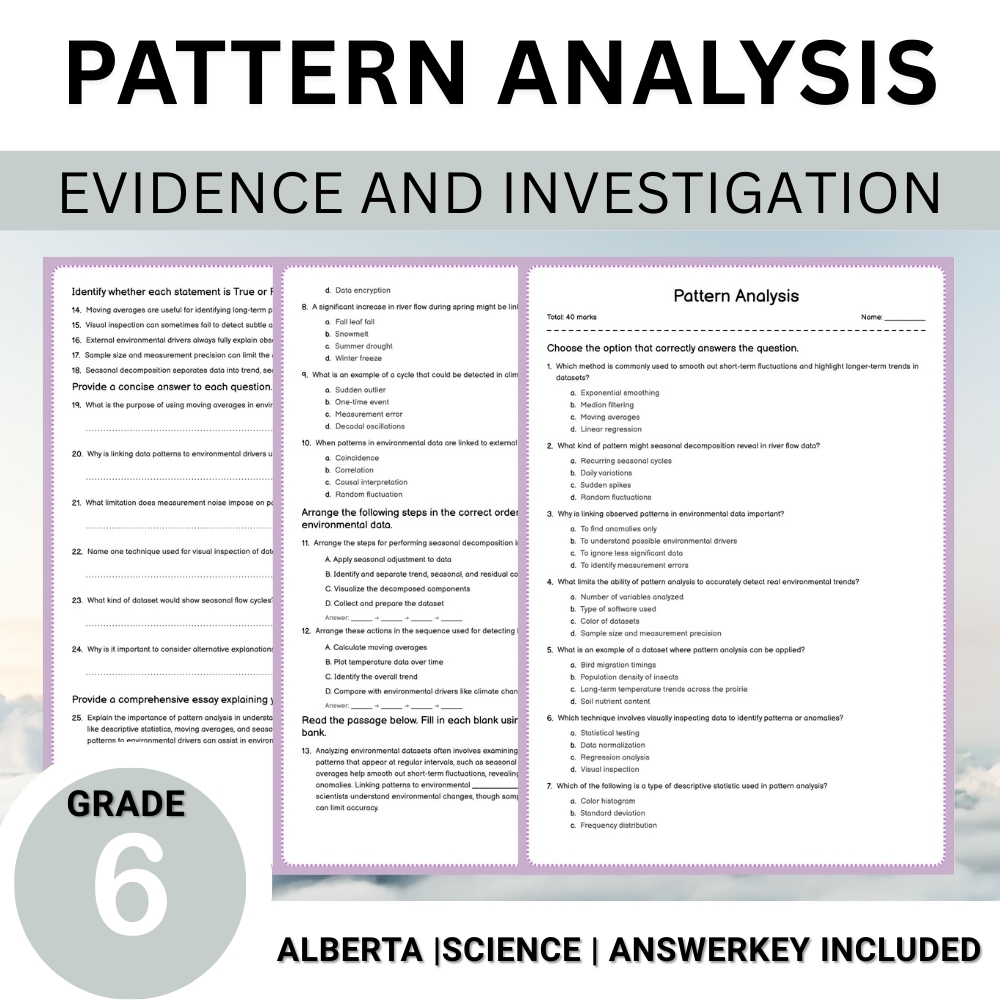
6th Grade Science | Pattern Analysis Worksheet (Answer Key) for Environmental Data
Learning Objectives
- Understand methods for detecting trends, cycles, and anomalies in datasets.
- Learn to interpret simple descriptive statistics and moving averages.
- Apply seasonal decomposition techniques to environmental data examples.
Also included in: Grade 6 Science Unit | Data & Measurement Worksheets Bundle (Assessment & Practice) +1 more
Instant download
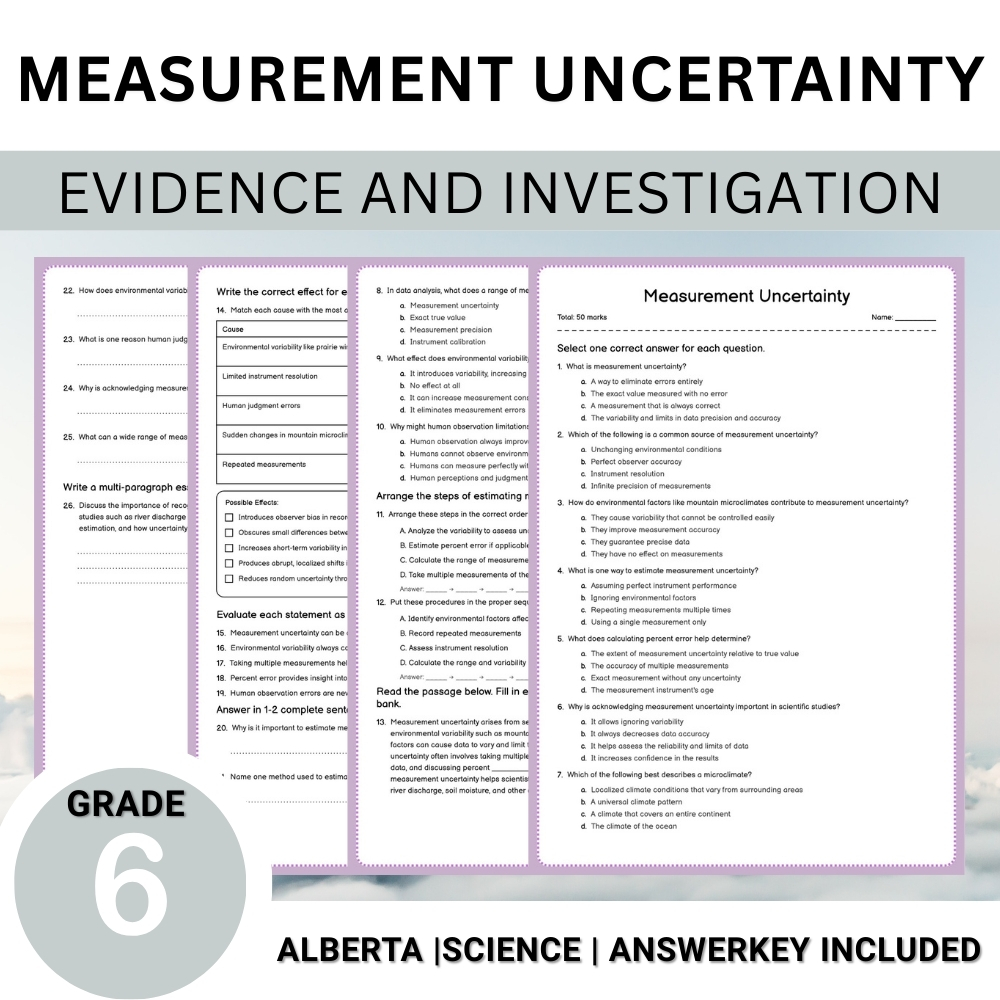
Grade 6 Science | Measurement Uncertainty Worksheet & Assessment (Printable PDF)
Learning Objectives
- Explain the concept of measurement uncertainty and its sources.
- Identify methods for estimating measurement uncertainty in real-world data.
- Analyze how uncertainty impacts confidence in scientific conclusions.
Also included in: Grade 6 Science Unit | Data & Measurement Worksheets Bundle (Assessment & Practice) +1 more
Instant download
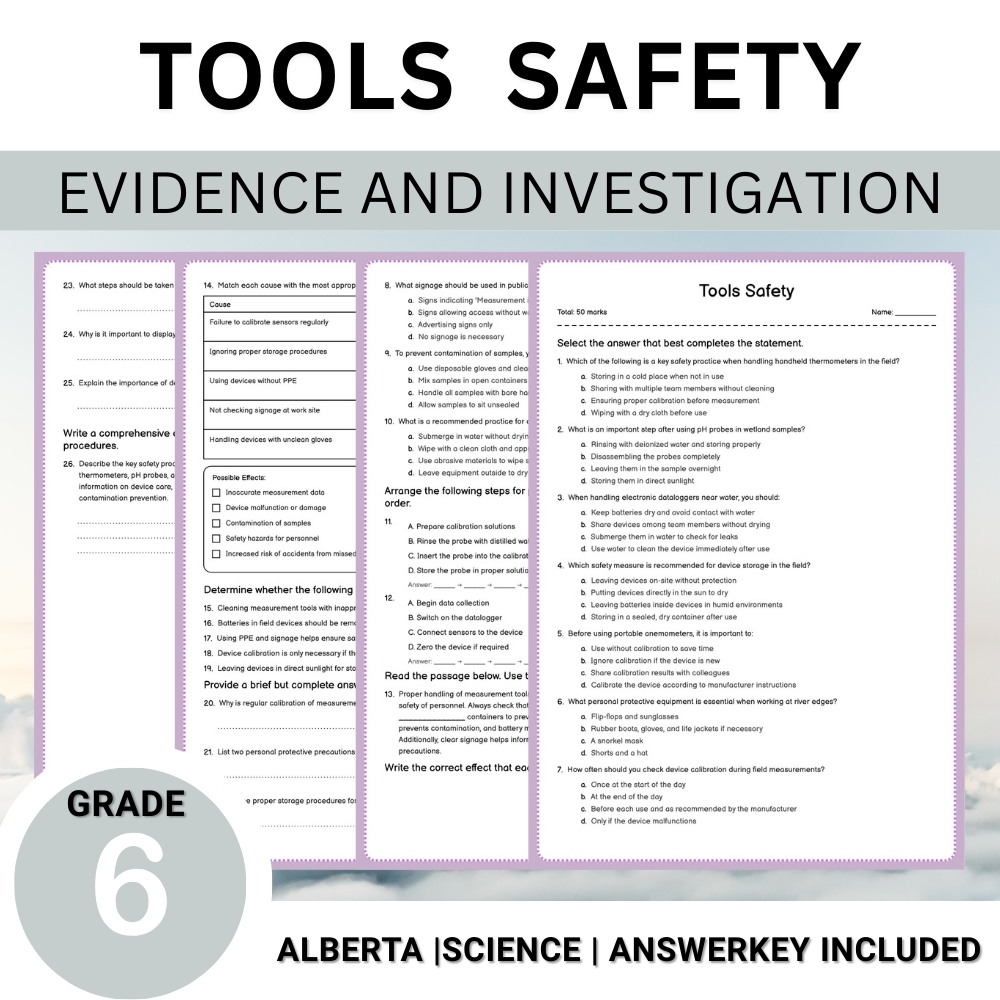
Grade 6 Science | Tools Safety Worksheet – Classroom Assessment & Student Practice (Printable PDF)
Learning Objectives
- Identify safe practices for handling measurement tools near Alberta field sites.
- Explain proper storage, cleaning, and maintenance of scientific devices.
- Describe personal protective precautions for wetland or river-edge work.
Also included in: Grade 6 Science Unit | Data & Measurement Worksheets Bundle (Assessment & Practice) +1 more
Instant download
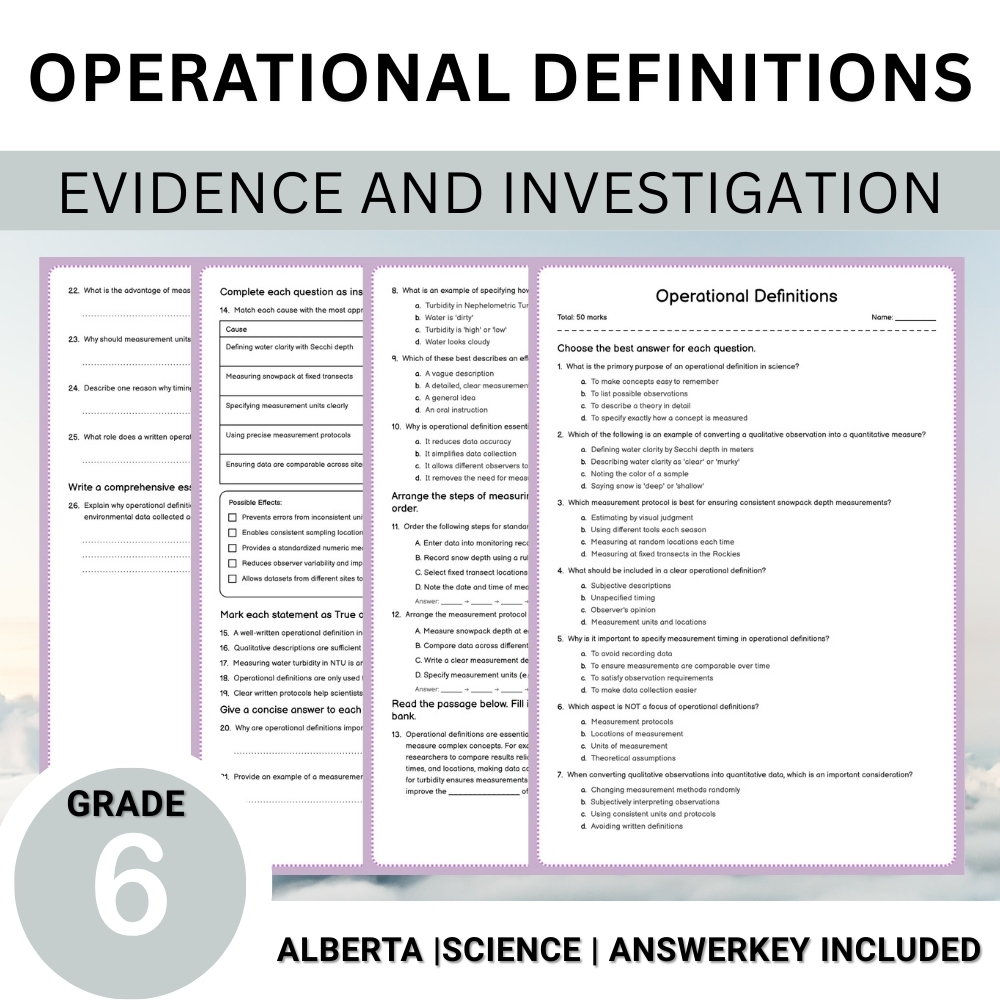
Grade 6 Science | Operational Definitions Worksheet (Printable PDF + Answer Key)
Learning Objectives
- Understand the concept of operational definitions and their importance in science.
- Learn how to create clear and measurable definitions for qualitative concepts.
- Identify different methods for converting qualitative observations into quantitative data.
Also included in: Grade 6 Science Unit | Data & Measurement Worksheets Bundle (Assessment & Practice) +1 more
Instant download

Grade 6 Current Electricity Circuits Worksheet | Ontario Science Activity Pack
 Created byTeacher's Corner
Learning Objectives
- Explain how electric current is the organized movement of charges through a conductor.
- Distinguish conventional current direction from electron flow in a circuit.
- Describe how potential difference (voltage) acts as the driving force for current.
Instant download

6th Grade Science Worksheet | Space Tools TEKS Practice (PDF)
Created byEvergreen Desk EducationLearning Objectives
- Explain how different space tools (telescopes, probes, and satellites) help scientists observe Earth and space systems.
- Describe how spectral imaging and remote sensing collect information about temperature, vegetation, and atmospheric composition.
- Interpret data using ideas like resolution limits and coordinate mapping to understand landforms and ocean conditions.
Instant download
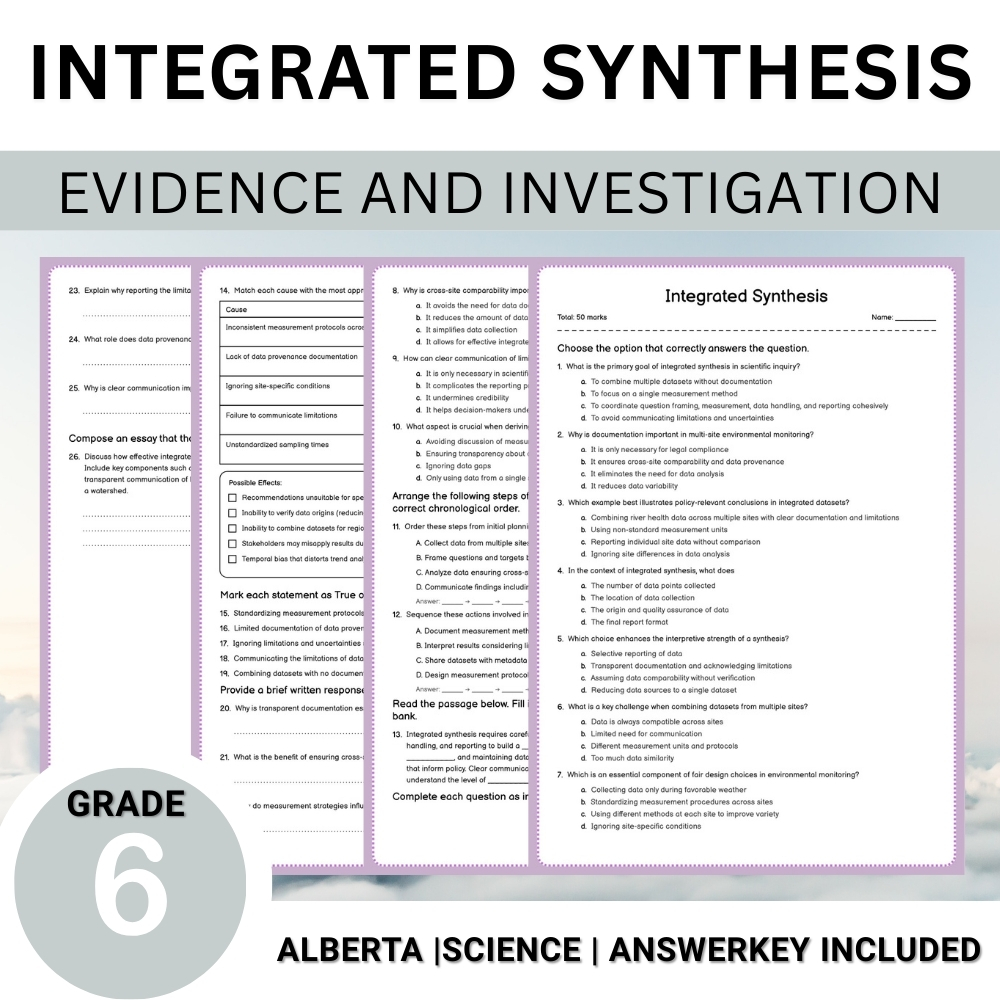
6th Grade Science | Integrated Synthesis Worksheet (Answer Key)
Learning Objectives
- Understand the components of integrated synthesis in scientific inquiry.
- Recognize the importance of documentation, comparability, and provenance in data collection across sites.
- Learn how to interpret and communicate limitations and evidence-based conclusions.
Also included in: Grade 6 Science Unit | Data & Measurement Worksheets Bundle (Assessment & Practice) +1 more
Instant download

Malware and Unsafe Downloads Worksheet | Grade 6 Computer Safety
Created byBright Mind ResourcesLearning Objectives
- Define malware, virus, download, and protection in simple computer-safety terms
- Identify risky signs in file names, links, and message attachments
- Explain how to protect devices and accounts when downloading files
Instant download
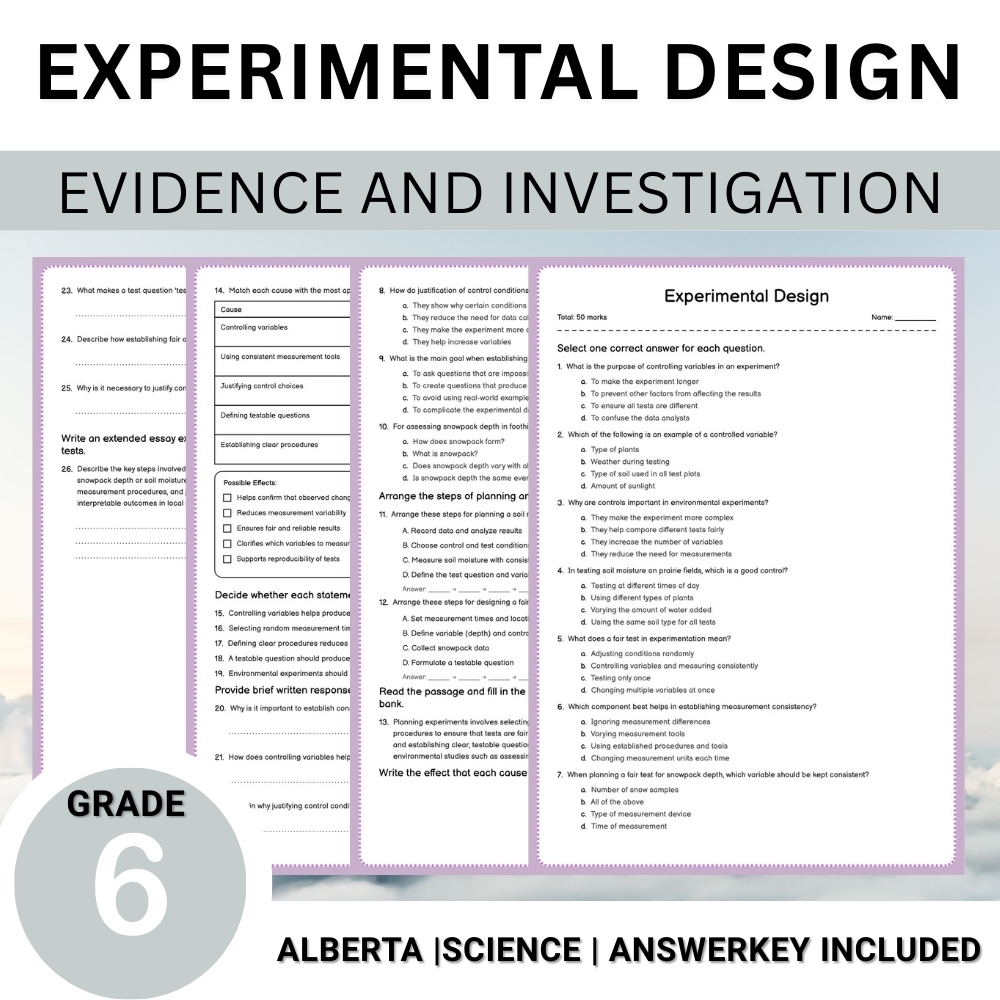
Grade 6 Science | Experimental Design Worksheet (Printable PDF & Assessment)
Learning Objectives
- Identify variables, controls, and measurement procedures in experiments.
- Explain how to plan fair tests for meaningful comparisons.
- Justify choices of control conditions in environmental experiments.
Also included in: Grade 6 Science Unit | Data & Measurement Worksheets Bundle (Assessment & Practice) +1 more
Instant download
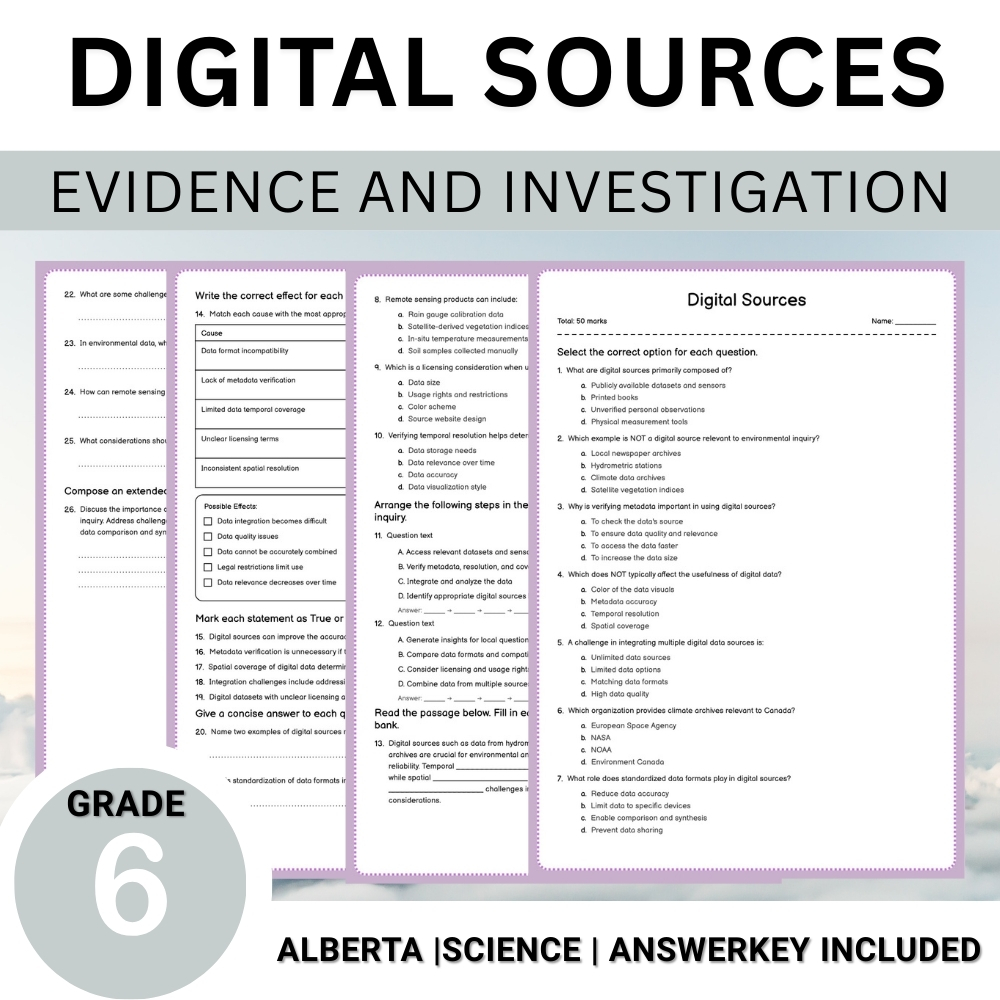
Grade 6 Science | Digital Sources Worksheet – Assessment & Student Practice (Printable PDF)
Learning Objectives
- Understand what digital sources are and their relevance to local inquiry.
- Identify examples of digital data used in environmental and climate analysis.
- Learn how to verify metadata, temporal resolution, and spatial coverage for digital sources.
Also included in: Grade 6 Science Unit | Data & Measurement Worksheets Bundle (Assessment & Practice) +1 more
Instant download
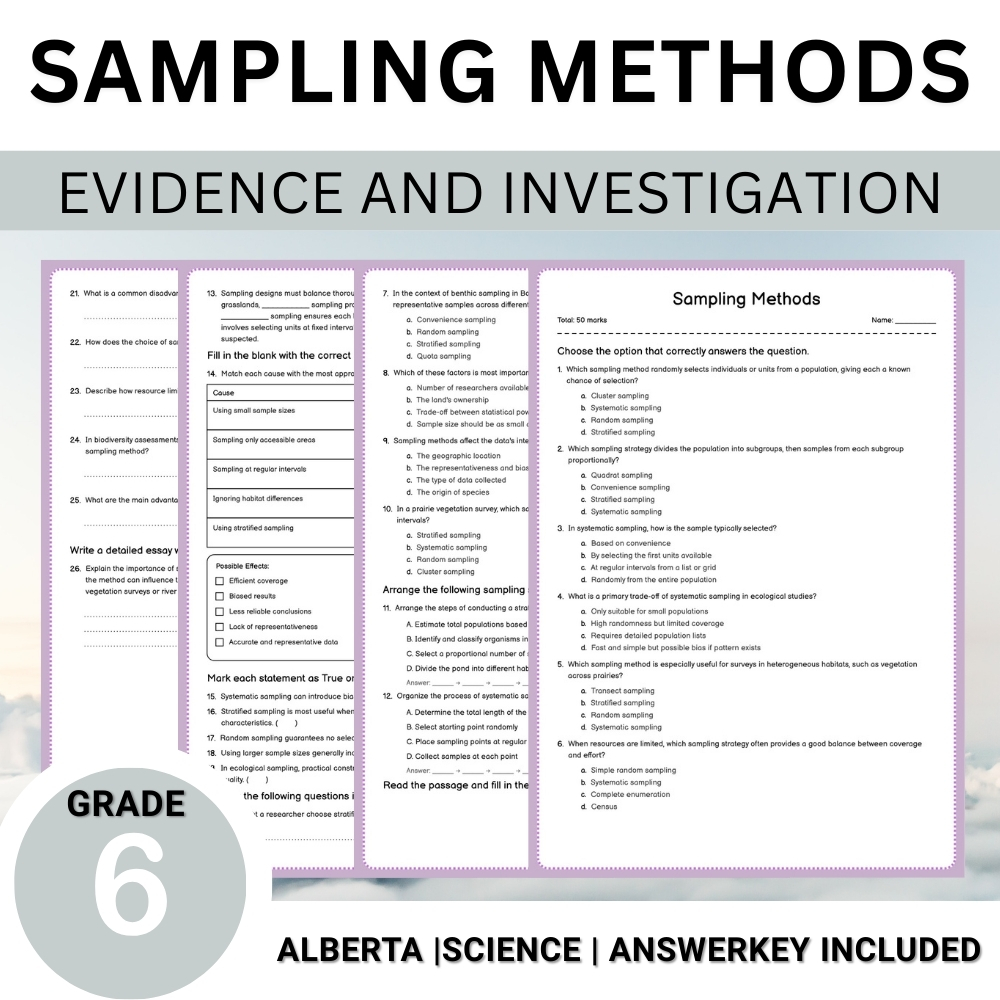
Grade 6 Science | Sampling Methods Worksheet (Printable PDF with Answer Key)
Learning Objectives
- Understand different sampling methods used in environmental and ecological studies.
- Identify how sampling strategies influence data interpretation and resource management.
- Compare random, stratified, and systematic sampling techniques with real-world examples.
Also included in: Grade 6 Science Unit | Data & Measurement Worksheets Bundle (Assessment & Practice) +1 more
Instant download
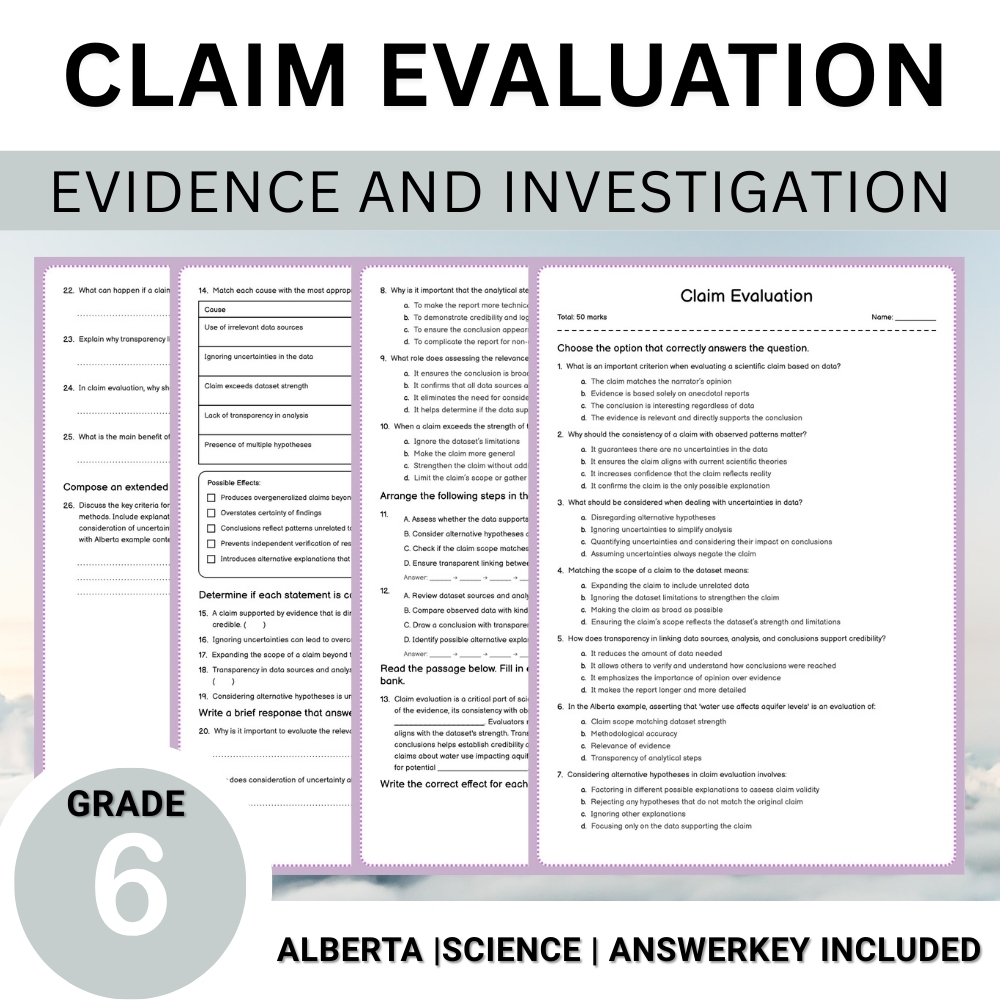
Grade 6 Science | Claim Evaluation Worksheet (Printable PDF & Assessment)
Learning Objectives
- Understand criteria for judging whether conclusions follow from data and methods.
- Evaluate evidence relevance, consistency with observed patterns, and consideration of uncertainties.
- Match claim scope to the dataset strength and assess transparency linking data, analysis, and conclusions.
Also included in: Grade 6 Science Unit | Data & Measurement Worksheets Bundle (Assessment & Practice) +1 more
Instant download
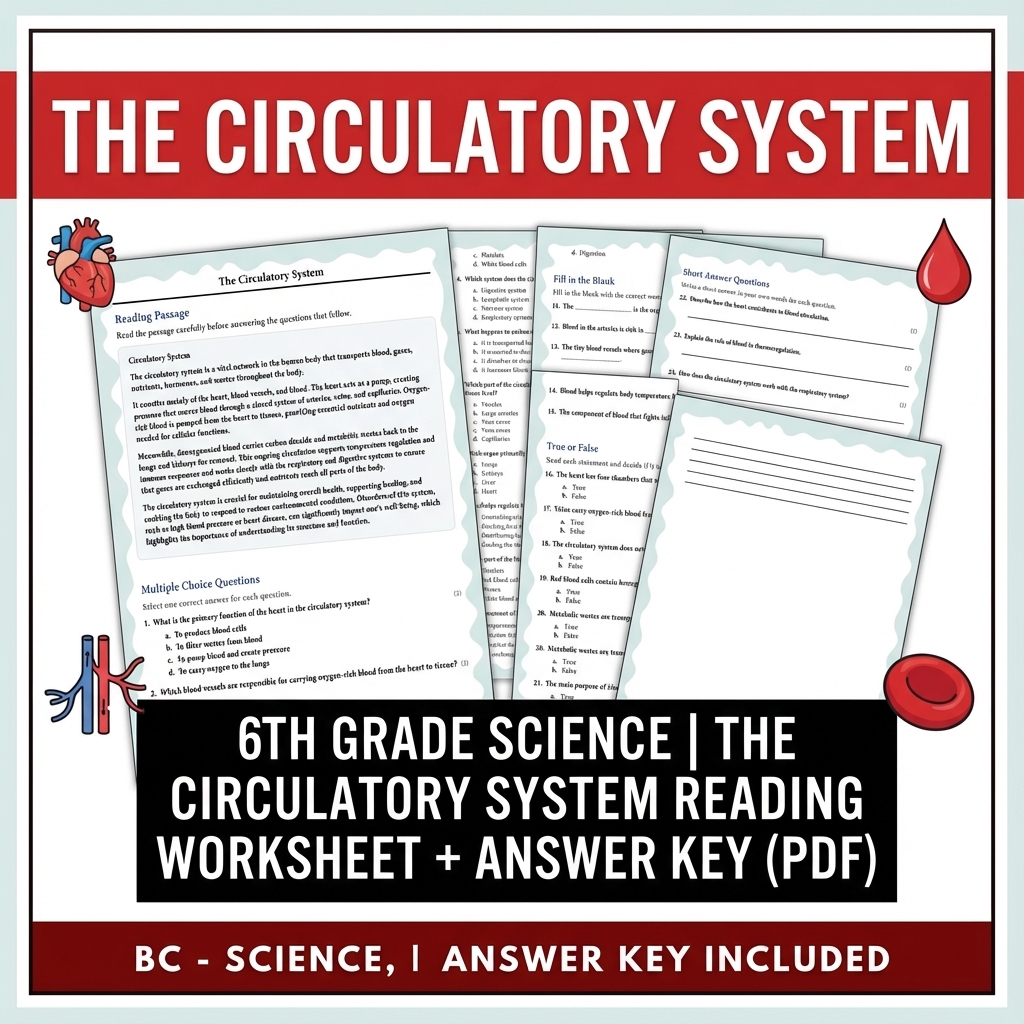
6th Grade Science | The Circulatory System Reading Worksheet + Answer Key (PDF)
JCreated byJ.S SheetsLearning Objectives
- Understand the structure and function of the circulatory system.
- Identify the components of blood and their roles.
- Describe how the heart pumps blood through vessels.
Instant download
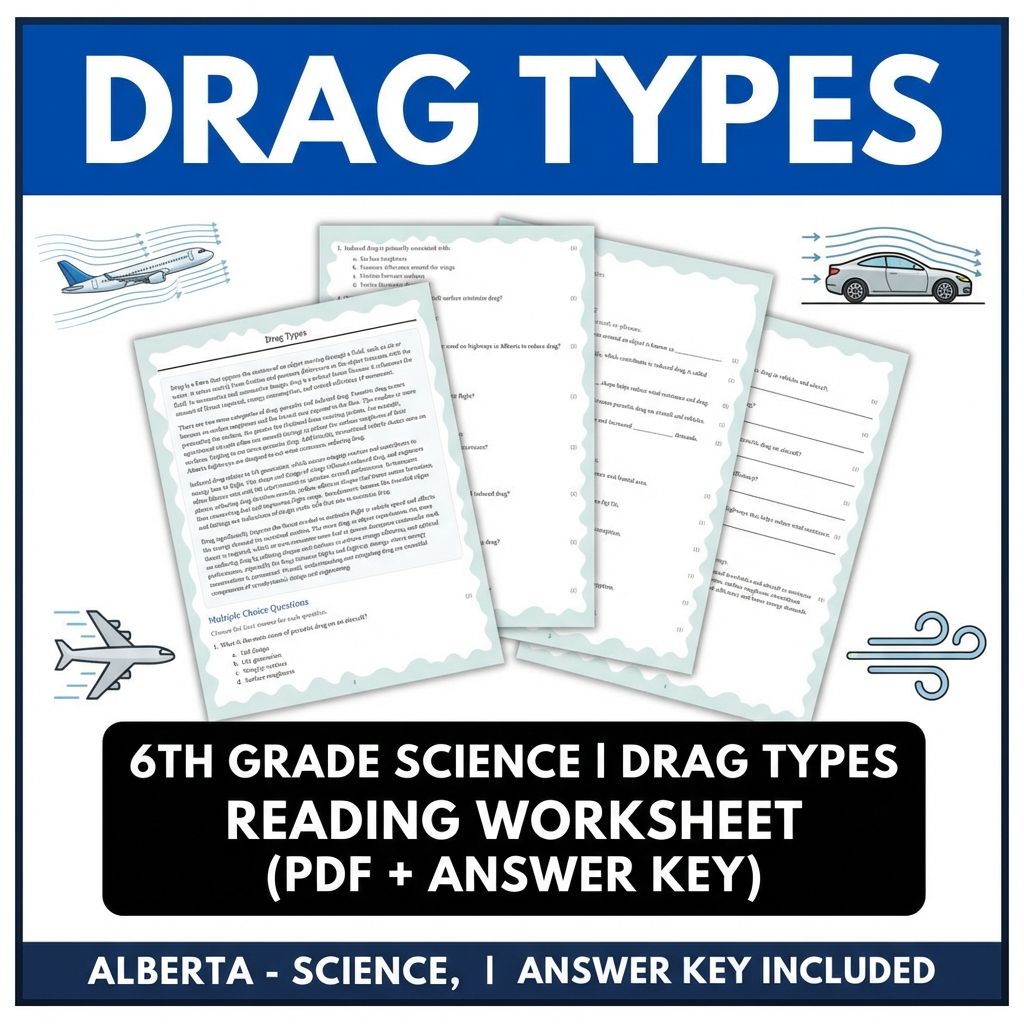
6th Grade Science | Drag Types Reading Worksheet (PDF + Answer Key)
JCreated byJ.S SheetsLearning Objectives
- Understand the different types of drag that affect flight and vehicle movement.
- Explain how friction and pressure differences influence drag.
- Identify design features that reduce drag, such as streamlined shapes and fairings.
Also included in: Grade 6 Science | Flight Physics & Aerodynamics UNIT Pack (Answer Keys Included) +1 more
Instant download
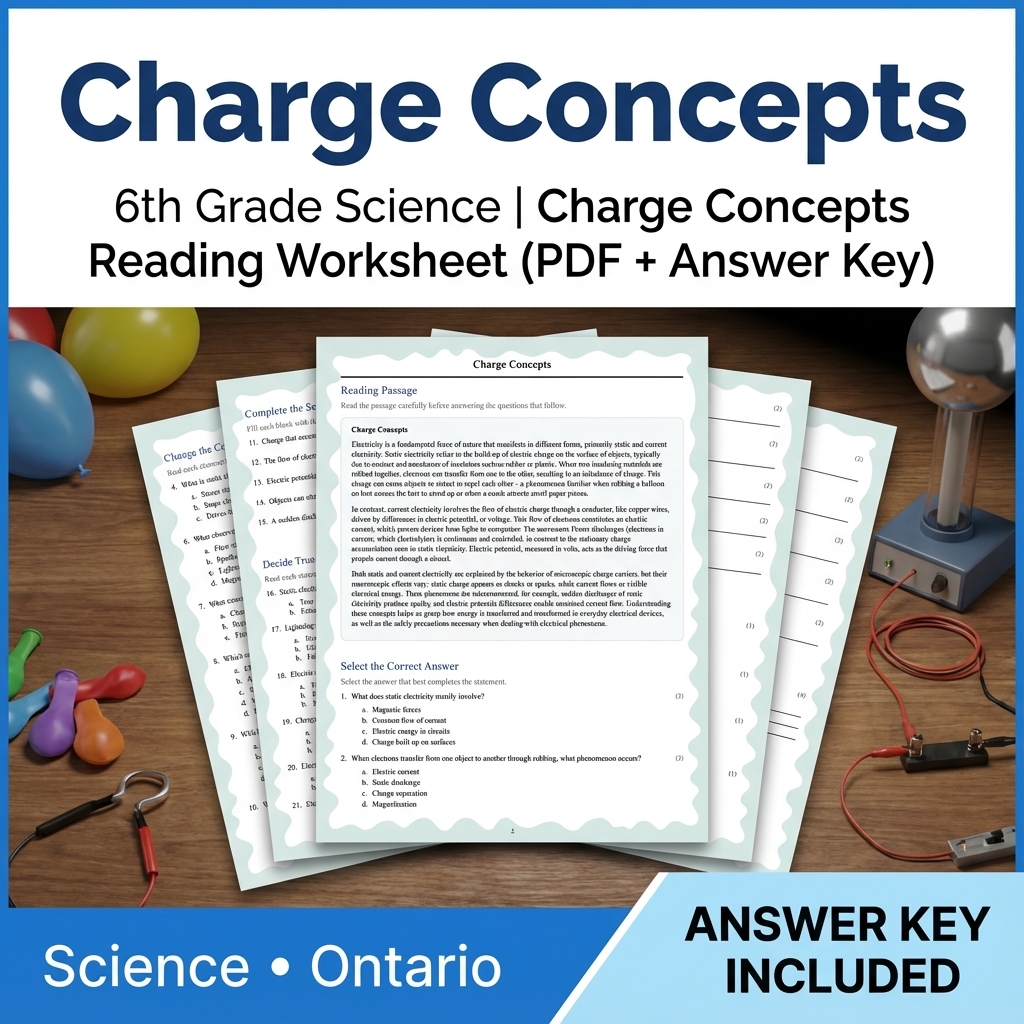
6th Grade Science | Charge Concepts Reading Worksheet & Answer Key (PDF)
JCreated byJ.S SheetsLearning Objectives
- Understand the difference between static and current electricity
- Define electric charge, charge separation, and flow
- Link observable phenomena like sparks and hair attraction to charge imbalance
Also included in: Grade 6 Science Circuit & Electricity Unit Bundle – Worksheets & Answer Keys +1 more
Instant download
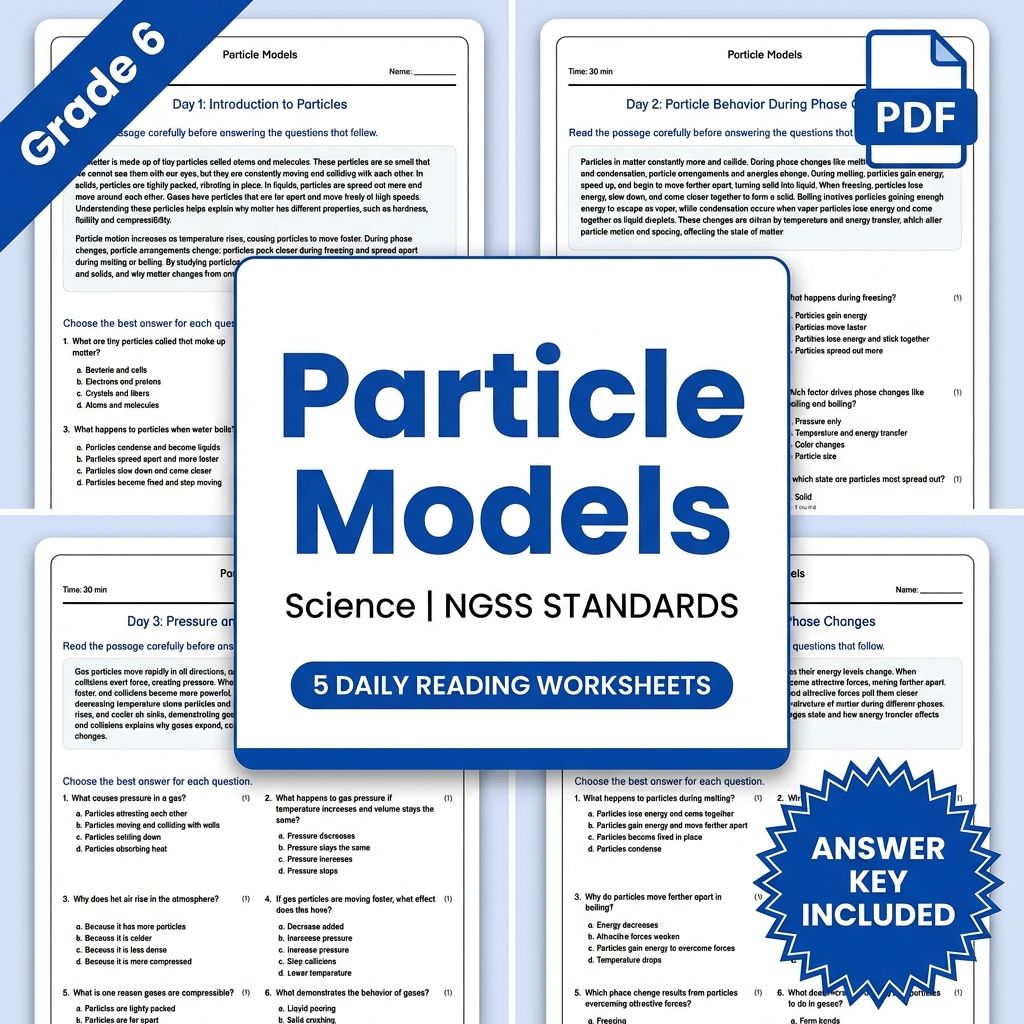
6th Grade Science | Particle Models Reading Worksheet (PDF+ Answer Key )
Created byCopper Leaf ClassroomLearning Objectives
- Understand that matter is made of tiny particles too small to see.
- Explain how particle motion relates to temperature and phase changes.
- Describe particle collisions, spacing, and behavior during melting, freezing, boiling, and condensation.
Instant download
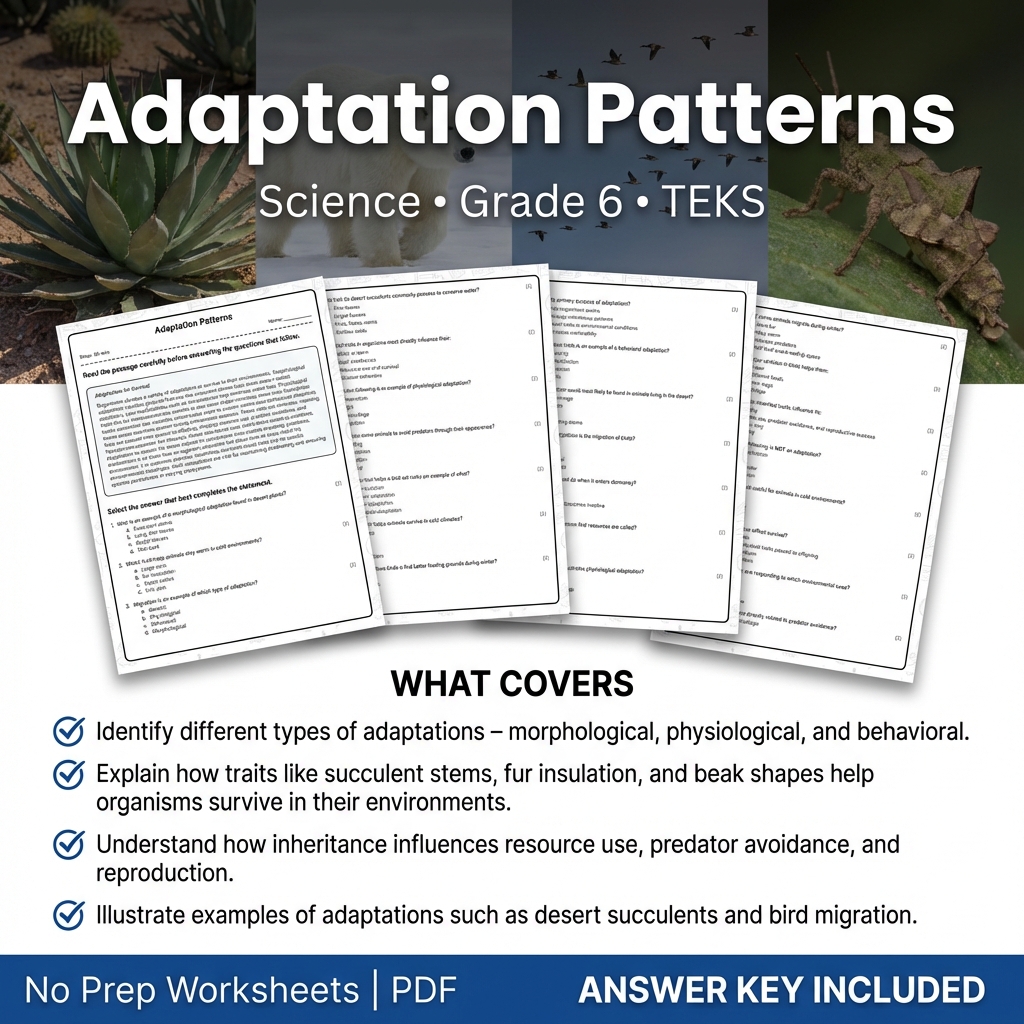
Grade 6 Science Worksheet on Adaptation Patterns | TEKS Standards
Created byCoral Reef LearningLearning Objectives
- Identify different types of adaptations – morphological, physiological, and behavioral.
- Explain how traits like succulent stems, fur insulation, and beak shapes help organisms survive in their environments.
- Understand how inheritance influences resource use, predator avoidance, and reproduction.
Instant download
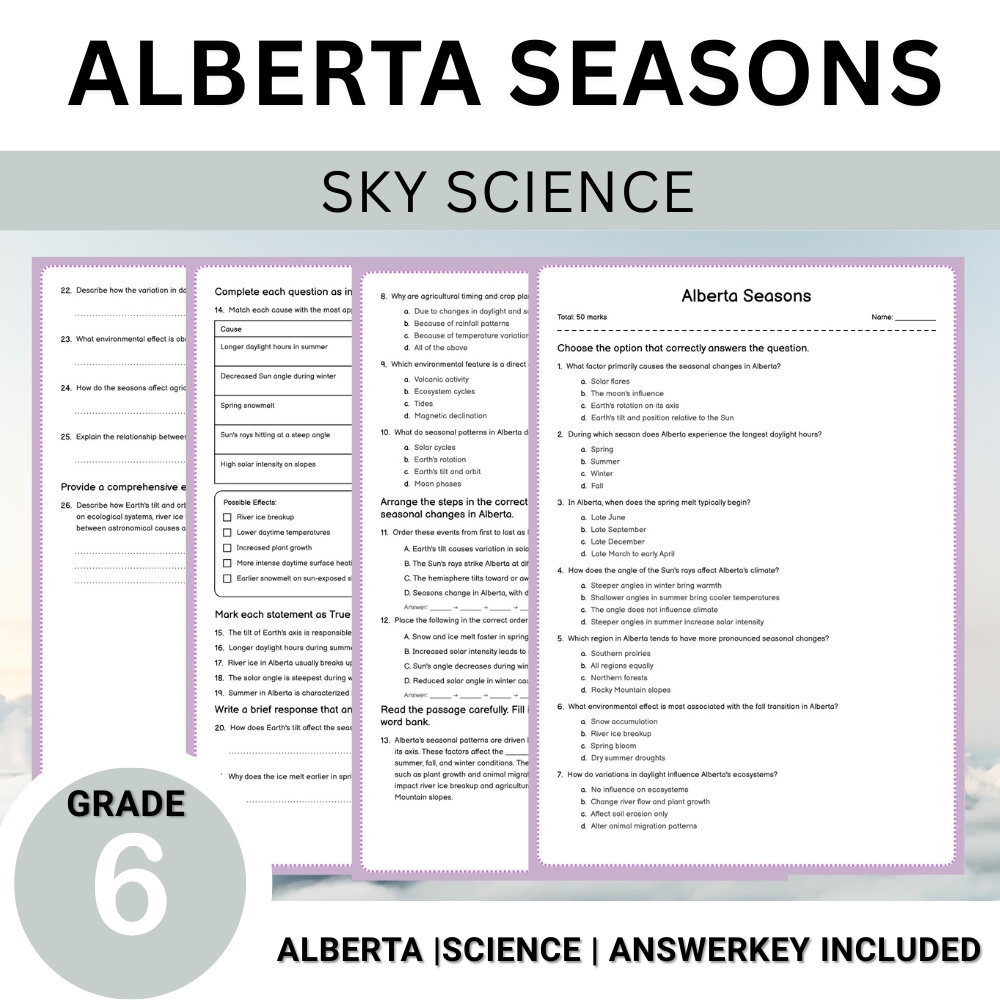
Grade 6 Science | Alberta Seasons Worksheet (Printable PDF + Answer Key)
Learning Objectives
- Understand how Earth's tilt and position relative to the Sun create seasonal variations in Alberta.
- Describe the regional manifestations of seasons in Alberta, including environmental and agricultural effects.
- Explain how astronomical causes influence terrestrial climate patterns and ecosystems.
Also included in: Grade 6 Science | Celestial & Space Phenomena UNIT Worksheet Bundle (Assessment & Practice) +1 more
Instant download
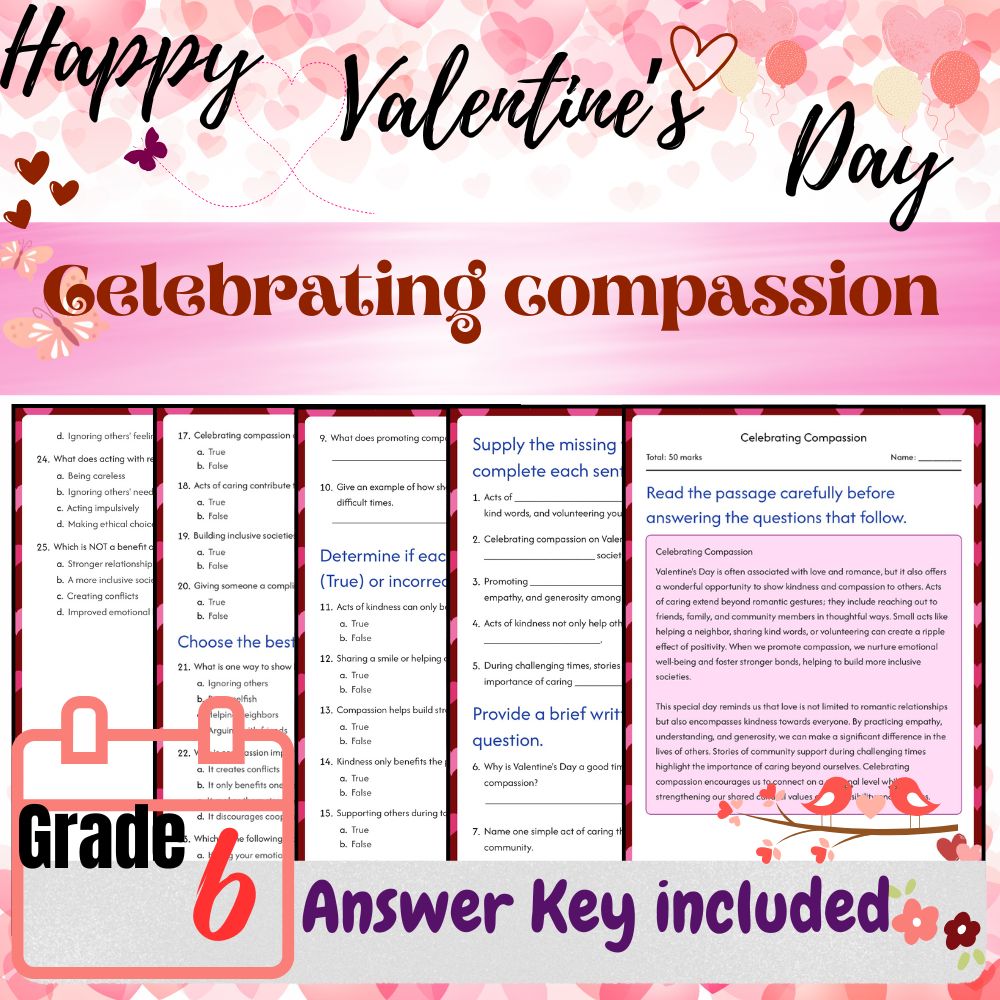
Grade 6|Valentine Day Worksheet for Celebrating Compassion | PDF + Answer Key
 Created byShaNova Worksheets
Learning Objectives
- Understand the broader meaning of kindness and compassion beyond romantic love.
- Recognize acts of caring towards friends, family, and communities.
- Reflect on how promoting love and compassion builds inclusive societies.
Also included in: Grade 6 Seasonal Valentine’s Day Worksheets Bundle (PDF + Answer Key)
Instant download
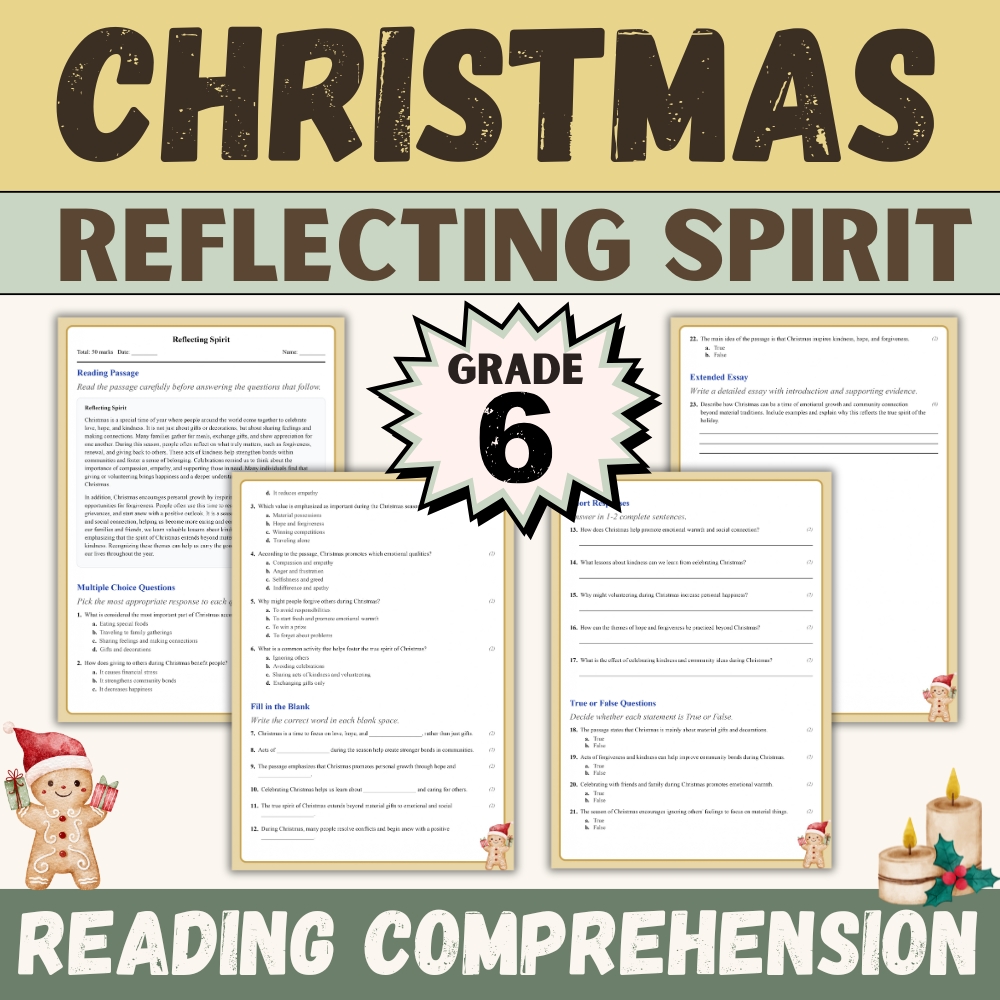
6th Grade Seasonal Reflection | Holiday-Themed Worksheet (Worksheet + Answer Key)
Created byCedar Grove LearningLearning Objectives
- Understand the deeper meaning of Christmas, focusing on hope, forgiveness, and renewal.
- Recognize how celebrations inspire acts of kindness and foster community spirit.
- Reflect on personal ways to embody the values of Christmas, promoting empathy and social-emotional growth.
Instant download
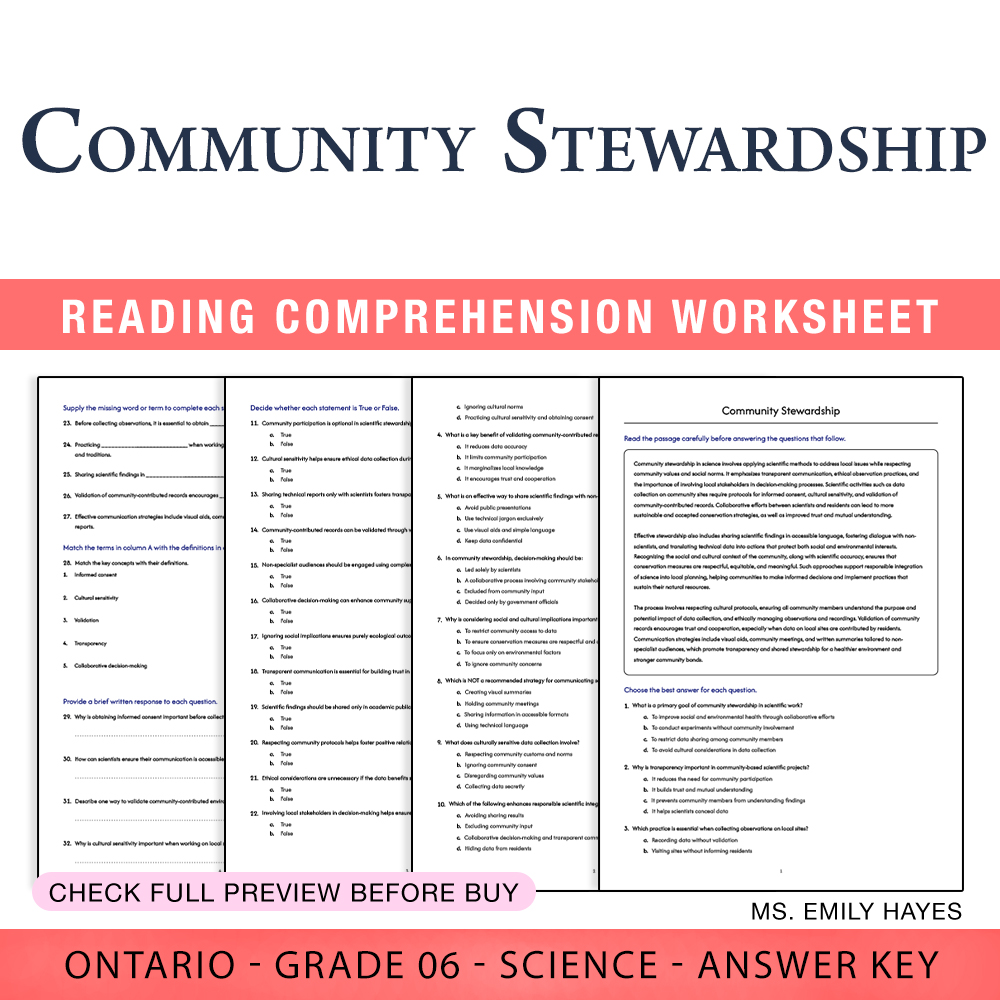
6th Grade Science | Community Stewardship Worksheet (PDF+ Answer Key)
Created byCopper Leaf ClassroomLearning Objectives
- Understand the importance of community engagement in scientific stewardship.
- Learn protocols for obtaining consent and practicing cultural sensitivity during local environmental assessments.
- Develop skills to validate and share community-contributed scientific records effectively.
Instant download
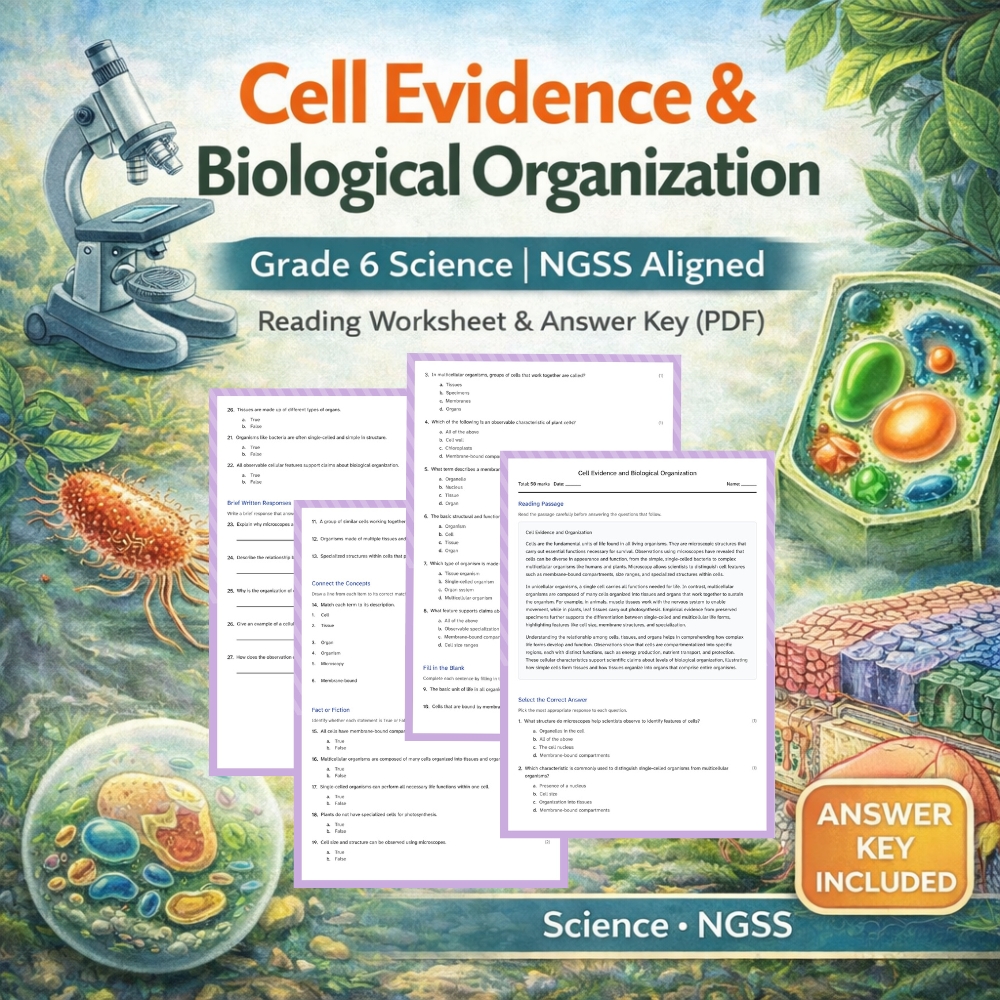
6th Grade Science | Cell Evidence & Biological Organization | NGSS Worksheet
Created byCedar Grove LearningLearning Objectives
- Identify and describe the basic unit of life, the cell, through observation and comparison.
- Differentiate between single-celled and multicellular organisms based on cellular evidence.
- Understand the relationships among cells, tissues, organs, and whole organisms.
Also included in: Grade 6 Science Worksheet Bundle | Cell Processes & Systems NGSS(PDF+Answer Key) +1 more
Instant download
Browse more categories
About Grade 6 Worksheets
Browse 8,578 printable Grade 6 worksheets across math, ELA, science, and social studies — each a ready-to-print PDF with optional answer keys.
MyTeachingSheets worksheets are made by real teacher-authors and checked before they go live. Download any as a print-ready PDF for lessons, homework, or independent practice — most include answer keys, and previews are always free.