
Grade 6 Worksheets
8,578 grade resources
Invasive Species Worksheet Grade 6 Ontario Science + Doodle Notes
 Created byChalk and Compass
Learning Objectives
- Explain how invasive species are introduced and why they can spread rapidly in new ecosystems
- Describe how invasive species affect native species through competition, predation, and habitat alteration
- Use indicators and monitoring to predict and evaluate ecological consequences of invasive species
Also included in: Grade 6 Science Ecosystems, Adaptations & Biodiversity Lesson Bundle | Ontario +1 more
Instant download
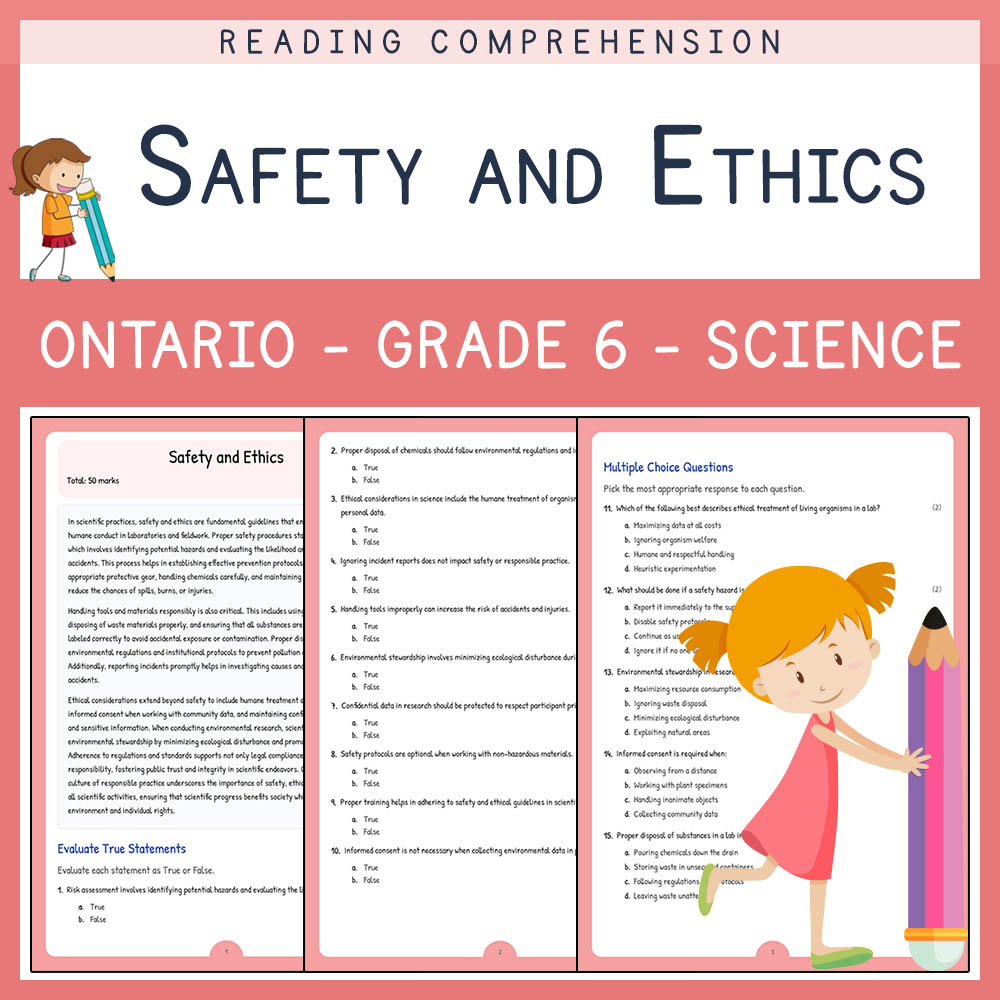
Grade 6 Science | Safety and Ethics Worksheet (PDF + Answer Key)
 Created byLumora Learning
Learning Objectives
- Understand foundational safety principles including risk assessment and hazard prevention.
- Identify proper handling and disposal procedures for materials and tools.
- Recognize ethical considerations such as humane treatment, confidentiality, and environmental stewardship.
Instant download
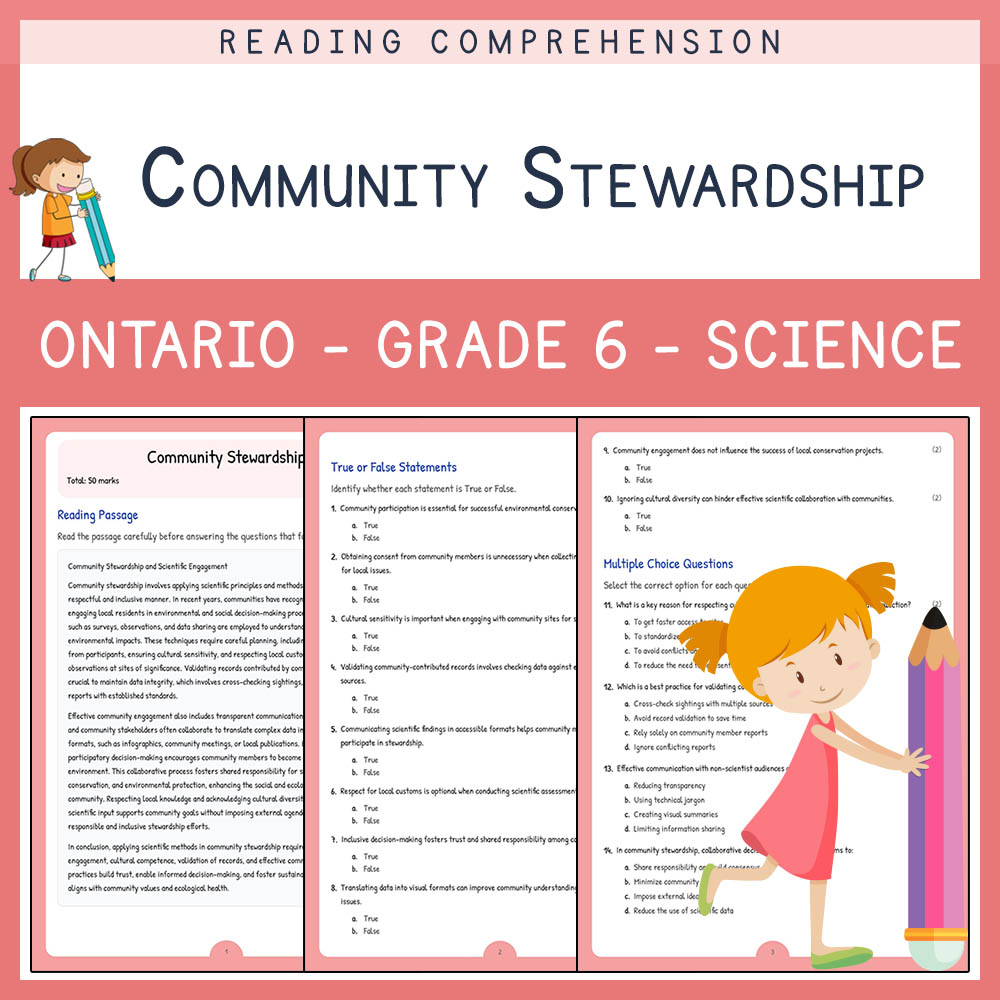
Grade 6 Science | Community Stewardship Worksheet & Answer Key (PDF)
Created byLumora LearningLearning Objectives
- Understand the application of scientific methods in local community issues.
- Identify protocols for obtaining consent and practicing cultural sensitivity during data collection.
- Evaluate strategies for validating and sharing community-contributed records.
Instant download
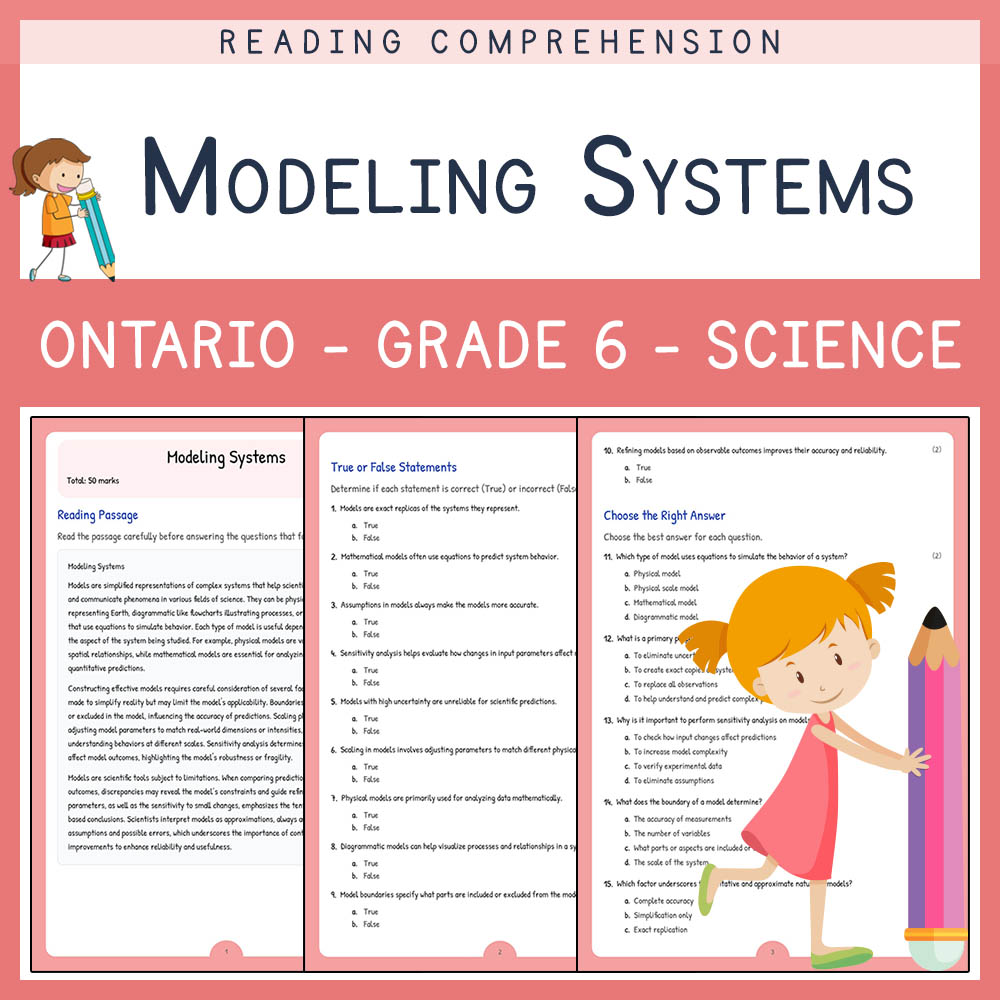
Grade 6 Science | Modeling Systems Worksheet & Answer Key – Ontario Curriculum
Created byLumora LearningLearning Objectives
- Understand different types of models used in science, such as physical, diagrammatic, and mathematical models.
- Identify the purpose and limitations of various models in representing complex systems.
- Evaluate the assumptions, boundaries, and scaling factors in models to interpret outcomes correctly.
Instant download
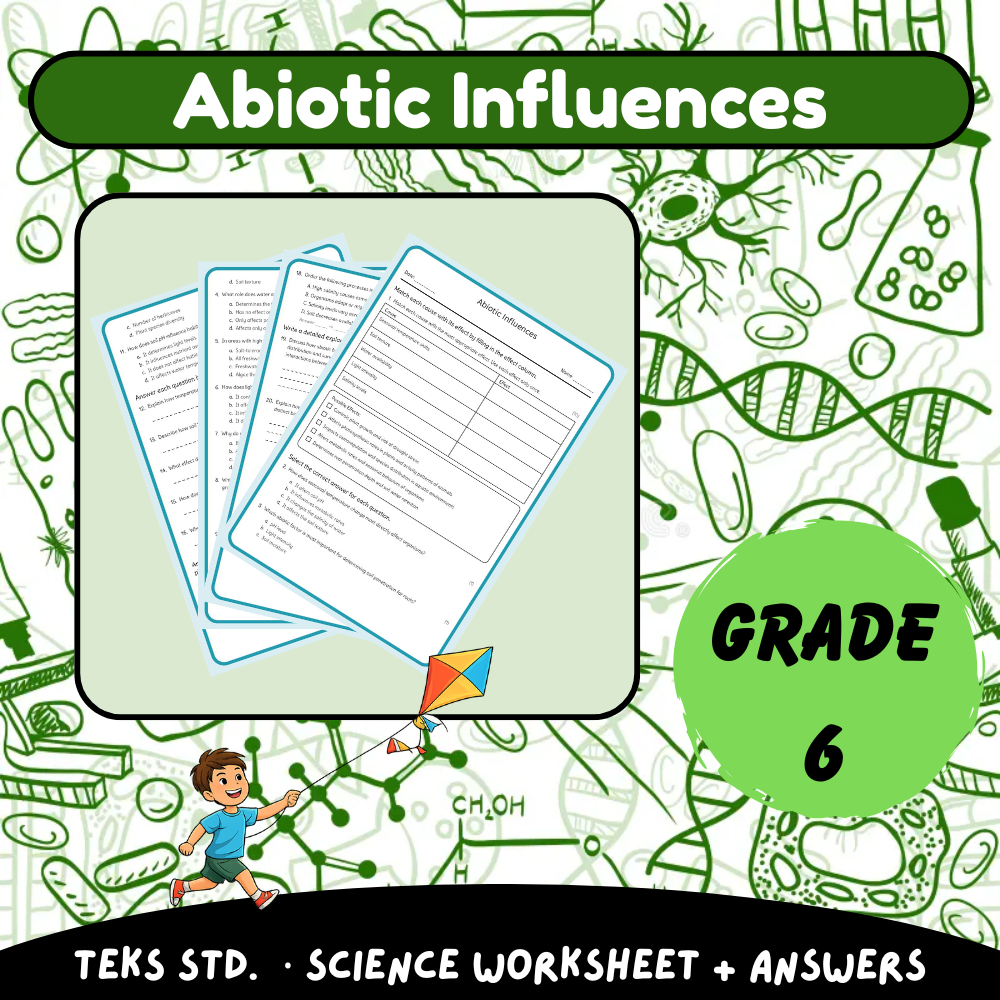
6th Grade Science | Abiotic Influences Worksheet (Answer Key) – TEKS Aligned
 Created byBright Mind Resources
Learning Objectives
- Identify key abiotic factors that affect habitats and organism distribution.
- Understand how temperature, water, light, soil, pH, and salinity influence living organisms.
- Explain interactions between environmental conditions and biological processes.
Instant download
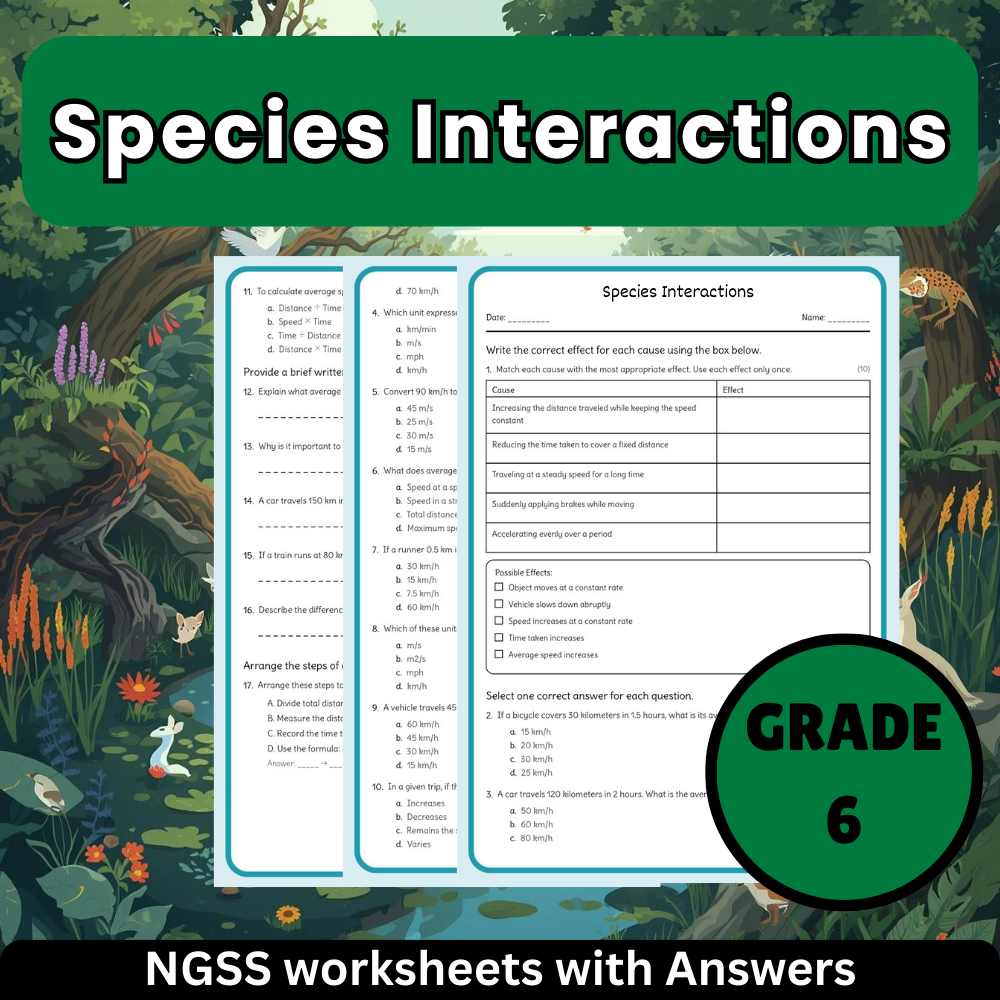
Grade 6 Science | Species Interactions Worksheet (NGSS Aligned, PDF)
Created byBright Mind ResourcesLearning Objectives
- Construct explanations predicting patterns of species interactions across ecosystems.
- Identify mutualism, competition, predation, and parasitism as recurring interaction types.
- Compare interaction outcomes in forest, grassland, and freshwater environments.
Also included in: Grade 6 Science Unit Bundle | Ecosystems & Biodiversity NGSS Worksheets (PDF) +2 more
Instant download
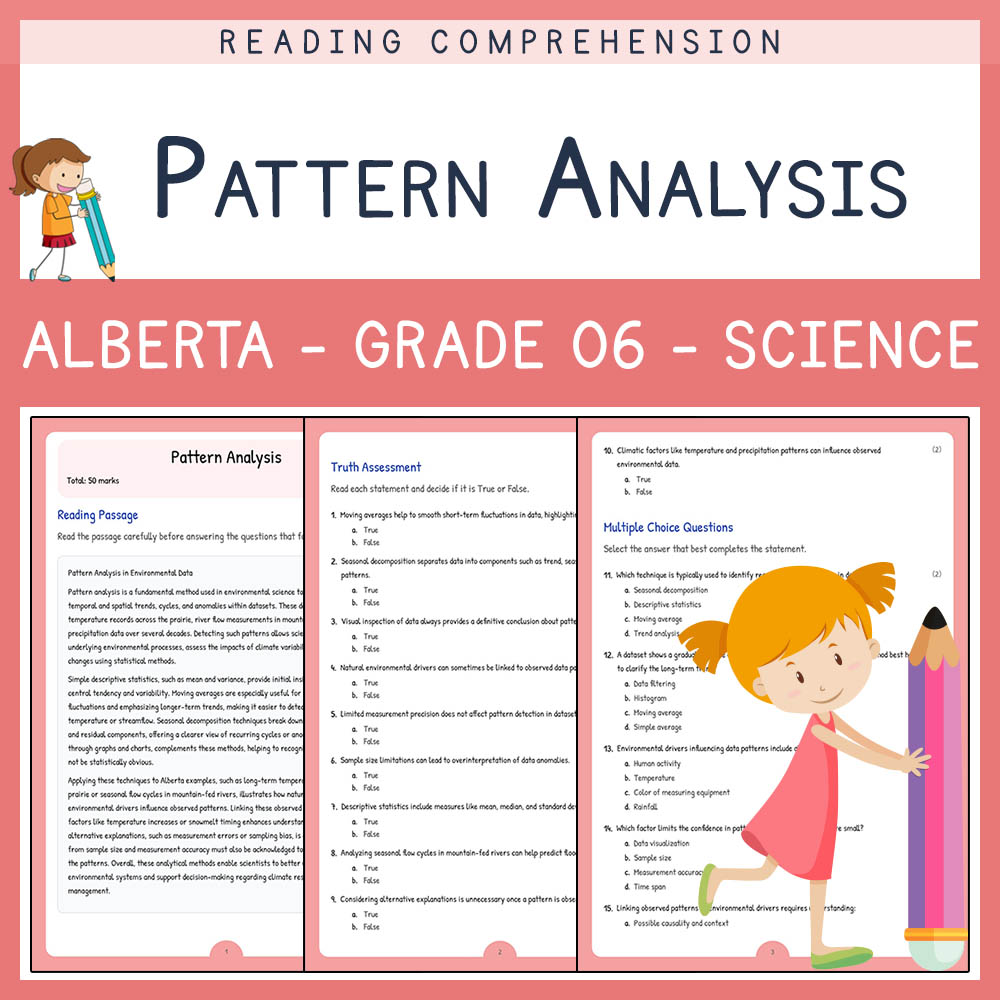
Grade 6 Science | Pattern Analysis Worksheet | Alberta Standard
Created byLumora LearningLearning Objectives
- Understand methods for detecting trends, cycles, and anomalies in datasets.
- Apply simple descriptive statistics and moving averages to real-world data.
- Interpret seasonal decomposition and visual inspection techniques.
Also included in: Grade 6 Science | Evidence and Investigation Custom Bundle | Alberta
Instant download
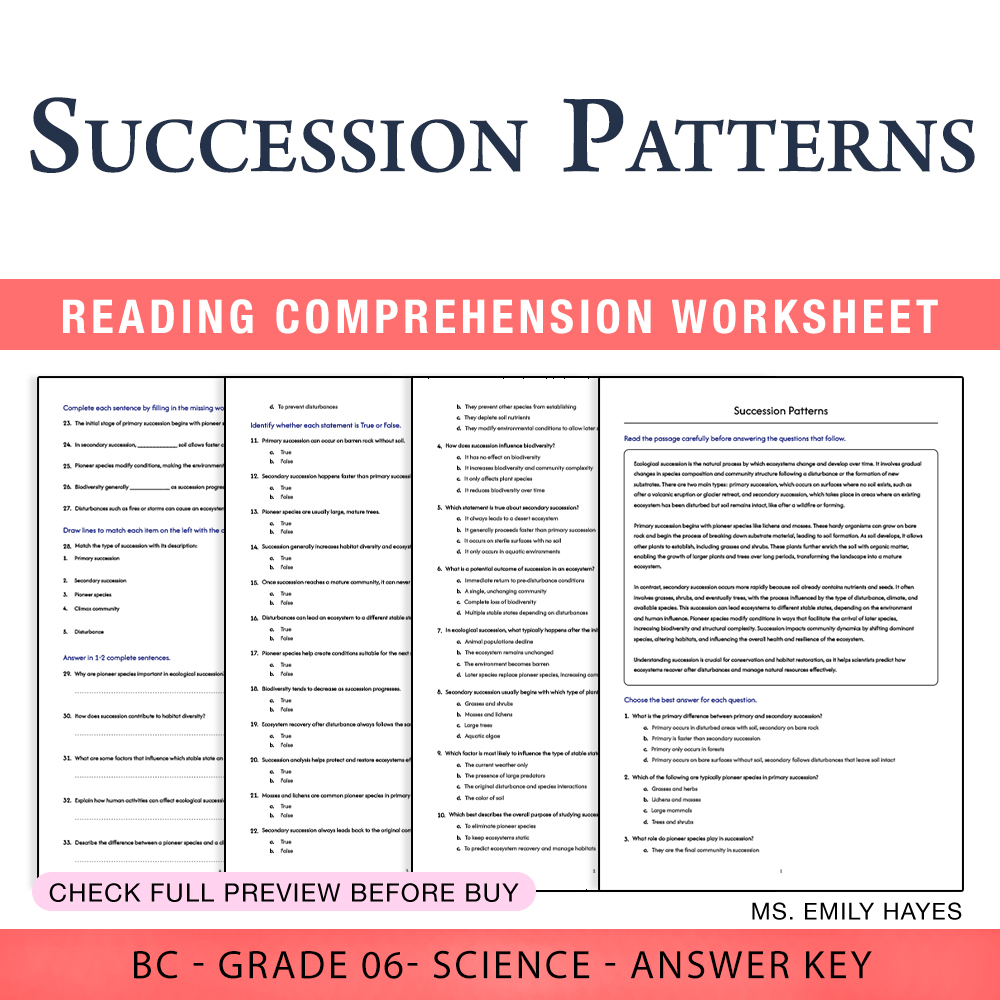
6th Grade Science | Succession Patterns Worksheet (PDF+ Answer Key)
 Created byCopper Leaf Classroom
Learning Objectives
- Describe the process of ecological succession and distinguish between primary and secondary succession.
- Identify the role of pioneer species during succession and understand how they modify environments for later species.
- Explain how succession affects biodiversity, community structure, and habitat availability.
Also included in: Grade 6 Science BC | Ecosystems and Human Impact Unit (PDF + Answer Keys) +1 more
Instant download

6th Grade Science | Control Surfaces Worksheet (PDF) – Alberta Standards
 Created byEvergreen Desk Education
Learning Objectives
- Explain how ailerons, elevators, and rudders change airflow to create aerodynamic moments.
- Describe how deflecting control surfaces alters lift and produces rolling, pitching, and yawing motions.
- Connect control-surface responses to real-world flight examples, including short-field operations and crosswind control.
Instant download

Grades 6 ,7 & 8 Holiday |Origins of May Day (International Workers' Day)
Learning Objectives
- Explain the origins of May Day as a movement for fair working hours and better workplace conditions
- Describe how workers used strikes and solidarity to advocate for labor rights
- Identify how May Day is celebrated around the world and why it remains meaningful today
Also included in: Grade 6- 8 May Day Holiday Unit Bundle: C3 Framework for Worker Rights +1 more
Instant download

Labor Day Worksheets: Labor Movements & Workers' Rights Grade 6
 Created byShaNova Worksheets
Learning Objectives
- Explain why workers formed labor movements around shared workplace concerns
- Identify labor movement goals including fair wages and safer workplaces
- Interpret labor activism vocabulary in short statements and scenarios
Instant download
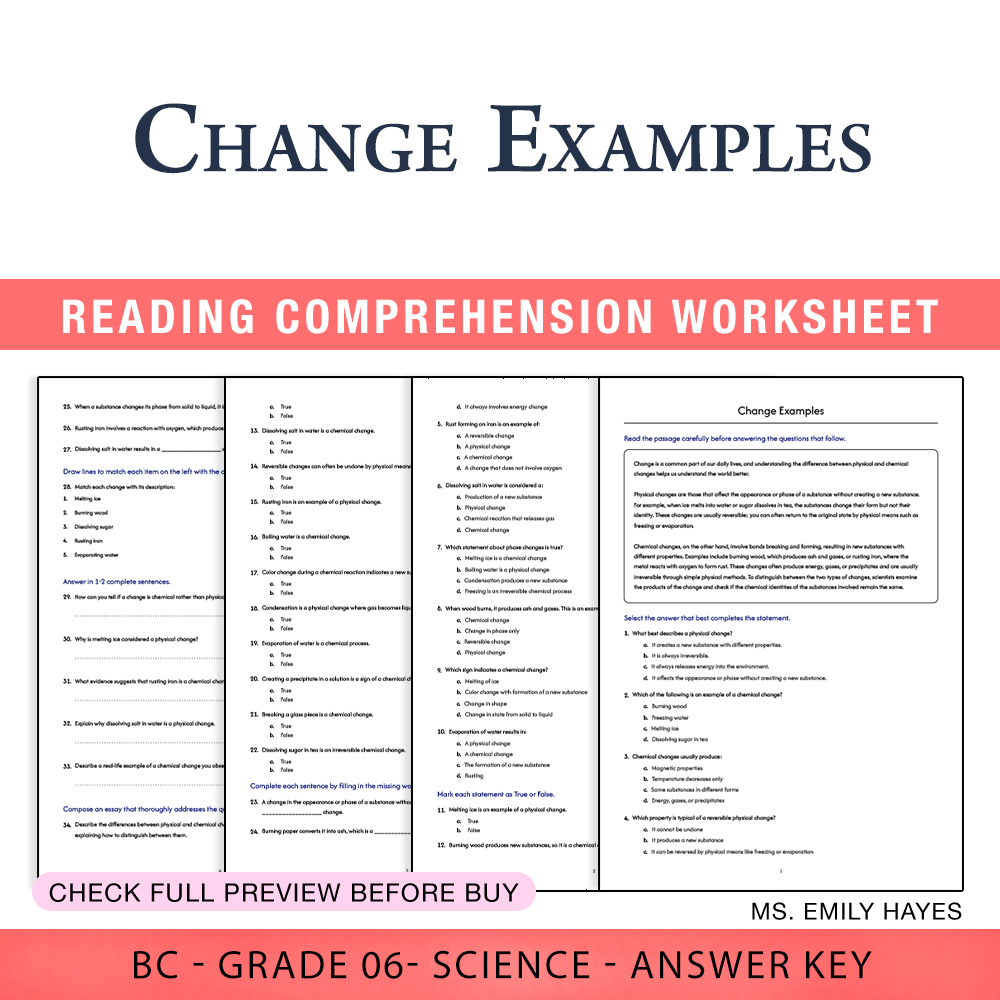
6th Grade Science | Change Examples Worksheet (PDF+ Answer Key)
Created byCopper Leaf ClassroomLearning Objectives
- Identify and differentiate between physical and chemical changes using real-world examples.
- Explain how to determine whether a change is physical or chemical by examining products and properties.
- Describe the features of reversible physical changes versus irreversible chemical changes.
Also included in: Grade 6 Science BC| Reaction Rates & Chemical Properties (PDF+ Answer Keys) +1 more
Instant download

6th Grade Science | Fossil Patterns Worksheet (PDF + Answer Key)
 Created byRiverstone Classroom
Learning Objectives
- Understand how fossil occurrences reveal patterns of organism origin, diversification, and extinction over geologic time.
- Analyze morphological transitions in the fossil record to infer evolutionary change.
- Interpret stratigraphic sequences, dating methods, and geographic distribution data to trace lineage continuity and environmental shifts.
Instant download
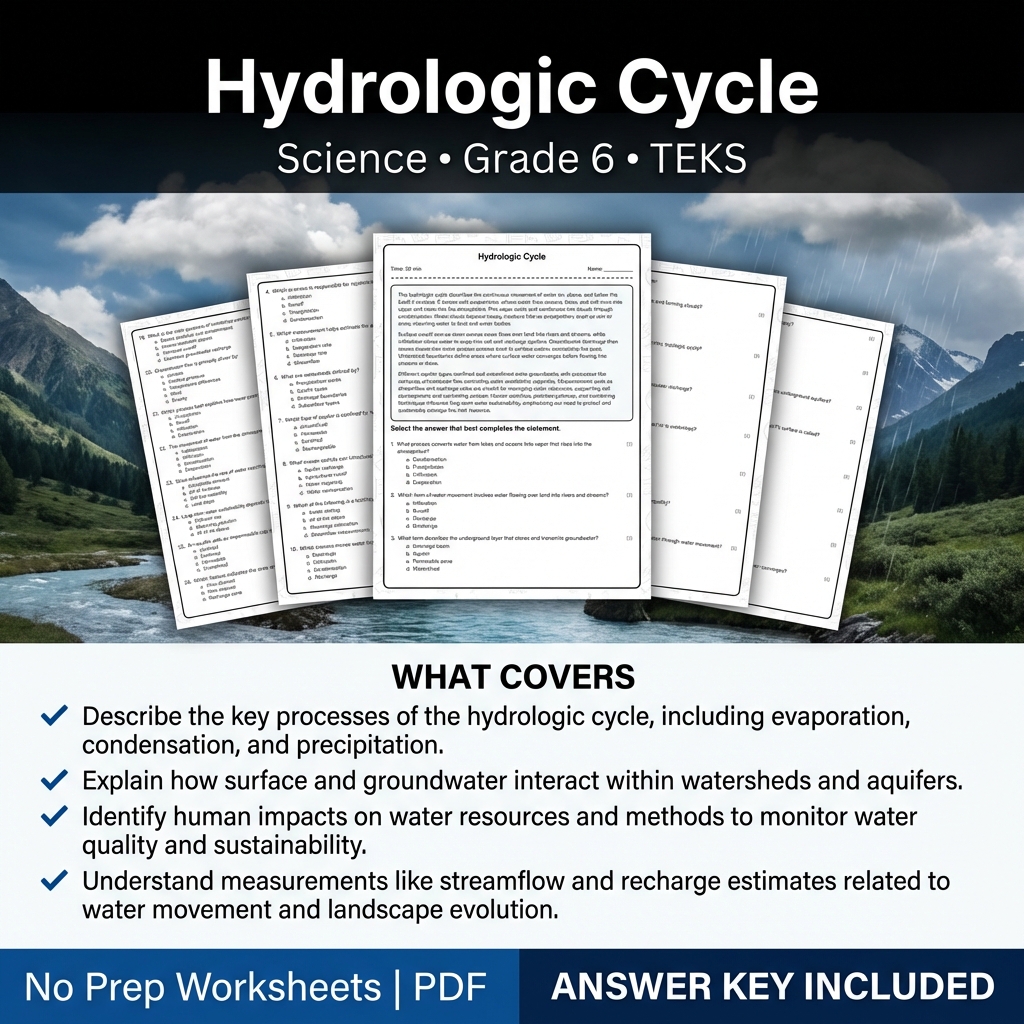
Hydrologic Cycle Science Worksheet for Grade 6 | TEKS Aligned
 Created byCoral Reef Learning
Learning Objectives
- Describe the key processes of the hydrologic cycle, including evaporation, condensation, and precipitation.
- Explain how surface and groundwater interact within watersheds and aquifers.
- Identify human impacts on water resources and methods to monitor water quality and sustainability.
Instant download
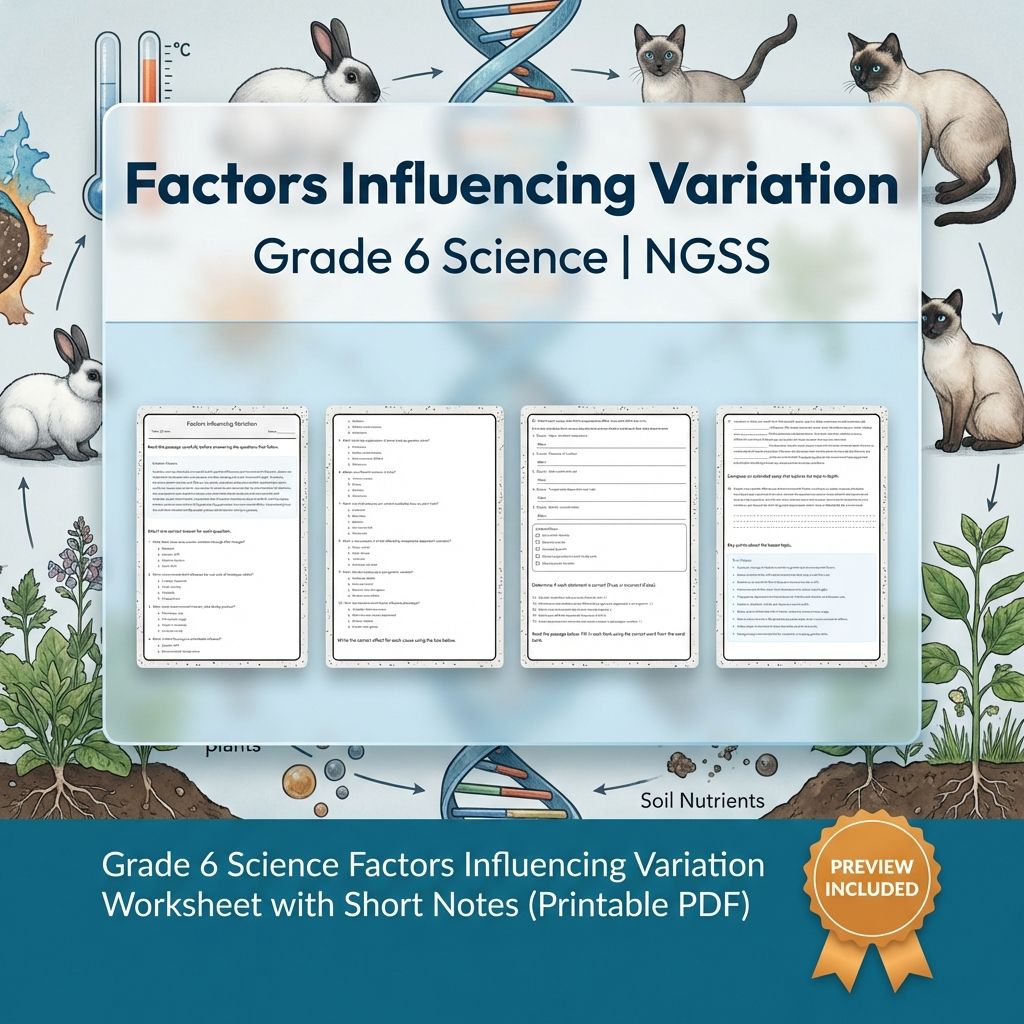
Grade 6 Science Factors Influencing Variation Worksheet with Short Notes (PDF)
 Created byMeadowlark Worksheets
Learning Objectives
- Understand how genetic and environmental factors contribute to observable traits.
- Explain examples like allele combinations, mutations, and nonheritable influences.
- Analyze interactions between inherited genes and environmental conditions.
Also included in: Grade 6 Science | Heredity: Inheritance & Variation NGSS Unit | Worksheets +1 more
Instant download
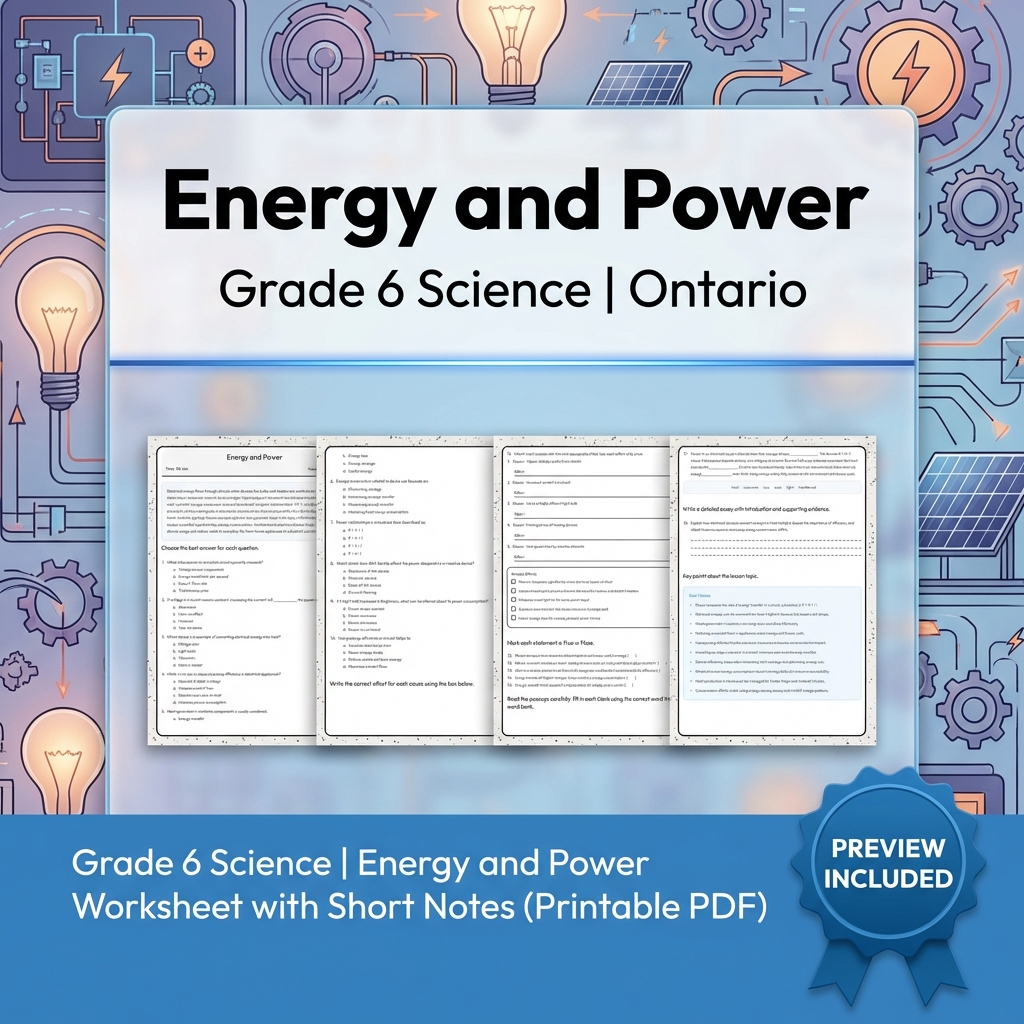
Grade 6 Science | Energy and Power Worksheet with Short Notes (Printable PDF)
Created byMeadowlark WorksheetsLearning Objectives
- Understand the concept of energy transfer in electrical circuits.
- Explain how power is related to energy transfer rate, current, and voltage.
- Identify everyday examples of electrical power usage and heat generation.
Also included in: Grade 6 Science Lesson Group on Energy, Circuits & Properties +1 more
Instant download

Biodiversity Patterns Worksheets: Richness, Turnover & Endemism Grade 6
 Created byWorld Paper Hub
Learning Objectives
- Explain how species richness and species occurrence can be used to describe biodiversity patterns.
- Compare biodiversity patterns across space (islands, latitudes, and habitat types) and time (community turnover).
- Identify ecological and historical factors that influence endemism and species composition.
Instant download
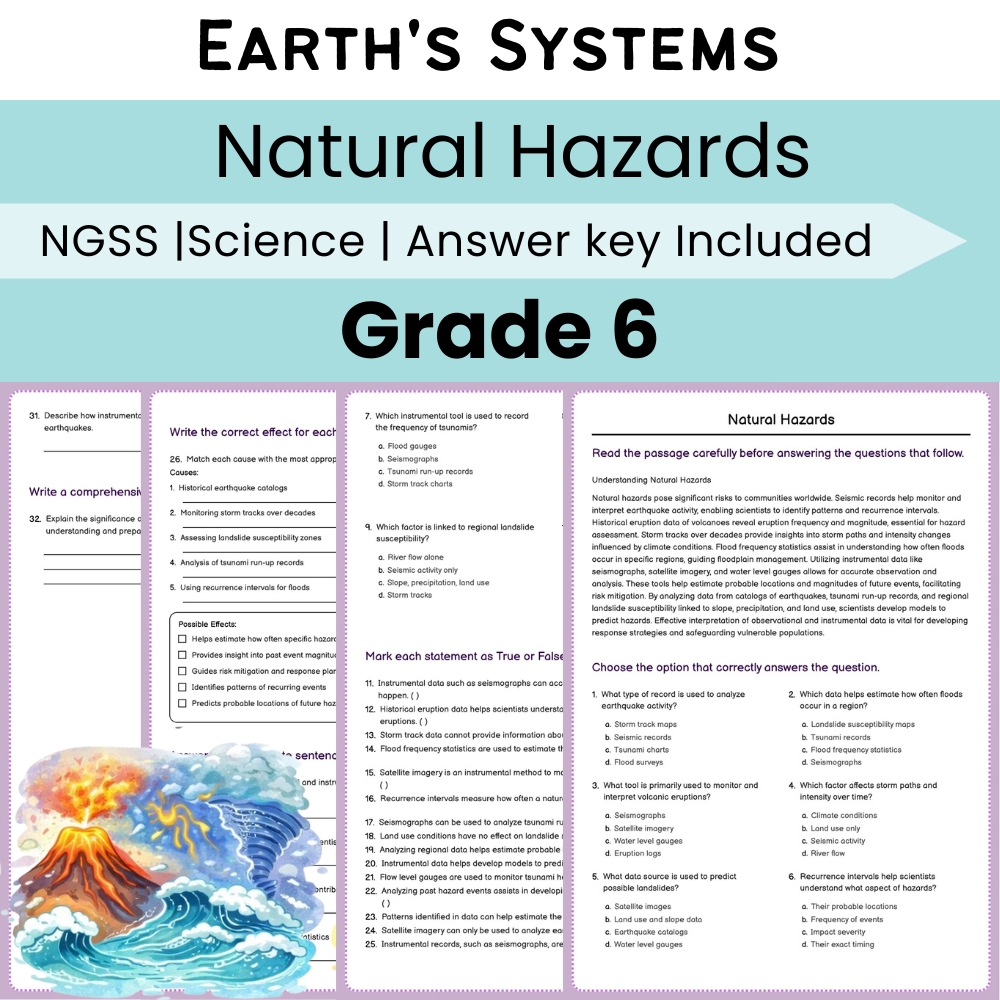
Natural Hazards Worksheet | Science Assessment for Grade 6 NGSS Printable PDF
Learning Objectives
- Understand how scientists analyze observational and instrumental data related to natural hazards.
- Identify patterns and recurrence intervals of events like earthquakes, tsunamis, and floods.
- Assess probable locations and magnitudes of natural hazards to inform risk management.
Also included in: Grade 6 Science | Earth's Systems Unit Worksheet Bundle (NGSS Aligned) +1 more
Instant download

6th Grade Holiday Art Appreciation Worksheet | Gratitude Across Cultures (PDF)
 Created bySilver Birch Teaching
Learning Objectives
- Explain how artworks can express gratitude and respect within school communities.
- Use vocabulary related to gratitude and appreciation to interpret art from different cultures.
- Analyze how respectful recognition can strengthen relationships between teachers and students.
Also included in: 6th Grade Holiday Lesson Bundle: May Framework +1 more
Instant download

Chemical Reactions Worksheet Grade 6 NGSS | Doodle Notes & Guide
 Created byAmber Owl Education
Learning Objectives
- Identify chemical reactions by analyzing quantitative and qualitative evidence such as gas production, precipitate formation, color change, and temperature change.
- Compare measurements taken before and after a reaction to determine whether new substances (new chemical species) formed.
- Use data reasoning to interpret evidence from typical reactions such as acid–carbonate reactions and metal oxidation.
Also included in: Grade 6 Science Matter and Chemical Reactions Lesson Bundle | NGSS +1 more
Instant download

Grade 6 Health – Fitness Components Daily Reading Worksheet | Ontario Standards
 Created byQuiet Forest Education
Learning Objectives
- Understand the concept of cardiovascular endurance
- Identify characteristics of good cardiovascular fitness
- Learn simple ways to assess cardiovascular endurance
Also included in: Active Living Grade 6 Health Daily Reading Worksheets Bundle | Ontario +2 more
Instant download
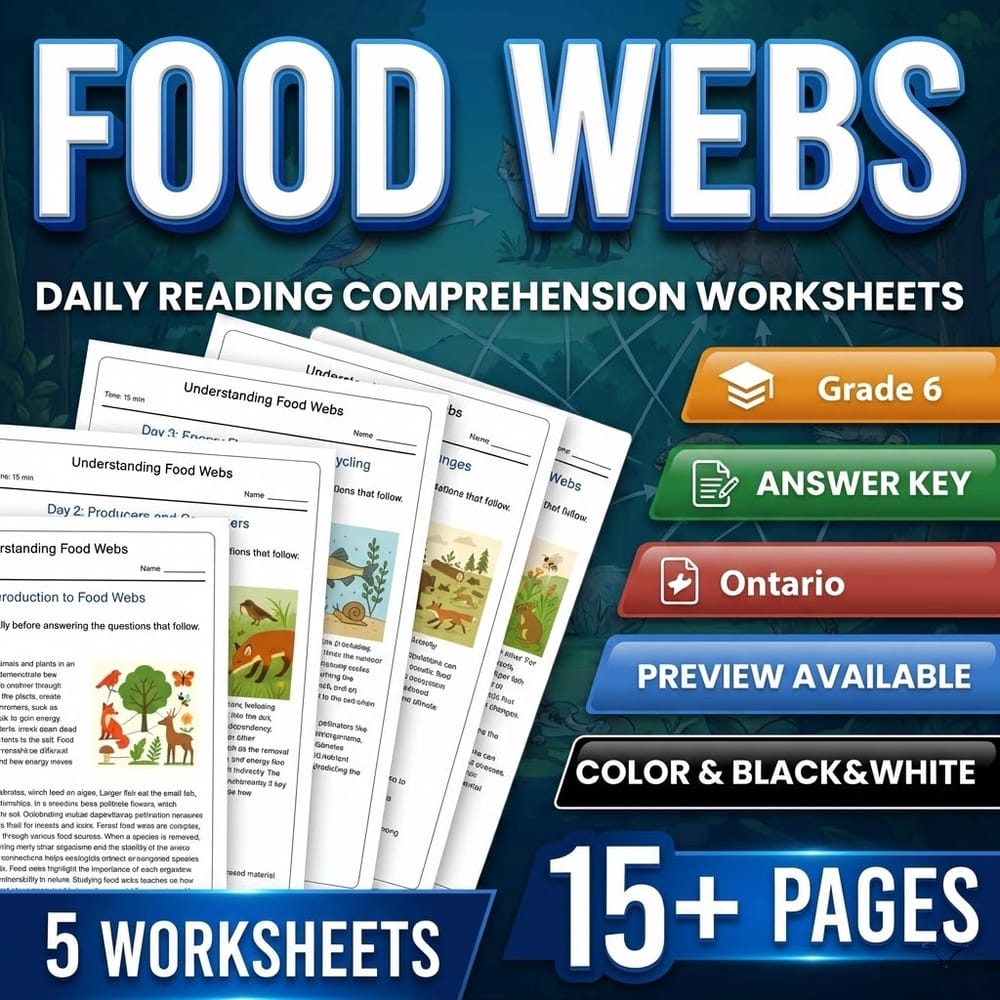
Grade 6 Science – Food Webs & Ecosystem Relationships | Daily Reading Worksheet
Created byQuiet Forest EducationLearning Objectives
- Define what a food web is and explain its importance in ecosystems.
- Identify producers, consumers, and decomposers within a food web.
- Describe the flow of energy through different trophic levels in food webs.
Also included in: Ecosystems and Environment Grade 6 Science Daily Worksheets Bundle | Ontario +1 more
Instant download
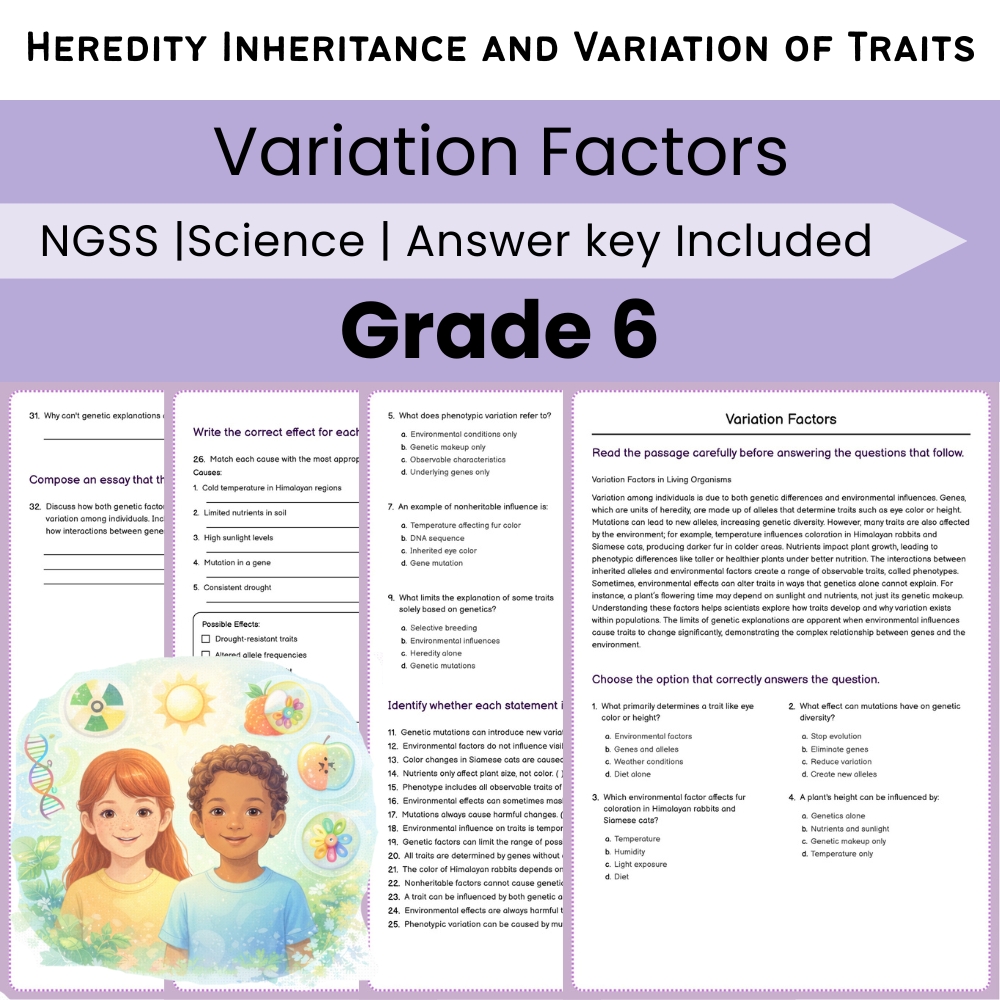
Variation Factors Worksheet | Grade 6 Science Printable PDF | NGSS
Learning Objectives
- Explain how genetic differences and environmental factors contribute to observable variations among individuals.
- Identify models of allele combinations and mutation impacts on traits.
- Describe nonheritable influences such as temperature-dependent coloration and nutrient effects on plants.
Also included in: Grade 6 Science INHERITANCE & VARIATION UNIT | Heredity NGSS Worksheet Bundle (2 Worksheets) +1 more
Instant download
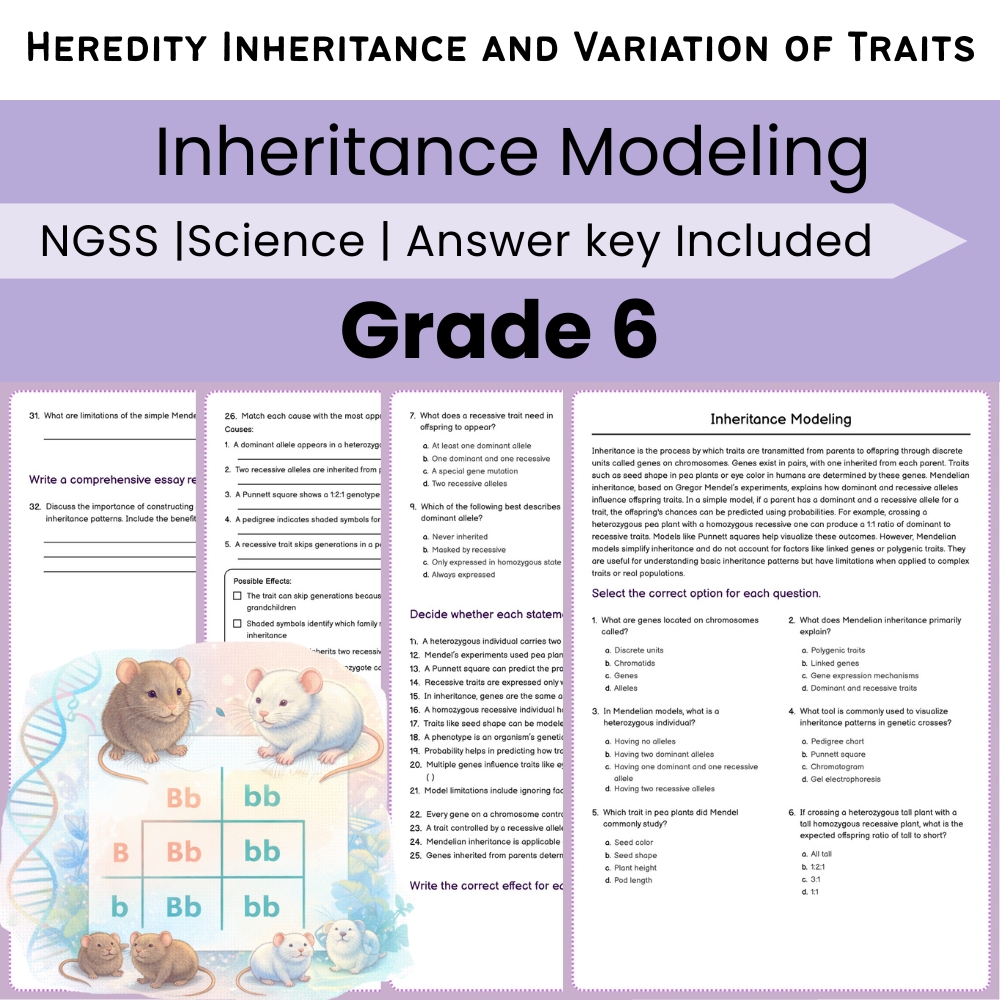
Inheritance Modeling Worksheet | Grade 6 Science Printable PDF NGSS
Learning Objectives
- Explain how traits are transmitted from parents to offspring using genes.
- Predict offspring trait ratios using Mendelian inheritance models.
- Construct and interpret simple models of dominant and recessive inheritance patterns.
Also included in: Grade 6 Science INHERITANCE & VARIATION UNIT | Heredity NGSS Worksheet Bundle (2 Worksheets) +1 more
Instant download

Infectious Disease Prevention Worksheet | Grade 6 Health Practices
 Created byTeacher's Corner
Learning Objectives
- Explain how germs spread from person to person
- Identify behaviors that help prevent infectious disease spread
- Explain why disease prevention practices matter
Instant download
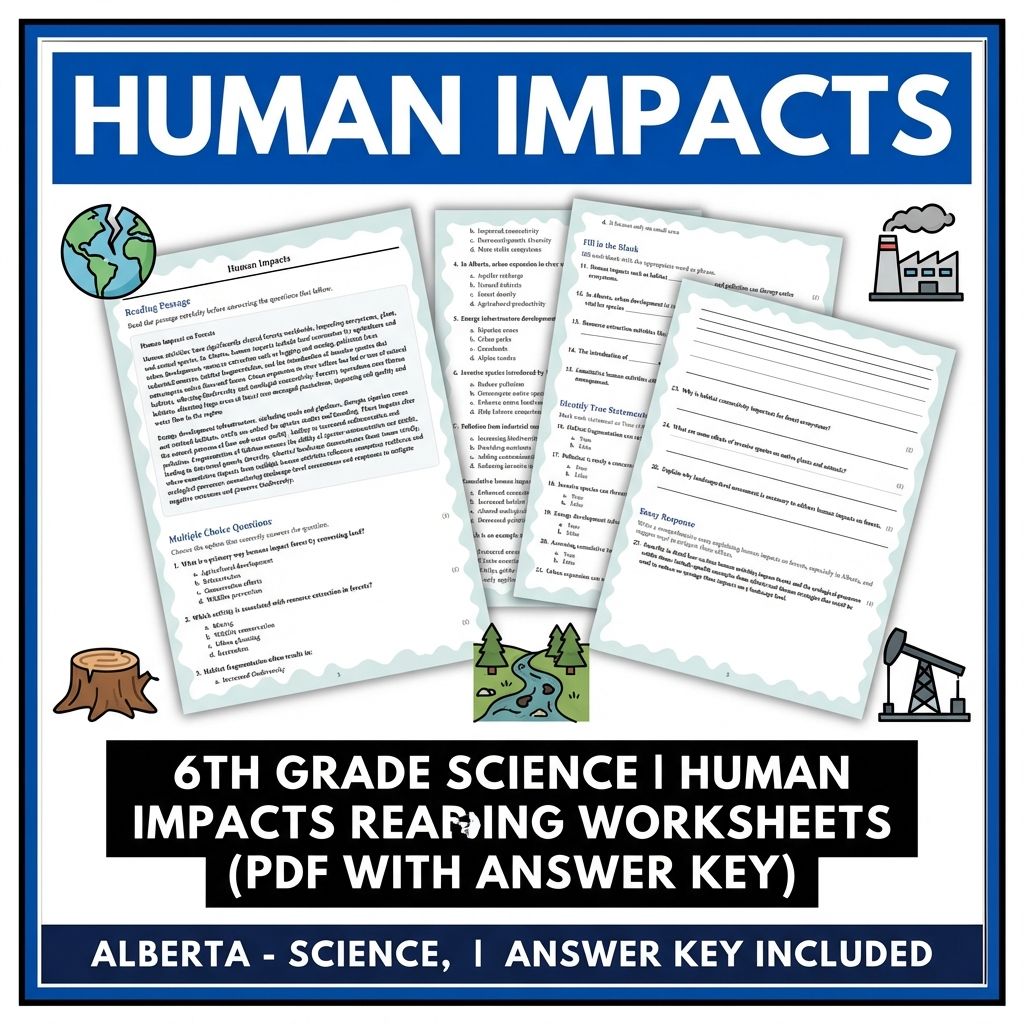
6th Grade Science | Human Impacts Reading Worksheets (PDF with Answer Key)
JCreated byJ.S SheetsLearning Objectives
- Understand the types of human impacts on forest ecosystems.
- Identify specific examples of land conversion, resource extraction, and pollution.
- Explain how these impacts affect habitat connectivity, soil, water quality, and species diversity.
Also included in: Grade 6 Science Unit Bundle | Ecosystems and Biodiversity (Answer Keys Included) +1 more
Instant download
6th Grade Science | Population Change | NGSS Worksheet & Answer Key
 Created byCedar Grove Learning
Learning Objectives
- Construct evidence-based arguments linking ecosystem component alterations to population dynamics.
- Analyze case studies involving predator reintroduction, invasive species, habitat fragmentation, and disease outbreaks.
- Interpret empirical data sets and longitudinal observations to infer causality in population responses.
Also included in: Grade 6 Science | Ecosystem Interactions & Population Dynamics Worksheet Bundle +1 more
Instant download
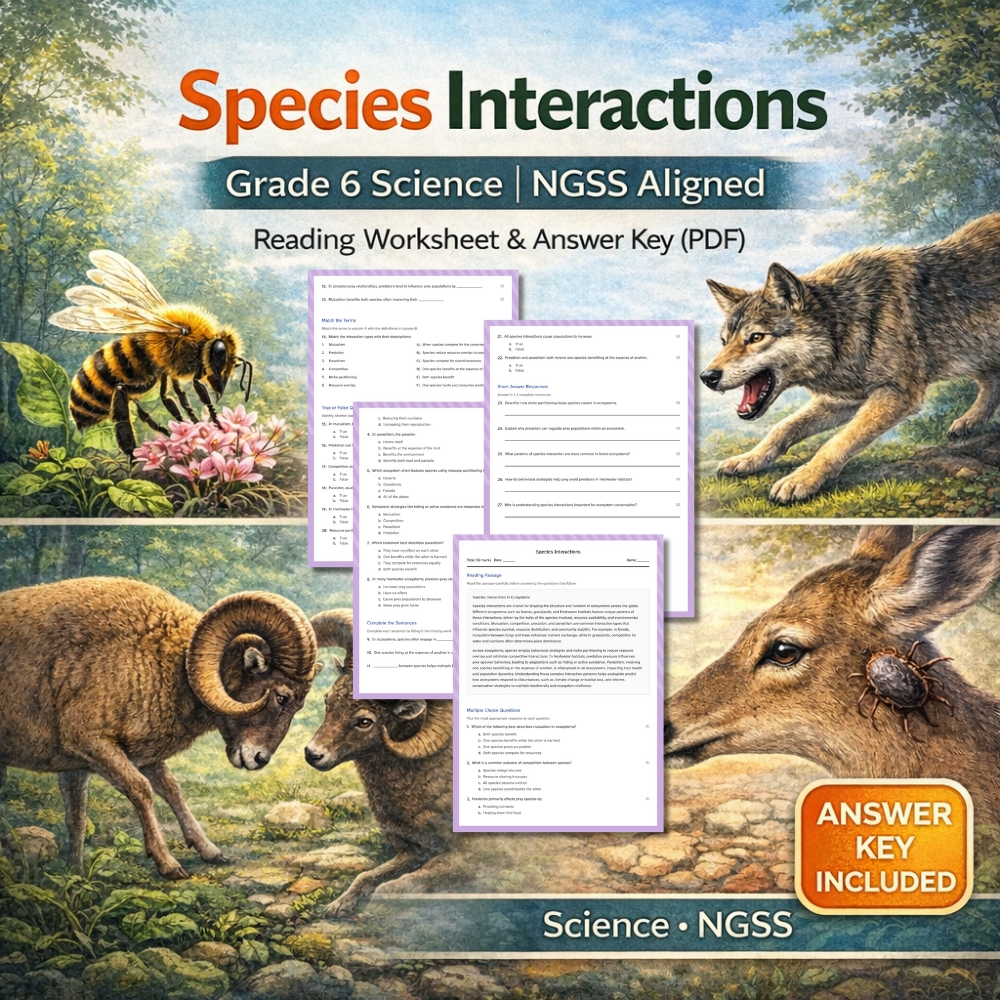
Grade 6 Science | Species Interactions | NGSS Worksheet & Answer Key
Created byCedar Grove LearningLearning Objectives
- Construct explanations predicting patterns of species interactions across different ecosystems.
- Identify and describe the types of species interactions such as mutualism, competition, predation, and parasitism.
- Compare interaction outcomes in forest, grassland, and freshwater ecosystems while relating niche partitioning, resource overlap, and behavioral strategies.
Also included in: Grade 6 Science | Ecosystem Interactions & Population Dynamics Worksheet Bundle +1 more
Instant download
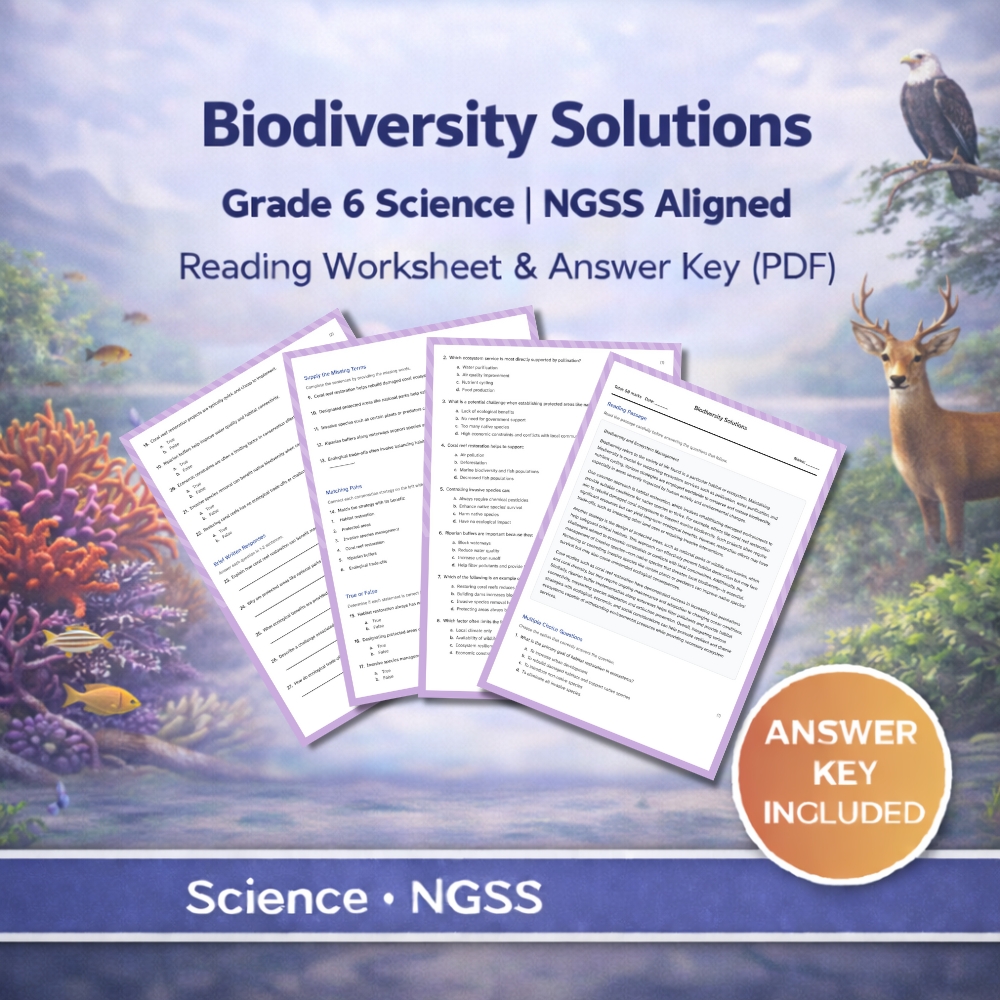
6th Grade Science | Biodiversity Solutions | Worksheet (NGSS Aligned)
Created byCedar Grove LearningLearning Objectives
- Compare different conservation strategies and understand their ecological trade-offs.
- Evaluate case studies of habitat restoration and invasive species management.
- Analyze effectiveness and feasibility of biodiversity solutions under environmental pressures.
Also included in: Grade 6 Science | Ecosystem Interactions & Population Dynamics Worksheet Bundle +1 more
Instant download
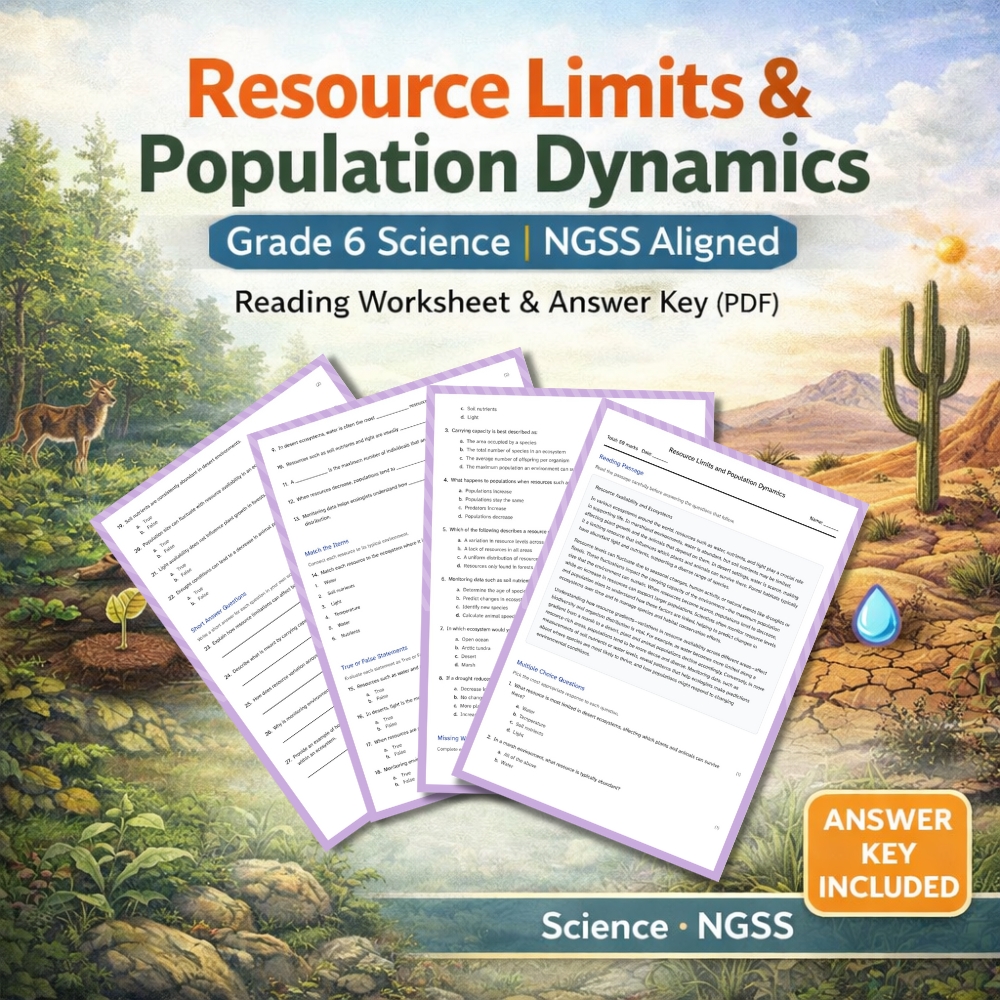
Grade 6 Science | Resource Limits & Population Dynamics | Worksheet (NGSS)
Created byCedar Grove LearningLearning Objectives
- Understand how resource availability affects individual organisms and population sizes.
- Interpret quantitative data related to resource distribution and population patterns.
- Identify limiting resources in different ecosystems such as marsh, desert, and forest habitats.
Also included in: Grade 6 Science | Ecosystem Interactions & Population Dynamics Worksheet Bundle +1 more
Instant download

6th Grade Science Worksheet – Adaptation Patterns TEKS Alignment (PDF)
Created byEvergreen Desk EducationLearning Objectives
- Identify morphological, physiological, and behavioral adaptations that help organisms survive in specific environments.
- Explain how inherited traits can improve survival, predator avoidance, and reproductive success.
- Compare how different environments (desert vs. temperate regions) favor different adaptation patterns.
Instant download
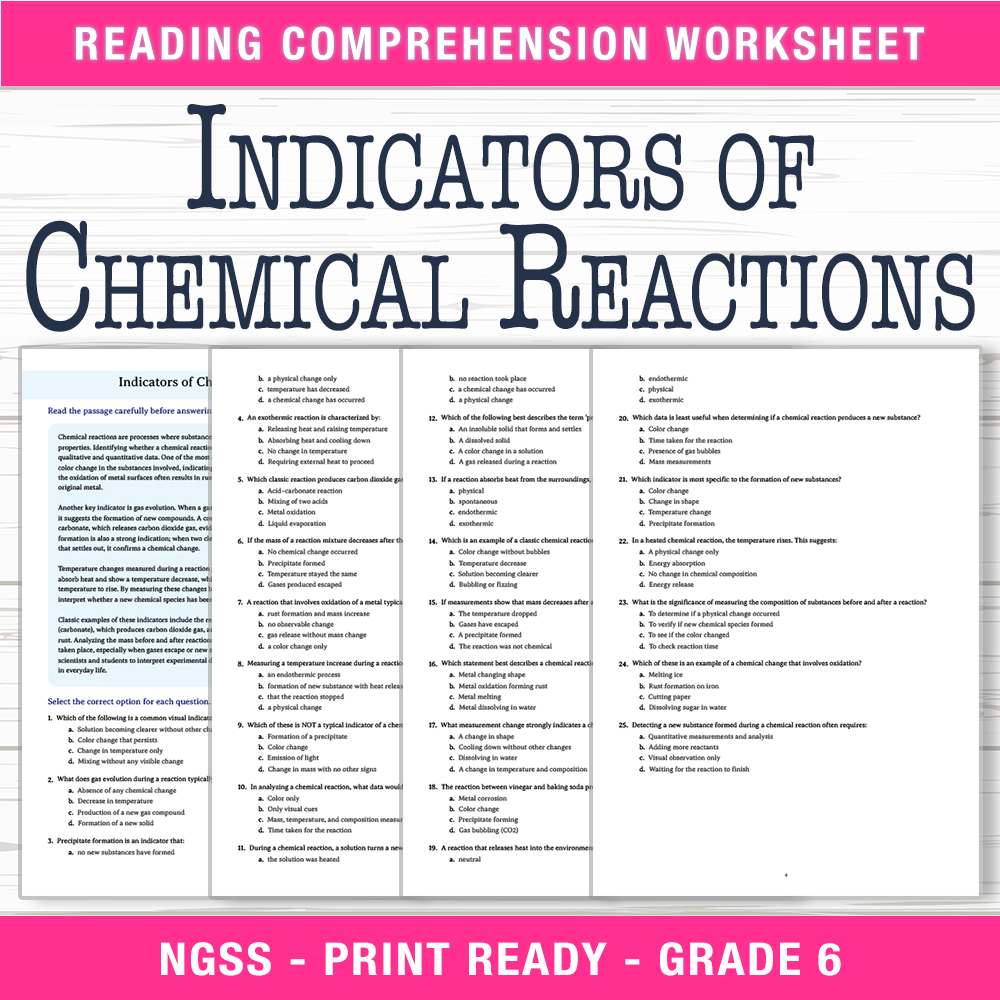
Grade 6 Science | Indicators of Chemical Reactions Workbook (PDF +Answer Key)
Created byRiverstone ClassroomLearning Objectives
- Identify key indicators that suggest a chemical reaction has occurred.
- Analyze qualitative and quantitative data to determine if a new substance has formed.
- Interpret measurements such as mass, temperature, and composition before and after reactions.
Instant download
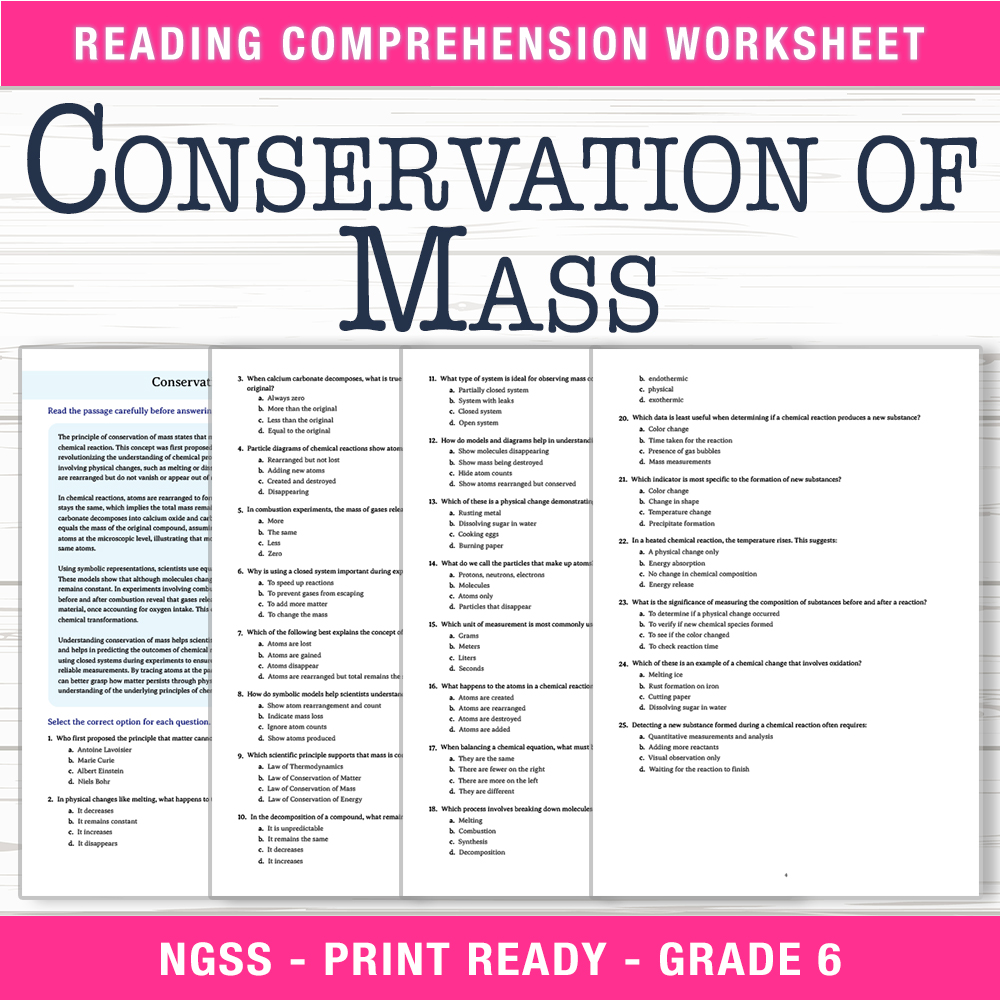
6th Grade Science | Conservation of Mass Worksheet (PDF + Answer Key)
Created byRiverstone ClassroomLearning Objectives
- Explain the principle of conservation of mass through physical and chemical changes.
- Trace atoms and mass through models and symbolic representations during reactions.
- Connect mass measurements before and after physical and chemical processes to the concept of matter conservation.
Instant download
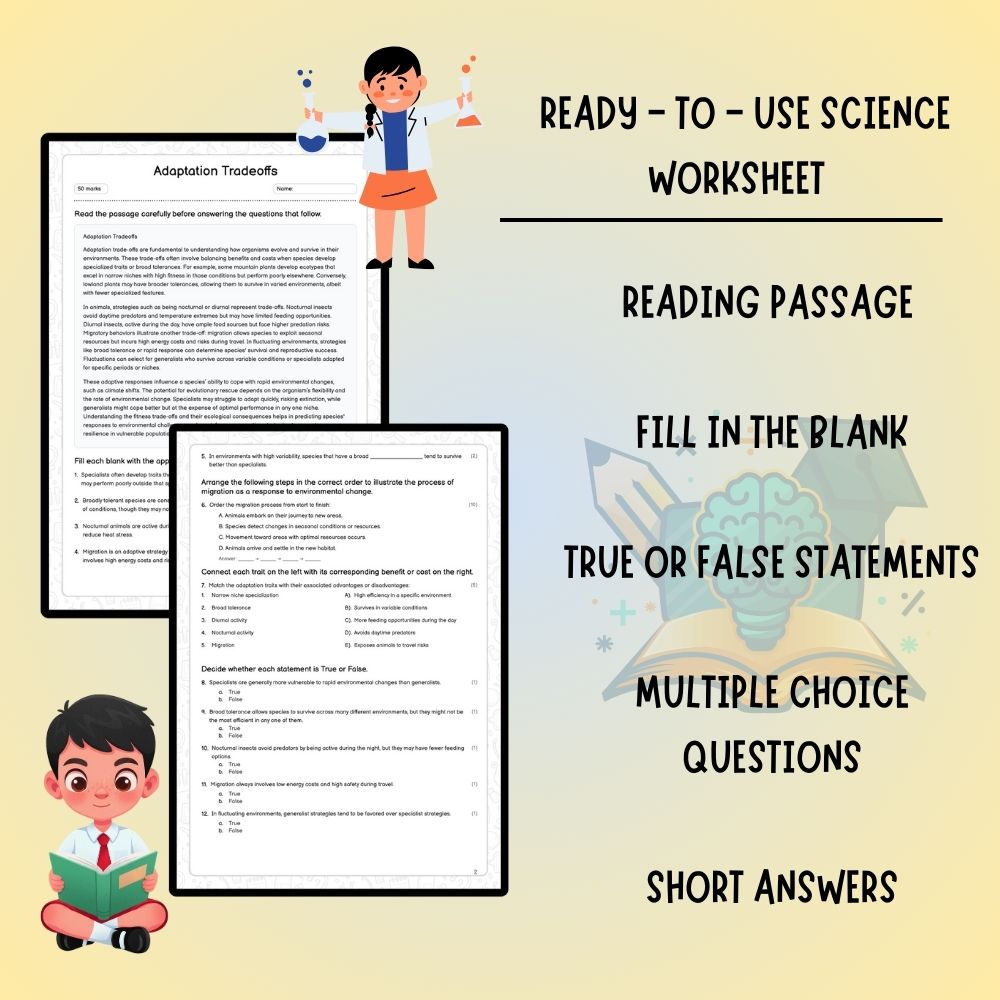
6th Grade Science | Adaptation Tradeoffs Worksheet (PDF )
 Created byPrism Point Learning
Learning Objectives
- Understand the concept of fitness trade-offs and how they influence adaptation strategies.
- Differentiate between specialists and generalists based on benefits and costs.
- Analyze real-world examples illustrating adaptation trade-offs, such as plant ecotypes and animal behaviors.
Also included in: Grade 6 Science Unit Bundle – Ecology, Classification & Environment
Instant download

Series Circuits Worksheet Grade 6 Science | Current & Voltage
Created byChalk and CompassLearning Objectives
- Explain how a series circuit forms a single-path (one-loop) configuration for current.
- Describe why the current is the same through each element in a series circuit.
- Use the idea of voltage division to predict how voltage is shared across series components.
Also included in: Grade 6 Science Circuits & Electricity Lesson Bundle | Ontario +1 more
Instant download
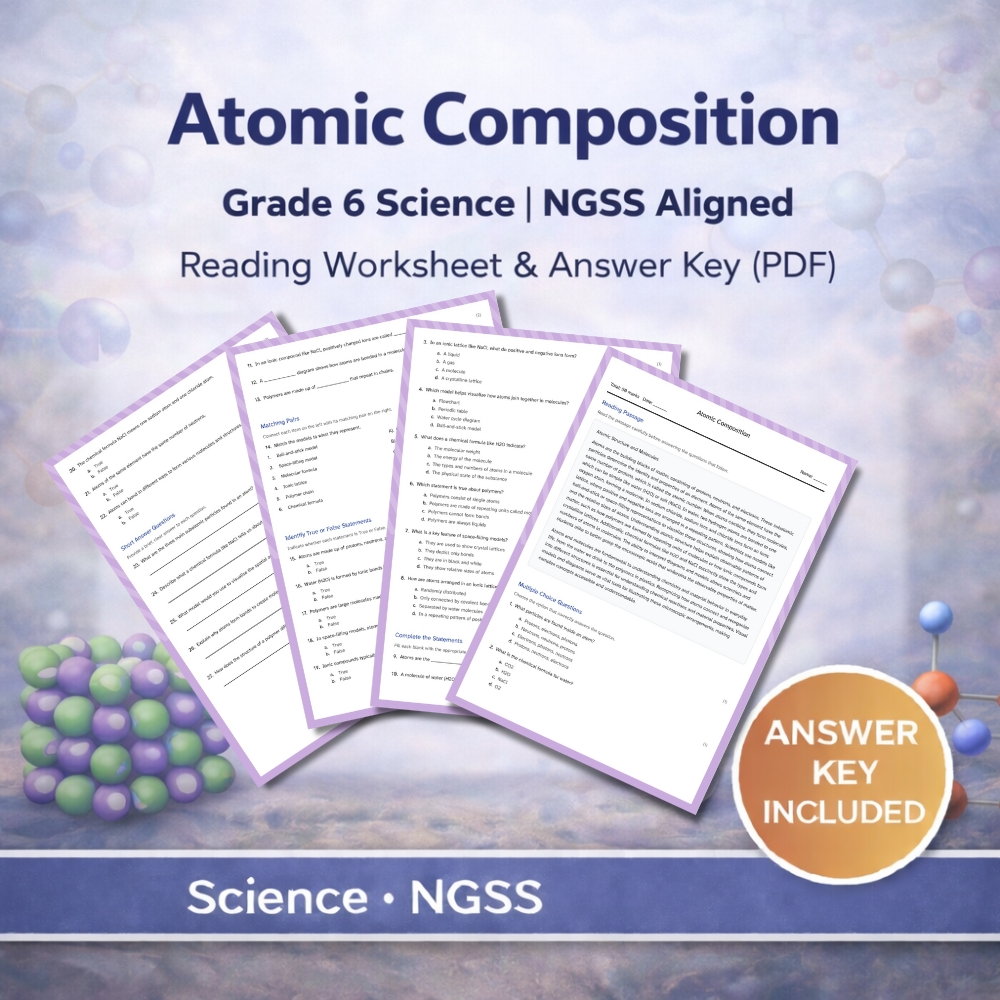
6th Grade Science | Atomic Composition | Worksheet & Answer Key (NGSS Aligned)
Created byCedar Grove LearningLearning Objectives
- Understand the basic structure of atoms and how they form molecules.
- Use models and representations to describe simple molecules like H2O and NaCl.
- Recognize patterns in the structure of polymers and ionic lattices.
Also included in: Grade 6 Science | Atomic & Molecular Models, Conservation & Reactions | NGSS +1 more
Instant download
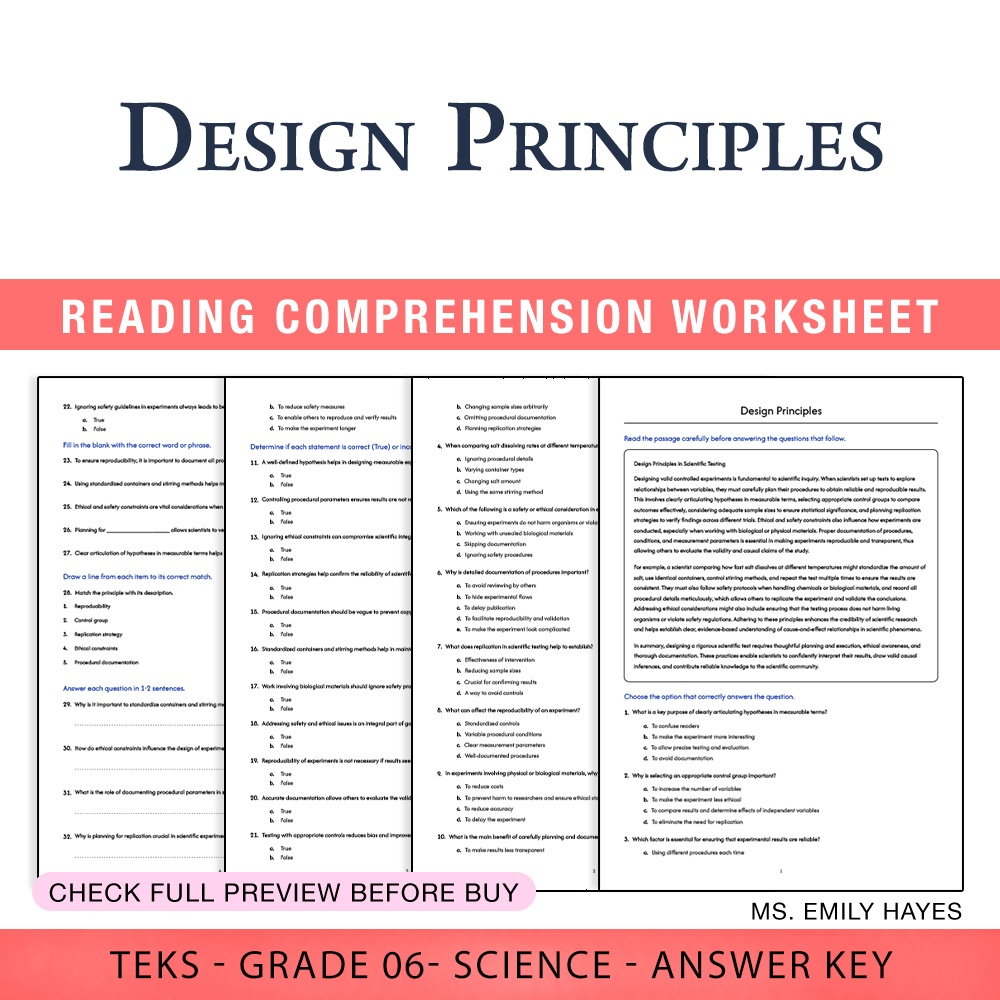
6th Grade Science | Design Principles Worksheet (PDF+ Answer Key)
Created byCopper Leaf ClassroomLearning Objectives
- Understand and articulate hypotheses in measurable terms for controlled experiments.
- Identify appropriate control groups and sample sizes in scientific testing.
- Describe strategies for replication to ensure reliability of experimental results.
Instant download

Prototype Evaluation Assessment for Grade 6 Science | Standards-Aligned
Created byPrism Point LearningLearning Objectives
- Understand how data and constraints are used to evaluate prototypes.
- Identify different types of evidence, including measurements and observations.
- Learn how to interpret failures and compare results to criteria.
Instant download
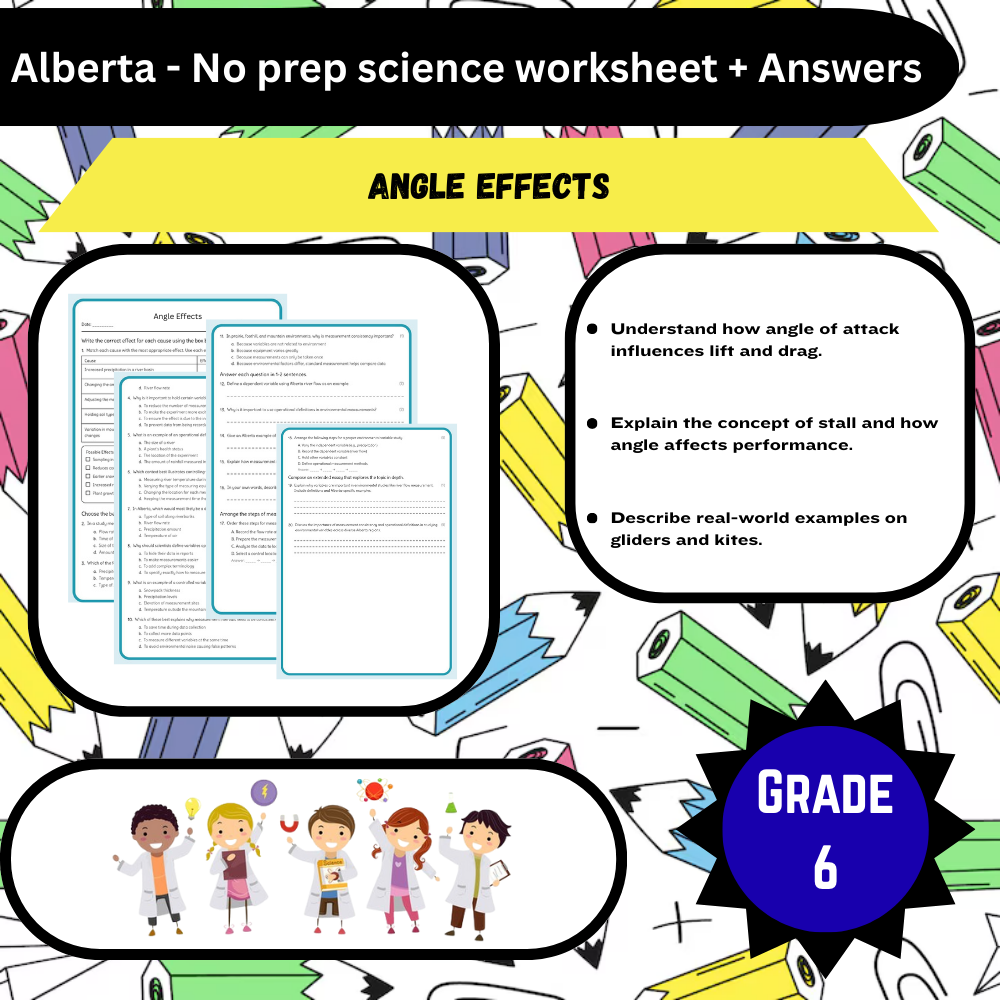
6th Grade Science | Angle Effects Worksheet (PDF) – Alberta Standards
Created byBright Mind ResourcesLearning Objectives
- Understand how the angle of attack influences lift and drag in flight.
- Explain the concept of stall and how angle adjustment affects flight performance.
- Describe real-world examples of angle effects on gliders and kites used in open fields.
Instant download

Grade 6 Science | Chemical Reactions - Daily Reading Comprehension Practice
Created byCoral Reef LearningLearning Objectives
- Identify indicators of chemical reactions such as color change, gas evolution, precipitates, and temperature change.
- Analyze qualitative and quantitative data to determine if a chemical reaction has occurred.
- Understand classic examples of chemical reactions like acid–carbonate reactions and metal oxidation.
Instant download
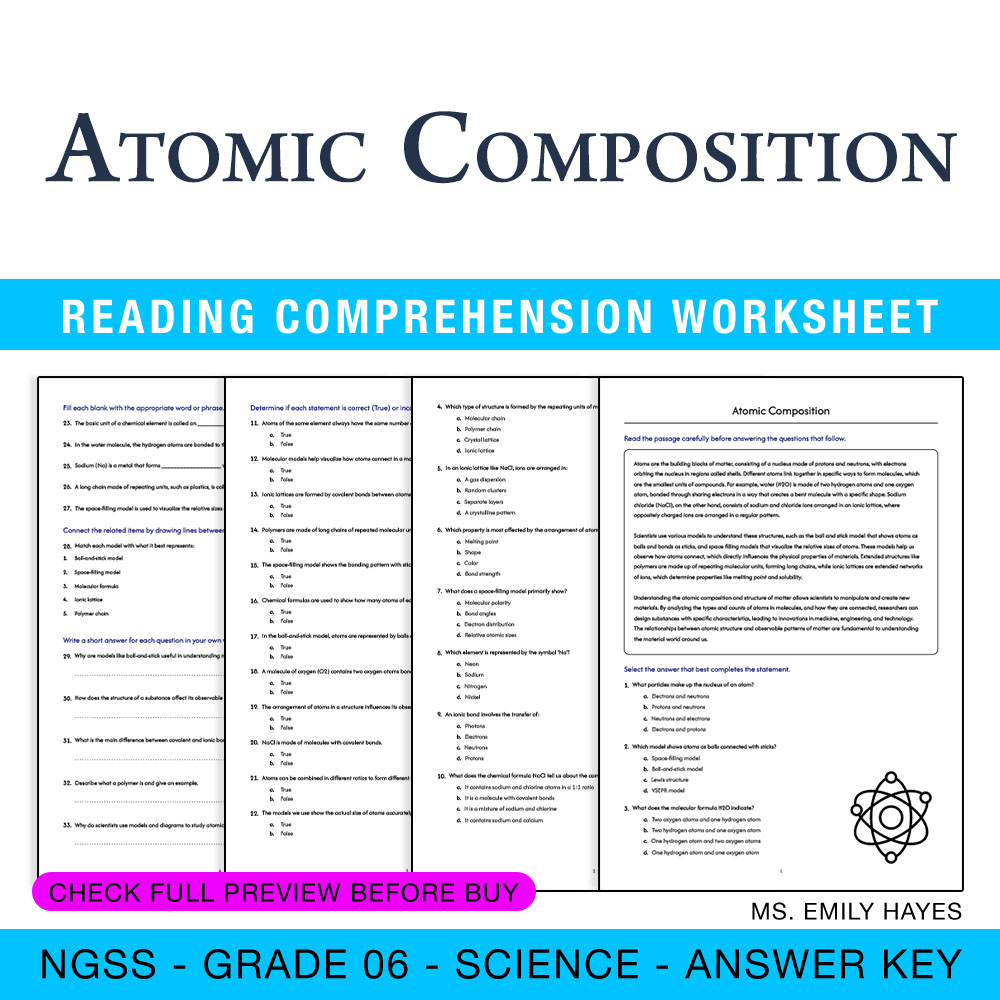
6th Grade Science | Atomic Composition Worksheet (PDF + Answer Key)
Created byCopper Leaf ClassroomLearning Objectives
- Describe how atoms combine to form molecules such as H2O and NaCl.
- Identify different models and representations used to visualize molecules and structures.
- Explain the relationship between molecular structure and observable patterns of matter.
Also included in: Grade 6 Science – Chemical Reactions & Conservation (PDF+ Answer Key)
Instant download
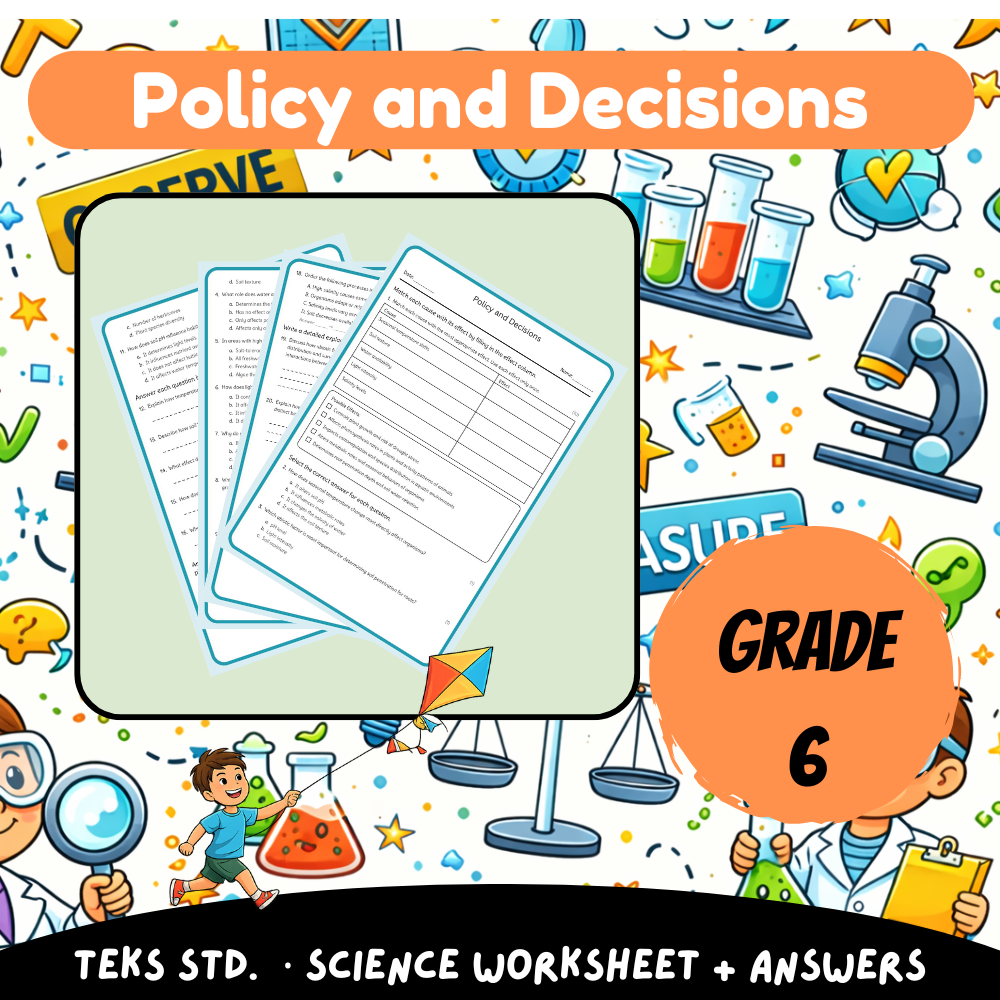
6th Grade Science – Policy and Decisions Worksheet (Worksheet + Answer Key) – TEKS Alignment
Created byBright Mind ResourcesLearning Objectives
- Understand how scientific evidence influences policy and decision-making.
- Identify key factors such as risk assessment, cost-benefit analysis, and stakeholder values.
- Interpret data and weigh uncertainties in societal decisions involving science and technology.
Instant download
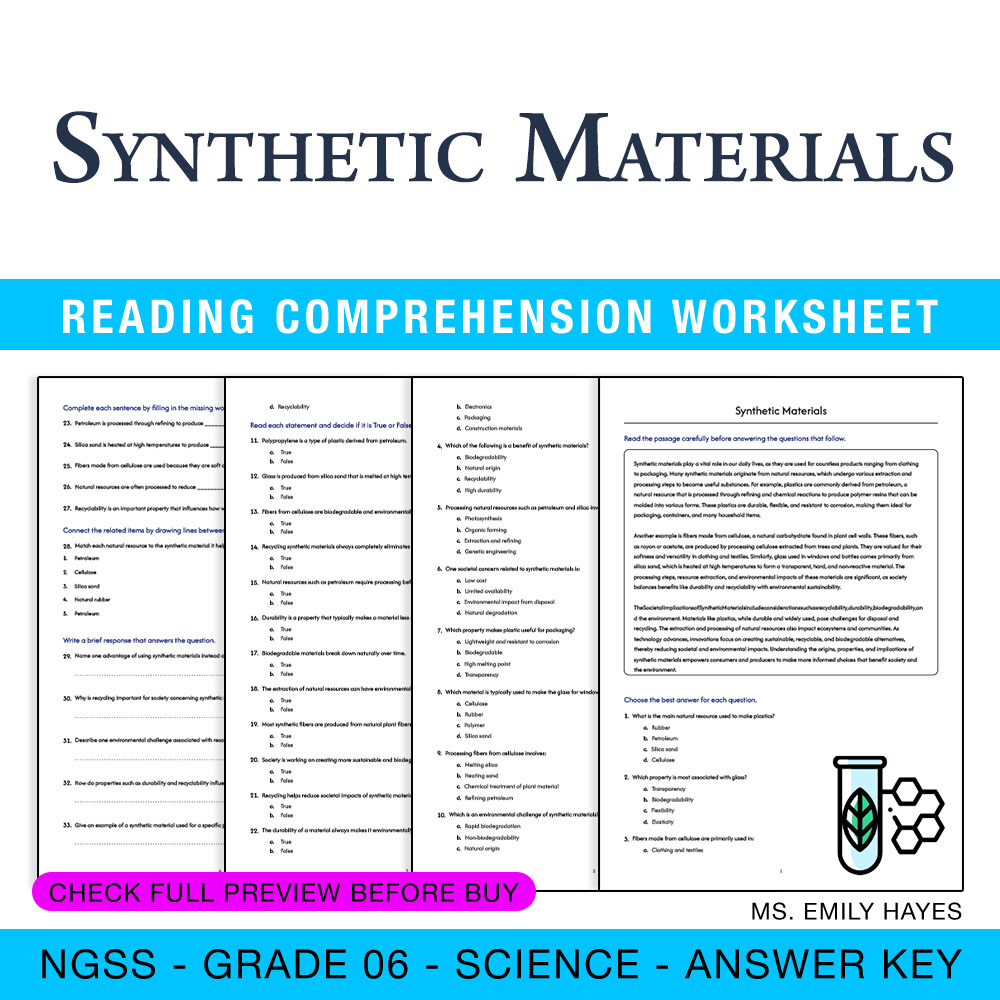
6th Grade Science | Chemical Reactions Worksheet (PDF + Answer Key)
Created byCopper Leaf ClassroomLearning Objectives
- Identify key indicators of chemical reactions such as color change, gas production, precipitate formation, and temperature change.
- Analyze quantitative and qualitative data to determine whether a chemical reaction has occurred and new substances have formed.
- Interpret pre-interaction and post-interaction measurements including mass, temperature, and composition data.
Also included in: Grade 6 Science – Chemical Reactions & Conservation (PDF+ Answer Key)
Instant download
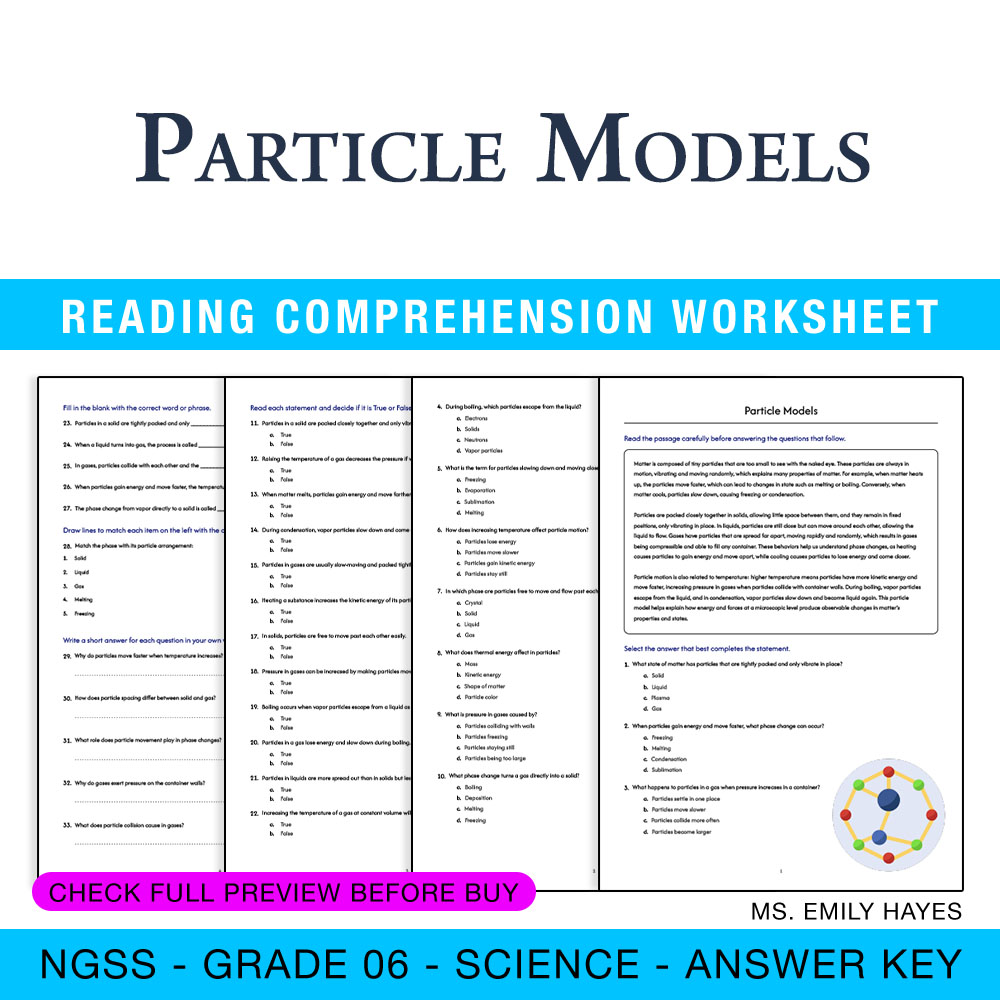
6th Grade Science | Particle Models Worksheet (PDF + Answer Key)
Created byCopper Leaf ClassroomLearning Objectives
- Describe matter as made up of particles too small to see.
- Explain how particle motion relates to phase changes and temperature.
- Use particle models to understand macroscopic properties like pressure and state changes.
Also included in: Grade 6 Science – Chemical Reactions & Conservation (PDF+ Answer Key)
Instant download
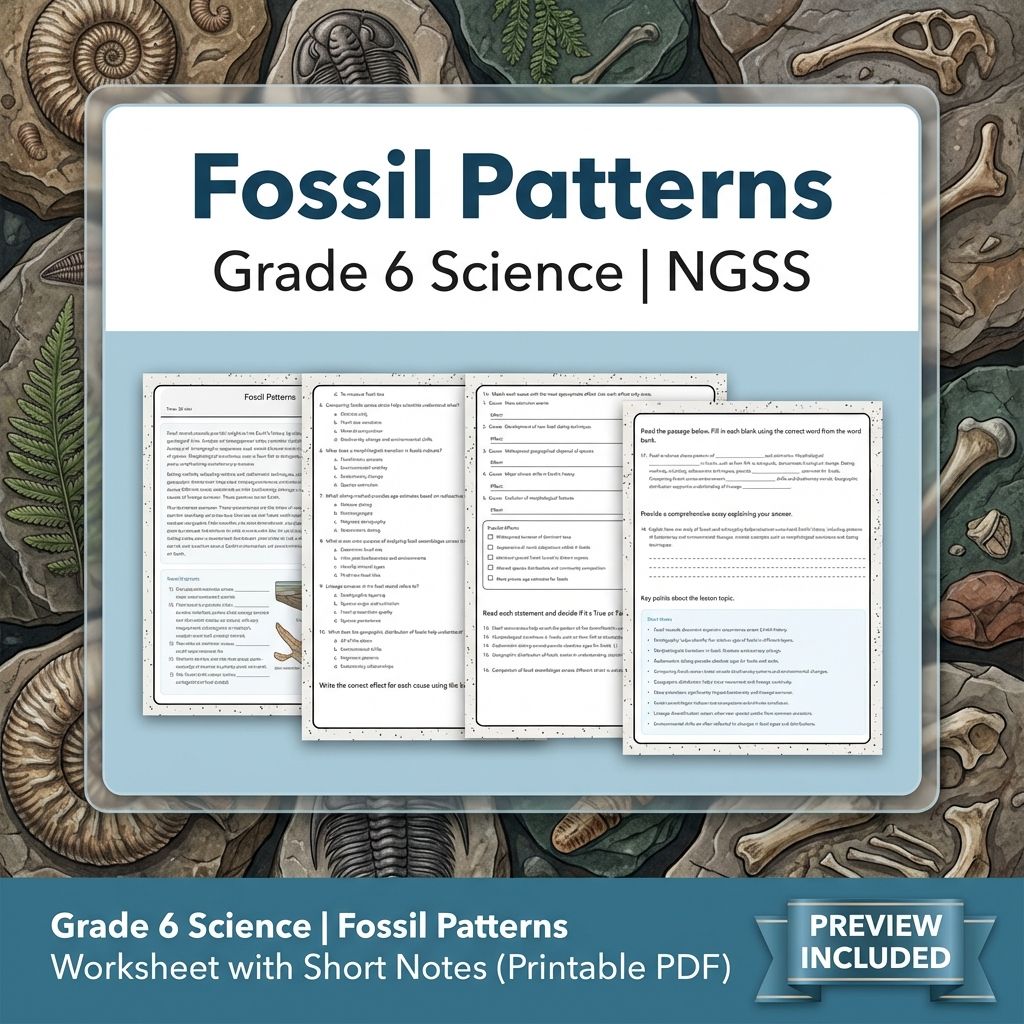
Grade 6 Science | Fossil Patterns Worksheet with Short Notes (Printable PDF)
Created byMeadowlark WorksheetsLearning Objectives
- Understand how fossil occurrences and stratigraphy reveal patterns of biodiversity over time.
- Analyze morphological transitions in the fossil record, such as fish-to-tetrapod evolution.
- Explain the role of dating methods and geographic distribution in tracing lineage continuity.
Also included in: Grade 6 Science | Biological Evolution: Unity and Diversity Unit Bundle +1 more
Instant download

6th Grade Science Atoms & Particles Worksheet | Matter Properties (PDF)
Created byEvergreen Desk EducationLearning Objectives
- Explain how matter can be modeled as particles and how atoms form elements.
- Describe how different particle compositions lead to measurable properties of substances.
- Use particle model ideas to interpret properties like density, melting point, and reactivity.
Instant download
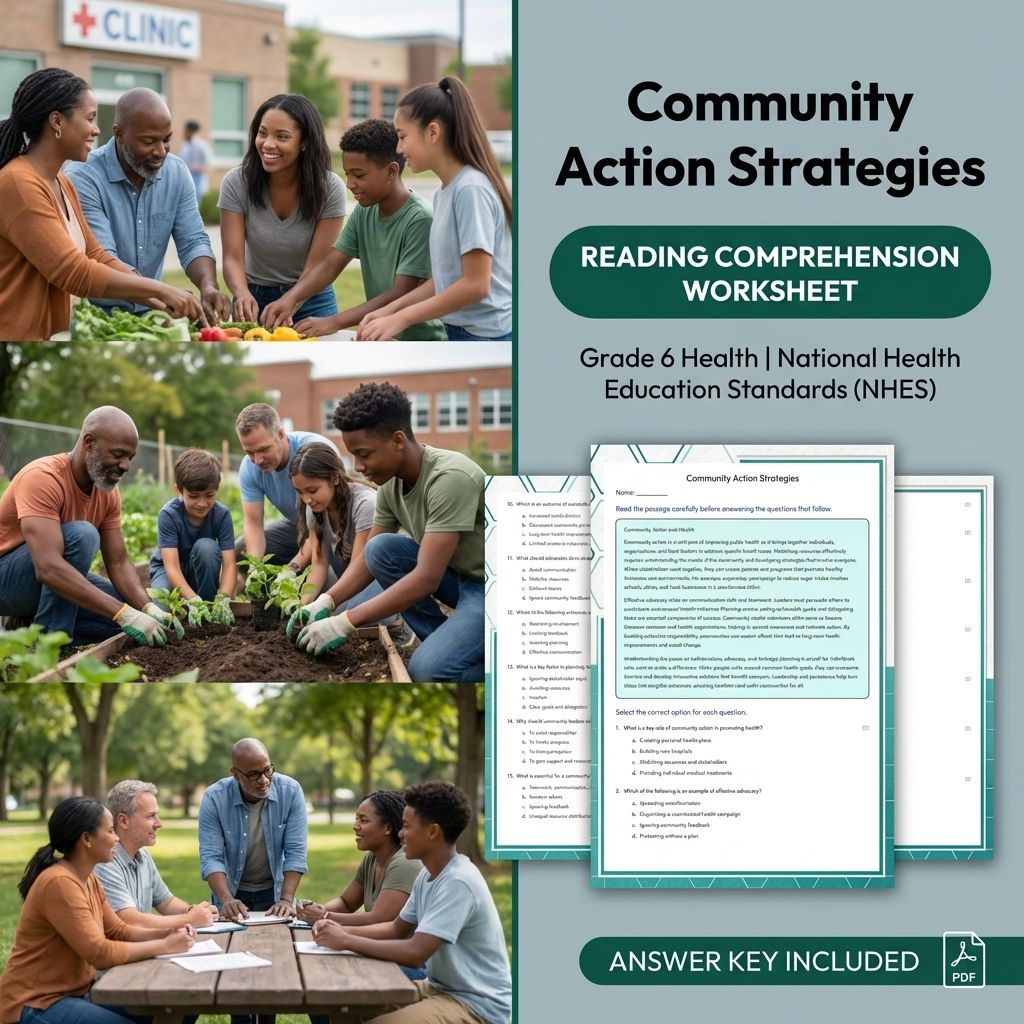
6th Grade Health | Community Action Strategies Worksheet for Standard NHES
 Created bySkylark Worksheets
Learning Objectives
- Understand the importance of community action in promoting health.
- Identify effective strategies for organizing community health initiatives.
- Learn how to communicate persuasively to involve stakeholders.
Also included in: Grade 6 Health Unit | Advocacy & Communication Worksheets (Answer Key Included) +1 more
Instant download
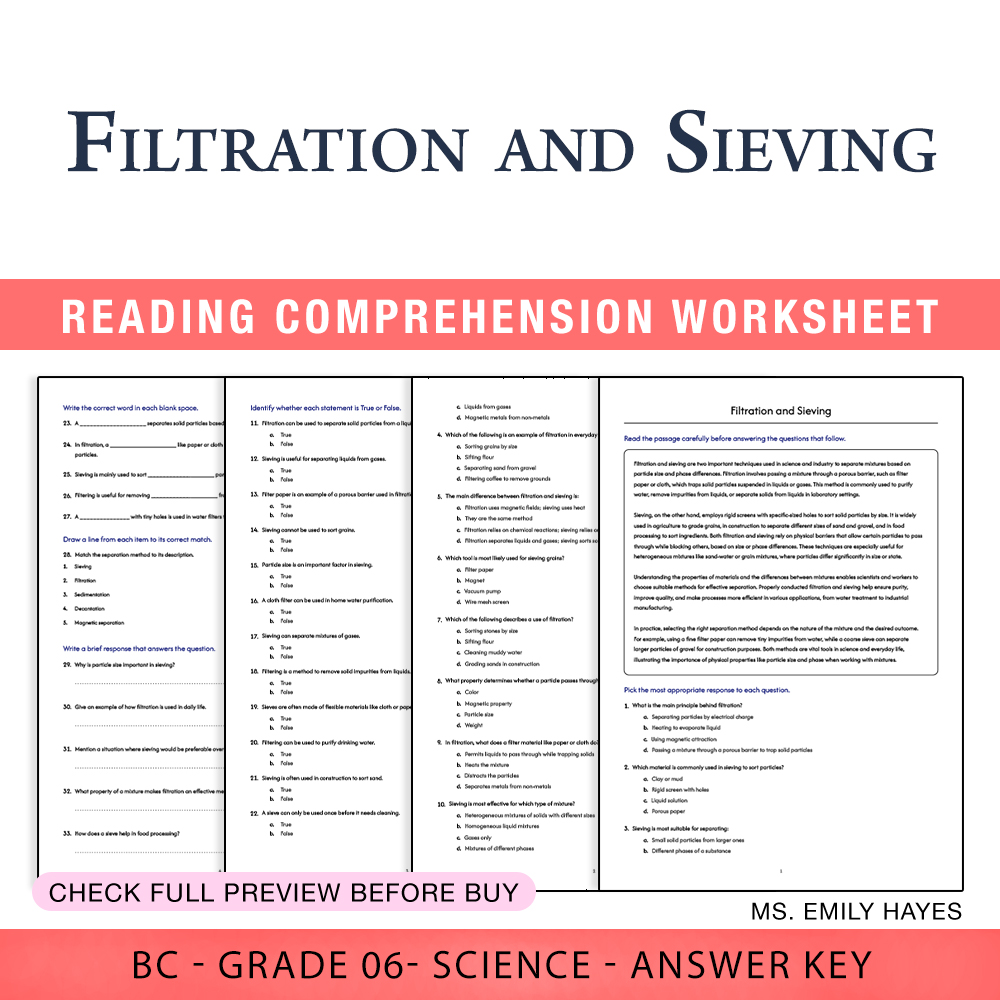
6th Grade Science | Filtration and Sieving Practice Worksheet (PDF+ Answer Key)
Created byCopper Leaf ClassroomLearning Objectives
- Understand the differences between filtration and sieving as methods for separating mixtures.
- Identify suitable materials and techniques used in filtration and sieving processes.
- Explain real-world applications of filtration and sieving in everyday life and industry.
Also included in: Grade 6 Science BC| Reaction Rates & Chemical Properties (PDF+ Answer Keys) +1 more
Instant download
Browse more categories
About Grade 6 Worksheets
Browse 8,578 printable Grade 6 worksheets across math, ELA, science, and social studies — each a ready-to-print PDF with optional answer keys.
MyTeachingSheets worksheets are made by real teacher-authors and checked before they go live. Download any as a print-ready PDF for lessons, homework, or independent practice — most include answer keys, and previews are always free.