
Grade 7 Worksheets
8,498 grade resources
Grade 7 Action-Reaction Forces Worksheet | Newton’s Third Law Practice
 Created byEvergreen Desk Education
Learning Objectives
- Explain Newton’s third law using the action-reaction force pair idea
- Identify action-reaction forces in contact and noncontact situations (including gravity)
- Use force and mass reasoning to predict acceleration direction and relative size
Instant download

Science Grade 7 Load Path Basics Worksheet | Ontario Standards Assessment
JCreated byJ.S SheetsLearning Objectives
- Explain what a load path is and describe how loads transfer from slabs or decks to beams, columns, trusses, and foundations
- Differentiate between dead loads and live loads and identify how they affect structures
- Identify where tension, compression, and shear typically occur in common structural members
Instant download

Grade 7 ELA Evidence Reasoning Worksheet (PDF) | General ELA Standards
 Created byGolden Apple Studio
Learning Objectives
- Explain how textual evidence supports an interpretation by stating the analytical link.
- Synthesize multiple details to address a claim from more than one angle.
- Identify patterns across a passage and describe how they strengthen a conclusion.
Also included in: Grade 7 Text Structure and Central Ideas ELA Lesson Bundle | General ELA +1 more
Instant download

Grade 7 Science | Thermal Basics in Science - Daily Reading Comprehension
 Created byCoral Reef Learning
Learning Objectives
- Understand how particle movement relates to temperature
- Identify different ways heat is transferred
- Recognize environmental examples of thermal exchange
Also included in: Energy, Heat and Thermal Processes Lesson Bundle: Grade 7 Science Alberta +1 more
Instant download

Grade 7 Holiday Patriot Day Worksheet for Building Resilience | PDF + Answer Key
 Created byShaNova Worksheets
Learning Objectives
- Explain what emotional resilience is and how it helps people cope after tragedy
- Identify healthy coping strategies and ways to support others during difficult times
- Describe how remembrance and community support can support healing
Instant download

Durability Factors Test Prep Worksheet | Grade 7 Science
 Created byPrism Point Learning
Learning Objectives
- Explain how corrosion, rot, moisture uptake, freeze–thaw cycling, and UV degradation reduce material performance over time
- Describe protective measures (coatings, cathodic protection, and concrete cover) and how they slow deterioration
- Relate service environment and inspection/maintenance choices to expected lifespan of bridge decks and exterior roofing
Instant download

Grade 7 English | Build Shared Understanding Worksheet (Alberta Standards PDF)
Created byGolden Apple StudioLearning Objectives
- Identify and use linking signals (e.g., therefore, however, because) to show how ideas relate in discussion.
- Use brief summaries and references to earlier points to confirm understanding and avoid unnecessary repetition.
- Synthesize new information into existing claims and respond to disagreement with reasoning and relevant details.
Also included in: Grade 7 Main Idea & Discussion Skills ELA Lesson Bundle – Alberta +1 more
Instant download
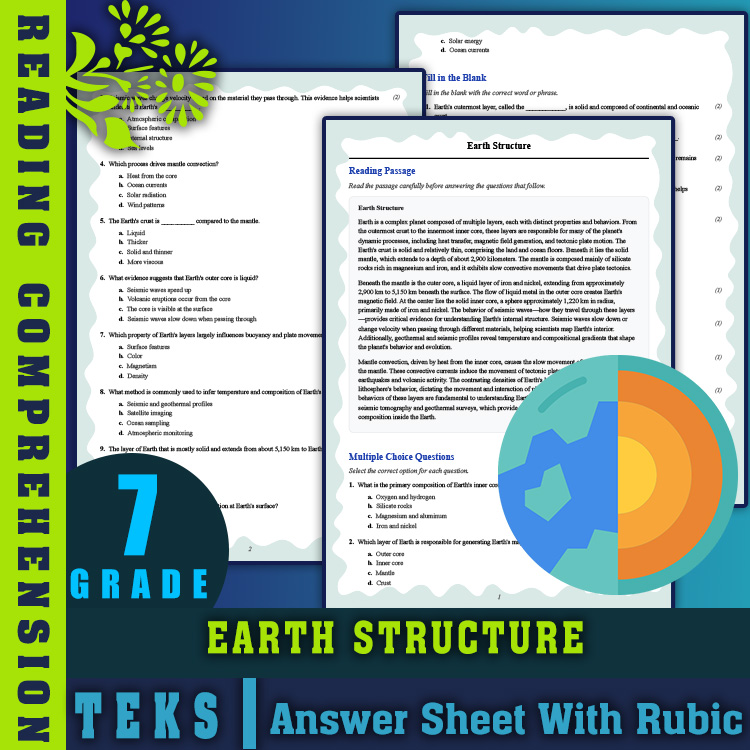
Grade 7 Science | Earth Structure Reading Worksheet (PDF + Rubric)
JCreated byJ.S SheetsLearning Objectives
- Describe Earth's internal layers and their properties.
- Explain how seismic waves provide evidence for Earth's internal structure.
- Understand mantle convection and its role in plate movement.
Instant download

Build Shared Understanding Worksheet Pack | Grade 7 ELA Practice
 Created bySunny Desk Resources
Learning Objectives
- Identify communication signals that show how ideas connect during discussion (linking words, summaries, and references).
- Explain how synthesis helps discussions move forward when new information is added.
- Use reasoning and relevant details to disagree respectfully and maintain a coherent group stance.
Also included in: Speaking and Listening Lesson Bundle | Grade 7 English Language Arts | Alberta +1 more
Instant download

Grade 7 Cell Evidence Worksheet | NGSS Practice & PDF
 Created byClear Sky Classroom
Learning Objectives
- Observe plant epidermis and protists using microscopy to identify cellular structures.
- Differentiate between unicellular and multicellular organisms based on microscopic observations.
- Understand the hierarchical organization from cells to tissues and organs.
Also included in: Grade 7 Cell Systems Science Lesson Bundle: NGSS Worksheet B +1 more
Instant download

Grade 7 Representations in Science Worksheet | NGSS Scientific Models Activity
 Created byBRIGHT PATH RESOURCES
Learning Objectives
- Understand different ways to represent matter interactions
- Interpret symbolic chemical equations
- Read and analyze graphs of mass or temperature versus time
Also included in: Chemical Reactions Grade 7 Science Daily Reading Worksheets Lesson Bundle | NGSS +2 more
Instant download

Grade 7 Science Worksheet | Durability Factors and Material Performance (PDF)
Created byEvergreen Desk EducationLearning Objectives
- Explain how environmental conditions (water, salts, freeze–thaw, and UV) lead to material degradation over time.
- Identify protective measures (coatings, cathodic protection, concrete cover, sealers, and detailing) that improve durability.
- Relate maintenance schedules and inspection intervals to expected lifespan and long-term structural reliability.
Also included in: Grade 7 Engineering Design & Materials Science Lesson Bundle Ontario +1 more
Instant download

Grade 7 Science Levels Of Organization Worksheet (PDF) – Alberta Standards
 Created bySilver Birch Teaching
Learning Objectives
- Identify and describe ecological levels of organization from individuals to ecosystems
- Explain how higher-level patterns (population, community, ecosystem) can’t be predicted from individual traits alone
- Use examples (such as trout in Alberta waters) to distinguish levels by their properties and processes
Also included in: Grade 7 Ecosystems & Biodiversity Science Lesson Bundle for Alberta Framework +1 more
Instant download

Grade 7 Science – Fitness & Survival | Daily Reading Worksheet
 Created byBright Mind Resources
Learning Objectives
- Understand what traits contribute to an organism's survival
- Learn how environment influences which traits are advantageous
- Explore the concept of fitness in different habitats
Also included in: Populations & Traits Grade 7 Science Daily Reading Lesson Bundle | Florida NGSSS +1 more
Instant download

Figurative Vocabulary ELA Worksheet Grade 7 Meaning and Context
Created bySunny Desk ResourcesLearning Objectives
- Determine the meaning of figurative language by using context clues.
- Identify how similes and metaphors shape an author’s message or theme.
- Interpret academic vocabulary in an explanation or argument.
Instant download
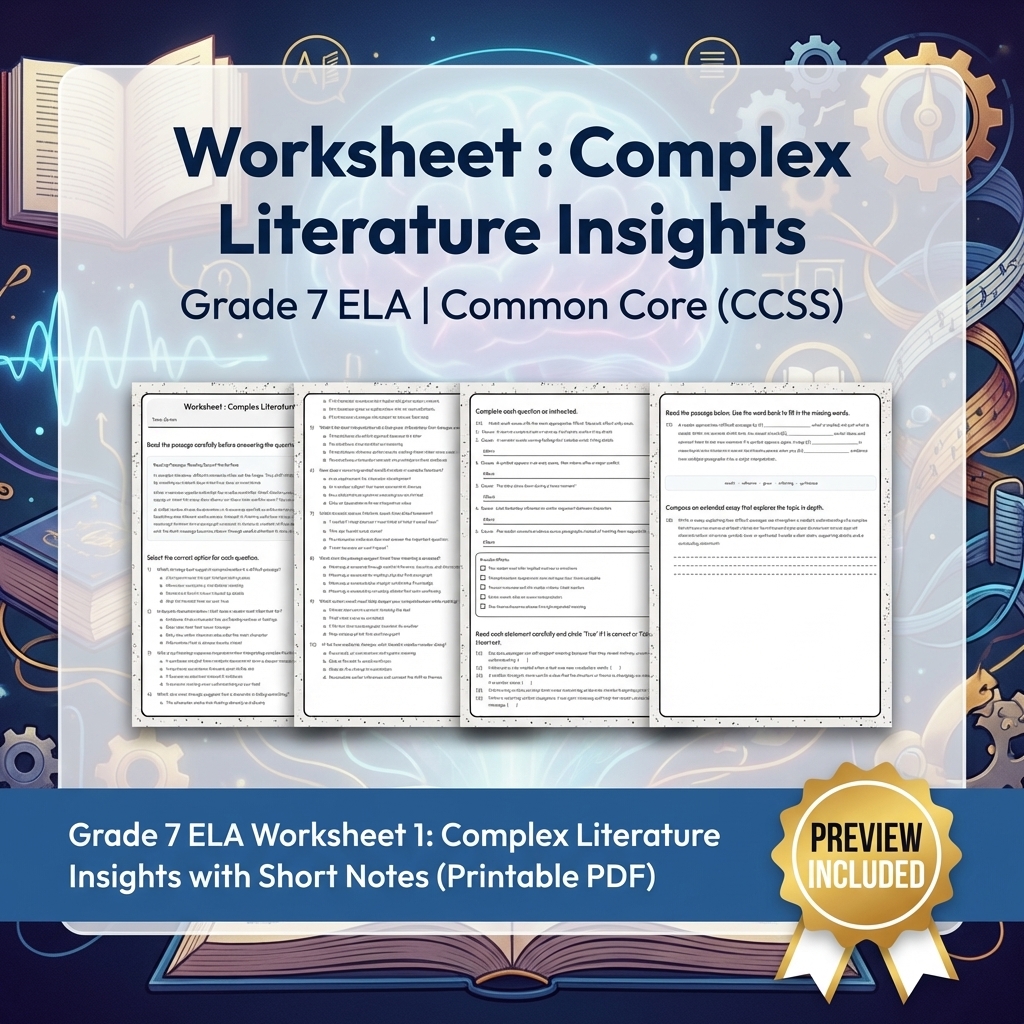
Grade 7 ELA Worksheet 1: Complex Literature Insights with Short Notes
 Created byMeadowlark Worksheets
Learning Objectives
- Analyze how challenging passages contribute to a text’s overall meaning.
- Use evidence from multiple parts of a text to support interpretations.
- Evaluate how layered characterization and nuanced structure shape a reader’s understanding.
Also included in: Grade 7 Theme, Point of View & Evidence Literary ELA Lesson Bundle (CCSS) +1 more
Instant download

Levers and Pulleys Worksheet for Grade 7 Science Alberta Standards
JCreated byJ.S SheetsLearning Objectives
- Understand how lever classes and pulley systems modify effort and direction of applied forces.
- Explain the concepts of torque, fulcrum placement, and mechanical advantage in simple terms.
- Calculate ideal mechanical advantage for common lever and pulley setups using basic arithmetic.
Instant download

Phase Energy Assessment | Alberta Standards for Grade 7 Science
Created byPrism Point LearningLearning Objectives
- Explain the concepts of particle kinetic and potential energy during phase changes.
- Describe how latent heat phenomena are involved in melting, freezing, evaporation, and condensation.
- Interpret microscopic particle interactions in terms of macroscopic energy changes.
Also included in: Lesson Grade 7 Science Mini Bundle | Matter and Chemical Change +1 more
Instant download

Grade 7 | Hiroshima Peace Day Worksheet for Peace Lessons | PDF + Answer Key
Created byShaNova WorksheetsLearning Objectives
- Explain the purpose of Hiroshima Peace Day and why it is remembered on August 6
- Describe how stories from survivors can build empathy and support conflict resolution
- Use key vocabulary related to peace, nonviolence, and reconciliation in context
Instant download

Grade 7 Solution Concentration Worksheet | Practice & Assessment PDF
Created byClear Sky ClassroomLearning Objectives
- Define solution concentration as the amount of solute relative to solvent and explain why concentration matters.
- Use and interpret concentration measures such as mass percent and grams per litre.
- Predict how changing concentration can affect physical properties like freezing point and boiling point.
Instant download

Grade 7 Purpose Audience Adaptation Worksheet | Ontario ELA Writing Skills
Created bySunny Desk ResourcesLearning Objectives
- Explain how purpose and audience affect word choice, tone, and emphasis in communication.
- Identify differences between concise community announcements and more detailed explanations.
- Revise a message to fit a new audience by adjusting formality, vocabulary, and level of detail.
Instant download
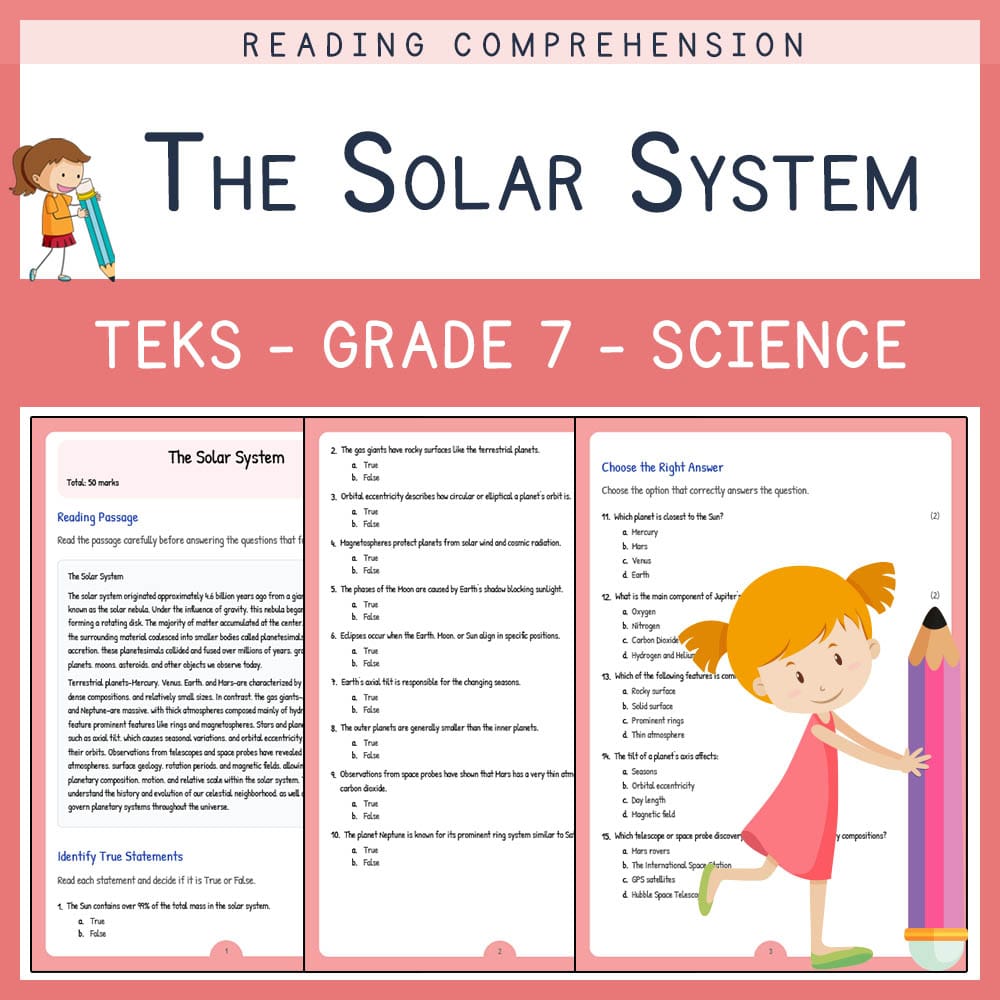
Grade 7 Science | The Solar System Worksheet | TEKS-Aligned
 Created byLumora Learning
Learning Objectives
- Understand the origins and formation of the solar system.
- Identify key properties and features of planets and other celestial bodies.
- Compare and contrast terrestrial and gas giant planets.
Also included in: Grade 7 Science | Earth and Space Systems Unit Bundle | TEKS Standard
Instant download

Grade 7 Science Worksheet | Evidence Arguments and Scientific Reasoning (PDF)
Created byEvergreen Desk EducationLearning Objectives
- Explain how scientific claims are supported by evidence using a clear chain from observations to reasoning.
- Evaluate arguments for consistency between stated quantities and what data actually show.
- Use scientific principles to justify why evidence supports a claim while avoiding unsupported cause-and-effect.
Also included in: Grade 7 Model-Based Scientific Reasoning Science Lesson Bundle (General) +1 more
Instant download

Grade 7 Social Studies – Global Trade Systems Worksheet (TEKS)
Created bySunny Desk ResourcesLearning Objectives
- Explain how global trade systems connect producers, traders, and consumers across regions.
- Compare mercantilism and capitalism by describing how each influences markets and resource allocation.
- Analyze how classic trade routes helped move goods, ideas, and resources while creating global interdependence.
Also included in: Grade 7 Industrialization & Global Trade Social Studies Lesson Bundle (TEKS) +1 more
Instant download

Grade 7 Holiday Reflection Worksheet | May Standard | Reading & Comprehension (PDF)
Created bySilver Birch TeachingLearning Objectives
- Explain the historical significance of VE Day and World Red Cross Day in relation to resilience and peace.
- Describe how humanitarian aid organizations, such as the Red Cross, help people affected by conflict and disasters.
- Use Grade 7 vocabulary related to compassion, cooperation, and humanitarian work to respond to questions.
Also included in: Grade 7 Holiday full month Bundle: May Framework Worksheets (40 Total)
Instant download

Grade 7 Net Force Worksheet | NGSS Practice & PDF
Created byClear Sky ClassroomLearning Objectives
- Define net force as the vector sum of all forces acting on an object.
- Explain how unbalanced forces cause changes in motion.
- Describe the relationship between net force, mass, and acceleration using diagrams and reasoning.
Also included in: Grade 7 Net Force, Interactions, Collisions Science Lesson Bundle (NGSS) +1 more
Instant download

Grade 7 Calorimetry Basics Worksheet | Alberta Use Practice PDF
Created byClear Sky ClassroomLearning Objectives
- Explain the role of calorimetry and energy conservation in predicting heat transfer.
- Use q = m · c · ΔT to relate temperature changes to energy transfer in joules.
- Identify how heat flows during melting, heating, and heat losses in real-world thermal scenarios.
Instant download
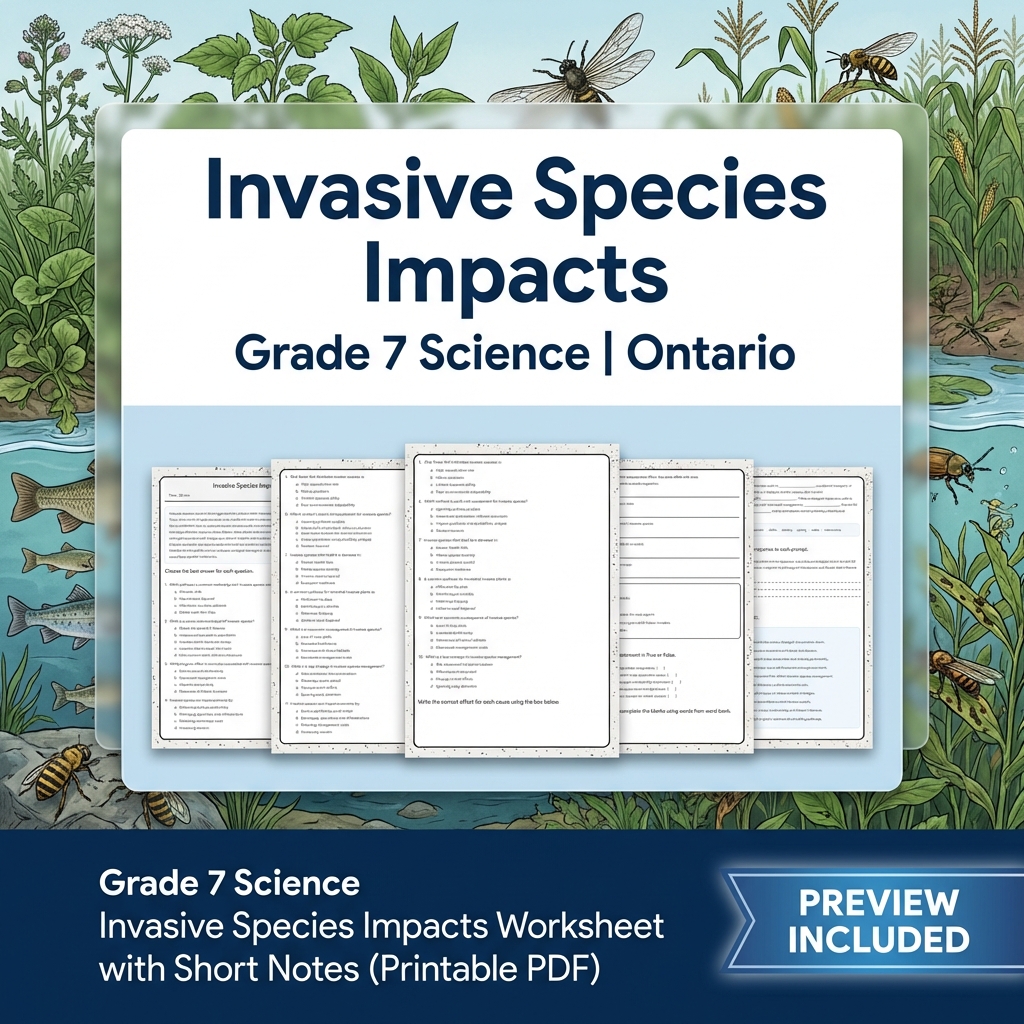
Grade 7 Science Invasive Species Impacts Worksheet with Short Notes (PDF)
Created byMeadowlark WorksheetsLearning Objectives
- Understand the ecological and economic consequences of invasive non-native species.
- Identify pathways and factors that facilitate invasive species establishment.
- Analyze long-term impacts such as reduced native biodiversity and altered ecosystems.
Also included in: Grade 7 Science Lesson Bundle with Ontario Framework | Ecosystems & Biodiversity +1 more
Instant download

Grade 7 Science | Adaptation Function - Daily Reading Comprehension
Created byCoral Reef LearningLearning Objectives
- Understand how structural adaptations help animals survive
- Identify examples of physical features that support survival
- Recognize the relationship between form and function in living organisms
Instant download

Grade 7 Science – Mass Measurements Worksheet (BC Standards) PDF
Created byEvergreen Desk EducationLearning Objectives
- Explain how conservation of mass is tested using total mass of reactants and products in a closed system
- Describe how accurate mass measurements depend on system boundaries, including gases and dissolved species
- Use measurement data to justify whether mass is conserved in a chemical change
Instant download

Oral Communication Worksheets: Active Listening Grade 7 ELA
Created byGolden Apple StudioLearning Objectives
- Identify the main idea in an oral or written message
- Identify key details that support a message's main idea
- Explain how tone affects the meaning of a message
Also included in: Grade 7 ELA Oral Communication Worksheets | Tone Shifts | Ontario +1 more
Instant download

Grade 7 ELA – Explanatory Structure & Informative Texts | Daily Worksheet
 Created byQuiet Forest Education
Learning Objectives
- Identify parts of an explanatory paragraph
- Understand how introductions, body, and conclusions are organized
- Recognize transitional phrases linking ideas
Also included in: Grade 7 Writing ELA Lesson Bundle for Daily Reading | Common Core (CCSS) +1 more
Instant download

Organized Paragraphing Worksheet Pack Grade 7 ELA Practice
Created bySunny Desk ResourcesLearning Objectives
- Identify the purpose of a topic sentence, supporting sentences, and a closing sentence in an organized paragraph.
- Revise paragraphing by improving focus, adding relevant supporting details, and strengthening transitions between ideas.
- Apply paragraph structure to write a clear cause-and-effect or compare-and-contrast paragraph.
Also included in: Grade 7 Writing Lesson Bundle | Alberta ELA Framework for Revision +1 more
Instant download

Resource Management in Indigenous Cultures Worksheet | Grade 7 Social Studies
Created byQuiet Forest EducationLearning Objectives
- Understand traditional Indigenous methods of resource management.
- Compare Indigenous practices with modern resource stewardship.
- Reflect on cultural approaches to sustainable resource use.
Also included in: Resources-Tech Grade 7 Social Studies Daily Reading Worksheets Lesson Bundle|BC +1 more
Instant download

Grade 7 ELA Explanatory Texts Worksheet (PDF) | General ELA Standards
Created byGolden Apple StudioLearning Objectives
- Identify the purpose and key features of explanatory (informative) writing, including clear focus and relevant supporting details.
- Determine how definitions and examples clarify specialized vocabulary and explain relationships among ideas.
- Revise sentences for coherence by ensuring each part contributes to the main explanation without drifting.
Also included in: Grade 7 ELA Writing, Research, & Revision Lesson Bundle | General ELA +1 more
Instant download

Clear Main Idea Worksheet | Grade 7 ELA Practice & Standards-Aligned
JCreated byJ.S SheetsLearning Objectives
- Identify the main idea of an oral message by focusing on the topic claim and the overall purpose.
- Evaluate whether supporting points follow a logical flow (introduction, sequence, conclusion) and remain aligned to the main idea.
- Revise a short message to improve clarity by using precise wording and consistent time/sequence/category transitions.
Instant download

Major Religions and Cultural Impact Worksheets Grade 7 Social Studies
 Created byWorld Paper Hub
Learning Objectives
- Identify key beliefs and practices of Christianity, Islam, Hinduism, Buddhism, and Judaism.
- Compare how religions influence holidays, laws, and daily social behavior in different societies.
- Explain how core religious ideas can shape cultural identity and community cohesion over time.
Instant download
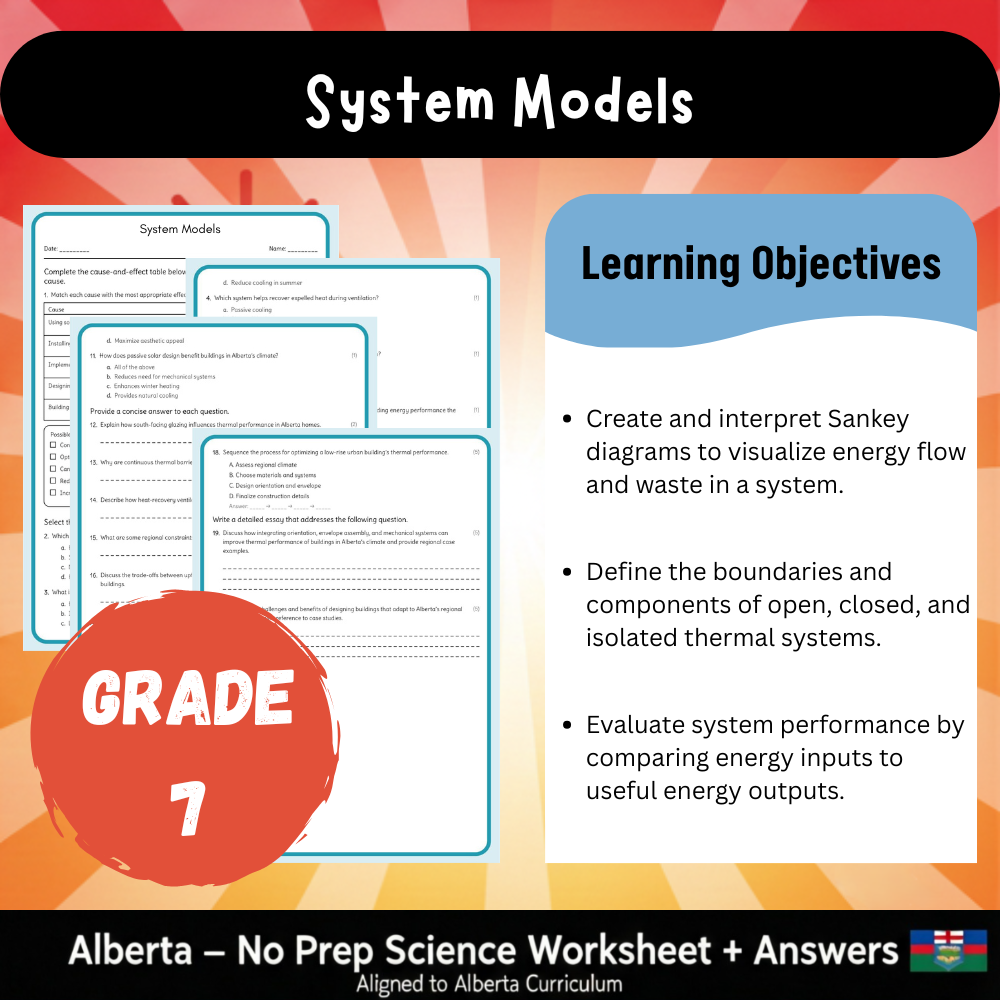
Grade 7 Science | System Models Worksheets (PDF) – Alberta Standard
Created byBright Mind ResourcesLearning Objectives
- Understand how energy flows within mechanical and industrial systems.
- Identify different energy transformation processes and their efficiency.
- Interpret energy flow diagrams and Sankey representations for system analysis.
Instant download

Scaling Effects Worksheet | Grade 7 Science Practice
Created byPrism Point LearningLearning Objectives
- Explain how square-cube relationships change forces, areas, and volumes when a prototype is scaled up or down.
- Predict how surface-to-volume ratio affects heat transfer and cooling in small versus large objects.
- Describe how Reynolds number can change fluid-flow behavior when conditions or size scale change.
Also included in: Grade 7 Technology & Engineering Design in Science: Lesson Bundle TEKS
Instant download

Grade 7 ELA – Understanding Context Clues & Comprehension | Daily Worksheet
Created byQuiet Forest EducationLearning Objectives
- Understand key concepts related to ELA
- Apply knowledge through practice questions
- Demonstrate comprehension of the material
Also included in: Text Analysis Grade 7 ELA Daily Reading Worksheets Lesson Bundle | TEKS +1 more
Instant download

Physical Influences Worksheet for Grade 7 Social Studies TEKS Standard
JCreated byJ.S SheetsLearning Objectives
- Explain how physical geographic factors (mountains, rivers, and climate) influence where civilizations develop.
- Describe how human geographic factors (settlement patterns and land use) interact with physical features.
- Analyze how geography affects trade routes, agriculture, and the long-term resilience of societies.
Instant download

Grade 7 Science Risk Assessment Worksheet | Ontario Curriculum | PDF
Created byClear Sky ClassroomLearning Objectives
- Identify common hazards in laboratory and field contexts and locate relevant hazard information in Safety Data Sheets (SDS).
- Explain how likelihood and severity affect risk and how controls reduce risk using the hierarchy of controls.
- Describe appropriate emergency planning, signage, incident reporting, and ethical responsibilities for personal and community safety.
Instant download

Atmospheric Systems Worksheet | Grade 7 Science Practice
Created byPrism Point LearningLearning Objectives
- Explain how uneven heating drives atmospheric energy transfer and convection
- Describe how pressure gradients and prevailing winds relate to weather variability
- Model large-scale circulation (Hadley cell) and connect it to climate patterns
Also included in: Grade 7 Earth and Space Systems Science Lesson Bundle TEKS Worksheets
Instant download
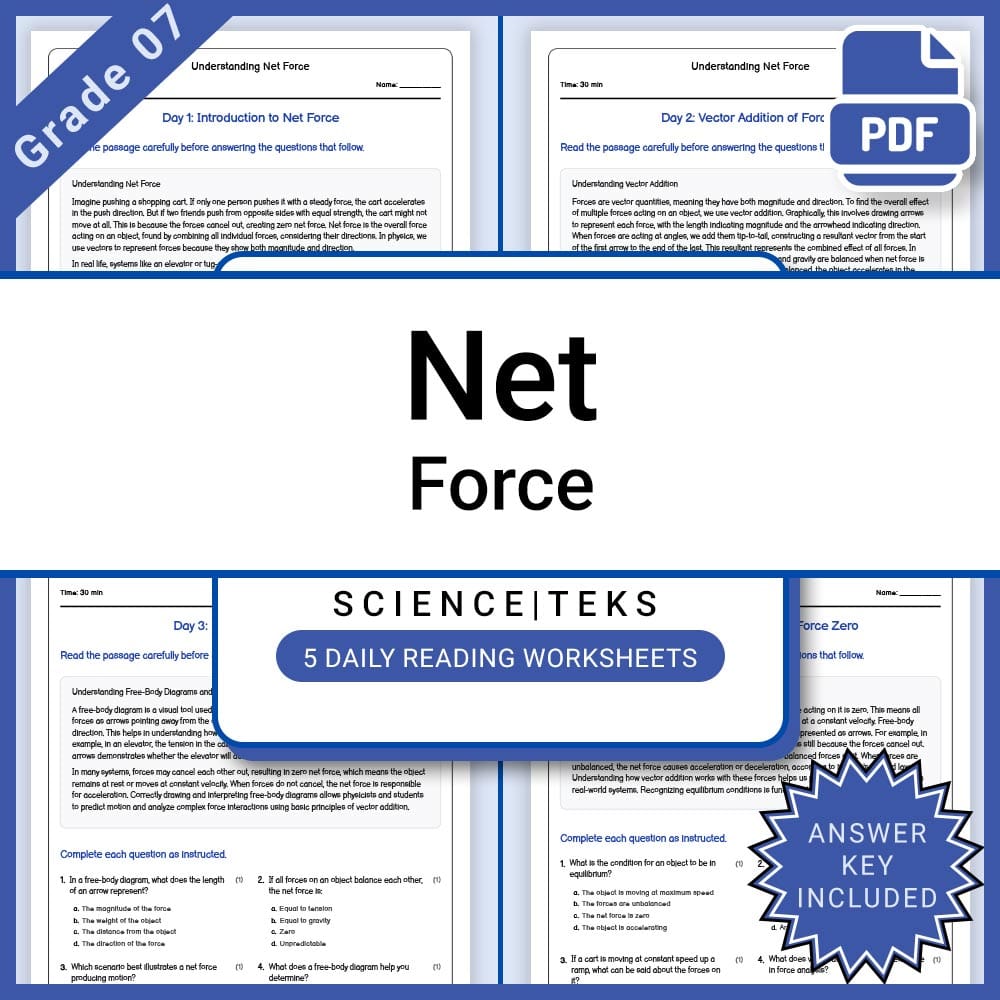
Grade 7 Science – Net Force Daily Reading Worksheet + Answer Key
JCreated byJ.S SheetsLearning Objectives
- Understand key concepts related to Science
- Apply knowledge through practice questions
- Demonstrate comprehension of the material
Also included in: Grade 7 Science Lesson Group Bundle with TEKS Framework +1 more
Instant download

Strategic Media Support Worksheet for Grade 7 ELA | Standards-Aligned Practice
JCreated byJ.S SheetsLearning Objectives
- Explain how visuals can support comprehension of spoken information without distracting listeners.
- Identify features of effective media displays (timelines, comparisons, evidence) and how they connect to the speaker’s claims.
- Evaluate whether multimedia and visual content is aligned with the timing and wording of a presentation.
Instant download

Cell Organization Worksheet | Standard BC Grade 7 Science Practice
JCreated byJ.S SheetsLearning Objectives
- Understand how cells organize into tissues, organs, and systems.
- Identify different tissue types and their functions.
- Explain how multicellular organization supports organism survival.
Instant download

Grade 7 Science – Energy & Change Daily Reading Worksheet | BC Standards
Created byBright Mind ResourcesLearning Objectives
- Understand the difference between exothermic and endothermic reactions.
- Identify signs of energy transfer during chemical and physical changes.
- Recognize how bond breaking and formation relate to energy exchange.
Also included in: Grade 7 States of Matter & Reactions Science Daily Reading Lesson Bundle | BC +1 more
Instant download

Theme and Textual Evidence Worksheets for Grade 7 ELA
Created byGolden Apple StudioLearning Objectives
- Identify details that build meaning in literary texts
- Explain how character actions contribute to meaning
- Interpret dialogue and descriptive choices in context
Also included in: Grade 7 ELA Reading Worksheets | Text Features, Theme & Author Craft +1 more
Instant download
Browse more categories
About Grade 7 Worksheets
Find Grade 7 worksheets covering math, ELA, science, and social studies. All 8,498 resources download instantly as PDFs for classwork, homework, or review.
MyTeachingSheets worksheets are made by real teacher-authors and checked before they go live. Download any as a print-ready PDF for lessons, homework, or independent practice — most include answer keys, and previews are always free.