
Grade 7 Worksheets
8,459 grade resources
Material Properties Worksheet | Alberta Grade 7 Science Assessment
JCreated byJ.S SheetsLearning Objectives
- Understand the intrinsic material properties that influence thermal behavior, such as conductivity, specific heat, density, and phase change.
- Compare common Alberta construction materials—fiberglass batts, spray foam, wood framing, and masonry—in terms of thermal resistance and structural considerations.
- Analyze how porosity, moisture content, and layered assemblies affect effective thermal conductivity.
Instant download

Simple Distillation Worksheet Grade 7 Science Separation of Mixtures
 Created byChalk and Compass
Learning Objectives
- Explain how vapor pressure and boiling point differences allow separation of miscible liquids using simple distillation.
- Describe the roles of condensation and collection in producing a distillate with higher purity.
- Identify common limitations of distillation, including close boiling points and azeotropes.
Also included in: Separation of Mixtures & Matter Properties Lesson Bundle – Grade 7 Science +1 more
Instant download

Cell Overview Test Prep Printable | Grade 7 Science
 Created byPrism Point Learning
Learning Objectives
- Explain how cell parts work together to carry out life processes
- Identify the functions of key organelles in a typical cell
- Compare how cell structures relate to a cell’s specific role
Also included in: Cellular Structure & Function Lesson Bundle | Grade 7 Science | Bc +1 more
Instant download

Grade 7 Science | Natural Selection - Daily Reading Comprehension
 Created byCoral Reef Learning
Learning Objectives
- Understand key concepts related to Science
- Apply knowledge through practice questions
- Demonstrate comprehension of the material
Instant download

Grade 7 Science – Levers & Pulleys | Daily Reading Worksheet
 Created byBright Mind Resources
Learning Objectives
- Understand the basic structure and function of levers and pulleys
- Identify the three classes of levers and examples of each
- Explain how pulleys change the effort and direction of force
Also included in: Grade 7 Structures & Forces Science Lesson Bundle Daily Reading | Alberta +2 more
Instant download

Predicting Reactions Worksheet | Science Practice for Grade 7 BC Standards
JCreated byJ.S SheetsLearning Objectives
- Understand how physical and chemical properties can predict chemical reactions.
- Identify indicators signaling chemical transformations during material interactions.
- Apply knowledge of reactivity patterns to anticipate reaction products and energy changes.
Instant download

Material Properties Worksheet | Grade 7 Science Activities
Created byPrism Point LearningLearning Objectives
- Explain how strength, stiffness, density, and environmental resilience affect material selection for load-bearing structures.
- Describe how materials behave under compression, tension, and bending and how that impacts long-term performance and maintenance.
- Use evidence from local conditions (frost and snow) to justify material choices for beams, bridges, and foundations.
Instant download

Grade 7 Science – Producers & Consumers in Ecosystems | Daily Reading Worksheet
Created byBright Mind ResourcesLearning Objectives
- Understand the roles of producers and consumers in an ecosystem
- Identify different types of consumers: primary, secondary, tertiary
- Explain how energy transfer occurs in food chains and food webs
Also included in: Grade 7 Ecosystems & Population Ecology Science Lesson Bundle | BC +1 more
Instant download

Filtration Methods Practice Worksheet | Grade 7 Science | Review
Created byPrism Point LearningLearning Objectives
- Explain how filtration separates particles using pore size and particle/phase differences
- Describe how flow behavior affects which particles pass through porous media
- Compare filtration and sedimentation for treating heterogeneous mixtures
Also included in: Grade 7 Substance & Mixture Properties Science Lesson Bundle (Ontario)
Instant download

Subject Verb Agreement Worksheet for Grade 7 ELA Practice
 Created bySunny Desk Resources
Learning Objectives
- Match a subject with the correct verb form for singular and plural subjects.
- Apply subject-verb agreement when words or phrases come between the subject and the verb.
- Use correct verb forms with common collective nouns and phrases like each/everyone.
Also included in: Grade 7 Language Lesson Bundle | Alberta ELA Grammar & Writing +1 more
Instant download

Grade 7 Science | Earth System Interactions - Daily Reading Comprehension
Created byCoral Reef LearningLearning Objectives
- Understand the different Earth systems: geosphere, hydrosphere, atmosphere, and biosphere.
- Recognize how these systems interact through movement of matter and energy.
- Identify examples of changes in one system affecting others.
Instant download

Grade 7 Truss Analysis & Load Paths Science Worksheet Alberta
 Created byBRIGHT PATH RESOURCES
Learning Objectives
- Identify the main idea and key vocabulary (tension, compression, load path) from an informational passage.
- Explain, using qualitative reasoning, how truss members carry loads through triangular shapes.
- Judge whether a truss behavior is better described as tension or compression based on the described member role.
Also included in: Grade 7 Alberta Science Forces Structures and Motion Worksheet Bundle +1 more
Instant download

Grade 7 Science | Conservation Of Matter - Daily Reading Comprehension
Created byCoral Reef LearningLearning Objectives
- Understand the principle of conservation of matter in chemical reactions
- Identify real-world examples of conservation of mass
- Explain how atoms are rearranged during chemical changes without gaining or losing mass
Instant download

Energy Conversion Worksheet | NGSS Grade 7 Science Practice and Assessment
JCreated byJ.S SheetsLearning Objectives
- Understand the principles of energy transfer and conservation during device operation.
- Identify examples of devices that convert energy from one form to another, such as generators, photovoltaic cells, and heaters.
- Describe the concept of energy accounting across multiple energy transformation steps.
Also included in: Grade 7: Energy Transformations and Accounting Science Lesson Bundle NGSS +1 more
Instant download

Grade 7 Sound Production Worksheet | Practice & Review PDF
 Created byClear Sky Classroom
Learning Objectives
- Explain how vibrating objects produce sound waves in a medium
- Compare how frequency and amplitude affect pitch and loudness
- Describe how sound transmission depends on the presence of a medium
Instant download

Grade 7 Science | Air Masses and Fronts Worksheet | NGSSS Aligned
 Created byLumora Learning
Learning Objectives
- Explain what air masses are and how their source regions affect temperature and moisture.
- Describe how fronts form when different air masses meet.
- Compare the weather changes commonly associated with warm fronts and cold fronts.
Instant download

Grade 7 Science – Modes of Transfer & Conduction Daily Reading Worksheet
Created byBright Mind ResourcesLearning Objectives
- Understand the process of thermal conduction.
- Identify examples of conduction in everyday life.
- Explain the molecular mechanisms underlying conduction.
Also included in: Heat Transfer Grade 7 Science Daily Reading Worksheets Lesson Bundle | Ontario +1 more
Instant download

Matter Properties Assessment | Florida NGSSS Grade 7 Science Worksheet
Created byPrism Point LearningLearning Objectives
- Identify physical properties (such as color, texture, state, and density) and explain how they can be observed or measured.
- Distinguish chemical properties from physical properties using examples like flammability and rusting.
- Use properties to support the classification of substances under consistent conditions.
Also included in: Grade 7 Matter, Forces & Energy Science Lesson Bundle | Florida NGSSS
Instant download

Grade 7 Science | Design Solutions in Building Architecture - Daily Reading Comp
Created byCoral Reef LearningLearning Objectives
- Understand how building orientation influences thermal performance.
- Identify strategies for passive solar gain and thermal barriers.
- Examine regional design considerations for Alberta's climate zones.
Also included in: Energy, Heat and Thermal Processes Lesson Bundle: Grade 7 Science Alberta +1 more
Instant download

Energy and Change Worksheet for Grade 7 Science | Standards-Aligned Practice
JCreated byJ.S SheetsLearning Objectives
- Understand how energy changes occur during chemical reactions, including exothermic and endothermic processes.
- Identify the relationship between energy transfer and bond breaking and formation.
- Distinguish chemical changes from physical changes based on energy evidence and other signs.
Instant download

Freshwater Dynamics Worksheet | Grade 7 Science | Standards-Aligned
JCreated byJ.S SheetsLearning Objectives
- Describe how stratification, light penetration, and oxygen gradients form in ponds and lakes.
- Explain how abiotic gradients influence community composition and vertical zonation.
- Compare how seasonal thermal turnover changes dissolved oxygen, nutrient mixing, and habitat suitability.
Instant download

Grade 7 Matter Classification Worksheet NGSSS Science Sorting Activity
 Created byEvergreen Desk Education
Learning Objectives
- Classify matter as an element, compound, or mixture based on composition and whether substances are chemically combined.
- Differentiate homogeneous and heterogeneous mixtures using the appearance of uniformity and visible parts.
- Predict how physical versus chemical changes could affect elements, compounds, and mixtures.
Instant download

Grade 7 Science – Understanding Physical Change | Daily Reading Worksheet
Created byBright Mind ResourcesLearning Objectives
- Define physical change and distinguish it from chemical change.
- Identify examples of physical changes in everyday life.
- Understand the reversibility of physical changes.
Also included in: Grade 7 States of Matter & Reactions Science Daily Reading Lesson Bundle | BC +1 more
Instant download

Grade 7 Voice and Tone Genre Audience and Purpose Worksheet | TEKS ELA
Created bySunny Desk ResourcesLearning Objectives
- Identify how voice and tone shift to match genre, audience, and purpose
- Distinguish expressive, objective, and persuasive tone in writing
- Revise sentences by improving word choice and sentence rhythm to better support meaning
Instant download

Grade 7 Science – Conservation of Mass Reading Worksheet | Alberta Standards
Created byBright Mind ResourcesLearning Objectives
- Understand that mass remains constant in closed systems during physical and chemical changes.
- Identify and explain examples of mass conservation in chemical reactions.
- Interpret data from sealed-container reactions to observe mass changes or the lack thereof.
Also included in: Grade 7 Solutions Science Daily Reading Worksheets Lesson Bundle | Alberta +2 more
Instant download

Elements vs Compounds Worksheet Grade 7 Science Ontario Unit
Created byChalk and CompassLearning Objectives
- Compare elements and compounds using atomic composition, chemical formulas, and bonding
- Explain how chemical combination changes observable properties such as melting point and conductivity
- Identify substances as elements or compounds based on particle type and fixed ratios
Also included in: Separation of Mixtures & Matter Properties Lesson Bundle – Grade 7 Science +1 more
Instant download

Grade 7 Science | Calorimetry Basics - Daily Reading Comprehension
Created byCoral Reef LearningLearning Objectives
- Understand the concepts of heat and temperature and how they differ.
- Learn about units of measurement for heat and temperature.
- Explore how calorimetry measures energy exchange during thermal processes.
Also included in: Energy, Heat and Thermal Processes Lesson Bundle: Grade 7 Science Alberta +1 more
Instant download

Niche Interactions Worksheet | TEKS Science Practice Grade 7
JCreated byJ.S SheetsLearning Objectives
- Describe how competition, predation, mutualism, and parasitism influence ecological niches and species survival.
- Explain how niche partitioning reduces competition and helps species coexist in the same habitat.
- Identify the role of keystone species in shaping community composition and stability.
Instant download

Grade 7 Forces And Motion Worksheet | NGSS Practice PDF
Created byClear Sky ClassroomLearning Objectives
- Explain how forces (pushes and pulls) can change an object’s motion.
- Differentiate balanced forces from unbalanced forces using the concept of net force.
- Use evidence from real-life examples to predict changes in speed or direction.
Instant download

Grade 7 Fossil Evidence Worksheet | NGSS Practice PDF
Created byClear Sky ClassroomLearning Objectives
- Explain how fossils form and what conditions help preserve remains, traces, or imprints
- Use fossil assemblages to infer past environments such as water, climate shifts, and ecological change
- Interpret how fossil evidence supports connections between sediment layers and broader Earth history
Instant download

Grade 7 Friction and Drag Worksheet | Alberta Science Forces and Motion
Created byBRIGHT PATH RESOURCESLearning Objectives
- Explain how friction opposes relative motion between surfaces.
- Compare static friction and kinetic friction using real examples.
- Identify how surface texture and normal force affect frictional force.
Also included in: Grade 7 Alberta Science Forces Structures and Motion Worksheet Bundle +1 more
Instant download

Grade 7 Biodiversity Indices & Community Diversity Worksheet | Ontario Science
 Created byTeacher's Corner
Learning Objectives
- Explain how species richness and evenness describe biodiversity in a habitat.
- Interpret common biodiversity index values and compare diversity across habitats.
- Describe how habitat heterogeneity and niche diversity can increase species turnover.
Instant download

Grade 7 Science | Food Web Flows - Daily Reading Comprehension
Created byCoral Reef LearningLearning Objectives
- Identify producers, consumers, and decomposers in an ecosystem.
- Understand how energy flows through food webs.
- Recognize the role of matter cycling in ecosystems.
Instant download

Conservation Status Worksheet | Grade 7 Science | Alberta Standards
JCreated byJ.S SheetsLearning Objectives
- Understand the criteria used to assess species conservation risk.
- Interpret evidence related to population trends, threats, and recovery potential.
- Identify factors influencing species vulnerability such as land use and genetic diversity.
Instant download

Grade 7 Net Force Effects Worksheet | California Standards Practice PDF
Created byClear Sky ClassroomLearning Objectives
- Explain how magnitude and direction of forces combine to produce a net force.
- Predict how balanced and unbalanced forces change an object’s motion (speed and/or direction).
- Use everyday examples (pushing a cart, stopping a moving object) to describe net force effects.
Instant download

Grade 7 Science Worksheet | Net Force Diagrams Alberta Standards (PDF)
Created byEvergreen Desk EducationLearning Objectives
- Explain how free-body diagrams represent forces acting on an object using properly labeled arrows.
- Determine the net force magnitude and direction by combining perpendicular (and parallel) force components.
- Use conventions for inclined surfaces to correctly decompose gravity into parallel and perpendicular components.
Instant download

Levels of Organization Worksheet | Grade 7 Science Activities
Created byPrism Point LearningLearning Objectives
- Describe hierarchical levels of organization from individual organisms to the biosphere
- Explain how producers, consumers, and decomposers affect energy flow through trophic levels
- Connect organism structures and habitat relationships to ecosystem stability and resilience
Also included in: Ecosystems & Adaptations Grade 7 Science Lesson Bundle TEKS Worksheets
Instant download

Matter Energy Flow Worksheet | Standards-Aligned Science Practice for Grade 7
JCreated byJ.S SheetsLearning Objectives
- Describe how energy flows through an ecosystem from producers to consumers.
- Identify the roles of producers, consumers, and decomposers in matter and energy transfer.
- Explain why energy decreases at higher trophic levels in food chains and webs.
Also included in: Grade 7 Ecosystem Energy & Matter Cycles Science Lesson Bundle +1 more
Instant download

Atomic Structure Worksheet | Grade 7 Science Practice
Created byPrism Point LearningLearning Objectives
- Explain how protons, neutrons, and electrons determine atomic identity and isotopic variation
- Relate atomic number and mass number to element identity and an isotope’s nucleus
- Describe basic electron arrangements and connect simple atomic models to observable patterns
Also included in: Grade 7 Matter, States, and Reactions in Science Lesson Bundle TEKS
Instant download

Habitat Fragmentation Grade 7 Science Worksheet | Standards-Aligned Practice
JCreated byJ.S SheetsLearning Objectives
- Understand how habitat fragmentation affects ecosystems and species.
- Identify the consequences of habitat fragmentation on biodiversity.
- Analyze strategies like corridors to mitigate habitat fragmentation effects.
Instant download
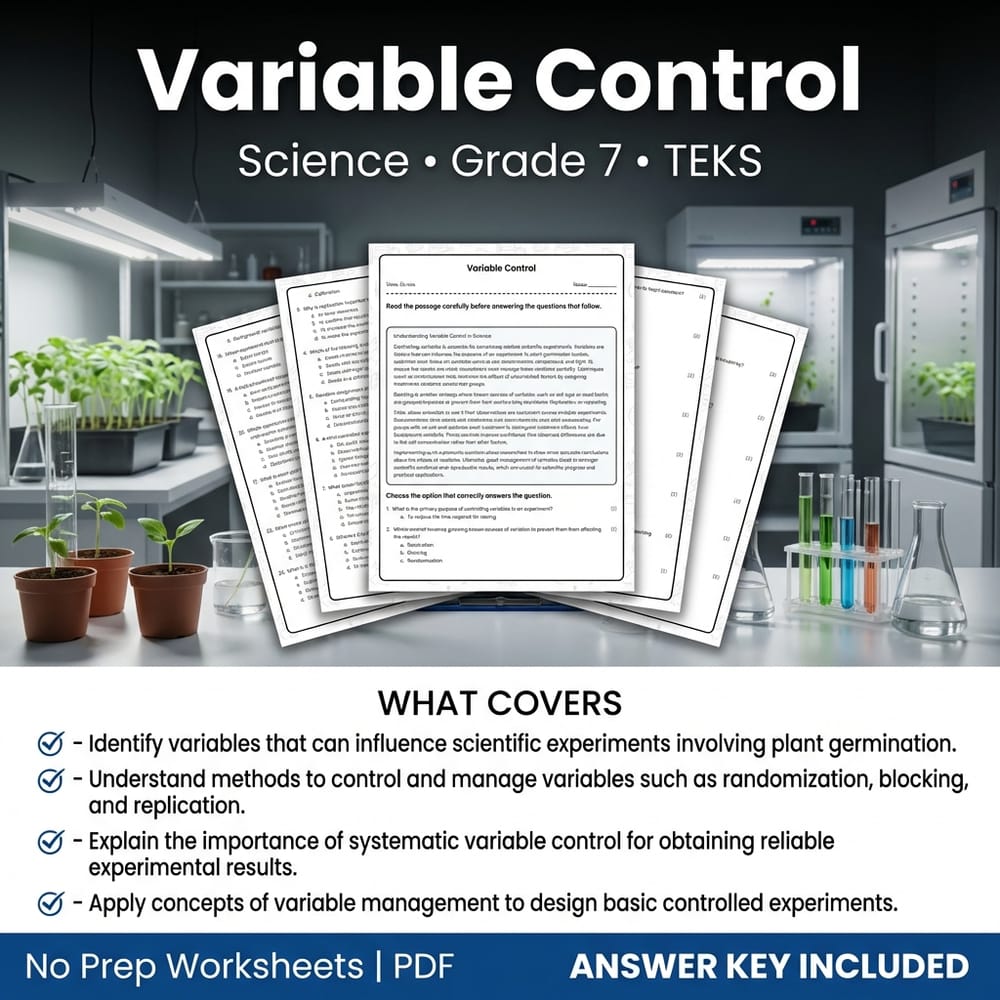
Variable Control Science Worksheet for Grade 7 | TEKS Aligned
Created byCoral Reef LearningLearning Objectives
- Identify variables that can influence scientific experiments involving plant germination.
- Understand methods to control and manage variables such as randomization, blocking, and replication.
- Explain the importance of systematic variable control for obtaining reliable experimental results.
Instant download

Predator Prey Dynamics Assessment Grade 7 Science | General Standards
Created byPrism Point LearningLearning Objectives
- Understand the cause-and-effect relationships in predator-prey interactions.
- Identify how changes in predator or prey populations affect community composition.
- Explain feedback mechanisms in ecological systems.
Instant download

Grade 7 Meiosis Variation Science Worksheet | Florida NGSSS + Answer Key
Created byEvergreen Desk EducationLearning Objectives
- Explain how meiosis produces genetically different reproductive cells
- Describe how crossing over and independent assortment increase genetic variation
- Connect genetic variation from meiosis to why siblings are not identical and to evolution over time
Instant download

Motion Graphs Worksheet | Grade 7 Science Practice
Created byPrism Point LearningLearning Objectives
- Interpret how slope and curvature in position-time graphs relate to velocity and changing velocity
- Interpret how slope in velocity-time graphs relates to acceleration
- Use correct graph patterns to describe constant velocity and changing motion
Instant download

Ecosystem Basics Worksheet Grade 7 Science | Standards-Aligned Practice
JCreated byJ.S SheetsLearning Objectives
- Define ecosystem components and distinguish biotic from abiotic factors in a habitat.
- Describe trophic categories (producers, consumers, decomposers) and their general roles.
- Explain how energy flows from sunlight to organisms and how matter cycles through ecosystems.
Instant download

Grade 7 Earth System Spheres Worksheet | Practice & PDF
Created byClear Sky ClassroomLearning Objectives
- Identify how the atmosphere, hydrosphere, geosphere, and biosphere interact as part of Earth’s system
- Explain how water, gases, and rock surfaces move between spheres and affect living things
- Use evidence to describe cause-and-effect relationships across Earth’s spheres
Instant download

Grade 7 Science | Forces and Motion Worksheet | NGSSS Aligned
Created byLumora LearningLearning Objectives
- Explain how net force affects an object's motion (speeding up, slowing down, changing direction, or staying at rest).
- Differentiate between balanced forces (net force of zero) and unbalanced forces (net force not zero).
- Use everyday examples to identify the direction and effect of forces like friction and gravity.
Instant download

Grade 7 Science – Particle Motion & Temperature | Daily Reading Worksheet
Created byBright Mind ResourcesLearning Objectives
- Understand how microscopic particles move and what factors influence their speed
- Explain the relationship between particle motion and temperature
- Describe how particle behavior affects thermal energy and pressure
Also included in: Grade 7 Heat Transfer Science Daily Reading Worksheets Lesson Bundle | Alberta +2 more
Instant download
Browse more categories
About Grade 7 Worksheets
Find Grade 7 worksheets covering math, ELA, science, and social studies. All 8,459 resources download instantly as PDFs for classwork, homework, or review.
MyTeachingSheets worksheets are made by real teacher-authors and checked before they go live. Download any as a print-ready PDF for lessons, homework, or independent practice — most include answer keys, and previews are always free.