
Grade 7 Science Worksheets
6,039 worksheets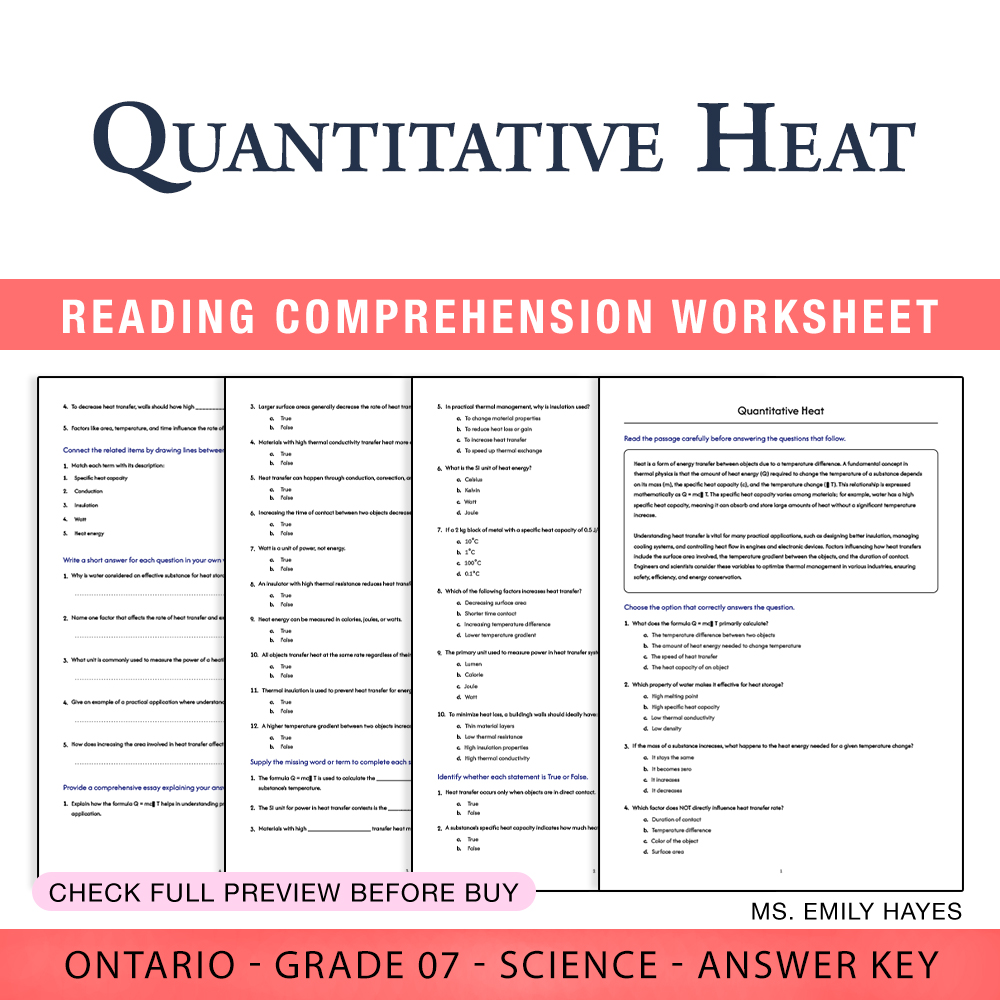
Grade 7 Science | Quantitative Heat Worksheet (PDF+ Answer Key)
 Created byCopper Leaf Classroom
Learning Objectives
- Understand the relationship between heat, mass, and temperature change using the equation Q = mcΔT.
- Calculate the amount of heat energy required to change the temperature of various substances.
- Explain factors affecting heat transfer such as area, temperature gradient, and time.
Instant download
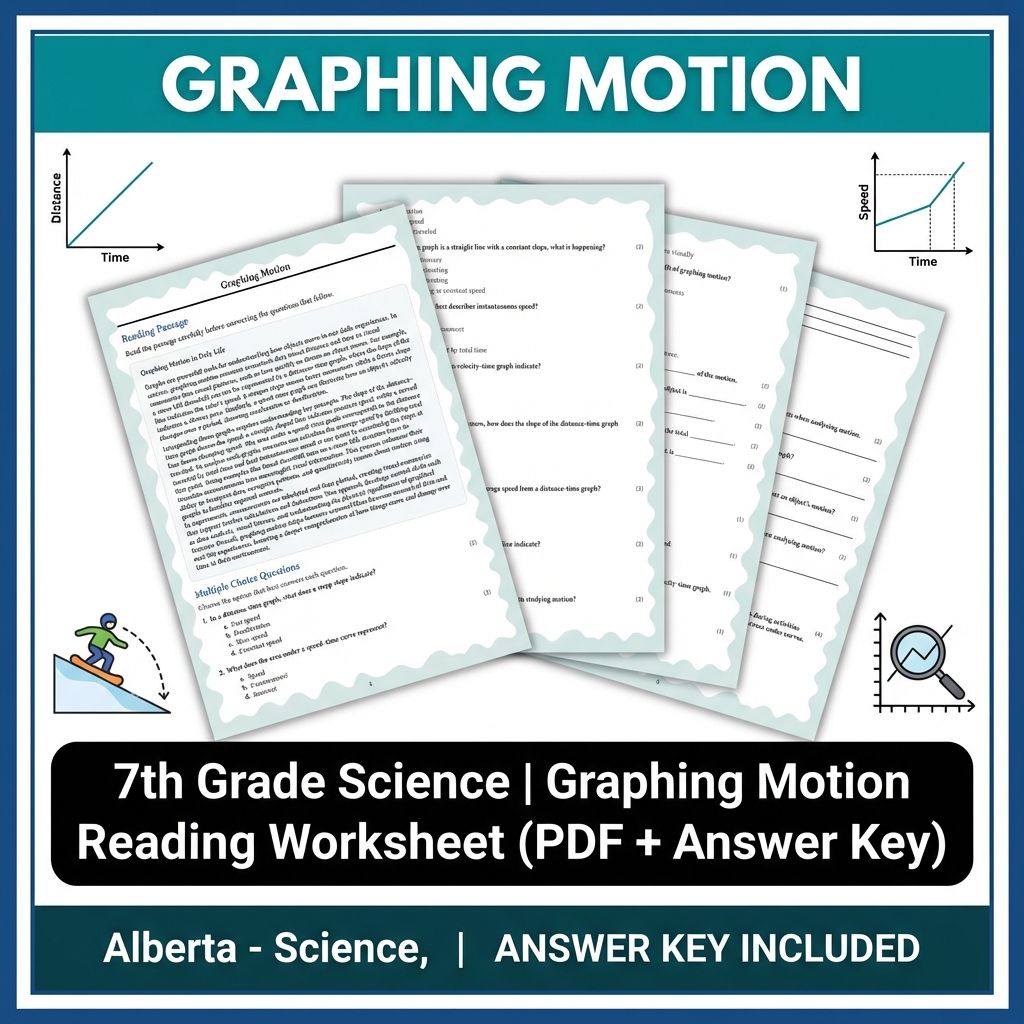
7th Grade Science | Graphing Motion Reading Worksheet (PDF + Answer Key)
JCreated byJ.S SheetsLearning Objectives
- Understand how distance–time and speed–time graphs represent motion.
- Interpret the meaning of slopes and areas under curves in motion graphs.
- Learn methods to compute average and instantaneous rates from graphs.
Also included in: Grade 7 Science | Forces, Motion & Structural Concepts (Answer Keys Included) +1 more
Instant download
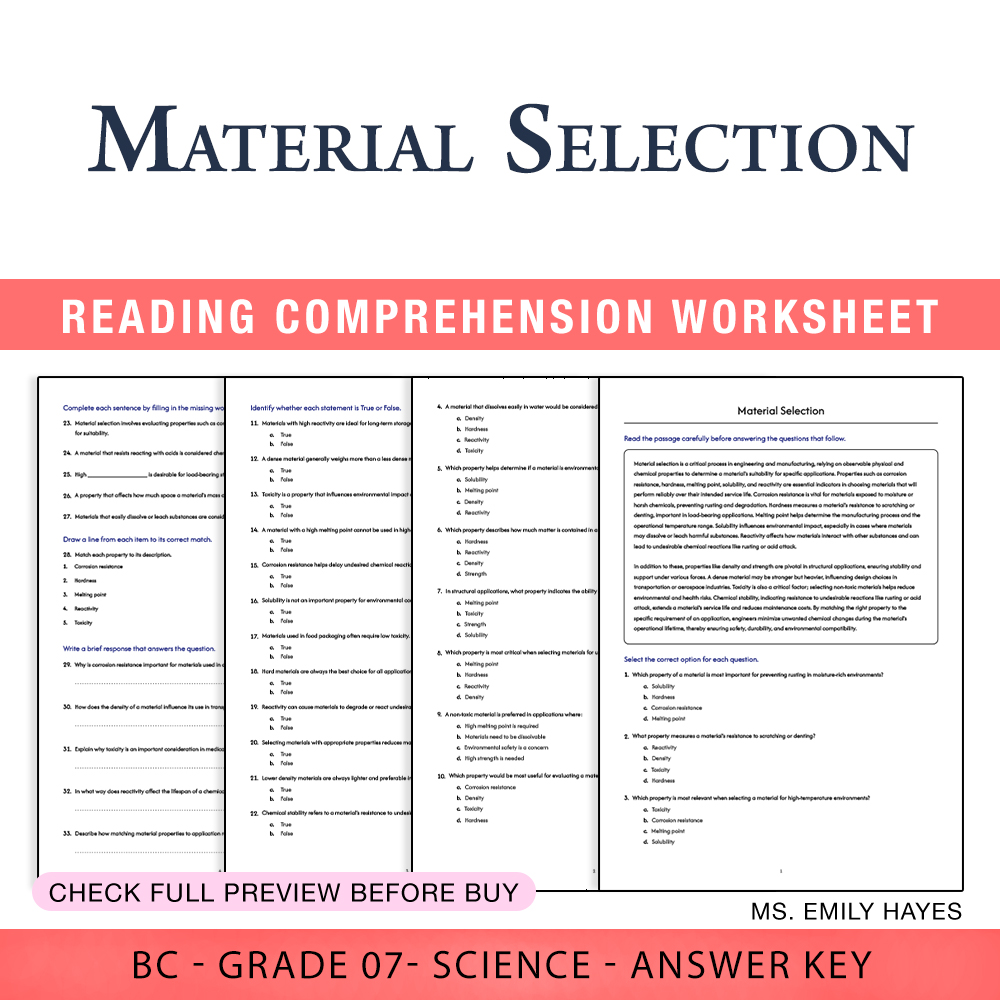
Grade 7 Science | Material Selection Worksheet (PDF+ Answer Key)
Created byCopper Leaf ClassroomLearning Objectives
- Understand how physical and chemical properties influence material suitability in various applications.
- Identify key properties such as corrosion resistance, hardness, melting point, solubility, and reactivity.
- Match material properties to specific application requirements to prevent unwanted chemical changes.
Also included in: Grade 7 Science Bundle| States of Matter & Chemical Reactions (PDF+ Answer Keys) +1 more
Instant download

Grade 7 Science | Gravity & Orbital Motion - Daily Reading Comprehension
 Created byCoral Reef Learning
Learning Objectives
- Explain the basic concept of gravity and how it pulls objects toward each other.
- Identify how gravity influences the motion of planets, moons, and satellites.
- Recognize observational evidence of gravitational effects in space.
Instant download
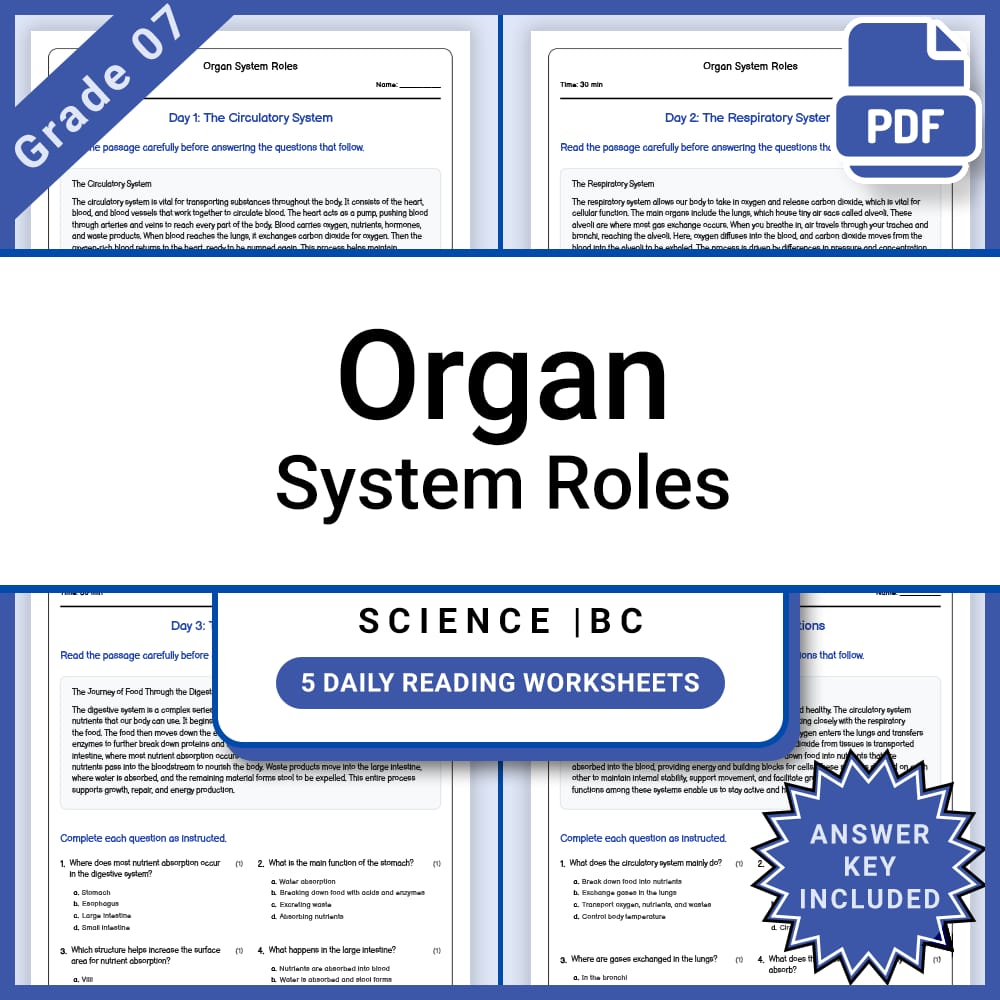
Grade 7 Science Organ System Roles Daily Reading Worksheet with Answer Key
JCreated byJ.S SheetsLearning Objectives
- Understand the structure and function of the circulatory system
- Identify the parts of the circulatory system, including the heart, blood, and blood vessels
- Explain how the circulatory system transports gases, nutrients, and wastes
Also included in: Grade 7 Science Lesson Group Bundle | Cell Structures and Processes +1 more
Instant download
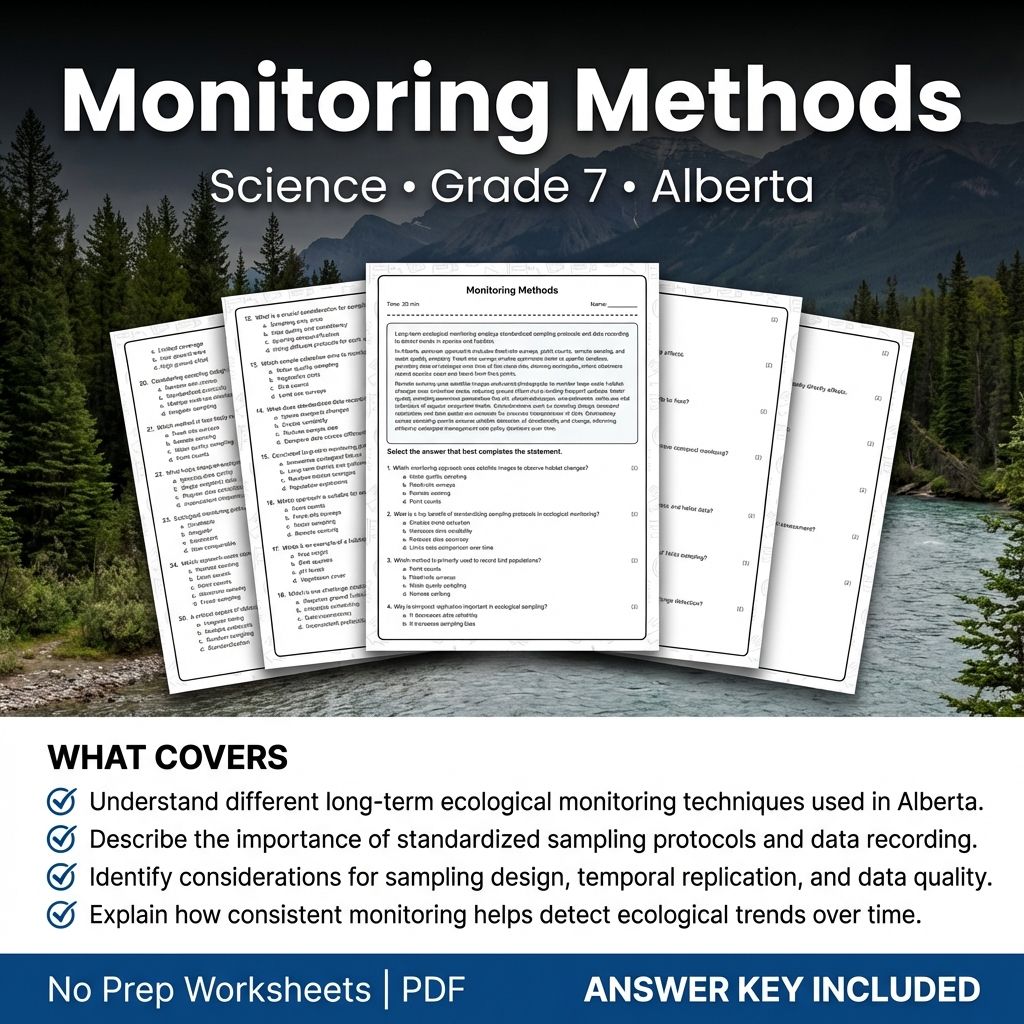
Monitoring Methods Science Worksheet | Grade 7 | Alberta Standards
Created byCoral Reef LearningLearning Objectives
- Understand different long-term ecological monitoring techniques used in Alberta.
- Describe the importance of standardized sampling protocols and data recording.
- Identify considerations for sampling design, temporal replication, and data quality.
Instant download
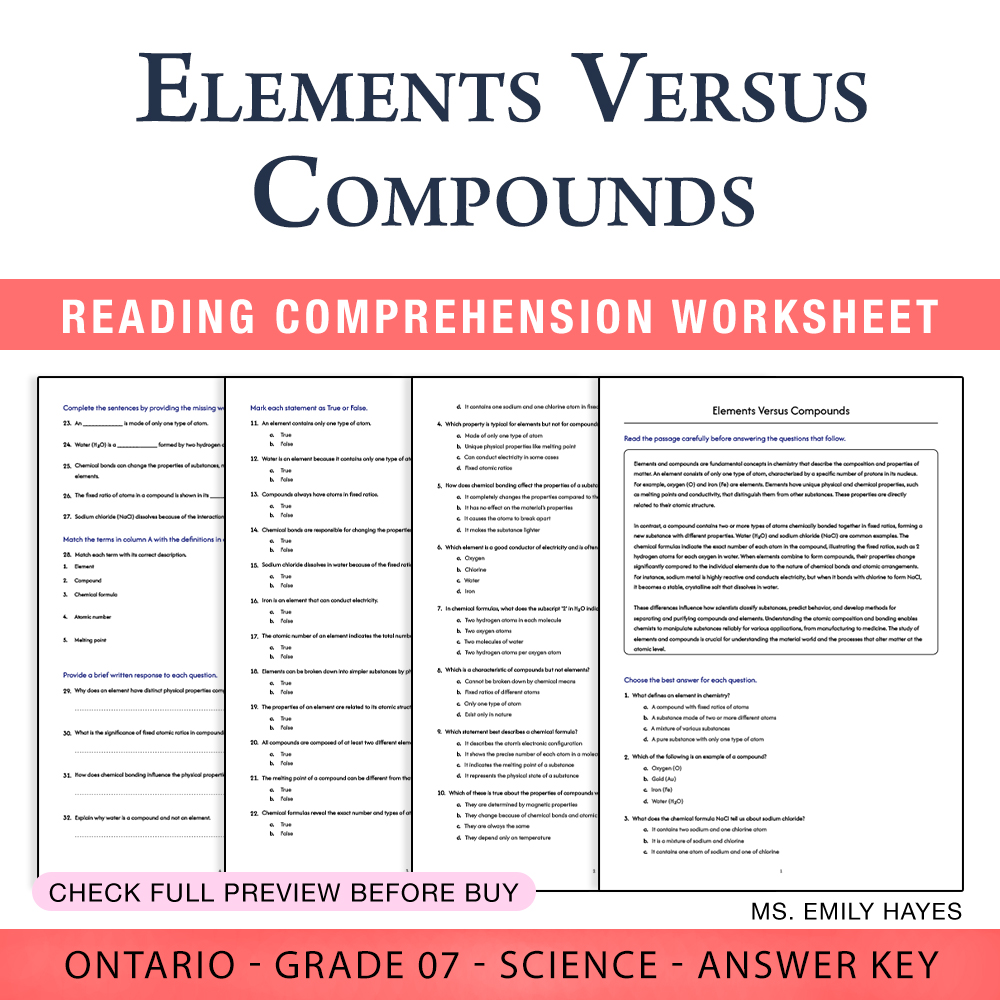
7th Grade Science | Elements Versus Compounds Worksheet (PDF+ Answer Key)
Created byCopper Leaf ClassroomLearning Objectives
- Describe the key differences between elements and compounds based on atomic composition and properties.
- Explain how chemical bonding and formulas define compounds and their fixed ratios.
- Identify examples of elements and compounds and understand how properties change upon chemical combination.
Instant download
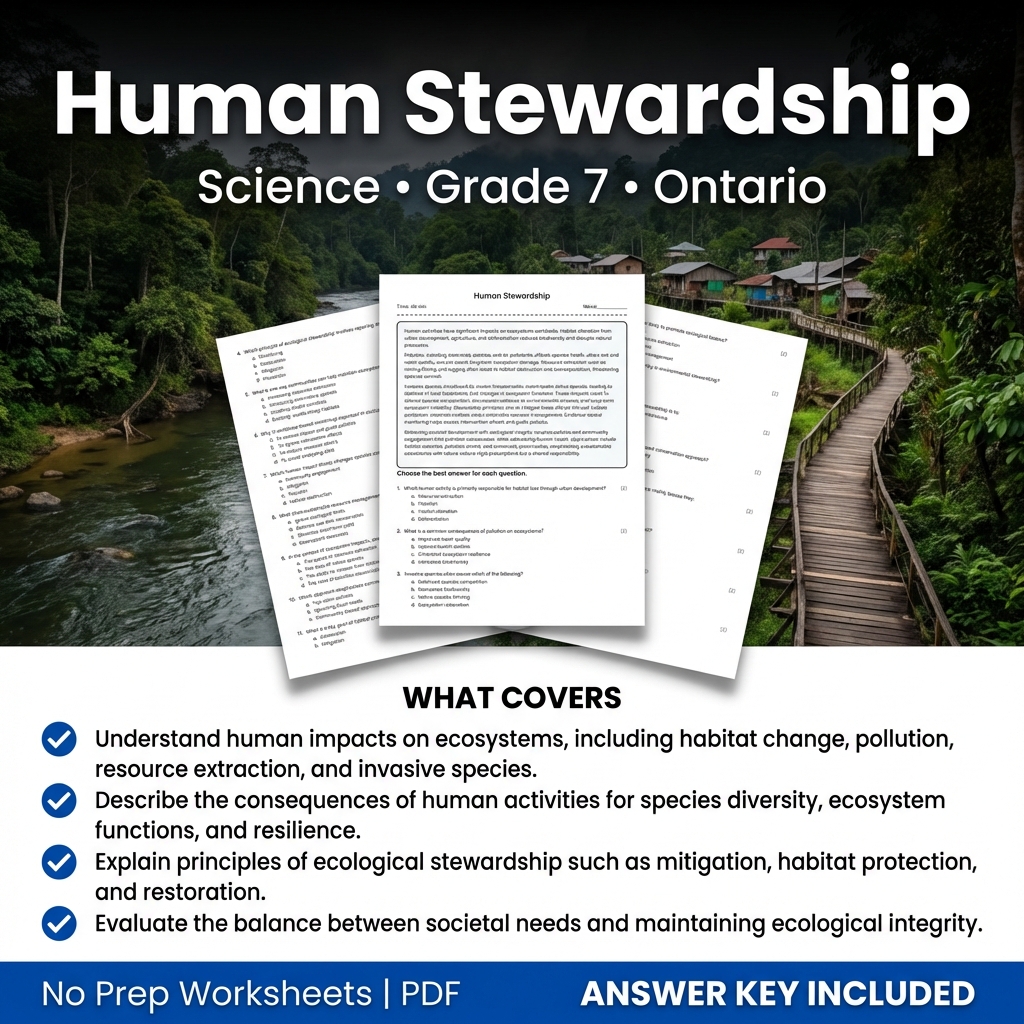
Human Stewardship Worksheet for Grade 7 Science | Ontario Standards
Created byCoral Reef LearningLearning Objectives
- Understand human impacts on ecosystems, including habitat change, pollution, resource extraction, and invasive species.
- Describe the consequences of human activities for species diversity, ecosystem functions, and resilience.
- Explain principles of ecological stewardship such as mitigation, habitat protection, and restoration.
Instant download
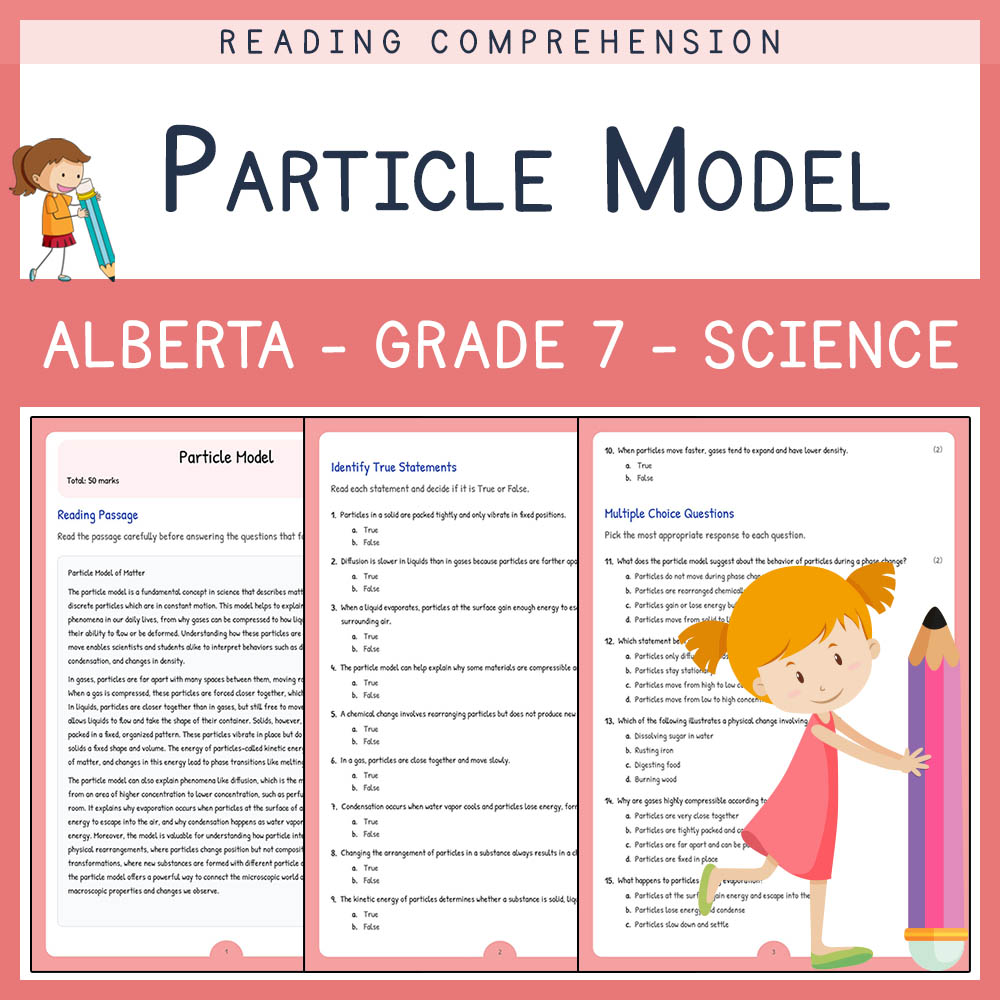
Grade 7 Science | Particle Model Worksheet Elena | Alberta Standard
 Created byLumora Learning
Learning Objectives
- Describe how the particle model explains states of matter and their properties.
- Analyze how particle arrangement and motion influence observable phenomena such as evaporation and condensation.
- Differentiate between physical rearrangements of particles and chemical transformations involving new substances.
Instant download
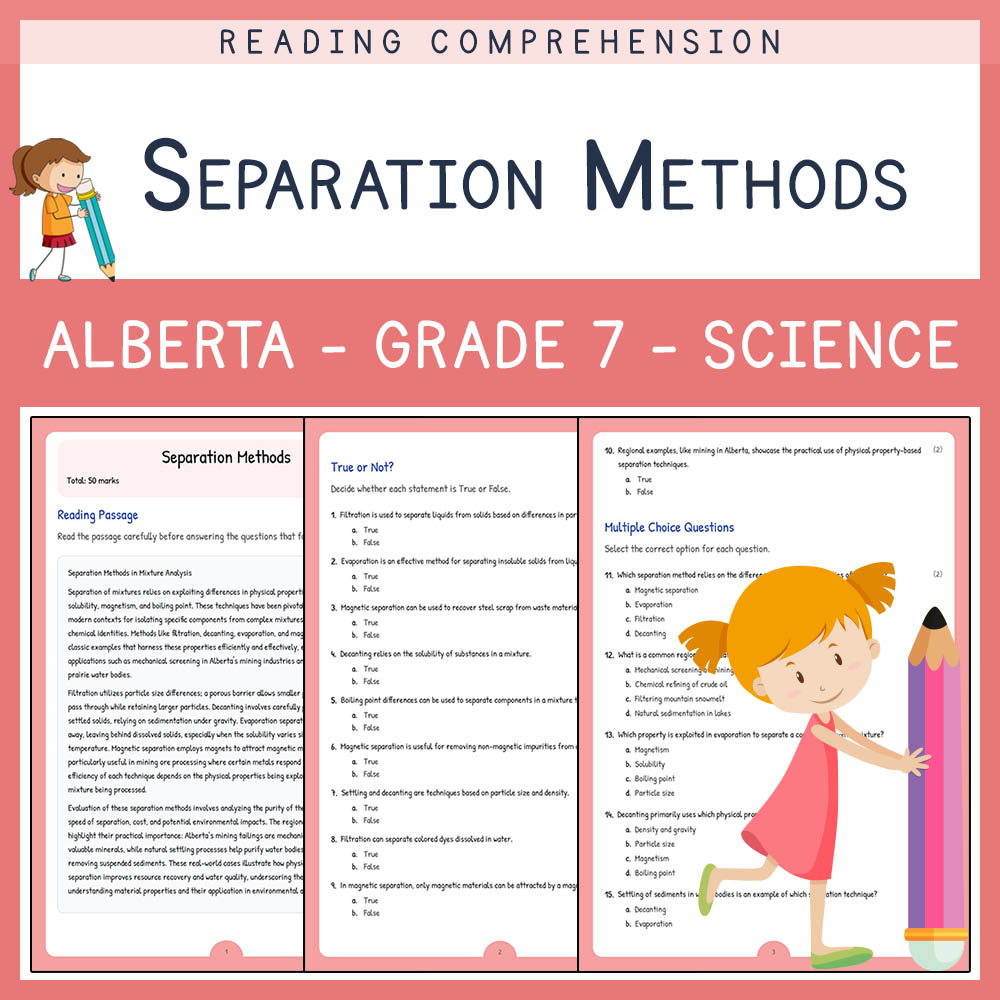
Grade 7 Science | Separation Methods Worksheet Elena | Alberta Standard
Created byLumora LearningLearning Objectives
- Understand different physical properties used to separate mixtures.
- Identify and describe techniques such as filtration, decanting, evaporation, and magnetic separation.
- Apply knowledge of separation techniques to practical regional examples.
Instant download
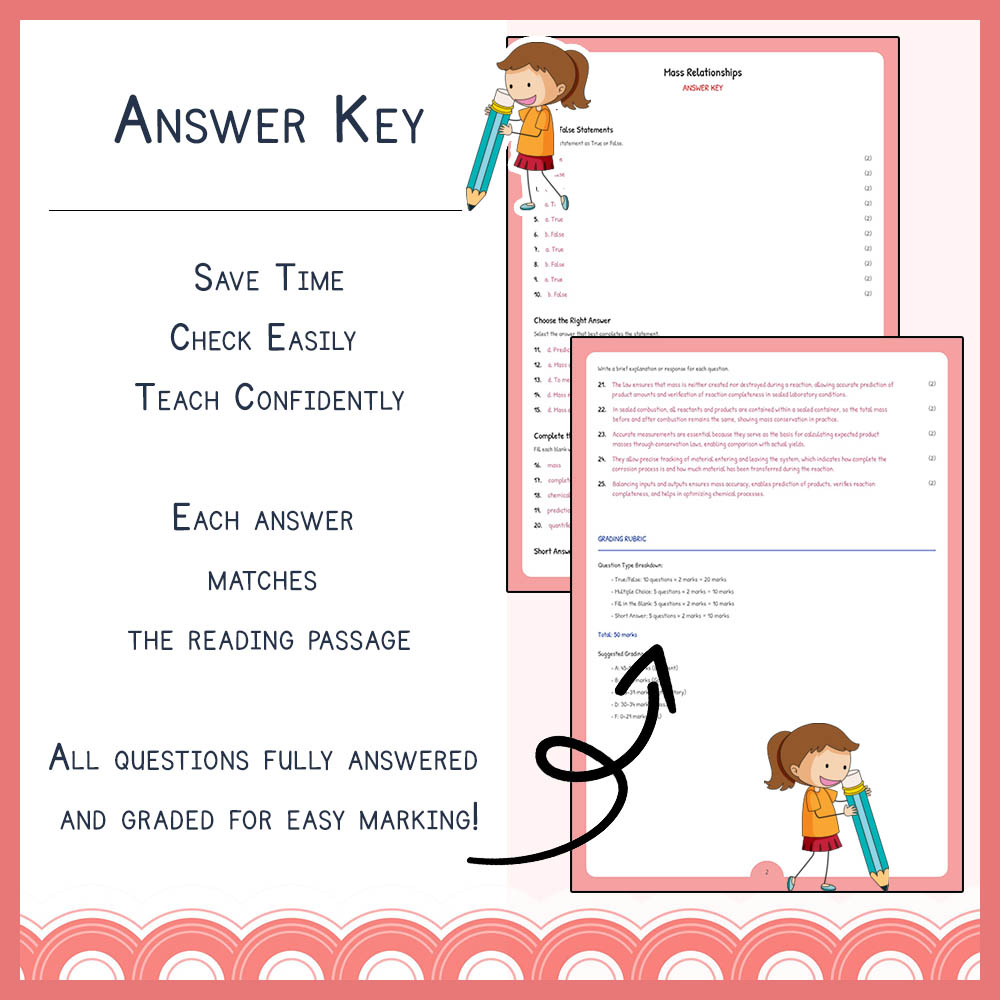
Grade 7 Science | Mass Relationships Worksheet | Alberta Standards
Created byLumora LearningLearning Objectives
- Understand the principles of conservation of mass in closed-system reactions.
- Explain how mass accounting relates reactant and product masses.
- Apply mass relationships to predict yields in chemical reactions.
Instant download
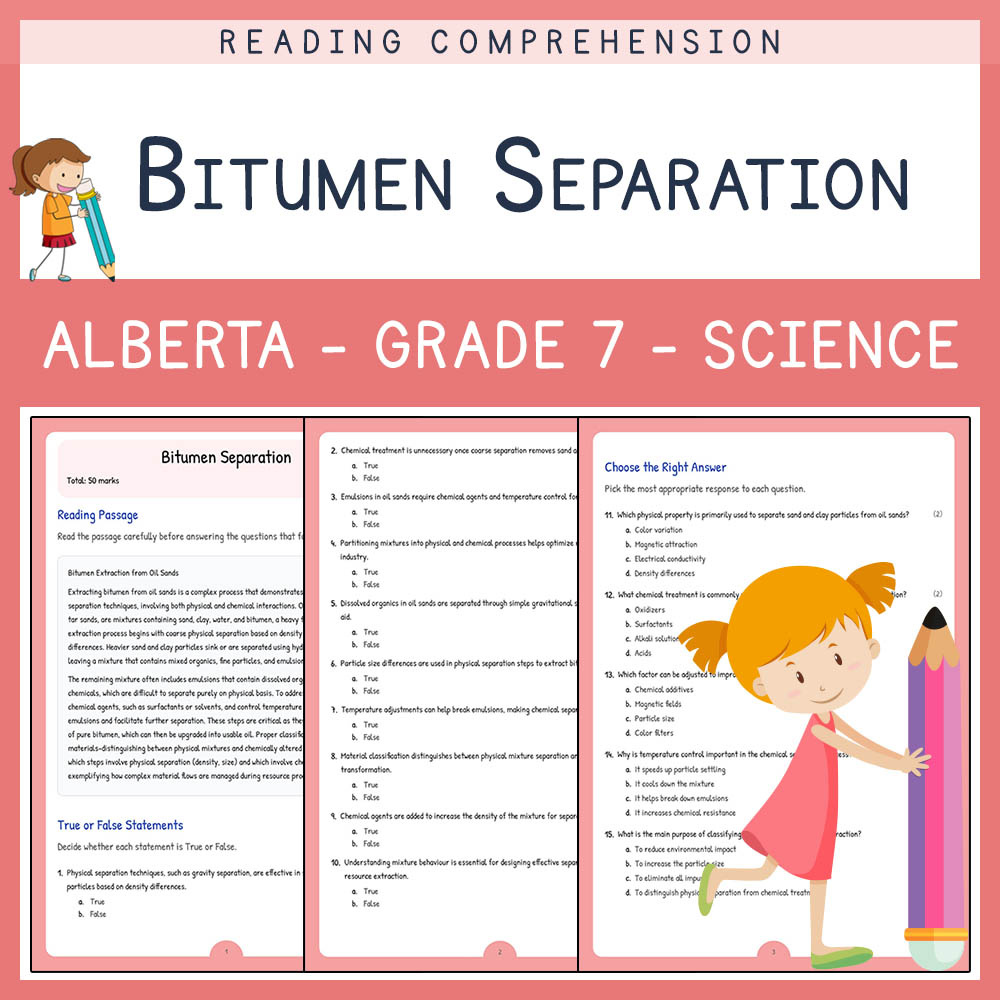
Grade 7 Science | Bitumen Separation Worksheet Elena | Alberta Standards
Created byLumora LearningLearning Objectives
- Understand the physical and chemical processes involved in the separation of bitumen from oil sands.
- Identify different separation methods based on mixture properties such as density, particle size, and chemical composition.
- Explain how physical separation and chemical treatment work together in complex mixture processing.
Instant download
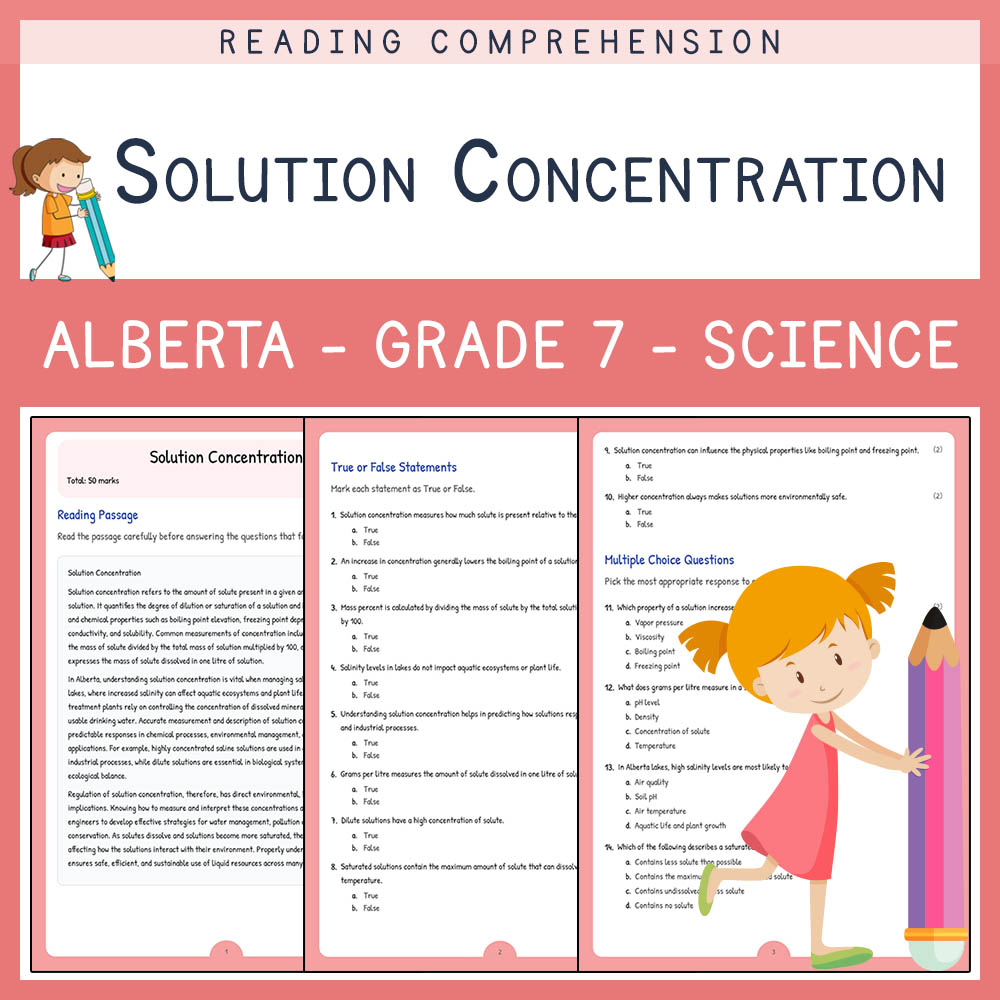
Grade 7 Science Assessment | Solution Concentration Worksheet | Alberta
Created byLumora LearningLearning Objectives
- Understand different measures of solution concentration, including mass percent and grams per litre.
- Identify how solution concentration affects physical properties like boiling point and freezing point.
- Describe real-world examples of solution concentration impacts, such as in water treatment and ecological systems.
Instant download
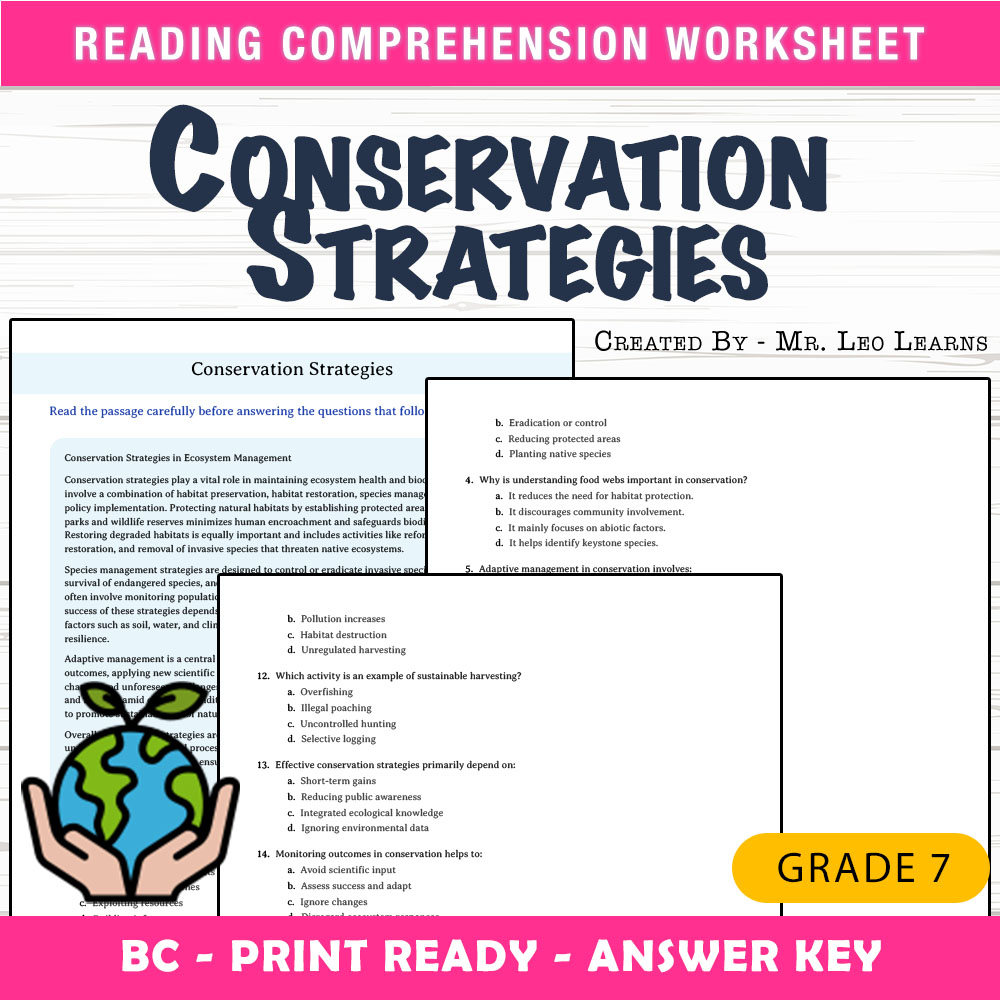
Grade 7 Science — Conservation Strategies Worksheet MCQ Paper
 Created byThe Resource Hub
Learning Objectives
- Understand various conservation strategies and their importance in ecosystem sustainability.
- Identify key methods used in habitat protection, restoration, and species management.
- Recognize how adaptive approaches improve conservation effectiveness over time.
Also included in: Grade 7 Science Ecosystems & Interactions Worksheet Bundle +1 more
Instant download
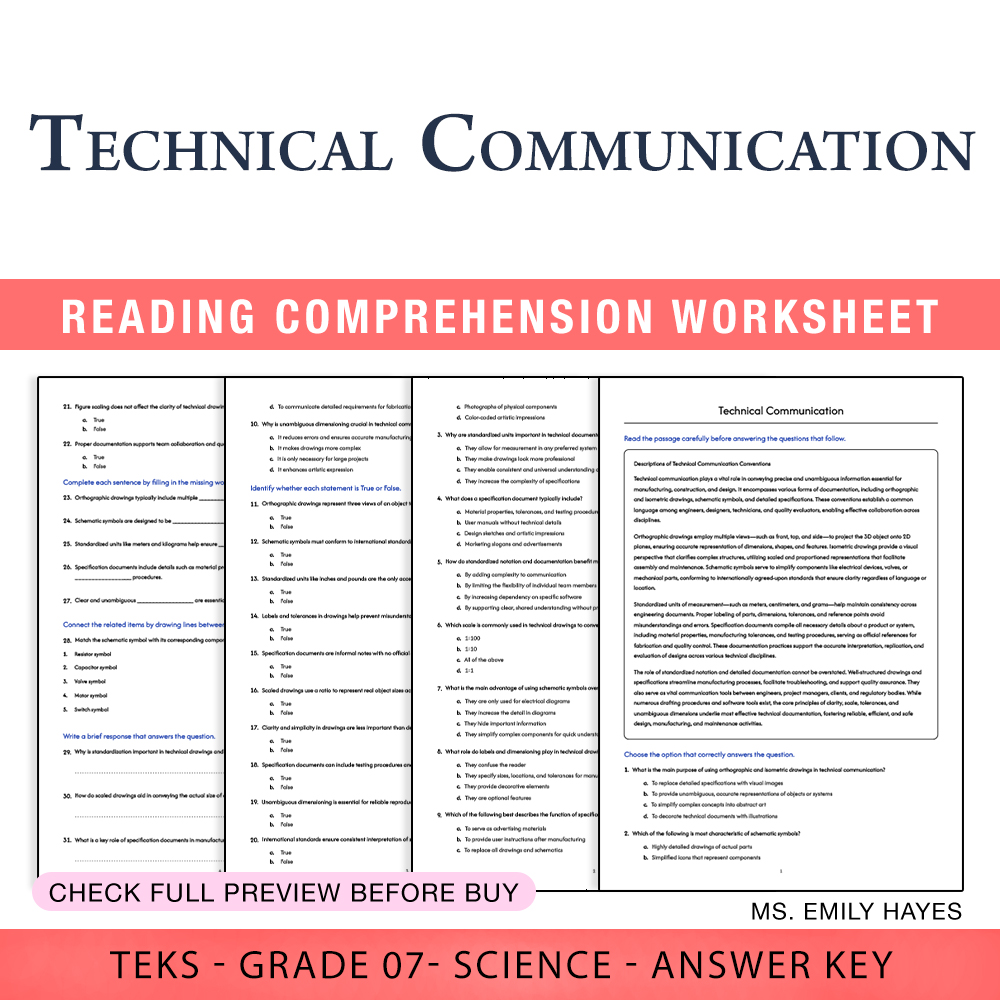
7th Grade Science | Technical Communication Worksheet (PDF+ Answer Key)
Created byCopper Leaf ClassroomLearning Objectives
- Understand the conventions and standards used in technical drawings and documentation.
- Identify common schematic symbols and their meanings.
- Explain the importance of standardized units, labels, and notation in conveying design intent.
Instant download
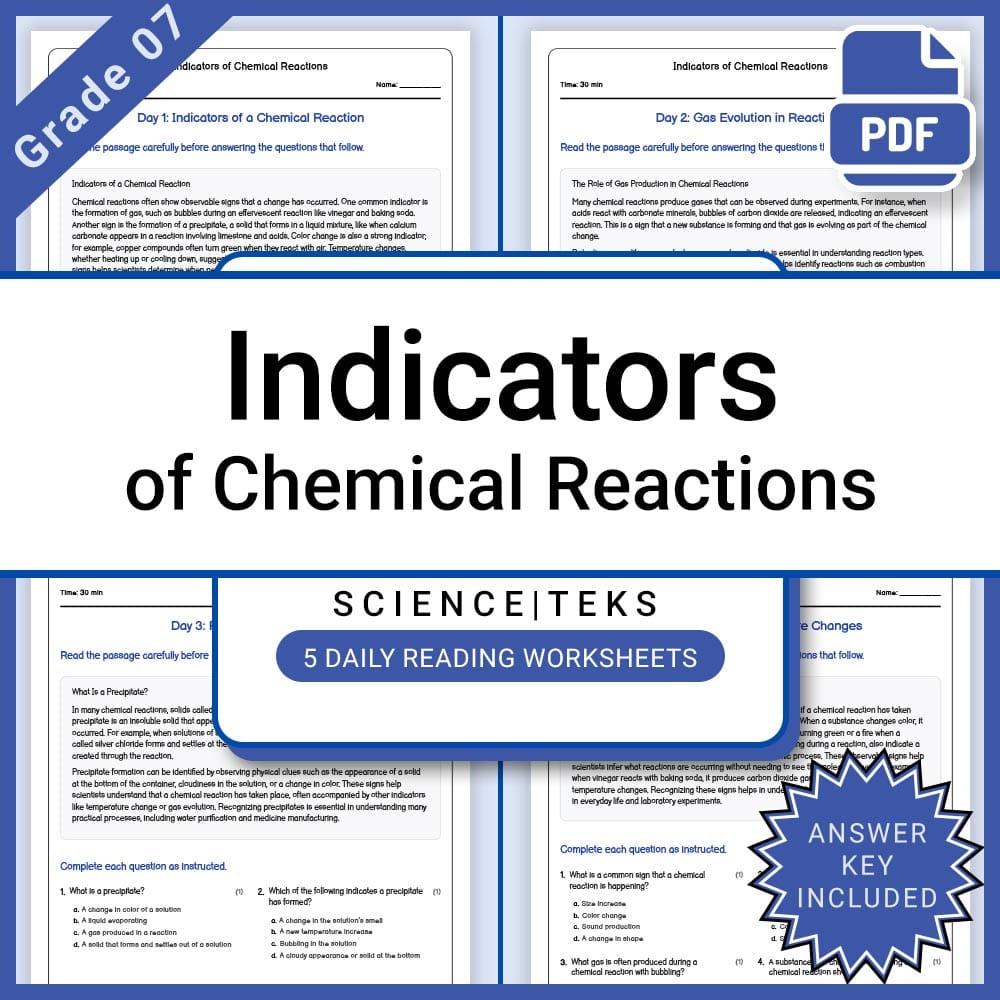
Grade 7 Science – Indicators of Chemical | Daily Worksheet + Answer Key
JCreated byJ.S SheetsLearning Objectives
- Understand key concepts related to Science
- Apply knowledge through practice questions
- Demonstrate comprehension of the material
Also included in: Grade 7 Science Lesson Group: TEKS-Aligned Daily Reading Worksheets +1 more
Instant download
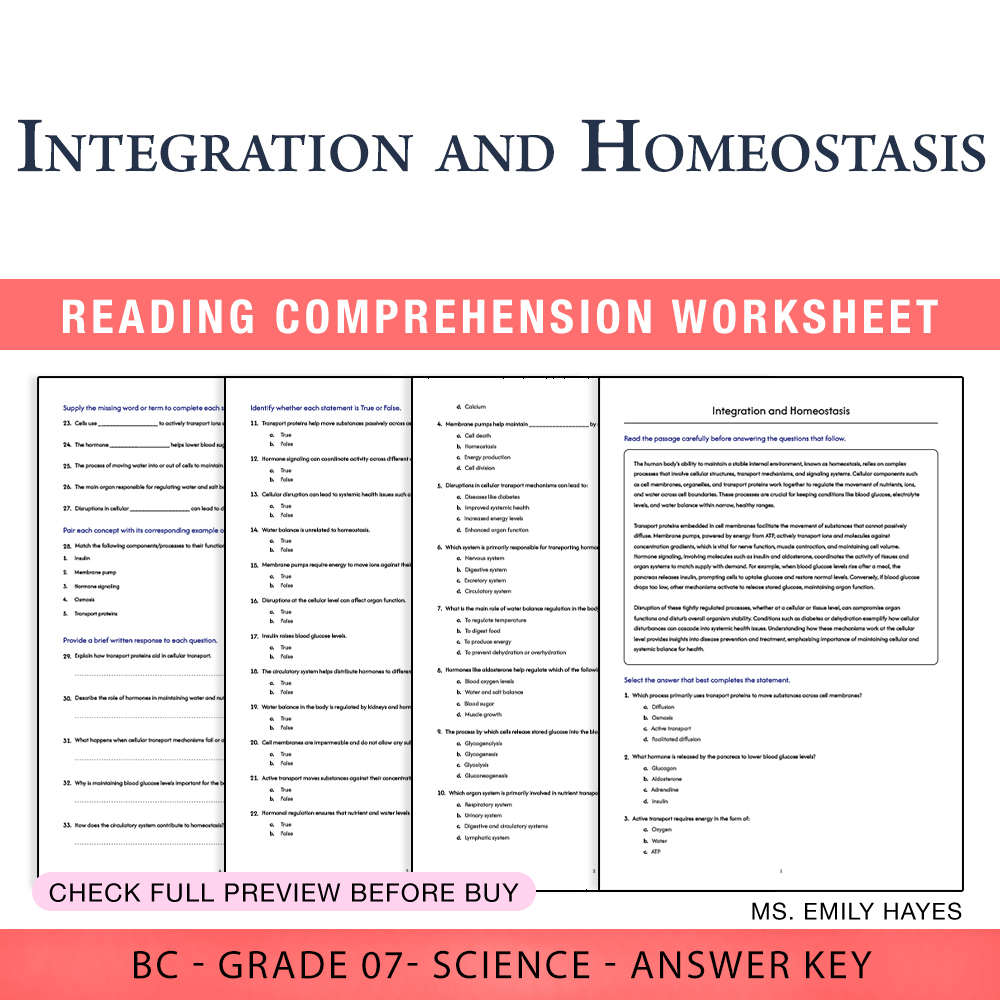
7th Grade Science | Integration and Homeostasis Worksheet (PDF+ Answer Key)
Created byCopper Leaf ClassroomLearning Objectives
- Understand how cellular structures and transport processes work together to maintain homeostasis in the body.
- Describe the role of transport proteins, membrane pumps, and hormones in regulating nutrient levels, ion concentrations, and water balance.
- Explain how disruptions at cellular or tissue levels can impact overall organ function and organism stability.
Also included in: Grade 7 Science Unit – Cells, Organ Systems & Surface Area (PDF+ Answer Key) +1 more
Instant download
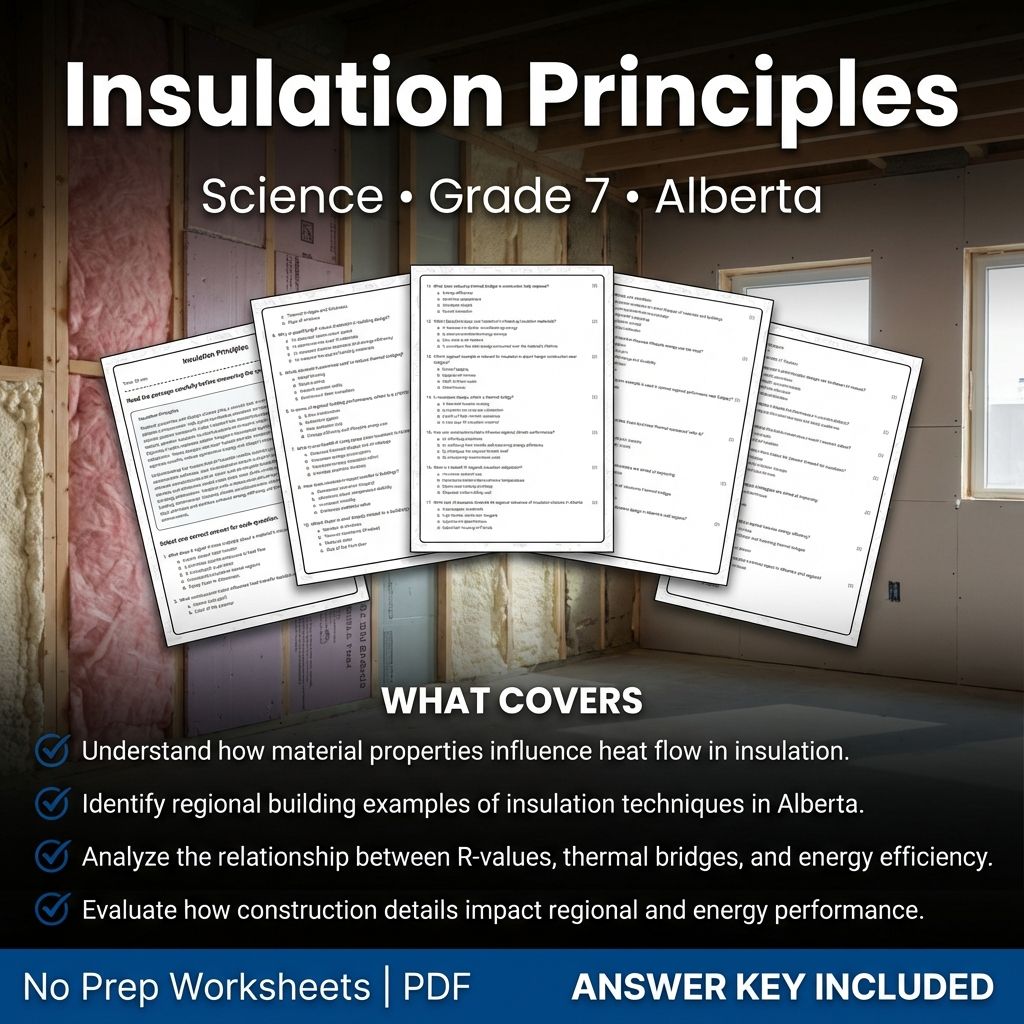
Grade 7 Science Worksheet on Insulation Principles | Alberta Standards
Created byCoral Reef LearningLearning Objectives
- Understand how material properties influence heat flow in insulation.
- Identify regional building examples of insulation techniques in Alberta.
- Analyze the relationship between R-values, thermal bridges, and energy efficiency.
Instant download

Grade 7 Science | Understanding Motion Graphs - Daily Reading Comprehension
Created byCoral Reef LearningLearning Objectives
- Interpret position-time graphs to determine an object's speed.
- Identify different types of motion patterns based on graph slopes.
- Understand how curved graphs indicate changing velocity.
Instant download
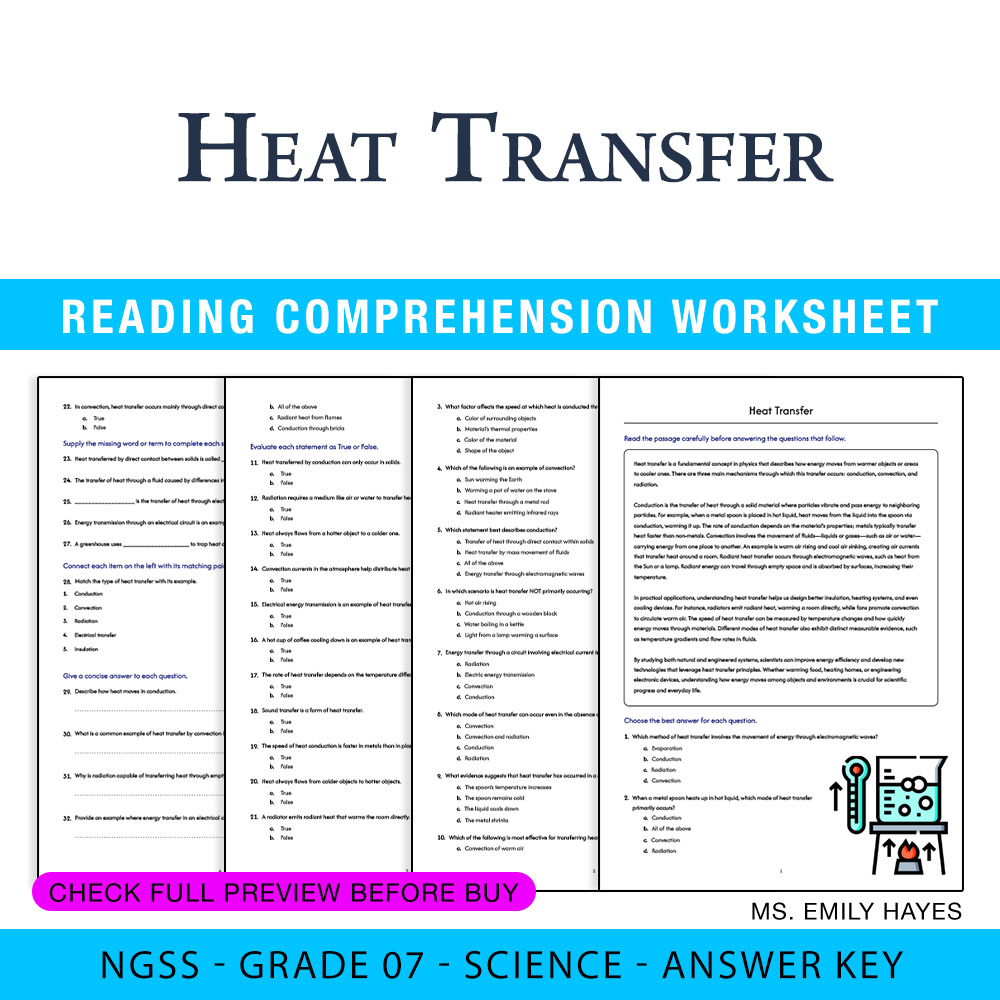
7th Grade Science | Heat Transfer Worksheet (PDF+ Answer Key)
Created byCopper Leaf ClassroomLearning Objectives
- Describe the main mechanisms of heat transfer: conduction, convection, and radiation.
- Identify examples of heat transfer in everyday life and laboratory settings.
- Explain how energy transfer causes temperature changes and rate differences among materials.
Instant download
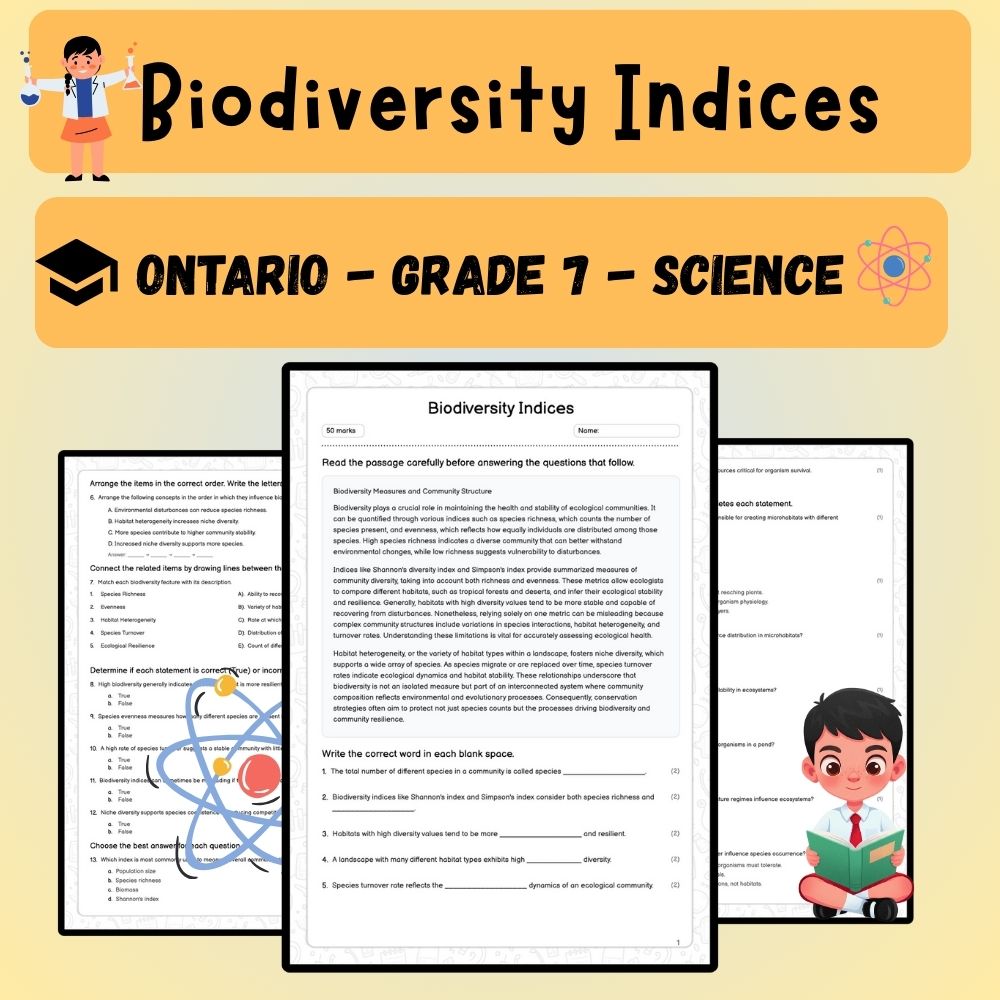
Grade 7 Science – Biodiversity Indices Worksheet (PDF ) for Ontario Standards
 Created byPrism Point Learning
Learning Objectives
- Understand the concept of species richness and evenness in ecological communities.
- Interpret biodiversity indices and compare diversity across habitats.
- Analyze the relationship between habitat heterogeneity, niche diversity, and species turnover.
Also included in: Grade 7 Science UNIT Bundle | Ecosystems & Biodiversity Worksheets +1 more
Instant download
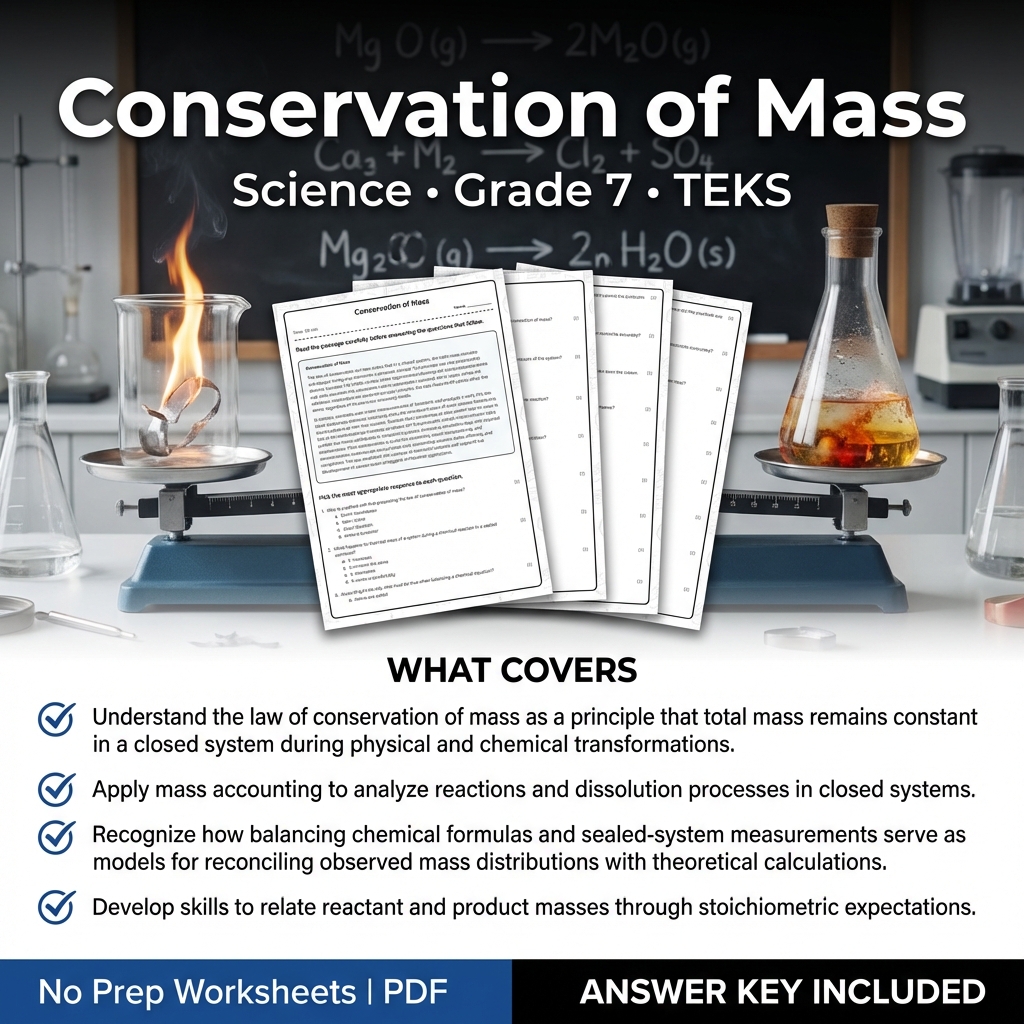
Grade 7 Science Worksheet on Conservation of Mass | TEKS Aligned
Created byCoral Reef LearningLearning Objectives
- Understand the law of conservation of mass as a principle that total mass remains constant in a closed system during physical and chemical transformations.
- Apply mass accounting to analyze reactions and dissolution processes in closed systems.
- Recognize how balancing chemical formulas and sealed-system measurements serve as models for reconciling observed mass distributions with theoretical calculations.
Instant download
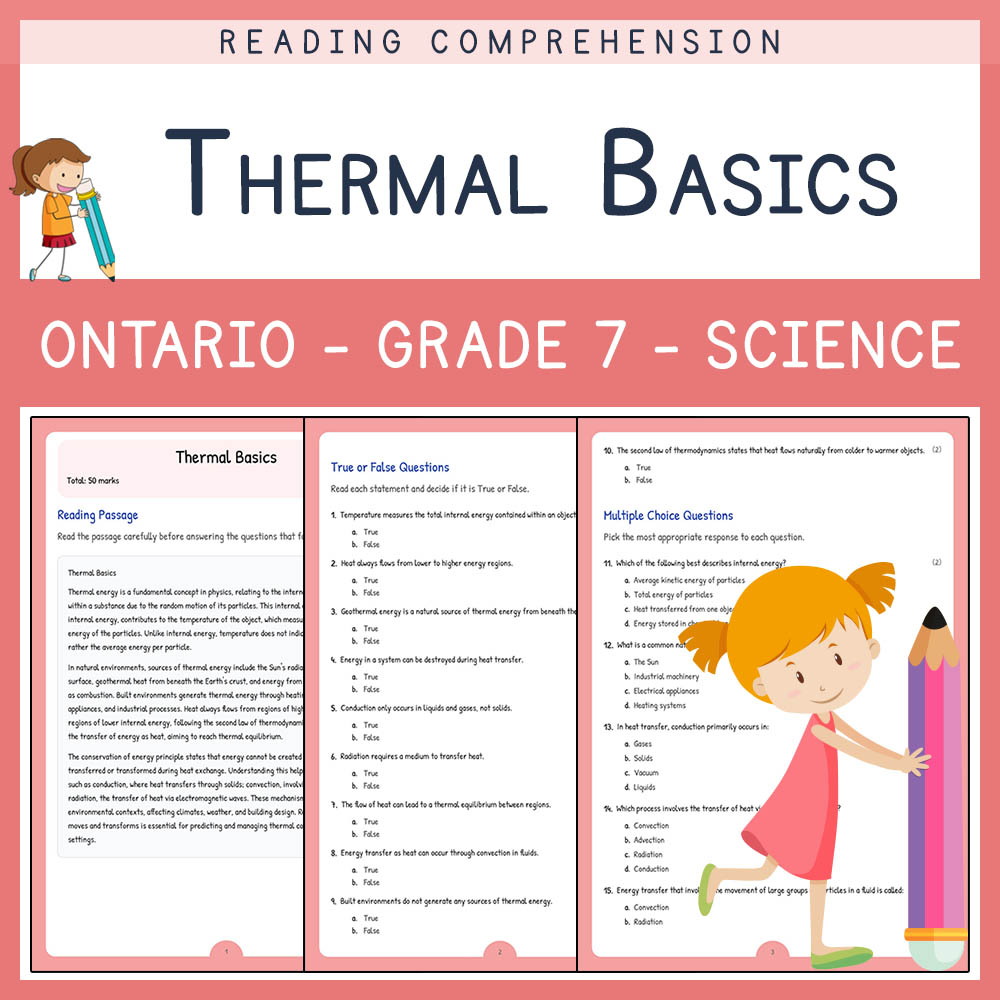
Grade 7 Science Assessment | Thermal Basics Worksheet Elena | Ontario
Created byLumora LearningLearning Objectives
- Explain the difference between internal energy and temperature as measures of particle motion.
- Identify common sources of thermal energy in natural and built environments.
- Describe the directional flow of heat from higher to lower energy regions.
Instant download
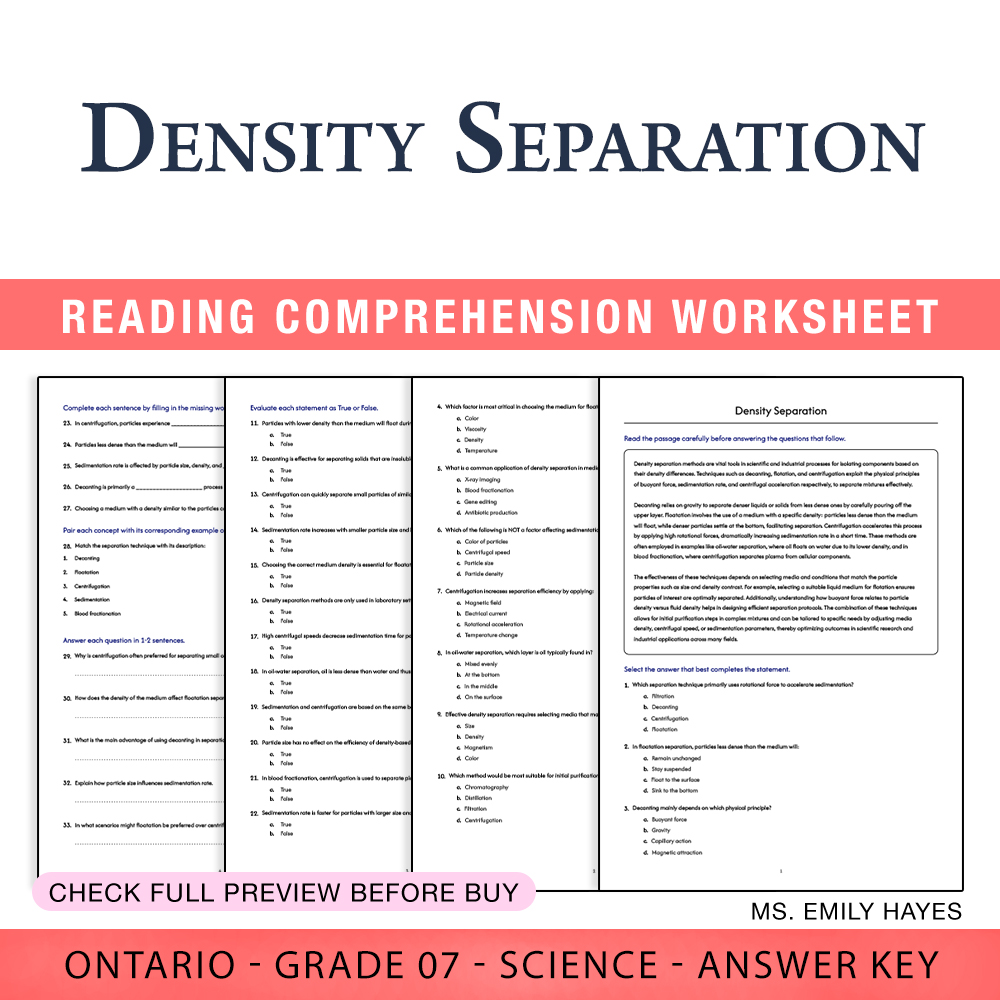
7th Grade Science | Density Separation Worksheet (PDF+ Answer Key)
Created byCopper Leaf ClassroomLearning Objectives
- Understand the concept of density and how it impacts separation techniques.
- Identify different density separation methods such as decanting, floatation, and centrifugation.
- Explain how buoyant force, sedimentation rate, and centrifugal acceleration relate to particle density and size.
Instant download

Grade 7 Science | Matter & Energy Flow in Ecosystems - Reading Comprehension
Created byCoral Reef LearningLearning Objectives
- Understand how producers create energy from sunlight through photosynthesis.
- Identify the role of producers in the food chain.
- Explain why plants are important for ecosystems.
Instant download
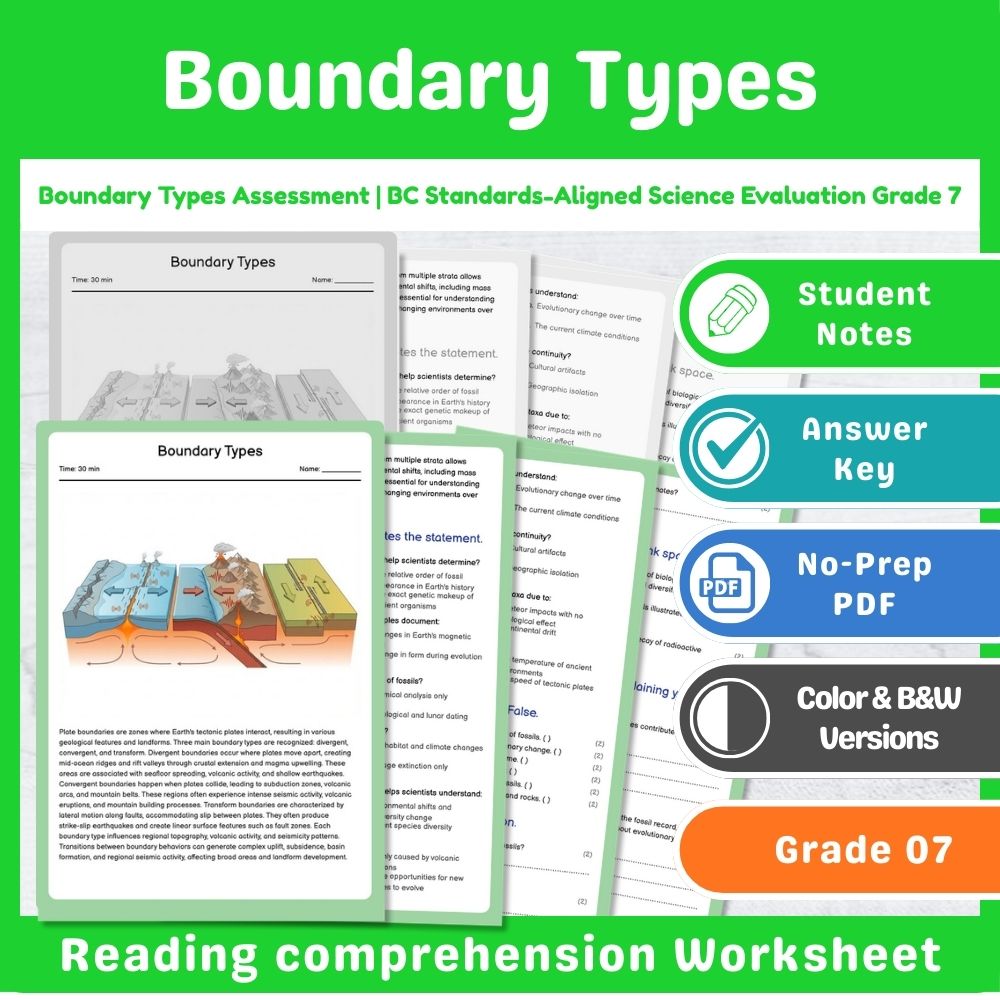
Boundary Types Assessment | BC Standards-Aligned Science Evaluation Grade 7
Created byPrism Point LearningLearning Objectives
- Understand the three principal boundary types and their characteristic landforms.
- Identify the processes and landforms associated with divergent, convergent, and transform boundaries.
- Explain how boundary transitions can produce complex regional geological patterns.
Also included in: Grade 7 Science Lesson – Earth Processes Assessment & Landforms Bundle
Instant download
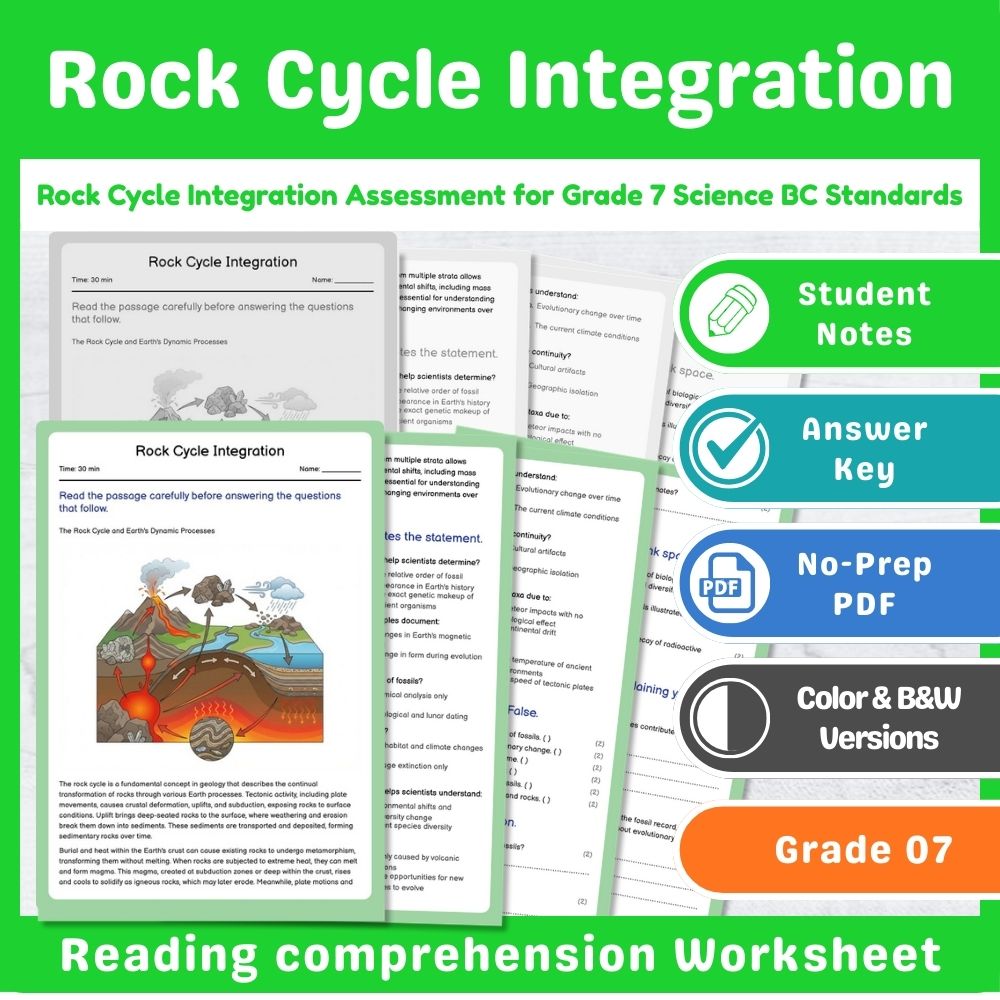
Rock Cycle Integration Assessment for Grade 7 Science BC Standards
Created byPrism Point LearningLearning Objectives
- Understand how the rock cycle links tectonics, magmatism, and surface processes.
- Identify the pathways of material transformation in the rock cycle.
- Explain how uplift, erosion, burial, and heat contribute to different rock types.
Also included in: Grade 7 Science Lesson – Earth Processes Assessment & Landforms Bundle
Instant download
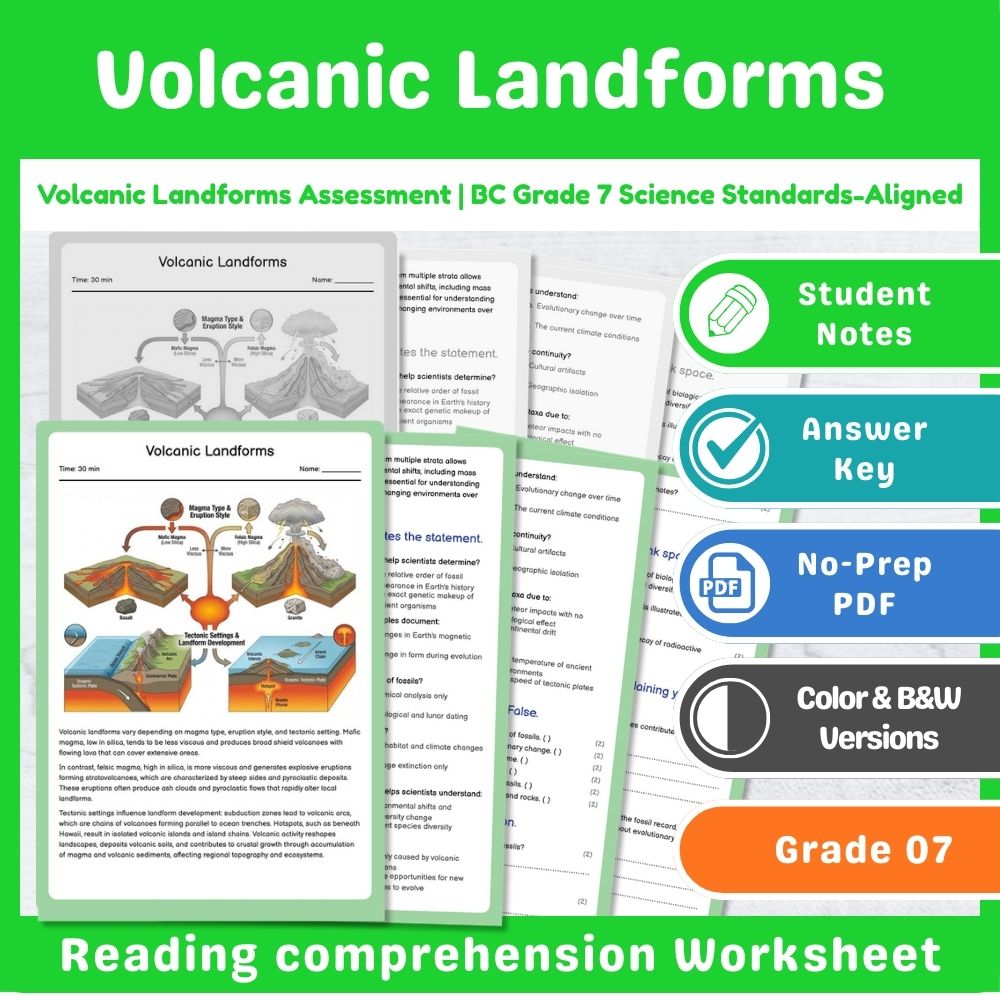
Volcanic Landforms Assessment | BC Grade 7 Science Standards-Aligned
Created byPrism Point LearningLearning Objectives
- Describe different types of volcanic landforms based on magma composition and eruption style.
- Identify the tectonic settings associated with various volcanic features such as arcs and hotspots.
- Explain how volcanic activity influences local topography and crustal growth.
Also included in: Grade 7 Science Lesson – Earth Processes Assessment & Landforms Bundle
Instant download
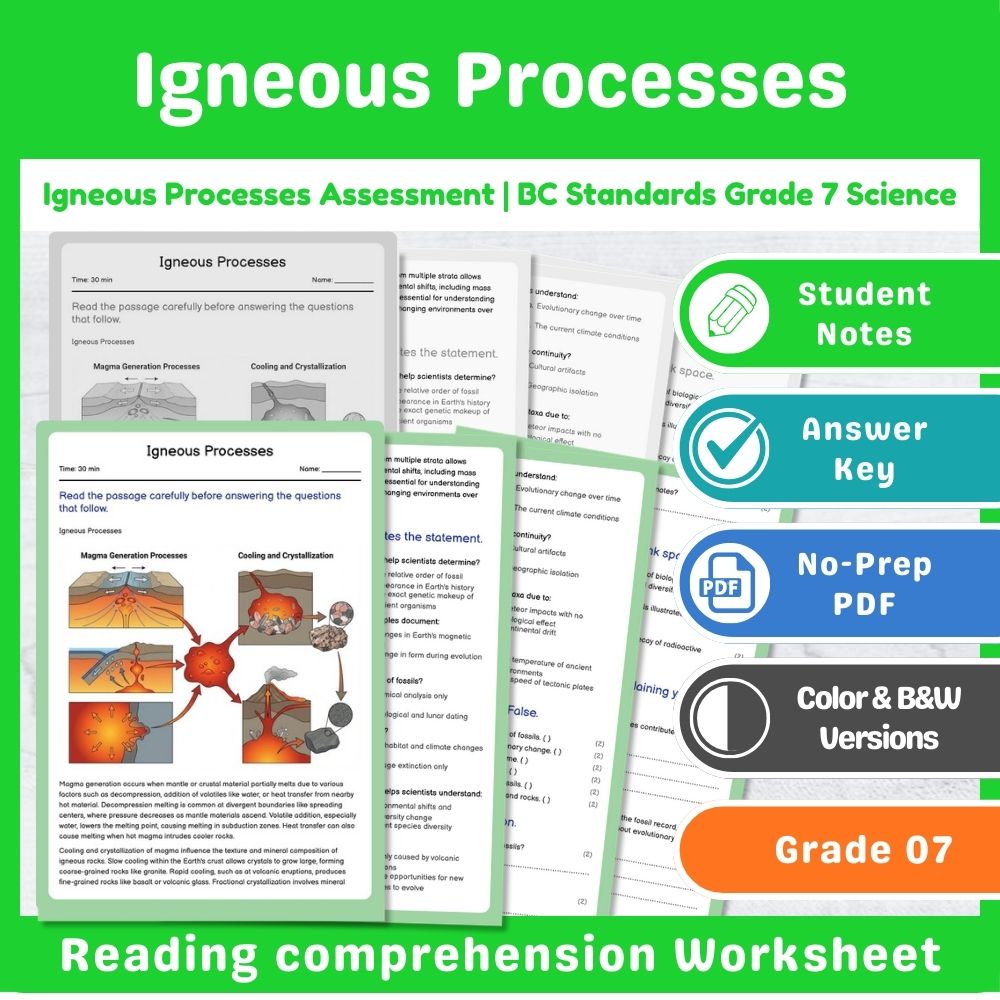
Igneous Processes Assessment | BC Standards Grade 7 Science
Created byPrism Point LearningLearning Objectives
- Describe how magma forms through partial melting due to decompression, volatiles, or heat transfer.
- Explain the processes of cooling and crystallization that determine rock textures and mineral assemblages.
- Identify the roles of fractional crystallization and magma mixing in producing diverse igneous rocks.
Also included in: Grade 7 Science Lesson – Earth Processes Assessment & Landforms Bundle
Instant download
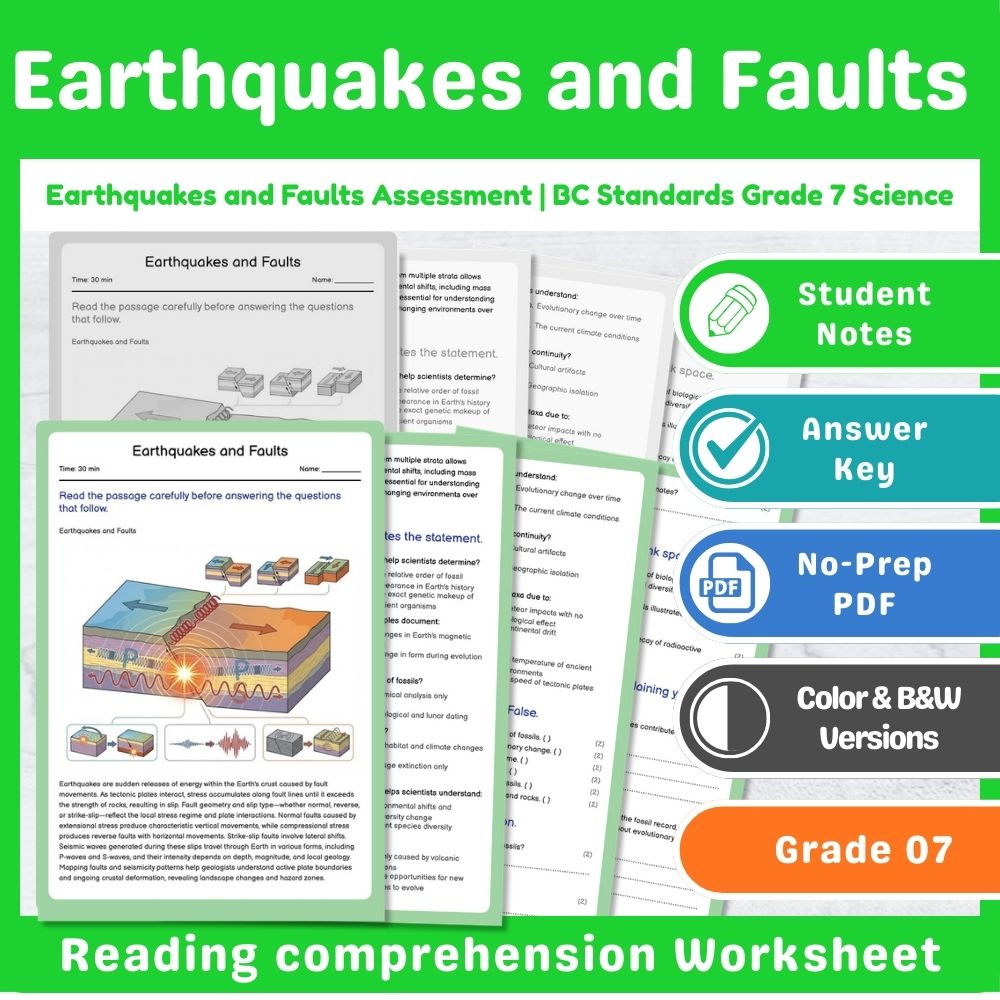
Earthquakes and Faults Assessment | BC Standards Grade 7 Science
Created byPrism Point LearningLearning Objectives
- Understand the causes and effects of earthquakes related to fault movements.
- Identify different fault types and their seismic signatures.
- Explain how seismic waves are generated and how they travel through the Earth.
Also included in: Grade 7 Science Lesson – Earth Processes Assessment & Landforms Bundle
Instant download
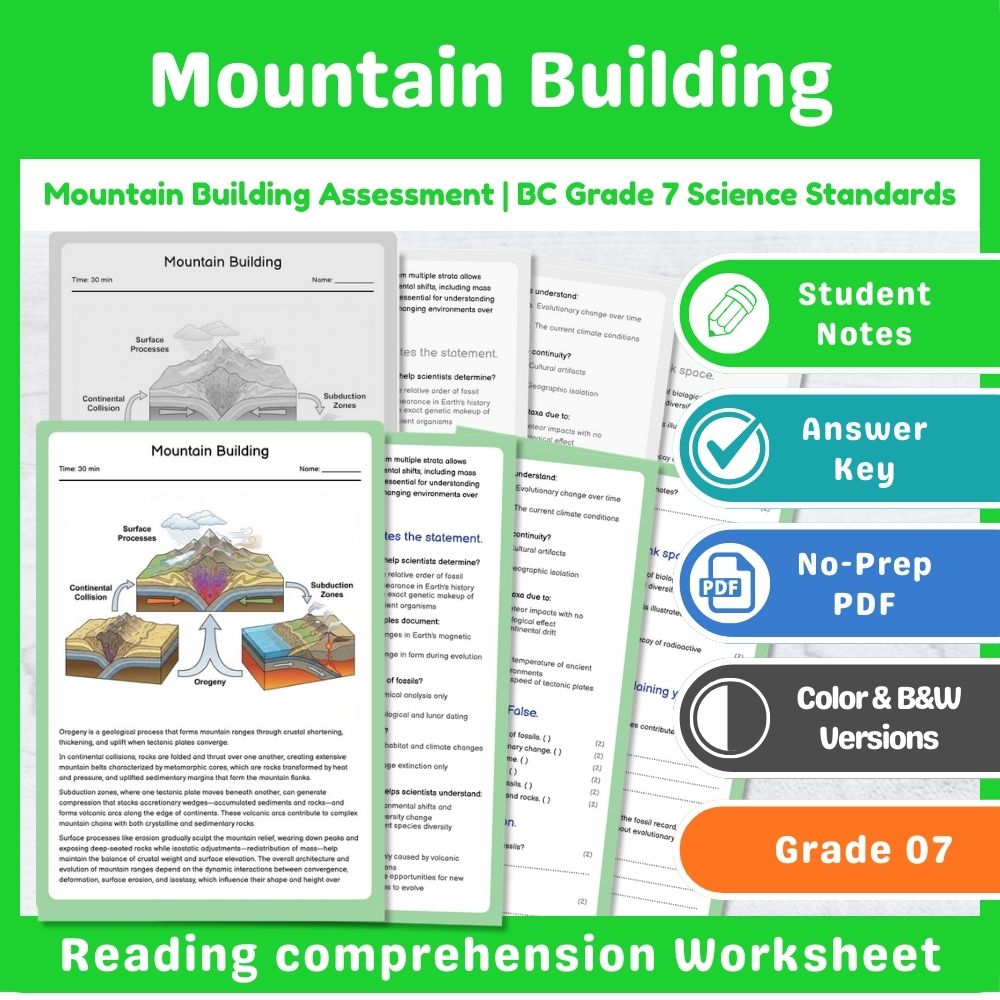
Mountain Building Assessment | BC Grade 7 Science Standards
Created byPrism Point LearningLearning Objectives
- Understand the processes involved in orogeny and mountain formation.
- Identify key geological features associated with mountain belts and subduction zones.
- Explain how surface processes shape mountain regions over time.
Also included in: Grade 7 Science Lesson – Earth Processes Assessment & Landforms Bundle
Instant download
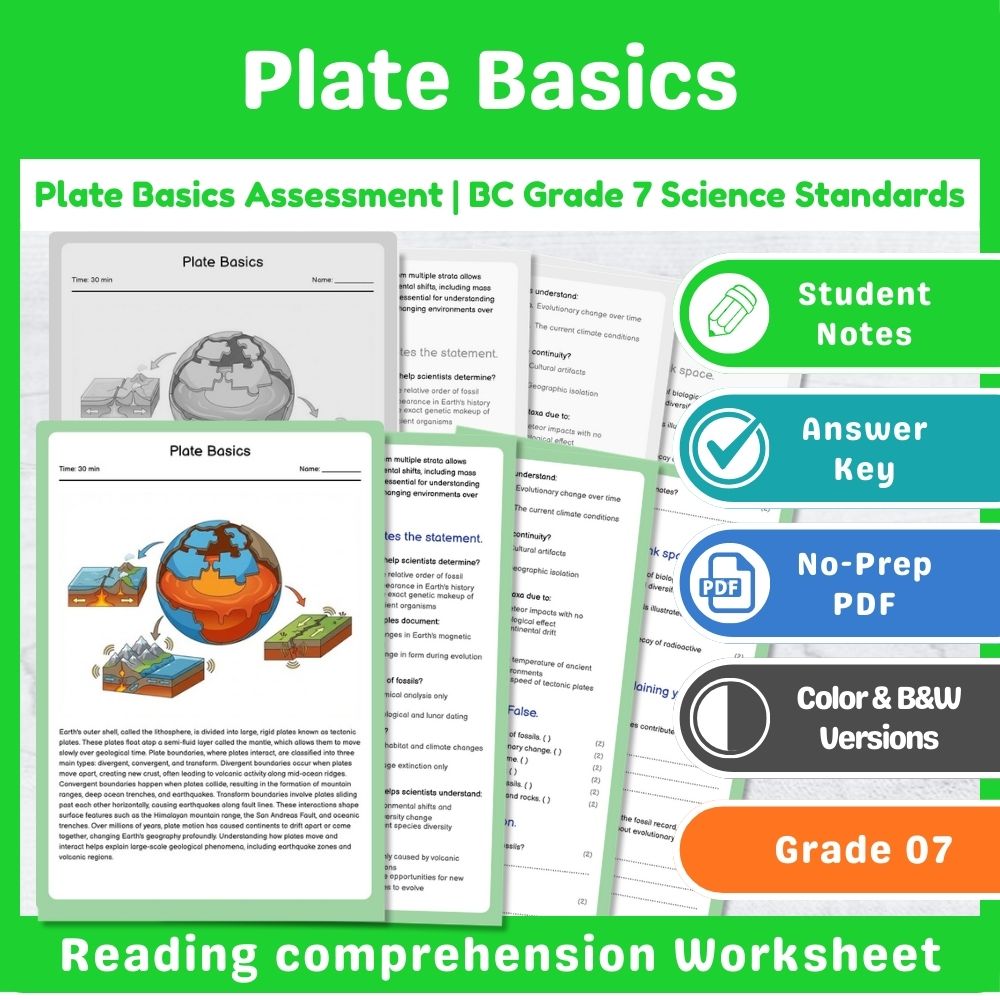
Plate Basics Assessment | BC Grade 7 Science Standards
Created byPrism Point LearningLearning Objectives
- Understand the structure and movement of Earth's lithospheric plates.
- Identify different types of plate boundaries and their effects on surface features.
- Explain how plate interactions influence geological activity such as earthquakes and volcanoes.
Also included in: Grade 7 Science Lesson – Earth Processes Assessment & Landforms Bundle
Instant download
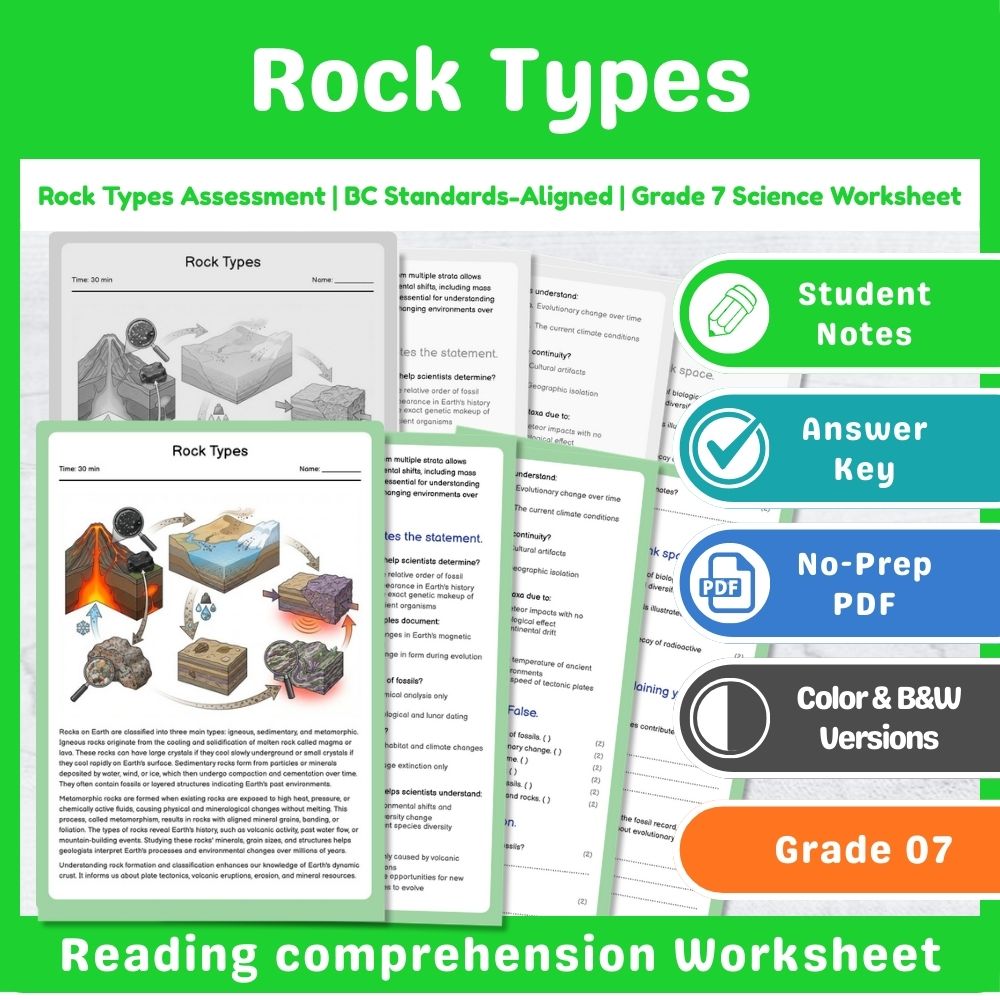
Rock Types Assessment | BC Standards-Aligned | Grade 7 Science Worksheet
Created byPrism Point LearningLearning Objectives
- Describe the three main types of rocks: igneous, sedimentary, and metamorphic.
- Explain the processes by which each type of rock forms.
- Identify distinguishing features of each rock type based on texture and mineral content.
Also included in: Grade 7 Science Lesson – Earth Processes Assessment & Landforms Bundle
Instant download
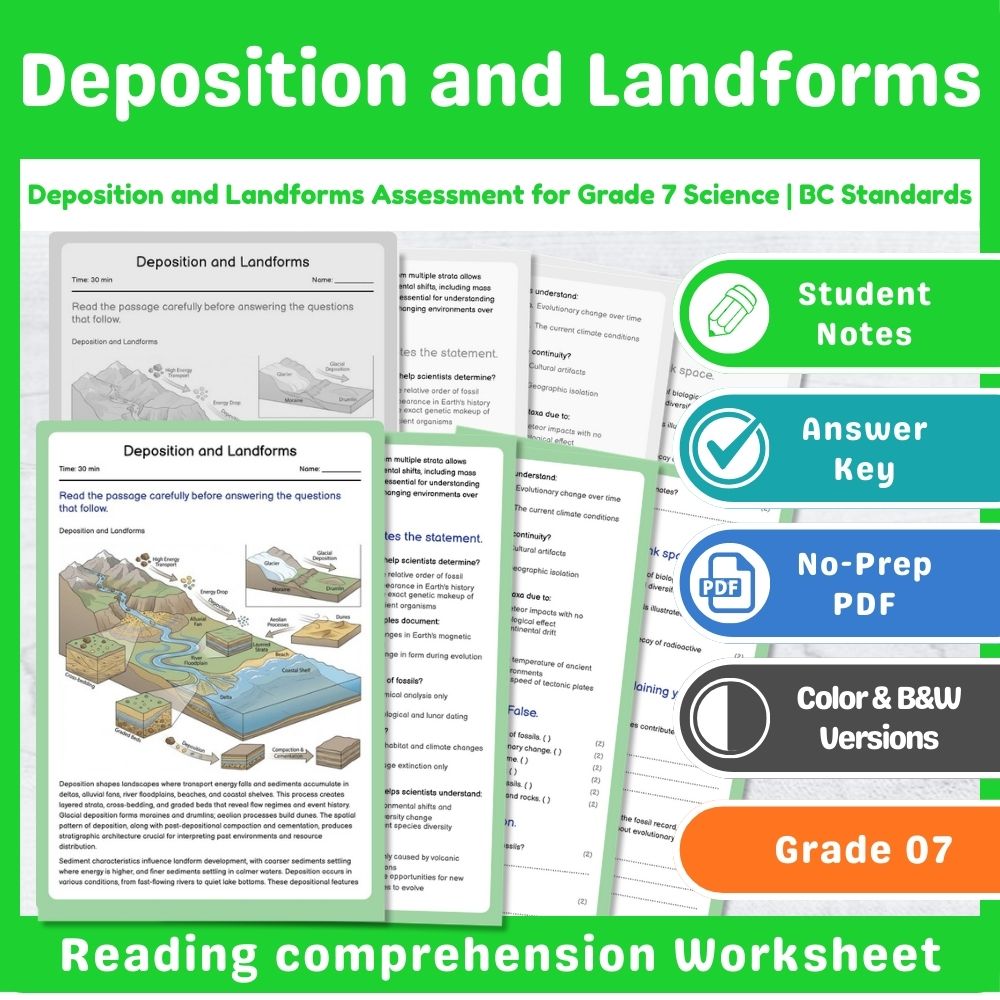
Deposition and Landforms Assessment for Grade 7 Science | BC Standards
Created byPrism Point LearningLearning Objectives
- Understand the processes of deposition and how they shape landforms.
- Identify different types of depositional features such as deltas, beaches, and moraines.
- Describe the characteristics of sediments involved in depositional environments.
Also included in: Grade 7 Science Lesson – Earth Processes Assessment & Landforms Bundle
Instant download
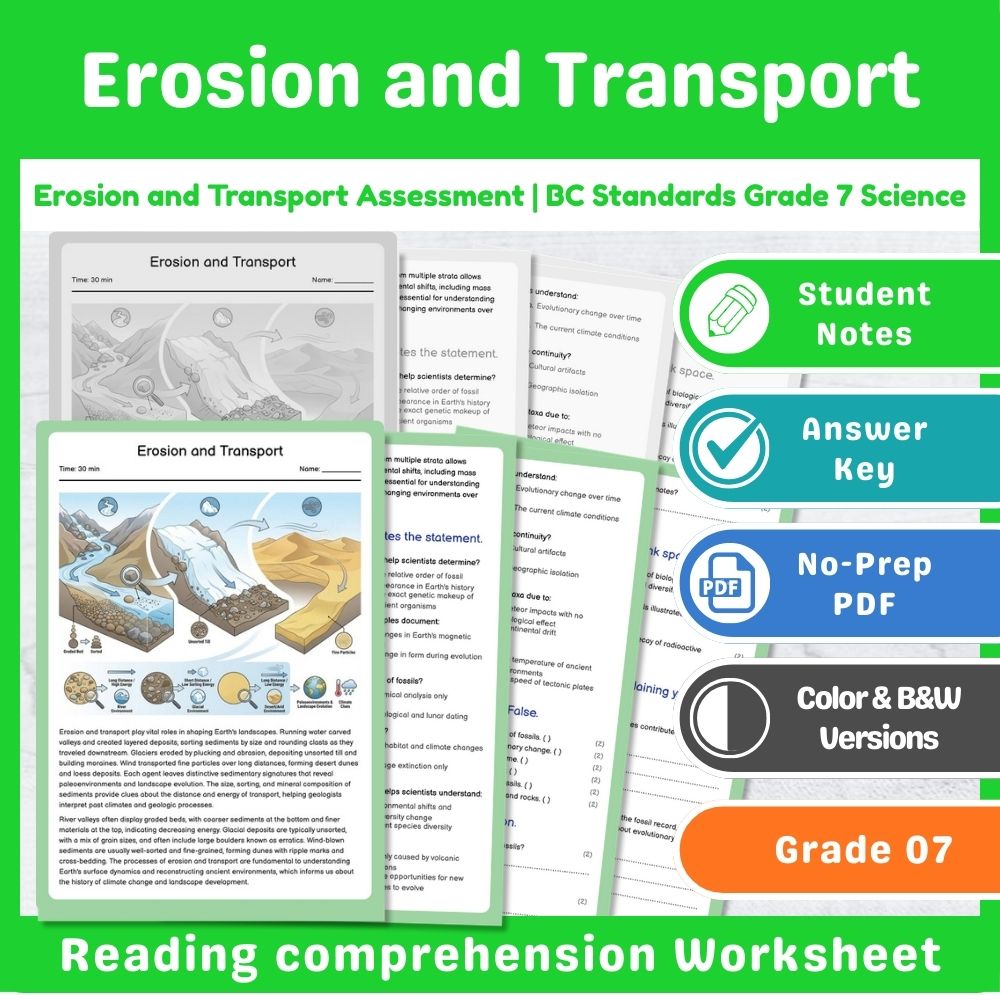
Erosion and Transport Assessment | BC Standards Grade 7 Science
Created byPrism Point LearningLearning Objectives
- Understand how agents like water, glaciers, wind, and gravity cause erosion and transport Sediment.
- Describe distinctive sedimentary signatures produced by different erosion agents.
- Interpret landscape features to deduce past environments and erosion history.
Also included in: Grade 7 Science Lesson – Earth Processes Assessment & Landforms Bundle
Instant download
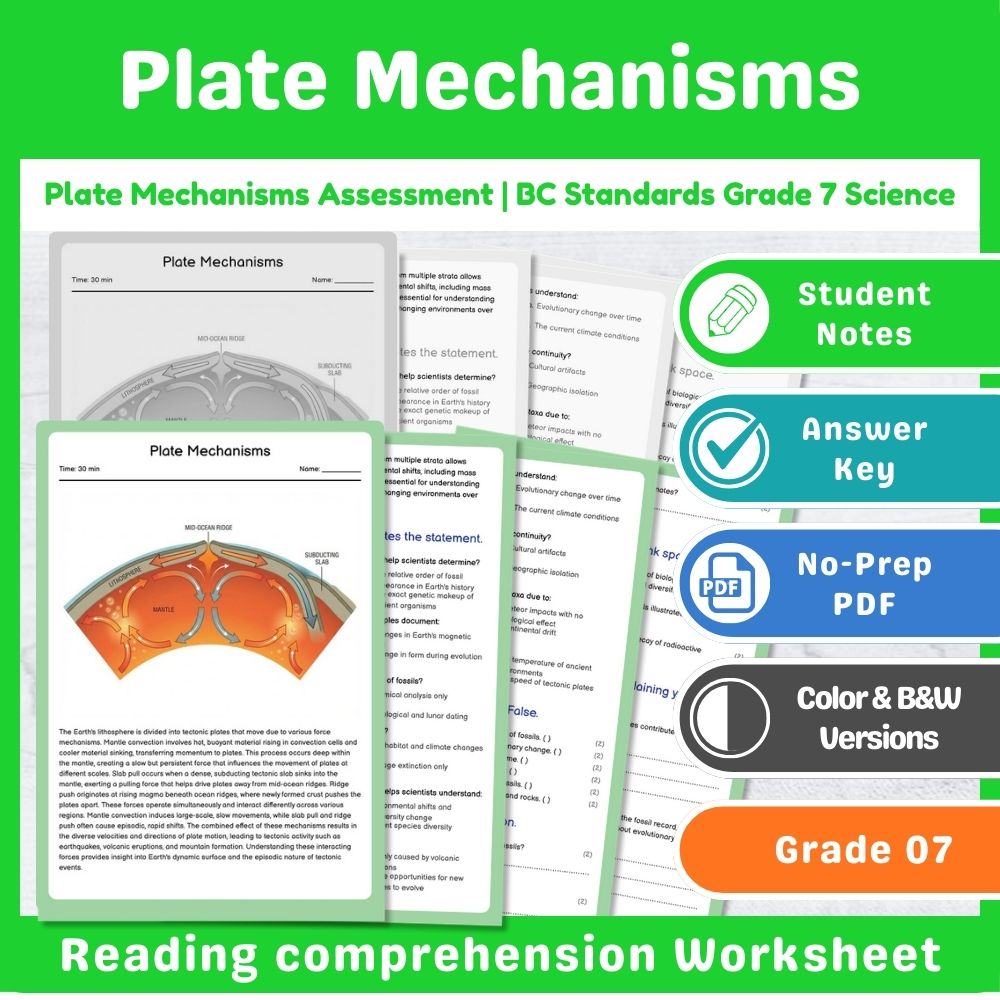
Plate Mechanisms Assessment | BC Standards Grade 7 Science
Created byPrism Point LearningLearning Objectives
- Describe the key force systems within the Earth's crust that drive plate motion.
- Explain how mantle convection, slab pull, and ridge push influence tectonic activity.
- Analyze the interaction of different plate force mechanisms and their impact on Earth's surface.
Also included in: Grade 7 Science Lesson – Earth Processes Assessment & Landforms Bundle
Instant download
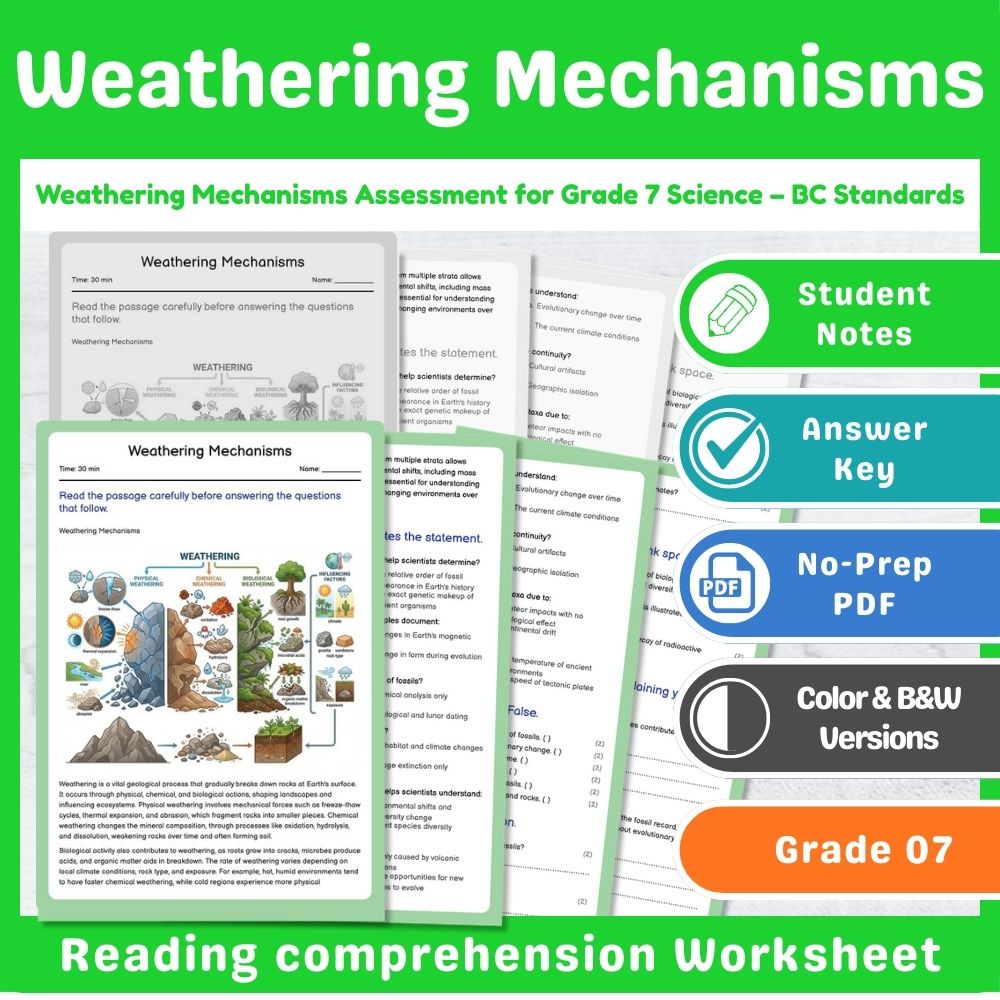
Weathering Mechanisms Assessment for Grade 7 Science – BC Standards
Created byPrism Point LearningLearning Objectives
- Understand the different types of weathering processes and how they affect rocks and landscapes.
- Identify examples of physical, chemical, and biological weathering mechanisms.
- Explain how weathering influences soil formation and landform development.
Also included in: Grade 7 Science Lesson – Earth Processes Assessment & Landforms Bundle
Instant download
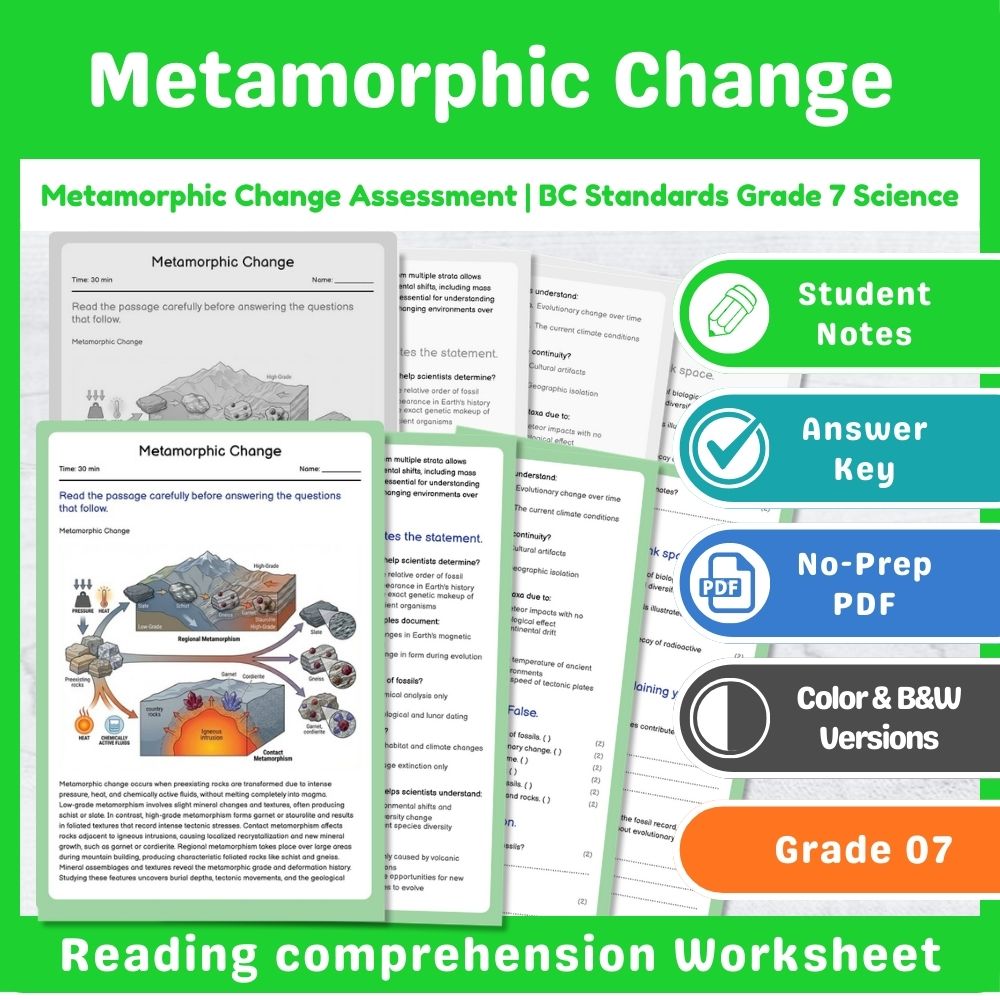
Metamorphic Change Assessment | BC Standards Grade 7 Science
Created byPrism Point LearningLearning Objectives
- Describe the processes involved in metamorphism and how rocks change mineralogically and texturally.
- Differentiate between contact and regional metamorphism and their effects on rocks.
- Identify mineral assemblages and textures that indicate metamorphic grade and history.
Also included in: Grade 7 Science Lesson – Earth Processes Assessment & Landforms Bundle
Instant download
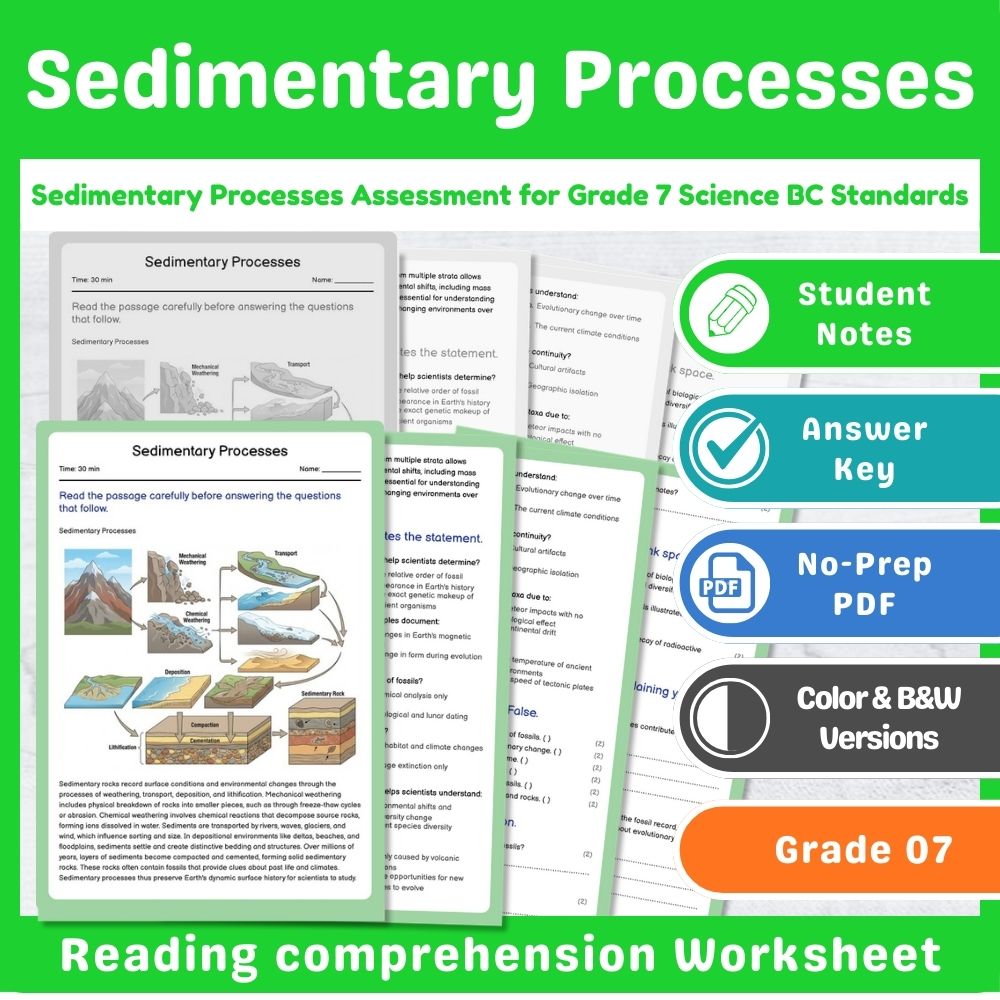
Sedimentary Processes Assessment for Grade 7 Science BC Standards
Created byPrism Point LearningLearning Objectives
- Describe the processes involved in the formation of sedimentary rocks.
- Identify different types of weathering and how they contribute to sediment formation.
- Explain how sediments are transported and deposited in various environments.
Also included in: Grade 7 Science Lesson – Earth Processes Assessment & Landforms Bundle
Instant download
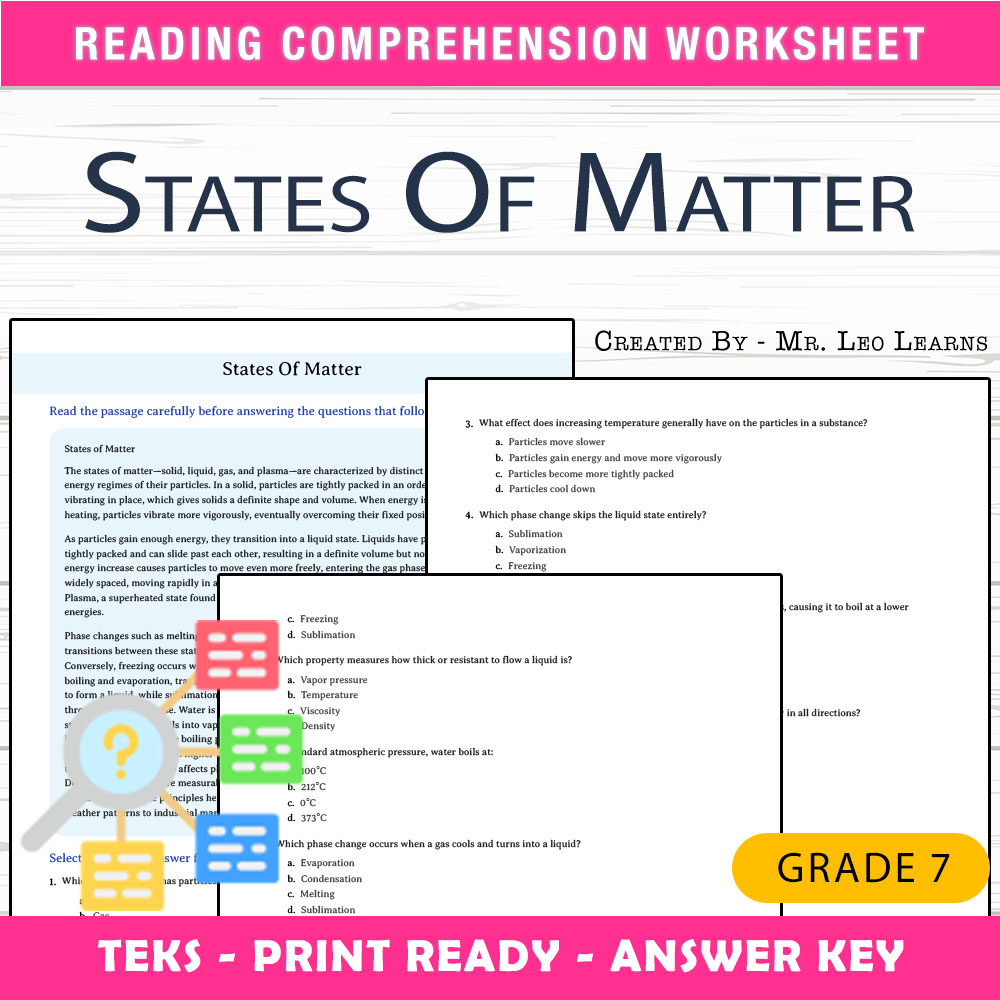
Grade 7 Science — States Of Matter Worksheet for Mastery
Created byThe Resource HubLearning Objectives
- Define and describe the different states of matter in terms of particle arrangements and energy levels.
- Explain phase changes such as melting, freezing, vaporization, condensation, and sublimation.
- Relate temperature and pressure to phase transition points and properties like density and viscosity.
Also included in: Grade 7 Science Unit Bundle – States, Reactions & Atomic Structure Worksheets +1 more
Instant download
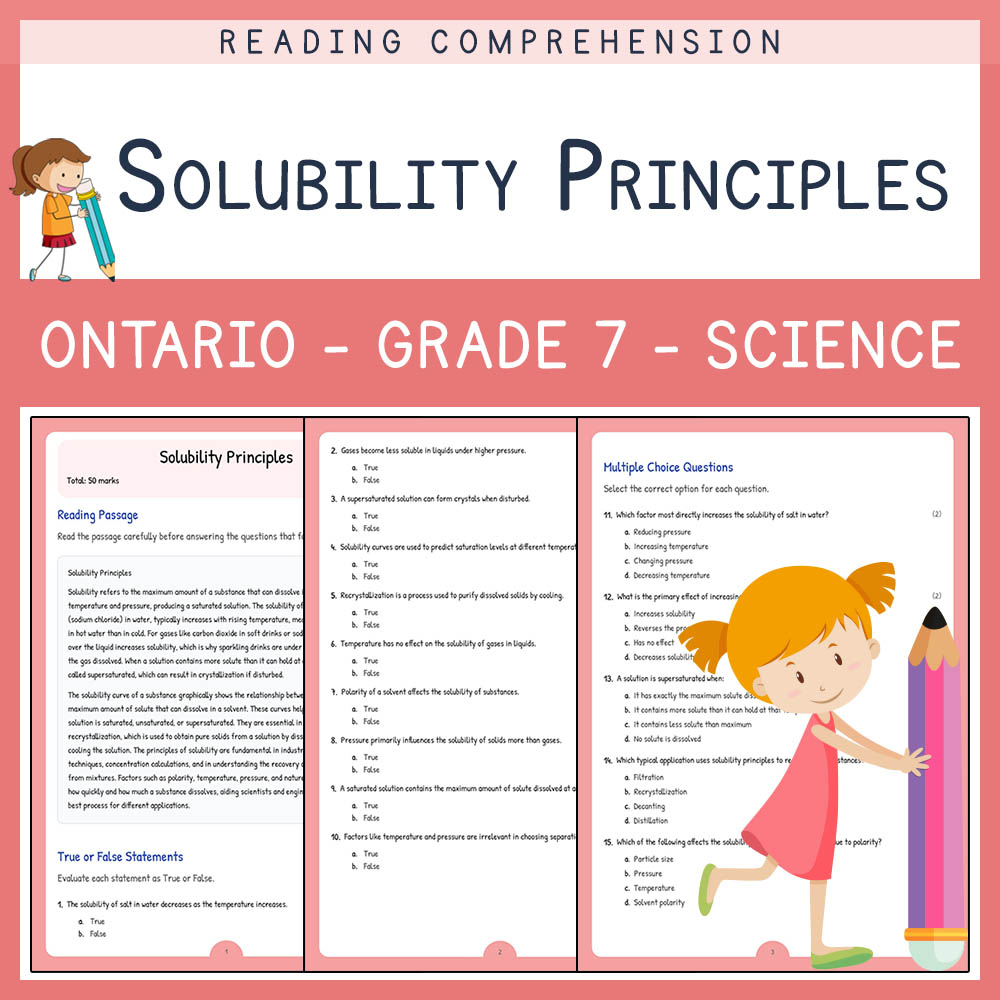
Grade 7 Science Worksheet | Solubility Principles | Ontario Standards
Created byLumora LearningLearning Objectives
- Understand the factors affecting solubility such as temperature, pressure, and solvent polarity.
- Interpret and analyze solubility curves and concepts of saturation and supersaturation.
- Explain how solubility concepts relate to solution processes like recrystallization, separation, and concentration calculations.
Also included in: Grade 7 Science | Pure Substances and Mixtures Unit Bundle | Ontario
Instant download
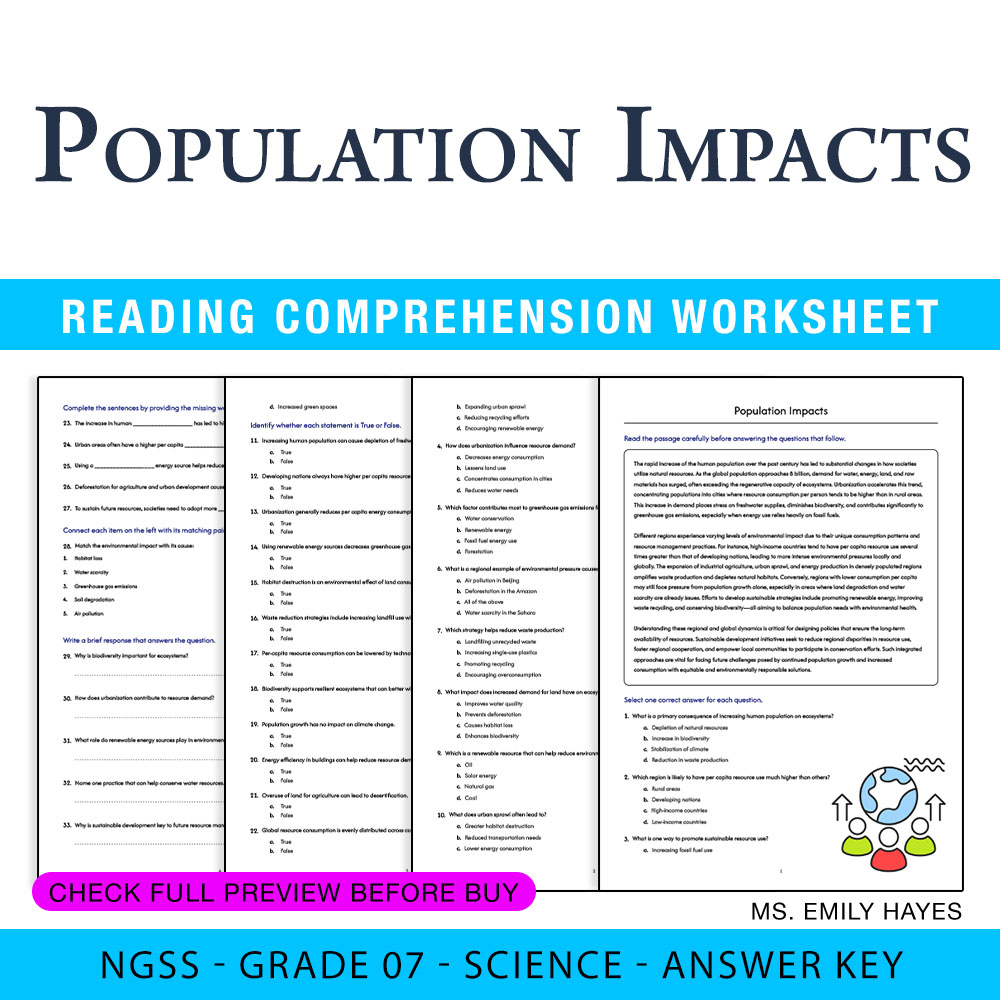
7th Grade Science | Population Impacts Worksheet (PDF+ Answer Key)
Created byCopper Leaf ClassroomLearning Objectives
- Understand how human population growth affects demand for natural resources and ecosystems.
- Analyze regional examples showing the relationship between consumption patterns and environmental pressures.
- Evaluate sustainable resource management strategies to mitigate negative impacts of population growth.
Instant download

Grade 7 Science Friction and Resistance Worksheet | Standards-Aligned Practice
JCreated byJ.S SheetsLearning Objectives
- Explain how friction and other resistive forces oppose motion and cause objects to slow down.
- Describe how surface texture and contact affect the size of frictional force.
- Connect resistive forces to energy changes (kinetic energy to thermal energy) during realistic motion.
Also included in: Grade 7 Matter, Energy & Forces Science Lesson Bundle – Florida NGSSS +1 more
Instant download

Grade 7 Science | Understanding Chromatography - Daily Reading Comprehension
Created byCoral Reef LearningLearning Objectives
- Understand key concepts related to Science
- Apply knowledge through practice questions
- Demonstrate comprehension of the material
Instant download
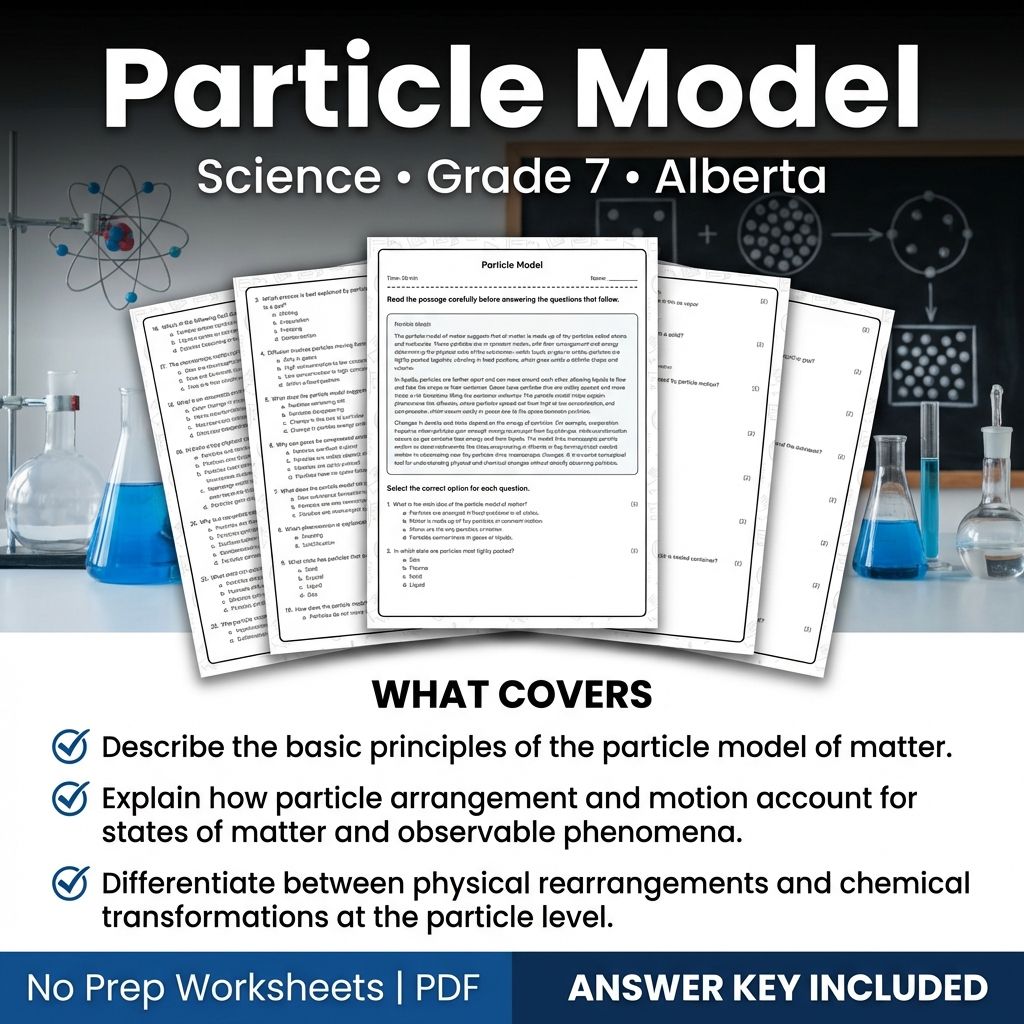
Particle Model Worksheet for Grade 7 Science | Alberta Standards
Created byCoral Reef LearningLearning Objectives
- Describe the basic principles of the particle model of matter.
- Explain how particle arrangement and motion account for states of matter and observable phenomena.
- Differentiate between physical rearrangements and chemical transformations at the particle level.
Instant download
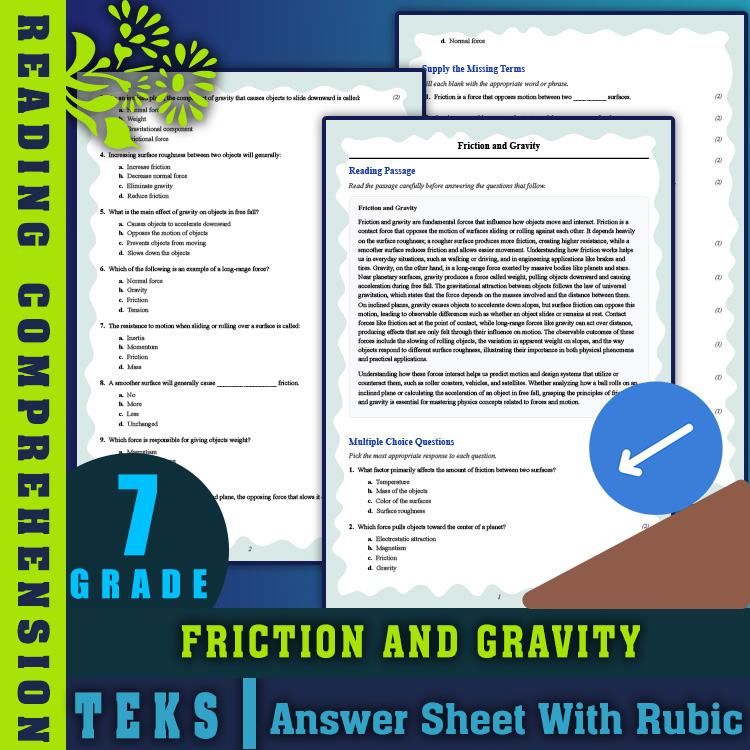
Grade 7 Science | Friction and Gravity Reading Worksheet (PDF + Answer Key)
JCreated byJ.S SheetsLearning Objectives
- Understand the forces of friction and gravity and how they affect motion.
- Explain how surface roughness influences resistance between objects.
- Describe the effects of gravity on objects in free fall and on inclined planes.
Instant download
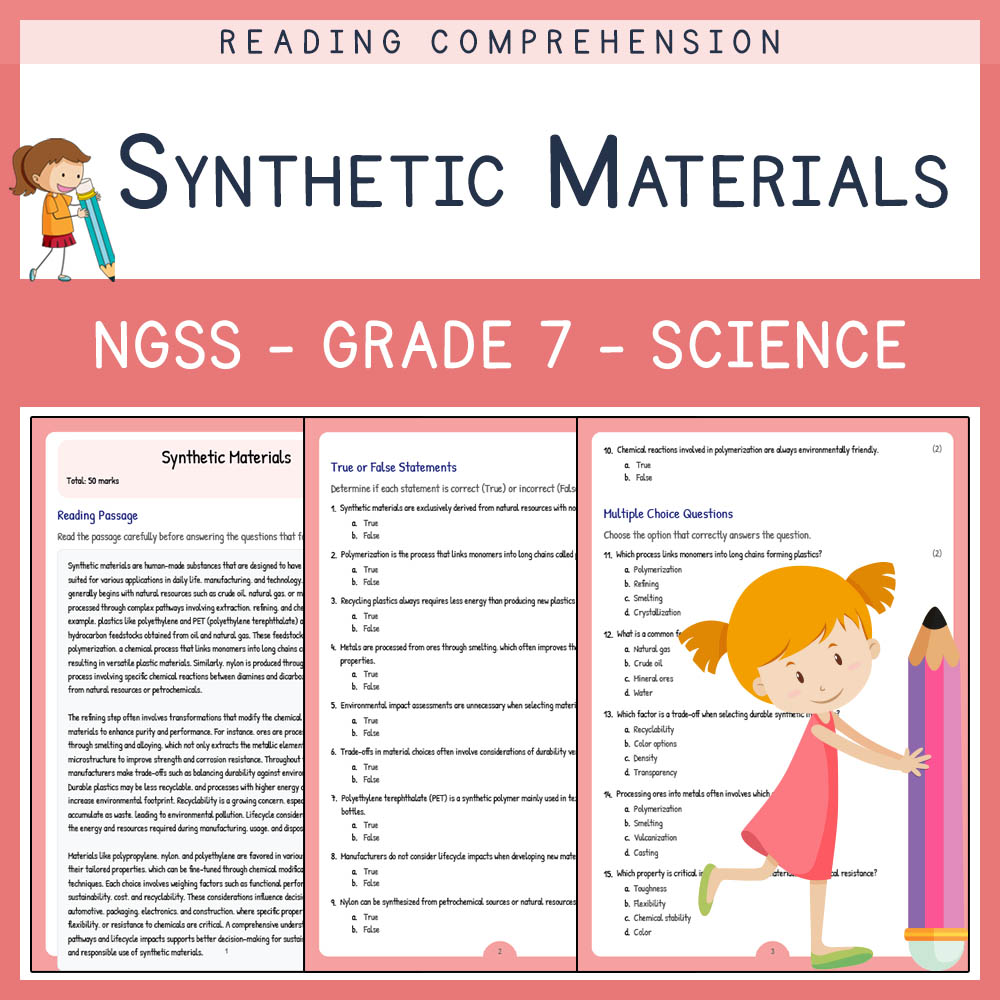
Grade 7 Science | Synthetic Materials Worksheet & Answer Key (NGSS Aligned)
Created byLumora LearningLearning Objectives
- Explain the production pathways of common synthetic materials from natural resources.
- Identify key process steps such as polymerization and refining that alter chemical composition and functional performance.
- Analyze trade-offs involved in material choices, including durability, recyclability, and environmental impact.
Instant download
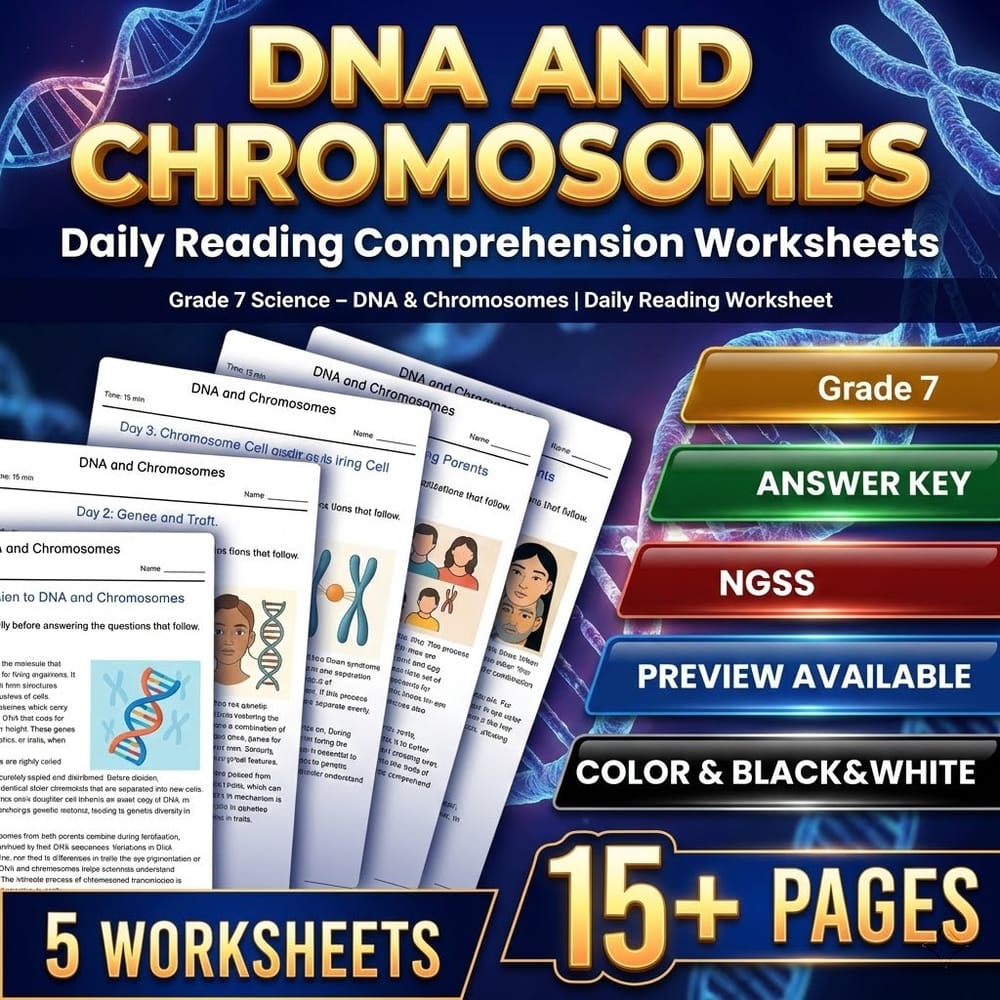
Grade 7 Science – DNA & Chromosomes | Daily Reading Worksheet
 Created byElena Brooks
Learning Objectives
- Understand the structure of DNA and how it forms chromosomes.
- Learn how genes influence observable traits.
- Explore the process of chromosome segregation during cell division.
Also included in: Genetics and Environment Grade 7 Science Daily Reading Worksheets Bundle | NGSS +1 more
Instant download
About Grade 7 Science Worksheets
Browse 6,039 printable Grade 7 Science worksheets — ready-to-print PDFs with answer keys where available.
Every worksheet on MyTeachingSheets is created by independent teacher-authors and reviewed before publication. All resources download as printable PDFs for classroom, homework, or at-home practice, and many include answer keys. Preview any worksheet free before buying.