
Grade 7 Science Worksheets
6,039 worksheets
Grade 7 Science – Modelling Ecosystems Daily Reading Worksheet + Answer Key
JCreated byJ.S SheetsLearning Objectives
- Understand the concept of ecological models and their purpose.
- Differentiate between conceptual and quantitative models.
- Identify model inputs, limitations, and regional examples.
Also included in: Grade 7 Science Lesson Group Bundle | Ecology, Environment & Sustainability +1 more
Instant download
Grade 7 Science – Biodiversity Measures | Daily Reading Worksheet + Answer Key
JCreated byJ.S SheetsLearning Objectives
- Understand the key concepts of biodiversity and its components
- Learn different ways to measure biodiversity such as richness, evenness, and habitat heterogeneity
- Interpret what various biodiversity metrics reveal about ecosystem health and resilience
Also included in: Grade 7 Science Lesson Group Bundle | Ecology, Environment & Sustainability +1 more
Instant download
Grade 7 Science – Animal Migration | Daily Reading Worksheet + Answer Key
JCreated byJ.S SheetsLearning Objectives
- Understand the main reasons animals migrate
- Identify common migration examples
- Analyze how migration impacts ecosystems and biodiversity
Also included in: Grade 7 Science Lesson Group Bundle | Ecology, Environment & Sustainability +1 more
Instant download
Grade 7 Science – Population Factors in Ecosystems Daily Worksheet + Answer Key
JCreated byJ.S SheetsLearning Objectives
- Understand how birth and death rates influence population size.
- Identify factors affecting population distribution such as resources and abiotic conditions.
- Analyze how environmental and human activities cause fluctuations in populations.
Also included in: Grade 7 Science Lesson Group Bundle | Ecology, Environment & Sustainability +1 more
Instant download
Grade 7 Science Pollution Effects Daily Reading Worksheet with Answer Key
JCreated byJ.S SheetsLearning Objectives
- Identify sources of nutrient runoff in aquatic environments.
- Describe how pollutants impact ecosystems and organisms.
- Understand pathways of contamination transfer and bioaccumulation.
Also included in: Grade 7 Science Lesson Group Bundle | Ecology, Environment & Sustainability +1 more
Instant download
Grade 7 Science – Levels Of Organization in Ecology Daily Worksheet + Answer Key
JCreated byJ.S SheetsLearning Objectives
- Understand the hierarchy of ecological levels from individual organisms to ecosystems
- Identify examples of each level within Alberta's ecological context
- Recognize how higher levels emerge with properties different from individual traits
Also included in: Grade 7 Science Lesson Group Bundle | Ecology, Environment & Sustainability +1 more
Instant download
Grade 7 Science – Indigenous Knowledge in Ecology Daily Worksheet + Answer Key
JCreated byJ.S SheetsLearning Objectives
- Understand the role of oral histories in ecological knowledge
- Identify examples of Indigenous land-use and stewardship practices
- Recognize the value of different knowledge systems for understanding ecosystems
Also included in: Grade 7 Science Lesson Group Bundle | Ecology, Environment & Sustainability +1 more
Instant download
Grade 7 Science – Ecological Inquiry in River Ecosystems Daily Reading Worksheet + Answer Key
JCreated byJ.S SheetsLearning Objectives
- Understand the steps involved in ecological inquiry.
- Analyze how observable data informs understanding of river ecosystems.
- Evaluate human impacts on ecological health through data interpretation.
Also included in: Grade 7 Science Lesson Group Bundle | Ecology, Environment & Sustainability +1 more
Instant download
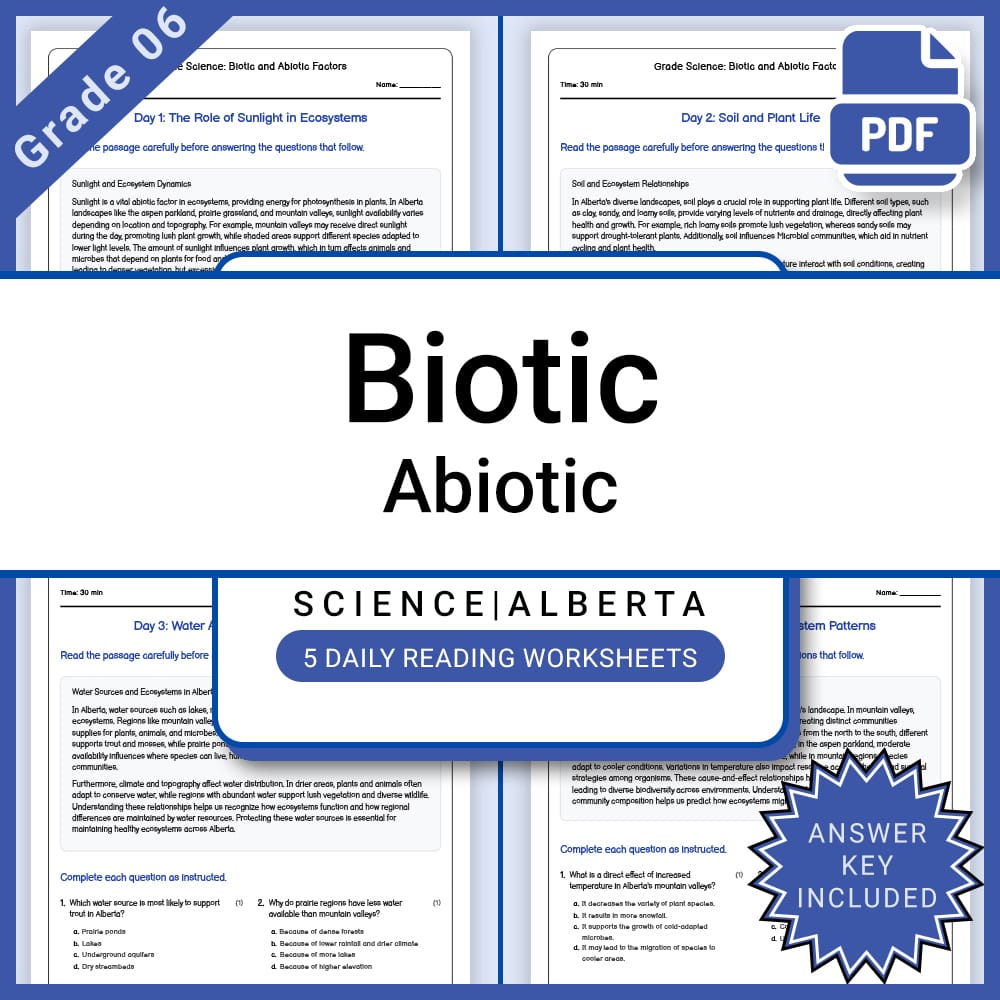
Grade 7 Science – Biotic and Abiotic Factors Daily Worksheet + Answer Key
JCreated byJ.S SheetsLearning Objectives
- Understand key concepts related to Science
- Apply knowledge through practice questions
- Demonstrate comprehension of the material
Also included in: Grade 7 Science Lesson Group Bundle | Ecology, Environment & Sustainability +1 more
Instant download
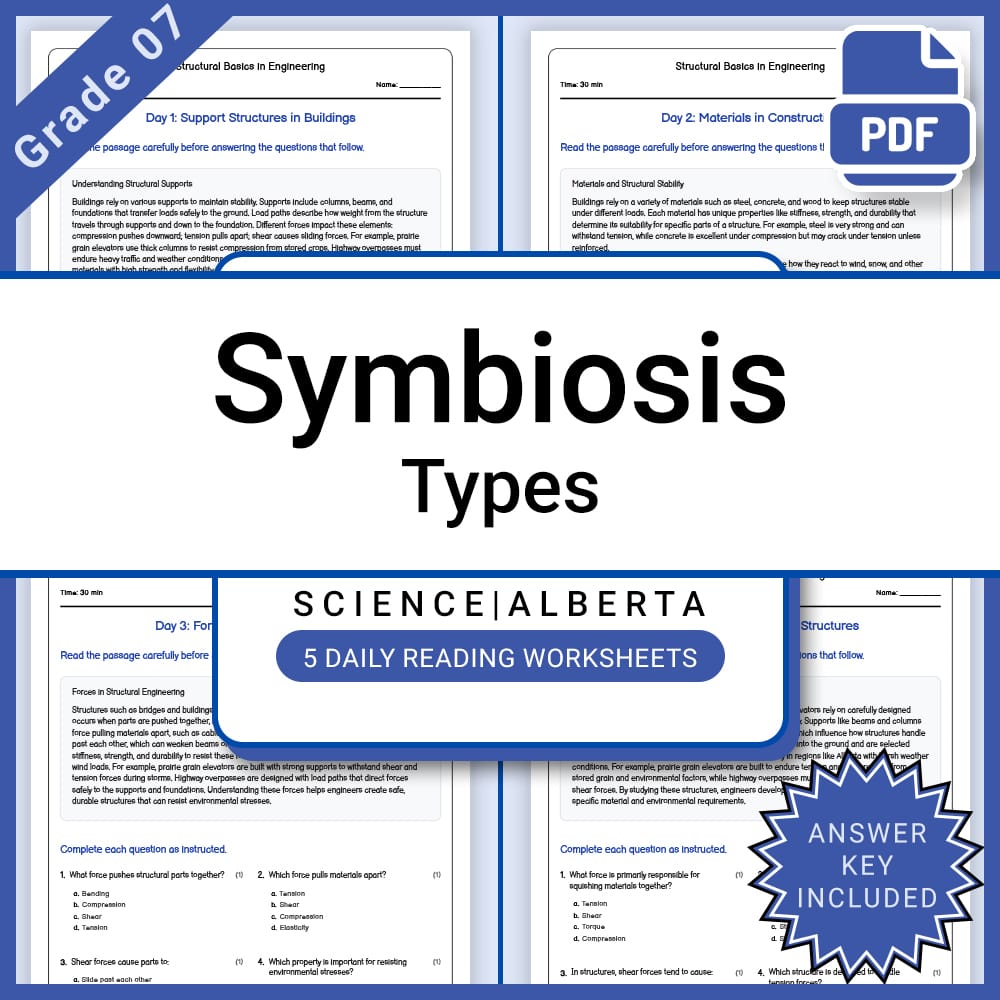
Grade 7 Science – Symbiosis Types in Ecology Daily Worksheet + Answer Key
JCreated byJ.S SheetsLearning Objectives
- Understand the different types of symbiotic relationships: mutualism, commensalism, and parasitism.
- Identify examples of mutualism, especially pollinator-plant interactions, from regional habitats.
- Describe ecological consequences of symbiosis on community structure and population dynamics.
Also included in: Grade 7 Science Lesson Group Bundle | Ecology, Environment & Sustainability +1 more
Instant download

Grade 7 Species Interactions Worksheet | NGSS Practice PDF
 Created byClear Sky Classroom
Learning Objectives
- Describe different types of species interactions such as predation, competition, parasitism, mutualism, and commensalism.
- Analyze food web diagrams to understand direct and indirect effects among species.
- Identify examples of species interactions in terrestrial and aquatic ecosystems.
Also included in: Grade 7 Ecosystems Interactions Energy Dynamics Science Lesson Bundle: NGSS +1 more
Instant download

Grade 7 Disturbance Effects Worksheet | NGSS Practice PDF
Created byClear Sky ClassroomLearning Objectives
- Understand how physical and biological disturbances impact ecosystems.
- Identify examples of disturbances such as wildfire, flooding, invasive species, and disease outbreaks.
- Explain mechanisms of resilience, resistance, and succession in ecosystem recovery.
Also included in: Grade 7 Ecosystems Interactions Energy Dynamics Science Lesson Bundle: NGSS +1 more
Instant download
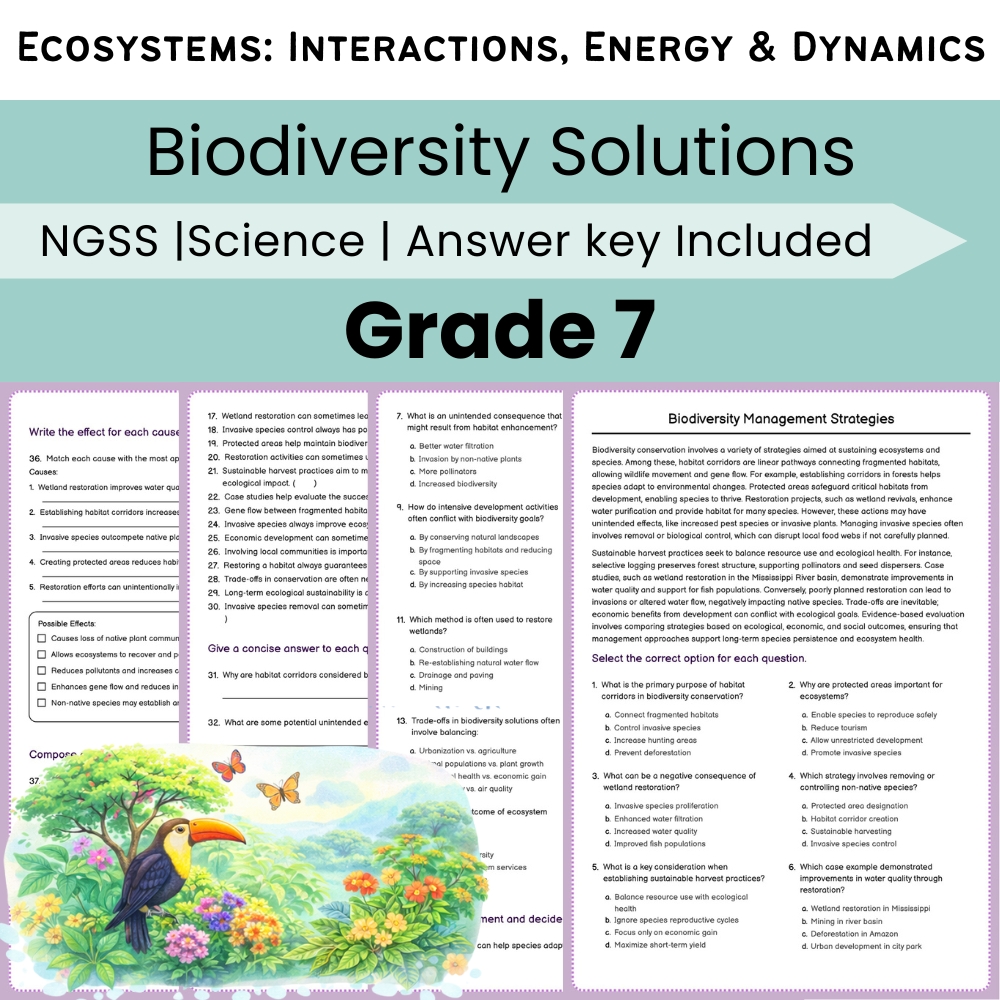
Biodiversity Management Strategies Worksheet | Grade 7 Science Printable PDF
Learning Objectives
- Understand different management strategies for maintaining biodiversity and ecosystem services.
- Evaluate benefits and unintended consequences of habitat corridors, protected areas, and restoration efforts.
- Compare ecological, economic, and social trade-offs in biodiversity solutions.
Also included in: Grade 7 Science Ecosystems Lesson Bundle | NGSS Interactions & Energy +1 more
Instant download
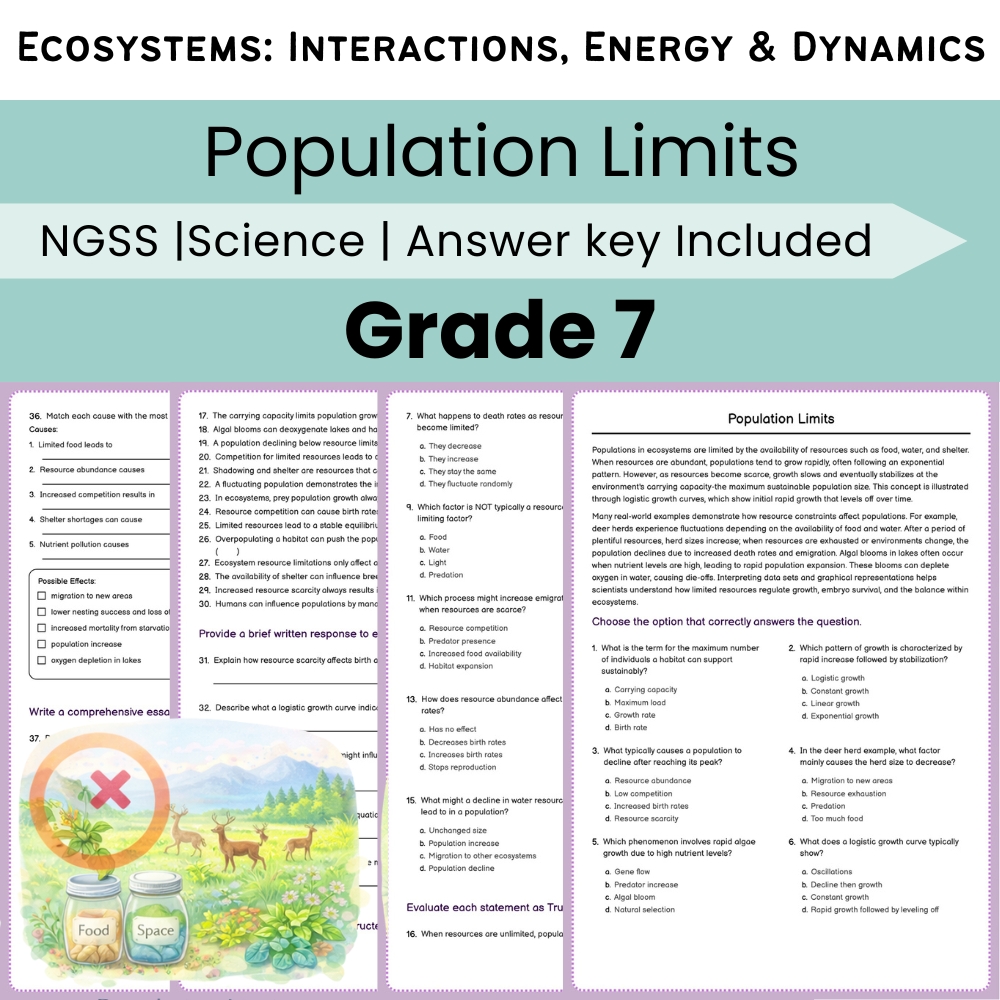
Population Limits Worksheet | Grade 7 Science Printable PDF Assessment
Learning Objectives
- Analyze how resource availability influences population size and growth rates.
- Interpret data sets and graphs related to ecosystem resource constraints.
- Understand the concepts of carrying capacity, logistic growth, and their effects on populations.
Also included in: Grade 7 Science Ecosystems Lesson Bundle | NGSS Interactions & Energy +1 more
Instant download
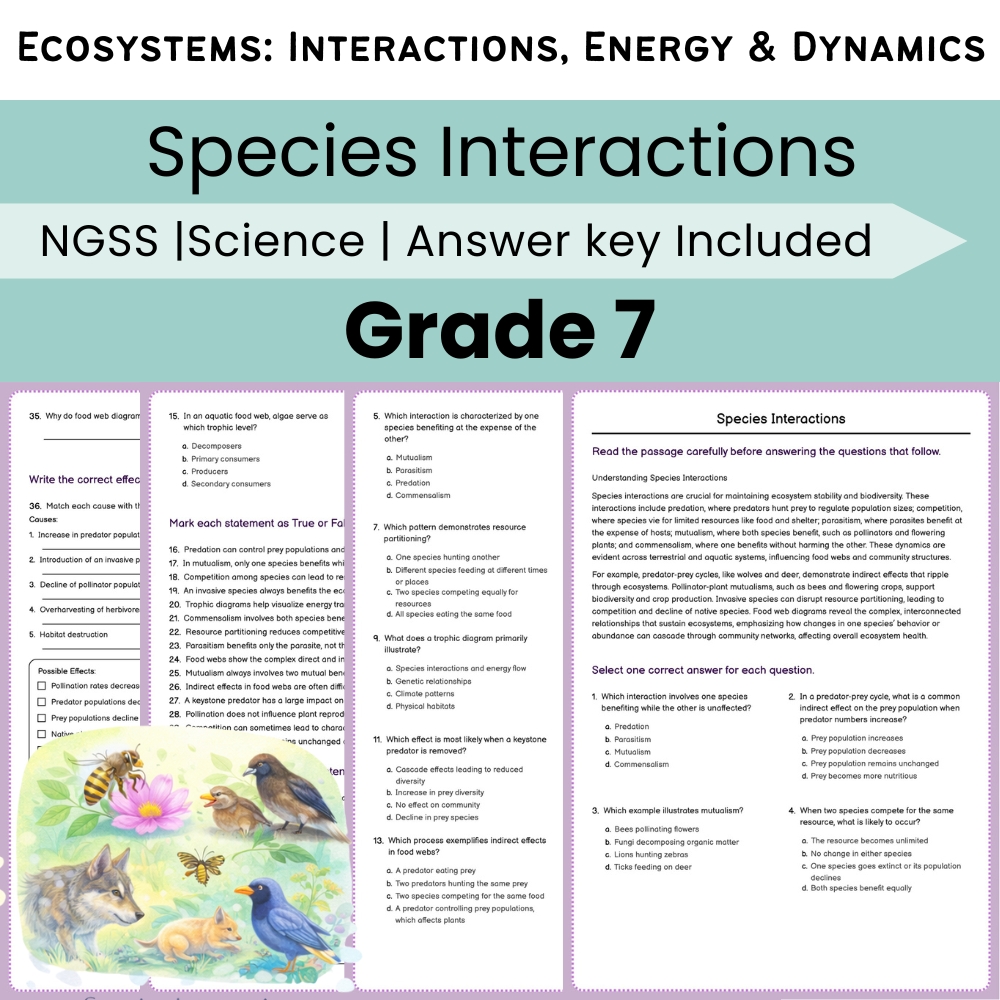
Species Interactions Worksheet | Grade 7 Science Assessment PDF
Learning Objectives
- Understand different patterns of species interactions such as predation, competition, parasitism, mutualism, and commensalism across ecosystems.
- Explain how direct and indirect effects influence food webs and community structure.
- Analyze examples like predator–prey cycles and pollinator-plant relationships to illustrate interaction dynamics.
Also included in: Grade 7 Science Ecosystems Lesson Bundle | NGSS Interactions & Energy +1 more
Instant download
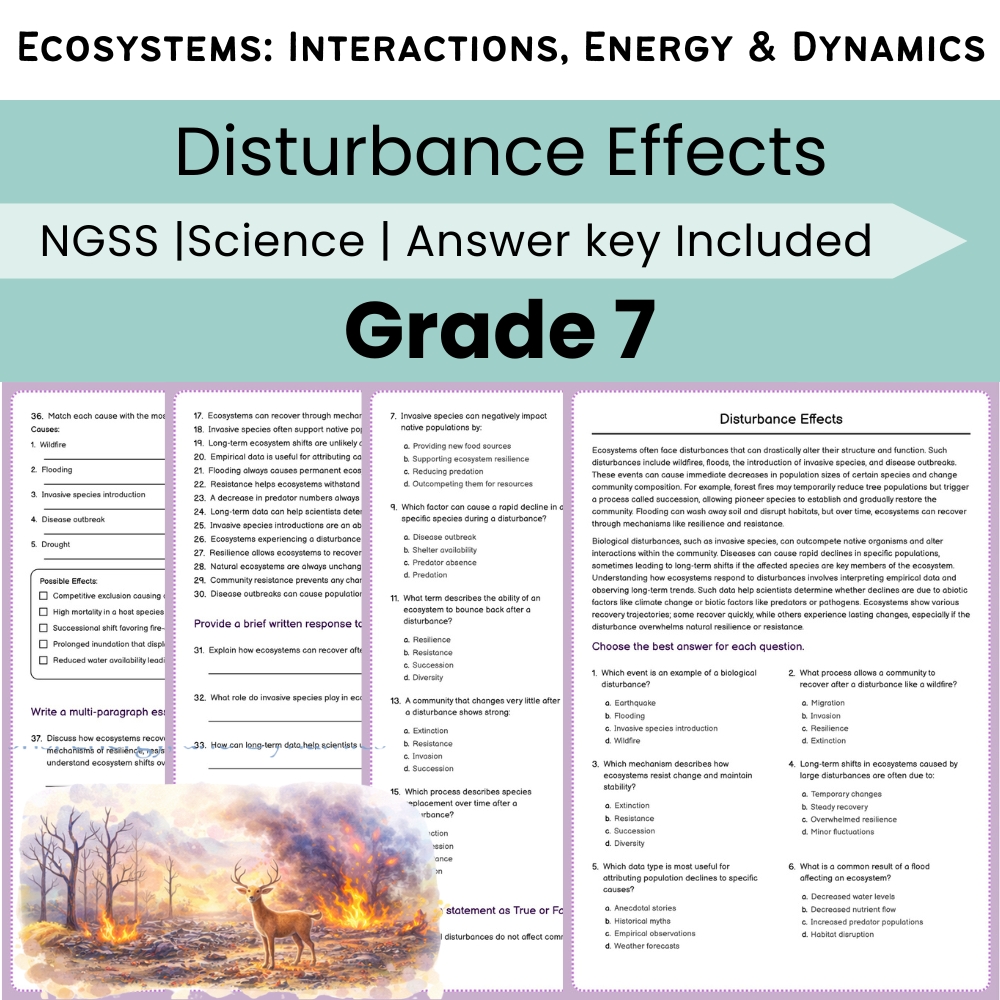
Disturbance Effects Worksheet | Grade 7 Science Printable PDF Assessment
Learning Objectives
- Understand how physical and biological disturbances impact ecosystems.
- Identify mechanisms of ecological resilience, resistance, and succession.
- Interpret empirical data and observations to determine causes of population changes.
Also included in: Grade 7 Science Ecosystems Lesson Bundle | NGSS Interactions & Energy +1 more
Instant download
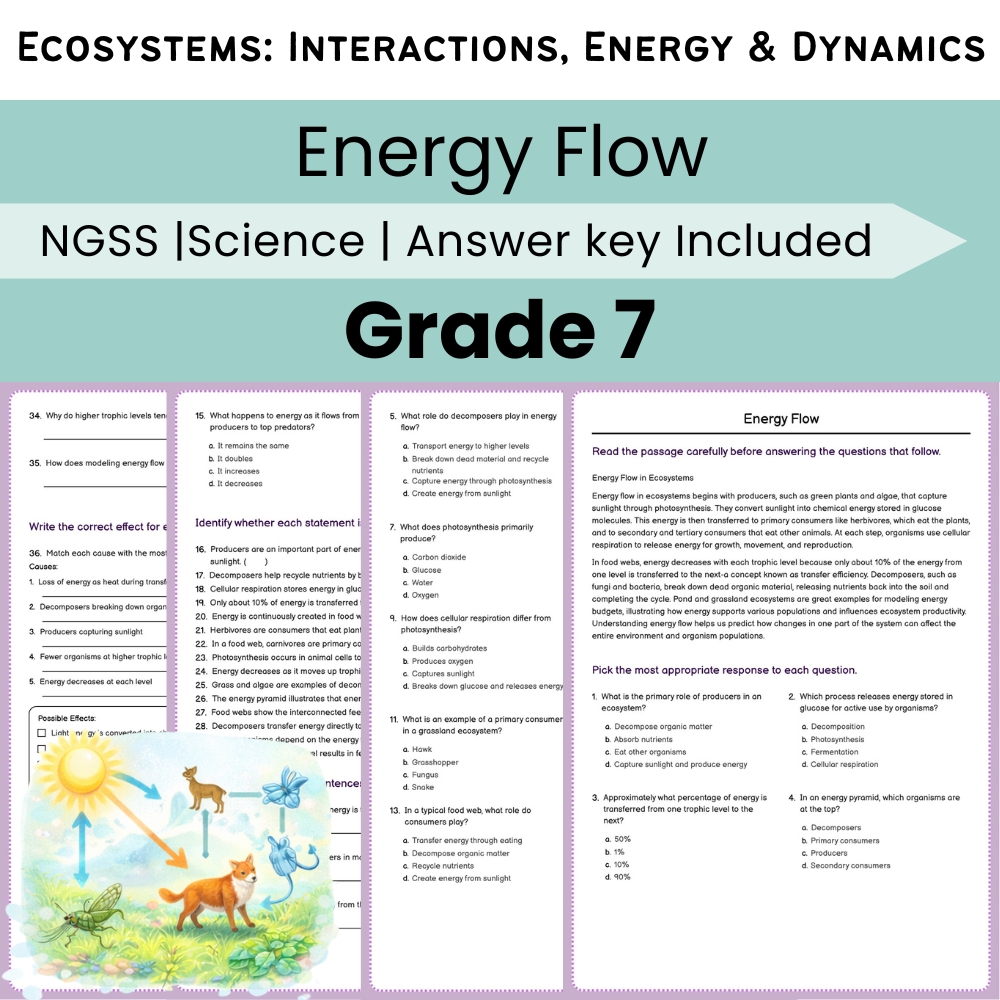
Energy Flow Worksheet for Grade 7 Science | NGSS Assessment & Student Practice
Learning Objectives
- Describe how energy transfers through different trophic levels in ecosystems.
- Explain the roles of producers, consumers, and decomposers in energy pyramids and food webs.
- Analyze the processes of photosynthesis and cellular respiration as mechanisms for energy capture and release.
Also included in: Grade 7 Science Ecosystems Lesson Bundle | NGSS Interactions & Energy +1 more
Instant download
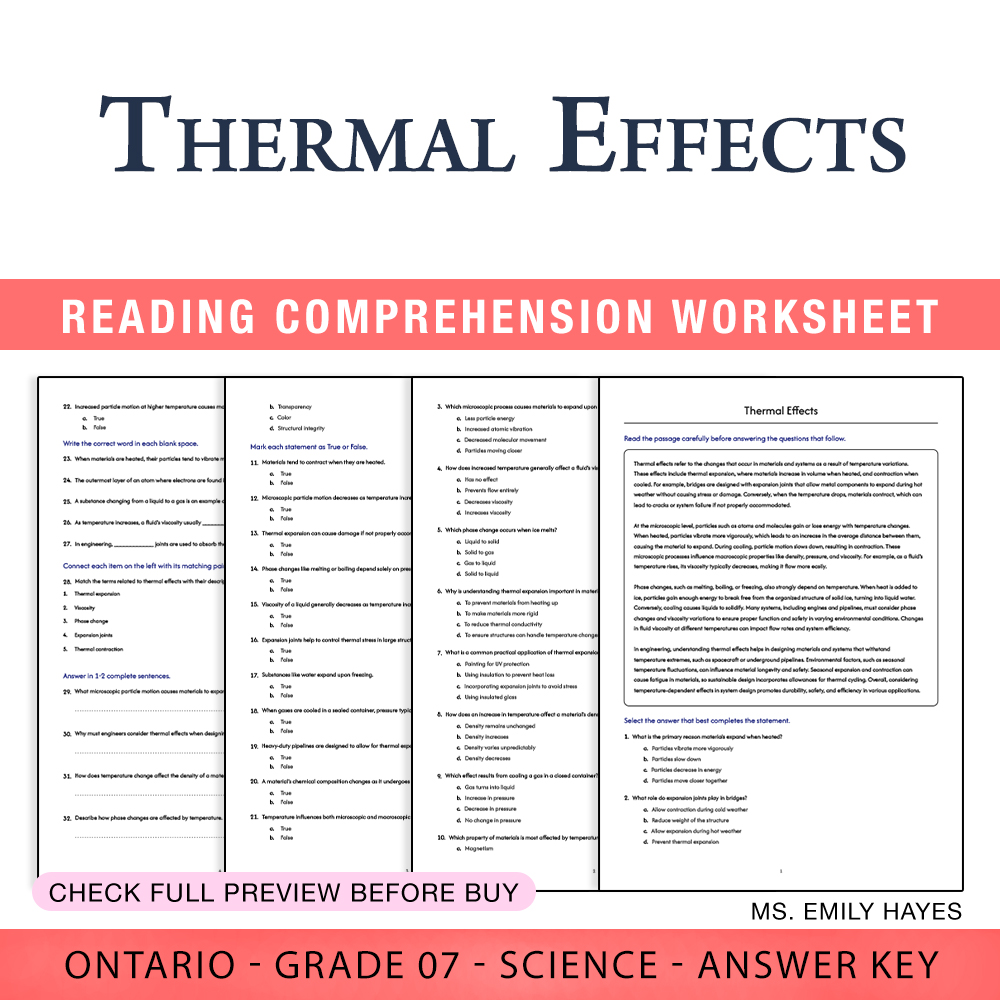
7th Grade Science | Thermal Effects Worksheet (PDF+ Answer Key)
 Created byCopper Leaf Classroom
Learning Objectives
- Understand how temperature changes cause materials to expand, contract, and change phases.
- Connect microscopic particle motion to observable macroscopic effects like volume change and viscosity variation.
- Recognize how thermal effects influence system behavior and material performance in engineering and environmental contexts.
Instant download

Grade 7 Science | Transfer Mechanisms and Forms | Florida NGSSS Aligned
 Created byLumora Learning
Learning Objectives
- Explain how energy transfers through conduction, convection, and radiation
- Identify which energy transfer mechanism is most likely occurring in everyday situations
- Describe how energy can transform from one form to another in common devices
Instant download
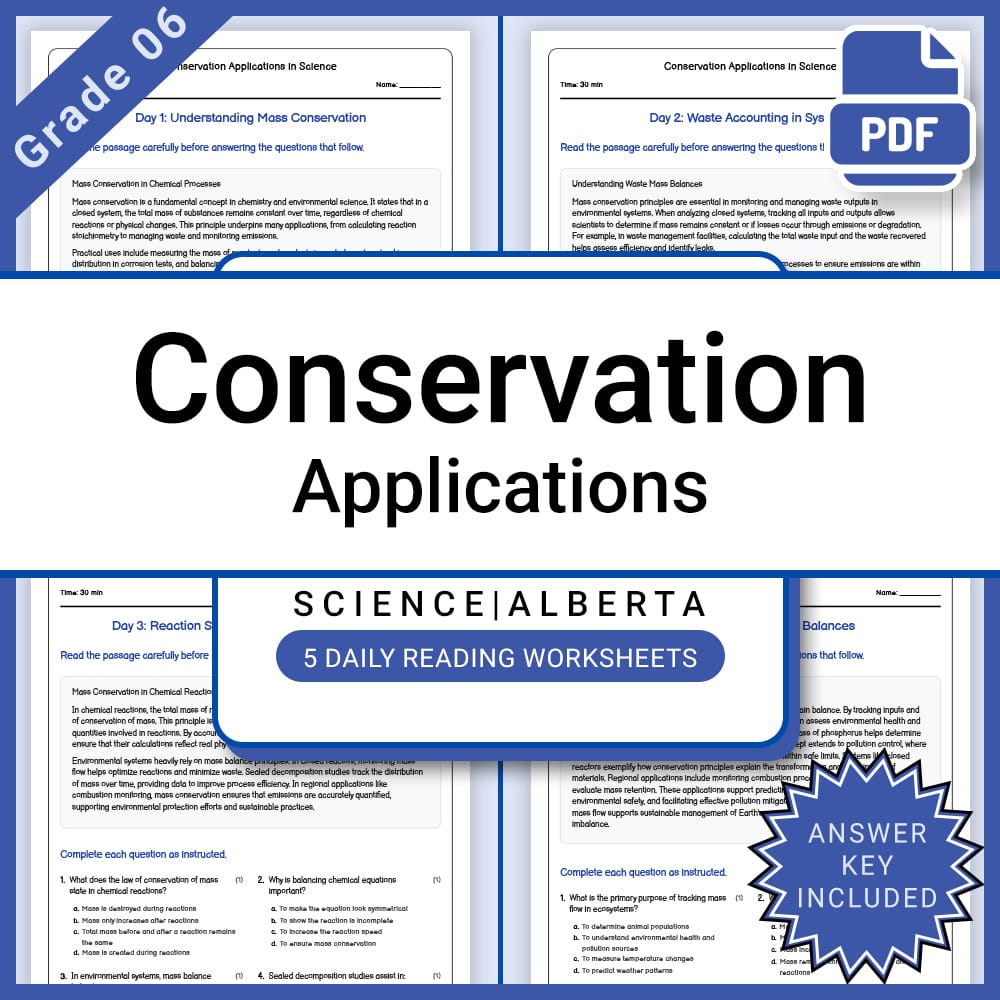
Grade 7 Science – Conservation Applications Daily Reading Worksheet + Answer Key
JCreated byJ.S SheetsLearning Objectives
- Understand the principle of mass conservation in chemical reactions.
- Identify practical applications of mass balance in environmental systems.
- Analyze real-world examples of conservation principles in closed systems.
Also included in: Grade 7 Science Lesson Bundle | Alberta Framework for Classroom Use +1 more
Instant download
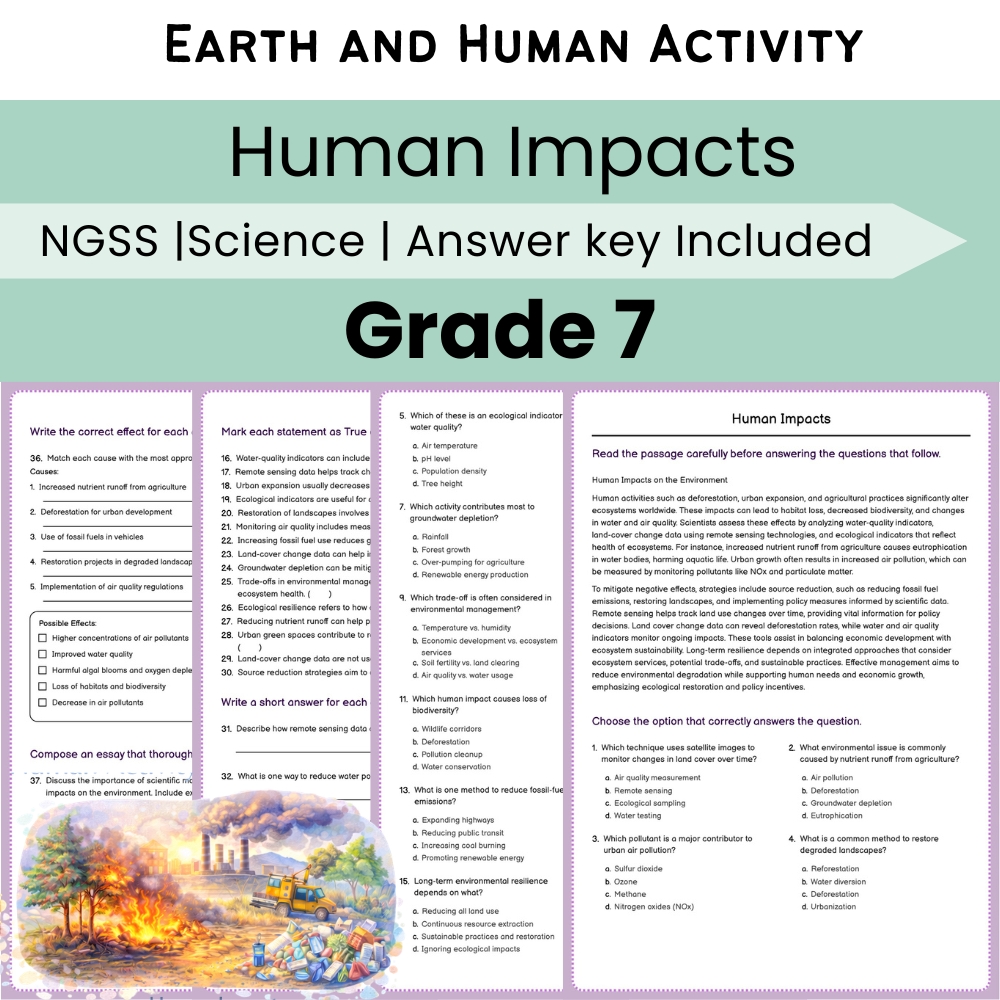
Human Impacts Science Worksheet | Grade 7 NGSS Assessment & Student Practice
Learning Objectives
- Understand how human activities impact the environment and monitor these effects using scientific methods.
- Identify techniques like water-quality analysis, remote sensing, and ecological indicators used for environmental assessment.
- Evaluate mitigation strategies to reduce human impacts while balancing economic and ecological needs.
Also included in: Grade 7 Science Lesson Bundle | Earth and Human Activity NGSS +1 more
Instant download

Grade 7 Human Impacts Worksheet | NGSS Practice PDF
Created byClear Sky ClassroomLearning Objectives
- Understand how human activities affect ecosystems and environment.
- Identify scientific tools used to monitor environmental changes.
- Analyze mitigation strategies for reducing human impacts.
Also included in: Grade 7 Ecosystems & Human Impacts Science Lesson Bundle Worksheet B (NGSS) +1 more
Instant download
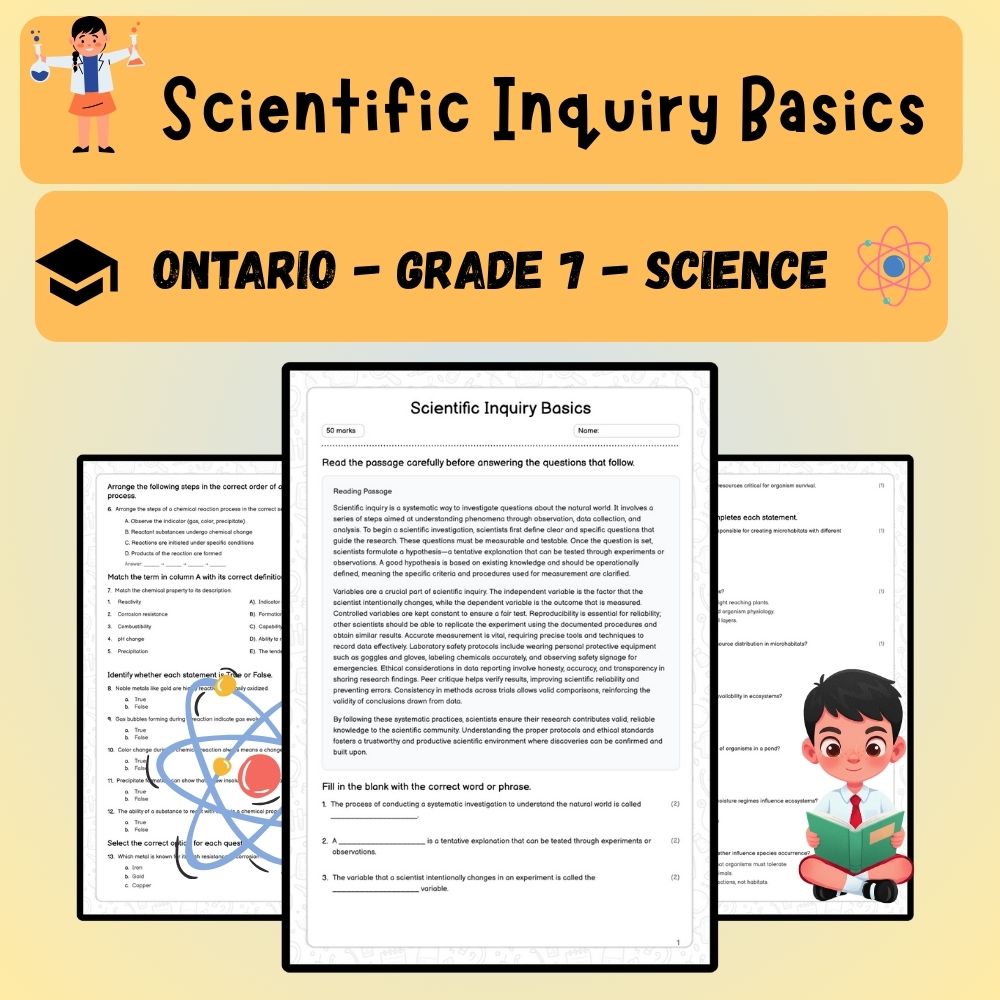
Grade 7 Science | Scientific Inquiry Basics Worksheet (PDF )
 Created byPrism Point Learning
Learning Objectives
- Understand the fundamental steps of the scientific inquiry process, including question formulation and hypothesis development.
- Recognize the importance of operational definitions, variables, and reproducibility in experiments.
- Learn basic laboratory safety protocols such as proper measurement, documentation, and safety sign recognition.
Also included in: Grade 7 Science UNIT Worksheet Bundle – Scientific Inquiry & Data Skills (PDF) +1 more
Instant download
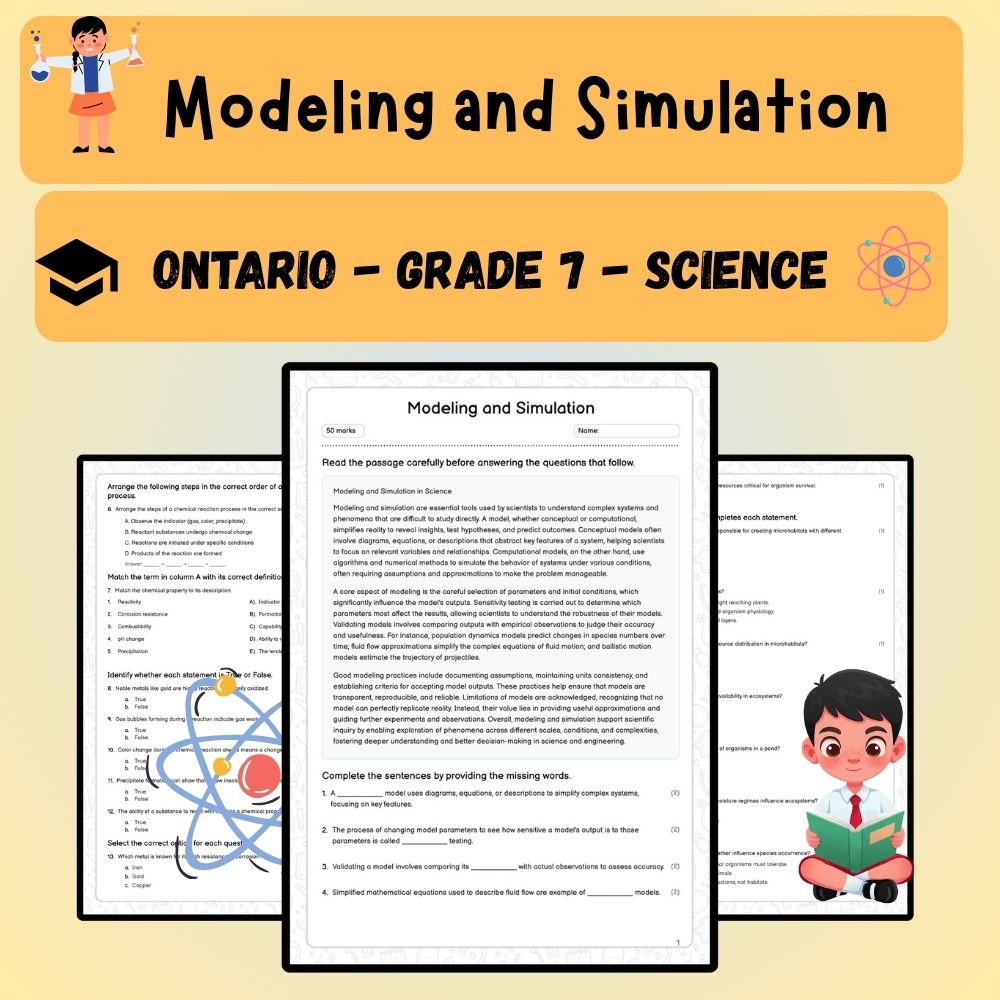
Grade 7 Science | Modeling & Simulation Worksheet (PDF )
Created byPrism Point LearningLearning Objectives
- Understand the principles of conceptual and computational modeling in science.
- Identify assumptions and parameters in different models.
- Evaluate the accuracy and limitations of models through sensitivity testing.
Also included in: Grade 7 Science UNIT Worksheet Bundle – Scientific Inquiry & Data Skills (PDF) +1 more
Instant download
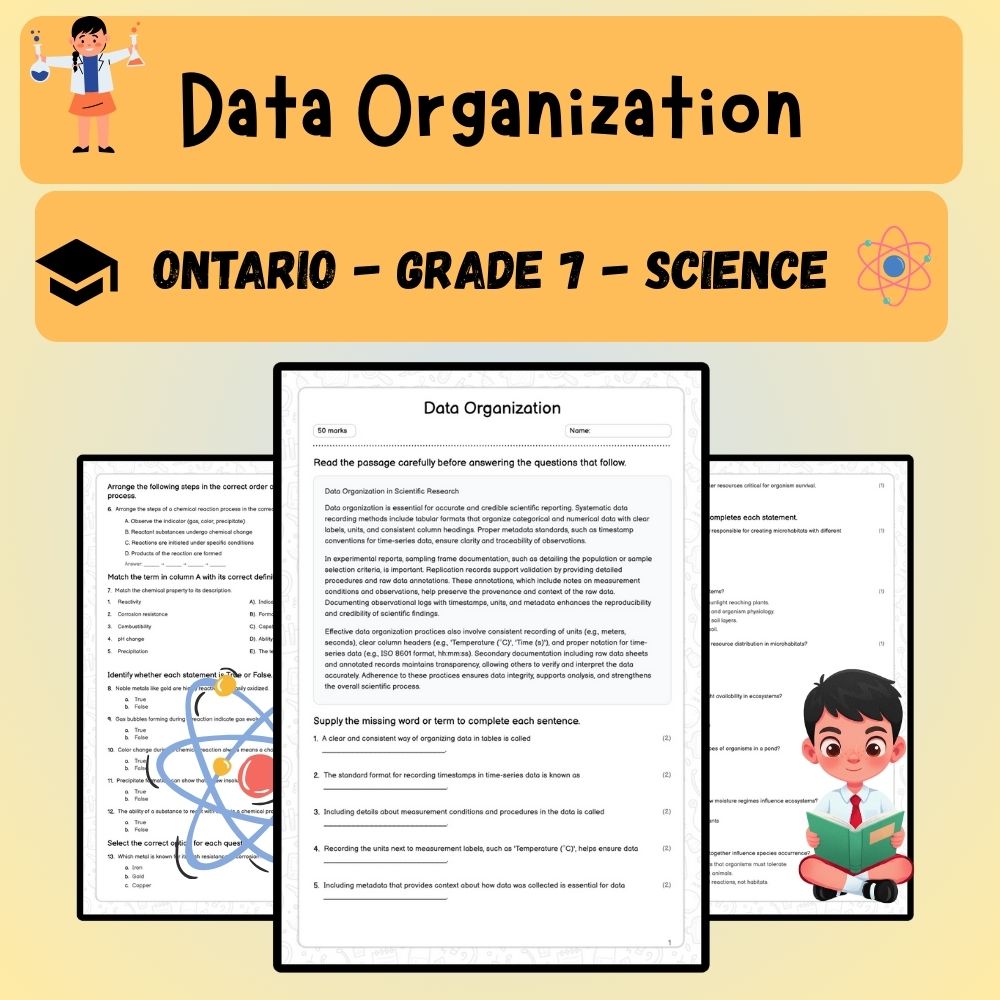
Grade 7 Science | Data Organization Worksheet (PDF) – Ontario Standards
Created byPrism Point LearningLearning Objectives
- Understand various methods of systematic data recording in scientific research.
- Identify appropriate formats, units, and documentation standards for data presentation.
- Apply logical sequencing and matching techniques to organize observational data.
Also included in: Grade 7 Science UNIT Worksheet Bundle – Scientific Inquiry & Data Skills (PDF) +1 more
Instant download
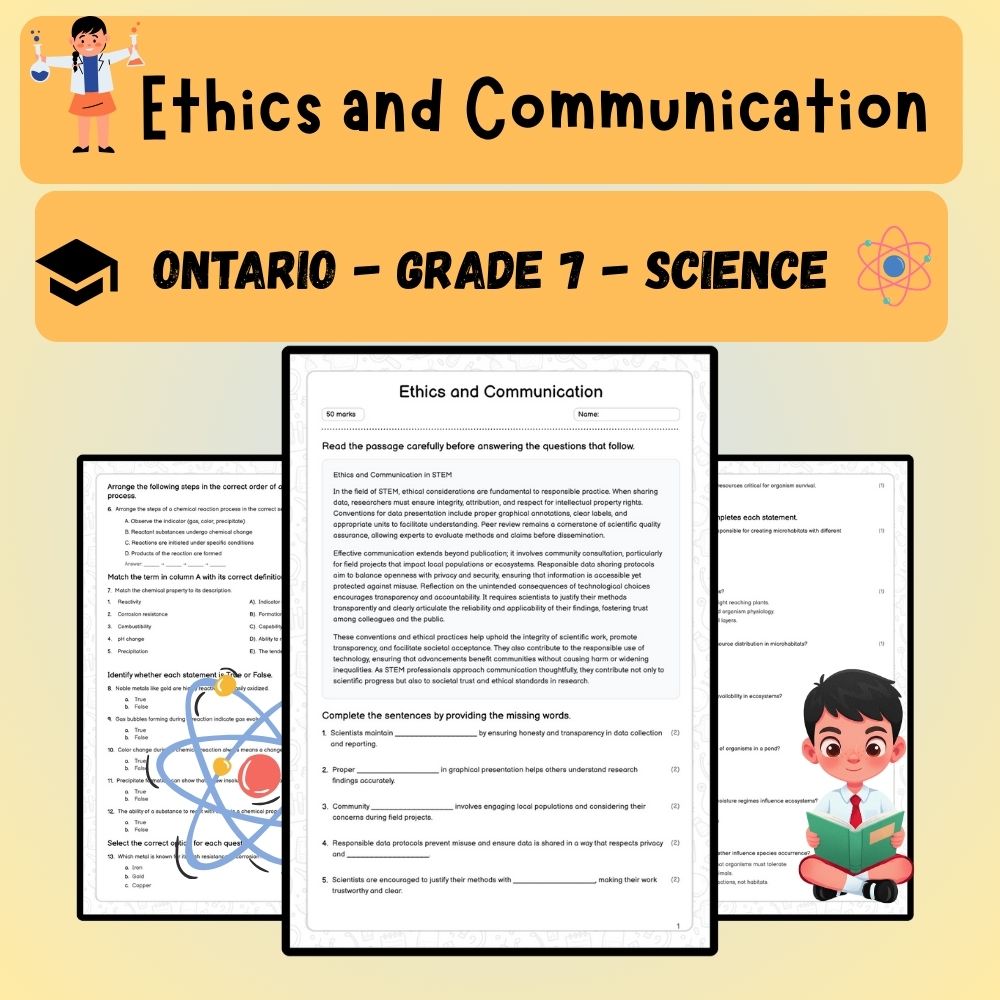
Grade 7 Science | Ethics & Communication Worksheet (PDF )
Created byPrism Point LearningLearning Objectives
- Understand the importance of ethical considerations in STEM communication and data sharing.
- Recognize conventions for technical reporting, graphical annotation, peer review, and public presentation.
- Analyze community consultation, responsible data protocols, and reflections on unintended consequences of technology.
Also included in: Grade 7 Science UNIT Worksheet Bundle – Scientific Inquiry & Data Skills (PDF) +1 more
Instant download
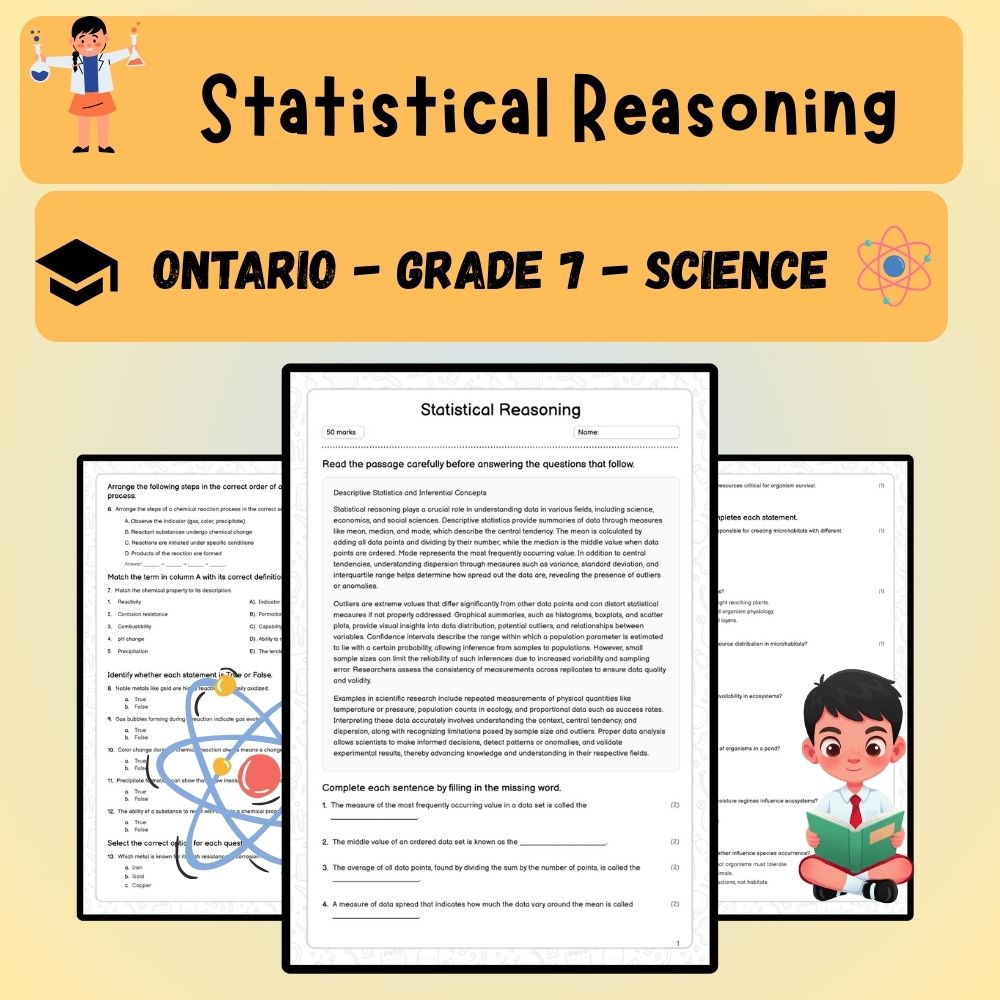
Grade 7 Science – Statistical Reasoning Worksheet (PDF ) – Ontario Standards
Created byPrism Point LearningLearning Objectives
- Understand and explain the concepts of mean, median, and mode in data analysis.
- Interpret and analyze measures of dispersion such as interquartile range, variance, and outliers.
- Apply graphical summaries and interpret their implications for data understanding.
Also included in: Grade 7 Science UNIT Worksheet Bundle – Scientific Inquiry & Data Skills (PDF) +1 more
Instant download
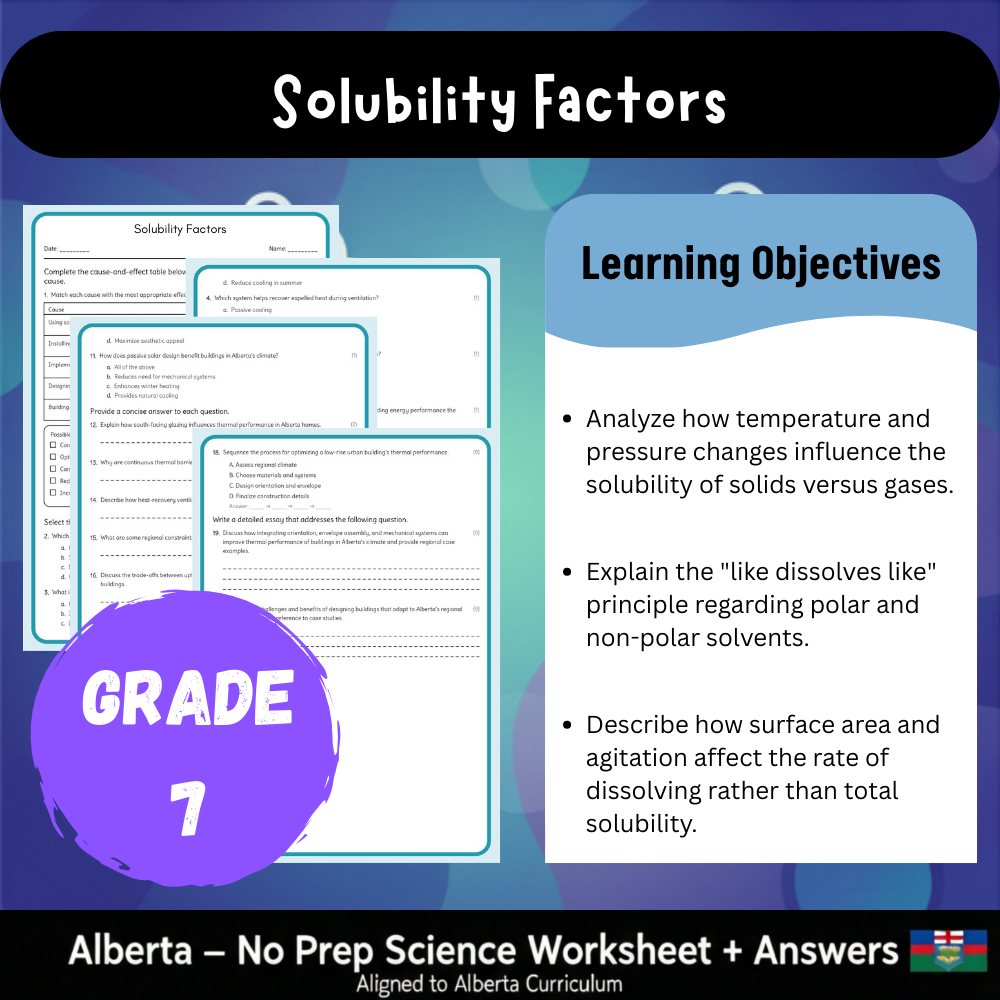
Grade 7 Science – Solubility Factors Worksheet (PDF) for Alberta Standards
 Created byBright Mind Resources
Learning Objectives
- Identify the variables that affect solubility in different conditions.
- Explain how temperature, pressure, and surface area influence the amount of solute dissolved.
- Describe real-world examples demonstrating the impact of solubility factors.
Instant download
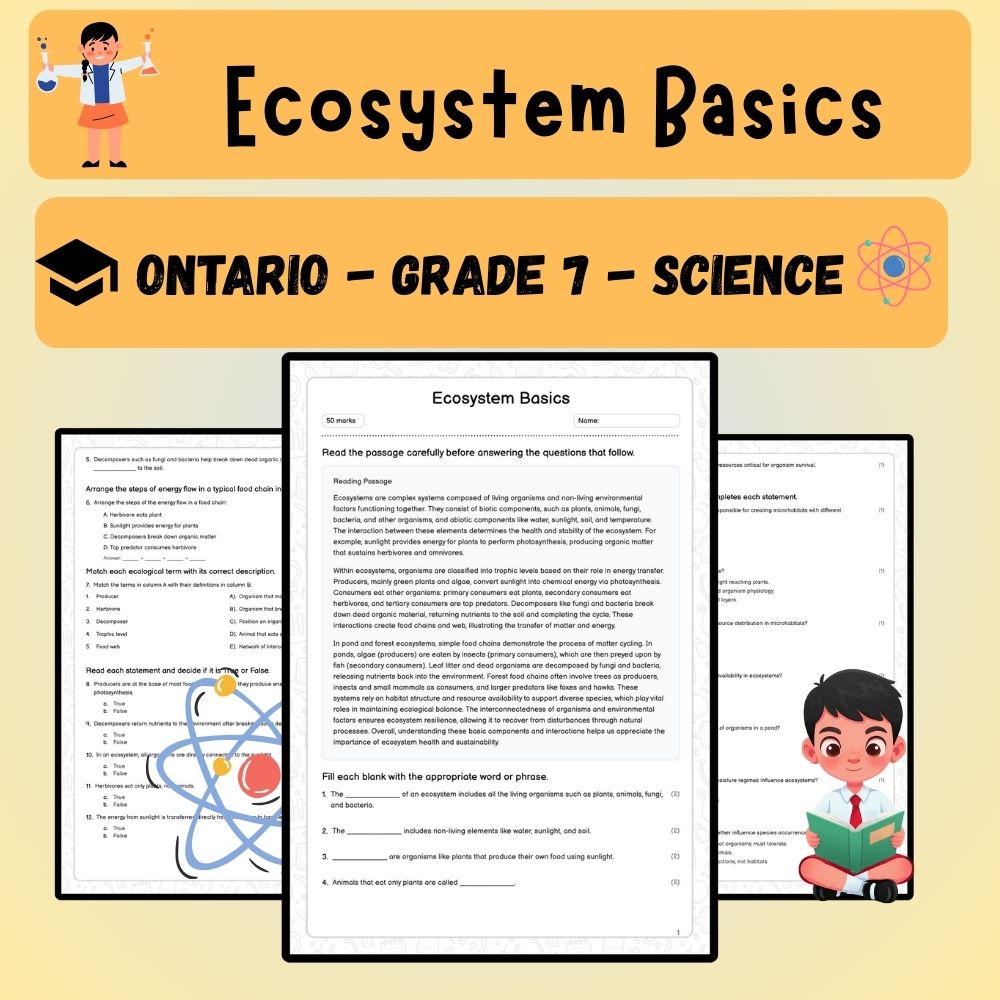
Grade 7 Science | Ecosystem Basics Worksheet (PDF ) – Ontario Standards
Created byPrism Point LearningLearning Objectives
- Understand the components and roles of biotic and abiotic elements in ecosystems.
- Identify trophic categories such as producers, consumers, and decomposers and their energy flow.
- Analyze simple food chains and the cycling of matter in pond and forest ecosystems.
Also included in: Grade 7 Science UNIT Bundle | Ecosystems & Biodiversity Worksheets +1 more
Instant download

Grade 7 Anatomical Evidence Worksheet NGSS Evolution Activity Answer Key
 Created byNorthstar Worksheets
Learning Objectives
- Explain how homologous and analogous structures provide evidence for evolution
- Use comparative anatomical features (limb bones, skull shape, vestigial organs) to infer evolutionary relationships
- Connect morphological comparisons with basic genetics and paleontology evidence to support phylogenetic ideas
Also included in: Grade 7 Evolution Evidence & Patterns Lesson Bundle | NGSS Science +1 more
Instant download

Grade 7 Species Interactions Worksheet | NGSS Ecosystems & Food Webs Activity
Created byNorthstar WorksheetsLearning Objectives
- Explain how predation, competition, parasitism, mutualism, and commensalism affect populations in terrestrial and aquatic ecosystems.
- Use food webs and trophic diagrams to describe direct and indirect (cascading) effects of species interactions.
- Interpret evidence-based claims about interaction strength changes, including examples of predator–prey cycles and invasive species.
Also included in: Grade 7 Ecosystems & Food Webs Lesson Bundle | Science | ngss +1 more
Instant download

Grade 7 Natural Selection Worksheet NGSS Evolution Activity Answer Key
Created byNorthstar WorksheetsLearning Objectives
- Explain how heritable variation and environmental pressures can change trait frequencies in populations over generations.
- Describe how differential survival and reproduction lead to adaptation.
- Use examples (such as antibiotic resistance and island finch beak variation) to interpret natural selection.
Also included in: Grade 7 Evolution Evidence & Patterns Lesson Bundle | NGSS Science +1 more
Instant download

Grade 7 Science – Physical Properties & Matter Separation | Reading Worksheet
Created byBright Mind ResourcesLearning Objectives
- Identify different physical properties of matter
- Describe how properties can be used to separate mixtures
- Differentiate between physical and chemical changes in substances
Also included in: Energy Transfer, Sound & Motion Lesson Bundle | Grade 7 Science | General +1 more
Instant download

Grade 7 Quantitative Models Worksheet NGSS Evolution Activity Answer Key
Created byNorthstar WorksheetsLearning Objectives
- Explain how allele frequencies can change over generations using quantitative models.
- Use probability and simple genotype frequency ideas to predict inheritance outcomes.
- Interpret basic Hardy-Weinberg expectations and compare them to observed trait frequencies.
Also included in: Grade 7 Evolution Evidence & Patterns Lesson Bundle | NGSS Science +1 more
Instant download

Grade 7 Fossil Patterns Worksheet NGSS Evolution Activity Answer Key
Created byNorthstar WorksheetsLearning Objectives
- Analyze patterns in the fossil record, including diversity, extinction events, and morphological change over geologic time
- Explain how stratigraphy and index fossils support correlation and inferences about ancestry
- Describe how transitional fossils provide evidence for evolutionary continuity
Also included in: Grade 7 Evolution Evidence & Patterns Lesson Bundle | NGSS Science +1 more
Instant download

Grade 7 Energy Flow Worksheet | NGSS Food Webs, Food Chains & Ecosystems
Created byNorthstar WorksheetsLearning Objectives
- Explain how energy moves through trophic levels in a food web and why decomposers matter for energy flow.
- Describe how photosynthesis captures energy and cellular respiration releases energy in living things.
- Use energy pyramids to model the decrease in available energy between trophic levels and relate this to population size.
Also included in: Grade 7 Ecosystems & Food Webs Lesson Bundle | Science | ngss +1 more
Instant download

Grade 7 Global Circulation Worksheet | NGSS Earth Science Activity with Answer Key
Created byNorthstar WorksheetsLearning Objectives
- Explain how unequal solar heating and Earth’s rotation drive global atmospheric circulation (Hadley, Ferrel, and polar cells).
- Describe how the Coriolis effect shapes prevailing winds and helps form jet streams.
- Connect large-scale ocean circulation (gyres and major currents like the Gulf Stream) to regional climate patterns.
Also included in: Grade 7 Earth Systems Processes Lesson Bundle | NGSS Earth Science +1 more
Instant download

Grade 7 Speciation Processes Worksheet NGSS Evolution Activity Answer Key
Created byNorthstar WorksheetsLearning Objectives
- Explain how reproductive isolation and geographic separation can lead to speciation.
- Describe how polyploidy and adaptive radiation can create new species.
- Interpret biogeographic and diversification patterns to understand biodiversity over time.
Also included in: Grade 7 Evolution Evidence & Patterns Lesson Bundle | NGSS Science +1 more
Instant download

Grade 7 Collisions Worksheet | NGSS Science Forces & Motion Activity
Created byNorthstar WorksheetsLearning Objectives
- Explain how momentum changes when objects collide using the conservation of momentum idea
- Describe how forces act during collisions through Newton’s third law (equal and opposite reactions)
- Distinguish elastic from inelastic collisions and predict likely outcomes
Also included in: Grade 7 Science Forces & Motion Lesson Bundle | NGSS Equilibrium & Collisions +1 more
Instant download

Grade 7 Population Limits Worksheet | NGSS Carrying Capacity & Ecosystems
Created byNorthstar WorksheetsLearning Objectives
- Explain how carrying capacity and resource availability affect population size and growth rate.
- Interpret logistic growth ideas using examples such as limited food, water, and shelter.
- Connect birth, death, immigration, and emigration to population change in ecosystems.
Also included in: Grade 7 Ecosystems & Food Webs Lesson Bundle | Science | ngss +1 more
Instant download
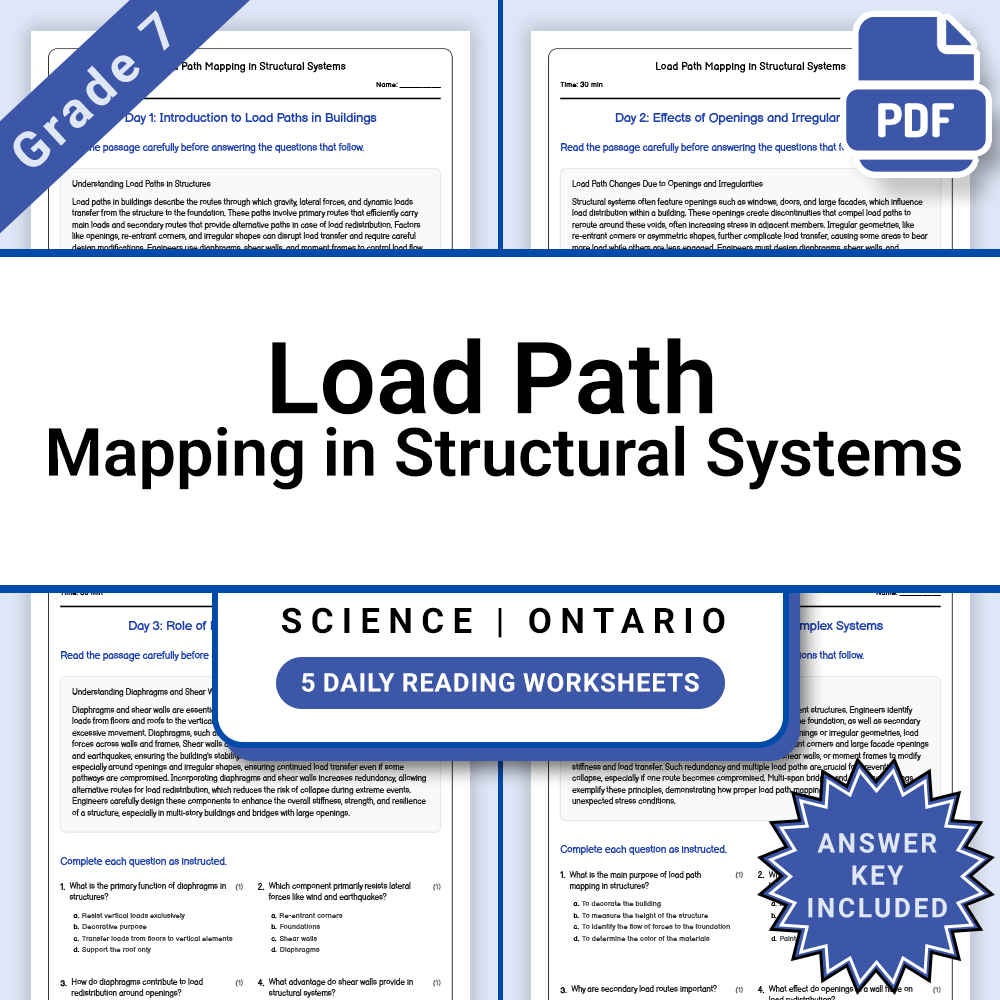
Grade 7 Science – Load Path Mapping Daily Reading Worksheet with Answer Key
JCreated byJ.S SheetsLearning Objectives
- Understand how load paths are transferred in buildings
- Identify primary and secondary load routes
- Recognize factors affecting load redistribution
Also included in: Grade 7 Science Lesson Bundle: Engineering & Structural Materials Ontario +1 more
Instant download
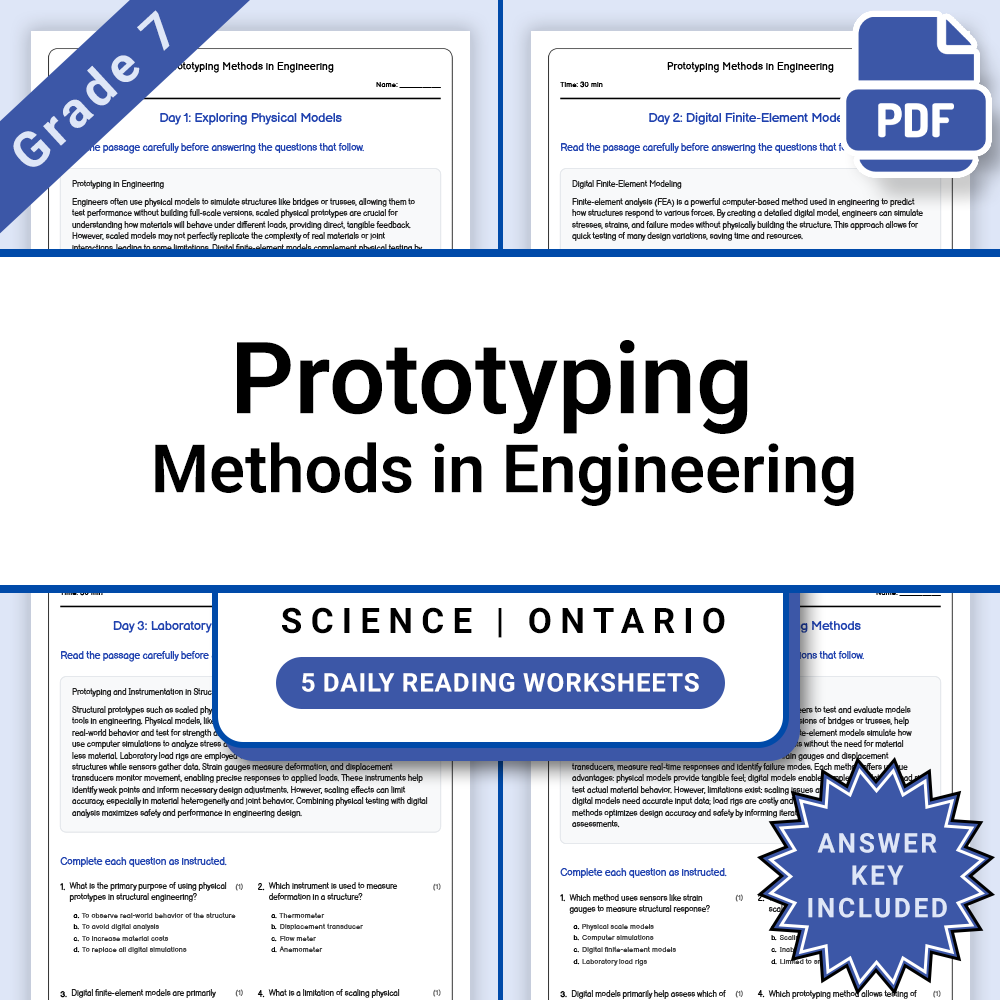
Grade 7 Science – Prototyping Methods in Engineering Worksheet + Answer Key
JCreated byJ.S SheetsLearning Objectives
- Understand different prototyping approaches, including physical models, digital models, and laboratory rigs.
- Identify the advantages and limitations of each prototyping method for testing strength and failure modes.
- Recognize instrumentation tools used in prototyping, such as strain gauges and displacement transducers.
Also included in: Grade 7 Science Lesson Bundle: Engineering & Structural Materials Ontario +1 more
Instant download
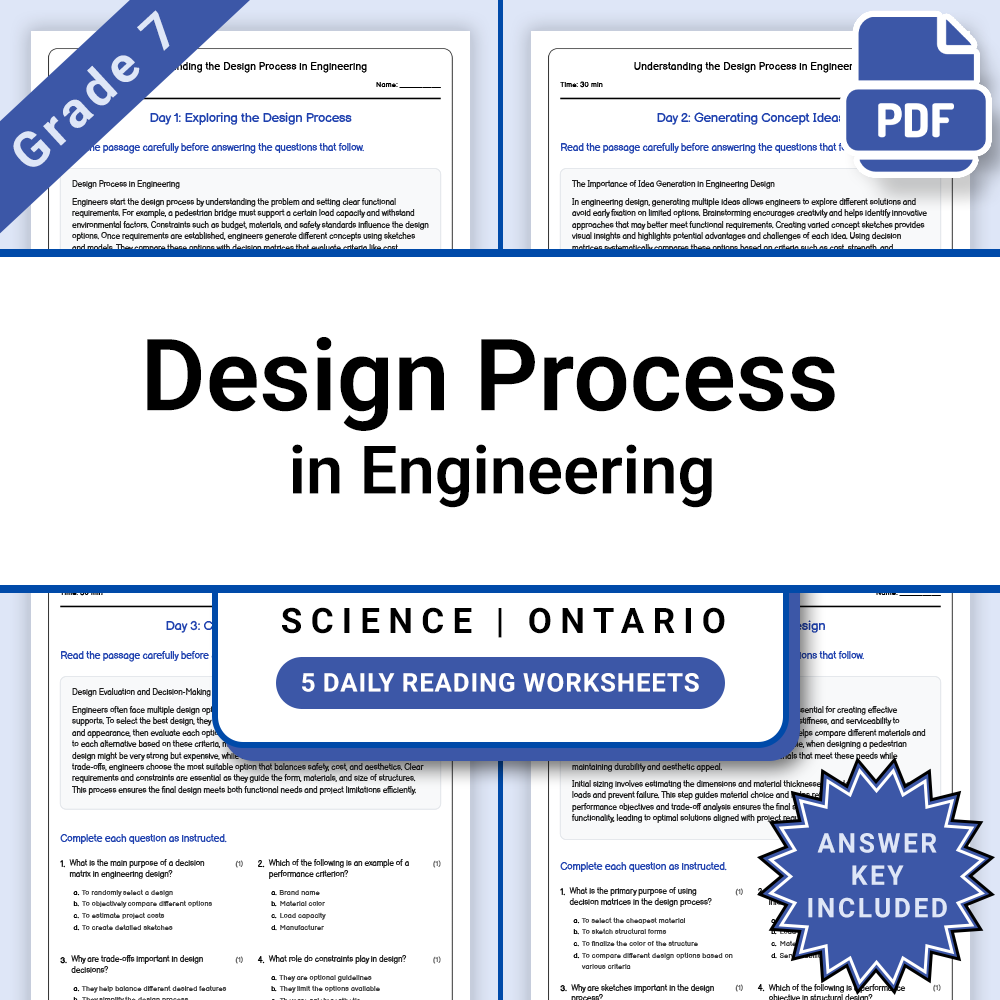
Grade 7 Science – Design Process Daily Reading Worksheet + Answer Key
JCreated byJ.S SheetsLearning Objectives
- Identify the key steps in the engineering design process.
- Explain the importance of defining functional requirements and constraints.
- Describe how sketches and decision matrices assist in comparing design options.
Also included in: Grade 7 Science Lesson Bundle: Engineering & Structural Materials Ontario +1 more
Instant download
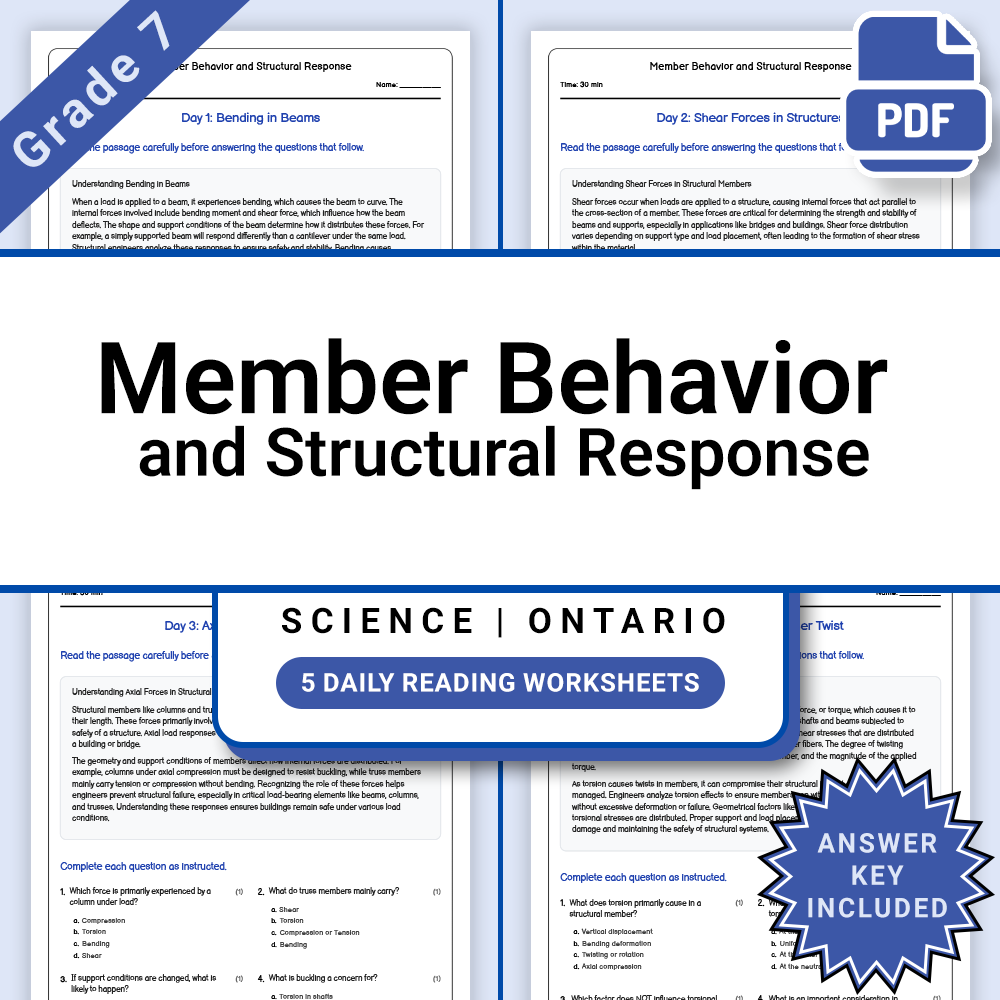
Grade 7 Science Member Behavior and Structural Response Worksheet + Answer Key
JCreated byJ.S SheetsLearning Objectives
- Understand how beams respond to loads through bending, shear, axial force, and torsion.
- Identify the effects of geometry and support conditions on internal force distribution.
- Describe the concepts of bending moment and shear force in beams and cantilevers.
Also included in: Grade 7 Science Lesson Bundle: Engineering & Structural Materials Ontario +1 more
Instant download
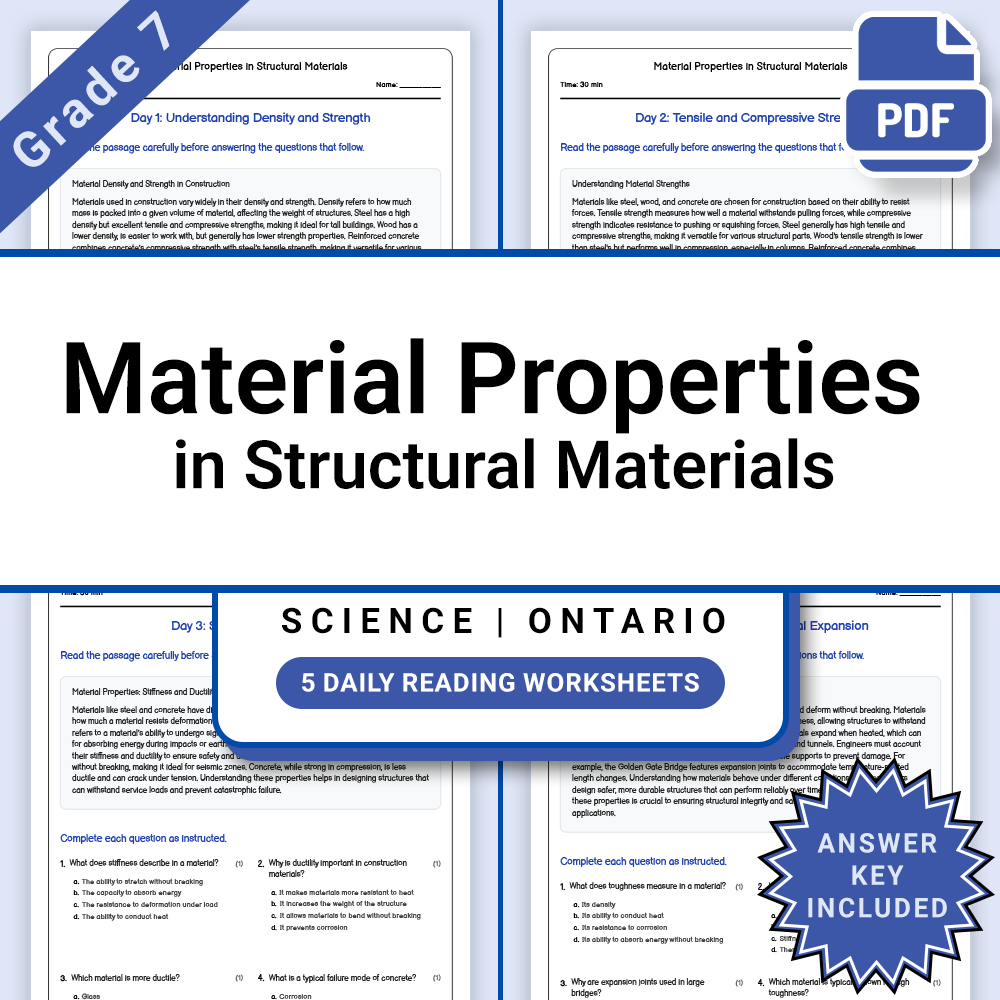
Grade 7 – Material Properties in Structural Materials Worksheet + Answer Key
JCreated byJ.S SheetsLearning Objectives
- Understand the key material properties such as density, tensile strength, compressive strength, stiffness, ductility, toughness, and thermal expansion.
- Learn how these properties affect structural performance, durability, and failure modes.
- Compare common construction materials—wood, steel, and reinforced concrete—in terms of strength-to-weight ratio, deformation, and failure.
Also included in: Grade 7 Science Lesson Bundle: Engineering & Structural Materials Ontario +1 more
Instant download
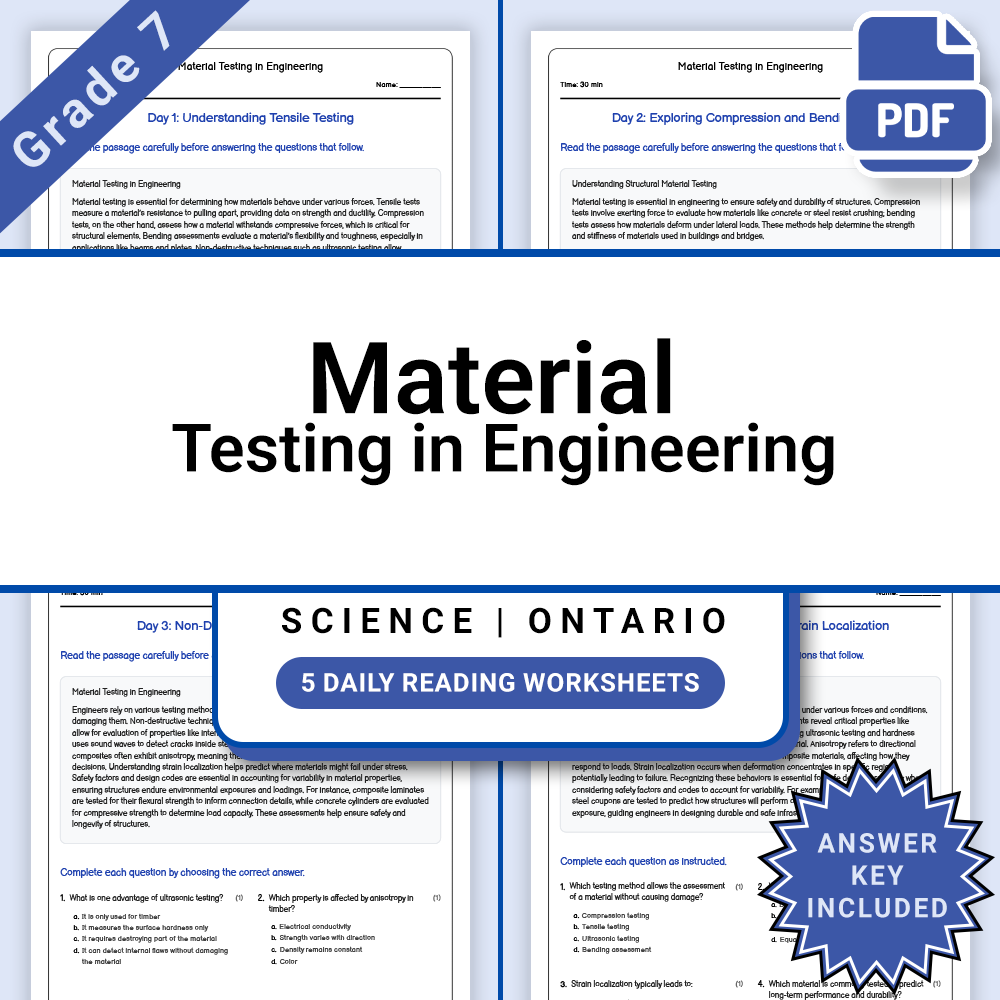
Grade 7 Science – Material Testing in Engineering Daily Worksheet + Answer Key
JCreated byJ.S SheetsLearning Objectives
- Understand the different methods used to test material properties such as tensile, compression, and bending assessments.
- Learn about non-destructive testing techniques like ultrasonic and hardness measurements.
- Explore the concept of anisotropy in timber and composite materials.
Also included in: Grade 7 Science Lesson Bundle: Engineering & Structural Materials Ontario +1 more
Instant download

Grade 7 Science – Durability of Materials Daily Reading Worksheet + Answer Key
JCreated byJ.S SheetsLearning Objectives
- Understand the factors that influence the durability of steel and other materials
- Identify protective measures such as coatings and cathodic protection
- Learn how environmental exposure impacts material lifespan
Also included in: Grade 7 Science Lesson Bundle: Engineering & Structural Materials Ontario +1 more
Instant download
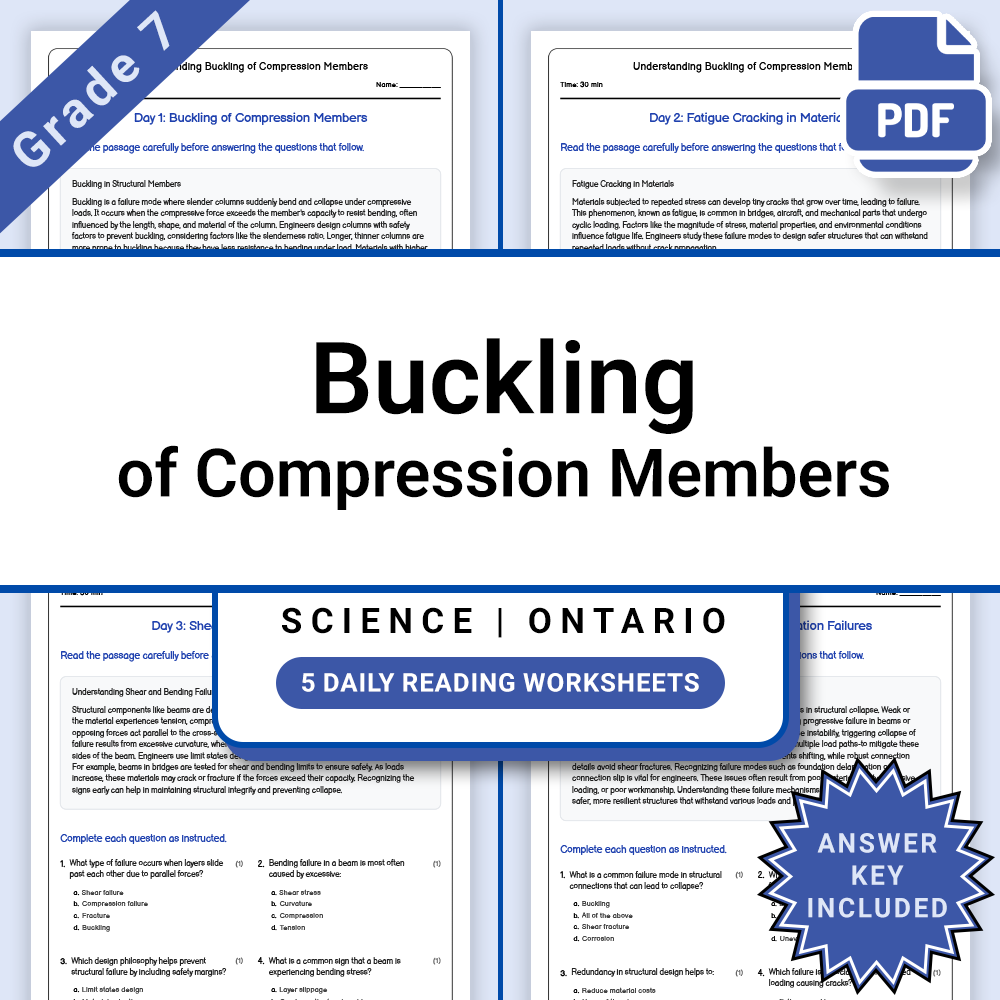
Grade 7 Science – Buckling of Compression Members | Worksheet + Answer Key
JCreated byJ.S SheetsLearning Objectives
- Identify the concept of buckling in slender compression columns.
- Recognize the factors that influence buckling failure in structural members.
- Analyze how material choice and shape affect buckling resistance.
Also included in: Grade 7 Science Lesson Bundle: Engineering & Structural Materials Ontario +1 more
Instant download
About Grade 7 Science Worksheets
Browse 6,039 printable Grade 7 Science worksheets — ready-to-print PDFs with answer keys where available.
Every worksheet on MyTeachingSheets is created by independent teacher-authors and reviewed before publication. All resources download as printable PDFs for classroom, homework, or at-home practice, and many include answer keys. Preview any worksheet free before buying.