
Grade 7 Science Worksheets
6,039 worksheets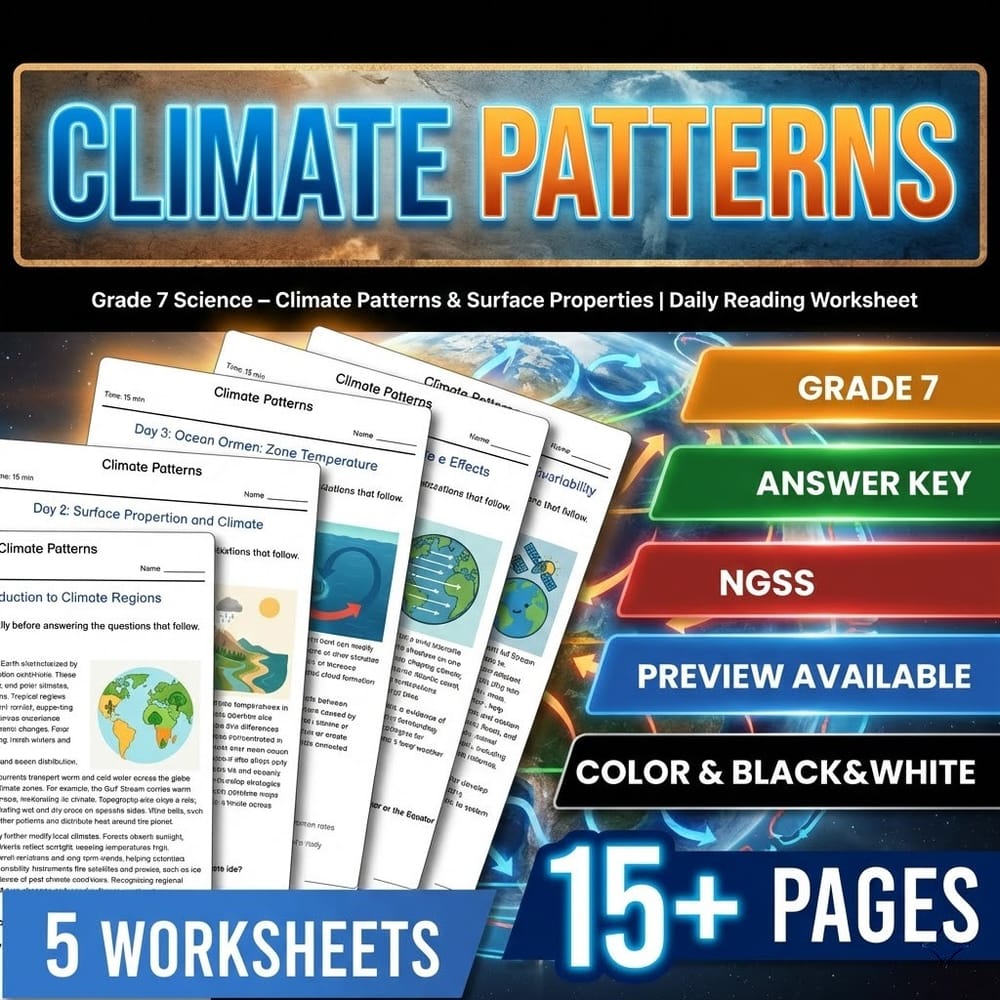
Grade 7 Science – Climate Patterns & Surface Properties |Daily Reading Worksheet
 Created byElena Brooks
Learning Objectives
- Understand the basic concepts of climate zones and how they are characterized by temperature and precipitation.
- Recognize the influence of ocean currents, topography, and atmospheric circulation on regional climate differences.
- Interpret temperature maps, wind vectors, and precipitation records to analyze climate variability and phenomena like El Niño and monsoon regimes.
Also included in: Water Cycle & Landforms Grade 7 Science Daily Reading Worksheets Bundle | NGSS +1 more
Instant download
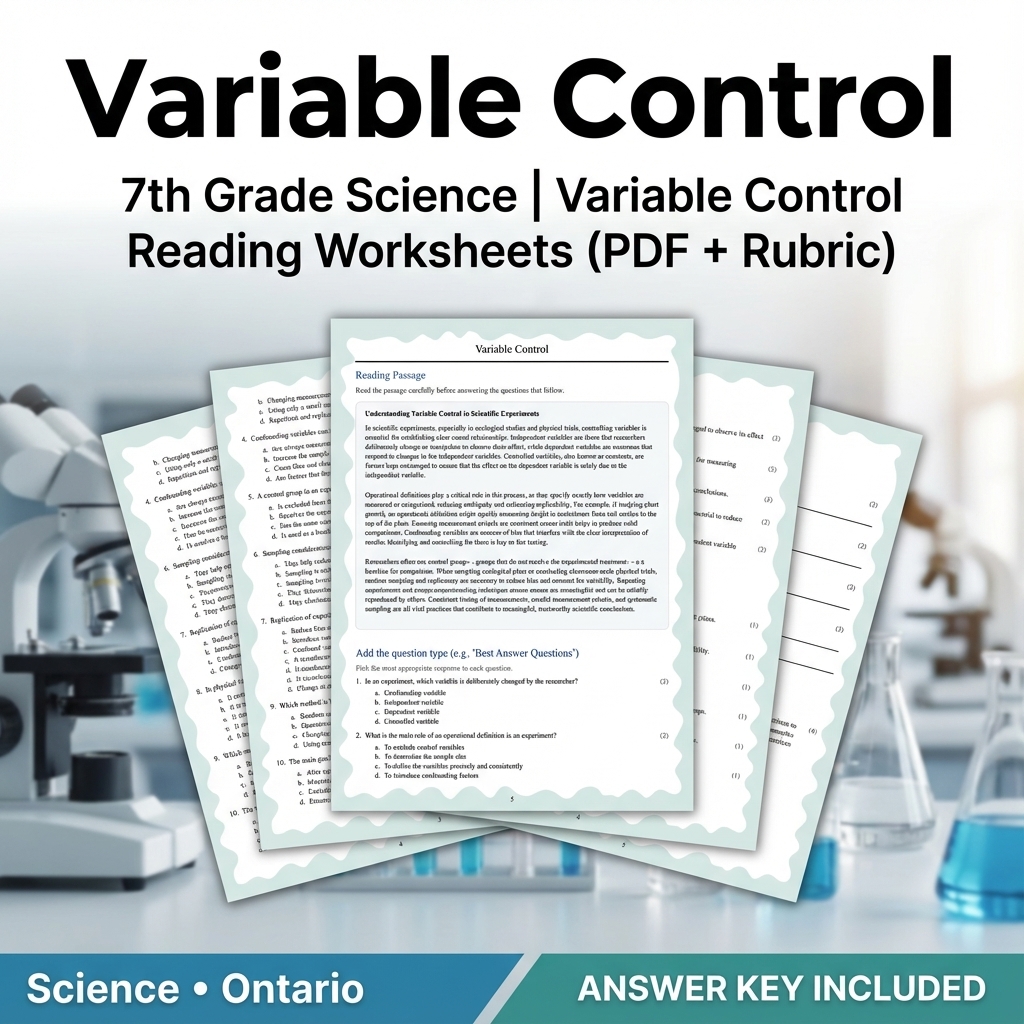
7th Grade Science | Variable Control Reading Worksheets (PDF + Rubric)
JCreated byJ.S SheetsLearning Objectives
- Understand the concepts of independent, dependent, and controlled variables.
- Describe how operational definitions help in standardizing measurements.
- Identify sources of confounding and how to minimize bias in experiments.
Also included in: Grade 7 Science Unit Bundle | Inquiry, Data & Modeling Skills +1 more
Instant download
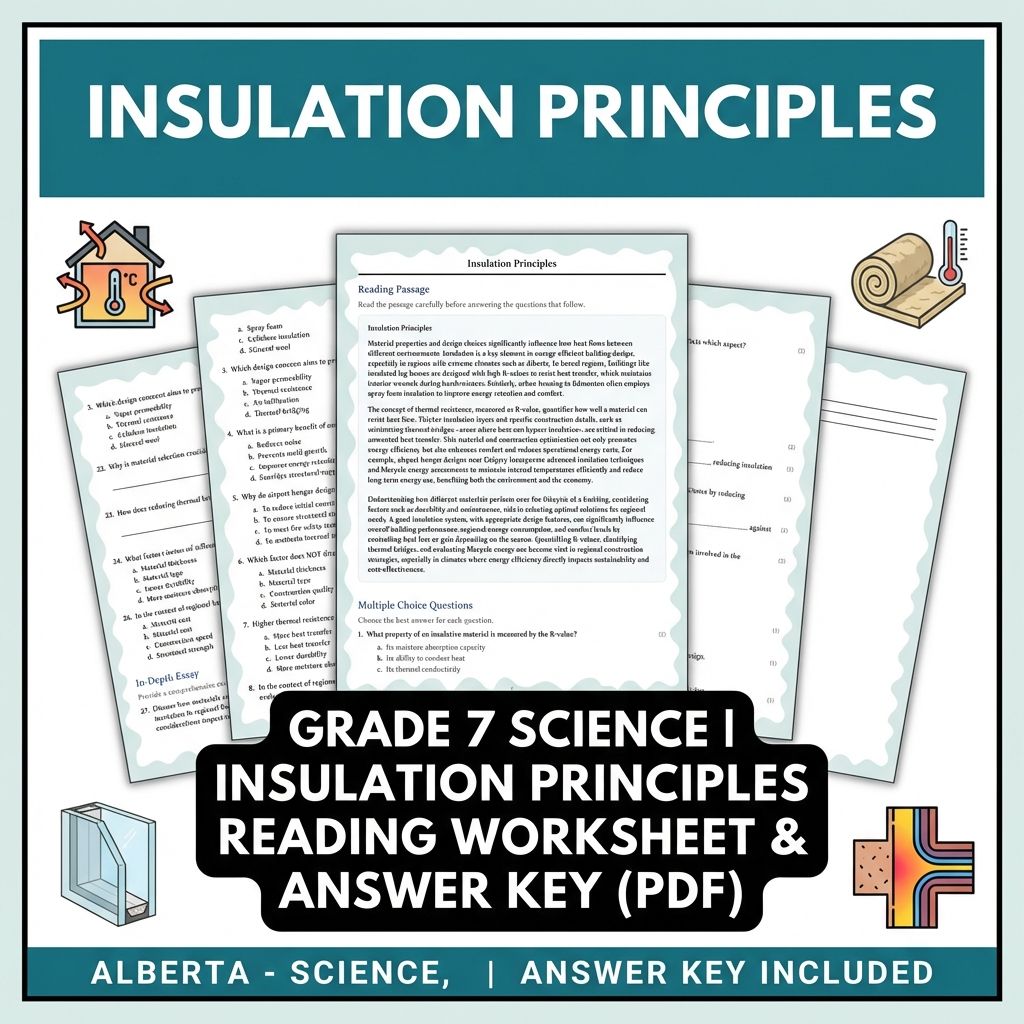
Grade 7 Science | Insulation Principles Reading Worksheet & Answer Key (PDF)
JCreated byJ.S SheetsLearning Objectives
- Understand how material properties like thermal resistance influence heat flow in buildings.
- Identify design choices that improve energy efficiency through insulation.
- Analyze regional examples of insulation strategies used in Alberta climate conditions.
Also included in: Grade 7 Science UNIT Bundle | Heat Transfer, Convection & Energy Worksheets +1 more
Instant download
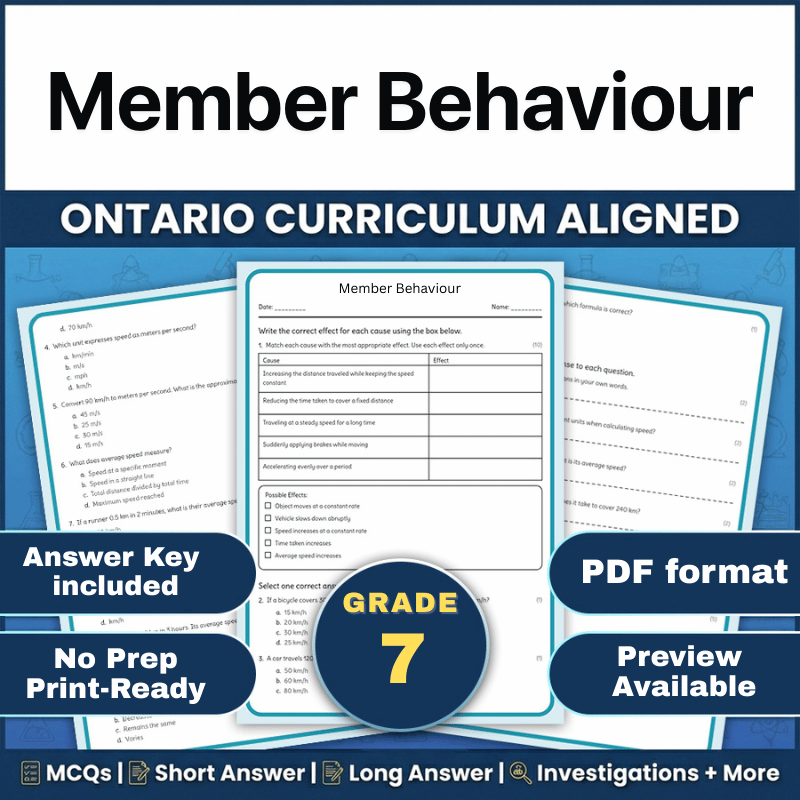
Grade 7 Science – Member Behaviour Worksheet (Ontario) (PDF)
 Created byBright Mind Resources
Learning Objectives
- Understand how structural members respond to loads through bending, shear, axial force, and torsion.
- Relate geometry and support conditions to internal force distribution in beams and columns.
- Describe the effects of bending moment and shear force on deflection and serviceability.
Instant download

Variable Control Worksheet | TEKS Grade 7 Science Practice and Assessment
JCreated byJ.S SheetsLearning Objectives
- Identify treatment variables, control variables, and dependent outcomes in a scientific investigation.
- Explain how control groups, replication, and randomization reduce confounding influences.
- Describe how blocking and documentation help manage known sources of variation and methodological constraints.
Instant download
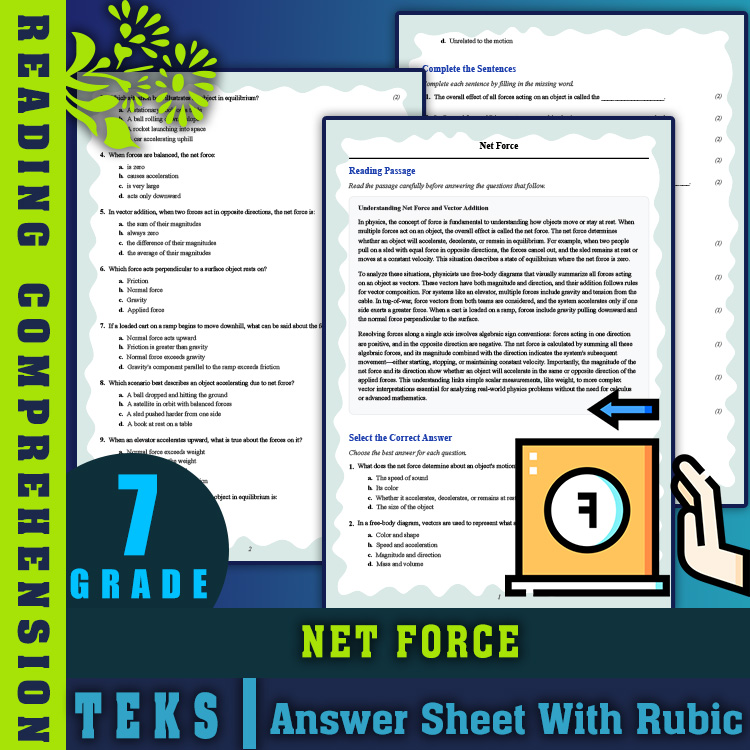
7th Grade Science | Net Force Reading Worksheet (PDF + Answer Key)
JCreated byJ.S SheetsLearning Objectives
- Understand the concept of net force and how it influences motion.
- Learn to interpret free-body diagrams for systems like elevator, tug-of-war, and loaded carts.
- Apply vector addition principles to resolve forces in one dimension.
Instant download
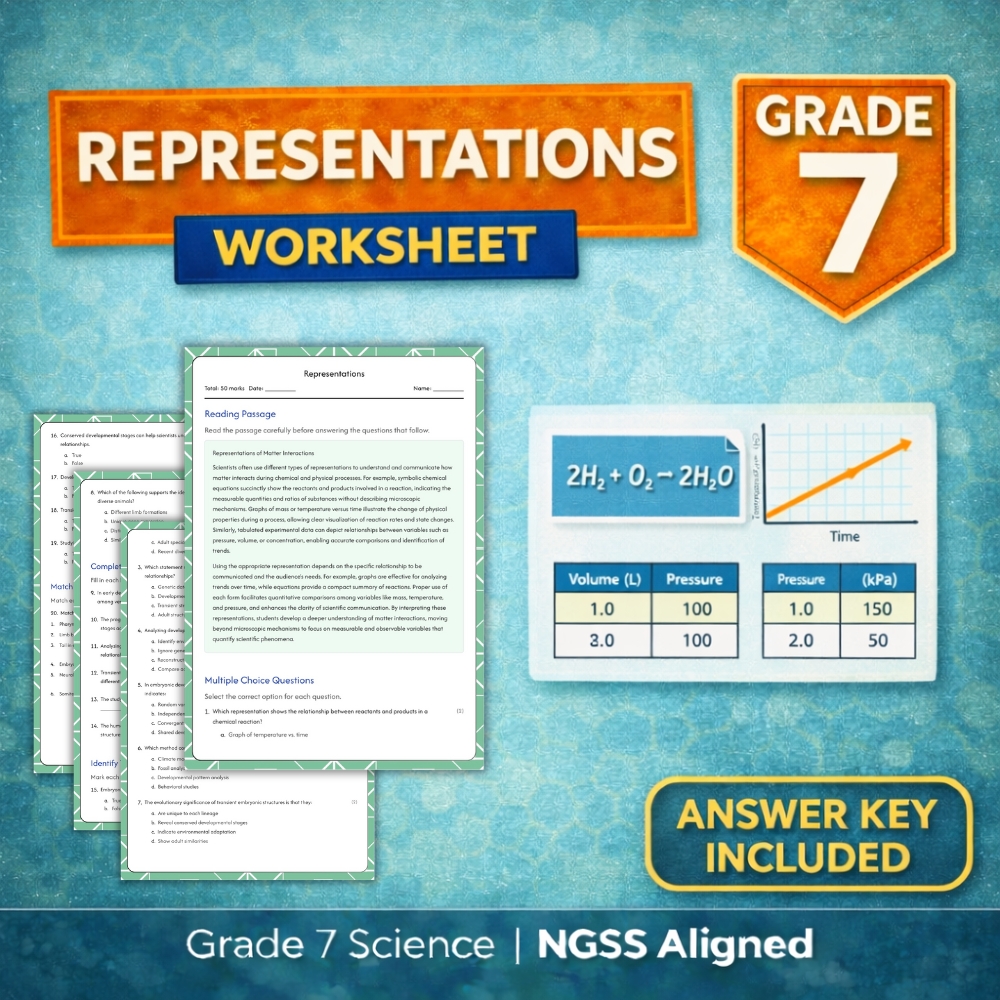
7th Grade Science | Representations Worksheet (NGSS) Printable PDF
 Created byCedar Grove Learning
Learning Objectives
- Describe how different representations convey matter interactions.
- Interpret and analyze symbolic chemical equations, graphs, and tabulated data.
- Select appropriate representations to compare quantities and express relationships.
Instant download
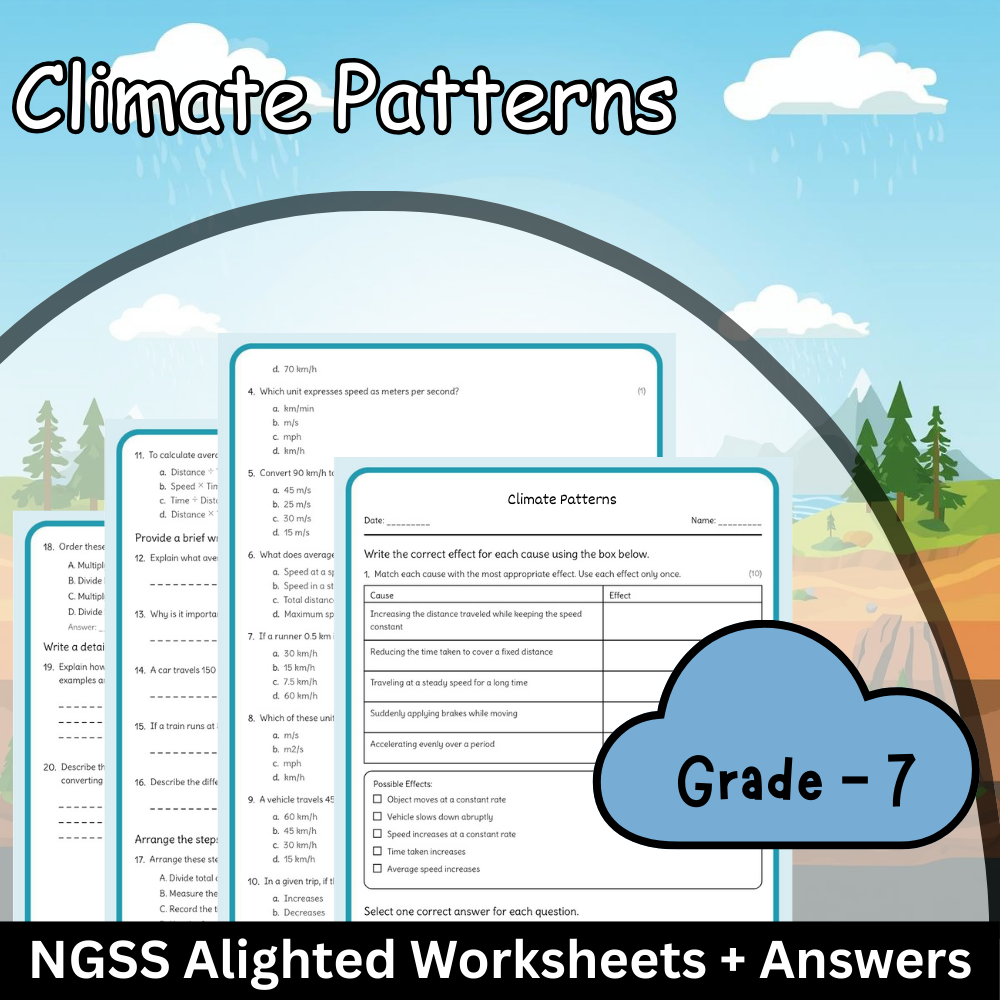
Grade 7 Science | Climate Patterns Worksheet (NGSS Aligned, PDF) with Answer Key
Created byBright Mind ResourcesLearning Objectives
- Understand how uneven solar heating influences regional climate patterns.
- Interpret temperature gradients, sea-surface temperature maps, wind vectors, and precipitation records.
- Explain phenomena such as El Niño, monsoon regimes, and prevailing wind belts.
Instant download
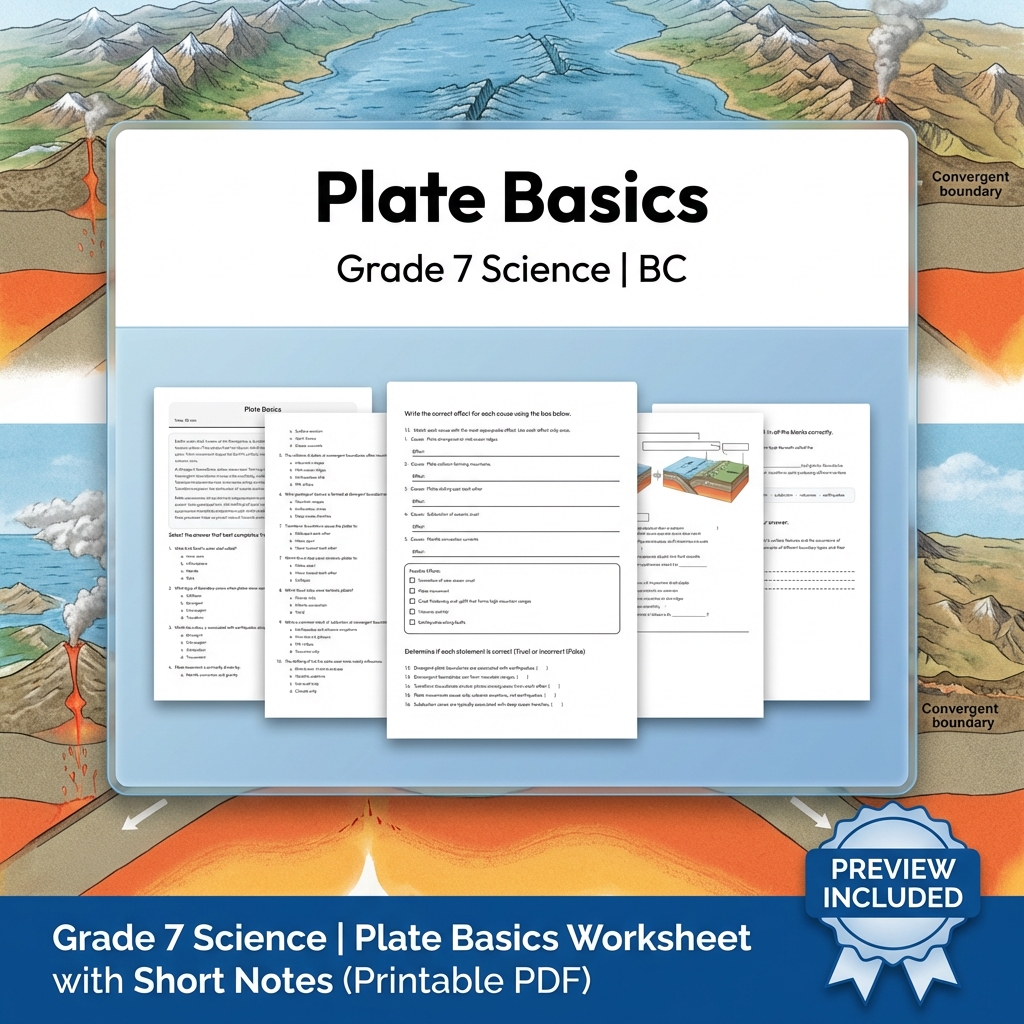
Grade 7 Science | Plate Basics Worksheet with Short Notes (Printable PDF)
 Created byMeadowlark Worksheets
Learning Objectives
- Understand the different types of plate boundaries and their effects on Earth's surface.
- Identify the movements of tectonic plates and their role in geological phenomena.
- Recognize how plate interactions cause earthquakes, volcanoes, and mountain formations.
Also included in: Grade 7 Science Lesson Bundle | Earth Processes Worksheets Group +1 more
Instant download

Grade 7 Science | Interpreting Data Worksheet | Florida NGSSS Aligned
 Created byLumora Learning
Learning Objectives
- Interpret patterns in graphs such as scatter plots, histograms, and line graphs to support scientific claims
- Use summary measures (range and averages) to compare data sets and describe variability
- Evaluate outliers and explain how uncertainty or random variation affects conclusions
Instant download
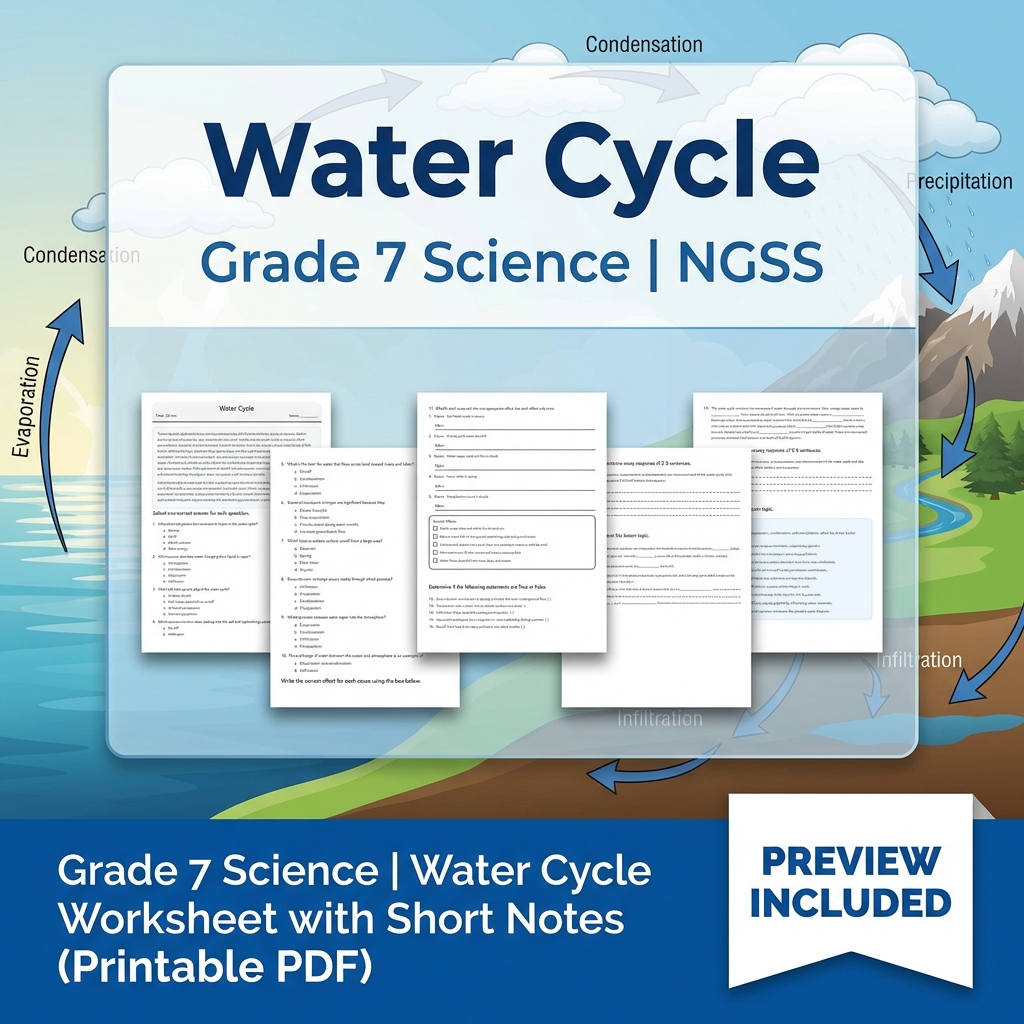
Grade 7 Science | Water Cycle Worksheet with Short Notes (Printable PDF)
Created byMeadowlark WorksheetsLearning Objectives
- Describe the processes involved in the water cycle, including evaporation, condensation, precipitation, infiltration, runoff, and groundwater flow.
- Explain how solar energy and gravity drive water movement among Earth's spheres.
- Identify interactions such as river discharge, groundwater flow contributing to springs, and seasonal snowpack changes.
Also included in: Grade 7 Science | Earth's Systems Unit Worksheets Pack – NGSS Aligned +1 more
Instant download
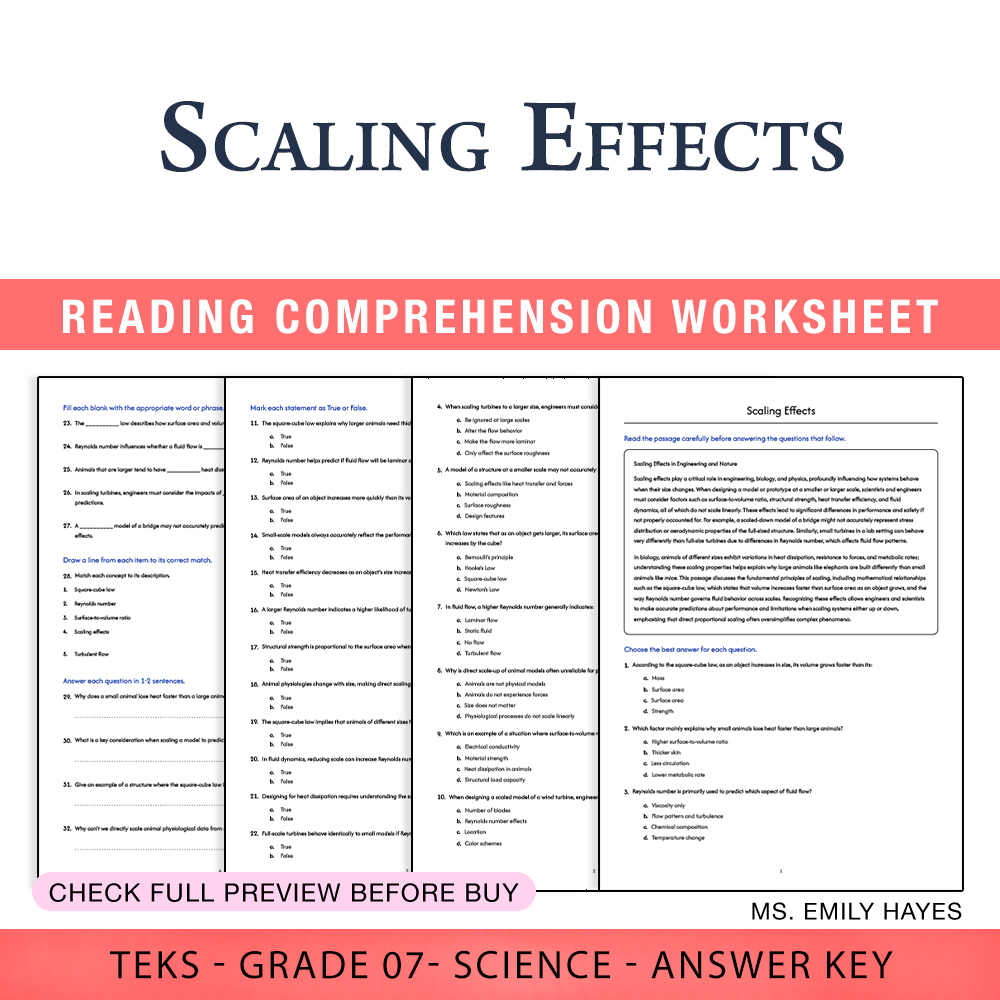
7th Grade Science | Scaling Effects Worksheet (PDF+ Answer Key)
 Created byCopper Leaf Classroom
Learning Objectives
- Understand how physical behavior changes when scaling models to full size.
- Explain the relationships described by the square-cube law and surface-to-volume ratios.
- Analyze the implications of Reynolds number in fluid flow at different scales.
Instant download
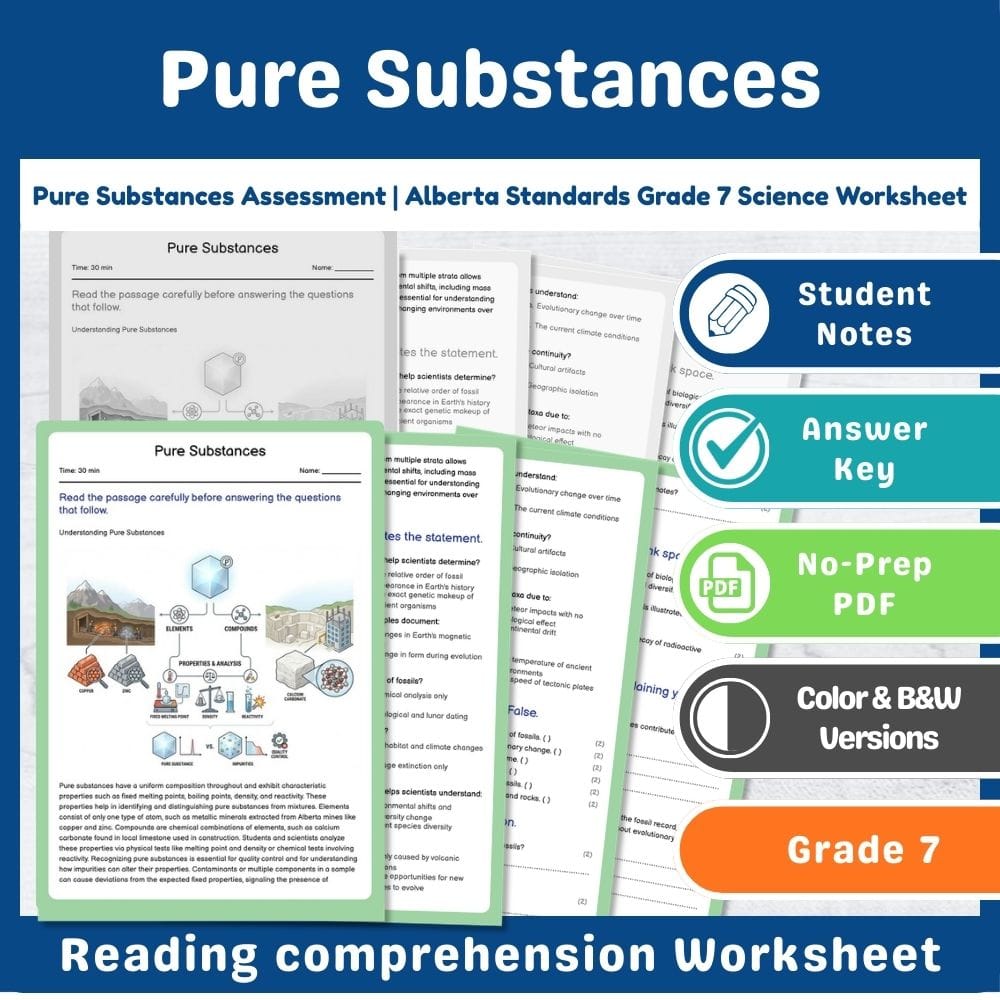
Pure Substances Assessment | Alberta Standards Grade 7 Science Worksheet
 Created byPrism Point Learning
Learning Objectives
- Understand the defining properties of pure substances such as fixed melting points, density, and reactivity.
- Differentiate between elements and compounds through physical and chemical tests.
- Identify real-world examples of pure substances from local sources and common compounds.
Also included in: Lesson Grade 7 Science Mini Bundle | Matter and Chemical Change +1 more
Instant download
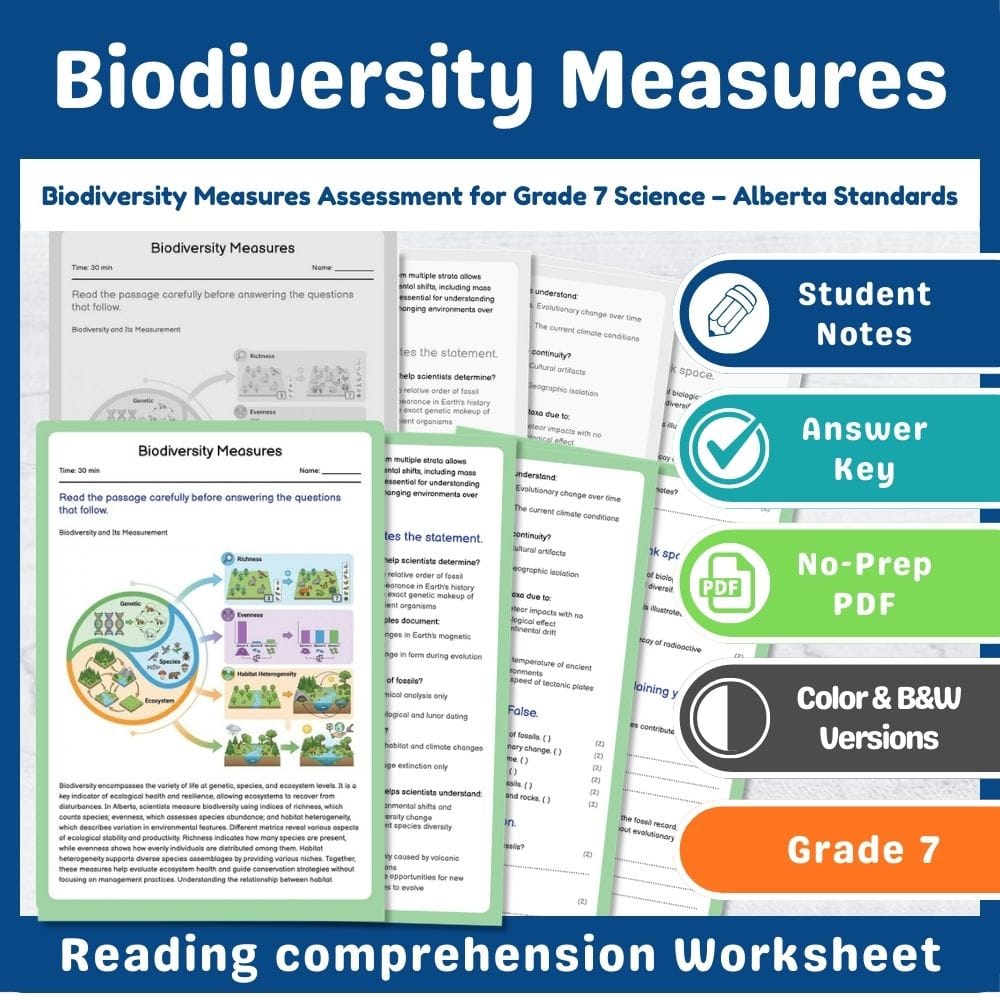
Biodiversity Measures Assessment for Grade 7 Science – Alberta Standards
Created byPrism Point LearningLearning Objectives
- Understand key concepts related to Science
- Apply knowledge through practice questions
- Demonstrate comprehension of the material
Also included in: Lesson Bundle Grade 7 Science - Interactions and Ecosystems +1 more
Instant download
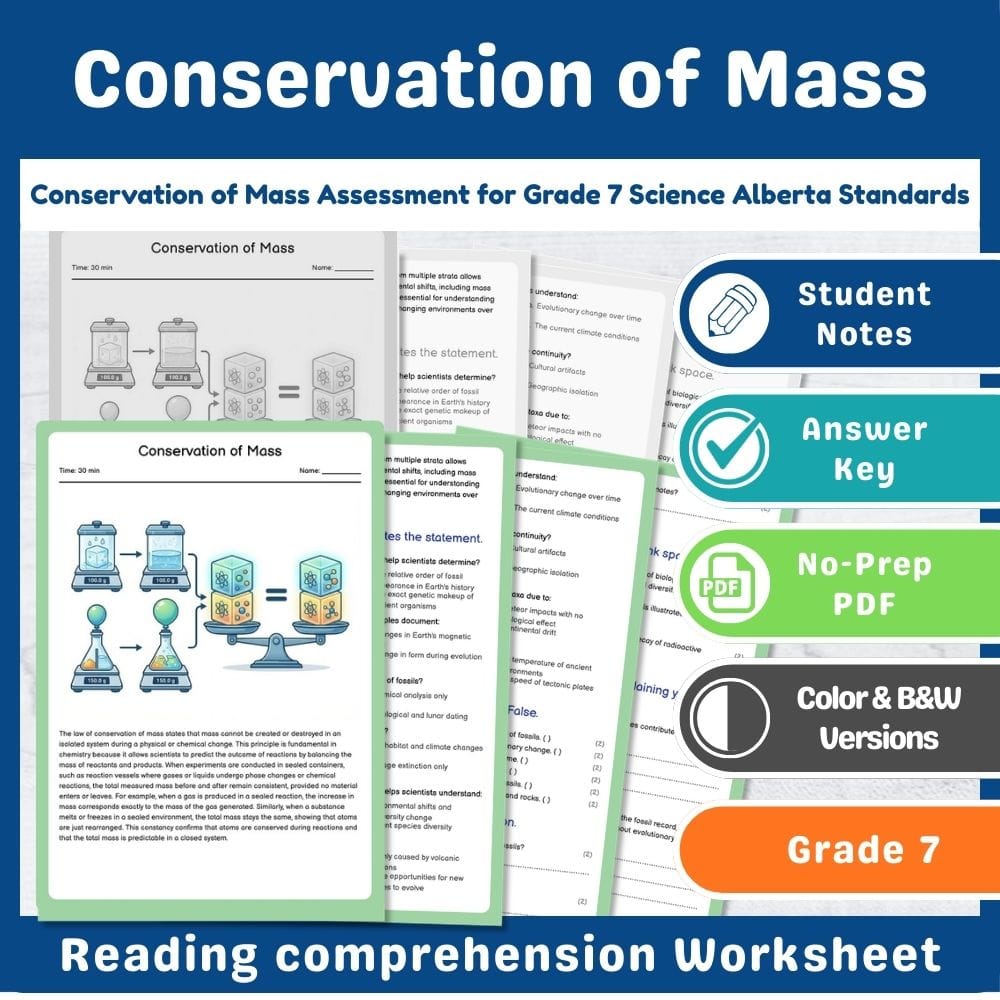
Conservation of Mass Assessment for Grade 7 Science Alberta Standards
Created byPrism Point LearningLearning Objectives
- Understand the principle of conservation of mass in physical and chemical changes.
- Describe how mass remains constant in a sealed system during reactions.
- Explain observations of sealed-container reactions that demonstrate mass conservation.
Also included in: Lesson Grade 7 Science Mini Bundle | Matter and Chemical Change +1 more
Instant download
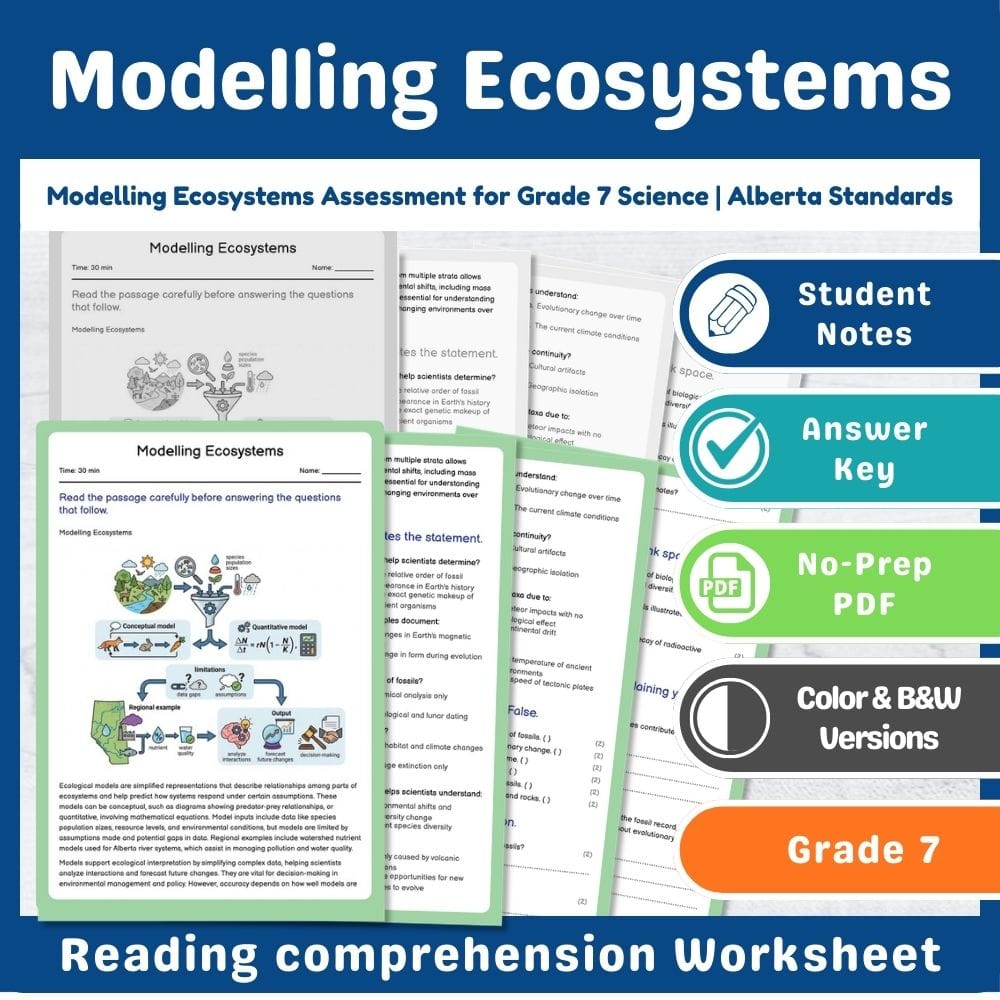
Modelling Ecosystems Assessment for Grade 7 Science | Alberta Standards
Created byPrism Point LearningLearning Objectives
- Understand the concept and importance of ecological models in environmental science.
- Identify different types of modelling approaches and their applications.
- Recognize regional examples of ecological models and their significance.
Also included in: Lesson Bundle Grade 7 Science - Interactions and Ecosystems +1 more
Instant download
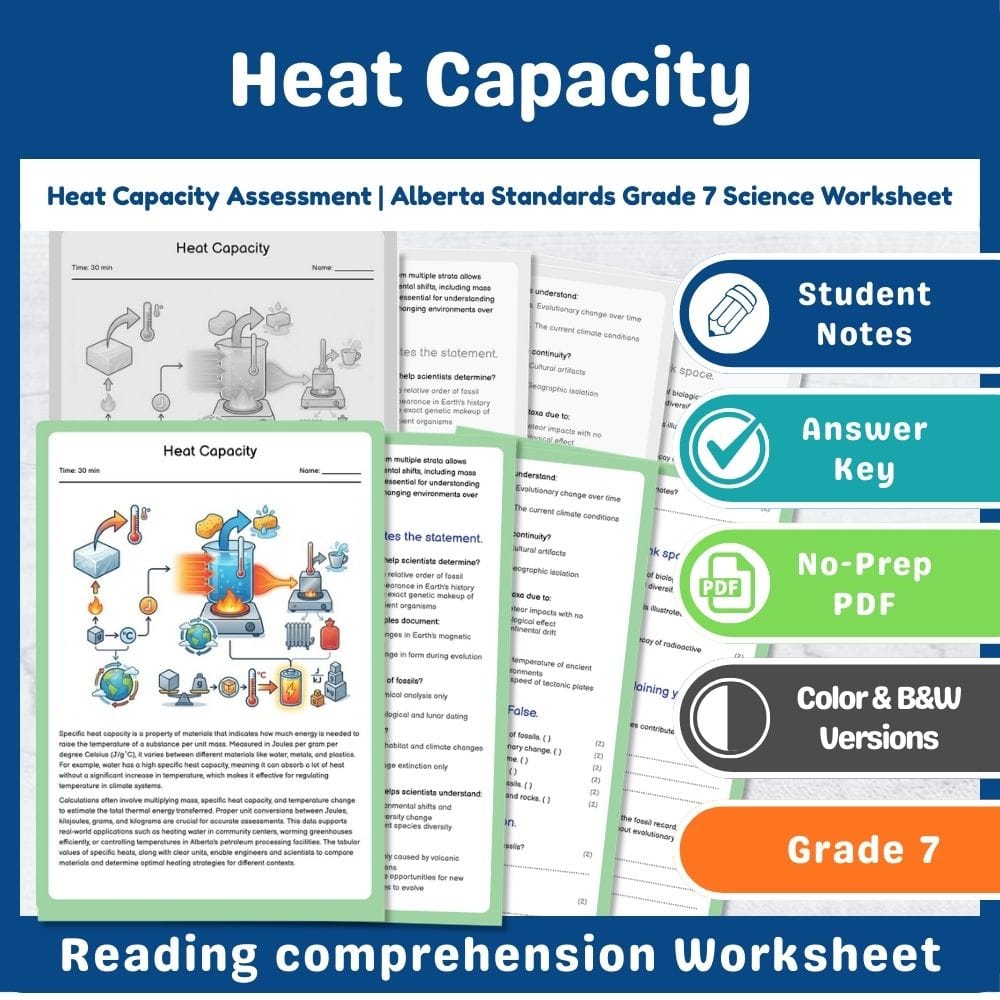
Heat Capacity Assessment | Alberta Standards Grade 7 Science Worksheet
Created byPrism Point LearningLearning Objectives
- Understand the concept of specific heat capacity and its units.
- Perform calculations involving mass, specific heat, and temperature change to find energy in Joules or kilojoules.
- Interpret tabular data of thermal properties for different materials.
Also included in: Lesson Grade 7 Science Mini Bundle | Energy, Heat & Thermal Processes +1 more
Instant download
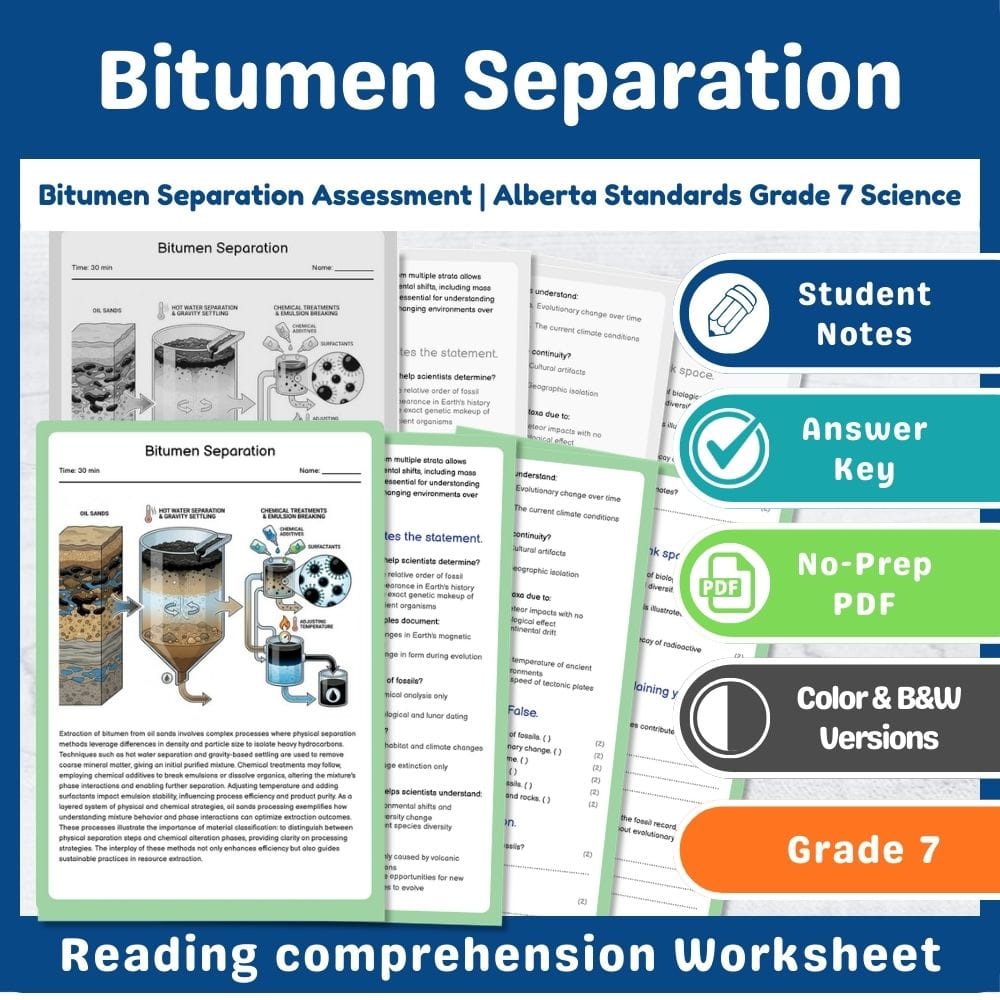
Bitumen Separation Assessment | Alberta Standards Grade 7 Science
Created byPrism Point LearningLearning Objectives
- Understand the physical and chemical processes involved in separating bitumen from oil sands.
- Identify differentiating features of physical separation versus chemical treatment in mixture processing.
- Explain how density, particle size, and additives influence separation methods.
Also included in: Lesson Grade 7 Science Mini Bundle | Matter and Chemical Change +1 more
Instant download
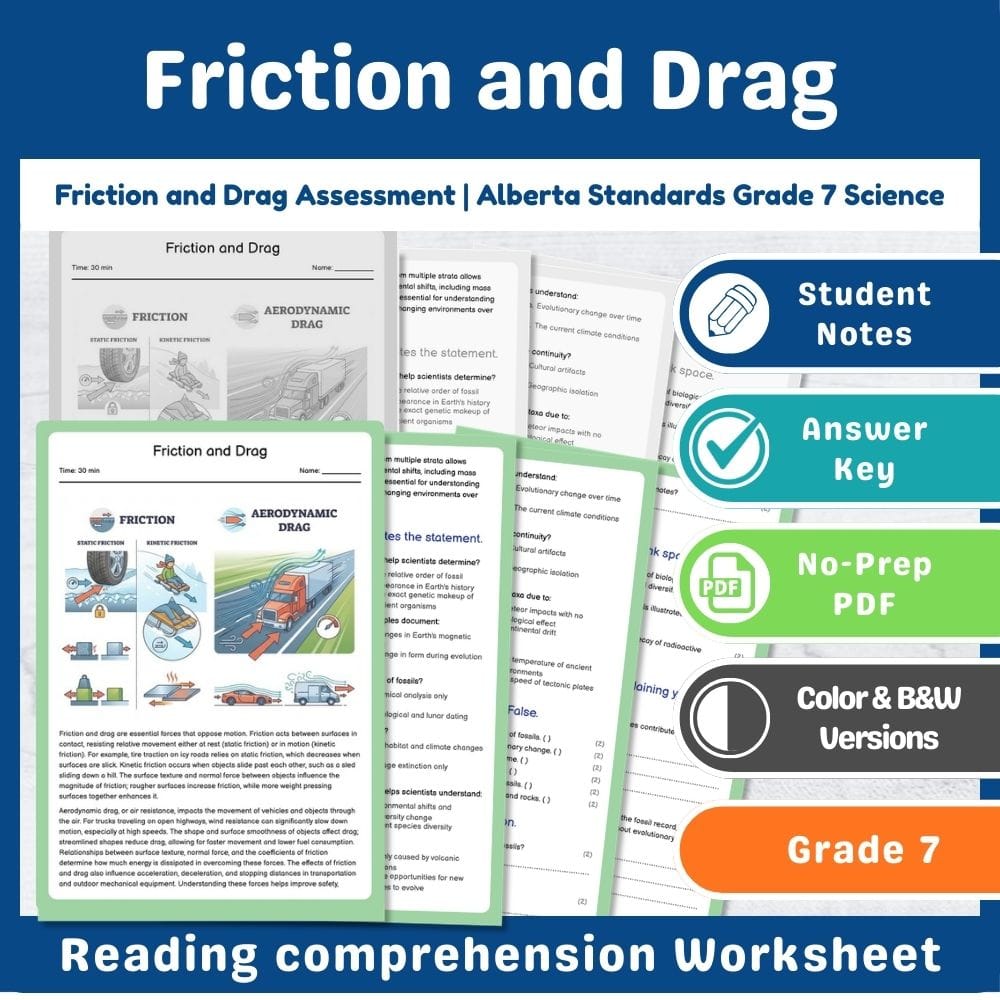
Friction and Drag Assessment | Alberta Standards Grade 7 Science
Created byPrism Point LearningLearning Objectives
- Explain the concepts of static and kinetic friction with examples.
- Describe how surface texture and normal force affect friction.
- Analyze how aerodynamic drag influences motion in real-world scenarios.
Also included in: Lesson Bundle Grade 7 Science Forces Structures and Motion | Alberta Standards +1 more
Instant download
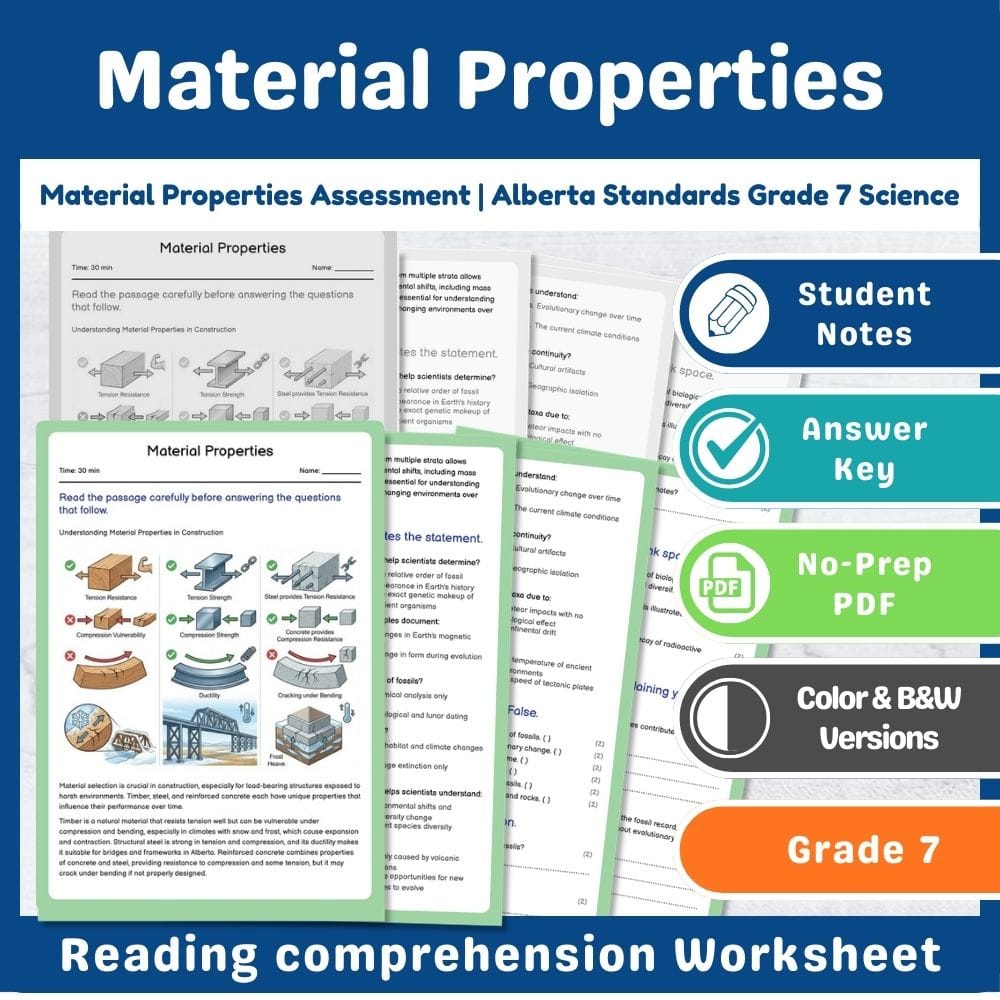
Material Properties Assessment | Alberta Standards Grade 7 Science
Created byPrism Point LearningLearning Objectives
- Understand how different materials perform under compression, tension, and bending.
- Compare timber, structural steel, and reinforced concrete in load-bearing applications.
- Analyze environmental effects on material durability in cold climates such as Alberta.
Also included in: Lesson Bundle Grade 7 Science Forces Structures and Motion | Alberta Standards +1 more
Instant download
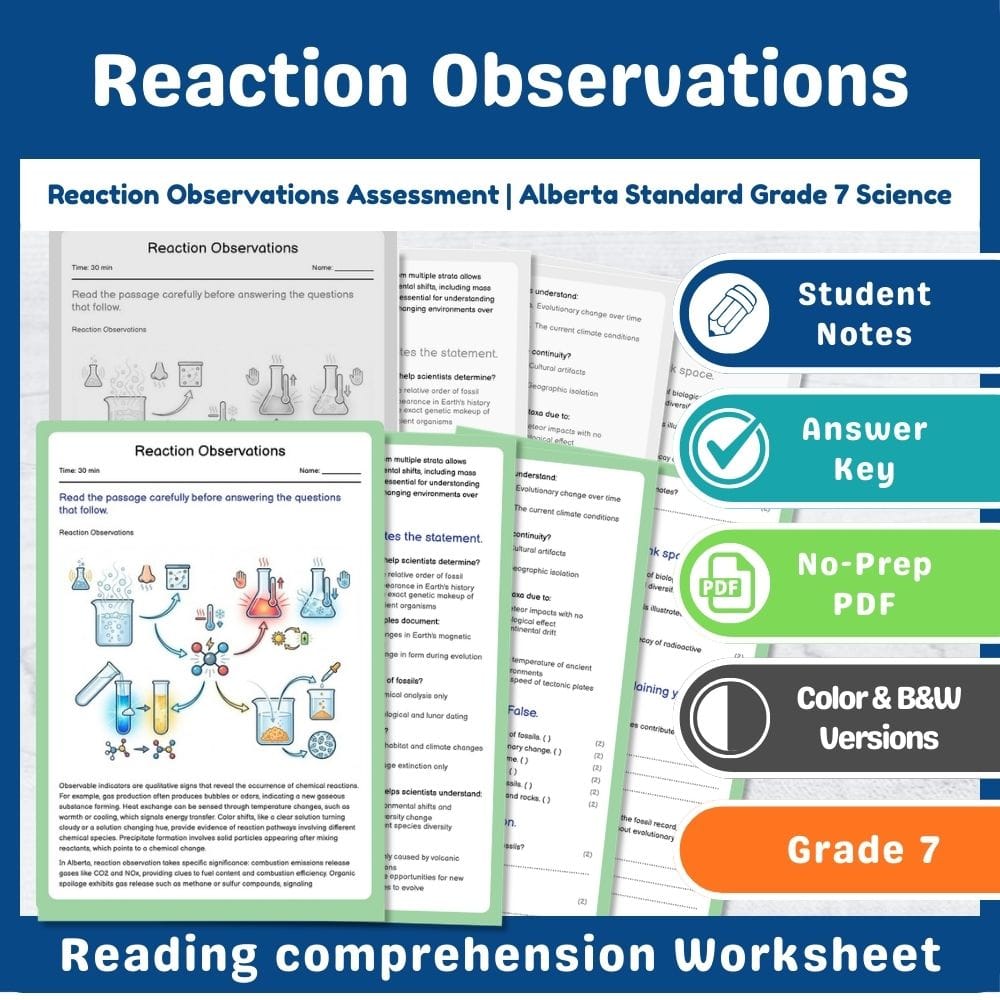
Reaction Observations Assessment | Alberta Standard Grade 7 Science
Created byPrism Point LearningLearning Objectives
- Identify different observable indicators of chemical reactions, such as gas production, color change, heat exchange, and precipitate formation.
- Describe how reaction types and extents can be contextualized through qualitative observations.
- Connect reaction observations to underlying particle interactions and mass changes.
Also included in: Lesson Grade 7 Science Mini Bundle | Matter and Chemical Change +1 more
Instant download
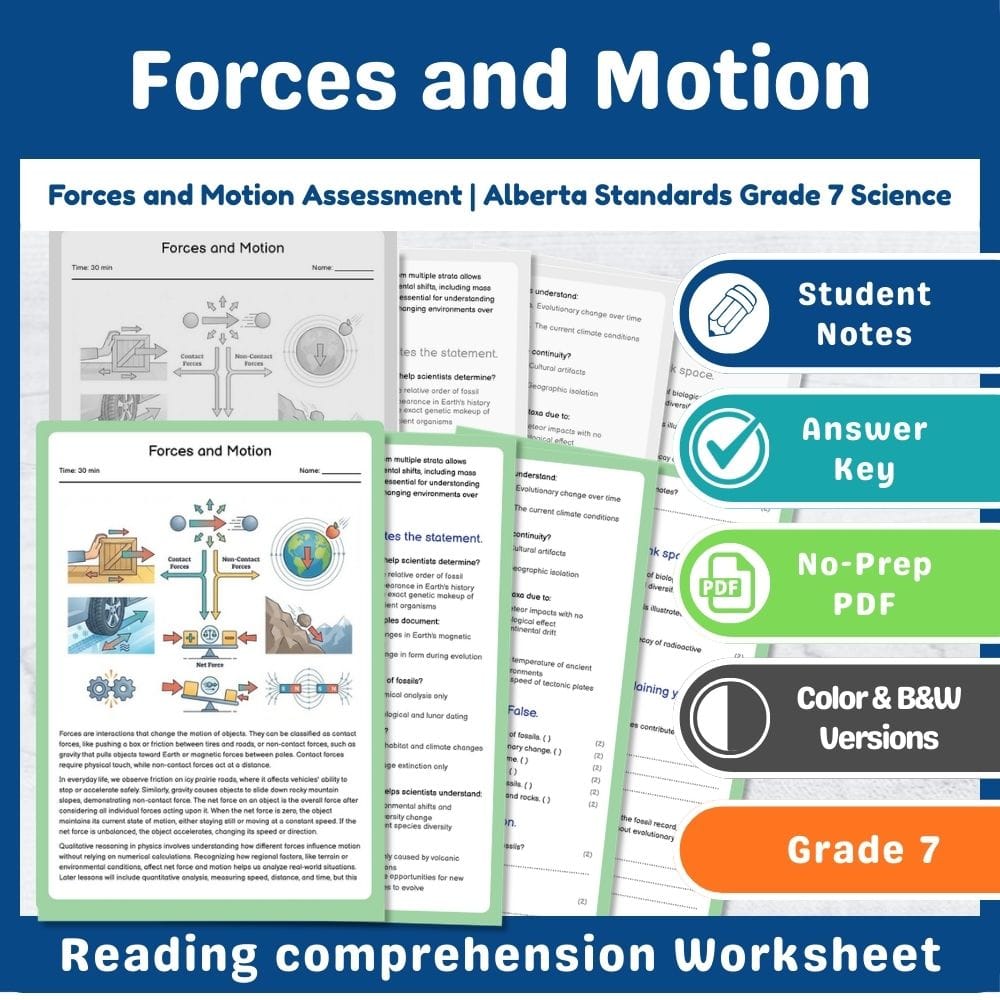
Forces and Motion Assessment | Alberta Standards Grade 7 Science
Created byPrism Point LearningLearning Objectives
- Understand the difference between contact and non-contact forces.
- Explain how net force affects the motion of an object.
- Identify examples of forces in regional contexts such as friction and gravity.
Also included in: Lesson Bundle Grade 7 Science Forces Structures and Motion | Alberta Standards +1 more
Instant download
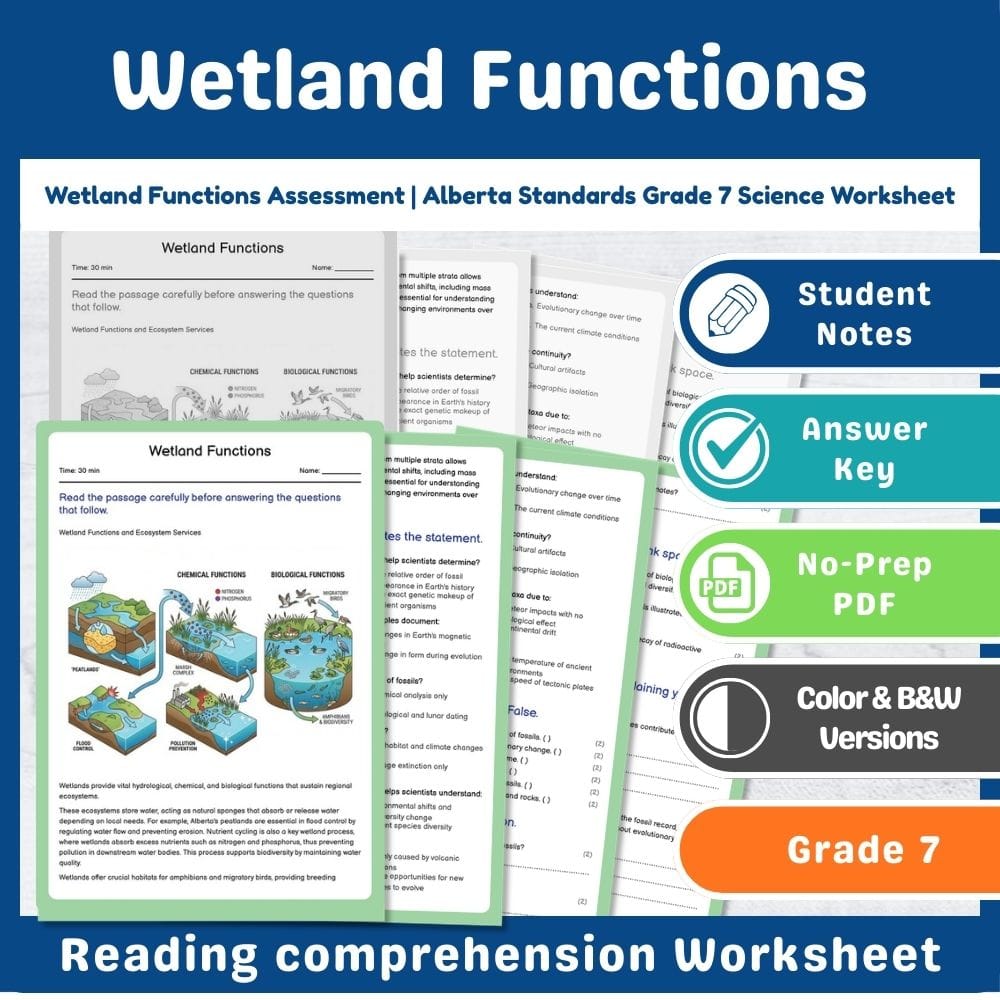
Wetland Functions Assessment | Alberta Standards Grade 7 Science Worksheet
Created byPrism Point LearningLearning Objectives
- Describe the hydrological, chemical, and biological functions of wetlands.
- Identify examples of how wetlands support biodiversity and ecosystem services.
- Explain the functional differences among wetland types such as peatlands and marshes.
Also included in: Lesson Bundle Grade 7 Science - Interactions and Ecosystems +1 more
Instant download
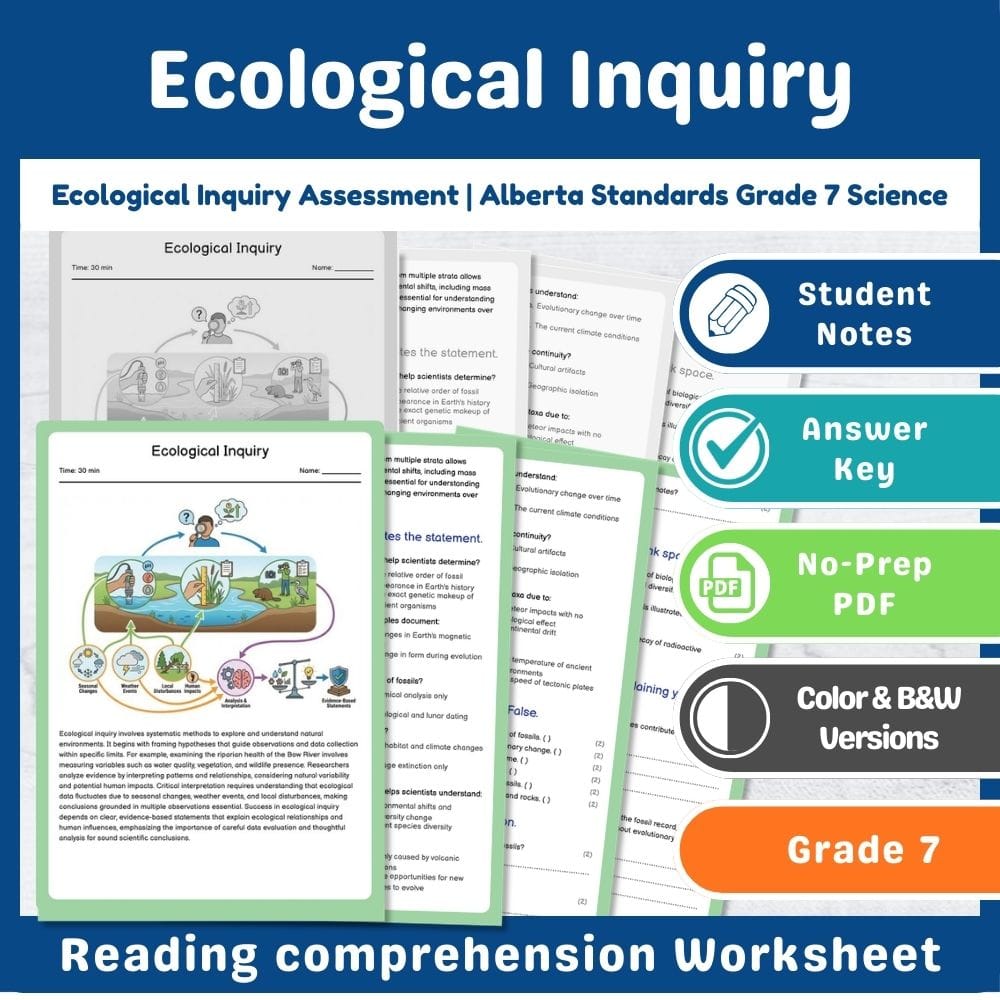
Ecological Inquiry Assessment | Alberta Standards Grade 7 Science
Created byPrism Point LearningLearning Objectives
- Understand the systematic approaches used in ecological inquiry, including posing questions and collecting observations.
- Interpret ecological data within natural variability and evaluate evidence to draw conclusions.
- Recognize local examples such as riparian health assessments and their role in ecological relationships.
Also included in: Lesson Bundle Grade 7 Science - Interactions and Ecosystems +1 more
Instant download
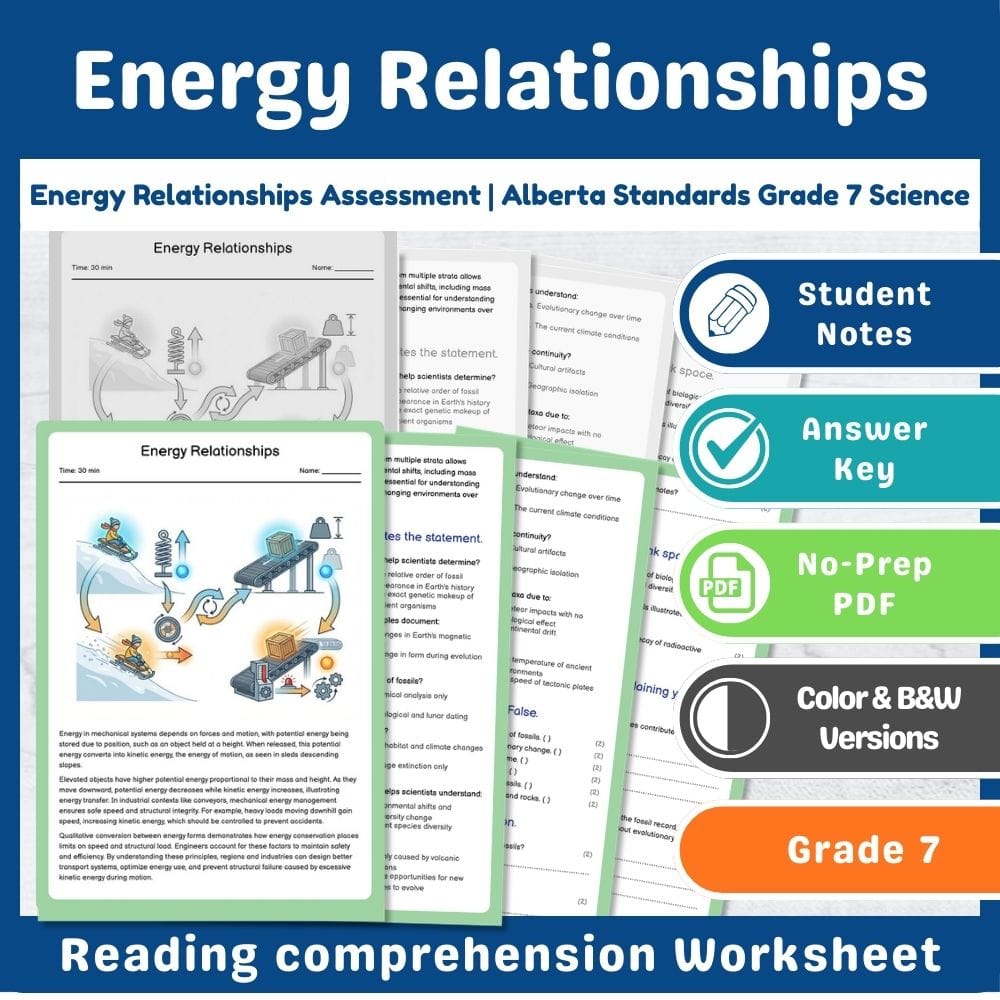
Energy Relationships Assessment | Alberta Standards Grade 7 Science
Created byPrism Point LearningLearning Objectives
- Describe how potential and kinetic energy are linked through energy transfer in mechanical systems.
- Explain how elevation, mass, and speed influence mechanical energy in real-world contexts.
- Interpret qualitative conversions between potential and kinetic energy during motion.
Also included in: Lesson Bundle Grade 7 Science Forces Structures and Motion | Alberta Standards +1 more
Instant download
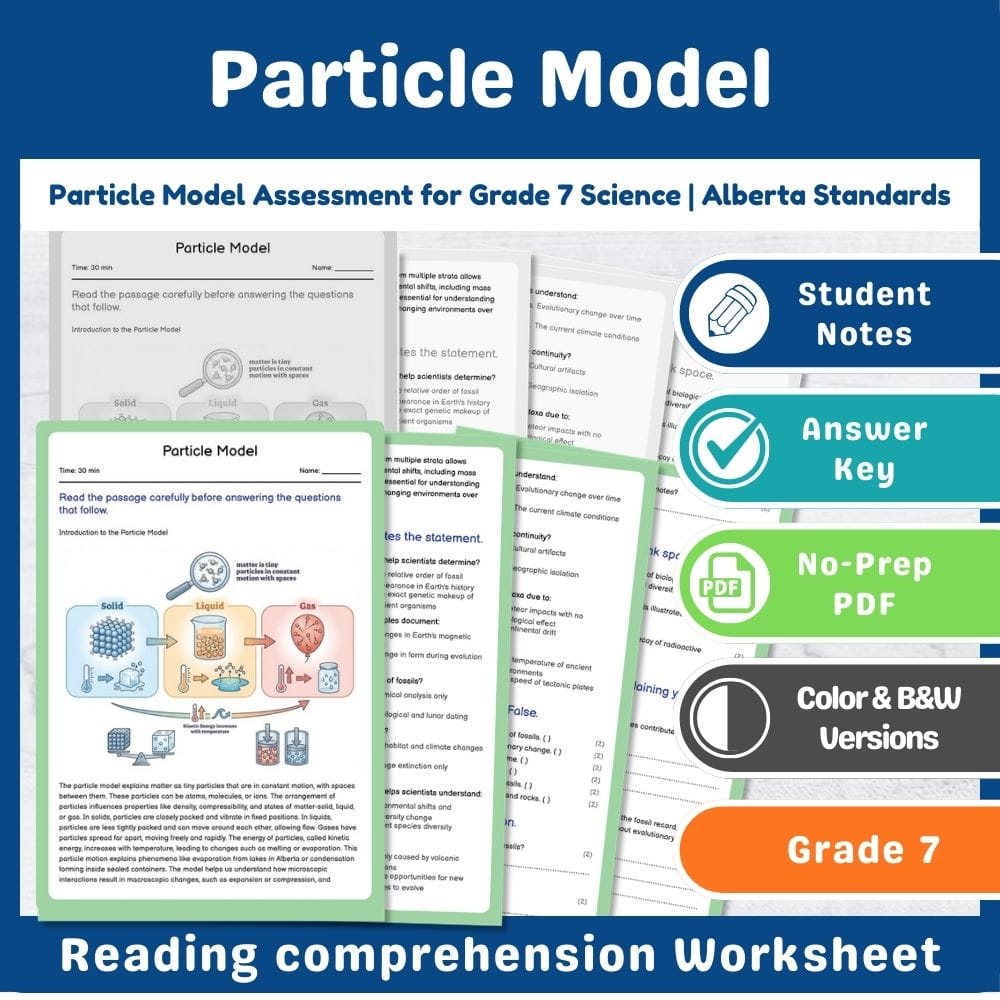
Particle Model Assessment for Grade 7 Science | Alberta Standards
Created byPrism Point LearningLearning Objectives
- Describe the particle model as a representation of matter with particles in constant motion.
- Explain how particle arrangement and kinetic energy determine states of matter, diffusion, and density.
- Relate microscopic particle motion to observable phenomena such as evaporation and condensation.
Also included in: Lesson Grade 7 Science Mini Bundle | Matter and Chemical Change +1 more
Instant download

Properties and Classification Assessment | TEKS Grade 7 Science Worksheet
Created byPrism Point LearningLearning Objectives
- Define physical and chemical properties used to classify substances.
- Identify measurable attributes such as density, solubility, hardness, and conductivity.
- Distinguish between elements, compounds, and mixtures based on observable properties.
Also included in: Grade 7 Matter and Energy Science Lesson Bundle: TEKS assessments
Instant download

Simple Machines Overview Worksheet for Grade 7 Science | Alberta Standards
JCreated byJ.S SheetsLearning Objectives
- Identify and describe the six types of simple machines and their functions.
- Calculate mechanical advantage for different simple machines using given data.
- Explain how simple machines alter force and direction to make work easier.
Instant download

Grade 7 Science | Weather vs Climate Worksheet | Florida NGSSS Aligned
Created byLumora LearningLearning Objectives
- Explain the difference between weather and climate using examples
- Identify key variables of weather (temperature, precipitation, humidity, wind)
- Describe how climate is determined by long-term averages and variability
Instant download
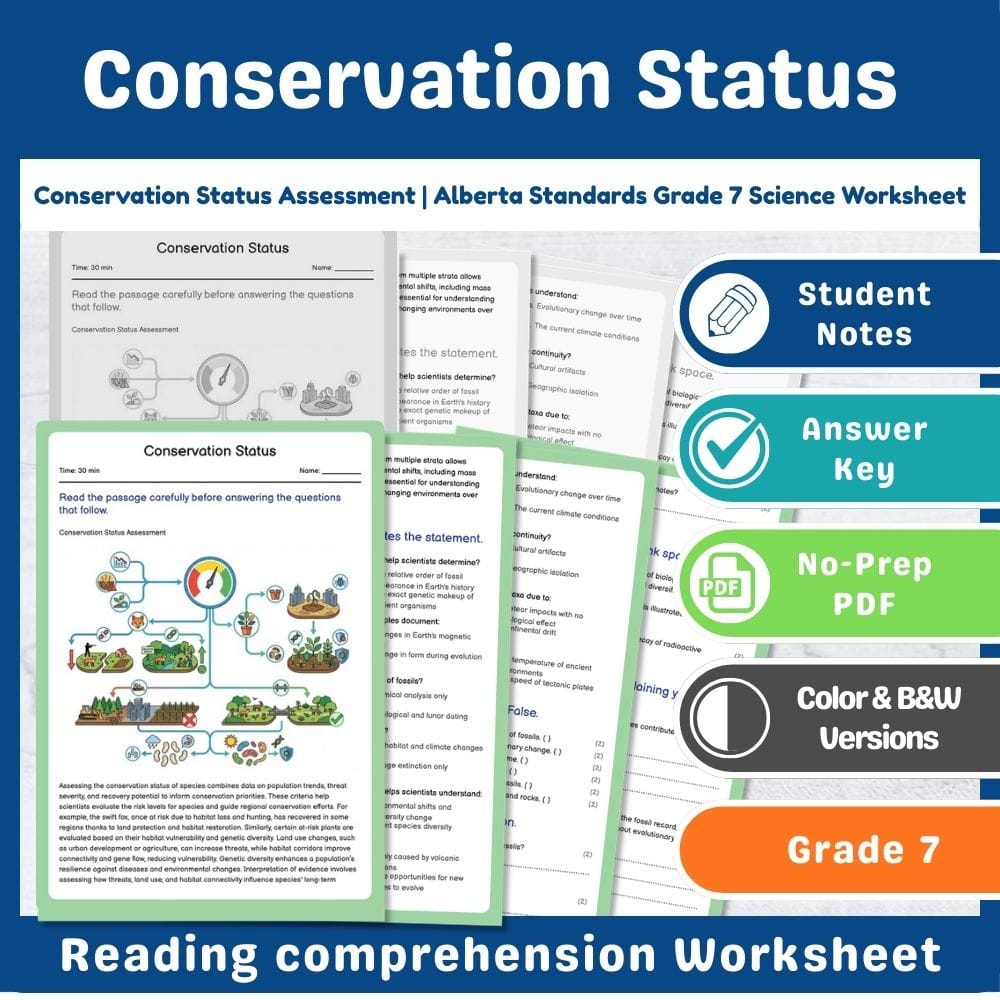
Conservation Status Assessment | Alberta Standards Grade 7 Science Worksheet
Created byPrism Point LearningLearning Objectives
- Understand the criteria used to evaluate the conservation status of species.
- Interpret evidence related to population trends, threats, and recovery potential.
- Identify factors like land use, genetic diversity, and connectivity that influence species vulnerability.
Also included in: Lesson Bundle Grade 7 Science - Interactions and Ecosystems +1 more
Instant download
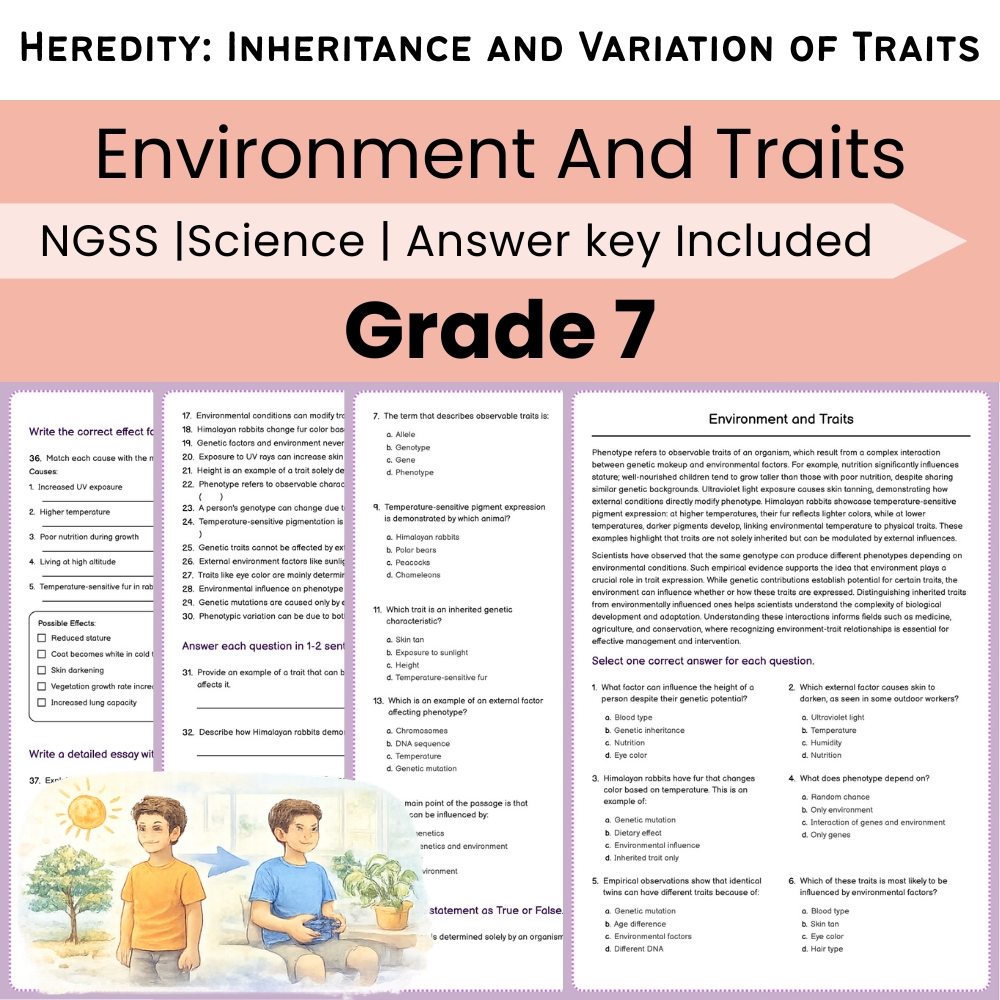
Environment and Traits Science Worksheet | Grade 7 Science printable PDF
Learning Objectives
- Understand how phenotype results from the interaction of genetics and environment.
- Identify examples of environmental influences on traits.
- Distinguish between inherited genetic traits and environmentally modulated traits.
Also included in: Grade 7 Science Worksheet Pack | Heredity and Trait Inheritance NGSS Bundle +1 more
Instant download

Grade 7 Science | Earth System Interactions - Daily Reading Comprehension
 Created byCoral Reef Learning
Learning Objectives
- Understand the different Earth systems: geosphere, hydrosphere, atmosphere, and biosphere.
- Recognize how these systems interact through movement of matter and energy.
- Identify examples of changes in one system affecting others.
Instant download

Grade 7 Science — Sedimentary Processes Worksheet MCQ Paper
 Created byThe Resource Hub
Learning Objectives
- Understand the step-by-step formation of sedimentary rocks from weathering to lithification.
- Identify different depositional environments and their features.
- Describe the processes involved in transportation, deposition, and preservation of sediments.
Also included in: Grade 7 Science | Earth's Systems & Processes Worksheet Bundle – BC Framework +1 more
Instant download
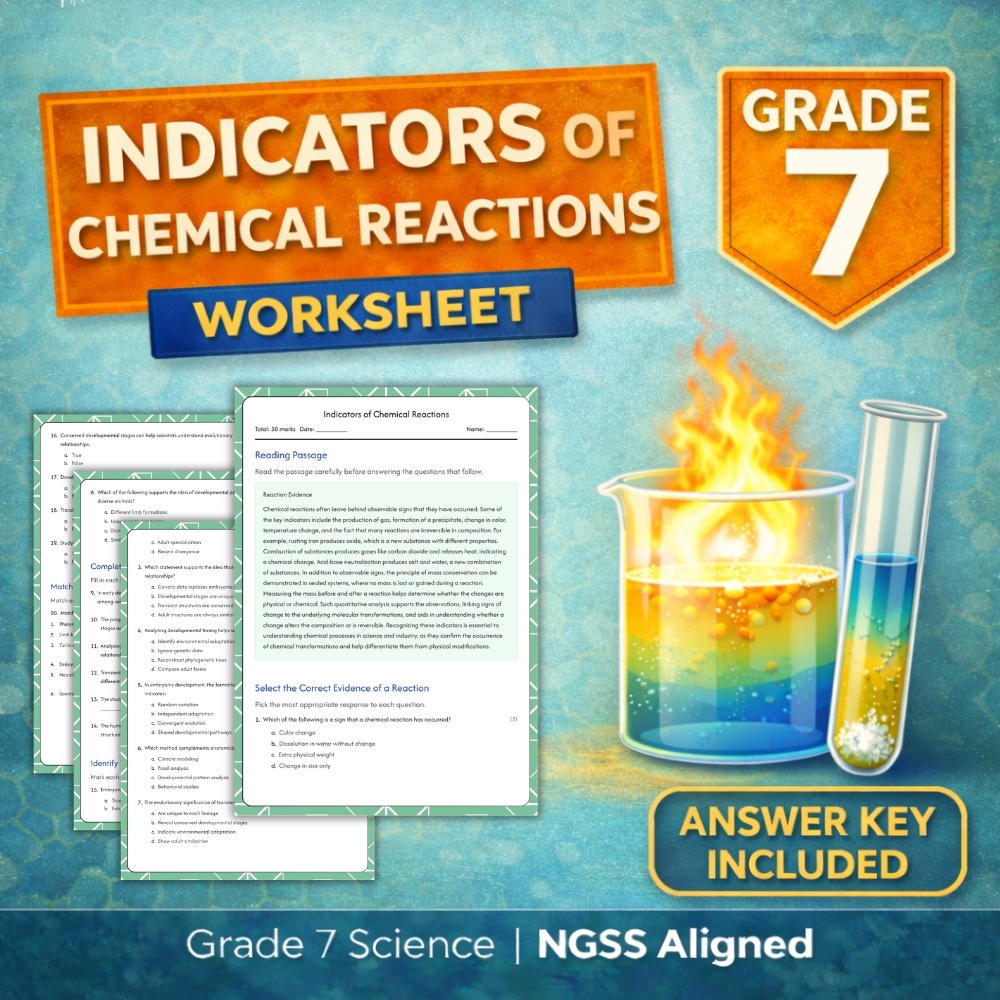
7th Grade Science | Indicators of Chemical Reactions Worksheet (NGSS) PDF
Created byCedar Grove LearningLearning Objectives
- Identify observable signs that indicate a chemical reaction has taken place.
- Describe different indicators such as gas production, precipitate formation, color change, temperature change, and irreversibility.
- Explain examples of chemical reactions including rusting, combustion, and acid–base neutralization.
Instant download
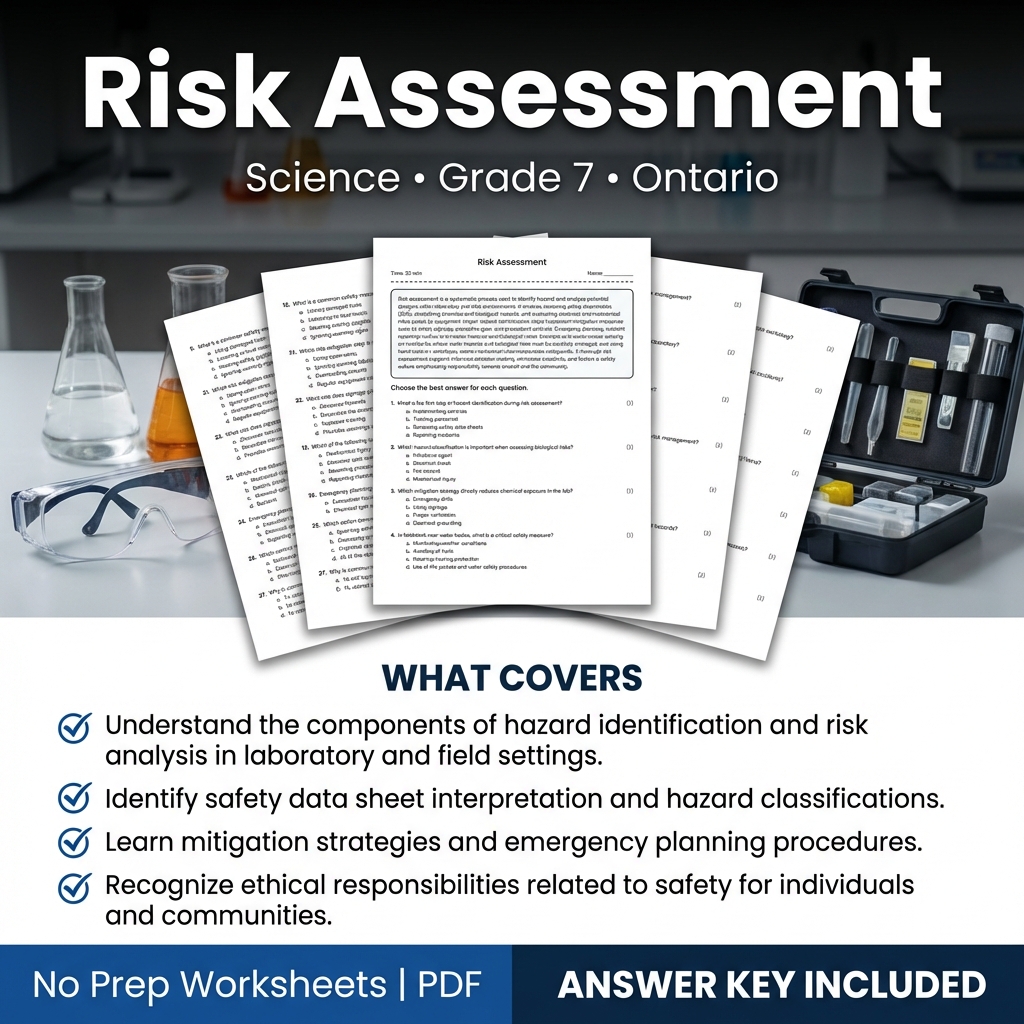
Risk Assessment Worksheet for Grade 7 Science | Ontario Standards
Created byCoral Reef LearningLearning Objectives
- Understand the components of hazard identification and risk analysis in laboratory and field settings.
- Identify safety data sheet interpretation and hazard classifications.
- Learn mitigation strategies and emergency planning procedures.
Instant download

Grade 7 Science | Statistical Reasoning in Science - Daily Reading Comprehension
Created byCoral Reef LearningLearning Objectives
- Understand key concepts related to Science
- Apply knowledge through practice questions
- Demonstrate comprehension of the material
Instant download
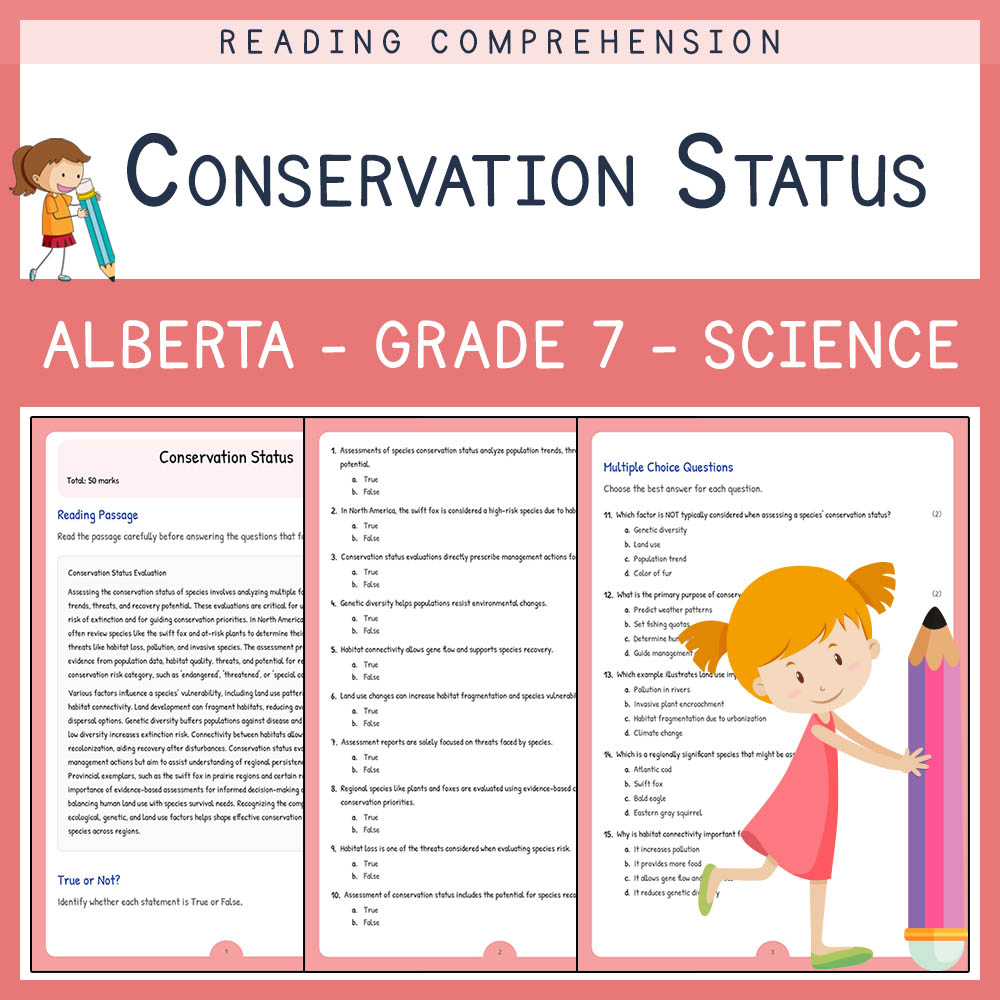
Grade 7 Science | Conservation Status Worksheet Elena | Alberta
Created byLumora LearningLearning Objectives
- Understand the criteria used to assess the conservation status of species.
- Identify regional examples and factors influencing species vulnerability.
- Interpret evidence related to population trends, threats, and recovery potential.
Also included in: Grade 7 Science | Interactions & Ecosystems Custom Bundle | Alberta
Instant download
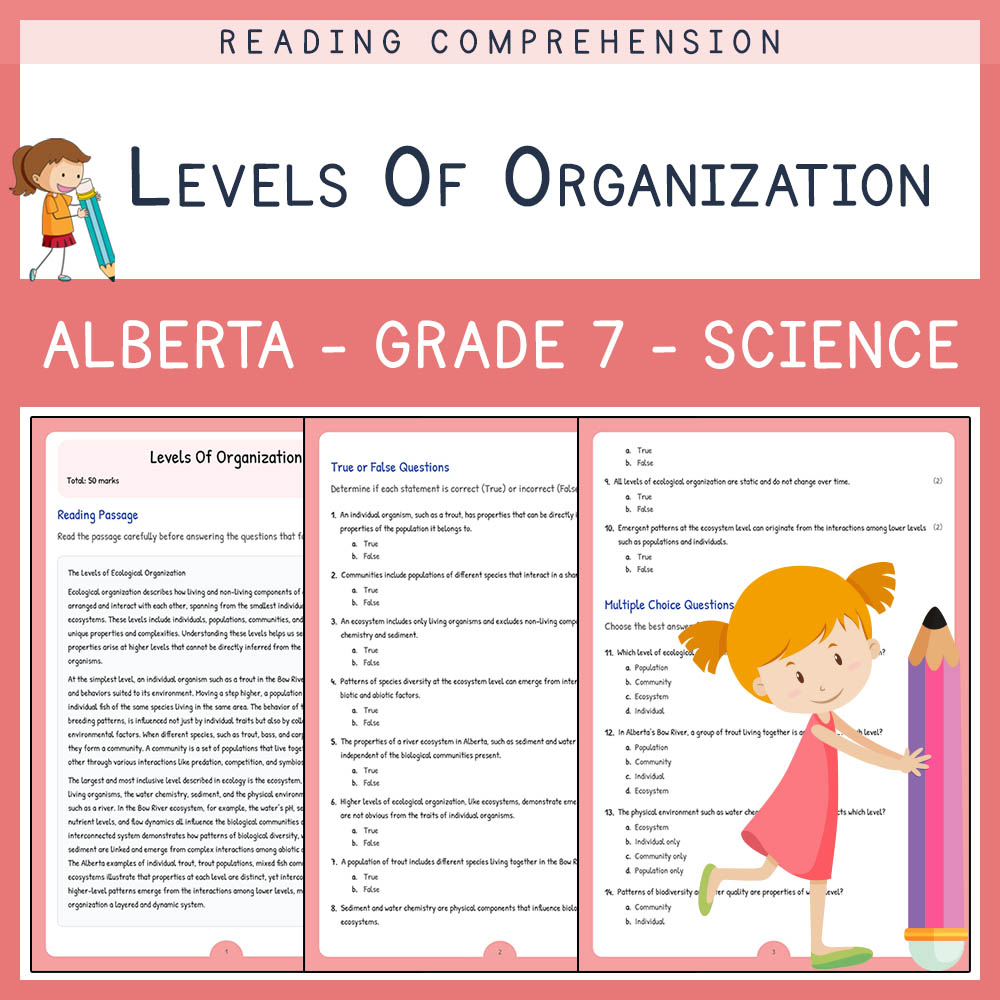
Grade 7 Science Assessment | Levels Of Organization Worksheet | Alberta
Created byLumora LearningLearning Objectives
- Identify the different levels of ecological organization and their properties.
- Explain how patterns at higher levels emerge from lower levels.
- Distinguish between individual organisms, populations, communities, and ecosystems using examples.
Also included in: Grade 7 Science | Interactions & Ecosystems Custom Bundle | Alberta
Instant download
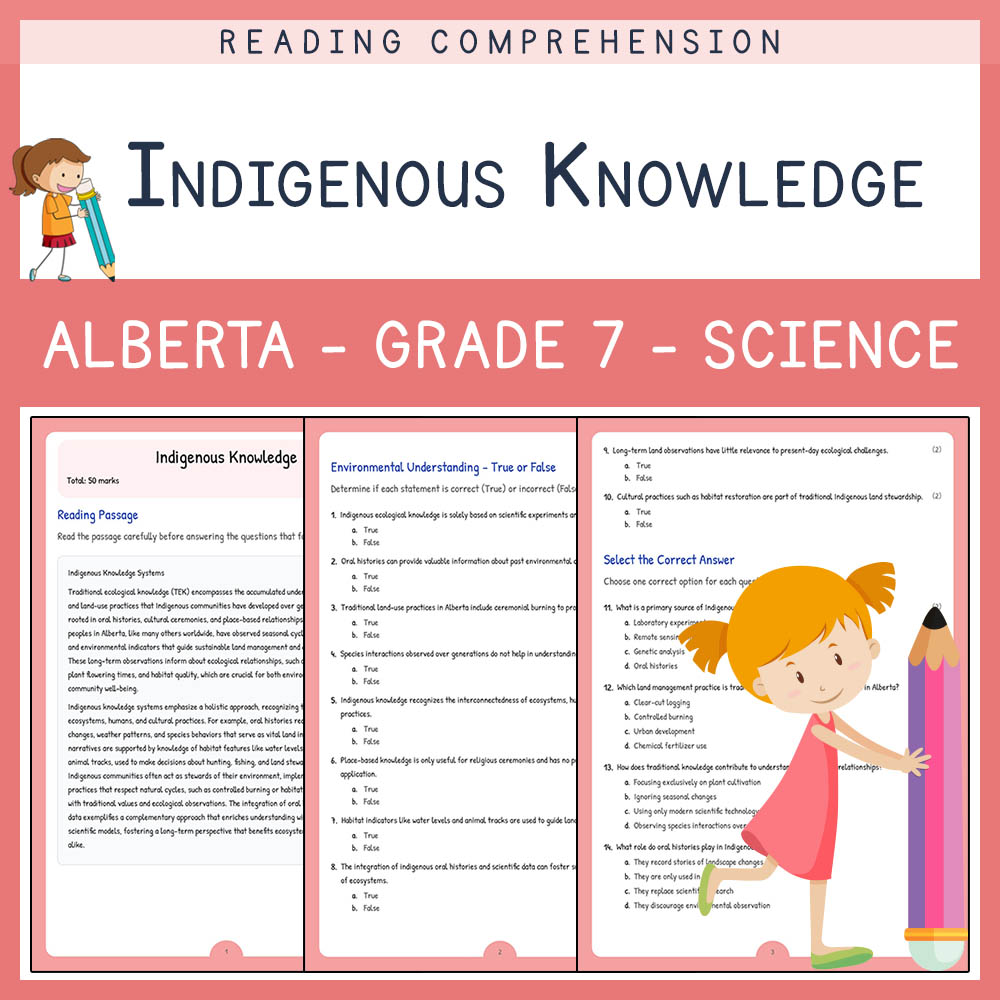
Grade 7 Science Assessment | Indigenous Knowledge Worksheet Elena | Alberta
Created byLumora LearningLearning Objectives
- Understand the role of oral histories and land-use practices in indigenous ecological understanding.
- Identify examples of traditional stewardship and habitat indicators used by Indigenous communities.
- Recognize the importance of integrating different knowledge systems to interpret environmental patterns.
Also included in: Grade 7 Science | Interactions & Ecosystems Custom Bundle | Alberta
Instant download
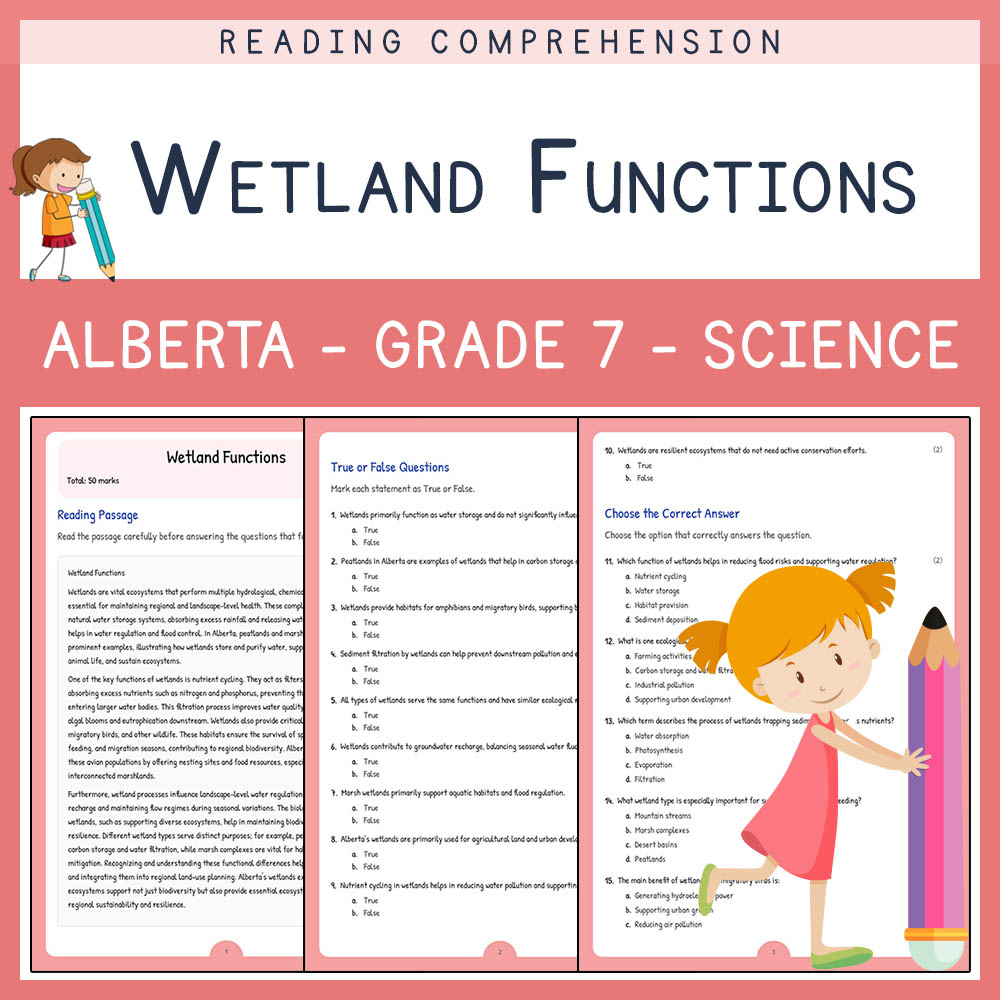
Grade 7 Science | Wetland Functions Worksheet Elena | Alberta Standards
Created byLumora LearningLearning Objectives
- Understand the hydrological, chemical, and biological functions performed by wetlands.
- Identify examples of Alberta wetlands and their ecological roles.
- Explain how wetlands contribute to water regulation and biodiversity.
Also included in: Grade 7 Science | Interactions & Ecosystems Custom Bundle | Alberta
Instant download
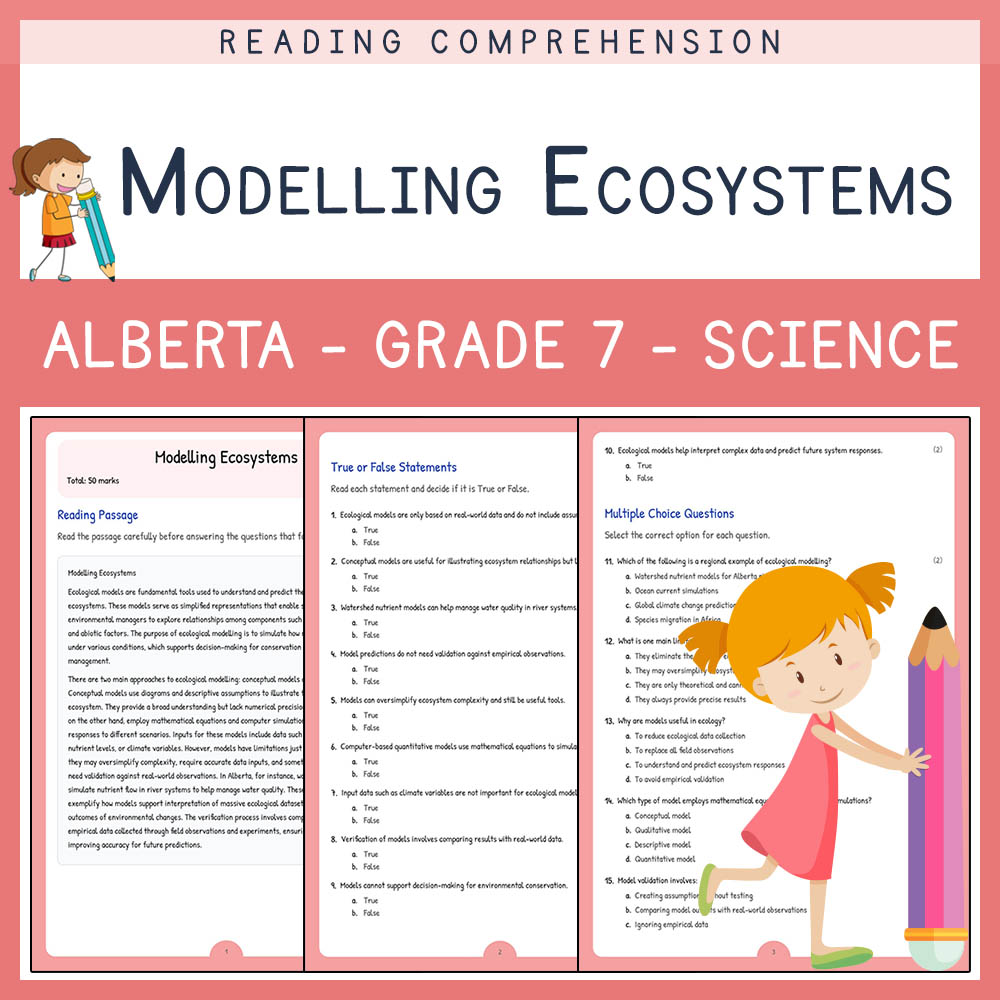
Grade 7 Science | Modelling Ecosystems Worksheet | Alberta Standards
Created byLumora LearningLearning Objectives
- Understand types of ecological models and their applications.
- Identify the inputs and limitations of ecological modelling.
- Explain regional examples such as watershed nutrient models.
Also included in: Grade 7 Science | Interactions & Ecosystems Custom Bundle | Alberta
Instant download
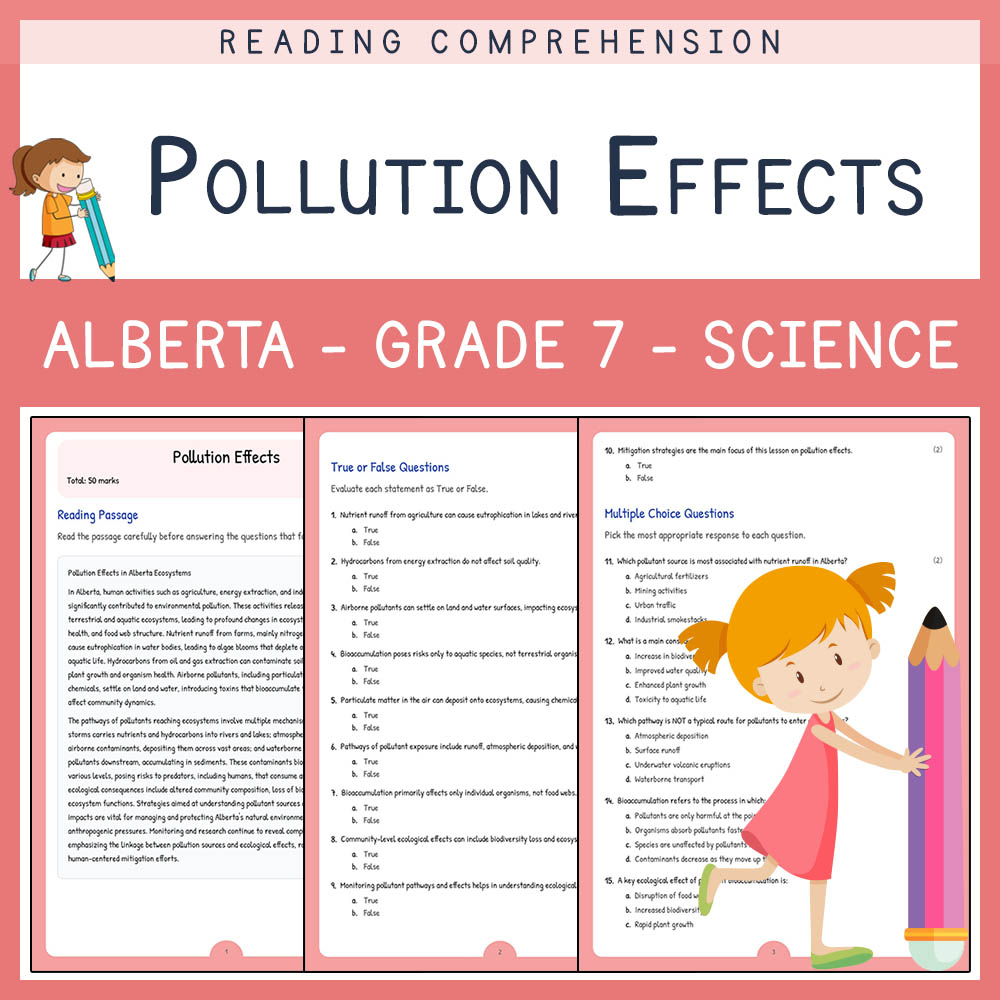
Grade 7 Science Assessment | Pollution Effects Worksheet | Alberta
Created byLumora LearningLearning Objectives
- Understand how human activities introduce contaminants into terrestrial and aquatic ecosystems.
- Identify different types of pollutants relevant to Alberta environments, such as nutrient runoff, hydrocarbons, and airborne deposition.
- Describe pathways of exposure, bioaccumulation risks, and community-level ecological consequences of pollutants.
Also included in: Grade 7 Science | Interactions & Ecosystems Custom Bundle | Alberta
Instant download
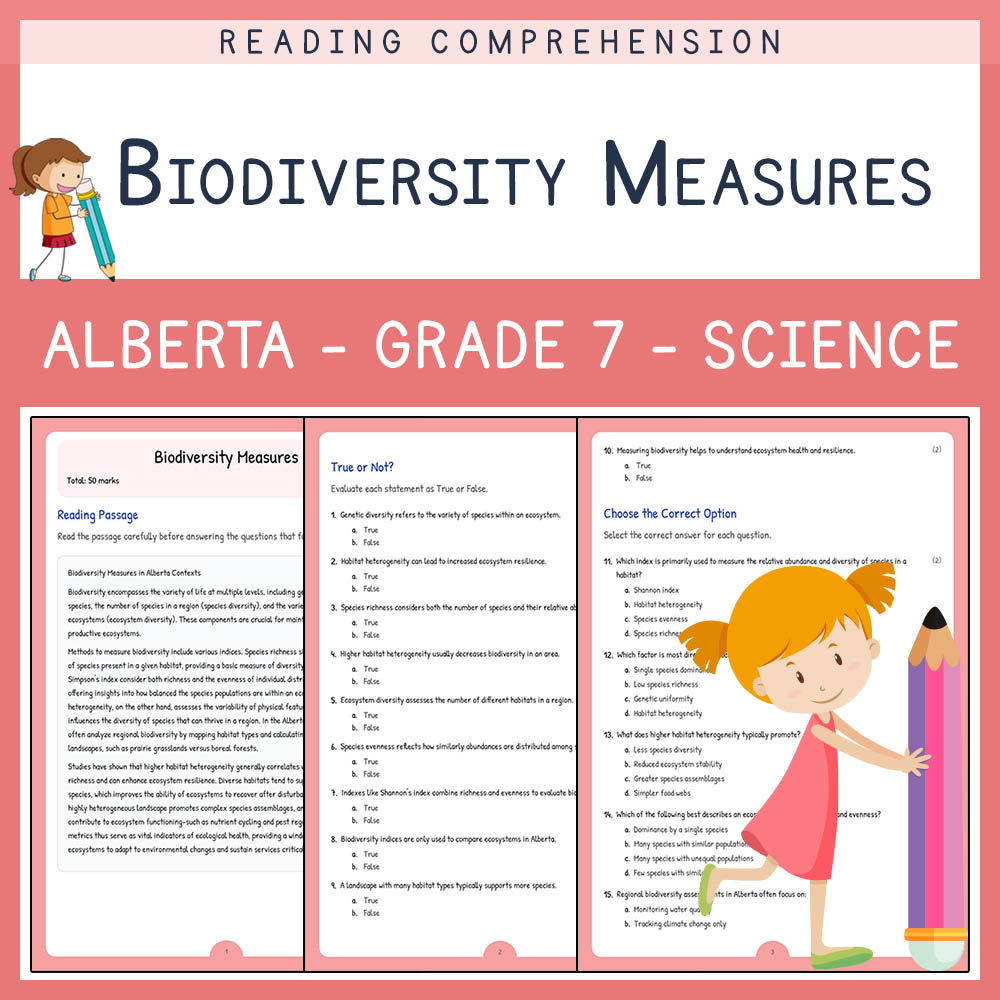
Grade 7 Science Assessment | Biodiversity Measures Worksheet Elena | Alberta
Created byLumora LearningLearning Objectives
- Describe different methods used to measure biodiversity, including indices of richness, evenness, and habitat heterogeneity.
- Interpret what biodiversity metrics reveal about ecosystem resilience and function.
- Examine the relationship between habitat complexity and species assemblages.
Also included in: Grade 7 Science | Interactions & Ecosystems Custom Bundle | Alberta
Instant download
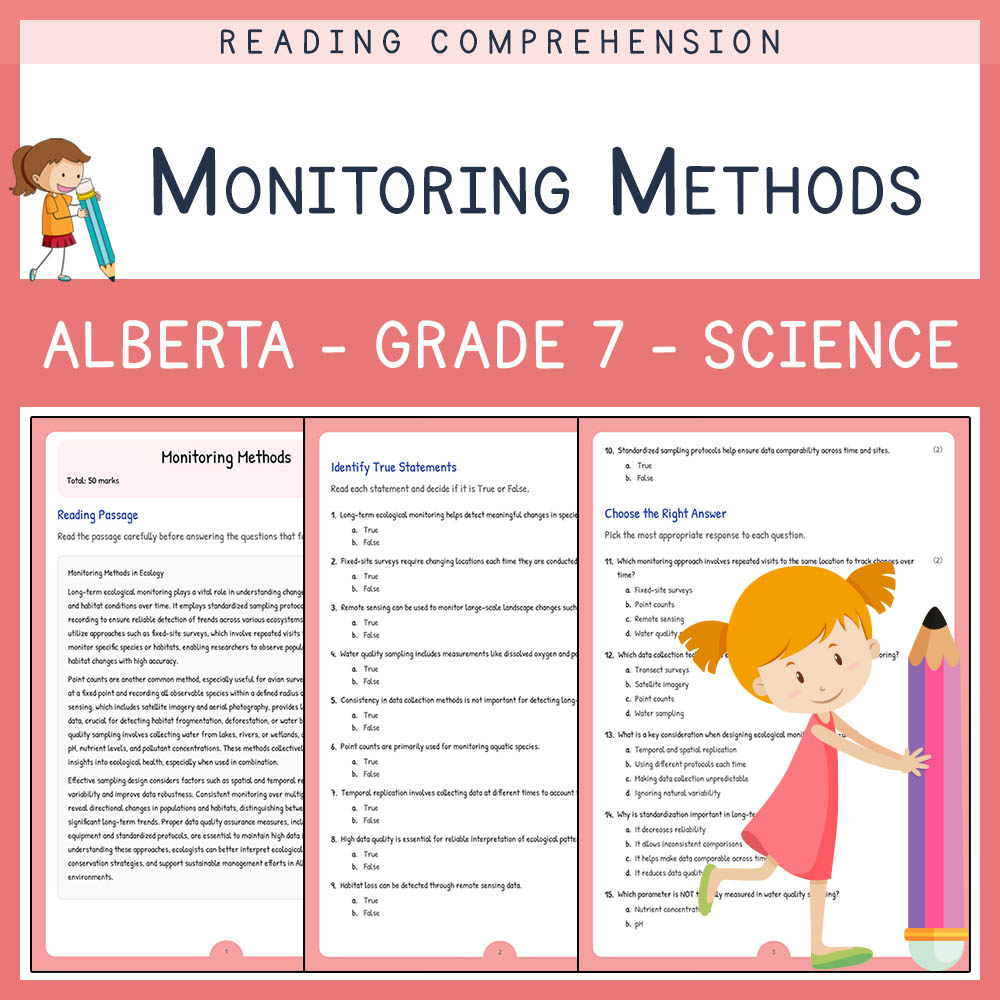
Grade 7 Science | Monitoring Methods Worksheet | Alberta Standard
Created byLumora LearningLearning Objectives
- Understand various long-term ecological monitoring techniques used in ecology.
- Identify key considerations for designing effective monitoring programs.
- Describe how data collection methods help detect ecological trends over time.
Also included in: Grade 7 Science | Interactions & Ecosystems Custom Bundle | Alberta
Instant download
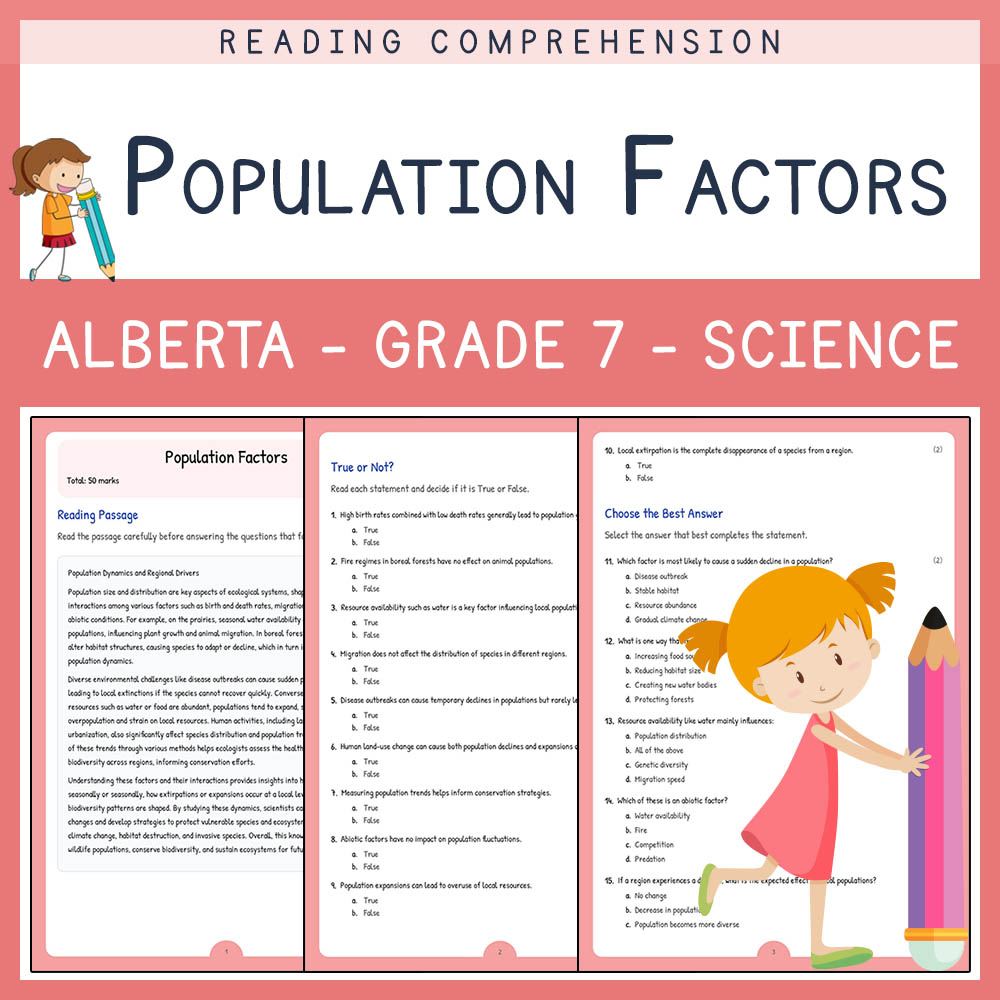
Grade 7 Science Assessment | Population Factors Worksheet Elena | Alberta
Created byLumora LearningLearning Objectives
- Understand how birth, death, immigration, and emigration influence population size and distribution.
- Identify regional drivers such as resource availability, water, fire, and disease that affect populations.
- Analyze how population fluctuations impact biodiversity and species status.
Also included in: Grade 7 Science | Interactions & Ecosystems Custom Bundle | Alberta
Instant download
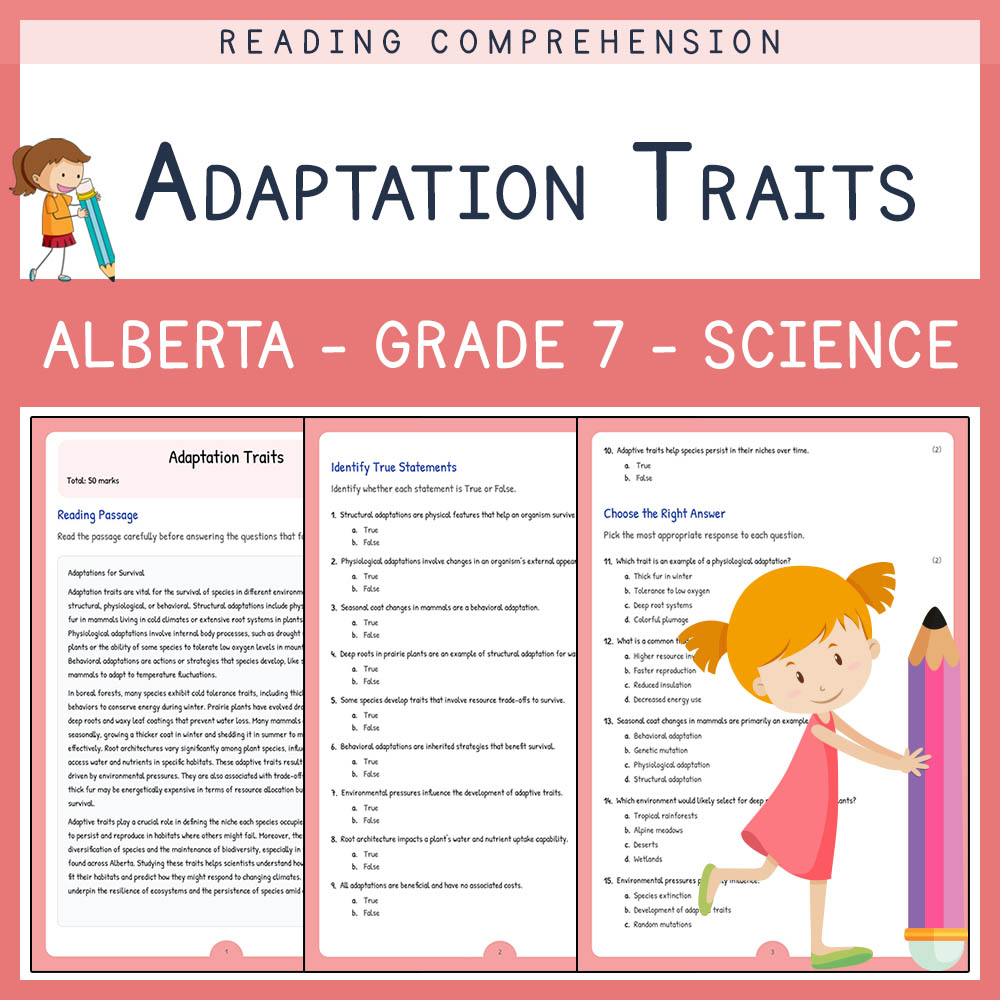
Grade 7 Science | Adaptation Traits Worksheet | Alberta Standard
Created byLumora LearningLearning Objectives
- Understand the concept of adaptive traits and how they contribute to survival.
- Identify different types of adaptations in various species.
- Analyze how traits are influenced by environmental pressures.
Also included in: Grade 7 Science | Interactions & Ecosystems Custom Bundle | Alberta
Instant download
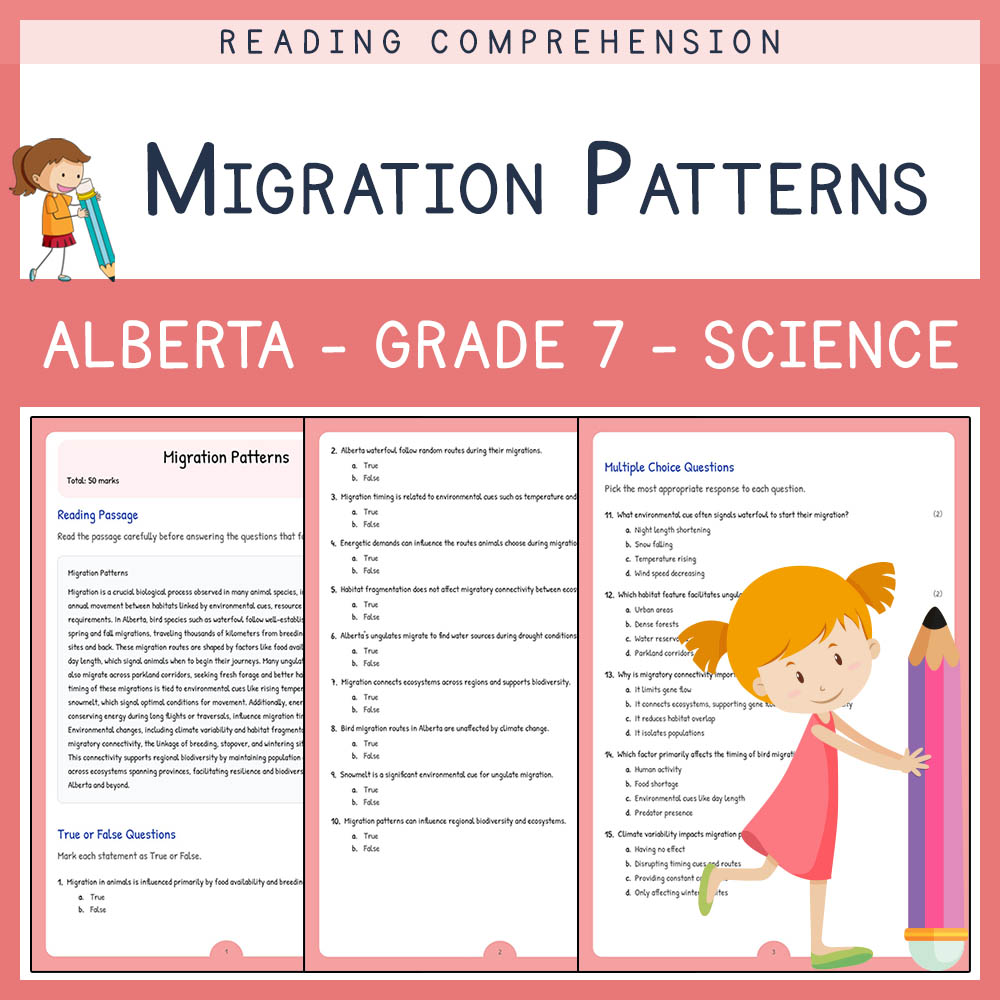
Grade 7 Science Assessment | Migration Patterns Worksheet Elena | Alberta
Created byLumora LearningLearning Objectives
- Understand the factors influencing migration patterns in animals across landscapes.
- Identify examples of migration in Alberta waterfowl and ungulate populations.
- Explain how timing cues, energetic demands, and connectivity influence migration.
Also included in: Grade 7 Science | Interactions & Ecosystems Custom Bundle | Alberta
Instant download
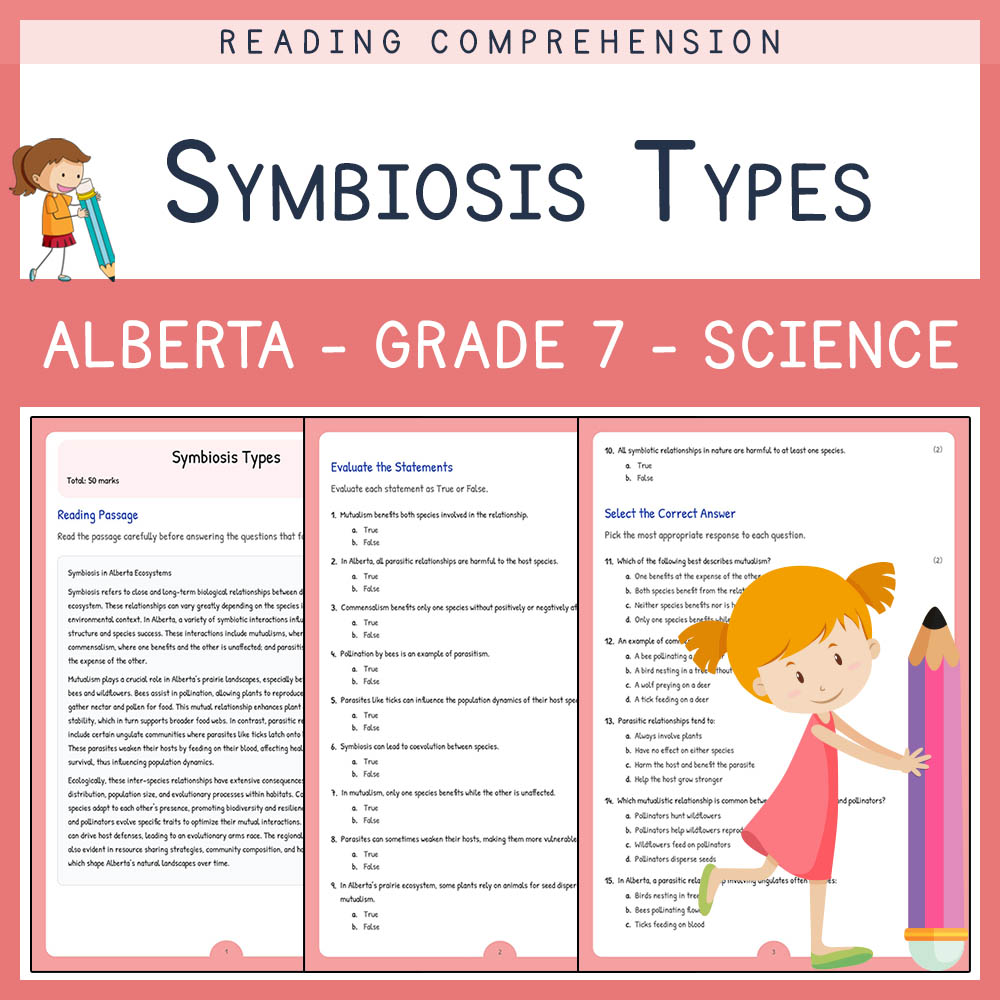
Grade 7 Science Assessment | Symbiosis Types Worksheet Elena | Alberta
Created byLumora LearningLearning Objectives
- Describe the different types of symbiosis: mutualism, commensalism, and parasitism.
- Identify Alberta-relevant examples of each symbiosis type, such as pollinator-plant interactions and parasitic relationships.
- Explain ecological consequences of symbiosis on population dynamics, resource sharing, and coevolution in regional habitats.
Also included in: Grade 7 Science | Interactions & Ecosystems Custom Bundle | Alberta
Instant download
About Grade 7 Science Worksheets
Browse 6,039 printable Grade 7 Science worksheets — ready-to-print PDFs with answer keys where available.
Every worksheet on MyTeachingSheets is created by independent teacher-authors and reviewed before publication. All resources download as printable PDFs for classroom, homework, or at-home practice, and many include answer keys. Preview any worksheet free before buying.