
Grade 8 Worksheets
8,326 grade resources
Genes and Traits Assessment | Florida NGSSS Grade 8 Science Printable
 Created byPrism Point Learning
Learning Objectives
- Explain how genes and alleles are passed from parents to offspring during reproduction
- Distinguish between genotype and phenotype and relate them to inherited traits
- Use allele combinations to predict how traits may appear in offspring
Also included in: Grade 8 Evolution and Genetics Science Lesson Bundle | Florida NGSSS
Instant download

Earth Materials Cycles and Energy Flows Worksheet | Grade 8 NGSS
 Created byNorthstar Worksheets
Learning Objectives
- Model how Earth’s materials cycle through rock, weathering, transport, and deposition processes.
- Explain how Earth’s internal heat and gravitational potential energy drive changes in the geosphere.
- Describe how interactions between the geosphere, hydrosphere, and atmosphere can change Earth’s surface.
Instant download

Rock and Mineral Formation Processes Worksheet | Grade 8 Science
 Created byBRIGHT PATH RESOURCES
Learning Objectives
- Explain how igneous, sedimentary, and metamorphic rocks form from changing Earth materials.
- Describe how minerals form and how their composition affects physical properties.
- Connect the rock cycle to long-term Earth changes driven by tectonic activity.
Also included in: Grade 8 Earth & Space Science Worksheets Bundle | Weather & Climate +2 more
Instant download
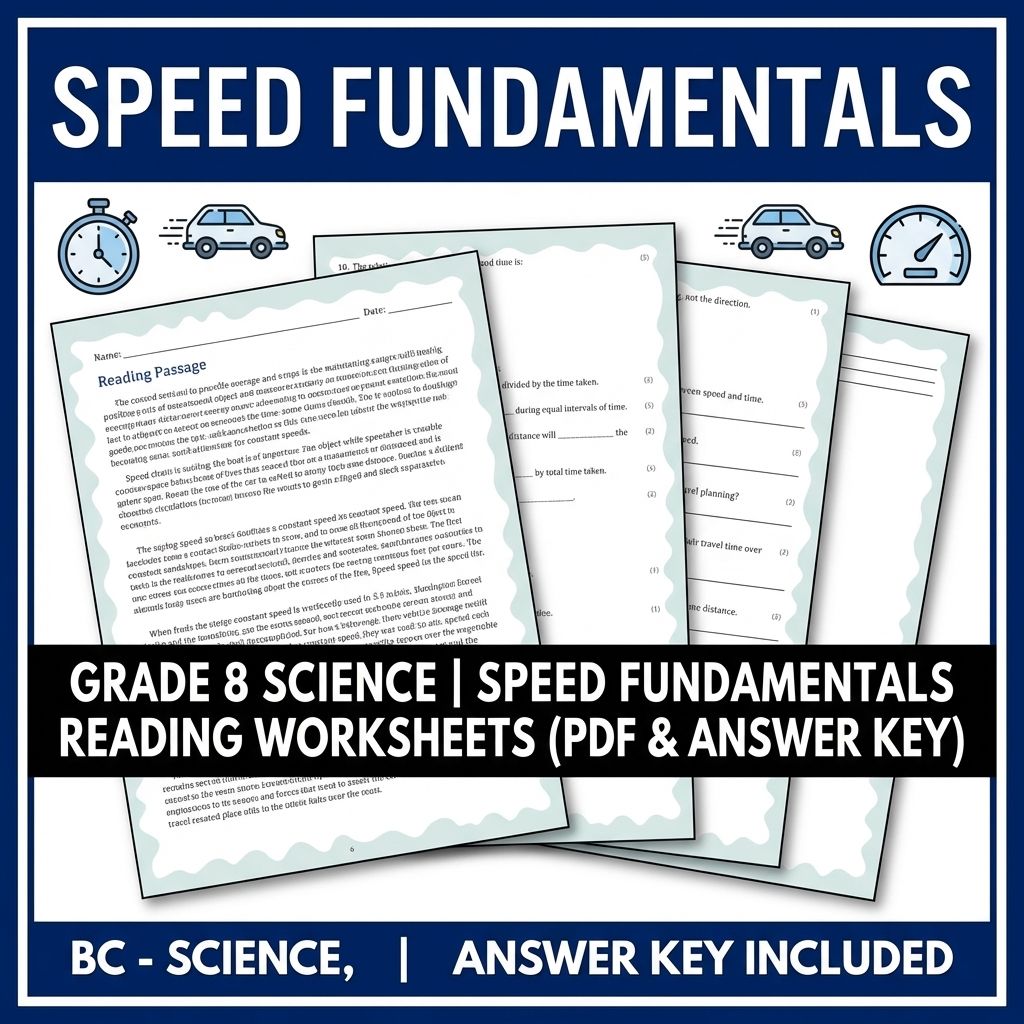
Grade 8 Science | Speed Fundamentals Reading Worksheets (PDF & Answer Key)
JCreated byJ.S SheetsLearning Objectives
- Define and calculate speed as distance divided by time.
- Differentiate between constant speed and average speed.
- Apply proportional reasoning to relate speed, distance, and time.
Instant download

Grade 8 Fossil Record Clues Worksheet | Practice & Standards PDF
 Created byClear Sky Classroom
Learning Objectives
- Explain how fossils in sedimentary rock layers provide clues about Earth’s past environments and organisms.
- Describe how matching fossil types and rock-layer ages across regions can support plate-tectonic ideas.
- Use rock and sediment characteristics to infer past conditions such as changes in climate or deposition.
Instant download

Grade 8 ELA – Daily Reading Worksheet | Understanding Figurative Language TEKS
 Created byQuiet Forest Education
Learning Objectives
- Understand key concepts related to ELA
- Apply knowledge through practice questions
- Demonstrate comprehension of the material
Also included in: Daily Reading & Text Analysis Grade 8 ELA Daily Worksheets Lesson Bundle | TEKS +1 more
Instant download

Grade 8 Science | Cultures of the Galaxy Worksheet (May Standards) (PDF)
 Created bySilver Birch Teaching
Learning Objectives
- Compare fictional Star Wars cultures (languages, customs, social structures) to real-world cultures using evidence from the text.
- Explain how stories reflect social values such as empathy, respect, and inclusion.
- Identify examples of cultural diversity and discuss ways communities can live in harmony despite differences.
Also included in: Grade 8 Holiday Media Literacy Science Lesson Bundle (May Framework) +1 more
Instant download

Grade 8 Holiday | National Aviation Day Worksheet for Mastery | PDF + Answer Key
 Created byShaNova Worksheets
Learning Objectives
- Explain key aviation milestones and how they improved the ability to fly safely and consistently.
- Describe the basic science behind flight, including lift and drag.
- Connect aviation history to modern uses such as emergency response and humanitarian aid.
Instant download

Grade 8 Science | Understanding Photosynthesis - Daily Reading Comprehension
 Created byCoral Reef Learning
Learning Objectives
- Identify the key evidence that supports the process of photosynthesis.
- Explain the biological mechanisms involved in converting sunlight to chemical energy.
- Analyze data patterns related to plant growth and energy production.
Instant download

Molecular Structure Worksheet | NGSS Grade 8 Science Assessment
 Created byCedar Grove Learning
Learning Objectives
- Describe how atoms combine to form molecules using particle models and symbolic formulas.
- Identify the types and numbers of atoms in common molecules such as H2O and CO2.
- Interpret molecular diagrams and structural models to understand bonding arrangements.
Instant download

Evidence Selection Worksheet for Grade 8 ELA | Standards-Aligned Practice
JCreated byJ.S SheetsLearning Objectives
- Identify the most relevant evidence to support a claim or topic sentence in an argument.
- Evaluate evidence for accuracy, relevance, and usefulness to the reader’s understanding.
- Choose a variety of evidence types (quotations, data, observations, and research notes) to strengthen writing.
Instant download

Scientific Inquiry Evidence-Based Explanations Worksheet | NGSSS Grade 8 Science
JCreated byJ.S SheetsLearning Objectives
- Identify how scientific inquiry starts with observations and questions about the natural world.
- Describe how investigations use evidence, controlled conditions, and careful record-keeping to support explanations.
- Compare new results with existing knowledge to evaluate whether a scientific idea fits well.
Also included in: Grade 8 Evidence-Based Scientific Inquiry Science Lesson Bundle | Florida NGSSS +1 more
Instant download

Ecosystem Matter Cycling Worksheet | Grade 8 Science Practice
Created byPrism Point LearningLearning Objectives
- Explain how matter cycles between living organisms and nonliving parts of an ecosystem.
- Describe how decomposition, gas exchange, and soil nutrient transformation return matter to the environment.
- Trace how producers and consumers transfer matter through feeding and growth over time.
Instant download

Grade 8 Flag Day Worksheet for Celebrating Patriotism PDF + Answer Key
Created byShaNova WorksheetsLearning Objectives
- Explain what the American flag symbolizes and why civic symbols matter.
- Describe at least three respectful ways communities celebrate Flag Day and show unity.
- Use evidence from examples to connect patriotism with empathy and inclusion.
Instant download

Human Impact Science Worksheet | TEKS Grade 8 Practice & Assessment
JCreated byJ.S SheetsLearning Objectives
- Explain how habitat alteration, pollution, resource extraction, and invasive species change ecosystems and biodiversity.
- Describe how human impacts can disrupt food webs and weaken ecosystem services.
- Evaluate trade-offs among economic, social, and ecological priorities when making environmental decisions.
Instant download

Grade 8 Math | Coding Concepts Worksheet (Ontario Standards) (PDF)
Created byClear Sky ClassroomLearning Objectives
- Understand basic algorithmic thinking and the use of coding constructs to represent linear patterns.
- Apply mathematical reasoning to interpret and generate data related to programming models.
- Solve problems involving calculations of ratios, percentages, and linear relationships in real-world contexts.
Also included in: Grade 8 Algebra Bundle: Coding & Mathematical Modelling Activities +1 more
Instant download

Mixtures Versus Compounds Worksheet | Grade 8 Science Practice
Created byPrism Point LearningLearning Objectives
- Distinguish mixtures from compounds based on bonding and proportions
- Explain how properties of mixture components compare to the properties of a compound
- Use examples to predict whether physical separation or a chemical reaction is required
Also included in: Matter & Chemical Change Lesson Bundle | Grade 8 Science | BC +1 more
Instant download
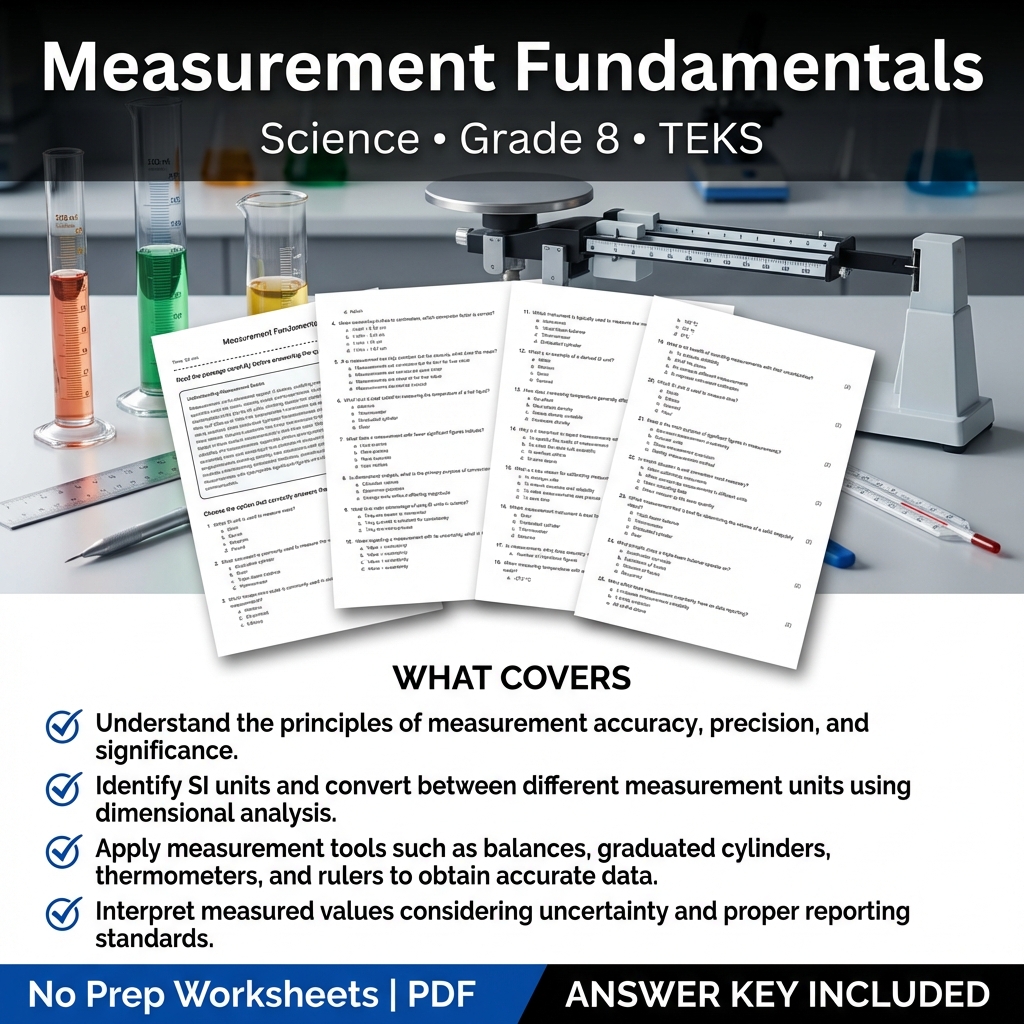
Measurement Fundamentals Worksheet for Grade 8 Science TEKS
Created byCoral Reef LearningLearning Objectives
- Understand the principles of measurement accuracy, precision, and significance.
- Identify SI units and convert between different measurement units using dimensional analysis.
- Apply measurement tools such as balances, graduated cylinders, thermometers, and rulers to obtain accurate data.
Instant download

Net Force and Motion Worksheet | Grade 8 Alberta Science Activity
Created byBRIGHT PATH RESOURCESLearning Objectives
- Define net force as the overall push or pull on an object.
- Explain how net force relates to whether an object speeds up, slows down, changes direction, or stays at rest.
- Distinguish balanced forces from unbalanced forces using net force.
Also included in: Grade 8 Alberta Science Forces and Motion Physics Worksheet Bundle +1 more
Instant download

Grade 8 Science – Tissue Types & Structures | Daily Reading Worksheet
 Created byBright Mind Resources
Learning Objectives
- Understand key concepts related to Science
- Apply knowledge through practice questions
- Demonstrate comprehension of the material
Also included in: Grade 8 Body Systems & Cell Structure Science Daily Reading Lesson Bundle | BC +1 more
Instant download

Grade 8 Science Worksheet – Particles Meet Energy (PDF)
 Created byEvergreen Desk Education
Learning Objectives
- Explain observable reaction outcomes by combining particle (atom/arrangement) and energy (temperature) perspectives.
- Use particle models to describe how atoms rearrange to form new substances during chemical reactions.
- Interpret temperature changes as evidence of energy changes in a reacting system.
Also included in: Grade 8 Matter, Forces, and Energy Science Lesson Bundle: General Framework +1 more
Instant download
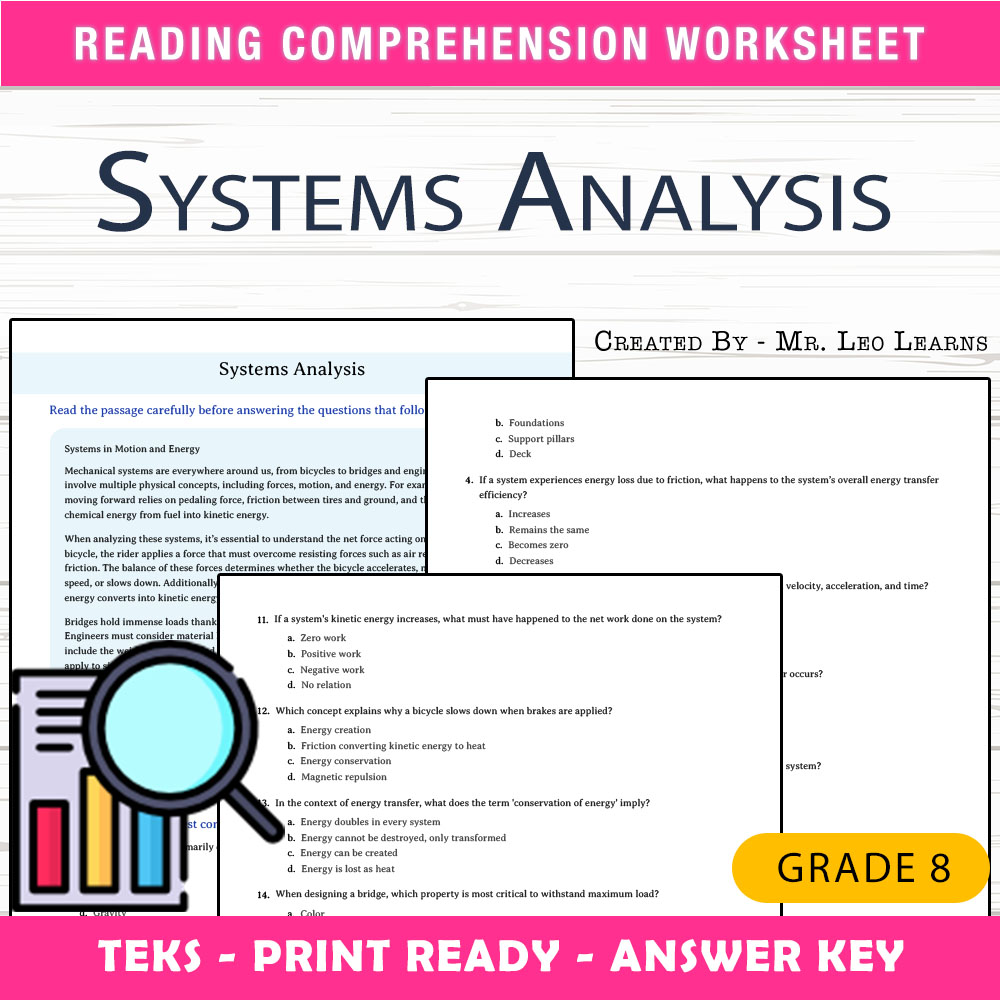
Grade 8 Science – Systems Analysis Worksheet for Mastery
 Created byThe Resource Hub
Learning Objectives
- Understand how forces, motion, and energy transfer are related in mechanical systems.
- Analyze real-world systems such as bicycles, bridges, and engines using quantitative reasoning.
- Evaluate the impact of factors like friction, material limits, and efficiency on system performance.
Also included in: Grade 8 Science Unit Bundle | Motion, Forces & Energy Mastery Worksheets +1 more
Instant download

Grade 8 Coherent Drafts Worksheet TEKS ELA Writing Process Practice
 Created byGolden Apple Studio
Learning Objectives
- Identify how a controlling idea shapes the organization of an informational draft
- Use topic sentences, supporting sentences, and purposeful paragraphing to explain details and reasons
- Evaluate whether transitions, tense, viewpoint, and style create coherence across paragraphs
Also included in: Source Attribution & Research Writing Lesson Bundle | Grade 8 ELA | teks +1 more
Instant download
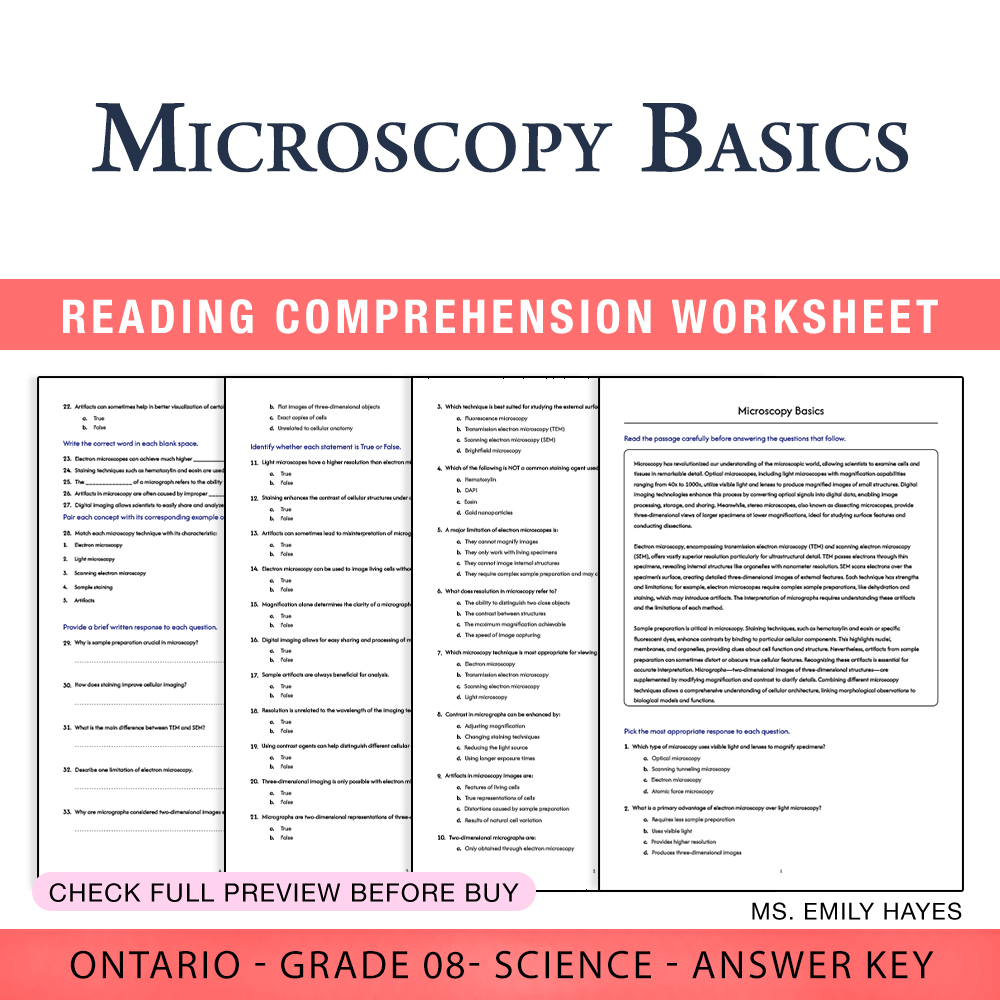
8th Grade Science | Microscopy Basics Worksheet (PDF+ Answer Key)
 Created byCopper Leaf Classroom
Learning Objectives
- Understand the principles of optical, digital, stereomicroscopy, and electron imaging techniques.
- Identify and explain key concepts such as magnification, resolution, and contrast.
- Compare and contrast different microscopy methods used for cellular visualization.
Instant download

Grade 8 Science | Energy Flow Trophic Levels Worksheet | General Standards
 Created byLumora Learning
Learning Objectives
- Describe how energy moves through trophic levels in an ecosystem.
- Explain why energy decreases as it transfers from producers to consumers.
- Use food web ideas to predict how changes in one species can affect other trophic levels.
Instant download

Grade 8 Science – Power Grids & Energy Sources | Daily Reading Worksheet
Created byBright Mind ResourcesLearning Objectives
- Explain the basic structure and components of electric power grids.
- Identify regional influences on power generation methods.
- Describe how power grids manage supply, demand, and losses.
Also included in: Grade 8 Electricity Science Daily Reading Worksheets Lesson Bundle | Alberta +2 more
Instant download

Grade 8 Math | Financial Calculations Worksheet (Ontario Standard) (PDF)
Created byClear Sky ClassroomLearning Objectives
- Calculate simple interest in various financial scenarios.
- Apply proportional reasoning to compare different savings and loan options.
- Interpret the effects of interest rates and time periods on total amounts.
Also included in: Grade 8 Math Financial Literacy Lesson Bundle | Ontario Standards +1 more
Instant download

Grade 8 Logical Organization Worksheet | TEKS ELA Writing Structure
Created byGolden Apple StudioLearning Objectives
- Identify how an opening, body, and conclusion contribute to a writer’s purpose.
- Use logical progression and transitions to connect ideas within and across paragraphs.
- Evaluate whether a text follows cause-and-effect, comparison, or problem-solution structure.
Also included in: Source Attribution & Research Writing Lesson Bundle | Grade 8 ELA | teks +1 more
Instant download

Grade 8 Science | Power and Efficiency in Electricity - Reading Comprehension
Created byCoral Reef LearningLearning Objectives
- Understand the concept of power as energy transfer per unit time.
- Learn how efficiency measures the useful output versus input in electrical devices.
- Identify common causes of energy loss in electrical systems.
Also included in: Electricity and Magnetism Lesson Bundle – Grade 8 Science Alberta +1 more
Instant download

Internal Structures Worksheet for Grade 8 Science | Standards-Aligned Practice
JCreated byJ.S SheetsLearning Objectives
- Identify the internal structures of living organisms and understand their functions.
- Explain how internal and external features support survival, growth, and reproduction.
- Connect the relationship between anatomy and function in different organisms.
Also included in: Grade 8 Adaptation and Ecosystem Change Science Lesson Bundle +1 more
Instant download

Grade 8 Science | Food Web Pathways Worksheet | California Standards
Created byLumora LearningLearning Objectives
- Explain how energy moves through interconnected food webs rather than single linear food chains
- Describe how changes in one population can create direct and indirect effects at different trophic levels
- Interpret food web relationships to predict likely consequences of disturbances
Instant download

Grade 8 Science – Measurement & Precision Daily Reading Worksheet | Alberta
Created byBright Mind ResourcesLearning Objectives
- Understand the importance of proper instrument calibration.
- Learn how to estimate measurement uncertainty.
- Recognize the significance of significant figures and units in data accuracy.
Also included in: Grade 8 Science Systems Forces Daily Reading Worksheets Lesson Bundle | Alberta +2 more
Instant download

Membrane Transport Worksheet | Grade 8 Science Review & Practice
Created byPrism Point LearningLearning Objectives
- Explain passive and active transport across cell membranes, including diffusion, osmosis, facilitated diffusion, and active transport.
- Use relationships involving concentration gradients, surface area, and membrane transport rate.
- Describe how vesicular transport (endocytosis and exocytosis) moves large materials across membranes.
Also included in: Grade 8 Cell Organization & Homeostasis Science lesson bundle: Ontario
Instant download

Grade 8 Science Worksheet | Understanding Density in Ontario (PDF)
Created byEvergreen Desk EducationLearning Objectives
- Explain density as mass per unit volume and use SI units (kg/m³ and g/mL) to compare materials.
- Use density to predict whether objects float or sink in water and connect this to buoyancy.
- Describe relative density and specific gravity and relate them to the density of a reference material.
Also included in: Grade 8 Fluid Pressure & Forces Science Lesson Bundle: Ontario Worksheet Set +1 more
Instant download

Grade 8 ELA – Evidence Interpretation & Reading Comprehension | Daily Worksheet
Created byQuiet Forest EducationLearning Objectives
- Understand how to connect evidence to main ideas in texts.
- Identify relevant details that support interpretations.
- Summarize how evidence explains the meaning of a passage.
Also included in: Grade 8 Daily Reading Text Evidence in ELA Lesson Bundle | BC Framework +1 more
Instant download
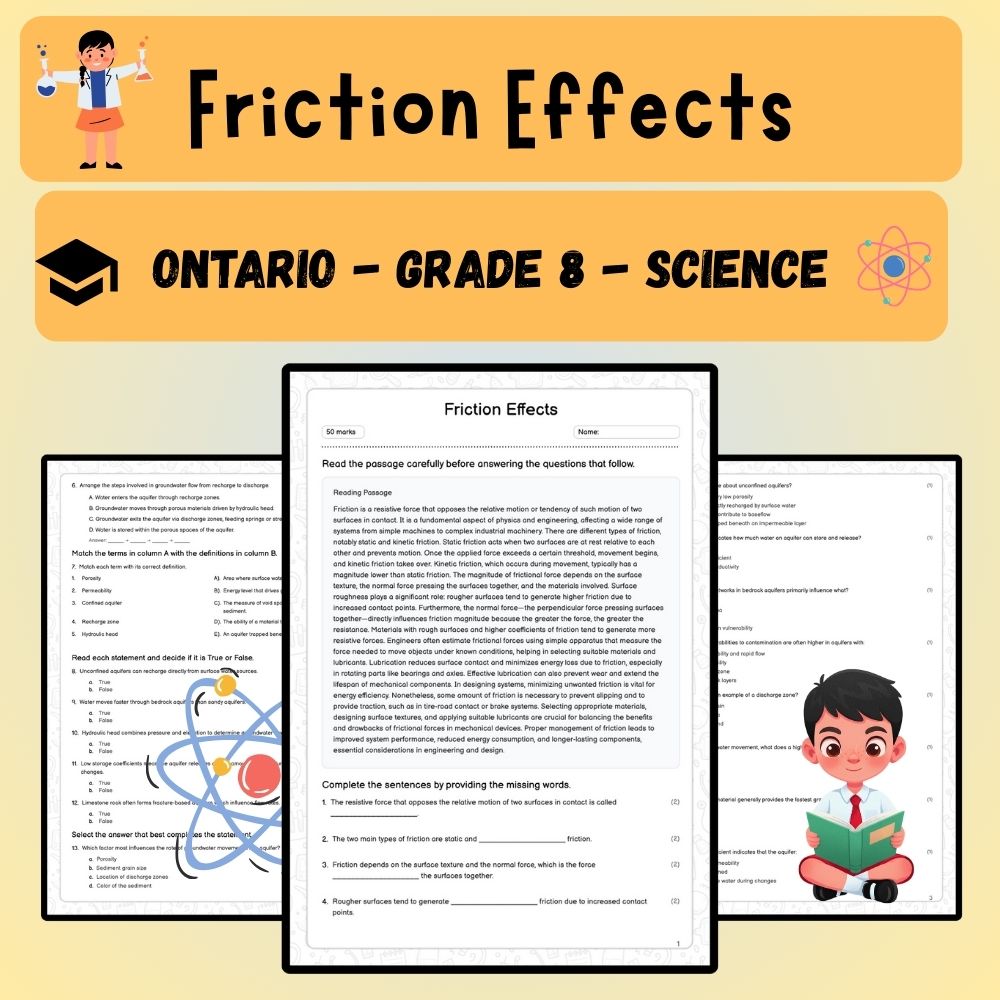
Grade 8 Science | Friction Effects Worksheet (PDF ) – Ontario Standards
Created byPrism Point LearningLearning Objectives
- Understand the different types of friction and their roles in mechanical systems.
- Analyze how surface texture, normal force, and material selection affect frictional forces.
- Evaluate methods for estimating friction in simple apparatus and their implications for engineering design.
Also included in: Grade 8 Science Unit Bundle | Forces, Energy & Motion Worksheets +1 more
Instant download
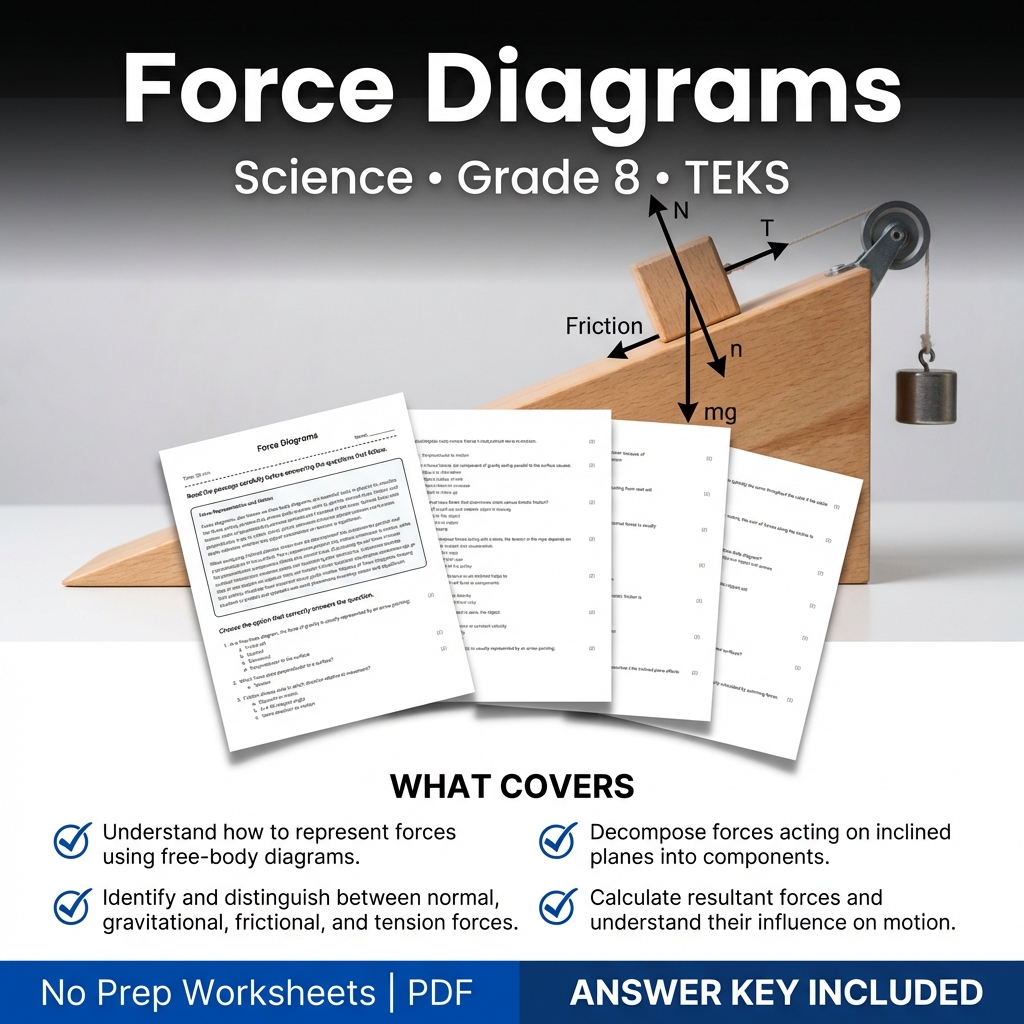
Force Diagrams Worksheet for Grade 8 Science | TEKS Practice
Created byCoral Reef LearningLearning Objectives
- Understand how to represent forces using free-body diagrams.
- Identify and distinguish between normal, gravitational, frictional, and tension forces.
- Decompose forces acting on inclined planes into components.
Instant download

Grade 8 ELA – Clarity & Voice Daily Reading Worksheet | TEKS Aligned
Created byQuiet Forest EducationLearning Objectives
- Understand key concepts related to ELA
- Apply knowledge through practice questions
- Demonstrate comprehension of the material
Also included in: Source Attribution & Revision Grade 8 ELA Daily Worksheets Lesson Bundle | TEKS +1 more
Instant download
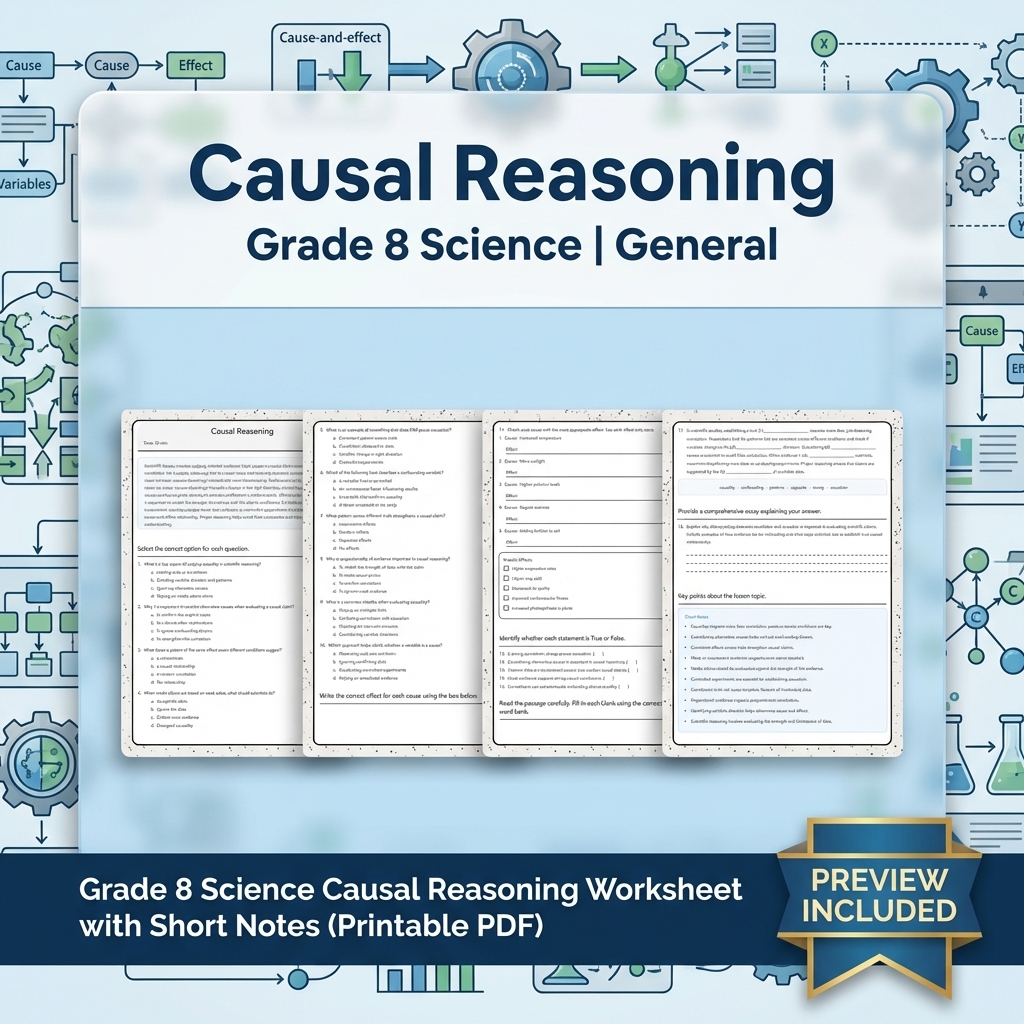
Grade 8 Science Causal Reasoning Worksheet with Short Notes (Printable PDF)
 Created byMeadowlark Worksheets
Learning Objectives
- Understand how to evaluate whether evidence supports a causal relationship or just correlation.
- Identify variables, alternative causes, and patterns across different conditions or trials.
- Analyze media claims to determine if they match the strength and limitations of available data.
Also included in: Grade 8 Scientific Reasoning Science Lesson Bundle: General Framework +1 more
Instant download

Grade 8 Health | Locomotor Skills Worksheet (Ontario Standards) (PDF)
 Created bySunny Desk Resources
Learning Objectives
- Refine locomotor skills by applying correct body positioning, arm/leg actions, and balance for running, jumping, and hopping.
- Analyze movement patterns by identifying common errors that reduce speed, control, and fluidity.
- Use feedback and practice strategies to improve technique during tag, relay, and station activities.
Also included in: Grade 8 Movement Competence Health Lesson Bundle: Ontario Framework +1 more
Instant download

Grade 8 Science | Testable Claims in Science - Daily Reading Comprehension
Created byCoral Reef LearningLearning Objectives
- Understand what makes a claim testable through observations and measurements.
- Identify variables and observations in scientific hypotheses.
- Differentiate between a hypothesis and an observation based on evidence.
Instant download

Grade 8 Watershed Systems Worksheet | Ontario Science Activity & Answer Key
Created byClear Sky ClassroomLearning Objectives
- Explain how watershed boundaries determine where water flows
- Describe how land cover, slope, and soil type affect infiltration and runoff
- Identify how stream networks and storage elements influence flow patterns and downstream impacts
Instant download

Grade 8 Science Worksheet – Biomedical Flow Concepts (Ontario Standard)
Created byEvergreen Desk EducationLearning Objectives
- Explain how viscosity, vessel diameter, and pressure gradients affect blood (fluid) flow using simplified pipe-flow ideas.
- Describe how non-Newtonian (shear-dependent) blood behavior can change perfusion.
- Relate systolic and diastolic pressure to arterial function and resistance.
Also included in: Grade 8 Fluid Pressure & Forces Science Lesson Bundle: Ontario Worksheet Set +1 more
Instant download

Grade 8 Science | Voltage Concepts Worksheet (Alberta Standards) (PDF)
Created bySilver Birch TeachingLearning Objectives
- Explain voltage (electric potential difference) as energy per unit charge available to move charges in a circuit
- Describe how voltage sources (cells, batteries, generators) relate to current and resistance in everyday circuits
- Use reference points to compare potential differences in multi-source circuit situations
Also included in: Grade 8 Electricity & Circuits Science Lesson Bundle: Alberta Framework +1 more
Instant download

Editing Conventions Practice Worksheet | Grade 8 ELA Activities
Created bySunny Desk ResourcesLearning Objectives
- Edit writing for punctuation conventions, including commas, quotation marks, and end punctuation.
- Identify and correct spelling and capitalization errors to improve clarity.
- Check sentence completeness and correct grammar, including verb tense consistency and subject-verb agreement.
Also included in: Grade 8 Writing Lesson Bundle | BC ELA Framework for Argument & Narrative +1 more
Instant download

Newton’s Laws and Quantitative Motion Worksheets | Grade 8 Science
Created byPrism Point LearningLearning Objectives
- Explain Newton’s three laws using clear cause-and-effect language
- Calculate force, mass, or acceleration using F = ma
- Determine net force from forces acting in opposite directions
Also included in: Systems in Action Lesson Bundle | Grade 8 Science | Ontario Framework +1 more
Instant download

Grade 8 Homeostatic Control Worksheet | Body Systems Science Practice
Created byPrism Point LearningLearning Objectives
- Explain how negative feedback helps maintain stable internal conditions in homeostasis.
- Identify key parts of a negative feedback system (sensors, control center, and effectors).
- Describe how homeostatic control supports blood chemistry, water balance, and oxygen levels.
Instant download

Grade 8 Science | Adaptation and Population Change Worksheet | General Aligned
Created byLumora LearningLearning Objectives
- Explain how inherited variation can lead to adaptation when environmental pressures change.
- Describe how adaptation can change allele frequencies and the composition of a population over generations.
- Differentiate between abiotic and biotic environmental pressures and give examples.
Instant download
Browse more categories
About Grade 8 Worksheets
Explore Grade 8 worksheets in math, ELA, science, and social studies. Our 8,326 Grade 8 printables print straight from PDF, answer keys included.
Each resource here is built by an independent educator and reviewed for quality. Worksheets print straight from PDF and suit classroom use, homework, or extra practice; most come with answer keys, and you can preview before purchasing.