
Grade 8 Worksheets
8,330 grade resources
Purpose and Audience ELA Worksheet Pack | Grade 8 Practice
 Created bySunny Desk Resources
Learning Objectives
- Explain how purpose (inform, persuade, entertain, explain) shapes what writers include in a text
- Describe how audience needs influence word choice and the level of formality
- Analyze how tone, perspective, and selected details affect a message
Also included in: Grade 8 Writing Lesson Bundle | BC ELA Framework for Argument & Narrative +1 more
Instant download

Earth’s Origins Worksheet | Assessment for Grade 8 Holiday PDF
Learning Objectives
- Understand the history and significance of Earth Day and environmental movements.
- Identify key figures and milestones in Earth's environmental awareness efforts.
- Explain the importance of pollution reduction, conservation, and climate change awareness.
Instant download
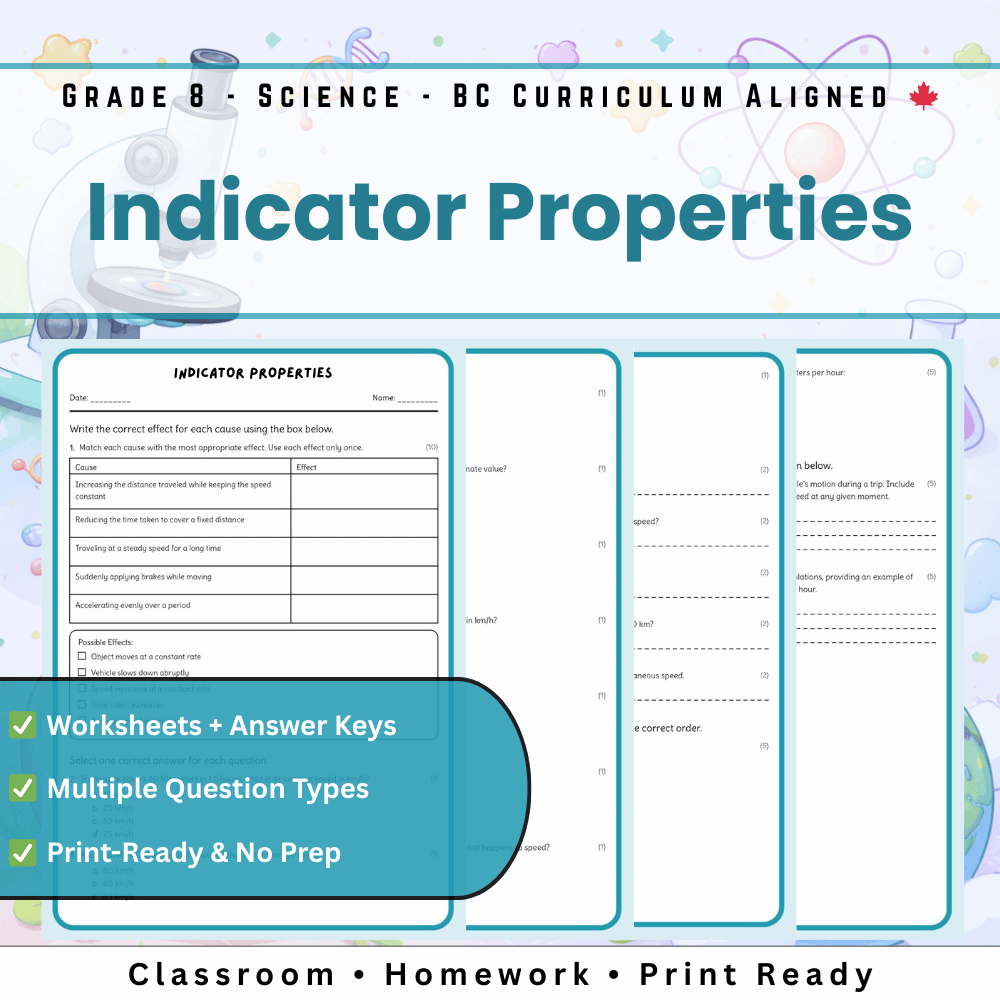
Grade 8 Science – Indicator Properties Worksheet + Answer Key - BC Standards
 Created byBright Mind Resources
Learning Objectives
- Understand how properties such as pH, conductivity, density, and refractive index change during chemical reactions.
- Recognize property shifts as evidence of chemical transformations versus physical mixing.
- Interpret measurements of property shifts to distinguish types of chemical changes.
Instant download

Forms of Energy Worksheet Pack Grade 8 Science Activities & Review
 Created byPrism Point Learning
Learning Objectives
- Identify major forms of energy: kinetic, potential, thermal, and energy carried by light and electricity
- Explain how energy can transfer and change form in everyday situations while conserving total energy
- Use correct science vocabulary to describe the relationship between temperature, motion, and stored position energy
Instant download

World War II Impact Worksheet for Grade 8 Social Studies TEKS
JCreated byJ.S SheetsLearning Objectives
- Explain how World War II changed U.S. industry and military planning through wartime mobilization.
- Describe how World War II accelerated social changes in the United States, including women’s roles in the workforce.
- Identify key ways the war influenced postwar U.S. policy priorities and international power.
Instant download

Advanced Synthesis Relationships Worksheet | Grade 8 ELA TEKS Activity
Created bySunny Desk ResourcesLearning Objectives
- Synthesize multiple research findings by connecting ideas using cause-and-effect, compare-and-contrast, and sequence relationships.
- Write a defensible conclusion supported by evidence from sources rather than unsupported generalizations.
- Acknowledge and explain counterevidence by showing how it aligns with or conflicts with the main research direction.
Instant download

Grade 8 Science | Mass and Motion Worksheet | BC Standard
 Created byLumora Learning
Learning Objectives
- Understand how mass influences the acceleration of objects under different forces.
- Interpret proportional relationships between mass, force, and acceleration.
- Compare and analyze how varying mass affects response to applied forces in real-world objects.
Also included in: Grade 8 Science | Forces and Motion Custom Bundle | BC Standards
Instant download

Grade 8 Author Purpose Worksheet | Ontario ELA Reading Comprehension Resource
Created byLumora LearningLearning Objectives
- Explain how an author’s purpose (to inform, to persuade, or to compare) shapes word choice and organization in informational and persuasive texts
- Identify the type of evidence used in a text, such as examples, statistics, and definitions, and connect it to the author’s intent
- Trace how details across paragraphs build toward the main idea to determine why specific information is included
Instant download

Molecular Structure Worksheet | Assessment for Grade 8 Science Printable PDF
Learning Objectives
- Describe the atomic composition of simple molecules using particle models and formulas.
- Represent atoms, element symbols, and bonding arrangements in common molecules.
- Distinguish between discrete molecules and extended solids through structural models.
Also included in: Grade 8 Science Lesson Bundle on Matter and Its Interactions NGSS +1 more
Instant download

Technological Impact Worksheet | Standards-Aligned Grade 8 Social Studies
JCreated byJ.S SheetsLearning Objectives
- Explain how electric power, transportation, and mechanized manufacturing changed economic activities in early 20th-century Canada.
- Analyze how technological change affected different groups, including Indigenous peoples, immigrants, and rural communities.
- Use primary sources (e.g., advertisements, patents, and newspaper articles) to describe social and economic impacts of innovation.
Instant download

Grade 8 Science | Transport Systems Worksheet | BC Aligned
Created byLumora LearningLearning Objectives
- Explain how vascular networks in plants and circulatory systems in animals distribute nutrients, gases, and waste products.
- Identify structural features like vessels, valves, and capillary beds that facilitate directional flow and exchange.
- Describe the functions of cellular components such as blood cells, xylem, and phloem in transport roles.
Also included in: Grade 8 Science | Cell Organization & Systems Custom Bundle | BC Aligned
Instant download

Gear Trains Practice Worksheet | Grade 8 Science Ontario
Created byPrism Point LearningLearning Objectives
- Explain how gear ratios determine the relationship between driver and driven angular velocity in simple and compound gear trains.
- Describe how torque multiplication and speed trade-offs occur when gears mesh, including direction changes.
- Calculate overall gear ratio and predict how angular velocity and torque change at the driven shaft.
Also included in: Grade 8 Work, Energy & Forces Science Lesson Bundle – Ontario Test Prep
Instant download

Grade 8 Thermal Effects Worksheet | NGSS Heat Energy Science Activity
 Created byBRIGHT PATH RESOURCES
Learning Objectives
- Understand how particle motion relates to temperature
- Explain phase changes based on particle energy
- Relate microscopic particle behavior to macroscopic temperature measurements
Also included in: Reactions & Matter Grade 8 Science Daily Reading Worksheets Lesson Bundle | NGSS +2 more
Instant download

Grade 8 Social Studies Worksheet | Changes in Governance (PDF) - TEKS Aligned
Created bySunny Desk ResourcesLearning Objectives
- Explain how constitutional amendments and landmark court decisions changed governance in the United States
- Analyze how voting rights and civil liberties (such as free speech) expanded over time
- Connect legal changes to broader social and political shifts
Also included in: Grade 8 Government & Constitutional Principles Social Studies Lesson Bundle TEKS +1 more
Instant download

Grade 8 Social Studies — Worksheet MCQ Paper for Mastering Political Reforms
 Created byThe Resource Hub
Learning Objectives
- Explain what political reforms are and how they affect governance and civic life
- Identify common causes of political reforms, including social movements and economic pressures
- Describe how reforms create continuity and change by comparing institutions before and after
Also included in: Grade 8 Urban Growth & Reform Social Studies Custom Bundle Ontario +1 more
Instant download

Grade 8 Science Worksheet – Atmospheric Effects | Ontario Standards (PDF)
 Created byEvergreen Desk Education
Learning Objectives
- Explain how atmospheric pressure affects boiling point and the operation of barometers and weather instruments.
- Use pressure-gradient ideas to describe how wind is generated in Earth’s atmosphere.
- Connect pressure differences to mechanical effects such as suction and elevation changes using kPa.
Also included in: Grade 8 Fluid Pressure & Forces Science Lesson Bundle: Ontario Worksheet Set +1 more
Instant download

Grade 8 Text Features Worksheet | Read With Structure TEKS ELA Activity
Created bySunny Desk ResourcesLearning Objectives
- Identify common text organization patterns in literary and informational writing (chronological, flashback, compare/contrast, cause/effect, problem/solution).
- Explain how the order of ideas helps readers understand relationships between details and the author’s message.
- Use signal words and structural clues to predict what information will come next in a text.
Instant download

Energy Transfer Worksheet | Grade 8 Science | Alberta Standards
JCreated byJ.S SheetsLearning Objectives
- Understand how force interactions lead to changes in kinetic and potential energy during motion.
- Identify real-world examples illustrating energy transfer through force and work.
- Describe qualitative relationships between applied force, displacement, and energy change in mechanical systems.
Also included in: Grade 8 Forces & Motion Science Lesson Bundle – Alberta framework worksheets +1 more
Instant download

Grades 6 - 8 Holiday Commemorative Reflection Worksheet | Assessment
Learning Objectives
- Connect the historical significance of D-Day to modern values of peace, resilience, and global citizenship
- Explain how commemorations shape cultural memory and influence empathy across generations
- Analyze stories of unity and heroism to identify enduring lessons from WWII for today
Also included in: Grades 6 - 8 D-Day History & Primary Sources Holiday Lesson Bundle | Common Core +2 more
Instant download
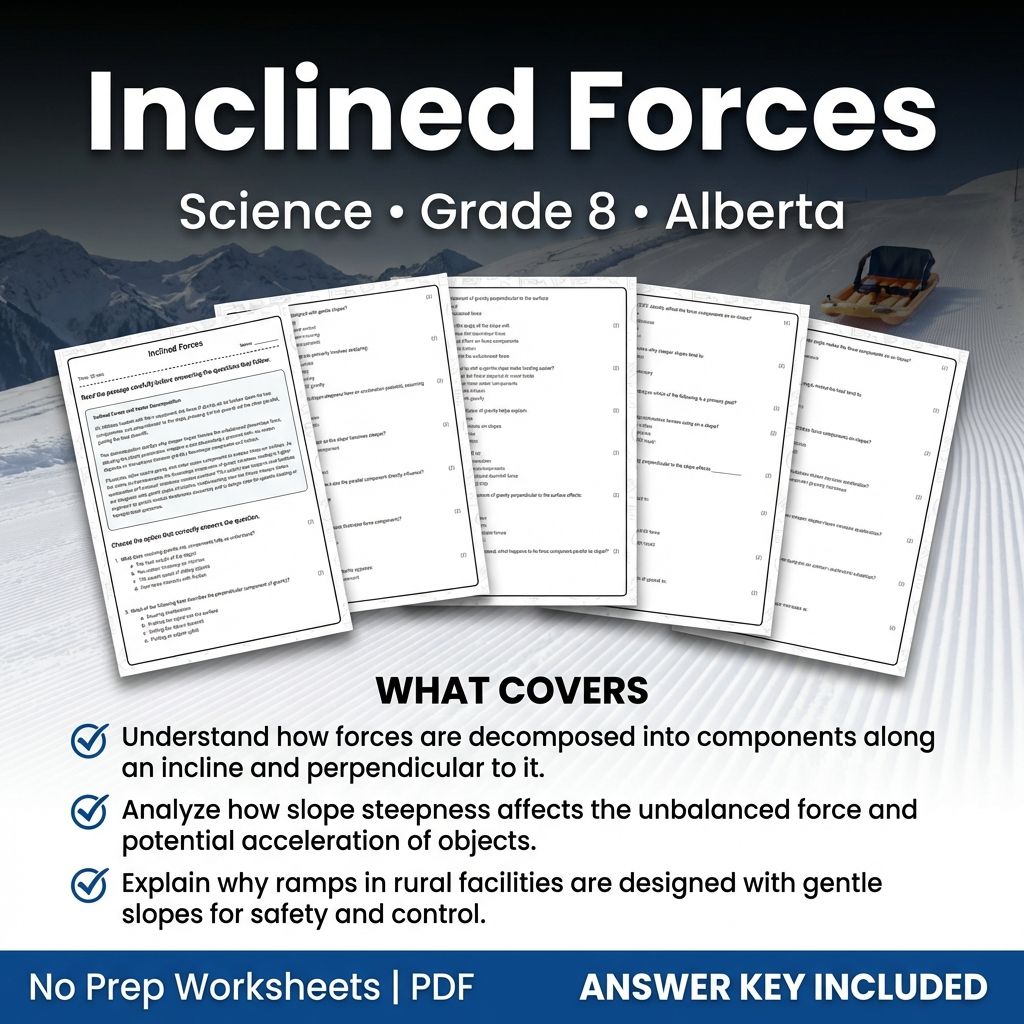
Inclined Forces Worksheet | Grade 8 Science | Alberta Standard
 Created byCoral Reef Learning
Learning Objectives
- Understand how forces are decomposed into components along an incline and perpendicular to it.
- Analyze how slope steepness affects the unbalanced force and potential acceleration of objects.
Instant download

Multimedia Presentation Worksheet Pack | Grade 8 ELA Practice
Created bySunny Desk ResourcesLearning Objectives
- Identify how a strong multimedia presentation uses clear claims and connected reasoning supported by relevant evidence.
- Evaluate how organization, precise language, and multimedia visuals work together to clarify meaning and strengthen credibility and impact.
- Use effective presentation choices to address a prompt with an introduction, explanation, and conclusion that guide the audience.
Also included in: Multimedia Presentations & Argument Reasoning Lesson Bundle – Grade 8 ELA CCSS +1 more
Instant download

Technique Selection Worksheet Grade 8 ELA Ontario Writing Strategies
Created bySunny Desk ResourcesLearning Objectives
- Identify how media techniques (imagery, color, pacing, layout, sound, and spokesperson tone) communicate a message to a specific audience.
- Select and justify techniques that support a chosen purpose (persuade, inform, entertain) and effect.
- Revise a message by changing techniques to better match audience expectations and intended meaning.
Instant download

Capitalization Rules Worksheet Pack | Grade 8 ELA Practice
Created bySunny Desk ResourcesLearning Objectives
- Use correct capitalization for sentence beginnings and after ending punctuation.
- Capitalize proper nouns, including names of people and places.
- Capitalize titles of works and specific calendar terms.
Also included in: Grade 8 ELA Language Mechanics Words, Voice & Punctuation Lesson Bundle | Common Core +1 more
Instant download

Grade 8 Science – Net Force Effects | Daily Reading Worksheet
Created byBright Mind ResourcesLearning Objectives
- Understand the concept of net force and how it influences motion.
- Identify various forces acting on an object, such as weight and friction.
- Describe how forces that are balanced or unbalanced affect an object's movement.
Also included in: Reaction Evidence & Matter Grade 8 Science Lesson Bundle | General Framework +1 more
Instant download

Grade 8 Science – Population Models & Growth | Daily Reading Worksheet
Created byBright Mind ResourcesLearning Objectives
- Understand the concept of exponential and logistic population growth
- Identify factors affecting population size such as resources and predation
- Interpret graphical representations of population dynamics
Also included in: Biological Evolution: Unity and Diversity Lesson Bundle Grade 8 Science | NGSS +1 more
Instant download

Food Webs Practice Worksheet | Grade 8 Science NGSS Review Assessment
Created byPrism Point LearningLearning Objectives
- Explain how energy moves through producers, consumers, and decomposers in terrestrial and aquatic food webs
- Describe trophic levels and the idea of energy loss between levels using ecological efficiency
- Connect primary production, cellular respiration, and trophic interactions to community structure and population size
Instant download

Grade 8 Science | Regional Water System Case Study - Daily Reading Comprehension
Created byCoral Reef LearningLearning Objectives
- Identify the components of the hydrologic cycle in large basins
- Understand the connectivity between groundwater and surface water
- Recognize the challenges of governing transboundary water systems
Instant download

Grade 8 Science | Distance-Time Graphs Worksheet | BC Aligned
Created byLumora LearningLearning Objectives
- Understand how distance-time graphs represent motion and how slope relates to speed.
- Calculate average speed by dividing change in distance by change in time between two points.
- Interpret various graph segments, including flat, steep, and curved lines, to analyze motion and acceleration.
Also included in: Grade 8 Science | Forces and Motion Custom Bundle | BC Standards
Instant download

Health Media and Technology Check-Up Worksheet Grade 8 | NHES Activity
Created byPrism Point LearningLearning Objectives
- Explain how media and technology can spread both accurate and misleading health information
- Use critical thinking steps to evaluate digital health messages
- Describe how media can affect body image and health-related decisions
Also included in: Health Choices, Media & Culture Lesson Bundle | Grade 8 Health NHES
Instant download

Grade 8 Design Problem Framing Worksheet | Practice & PDF
 Created byClear Sky Classroom
Learning Objectives
- Identify the desired outcome and the real-world problem context in an engineering design challenge
- Write measurable goals and connect them to practical limitations and constraints
- Explain how framing a problem supports generating multiple viable solution approaches
Instant download

Grade 8 Electrical to Thermal Energy Transformations Worksheet | Alberta
Created byBRIGHT PATH RESOURCESLearning Objectives
- Identify how electrical energy transforms into thermal energy in resistive devices.
- Use efficiency and power ideas to describe energy losses as heat.
- Find key details in an informational passage and summarize the main idea.
Also included in: Grade 8 Alberta Science Electricity and Magnetism Worksheet Bundle +1 more
Instant download

Goal-Setting Strategies Worksheet Grade 8 | September SEL Activity
 Created byShaNova Worksheets
Learning Objectives
- Explain what SMART goals are and identify each component (Specific, Measurable, Achievable, Relevant, Time-bound).
- Use goal-setting strategies to plan realistic academic and personal objectives for September.
- Describe how monitoring progress and adjusting plans can improve motivation and resilience.
Instant download

Water Cycle Worksheet Grade 8 NGSS Science with Doodle Note & Guide
 Created byAmber Owl Education
Learning Objectives
- Explain the main stages of the water cycle, including evaporation, condensation, precipitation, infiltration, runoff, and groundwater flow.
- Describe how sunlight and gravity drive global and local hydrologic cycling.
- Connect water-cycle processes to weathering and erosion, such as river incision, karst formation, and coastal erosion.
Also included in: Grade 8 Science Earth Systems & Weather Patterns Lesson Bundle: NGSS +1 more
Instant download

Grade 8 Density and Buoyancy Worksheet | NGSS Practice & PDF
Created byClear Sky ClassroomLearning Objectives
- Explain density as mass per unit volume and use it to predict whether an object will sink or float in a given fluid.
- Compare densities of objects and fluids to predict buoyant behavior.
- Describe how buoyancy relates to forces exerted by fluids and to the volume of fluid displaced.
Instant download

Grade 8 TEKS Evidence-Based Responses Worksheet with Answer Key PDF
Created bySunny Desk ResourcesLearning Objectives
- Write discussion responses that connect a viewpoint to specific evidence from a message
- Explain how evidence supports a claim using clear reasoning
- Address possible counterpoints respectfully using evidence and logic
Instant download

Writing Organizers Worksheet Pack | Grade 8 ELA Activities
 Created byMeadowlark Worksheets
Learning Objectives
- Identify common writing structures (chronological sequencing, compare/contrast, cause/effect, problem/solution) and match them to a purpose.
- Use an organizer to plan main ideas and supporting details so a draft moves logically from opening to closing.
- Explain how clear section expectations help writers avoid missing information and reduce gaps.
Also included in: Grade 8 Evidence-Based Writing ELA Lesson Bundle for Alberta Class Instruction +1 more
Instant download

Objective Summary Worksheet for Grade 8 ELA Practice
Created bySunny Desk ResourcesLearning Objectives
- Explain what an objective summary includes and excludes (no opinions or commentary).
- Identify the central events and key developments that drive conflict and theme in a narrative.
- Write a neutral, accurate summary using major turning points from the text.
Also included in: Narrative Elements & Theme in Grade 8 ELA Lesson Bundle | CCSS +1 more
Instant download

Grade 8 Science | Energy Dissipation Worksheet | BC Aligned
Created byLumora LearningLearning Objectives
- Understand the concept of energy dissipation and how it affects mechanical systems.
- Identify common mechanisms that cause energy loss such as friction, air resistance, and deformation.
- Explain the importance of efficiency in minimizing energy loss in mechanical operations.
Also included in: Grade 8 Science | Forces and Motion Custom Bundle | BC Standards
Instant download

Grade 8 Health | Decision Processes Worksheet (NHES) Practice PDF
Created bySunny Desk ResourcesLearning Objectives
- Apply a step-by-step decision process to health choices involving peer pressure, media, or environmental factors.
- Evaluate risks and benefits by considering short-term and long-term effects on health and well-being.
- Predict likely outcomes and select the most appropriate action using logical reasoning and critical thinking.
Also included in: Grade 8 Decision-Making Skills Health Lesson Bundle (NHES Standards) +1 more
Instant download

Grade 8 | Tax Day Worksheet for Mastering Budgeting & Income | PDF + Answer Key
Created byShaNova WorksheetsLearning Objectives
- Understand the importance of budgeting around Tax Day.
- Identify key financial terms related to personal finance and taxes.
- Learn how to plan and manage income, expenses, and savings effectively.
Instant download

Structure and Perspective Worksheet | Alberta ELA Standards Grade 8
JCreated byJ.S SheetsLearning Objectives
- Explain how narrative and informational text structures influence perspective and theme.
- Identify structural signals such as point of view, sequence, headings, and logical organization in a text.
- Use evidence to describe how structure guides a reader’s interpretation of importance and meaning.
Instant download

Grade 8 Social Studies | Population Change Worksheet (Ontario Standards) (PDF)
Created bySunny Desk ResourcesLearning Objectives
- Explain how birth rates, migration, and ageing influence population size and distribution over time
- Identify causes and consequences of migration and mobility for communities and urban areas
- Use demographic information to describe impacts on workforce, housing, and public services
Also included in: Grade 8 Human-Environment Systems Social Studies Lesson Bundle – Ontario +1 more
Instant download

Grade 8 Social Studies — Sources and Impact Worksheet MCQ Paper
Created byThe Resource HubLearning Objectives
- Interpret and analyze various historical sources such as treaties, government reports, and Indigenous testimonies.
- Evaluate the impacts of colonial and federal decisions on Indigenous livelihoods from multiple perspectives.
- Understand how land rights, social wellbeing, and economic stability of Indigenous communities were affected.
Also included in: Grade 8 Indigenous–Government Interactions Social Studies Custom Bundle | BC +1 more
Instant download

Grade 8 Science | Water Cycle Models - Daily Reading Comprehension
Created byCoral Reef LearningLearning Objectives
- Understand the main stages of the water cycle
- Identify how water moves between atmosphere, surface, and subsurface
- Recognize the processes of evaporation, condensation, and precipitation
Instant download

Grade 8 ELA – Argument Evidence Check & Critical Thinking | Daily Worksheet
 Created byQuiet Forest Education
Learning Objectives
- Identify the main claim and supporting evidence in a text.
- Evaluate whether cited evidence matches the scope of claims.
- Assess the relevance and credibility of evidence used in arguments.
Also included in: Grade 8 Informational Text ELA Lesson Bundle | General ELA Framework +2 more
Instant download

Science Kinetic and Potential Energy Worksheet | NGSS Aligned Grade 8
JCreated byJ.S SheetsLearning Objectives
- Explain how kinetic energy relates to motion and how it changes when speed changes
- Describe how potential energy depends on position or configuration, especially gravitational potential energy
- Use examples (like roller coasters and falling objects) to show how energy shifts between potential and kinetic forms
Also included in: Grade 8 Energy, Motion, and Matter Changes Science Lesson Bundle: Florida NGSSS +1 more
Instant download

Predictive Models in Science Worksheet | Standards-Aligned Grade 8 Practice
JCreated byJ.S SheetsLearning Objectives
- Explain how scientific predictive models connect variables to expected outcomes
- Identify key features of a useful model, including assumptions and testable predictions
- Use model-based reasoning to interpret patterns in data
Also included in: Grade 8 Scientific Reasoning and CER Science Lesson Bundle | General +1 more
Instant download

Inheritance and Variation Worksheets for Grade 8 Life Science
Created byBRIGHT PATH RESOURCESLearning Objectives
- Explain how inherited traits can differ between siblings even when parents have the same genes.
- Describe how recombination during reproduction creates new combinations of genes.
- Use evidence from families and populations to support the idea that variation affects survival under local conditions.
Also included in: Grade 8 Life Science Bundle | Homeostasis, Genetics & Ecosystems +2 more
Instant download
Browse more categories
About Grade 8 Worksheets
Explore Grade 8 worksheets in math, ELA, science, and social studies. Our 8,330 Grade 8 printables print straight from PDF, answer keys included.
Each resource here is built by an independent educator and reviewed for quality. Worksheets print straight from PDF and suit classroom use, homework, or extra practice; most come with answer keys, and you can preview before purchasing.