
Grade 8 Science Worksheets
6,006 worksheets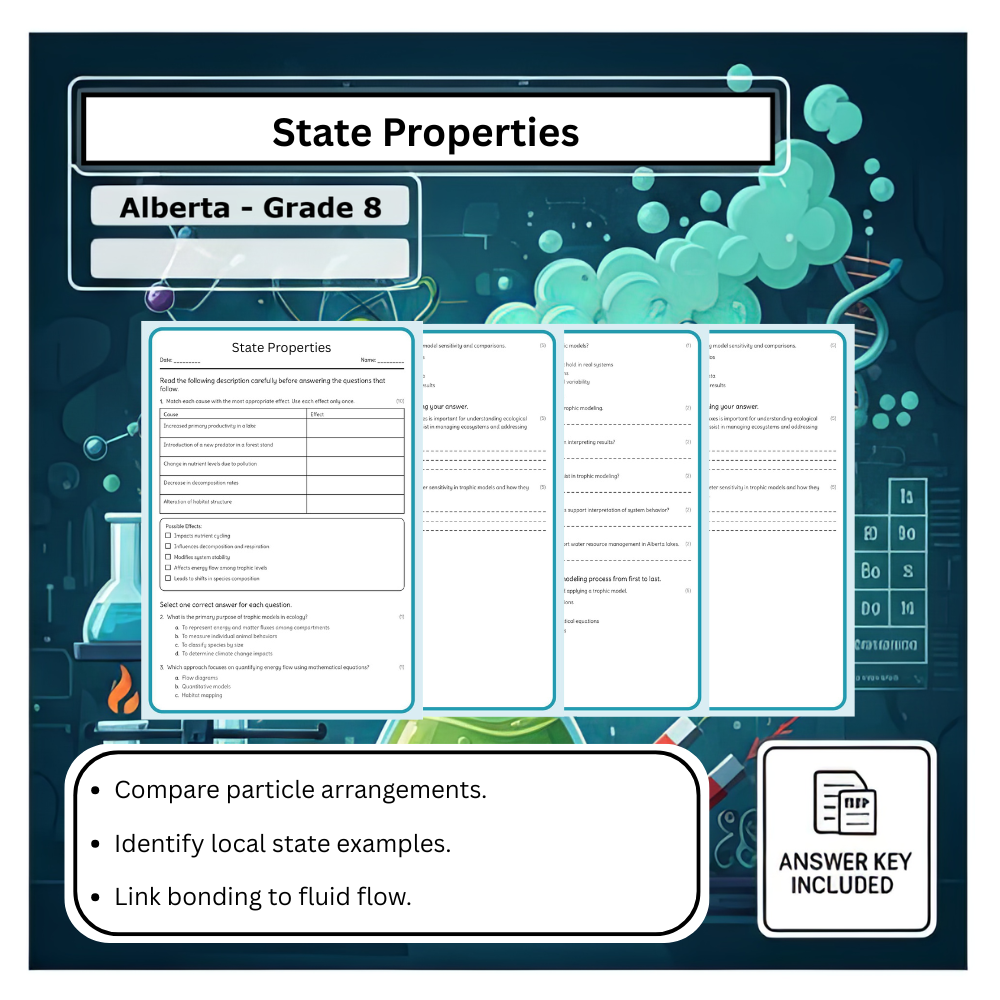
Grade 8 Science | State Properties Worksheet (PDF) – Alberta Standards
 Created byBright Mind Resources
Learning Objectives
- Understand the particle arrangement and energy differences among solids, liquids, and gases.
- Identify real-world examples of each state from Alberta context.
- Explain how particle bonding strength affects the shape and flow of different states.
Instant download
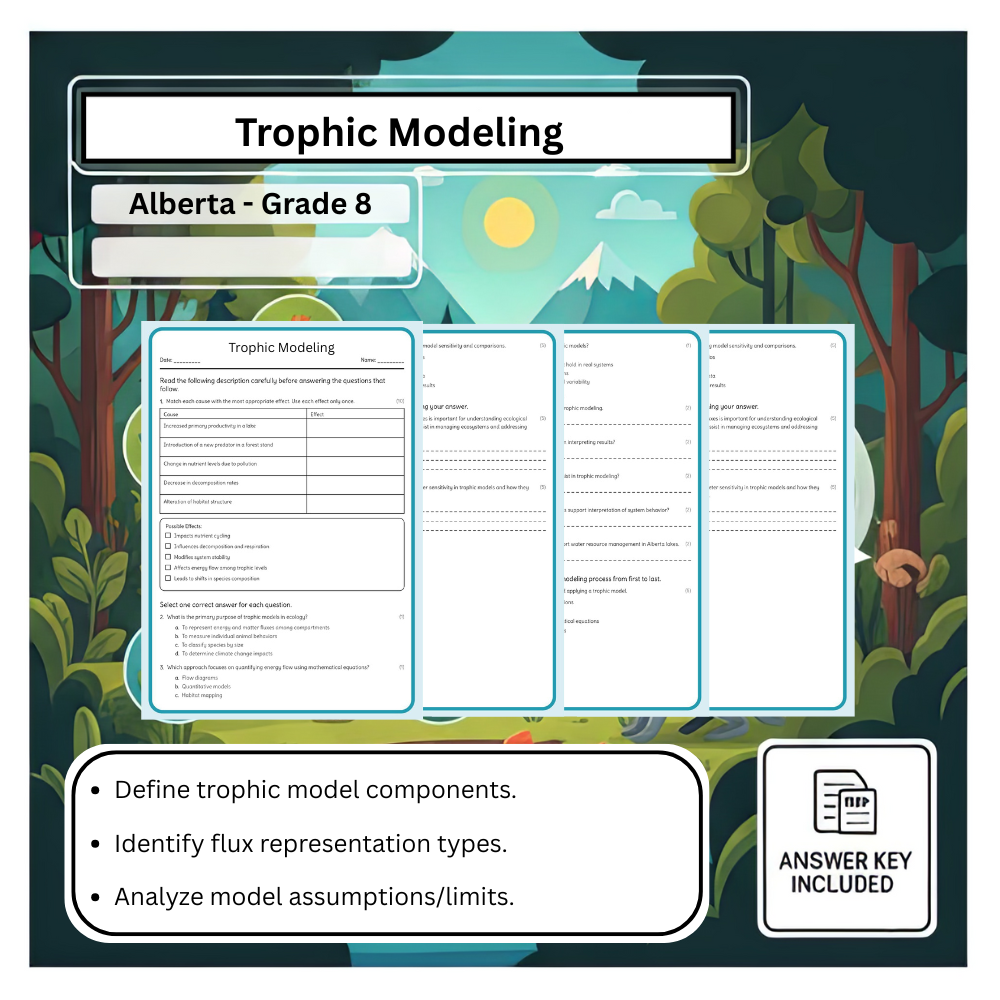
Grade 8 Science | Trophic Modeling Worksheet (PDF) – Alberta Standards
Created byBright Mind ResourcesLearning Objectives
- Explain the purpose and components of trophic models in ecological systems.
- Identify different types of models used to represent energy and matter fluxes.
- Analyze assumptions and limitations of quantitative and conceptual trophic models.
Instant download
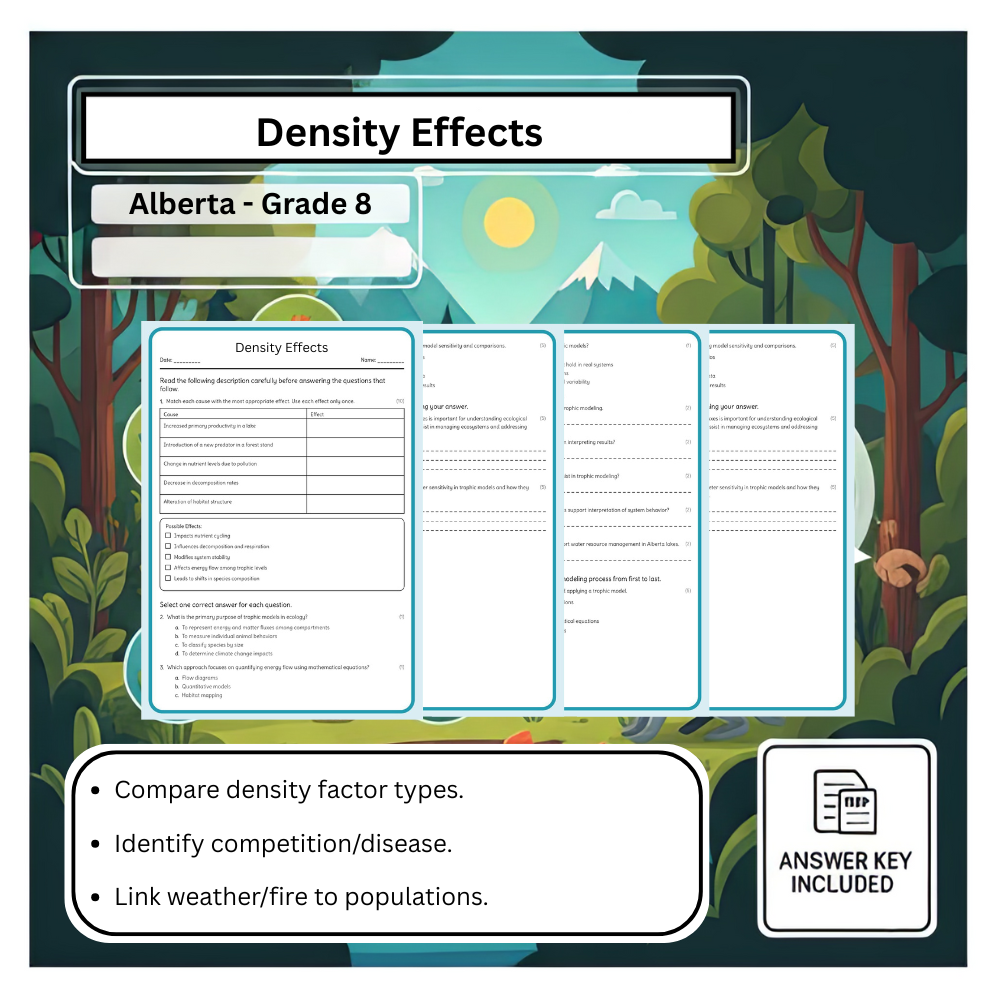
Grade 8 Science | Density Effects Worksheet (PDF) – Alberta Standards
Created byBright Mind ResourcesLearning Objectives
- Understand the difference between density-dependent and density-independent factors affecting populations.
- Identify examples of resource competition, disease transmission, and social behaviors as density-dependent influences.
- Recognize weather events, drought, and fire as density-independent factors affecting populations.
Instant download
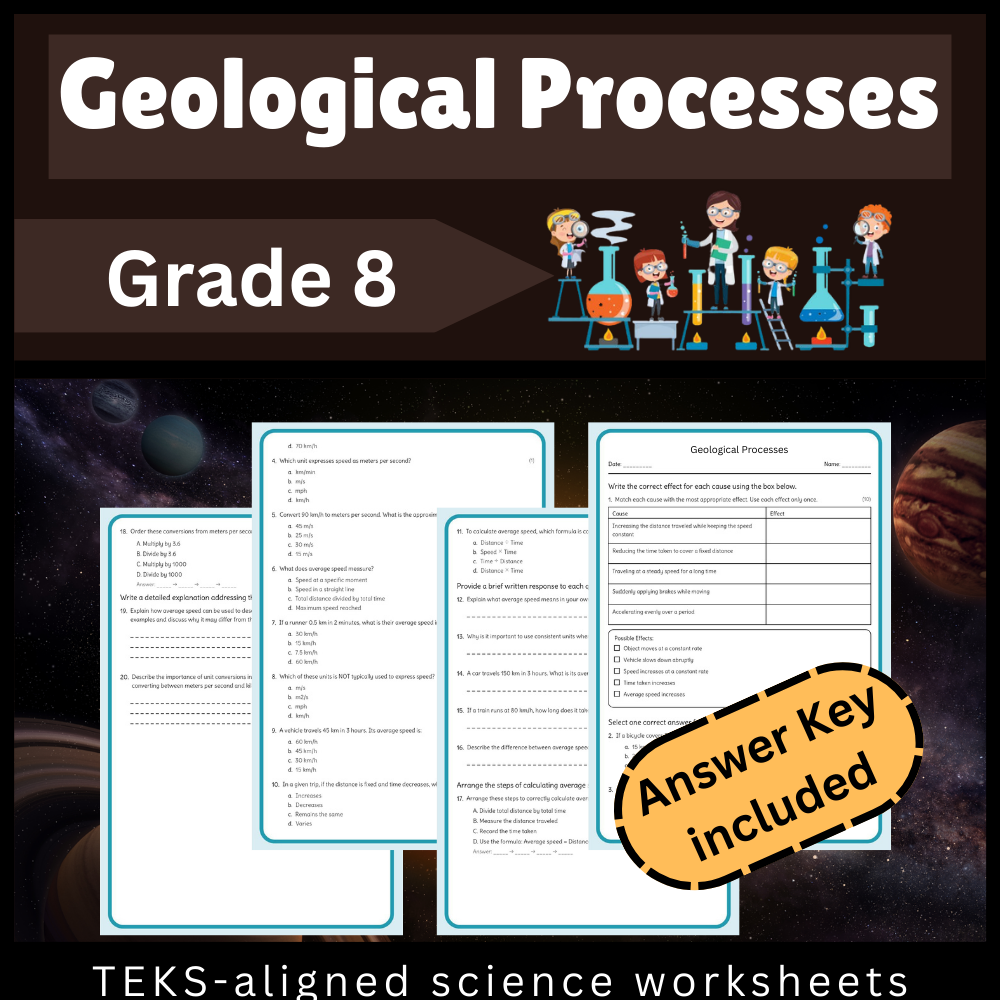
Grade 8 Science | Geological Processes Worksheet (Answer Key) – TEKS Aligned
Created byBright Mind ResourcesLearning Objectives
- Describe the different types of plate boundaries and their associated landforms.
- Explain the mechanisms of plate tectonics such as mantle convection and subduction.
- Identify observable evidence of geological processes like mid-ocean ridges and volcanic arcs.
Also included in: Grade 8 Science UNIT Bundle | Weather, Solar System & Earth - TEKS Aligned +1 more
Instant download
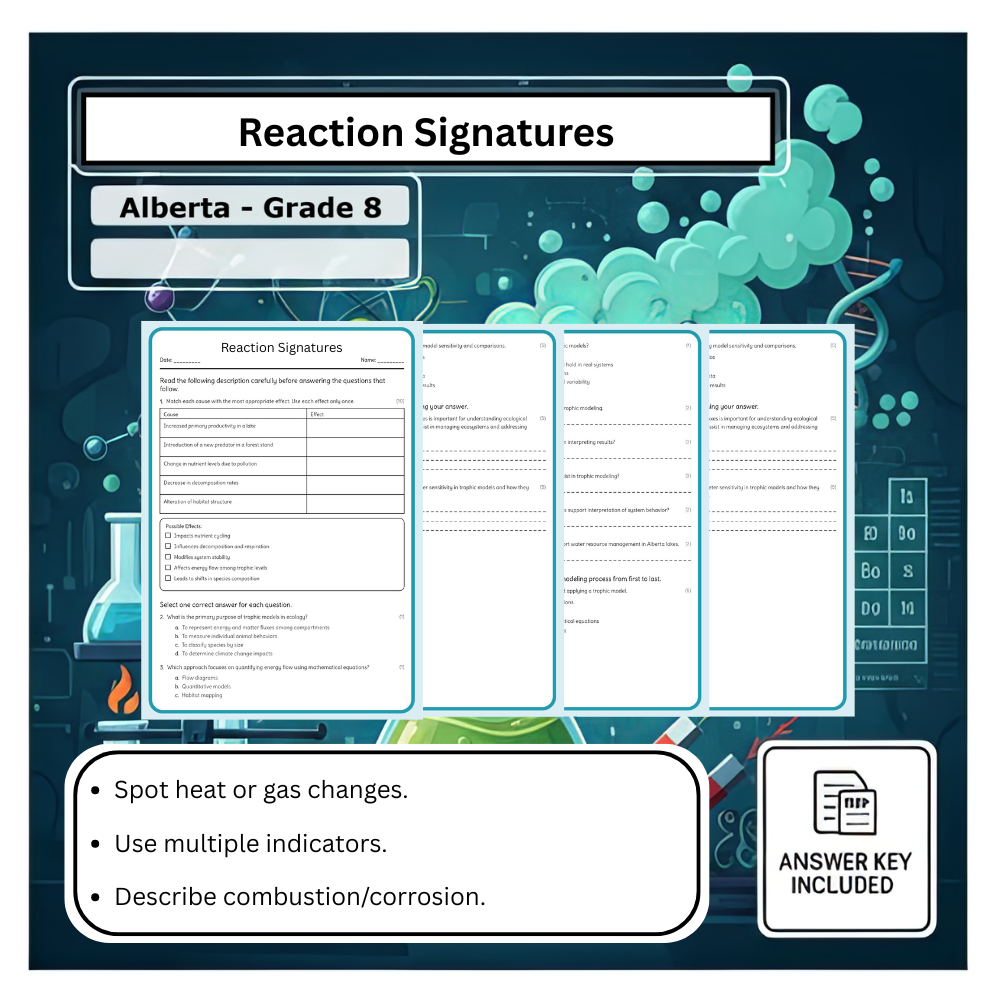
Grade 8 Science - Reaction Signatures Worksheet (PDF) – Alberta Standards
Created byBright Mind ResourcesLearning Objectives
- Identify observable signatures of chemical change such as temperature change, precipitate formation, color change, and gas release.
- Explain how multiple indicators can support the identification of chemical transformations in environmental and industrial contexts.
- Describe examples of chemical changes occurring in real-world situations like corrosion, effervescence, and combustion residues.
Instant download
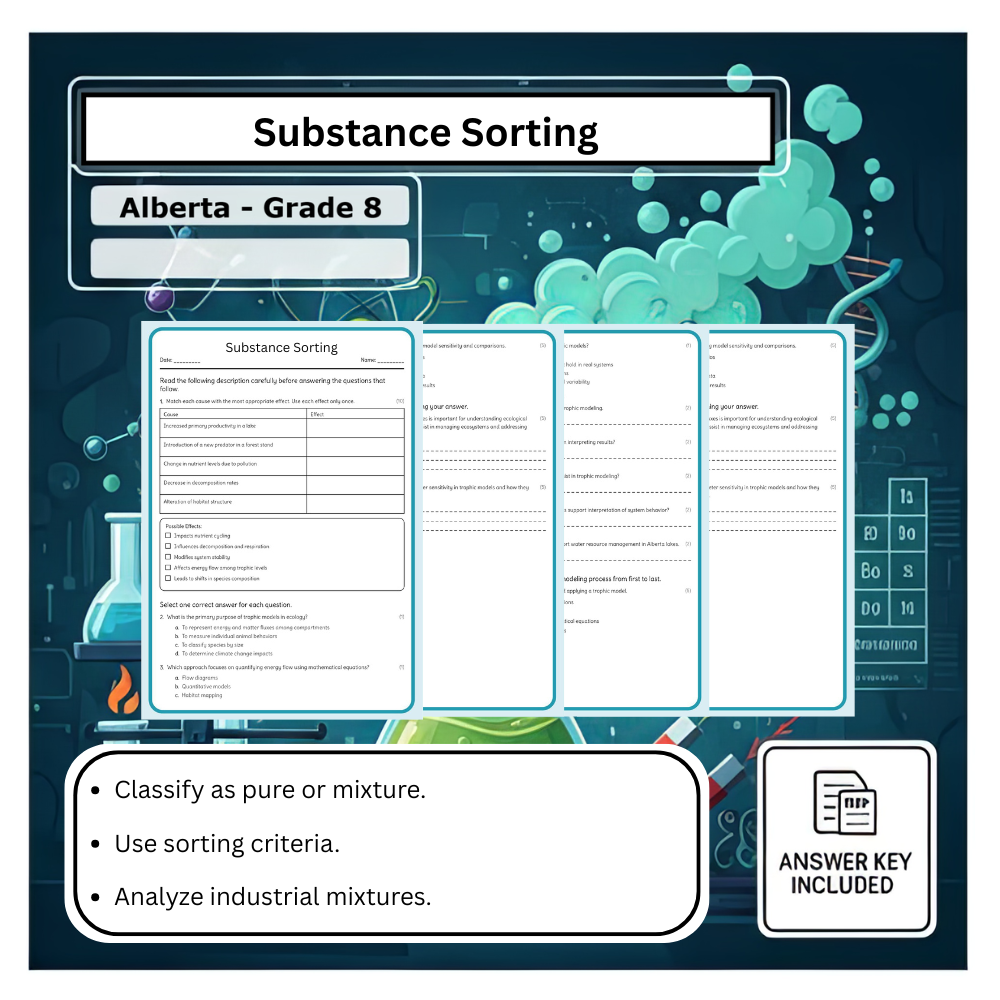
Grade 8 Science – Substance Sorting Worksheet (PDF) aligned with Alberta standards
Created byBright Mind ResourcesLearning Objectives
- Understand the classification of substances into pure substances and mixtures.
- Identify the criteria used to categorize different types of materials.
- Analyze regional examples of substances and mixtures in environmental and industrial contexts.
Instant download
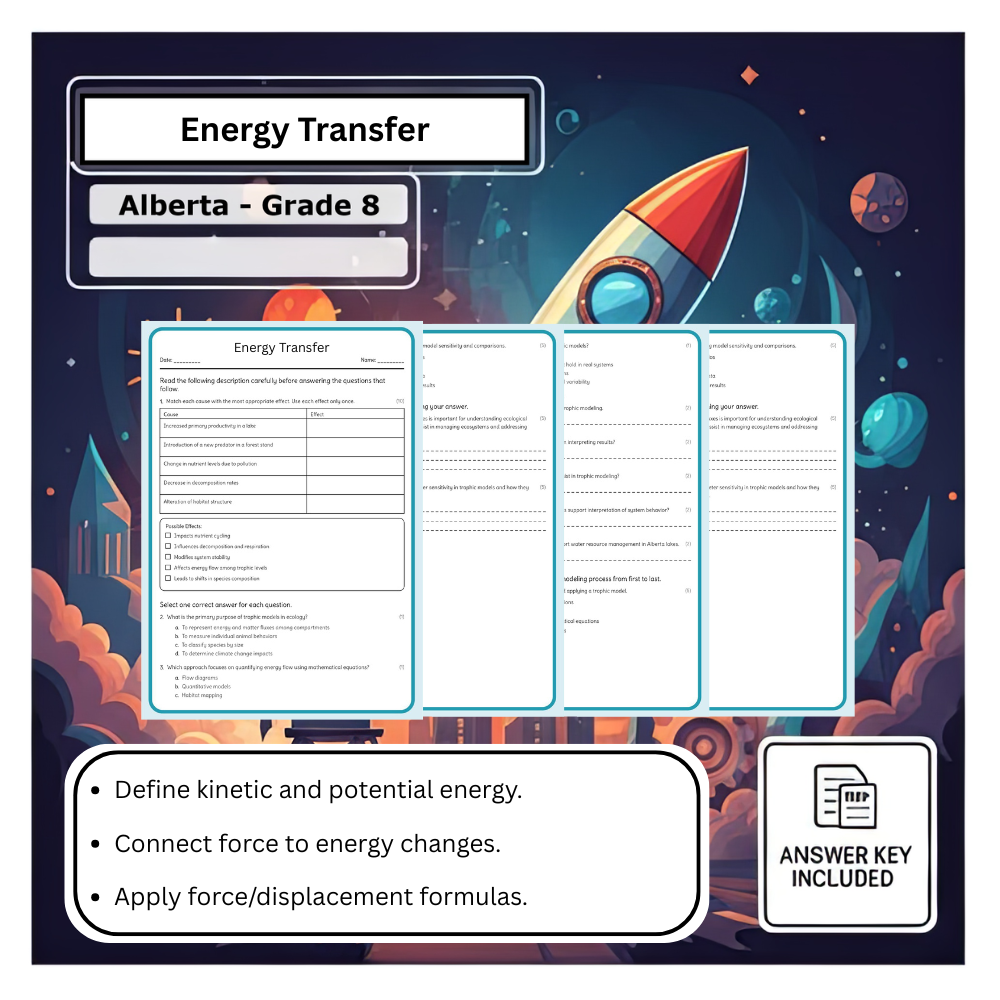
Grade 8 Science | Energy Transfer (Worksheet + Answer Key) – Alberta Standards
Created byBright Mind ResourcesLearning Objectives
- Understand the concepts of mechanical energy, including kinetic and potential energy.
- Connect force interactions to changes in energy during motion.
- Apply qualitative relationships between force, displacement, and energy transfer.
Instant download
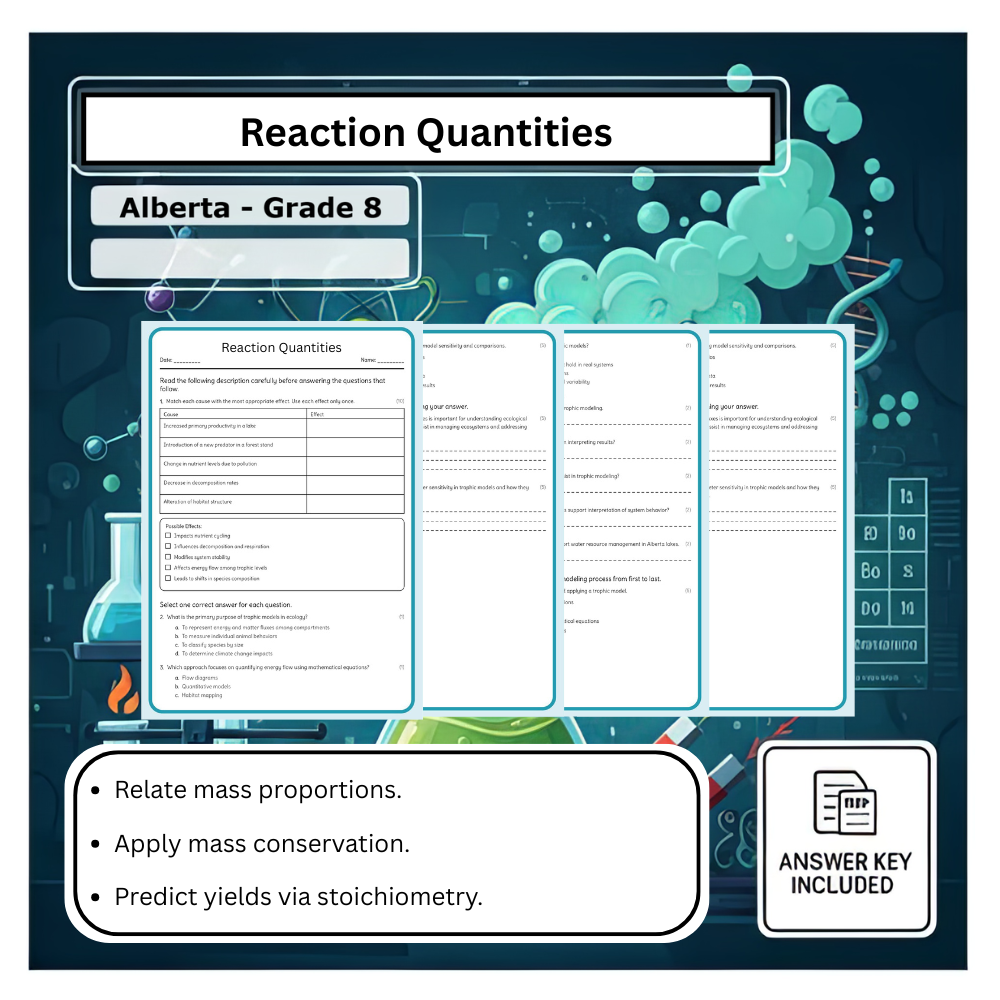
Grade 8 Science – Reaction Quantities Worksheet (PDF) – Alberta Standards
Created byBright Mind ResourcesLearning Objectives
- Understand how to relate masses of reactants and products in chemical reactions using proportional reasoning.
- Apply the law of conservation of mass to interpret measurements in chemical systems.
- Use stoichiometry to predict relative amounts of substances involved in reactions.
Instant download
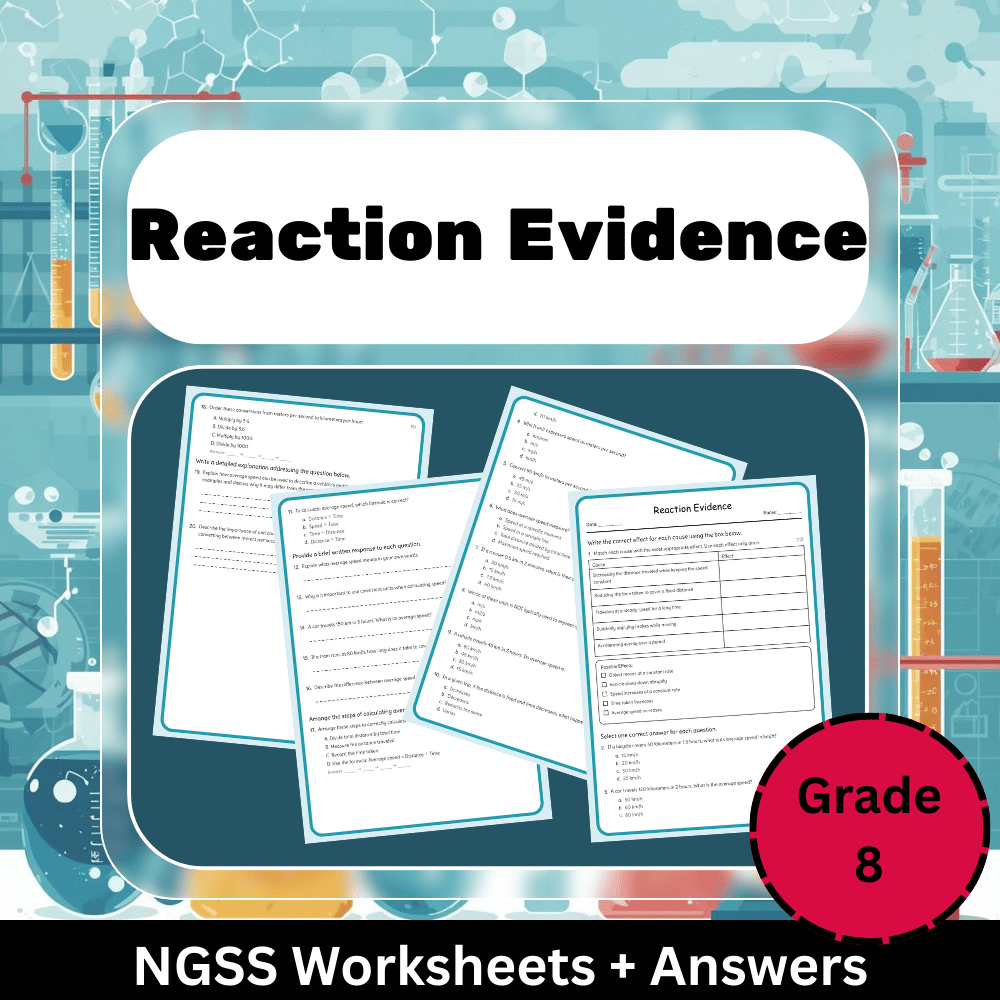
Grade 8 Science | Reaction Evidence Worksheet (Answer Key) NGSS Aligned
Created byBright Mind ResourcesLearning Objectives
- Identify observable indicators of chemical reactions such as color change, gas production, precipitate formation, and temperature change.
- Interpret qualitative and quantitative data from various reactions to distinguish chemical transformations from physical mixing.
- Connect macroscopic evidence to particle rearrangement and formation of new substances with distinct properties.
Also included in: Grade 8 Science | Molecular Structures & Energy Effects Unit Worksheet Pack-NGSS +2 more
Instant download
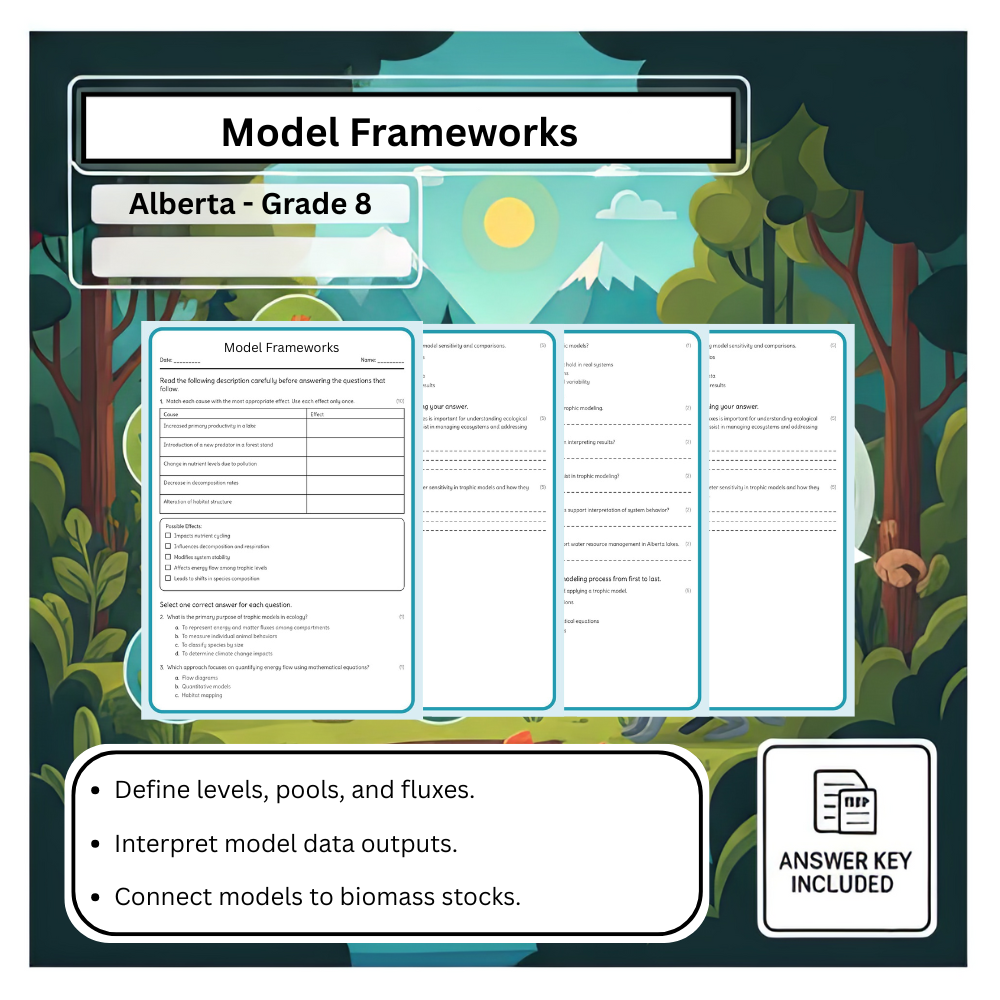
Grade 8 Science | Model Frameworks Worksheet (PDF) – Alberta Standards
Created byBright Mind ResourcesLearning Objectives
- Understand basic modeling conventions used in ecosystems, including trophic levels, nutrient pools, and fluxes.
- Interpret model outputs and recognize assumptions and limitations of ecosystem models.
- Connect components of models to observable features such as biomass stocks and decomposition rates.
Instant download
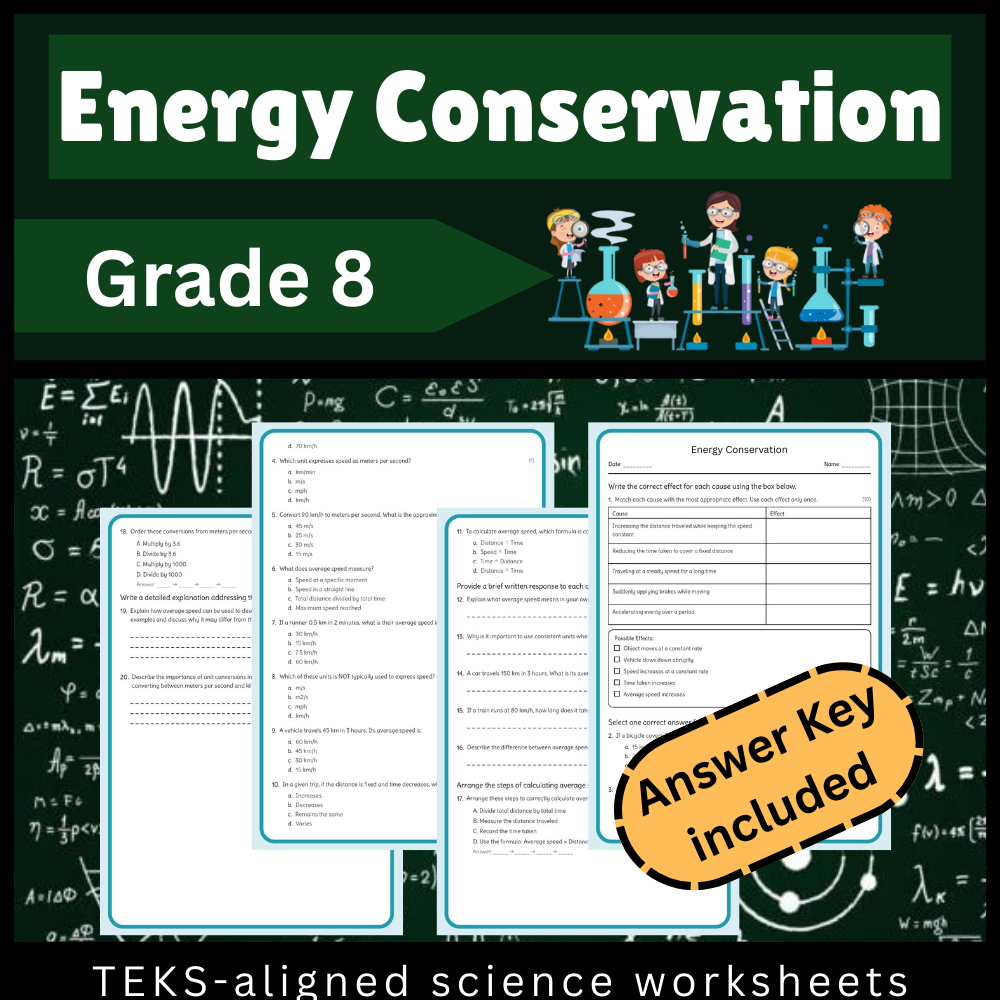
Grade 8 Science | Energy Conservation Worksheet (Worksheet + Answer Key) PDF
Created byBright Mind ResourcesLearning Objectives
- Understand the principles of mechanical energy conservation in near-ideal systems.
- Analyze how gravitational potential energy converts to kinetic energy in pendulums and roller-coaster segments.
- Recognize the effects of friction and air resistance on energy dissipation as heat.
Also included in: Grade 8 Science Unit | Motion, Forces & Energy Worksheets Bundle (TEKS Aligned) +1 more
Instant download
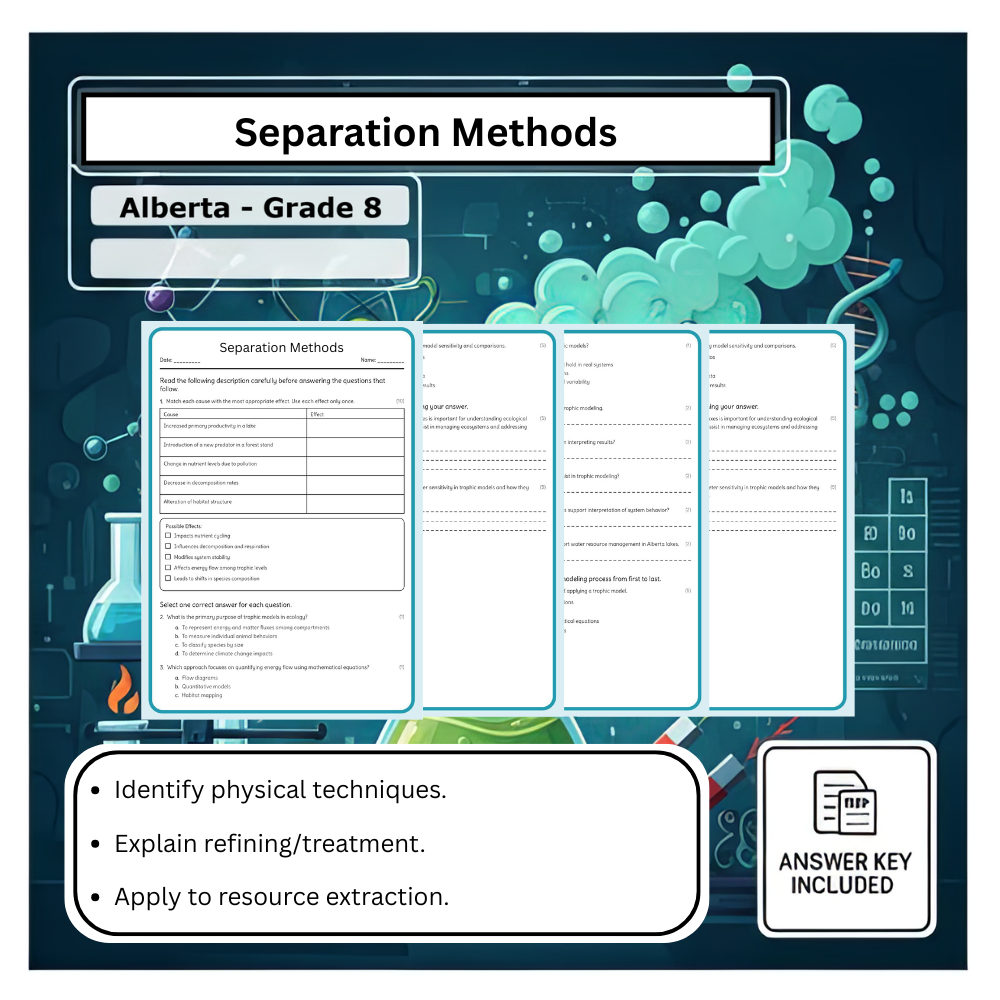
Grade 8 Science – Separation Methods (Worksheet + Answer Key) Alberta Standards
Created byBright Mind ResourcesLearning Objectives
- Identify different separation techniques based on physical properties such as particle size, solubility, boiling point, and magnetic susceptibility.
- Explain how methods like filtration, evaporation, and distillation are used in real-world contexts such as water treatment, oil refining, and mineral processing.
- Describe examples of separation methods used in Alberta for municipal water clarification, bitumen extraction, and grain cleaning.
Instant download
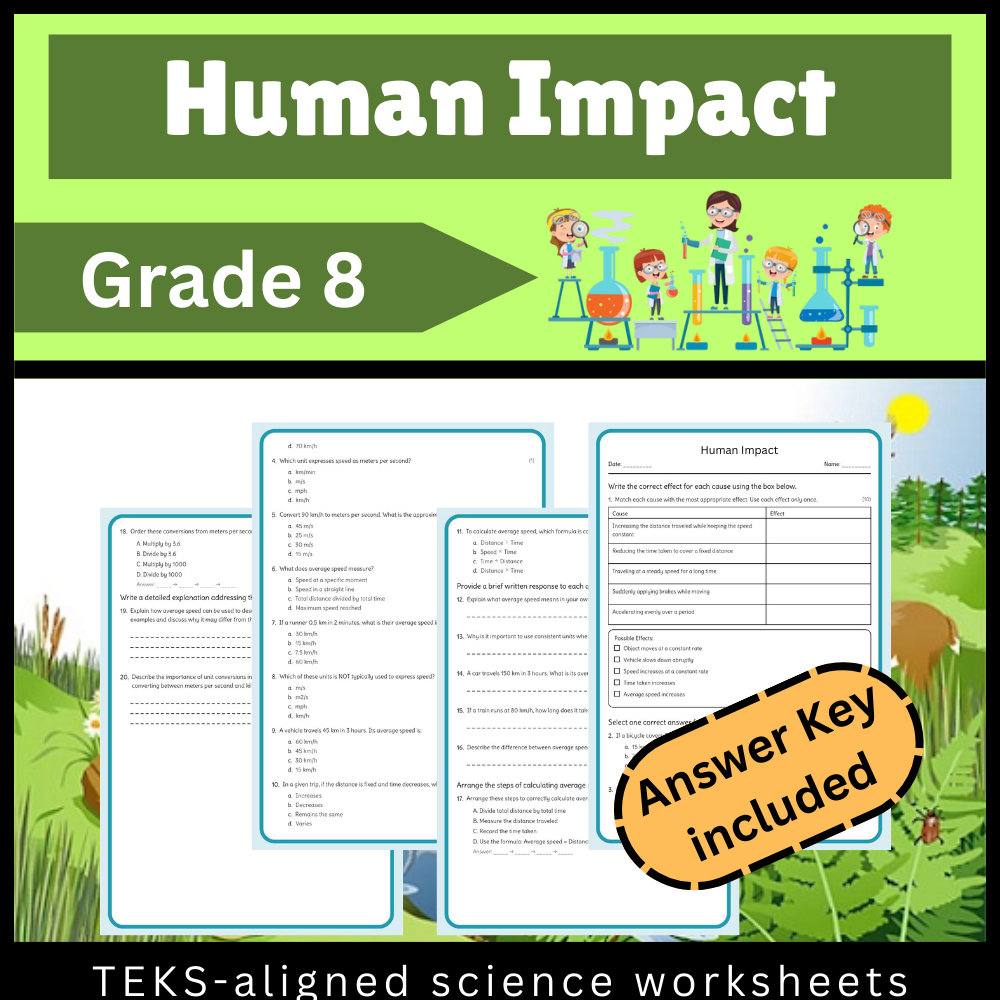
Grade 8 Science | Human Impact Worksheet (Answer Key) – TEKS Standards
Created byBright Mind ResourcesLearning Objectives
- Identify human activities that influence ecosystems including habitat alteration, pollution, resource extraction, and invasive species introduction.
- Explain how human activities affect biodiversity, food web dynamics, and ecosystem services.
- Evaluate mitigation strategies like habitat restoration and pollution reduction.
Also included in: Grade 8 Science Unit Bundle | Ecosystems,Evolution & Cell Processes TEKS Aligned +1 more
Instant download
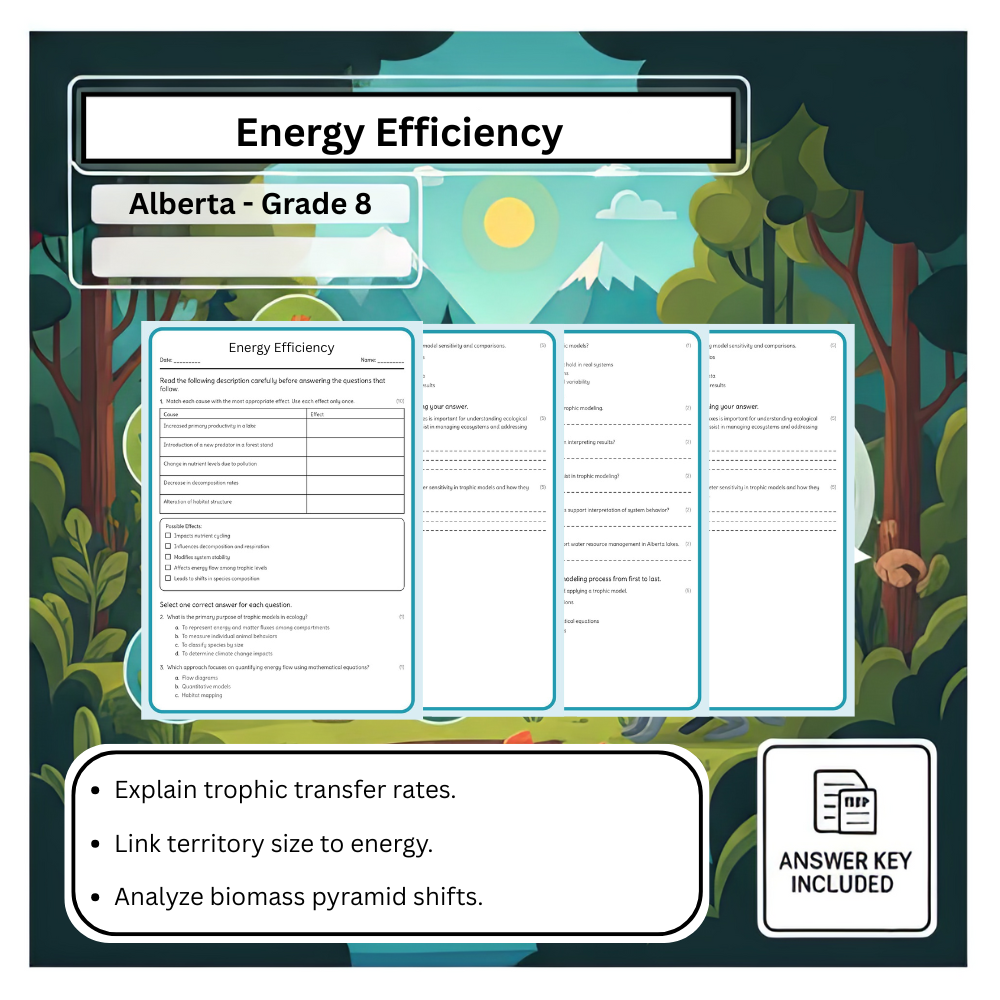
Grade 8 Science | Energy Efficiency Worksheet (PDF) – Alberta Standards
Created byBright Mind ResourcesLearning Objectives
- Explain the concept of energy transfer efficiency between trophic levels.
- Describe why large predators need extensive territories due to energy transfer limitations.
- Analyze biomass pyramid variations across different ecosystems and their implications.
Instant download
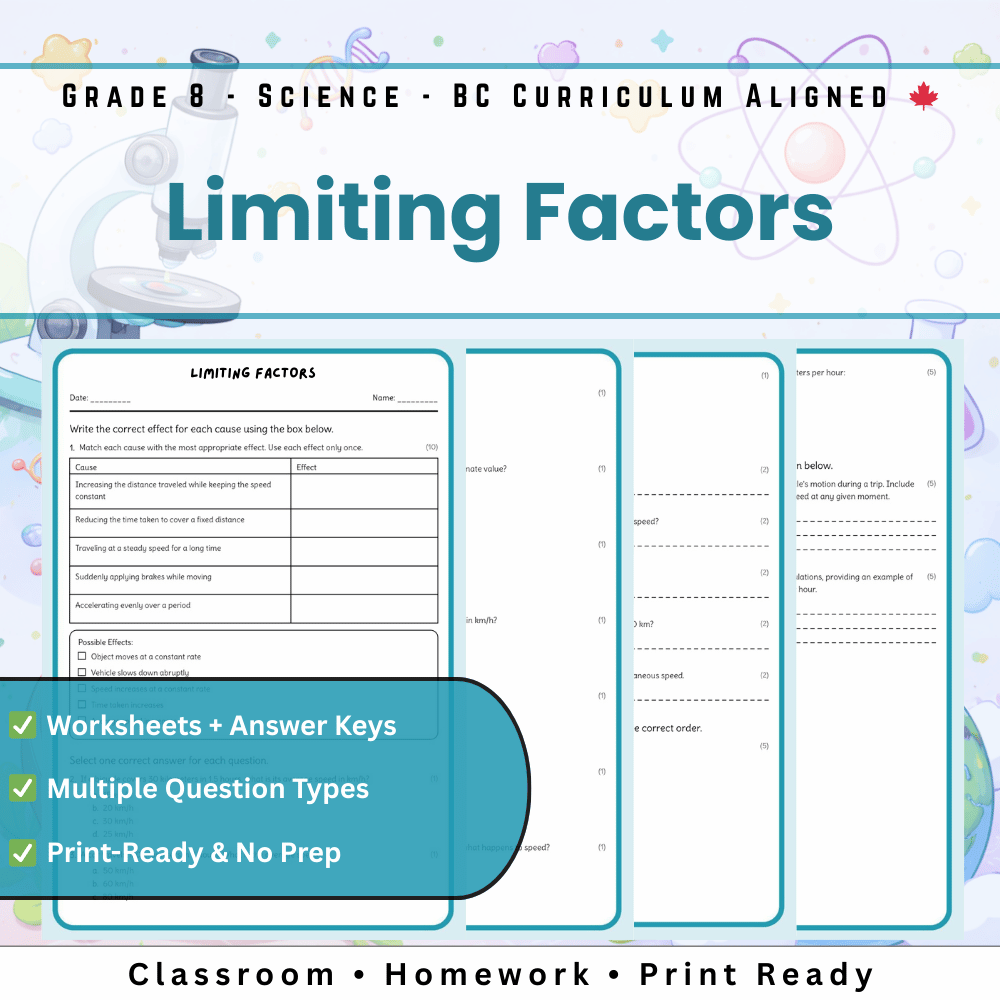
Grade 8 Science | Understanding Limiting Factors Worksheet(PDF) for BC Standards
Created byBright Mind ResourcesLearning Objectives
- Understand which environmental factors limit the size of populations.
- Explain how biotic and abiotic factors influence population dynamics.
- Describe the concept of carrying capacity and its fluctuations.
Instant download
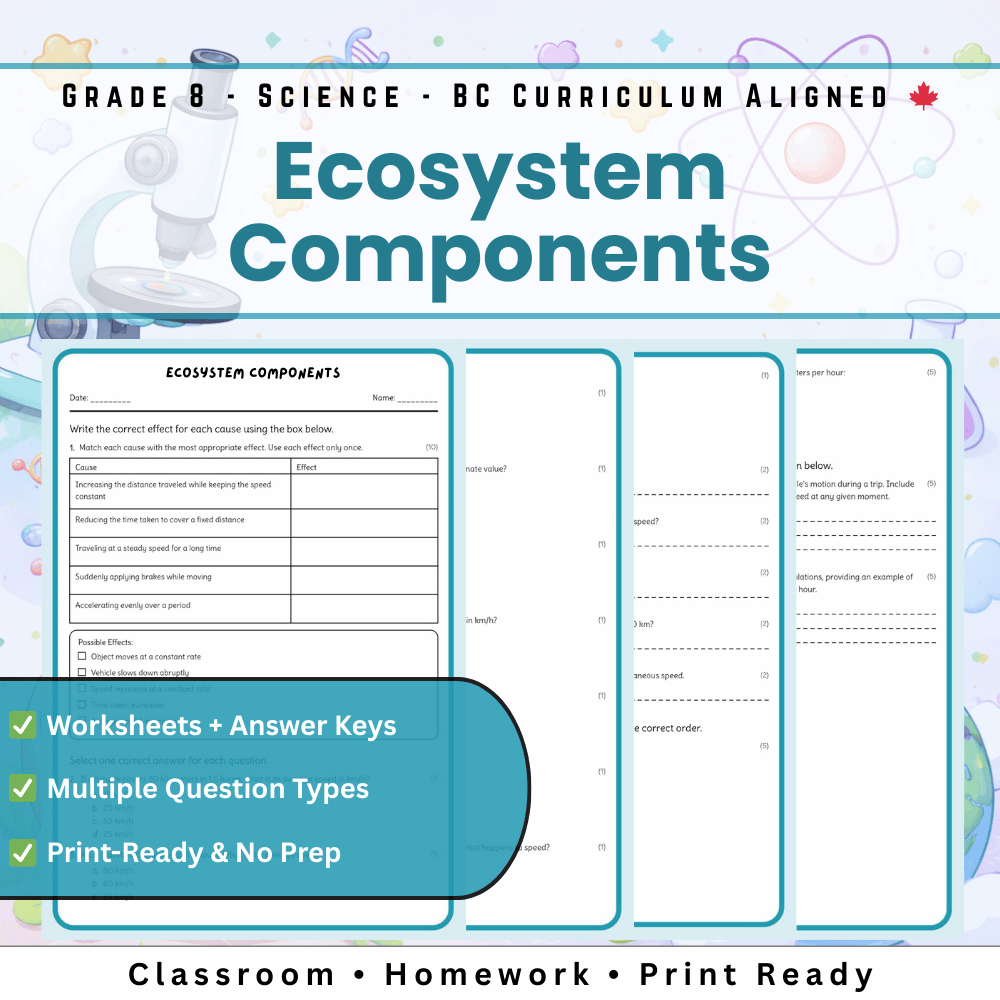
Grade 8 Science | Ecosystem Components Worksheet (PDF) – BC Standards
Created byBright Mind ResourcesLearning Objectives
- Identify the main components of an ecosystem and their roles.
- Understand the difference between biotic and abiotic factors in ecosystems.
- Describe how energy flows and matter cycles in an ecosystem.
Instant download
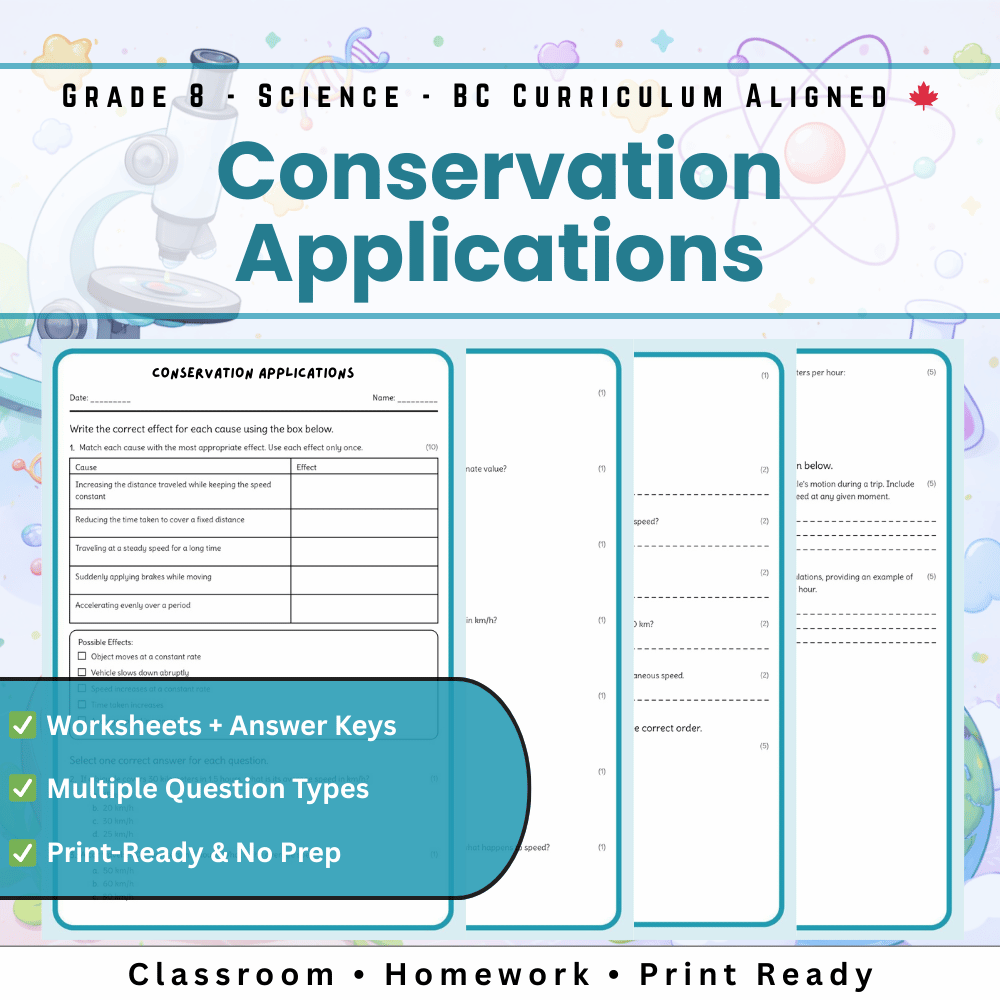
Grade 8 Science | Conservation Applications Worksheet (PDF) – BC Standards
Created byBright Mind ResourcesLearning Objectives
- Understand the importance of conservation of mass in physical systems.
- Apply quantitative methods to track reactants and products in chemical reactions.
- Distinguish between open and closed systems regarding mass transfer and losses.
Instant download
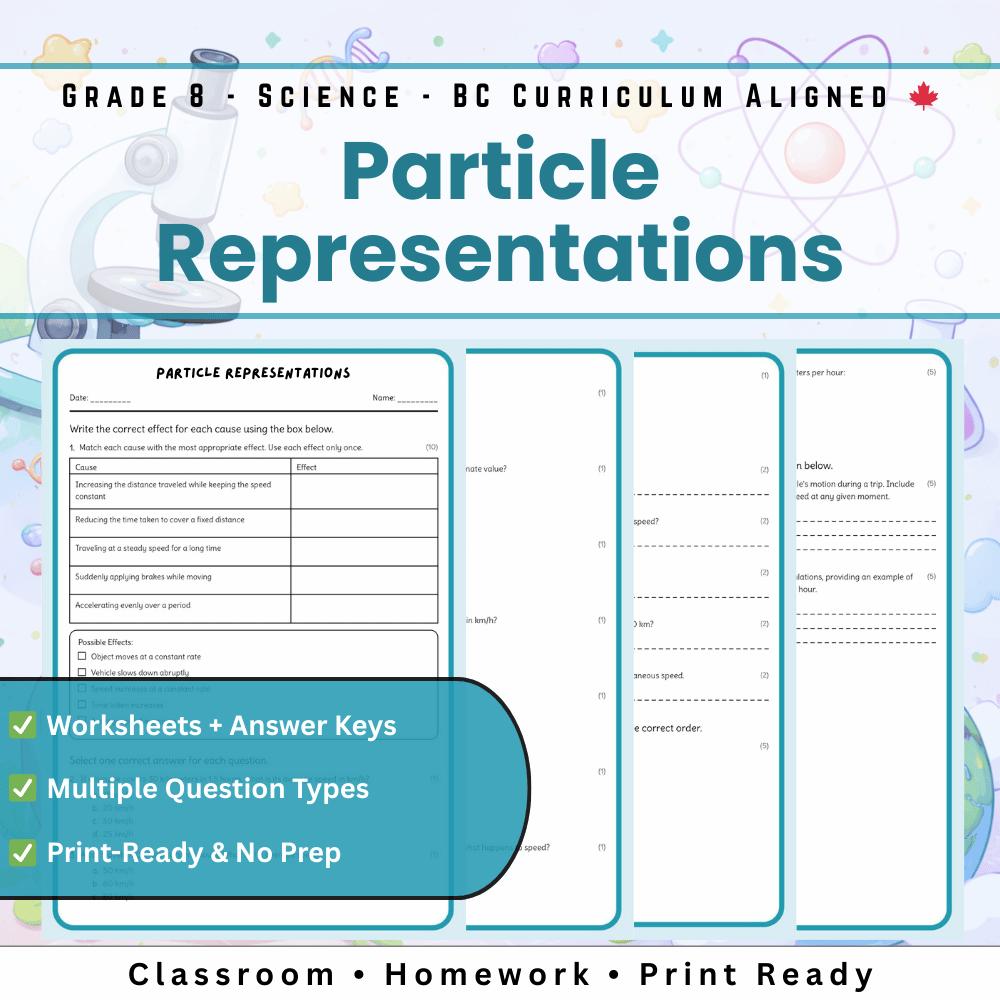
Grade 8 Science | Particle Representations Worksheet (PDF) for BC Standards
Created byBright Mind ResourcesLearning Objectives
- Understand how particle models depict atoms and molecules during chemical reactions.
- Interpret particle diagrams that illustrate bond breaking and formation.
- Explain how atomic rearrangements account for observable changes in mass and properties.
Instant download
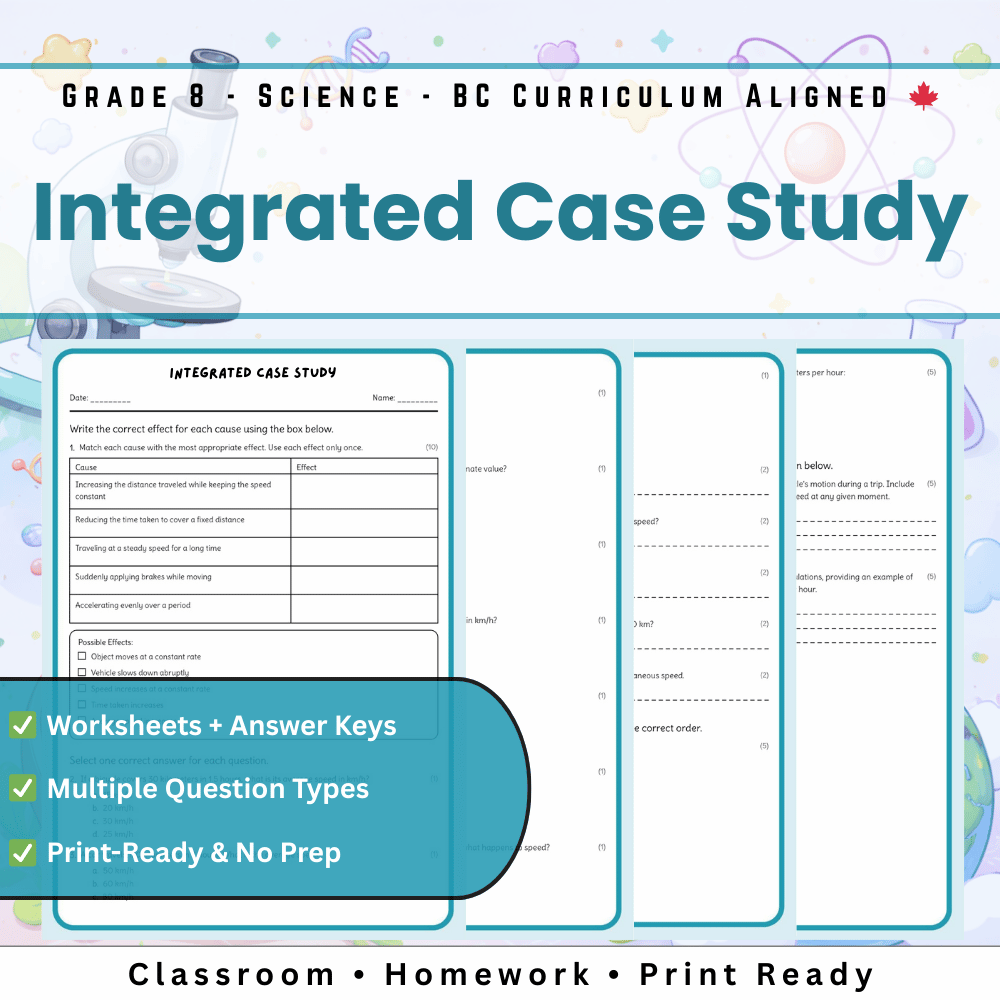
Grade 8 Science – Environmental Impacts & Ecosystem Study Worksheet + Answer Key
Created byBright Mind ResourcesLearning Objectives
- Analyze the interactions among organisms, abiotic factors, and human activities in a keystone species context.
- Evaluate how environmental changes impact population dynamics and ecosystem resilience.
- Interpret data related to water temperature, habitat fragmentation, and pollution effects.
Instant download
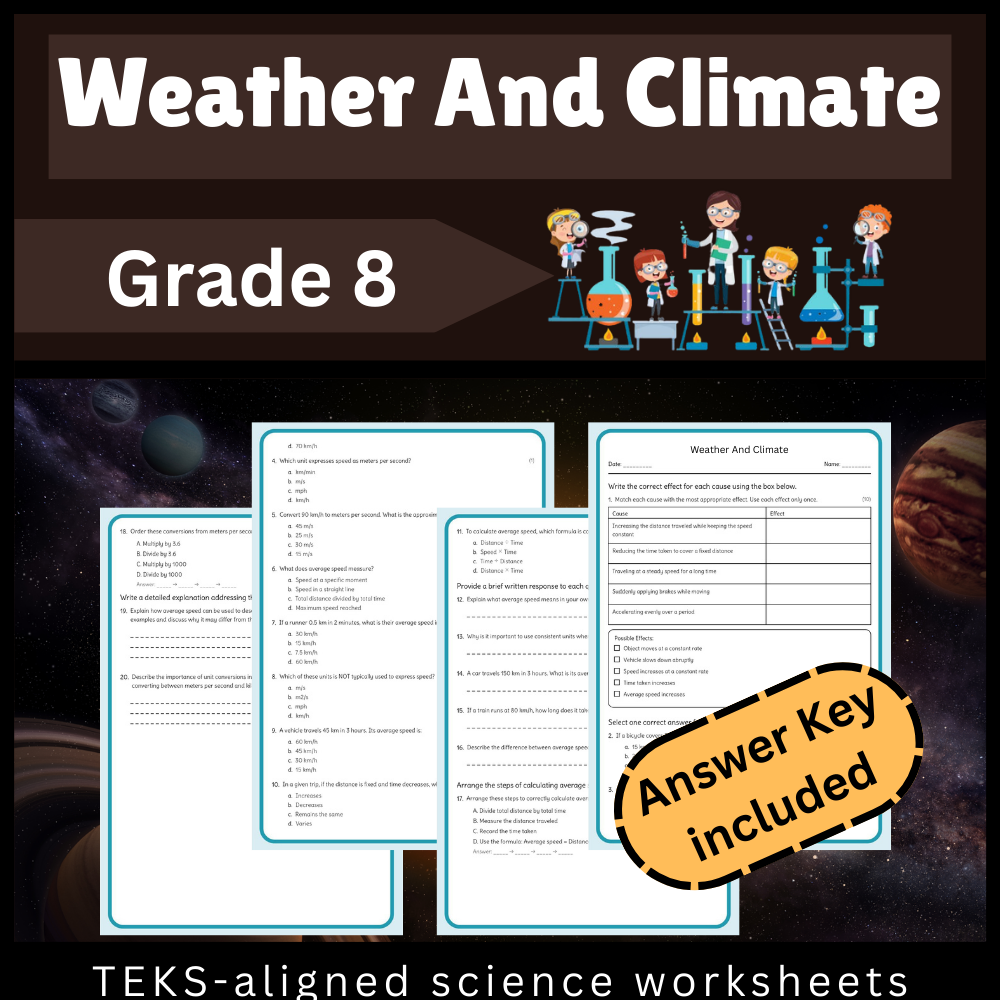
Grade 8 Science | Weather and Climate Worksheet (Worksheet + Answer Key) TEKS Standards
Created byBright Mind ResourcesLearning Objectives
- Differentiate between weather and climate phenomena and patterns.
- Identify key processes influencing atmospheric conditions, such as air mass interactions, fronts, and pressure systems.
- Explain the role of energy transfer, circulation cells, and ocean-atmosphere coupling in shaping weather and climate.
Also included in: Grade 8 Science UNIT Bundle | Weather, Solar System & Earth - TEKS Aligned +1 more
Instant download
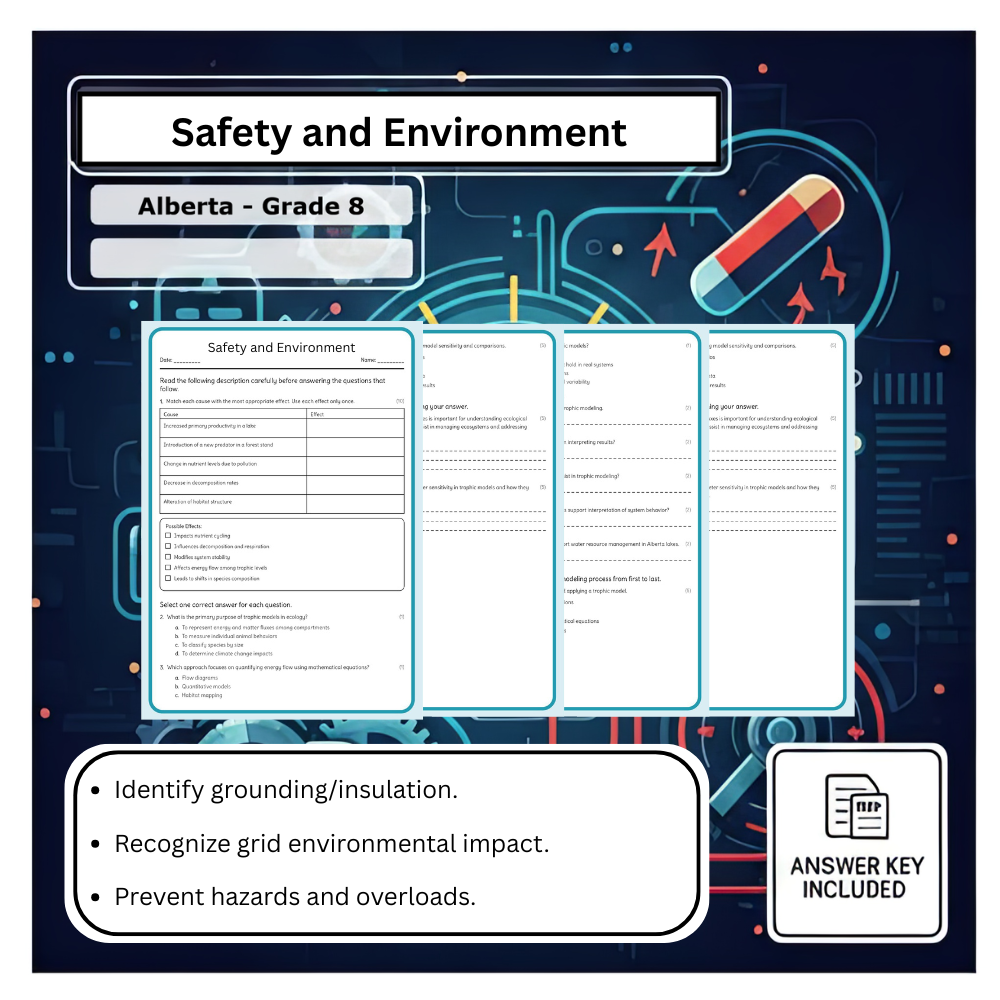
Grade 8 Science | Safety and Environmental Considerations Worksheet (PDF)
Created byBright Mind ResourcesLearning Objectives
- Understand key safety features in electrical systems, including grounding, insulation, and overload protection.
- Recognize environmental implications of electrical energy generation and infrastructure.
- Identify safety measures to prevent electrical hazards and environmental impacts.
Instant download
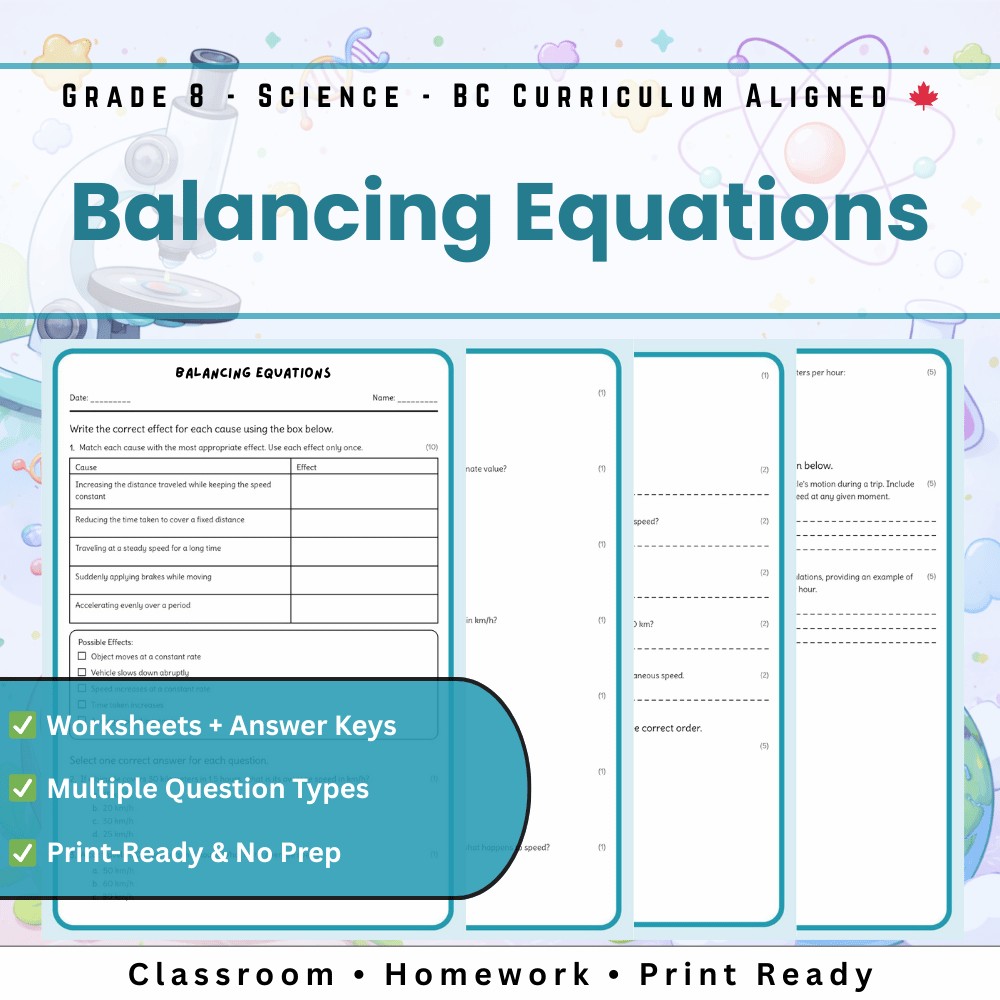
Grade 8 Science | Balancing Equations Worksheet & Answer Key (PDF)
Created byBright Mind ResourcesLearning Objectives
- Understand the purpose of coefficients in chemical equations to balance atoms.
- Learn how to correctly place coefficients to preserve atom counts during reactions.
- Interpret stoichiometry principles to predict reactant amounts required for specified products.
Instant download
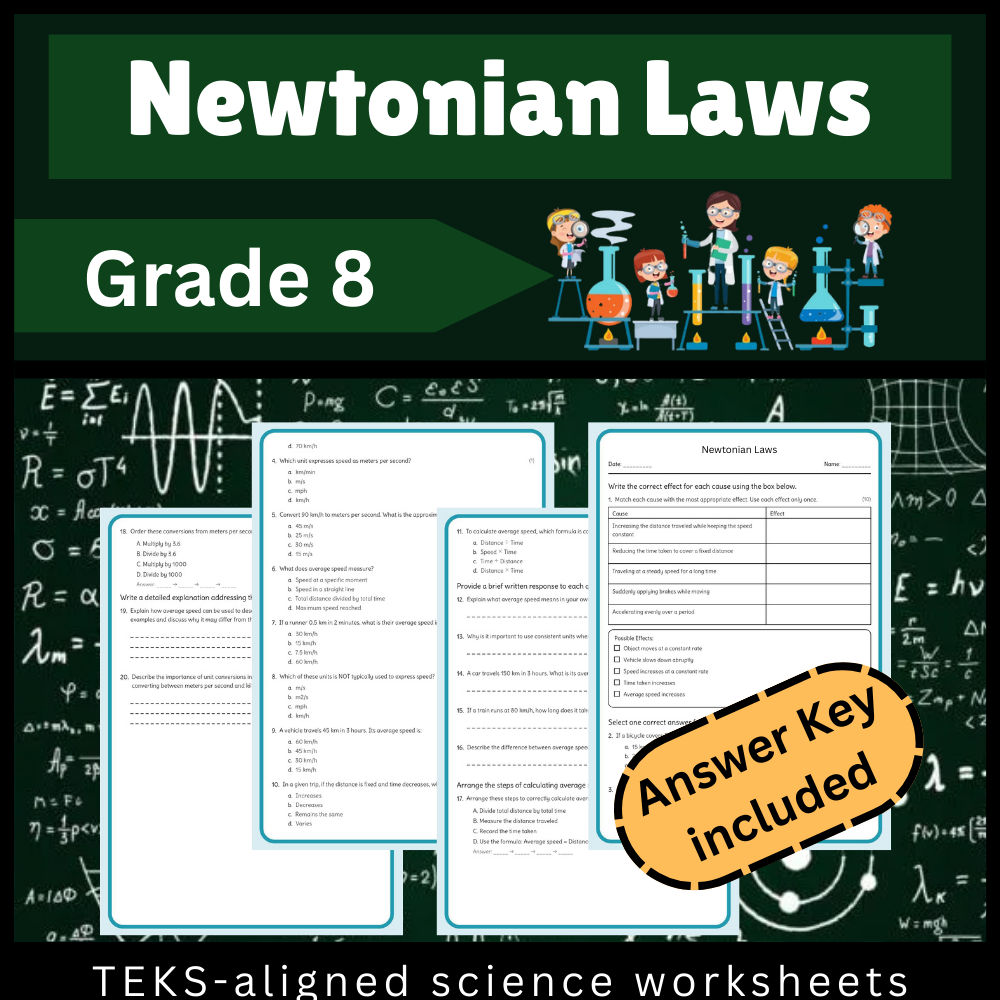
Grade 8 Science – Newtonian Laws (Worksheet + Answer Key) | TEKS Aligned
Created byBright Mind ResourcesLearning Objectives
- Explain the concept of inertia and how it relates to Newton's First Law.
- Describe the relationship between force, mass, and acceleration as stated in Newton's Second Law.
- Identify action and reaction pairs in different physical situations.
Also included in: Grade 8 Science Unit | Motion, Forces & Energy Worksheets Bundle (TEKS Aligned) +1 more
Instant download
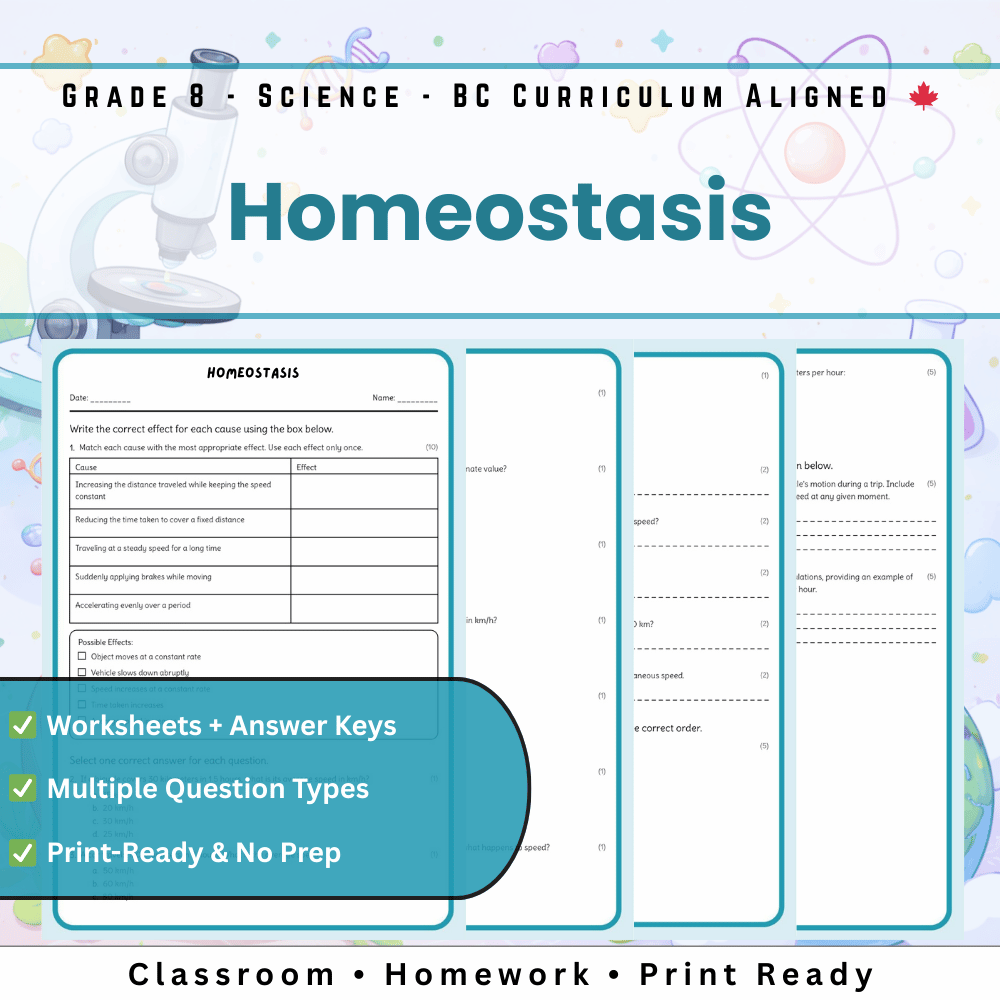
Grade 8 Science | Homeostasis Worksheet (PDF) – BC Standards & Key Concepts
Created byBright Mind ResourcesLearning Objectives
- Explain the concept of homeostasis and its importance in maintaining internal stability.
- Identify feedback mechanisms involved in homeostasis, including sensors, integrating centers, and effectors.
- Describe the physiological responses, such as vasodilation and hormone release, that restore balance.
Instant download
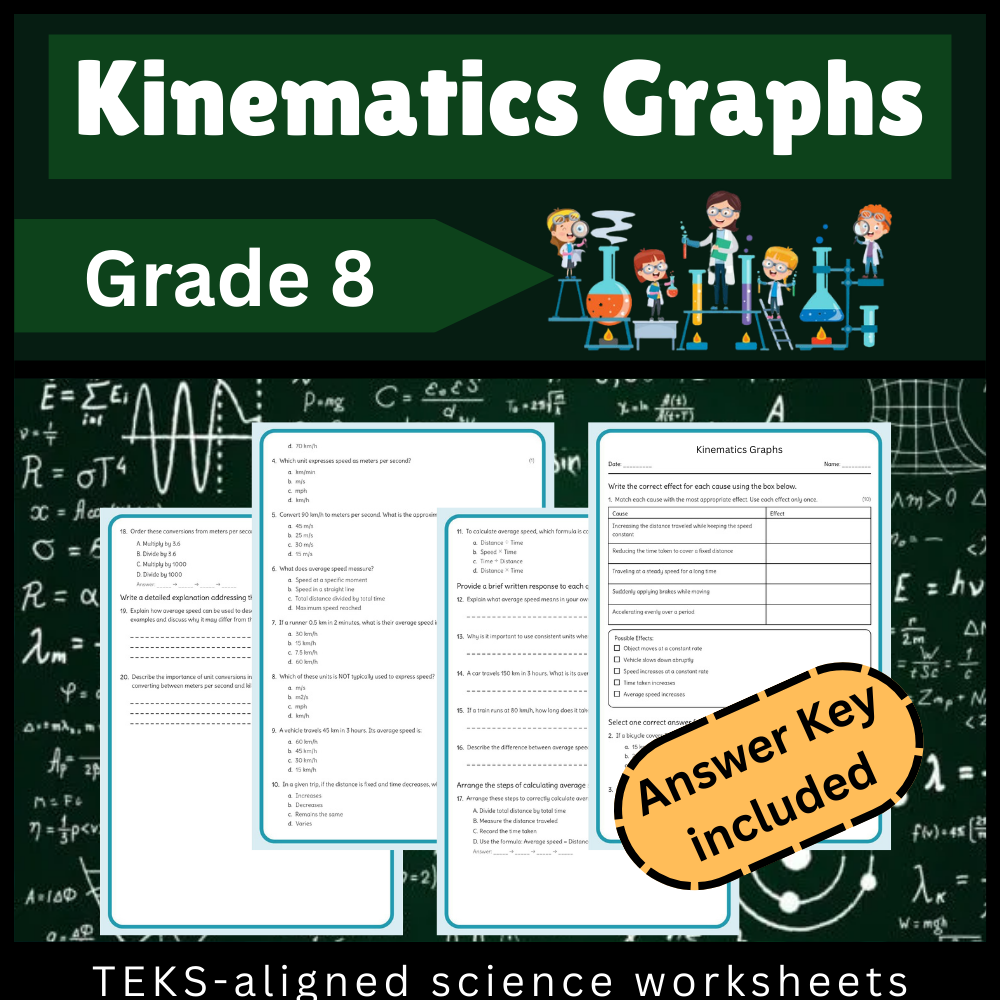
Grade 8 Science | Kinematics Graphs (Worksheet + Answer Key) – TEKS Aligned
Created byBright Mind ResourcesLearning Objectives
- Interpret motion information from distance–time and velocity–time graphs.
- Identify the significance of slope and area in analyzing motion profiles.
- Differentiate between uniform and accelerated motion using graphs.
Also included in: Grade 8 Science Unit | Motion, Forces & Energy Worksheets Bundle (TEKS Aligned) +1 more
Instant download
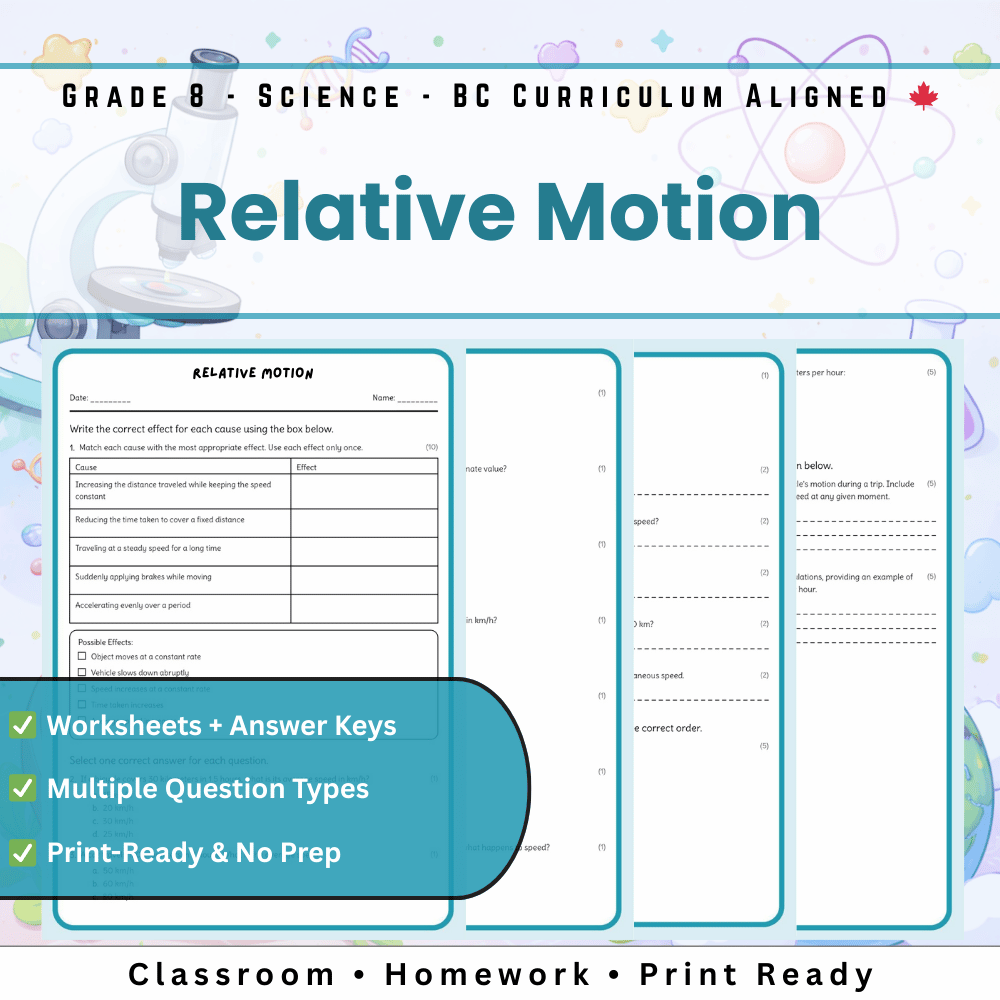
Grade 8 Science | Relative Motion Worksheet (Answer Key) – BC Standards
Created byBright Mind ResourcesLearning Objectives
- Understand how relative motion depends on reference frames and the addition or subtraction of velocities.
- Apply proportional relationships between speed, distance, and time in different frames of observation.
- Analyze simple scenarios involving two objects moving toward each other or crossing a stream to determine apparent speeds and meeting points.
Instant download
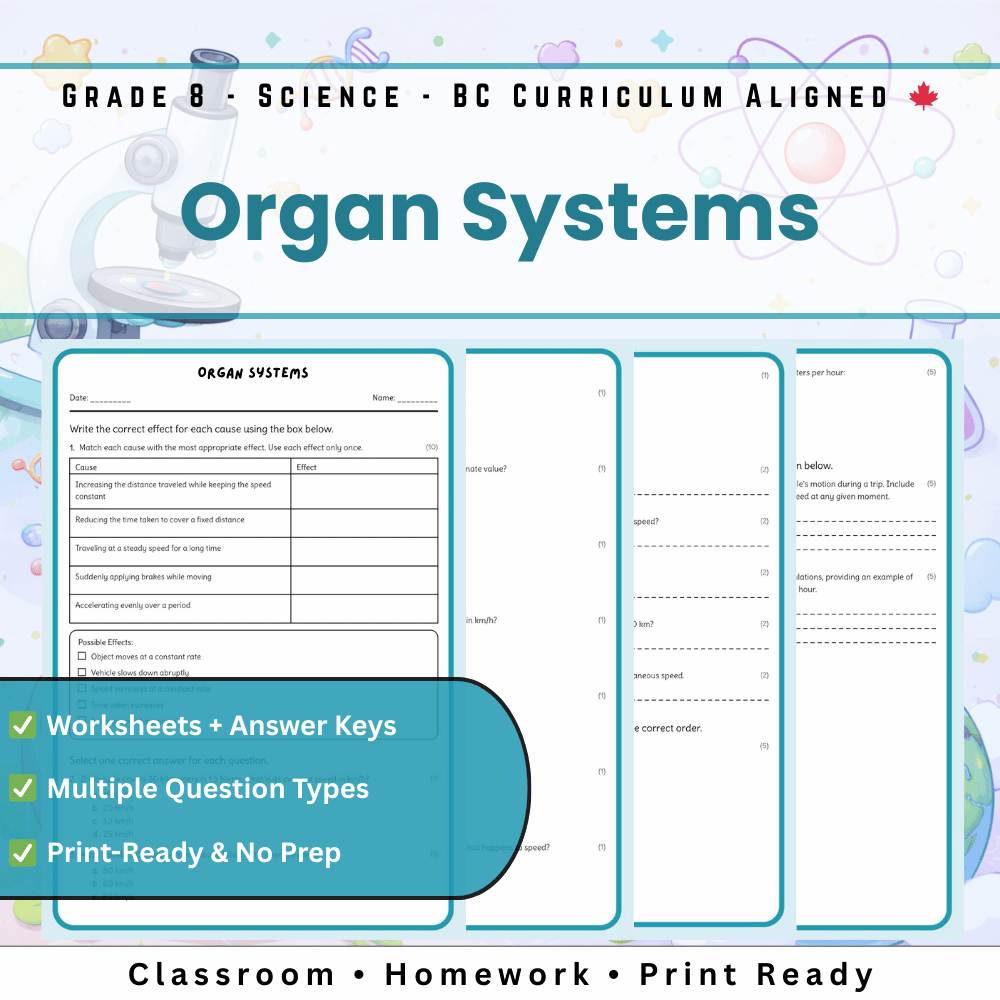
Grade 8 Science | Organ Systems Worksheet (Worksheet + Answer Key)– BC Standards
Created byBright Mind ResourcesLearning Objectives
- Describe the composition and function of different organ systems in the human body.
- Explain how organs work together within systems to maintain internal stability and respond to external changes.
- Identify the roles of tissue interfaces and communication pathways in system function.
Instant download
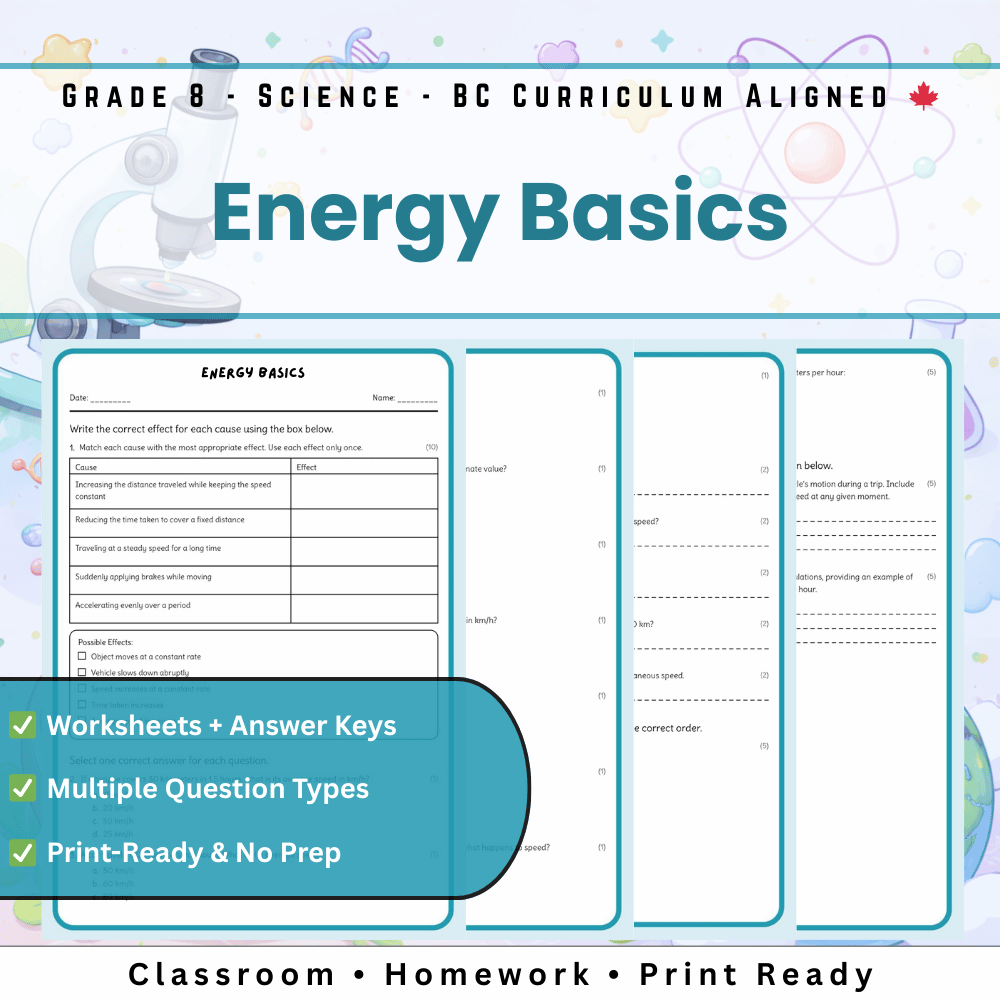
Grade 8 Science | Energy Basics Worksheet (PDF) Aligns with BC Standards
Created byBright Mind ResourcesLearning Objectives
- Understand the different forms of mechanical energy including kinetic and potential energy.
- Explain how energy transfers occur in simple systems like swinging pendulums, rolling balls, and falling weights.
- Identify how forces do work and convert energy forms during motion.
Instant download
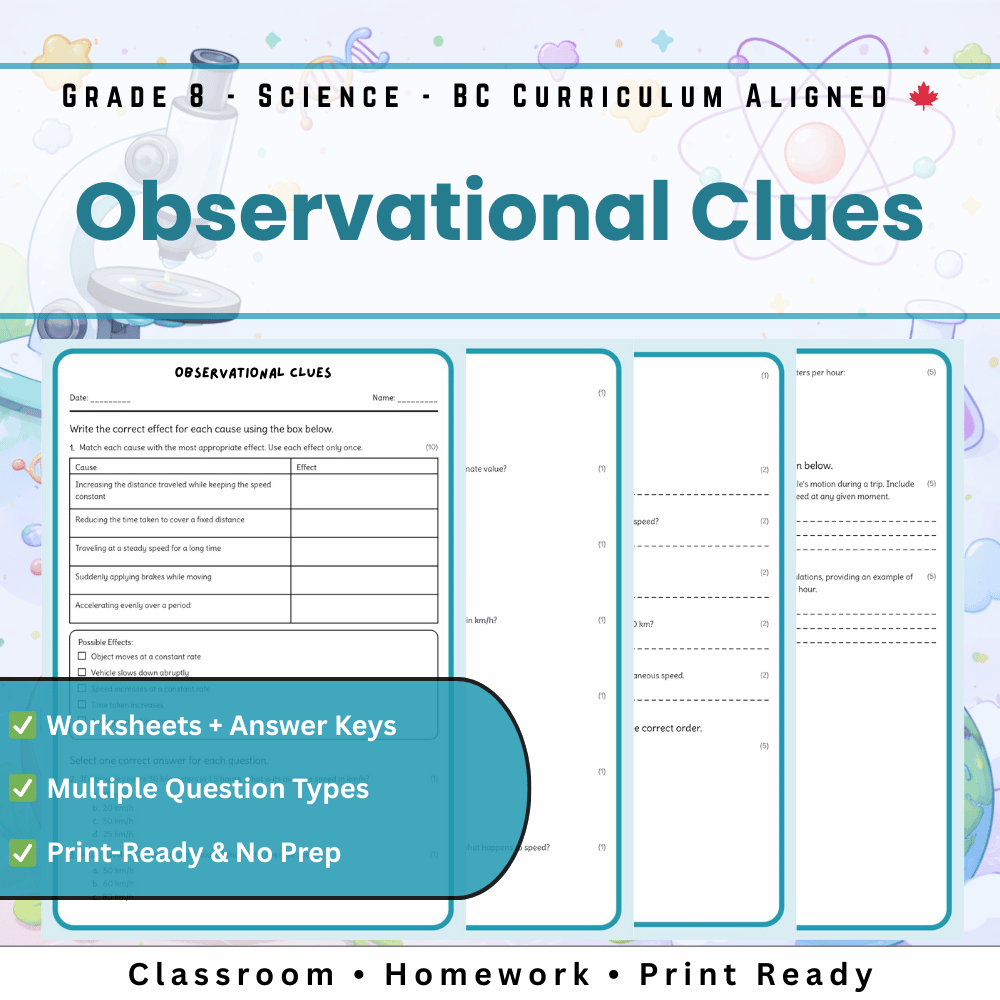
Grade 8 Science | Observational Clues Worksheet (PDF) BC Standards
Created byBright Mind ResourcesLearning Objectives
- Identify and differentiate between physical and chemical changes based on observable clues.
- Recognize indicators such as gas evolution, precipitate formation, color change, and temperature shifts as signs of chemical change.
- Understand that reversible state changes and size alterations typically indicate physical change.
Instant download
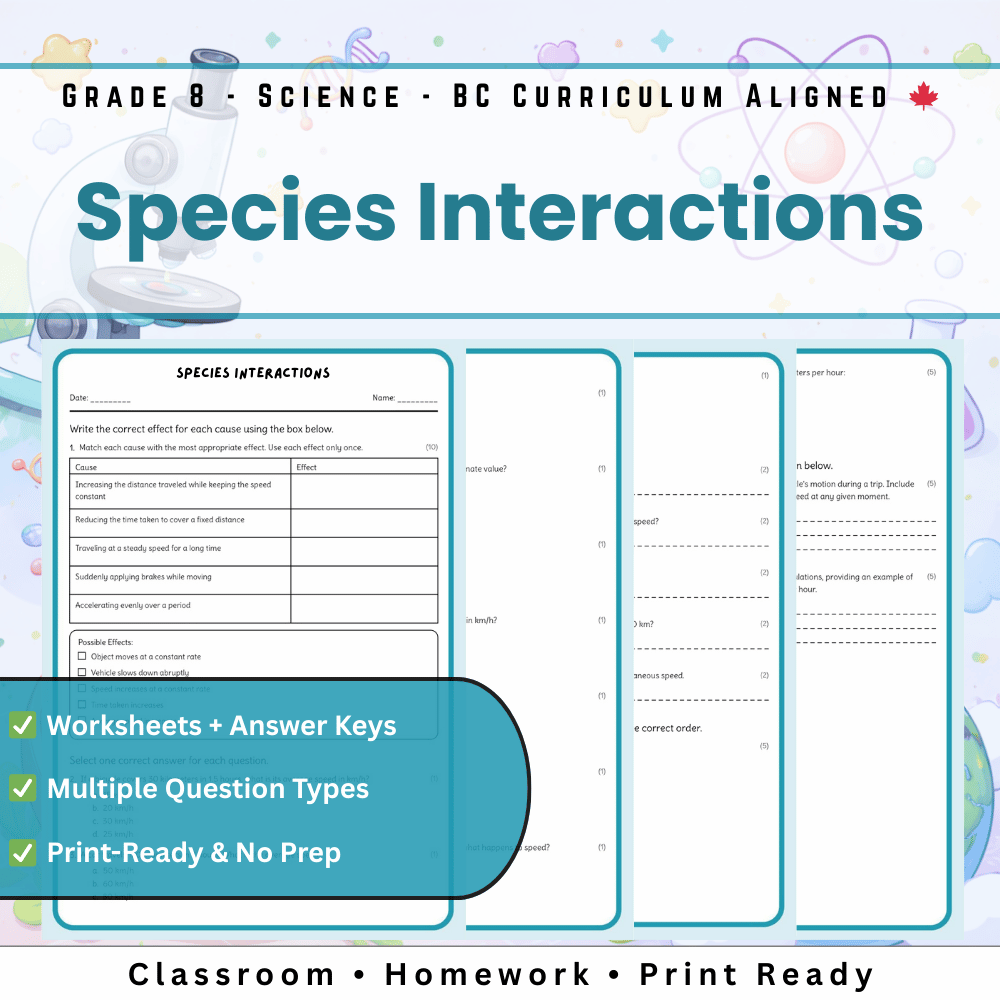
Grade 8 Science | Species Interactions Worksheet+ Answer Key (PDF - BC Standards
Created byBright Mind ResourcesLearning Objectives
- Identify different types of species interactions such as predation, competition, parasitism, mutualism, and commensalism.
- Explain how species interactions affect population dynamics and community structure.
- Describe examples of mutualism and predation in ecosystems.
Instant download
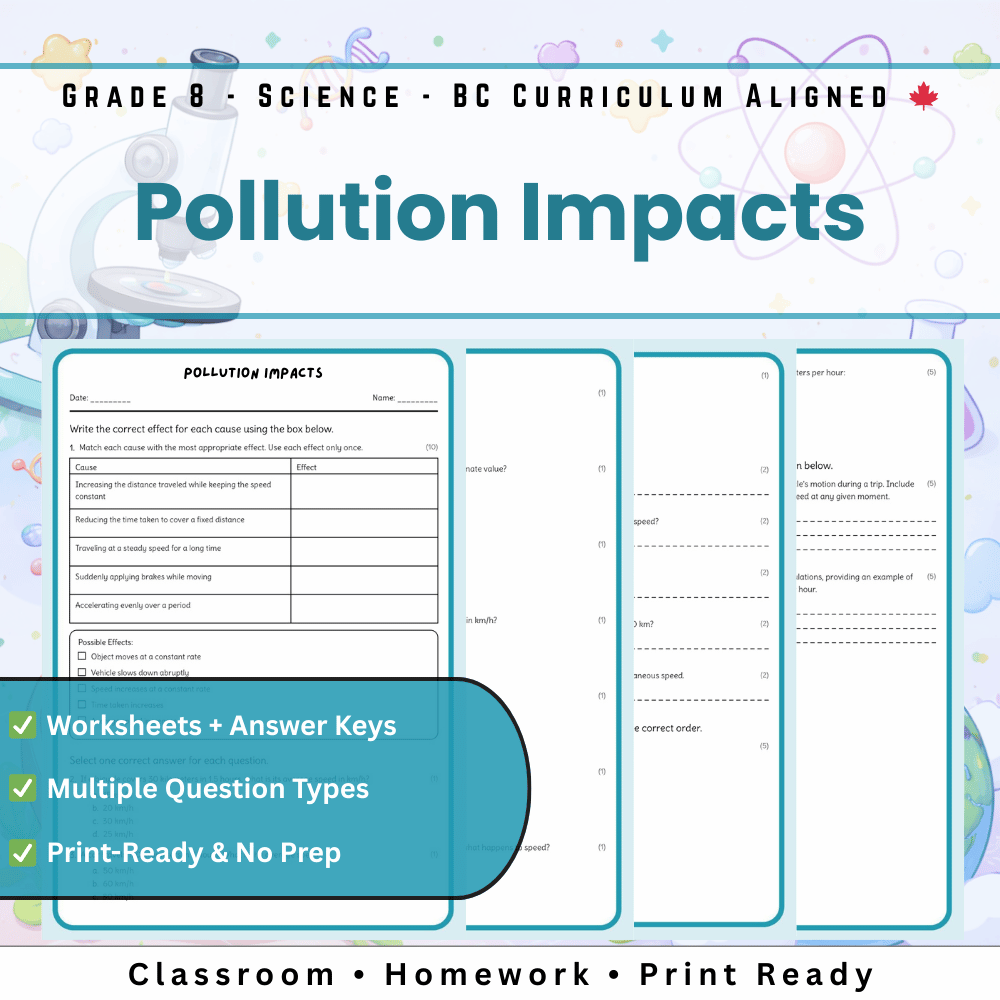
Grade 8 Science | Pollution Impacts Worksheet (PDF) – Impact & Evaluation
Created byBright Mind ResourcesLearning Objectives
- Understand how pollution affects ecosystem chemistry and nutrient cycles.
- Identify consequences of pollution on water quality, soil fertility, and organism health.
- Analyze the process of eutrophication and bioaccumulation in food webs.
Instant download
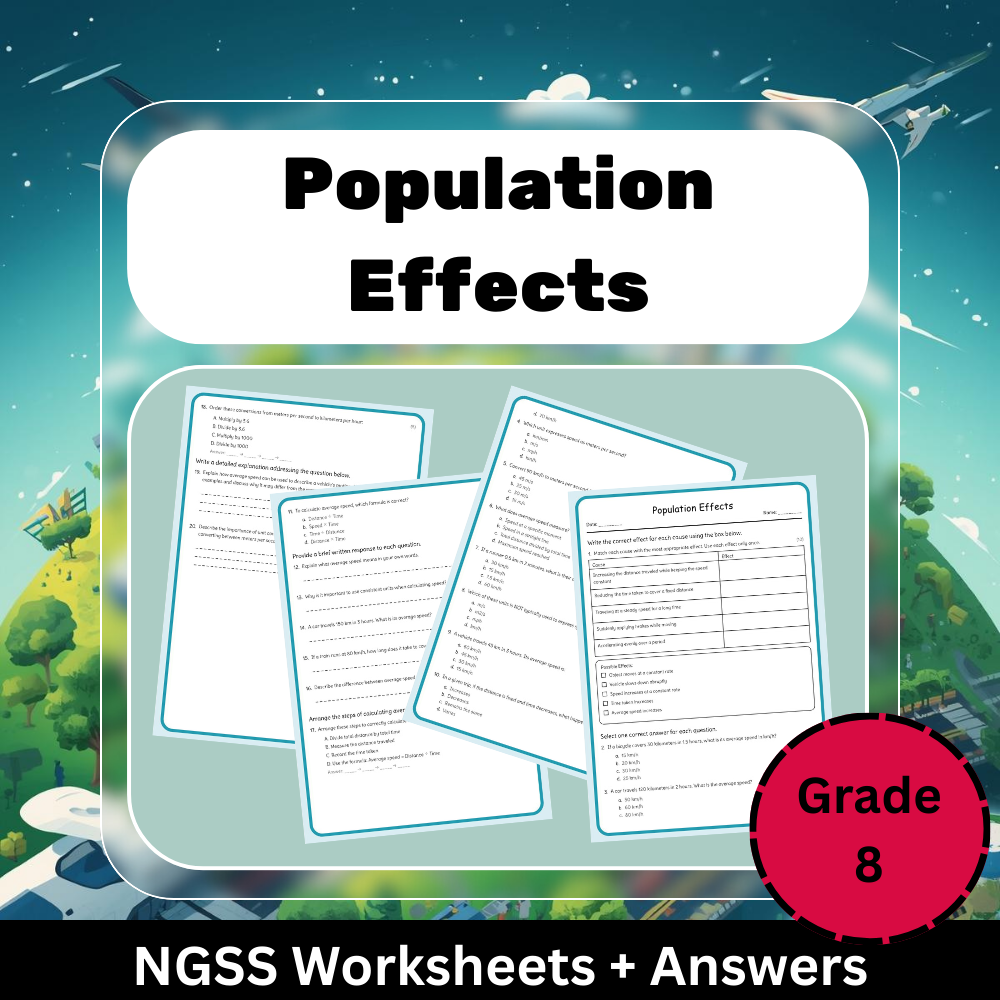
Grade 8 Science | Population Effects Worksheet (Answer Key) – NGSS Aligned
Created byBright Mind ResourcesLearning Objectives
- Analyze how population growth influences resource use and Earth system changes.
- Evaluate the links between demographic patterns, consumption, and environmental impact.
- Interpret data on resource use trends, land-cover change, and biogeochemical fluxes.
Also included in: Grade 8 Science Unit | Climate & Environment NGSS Worksheets & Resources +2 more
Instant download
Grade 8 Science | Earth Materials Worksheet (NGSS Aligned) – PDF
Created byBright Mind ResourcesLearning Objectives
- Describe the processes involved in the rock cycle and mantle convection.
- Explain the interactions among geosphere, hydrosphere, and atmosphere in Earth's material cycles.
- Identify different surface features related to Earth's crust and geological activity.
Also included in: Grade 8 Science Unit | Weather, Water Cycle & Climate Circulation Worksheets +2 more
Instant download
Grade 8 Science Resource Distribution | NGSS-Aligned Worksheet (PDF)
Created byBright Mind ResourcesLearning Objectives
- Understand geological processes that affect resource formation and distribution.
- Identify different types of mineral, energy, and groundwater resources.
- Analyze how resource accessibility and quality vary regionally.
Also included in: Grade 8 Science Unit | Climate & Environment NGSS Worksheets & Resources +2 more
Instant download
Grade 8 Science | Genetic Diversity Worksheet + Answer Key (PDF) – BC Standards
Created byBright Mind ResourcesLearning Objectives
- Explain the importance of genetic diversity within populations.
- Identify factors that influence genetic variation among species.
- Analyze the consequences of low genetic diversity on species survival.
Instant download
Grade 8 Science | Climate Circulation Concepts & NGSS Aligned Worksheet (PDF)
Created byBright Mind ResourcesLearning Objectives
- Explain the patterns of atmospheric and oceanic circulation driven by unequal solar heating and planetary rotation.
- Describe the functions of Hadley, Ferrel, and polar cells and their influence on regional climates.
- Analyze how Coriolis effect influences wind direction and ocean currents such as gyres and thermohaline circulation.
Also included in: Grade 8 Science Unit | Weather, Water Cycle & Climate Circulation Worksheets +2 more
Instant download
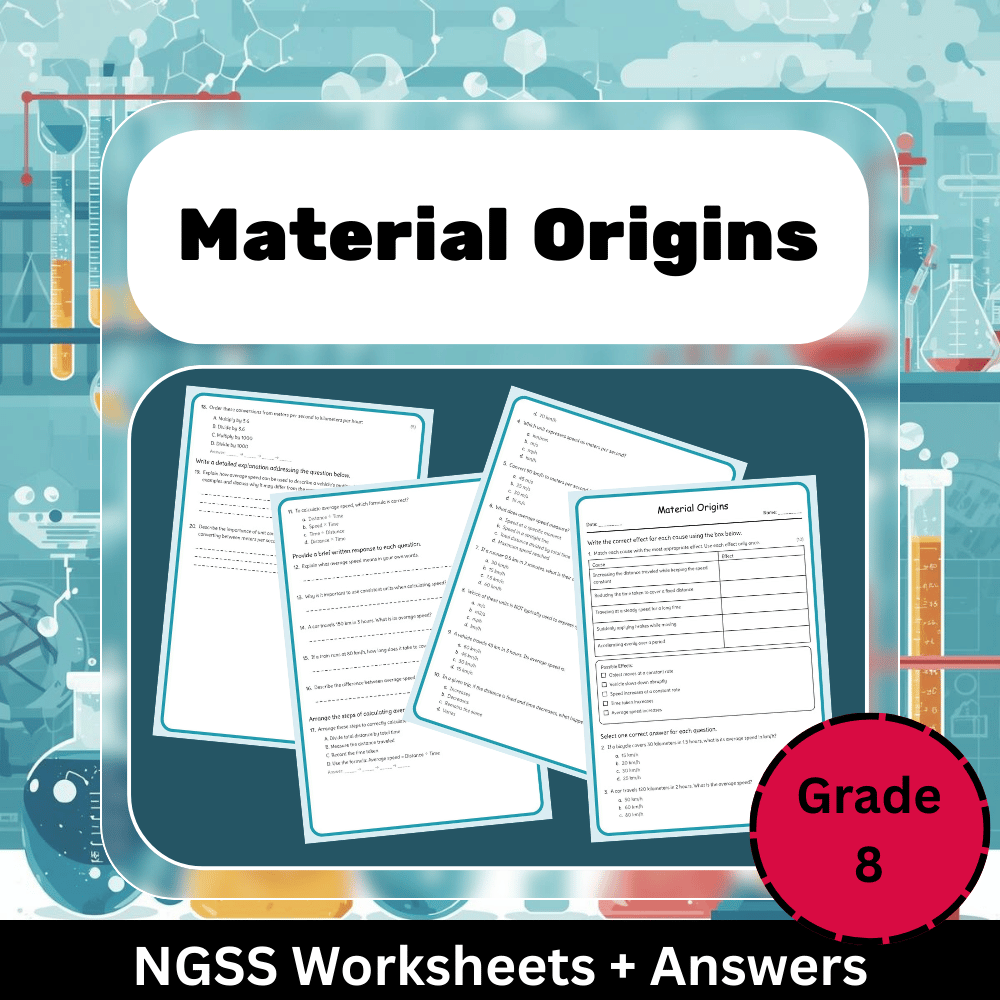
Grade 8 Science | Material Origins Worksheet (NGSS Aligned PDF)
Created byBright Mind ResourcesLearning Objectives
- Understand how natural resources are transformed into synthetic materials.
- Identify the properties and applications of materials derived from different sources.
- Explore environmental and resource considerations in material sourcing and processing.
Also included in: Grade 8 Science | Molecular Structures & Energy Effects Unit Worksheet Pack-NGSS +2 more
Instant download
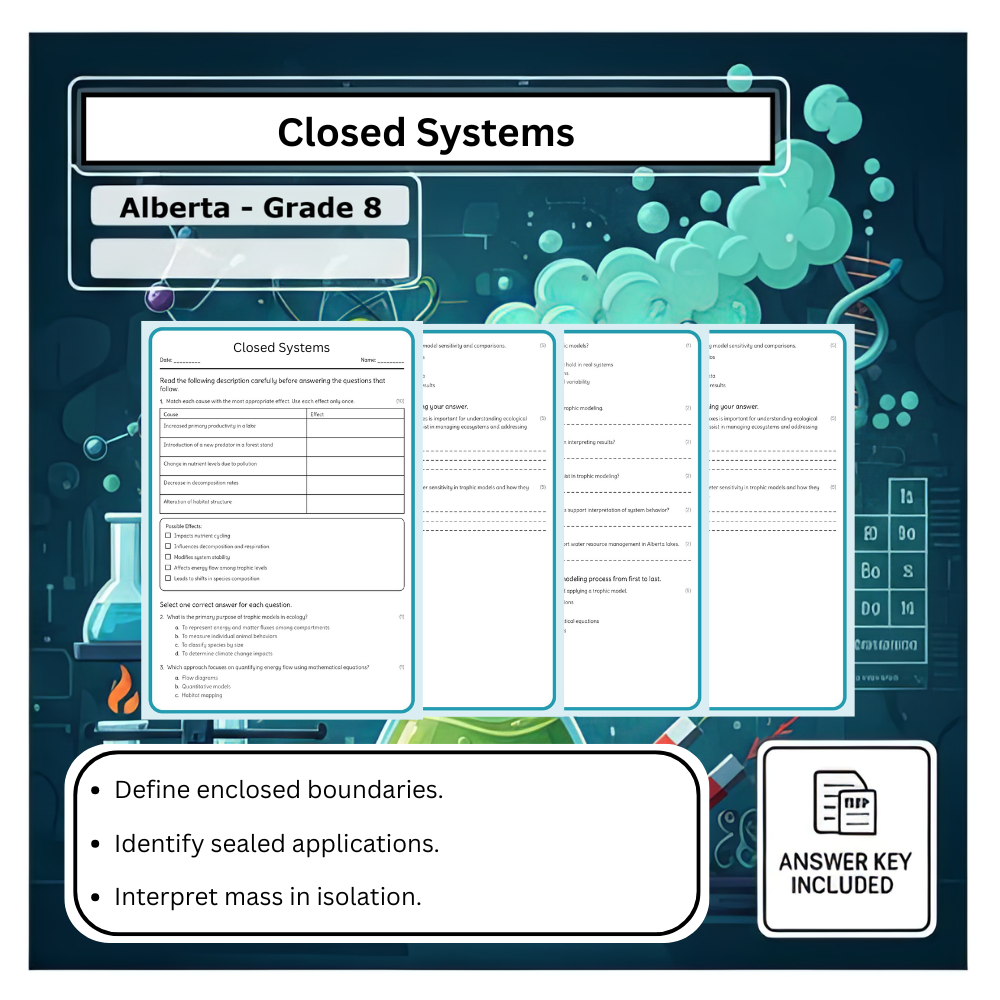
Grade 8 Science – Closed Systems Worksheet (Worksheet + Answer Key) | Alberta Standards
Created byBright Mind ResourcesLearning Objectives
- Understand the concept of closed-system analysis and its significance in chemical and environmental processes.
- Identify examples and applications of closed systems in real-world scenarios.
- Interpret mass conservation principles within enclosed systems.
Instant download
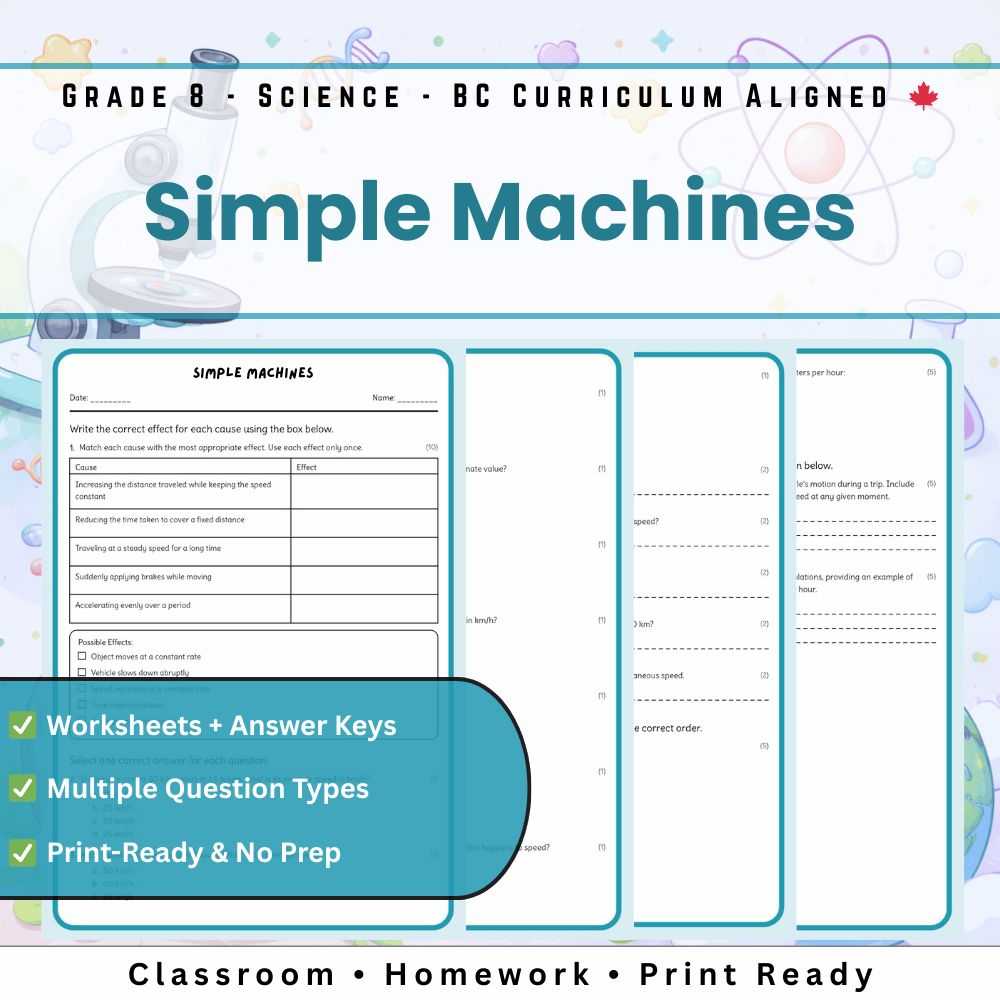
Grade 8 Science | Simple Machines Worksheet (Answer Key) – BC Standards
Created byBright Mind ResourcesLearning Objectives
- Understand how simple machines transfer energy through mechanical advantage.
- Identify the functions of levers, pulleys, and gears in mechanical systems.
- Explain how energy is conserved and losses occur in simple machines.
Instant download
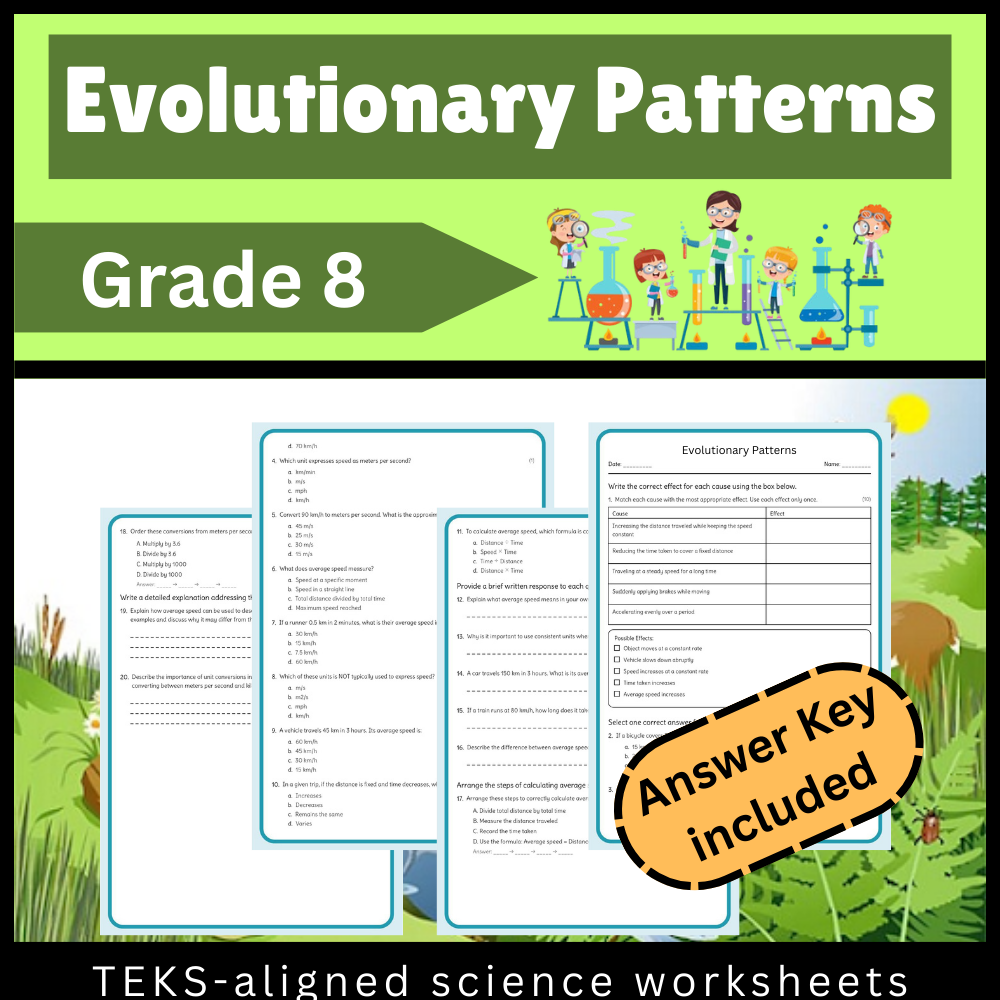
Grade 8 Science – Evolutionary Patterns Worksheet (PDF) | TEKS Standards
Created byBright Mind ResourcesLearning Objectives
- Identify sources of genetic variation and understand their role in evolution
- Explain how selective pressures influence trait distribution over generations
- Differentiate between natural selection and artificial selection
Also included in: Grade 8 Science Unit Bundle | Ecosystems,Evolution & Cell Processes TEKS Aligned +1 more
Instant download
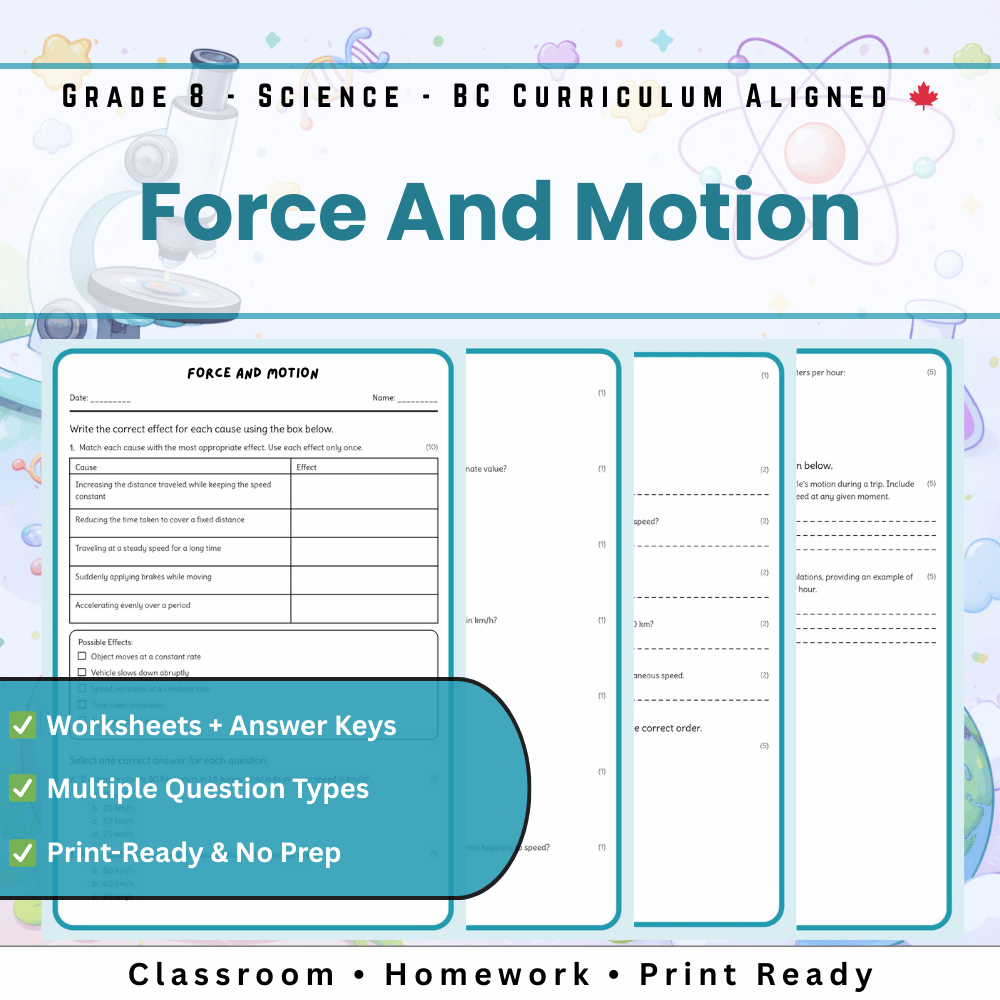
Grade 8 Science | Force & Motion Worksheets (Worksheet + Answer Key) PDF
Created byBright Mind ResourcesLearning Objectives
- Understand how net force affects the change in motion of an object.
- Explain the relationship between mass, force, and acceleration.
- Predict how doubling force or tripling mass influences an object's movement.
Instant download
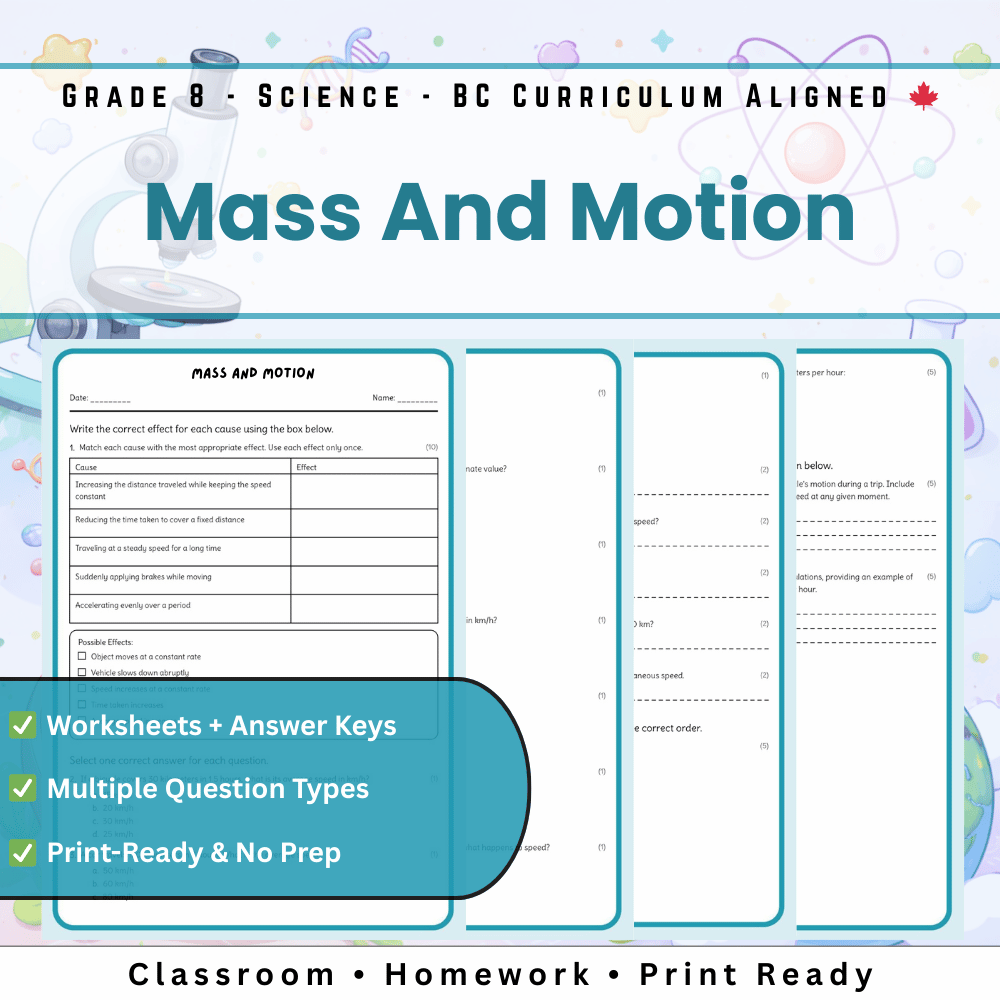
Grade 8 Science | Mass and Motion Worksheet (Answer Key) – BC Standard
Created byBright Mind ResourcesLearning Objectives
- Understand how mass influences the response to net force and motion.
- Explain the inverse relationship between mass and acceleration for a given net force.
- Compare the effects of the same applied force on objects of different masses.
Instant download
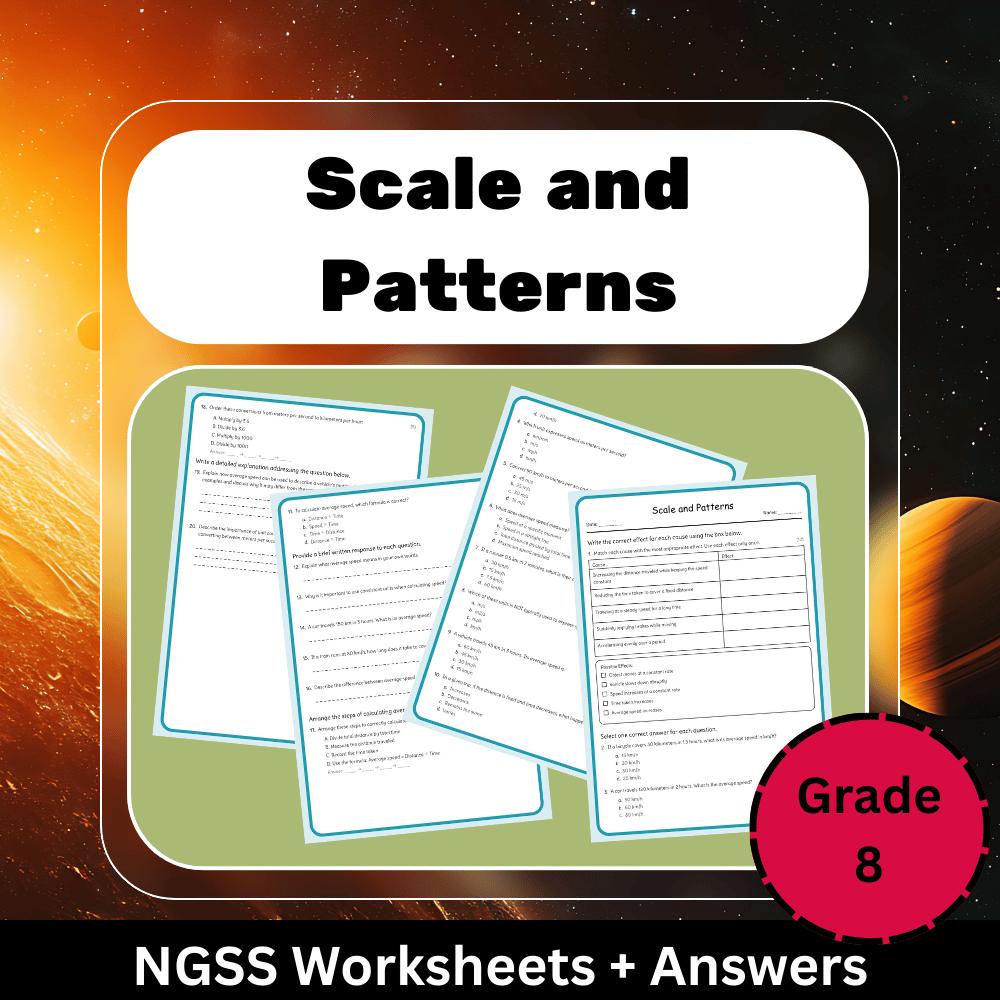
Grade 8 Science | Scale and Patterns Worksheet (NGSS Aligned, PDF)
Created byBright Mind ResourcesLearning Objectives
- Analyze scale relationships among solar system objects using quantitative data.
- Interpret patterns in diameters, masses, distances, and orbital periods of planets and moons.
- Use astronomical units and relative scaling to compare celestial objects.
Also included in: Grade 8 Science Unit | Motion, Cycles & Patterns Worksheet Bundle (NGSS Aligned) +2 more
Instant download
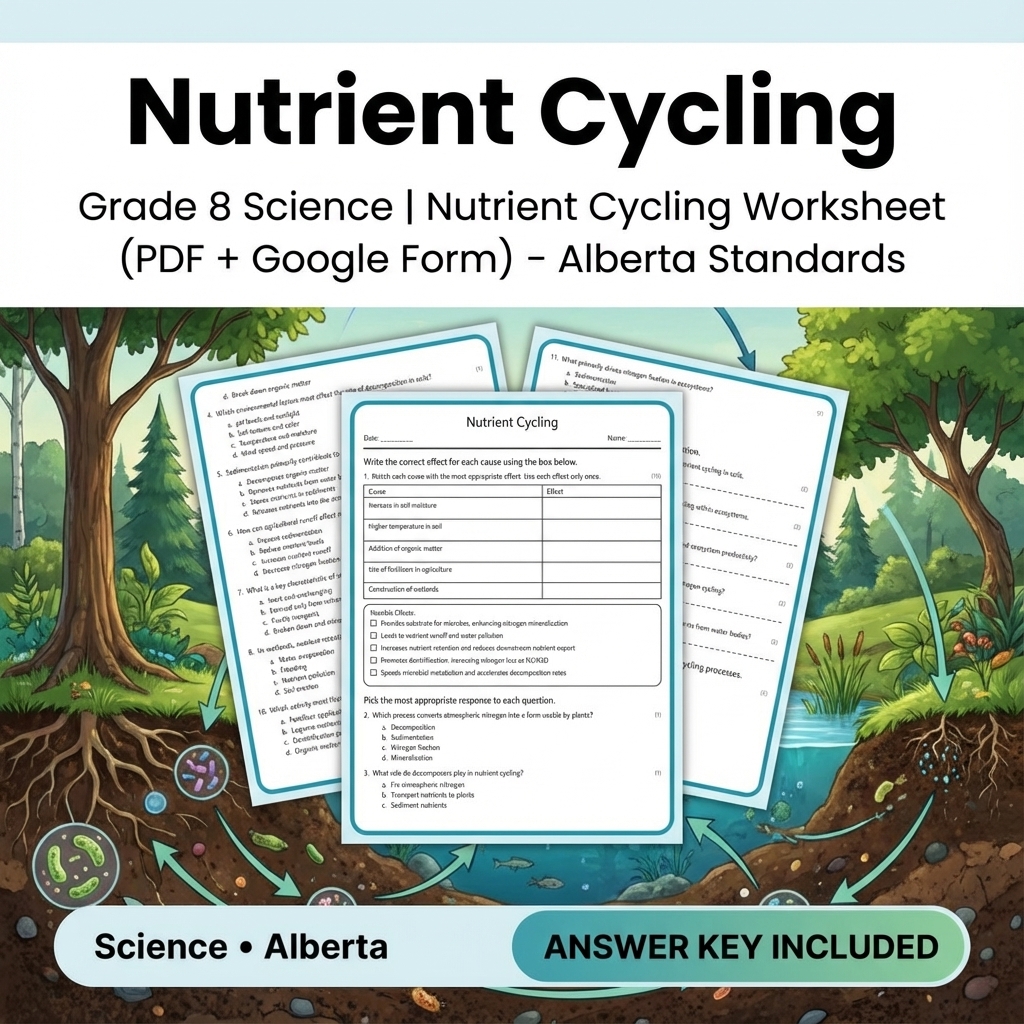
Grade 8 Science | Nutrient Cycling Worksheet (PDF) – Alberta Standards
Created byBright Mind ResourcesLearning Objectives
- Explain key processes involved in nutrient cycling in ecosystems.
- Identify the roles of decomposers, nitrogen fixation, and sedimentation.
- Describe how environmental factors influence nutrient cycling rates.
Instant download
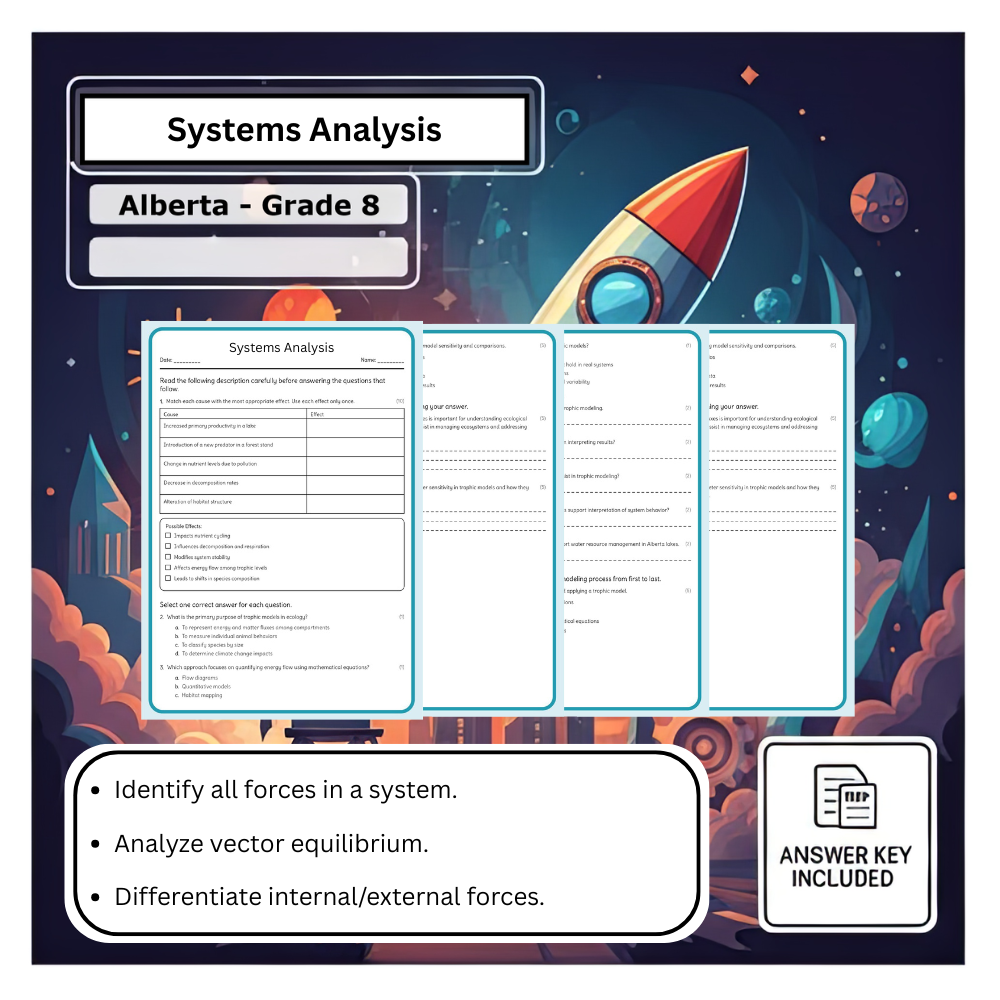
Grade 8 Science – Systems Analysis Worksheet (PDF) – Alberta Standards
Created byBright Mind ResourcesLearning Objectives
- Understand how to identify and decompose forces in complex systems
- Analyze vector contributions and assess equilibrium or net acceleration
- Differentiate between internal and external interactions in systems
Instant download
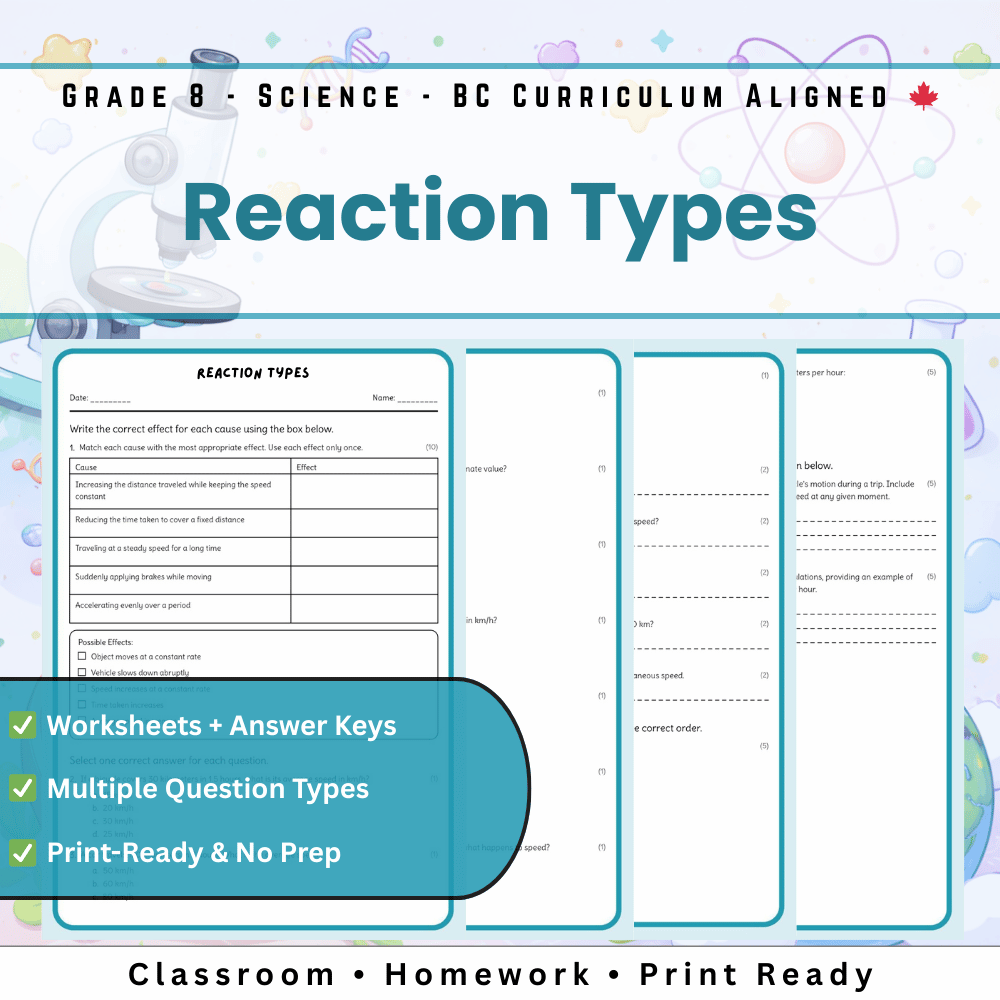
Grade 8 Science | Reaction Types Worksheet (PDF) – Standard BC – Science
Created byBright Mind ResourcesLearning Objectives
- Identify and describe the main types of chemical reactions including synthesis, decomposition, single and double displacement, and combustion.
- Recognize characteristic bond-making and bond-breaking patterns in different reaction types.
- Predict possible products based on the reaction type.
Instant download
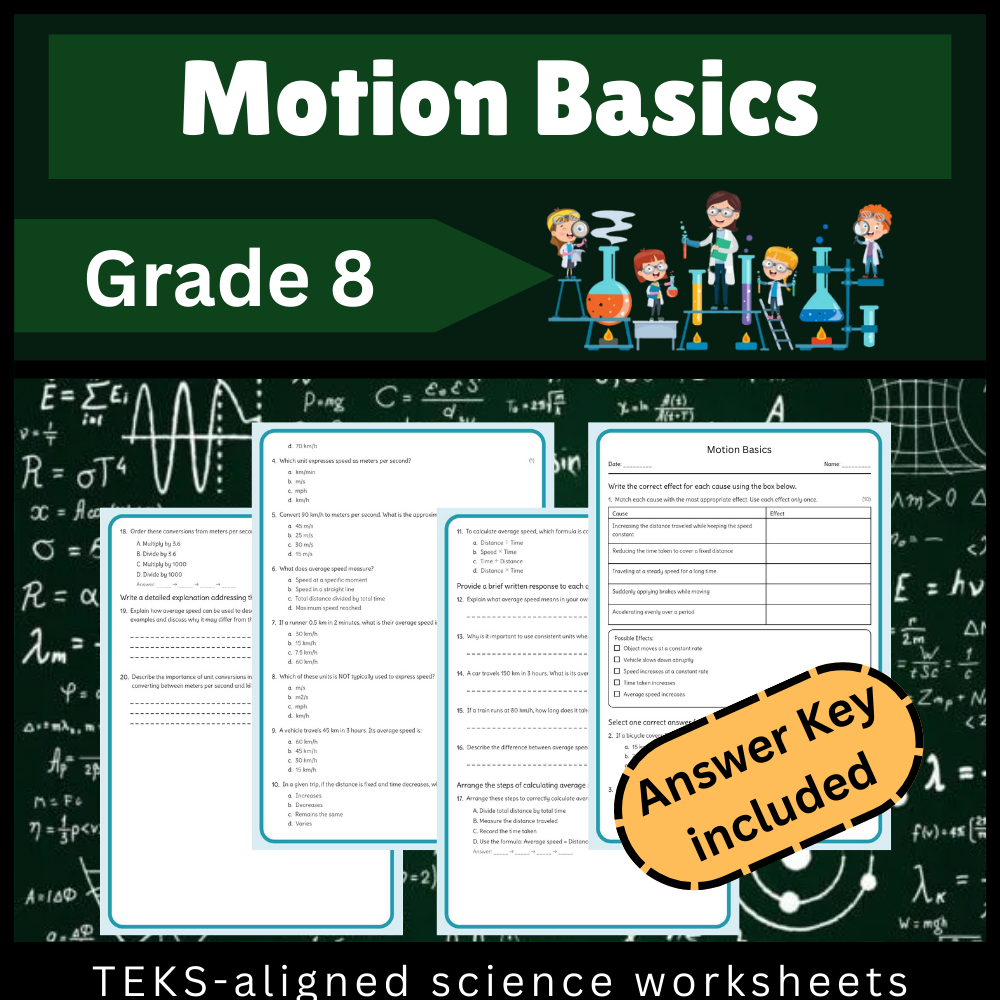
Grade 8 Science | Motion Basics Worksheet (Answer Key) – TEKS-Aligned
Created byBright Mind ResourcesLearning Objectives
- Understand fundamental concepts of motion, including position, distance, speed, velocity, and acceleration.
- Differentiate between scalar and vector quantities related to motion.
- Interpret distance–time and velocity–time graphs with examples such as rolling balls and toy vehicles.
Also included in: Grade 8 Science Unit | Motion, Forces & Energy Worksheets Bundle (TEKS Aligned) +1 more
Instant download
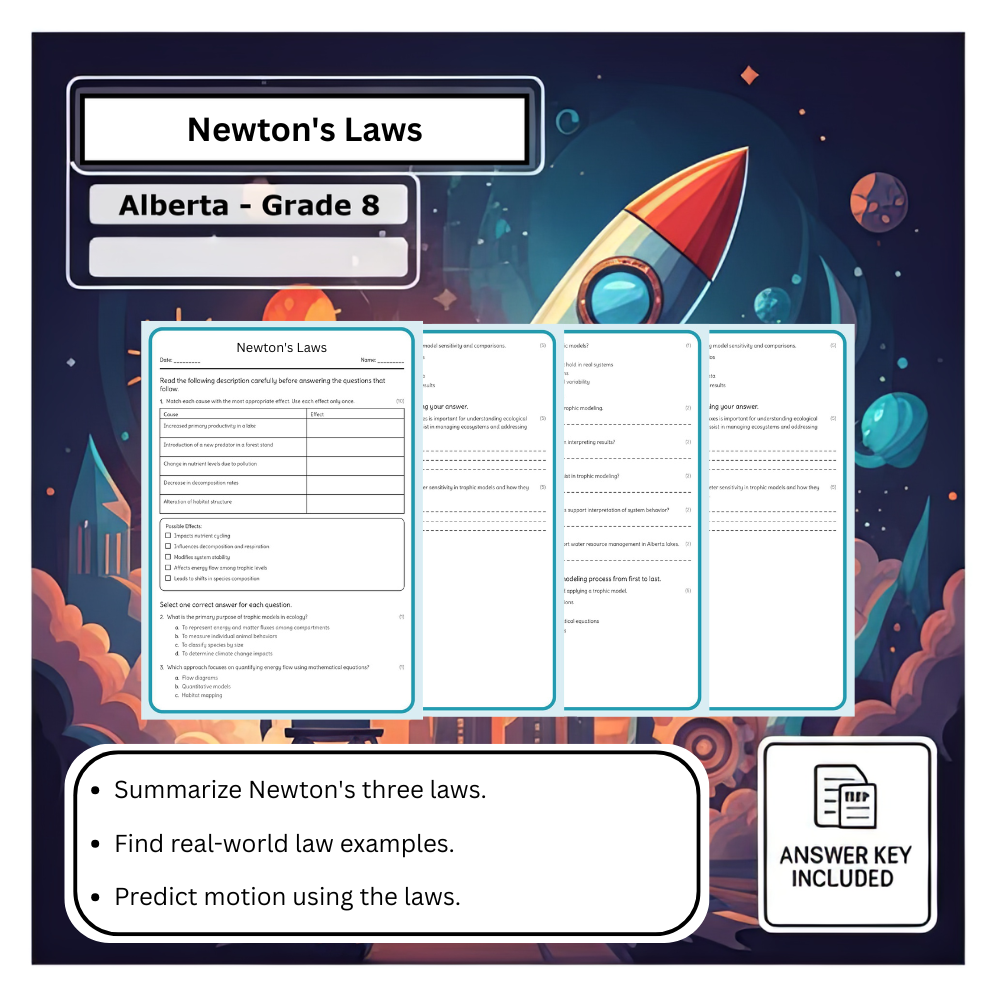
Grade 8 Science | Newton's Laws (Worksheet + Answer Key) – Alberta Standard
Created byBright Mind ResourcesLearning Objectives
- Describe and explain Newton's three laws of motion.
- Identify real-world examples that demonstrate each of Newton's laws.
- Predict changes in motion and force using Newton's laws.
Instant download
About Grade 8 Science Worksheets
Explore Grade 8 Science worksheets for classwork, homework, or review. Our 6,006 printables download instantly as PDFs.
Each resource here is built by an independent educator and reviewed for quality. Worksheets print straight from PDF and suit classroom use, homework, or extra practice; most come with answer keys, and you can preview before purchasing.