
Grade 8 Science Worksheets
6,006 worksheets
Grade 8 Science – Plate Motions & Landforms | Daily Reading Worksheet
 Created byElena Brooks
Learning Objectives
- Identify different types of plate boundaries and their characteristics.
- Understand mechanisms involved in plate tectonics such as subduction, rifting, and continental collision.
- Recognize landforms created by plate movements, including mountains, ocean basins, and volcanic arcs.
Instant download

Grade 8 Science – Population Growth & Factors | Daily Reading Worksheet
 Created byBright Mind Resources
Learning Objectives
- Understand the basic concepts of population change, including birth rates, death rates, immigration, and emigration.
- Identify patterns of population increase, stability, and decline.
- Learn how reproductive strategies, age structure, and resource availability influence population dynamics.
Also included in: Grade 8 Ecosystems Daily Reading Worksheets Lesson Bundle | BC +1 more
Instant download

Grade 8 Science – Abiotic Influences on Ecosystems | Daily Reading Worksheet
Created byBright Mind ResourcesLearning Objectives
- Understand how light and temperature affect plant and animal life.
- Identify various abiotic factors that influence ecosystems.
- Explain how changes in abiotic conditions can alter community composition.
Also included in: Grade 8 Ecosystems Daily Reading Worksheets Lesson Bundle | BC +1 more
Instant download

Grade 8 Science – Simple Lever & Machines | Daily Reading Worksheet
Created byBright Mind ResourcesLearning Objectives
- Identify the parts of a lever and describe its function
- Understand how a lever makes work easier by changing force and distance
- Analyze real-life examples of levers in everyday objects
Also included in: Grade 8 Energy & Motion Science Daily Reading Worksheets Lesson Bundle | TEKS +2 more
Instant download
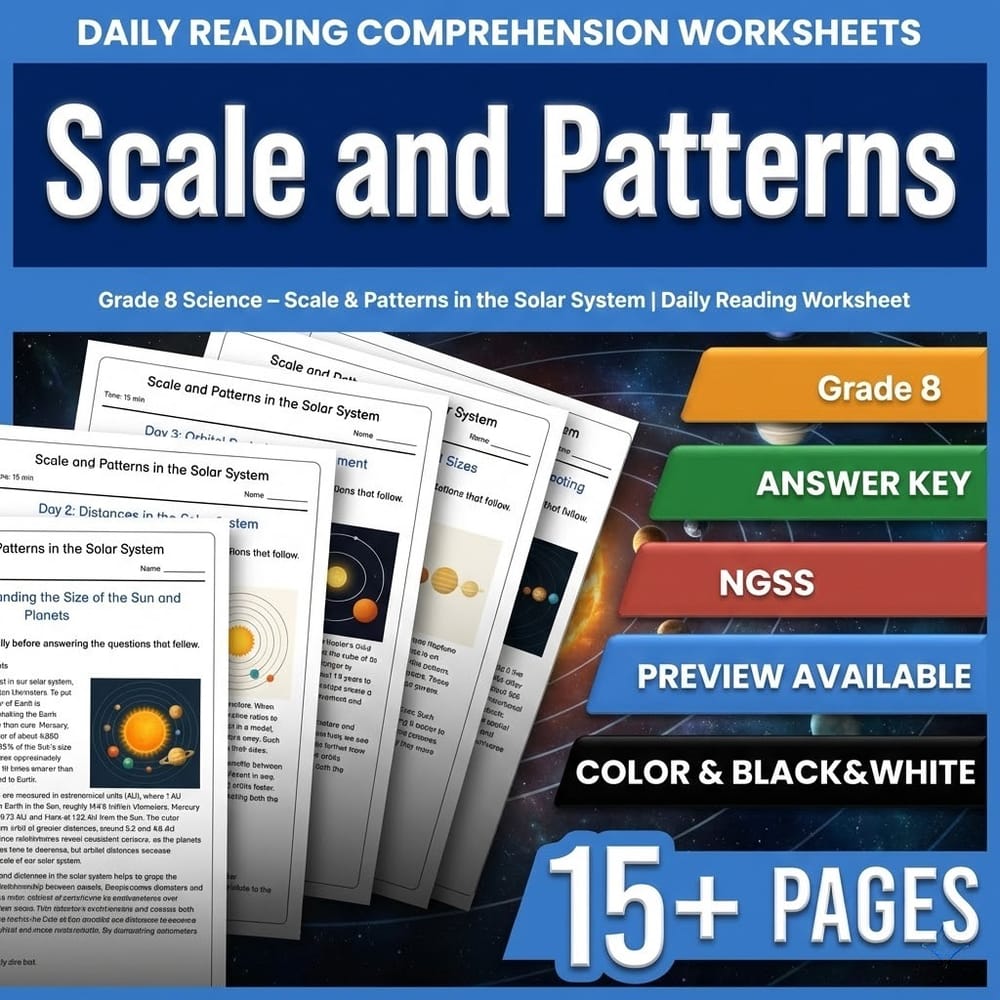
Grade 8 Science – Scale & Patterns in the Solar System | Daily Reading Worksheet
Created byElena BrooksLearning Objectives
- Interpret planetary diameters and compare their sizes relative to the Sun
- Understand the use of astronomical units in measuring distances
- Identify patterns and relationships among solar system objects based on data
Instant download

Grade 8 Science – Reaction Evidence & Matter | Daily Reading Worksheet
Created byBright Mind ResourcesLearning Objectives
- Identify signs indicating a chemical reaction
- Understand that atoms are conserved during reactions
- Recognize physical evidence of chemical changes
Also included in: Reaction Evidence & Matter Grade 8 Science Lesson Bundle | General Framework +1 more
Instant download

Grade 8 Science – Lever Mechanics & Simple Machines | Daily Reading Worksheet
Created byBright Mind ResourcesLearning Objectives
- Identify and describe the three classes of levers
- Understand the placement of fulcrums, input, and output forces
- Calculate the mechanical advantage of different lever types
Also included in: Grade 8 Mechanical Systems Science Reading Worksheets – Lesson Bundle | Ontario +1 more
Instant download

Grade 8 Science – Kinematics Graphs & Motion | Daily Reading Worksheet
Created byBright Mind ResourcesLearning Objectives
- Understand how to read and interpret distance–time graphs
- Identify the slope of a graph and relate it to speed
- Differentiate between uniform and accelerated motion using graphs
Also included in: Grade 8 Energy & Motion Science Daily Reading Worksheets Lesson Bundle | TEKS +2 more
Instant download

Grade 8 Science – Mechanical Advantage in Levers & Pulley Systems | Worksheet
Created byBright Mind ResourcesLearning Objectives
- Understand the concept of mechanical advantage using lever systems
- Calculate ideal mechanical advantage using lever arm ratios
- Understand the difference between ideal and actual mechanical advantage considering friction
Also included in: Grade 8 Energy & Motion Science Daily Reading Worksheets Lesson Bundle | TEKS +2 more
Instant download

Grade 8 Science – Introduction to Aquifers & Water Flow | Daily Worksheet
 Created byQuiet Forest Education
Learning Objectives
- Identify different types of aquifers (confined and unconfined).
- Understand the basic structure and function of aquifers.
- Recognize the importance of groundwater flow systems.
Also included in: Grade 8 Science Full Year Bundle Ontario Daily Reading Worksheets
Instant download
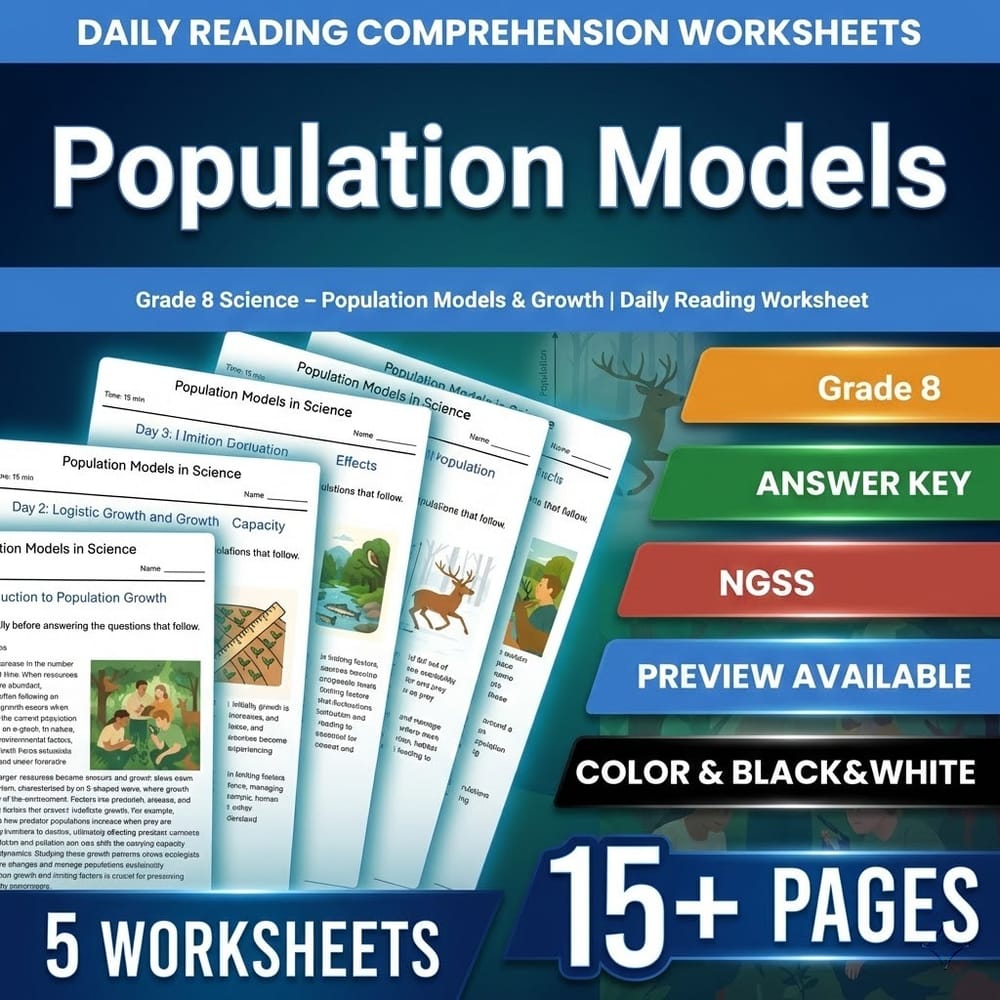
Grade 8 Science – Population Models & Growth | Daily Reading Worksheet
Created byElena BrooksLearning Objectives
- Understand the concept of exponential growth and how populations can increase rapidly under ideal conditions.
- Identify the features of basic population curves and the factors that influence population size.
- Differentiate between logistic and exponential growth models and explain concepts such as carrying capacity and limiting factors.
Instant download

Grade 8 Science – Understanding Pascal's Principle Daily Reading Worksheet
Created byBright Mind ResourcesLearning Objectives
- Explain the concept of pressure transmission in confined fluids.
- Identify how force and area relate in hydraulic systems.
- Describe real-world applications of Pascal's principle such as hydraulic presses and brake systems.
Also included in: Grade 8 Fluid Mechanics & Pressure Science Lesson Bundle | Ontario +1 more
Instant download

Grade 8 Science – Applied Investigations in Environmental Science | Worksheet
Created byBright Mind ResourcesLearning Objectives
- Understand the concept of variables in experiments
- Identify independent, dependent, and controlled variables
- Learn how controlling variables affects the fairness of investigations
Also included in: Experiments Grade 8 Science Daily Reading Worksheets Lesson Bundle | TEKS +2 more
Instant download

Grade 8 Science – Energy Forms in Mechanical Systems | Daily Reading Worksheet
Created byBright Mind ResourcesLearning Objectives
- Identify different forms of energy present in mechanical systems.
- Describe how potential and kinetic energy are stored and transformed.
- Recognize thermal and acoustic energy as forms of energy dissipation.
Also included in: Grade 8 Mechanical Systems Science Reading Worksheets – Lesson Bundle | Ontario +1 more
Instant download

Grade 8 Science – Ecosystem Structure & Food Webs | Daily Reading Worksheet
Created byBright Mind ResourcesLearning Objectives
- Identify key components of ecosystems including biotic and abiotic factors.
- Understand different biomes and climatic influences.
- Describe the roles of producers, consumers, and decomposers in energy flow and nutrient cycling.
Also included in: Grade 8 Ecosystems & Cells Science Daily Reading Lesson Bundle | TEKS +2 more
Instant download
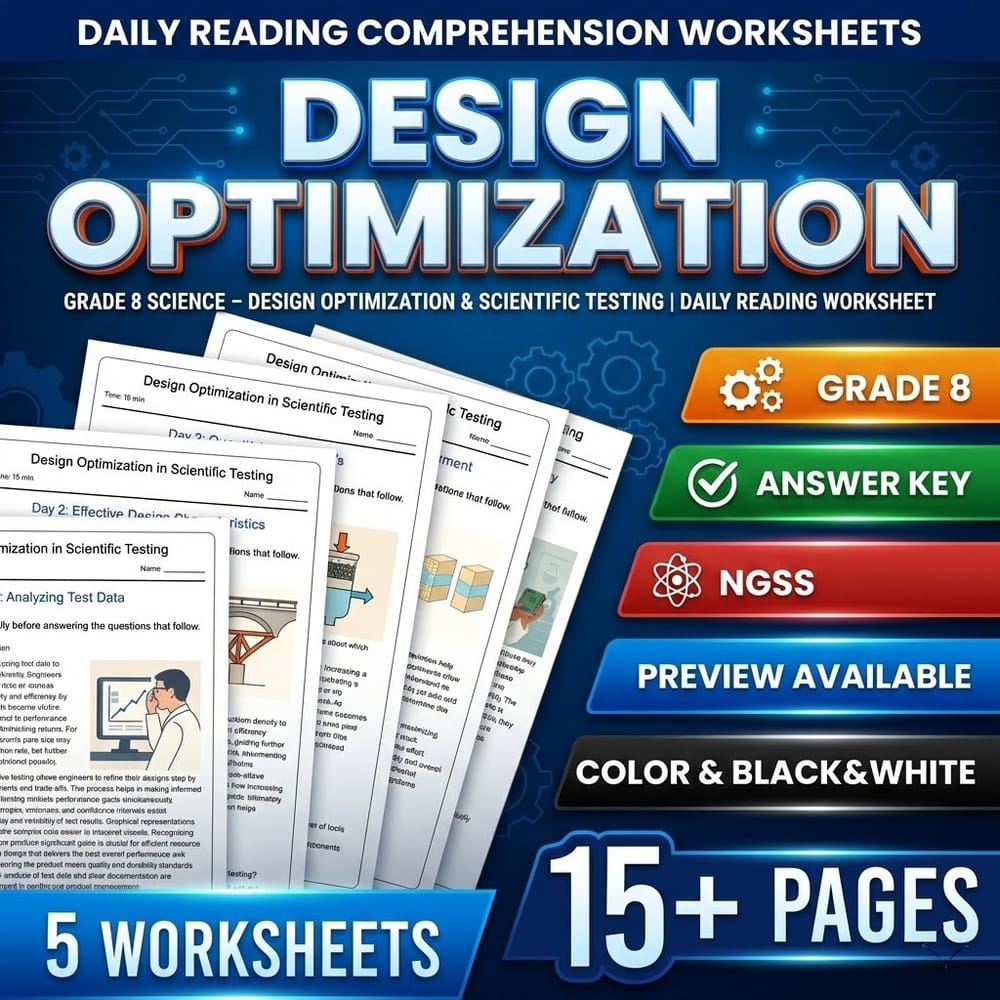
Grade 8 Science – Design Optimization & Scientific Testing | Daily Worksheet
Created byElena BrooksLearning Objectives
- Interpret graphical data from experiments to identify performance trends
- Analyze test results to determine effective design characteristics
- Understand the concept of trade-offs among multiple performance metrics
Instant download
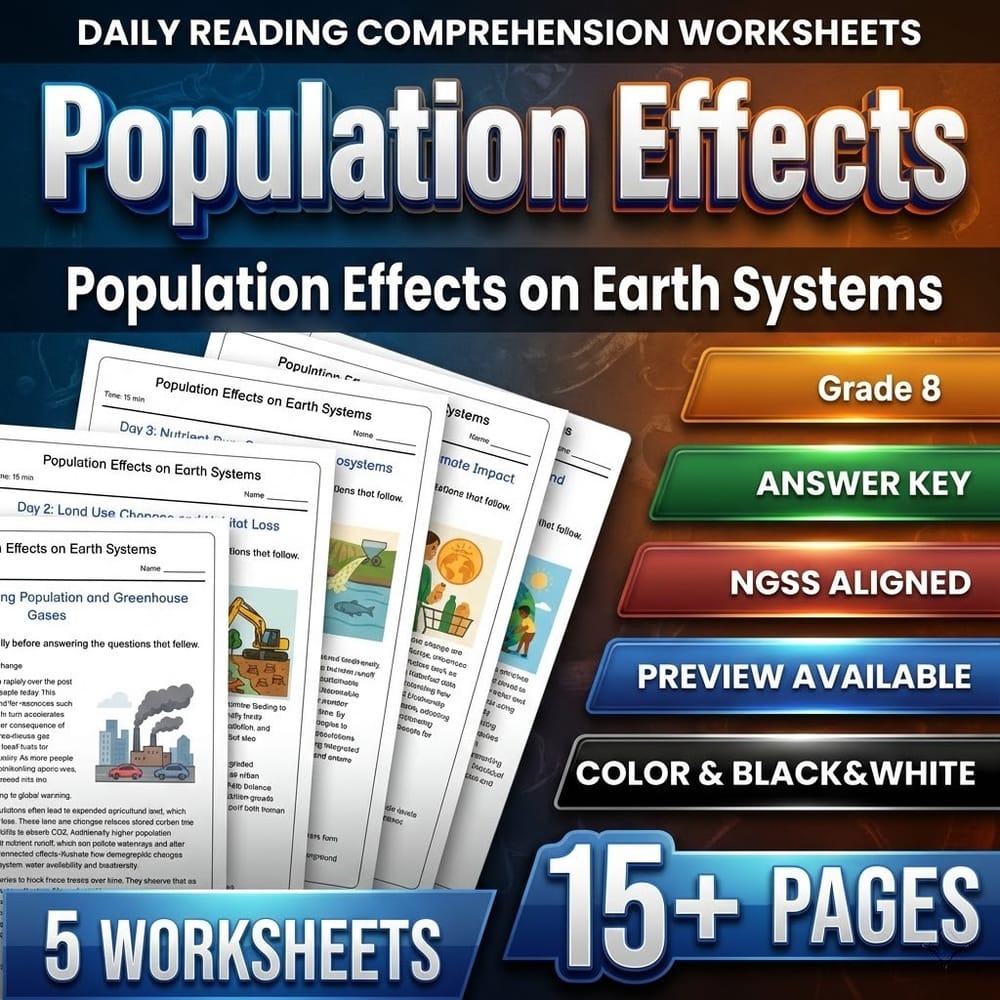
Grade 8 Science – Population Effects & Human Impact | Daily Reading Worksheet
Created byElena BrooksLearning Objectives
- Understand how population growth contributes to greenhouse gas emissions.
- Analyze the link between demographic changes and resource consumption.
- Evaluate the impact of human activities on climate, water, and biodiversity.
Instant download

Grade 8 Science – Flotation & Stability | Daily Reading Worksheet
Created byBright Mind ResourcesLearning Objectives
- Understand the principles of buoyancy and stability in floating bodies
- Identify the factors affecting the stability of boats and ships
- Analyze how design choices influence safe trim and balance
Also included in: Grade 8 Fluid Mechanics & Pressure Science Lesson Bundle | Ontario +1 more
Instant download

Grade 8 Science – Pulley Systems Daily Reading Worksheet | Ontario Standards
Created byBright Mind ResourcesLearning Objectives
- Identify different types of pulleys: fixed, movable, and compound.
- Describe how pulley arrangements reduce the effort needed to lift loads.
- Explain the concept of mechanical advantage in pulley systems.
Also included in: Grade 8 Mechanical Systems Science Reading Worksheets – Lesson Bundle | Ontario +1 more
Instant download

Grade 8 Science – Plate Motion & Surfaces | Daily Reading Worksheet
Created byBright Mind ResourcesLearning Objectives
- Understand the different types of plate boundaries and their characteristics
- Identify how surface features such as mountains, ridges, and earthquake zones relate to plate movements
- Explain the processes of divergence, convergence, and transform motion in plate tectonics
Also included in: Earth & Space Grade 8 Science Daily Reading Worksheets Lesson Bundle | General +1 more
Instant download

Grade 8 Science – Heredity & Variation | Daily Reading Worksheet
Created byBright Mind ResourcesLearning Objectives
- Understand how genetic traits are inherited from parents
- Identify examples of genetic variation in organisms
- Explain the process of recombination during reproduction
Also included in: Species Interactions & Ecosystems Grade 8 Reading Lesson Bundle | General +1 more
Instant download

Grade 8 Science – Hydrologic Measurement Techniques & Data Collection
Created byBright Mind ResourcesLearning Objectives
- Understand the key instruments used to measure water flow and quality
- Identify various methods for stream gauging and water sampling
- Explain the importance of temporal resolution and data interpretation in hydrology
Also included in: Grade 8 Water Systems Science Daily Reading Worksheets Lesson Bundle | Ontario +1 more
Instant download

Grade 8 Science – Natural Selection & Evolution | Daily Reading Worksheet
Created byBright Mind ResourcesLearning Objectives
- Understand the basic concept of natural selection
- Identify how advantageous traits contribute to survival and reproduction
- Recognize examples of natural selection in nature
Also included in: Genetics Grade 8 Science Daily Reading Worksheets lesson bundle | Florida NGSSS +1 more
Instant download

Grade 8 Science – Buoyant Force & Fluid Displacement | Daily Reading Worksheet
Created byBright Mind ResourcesLearning Objectives
- Define buoyant force and explain Archimedes' principle.
- Identify factors affecting the buoyant force acting on objects in fluids.
- Determine whether objects will sink, float, or stay neutrally buoyant based on density and displaced volume.
Also included in: Grade 8 Fluid Mechanics & Pressure Science Lesson Bundle | Ontario +1 more
Instant download

Grade 8 Science – Plate Tectonics & Earth's Surface | Daily Reading Worksheet
Created byBright Mind ResourcesLearning Objectives
- Identify different types of plate boundaries
- Understand how earth's landforms change through plate movements
- Recognize evidence supporting plate tectonics
Also included in: Grade 8 Earth Science Daily Reading Worksheets Lesson Bundle | Florida NGSSS +1 more
Instant download

Grade 8 Science – Regional Water Systems & Transboundary Lakes | Worksheet
Created byBright Mind ResourcesLearning Objectives
- Understand the hydrologic cycle within large basin systems
- Identify factors influencing nutrient loading and contaminant sources
- Analyze governance and management challenges in transboundary water areas
Also included in: Grade 8 Water Systems Science Daily Reading Worksheets Lesson Bundle | Ontario +1 more
Instant download
Grade 8 Science – Tradeoff Analysis & Materials Selection | Daily Worksheet
Created byElena BrooksLearning Objectives
- Understand the concept of tradeoff analysis in project management.
- Learn how to prioritize constraints using multi-criteria decision methods.
- Apply basic tools like weighted scoring and Pareto comparisons to evaluate design options.
Instant download

Grade 8 Science – Transport Systems & Circulatory System | Reading Worksheet
Created byBright Mind ResourcesLearning Objectives
- Understand the structure of the circulatory system
- Identify the roles of blood vessels, valves, and capillaries
- Explain how nutrients, gases, and waste products are transported
Also included in: Grade 8 Body Systems & Cell Structure Science Daily Reading Lesson Bundle | BC +1 more
Instant download
Grade 8 Science – Earth's Materials & Rock Cycle | Daily Reading Worksheet
Created byElena BrooksLearning Objectives
- Describe the processes involved in the formation and transformation of rocks within the Earth's rock cycle.
- Explain the roles of mantle convection, weathering, erosion, and deposition in shaping Earth's surface features.
- Identify different types of rocks and their formation processes.
Instant download

Grade 8 Science – Design Modeling & Representations | Daily Reading Worksheet
Created byBright Mind ResourcesLearning Objectives
- Define what a model is in the context of science and engineering.
- Differentiate between physical, graphical, and computational models.
- Describe the purposes of using models before final design implementation.
Also included in: Design Grade 8 Science Daily Reading Worksheets Bundle | CA Standards +1 more
Instant download
Grade 8 Science – Circulatory System | Daily Reading Worksheet
Created byElena BrooksLearning Objectives
- Explain the main functions of the circulatory system.
- Identify key organs involved in blood circulation.
- Describe how the circulatory system maintains homeostasis.
Instant download

Grade 8 Science – Water Cycle & Processes | Daily Reading Worksheet
Created byBright Mind ResourcesLearning Objectives
- Identify the different stages of the water cycle.
- Understand how water moves through Earth's systems.
- Explain the roles of evaporation, condensation, precipitation, runoff, and infiltration.
Also included in: Earth Grade 8 Science Daily Reading Worksheets Bundle | California Standards +1 more
Instant download
Grade 8 Science – Atomic & Molecular Structure | Daily Reading Worksheet
Created byElena BrooksLearning Objectives
- Identify atoms and molecules using particle models and symbols.
- Understand how atoms combine to form molecules.
- Interpret molecular formulas and structural representations.
Instant download
Grade 8 Science – Food Webs & Energy Flow | Daily Reading Worksheet
Created byElena BrooksLearning Objectives
- Identify the roles of producers, consumers, and decomposers in an ecosystem.
- Describe the flow of energy through food webs and trophic levels.
- Explain the concept of ecological efficiency and energy loss between trophic levels.
Instant download

Grade 8 Science – Efficiency Losses in Mechanical Systems | Daily Worksheet
Created byQuiet Forest EducationLearning Objectives
- Understand energy dissipation mechanisms such as frictional heating, sound emission, and hysteresis.
- Explain how these losses reduce the overall efficiency of mechanical systems.
- Identify factors that cause efficiency reductions in gears, bearings, and belt drives.
Also included in: Energy Grade 8 Science Daily Reading Worksheets Bundle | Ontario Framework +1 more
Instant download
Grade 8 Science – Force & Motion Daily Reading Worksheet | NGSS
Created byElena BrooksLearning Objectives
- Understand the concept of force and how it affects objects.
- Explain the relationship between net force, mass, and acceleration using simple models.
- Identify real-life examples demonstrating force effects on motion.
Instant download

Grade 8 Science – Layered Fluids & Stratification | Daily Reading Worksheet
Created byQuiet Forest EducationLearning Objectives
- Understand the concept of fluid stratification
- Identify how temperature and salinity influence fluid density
- Explain the stability regimes of layered fluids
Also included in: Fluid Dynamics Grade 8 Science Daily Reading Worksheets Bundle | Ontario +1 more
Instant download
Grade 8 Science | Organ Systems Worksheet (Ontario, Science 1) (PDF)
Created byBright Mind ResourcesLearning Objectives
- Describe how tissue composition relates to organ system function in circulatory, respiratory, and digestive systems.
- Explain how specialized tissues form organs that enable processes like gas exchange, nutrient transport, and waste removal.
- Analyze the role of blood and epithelial interfaces in optimizing surface area and transport mechanisms for system efficiency.
Instant download
Grade 8 Science – Surface Forces Worksheet (Ontario | Science 1 PDF)
Created byBright Mind ResourcesLearning Objectives
- Understand how pressure distributions affect submerged surfaces.
- Apply integrative methods to calculate net force and center of pressure.
- Analyze pressure on planar and curved surfaces in fluid mechanics.
Instant download
Grade 8 Science – Flotation Stability Worksheet (Ontario) (PDF)
Created byBright Mind ResourcesLearning Objectives
- Explain how relative positions of the centre of gravity and centre of buoyancy affect stability of floating bodies.
- Identify factors such as weight distribution, hull shape, and loading that influence righting moments and tipping safety.
- Calculate stability margins and buoyancy shifts during loading changes.
Instant download
Grade 8 Science Worksheet | Tissue Organization – Ontario Standards (PDF)
Created byBright Mind ResourcesLearning Objectives
- Describe the major tissue types: epithelial, connective, muscle, and nervous tissues.
- Identify cellular and extracellular components characteristic of each tissue type.
- Explain the functional relationships between tissue structure and physiological functions.
Instant download
Grade 8 Science –Thermal Effects and Particle Motion Worksheet(PDF + Answer Key)
 Created byCopper Leaf Classroom
Learning Objectives
- Understand key concepts related to Science
- Apply knowledge through practice questions
- Demonstrate comprehension of the material
Instant download
Grade 8 Science – Tradeoff Analysis in Renewable Energy Projects(PDF +Answers)
Created byCopper Leaf ClassroomLearning Objectives
- Understand the concept of tradeoffs in project decision-making.
- Analyze the impact of cost, sustainability, and efficiency in renewable energy.
- Apply decision tools such as weighted scoring and pareto comparisons.
Instant download
Grade 8 Science – Sources of Pollution Worksheet (Ontario Standards) (PDF)
Created byBright Mind ResourcesLearning Objectives
- Differentiate between point and nonpoint sources of pollution with examples.
- Understand processes like nutrient enrichment, eutrophication, and oxygen depletion.
- Connect landscape practices and land-use patterns to pollutant transport pathways and vulnerability.
Instant download
Grade 8 Science | Comparative Cells Worksheet (Ontario) – Science 1 (PDF)
Created byBright Mind ResourcesLearning Objectives
- Identify the distinguishing features of plant and animal cells.
- Describe the functions of cellular components such as cell walls, chloroplasts, vacuoles, centrioles, and lysosomes.
- Compare prokaryotic and eukaryotic cell organization.
Instant download
Grade 8 Science – Hydrostatic Variation Worksheet (Ontario) (PDF)
Created byBright Mind ResourcesLearning Objectives
- Understand the relationship between pressure, fluid density, and depth as described by p = ρgh.
- Explain how pressure differences occur in communicating vessels and the hydrostatic paradox.
- Calculate pressure at various depths in different fluid scenarios and analyze the forces involved.
Instant download
Grade 8 Science – Pascal's Principle Worksheet (Ontario | PDF)
Created byBright Mind ResourcesLearning Objectives
- Explain the concept of pressure transmission in confined fluids according to Pascal's principle.
- Calculate the relationship between input and output forces and areas in hydraulic systems.
- Identify real-world devices that utilize Pascal's principle, such as hydraulic presses and braking systems.
Instant download
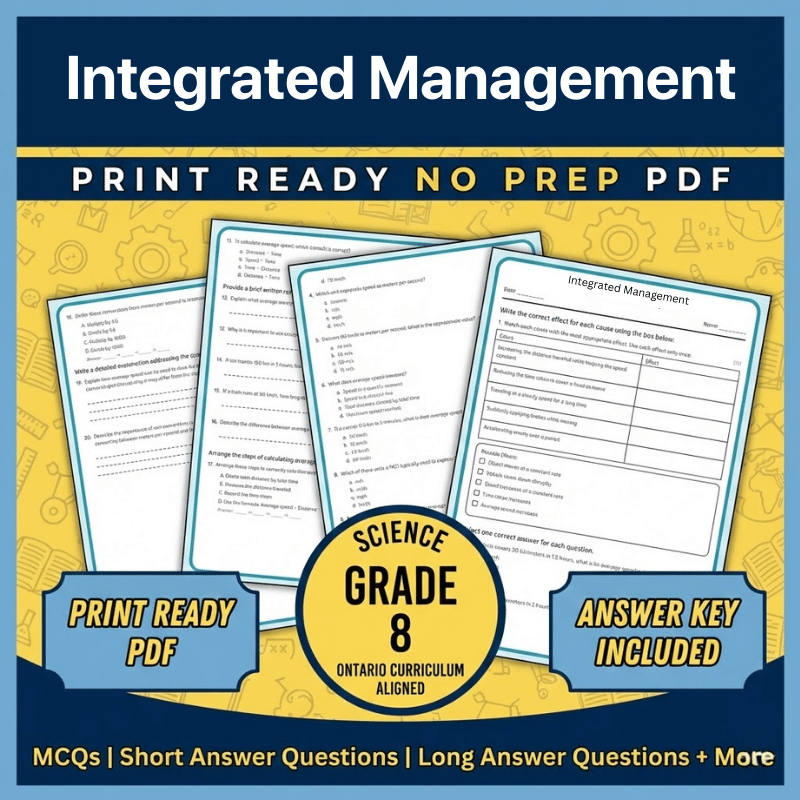
Grade 8 Science | Integrated Management Worksheet (Ontario) (PDF)
Created byBright Mind ResourcesLearning Objectives
- Understand the concept of integrated water resources management and its components.
- Identify governance instruments and strategies used in water management.
- Explain how scientific understanding informs policy decisions in water resource management.
Instant download
About Grade 8 Science Worksheets
Explore Grade 8 Science worksheets for classwork, homework, or review. Our 6,006 printables download instantly as PDFs.
Each resource here is built by an independent educator and reviewed for quality. Worksheets print straight from PDF and suit classroom use, homework, or extra practice; most come with answer keys, and you can preview before purchasing.