
Grade 8 Science Worksheets
6,006 worksheets
Speed as Scalar Magnitude Worksheet | Grade 8 Alberta Science Activity
 Created byBRIGHT PATH RESOURCES
Learning Objectives
- Define speed as the scalar magnitude of motion
- Distinguish speed from velocity and acceleration using a scenario
- Use distance and time to calculate and interpret speed
Also included in: Grade 8 Alberta Science Forces and Motion Physics Worksheet Bundle +1 more
Instant download

Grade 8 Voltage and Current Worksheet | Electricity Alberta Science
Created byBRIGHT PATH RESOURCESLearning Objectives
- Explain the relationship between voltage and electric current
- Define current, resistance, and the role of electric potential
- Use key vocabulary from a science passage to answer questions
Also included in: Grade 8 Alberta Science Electricity and Magnetism Worksheet Bundle +1 more
Instant download

Grade 8 Chemical Reactions Temperature Change Worksheet | Alberta Science
Created byBRIGHT PATH RESOURCESLearning Objectives
- Identify how temperature changes can signal a chemical reaction.
- Use cause-and-effect reasoning to match evidence to chemical change.
- Explain why multiple reaction indicators can strengthen conclusions.
Also included in: Grade 8 Alberta Science Matter and Chemical Change Worksheet Bundle +1 more
Instant download

Matter Conservation in Closed Systems Worksheet | Grade 8 Alberta Science
Created byBRIGHT PATH RESOURCESLearning Objectives
- Define a closed system in terms of matter exchange
- Identify examples of what can change and what stays the same in a closed system
- Use mass conservation ideas to interpret reactants and products in a contained process
Also included in: Grade 8 Alberta Science Matter and Chemical Change Worksheet Bundle +1 more
Instant download

Grade 8 Voltage as Electric Potential Difference Worksheet | Alberta
Created byBRIGHT PATH RESOURCESLearning Objectives
- Define voltage as electric potential difference and relate it to energy per unit charge.
- Explain how voltage influences electric current using the ideas of energy, charge, and resistance.
- Identify common voltage sources and understand the role of reference points in circuit analysis.
Also included in: Grade 8 Alberta Science Electricity and Magnetism Worksheet Bundle +1 more
Instant download

Grade 8 Energy Efficiency in Food Chains Worksheet | Alberta Science
Created byBRIGHT PATH RESOURCESLearning Objectives
- Describe how energy is transferred between trophic levels in a food chain
- Use typical efficiency ranges to explain why less energy reaches higher trophic levels
- Connect energy availability to population size and ecosystem biomass patterns
Also included in: Grade 8 Alberta Science Interactions and Ecosystems Worksheet Bundle +1 more
Instant download

Newton’s First Law and Inertia Worksheet | Grade 8 TEKS Science
Created byBRIGHT PATH RESOURCESLearning Objectives
- Explain inertia using Newton’s First Law
- Identify evidence of inertia in everyday situations
- Describe how forces change motion in terms of net force and acceleration
Also included in: Grade 8 Force Motion and Energy Science Reading Worksheets Bundle | TEKS +1 more
Instant download

Centripetal Force and Direction Change Worksheet | Grade 8 Alberta Science
Created byBRIGHT PATH RESOURCESLearning Objectives
- Identify the main idea of how circular motion changes direction
- Explain how centripetal force, radius, and mass relate to the needed inward force
- Describe what happens when inward force is not sufficient for a curve
Also included in: Grade 8 Alberta Science Forces and Motion Physics Worksheet Bundle +1 more
Instant download

Grade 8 Biomedical Flow Worksheet | Ontario Science + Doodle Notes
 Created byChalk and Compass
Learning Objectives
- Explain how fluid mechanics ideas (viscosity, vessel diameter, pressure gradient) connect to blood flow and resistance.
- Describe how non-Newtonian blood behavior can affect perfusion in small vessels.
- Use simplified pipe-flow relationships to estimate how pressure drop and volumetric flow respond to changes in vessel diameter and stenosis.
Also included in: Fluids, Pressure & Flow Lesson Bundle — Grade 8 Science Ontario +1 more
Instant download

Grade 8 Climate Circulation Worksheet | NGSS Atmosphere & Global Winds
 Created byAmber Owl Education
Learning Objectives
- Explain how unequal solar heating and Earth’s rotation help drive atmospheric circulation patterns (Hadley, Ferrel, and polar cells).
- Describe how the Coriolis effect influences wind direction and contributes to trade winds, monsoons, and other regional weather patterns.
- Connect major ocean circulation (gyres and thermohaline circulation) to regional climates and multi-year variability such as El Niño–Southern Oscillation.
Also included in: Grade 8 Science Earth Systems & Weather Patterns Lesson Bundle: NGSS +1 more
Instant download
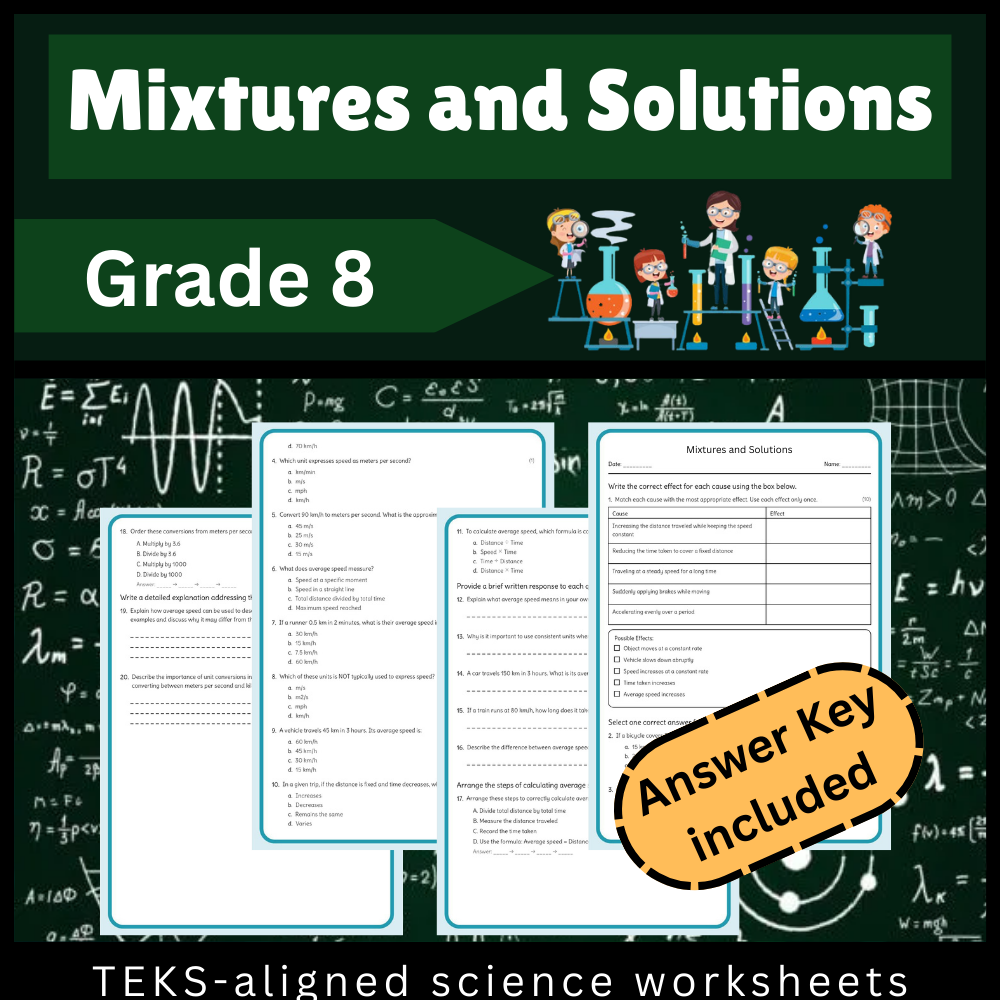
Grade 8 Science | Mixtures and Solutions Worksheet (Answer Key) PDF
 Created byBright Mind Resources
Learning Objectives
- Identify different types of mixtures as heterogeneous or homogeneous.
- Explain how solutions are formed and the concept of saturation and solubility.
- Describe common methods for separating mixtures such as filtration, evaporation, and distillation.
Also included in: Grade 8 Science Unit Bundle | States of Matter & Reaction Rates Worksheets- TEKS +1 more
Instant download

Grade 8 Science – Energy Foundations in Ecosystems | Daily Reading Worksheet
Created byBright Mind ResourcesLearning Objectives
- Understand primary sources of energy in ecosystems such as sunlight and chemical energy
- Describe how energy moves through different levels of the food web
- Explain the role of decomposers and detritivores in energy transfer
Also included in: Grade 8 Ecosystems Science Daily Reading Worksheets Lesson Bundle | Alberta +2 more
Instant download

Grade 8 Science – Population Patterns & Ecosystem Dynamics | Reading Worksheet
Created byBright Mind ResourcesLearning Objectives
- Identify different types of population growth curves
- Understand the factors influencing population dynamics
- Recognize real-world examples of population fluctuations
Also included in: Grade 8 Ecosystems Science Daily Reading Worksheets Lesson Bundle | Alberta +2 more
Instant download

Grade 8 Science – Electric Charge & Electricity | Daily Reading Worksheet
Created byBright Mind ResourcesLearning Objectives
- Understand what electric charge is and its basic properties.
- Differentiate between static electricity and current electricity.
- Identify examples of static electricity in everyday life.
Also included in: Grade 8 Electricity Science Daily Reading Worksheets Lesson Bundle | Alberta +2 more
Instant download

Grade 8 Science – Free-Body Diagrams & Forces | Daily Reading Worksheet
Created byBright Mind ResourcesLearning Objectives
- Identify different forces acting on an object in various scenarios
- Understand how to represent forces using vectors in free-body diagrams
- Analyze how forces influence the motion of objects
Also included in: Grade 8 Science Systems Forces Daily Reading Worksheets Lesson Bundle | Alberta +2 more
Instant download

Grade 8 Science – Aerodynamic Drag & Air Resistance | Daily Reading Worksheet
Created byBright Mind ResourcesLearning Objectives
- Define aerodynamic drag and explain its effects on moving objects.
- Identify factors that influence air resistance such as shape, area, and flow conditions.
- Describe real-world applications where reducing or increasing drag is important.
Also included in: Grade 8 Science Systems Forces Daily Reading Worksheets Lesson Bundle | Alberta +2 more
Instant download

Grade 8 Science – Friction & Surface Texture Daily Reading Worksheet
Created byBright Mind ResourcesLearning Objectives
- Define static and kinetic friction
- Identify real-world examples of friction
- Explain how surface texture and materials affect friction
Also included in: Grade 8 Science Systems Forces Daily Reading Worksheets Lesson Bundle | Alberta +2 more
Instant download

Grade 8 Science – Series & Parallel Circuits | Daily Reading Worksheet
Created byBright Mind ResourcesLearning Objectives
- Understand the differences between series and parallel circuit arrangements.
- Identify components connected in series versus parallel.
- Predict the behavior of circuits based on their configuration.
Also included in: Grade 8 Electricity Science Daily Reading Worksheets Lesson Bundle | Alberta +2 more
Instant download

Organ Systems and Homeostasis Worksheet | Grade 8 NGSS Science
 Created byNorthstar Worksheets
Learning Objectives
- Explain how multiple organ systems work together to maintain homeostasis.
- Describe feedback mechanisms and how they help keep internal conditions stable.
- Use key vocabulary from circulatory, respiratory, digestive, nervous, and endocrine systems.
Instant download

Weather Patterns Air Masses and Pressure Worksheet | Grade 8 NGSS
Created byNorthstar WorksheetsLearning Objectives
- Explain how air mass movement and pressure changes relate to weather conditions such as wind, temperature, humidity, and precipitation.
- Describe how fronts and cyclones form and how frontogenesis and cyclogenesis affect observable weather patterns.
- Use observational tools (surface pressure maps, temperature gradients, radiosonde profiles, and Doppler radar) to support interpretations of weather events.
Instant download

Grade 8 Science – Power & Efficiency in Electrical Devices | Reading Worksheet
Created byBright Mind ResourcesLearning Objectives
- Understand the concept of power as energy transfer per unit time
- Identify factors affecting the efficiency of electrical devices
- Analyze how energy loss mechanisms impact device performance
Also included in: Grade 8 Electricity Science Daily Reading Worksheets Lesson Bundle | Alberta +2 more
Instant download

Grade 8 Science – Population Effects on Earth Systems | Daily Reading Worksheet
Created byBright Mind ResourcesLearning Objectives
- Understand how population growth influences resource consumption
- Analyze links between demographic changes and environment
- Evaluate evidence of human impact on climate, land, and water
Also included in: Geoscience Grade 8 Science Daily Reading Worksheets Lesson Bundle | NGSS +1 more
Instant download

Grade 8 Science – Understanding Momentum & Collisions | Daily Reading Worksheet
Created byBright Mind ResourcesLearning Objectives
- Define momentum and explain its significance in physics.
- Differentiate between elastic and inelastic collisions.
- Describe how momentum changes before and after a collision.
Also included in: Physical Science Grade 8 Science Daily Reading Worksheets Lesson Bundle | NGSS +1 more
Instant download

Grade 8 Science – Material Origins & Synthetic Materials | Reading Worksheet
Created byBright Mind ResourcesLearning Objectives
- Understand how petroleum is processed into plastics
- Recognize the steps involved in transforming raw materials into finished products
- Identify the importance of molecular structure in determining material properties
Also included in: Particle Motion Grade 8 Science Daily Reading Worksheets Lesson Bundle | NGSS +1 more
Instant download

Grade 8 Science – Problem Definition in Engineering | Daily Reading Worksheet
Created byBright Mind ResourcesLearning Objectives
- Define criteria and constraints for engineering problems.
- Identify measurable performance goals, safety requirements, and environmental conditions.
- Analyze trade-offs in problem scenarios such as cost, durability, and time.
Also included in: Grade 8 Tradeoff Analysis Science Daily Reading Worksheets Lesson Bundle | NGSS +1 more
Instant download

Grade 8 Science – Understanding the Particle Model | Daily Reading Worksheet
Created byBright Mind ResourcesLearning Objectives
- Explain the basic concepts of the particle model of matter.
- Describe how particles behave in different states of matter.
- Relate particle motion and spacing to properties like compressibility and diffusion.
Also included in: Grade 8 States of Matter Science Daily Reading Lesson Bundle | FL-NGSSS +1 more
Instant download

Grade 8 Science – Reaction Rates & Factors | Daily Reading Worksheet
Created byBright Mind ResourcesLearning Objectives
- Understand the concept of reaction rate and its importance in chemistry
- Identify factors that affect the speed of chemical reactions
- Explain how molecular collisions influence reaction speed
Also included in: Grade 8 Energy Transfer & Heat Transfer Science Lesson Bundle | TEKS Daily +2 more
Instant download

Grade 8 Science – Solar System Feature Evidence | Daily Reading Worksheet
Created byBright Mind ResourcesLearning Objectives
- Identify different surface features on planets and moons.
- Understand how surface features provide clues about planetary history.
- Analyze evidence related to planetary differentiation, impacts, and geological activity.
Also included in: Earth & Space Grade 8 Science Daily Reading Worksheets Lesson Bundle | General +1 more
Instant download

Grade 8 Science – Biodiversity & Conservation | Daily Reading Worksheet
Created byBright Mind ResourcesLearning Objectives
- Understand the concept of biodiversity and its importance in ecosystems.
- Identify different levels of biodiversity: genetic, species, and ecosystem.
- Recognize basic conservation strategies and challenges.
Also included in: Grade 8 Ecosystems & Cells Science Daily Reading Lesson Bundle | TEKS +2 more
Instant download

Grade 8 Science – Understanding Mixtures & Solutions | Daily Reading Worksheet
Created byBright Mind ResourcesLearning Objectives
- Define and distinguish between heterogeneous and homogeneous mixtures.
- Explain the process of solution formation and concepts of saturation and solubility.
- Identify common separation techniques such as filtration, evaporation, and distillation.
Also included in: Grade 8 Energy Transfer & Heat Transfer Science Lesson Bundle | TEKS Daily +2 more
Instant download

Grade 8 Science – Density & Related Concepts | Daily Reading Worksheet
 Created byQuiet Forest Education
Learning Objectives
- Define density and understand its importance in science.
- Relate mass, volume, and density through numerical examples.
- Explain how density determines if an object floats or sinks in water.
Also included in: Fluid Dynamics Grade 8 Science Daily Reading Worksheets Bundle | Ontario +1 more
Instant download

Grade 8 Science – Digestive System & Functions | Daily Reading Worksheet
Created byBright Mind ResourcesLearning Objectives
- Understand the main parts of the digestive system and their functions.
- Describe how mechanical and chemical digestion work together.
- Recognize the importance of tissue specialization in digestion.
Also included in: Grade 8 Body Systems & Cell Structure Science Daily Reading Lesson Bundle | BC +1 more
Instant download

Grade 8 Science – Friction & Drag Daily Reading Worksheet | BC Standards
Created byBright Mind ResourcesLearning Objectives
- Define friction and fluid drag
- Describe how surface types affect friction
- Explain the factors that influence fluid drag
Also included in: Grade 8 Motion Forces Energy Science Daily Reading Lesson Bundle | BC +1 more
Instant download

Grade 8 Science – Energy Basics & Daily Reading Worksheet | BC Standards
Created byBright Mind ResourcesLearning Objectives
- Understand the different forms of mechanical energy, including kinetic and potential energy.
- Explain how energy transfers occur in simple systems like falling objects and swinging pendulums.
- Identify how forces such as friction and air resistance convert mechanical energy into thermal energy.
Also included in: Grade 8 Motion Forces Energy Science Daily Reading Lesson Bundle | BC +1 more
Instant download
Grade 8 Science – Gravity & Motion in Space | Daily Reading Worksheet
 Created byElena Brooks
Learning Objectives
- Understand how gravity influences the motion of celestial bodies
- Identify the role of gravity in maintaining planetary orbits
- Describe how gravitational attraction affects moons, comets, and asteroids
Instant download

Grade 8 Science – Organ Systems Survival & Respiratory System | Worksheet
Created byBright Mind ResourcesLearning Objectives
- Understand how the respiratory system exchanges gases to support life.
- Identify key organs involved in respiration activities.
- Describe the process of breathing and gas exchange in the lungs.
Also included in: Species Interactions & Ecosystems Grade 8 Reading Lesson Bundle | General +1 more
Instant download

Grade 8 Science – Energy Flow & Trophic Levels | Daily Reading Worksheet
Created byBright Mind ResourcesLearning Objectives
- Identify different trophic levels in an ecosystem.
- Understand how energy flows through food chains and webs.
- Explain why energy decreases along a food chain.
Also included in: Species Interactions & Ecosystems Grade 8 Reading Lesson Bundle | General +1 more
Instant download

Grade 8 Science – Total Energy Balance & Conservation | Daily Reading Worksheet
Created byBright Mind ResourcesLearning Objectives
- Understand the concept of energy conservation within a system.
- Identify examples of energy transfer and conversion.
- Explain how energy shifts between potential and kinetic forms.
Also included in: Grade 8 Energy, Forces & Matter Lesson Bundle - Daily Reading | Calif. Std. +1 more
Instant download

Grade 8 Science – Phase Changes & States of Matter | Daily Reading Worksheet
Created byBright Mind ResourcesLearning Objectives
- Understand what happens during melting, freezing, evaporation, and condensation.
- Identify energy transfer during phase changes.
- Recognize real-world examples of phase changes.
Also included in: Grade 8 States of Matter Science Daily Reading Lesson Bundle | FL-NGSSS +1 more
Instant download

Grade 8 Science – Blood Flow & Circulatory System | Daily Reading Worksheet
Created byQuiet Forest EducationLearning Objectives
- Identify key factors affecting blood flow in vessels
- Explain how vessel properties influence perfusion
- Describe the effects of narrowing (stenosis) on blood pressure and flow
Also included in: Fluid Dynamics Grade 8 Science Daily Reading Worksheets Bundle | Ontario +1 more
Instant download

Grade 8 Science – Simple Lever & Machines | Daily Reading Worksheet
Created byBright Mind ResourcesLearning Objectives
- Identify the parts of a lever and describe its function
- Understand how a lever makes work easier by changing force and distance
- Analyze real-life examples of levers in everyday objects
Also included in: Grade 8 Energy & Motion Science Daily Reading Worksheets Lesson Bundle | TEKS +2 more
Instant download

Grade 8 Science – Forces & Motion | Daily Reading Worksheet
Created byBright Mind ResourcesLearning Objectives
- Understand the definition of force and its characteristics.
- Identify different types of forces such as push, pull, gravity, and friction.
- Explain how forces affect the motion of objects.
Also included in: Reaction Evidence & Matter Grade 8 Science Lesson Bundle | General Framework +1 more
Instant download
Grade 8 Science – Fossil Evidence & Ancestry Patterns | Daily Reading Worksheet
Created byElena BrooksLearning Objectives
- Understand key concepts related to Science
- Apply knowledge through practice questions
- Demonstrate comprehension of the material
Instant download

Grade 8 Science – Energy Pathways in Mechanical Systems | Daily Worksheet
Created byQuiet Forest EducationLearning Objectives
- Understand how energy is transferred through gear, pulley, and hydraulic systems
- Identify points of energy conversion and losses in mechanical systems
- Apply concepts of energy transfer to real-world examples such as motors and pumps
Also included in: Energy Grade 8 Science Daily Reading Worksheets Bundle | Ontario Framework +1 more
Instant download
Grade 8 Science – Scale & Patterns in the Solar System | Daily Reading Worksheet
Created byElena BrooksLearning Objectives
- Interpret planetary diameters and compare their sizes relative to the Sun
- Understand the use of astronomical units in measuring distances
- Identify patterns and relationships among solar system objects based on data
Instant download

Grade 8 Science – Abiotic Influences on Ecosystems | Daily Reading Worksheet
Created byBright Mind ResourcesLearning Objectives
- Understand how light and temperature affect plant and animal life.
- Identify various abiotic factors that influence ecosystems.
- Explain how changes in abiotic conditions can alter community composition.
Also included in: Grade 8 Ecosystems Daily Reading Worksheets Lesson Bundle | BC +1 more
Instant download

Grade 8 Science – Plate Motions & Landforms | Daily Reading Worksheet
Created byElena BrooksLearning Objectives
- Identify different types of plate boundaries and their characteristics.
- Understand mechanisms involved in plate tectonics such as subduction, rifting, and continental collision.
- Recognize landforms created by plate movements, including mountains, ocean basins, and volcanic arcs.
Instant download

Grade 8 Science – Population Growth & Factors | Daily Reading Worksheet
Created byBright Mind ResourcesLearning Objectives
- Understand the basic concepts of population change, including birth rates, death rates, immigration, and emigration.
- Identify patterns of population increase, stability, and decline.
- Learn how reproductive strategies, age structure, and resource availability influence population dynamics.
Also included in: Grade 8 Ecosystems Daily Reading Worksheets Lesson Bundle | BC +1 more
Instant download
About Grade 8 Science Worksheets
Explore Grade 8 Science worksheets for classwork, homework, or review. Our 6,006 printables download instantly as PDFs.
Each resource here is built by an independent educator and reviewed for quality. Worksheets print straight from PDF and suit classroom use, homework, or extra practice; most come with answer keys, and you can preview before purchasing.