
Grade 8 Science Worksheets
6,006 worksheets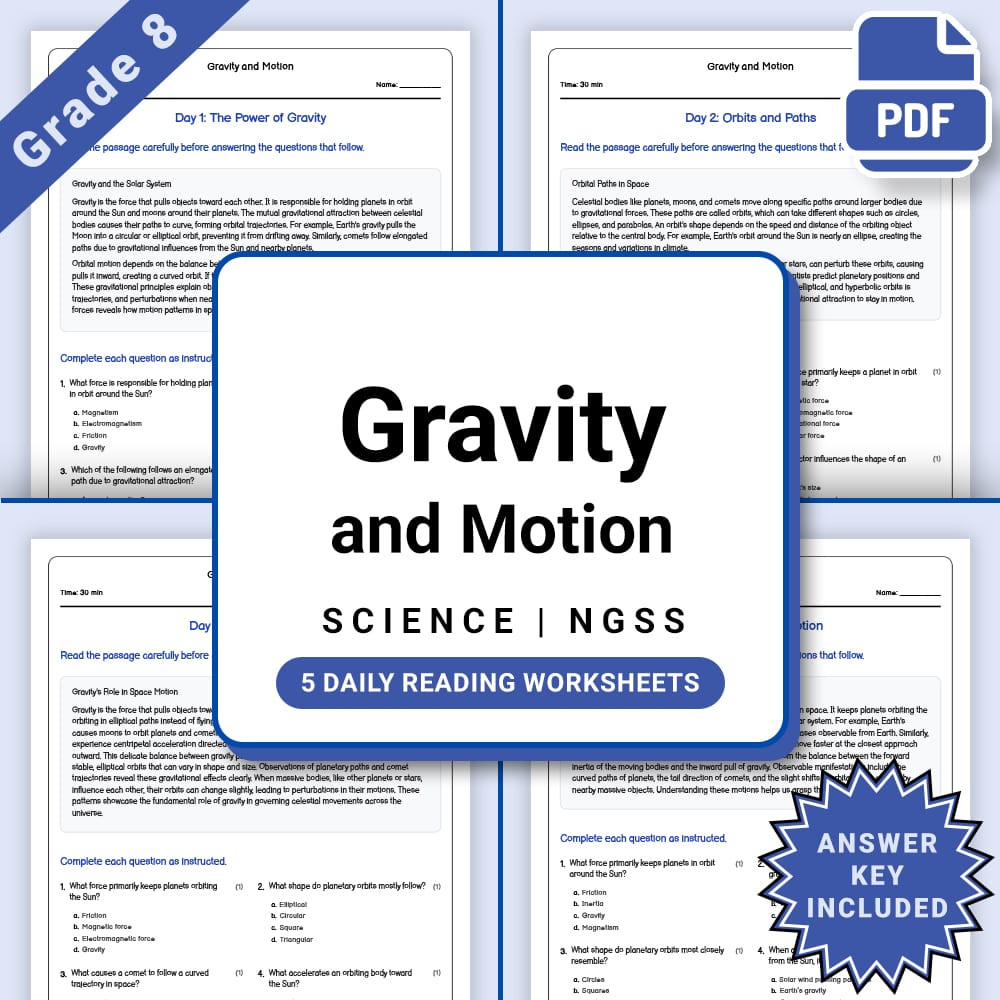
Grade 8 Science – Gravity and Motion Worksheet(PDF + Answer Key)
 Created byCopper Leaf Classroom
Learning Objectives
- Understand how gravity influences the motion of objects in space.
- Identify orbital paths of planets, moons, comets, and asteroids.
- Explain the mutual gravitational attraction between celestial bodies.
Instant download
Grade 8 Science | Biomedical Flow Worksheet (Ontario Standards) (PDF)
 Created byBright Mind Resources
Learning Objectives
- Explain how fluid mechanics principles apply to blood transport in the circulatory system.
- Describe the effects of non-Newtonian blood properties on perfusion and flow resistance.
- Relate systolic and diastolic pressures to arterial function and health.
Instant download
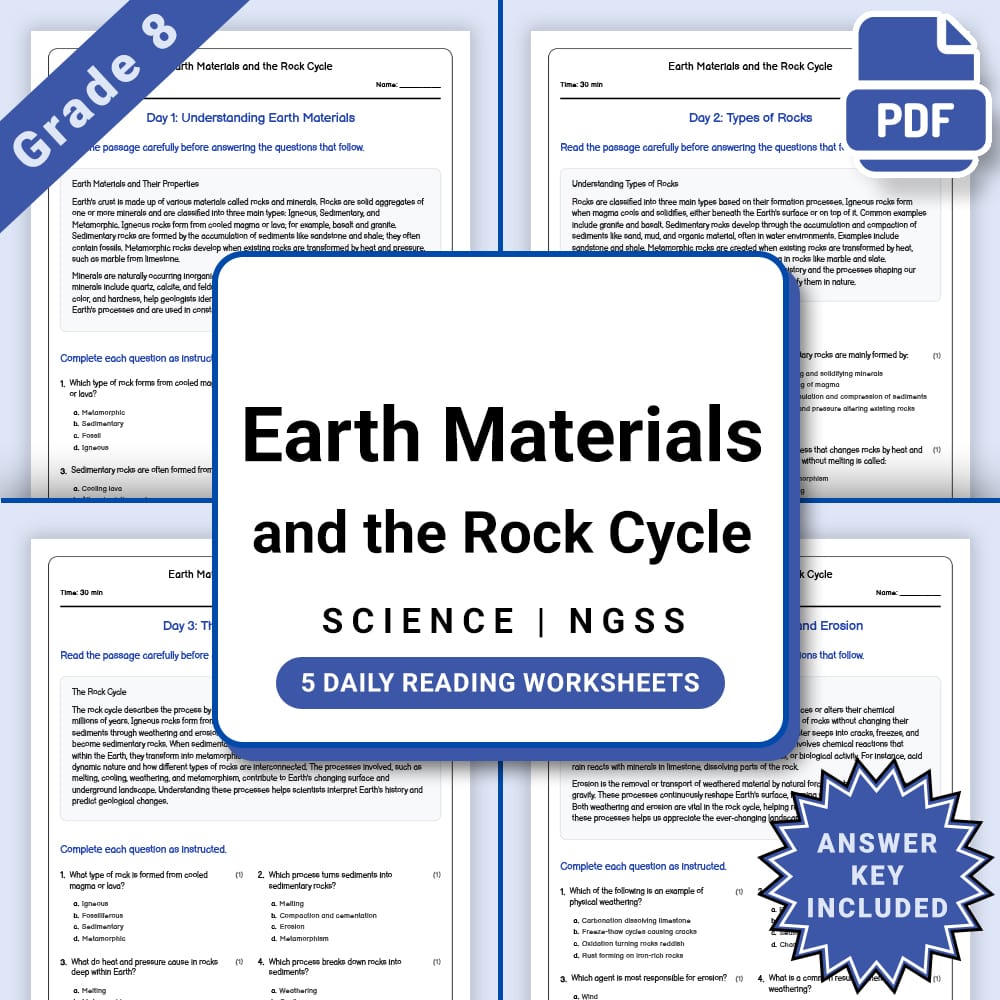
Grade 8 Science – Earth Materials and the Rock Cycle Worksheet(PDF + Answer Key)
Created byCopper Leaf ClassroomLearning Objectives
- Identify different types of Earth materials
- Understand properties of rocks and minerals
- Describe the processes of the rock cycle
Instant download
Grade 8 Science – Membrane Structure Worksheet (Ontario) (PDF)
Created byBright Mind ResourcesLearning Objectives
- Describe the components and architecture of cell membranes, including the phospholipid bilayer, proteins, cholesterol, and carbohydrates.
- Explain the functions of membrane proteins in transport, signaling, and structural support.
- Compare structural variations in membranes among different cell types, such as plant cells and specialized animal cells, and how these influence permeability and interactions with the environment.
Instant download
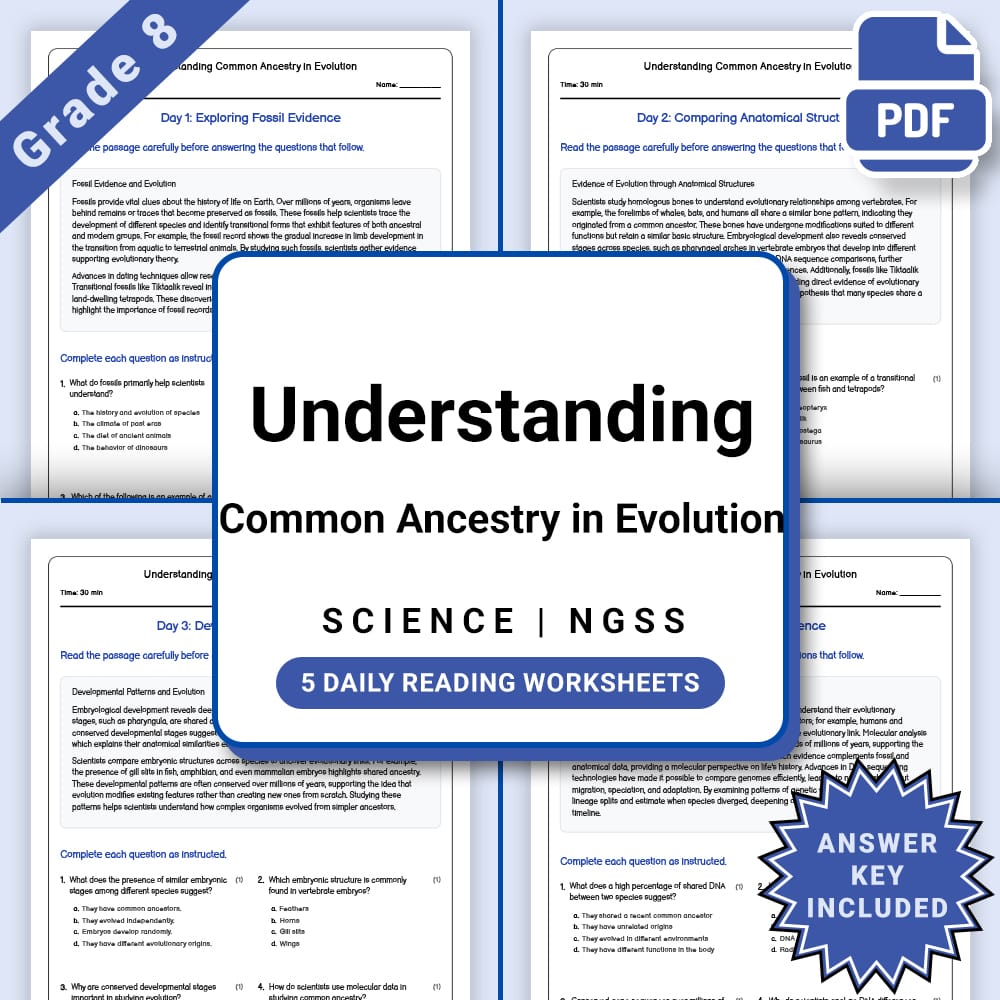
Grade 8 Science – Understanding Common Ancestry in Evolution (PDF + Answer Key)
Created byCopper Leaf ClassroomLearning Objectives
- Analyze fossil records to identify transitional species
- Recognize homologous structures across different vertebrates
- Interpret molecular data to infer shared ancestry
Instant download
Grade 8 Science | Global Distribution Worksheet (Ontario Standards) (PDF)
Created byBright Mind ResourcesLearning Objectives
- Understand the proportions and distribution of freshwater and saline reservoirs around the world.
- Identify spatial patterns related to climate, topography, and geology in water storage.
- Analyze the limitations of accessible freshwater sources and their implications for human use.
Instant download
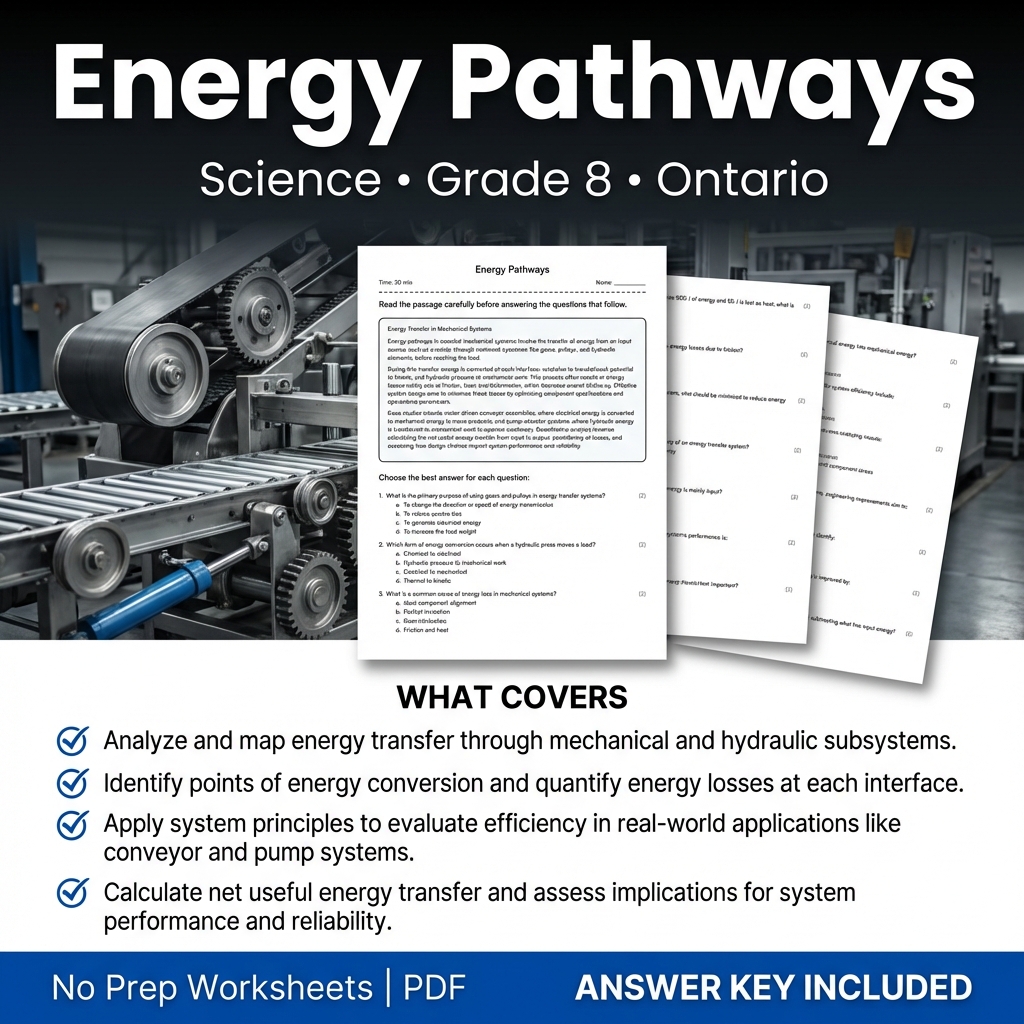
Energy Pathways Worksheet for Grade 8 Science – Ontario Standards
 Created byCoral Reef Learning
Learning Objectives
- Analyze and map energy transfer through mechanical and hydraulic subsystems.
- Identify points of energy conversion and quantify energy losses at each interface.
- Apply system principles to evaluate efficiency in real-world applications like conveyor and pump systems.
Instant download
Grade 8 Science – Surface Exchanges Worksheet (Ontario) - Science 1 (PDF)
Created byBright Mind ResourcesLearning Objectives
- Explain the mechanisms of surface water and groundwater interactions.
- Identify factors influencing exchange rates such as permeability, hydraulic gradients, and recharge zones.
- Describe how river stage and seasonal variability affect surface and groundwater exchanges.
Instant download
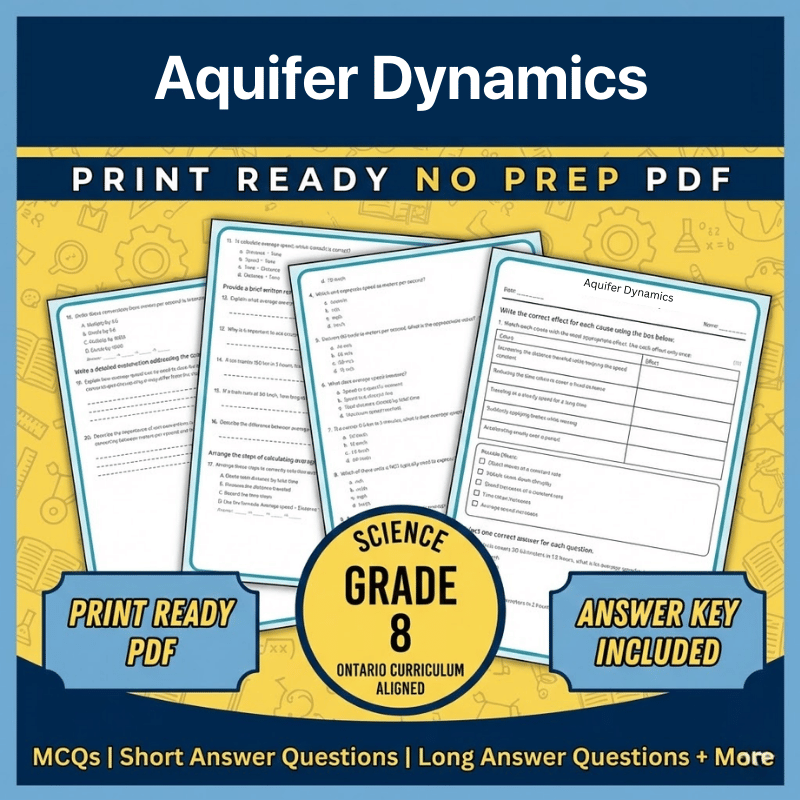
Grade 8 Science – Aquifer Dynamics Worksheet (Ontario) (PDF)
Created byBright Mind ResourcesLearning Objectives
- Understand the structure and functions of aquifers and groundwater flow systems.
- Identify key factors such as porosity, permeability, and hydraulic head that influence groundwater movement.
- Explain the concepts of confined and unconfined aquifers, recharge and discharge zones.
Instant download
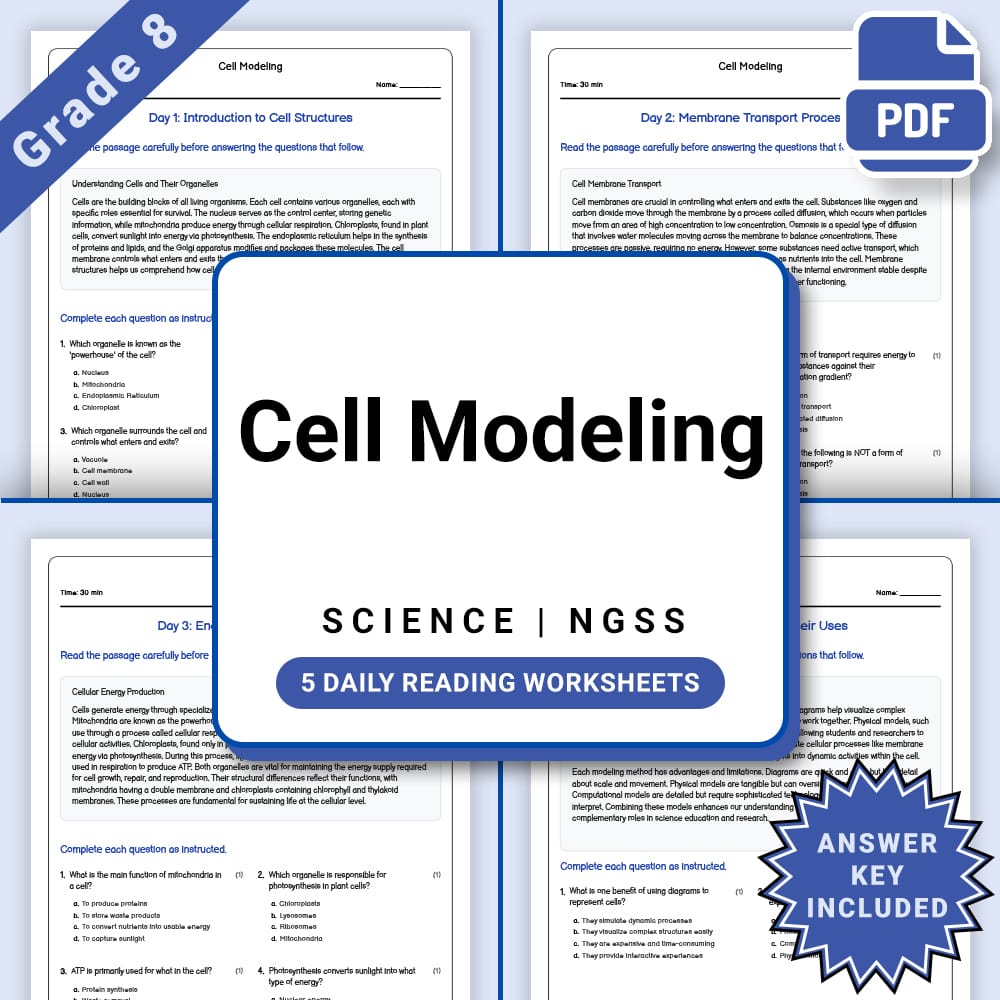
Grade 8 Science – Cell Modeling Daily Reading Worksheet(PDF + Answer Key)
Created byCopper Leaf ClassroomLearning Objectives
- Identify the main organelles in a cell
- Describe the functions of key cellular structures
- Understand how model representations illustrate cellular processes
Instant download
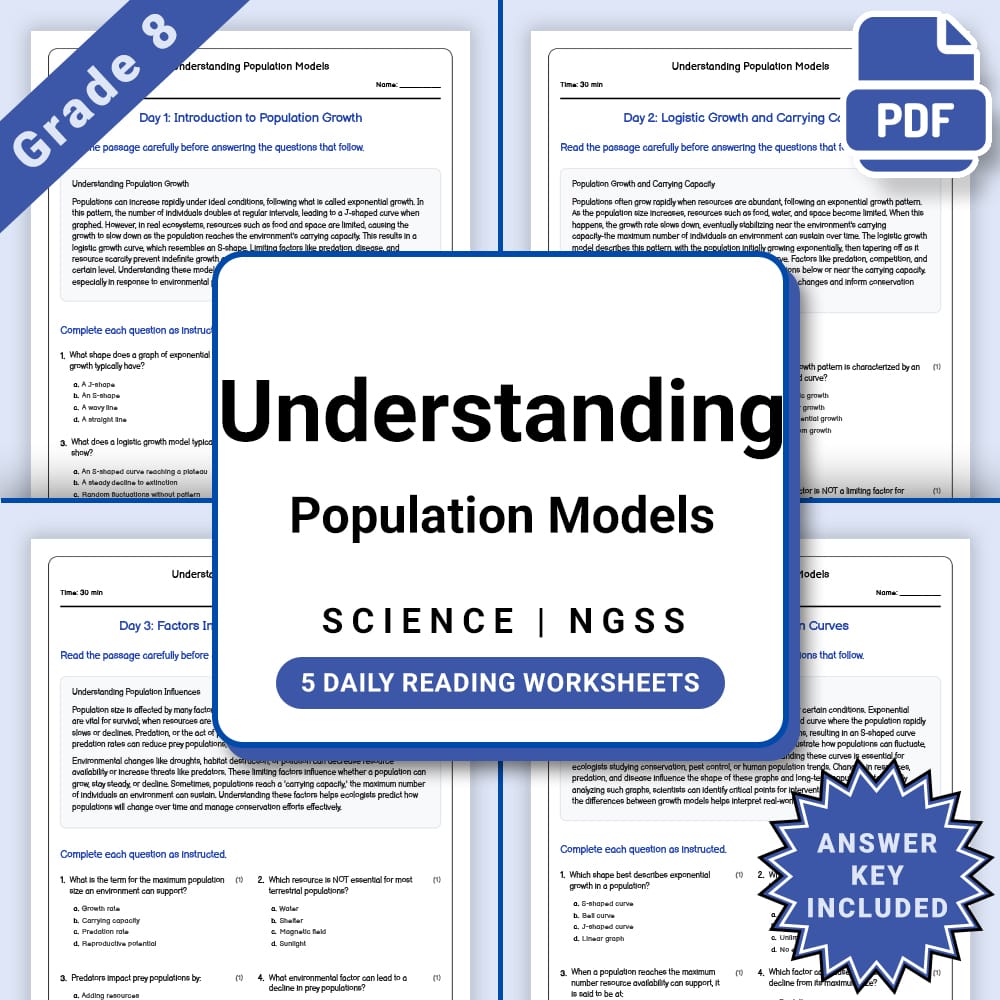
Grade 8 Science – Understanding Population Models Worksheet(PDF + Answer Key)
Created byCopper Leaf ClassroomLearning Objectives
- Recognize the basic concepts of exponential and logistic population growth
- Interpret simple graphical representations of population changes
- Identify factors that influence population size and growth limits
Instant download
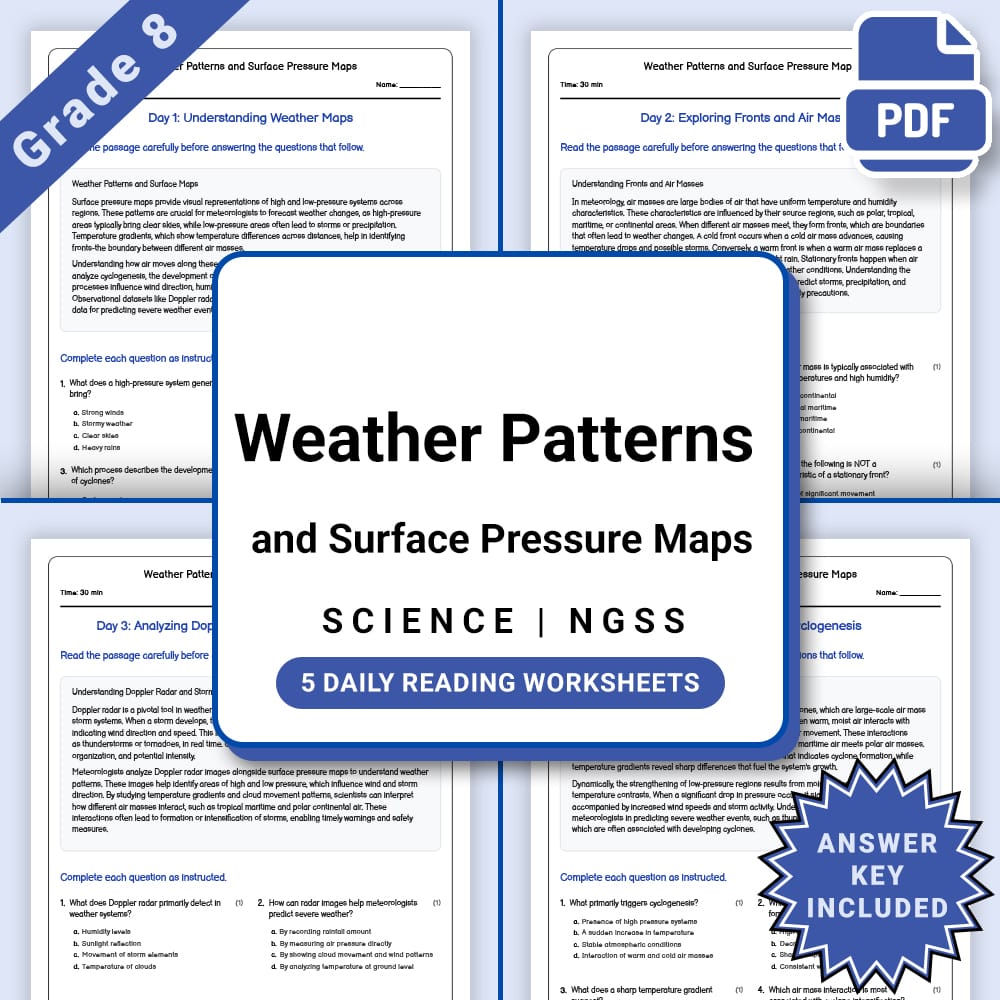
Grade 8 Science – Weather Maps and Surface Pressure Worksheet(PDF + Answer Key)
Created byCopper Leaf ClassroomLearning Objectives
- Understand how to interpret surface pressure maps and temperature gradients.
- Identify the relationship between air masses and weather changes.
- Explore the processes of frontogenesis and cyclogenesis.
Instant download

Population Effects Worksheet | NGSS Grade 8 Science Assessment
 Created byCedar Grove Learning
Learning Objectives
- Analyze how population growth influences resource consumption and Earth system changes.
- Evaluate evidence linking demographic patterns to climate change, water availability, and biodiversity.
- Interpret data trends and cause-effect relationships related to resource use and environmental impact.
Instant download
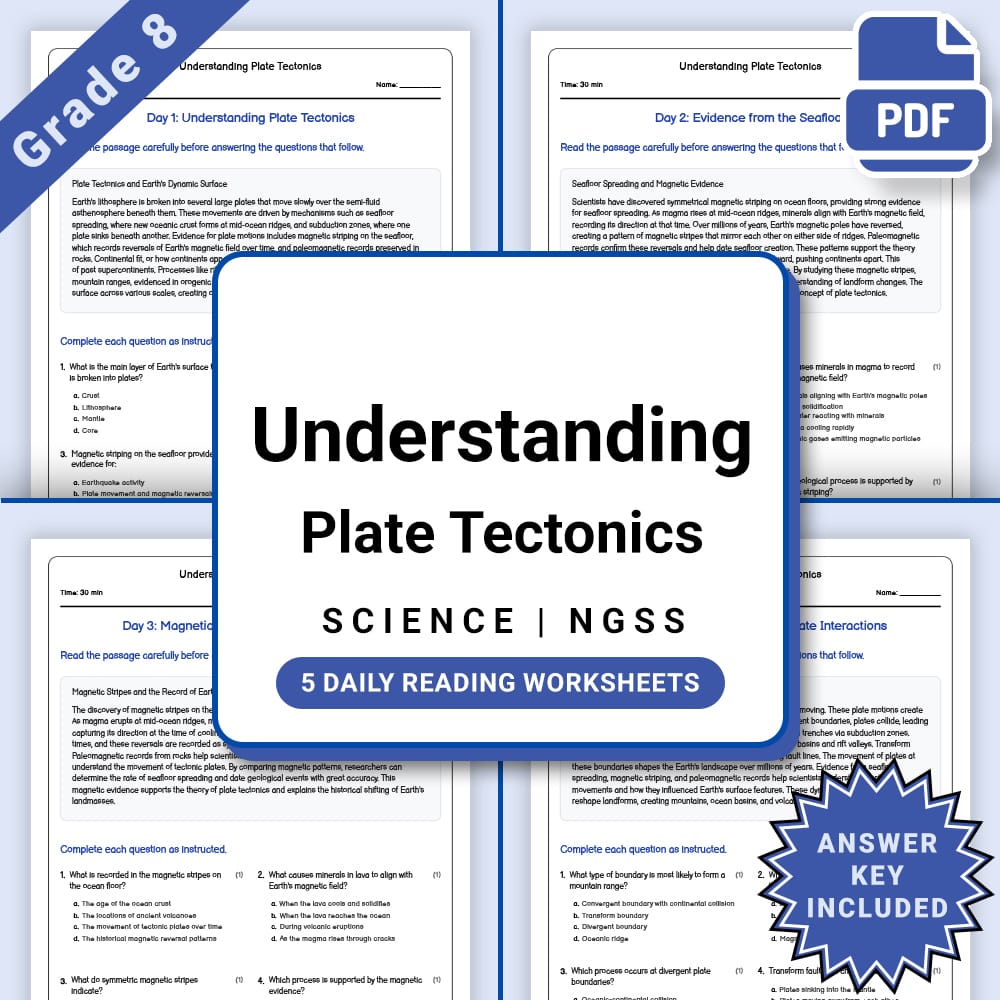
Grade 8 Science – Plate Tectonics Daily Reading Worksheet(PDF + Answer Key)
Created byCopper Leaf ClassroomLearning Objectives
- Explain the basic mechanisms of plate movements and tectonic activity.
- Identify key evidence supporting plate tectonics, such as seafloor spreading and magnetic striping.
- Describe processes like subduction, rifting, and continental collision that shape Earth's surface.
Instant download
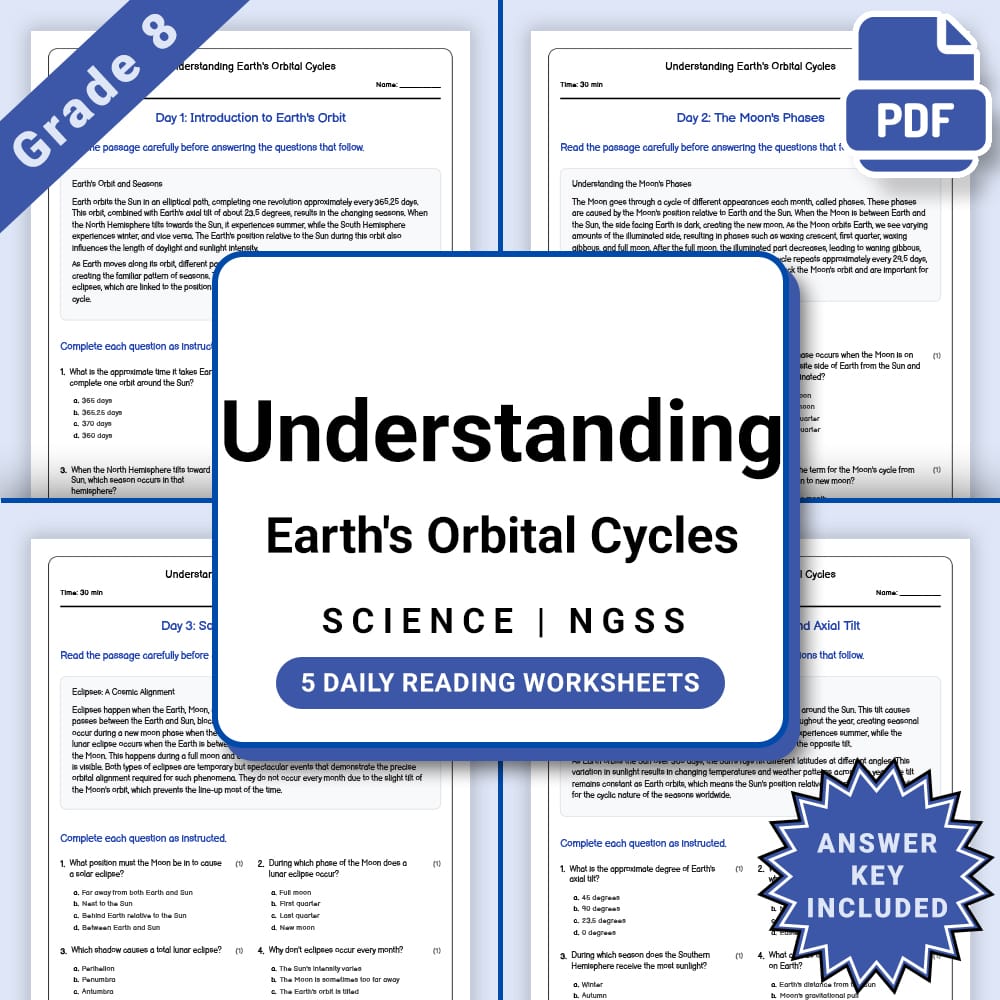
Grade 8 Science – Understanding Earth's Orbital Cycles Worksheet(PDF + Answers)
Created byCopper Leaf ClassroomLearning Objectives
- Explain the motion of Earth around the Sun and how it influences seasons.
- Identify and describe key lunar phases and related phenomena such as eclipses.
- Understand the significance of axial tilt and orbital geometry in cyclic phenomena.
Instant download
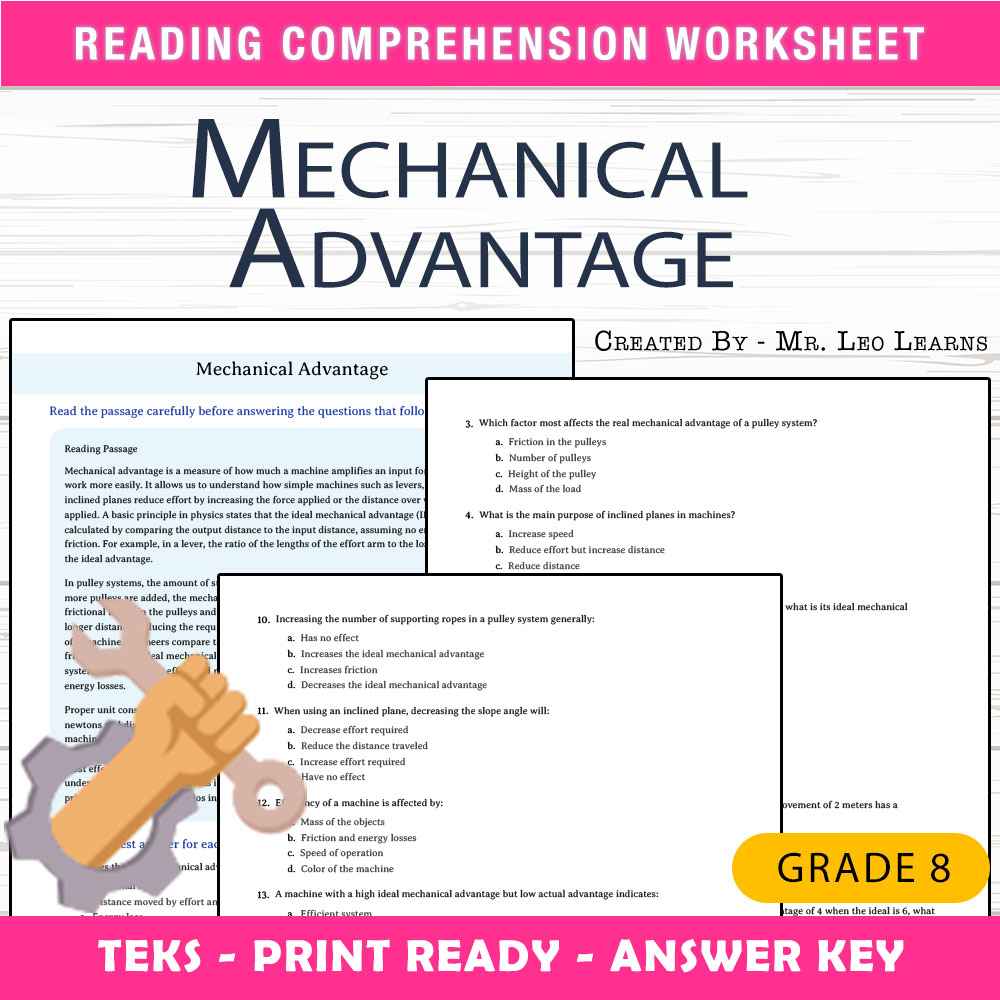
Grade 8 Science — Mechanical Advantage Worksheet for Mastery
 Created byThe Resource Hub
Learning Objectives
- Understand the concept of mechanical advantage in simple machine systems.
- Apply algebraic formulas to calculate ideal and actual mechanical advantage.
- Analyze how forces, distances, and efficiencies relate in different machine configurations.
Also included in: Grade 8 Science Unit Bundle | Motion, Forces & Energy Mastery Worksheets +1 more
Instant download
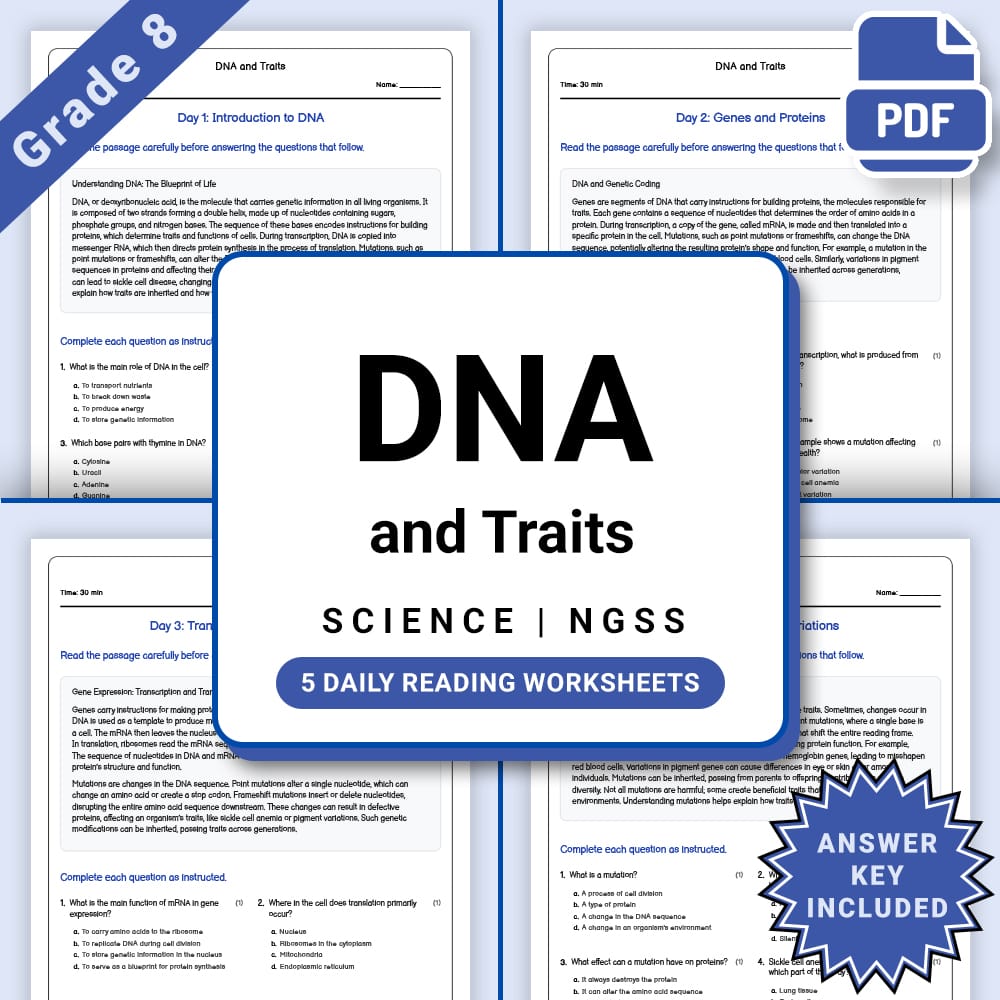
Grade 8 Science – DNA and Traits Daily Reading Worksheet(PDF + Answer Key)
Created byCopper Leaf ClassroomLearning Objectives
- Understand the basic structure and function of DNA
- Explain how DNA sequences determine traits
- Describe the processes of transcription and translation
Instant download
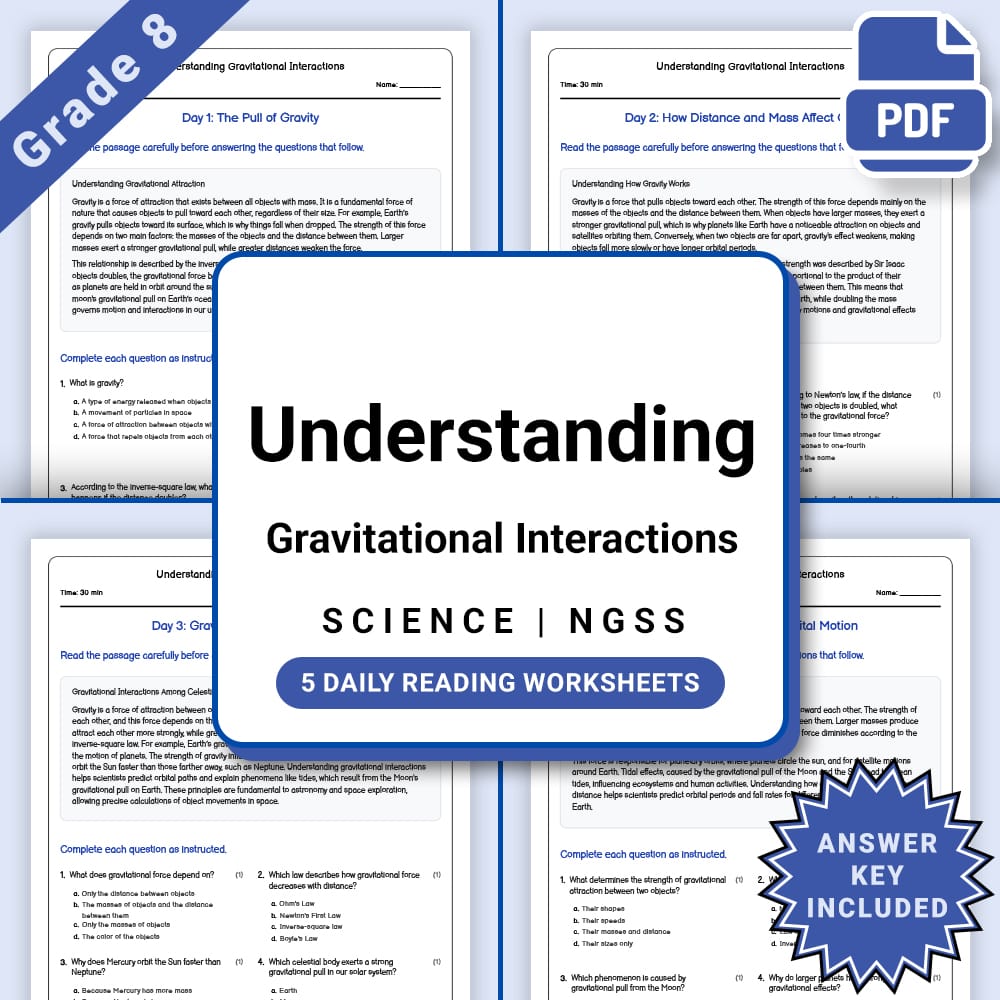
Grade 8 Science – Understanding Gravitational Interactions (PDF + Answer Key)
Created byCopper Leaf ClassroomLearning Objectives
- Explain what gravity is and how it causes objects to attract each other.
- Describe how mass and distance affect the strength of gravitational pull.
- Identify real-world examples of gravitational effects, such as planets orbiting the sun and tides in oceans.
Instant download
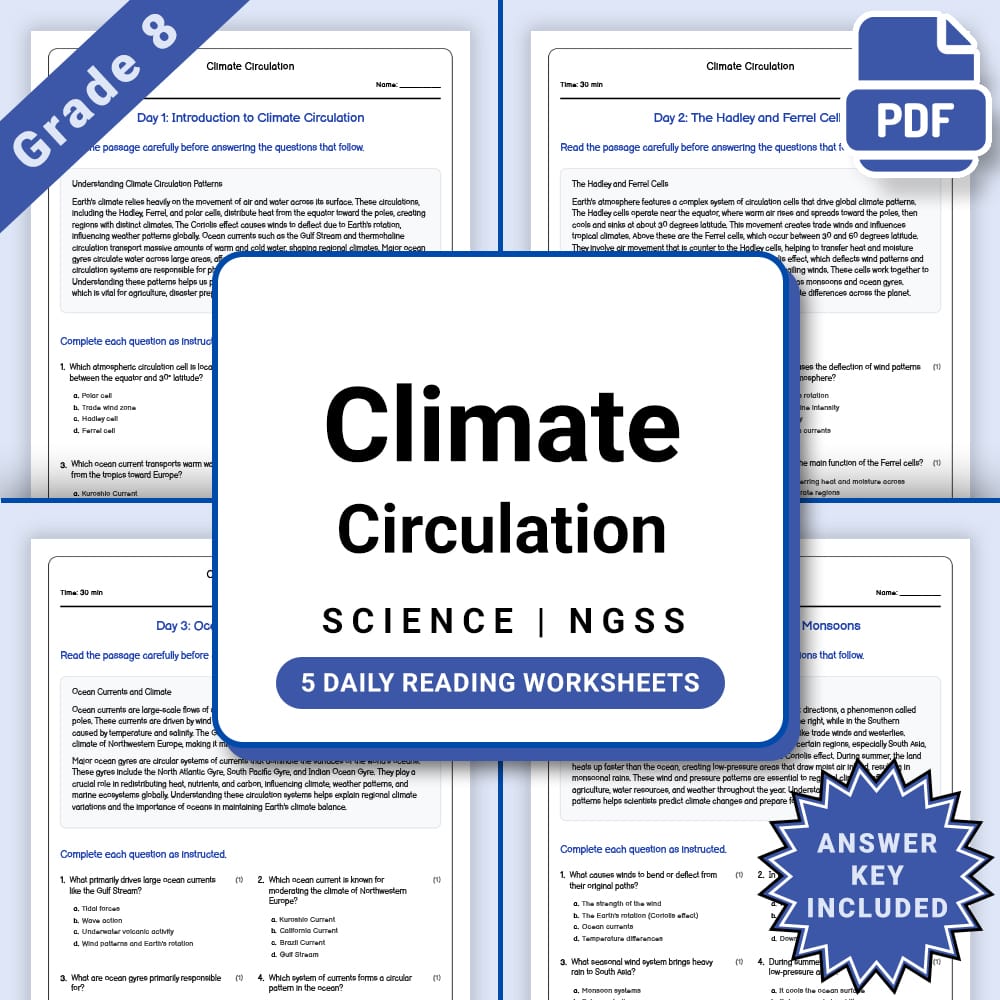
Grade 8 Science – Climate Circulation Daily Reading Worksheet(PDF + Answer Key)
Created byCopper Leaf ClassroomLearning Objectives
- Understand key concepts related to Science
- Apply knowledge through practice questions
- Demonstrate comprehension of the material
Instant download
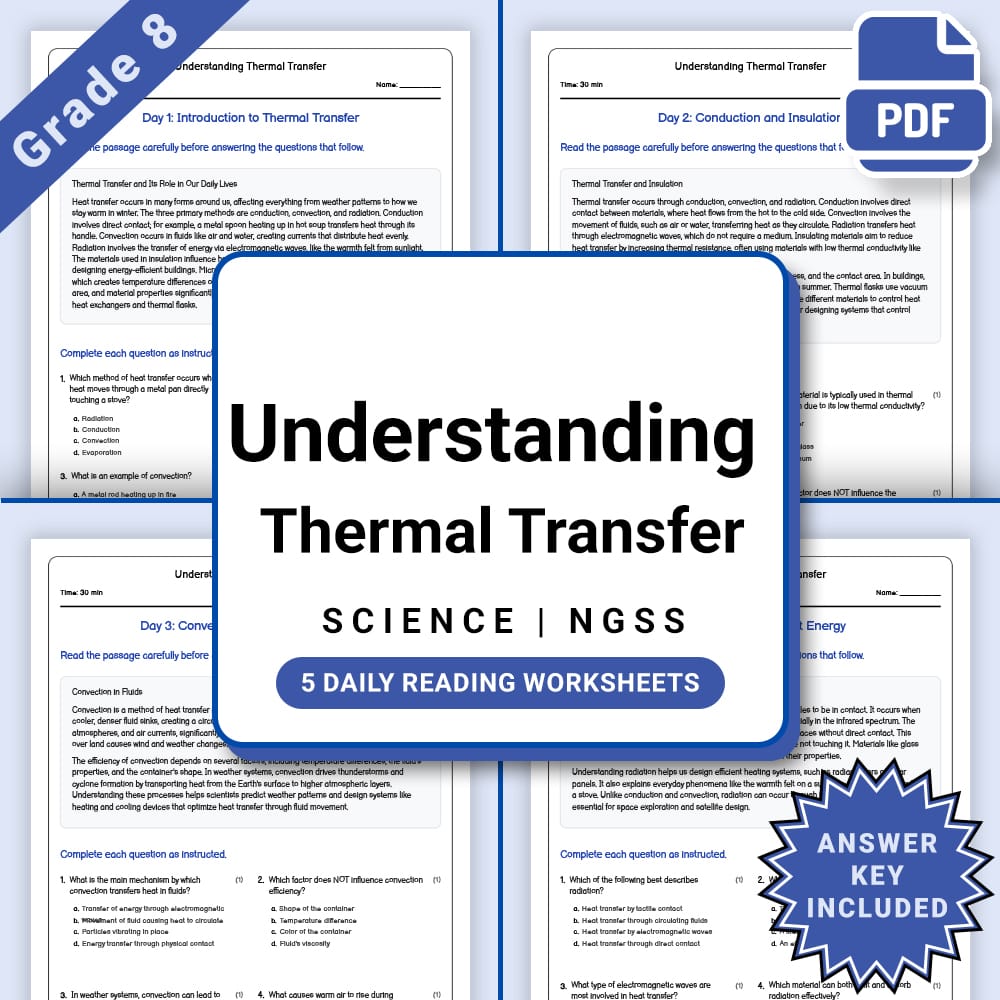
Grade 8 Science – Understanding Thermal Transfer Worksheet(PDF + Answer Key)
Created byCopper Leaf ClassroomLearning Objectives
- Identify the three main methods of heat transfer: conduction, convection, and radiation.
- Understand how material properties influence thermal energy flow.
- Recognize practical applications of insulation and heat exchangers.
Instant download
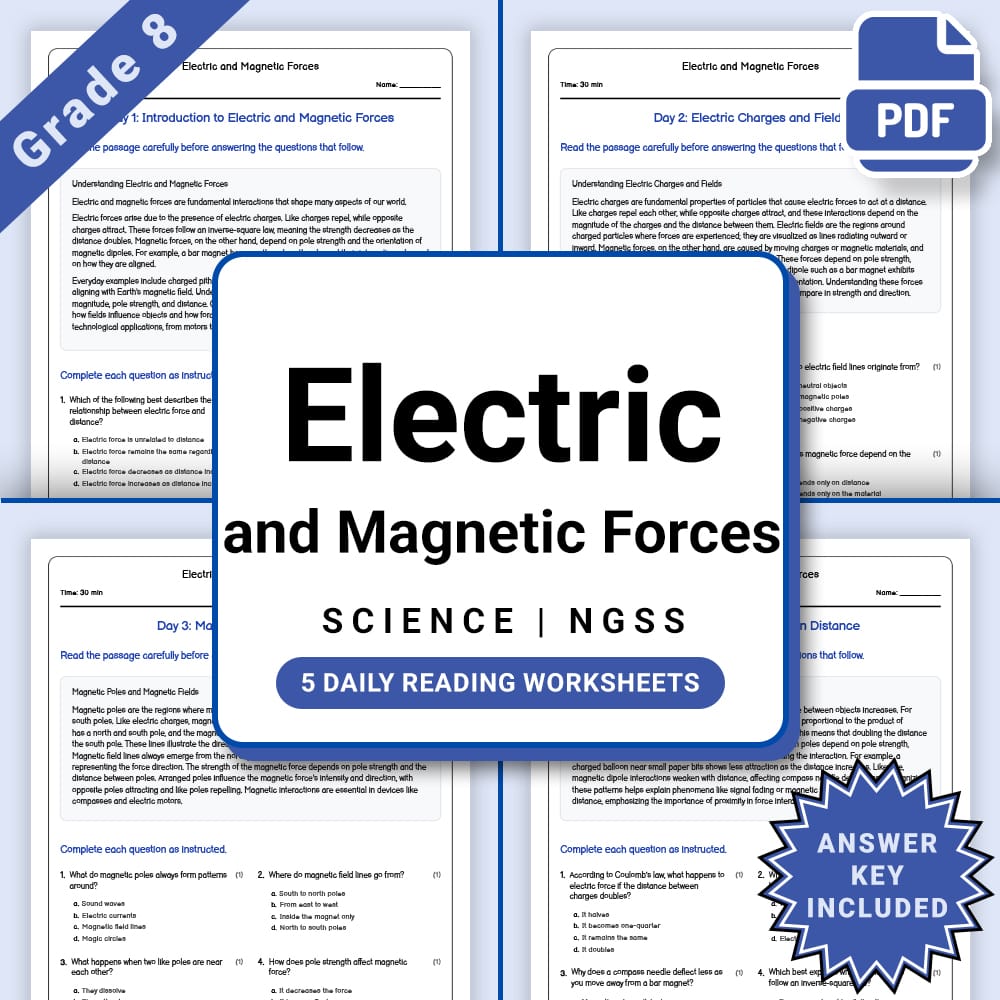
Grade 8 Science – Electric and Magnetic Forces Worksheet(PDF + Answer Key)
Created byCopper Leaf ClassroomLearning Objectives
- Understand the basic concepts of electric forces and magnetic forces.
- Compare how electric and magnetic forces interact and depend on different factors.
- Recognize examples of electric and magnetic interactions in everyday life.
Instant download
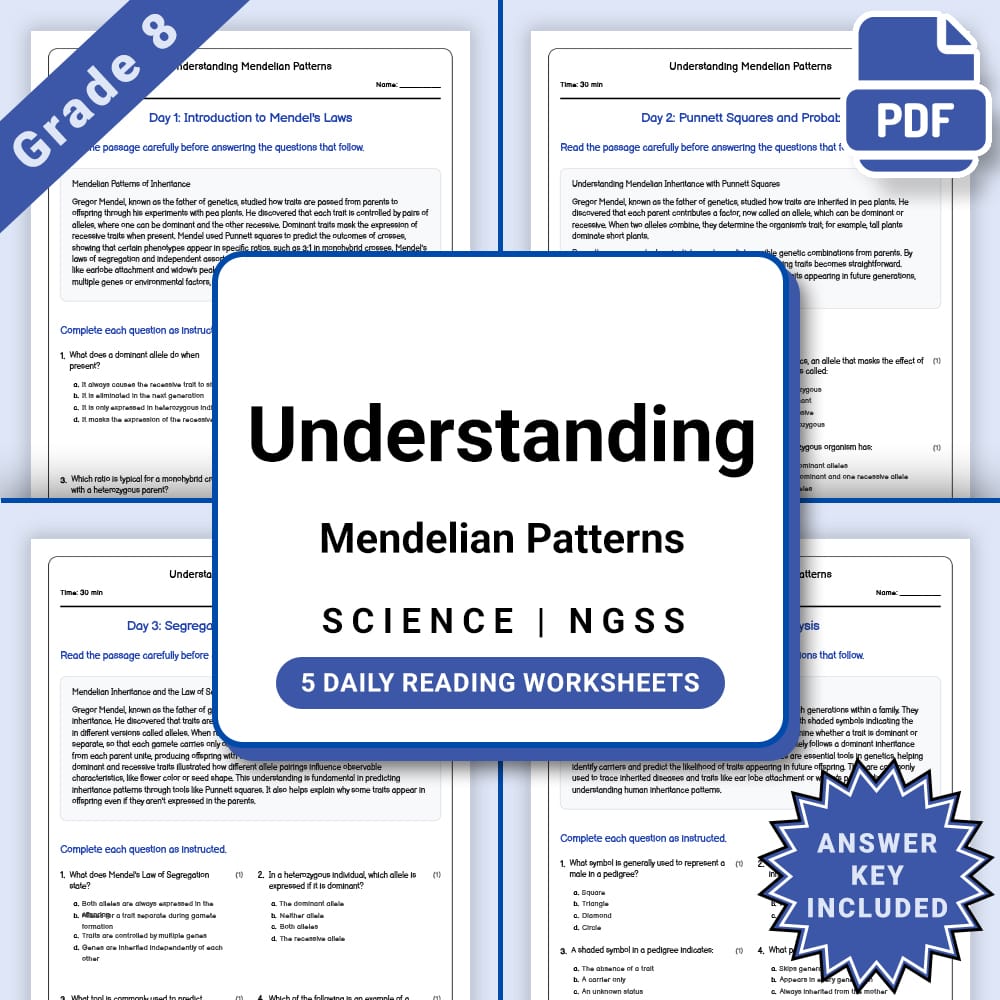
Grade 8 Science – Understanding Mendelian Patterns Worksheet(PDF + Answer Key)
Created byCopper Leaf ClassroomLearning Objectives
- Identify dominant and recessive traits in Mendelian inheritance.
- Understand how Punnett squares predict genotype and phenotype ratios.
- Interpret basic pedigrees to determine inheritance patterns.
Instant download
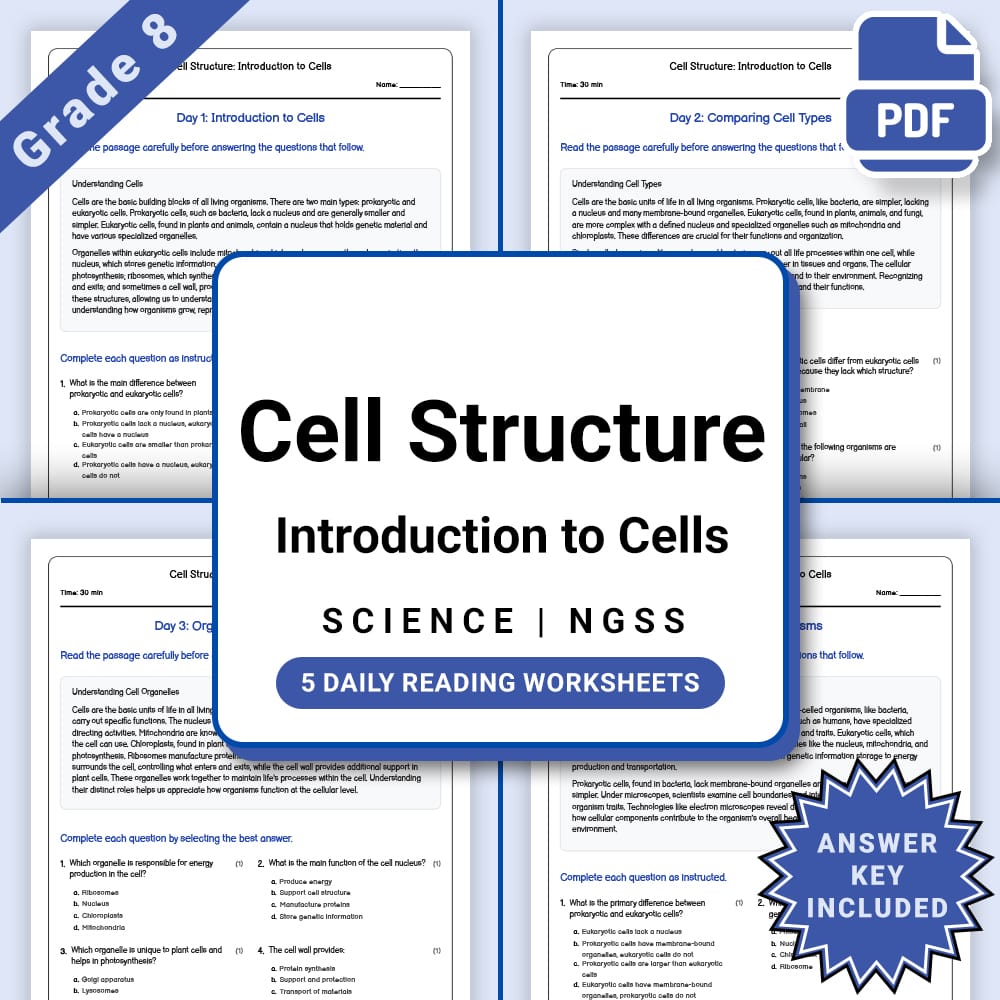
Grade 8 Science – Cell Structure Introduction Worksheet(PDF + Answer Key)
Created byCopper Leaf ClassroomLearning Objectives
- Identify key organelles within plant and animal cells
- Describe the functions of major cell structures such as nucleus, mitochondria, and chloroplasts
- Differentiate between prokaryotic and eukaryotic cells
Instant download
Grade 8 Science | Atmospheric Effects Worksheet (Ontario, PDF)
Created byBright Mind ResourcesLearning Objectives
- Explain how atmospheric pressure influences weather and physical systems.
- Describe how barometers operate based on pressure changes.
- Understand the relationship between altitude and pressure variation.
Instant download
Grade 8 Science – Inclined Planes Worksheet (Ontario | PDF)
Created byBright Mind ResourcesLearning Objectives
- Understand the mechanics of inclined planes and how they provide mechanical advantage.
- Calculate ideal and actual mechanical advantage for ramps and wedges.
- Analyze how factors like friction and surface finish impact input force requirements.
Instant download
Grade 8 Science Worksheet – Membrane Transport (Ontario) | PDF
Created byBright Mind ResourcesLearning Objectives
- Understand the different types of membrane transport mechanisms, including passive and active processes.
- Identify and describe processes such as diffusion, osmosis, facilitated diffusion, and active transport.
- Explain the roles of carrier proteins and pumps in membrane transport.
Instant download
Grade 8 Science | Cell Theory Worksheet (Ontario Standards) (PDF)
Created byBright Mind ResourcesLearning Objectives
- Understand the historical development of the cell theory.
- Identify the core principles that define cellular biology.
- Connect microscopic evidence and imaging techniques to cell discovery.
Instant download
Grade 8 Science – Rotational Forces Worksheet (Ontario | Science 1 PDF)
Created byBright Mind ResourcesLearning Objectives
- Understand torque, lever arm, and conditions for equilibrium in rotational systems.
- Explain the relationship between net torque and angular acceleration.
- Perform simple calculations linking rotational inertia, applied torque, and rotational speed.
Instant download
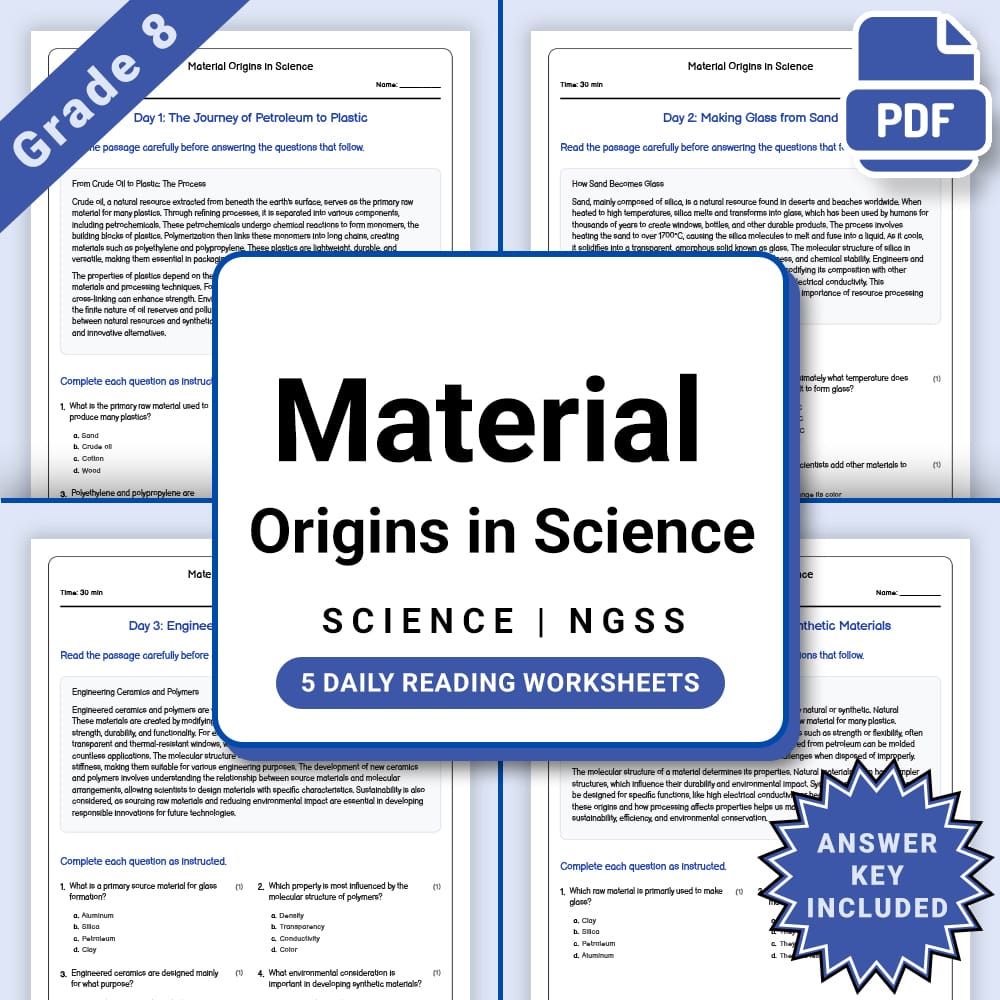
Grade 8 Science – Material Origins Daily Reading Worksheet(PDF + Answer Key)
Created byCopper Leaf ClassroomLearning Objectives
- Understand how crude oil is processed into plastics
- Identify the basic source materials for different synthetic materials
- Explain how molecular structures influence material properties
Instant download
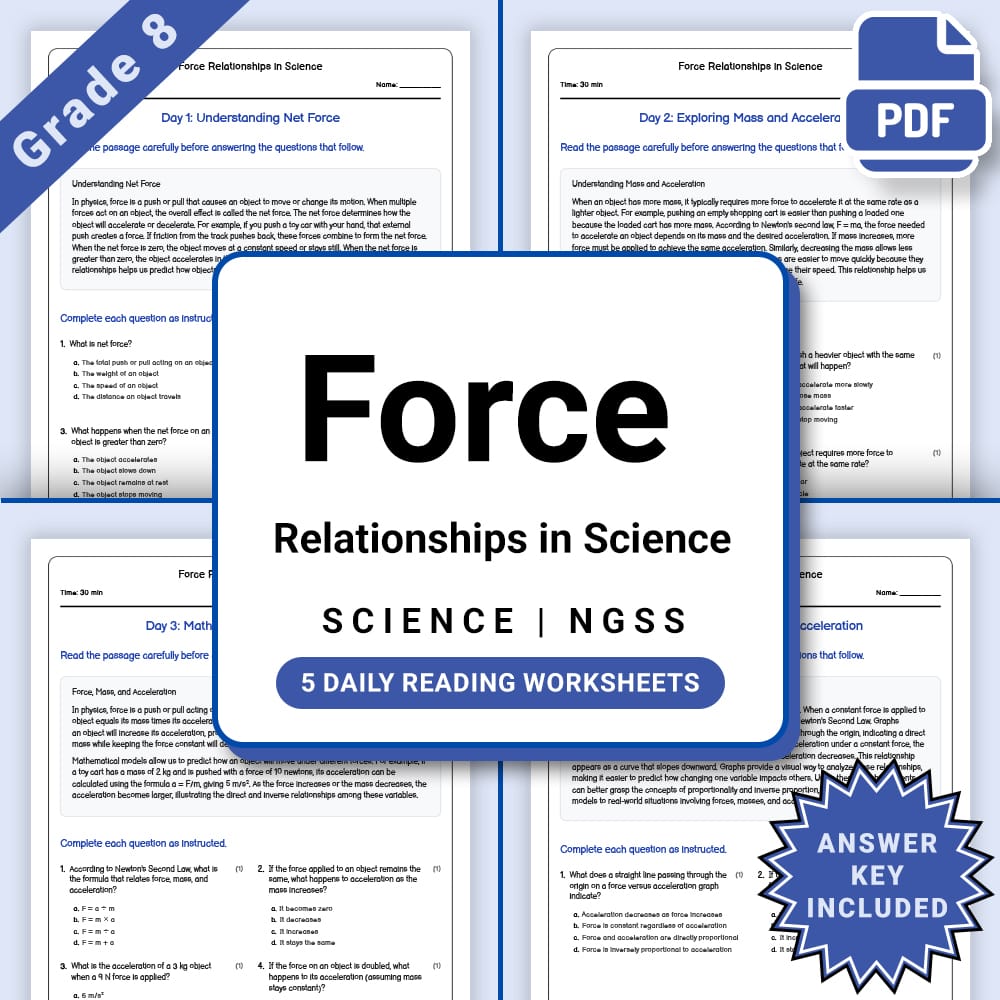
Grade 8 Science – Force Relationships Worksheet(PDF + Answer Key)
Created byCopper Leaf ClassroomLearning Objectives
- Understand key concepts related to Science
- Apply knowledge through practice questions
- Demonstrate comprehension of the material
Instant download
Grade 8 Science – Hydraulic Transmission Worksheet (Ontario Standards PDF)
Created byBright Mind ResourcesLearning Objectives
- Explain the basic principles of hydraulic systems based on Pascal's law.
- Describe how force and area relate in hydraulic pistons to produce force multiplication.
- Identify common applications of hydraulic transmission, such as jacks and brake systems.
Instant download
Grade 8 Science | Green Infrastructure Worksheet (Ontario, PDF)
Created byBright Mind ResourcesLearning Objectives
- Describe various nature-based and engineered stormwater management practices.
- Explain the functions such as infiltration, runoff control, and sediment capture.
- Identify key design parameters affecting green infrastructure effectiveness.
Instant download
Grade 8 Science Worksheet | Conservation Strategies (Ontario Standards) (PDF)
Created byBright Mind ResourcesLearning Objectives
- Identify principles and methods for the stewardship of freshwater resources.
- Analyze trade-offs among water supply, ecological health, and economics.
- Evaluate community and individual actions that influence water sustainability.
Instant download
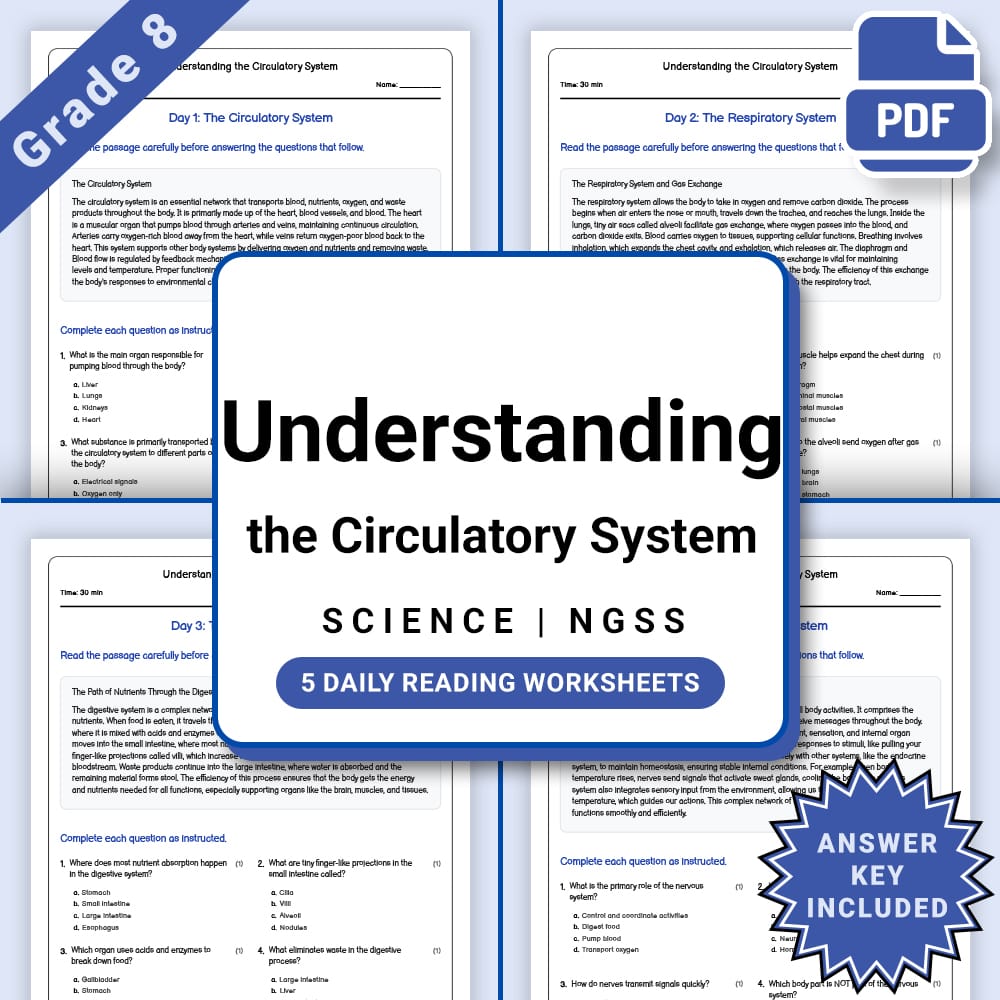
Grade 8 Science – Understanding the Circulatory System (PDF + Answer Key)
Created byCopper Leaf ClassroomLearning Objectives
- Identify the main components of the circulatory system
- Describe how blood circulates throughout the body
- Explain the role of the heart and blood vessels
Instant download
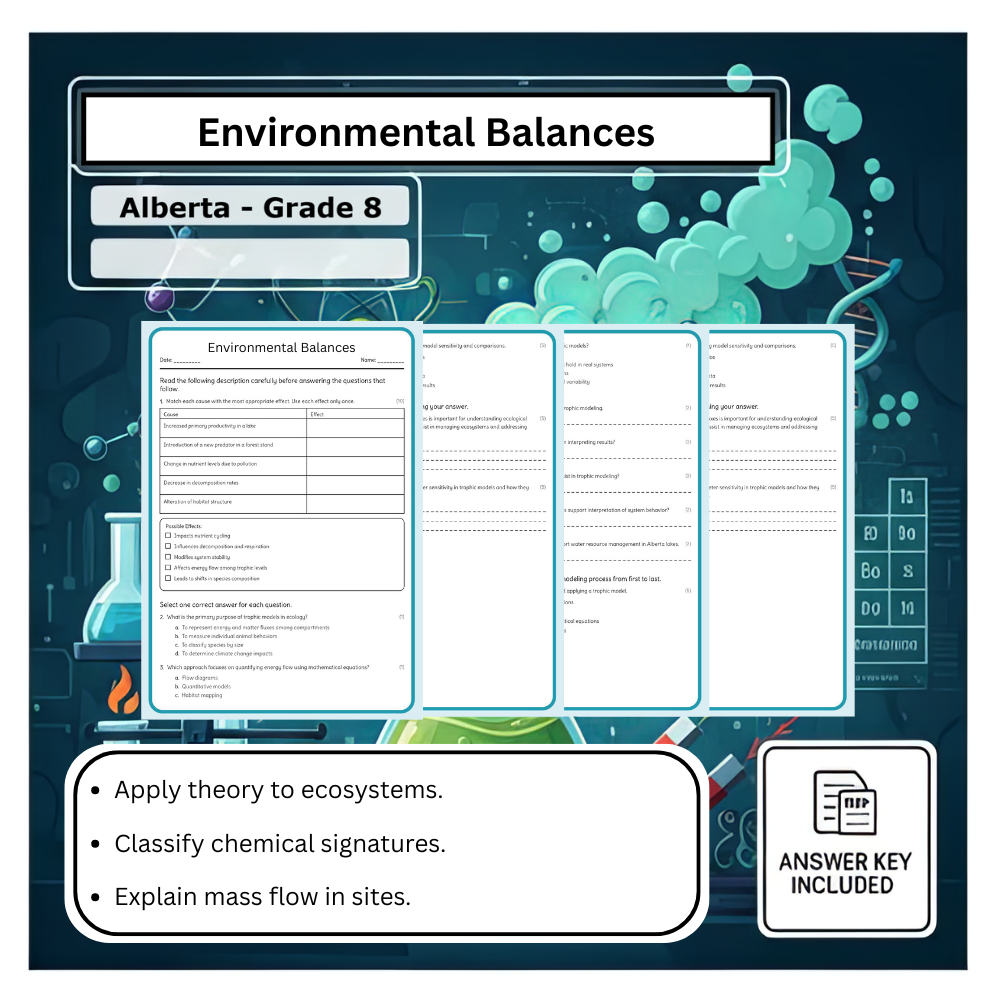
Grade 8 Science – Environmental Balances Worksheet (PDF) – Alberta Standards
Created byBright Mind ResourcesLearning Objectives
- Understand how particle theory applies to environmental systems.
- Classify environmental processes based on phases and chemical signatures.
- Explain the principle of mass conservation in ecosystems and contamination sites.
Instant download

Grade 8 Science – Circular Motion Worksheet (PDF) | Alberta Standards
Created byBright Mind ResourcesLearning Objectives
- Understand the concept of centripetal force and how it causes objects to move in a circle.
- Analyze how forces, mass, and radius affect the necessary centripetal force in circular motion.
- Describe real-world phenomena involving circular motion, such as road curves and amusement rides.
Instant download
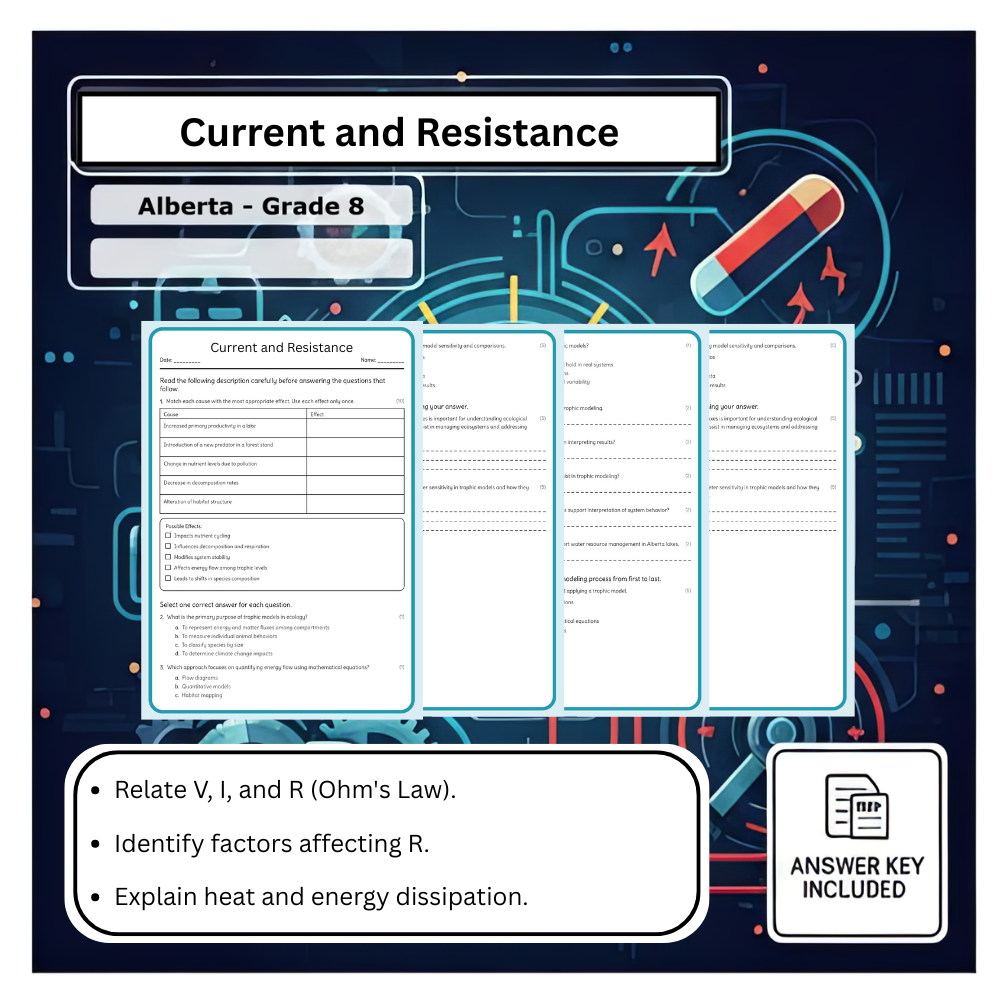
Grade 8 Science | Current and Resistance Worksheet (PDF) – Alberta Standards
Created byBright Mind ResourcesLearning Objectives
- Understand the relationship between voltage, current, and resistance in electrical circuits.
- Identify factors affecting resistance in different materials and conditions.
- Explain how resistance influences energy dissipation and component heating.
Instant download
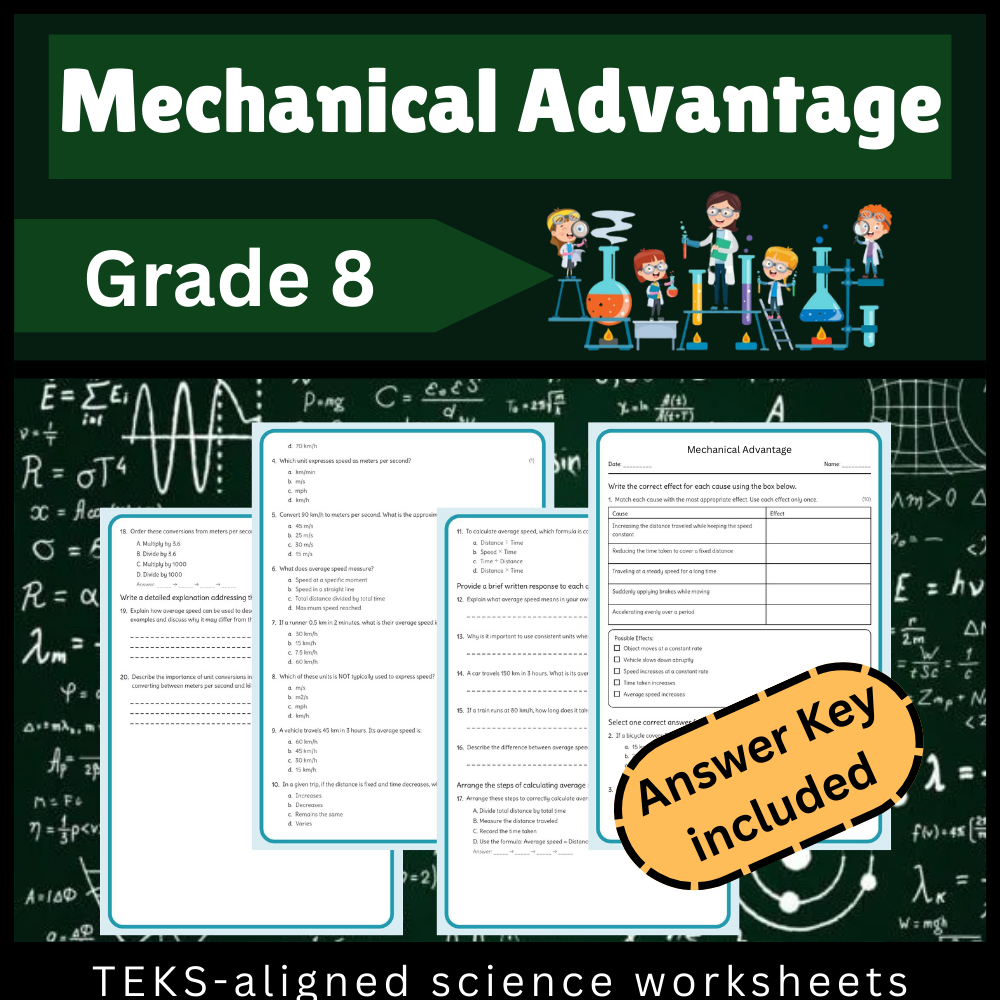
Grade 8 Science | Mechanical Advantage Worksheet (Answer Key) – TEKS Aligned
Created byBright Mind ResourcesLearning Objectives
- Understand and calculate the ideal and actual mechanical advantage of simple machines.
- Apply algebraic formulas to relate force, distance, and work in machine systems.
- Analyze the effects of frictional losses on real mechanical advantage.
Also included in: Grade 8 Science Unit | Motion, Forces & Energy Worksheets Bundle (TEKS Aligned) +1 more
Instant download
Grade 8 Science | Voltage Concepts Worksheet (PDF) – Alberta Standards
Created byBright Mind ResourcesLearning Objectives
- Understand the concept of voltage as electric potential difference.
- Identify sources of voltage such as batteries and generators.
- Explain how voltage affects current flow in circuits.
Instant download
Grade 8 Science – Cell Specialization Worksheets + Answer Key | BC Standards
Created byBright Mind ResourcesLearning Objectives
- Explain how cell specialization allows cells to perform specific biological tasks.
- Identify examples of specialized cells and their adaptations.
- Describe how structural modifications support cell function in tissues.
Instant download
Grade 8 Science | Population Patterns Worksheet (PDF) – Alberta Standards
Created byBright Mind ResourcesLearning Objectives
- Describe different types of population growth curves, including exponential and logistic models.
- Analyze case studies such as snowshoe hare–lynx cycles and forest insect outbreaks to understand population dynamics.
- Explain factors like carrying capacity, reproductive strategies, and time lags in shaping population trajectories.
Instant download
Grade 8 Science – Intermolecular Forces Worksheet (PDF) – Alberta Standards
Created byBright Mind ResourcesLearning Objectives
- Explain how intermolecular forces affect melting and boiling points.
- Relate the strength of intermolecular forces to chemical volatility and solubility.
- Describe regional phenomena like freeze-thaw cycles, volatility of hydrocarbons, and humidity effects in Alberta.
Instant download
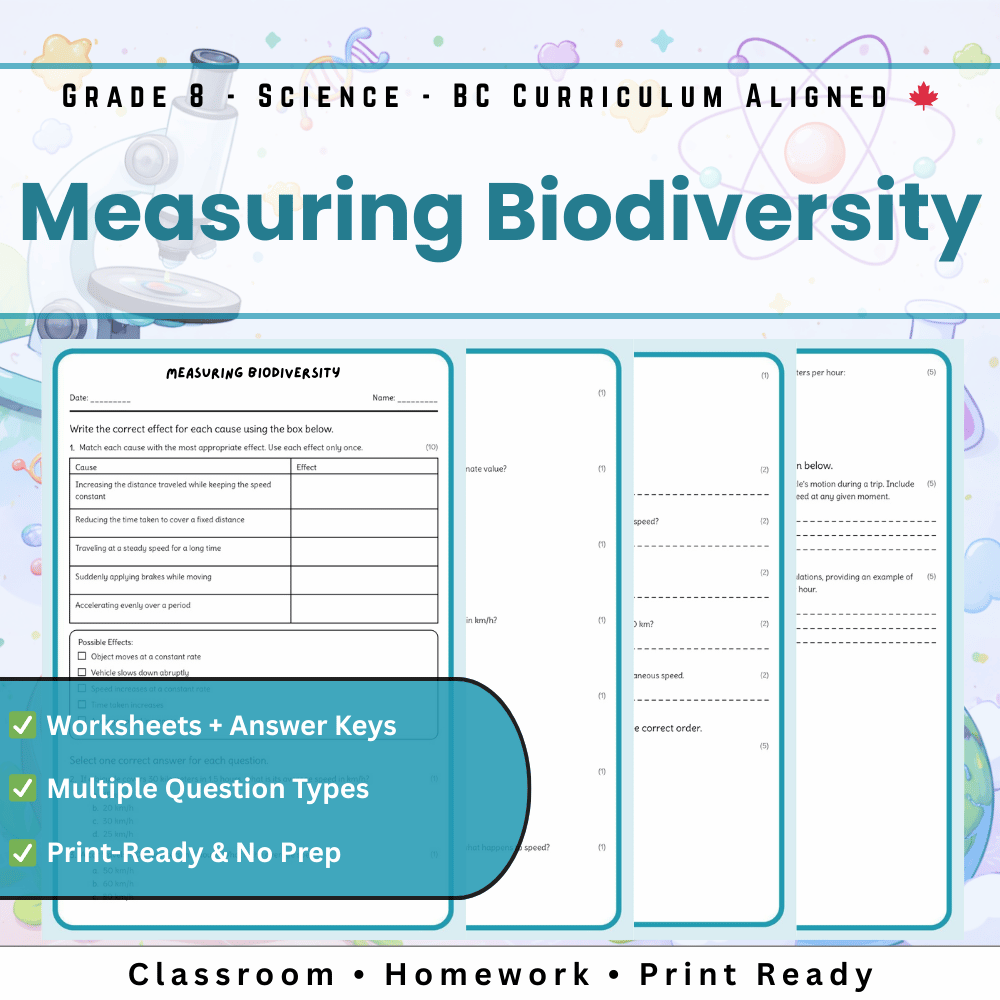
Grade 8 Science | Measuring Biodiversity Worksheet (Answer Key) | BC Standards
Created byBright Mind ResourcesLearning Objectives
- Understand the concepts of species richness, evenness, and diversity indices in measuring biodiversity.
- Explain how habitat heterogeneity, sampling methods, and temporal factors influence biodiversity estimates.
- Analyze patterns of biodiversity across different environments to inform conservation efforts.
Instant download
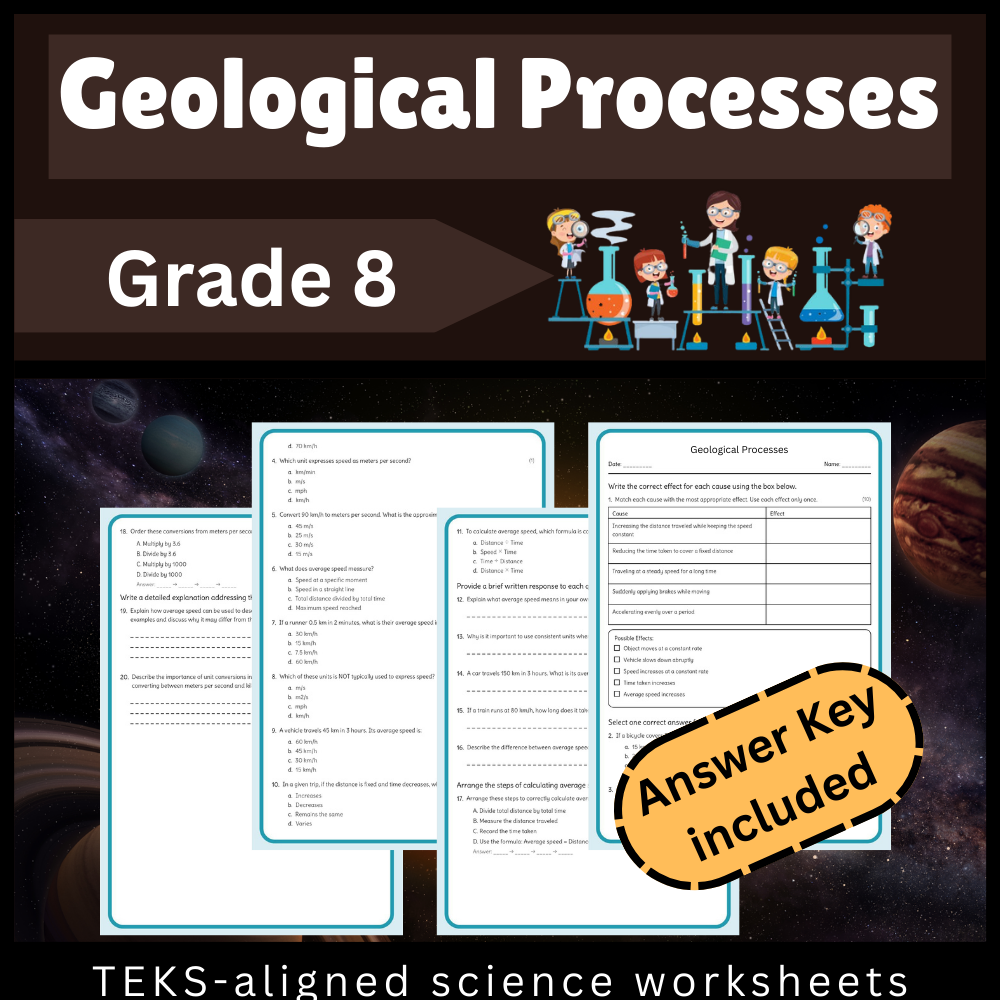
Grade 8 Science | Geological Processes Worksheet (Answer Key) – TEKS Aligned
Created byBright Mind ResourcesLearning Objectives
- Describe the different types of plate boundaries and their associated landforms.
- Explain the mechanisms of plate tectonics such as mantle convection and subduction.
- Identify observable evidence of geological processes like mid-ocean ridges and volcanic arcs.
Also included in: Grade 8 Science UNIT Bundle | Weather, Solar System & Earth - TEKS Aligned +1 more
Instant download
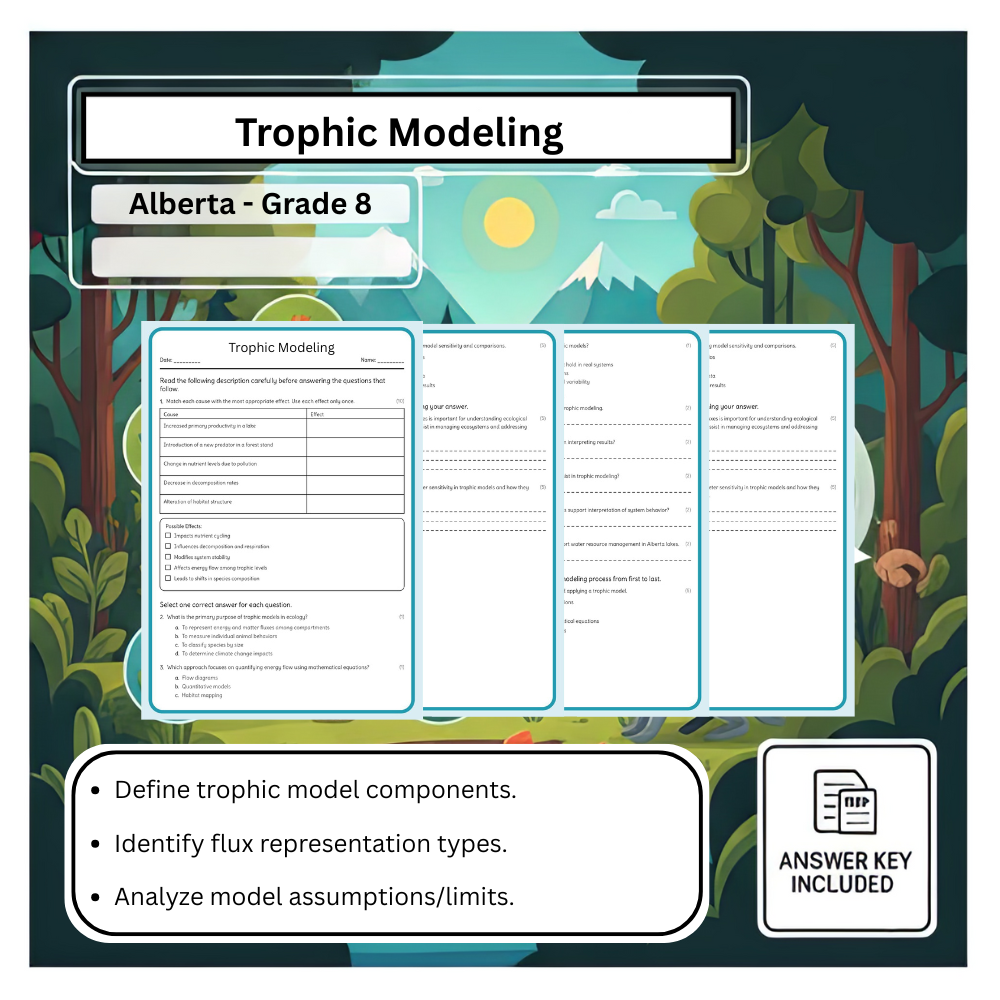
Grade 8 Science | Trophic Modeling Worksheet (PDF) – Alberta Standards
Created byBright Mind ResourcesLearning Objectives
- Explain the purpose and components of trophic models in ecological systems.
- Identify different types of models used to represent energy and matter fluxes.
- Analyze assumptions and limitations of quantitative and conceptual trophic models.
Instant download
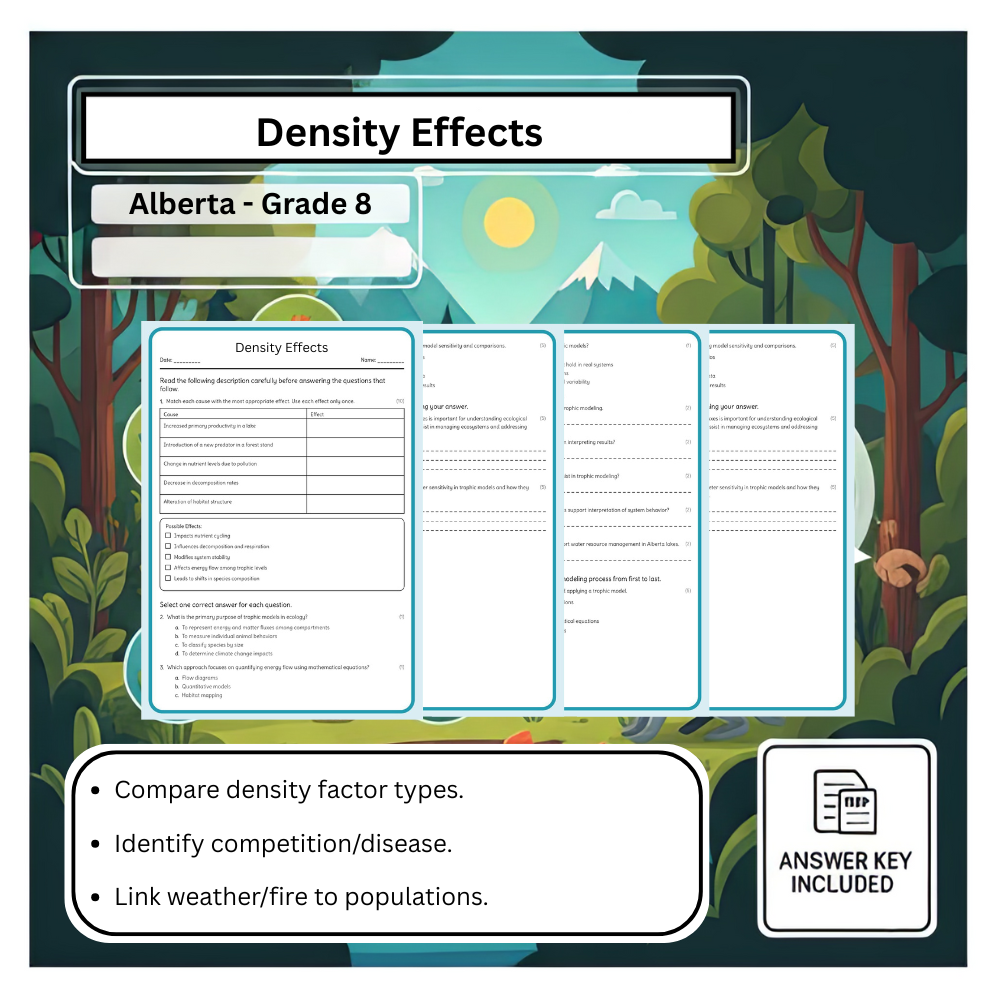
Grade 8 Science | Density Effects Worksheet (PDF) – Alberta Standards
Created byBright Mind ResourcesLearning Objectives
- Understand the difference between density-dependent and density-independent factors affecting populations.
- Identify examples of resource competition, disease transmission, and social behaviors as density-dependent influences.
- Recognize weather events, drought, and fire as density-independent factors affecting populations.
Instant download
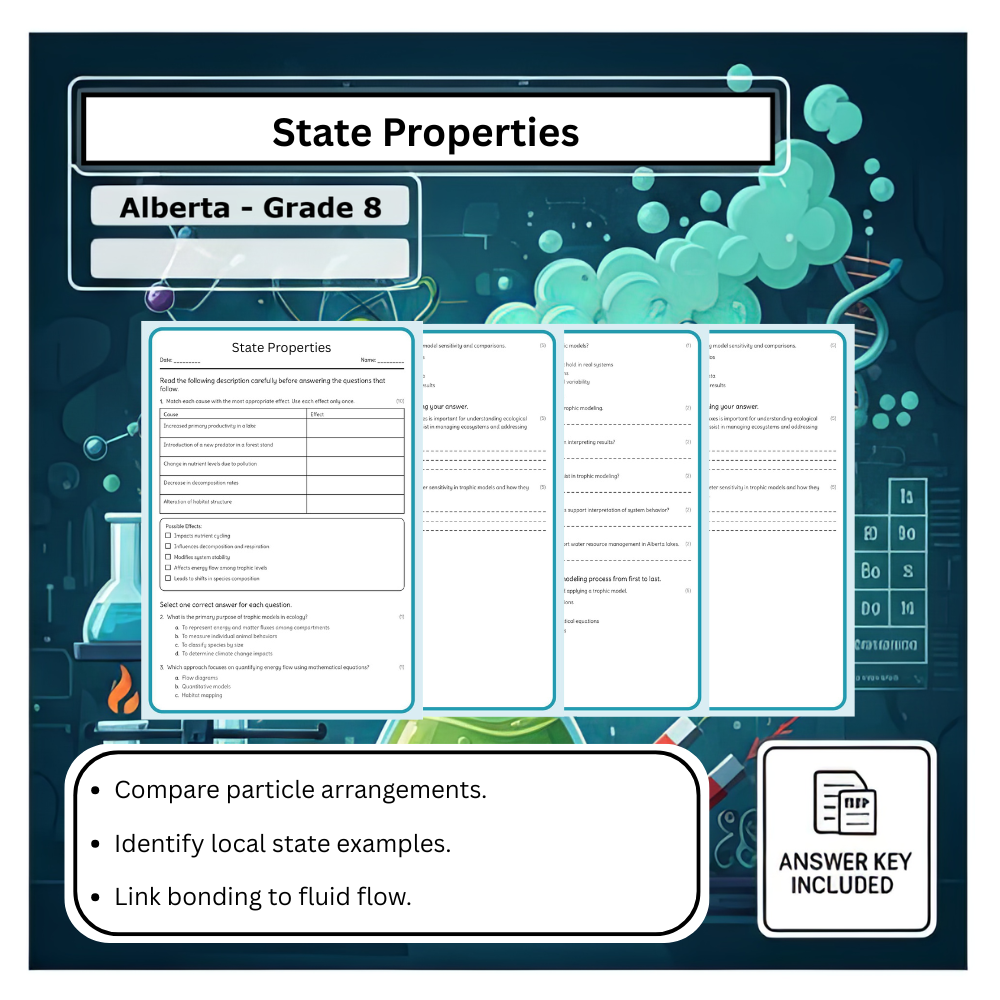
Grade 8 Science | State Properties Worksheet (PDF) – Alberta Standards
Created byBright Mind ResourcesLearning Objectives
- Understand the particle arrangement and energy differences among solids, liquids, and gases.
- Identify real-world examples of each state from Alberta context.
- Explain how particle bonding strength affects the shape and flow of different states.
Instant download
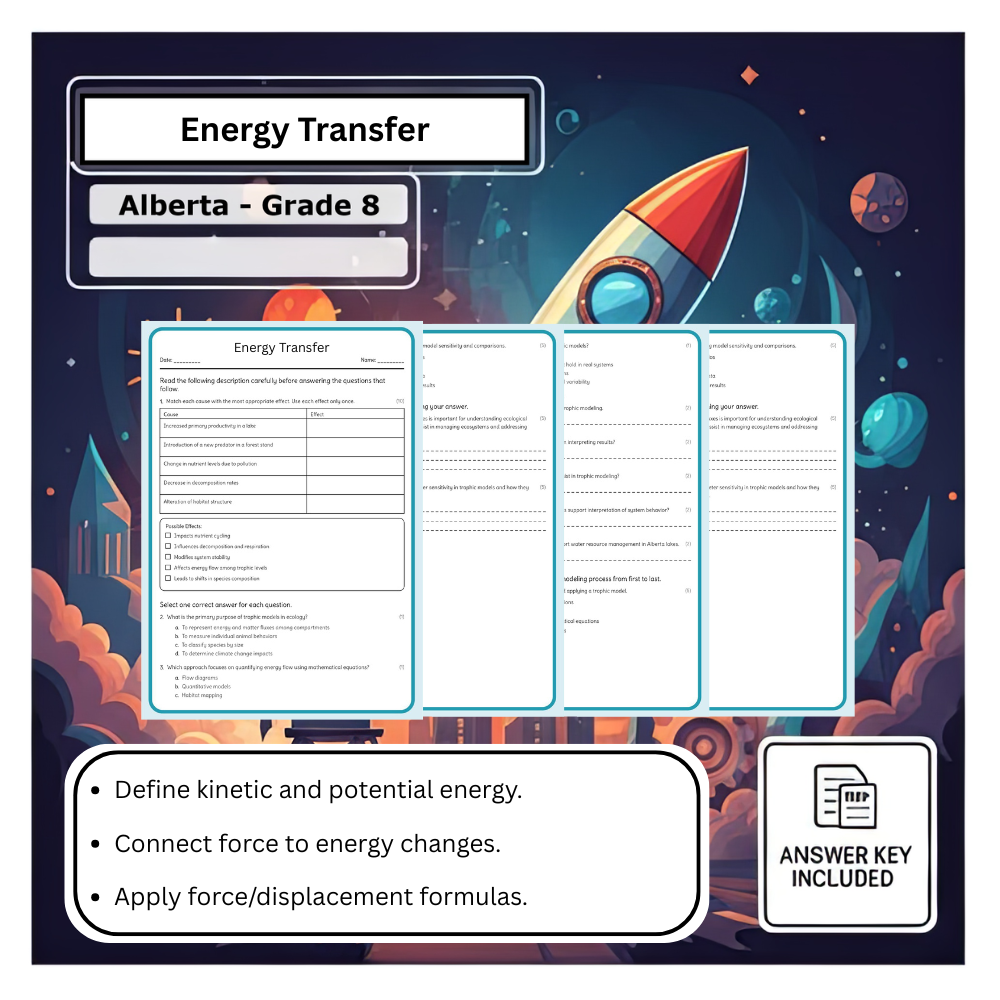
Grade 8 Science | Energy Transfer (Worksheet + Answer Key) – Alberta Standards
Created byBright Mind ResourcesLearning Objectives
- Understand the concepts of mechanical energy, including kinetic and potential energy.
- Connect force interactions to changes in energy during motion.
- Apply qualitative relationships between force, displacement, and energy transfer.
Instant download
About Grade 8 Science Worksheets
Explore Grade 8 Science worksheets for classwork, homework, or review. Our 6,006 printables download instantly as PDFs.
Each resource here is built by an independent educator and reviewed for quality. Worksheets print straight from PDF and suit classroom use, homework, or extra practice; most come with answer keys, and you can preview before purchasing.