
Grade 8 Science Worksheets
6,006 worksheets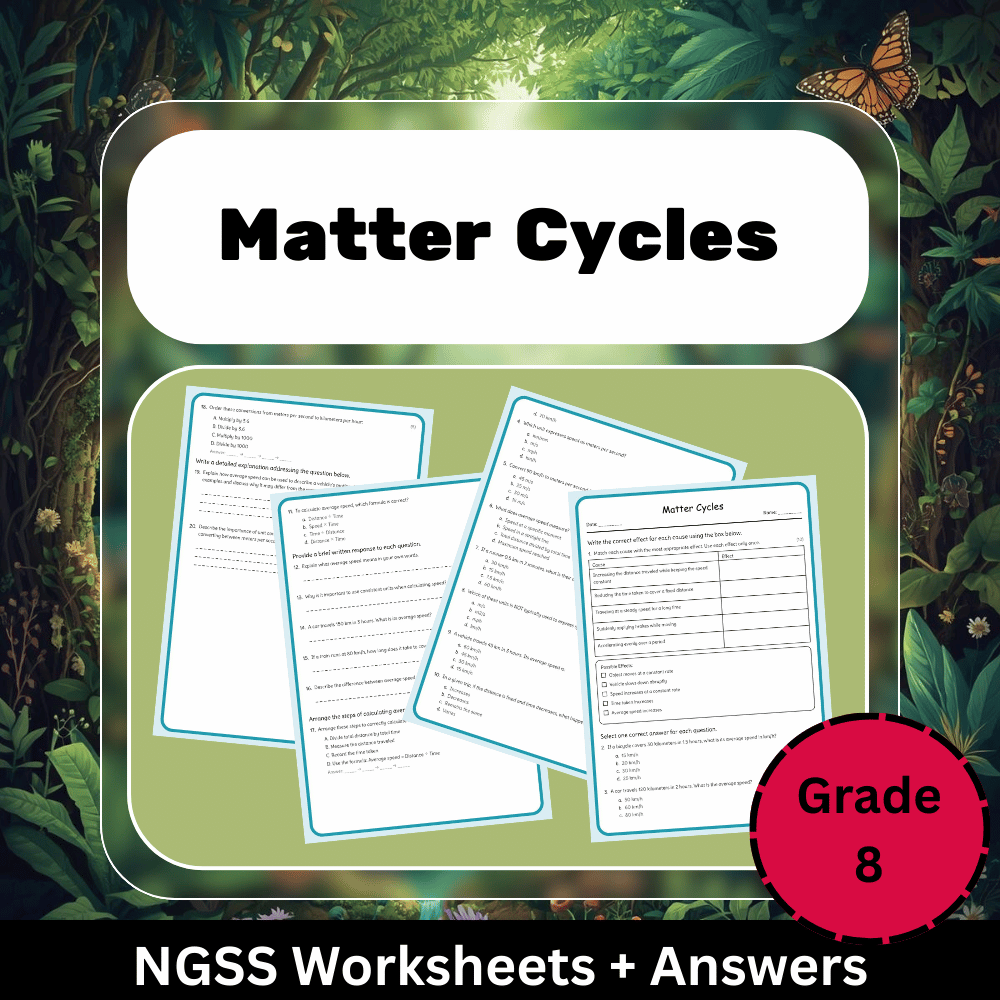
Grade 8 Science – Matter Cycles Worksheet (Worksheet + Answer Key)| NGSS-Aligned
 Created byBright Mind Resources
Learning Objectives
- Describe how matter cycles between living organisms and the abiotic environment.
- Explain processes such as photosynthesis, respiration, and decomposition in the cycling of matter.
- Trace atoms like carbon and water through ecosystems involving producers, consumers, and decomposers.
Also included in: Grade 8 Science Unit Bundle: Ecosystems, Matter Cycles & Food Webs Worksheets +2 more
Instant download

Grade 8 Chemical Reaction Models Worksheet | General Use Practice PDF
 Created byClear Sky Classroom
Learning Objectives
- Model a chemical reaction using particle diagrams that show how atoms and particle counts change before and after the reaction.
- Use energy models to explain whether a reaction releases or absorbs thermal energy and what that implies about particle motion.
- Connect observable evidence (color change, gas formation, temperature change) to particle-level and energy-level changes.
Instant download

Mass and Weight Worksheet for Grade 8 Science – Standards-Aligned Practice
JCreated byJ.S SheetsLearning Objectives
- Distinguish between mass as an intrinsic property of matter and weight as a gravitational force.
- Explain how mass and weight relate through gravitational acceleration.
- Apply regional examples like haul truck load specifications and agricultural dosing to understand mass and weight concepts.
Also included in: Grade 8 Forces & Motion Science Lesson Bundle – Alberta framework worksheets +1 more
Instant download

Natural Selection Worksheet for Grade 8 Science | Standards-Aligned Practice
JCreated byJ.S SheetsLearning Objectives
- Explain how natural selection depends on variation, heritability, and environmental pressure.
- Use the idea of differential survival and reproduction to predict how trait frequencies can change over generations.
- Describe how adaptations can become more common and how this can lead to divergence in separated populations.
Also included in: Grade 8 Evolution and Ecosystems Science Lesson Bundle | Florida NGSSS +1 more
Instant download

Grade 8 Science | Models & Refinement - Daily Reading Comprehension
 Created byCoral Reef Learning
Learning Objectives
- Understand what scientific models are and how they are used in engineering.
- Recognize different types of models and their purposes.
- Learn how measurements from physical prototypes can lead to model adjustments.
Instant download

Grade 8 Science | Mixtures Versus Compounds Worksheet | BC Aligned
 Created byLumora Learning
Learning Objectives
- Differentiate between mixtures and compounds based on their properties.
- Identify methods to separate mixtures and compounds.
- Explain the formation of compounds through chemical bonds.
Instant download

Grade 8 Science – Mixtures and Solutions Worksheet (TEKS) PDF
 Created byEvergreen Desk Education
Learning Objectives
- Distinguish heterogeneous and homogeneous mixtures using observable properties
- Explain how solutions form, including the roles of solute, solvent, and solubility
- Describe saturation and predict what happens when more solute is added to a solution
Instant download

Grade 8 Science – Osmosis & Water Potential | Daily Reading Worksheet
Created byBright Mind ResourcesLearning Objectives
- Understand the principles of osmosis and water potential in cellular contexts.
- Differentiate between hypotonic, isotonic, and hypertonic environments and their effects on cells.
- Describe mechanisms such as turgor pressure and volume control that cells use to maintain osmotic balance.
Also included in: Grade 8 Life Systems Science Daily Reading Worksheets Lesson Bundle | Ontario +1 more
Instant download

Testable Claims and Hypotheses Worksheets for Grade 8 Science
 Created byBRIGHT PATH RESOURCES
Learning Objectives
- Identify testable claims by linking a measurable factor to an observable outcome
- Write or evaluate hypotheses using clear variables and realistic expectations
- Determine what data patterns would support or weaken a hypothesis
Also included in: Grade 8 Scientific Inquiry Worksheets Bundle | General Science +2 more
Instant download

Fluid Pressure Worksheets: Force per Area and Depth Grade 8
 Created byPrism Point Learning
Learning Objectives
- Define pressure as force per unit area using appropriate SI terminology
- Calculate pressure from given force and contact area
- Convert pressure values between pascals and kilopascals
Also included in: Fluids, Pressure & Buoyancy Lesson Bundle | Grade 8 Science | Ontario +1 more
Instant download

Grade 8 Science Worksheet | Evidence of Solar System Features (PDF)
Created byEvergreen Desk EducationLearning Objectives
- Explain how composition and differentiation can lead to different densities across solar system bodies.
- Use observational evidence (craters, volcanism, rings/moons) to support claims about heat history and resurfacing.
- Describe how orbital patterns reflect gravitational interactions during early solar system evolution.
Also included in: Grade 8 Earth and Space Science Lesson Bundle - General Framework +1 more
Instant download

Science Grade 8 Energy Transformations Worksheet | Standards-Aligned Practice
JCreated byJ.S SheetsLearning Objectives
- Explain how energy can move between objects and change form during physical processes.
- Use examples like friction and household devices to describe transformations between mechanical, electrical, thermal, and light energy.
- Apply the idea of energy conservation by tracking energy changes rather than energy disappearing.
Also included in: Matter and Energy Interactions | Grade 8 Science Lesson Bundle: General +1 more
Instant download

Braking Distance and Friction Worksheets Grade 8 Science
 Created bySunny Desk Resources
Learning Objectives
- Explain how reaction time and braking deceleration determine total stopping distance
- Describe how tire-road friction and braking force affect how quickly a vehicle slows
- Use the concepts of anti-lock braking systems and brake fade to predict changes in stopping distance
Also included in: Forces and Motion Grade 8 Alberta Science Worksheets Bundle +1 more
Instant download
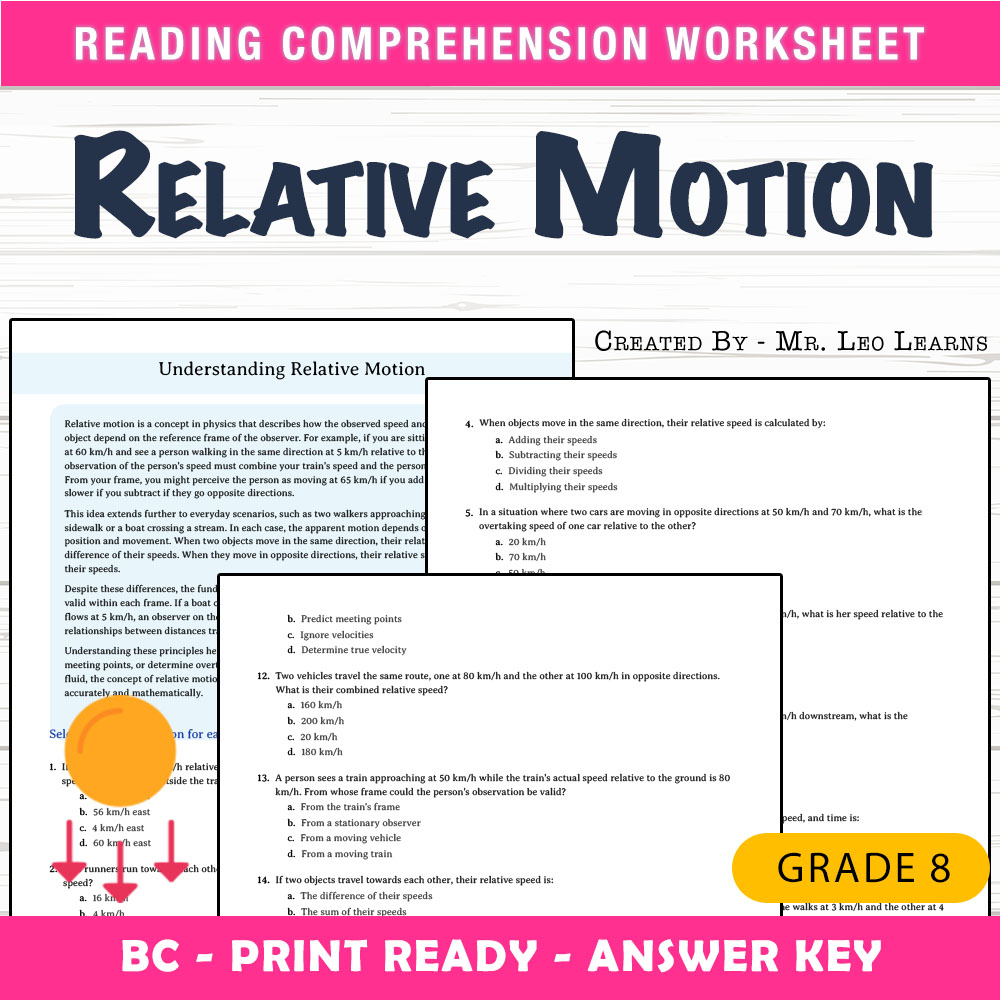
Grade 8 Science — Understanding Relative Motion Worksheet for Mastery | PDF + Answer Key
 Created byThe Resource Hub
Learning Objectives
- Explain the concept of relative motion and how observed speeds depend on the reference frame.
- Apply proportional relationships among speed, distance, and time within different frames of reference.
- Analyze simple scenarios such as two walkers moving toward each other or a boat crossing a stream to understand how relative speeds are affected by different frames.
Also included in: Grade 8 Science Forces, Motion & Energy UNIT Bundle +1 more
Instant download
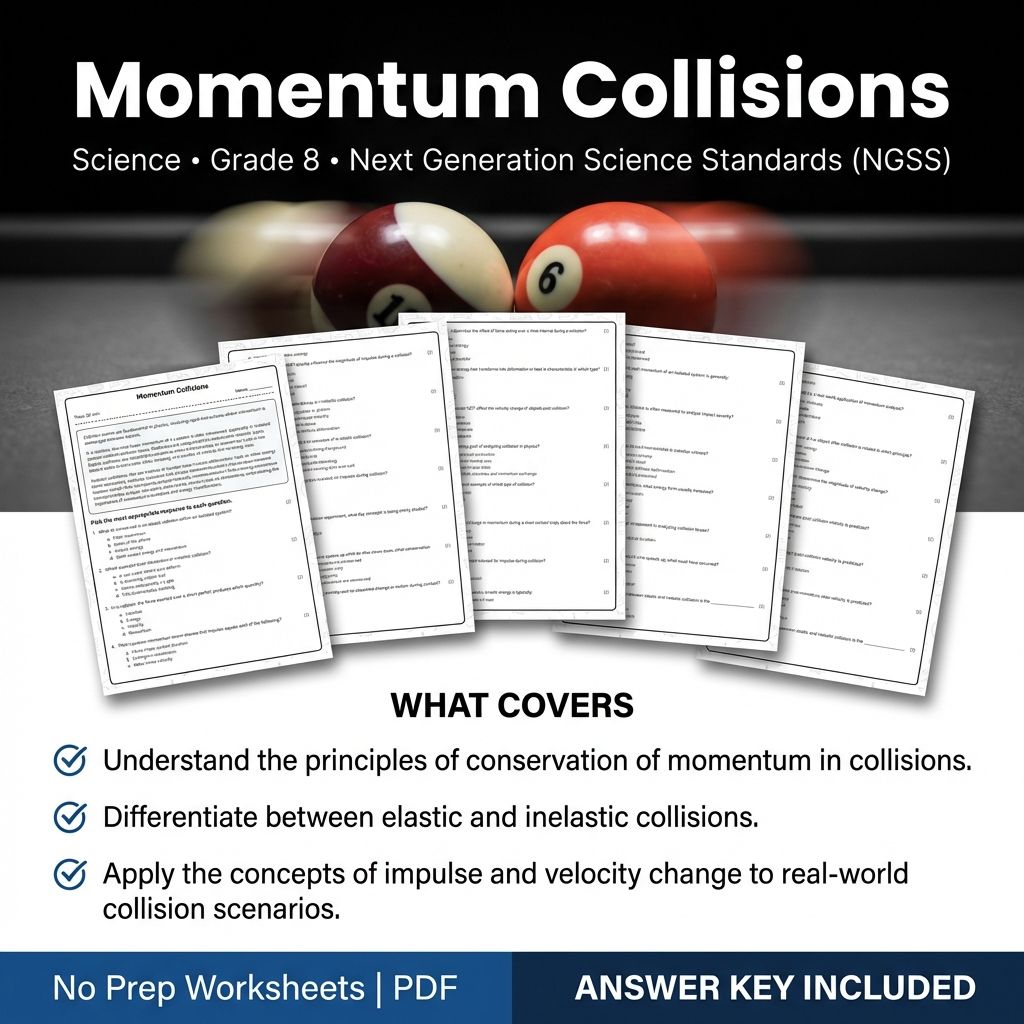
8th Grade Science | Momentum & Collisions Worksheet with Answer Key (PDF)
Created byCoral Reef LearningLearning Objectives
- Understand the principles of conservation of momentum in collisions.
- Differentiate between elastic and inelastic collisions.
- Apply the concepts of impulse and velocity change to real-world collision scenarios.
Instant download

Grade 8 Science Worksheet – Properties of Matter & Measurements (PDF)
Created byEvergreen Desk EducationLearning Objectives
- Identify and describe measurable properties of matter, including density, solubility, melting point, boiling point, and conductivity.
- Compare materials using quantitative physical characteristics (mass, volume, and temperature).
- Explain how physical properties help classify matter and support separation techniques.
Instant download

Grade 8 Science | Solution Optimization Worksheet | California Standards
Created byLumora LearningLearning Objectives
- Explain how criteria and constraints are used to compare alternative solutions.
- Identify tradeoffs when improving one performance goal causes drawbacks in another.
- Justify why a chosen design is optimal for a given situation.
Instant download

Energy Transformations Physical Science Worksheets Grade 8
Created byBRIGHT PATH RESOURCESLearning Objectives
- Explain how energy changes form during physical processes using the terms mechanical, thermal, electrical, and light energy.
- Describe how friction can transform mechanical energy into thermal energy and how this shows up as warming.
- Track energy as it transfers between objects or systems and identify that energy does not disappear.
Also included in: Grade 8 Chemical Reactions & Conservation of Matter Bundle | Science +2 more
Instant download

Grade 8 Science – Viscosity & Flow Daily Reading Worksheet | Ontario Standard
Created byBright Mind ResourcesLearning Objectives
- Define and explain the concepts of viscosity, including dynamic and kinematic viscosity.
- Differentiate between low-viscosity and high-viscosity fluids such as water and oil.
- Describe how viscosity affects flow rates in pipes and relate it to real-world applications.
Also included in: Grade 8 Fluid Mechanics & Pressure Science Lesson Bundle | Ontario +1 more
Instant download
Grade 8 Science Power in Mechanical Systems Daily Reading Worksheet Answer Key
JCreated byJ.S SheetsLearning Objectives
- Define power as the rate of doing work.
- Explain the relationship between torque, rotational speed, and power.
- Apply SI units of watts to measure mechanical power.
Also included in: Grade 8 Science Lesson Group Bundle – Mechanical Systems and Energy +1 more
Instant download
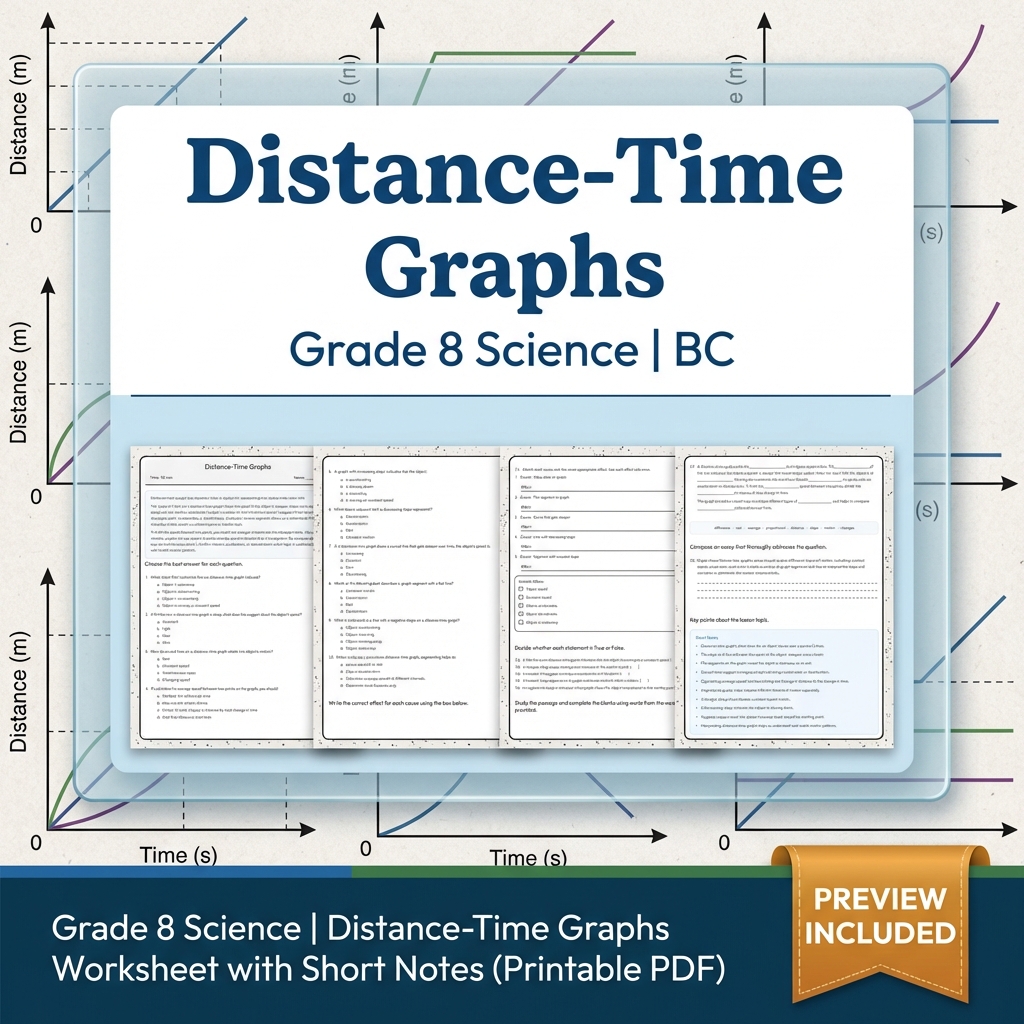
Grade 8 Science | Distance-Time Graphs Worksheet with Short Notes (PDF)
 Created byMeadowlark Worksheets
Learning Objectives
- Understand how to interpret distance-time graphs to analyze motion.
- Identify different segments of a distance-time graph indicating rest, constant speed, or acceleration.
- Calculate average speed between two points on a graph.
Also included in: Grade 8 Science Lesson Bundle | BC Framework & Key Concepts Worksheet Pack +1 more
Instant download

Endothermic and Exothermic Energy Changes Worksheets Grade 8
Created byBRIGHT PATH RESOURCESLearning Objectives
- Compare endothermic and exothermic reactions using energy flow and temperature evidence
- Explain energy changes using particle motion and bonding rearrangements rather than energy from outside
- Interpret models of exothermic and endothermic reactions to predict whether the surroundings warm or cool
Also included in: Grade 8 Chemical Reactions & Conservation of Matter Bundle | Science +2 more
Instant download

Chemical Reaction Models Worksheets Grade 8 Physical Science
Created byBRIGHT PATH RESOURCESLearning Objectives
- Explain how chemical reactions rearrange atoms to form new substances.
- Use a particle model to describe changes in bonding and the number of each substance’s particles after a reaction.
- Connect observable evidence (color, gas, temperature change) to particle-level and energy-level changes using reaction models.
Also included in: Grade 8 Chemical Reactions & Conservation of Matter Bundle | Science +2 more
Instant download

Inquiry Models Worksheet for Grade 8 Science | Standards-Aligned Practice
JCreated byJ.S SheetsLearning Objectives
- Compare hypothesis-driven, descriptive, and correlational inquiry models and identify what each can (and cannot) claim.
- Use boundary conditions and underlying assumptions to evaluate when a scientific model is likely to be valid.
- Connect conceptual and mathematical representations to generate testable predictions from models.
Instant download

Net Force and Motion Changes Worksheet | Grade 8 Physical Science
Created byBRIGHT PATH RESOURCESLearning Objectives
- Explain how forces can be push or pull interactions that change motion
- Describe the difference between balanced and unbalanced forces using net force
- Predict how velocity changes when forces act in the same or opposite directions
Also included in: Grade 8 Chemical Reactions & Conservation of Matter Bundle | Science +2 more
Instant download

Energy Conservation in Systems Worksheets Grade 8 Physical Science
Created byBRIGHT PATH RESOURCESLearning Objectives
- Explain energy conservation using the idea of a system and its surroundings.
- Describe how energy can change forms during energy transfers without changing total energy.
- Predict how mechanical energy changes when friction and height are involved.
Also included in: Grade 8 Chemical Reactions & Conservation of Matter Bundle | Science +2 more
Instant download
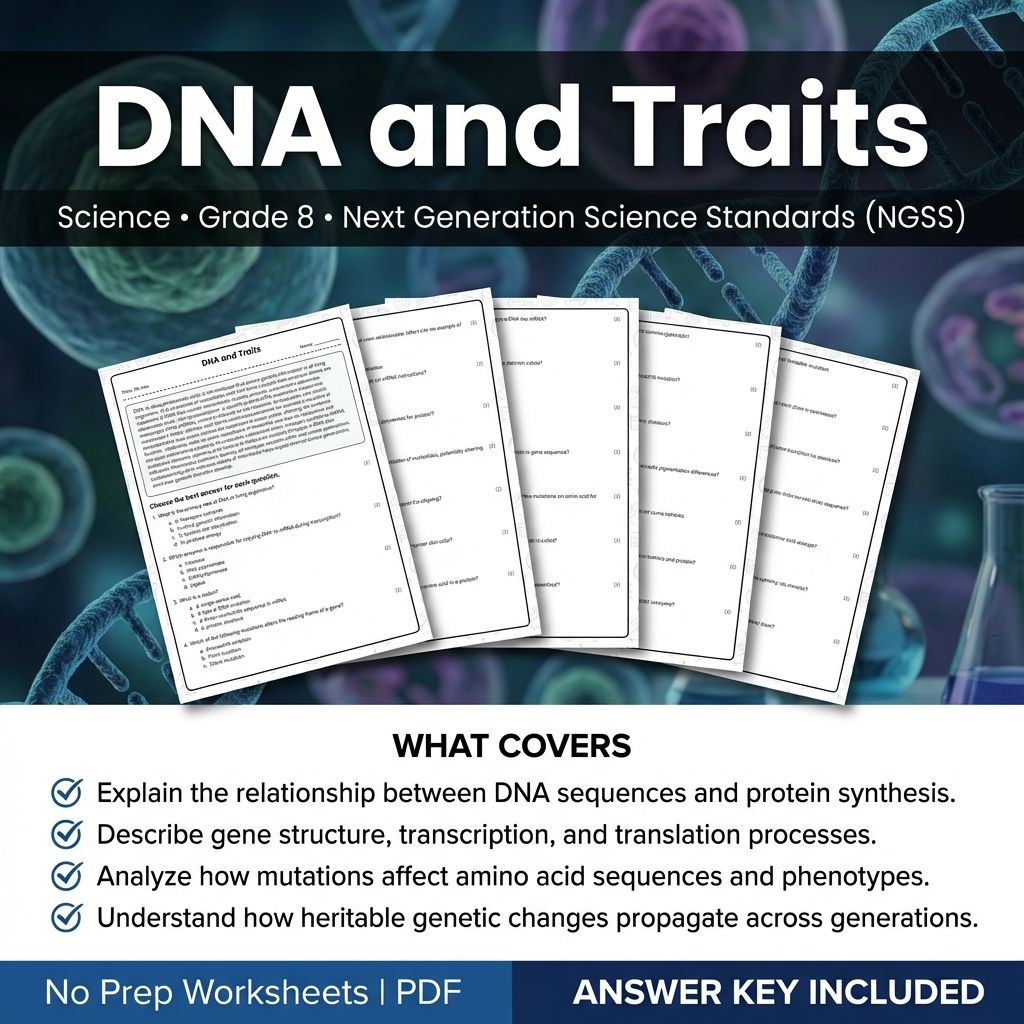
8th Grade Science | DNA and Traits Worksheet with Answer Key (Printable PDF)
Created byCoral Reef LearningLearning Objectives
- Explain the relationship between DNA sequences and protein synthesis.
- Describe gene structure, transcription, and translation processes.
- Analyze how mutations affect amino acid sequences and phenotypes.
Instant download
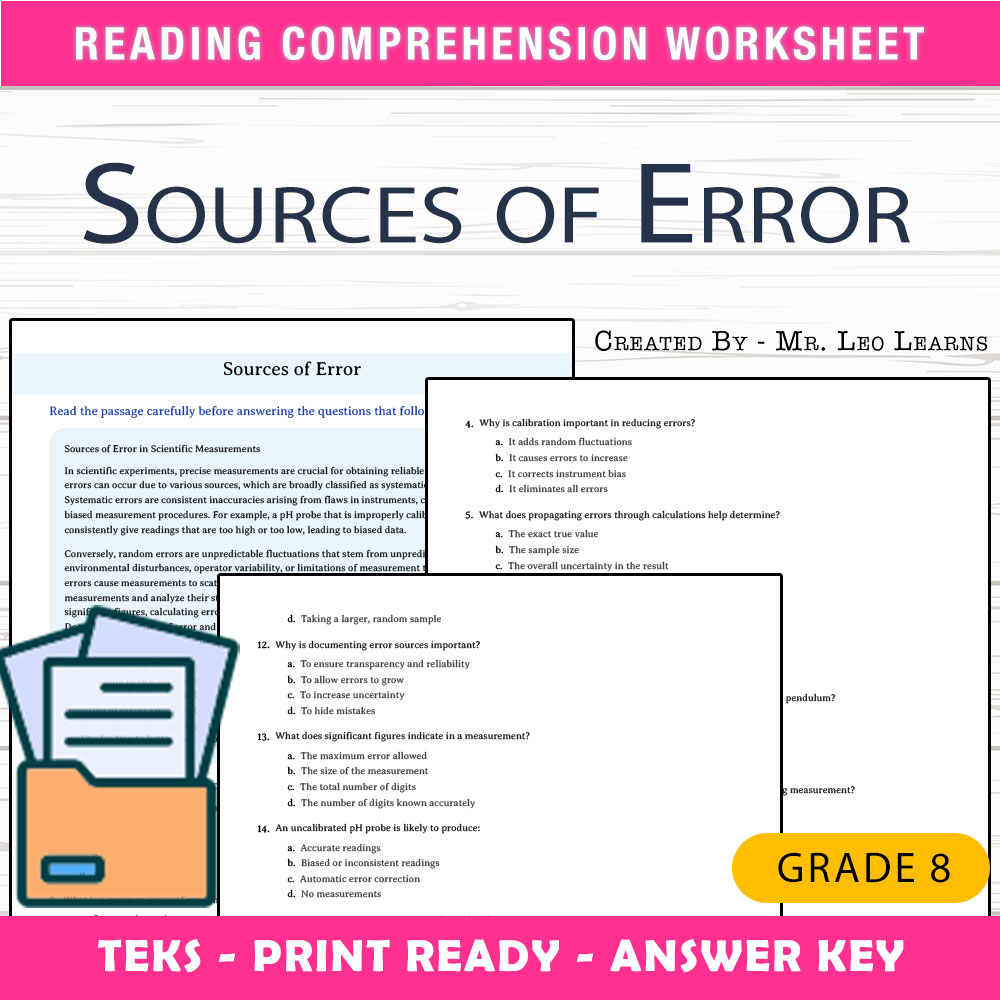
Grade 8 Science — Sources of Error Worksheet for Mastery
Created byThe Resource HubLearning Objectives
- Understand the different types of measurement errors and their sources.
- Identify ways to quantify and reduce systematic and random errors.
- Apply error analysis techniques such as significant figures, error margins, and propagation methods.
Also included in: Grade 8 Science Unit Bundle | Scientific Inquiry & Data Skills Worksheet Pack +1 more
Instant download
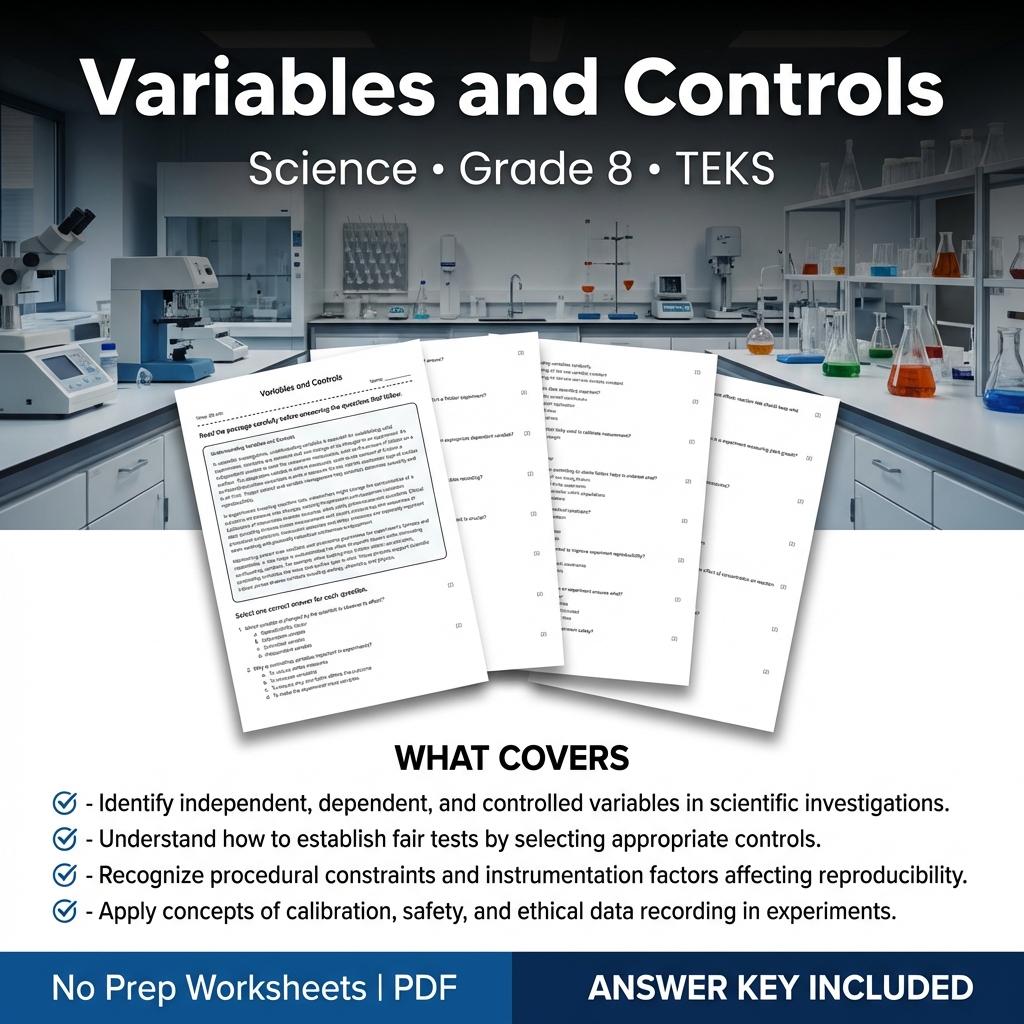
Variables and Controls Worksheet | Science Grade 8 TEKS Standards
Created byCoral Reef LearningLearning Objectives
- Identify independent, dependent, and controlled variables in scientific investigations.
- Understand how to establish fair tests by selecting appropriate controls.
- Recognize procedural constraints and instrumentation factors affecting reproducibility.
Instant download

Grade 8 Science | Ecosystem Components Worksheet | BC Aligned
Created byLumora LearningLearning Objectives
- Describe the roles of producers, consumers, and decomposers in an ecosystem.
- Identify abiotic factors such as sunlight, water, and temperature that influence ecosystems.
- Explain how interactions between biotic and abiotic elements shape ecological communities.
Instant download

Testable Questions Worksheet | Grade 8 Science NGSSS Inquiry Skills Key
Created byEvergreen Desk EducationLearning Objectives
- Identify features of a testable science question that can be answered using measurable or observable evidence
- Distinguish observations, claims, and assumptions in scientific statements
- Rewrite vague questions into clear, testable questions using variables and defined conditions
Instant download

Energy Transformations Assessment for Grade 8 Science | Standards-Aligned
Created byPrism Point LearningLearning Objectives
- Understand how energy changes form during physical processes.
- Identify examples of energy transformation in everyday life.
- Explain the conservation of energy during transformations.
Also included in: Grade 8 Physical Science Science Lesson Bundle – General Framework
Instant download

Biodiversity Conservation Worksheet | Grade 8 Science TEKS-Aligned
Created byPrism Point LearningLearning Objectives
- Explain how genetic, species, and ecosystem diversity support ecosystem functions and services.
- Describe conservation strategies such as habitat connectivity, protected areas, and restoration and how they affect biodiversity outcomes.
- Evaluate trade-offs and adaptive management decisions using real-world examples.
Also included in: Grade 8 Ecosystems & Cellular Processes Science Lesson Bundle TEKS +1 more
Instant download

Energy Changes Worksheet for Grade 8 Science | Standards-Aligned Practice
JCreated byJ.S SheetsLearning Objectives
- Understand how bonds are broken and formed during chemical reactions and how energy changes are involved.
- Differentiate between endothermic and exothermic reactions based on energy profiles.
- Explain how bond enthalpies relate to temperature changes observed during reactions.
Instant download

Grade 8 Science Worksheet | Understanding Force Diagrams (PDF)
Created byEvergreen Desk EducationLearning Objectives
- Explain how free-body diagrams represent all forces acting on an object.
- Identify normal force, tension, friction, and gravitational force on simple contact and non-contact systems.
- Distinguish balanced from unbalanced net force and relate each to constant velocity versus acceleration.
Also included in: Grade 8 Work, Energy & Forces Science lesson bundle Ontario worksheet set +1 more
Instant download

Kinematics Graphs Worksheet | Science Practice for Grade 8 TEKS
JCreated byJ.S SheetsLearning Objectives
- Interpret slope on distance–time and velocity–time graphs to determine speed and acceleration.
- Use the area under a velocity–time graph to determine displacement.
- Compare motion profiles qualitatively using graph shape (straight lines vs curves).
Instant download

Grade 8 Evidence Based Explanations Worksheet | General Practice PDF
Created byClear Sky ClassroomLearning Objectives
- Differentiate a claim from evidence and reasoning in a scientific explanation.
- Use evidence to justify a mechanism instead of replacing the data with opinions.
- Compare alternative explanations by stating what the current evidence supports and rules out, and what new evidence could discriminate.
Instant download

Environmental Monitoring Worksheet | NGSS Grade 8 Science Practice
JCreated byJ.S SheetsLearning Objectives
- Understand different methods used for monitoring ecosystems and water resources.
- Identify indicators of ecological health and their significance.
- Analyze measurement protocols and thresholds for environmental mitigation.
Also included in: Grade 8 Climate Drivers and Environmental Systems Science Lesson Bundle – NGSS +1 more
Instant download
Grade 8 Science | Osmotic Balance Reading Worksheet & Answer Key (PDF)
JCreated byJ.S SheetsLearning Objectives
- Explain the principles of water potential and tonicity in cells.
- Differentiate between hypotonic, isotonic, and hypertonic environments.
- Describe cellular responses to osmotic changes in plant and animal cells.
Also included in: Grade 8 Science Unit Bundle – Cell Structure & Function (Answer Keys Included) +1 more
Instant download

Grade 8 Science – Reaction Evidence Worksheet (PDF) | BC Standards
Created byEvergreen Desk EducationLearning Objectives
- Identify observable evidence that indicates a chemical change versus a physical change.
- Classify common transformations using evidence such as gas formation, precipitate, temperature/colour change, or irreversible property change.
- Explain how atomic rearrangement relates to chemical change and why it cannot be reversed by simple physical methods.
Instant download

Grade 8 Science – Buoyant Force & Displacement | Daily Reading Worksheet
 Created byQuiet Forest Education
Learning Objectives
- Explain Archimedes' principle and its relation to buoyant force.
- Identify how displaced fluid volume affects buoyancy.
- Differentiate between apparent weight in air and when submerged.
Also included in: Fluid Dynamics Grade 8 Science Daily Reading Worksheets Bundle | Ontario +1 more
Instant download

Grade 8 Sustainable Solutions Worksheet | NGSS Practice & PDF
Created byClear Sky ClassroomLearning Objectives
- Explain how sustainable practices reduce impacts on Earth’s air, water, land, and ecosystems
- Identify key strategies for improving resource efficiency, reducing waste, and treating pollutants
- Use data-based reasoning to compare solutions that meet human needs while lowering harm
Instant download

Grade 8 Science | Design Problem Parameters - Reading Comprehension Practice
Created byCoral Reef LearningLearning Objectives
- Define what design constraints and success criteria are in engineering.
- Identify constraints in various engineering problems.
- Explain how constraints influence the design process and outcome.
Instant download

Evidence-Based Explanations Worksheets for Grade 8 Science
Created byBRIGHT PATH RESOURCESLearning Objectives
- Explain how evidence supports a claim using a mechanism that matches observed data
- Compare alternative explanations by stating what evidence supports, rules out, and would discriminate
- Describe uncertainty or limits when evidence is mixed rather than overstating certainty
Also included in: Grade 8 Scientific Inquiry Worksheets Bundle | General Science +2 more
Instant download

Mass and Motion Worksheet for Grade 8 Science | Standards-Aligned Practice
JCreated byJ.S SheetsLearning Objectives
- Understand how mass influences the acceleration of objects under applied forces.
- Recognize the inverse relationship between mass and acceleration in Newton's second law.
- Compare the responses of objects with different masses when pushed with the same force.
Instant download

Solar System Formation Worksheets: Evidence & Geology | Grade 8
Created byBRIGHT PATH RESOURCESLearning Objectives
- Explain how density and composition evidence support the idea of planetary differentiation
- Describe how orbital patterns and arrangement of bodies provide evidence for gravitational interactions during early solar system evolution
- Interpret crater, volcanic, ring, and moon evidence to infer impact history and resurfacing
Also included in: Grade 8 Earth & Space Science Worksheets Bundle | Weather & Climate +2 more
Instant download

Grade 8 Gravity Attraction Worksheet | Practice & Standards PDF
Created byClear Sky ClassroomLearning Objectives
- Explain how gravitational attraction depends on both mass and distance
- Describe gravity as a force that acts at a distance and affects motion
- Use evidence from real-world examples to make claims about changes in gravitational strength
Instant download

Grade 8 Science Worksheet | Pendulum Energy & Mechanical Energy (PDF)
Created byEvergreen Desk EducationLearning Objectives
- Explain how a pendulum transfers energy between gravitational potential energy and kinetic energy during a swing.
- Describe how friction and air resistance affect mechanical energy in real pendulums.
- Relate amplitude, mass, and length to changes in energy distribution and the pendulum’s period.
Instant download
About Grade 8 Science Worksheets
Explore Grade 8 Science worksheets for classwork, homework, or review. Our 6,006 printables download instantly as PDFs.
Each resource here is built by an independent educator and reviewed for quality. Worksheets print straight from PDF and suit classroom use, homework, or extra practice; most come with answer keys, and you can preview before purchasing.