
Grade 9 Worksheets
9,323 grade resources
Text Synthesis Worksheet for Grade 9 ELA | Alberta Standards-Aligned
JCreated byJ.S SheetsLearning Objectives
- Define text synthesis and explain how it differs from summary
- Identify relationships among ideas across multiple texts (agreement, differences, and connections)
- Use evidence from more than one source to support a response to a prompt
Instant download

Grade 9 ELA Delivery Refinement Worksheet – Alberta Standards (PDF)
 Created byGolden Apple Studio
Learning Objectives
- Analyze how delivery choices (pace, volume, tone, and clarity) affect audience understanding.
- Revise a message to better match a specific audience, purpose, and speaking context.
- Use feedback to improve both message accuracy and presentation (physical and verbal) delivery.
Also included in: Grade 9 ELA Signposting & Transitions Skills Lesson Bundle - Alberta +1 more
Instant download
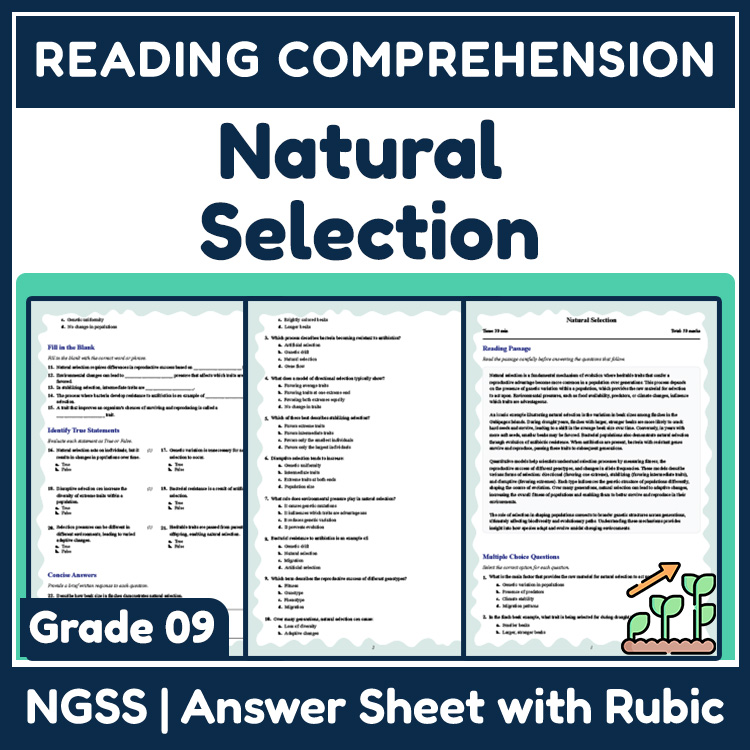
Grade 9 Science | Natural Selection Reading Worksheet (PDF + Answer Key)
JCreated byJ.S SheetsLearning Objectives
- Explain the mechanism of natural selection and how it leads to genetic change in populations.
- Identify examples of natural selection such as beak morphology shifts and bacterial antibiotic resistance.
- Describe the role of genetic variation, inheritance, and environmental pressures in evolution.
Also included in: Grade 9 Science | Evolution & Speciation Unit Worksheet Bundle
Instant download

Citations and Source Use Worksheet for Grade 9 ELA | TEKS Research
Created byGolden Apple StudioLearning Objectives
- Explain how in-text citations connect to a works cited/reference list and maintain consistent attribution.
- Use quotation and paraphrase practices to give appropriate credit while supporting claims with evidence.
- Apply citation formatting conventions for both print and digital sources.
Also included in: Grade 9 ELA Writing & Research Skills Lesson Bundle | TEKS Framework +1 more
Instant download

Grade 9 ELA – Daily Reading Worksheet & Ontario Standards | Rhetorical Questions
 Created byQuiet Forest Education
Learning Objectives
- Identify rhetorical questions within a text
- Analyze the purpose and effect of rhetorical questions
- Differentiate between rhetorical questions and genuine inquiries
Also included in: Writing Grade 9 ELA Daily Reading Worksheets Lesson Bundle | Ontario +1 more
Instant download

Kinematic Equations Worksheets Grade 9 Physics Constant Acceleration
 Created byPrism Point Learning
Learning Objectives
- Calculate velocity using constant-acceleration kinematic equations
- Select equations based on known variables and units
- Apply sign conventions to one-dimensional vertical free-fall
Also included in: Physics: Forces and Energy Lesson Bundle | Grade 9 Science | Ontario +1 more
Instant download

Grade 9 Science Levels of Organization Worksheet | Ontario Biology Activity
 Created byChalk and Compass
Learning Objectives
- Explain hierarchical levels of organization from cells to systems using correct scientific vocabulary.
- Describe how cell specialization and extracellular matrices contribute to emergent organ functions.
- Interpret how tissue arrangement and transport at interfaces affect physiological capacity and constraints.
Also included in: Homeostasis and Human Body Systems Lesson Bundle | Grade 9 Science | Ontario +1 more
Instant download
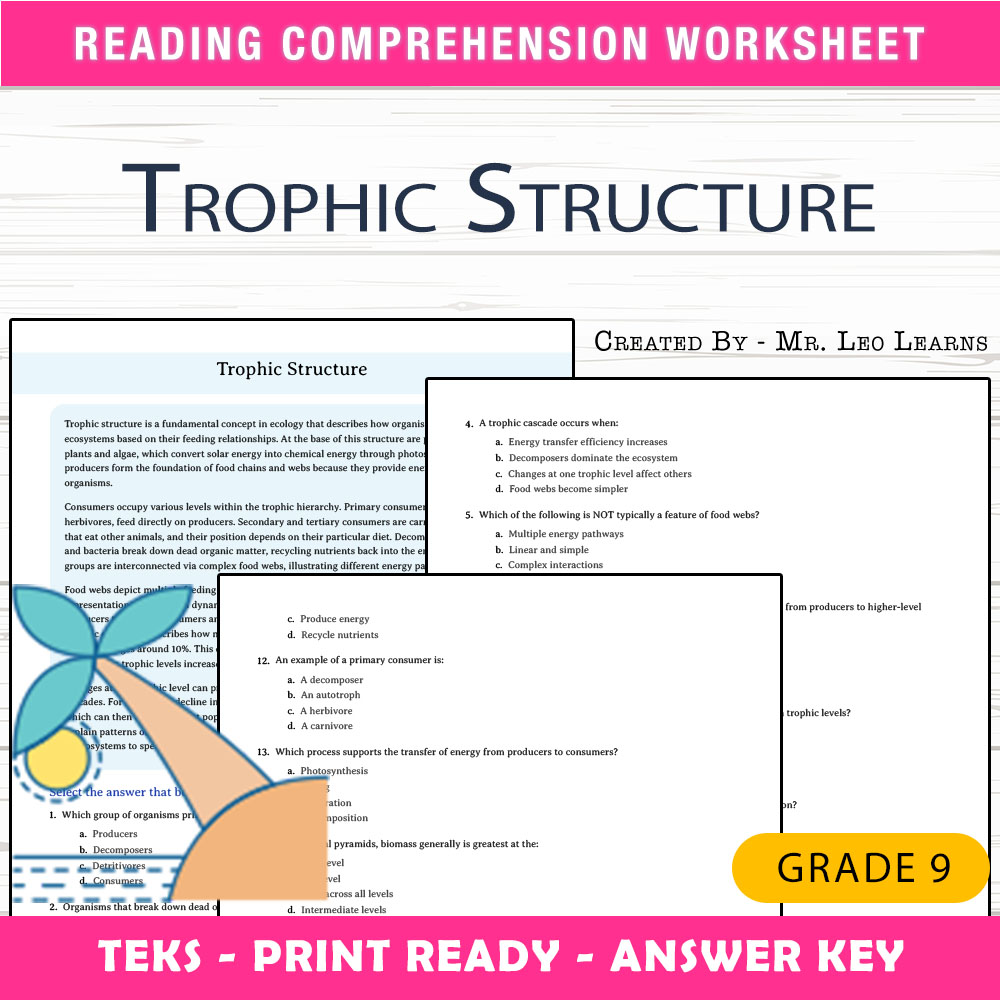
Grade 9 Science — Trophic Structure Worksheet for Mastery
 Created byThe Resource Hub
Learning Objectives
- Explain the components of trophic structure, including producers, consumers, and decomposers.
- Describe the roles of food chains and food webs in illustrating energy flow.
- Analyze how trophic efficiency influences biomass and ecosystem productivity.
Also included in: Grade 9 Science Ecosystems & Biogeochemical Cycles Unit Bundle (Worksheet Pack) +1 more
Instant download

Grade 9 Delivery Refinement Worksheet | Voice, Pacing & Emphasis TEKS
 Created bySunny Desk Resources
Learning Objectives
- Refine a presentation by aligning vocal expression, pacing, and emphasis with the message
- Use controlled pauses at meaningful moments to maintain audience attention
- Evaluate and improve how visual and oral support materials strengthen, not replace, a spoken plan
Instant download

Newton’s Third Law Pairs Worksheet Grade 9 Science NGSSS Physics
 Created byEvergreen Desk Education
Learning Objectives
- Explain Newton’s Third Law using the idea of action–reaction pairs that act on different objects
- Identify forces in a scenario and determine the direction and relative size of the matching third-law force
- Predict how force pairs affect the motion of each object involved
Instant download

Grade 9 Cultural Norms and Health Decisions Worksheet | NHES Health
Created byPrism Point LearningLearning Objectives
- Explain how cultural norms can influence health choices and behaviors.
- Identify examples of health-promoting and health-hindering cultural practices.
- Describe how to use culturally sensitive communication in peer and health settings.
Instant download

Grade 9 Source Integration Worksheet | Research Writing & ELA Skills
Created bySunny Desk ResourcesLearning Objectives
- Identify how summary, paraphrase, and quotation each contribute to source integration in writing.
- Use accurate attribution to show where information and wording come from.
- Connect evidence to the writer’s purpose by adding explanation rather than dropping quotes.
Also included in: Grade 9 Writing Lesson Bundle | ELA | General ELA Framework +1 more
Instant download

Newton’s Second Law Worksheets Grade 9 Force Mass Acceleration
Created byPrism Point LearningLearning Objectives
- Explain the relationship between net force, mass, and acceleration
- Distinguish mass from weight in force and acceleration contexts
- Calculate acceleration from net force and mass
Also included in: Physics: Forces and Energy Lesson Bundle | Grade 9 Science | Ontario +1 more
Instant download

Grade 9 Science – Biological System Hierarchy & Daily Reading Worksheet | NGSS
 Created byBright Mind Resources
Learning Objectives
- Understand key concepts related to Science
- Apply knowledge through practice questions
- Demonstrate comprehension of the material
Also included in: Grade 9 Cell Systems Science Daily Reading Lesson Bundle | NGSS +2 more
Instant download

Magnetic Fields Worksheets | Field Mapping Grade 9 Science
Created bySunny Desk ResourcesLearning Objectives
- Explain how magnets and moving electric charges create magnetic fields
- Use field line orientation to predict force direction on magnetic materials
- Relate current direction in a wire to magnetic field direction using right-hand rules
Also included in: Grade 9 Electricity & Magnetism Lesson Bundle | Alberta Science +1 more
Instant download

Character Development Worksheet Pack | Grade 9 ELA Practice
Created bySunny Desk ResourcesLearning Objectives
- Analyze how a character’s actions and relationships reveal traits and evolve over time
- Explain how internal and external forces shape a character’s motivation, beliefs, and moral choices
- Use evidence from key moments to interpret character growth or contradiction
Also included in: Grade 9 Theme, Choices & Character Development Lesson Bundle | CCSS ELA +1 more
Instant download

World Food Day Global Food Systems Worksheet Grade 9 | PDF + Key
 Created byShaNova Worksheets
Learning Objectives
- Explain how global trade and policies influence what foods people can access.
- Describe how food supply chains connect farms, processing, shipping, and markets.
- Analyze how climate change can affect food availability in different regions.
Instant download

Grade 9 Audience Media Creation Worksheet | Ontario ELA Media Literacy Activity
 Created byLumora Learning
Learning Objectives
- Analyze how audience needs influence message format, tone, vocabulary, and evidence.
- Evaluate statements about persuasive and informational media choices.
- Identify rhetorical and design strategies that improve clarity for a specific audience.
Instant download

Grade 9 Textual Evidence Worksheet | CCSS Reading Comprehension Activity
Created bySunny Desk ResourcesLearning Objectives
- Identify strong textual evidence by using specific details (exact quotations, paraphrases, and precise references).
- Explain how evidence supports a claim by describing the effect of wording in a scene’s reasoning and conflict.
- Differentiate between general impressions and evidence-based reasoning.
Also included in: Grade 9 Theme, Choices & Character Development Lesson Bundle | CCSS ELA +1 more
Instant download
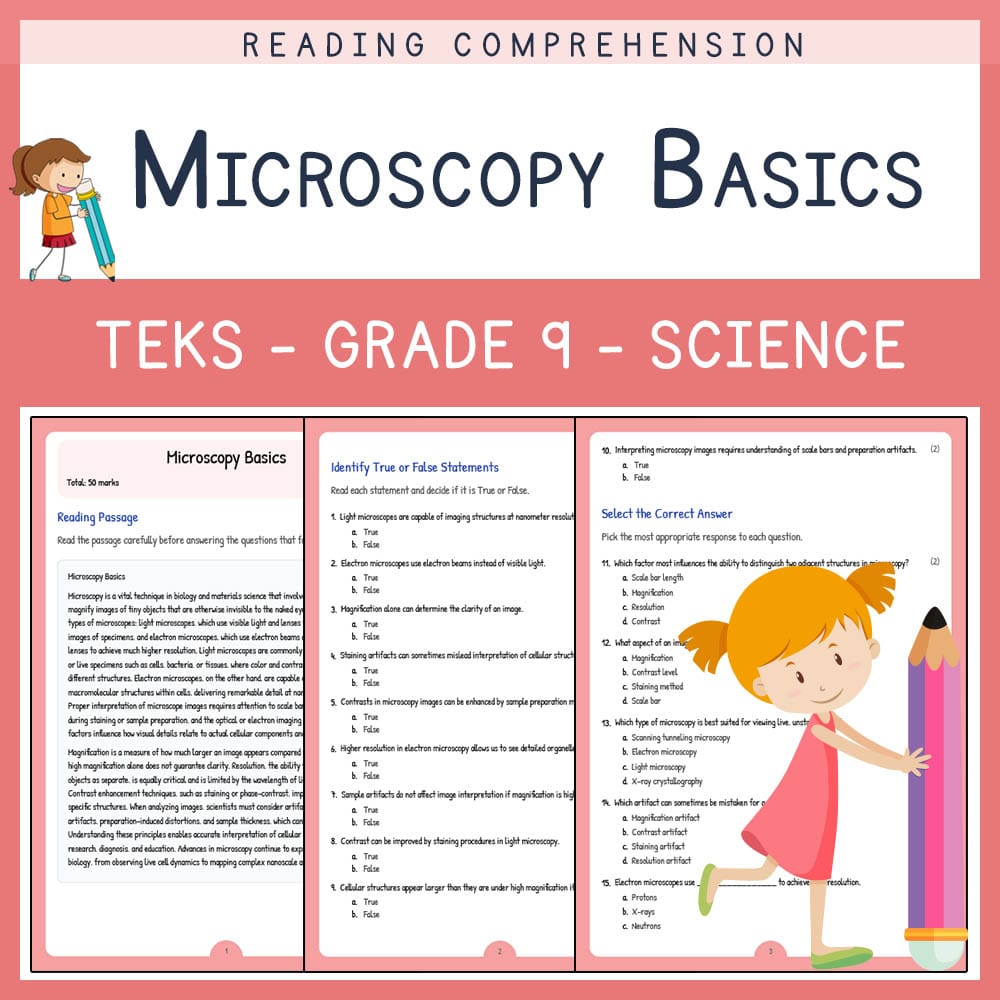
Grade 9 Science | Microscopy Basics Worksheet | TEKS Aligned
Created byLumora LearningLearning Objectives
- Understand the fundamental principles of optical and electron microscopy.
- Identify differences between magnification, resolution, and contrast in microscopes.
- Explain how image interpretation depends on scale bars, staining, and sample preparation.
Also included in: Grade 9 Science | Cell Structure & Function Lesson Bundle | TEKS Aligned
Instant download
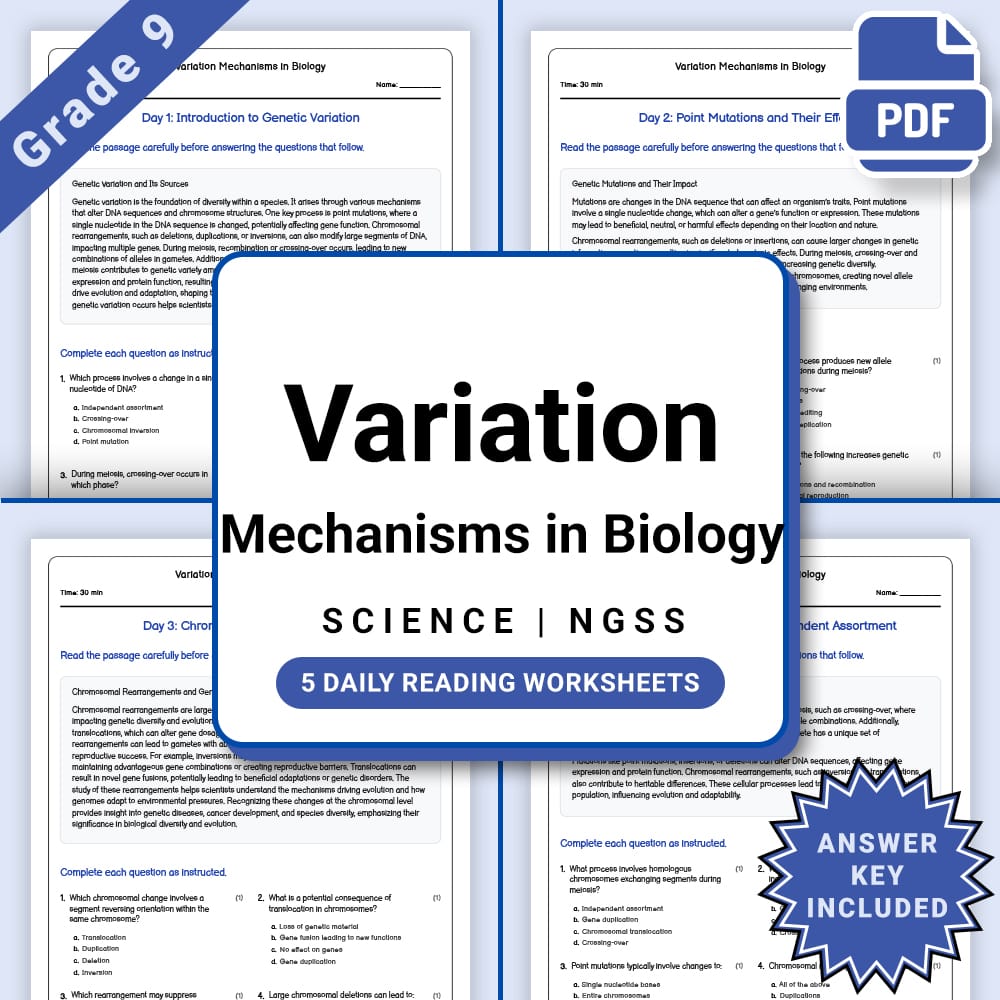
Grade 9 Science – Variation Mechanisms Worksheet(PDF + Answer Key)
 Created byCopper Leaf Classroom
Learning Objectives
- Understand key concepts related to Science
- Apply knowledge through practice questions
- Demonstrate comprehension of the material
Instant download

Grade 9 Error Sources Worksheet | AP Practice & PDF
 Created byClear Sky Classroom
Learning Objectives
- Identify common sources of random and systematic error in scientific investigations.
- Distinguish between confounding and model mis-specification, and explain how each can affect results.
- Use evidence from cross-method comparisons, residual patterns, and sensitivity analyses to evaluate bias.
Also included in: Grade 9 Science Practices Science Lesson Bundle | Advanced Placement (AP) +1 more
Instant download
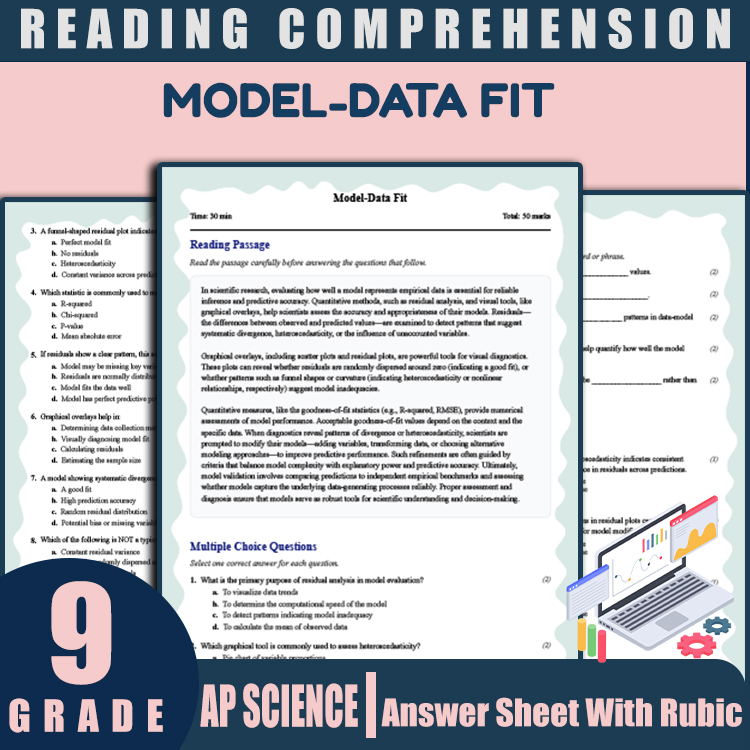
Grade 9 Science | Model-Data Fit Reading Worksheet (PDF + Rubric)
JCreated byJ.S SheetsLearning Objectives
- Explain the purpose of assessing model-data fit in scientific analysis.
- Identify graphical and quantitative methods used to evaluate the consistency between models and observations.
- Interpret residual plots and goodness-of-fit measures to diagnose potential issues in models.
Instant download

Grade 9 Science — Worksheet MCQ Paper for Mastering Spheres Connectivity
Created byThe Resource HubLearning Objectives
- Explain the interactions among the geosphere, hydrosphere, atmosphere, and biosphere using conceptual models.
- Identify key processes such as riverine nutrient transport, soil-atmosphere gas fluxes, and ocean upwelling effects.
- Understand how spatial schematics and mass-balance thinking help interpret environmental system feedbacks.
Also included in: Grade 9 Earth and Space Sciences AP Bundle | Science Worksheets and Activities +1 more
Instant download

Grade 9 Understanding Orbital Motion Worksheet | NGSS Space Science Activity
 Created byBRIGHT PATH RESOURCES
Learning Objectives
- Explain the basic principles of orbital motion
- Describe how gravity influences planetary and satellite trajectories
- Interpret Kepler's laws and Newton's law of universal gravitation
Also included in: Space Science Evolution & Timescales Daily Reading Grade 9 Lesson Bundle | NGSS +1 more
Instant download

Audience Purpose Language Worksheet Grade 9 ELA Ontario Writing Skills
Created bySunny Desk ResourcesLearning Objectives
- Explain how audience, purpose, and context affect word choice and tone in oral communication.
- Identify the level of formality and appropriate vocabulary for different listeners and situations.
- Revise a message to better match a new audience while keeping the original meaning.
Instant download

Theme and Choices Worksheet | CCSS Grade 9 Literary Analysis Activity
Created bySunny Desk ResourcesLearning Objectives
- Identify a text’s theme by analyzing how character decisions shape conflict and meaning.
- Explain how an author’s structural choices (pacing, conflict progression, and character development) support a central idea.
- Use evidence from a passage to justify how repeated choices and patterns clarify the author’s message.
Also included in: Grade 9 Theme, Choices & Character Development Lesson Bundle | CCSS ELA +1 more
Instant download

Grade 9 Science – Milankovitch Cycles & Earth's Climate | Reading Worksheet
Created byBright Mind ResourcesLearning Objectives
- Understand the basic concepts of Earth's orbital variations.
- Learn how Milankovitch cycles influence Earth's climate over long timescales.
- Identify the three main components of Milankovitch cycles: eccentricity, axial tilt, and precession.
Also included in: Grade 9 Earth Systems Science Daily Reading Worksheets Lesson Bundle | BC +1 more
Instant download

Structural Patterns
Created bySunny Desk ResourcesLearning Objectives
- Analyze how an author’s structural choices (ordering, divisions, and recurring patterns) shape meaning and impact.
- Explain how pacing and delayed revelations create suspense and guide readers’ interpretations.
- Connect specific moments in a text to the overall structure to support a claim about theme or effect.
Also included in: Grade 9 Theme, Choices & Character Development Lesson Bundle | CCSS ELA +1 more
Instant download

Rhetorical Style Worksheet for Grade 9 ELA | TEKS Literary Analysis
Created byGolden Apple StudioLearning Objectives
- Identify how tone, voice, and diction change based on audience and genre in writing.
- Explain how rhetorical choices build credibility by connecting claims to evidence and reasoning.
- Revise sentences to improve clarity, formality, and transitions across paragraphs.
Also included in: Grade 9 ELA Writing & Research Skills Lesson Bundle | TEKS Framework +1 more
Instant download

Grade 9 Science Orbital Interactions Worksheet | Seasons, Tides & Climate
Created byChalk and CompassLearning Objectives
- Explain how eccentricity, axial tilt, and precession affect seasonal insolation patterns.
- Describe tidal forcing by the Moon and Sun using ideas of gravitational gradients and relative geometry.
- Connect tidal locking, resonance, and observational effects such as day length and tidal range.
Also included in: Earth Systems & Space Lesson Bundle – Grade 9 Science Ontario Framework +1 more
Instant download

Source Credibility Worksheet | Grade 9 ELA | Standards-Aligned Practice
JCreated byJ.S SheetsLearning Objectives
- Evaluate source credibility by analyzing evidence quality, citations, author expertise, and accuracy checks.
- Determine source relevance by judging whether information directly fits the research purpose and remains timely and appropriate.
- Use credibility and relevance criteria to decide when to trust, question, or avoid a source.
Instant download

Grade 9 Science – Ecosystem Change & Resilience | Daily Reading Worksheet
Created byBright Mind ResourcesLearning Objectives
- Understand the components that make up an ecosystem.
- Recognize how disturbances can alter ecosystem stability.
- Learn about factors that influence ecosystems' ability to recover.
Also included in: Cells Genetics & Ecosystems Grade 9 Science Reading Lesson Bundle | General +1 more
Instant download

Grade 9 Science | Orbital Interactions & Seasons - Reading Practice
 Created byCoral Reef Learning
Learning Objectives
- Explain how Earth's eccentricity influences seasonal weather patterns.
- Identify the effects of axial tilt on the distribution of sunlight during different seasons.
- Describe the concept of precession and its impact on long-term climate variability.
Instant download
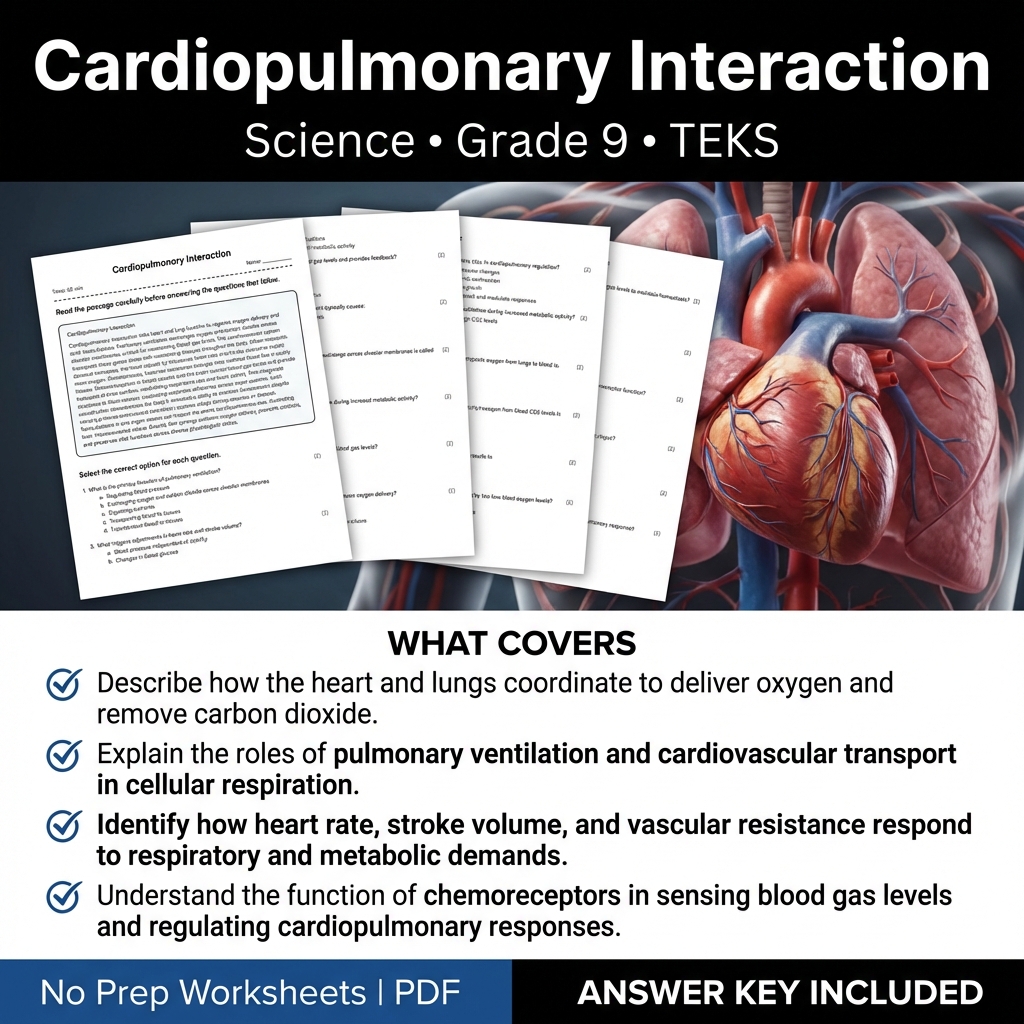
Grade 9 Science Worksheet on Cardiopulmonary Interaction TEKS
Created byCoral Reef LearningLearning Objectives
- Describe how the heart and lungs coordinate to deliver oxygen and remove carbon dioxide.
- Explain the roles of pulmonary ventilation and cardiovascular transport in cellular respiration.
- Identify how heart rate, stroke volume, and vascular resistance respond to respiratory and metabolic demands.
Instant download

Homeostasis Feedback Mechanisms Worksheet Grade 9 Science Activity
Created byEvergreen Desk EducationLearning Objectives
- Explain what homeostasis is and identify regulated variables and set points.
- Describe how negative feedback mechanisms reduce deviations and restore balance.
- Apply homeostasis feedback ideas to real-life examples (temperature, blood glucose, oxygen delivery).
Instant download

Grade 9 Cross Text Connections Worksheet | Ontario ELA Analysis Skills
Created bySunny Desk ResourcesLearning Objectives
- Compare themes and character or speaker responses across two texts using specific evidence.
- Explain why similarities or differences between texts matter to interpretation.
- Connect ideas across texts to personal experience or society while staying anchored in concrete details.
Instant download
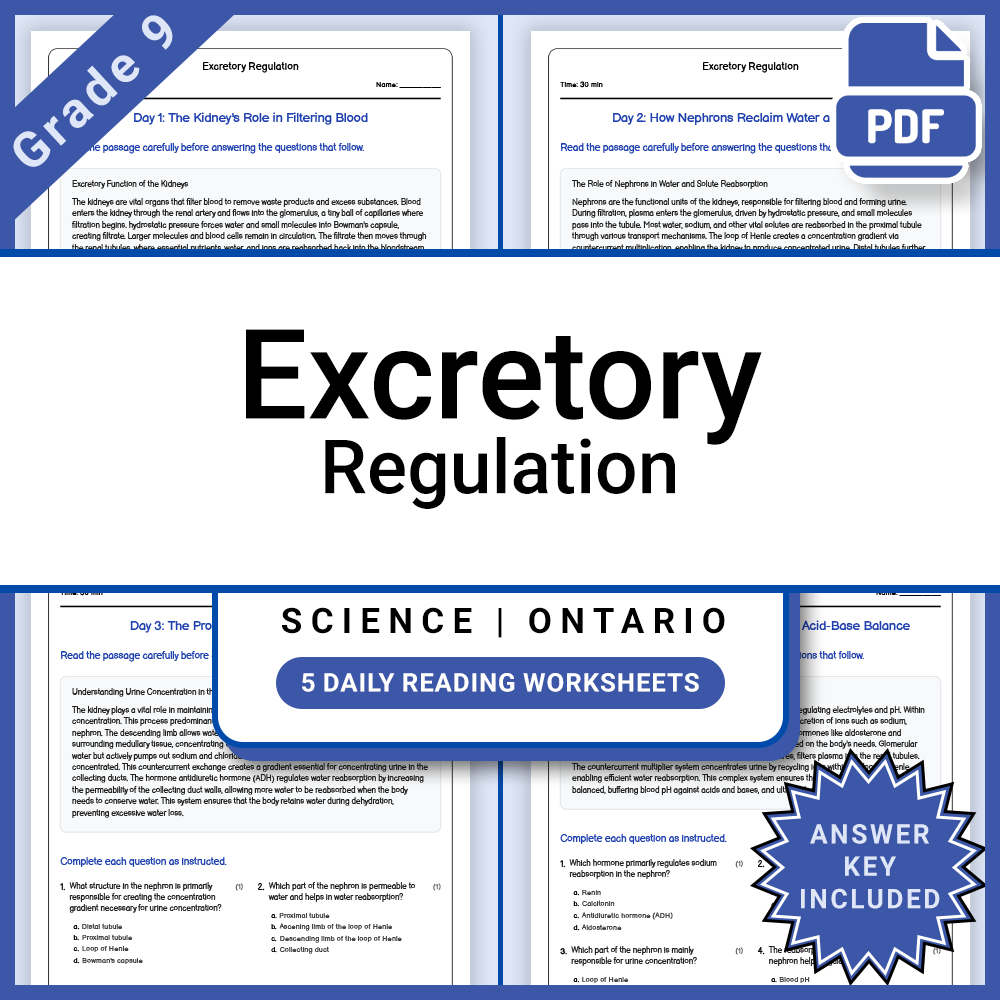
Grade 9 Science – Excretory Regulation Daily Reading Worksheet + Answer Key
JCreated byJ.S SheetsLearning Objectives
- Understand the structure and function of the nephron and glomerulus
- Explain the processes of blood filtration, reabsorption, secretion, and urine concentration
- Describe how the kidney regulates electrolytes, pH, and blood pressure
Also included in: Grade 9 Science Lesson Group | Human Body Systems, Environment & Energy +1 more
Instant download

Grade 9 Science – Cosmic Timescales & Universe Expansion |Reading Worksheet
Created byBright Mind ResourcesLearning Objectives
- Describe observational evidence supporting the expanding universe
- Explain the significance of cosmic microwave background measurements
- Understand how redshift surveys relate to galaxy motion
Also included in: Astronomy Grade 9 Science Daily Reading Worksheets Bundle | NGSS +2 more
Instant download

Coherent Argument Worksheet | Ontario Standard Grade 9 ELA Practice PDF
JCreated byJ.S SheetsLearning Objectives
- Identify the controlling idea and explain how reasons support a claim in a coherent argument
- Evaluate whether evidence directly connects to the reason it is meant to support
- Use transitions to show logical movement between paragraphs and ideas
Instant download

Grade 9 ELA – Explanation & Evidence in Argumentative Writing | Daily Worksheet
Created byQuiet Forest EducationLearning Objectives
- Define the purpose of explanations in connecting evidence to ideas.
- Identify reasoning patterns used to support claims.
- Distinguish between evidence and reasoning in a text.
Also included in: Grade 9 Writing and Representing ELA Lesson Bundle for Alberta Standards +1 more
Instant download

Grade 9 ELA – Analyzing Character Clues & Making Inferences | Daily Worksheet
Created byQuiet Forest EducationLearning Objectives
- Identify textual clues that reveal character feelings and motives.
- Use evidence from dialogue and actions to make inferences.
- Develop critical thinking skills by connecting details to character motivations.
Also included in: Reading and Viewing Lesson Bundle | Grade 9 ELA | BC Standards +1 more
Instant download

Enzyme Basics Worksheet | TEKS Grade 9 Science Practice and Assessment
JCreated byJ.S SheetsLearning Objectives
- Explain how enzymes lower activation energy to increase reaction rates
- Describe how enzyme structure, active sites, and induced fit support substrate specificity
- Compare the roles of cofactors and coenzymes in enzyme-catalyzed reactions
Instant download

Grade 9 Science | Volcanic Processes Worksheet | AP Aligned
Created byLumora LearningLearning Objectives
- Understand the different types of magmatic systems and eruptive styles.
- Explain how compositional controls influence volcanic gas emissions and landscape modifications.
- Differentiate between effusive shield volcanism and explosive stratovolcano behavior based on magma viscosity and volatile content.
Also included in: Grade 9 Science | Earth and Space Science Custom Bundle | AP Aligned
Instant download
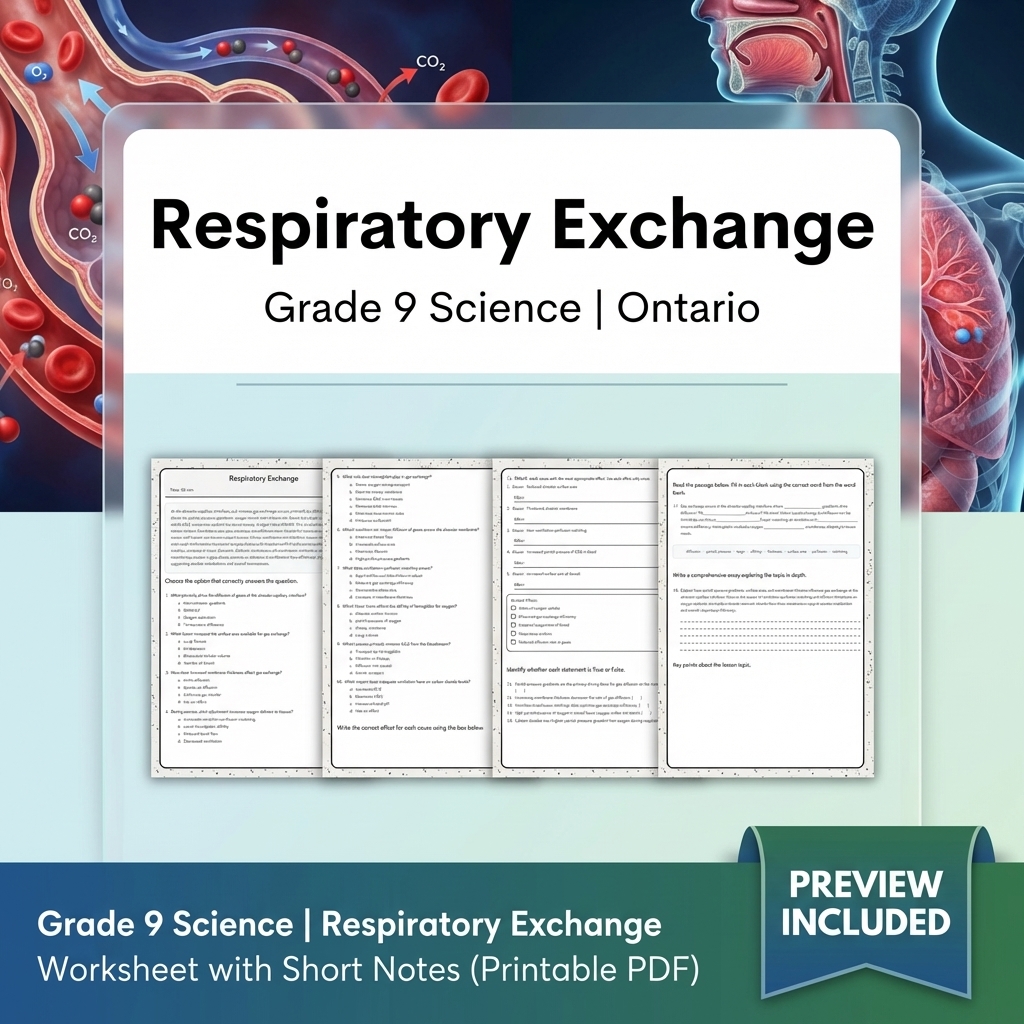
Grade 9 Science | Respiratory Exchange Worksheet with Short Notes
 Created byMeadowlark Worksheets
Learning Objectives
- Explain the process of pulmonary gas exchange at the alveolar–capillary interface.
- Describe how partial pressures, surface area, and membrane thickness influence diffusion of gases.
- Identify factors affecting oxygen uptake and carbon dioxide removal, including haemoglobin affinity and perfusion.
Instant download

Rhetorical Devices Worksheet for Grade 9 ELA | Standards-Aligned Practice
JCreated byJ.S SheetsLearning Objectives
- Identify common rhetorical devices (repetition, contrast, figurative language, and sentence rhythm) and explain how they affect a reader.
- Analyze how rhetorical choices support an author’s purpose while maintaining clarity through correct syntax and punctuation.
- Revise or evaluate writing for effectiveness by checking whether devices align with the thesis and enhance meaning.
Instant download

Grade 9 Mechanical Energy Worksheet | NGSS Science Activity & Notes
Created byBRIGHT PATH RESOURCESLearning Objectives
- Understand the concepts of kinetic and potential energy
- Learn how energy transforms and conserves in mechanical systems
- Identify examples of energy transfer such as in pendulums and roller coasters
Also included in: Energy Conservation Grade 9 Science Daily Reading Lesson Bundle | NGSS +1 more
Instant download

Grade 9 Science | Measurement Accuracy in Science - Daily Reading Comprehension
Created byCoral Reef LearningLearning Objectives
- Understand the concept of significant figures and their importance in measurements
- Identify significant figures in various measurement readings
- Learn how to convert measurement units accurately
Instant download
Browse more categories
About Grade 9 Worksheets
Browse 9,323 printable Grade 9 worksheets across algebra, biology, literature, and history — each a ready-to-print PDF with optional answer keys.
Every worksheet on MyTeachingSheets is created by independent teacher-authors and reviewed before publication. All resources download as printable PDFs for classroom, homework, or at-home practice, and many include answer keys. Preview any worksheet free before buying.