
Grade 9 Worksheets
9,323 grade resources
Grade 9 Science | Reproductive Modes - Daily Reading Comprehension
 Created byCoral Reef Learning
Learning Objectives
- Identify different reproductive strategies: sexual and asexual
- Understand how organisms reproduce via various methods
- Compare advantages and disadvantages of each reproductive mode
Also included in: Reproduction and Heredity Lesson Bundle | Grade 9 Science | Alberta +1 more
Instant download
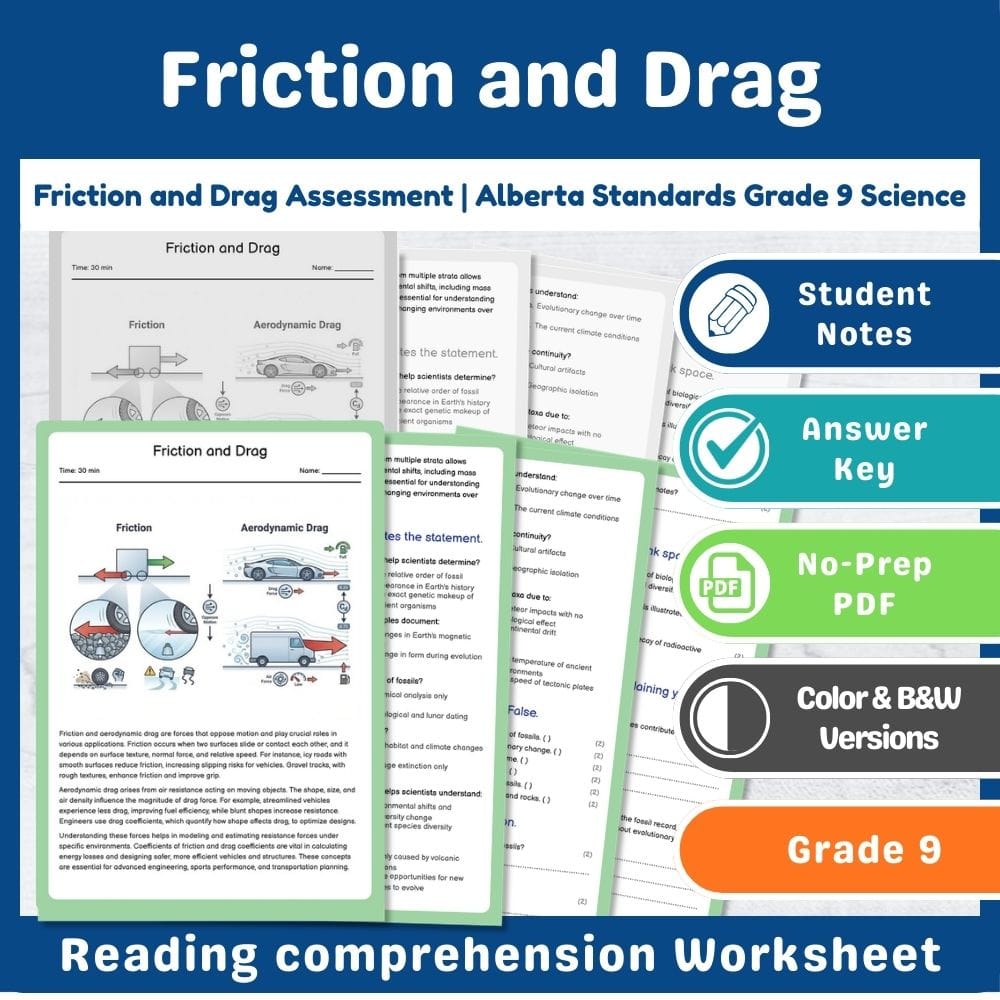
Friction and Drag Assessment | Alberta Standards Grade 9 Science
 Created byPrism Point Learning
Learning Objectives
- Explain how friction and aerodynamic drag oppose motion and convert mechanical energy into thermal energy.
- Describe the factors affecting friction on icy roads and gravel tracks.
- Identify the variables influencing aerodynamic drag on various structures.
Also included in: Grade 9 Forces and Motion Science Lesson Bundle Alberta Framework +1 more
Instant download
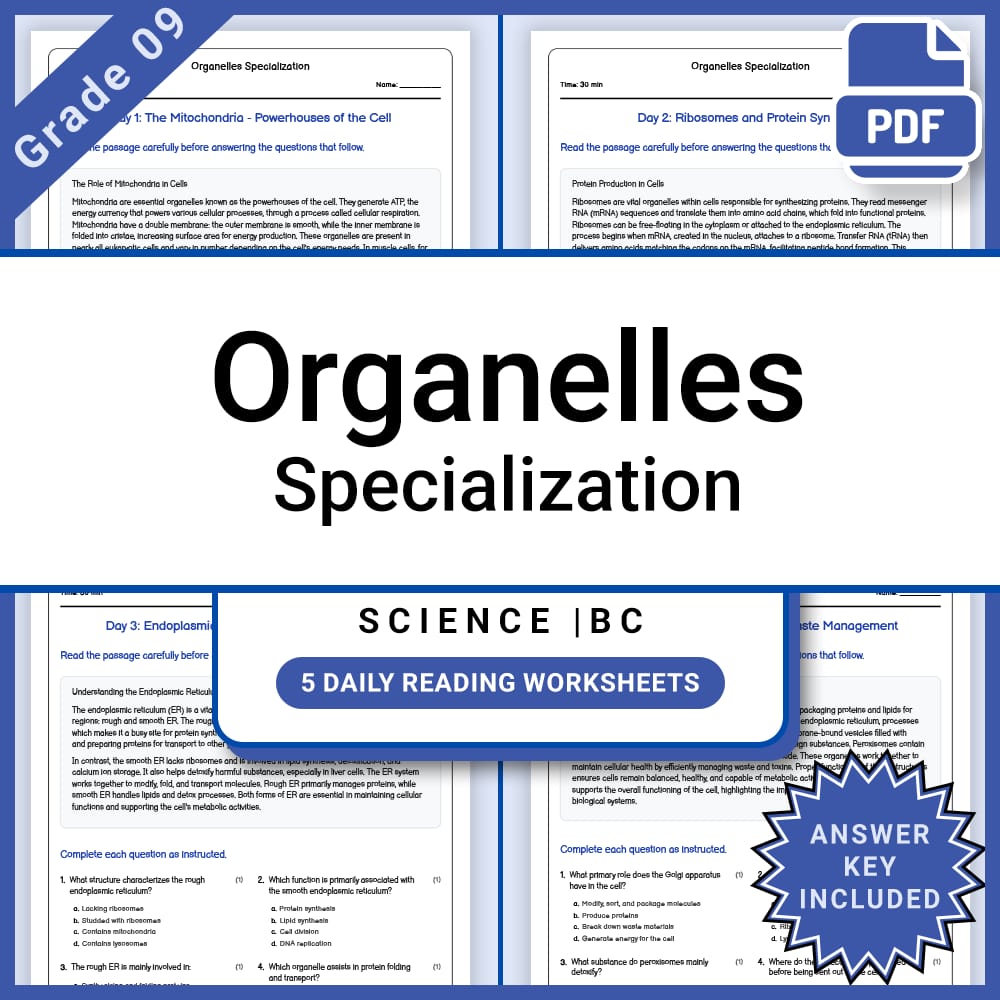
Grade 9 Science – Organelles Specialization Daily Reading Worksheet + Answer Key
JCreated byJ.S SheetsLearning Objectives
- Understand the structure and function of key organelles in eukaryotic cells.
- Identify the role of mitochondria in energy production.
- Explain how different organelles work together to maintain cellular function.
Also included in: Grade 9 Science Lesson Group Bundle | BC Framework Activities & Worksheets +1 more
Instant download
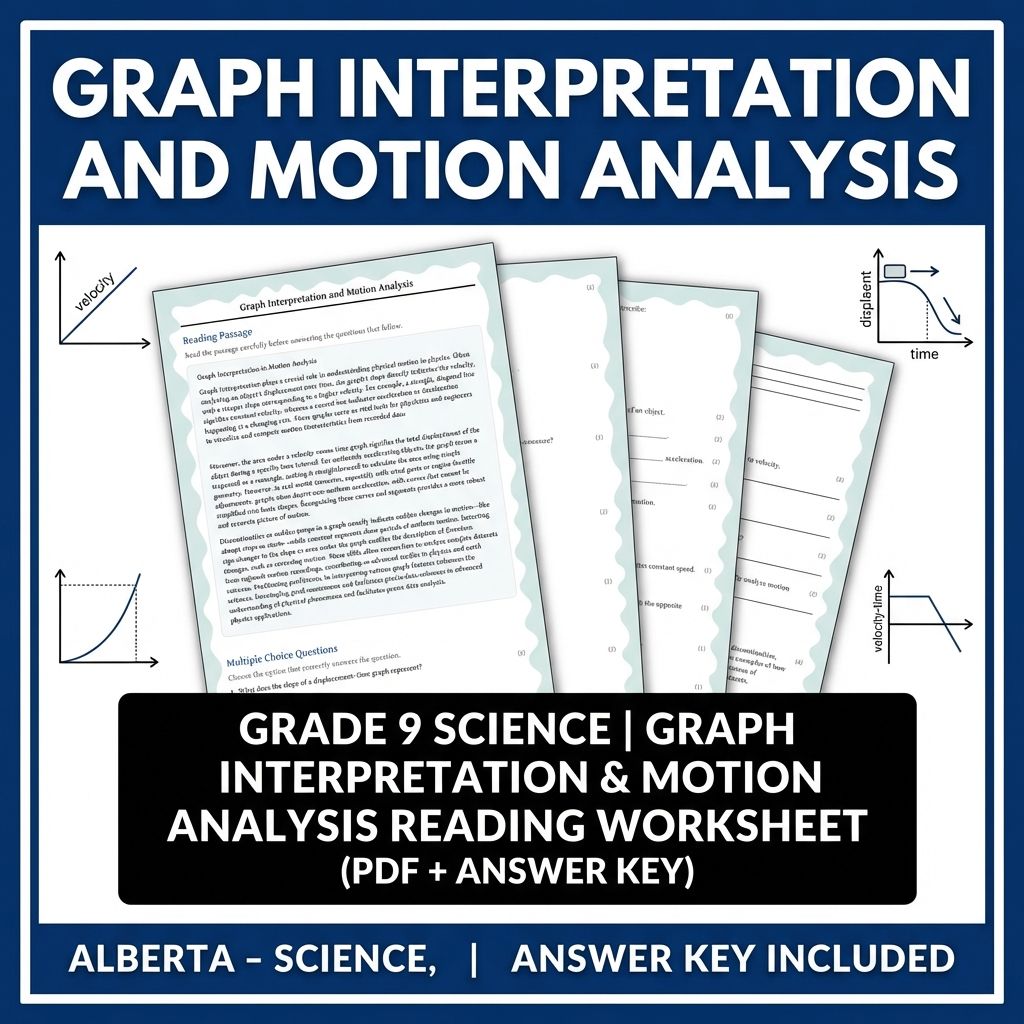
Grade 9 Science | Graph Interpretation & Motion Analysis (PDF + Answer Key)
JCreated byJ.S SheetsLearning Objectives
- Understand how the slope of displacement-time, velocity-time graphs relates to physical motion parameters.
- Interpret the area under a velocity-time graph to determine displacement.
- Identify curved graphs indicating non-uniform acceleration and understand their physical causes.
Also included in: Grade 9 Science Unit Bundle | Motion, Forces & Energy Activities (PDF) +1 more
Instant download

Grade 9 Math – Efficient Computation Worksheet (Ontario) (PDF)
 Created byClear Sky Classroom
Learning Objectives
- Develop strategies for performing calculations efficiently with integers, fractions, decimals, and percentages.
- Apply mental math and pattern recognition techniques to solve mathematical problems quickly.
- Use technological tools appropriately to interpret numerical outputs in real-world contexts.
Also included in: Grade 9 Math Number Bundle – Ontario Standards & Key Concepts +1 more
Instant download

Grade 9 Mechanical Energy Worksheet | NGSS Practice PDF
Created byClear Sky ClassroomLearning Objectives
- Understand the concepts of kinetic and potential energy in mechanical systems.
- Apply the work-energy theorem to analyze energy transfer in various phenomena.
- Explore the effects of non-conservative forces like friction on energy conservation.
Also included in: Grade 9 Energy Transformations Science Lesson Bundle Worksheets | NGSS +1 more
Instant download
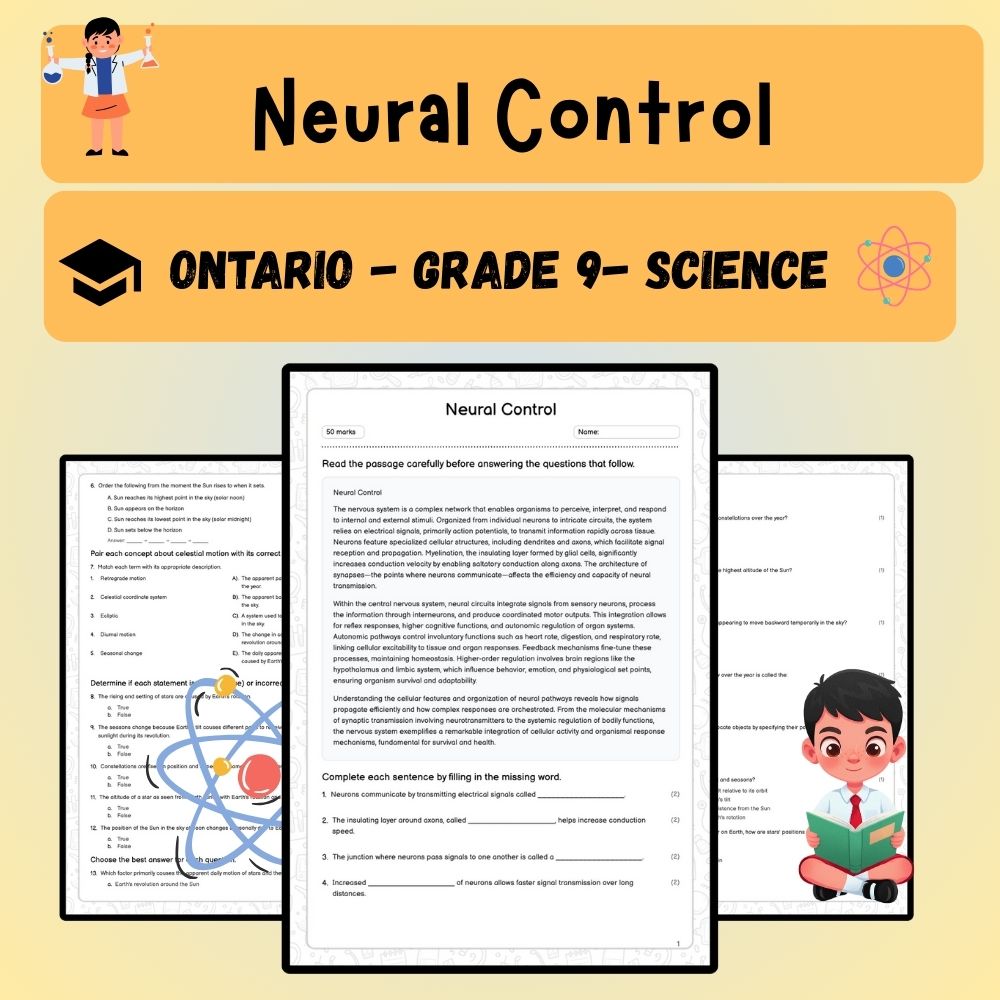
Grade 9 Science | Neural Control Worksheet (PDF) — Ontario Standard Practice
Created byPrism Point LearningLearning Objectives
- Understand the organization of the nervous system from neurons to neural circuits and central integration.
- Explain how action potentials and synaptic transmission propagate signals along neurons.
- Relate cellular features like myelination and synaptic architecture to conduction velocity and processing capacity.
Also included in: Grade 9 Science Unit Bundle | Human Body Systems & Cell Functions +1 more
Instant download
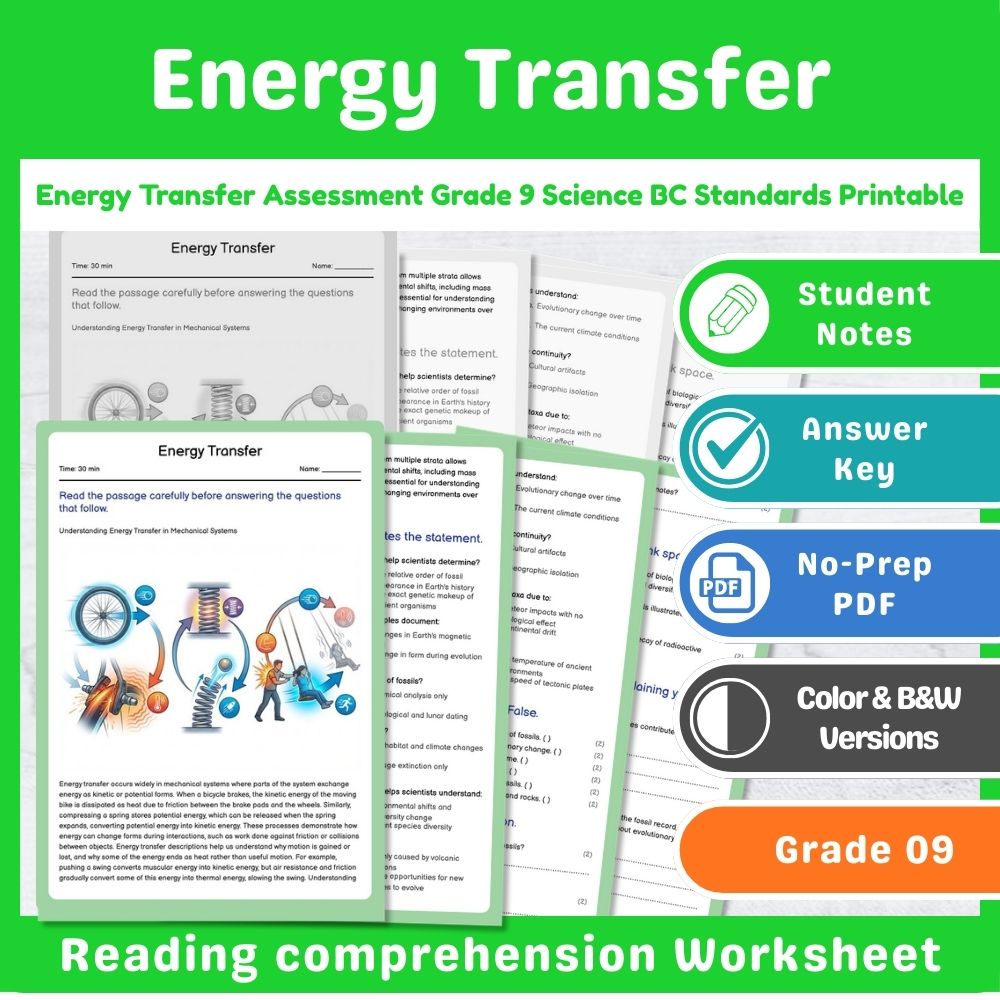
Energy Transfer Assessment Grade 9 Science BC Standards Printable
Created byPrism Point LearningLearning Objectives
- Explain how mechanical systems transfer energy through work, collisions, and friction.
- Describe how energy is gained or lost in moving systems and why some energy converts to heat.
- Analyze real-world examples like braking a bicycle or compressing a spring to understand energy pathways.
Instant download
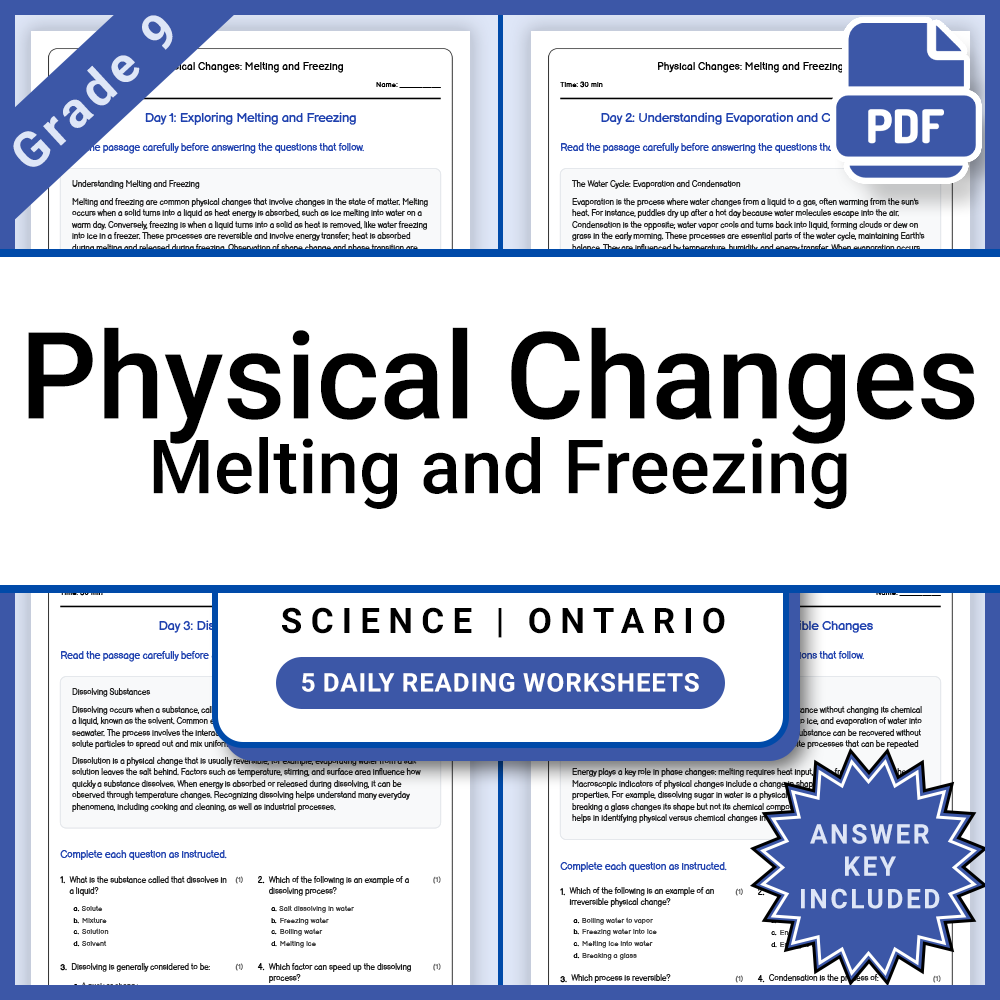
Grade 9 Science – Physical Changes Melting and Freezing Worksheet + Answer Key
JCreated byJ.S SheetsLearning Objectives
- Understand the processes of melting and freezing as examples of physical changes
- Identify reversible physical transformations and their indicators
- Describe how energy transfer occurs during phase changes
Also included in: Grade 9 Science Lesson Group: Ontario Curriculum Daily Reading Worksheets +1 more
Instant download

Collision Safety Worksheet | Grade 9 Science Printable PDF & Assessment
Learning Objectives
- Understand the principles of impulse and force-time relationships in collisions.
- Analyze the effectiveness of various crash mitigation strategies like crumple zones and airbags.
- Interpret force‑time graphs to evaluate impact forces during collisions.
Also included in: Grade 9 Science: Motion and Stability Forces and Interactions Lesson Bundle +1 more
Instant download

Grade 9 Science | Molecular Geometry Worksheet | BC Aligned
 Created byLumora Learning
Learning Objectives
- Understand the principles governing molecular shape based on electron pair repulsion.
- Identify common molecular geometries such as linear, trigonal planar, tetrahedral, and bent.
- Explain how molecular shape influences polarity and intermolecular forces.
Instant download
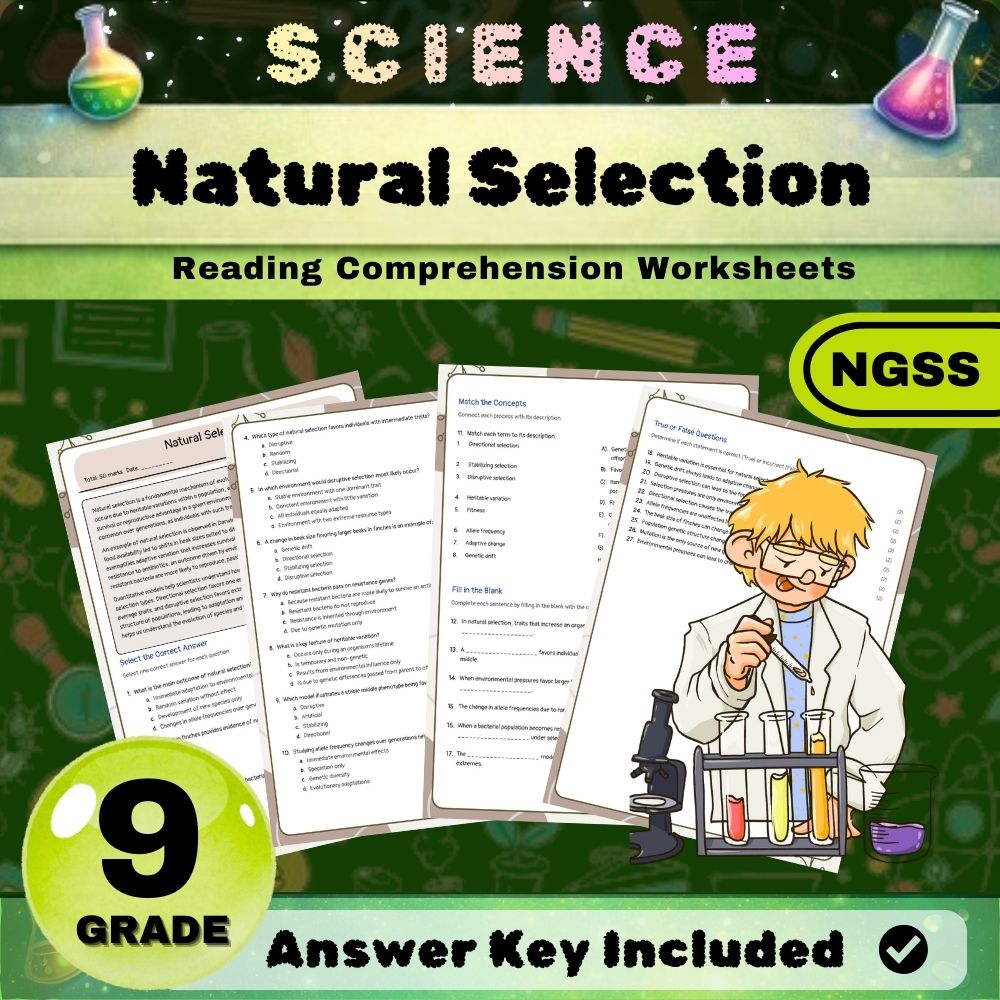
Grade 9 Science | Natural Selection Worksheet (NGSS) (PDF)
 Created byMaple Path Learning
Learning Objectives
- Explain how heritable variation leads to differential survival and reproduction in populations.
- Describe examples of natural selection such as beak morphology in finches and bacterial antibiotic resistance.
- Use models to understand types of selection: directional, stabilizing, and disruptive.
Also included in: Grade 9 Science Lesson Bundle | Biological Evolution: Unity & Diversity +1 more
Instant download
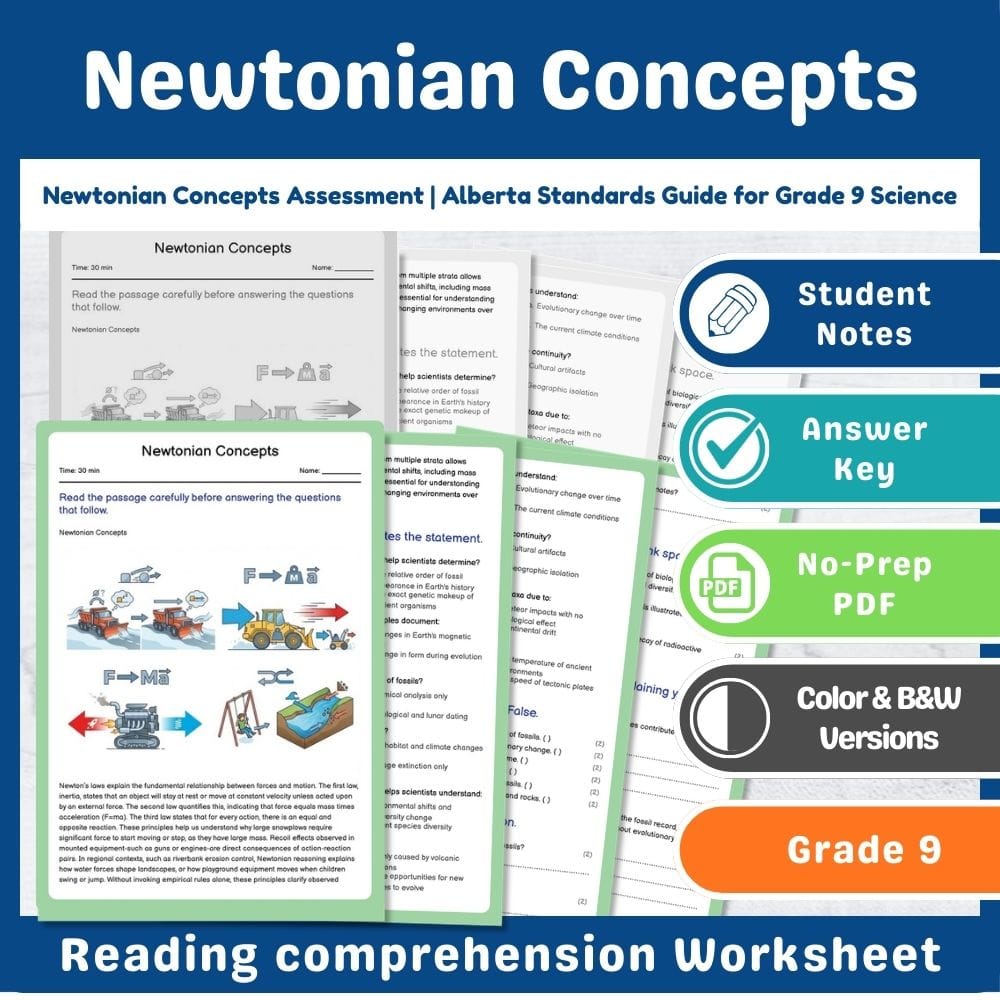
Newtonian Concepts Assessment | Alberta Standards Guide for Grade 9 Science
Created byPrism Point LearningLearning Objectives
- Understand Newton's three laws of motion and their practical implications.
- Identify real-world examples demonstrating Newtonian principles.
- Explain how forces influence motion in common regional contexts.
Also included in: Grade 9 Forces and Motion Science Lesson Bundle Alberta Framework +1 more
Instant download
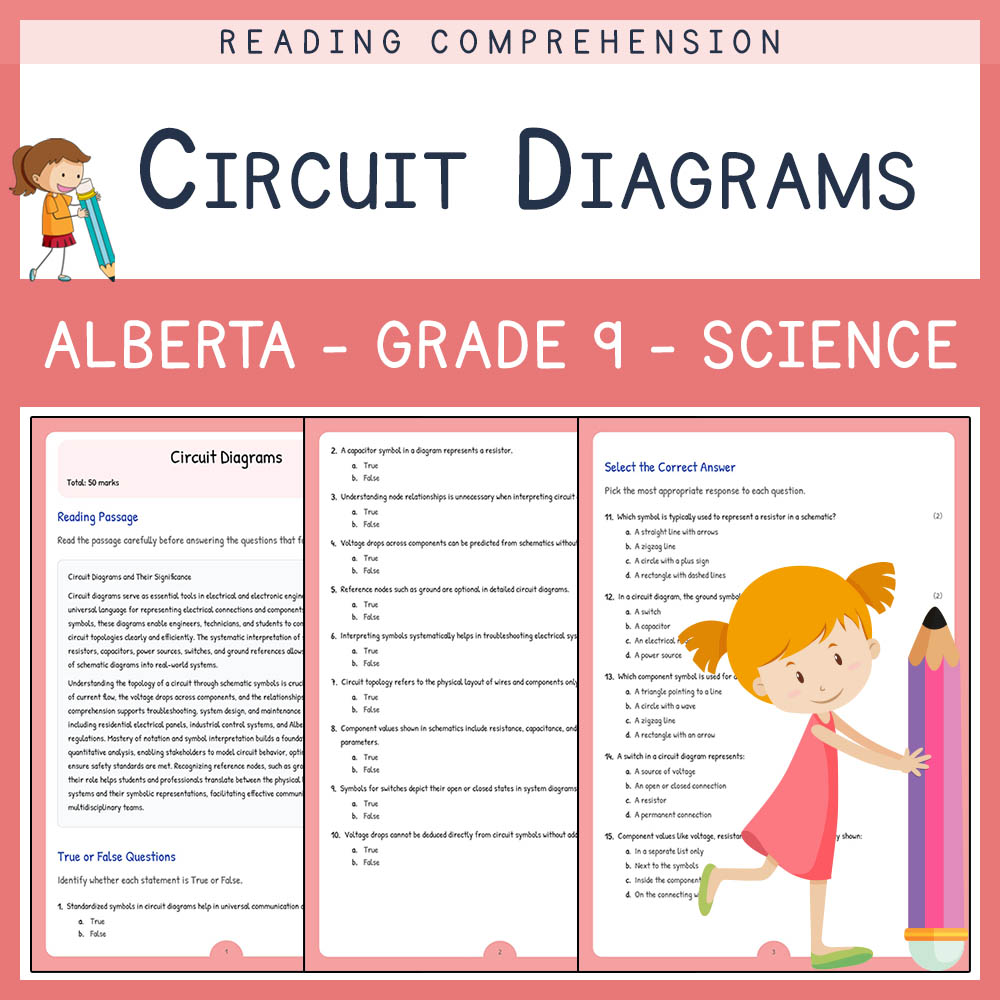
Grade 9 | Circuit Diagrams Worksheet | Alberta Standards
Created byLumora LearningLearning Objectives
- Understand and interpret standardized symbols used in circuit diagrams.
- Identify the relationship between circuit symbols and physical components.
- Translate schematic representations into physical systems and vice versa.
Instant download

Producers & Consumers in Ecosystems Worksheet | Grade 9 NGSS Ecology
 Created byBRIGHT PATH RESOURCES
Learning Objectives
- Understand the process of photosynthesis and how it contributes to energy flow in ecosystems.
- Identify key factors affecting photosynthesis rates and biomass accumulation.
- Explain the importance of producers like plants and algae in cycling carbon and oxygen.
Also included in: Ecosystems Grade 9 Science Daily Reading Worksheets Lesson Bundle | NGSS +1 more
Instant download

Grade 9 Science – Chemical Properties & Reactions | Daily Reading Worksheet
 Created byQuiet Forest Education
Learning Objectives
- Understand the concept of chemical properties and how they differ from physical properties
- Identify examples of chemical properties such as flammability, reactivity, oxidation, and stability
- Learn to observe indicators of chemical change including formation of new substances, gas evolution, precipitates, and color change
Also included in: Matter and Chemical Change Grade 9 Science Daily Worksheets Bundle | Ontario +1 more
Instant download

Grade 9 Science | Two-Dimensional Motion Worksheet | AP Aligned
Created byLumora LearningLearning Objectives
- Understand how vector decomposition helps analyze motion in a plane.
- Apply parametric equations to describe projectile trajectories.
- Use vector addition to predict range, maximum height, and time-of-flight.
Also included in: Grade 9 Science | Physics Principles Science Custom Bundle | AP Aligned
Instant download

Grade 9 Model From Table Worksheet | Common Core Functions & Algebra
Created byBRIGHT PATH RESOURCESLearning Objectives
- Identify the input and output variables from a table of reliable data pairs.
- Construct an explicit functional rule that matches the pattern in a table.
- Use the rule to predict output values for new inputs.
Also included in: Functions & Function Operations Lesson Bundle | Grade 9 Maths | Common Core +1 more
Instant download
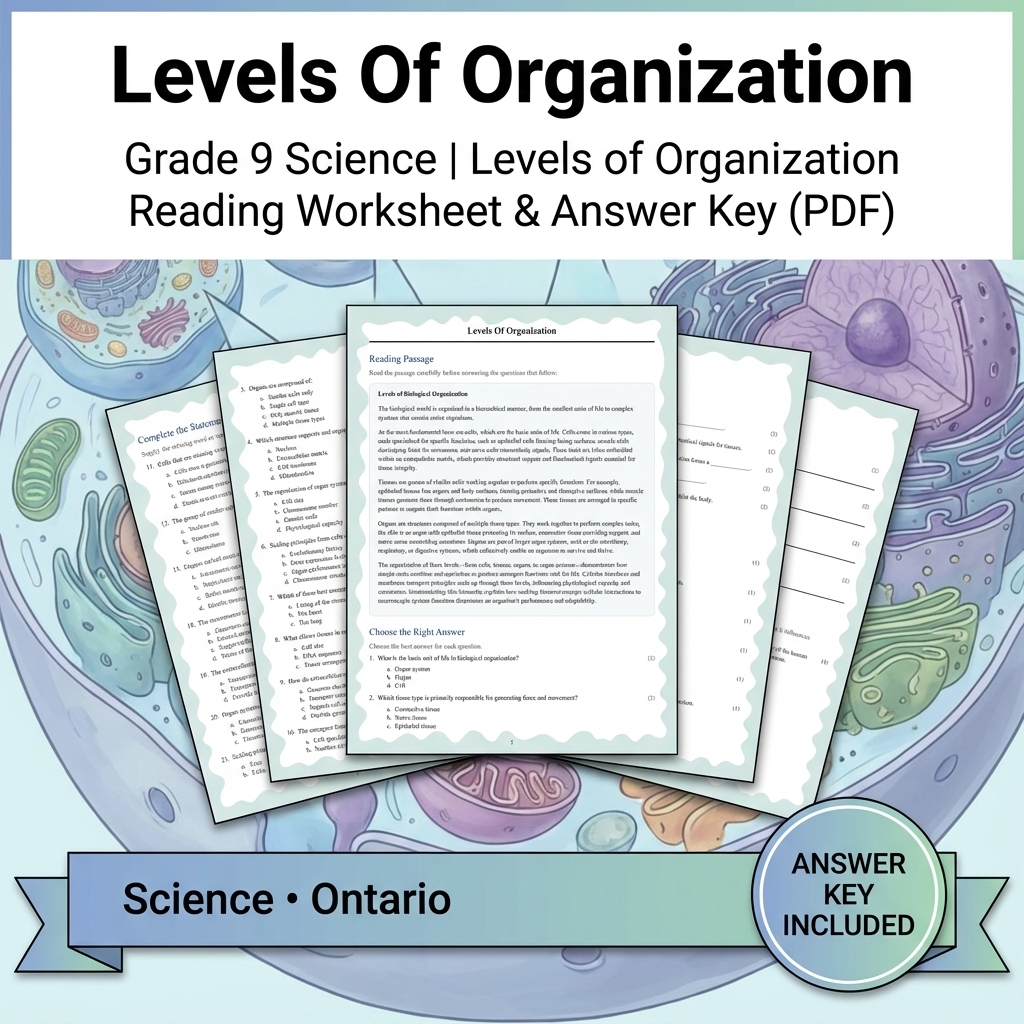
Grade 9 Science | Levels of Organization Reading Worksheet & Answer Key (PDF)
JCreated byJ.S SheetsLearning Objectives
- Explain hierarchical relationships among cells, tissues, organs, and systems using canonical examples.
- Describe how cell specialization and extracellular matrices produce emergent organ functions.
- Understand how tissue arrangement supports organ-level processes and their role in physiological capacity.
Also included in: Grade 9 Science Unit Bundle | Human Body Systems & Cell Functions +1 more
Instant download

Grade 9 Science Worksheet – Atomic Structure (PDF) | Alberta Standards
 Created bySilver Birch Teaching
Learning Objectives
- Explain how protons, neutrons, and electrons determine atomic number, mass number, and isotopes
- Use simple atomic models to describe how electron location relates to chemical behavior
- Connect atomic composition to properties of elements and the formation of compounds
Also included in: Grade 9 Chemical Reactions Science Lesson Bundle: Alberta Framework +1 more
Instant download
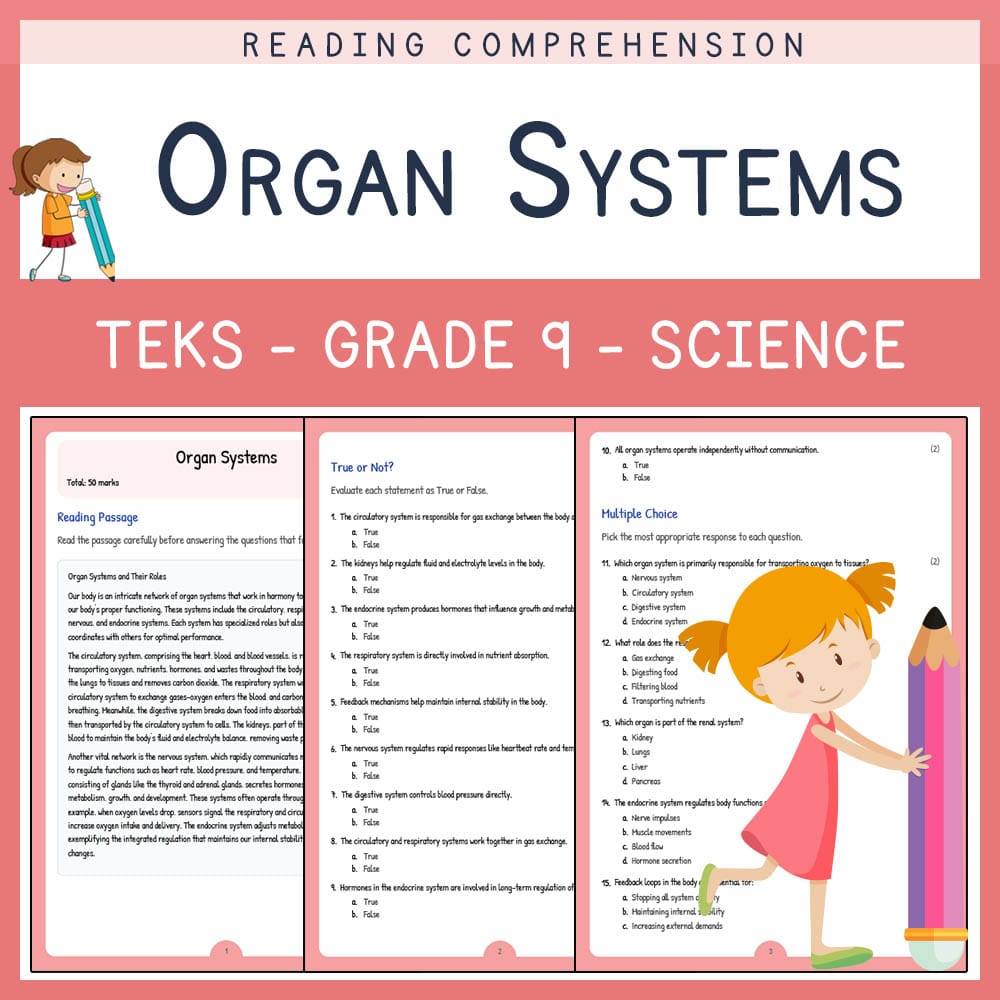
Grade 9 Science | Organ Systems Worksheet | TEKS-Aligned
Created byLumora LearningLearning Objectives
- Describe the main functions of human organ systems and how they work together.
- Explain how feedback mechanisms regulate physiological processes.
- Identify the roles of the circulatory, respiratory, digestive, renal, nervous, and endocrine systems.
Instant download
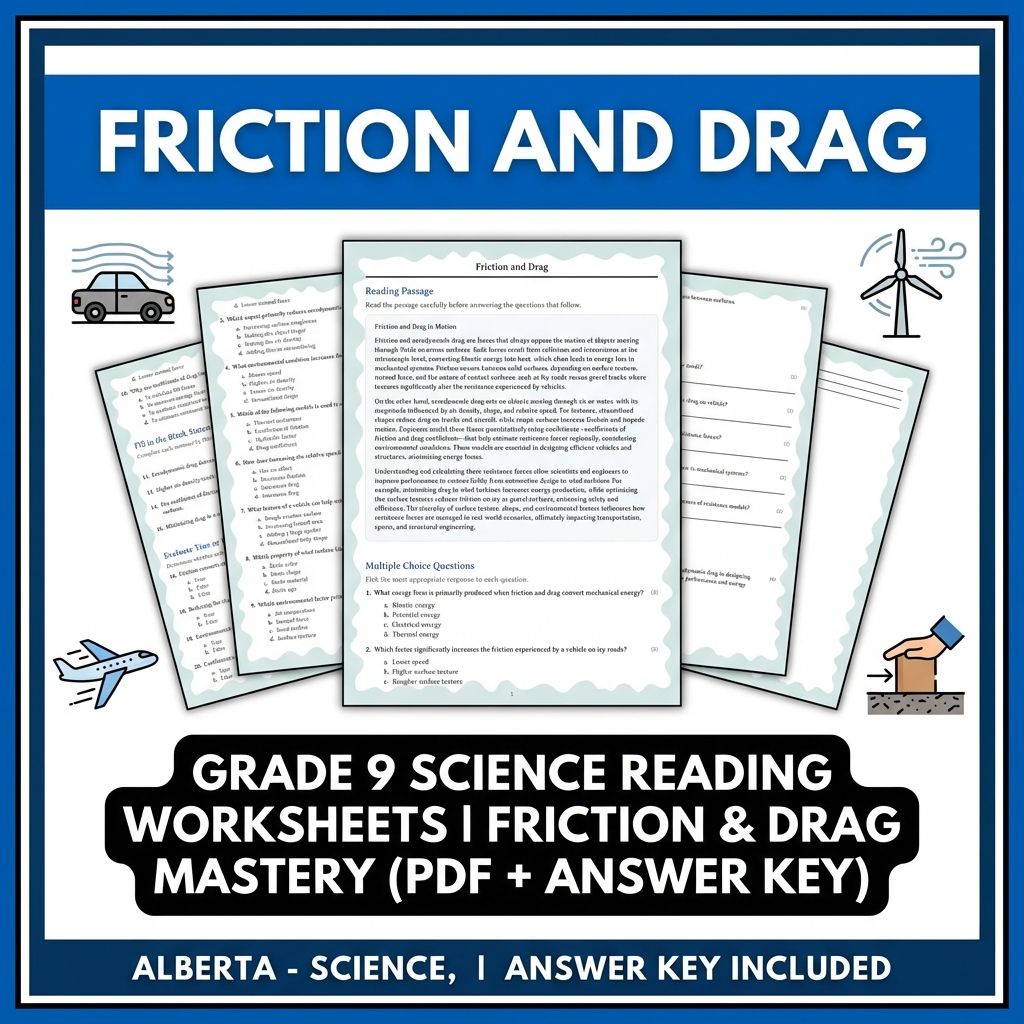
Grade 9 Science Reading Worksheets | Friction & Drag Mastery (PDF + Answer Key)
JCreated byJ.S SheetsLearning Objectives
- Understand how friction and aerodynamic drag oppose motion and transform mechanical energy into thermal energy.
- Explain how surface texture, normal force, and speed influence friction on different terrains.
- Describe how air density and shape affect drag on various objects like vehicles and wind turbine blades.
Also included in: Grade 9 Science Unit Bundle | Motion, Forces & Energy Activities (PDF) +1 more
Instant download
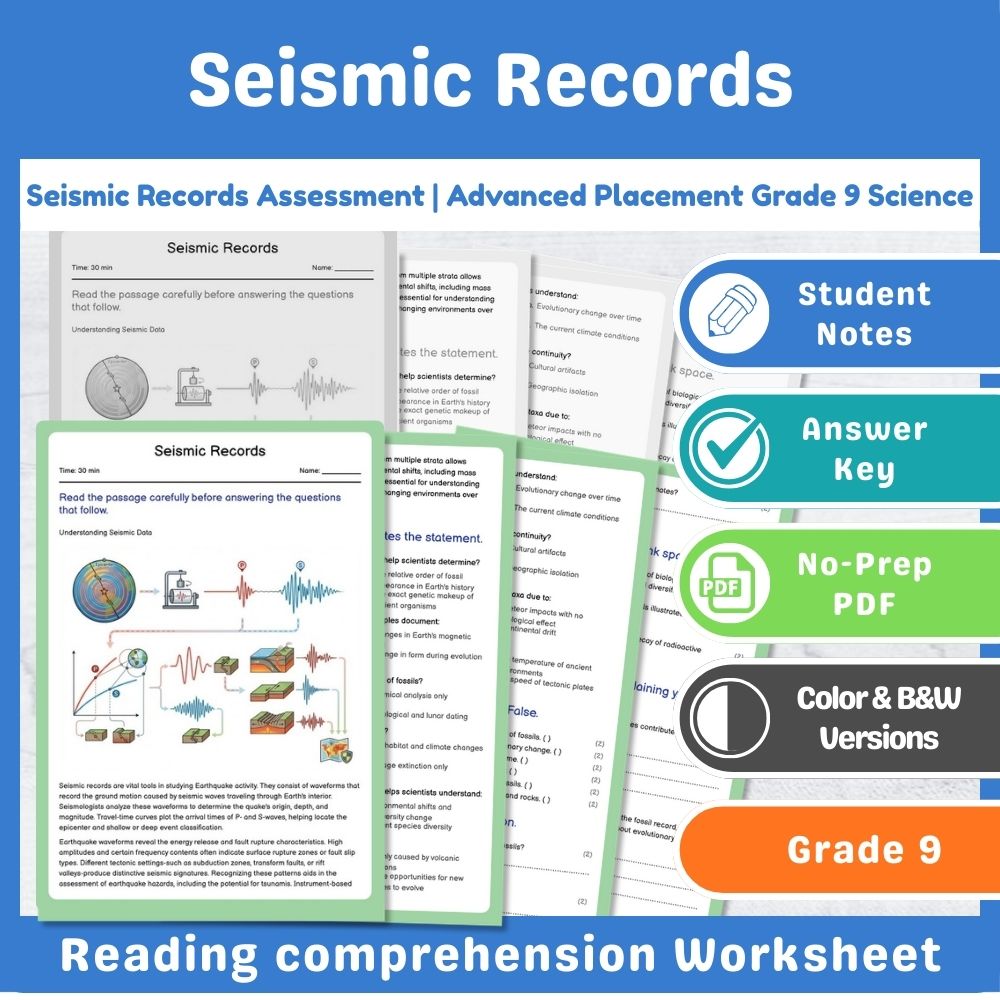
Seismic Records Assessment | Advanced Placement Grade 9 Science
Created byPrism Point LearningLearning Objectives
- Interpret earthquake waveforms and travel-time curves to infer subsurface structures.
- Compare P- and S-wave arrivals, waveform amplitudes, and frequency content to distinguish earthquake depths and locations.
- Connect seismic activity patterns to tectonic environments and surface hazard phenomena such as tsunamis.
Also included in: Grade 9 Science Mini Bundle | Earth and Space Sciences AP Standards
Instant download
Grade 9 Science – Combined Circuits Worksheet (PDF) - Alberta Standard
 Created byBright Mind Resources
Learning Objectives
- Understand the principles of combined series-parallel circuits.
- Identify equivalent resistances in mixed circuit configurations.
- Analyze current and voltage distributions in complex electrical systems.
Instant download
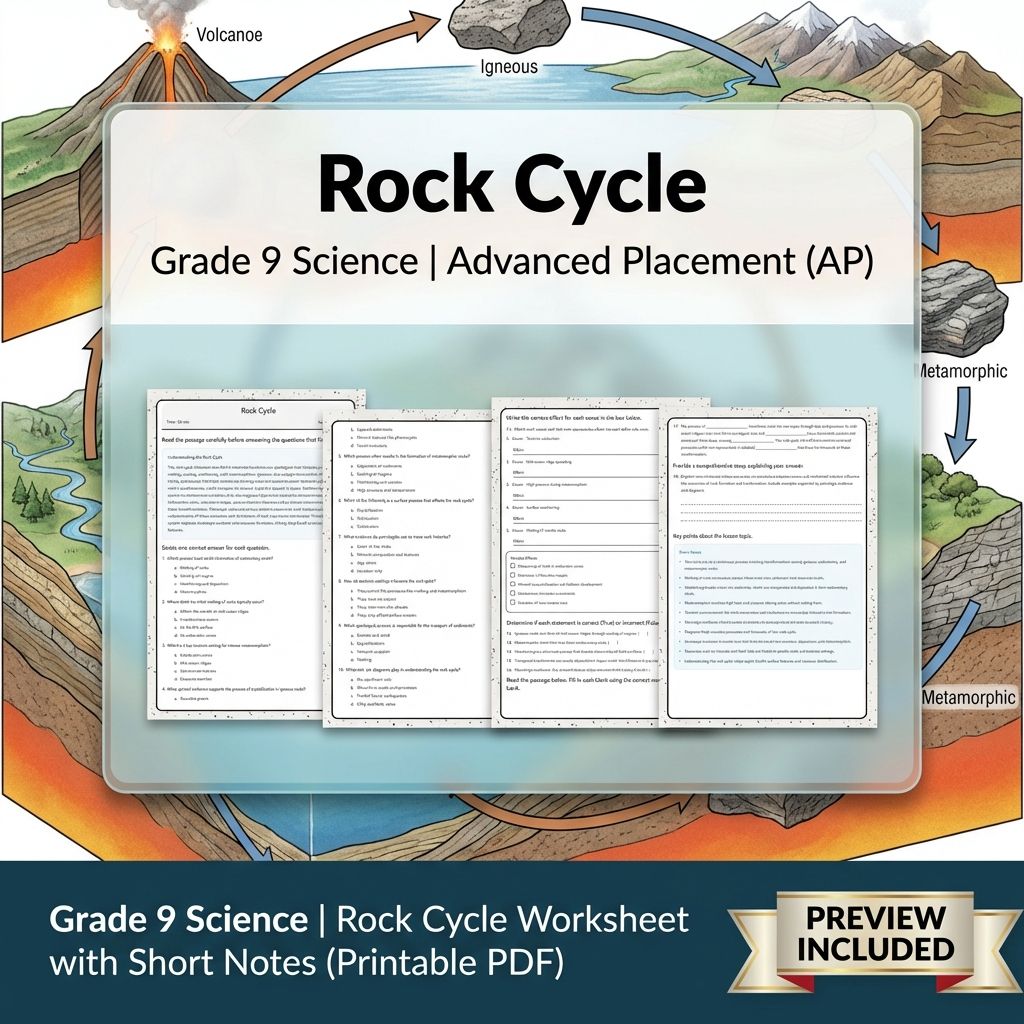
Grade 9 Science | Rock Cycle Worksheet with Short Notes (Printable PDF)
 Created byMeadowlark Worksheets
Learning Objectives
- Explain the processes involved in the rock cycle, including melting, crystallization, weathering, transport, deposition, and metamorphism.
- Identify how tectonic settings influence rock formation and transformation.
- Connect petrologic evidence and diagrams to real-world landscape evolution and resource distribution.
Also included in: Grade 9 Science | Earth Systems & Geology Unit Worksheet Bundle (Printable PDFs) +1 more
Instant download
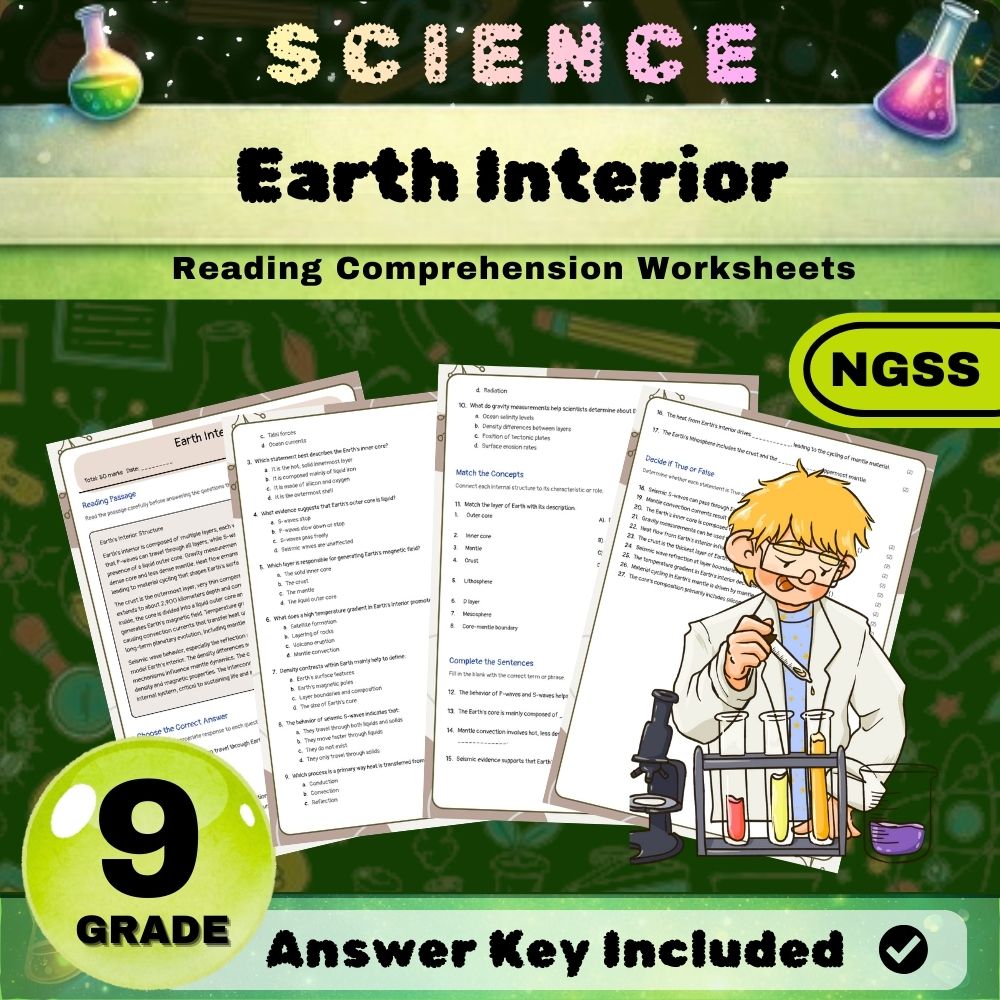
Grade 9 Science | Earth Interior SCIENCE NGSS Worksheet (PDF)
Created byMaple Path LearningLearning Objectives
- Describe the layered internal structure of Earth based on seismic, gravity, and heat-flow evidence.
- Interpret the behavior of P-waves and S-waves to understand Earth's composition.
- Explain how density contrasts and temperature gradients influence mantle convection.
Also included in: Grade 9 Science | Earth's Systems NGSS Unit Bundle (NGSS-Aligned Instruction) +1 more
Instant download
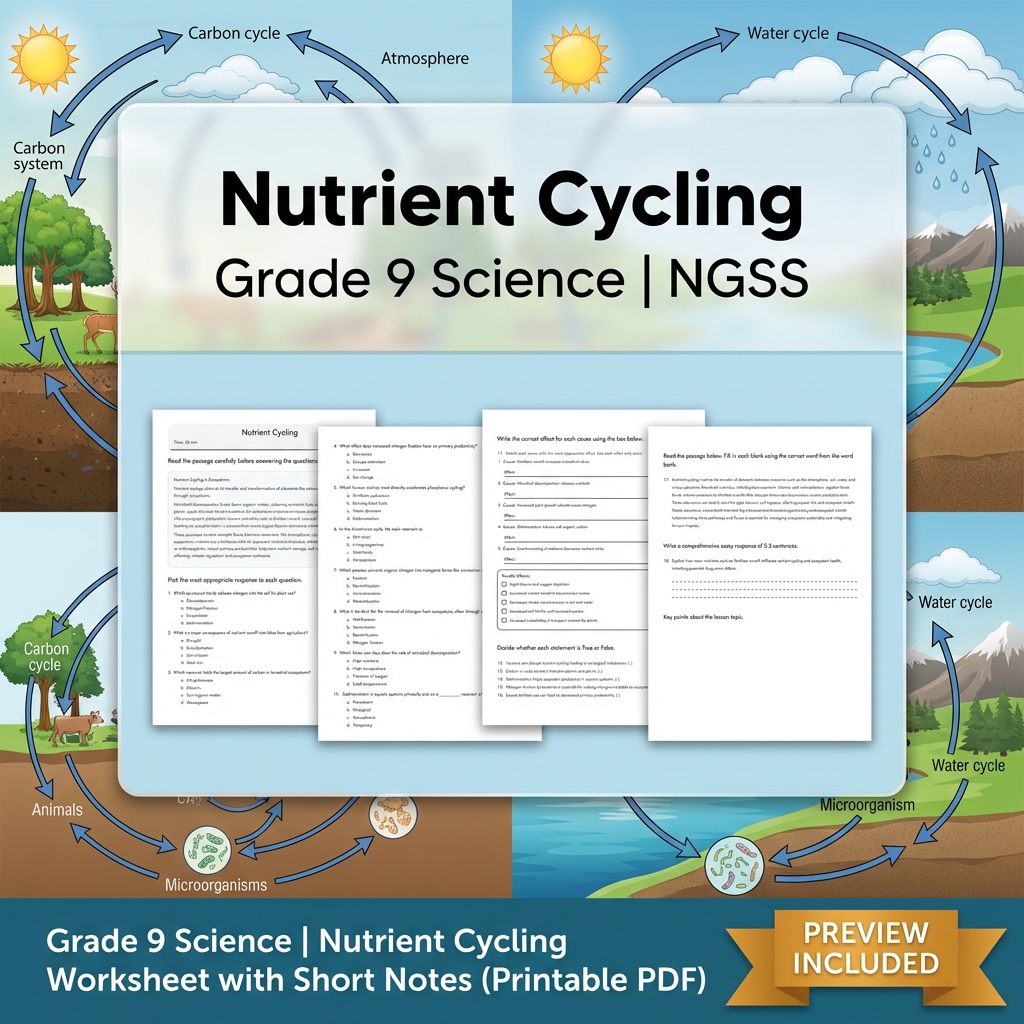
Grade 9 Science | Nutrient Cycling Worksheet with Short Notes (Printable PDF)
Created byMeadowlark WorksheetsLearning Objectives
- Understand the processes involved in nutrient cycling within ecosystems.
- Identify pathways and reservoirs of carbon, nitrogen, and phosphorus.
- Analyze human impacts like fertilizer runoff on nutrient balance and ecosystem health.
Also included in: Grade 9 Science | Ecosystems: Interactions, Energy & Dynamics NGSS UNIT Bundle +1 more
Instant download

Force And Acceleration Worksheet | Grade 9 Science Practice
Created byPrism Point LearningLearning Objectives
- Explain how net force and mass determine acceleration using proportional reasoning
- Interpret acceleration direction based on the net force direction (vector behavior)
- Solve basic qualitative and quantitative relationships involving force, mass, and acceleration
Also included in: Forces and Motion Lesson Bundle – Grade 9 Science Framework BC +1 more
Instant download
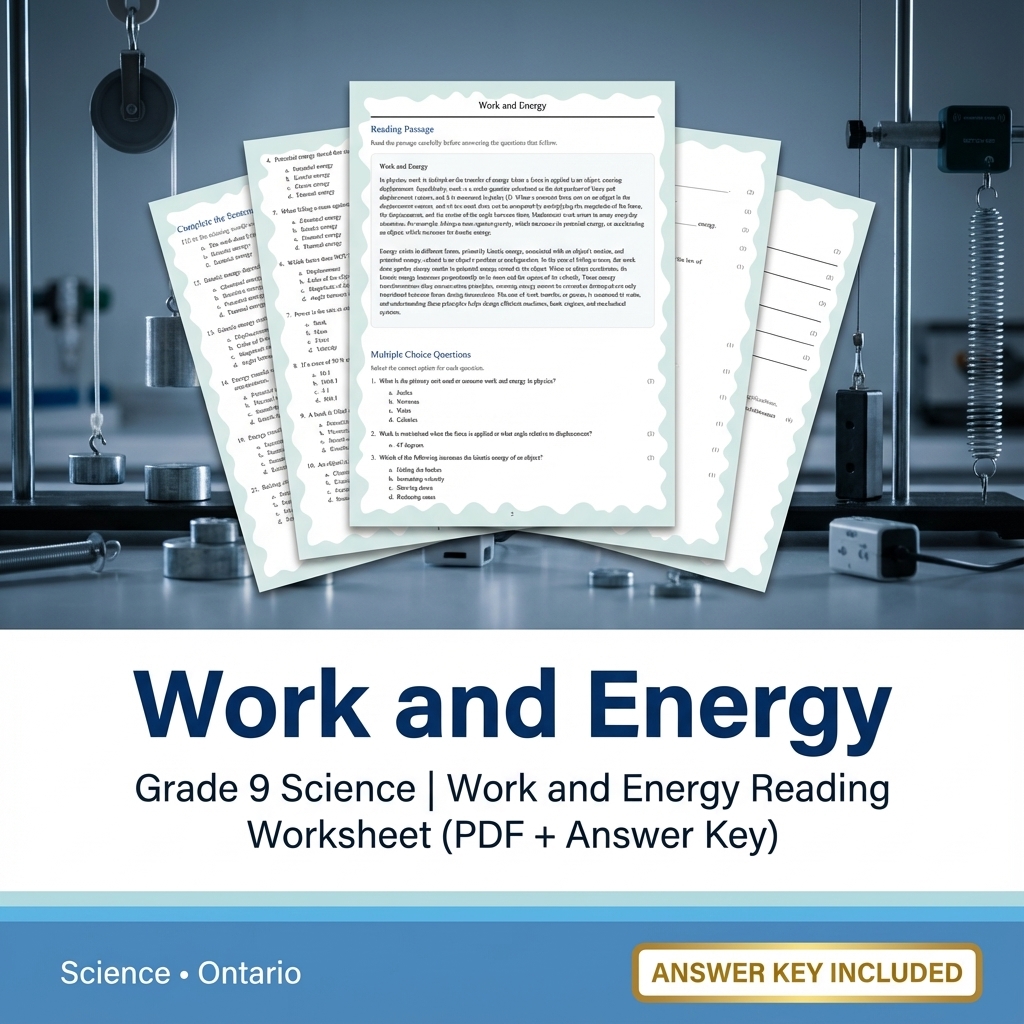
Grade 9 Science | Work and Energy Reading Worksheet (PDF + Answer Key)
JCreated byJ.S SheetsLearning Objectives
- Define and explain the concept of mechanical work in physics.
- Identify different forms of energy, including kinetic and potential energy.
- Calculate work done by constant forces in various contexts.
Also included in: Grade 9 Science Unit | Force, Motion & Energy Worksheets & Answer Keys Bundle +1 more
Instant download

Science Worksheet Uncertainty and Error | Grade 9 NGSSS Standards Practice
JCreated byJ.S SheetsLearning Objectives
- Distinguish between random uncertainty and systematic error in measurement results
- Explain why uncertainty supports scientific reasoning and fair comparison of data
- Use appropriate significant figures and uncertainty ranges when reporting measurement-based calculations
Also included in: Grade 9 Scientific Inquiry & Evidence Science Lesson Bundle | Florida (NGSSS) +1 more
Instant download

Grade 9 Social Studies Worksheet – Colonial Policies Impact (PDF)
 Created bySunny Desk Resources
Learning Objectives
- Analyze how specific colonial policies affected Indigenous cultural identity, social cohesion, and territory over time
- Evaluate how governance structures and land laws changed Indigenous rights, community stability, and mobility
- Explain Indigenous responses and adaptations to colonial policy and oppression
Also included in: Grade 9 Treaties & Colonial Policies Social Studies Lesson Bundle BC +1 more
Instant download

Grade 9 Social Studies | Regional Ecosystems Worksheet (TEKS) PDF
Created bySunny Desk ResourcesLearning Objectives
- Explain how climate, landforms, and water availability influence where ecosystems occur in different regions.
- Analyze how ecosystems affect biodiversity, ecosystem services, and the resources available to people.
- Evaluate human impacts on forests, grasslands, and wetlands and propose conservation-focused actions for sustainable regional development.
Also included in: Grade 9 Regional Geography Social Studies Lesson Bundle Worksheets for TEKS +1 more
Instant download
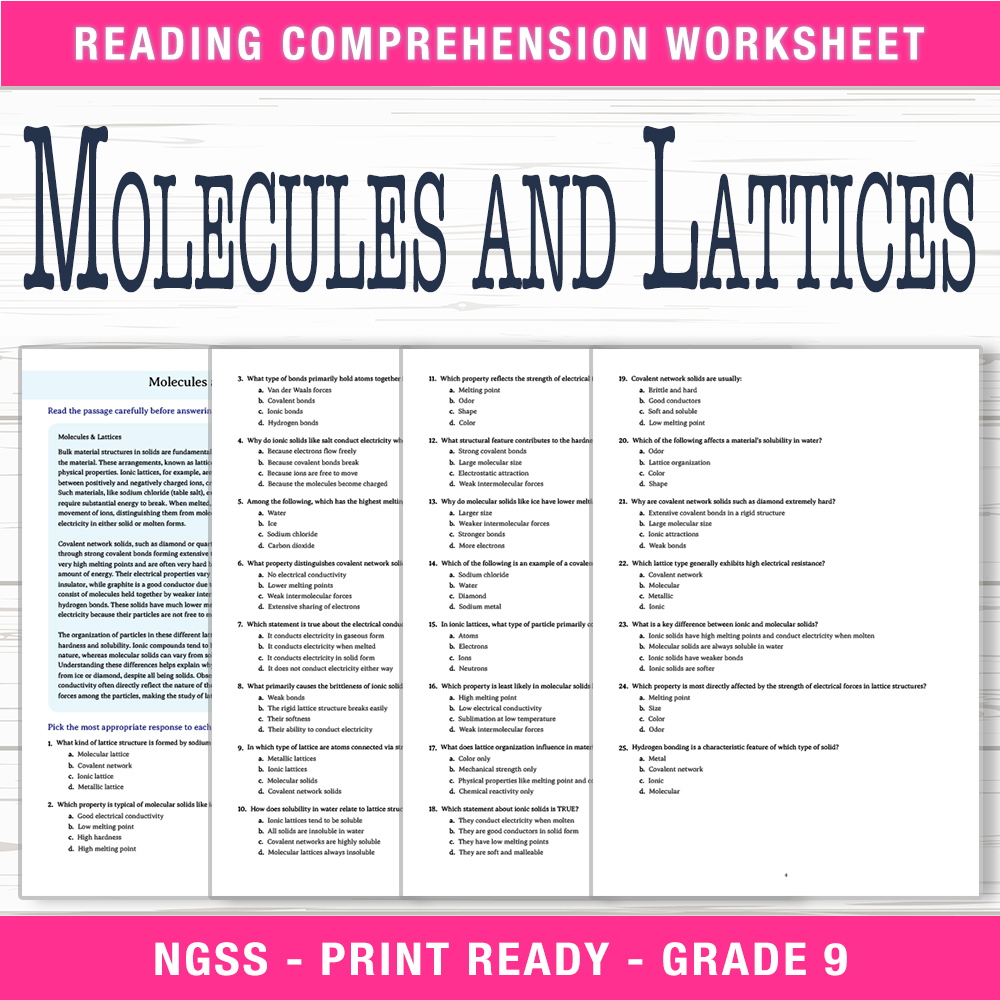
Grade 9 Science | Molecules and Lattices Worksheet (PDF + Answer Key)
 Created byRiverstone Classroom
Learning Objectives
- Understand the different types of particle arrangements in solid materials, including ionic, covalent network, and molecular lattices.
- Identify how lattice organization influences physical properties such as melting point, electrical conductivity, hardness, and solubility.
- Compare the properties of ionic solids like sodium chloride with molecular solids like ice based on their particle arrangements and electrical interactions.
Instant download

Grade 9 Science | Reaction Stoichiometry Worksheet with Short Notes (PDF)
Created byMeadowlark WorksheetsLearning Objectives
- Understand and apply conservation of mass to balanced chemical equations.
- Relate moles, mass, and particle counts using molar mass conversions.
- Analyze limiting reagents and calculate theoretical yields in reactions.
Also included in: Grade 9 Science Unit | Matter and Its Interactions NGSS Worksheet Pack +1 more
Instant download
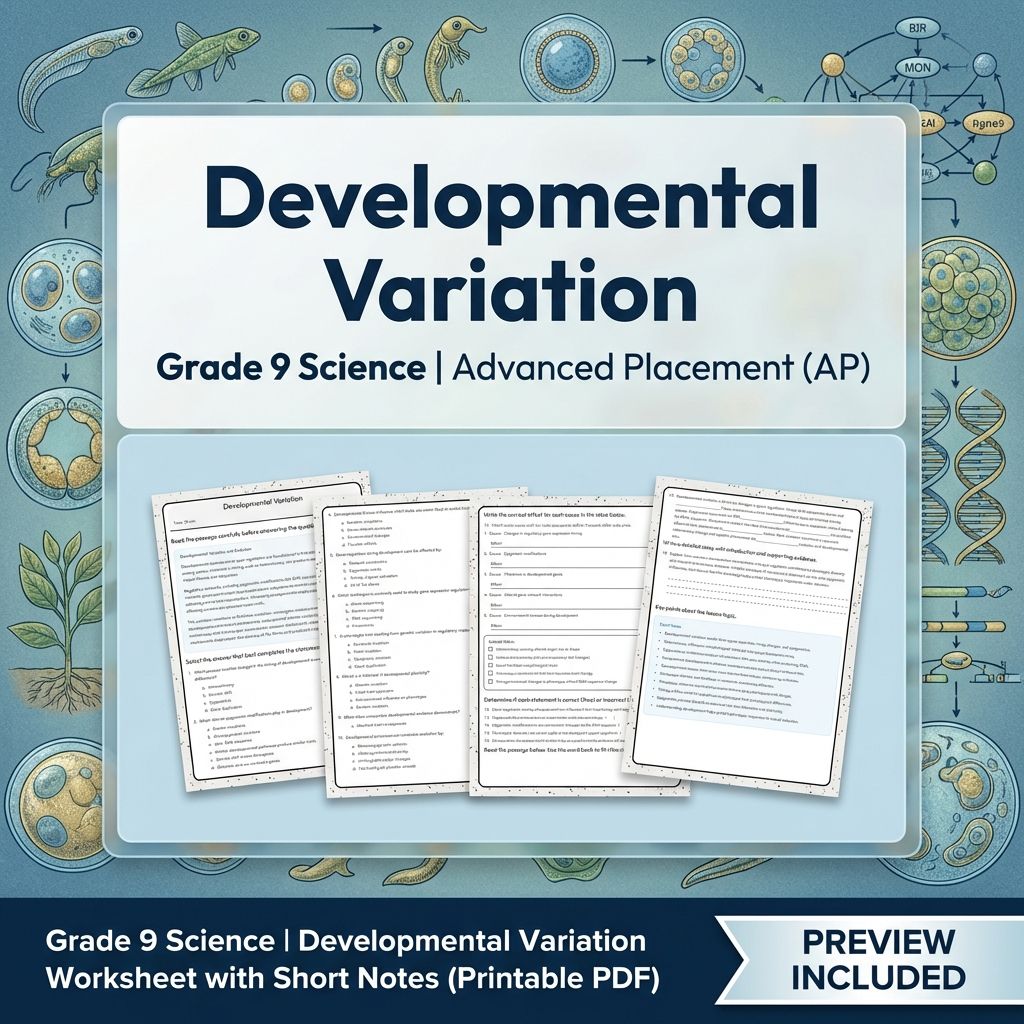
Grade 9 Science | Developmental Variation Worksheet with Short Notes (PDF)
Created byMeadowlark WorksheetsLearning Objectives
- Understand how genetic and developmental processes generate phenotypic diversity.
- Explain the roles of regulatory networks, timing shifts, and epigenetics in development.
- Analyze comparative developmental evidence to link gene regulation to traits.
Also included in: Grade 9 Science Unit | Cellular Processes & Ecosystems Worksheet Pack (PDF) +1 more
Instant download
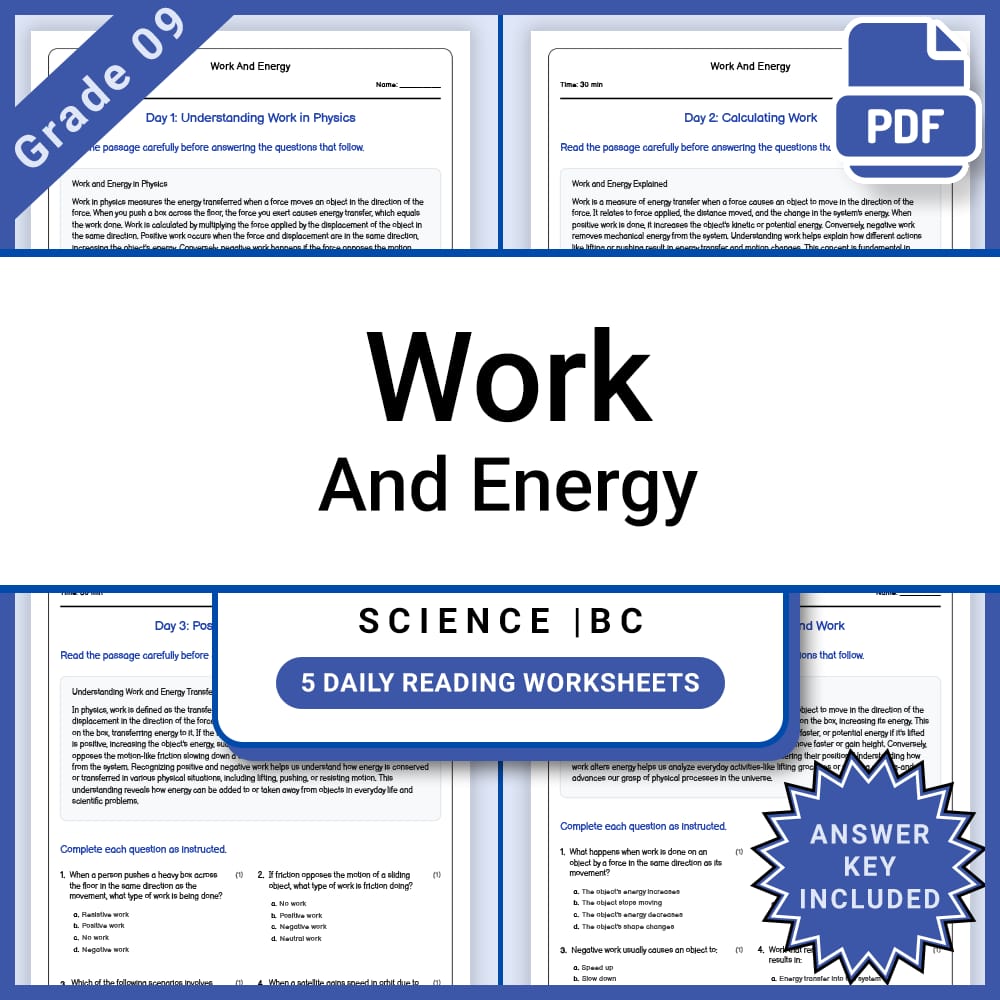
Grade 9 Science – Work and Energy Daily Reading Worksheet + Answer Key
JCreated byJ.S SheetsLearning Objectives
- Understand the concept of work in physics
- Identify the conditions under which work is done
- Differentiate between positive and negative work
Also included in: Grade 9 Science Lesson Bundle | Physics and Energy Concept Worksheets +1 more
Instant download
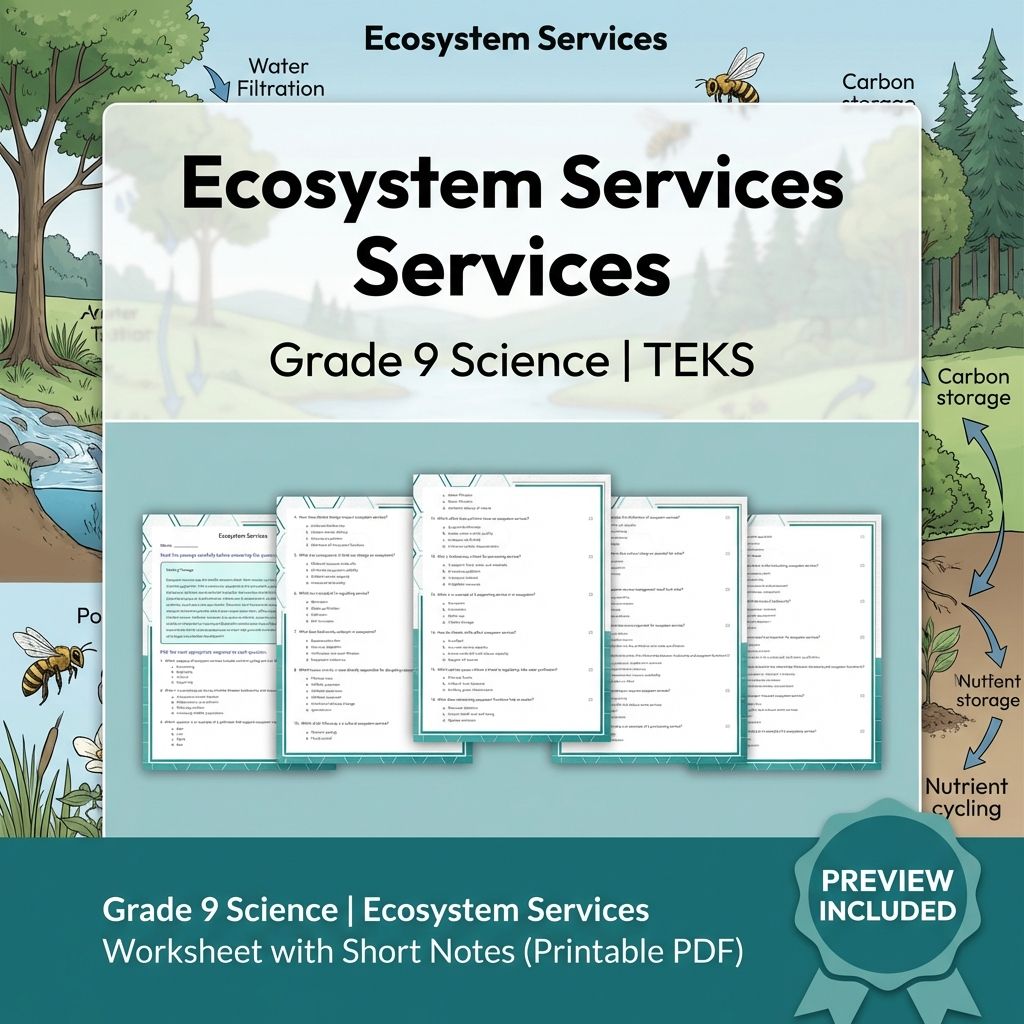
Grade 9 Science | Ecosystem Services Worksheet with Short Notes (PDF)
Created byMeadowlark WorksheetsLearning Objectives
- Define and identify different types of ecosystem services including provisioning, regulating, cultural, and supporting functions.
- Explain the role of biodiversity in maintaining ecosystem services.
- Assess how human activities like land-use change, pollution, and climate shifts impact ecosystem service delivery.
Instant download

Grade 9 Math – Interest Calculations Worksheet (Ontario Standards | PDF)
Created byClear Sky ClassroomLearning Objectives
- Understand how to calculate simple interest using the interest formula.
- Apply interest calculations to real-life financial scenarios involving savings and loans.
- Interpret the effects of principal, rate, and time on the total interest earned or paid.
Also included in: Grade 9 Math Lesson Group: Financial Literacy and Budgeting Skills Ontario +1 more
Instant download
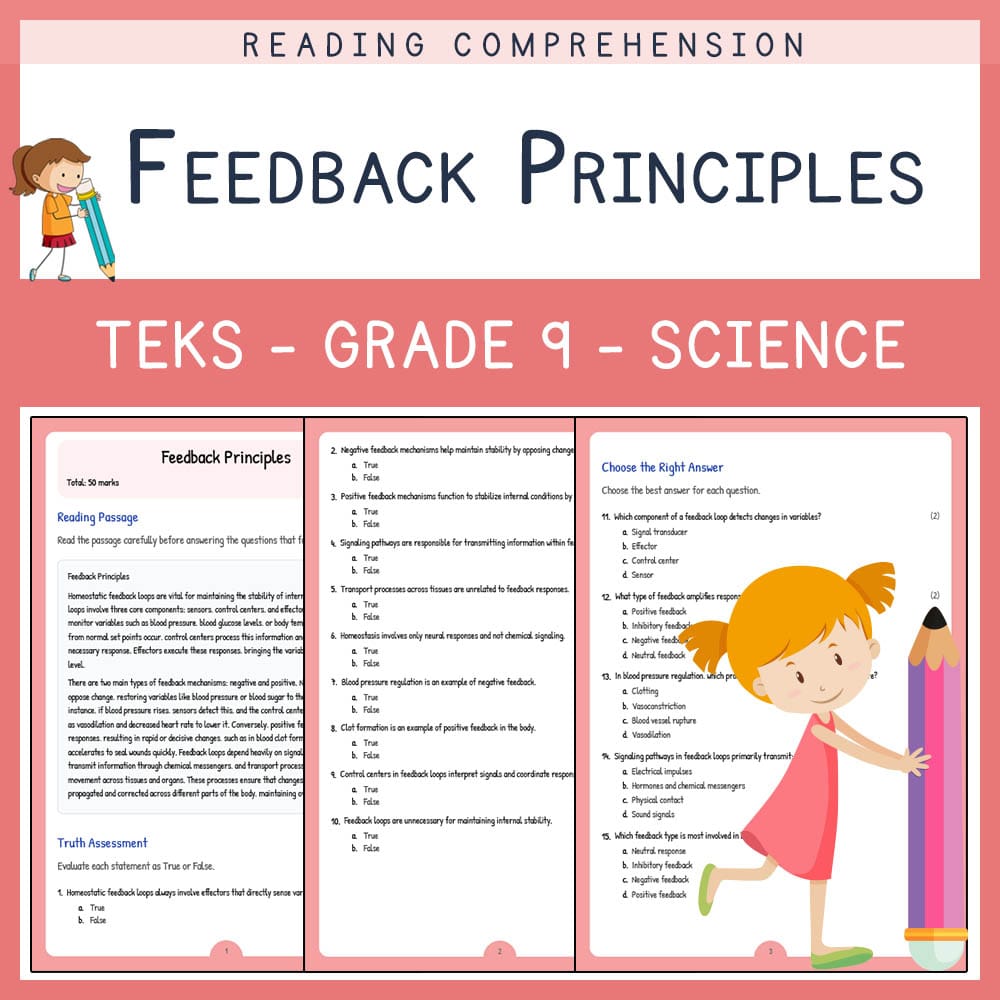
Grade 9 Science | Feedback Principles Worksheet | TEKS-Aligned
Created byLumora LearningLearning Objectives
- Understand the components of homeostatic feedback loops and their roles.
- Differentiate between negative and positive feedback mechanisms.
- Explain how signaling pathways and transport processes contribute to physiological regulation.
Instant download

Grade 9 | Independence Day for Mastering American Revolution | PDF + Answer Key
 Created byShaNova Worksheets
Learning Objectives
- Describe key events and ideas that led to the Declaration of Independence.
- Explain how revolutionary ideals such as liberty, equality, and self-governance shaped American identity.
- Identify important concepts and civic values connected to early U.S. independence.
Instant download
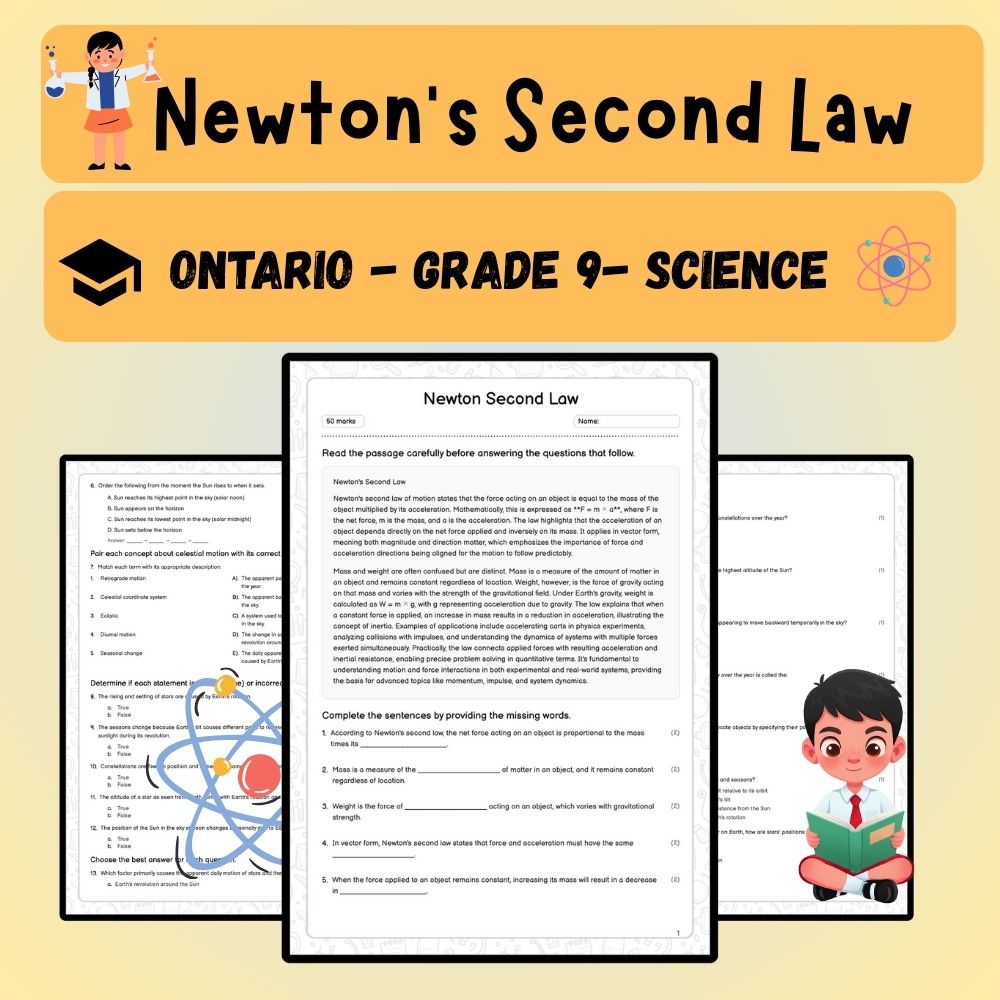
Grade 9 Science | Newton's Second Law Worksheet (PDF) – Ontario Standard
Created byPrism Point LearningLearning Objectives
- Understand the mathematical relationship between net force, mass, and acceleration as expressed in Newton's second law.
- Differentiate between and relate mass and weight, and comprehend their implications for force and acceleration.
- Apply Newton's second law to problems involving acceleration, force, and mass, including systems with multiple forces.
Also included in: Grade 9 Science Unit | Forces, Motion & Energy Worksheets (Ontario Standards) +1 more
Instant download
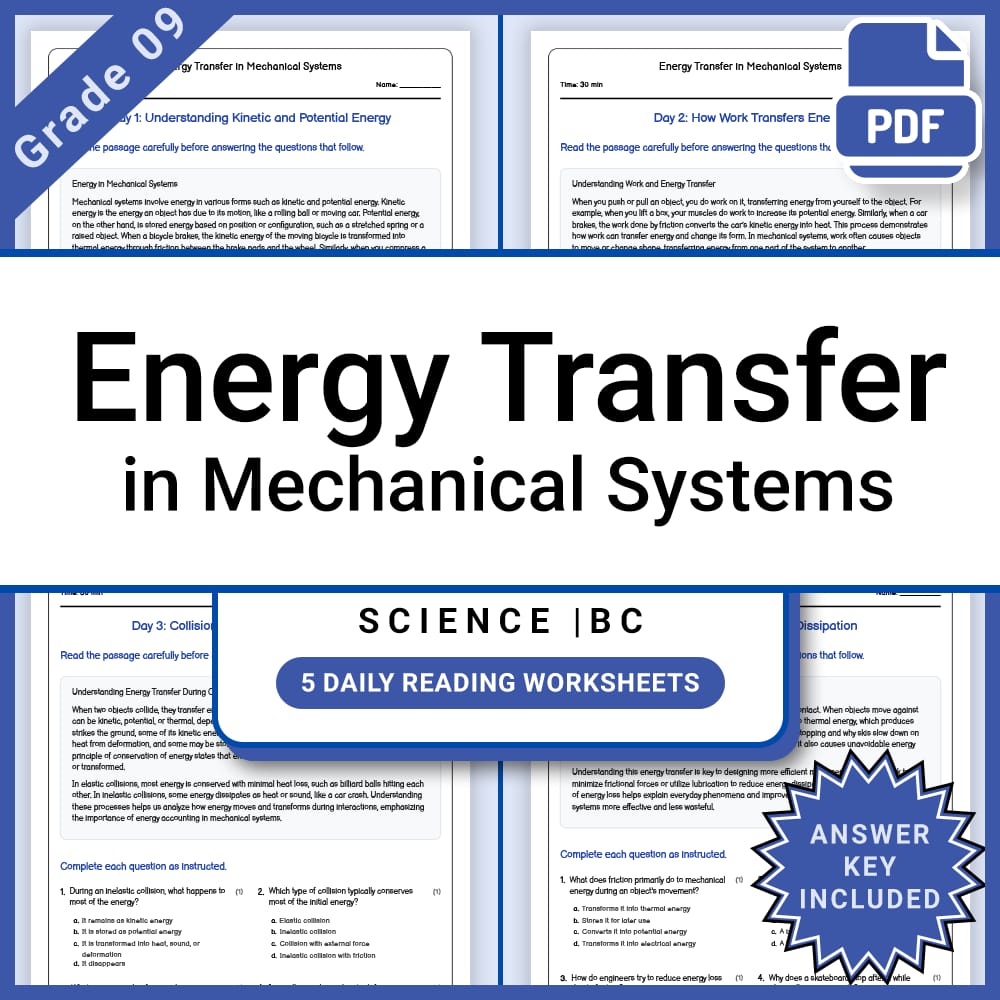
Grade 9 Science – Energy Transfer Daily Reading Worksheet + Answer Key
JCreated byJ.S SheetsLearning Objectives
- Identify different forms of energy such as kinetic and potential energy
- Explain how energy shifts between different forms in various scenarios
- Describe how nonconservative forces like friction affect energy conservation
Also included in: Grade 9 Science Lesson Bundle | Physics and Energy Concept Worksheets +1 more
Instant download
Grade 9 Science | Genetic Drift Worksheet with Short Notes (Printable PDF)
Created byMeadowlark WorksheetsLearning Objectives
- Understand the concept of genetic drift and its role in evolution.
- Identify causes and effects of genetic drift in small populations.
- Distinguish between genetic drift and natural selection.
Instant download

Grade 9 Science – Reservoirs & Feedback | Daily Reading Worksheet
Created byBright Mind ResourcesLearning Objectives
- Identify different types of water reservoirs and their functions in the water cycle
- Understand how reservoirs influence climate and environmental feedbacks
- Describe the movement of carbon and water between various reservoirs
Also included in: Earth & Space Systems Grade 9 Science Daily Reading Worksheets Bundle | General +1 more
Instant download

Grade 9 Science | Nucleic Acid Structure Worksheet | TEKS Aligned
Created byLumora LearningLearning Objectives
- Describe the chemical structure of DNA and RNA and their nucleotide components.
- Explain the significance of nucleotide pairing, double helix formation, and strand orientation in DNA replication.
- Identify differences between DNA and RNA in terms of structure, sugar component, and base composition.
Also included in: Grade 9 Science | Genetics & Biotechnology Lesson Bundle | TEKS Aligned
Instant download
Grade 9 Science | Population Ecology Worksheet (Worksheet + Answer Key) – TEKS Standards
Created byBright Mind ResourcesLearning Objectives
- Understand the key factors that influence changes in population size over time.
- Identify the difference between density-dependent and density-independent factors affecting populations.
- Analyze how population dynamics interact with ecosystem processes and species interactions.
Also included in: Grade 9 Science UNIT Bundle | Ecosystems & Biogeochemical Cycles TEKS-Aligned +3 more
Instant download
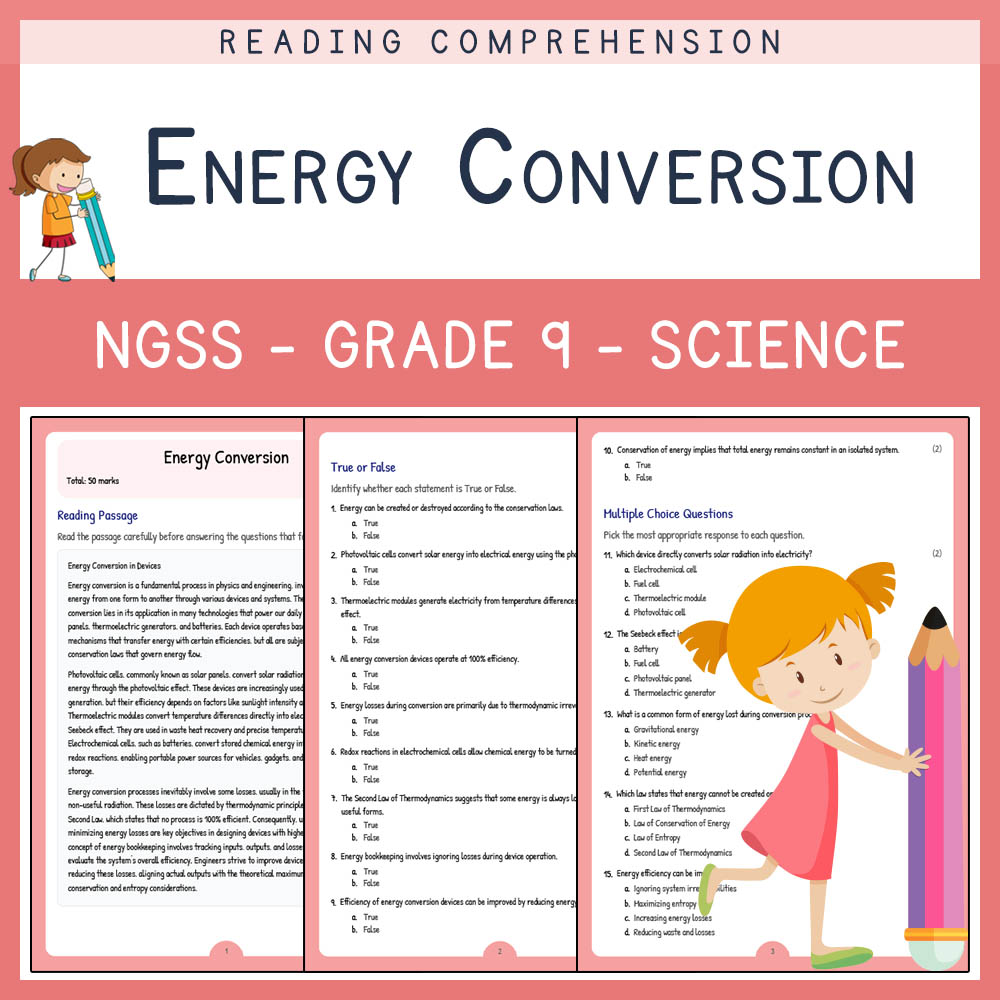
Grade 9 Science | Energy Conversion Worksheet (PDF + Answer Key) – NGSS Aligned
Created byLumora LearningLearning Objectives
- Understand the principles of energy conversion and the types of devices involved.
- Identify the sources, processes, and efficiencies of different energy transfer methods.
- Analyze energy losses and the importance of energy bookkeeping in practical applications.
Instant download

Tissue Types and Specialized Functions Worksheets | Grade 9 Science
Created byPrism Point LearningLearning Objectives
- Identify the four principal tissue classes and key cellular features
- Explain how extracellular matrix properties influence connective tissue function
- Compare specialized epithelial, connective, and muscle tissues
Also included in: Grade 9 Science Lesson Bundle: Human Homeostasis & Cell Systems | Ontario +1 more
Instant download
Browse more categories
About Grade 9 Worksheets
Browse 9,323 printable Grade 9 worksheets across algebra, biology, literature, and history — each a ready-to-print PDF with optional answer keys.
Every worksheet on MyTeachingSheets is created by independent teacher-authors and reviewed before publication. All resources download as printable PDFs for classroom, homework, or at-home practice, and many include answer keys. Preview any worksheet free before buying.