
Grade 9 Worksheets
9,323 grade resources
Grade 9 Science Worksheet | Chemical Changes with Ontario Standards (PDF)
 Created byEvergreen Desk Education
Learning Objectives
- Distinguish chemical changes from physical changes by linking observable evidence to new substances.
- Identify common indicators of chemical change: temperature change, gas production, precipitate formation, and persistent colour change.
- Explain chemical change using a microscopic reactant-to-product model rather than only macroscopic rearrangement.
Also included in: Grade 9 States & Energy to Chemical Reactions Science Lesson Bundle (Ontario) +1 more
Instant download

Grade 9 Science – Biotech Ethics Daily Reading Worksheet with Answer Key
JCreated byJ.S SheetsLearning Objectives
- Understand the key ethical considerations in biotechnology.
- Analyze benefits and risks associated with genetic manipulation.
- Explore societal and environmental implications of biotech advances.
Also included in: Grade 9 Science Lesson Bundle on Genetics and DNA TEKS Aligned +1 more
Instant download

Grade 9 ELA Speaker Reasoning Worksheet | Common Core (PDF)
 Created byGolden Apple Studio
Learning Objectives
- Evaluate a speaker’s argument by analyzing point of view, reasoning, and use of evidence.
- Determine whether evidence directly supports a claim or only replaces it with a vague assertion.
- Analyze rhetorical choices and appeals to explain how they shape audience interpretation.
Also included in: Grade 9 ELA Full-Year Worksheet Bundle | CCSS Common Core
Instant download

Climate Trends Worksheet for Grade 9 AP Science Data Analysis Activities
 Created byPrism Point Learning
Learning Objectives
- Analyze spatial and temporal climate data to identify trends and anomalies in temperature and precipitation
- Use evidence-based reasoning to separate long-term climate change from internal variability
- Interpret potential climate drivers by comparing observations with greenhouse gas and volcanic aerosol forcings
Also included in: Earth Systems & Climate Evidence Lesson Bundle | Grade 9 Science | AP
Instant download

Grade 9 Science – Food Web Energy & Trophic Levels | Daily Reading Worksheet
 Created byBright Mind Resources
Learning Objectives
- Identify producers and consumers in food chains.
- Understand the flow of energy through trophic levels.
- Recognize how food webs illustrate interconnected energy pathways.
Also included in: Selection Grade 9 Science Daily Reading Worksheets Lesson Bundle | FL NGSSS +1 more
Instant download

Climate Drivers Worksheet | Grade 9 Science Printable PDF Assessment
Learning Objectives
- Understand the key factors that influence Earth's climate, including solar flux, albedo, greenhouse gases, and ocean heat transport.
- Analyze how surface-atmosphere interactions affect regional weather patterns and long-term climate trends.
- Interpret observational records, radiative transfer calculations, and paleoclimate proxies to assess climate variability.
Also included in: Grade 9 Earth's Systems Science Lesson Bundle NGSS | Natural Hazards & Geology +1 more
Instant download

Historical Journey Worksheet | Standard June Grades 9 -10 Holiday PDF
Learning Objectives
- Explain the historical origins of Flag Day and how patriotic traditions developed before official recognition.
- Identify key figures and events that influenced the way Americans celebrated the flag.
- Evaluate debates about symbolism, civic responsibility, and respectful national traditions.
Also included in: Flag Day Reading Comprehension Bundle | Grades 9–10 +2 more
Instant download

Grade 9 Complex Inheritance Daily Reading Worksheet | TEKS Biology
 Created byBRIGHT PATH RESOURCES
Learning Objectives
- Identify the main idea of a text about complex inheritance.
- Explain how multiple genes and the environment can shape observable traits.
Also included in: Grade 9 Genetics Molecular Biology Science Reading Worksheets Bundle | TEKS +1 more
Instant download

Weather Data Patterns Assessment | General Grade 9 Science Standards
Created byPrism Point LearningLearning Objectives
- Understand how atmospheric conditions relate to observable weather patterns.
- Analyze data sets including temperature, humidity, and precipitation to identify relationships.
- Explain the impact of air mass movement and energy exchange on weather variability.
Instant download

Pollinators' Role Worksheet for Grades 9 - 10 | Holiday Assessment
Learning Objectives
- Explain how bees transfer pollen and why this supports plant reproduction
- Analyze how bee activity contributes to biodiversity and ecosystem stability
- Connect pollinator health to human food security and sustainable agriculture
Also included in: Grades 9 - 10 Pollinators & Biodiversity Holiday Custom Bundle +2 more
Instant download
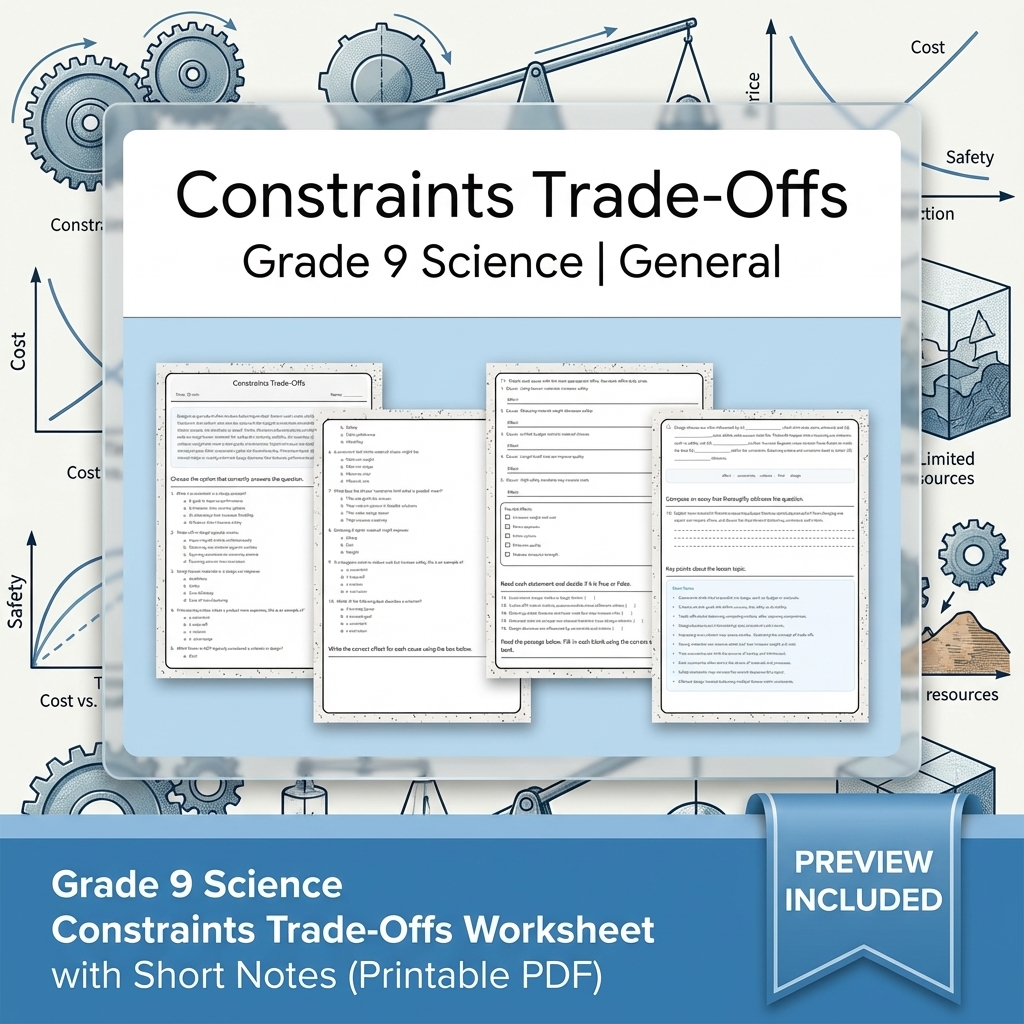
Grade 9 Science Constraints Trade-Offs Worksheet with Short Notes
 Created byMeadowlark Worksheets
Learning Objectives
- Understand how design constraints limit options and influence decision-making.
- Identify trade-offs among criteria such as cost, safety, and materials in design choices.
- Analyze how constraints and criteria shape the final design selection.
Also included in: Grade 9 Engineering Design Science Lesson Bundle: General Framework +1 more
Instant download

Grade 9 Social Studies | Environmental Boundaries Worksheet (TEKS) (PDF)
 Created bySunny Desk Resources
Learning Objectives
- Explain how physical natural boundaries (mountains, rivers, deserts) shape political borders and regional boundaries.
- Analyze how environmental divides influence migration patterns and cultural interaction between groups.
- Evaluate when natural boundaries promote stability and when they contribute to conflict.
Also included in: Grade 9 Regional Geography Social Studies Lesson Bundle Worksheets for TEKS +1 more
Instant download

Grade 9 Human-Environment Systems Worksheet | TEKS Social Studies
 Created byThe Resource Hub
Learning Objectives
- Explain how human activities and natural processes interact in human-environment systems
- Identify feedback loops that can increase or reduce environmental risk
- Analyze how land use decisions affect resource sustainability in a region
Also included in: Grade 9 Regional Geography & Urbanization Lesson Bundle | TEKS Social Studies +1 more
Instant download

Grade 9 Science – Phases & Eclipses | Daily Reading Worksheet
 Created byQuiet Forest Education
Learning Objectives
- Understand key concepts related to Science
- Apply knowledge through practice questions
- Demonstrate comprehension of the material
Also included in: Earth and Space Systems Grade 9 Science Daily Worksheets Bundle | Ontario +1 more
Instant download

Grade 9 Science – Evolution & Natural Selection Reading Worksheet | TEKS Aligned
Created byBright Mind ResourcesLearning Objectives
- Define evolution and heritable traits.
- Identify mechanisms that drive evolutionary change.
- Explain how traits can change over generations.
Also included in: Grade 9 Evolution Science Daily Reading Worksheets Lesson Bundle | TEKS +2 more
Instant download

Grade 9 Science | Scale and Proportion in Science - Daily Reading Comprehension
 Created byCoral Reef Learning
Learning Objectives
- Understand the basic concepts of scaling laws and proportional reasoning.
- Recognize how scale affects measurements and observations.
- Identify examples of scale-dependent phenomena in science.
Also included in: Science Practices Lesson Bundle – Grade 9 Science, Advanced Placement Reading +1 more
Instant download

Photosynthesis Overview Worksheet | Grade 9 Science Practice
Created byPrism Point LearningLearning Objectives
- Explain how photosynthesis converts light energy into chemical energy in chloroplasts
- Describe the roles of pigments, electron transport chains, and ATP/NADPH in carbon fixation
- Identify key inputs and outputs of photosynthesis, including oxygen release
Instant download
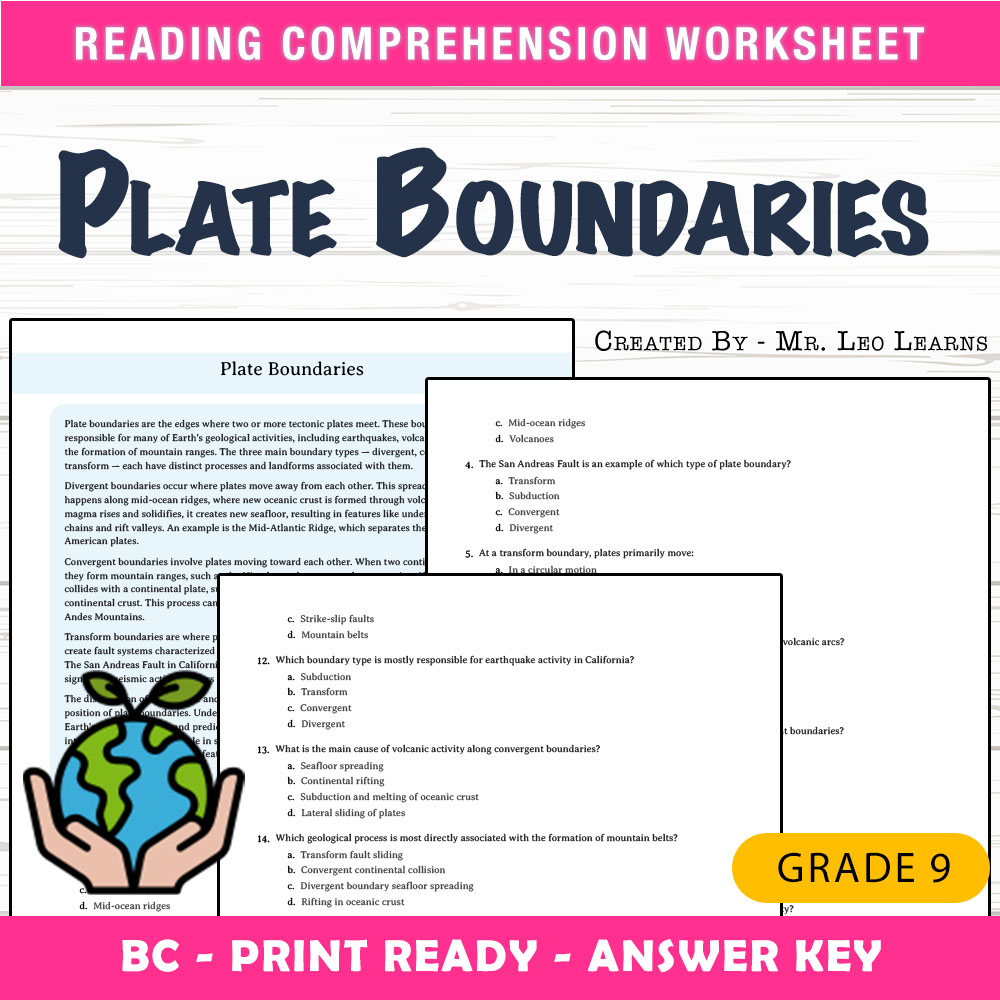
Grade 9 Science — Worksheet MCQ Paper for Mastering Plate Boundaries
Created byThe Resource HubLearning Objectives
- Identify the three main types of plate boundaries and their characteristics.
- Describe landforms and geological processes associated with divergent, convergent, and transform boundaries.
- Explain how boundary types influence regional earthquake and volcano patterns.
Also included in: Grade 9 Science | Earth and Space Systems Unit Worksheet Bundle (BC Framework) +1 more
Instant download

Grade 9 Science – Selection & Fitness Daily Reading Worksheet | NGSSS
Created byBright Mind ResourcesLearning Objectives
- Understand the concept of fitness in biological terms.
- Identify traits that influence an organism's survival in its environment.
- Explain how natural selection acts on heritable traits to shape populations over time.
Also included in: Selection Grade 9 Science Daily Reading Worksheets Lesson Bundle | FL NGSSS +1 more
Instant download

Grade 9 Science | Evidence of Chemical Change - Daily Reading Comprehension
Created byCoral Reef LearningLearning Objectives
- Identify color changes as evidence of chemical reactions.
- Understand observable signs that indicate a chemical change has occurred.
- Recognize real-world examples of chemical change involving color shifts.
Also included in: Matter and Chemical Change Lesson Bundle – Grade 9 Science Alberta +1 more
Instant download

Genetic Transmission Worksheet | Mendelian Genetics Grade 9 AP Science
Created byPrism Point LearningLearning Objectives
- Explain how chromosomal behavior during meiosis connects to Mendelian inheritance patterns.
- Predict genotypic and phenotypic ratios using Punnett frameworks and probability.
- Interpret deviations from simple dominance, including incomplete dominance, codominance, and linkage.
Instant download

Grade 9 Selection and Fitness Worksheet | NGSS Practice PDF
 Created byClear Sky Classroom
Learning Objectives
- Explain how fitness relates to survival and reproduction in a specific environment
- Describe how heritable traits can change in frequency through natural selection
- Analyze how changing environments can make different traits more or less beneficial
Instant download

Grade 9 Molecular Inheritance Worksheet | Practice & Assessment PDF
Created byClear Sky ClassroomLearning Objectives
- Explain how faithful DNA replication supports molecular inheritance through the reduction of point mutations.
- Describe how transcriptional control, RNA processing, and translation connect nucleic acid sequence changes to phenotype.
- Predict how coding-region and regulatory-region mutations can differ in their effects on gene expression and protein function.
Also included in: Grade 9 Biology and Ecosystems Science Lesson Bundle for Advanced Placement (AP) +1 more
Instant download

Grade 9 Science – Force Basics Daily Reading Worksheet | Ontario Standards
Created byBright Mind ResourcesLearning Objectives
- Distinguish between contact and non-contact forces
- Identify real-world examples of each force type
- Understand the concepts of force magnitude, direction, and point of application
Also included in: Grade 9 Work, Energy & Forces Science Daily Reading Lesson Bundle | Ontario +1 more
Instant download

Grade 9 Social Studies | Vegetation and Soils Worksheet (PDF) – Ontario Standards
Created bySunny Desk ResourcesLearning Objectives
- Explain how climate influences vegetation types and soil characteristics in Canadian regions.
- Describe processes of soil formation, including the role of parent material, time, organisms, and water/temperature.
- Analyze how soil degradation and recovery relate to vegetation cover, erosion, and nutrient loss.
Also included in: Grade 9 Climate and Landscapes Social Studies Lesson Bundle for Ontario +1 more
Instant download

Grade 9 | Independence Day Worksheet for Patriotism & Values | PDF + Answer Key
 Created byShaNova Worksheets
Learning Objectives
- Define patriotism as active commitment to shared values, not just celebrations or symbols.
- Analyze how freedom, justice, and community service show up in everyday civic actions.
- Reflect on how democratic citizenship strengthens unity while respecting diverse perspectives.
Instant download
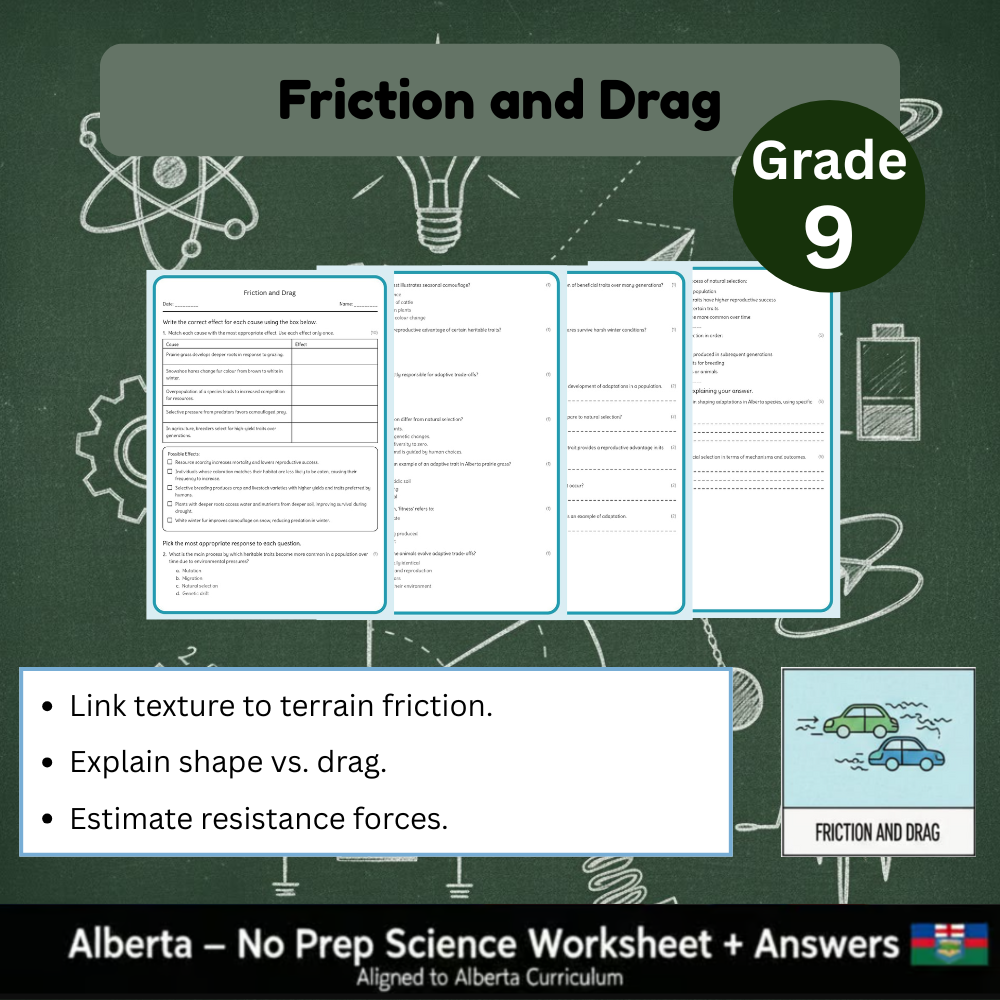
Grade 9 Science – Friction & Drag Concepts (Worksheet + Answer Key) | Alberta Standards
Created byBright Mind ResourcesLearning Objectives
- Explain how surface texture and normal force affect friction on different terrains.
- Describe how air density and shape influence aerodynamic drag on various objects.
- Use coefficients of friction and drag coefficients to estimate resistance forces in different environments.
Instant download
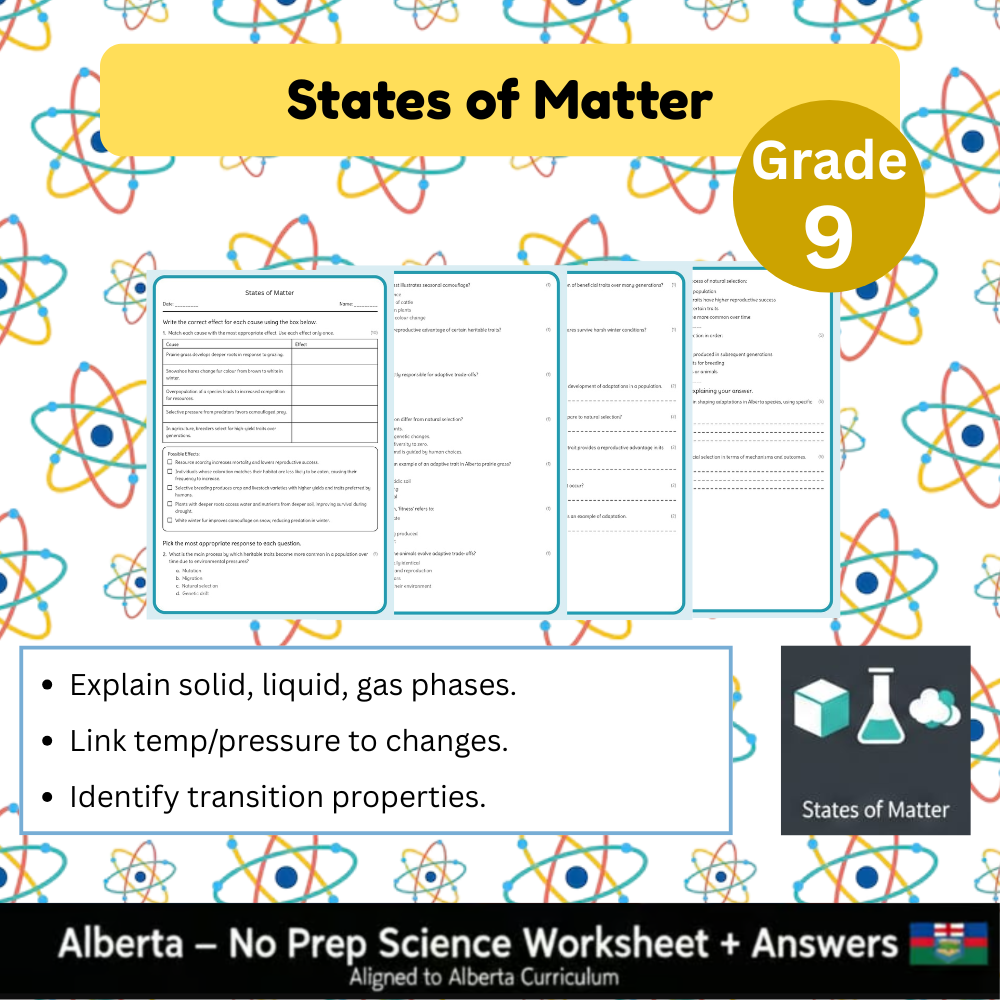
Grade 9 Science | States of Matter Worksheet (PDF) – Alberta Standards
Created byBright Mind ResourcesLearning Objectives
- Explain the different phases of matter: solid, liquid, and gas.
- Describe how temperature and pressure cause changes in state.
- Identify properties of solids, liquids, and gases and how they transition between states.
Instant download
Grade 9 Science | Center Stability Worksheet (Answer Key) – NGSS Aligned
Created byBright Mind ResourcesLearning Objectives
- Understand how to calculate the center of mass for composite systems.
- Apply moments and torque conditions to analyze static equilibrium.
- Assess the stability of objects based on their mass distribution and support base.
Instant download

Grade 9 Holiday | Bastille Day for Mastering Symbols | PDF + Answer Key
Created byShaNova WorksheetsLearning Objectives
- Explain how key French national symbols (the flag and the Marseillaise) connect to Bastille Day and ideas of freedom.
- Analyze how patriotic symbols help build unity and pride during public celebrations.
- Describe how historical meanings of symbols can evolve into contemporary civic traditions.
Instant download

Grade 9 Science Worksheet | Earth System Cycles (PDF) - General Standards
Created byEvergreen Desk EducationLearning Objectives
- Explain how Earth’s water moves through connected reservoirs and processes in the water cycle.
- Describe how carbon shifts among the atmosphere, living things, oceans, and rocks through major processes.
- Connect solar energy and Earth’s radiation balance to weather and long-term temperature patterns.
Also included in: Grade 9 Earth and Space Science Lesson Bundle (General) Science Worksheets +1 more
Instant download

Grade 9 Science | Limiting Factors in Ecosystems - Daily Reading Comprehension
Created byCoral Reef LearningLearning Objectives
- Identify various limiting factors in ecosystems.
- Explain how resource availability influences population size.
- Understand the role of predation, disease, and environmental conditions as limiting factors.
Instant download

Grade 9 Holiday Reflection Worksheet | Reading Comprehension & Responses
 Created byCedar Grove Learning
Learning Objectives
- Analyze how acts of gratitude build stronger relationships in school communities
- Reflect on personal values by identifying meaningful moments of appreciation
- Use grade-appropriate vocabulary related to thanks, respect, and community support in written responses
Also included in: Grade 9 Lesson Bundle: Teacher Appreciation Day | Roles, Educators & Reflection +1 more
Instant download

Grade 9 Science – Feedback Principles in Homeostasis | Daily Reading Worksheet
Created byBright Mind ResourcesLearning Objectives
- Understand the components of feedback loops in biological systems
- Differentiate between negative and positive feedback
- Describe how feedback mechanisms contribute to stability in the body
Also included in: Grade 9 Homeostasis & Body Systems Science Lesson Bundle Daily Reading | TEKS +2 more
Instant download

Grade 9 Science – Physical & Chemical Changes | Daily Reading Worksheet
Created byBright Mind ResourcesLearning Objectives
- Identify examples of physical changes in matter.
- Distinguish between physical and chemical properties.
- Understand the difference between physical and chemical changes.
Also included in: Grade 9 Forces, Energy & Matter Science lesson bundle Florida NGSSS +1 more
Instant download

Grade 9 ELA | Academic Conversation Worksheet (PDF) aligned to CCSS
Created byGolden Apple StudioLearning Objectives
- Use academic conversation stems to build on others’ ideas by referring to evidence and clarifying meaning.
- Identify and apply effective discussion roles (facilitator, questioner, clarifier) to support productive group understanding.
- Evaluate whether a discussion move shows responsiveness, respect, and shared purpose.
Also included in: Grade 9 ELA Full-Year Worksheet Bundle | CCSS Common Core
Instant download
Grade 9 Science | Collision Safety Worksheet with Short Notes (Printable PDF)
Created byMeadowlark WorksheetsLearning Objectives
- Explain how impulse and force-time tradeoffs reduce peak impact forces during collisions.
- Identify materials and design strategies like crumple zones, airbags, and staged deformation that mitigate collision impact.
- Analyze force‑time graphs and impulse considerations to evaluate collision mitigation methods.
Also included in: Grade 9 Science | Motion and Stability Forces & Interactions NGSS UNIT Bundle +1 more
Instant download

Electromagnetic Radiation Worksheet | Grade 9 Science Printable PDF Assessment
Learning Objectives
- Explain the wave and photon descriptions of electromagnetic radiation.
- Relate frequency to photon energy and interactions with matter.
- Identify characteristic phenomena such as atomic emission and absorption lines.
Also included in: Grade 9 Waves and Their Applications in Technologies for Information Transfer Lesson Bundle +1 more
Instant download

Grade 9 Science – Understanding Vectors & Forces | Daily Reading Worksheet
Created byQuiet Forest EducationLearning Objectives
- Define and identify vectors, magnitude, and direction
- Represent forces graphically using vectors
- Resolve forces into components
Also included in: Forces and Energy Grade 9 Science Daily Reading Worksheets Bundle | Ontario +1 more
Instant download

Wave Frequency, Wavelength and Amplitude Worksheets: Grade 9
Created byBRIGHT PATH RESOURCESLearning Objectives
- Explain how wave frequency and wavelength are related to repeating patterns in a signal.
- Describe how amplitude affects the size of a wave disturbance and its associated energy.
- Translate between wave descriptions by using the links among frequency, wavelength, and amplitude.
Also included in: Grade 9 Science Waves, Forces & Energy Transfer Worksheets Bundle +1 more
Instant download

Grade 9 Social Studies | Global Trade Routes Worksheet (TEKS) (PDF)
Created bySunny Desk ResourcesLearning Objectives
- Explain how coastlines, crossroads, and navigable waterways influence the movement of goods and people.
- Evaluate how physical geography can either facilitate or hinder global trade networks.
- Analyze how trade routes shape regional economies and enable cultural exchange.
Also included in: Grade 9 Regional Geography Social Studies Lesson Bundle Worksheets for TEKS +1 more
Instant download

Grade 9 ELA Narrative Style Worksheet (PDF) – Common Core Standards
Created byGolden Apple StudioLearning Objectives
- Identify how point of view shapes tone and meaning in a narrative
- Analyze how dialogue and sensory detail create motivation, conflict, and atmosphere
- Evaluate how time shifts and varied syntax influence an emotional arc
Also included in: Grade 9 Writing Argument & Narrative Lesson Bundle | ELA Common Core +1 more
Instant download

Grade 9 Science | Understanding Atomic Structure - Daily Reading Comprehension
Created byCoral Reef LearningLearning Objectives
- Identify the major subatomic particles in an atom
- Describe the role of protons, neutrons, and electrons
- Explain how atomic structure determines chemical properties
Instant download

Grade 9 Science – Ecosystem Resilience Daily Reading Worksheet + Answer Key
JCreated byJ.S SheetsLearning Objectives
- Define resistance and resilience in ecosystems.
- Describe how ecosystems respond to disturbances.
- Identify factors affecting ecosystem resilience.
Also included in: Grade 9 Science Lesson Bundle: Ecosystems and Ecology Worksheets +1 more
Instant download

Grade 9 Phylogenetic Trees Worksheet | Evolutionary Relationships | NGSS
 Created byAmber Owl Education
Learning Objectives
- Explain how phylogenetic trees represent hypotheses of common descent using shared derived characters and branching order.
- Interpret how morphological data and molecular sequence data can be used to infer relationships.
- Describe how cladistics and tree-building methods (parsimony and distance) differ in their logic.
Also included in: Grade 9 Science Evolution & Speciation Lesson Bundle | NGSS +1 more
Instant download

Grade 9 Science – Understanding the Hydrologic Fluxes Daily Reading Worksheet
Created byBright Mind ResourcesLearning Objectives
- Describe the main components of the water cycle
- Identify how surface and subsurface water flows are measured
- Explain the relationship between precipitation, evapotranspiration, and streamflow
Also included in: Grade 9 Earth Systems Science Daily Reading Worksheets Lesson Bundle | AP +2 more
Instant download

Magnetic Fields Worksheet | Grade 9 Science Activities
Created byPrism Point LearningLearning Objectives
- Explain how magnetic fields are produced by permanent magnets and moving electric charges.
- Use field-line ideas to predict how magnets and currents interact.
- Describe how the direction of current relates to the direction of the magnetic field for simple cases.
Also included in: Electrical Systems & Magnetism Lesson Bundle | Grade 9 Science | Alberta
Instant download

Resource Impacts Worksheet for Grade 9 Science – Standards-Aligned Practice
JCreated byJ.S SheetsLearning Objectives
- Evaluate quantifiable human–Earth interactions affecting water, soil, mineral, and energy resources using indicators such as extraction rates and land-use change metrics.
- Interpret resource trends in the context of natural variability and system thresholds, addressing consequences like subsidence and soil erosion.
- Use comparative datasets and ratio-based measures to assess sustainability implications and connect local resource changes to broader Earth system responses.
Instant download
Browse more categories
About Grade 9 Worksheets
Browse 9,323 printable Grade 9 worksheets across algebra, biology, literature, and history — each a ready-to-print PDF with optional answer keys.
Every worksheet on MyTeachingSheets is created by independent teacher-authors and reviewed before publication. All resources download as printable PDFs for classroom, homework, or at-home practice, and many include answer keys. Preview any worksheet free before buying.